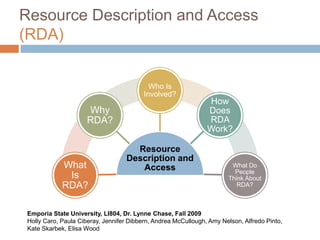
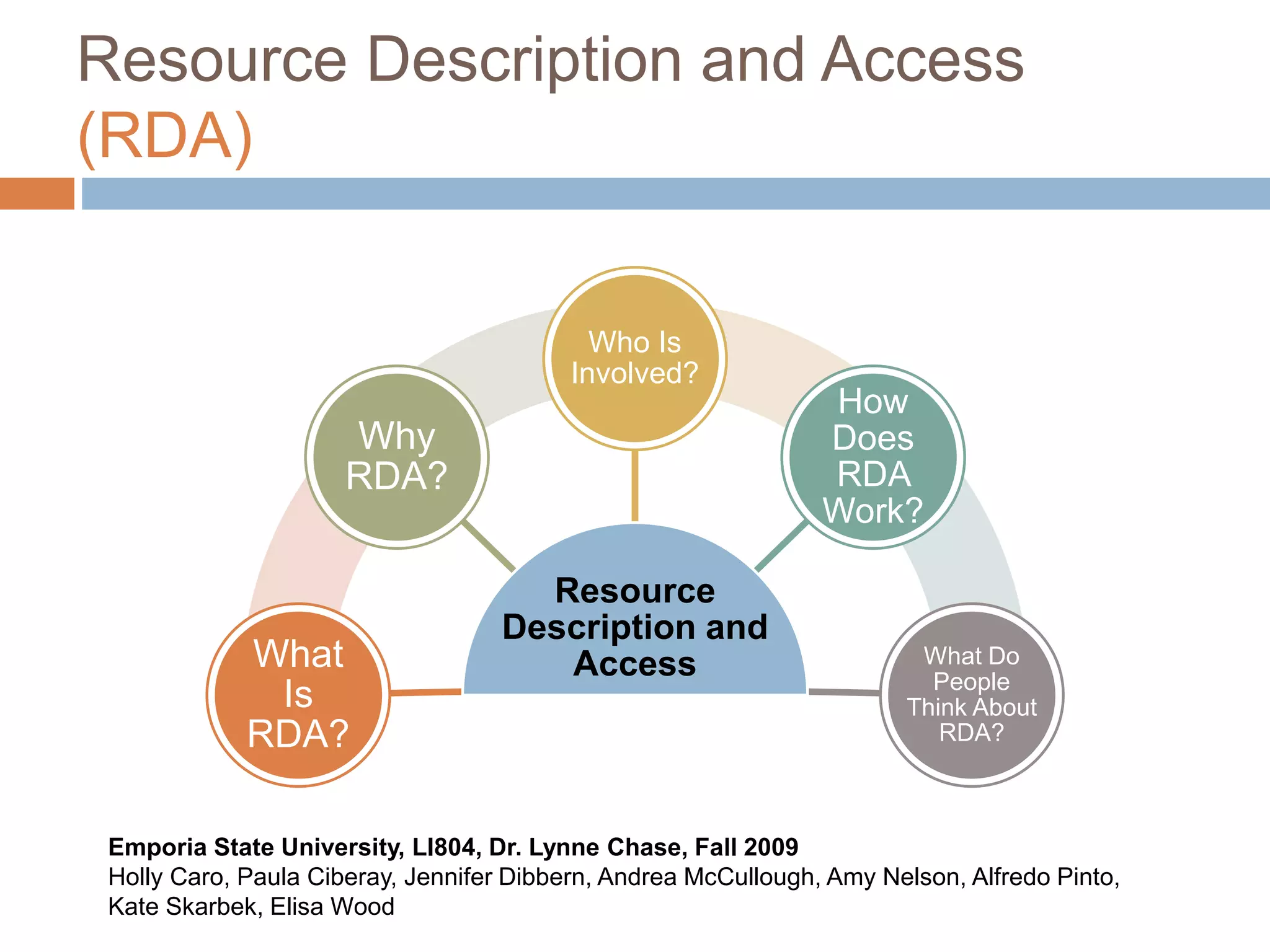
Resource Description and Access
(RDA)
Resource
Description and
AccessWhat
Is
RDA?
Why
RDA?
Who Is
Involved?
How
Does
RDA
Work?
What Do
People
Think About
RDA?
Emporia State University, LI804, Dr. Lynne Chase, Fall 2009
Holly Caro, Paula Ciberay, Jennifer Dibbern, Andrea McCullough, Amy Nelson, Alfredo Pinto,
Kate Skarbek, Elisa Wood
What is Resource Description and
Access (RDA)?
Cataloguing code
Primarily used by libraries
Designed to replace Anglo-American Cataloguing Rules,
2nd Ed (AACR2)
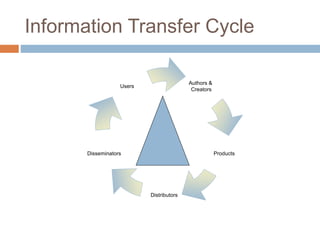
Information Transfer Cycle
Authors &
Creators
Products
Distributors
Disseminators
Users
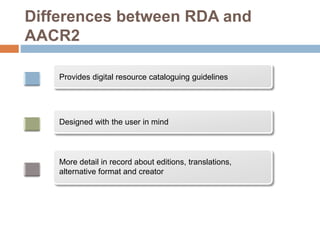
Differences between RDA and
AACR2
Provides digital resource cataloguing guidelines
Designed with the user in mind
More detail in record about editions, translations,
alternative format and creator
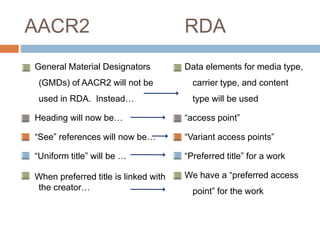
AACR2 RDA
General Material Designators
(GMDs) of AACR2 will not be
used in RDA. Instead…
Heading will now be…
“See” references will now be…
“Uniform title” will be …
When preferred title is linked with
the creator…
Data elements for media type,
carrier type, and content
type will be used
“access point”
“Variant access points”
“Preferred title” for a work
We have a “preferred access
point” for the work
Expanding Bibliographic Universe
“This bibliographic
universe is not just
books, but rather,
many galaxies and
worlds of
content….”
(Tillet, 2008, p. 4)
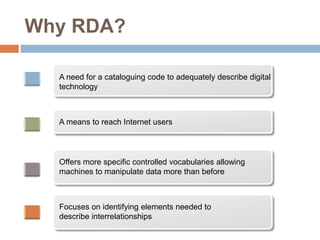
Why RDA?
A need for a cataloguing code to adequately describe digital
technology
A means to reach Internet users
Offers more specific controlled vocabularies allowing
machines to manipulate data more than before
Focuses on identifying elements needed to
describe interrelationships
Who is Involved in the Development
of RDA?
Joint Steering Committee (JSA) for Development of RDA
Canadian Committee on Cataloguing
Close Up on Key Players
LOC Working group on the Future of Bibliographic
Control
Presents findings on bibliographic control and other descriptive
practices
Presents findings on supporting management of and access to
library materials in the evolving information technology
environment
Recommends ways library community can implement these
practices
Advises Library of Congress on its roles and priorities – In 2008,
recommended suspending work on RDA
Close Up on Key Players, cont.
Committee of Principles
RDA Test Coordinating Committee Members
RDA Test Partners- Partners represent institutions that use a
wide range of cataloging systems, OPACS, communication
formats and types of materials.
Museums
Archives
Publishers
Educators
ILS Vendors
Dublin Core
Other semantic web
communities
Who Uses RDA?
Few so far
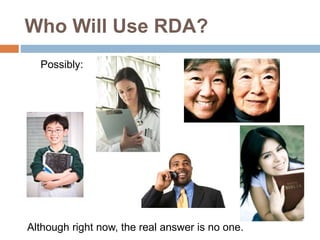
Who Will Use RDA?
Possibly:
Although right now, the real answer is no one.
Potential Users of RDA
Library communities who do not currently use an online
catalogs, databases or bibliographies
Other communities with a need for access to online catalogs,
databases or bibs
Corporations and businesses
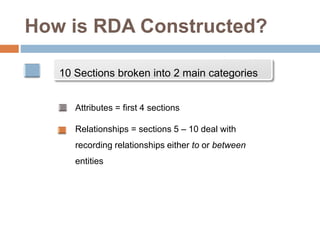
How is RDA Constructed?
10 Sections broken into 2 main categories
Attributes = first 4 sections
Relationships = sections 5 – 10 deal with
recording relationships either to or between
entities
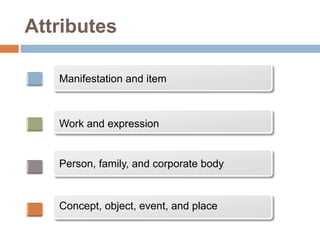
Attributes
Manifestation and item
Work and expression
Person, family, and corporate body
Concept, object, event, and place
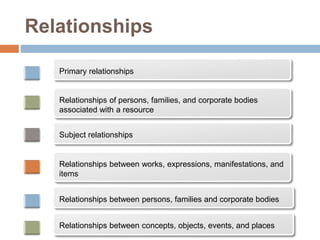
Relationships
Primary relationships
Relationships of persons, families, and corporate bodies
associated with a resource
Subject relationships
Relationships between works, expressions, manifestations, and
items
Relationships between persons, families and corporate bodies
Relationships between concepts, objects, events, and places
What is RDA Based On?
Functional Requirements for Bibliographic
Resources (FRBR)
Functional Requirements for Authority
Data (FRAD)
Functional Requirements for
Bibliographic Resources (FRBR)
An entity-relationship model
Designed to give holistic approach to user retrieval and
access
Reflects an associative, relational organization of information
where the user can expand their search in multiple directions
if they wish
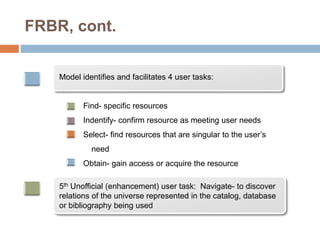
FRBR, cont.
Model identifies and facilitates 4 user tasks:
Find- specific resources
Indentify- confirm resource as meeting user needs
Select- find resources that are singular to the user’s
need
Obtain- gain access or acquire the resource
5th Unofficial (enhancement) user task: Navigate- to discover
relations of the universe represented in the catalog, database
or bibliography being used
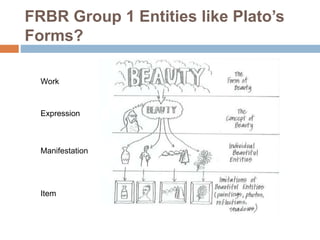
FRBR Group 1 Entities like Plato’s
Forms?
Work
Expression
Manifestation
Item
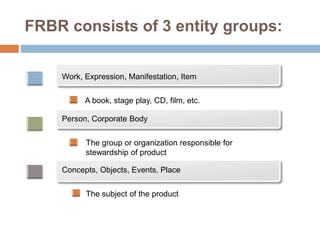
FRBR consists of 3 entity groups:
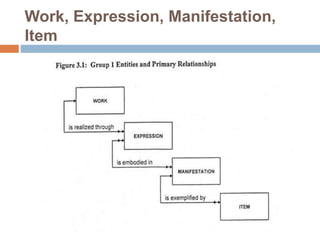
Work, Expression, Manifestation, Item
Person, Corporate Body
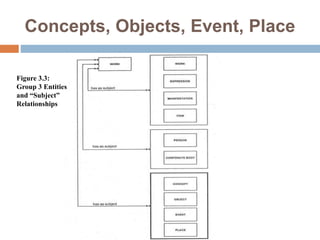
Concepts, Objects, Events, Place
A book, stage play, CD, film, etc.
The group or organization responsible for
stewardship of product
The subject of the product
Work, Expression, Manifestation,
Item
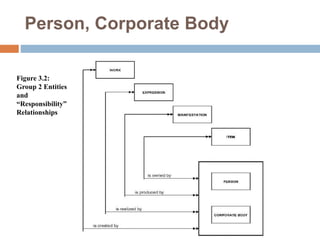
Person, Corporate Body
Figure 3.2:
Group 2 Entities
and
“Responsibility”
Relationships
Concepts, Objects, Event, Place
Figure 3.3:
Group 3 Entities
and “Subject”
Relationships
How FRBR is Used
FictionFinder is an OCLC, FRBR-based
online catalog for over 2.9 fiction records in
WorldCat
Functional Requirements for Authority
Data (FRAD)
An entity-relationship model
User-centered
Model identifies 4 user tasks
Find- same as FRBR
Identify- same as FRBR
Contextualize- to place in context, to clarify relationships
Justify- document why the name was chosen as an access
point
FRAD Functions
Every access point to a work is unique and
allows access to the specific work
Searching under one heading will find
associated records or collections
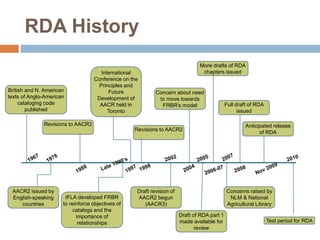
RDA History
British and N. American
texts of Anglo-American
cataloging code
published
AACR2 issued by
English-speaking
countries
Revisions to AACR2
IFLA developed FRBR
to reinforce objectives of
catalogs and the
importance of
relationships
Revisions to AACR2
International
Conference on the
Principles and
Future
Development of
AACR held in
Toronto
Draft revision of
AACR2 begun
(AACR3)
Concern about need
to move towards
FRBR's model
Draft of RDA part 1
made available for
review
More drafts of RDA
chapters issued
Concerns raised by
NLM & National
Agricultural Library
Full draft of RDA
issued
Test period for RDA
Anticipated release
of RDA
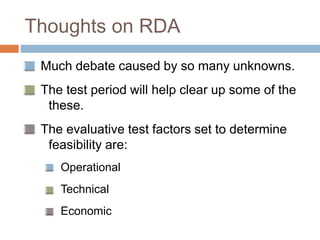
Thoughts on RDA
Much debate caused by so many unknowns.
The test period will help clear up some of the
these.
The evaluative test factors set to determine
feasibility are:
Operational
Technical
Economic
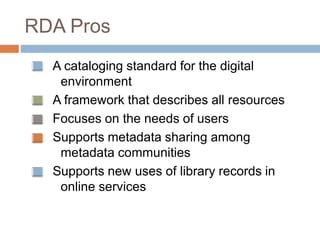
RDA Pros
A cataloging standard for the digital
environment
A framework that describes all resources
Focuses on the needs of users
Supports metadata sharing among
metadata communities
Supports new uses of library records in
online services
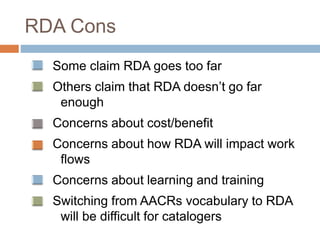
RDA Cons
Some claim RDA goes too far
Others claim that RDA doesn’t go far
enough
Concerns about cost/benefit
Concerns about how RDA will impact work
flows
Concerns about learning and training
Switching from AACRs vocabulary to RDA
will be difficult for catalogers
Further RDA Questions
Will switching from format as top priority to function as
top priority work efficiently in the arrangement of
cataloging rules?
Will the additional information provided by RDA prove
useful to users, will the results be information
overload?
Will ILS systems be compatible with all access points?
Will transitioning to RDA be difficult for the customer;
will it be easily understood?
References
FictionFinder: A FRBR-based prototype for fiction in WorldCat (n.d.). Retrieved September 22,
2009, from http://www.oclc.org/research/projects/frbr/fictionfinder.htm
Hillman, D. (2009, February 2). Denver Midwinter: All RDA, all the time… [Web log message].
Retrieved from http://managemetadata.org/blog/2009/02/02/denver-midwinter-all-rda-all-
the-time
International Federation of Library Associations and Institutions (2009, February). Functional
requirements for bibliographic records (Final Report). Retrieved from
http://www.ifla.org/en/publications/functional-requirements-for-bibliographic-records
Joint Steering Committee for the Development of RDA (2009). Report on RDA. Retrieved from
http://www.rda-jsc.org/index.html
Joint Steering Committee for the Development of RDA (2006). Resource description and
access. Retrieved from http://www.rdaonline.org/
Library of Congress (2008). Joint Statement of the Library of Congress, the National Library of
Medicine, and the National Agricultural Library on Resource Description and Access.
Retrieved from http://www.loc.gov/bibliographic-future/rda/
Library of Congress (2008). On the Record: Report of The Library of Congress Working Group
on the Future of Bibliographic Control. Retrieved from http://www.loc.gov/bibliographic-
future/rda/
References, cont.
Library of Congress (2009). Testing Resource Description and Access. Retrieved from
http://www.loc.gov/bibliographic-future/rda/
Lovins, D. (2008). Cataloging news. Cataloging & Classification Quarterly, 45(4), 101-113.
Patton, G.E. (2009, August). From FRBR to FRAD: Extending the model. Paper presented at the
World Library and Information Congress: 75TH IFLA General Conference and Council, Milan,
Italy. Retrieved from http://www.ifla.org/files/hq/papers/ifla75/215-patton-en.pdf
Taylor, A.G., Joudrey, D.N. (2009) The organization of information. Westport, Connecticut: Libraries
Unlimited.
Tillett, B. (2008). Cataloging principles and RDA: Resource description and access. Retrieved from
http://www.frbr.org/2008/07/16/barbara-tillett-rda-webcasts
Tillett, B. (2008). Resource description and access: Background/overview. Retrieved from
http://www.frbr.org/2008/07/16/barbara-tillett-rda-webcasts
Tillett, B. (2004). What is FRBR? A conceptual model for the bibliographic universe, The Australian
Library Journal, 54 (1). Retrieved October 4, 2009, from
www.worldcat.org/oclc/54962277?tab=details
Vizine-Goetz, D. (2007). Fiction Finder: Imagining a Next Generation Catalog. Retrieved September
22, 2009, from http://www.oclc.org/research/projects/frbr/fictionfinder.htm

RDA Presentation

  • 1.
    Resource Description andAccess (RDA) Resource Description and AccessWhat Is RDA? Why RDA? Who Is Involved? How Does RDA Work? What Do People Think About RDA? Emporia State University, LI804, Dr. Lynne Chase, Fall 2009 Holly Caro, Paula Ciberay, Jennifer Dibbern, Andrea McCullough, Amy Nelson, Alfredo Pinto, Kate Skarbek, Elisa Wood
  • 2.
    What is ResourceDescription and Access (RDA)? Cataloguing code Primarily used by libraries Designed to replace Anglo-American Cataloguing Rules, 2nd Ed (AACR2)
  • 3.
    Information Transfer Cycle Authors& Creators Products Distributors Disseminators Users
  • 4.
    Differences between RDAand AACR2 Provides digital resource cataloguing guidelines Designed with the user in mind More detail in record about editions, translations, alternative format and creator
  • 5.
    AACR2 RDA General MaterialDesignators (GMDs) of AACR2 will not be used in RDA. Instead… Heading will now be… “See” references will now be… “Uniform title” will be … When preferred title is linked with the creator… Data elements for media type, carrier type, and content type will be used “access point” “Variant access points” “Preferred title” for a work We have a “preferred access point” for the work
  • 6.
    Expanding Bibliographic Universe “Thisbibliographic universe is not just books, but rather, many galaxies and worlds of content….” (Tillet, 2008, p. 4)
  • 7.
    Why RDA? A needfor a cataloguing code to adequately describe digital technology A means to reach Internet users Offers more specific controlled vocabularies allowing machines to manipulate data more than before Focuses on identifying elements needed to describe interrelationships
  • 8.
    Who is Involvedin the Development of RDA? Joint Steering Committee (JSA) for Development of RDA Canadian Committee on Cataloguing
  • 9.
    Close Up onKey Players LOC Working group on the Future of Bibliographic Control Presents findings on bibliographic control and other descriptive practices Presents findings on supporting management of and access to library materials in the evolving information technology environment Recommends ways library community can implement these practices Advises Library of Congress on its roles and priorities – In 2008, recommended suspending work on RDA
  • 10.
    Close Up onKey Players, cont. Committee of Principles RDA Test Coordinating Committee Members RDA Test Partners- Partners represent institutions that use a wide range of cataloging systems, OPACS, communication formats and types of materials. Museums Archives Publishers Educators ILS Vendors Dublin Core Other semantic web communities
  • 11.
  • 12.
    Who Will UseRDA? Possibly: Although right now, the real answer is no one.
  • 13.
    Potential Users ofRDA Library communities who do not currently use an online catalogs, databases or bibliographies Other communities with a need for access to online catalogs, databases or bibs Corporations and businesses
  • 14.
    How is RDAConstructed? 10 Sections broken into 2 main categories Attributes = first 4 sections Relationships = sections 5 – 10 deal with recording relationships either to or between entities
  • 15.
    Attributes Manifestation and item Workand expression Person, family, and corporate body Concept, object, event, and place
  • 16.
    Relationships Primary relationships Relationships ofpersons, families, and corporate bodies associated with a resource Subject relationships Relationships between works, expressions, manifestations, and items Relationships between persons, families and corporate bodies Relationships between concepts, objects, events, and places
  • 17.
    What is RDABased On? Functional Requirements for Bibliographic Resources (FRBR) Functional Requirements for Authority Data (FRAD)
  • 18.
    Functional Requirements for BibliographicResources (FRBR) An entity-relationship model Designed to give holistic approach to user retrieval and access Reflects an associative, relational organization of information where the user can expand their search in multiple directions if they wish
  • 19.
    FRBR, cont. Model identifiesand facilitates 4 user tasks: Find- specific resources Indentify- confirm resource as meeting user needs Select- find resources that are singular to the user’s need Obtain- gain access or acquire the resource 5th Unofficial (enhancement) user task: Navigate- to discover relations of the universe represented in the catalog, database or bibliography being used
  • 20.
    FRBR Group 1Entities like Plato’s Forms? Work Expression Manifestation Item
  • 21.
    FRBR consists of3 entity groups: Work, Expression, Manifestation, Item Person, Corporate Body Concepts, Objects, Events, Place A book, stage play, CD, film, etc. The group or organization responsible for stewardship of product The subject of the product
  • 22.
  • 23.
    Person, Corporate Body Figure3.2: Group 2 Entities and “Responsibility” Relationships
  • 24.
    Concepts, Objects, Event,Place Figure 3.3: Group 3 Entities and “Subject” Relationships
  • 25.
    How FRBR isUsed FictionFinder is an OCLC, FRBR-based online catalog for over 2.9 fiction records in WorldCat
  • 26.
    Functional Requirements forAuthority Data (FRAD) An entity-relationship model User-centered Model identifies 4 user tasks Find- same as FRBR Identify- same as FRBR Contextualize- to place in context, to clarify relationships Justify- document why the name was chosen as an access point
  • 27.
    FRAD Functions Every accesspoint to a work is unique and allows access to the specific work Searching under one heading will find associated records or collections
  • 28.
    RDA History British andN. American texts of Anglo-American cataloging code published AACR2 issued by English-speaking countries Revisions to AACR2 IFLA developed FRBR to reinforce objectives of catalogs and the importance of relationships Revisions to AACR2 International Conference on the Principles and Future Development of AACR held in Toronto Draft revision of AACR2 begun (AACR3) Concern about need to move towards FRBR's model Draft of RDA part 1 made available for review More drafts of RDA chapters issued Concerns raised by NLM & National Agricultural Library Full draft of RDA issued Test period for RDA Anticipated release of RDA
  • 29.
    Thoughts on RDA Muchdebate caused by so many unknowns. The test period will help clear up some of the these. The evaluative test factors set to determine feasibility are: Operational Technical Economic
  • 30.
    RDA Pros A catalogingstandard for the digital environment A framework that describes all resources Focuses on the needs of users Supports metadata sharing among metadata communities Supports new uses of library records in online services
  • 31.
    RDA Cons Some claimRDA goes too far Others claim that RDA doesn’t go far enough Concerns about cost/benefit Concerns about how RDA will impact work flows Concerns about learning and training Switching from AACRs vocabulary to RDA will be difficult for catalogers
  • 32.
    Further RDA Questions Willswitching from format as top priority to function as top priority work efficiently in the arrangement of cataloging rules? Will the additional information provided by RDA prove useful to users, will the results be information overload? Will ILS systems be compatible with all access points? Will transitioning to RDA be difficult for the customer; will it be easily understood?
  • 33.
    References FictionFinder: A FRBR-basedprototype for fiction in WorldCat (n.d.). Retrieved September 22, 2009, from http://www.oclc.org/research/projects/frbr/fictionfinder.htm Hillman, D. (2009, February 2). Denver Midwinter: All RDA, all the time… [Web log message]. Retrieved from http://managemetadata.org/blog/2009/02/02/denver-midwinter-all-rda-all- the-time International Federation of Library Associations and Institutions (2009, February). Functional requirements for bibliographic records (Final Report). Retrieved from http://www.ifla.org/en/publications/functional-requirements-for-bibliographic-records Joint Steering Committee for the Development of RDA (2009). Report on RDA. Retrieved from http://www.rda-jsc.org/index.html Joint Steering Committee for the Development of RDA (2006). Resource description and access. Retrieved from http://www.rdaonline.org/ Library of Congress (2008). Joint Statement of the Library of Congress, the National Library of Medicine, and the National Agricultural Library on Resource Description and Access. Retrieved from http://www.loc.gov/bibliographic-future/rda/ Library of Congress (2008). On the Record: Report of The Library of Congress Working Group on the Future of Bibliographic Control. Retrieved from http://www.loc.gov/bibliographic- future/rda/
  • 34.
    References, cont. Library ofCongress (2009). Testing Resource Description and Access. Retrieved from http://www.loc.gov/bibliographic-future/rda/ Lovins, D. (2008). Cataloging news. Cataloging & Classification Quarterly, 45(4), 101-113. Patton, G.E. (2009, August). From FRBR to FRAD: Extending the model. Paper presented at the World Library and Information Congress: 75TH IFLA General Conference and Council, Milan, Italy. Retrieved from http://www.ifla.org/files/hq/papers/ifla75/215-patton-en.pdf Taylor, A.G., Joudrey, D.N. (2009) The organization of information. Westport, Connecticut: Libraries Unlimited. Tillett, B. (2008). Cataloging principles and RDA: Resource description and access. Retrieved from http://www.frbr.org/2008/07/16/barbara-tillett-rda-webcasts Tillett, B. (2008). Resource description and access: Background/overview. Retrieved from http://www.frbr.org/2008/07/16/barbara-tillett-rda-webcasts Tillett, B. (2004). What is FRBR? A conceptual model for the bibliographic universe, The Australian Library Journal, 54 (1). Retrieved October 4, 2009, from www.worldcat.org/oclc/54962277?tab=details Vizine-Goetz, D. (2007). Fiction Finder: Imagining a Next Generation Catalog. Retrieved September 22, 2009, from http://www.oclc.org/research/projects/frbr/fictionfinder.htm

Editor's Notes