RDA Bootcamp
Vermont Library Conference
May 21, 2013
Presenters
Tom McMurdo
Collections & Digital Initiatives Librarian, VTLib
Helen Linda
Systems & Technical Services Librarian, Goddard College
Amber Billey
Catalog/Metadata Librarian, University of Vermont
Christine Webb
Cataloger & Reference Librarian, Fletcher Free Library
Agenda
Introduction to RDA
● What is it?
● Why is it?
The Very Basics of RDA
● Bibliographic Description
● Access Points
Implementing RDA
● It's all in progress
● System & policy prep
Introduction to RDA
What are we talking about today?
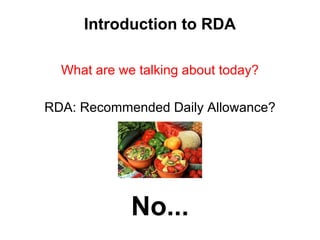
RDA: Recommended Daily Allowance?
No...
Introduction to RDA
I have heard:
RDA: Retirement Day Approaching?
Not that...
Introduction to RDA
RDA: Real Diaper Association?
(And, yes, there is a Real Diaper Association.)
Definitely not...
Introduction to RDA
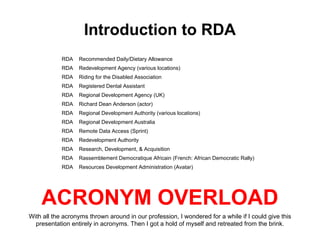
RDA Recommended Daily/Dietary Allowance
RDA Redevelopment Agency (various locations)
RDA Riding for the Disabled Association
RDA Registered Dental Assistant
RDA Regional Development Agency (UK)
RDA Richard Dean Anderson (actor)
RDA Regional Development Authority (various locations)
RDA Regional Development Australia
RDA Remote Data Access (Sprint)
RDA Redevelopment Authority
RDA Research, Development, & Acquisition
RDA Rassemblement Democratique Africain (French: African Democratic Rally)
RDA Resources Development Administration (Avatar)
ACRONYM OVERLOAD
With all the acronyms thrown around in our profession, I wondered for a while if I could give this
presentation entirely in acronyms. Then I got a hold of myself and retreated from the brink.
Introduction to RDA
RDA: Resource Description and Access
Introduction to RDA
In the late 1990s, talks began about updating
AACR2. RDA emerged from these discussions.
On March 31, 2013, the Library of Congress
officially adopted RDA as their bibliographic
cataloging standard.
Introduction to RDA
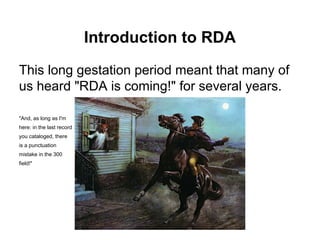
This long gestation period meant that many of
us heard "RDA is coming!" for several years.
"And, as long as I'm
here: in the last record
you cataloged, there
is a punctuation
mistake in the 300
field!"
Introduction to RDA
Because we heard "RDA is coming" for so long,
I think it caused undue anxiety and made the
changes with RDA overblown.
RDA does make changes to the way we
catalog things. Most of these are welcome
adjustments that put more power in the hands
of the cataloger. But, in a day-to-day sense,
RDA doesn't radically change what we do.
Introduction to RDA
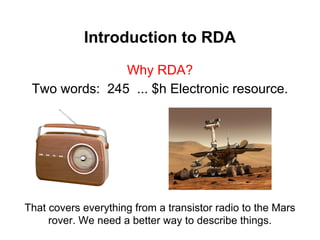
Why RDA?
Two words: 245 ... $h Electronic resource.
That covers everything from a transistor radio to the Mars
rover. We need a better way to describe things.
FRBR - The Foundation of RDA
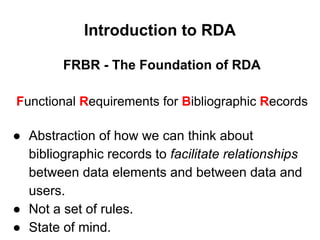
Functional Requirements for Bibliographic Records
● Abstraction of how we can think about
bibliographic records to facilitate relationships
between data elements and between data and
users.
● Not a set of rules.
● State of mind.
Introduction to RDA
Introduction to RDA
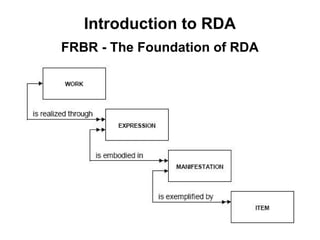
FRBR - The Foundation of RDA
Introduction to RDA
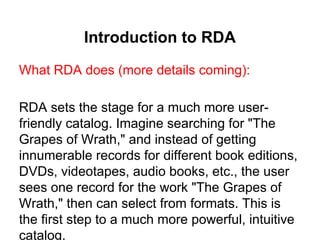
What RDA does (more details coming):
RDA sets the stage for a much more user-
friendly catalog. Imagine searching for "The
Grapes of Wrath," and instead of getting
innumerable records for different book editions,
DVDs, videotapes, audio books, etc., the user
sees one record for the work "The Grapes of
Wrath," then can select from formats. This is
the first step to a much more powerful, intuitive
catalog.
Introduction to RDA
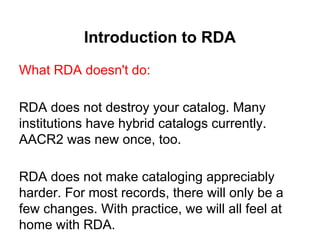
What RDA doesn't do:
RDA does not destroy your catalog. Many
institutions have hybrid catalogs currently.
AACR2 was new once, too.
RDA does not make cataloging appreciably
harder. For most records, there will only be a
few changes. With practice, we will all feel at
home with RDA.
Introduction to RDA
What RDA doesn't do:
By simply scanning the ISBN or entering a title
and publication date, RDA does not
automatically generate a catalog record by
crawling the web and pulling in linked data...
yet.
That is still coming.
And, don't worry, catalogs will always need
Introduction to RDA
To briefly summarize:
RDA gives us a better way to describe things in
plain English.
RDA puts more power in the hands of the
cataloger.
RDA is a small change.
RDA has a lot of future potential.
The Very Basics of RDA - Description
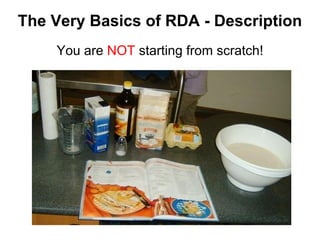
You are NOT starting from scratch!
Practically speaking RDA is like AACRII, but it...
● Removes the constraints of cataloging for
index cards.
● Is format & encoding standard neutral.
● Adds potential for catalog records to work with
theories like FRBR and developing
technologies like linked data.
The Very Basics of RDA - Description
We're nearly there already!
The Very Basics of RDA - Description
If you get nothing else out of today, remember this:
TAKE WHAT YOU SEE
ACCEPT WHAT YOU GET
The Very Basics of RDA - Description
Take What You See & Accept What You Get
applies to everything...really!
Cataloger's Judgement as you always imagined it!
● Capitalization
● Abbreviation
● Typos
● Chief Sources of Information
● Publication Info
● Description
● Supporting Resources
● EVERYTHING
The Very Basics of RDA - Description
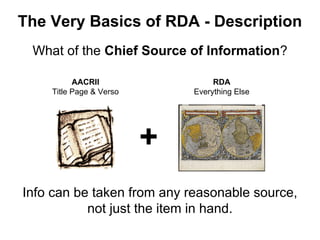
What of the Chief Source of Information?
Info can be taken from any reasonable source,
not just the item in hand.
AACRII
Title Page & Verso
+
RDA
Everything Else
The Very Basics of RDA - Description
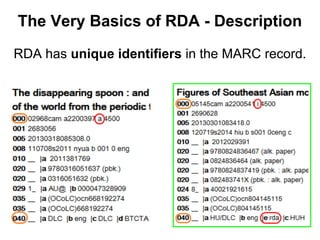
RDA has unique identifiers in the MARC record.
The Very Basics of RDA - Description
Transcribe
what you see:
No more latin,
[sic] corrections,
punctuation
uniformity, and
only small
number of
commonly
recognized
abbreviations.
Differences in
the Public
Catalog
New RDA
Content, Media,
& Carrier
elements
replace General
Material
Designation
[GMD]
The Very Basics of RDA - Description
Differences in
the MARC
Record
New RDA
Content, Media,
& Carrier
elements
replace General
Material
Designation
[GMD]
The Very Basics of RDA - Description
What's the difference?
GMD
22 Terms
[art original] [microscope slides]
[art reproduction] [model]
[chart] [motion picture]
[diorama] [picture]
[electronic resource] [realia]
[filmstrip] [slide]
[flash card] [sound recording]
[game] [technical drawing]
[graphic] [toy]
[kit] [transparency]
[microform] [videorecording]
RDA ELEMENTS
90 Terms
RDA Content
25 terms
RDA Media
10 terms
RDA Carrier
9 Groupings
Audio - 8 terms
Computer - 9 terms
Microform - 10 terms
Microscopic - 2 terms
Projected Image - 10 terms
Stereographic - 3 terms
Unmediated - 7 terms
Video - 5 terms
Unspecified - 1 term
The Very Basics of RDA - Description
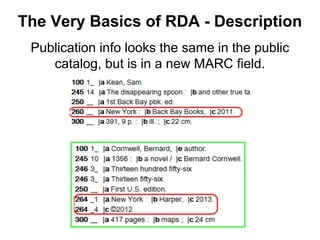
Publication info looks the same in the public
catalog, but is in a new MARC field.
260 $a [S.l. : $b s.n., $c 1999].
264 _1$a [Place of publication not identified] :
$b [publisher not identified], $c [1999].
Brackets in publication information - now
enclose individual pieces of information.
The Very Basics of RDA - Description
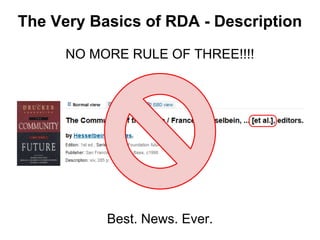
NO MORE RULE OF THREE!!!!
Best. News. Ever.
NEW AUTHORITY CONTROL
● Not called headings anymore...access points
● Goals
○ Provide more contextual information
○ Commonly used terms
○ No abbreviations
○ Include families
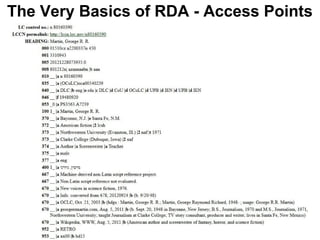
The Very Basics of RDA - Access Points
Names and Subjects
● No more abbreviations!
● Titles and terms with surnames
● Vermont. Department of Libraries.
● Bible. Old Testament.
● Williams, Hank, Jr., 1949-
The Very Basics of RDA - Access Points
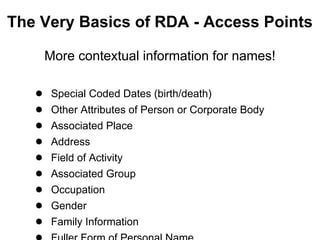
More contextual information for names!
● Special Coded Dates (birth/death)
● Other Attributes of Person or Corporate Body
● Associated Place
● Address
● Field of Activity
● Associated Group
● Occupation
● Gender
● Family Information
The Very Basics of RDA - Access Points
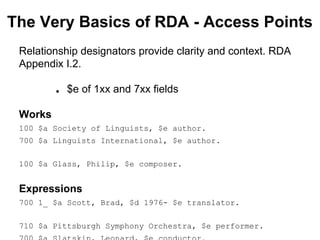
Relationship designators provide clarity and context. RDA
Appendix I.2.
■ $e of 1xx and 7xx fields
Works
100 $a Society of Linguists, $e author.
700 $a Linguists International, $e author.
100 $a Glass, Philip, $e composer.
Expressions
700 1_ $a Scott, Brad, $d 1976- $e translator.
710 $a Pittsburgh Symphony Orchestra, $e performer.
The Very Basics of RDA - Access Points
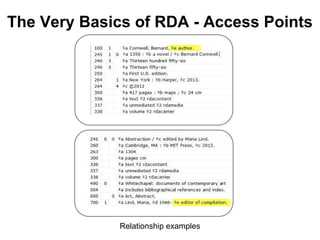
Relationship examples
The Very Basics of RDA - Access Points
Implementing RDA in Your Catalog
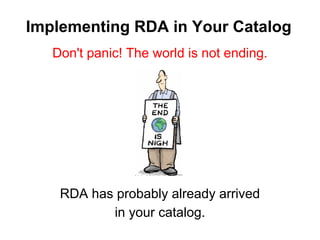
Don't panic! The world is not ending.
RDA has probably already arrived
in your catalog.
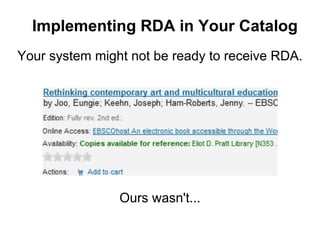
Your system might not be ready to receive RDA.
Ours wasn't...
Implementing RDA in Your Catalog
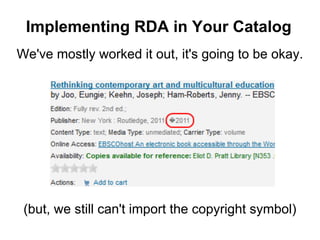
(but, we still can't import the copyright symbol)
We've mostly worked it out, it's going to be okay.
Implementing RDA in Your Catalog
Determine if your system is ready for RDA
Does your ILS have the most recent MARC
format update that includes RDA elements?
Do policies exist for 264, 33X and other RDA
elements?
Can you edit the elements?
Find out how your system gets information to
help patrons pick between the book, DVD, book
on CD, downloadable audiobook, etc.
Implementing RDA in Your Catalog
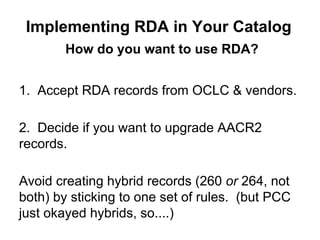
How do you want to use RDA?
1. Accept RDA records from OCLC & vendors.
2. Decide if you want to upgrade AACR2
records.
Avoid creating hybrid records (260 or 264, not
both) by sticking to one set of rules. (but PCC
just okayed hybrids, so....)
Implementing RDA in Your Catalog
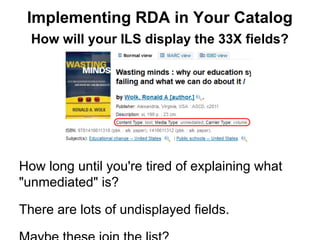
How will your ILS display the 33X fields?
How long until you're tired of explaining what
"unmediated" is?
There are lots of undisplayed fields.
Implementing RDA in Your Catalog
EXPERTS
There are none!
Mistakes will be
made, practices
will change.
Flexibility is the
order of the day!
Implementing RDA in Your Catalog
Resources
The Technical Services Section of VLA
(formerly Cataloging Roundtable) is compiling
ALL of the best resources for learning RDA.
http://vtcat.wordpress.com/resources/rda/
Implementing RDA in Your Catalog
Thank you!
Any questions?

RDA Bootcamp

  • 1.
    RDA Bootcamp Vermont LibraryConference May 21, 2013
  • 2.
    Presenters Tom McMurdo Collections &Digital Initiatives Librarian, VTLib Helen Linda Systems & Technical Services Librarian, Goddard College Amber Billey Catalog/Metadata Librarian, University of Vermont Christine Webb Cataloger & Reference Librarian, Fletcher Free Library
  • 3.
    Agenda Introduction to RDA ●What is it? ● Why is it? The Very Basics of RDA ● Bibliographic Description ● Access Points Implementing RDA ● It's all in progress ● System & policy prep
  • 4.
    Introduction to RDA Whatare we talking about today? RDA: Recommended Daily Allowance? No...
  • 5.
    Introduction to RDA Ihave heard: RDA: Retirement Day Approaching? Not that...
  • 6.
    Introduction to RDA RDA:Real Diaper Association? (And, yes, there is a Real Diaper Association.) Definitely not...
  • 7.
    Introduction to RDA RDARecommended Daily/Dietary Allowance RDA Redevelopment Agency (various locations) RDA Riding for the Disabled Association RDA Registered Dental Assistant RDA Regional Development Agency (UK) RDA Richard Dean Anderson (actor) RDA Regional Development Authority (various locations) RDA Regional Development Australia RDA Remote Data Access (Sprint) RDA Redevelopment Authority RDA Research, Development, & Acquisition RDA Rassemblement Democratique Africain (French: African Democratic Rally) RDA Resources Development Administration (Avatar) ACRONYM OVERLOAD With all the acronyms thrown around in our profession, I wondered for a while if I could give this presentation entirely in acronyms. Then I got a hold of myself and retreated from the brink.
  • 8.
    Introduction to RDA RDA:Resource Description and Access
  • 9.
    Introduction to RDA Inthe late 1990s, talks began about updating AACR2. RDA emerged from these discussions. On March 31, 2013, the Library of Congress officially adopted RDA as their bibliographic cataloging standard.
  • 10.
    Introduction to RDA Thislong gestation period meant that many of us heard "RDA is coming!" for several years. "And, as long as I'm here: in the last record you cataloged, there is a punctuation mistake in the 300 field!"
  • 11.
    Introduction to RDA Becausewe heard "RDA is coming" for so long, I think it caused undue anxiety and made the changes with RDA overblown. RDA does make changes to the way we catalog things. Most of these are welcome adjustments that put more power in the hands of the cataloger. But, in a day-to-day sense, RDA doesn't radically change what we do.
  • 12.
    Introduction to RDA WhyRDA? Two words: 245 ... $h Electronic resource. That covers everything from a transistor radio to the Mars rover. We need a better way to describe things.
  • 13.
    FRBR - TheFoundation of RDA Functional Requirements for Bibliographic Records ● Abstraction of how we can think about bibliographic records to facilitate relationships between data elements and between data and users. ● Not a set of rules. ● State of mind. Introduction to RDA
  • 14.
    Introduction to RDA FRBR- The Foundation of RDA
  • 15.
    Introduction to RDA WhatRDA does (more details coming): RDA sets the stage for a much more user- friendly catalog. Imagine searching for "The Grapes of Wrath," and instead of getting innumerable records for different book editions, DVDs, videotapes, audio books, etc., the user sees one record for the work "The Grapes of Wrath," then can select from formats. This is the first step to a much more powerful, intuitive catalog.
  • 16.
    Introduction to RDA WhatRDA doesn't do: RDA does not destroy your catalog. Many institutions have hybrid catalogs currently. AACR2 was new once, too. RDA does not make cataloging appreciably harder. For most records, there will only be a few changes. With practice, we will all feel at home with RDA.
  • 17.
    Introduction to RDA WhatRDA doesn't do: By simply scanning the ISBN or entering a title and publication date, RDA does not automatically generate a catalog record by crawling the web and pulling in linked data... yet. That is still coming. And, don't worry, catalogs will always need
  • 18.
    Introduction to RDA Tobriefly summarize: RDA gives us a better way to describe things in plain English. RDA puts more power in the hands of the cataloger. RDA is a small change. RDA has a lot of future potential.
  • 19.
    The Very Basicsof RDA - Description You are NOT starting from scratch!
  • 20.
    Practically speaking RDAis like AACRII, but it... ● Removes the constraints of cataloging for index cards. ● Is format & encoding standard neutral. ● Adds potential for catalog records to work with theories like FRBR and developing technologies like linked data. The Very Basics of RDA - Description
  • 21.
    We're nearly therealready! The Very Basics of RDA - Description
  • 22.
    The Very Basicsof RDA - Description If you get nothing else out of today, remember this: TAKE WHAT YOU SEE ACCEPT WHAT YOU GET
  • 23.
    The Very Basicsof RDA - Description Take What You See & Accept What You Get applies to everything...really! Cataloger's Judgement as you always imagined it! ● Capitalization ● Abbreviation ● Typos ● Chief Sources of Information ● Publication Info ● Description ● Supporting Resources ● EVERYTHING
  • 24.
    The Very Basicsof RDA - Description What of the Chief Source of Information? Info can be taken from any reasonable source, not just the item in hand. AACRII Title Page & Verso + RDA Everything Else
  • 25.
    The Very Basicsof RDA - Description RDA has unique identifiers in the MARC record.
  • 26.
    The Very Basicsof RDA - Description Transcribe what you see: No more latin, [sic] corrections, punctuation uniformity, and only small number of commonly recognized abbreviations.
  • 27.
    Differences in the Public Catalog NewRDA Content, Media, & Carrier elements replace General Material Designation [GMD] The Very Basics of RDA - Description
  • 28.
    The Very Basicsof RDA - Description Differences in the MARC Record New RDA Content, Media, & Carrier elements replace General Material Designation [GMD]
  • 29.
    The Very Basicsof RDA - Description What's the difference? GMD 22 Terms [art original] [microscope slides] [art reproduction] [model] [chart] [motion picture] [diorama] [picture] [electronic resource] [realia] [filmstrip] [slide] [flash card] [sound recording] [game] [technical drawing] [graphic] [toy] [kit] [transparency] [microform] [videorecording] RDA ELEMENTS 90 Terms RDA Content 25 terms RDA Media 10 terms RDA Carrier 9 Groupings Audio - 8 terms Computer - 9 terms Microform - 10 terms Microscopic - 2 terms Projected Image - 10 terms Stereographic - 3 terms Unmediated - 7 terms Video - 5 terms Unspecified - 1 term
  • 30.
    The Very Basicsof RDA - Description Publication info looks the same in the public catalog, but is in a new MARC field.
  • 31.
    260 $a [S.l.: $b s.n., $c 1999]. 264 _1$a [Place of publication not identified] : $b [publisher not identified], $c [1999]. Brackets in publication information - now enclose individual pieces of information. The Very Basics of RDA - Description
  • 32.
    The Very Basicsof RDA - Description NO MORE RULE OF THREE!!!! Best. News. Ever.
  • 33.
  • 34.
    ● Not calledheadings anymore...access points ● Goals ○ Provide more contextual information ○ Commonly used terms ○ No abbreviations ○ Include families The Very Basics of RDA - Access Points
  • 35.
    Names and Subjects ●No more abbreviations! ● Titles and terms with surnames ● Vermont. Department of Libraries. ● Bible. Old Testament. ● Williams, Hank, Jr., 1949- The Very Basics of RDA - Access Points
  • 36.
    More contextual informationfor names! ● Special Coded Dates (birth/death) ● Other Attributes of Person or Corporate Body ● Associated Place ● Address ● Field of Activity ● Associated Group ● Occupation ● Gender ● Family Information The Very Basics of RDA - Access Points
  • 37.
    The Very Basicsof RDA - Access Points
  • 38.
    Relationship designators provideclarity and context. RDA Appendix I.2. ■ $e of 1xx and 7xx fields Works 100 $a Society of Linguists, $e author. 700 $a Linguists International, $e author. 100 $a Glass, Philip, $e composer. Expressions 700 1_ $a Scott, Brad, $d 1976- $e translator. 710 $a Pittsburgh Symphony Orchestra, $e performer. The Very Basics of RDA - Access Points
  • 39.
    Relationship examples The VeryBasics of RDA - Access Points
  • 40.
    Implementing RDA inYour Catalog Don't panic! The world is not ending. RDA has probably already arrived in your catalog.
  • 41.
    Your system mightnot be ready to receive RDA. Ours wasn't... Implementing RDA in Your Catalog
  • 42.
    (but, we stillcan't import the copyright symbol) We've mostly worked it out, it's going to be okay. Implementing RDA in Your Catalog
  • 43.
    Determine if yoursystem is ready for RDA Does your ILS have the most recent MARC format update that includes RDA elements? Do policies exist for 264, 33X and other RDA elements? Can you edit the elements? Find out how your system gets information to help patrons pick between the book, DVD, book on CD, downloadable audiobook, etc. Implementing RDA in Your Catalog
  • 44.
    How do youwant to use RDA? 1. Accept RDA records from OCLC & vendors. 2. Decide if you want to upgrade AACR2 records. Avoid creating hybrid records (260 or 264, not both) by sticking to one set of rules. (but PCC just okayed hybrids, so....) Implementing RDA in Your Catalog
  • 45.
    How will yourILS display the 33X fields? How long until you're tired of explaining what "unmediated" is? There are lots of undisplayed fields. Implementing RDA in Your Catalog
  • 46.
    EXPERTS There are none! Mistakeswill be made, practices will change. Flexibility is the order of the day! Implementing RDA in Your Catalog
  • 47.
    Resources The Technical ServicesSection of VLA (formerly Cataloging Roundtable) is compiling ALL of the best resources for learning RDA. http://vtcat.wordpress.com/resources/rda/ Implementing RDA in Your Catalog
  • 48.