Blogs for all reasons  Ann Chapman UKOLN University of Bath Bath, UK UKOLN is supported by: This work is licensed under a Attribution-NonCommercial-ShareAlike 2.0 licence (but note caveat) About this talk  Looks at three blogs, explaining the different audiences, aims and approaches used.  Twitter: http://twitter.com/ukolnculture/  Email: [email_address] Resources bookmarked using ‘ili2010-workshop'  tag
Three Case Studies How blogs differ Aims Audience and ‘tone or flavour’ Set-up and Effort What happened? The case studies CILIP Catalogue & Indexing Group (CIG) blog UKOLN Cultural Heritage blog JISC SIS Landscape Study blog
CIG blog - Aims What we wanted to do Communicate with group members News items (CIG and wider) Publicise our events Publicise our e-journal Invite people to write book reviews Start up discussions
CIG blog – Set-up  Timeline Jan 2007 Set up on Blogspot By ‘activist’ committee member Posting rights – 4 officers and the ‘activist’ Spring 2007 Move content to CILIP Web site blogging facility Posting rights – all committee members Comments – anyone (moderated) 2009 Write blog policy and add to blog
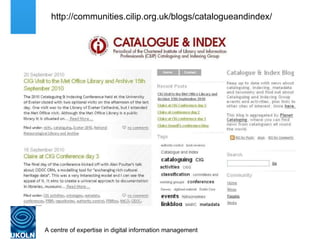
http://communities.cilip.org.uk/blogs/catalogueandindex/
CIG blog - Effort A mixed bag Admin by CILIP Web team (e.g. they change who has posting rights) CIG blog manager (spam, comments, reminders to post) CIG Committee (16 to 20 people) – all able to post CIG members – can comment but not post
CIG blog – Review Frequency of posts Too erratic / too few – viewings drop No set schedule – need to monitor New features Meet the Committee - once a month, everyone takes a turn Blogging from the residential conference Discussion Attempts to start discussion not successful Viewing figures (from CILIP) Can’t tell who is viewing (CIG member or others) Not increasing visit / event uptake (feedback)
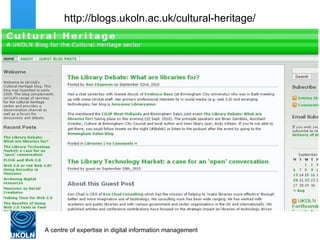
Cultural Heritage blog - Aims What we set out to do Complement other sections of the UKOLN Cultural Heritage Web site Dissemination Forum for discussion and debate Focus on Web 2.0 and Social Web Cross sector appeal – libraries, museums and archives
Cultural Heritage blog – Set-up Timeline Jan 2009 News items Mostly by UKOLN staff Occasional guest posts April 2010 New focus on community input More guest posts – on Web 2.0 experiences Interspersed with UKOLN posts Twitterfeed to Twitter (set up accounts)
http://blogs.ukoln.ac.uk/cultural-heritage/
Cultural  Heritage blog - Effort Initially (Jan 2009) 3 members UKOLN staff Each focus on an area 1 member as Manager  Now (from April 2010) 1 member UKOLN staff Write some posts Sign up guest post writers Deal with comments and spam Guest post writers
Cultural Heritage blog - Review Guest posts Take time (contact, reminder, images, set-up) Long posts – split into two or more parts Mix of first timers and old hands Generates interest (guests tweet about post) Scheduling publication (keeping some in hand) UKOLN posts Was – challenge of finding suitable topics on regular basis Now – fit these in between guest posts
JISC SIS Study blog - Aims What JISC required Project Web presence – minimum 3 years Final report Project requirements Collect data 6 month timescale – too short for usual survey methods Contact specific group – Web 2.0 users Make data available to community throughout project
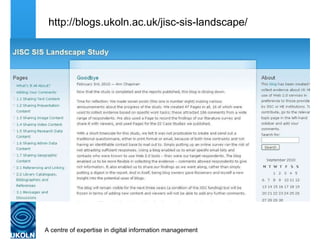
JISC SIS Study blog – Set-up The approach Blog posts – limited to progress ‘reports’ Pages ‘ About’ and ‘Adding Comments’ guide Data collection Page per topic (16) Intro text by UKOLN to initiate feedback Comments submitted (186) = raw data Case studies (22 completed) Literature review Shared with participants (and observers) Added items as we found them
http://blogs.ukoln.ac.uk/jisc-sis-landscape/
JISC SIS Study blog – Effort UKOLN Project leader and project researcher Rsearch method – so time allocated Blog set-up Create Pages within blog to collect data Find and work with case study subjects Plan and implement close down Participants People posting comments Case study subjects
JISC SIS Study blog – Review During the project Promotion to target audience difficult Email lists – generated little feedback Personal contacts – best approach Amazon voucher draw – suspect little impact Data collected Relevant and useful Used in final report After the project ended Closing down posts What happens when 3 years is up? Archiving – UKOLN or JISC?
Key points Questions first Who is the audience? What is the aim? Then plan, plan and plan some more Identify effort Solo or team? Guest posts? What happens if people leave or move jobs? Decide Comments: allow? moderate? Scope Attribution (quotes, images, etc.) Using twitter and twitterfeed Write a Blog policy Close down – identify when and why
Questions Any questions? Name : Ann Chapman  Address : UKOLN, University of Bath, BATH, UK Email : a.d.chapman@ukoln.ac.uk Web site : http://www.ukoln.ac.uk/ Blog :  http://blogs.ukoln.ac.uk/cultural-heritage/ http://www.ukoln.ac.uk/cultural-heritage/events/ili-2010-workshop/

Blogs for all reasons

  • 1.
    Blogs for allreasons Ann Chapman UKOLN University of Bath Bath, UK UKOLN is supported by: This work is licensed under a Attribution-NonCommercial-ShareAlike 2.0 licence (but note caveat) About this talk Looks at three blogs, explaining the different audiences, aims and approaches used. Twitter: http://twitter.com/ukolnculture/ Email: [email_address] Resources bookmarked using ‘ili2010-workshop' tag
  • 2.
    Three Case StudiesHow blogs differ Aims Audience and ‘tone or flavour’ Set-up and Effort What happened? The case studies CILIP Catalogue & Indexing Group (CIG) blog UKOLN Cultural Heritage blog JISC SIS Landscape Study blog
  • 3.
    CIG blog -Aims What we wanted to do Communicate with group members News items (CIG and wider) Publicise our events Publicise our e-journal Invite people to write book reviews Start up discussions
  • 4.
    CIG blog –Set-up Timeline Jan 2007 Set up on Blogspot By ‘activist’ committee member Posting rights – 4 officers and the ‘activist’ Spring 2007 Move content to CILIP Web site blogging facility Posting rights – all committee members Comments – anyone (moderated) 2009 Write blog policy and add to blog
  • 5.
  • 6.
    CIG blog -Effort A mixed bag Admin by CILIP Web team (e.g. they change who has posting rights) CIG blog manager (spam, comments, reminders to post) CIG Committee (16 to 20 people) – all able to post CIG members – can comment but not post
  • 7.
    CIG blog –Review Frequency of posts Too erratic / too few – viewings drop No set schedule – need to monitor New features Meet the Committee - once a month, everyone takes a turn Blogging from the residential conference Discussion Attempts to start discussion not successful Viewing figures (from CILIP) Can’t tell who is viewing (CIG member or others) Not increasing visit / event uptake (feedback)
  • 8.
    Cultural Heritage blog- Aims What we set out to do Complement other sections of the UKOLN Cultural Heritage Web site Dissemination Forum for discussion and debate Focus on Web 2.0 and Social Web Cross sector appeal – libraries, museums and archives
  • 9.
    Cultural Heritage blog– Set-up Timeline Jan 2009 News items Mostly by UKOLN staff Occasional guest posts April 2010 New focus on community input More guest posts – on Web 2.0 experiences Interspersed with UKOLN posts Twitterfeed to Twitter (set up accounts)
  • 10.
  • 11.
    Cultural Heritageblog - Effort Initially (Jan 2009) 3 members UKOLN staff Each focus on an area 1 member as Manager Now (from April 2010) 1 member UKOLN staff Write some posts Sign up guest post writers Deal with comments and spam Guest post writers
  • 12.
    Cultural Heritage blog- Review Guest posts Take time (contact, reminder, images, set-up) Long posts – split into two or more parts Mix of first timers and old hands Generates interest (guests tweet about post) Scheduling publication (keeping some in hand) UKOLN posts Was – challenge of finding suitable topics on regular basis Now – fit these in between guest posts
  • 13.
    JISC SIS Studyblog - Aims What JISC required Project Web presence – minimum 3 years Final report Project requirements Collect data 6 month timescale – too short for usual survey methods Contact specific group – Web 2.0 users Make data available to community throughout project
  • 14.
    JISC SIS Studyblog – Set-up The approach Blog posts – limited to progress ‘reports’ Pages ‘ About’ and ‘Adding Comments’ guide Data collection Page per topic (16) Intro text by UKOLN to initiate feedback Comments submitted (186) = raw data Case studies (22 completed) Literature review Shared with participants (and observers) Added items as we found them
  • 15.
  • 16.
    JISC SIS Studyblog – Effort UKOLN Project leader and project researcher Rsearch method – so time allocated Blog set-up Create Pages within blog to collect data Find and work with case study subjects Plan and implement close down Participants People posting comments Case study subjects
  • 17.
    JISC SIS Studyblog – Review During the project Promotion to target audience difficult Email lists – generated little feedback Personal contacts – best approach Amazon voucher draw – suspect little impact Data collected Relevant and useful Used in final report After the project ended Closing down posts What happens when 3 years is up? Archiving – UKOLN or JISC?
  • 18.
    Key points Questionsfirst Who is the audience? What is the aim? Then plan, plan and plan some more Identify effort Solo or team? Guest posts? What happens if people leave or move jobs? Decide Comments: allow? moderate? Scope Attribution (quotes, images, etc.) Using twitter and twitterfeed Write a Blog policy Close down – identify when and why
  • 19.
    Questions Any questions?Name : Ann Chapman Address : UKOLN, University of Bath, BATH, UK Email : a.d.chapman@ukoln.ac.uk Web site : http://www.ukoln.ac.uk/ Blog : http://blogs.ukoln.ac.uk/cultural-heritage/ http://www.ukoln.ac.uk/cultural-heritage/events/ili-2010-workshop/