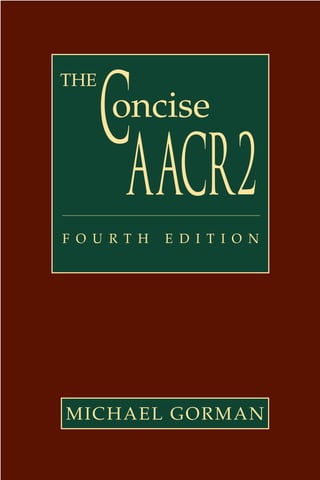
THE

C

oncise

AACR2

F O U R T H

E D I T I O N

MICHAEL GORMAN
THE

C AACR2
oncise

FOURTH EDITION

Based on AACR2
2002 Revision
2004 Update

Prepared by

MICHAEL GORMAN

Chicago: American Library Association
Ottawa: Canadian Library Association
London: Chartered Institute of Library and Information Professionals
2004
Published 2004 by
AMERICAN LIBRARY ASSOCIATION
50 East Huron Street, Chicago, Illinois 60611
ISBN 0-8389-3548-6
CANADIAN LIBRARY ASSOCIATION
328 Frank Street, Ottawa, Ontario, Canada K2P 0X8
ISBN 0-88802-311-1
Facet Publishing for the
CHARTERED INSTITUTE OF LIBRARY
AND INFORMATION PROFESSIONALS
7 Ridgmount Street, London WC1E 7AE
ISBN 1-85604-540-4

Library of Congress Cataloging-in-Publication Data
Gorman, Michael, 1941The concise AACR2, 2004 revision / prepared by Michael Gorman.
p.
cm.
Includes index.
ISBN 0-8389-3548-6
1. Anglo-American cataloguing rules. 2. Descriptive cataloging—Rules.
I. Title: Concise Anglo-American cataloguing rules, 2004 revision. II. AngloAmerican cataloguing rules. III. Title.
Z694.15.A56G67 2004
025.3'2–dc22
2004016088
Canadian Cataloguing in Publication Data
Gorman, Michael, 1941The concise AACR2 : based on AACR2 2002 revision, 2004 update / prepared
by Michael Gorman. — 4th ed.
Includes bibliographical references and index.
ISBN 0-88802-311-1
1. Descriptive cataloging—Rules. I. Title. II. Title: Anglo-American
cataloguing rules.
Z694.15.A56G67 2004
025.3'2
C2004-905125-3
British Library Cataloguing in Publication Data
A catalogue record for this book is available from the British Library.
ISBN 1-85604-540-4
Copyright © 2004, American Library Association, Canadian Library Association, and
the Chartered Institute of Library and Information Professionals
08

07

06

05

04

5

4

3

2

1
To the memory
of my father
PHILIP DENIS GORMAN

1903–1980
my mother
ALICIA F. GORMAN

1918–1998
and of my friend
HUGH CRAIG ATKINSON

1933–1986
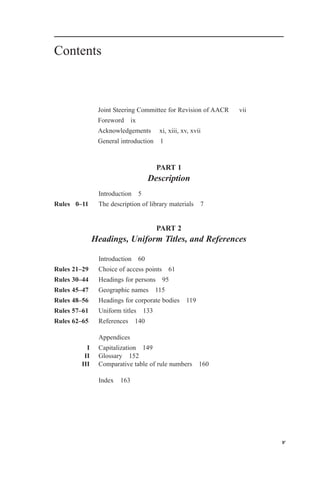
Contents

Joint Steering Committee for Revision of AACR
Foreword

vii

ix

Acknowledgements

xi, xiii, xv, xvii

General introduction

1

PART 1

Description
Introduction
Rules 0–11

5

The description of library materials

7

PART 2

Headings, Uniform Titles, and References
Introduction

60

Rules 21–29

Choice of access points

61

Rules 30–44

Headings for persons

Rules 45–47

Geographic names

Rules 48–56

Headings for corporate bodies

Rules 57–61

Uniform titles

Rules 62–65

References

95

115
119

133

140

Appendices
I
II
III

Capitalization 149
Glossary 152
Comparative table of rule numbers
Index

160

163

v
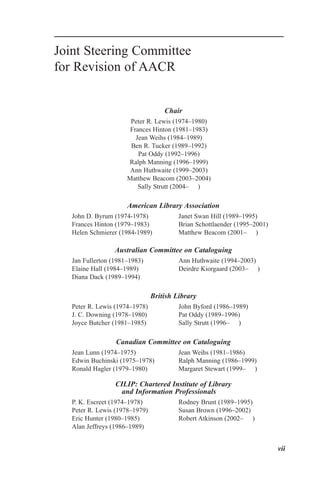
Joint Steering Committee
for Revision of AACR

Chair
Peter R. Lewis (1974–1980)
Frances Hinton (1981–1983)
Jean Weihs (1984–1989)
Ben R. Tucker (1989–1992)
Pat Oddy (1992–1996)
Ralph Manning (1996–1999)
Ann Huthwaite (1999–2003)
Matthew Beacom (2003–2004)
Sally Strutt (2004– )

American Library Association
John D. Byrum (1974-1978)
Frances Hinton (1979–1983)
Helen Schmierer (1984-1989)

Janet Swan Hill (1989–1995)
Brian Schottlaender (1995–2001)
Matthew Beacom (2001– )

Australian Committee on Cataloguing
Jan Fullerton (1981–1983)
Elaine Hall (1984–1989)
Diana Dack (1989–1994)

Ann Huthwaite (1994–2003)
Deirdre Kiorgaard (2003– )

British Library
Peter R. Lewis (1974–1978)
J. C. Downing (1978–1980)
Joyce Butcher (1981–1985)

John Byford (1986–1989)
Pat Oddy (1989–1996)
Sally Strutt (1996– )

Canadian Committee on Cataloguing
Jean Lunn (1974–1975)
Edwin Buchinski (1975–1978)
Ronald Hagler (1979–1980)

Jean Weihs (1981–1986)
Ralph Manning (1986–1999)
Margaret Stewart (1999– )

CILIP: Chartered Institute of Library
and Information Professionals
P. K. Escreet (1974–1978)
Peter R. Lewis (1978–1979)
Eric Hunter (1980–1985)
Alan Jeffreys (1986–1989)

Rodney Brunt (1989–1995)
Susan Brown (1996–2002)
Robert Atkinson (2002– )

vii
viii

JOINT STEERING COMMITTEE

Library of Congress
C. Sumner Spalding (1974)
Elizabeth Tate (1974–1976)
Ben R. Tucker (1976–1992)

Sarah E. Thomas (1992–1994)
Barbara B. Tillett (1994– )

Editors of AACR2
Michael Gorman (1974–1988)

Paul W. Winkler (1974–1988)
Foreword to 1981 Edition

The idea of a concise text of the Anglo-American Cataloguing Rules
is older than the idea of a second edition of the Rules (AACR2) itself.
Michael Gorman first began work on what was then thought of as an
“abridged edition” of the British Text of AACR 1967 almost two years
before the Joint Steering Committee for Revision of AACR (of which
I had the privilege to be the first chairperson) was set up to carry out
the task of producing AACR2.
The principal stimulus to that first project was the need expressed
by librarians in third-world countries for a set of basic rules, stated in
simple English, that could be used by relatively untrained personnel
for relatively small and uncomplicated catalogues; and that would be
compatible with a progress to the use of the full Anglo-American
Cataloguing Rules as staff grew in training and experience and as the
catalogues grew in size and complexity. Accordingly, Michael Gorman
set to work with a small steering group consisting of Philip K. Escreet
and Geoffrey E. Hamilton (both of whom also served later on the Joint
Steering Committee for Revision of AACR). Indeed, the project was
within sight of completion when he laid it aside to take on a larger task,
as one of the two editors of AACR2.
One of the main objectives of AACR2, attained by its publication in
1978, was to bring together the separate North American and British
texts of 1967; and another was to reorganize and express the rules in a
simpler and more direct way. So most of the earlier work on the
abridgement was nugatory—or, rather, it was used in other ways than
originally planned, in AACR2 itself. However, the Joint Steering
Committee soon perceived that the potential was even greater than had
previously been estimated for a version of AACR2 that would meet the
needs of the many practitioners and students in our own countries, as
well as elsewhere in the world, to whom the full and comprehensive
text of AACR2 tells more than they need to know, or wish to hear,
about standards and procedures for catalogue making and the organization of bibliographic records at a particular time in the development
of their own libraries, of their own bibliographic services, or of their
own studies.
ix
x

FOREWORD

Our main concern was that the quest for simplicity and conciseness
in the smaller or less complex library and bibliographic environments
should not be impeded by the full text’s need to provide in some detail
for the whole range of conditions and complexities in the largest or
most fully developed libraries and services. We were convinced, too,
that the principles and practice set out in AACR2 were, in general
terms, equally valid at both ends of the spectrum of development of
library services, and, to change the metaphor, that a clearance of the
least familiar trees from the thickly planted wood we call AACR would
enable everyone who has a need to enter it to see the wood more easily
as a whole and to find his or her way through it safely and surely.
These were the aims that led the Joint Steering Committee to seek
and obtain approval from its parent bodies, the authors of AACR2, for
the creation and publication of a concise text, making use of Michael
Gorman’s dual experience in preparing the earlier abridgement and
editing AACR2, and of the reconstituted Joint Steering Committee as
the authoritative advisory group to ensure the most effective relationship between the concise and the full texts.
These are what the authors now have every confidence and belief
has been accomplished in the CONCISE AACR2. It is a high quality
working tool of practical value in all kinds of libraries and in many
countries, and it embodies the essence of the Anglo-American Cataloguing Rules in their most up-to-date form, with all the benefits that
signifies in the wide world of national standards and international harmonization.
PETER R. LEWIS
Director General
Bibliographic Services Division
The British Library
Acknowledgements (1981)

Acknowledgements are due, in the first instance, members of the
cataloguing rules committee of the Library Association from 1968 onwards. This shorter edition of the Anglo-American Cataloguing Rules
has been twelve years in the making. In encouraging me to attempt to
produce a standard, though abridged, set of rules, the British cataloguing rules committee is responsible for the present publication in
ways which its then members may not be aware. More recently, the
Joint Steering Committee for Revision of AACR (JSC) has given me
complete support and encouragement. In particular, I wish to thank
Peter Lewis (the chair of JSC from 1976 to 1980), Ronald Hagler, Fran
Hinton, and Ben Tucker for their interest, comments, and unfailingly
helpful suggestions. Many members of the American Library Association’s Catalog Code Revision Committee and, subsequently, Cataloging Committee—Description and Access, have provided me with advice
and information.
The following individuals have helped me with comments, criticism, examples, and suggestions: Liz Bishoff, John Byrum, Karen
Lunde Christensen, Neal Edgar, Anne Gorman, Eric Hunter, Arnold
Wajenberg, Jean Riddle Weihs. My thanks are due my graduate assistants at the University of Illinois (1978–80), Elvira Chavaria and Anne
Reuland. Wendy Darre, who typed the many drafts of these rules with
her inimitable competence and dispatch, was of invaluable assistance.
I am grateful to Helen Cline (managing editor, ALA) for the expertise,
care, and hard work that she brought to the task of editing this work for
publication. Last, I wish to recognize my daughters, Emma and Alice,
without whose unfailing help and encouragement this whole enterprise
would have been completed sooner.
MICHAEL GORMAN

xi
Acknowledgements (1989)

I wish to reiterate my gratitude to all those named in the acknowledgements in the first edition of the CONCISE AACR2. In particular, I
am grateful for the continuing help and encouragement of Helen Cline,
Ronald Hagler, and Jean Weihs. I would also like to thank my assistants at the University of Illinois (Lisa Boise and Anne Phillips) and
my assistant at CSU–Fresno (Janet Bancroft). I wish to express my
appreciation to the many teachers of cataloguing that have used the
CONCISE AACR2 in their classes, especially to Ellen Koger who
passed on many useful comments. My thanks for many things are due
to Karen Schmidt. My special thanks go to Ken Bakewell for all the
hard work he has put into compiling the excellent indexes to both editions to this book. My daughters, Emma and Alice, are now grown
women of whose accomplishments I am excessively proud. They still
think that the editors of cataloguing codes are strange, and who am I to
say them nay?
M.G.

xiii
Acknowledgements (1998)

I wish to reiterate my gratitude to those named in the acknowledgements in the first two editions of the CONCISE AACR2. In particular,
the continuing interest and friendship of Ronald Hagler has meant
much to me for many years. I would like to thank Marlene Chamberlain
of ALA Publishing for her advice and assistance during the process of
creating this edition. My assistant at California State University–
Fresno—Susan Mangini—has been her usual indispensable self. I would
be lost without her tactful but relentless reminders of deadlines. I am
grateful to Jean Weihs for compiling the index to this edition.
The love of my daughters—Emma and Alice—is more important to
me than I can say, and Emma’s son, Louis, is a light in my life.
M.G.

xv
Acknowledgements (2004)

I wish to reiterate my gratitude to those named in the acknowledgements in the first three editions of the CONCISE AACR2. I owe all the
people named therein a great debt accumulated over the more than
three decades of involvement with the making and interpreting of cataloguing rules, a pursuit that still intrigues and involves me. I have been
inspired by the work of the late Seymour Lubetzky (1898–2003) and,
in all humility, hope that the CONCISE AACR2 embodies the principles
he advocated so successfully. I repeat my thanks to Marlene Chamberlain and add thanks to Mary Huchting, both of ALA Editions. My
assistants, Susan Mangini and Bernie Griffith, of the Madden Library,
California State University, Fresno, combine to keep me on the straight
and narrow path. I owe many things to my wife, Anne Christine Reuland.
I am eternally sustained by the love of my daughters, Emma Celeste
Gorman and Alice Clara Singer, and the love I have for my grandchildren, Louis Dexter Gorman (1996– ), Bess Rosa Gorman (2000– ),
and Leo Benjamin Singer (2004– ).

xvii
General Introduction

This book is intended to convey the essence and basic principles of
the second edition of the Anglo-American cataloguing rules (AACR2)
without many of that comprehensive work’s rules for out-of-the-way
and complex materials. Those rules from the full text that have been
retained have been rewritten, simplified, and, usually, supplied with
new examples. This rewriting is intended to highlight the rules for commonly encountered library materials and to make them even more
accessible. Although the method of presentation is different, the end
result of the cataloguing process should be the same whether one is
using the full or the concise text. In other words, the CONCISE AACR2
prescribes the same cataloguing practice as the full text, but presents
only the more generally applicable aspects of that practice and presents
them in different terms. The user of the CONCISE AACR2 is referred to
the full text for guidance on problems not covered by the concise text
and for fuller explanation of rules contained in the concise text. To assist
reference between the two texts, a table is given (appendix III) that
relates the rules in the concise text to their equivalents in the full text.
The CONCISE AACR2 is intended for cataloguing students, cataloguers in a number of different situations, and other librarians.
Persons working in small libraries, especially “one-person” libraries,
will be able to do standard cataloguing without the necessity of
learning all the details of structure and content of the full text.
Beginning students of cataloguing, especially those who wish to learn
about cataloguing but not to be cataloguers, will find the CONCISE
AACR2 a good introduction to the national cataloguing standard. Paraprofessionals engaged in copy cataloguing by use of catalogue records
supplied by national libraries or members of bibliographic networks
will find the CONCISE AACR2 an accessible guide to standard cataloguing practice. Public service librarians who wish to understand new
developments in descriptive cataloguing practice will find the CONCISE
AACR2 a relatively brief summary of that practice. Last, cataloguers
1
2

GENERAL INTRODUCTION

working in a non-English-language environment will be able to use the
CONCISE AACR2 as a readily comprehensible summary of AACR2
practice.
In practical application, the CONCISE AACR2 is likely to be most
useful in small general libraries, though it can be used for basic cataloguing in large general libraries and for cataloguing in multimedia
resource centres and in nonarchival specialist libraries.
The style and spellings used in the CONCISE AACR2 follow those of
the full text in that they generally follow the Chicago manual of style1
and Webster’s New international dictionary.2 Where Webster’s permits
a British spelling as an alternative, that spelling is followed. As with
the full text, care has been taken in the CONCISE AACR2 to avoid sexist
language and sexist implications in the rules and examples.
The order of rules in the CONCISE AACR2 follows the usual and recommended sequence of cataloguing, in that part 1 deals with the description of the item being catalogued and part 2 deals with the establishment of access points (name headings and uniform titles) to be
added to those descriptions, and references to be made to those access
points. Separate introductions to part 1 and part 2 begin on pages 5 and
60, respectively.
These rules are based on the idea that one main entry is made for
each item described and that this is supplemented by added entries. If,
in your catalogue, no distinction is made between main and added
entries, use rules 21–29 to decide all the access points to be added to a
description and ignore the distinction between main access points and
other access points.
Distinguish the headings and/or uniform titles added to the description by giving them on separate lines above the description. If any
entry begins with a title proper (that is, the first element of the description—see rule 1B), give the description alone or repeat the title proper
on a line above the description.

1. The Chicago manual of style. — 15th ed. — Chicago : London : University of
Chicago Press, 2003.
2. Webster’s third new international dictionary of the English language,
unabridged. — Springfield, Mass. : Merriam-Webster ; Harlow, Essex : Distributed
by Longman Group, c1986.
GENERAL INTRODUCTION

3

Example of entry with heading:
Basbanes, Nicholas A.
A splendor of letters : the
permanence of books in an impermanent
world. -– New York : HarperCollins, 2003.
–- 444 p. –- ISBN 0-06-008287-9

Example of one style of entry under title proper:
Thayer Birding Software’s Birds of
North America. -– Cincinnati : Thayer
Birding Software, 1996. —- 1 computer
optical disc: col., sd. + 1 user’s guide

The entries in many online catalogues (OPACs) are in a format in
which each area of the entry (heading, title area, publication details,
etc.) is presented on a different line and is often labeled. However,
even in OPACs, areas should be presented in the order given in these
rules and with the prescribed internal punctuation.
Example of one style of entry in an OPAC:
Author
Title
Publisher
Description
Standard no.

Jones, Norah, 1979Come away with me
Los Angeles : Blue Note,
2002
1 CD
7243-5-32088-2-0

Some rules or parts of rules are designated as optional, or are introduced by the word optionally, or are presented as an either/or choice.
Decide which option is to be used and in which circumstances. Base
your decision on your judgement of what is best for your catalogue and
its users. Make a record of such decisions.
Sometimes a cataloguer needs to exercise judgement and decide on
an interpretation. The need for these is indicated in the CONCISE
AACR2 by words and phrases such as if appropriate, important, and if
necessary. Apply judgements and interpretations consistently within
one catalogue, and, when possible, record each exercise of judgement.
Rules on capitalization and a glossary are given as appendices I and II.
4

GENERAL INTRODUCTION

The examples used throughout the CONCISE AACR2 have been
chosen to illustrate commonly encountered cases. Examples drawn from
a variety of media and from modern English-language items have been
preferred. Remember that examples only illustrate the rules and are not
intended to expand on the rules unless a rule specifically says so.
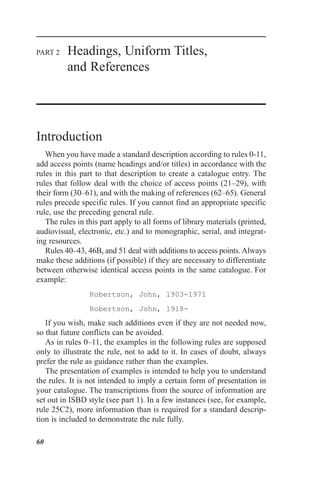
PART 1

Description

Introduction
A bibliographic resource (often referred to as an “item”) is a manifestation of a work that forms the basis for a bibliographic description.
A bibliographic resource can be a book or other printed document; a
Website, database, or other electronic resource; a graphic such as a
poster or art work; a video or film; a CD or other sound recording; or
any other means by which recorded knowledge and information are
communicated. This part of the CONCISE AACR2 Contains instructions
on how to make a description of such a resource that has been acquired
by your library or to which your library gives access (as in the case of
remote electronic resources). The description is displayed in a catalogue after having been retrieved by the use of one or more access
points established for the item according to the instructions in part 2.
The rules are based on those in part I of the full text of AACR2. In
the CONCISE AACR2 only the usual case is dealt with. For more difficult materials or for out-of-the-way problems, see the full text.
The CONCISE AACR2 deals with all materials in one chapter (as
opposed to the analytical structure of part I of AACR2 in which each
type of library material is dealt with separately as far as description is
concerned). Thus, for example, all the rules on physical description
will be found in rule 5 and its subrules.
In describing library materials according to these rules, a basic principle is that you describe the actual bibliographic resource in the
format acquired by your library or to which your library gives access.
For example, a manuscript reproduced as a book is described as a
book; a book reproduced on microfilm is described as a microfilm; a
text that has been digitized is described as an electronic resource. Do
not describe what something was; describe what something is.
The generalizing of the descriptive rules in the CONCISE AACR2 has
led to the loss of some nuances of the original text. None of these
5
6

DESCRIPTION

details affects access to the descriptions. For example, the rules on
sources of information in this text may lead to a diminished use of square
brackets in the entry. This small loss of a few refinements will not affect
the user of a catalogue in which CONCISE AACR2 entries are found.
Not all the elements set out for the description of materials will be
needed for a particular item or for a particular catalogue. See rule 0E
for a specification of the minimum elements needed. In particular, any
detail described as optional need not necessarily be included in a
description. Most notes (see rule 7) are optional; a note should only be
made if it is necessary to the understanding or identification of the item
being described, or if rule 7 indicates that it is required.
Some measurements prescribed in rule 5D are not metric. Use
metric measurements in their place if they are more suitable for the
material or the country in which the cataloguing is being done.
If you are cataloguing in a non-English-speaking country or region,
substitute your language or your language abbreviations for the English
terms or abbreviations specified in these rules. However, do not translate data transcribed from the item being catalogued.
The Description of Library Materials

Contents
0.
0A.
0B.
0C.
0D.
0E.

GENERAL RULE
Sources of information
Several chief sources of information
The description
Punctuation of the description
Levels of detail in the description

1.
1A.
1A1.
1B.
1C.
1D.
1E.
1F.
1G.

TITLE AND STATEMENT OF RESPONSIBILITY AREA
Preliminary rule
Punctuation
Title proper
General material designation
Parallel titles
Other title information
Statements of responsibility
Items without a collective title

2.
2A.
2A1.
2B.
2C.

EDITION AREA
Preliminary rule
Punctuation
Edition statement
Statements of responsibility relating to the edition

3.

SPECIAL AREA FOR SERIALS, MAPS AND OTHER
CARTOGRAPHIC MATERIALS, AND MUSIC
Serials
Punctuation
Designation of first issue
Date
No designation
Ceased serials
Successive designations

3A.
3A1.
3A2.
3A3.
3A4.
3A5.
3A6.

7
8

DESCRIPTION

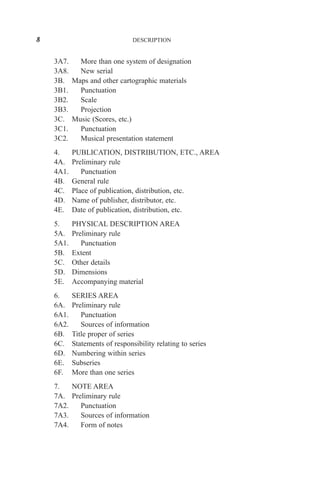
3A7.
More than one system of designation
3A8.
New serial
3B. Maps and other cartographic materials
3B1.
Punctuation
3B2.
Scale
3B3.
Projection
3C. Music (Scores, etc.)
3C1.
Punctuation
3C2.
Musical presentation statement
4.
4A.
4A1.
4B.
4C.
4D.
4E.

PUBLICATION, DISTRIBUTION, ETC., AREA
Preliminary rule
Punctuation
General rule
Place of publication, distribution, etc.
Name of publisher, distributor, etc.
Date of publication, distribution, etc.

5.
5A.
5A1.
5B.
5C.
5D.
5E.

PHYSICAL DESCRIPTION AREA
Preliminary rule
Punctuation
Extent
Other details
Dimensions
Accompanying material

6.
6A.
6A1.
6A2.
6B.
6C.
6D.
6E.
6F.

SERIES AREA
Preliminary rule
Punctuation
Sources of information
Title proper of series
Statements of responsibility relating to series
Numbering within series
Subseries
More than one series

7.
NOTE AREA
7A. Preliminary rule
7A2.
Punctuation
7A3.
Sources of information
7A4.
Form of notes
DESCRIPTION

7B. Notes
7B1.
Special notes for serials and electronic resources
7B2.
Nature of the item
7B3.
Language
7B4.
Adaptation
7B5.
Titles
7B6.
Credits and other statements of responsibility
7B7.
Edition and history
7B8.
Publication, etc.
7B9.
Physical details
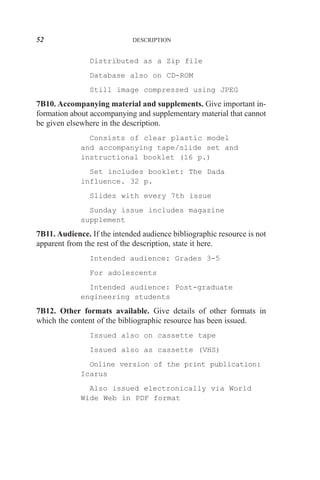
7B10. Accompanying material and supplements
7B11. Audience
7B12. Other formats available
7B13. Summary
7B14. Contents
7B15. Copy being described, library’s holdings, and restrictions
on use
7B16. “With” notes
7B17. Serials, integrating resources, and multipart resources: basis
for the description
8.
STANDARD NUMBER
8A. Preliminary rule
8A1.
Punctuation
8A2.
Sources of information
8B. Standard number
9.

SUPPLEMENTARY ITEMS

10.

RESOURCES MADE UP OF MORE THAN ONE TYPE
OF MATERIAL

11.

FACSIMILES, PHOTOCOPIES, AND OTHER
REPRODUCTIONS

9
10

DESCRIPTION

0. GENERAL RULE
0A. Sources of information
Most bibliographic resources acquired by a library or to which a
library gives access belong to one of the following types of publication. For each type the chief source of information is:
TYPE OF MATERIAL

CHIEF SOURCE OF INFORMATION

Books, pamphlets, and other
printed texts (including
atlases)
Electronic resources
Graphic materials (pictures,
posters, wall charts, etc.)
Maps and other cartographic
materials (other than atlases)
Microforms
Motion pictures and videorecordings
Printed music
Sound recordings
Discs (CDs)
Discs (LPs, EPs, etc.)

Title page

Tapes
Three-dimensional objects
(models, dioramas, games,
etc.)

The resource itself
The item itself
The item itself
Title frame
The item itself
Title page
The disc itself and label
(if two, both taken
together)
The tape itself and its
label(s)
The object itself

The chief source for a serial is the chief source of the first issue, or in
its absence, the earliest available issue.1 The chief source of information for an integrating resource is the current iteration of the resource.
1. The chief source for a printed serial with no title page is (in this order):
a)
b)
c)
d)

the title page for part of the serial
the cover
the caption
the masthead

e) the editorial pages
f) the colophon
g) other pages
DESCRIPTION

11

If the chief source is, in fact, two or more sources, prefer information from the first listed to the others. For example, prefer the tape
itself to its label in the case of tapes.
Use information found in the chief source in preference to information found elsewhere. If the necessary information cannot be found in
the chief source, take it from:
1) any other source that is part of the bibliographic resource itself
or
2) any other source that accompanies the bibliographic resource
and was issued by the publisher or issuer (for example, online
documentation, a container, a printed insert).
If all else fails, take the information from any available source (for
example, a reference work) or compose it yourself.
If you have taken the information from outside the bibliographic
resource or have composed it yourself, enclose it in square brackets
and indicate the source in a note (see rule 7B5).
0B. Several chief sources of information
0B1. Single part. If a unitary bibliographic resource has more than one
chief source of information, choose the chief source according to the
following rules.
a) Use the chief source of information with the latest date of
publication.
b) If one chief source treats the resource as a single item and the
other as part of a multipart resource, use the source that corresponds to the way in which the item is being catalogued (for
example, use the multipart source if you are describing all the
parts in one description).
c) If the resource contains words (written, spoken, or sung) all in
one language, use the source in the language of the resource
(for example, use an English title page for a book in English).
d) If the resource is in a number of languages, use the source in
the language occurring first in the following list: English, the
first occurring source in any other language using the roman
alphabet, the first occurring source in any other language.
12

DESCRIPTION

0B2. Multipart resources (for example, books in two or more volumes). If a resource is in a number of separate parts, use the chief
source for the first part. If there is no first part, use the chief source that
gives the most information. If the information differs in the chief
sources of the other parts, and if the difference is important, make a note
(see rule 7B5).
0C. The description
The description is divided into the following areas:
title and statement of responsibility
edition
special area (only for serials; maps, etc.; music)
publication, etc.
physical description
series
notes (a repeatable area)
standard number
0D. Punctuation of the description
Separate the areas listed in rule 0C by using one of the following
methods. Either introduce each area (except the first) by a full stop,
space, dash, space (. — ) as set out here:
Title and statement of responsibility. -Edition. -- Special area. -- Publication,
etc. -- Physical description. -- Series.
-- Note. -- Note. -- Standard number

or begin a new paragraph for certain areas as set out here:
Title and statement of responsibility.
-- Edition. -- Special area. -Publication, etc.
Physical description. -- Series
Notes
(each note occupies a separate paragraph, though
notes may be combined—see rule 7A1)
Standard number

or if the description is to appear in an online catalogue in which each
area is labeled, use only the punctuation that is internal to each area.
DESCRIPTION

13

Within each area, introduce each element (a part of an area), except
the first, by special punctuation as set out at the head of the rules in this
part for that area (1A1, 2A1, etc.).
Omit any area or element that does not apply to the item being catalogued. Omit also its introductory punctuation.
Here are examples of simple descriptions (one for a book, one for a
sound disc). Each is set out in the ways specified above.
Example 1. First layout
The fair garden and the swarm of beasts
: the library and the young adult /
Margaret A. Edwards. -- Rev. and
expanded. -- New York : Hawthorn, c1974.
-- 194 p. ; 22 cm. -- Previous ed. 1969

Example 1. Second layout
The fair garden and the swarm of
beasts : the library and the young adult
/ Margaret A. Edwards. -- Rev. and
expanded. -- New York : Hawthorn, c1974
194 p. ; 22 cm.
Previous ed. 1969

Example 1. Online catalogue
Title

Edition
Publisher
Description
Notes

The fair garden and the swarm
of beasts : the library and
the young adult.
Rev. and expanded.
New York : Hawthorn, c1974.
194 p. ; 22 cm.
Previous ed. 1969.

Example 2. First layout
The way I should [sound recording] /
Iris DeMent. -- Burbank, Calif. : Warner
Bros., c1996. -- 1 sound disc : digital,
stereo. ; 4 3/4 in.
14

DESCRIPTION

Example 2. Second layout
The way I should [sound recording] /
Iris DeMent. -- Burbank, Calif. : Warner
Bros., c1996.
1 sound disc : digital, stereo. ;
4 3/4 in.

Example 2. Online catalogue
Title
Publisher
Description

The way I should [sound
recording] / Iris DeMent.
Burbank, Calif. : Warner
Bros., c1996.
1 sound disc : digital,
stereo. ; 4 3/4 in.

0E. Levels of detail in the description
As a basic minimum, include at least the areas and elements (provided
that they apply to the bibliographic resource) set out in this illustration:
Title proper / first statement of
responsibility2. -- Edition statement. -Special area for serials, maps, music. -First named publisher, etc., date. -Extent of item. -- Required note(s). -Standard number

Include further information as set out in rules 1–8 when appropriate for
your catalogue or your library.

2. If the person or body named in this statement is recognizably the same as the
person or body chosen as the main entry heading (see rules 23–28) and there are no
other words or only the word “by” (or its equivalent in another language) in the
statement, you may omit the statement.
DESCRIPTION

15

1. TITLE AND STATEMENT OF RESPONSIBILITY
AREA
Contents:
1A.
1B.
1C.
1D.
1E.
1F.
1G.

Preliminary rule
Title proper
General material designation
Parallel titles
Other title information
Statements of responsibility
Items without a collective title

1A. Preliminary rule
1A1. Punctuation
Precede the title of a separate part, supplement, or section by a full
stop, space (. ).
Enclose the general material designation in square brackets ([ ]).
Precede a parallel title by a space, equals sign, space ( = ).
Precede other title information by a space, colon, space ( : ).
Precede the first statement of responsibility by a space, diagonal
slash, space ( / ).
Precede each other statement of responsibility by a space, semicolon, space ( ; ).
1B. Title proper
1B1. Transcribe the title proper exactly as it is found in the chief source
of information except that the punctuation and the capitalization found
there need not be followed. See appendix I for rules on capitalization.
Gone with the wind
The big money
White mansions
McAuslan in the rough and other stories
16 greatest original bluegrass hits
The 4:50 from Paddington
The Fresno bee
16

DESCRIPTION

Britannica online
WordStar
The electronic journal of analytical
philosophy
Index to the Columbia edition of the
works of John Milton
Washingtonpost.com
Supplement to The journal of physics
and chemistry of solids
Son of the black stallion
Map of Middle Earth
Elvis is dead, & I’m not feeling too
good myself
Les amants

However, do not transcribe introductory words that are not intended
to be part of the title.
not

Sleeping Beauty
Disney presents Sleeping Beauty

not

NASA quest
Welcome to NASA quest

1B2. If the name of an author, publisher, etc., is an integral part of the
title proper, record it as such. Do not repeat the name in a statement of
responsibility (see rule 1F1).
The Rolling Stones’ greatest hits
The most of P.G. Wodehouse
The complete Firbank
Geographia Al road atlas of London
The new Oxford book of English verse
CNN interactive
DESCRIPTION

17

When hearts are trumps by Tom Hall /
Will H. Bradley
(a poster by Bradley advertising a play by Hall )
Proceedings of the Annual Workshop on
School Libraries

1B3. If the title proper consists solely of the name of the person or
body responsible for the bibliographic resource or work of which it is
a manifestation, give that name as the title proper.
Byron
(a book of poems)
Waylon Jennings
(a sound recording of performances by Jennings)
Amazon.com
(the online company’s Website)
International Conference on the Law of
the Sea
(proceedings of the conference)

1B4. If the bibliographic resource being catalogued is a part of a larger
bibliographic entity (for example, a volume of a multivolume set, a disc
that is part of a set of discs, a serial that is a continuing part of another
larger serial)
or is a supplement to another publication
and the title proper consists of the title of the larger publication
and an indication of the part or supplement
and the two parts of the title are not linked grammatically,
give the title proper as the title of the larger entity followed by the indication of the part.
Faust. Part 1
Stocks & bonds today. Supplement
The music of the masters. 1850-1889

1B5. If the title proper of a serial includes a date or numbering that
varies from issue to issue, omit this date or numbering. Indicate the
18

DESCRIPTION

omission by “ … ” unless the date or numbering occurs at the beginning
of the title.
Report on the … Conference on AIDS and
Alternative Medicine
(chief source reads: Report on the Second Conference
on AIDS and Alternative Medicine)

but
not

Annual report

… annual report
(chief source reads: 1987 Annual Report)

1B6. If there is no chief source of information (for example, a book
without a title page), supply a title proper (in this order of preference)
from the rest of the bibliographic resource, from its accompanying
material, or from elsewhere (for example, a reference source). If no
title can be found anywhere, make up a brief descriptive title yourself.
Give a supplied or made-up title in square brackets and make a note
(see rule 7B5).
[Map of Australia]
[Photograph of Kenneth Williams]
[City of Portolina Website]

1B7. If the title appears in two or more languages, use the one that is
in the main language of the bibliographic resource as the title proper.
If there is more than one main language, use the title that appears first.
1.B8. If the title proper of a multipart resource changes between parts,
retain the title proper of the first or earliest part, and give the later title
in a note (see also rule 22B).
1B9. If the title proper of a serial changes, make a new description, and
give the earlier title in a note (see also rule 22C). Close the earlier
description.
1B10. If the title proper of an integrating resource changes, replace the
former title proper with the new title proper and give the earlier title in
a note (see also rule 22D).
19

DESCRIPTION

1C. General material designation. Optional addition
1C1. General rule. If you want to use a general material designation
as an “early warning” to the catalogue user, give a term from the following list immediately following the title proper.3
activity card
art original
art reproduction
braille
cartographic material
chart (not a map)
diorama
electronic resource
filmstrip

flash card
game
kit
manuscript
microform
microscope slide
model
motion picture
music

picture
realia
slide
sound recording
technical drawing
toy
transparency
videorecording

The San Joaquin Valley [diorama]
RLG diginews [electronic resource]
Exploring the human body [kit]
HealthWorld online [electronic
resource]
The New York times [microform]
Black and blue [sound recording]

For material for the blind and visually impaired, add “(braille)”,
“(large print)”, or “(tactile)” to any of the above terms when appropriate.
The banks of green willow [music
(braille)]
Camden [map (large print)]

1C2. If the bibliographic resource is a reproduction in another form
(for example, a book in microform; a map on a slide; an online encyclopedia), give the general material designation appropriate to the
reproduction (for example, in the case of a map on a slide, give
“[slide]”).
3. This list reflects North American and Australian practice as set out in AACR2,
rule 1.1C.
20

DESCRIPTION

1C3. Because they are optional, general material designations are not
given in the rest of the examples in this part (except as needed to illustrate another issue). Do not take this as implying that they should or
should not be used in a particular case.
1D. Parallel titles
If the title appears in the chief source of information in two or more
languages, choose one of these as the title proper (see rule 1B7). Give
one other title (the one appearing first or the one following the title
proper) as the parallel title.
Dansk-Engelske ordbog = Danish-English
dictionary
Road map of France = Carte routière de
la France

1E. Other title information
1E1. Transcribe other title information (for example, a subtitle) appearing in the chief source of information.
Bits of paradise : twenty-one
uncollected stories
Aspects of Alice : Lewis Carroll’s
dreamchild as seen through the critics’
looking-glasses, 1865-1971
Annie Hall : a nervous romance
The gate : the Bay Area’s home page
The devil’s dictionary : a selection of
the bitter definitions of Ambrose Bierce

1E2. If there is more than one subtitle (or unit of other title information) appearing in the chief source of information, give them in the
order in which they appear there.
Clawhammer banjo : the return of the
clawhammer banjo : twenty Irish, English,
and American tunes
DESCRIPTION

21

1E3. If the other title information is lengthy and does not contain
important information, omit it.
1E4. If the title proper needs explanation, make a brief addition as
other title information.
Shelley : [selections]
Conference on Aesthetic Values and the
Ideal : [proceedings]

1F. Statements of responsibility
1F1. First statement of responsibility. Always give the statement of
responsibility that appears first in the chief source of information,
unless the name of the author, publisher, etc., has already appeared as
part of the title (see rule 1B2) or other title information.
Hangover Square / by Patrick Hamilton
Cruising / Jonathan Raban
Honky tonk heroes / Waylon Jennings
Shoot low, lads, they’re ridin’
Shetland ponies / Lewis Grizzard
Proceedings / International Conference
on Nematodes
The monocled mutineer / William Allison
and John Fairley
American literature : a representative
anthology of American writing from
colonial times to the present / selected
and introduced by Geoffrey Moore
Amazing universe CD-ROM / produced by
Hopkins Technology

but
not

The portable Oscar Wilde
The portable Oscar Wilde / Oscar Wilde
22

DESCRIPTION

but

not

Lady Windermere’s fan : the
the Old Vic’s presentation of
Wilde’s play
Lady Windermere’s fan : the
the Old Vic’s presentation of
Wilde’s play / Oscar Wilde

film of
Oscar
film of
Oscar

1F2. Other statements of responsibility. Give other statements of
responsibility that appear in the chief source of information in the form
and order in which they appear there. If the order is ambiguous, give
them in the order that makes the most sense.
Snow White and the seven dwarfs : a
tale from the Brothers Grimm / translated
by Randall Jarrell ; pictures by Nancy
Ekholm Burkert
A saint in America : John Neumann /
Raymond C. Kammerer and Carl R.
Steinbecker ; made by Creative Sights &
Sounds
Plats du jour / Patience Gray and
Primrose Boyd ; illustrated by David
Gentleman
Xmag : screen magnification program /
written by Danny Shapiro ; ported to
Motif by Philip Schneider
Dougal and the blue cat : original
soundtrack of the Nat Cohen-EMI film /
original story written and directed by
Serge Danot ; English version by Eric
Thompson ; music by Joss Baselli

1F3. Give the statements of responsibility after the title information
even if they appear before the title in the chief source of information.
Only the lonely / Roy Orbison
(disc label reads: ROY ORBISON
Only The Lonely)
DESCRIPTION

23

1F4. If no statement of responsibility appears in the chief source of
information, do not supply one. If such a statement is necessary to
make the description complete, give it in a note (see rule 7B6).
1F5. If a single statement of responsibility names more than three
persons or bodies, omit all but the first named. Indicate the omission
by “ ... ” and add “et al.” in square brackets.
London consequences : a novel /
edited by Margaret Drabble and B.S.
Johnson ; the work also of Paul
Ableman ... [et al.]
(second statement names fifteen other persons)

1F6. Omit statements of responsibility relating to persons or bodies with
minor responsibility for the item. Such minor responsibility includes:
writing an introduction to a book
performing in a motion picture (see also rule 7B6)
playing a subsidiary role in producing a motion picture (for
example, assistant director, make-up artist, editor)
being responsible for the physical production of the item.
1F7. Omit titles, qualifications, etc., attached to personal names in statements of responsibility unless omitting them makes the statement unintelligible or misleading.
The larks of Surinam / by Robert
Antrobus
(name appears as: Dr. Robert Antrobus)
Koalas : our friends from Down Under /
by S.K. Arline
(name appears as: S.K. Arline, F.R.N.Z.S.)

but
The prisoner of Chillon / Lord Byron
Fruitful and responsible love / Pope
John Paul II
Horton hears a Who! / by Dr. Seuss
24

DESCRIPTION

1F8. Add a word or phrase to the statement of responsibility only if it
is necessary to make the statement clear.
Denmark : a film / [produced and
directed by] Eigil Kongsted
The best man / Tomi Ungerer ; [designed
by] Bob Cox
Strikeout and other simulation games /
[collected by] Jim Good

but
Red headed stranger / Willie Nelson
Catalogue / Liverpool Public Library

1G. Items without a collective title
1G1. With predominant part. If a bibliographic resource contains
two or more separately titled parts and lacks a collective title, make a
single description if one of the parts is predominant. Use the title of
that part as the title proper and name the other parts in a note. When
appropriate, make added entries for the other parts.
Cello concerto in E minor, op. 85 /
Elgar
Note: In the south: concert overture,
op. 50 and Elegy for strings, op. 58
also on CD

1G2. Without predominant part. If no one part predominates:
either make a separate entry for each part (see also rule 7B16)
or give all the titles in the order in which they appear in the
chief source and make added entries for all the parts other
than the first named as instructed in rule 29B8.
If you are making one entry for the bibliographic resource and all
the parts are manifestations of works by the same person(s) or body
(bodies), separate the titles by a space, semicolon, space ( ; ).
The Brandenburg concertos no. 2 &
no. 6 ; The clavier concerto in D minor
/ Bach
DESCRIPTION

25

Grand Teton ; Yellowstone National Park
(maps on same sheet)
A survey of spending on foreign
language teaching ; Foreign language
teaching resources / principal
investigator J.L. Pianko

If you are making one entry for the bibliographic resource and the
parts are manifestations of works by different persons or bodies, give
the titles and statements of responsibility in the order in which they
appear in the chief source. Separate the titles and statements of responsibility of one part from those of another by a full stop followed by two
spaces (. ).
Rosaceae : twelve hand-coloured
etchings / by Fenella Wingift. Liliaceae
: twelve hand-coloured etchings / by
Pandora Braithwaite

2. EDITION AREA
Contents:
2A. Preliminary rule
2B. Edition statement
2C. Statements of responsibility relating to the edition
2A. Preliminary rule
2A1. Punctuation
Precede this area by a full stop, space, dash, space (. — ).
Precede a statement of responsibility following an edition statement
by a space, diagonal slash, space ( / ).
2A2. Take information for this area from the chief source of information (see rule 0A) or from any formal statement made by the publisher or issuer either in the bibliographic resource or in material that
accompanies it (for example, a container, a record sleeve, online documentation).
Enclose information taken from anywhere else in square brackets.
26

DESCRIPTION

2B. Edition statement
Give the edition statement as found except:
1) replace words with standard abbreviations
and
2) replace words with numbers where appropriate.
New ed.
(appears in item as: New Edition)
Rev. ed.
(appears in item as: Revised edition)
Version 3.8
3rd ed.
(appears in item as: Third edition)
Windows 95 ed.
(appears in item as: Windows 95 edition)
TryoPoly. -- Chicago ed.
(a game with different versions for different cities)
The international herald-tribune. -Airmail ed.

2C. Statements of responsibility relating to the edition
2C1. If a statement of responsibility relates to one or some editions but
not to all, give it after the edition statement if there is one. Follow the
rules in 1F.
A dictionary of modern English usage /
by H.W. Fowler. -- 2nd ed. / revised by
Ernest Gowers
Anglo-American cataloguing rules. -2nd ed. / prepared by the American
Library Association ... [et al.] ; edited
by Michael Gorman and Paul W. Winkler
Version 2.4, corr. / with diagrams by
Harry Weeks
DESCRIPTION

27

2C2. If there is no edition statement, give such a statement of responsibility in the title and statement of responsibility area.
Little Dorrit / Charles Dickens ;
edited by John Holloway
From Atlanta to the sea / William T.
Sherman ; edited with an introduction by
B.H. Liddell Hart

2C3. If there is doubt about whether a statement of responsibility
applies to all editions or only to some, give it in the title and statement
of responsibility area.

3. SPECIAL AREA FOR SERIALS, MAPS AND OTHER
CARTOGRAPHIC MATERIALS, AND MUSIC
3A. Serials (in all formats)
3A1. Punctuation
Precede this area by a full stop, space, dash, space (. — ).
Follow the designation and/or date of the first issue by a hyphen.
Enclose a date following the designation of the first issue in parentheses (( )).
Precede a new series of numbering, etc., by a space, semicolon,
space ( ; ).
3A2. Designation of first issue. Give the designation (volume, part,
numbering, etc.) of the first issue of a serial. Replace words with standard abbreviations. Replace words with numbers where appropriate.
Inside sports. -- Vol. 1, no. 1Private eye. -- No. 1-

3A3. Date. If the first issue of a serial is designated only by a date, give
that date. Replace words with standard abbreviations. Replace words
with numbers where appropriate.
Master’s theses in education. -1951-
28

DESCRIPTION

If the first issue is identified by both numbering, etc., and a date,
give the numbering, etc., before the date.
ALCTS network news. -- Vol. 1, no. 1
(May 13, 1991)-

3A4. No designation. If the first issue lacks a designation or date, give
“[No. 1]- ”. If, however, later issues adopt a numbering, follow that.
[Pt. l](later issues numbered: Part 2, Part 3, etc.)

3A5. Ceased serials. If the serial has ceased publication, give the designation and/or date of the first issue or part followed by the designation and/or date of the last issue.
Quarter horse newsletter. -- No. 1 (May
1973)-no. 17 (Sept. 1974)

3A6. Successive designations. If a serial starts a new system of designation without changing its title, give the designation of the first and
last issues under the old system, followed by the designation of the
first issue under the new system.
Language/art/language. -- Vol. 1, no.
1-vol. 3, no. 7; no. 32-

3A7. More than one system of designation. If a serial has more than
one separate system of designation, give each in the order in which it
appears in the chief source of information. Separate the designations
by an equals sign, space (= ) or, if the serial has ceased, by a space,
equals sign, space ( = ).
English review. -- Vol. 1, no. 1-= no.
11Syrian studies. -- Vol. 1, no. 1-vol.
5, no. 3 = Issue 1-issue 19

3A8. New serial. If the title proper of a serial changes (see rule 22C),
make a new description and close the old description (see rule 3A5).
DESCRIPTION

29

3B. Maps and other cartographic materials
3B1. Punctuation
Precede this area by a full stop, space, dash, space (. — ).
Precede a projection statement by a space, semicolon, space ( ; ).
3B2. Scale. Give the scale of a cartographic resource if it is found on
the resource or if it can be determined easily (for example, from a bar
graph). Give the scale as a representative fraction.4
Precede the scale by “Scale”.
Scale 1:500,000
Scale 1:63,360
(appears on item as: One inch to a mile)

If the scale appears as a representative fraction and in words, give
the representative fraction only.
Scale 1:253,440
(also appears as: One inch to four miles)

If the scale does not appear on the cartographic resource and cannot
easily be determined, do not give a scale statement.
If the description is of a multipart cartographic resource with two or
more scales that are given, give the statement Scales differ.
3B3. Projection. Give the statement of projection if it is found on the
cartographic resource. Replace words with standard abbreviations.
; transverse Mercator proj.
(scale given)
Transverse Mercator proj.
(scale not given)

4.

1/2 in. to a mile = 1:126,720
2 in. to a mile = 1:31,680
1 in. to a mile = 1:63,360
4 in. to a mile = 1:15,840
If the scale is given in centimetres (cm.) to kilometres (km.), multiply the km.
by 100,000. For example, 1 cm. to 2.5 km. equals 1:250,000 as a representative
fraction.
30

DESCRIPTION

3C. Music (Scores, etc.)
3C1. Punctuation
Precede this area by a full stop, space, dash, space (. — ).
3C2. Musical presentation statement. If a statement indicating the
physical presentation of the music appears separately in the chief
source of information, give it here. Typical musical presentation statements include “Miniature score”, “Playing score”, and “Full score”.
Symphony in B flat for concert band /
Hindemith. -- Miniature score

4. PUBLICATION, DISTRIBUTION, ETC., AREA
Contents:
4A.
4B.
4C.
4D.
4E.

Preliminary rule
General rule
Place of publication, distribution, etc.
Name of publisher, distributor, etc.
Date of publication, distribution, etc.

4A. Preliminary rule
4A1. Punctuation
Precede this area by a full stop, space, dash, space (. — ).
Precede a second place of publication, etc., by a space, semicolon,
space ( ; ).
Precede the name of a publisher, etc., by a space, colon, space ( : ).
Precede the date of publication, etc., by a comma, space (, ).
4A2. Take information for this area from the chief source of information (see rule 0A) or from any formal statement made by the publisher
or issuer either on the bibliographic resource or in material accompanying the resource (for example, container, record sleeve, accompanying
documentation). Enclose information taken from anywhere else in square
brackets.
DESCRIPTION

31

4B. General rule
4B1. In this area, give information relating to the publisher, distributor,
etc., and the date of its publication, distribution, etc.
4B2. If a bibliographic resource has two or more places of publication,
distribution, etc., and/or two or more publishers, distributors, etc., give
the first named place and publisher, distributor, etc. If another place
and publisher, distributor, etc., is more prominent in the chief source of
information, also give that place and publisher, distributor, etc.
If a place and/or publisher, distributor, etc., in your country is named
in a secondary position, optionally add that place and publisher, distributor, etc.
Oxford ; New York : Oxford University Press
(if you are cataloguing in the United States)
New York : Dutton ; Toronto : Clarke, Irwin
(if you are cataloguing in Canada)
Burbank, Calif. : Warner Bros. ;
London: Butterfly Records
(if you are cataloguing in the United Kingdom)

4C. Place of publication, distribution, etc.
4C1. Give the place of publication as it appears.
London
Los Angeles
Tolworth, England

Supply the name of a country, state, province, etc., if it does not
appear but is necessary to identify the place.
London [Ont.]

4C2. If a publisher, distributor, etc., has offices in more than one place,
always give the first named place. Optionally, give any other place that
is in your country. Omit all other places.
New York ; London
(if you are cataloguing in the United Kingdom)
32

DESCRIPTION

London ; Melbourne
(if you are cataloguing in Australia)
London ; New York
(if you are cataloguing in the United States)

4C3. If the place of publication, distribution, etc., is uncertain or
unknown, leave out this element.
4D. Name of publisher, distributor, etc.
4D1. Give the name of the publisher, distributor, etc., in the shortest
form in which it can be understood and identified. Omit accompanying
wording that implies the publishing function.
London : MacGibbon & Kee
Berkeley : Kicking Mule Records
Rochester, N.Y. : Modern Learning Aids

not

London : Cape
London : Jonathan Cape

not

London : Allen & Unwin
London : Published by Allen & Unwin

but
not

London : W.H. Allen
London : Allen
(avoids confusion with other publishers called Allen)

4D2. If the name of the publisher, etc., is unknown, leave out this
element.
4D3. If the person or body named here is a distributor, optionally add
“distributor” in square brackets.
San Diego Interactive Data Corporation
[distributor]

4E. Date of publication, distribution, etc.
4E1. Resources other than serials, integrating resources, and multipart resources. Give the year of publication, distribution, etc., of the
edition named in the edition area (see rule 2B). Ignore dates of later
DESCRIPTION

33

issues of the same edition. If there is no edition statement, give the year
of first publication of the item you are describing. Give the year in
arabic numbers.
Ottawa : Canadian Library Association,
1985

4E2. Serials, integrating resources, and multipart resources. Give
the beginning date of a serial, integrating resource, or multipart resource that is not yet completed. Follow the date by a hyphen.
1999-

Give the beginning and ending dates of a serial, integrating resource,
or multipart resource that is completed.
2000-2003

If the beginning and ending dates of a serial, integrating resource, or
multipart resource are not known, omit them and, optionally, make a
note (see 7B8).
4E3. If no date of publication is found on the item, give (in this order
of preference):
a) the year of publication found on material accompanying the bibliographic resource
London : Virgin, 1998
(found on CD container)

b) the latest copyright year found on the bibliographic resource,
preceded by “c” or, for some sound recordings, “p”
New York : Knopf, c1954
New York : Polydor, p1979

c) an approximate year preceded by “ca.” and enclosed in square
brackets.
Toronto : Scaramouche, [ca. 1950]
(no date found but probably around 1950 )
34

DESCRIPTION

5. PHYSICAL DESCRIPTION AREA
Contents:
5A.
5B.
5C.
5D.
5E.

Preliminary rule
Extent
Other details
Dimensions
Accompanying material

5A. Preliminary rule
5A1. Punctuation
Precede this area by a full stop, space, dash, space (. — ) or start a
new paragraph (see rule 0D).
Precede the other details (i.e., other than extent or dimensions) by a
space, colon, space ( : ).
Precede the dimensions by a space, semicolon, space ( ; ).
Precede the statement of accompanying materials by a space, plus
sign, space ( + ).
5A2. Source of information. Take information for this area from any
source, but prefer information taken from the item itself.
5B. Extent
5B1. Bibliographic resources other than books and atlases. Record
the number of parts of a resource by giving the number of pieces, etc.,
in arabic numbers and the name of the resource or parts taken from the
following list.
a) Art pictures. Use “art original”, “art print”, or “art reproduction”, as appropriate.
3 art prints
1 art reproduction

b) Charts, etc. Use “chart”, “poster”, “flip chart”, or “wall chart”,
as appropriate.
3 charts
2 posters
DESCRIPTION

35

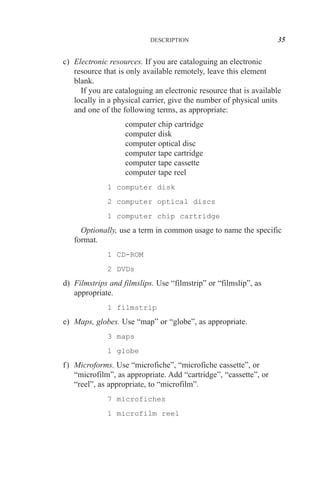
c) Electronic resources. If you are cataloguing an electronic
resource that is only available remotely, leave this element
blank.
If you are cataloguing an electronic resource that is available
locally in a physical carrier, give the number of physical units
and one of the following terms, as appropriate:
computer chip cartridge
computer disk
computer optical disc
computer tape cartridge
computer tape cassette
computer tape reel
1 computer disk
2 computer optical discs
1 computer chip cartridge

Optionally, use a term in common usage to name the specific
format.
1 CD-ROM
2 DVDs

d) Filmstrips and filmslips. Use “filmstrip” or “filmslip”, as
appropriate.
1 filmstrip

e) Maps, globes. Use “map” or “globe”, as appropriate.
3 maps
1 globe

f ) Microforms. Use “microfiche”, “microfiche cassette”, or
“microfilm”, as appropriate. Add “cartridge”, “cassette”, or
“reel”, as appropriate, to “microfilm”.
7 microfiches
1 microfilm reel
36

DESCRIPTION

Optionally, if you have used the general material designation
“microform”, omit “micro” from the statement of extent.
7 fiches
1 film reel

g) Motion pictures. Use “film cartridge”, “film cassette”, “film
loop”, or “film reel”, as appropriate.
4 film reels

Optionally, if you have used the general material designation
“motion picture”, omit “film” from the statement of extent.
4 reels

h) Music. Use “score” and/or “part”, as appropriate.
1 score
2 parts
1 score + 12 parts

i) Slides. Use “slide”.
3 slides

j) Sound recordings. Use “sound cartridge”, “sound cassette”,
“sound disc”, or “sound tape reel”, as appropriate.
2 sound cassettes

Optionally, if you have used the general material designation
“sound recording”, omit “sound” from the statement of extent.
2 cassettes

k) Three-dimensional objects. Use an appropriate term (for
example, “diorama”, “game”, “model”, “toy”).
1 diorama
2 jigsaw puzzles
1 paperweight
DESCRIPTION

37

l) Videorecordings. Use “videocartridge”, “videocassette”,
“videodisc”, or “videoreel”, as appropriate.
1 videodisc

Optionally, if you have used the general material designation
“videorecording”, omit “video” from the statement of extent.
1 disc

m) Graphic materials other than those specified above. Use an
appropriate term (for example, “flash card”, “photograph”).
3 photographs
1 technical drawing
1 activity card
2 pictures

If the bibliographic resource has a playing time that is stated on it or
its container or that can be ascertained easily, add the playing time in
parentheses.
1 sound disc (35 min.)
2 videoreels (88 min.)
8 film reels (105 min.)
5 sound cassettes (30 min. each)

5B2. Extent of books, atlases, and other printed items. Single volumes. Record the number of pages in the main numbered sequence.
327 p.

If there is more than one main numbered sequence, give the number
of pages in each sequence in the order in which the sequences appear
in the item.
320, 200 p.

Ignore unnumbered sequences and minor sequences.
327 p.

not

[32], 327 p.
38

DESCRIPTION

119 p.

not

xii, 119 p.

300 p.

not

12, 300 p.

If there are no numbered sequences or a great many numbered
sequences, give “1 v.”.
5B3. Extent of books, atlases, and other printed resources (including completed printed serials). More than one volume. Record the
number of volumes in a multivolume book or in a “dead”5 printed
serial.
3 v.
200 v.
19 v.

5B4. Incomplete resources. If a multipart bibliographic resource is
incomplete or if it is a “live”6 serial, give one of the terms listed in 5B1
or “v.” (for printed materials).
maps
film reels
v.

5C. Other details
Give other details as set out here.
1) Books, pamphlets and other printed text; microforms; music;
printed serials. If the bibliographic resource contains illustrations, give “ill.”. If the illustrations are numbered sequentially,
give the number in arabic numerals.
320 p. : ill.
320 p. : 37 ill.
1 score : ill.
3 microfiches : ill.
5. A serial that has ceased publication.
6. A serial that is still being issued.
DESCRIPTION

39

If all the illustrations are coloured, give “col. ill.”. If some of
the illustrations are coloured, give “ill. (some col.)”.
320 p. : col. ill.
320 p. : ill. (some col.)

2) Electronic resources. If you are cataloguing an electronic
resource that is only available remotely, leave this element
blank.
If a local electronic resource is stated to produce sound or is
known to produce sound, give “sd.”.
1 computer optical disc : sd.

If a local electronic resource displays in two or more colours
or is known to produce two or more colours, give “col.”.
1 computer optical disc : col.

3) Graphic resources (two-dimensional). If the resource is
coloured, give “col.”.
3 filmstrips : col.
7 posters : col.

If a filmstrip or slide set has integral sound, give “sd.”.
3 filmstrips : col., sd.
48 slides : col., sd.

If, however, a sound recording merely accompanies the filmstrip or slide set, treat it as accompanying material (see rule
5E) or, if appropriate, as part of a kit (see rule 10C).
4) Maps, globes. If the map or globe is coloured, give “col.”.
1 globe : col.
3 maps : col.

5) Motion pictures and videorecordings. Indicate whether the
motion picture or videorecording is sound or silent by giving
“sd.” or “si.”.
40

DESCRIPTION

1 videocassette (74 min.) : sd.
1 film reel (30 min.) : si.

If the motion picture or videorecording is in colour give “col.”.
14 film reels : sd., col.

6) Sound recordings. For analog discs, give “analog” and the
playing speed in revolutions per minute (rpm).
2 sound discs : analog, 33 1/3 rpm

For all other sound recordings, give “analog” or “digital”,7 as
appropriate.
2 sound discs : digital
2 sound cassettes : analog

For all sound recordings, give the number of sound channels if
the information is readily available. Use one of the following terms.
mono. ( for monaural recordings)
stereo. ( for stereophonic recordings)
quad. ( for quadraphonic recordings)
2 sound cassettes : analog, stereo.
1 sound disc (30 min.) : analog,
33 1/3 rpm, stereo.
1 sound disc (70 min.) : digital,
stereo.

7) Three-dimensional objects. Give the material(s) of which the
object is made, unless the materials are numerous or unknown.
2 paperweights : glass
1 diorama : papier mâché
1 game : wood & plastic
1 toy : wool & cotton
7. A digital recording is one in which the sound is digitally encoded on the item
(for example, a “compact disc”).
DESCRIPTION

41

If the object is black and white, give “b&w”. If the object is
in one or two colours, give the name(s) of the colour(s). If it is
in three or more colours, give “col.”.
1 box : wood & metal, b&w
1 vase : porcelain, blue & white
1 paperweight : glass, col.

5D. Dimensions
Give the dimensions of the bibliographic resource as set out here.
1) Books, pamphlets, and other printed texts; music; printed
serials. Give the outside height in centimetres (cm.) to the next
centimetre up.
325 p. : ill. ; 27 cm.
3 v. : col. ill. ; 25 cm.
1 score ; 24 cm.

2) Filmstrips and filmslips. Give the gauge (width) in millimetres
(mm.).
1 filmstrip : col. ; 35 mm.

3) Globes. Give the diameter of the globe in centimetres.
1 globe : col. ; 12 cm. in diam.

4) Maps and two-dimensional graphic items (except filmstrips,
filmslips, and slides). Give the height and width in centimetres
to the next centimetre up.
1 map : col. ; 25 × 35 cm.
1 poster : col. ; 30 × 38 cm.

5) Microfiches. Give the height and width in centimetres to the
next centimetre up, unless they are the standard dimensions
(10.5 cm. × 14.8 cm.). In the latter case, do not give the
dimensions.
3 microfiches ; 12 × 17 cm.
42

DESCRIPTION

6) Motion pictures and microfilm reels. Give the gauge (width) in
millimetres.
1 film reel (12 min.) : sd. ; 16 mm.
1 microfilm reel ; 16 mm.

7) Slides. Do not give the dimensions if they are 5 × 5 cm.
8) Sound discs and electronic discs/disks. Give the diameter in
inches.
1 sound disc : analog, 33 1/3 rpm,
stereo. ; 12 in.
1 sound disc (49 min.) : digital,
stereo. ; 4 3/4 in.
1 computer disk : 3 1/2 in.

9) Sound cassettes and cartridges. Do not give dimensions.
10) Three-dimensional objects. Give the height, or the height
and width, or the height, width, and depth (as appropriate) in
centimetres.
1 sculpture : marble ; 110 cm. high
1 quilt : cotton, red & white ; 278 ×
200 cm.

If the object is in a container, name the container (for
example, “in box”) and add the dimensions of the container.
1 diorama ; in box 30 × 20 × 17 cm.

5E. Accompanying material
5E1. Definition. “Accompanying material” is material issued with,
and intended to be used with, the bibliographic resource being catalogued. It is often, but not always, in a different physical form. Examples
include: a slide set with an accompanying book; a book with an accompanying atlas; a filmstrip with an accompanying sound recording.
5E2. Give the number of physical units and the name of any significant
accompanying material. Use the terms listed in rule 5B when possible.
DESCRIPTION

43

323 p. : ill. ; 24 cm. + 6 maps
3 v. : ill. (some col.) ; 27 cm. + 1
set of teacher’s notes
1 score ; 26 cm. + 1 sound cassette
1 filmstrip : col. ; 35 cm. + 1 sound
disc
1 computer optical disc : sd., col. ;
4 3/4 in. + 1 sound cassette

If the accompanying material is minor, either describe it in a note
(see rule 7B10) or ignore it.

6. SERIES AREA
Contents:
6A.
6B.
6C.
6D.
6E.
6F.

Preliminary rule
Title proper of series
Statements of responsibility relating to series
Numbering within series
Subseries
More than one series

6A. Preliminary rule
6A1. Punctuation
Precede this area by a full stop, space, dash, space (. — ).
Enclose each series statement in parentheses (( )).
Precede a statement of responsibility relating to a series by a space,
diagonal slash, space ( / ).
Precede the numbering within a series by a space, semicolon, space ( ; ).
Precede the title of a subseries by a full stop, space (. ).
6A2. Sources of information. Take information recorded in this area
from the bibliographic resource or its container. Do not give series information taken from any other source.
44

DESCRIPTION

6B. Title proper of series
6B1. Transcribe the title proper of the series as found on the bibliographic resource or its container. See rule 1B for instructions on how
to record titles proper.
(About Britain ...8
(Penguin crime fiction ...
(A1 street atlas series ...
(Family library of great music ...
(Interactive digital computer teaching
models ...

6B2. If more than one form of the series title is found on the bibliographic
resource and its container, give the form found on the resource itself. If
more than one form appears on the resource or if the variant forms appear
only on the container, give the form that best identifies the series.
(Carrier cookery cards ...
(appears on the item as: Cookery cards and as Carrier
cookery cards)

6C. Statements of responsibility relating to series
Only give statements of responsibility about persons or corporate
bodies responsible for the series if they appear on the bibliographic
resource or its container and if they are necessary to identify the series.
See rule 1F for instructions on how to record statements of responsibility.
(Works / Thomas Hardy ...
(Sound cassettes / Institute for the
New Age ...
(Collected software / American
University, English Language Institute
...

8. The three dots here and in the other examples in rule 6 indicate that other elements (for example, numbering) may be necessary to complete the series statement.
DESCRIPTION

45

Do not record statements relating to editors of series.
not

(Society and the Victorians ...
(Society and the Victorians / general
editor John Spiers ...

6D. Numbering within series
6D1. Give the numbering or other designation of the bibliographic
resource within the series if that numbering appears on the item or its
container. Give the numbering or other designation as it appears. Use
standard abbreviations (for example, use “no.” for “number” and “v.”
for “volume”).
(Collectors pieces ; 14)
(VideoClassics ; 312)
(Family library of great music ; album 5)
(Computer simulation games ; module 5)
(Sounds of the seventies ; no. 54)
(Polyphony ; v. E)
(Art and the modern world ; 1981A)

6E. Subseries
If the bibliographic resource is part of a series that is itself part of a
larger series and both series are named on the resource or its container,
give the details of the larger series before the details of the smaller series.
(Science. The world environment)
(Music for today. Series 2 ; no. 8)

6F. More than one series
If the bibliographic resource belongs to two or more separate series
and both are named on the resource or its container, give the details of
each series separately. Give the series statements in the order in which
they appear.
(Video marvels ; no. 33) (Educational
progress series ; no. 3)
46

DESCRIPTION

7. NOTE AREA
Contents:
7A. Preliminary rule
7B. Notes
7A. Preliminary rule
7A1. Give useful descriptive information that cannot be fitted into the
rest of the description in a note. A general outline of types of notes is
given in rule 7B. If a note seems to be useful, give it even if it is not in
that general outline. When appropriate, combine two or more notes to
make one note.
7A2. Punctuation
Precede each note by a full stop, space, dash, space (. — ) or give
each note as a separate paragraph (see rule 0D).
Separate any introductory word(s) of a note (for example, “Contents”, “Summary”) from the rest of the note by a colon, space (: ).
7A3. Sources of information. Take notes from any suitable source.
7A4. Form of notes
Order. Give notes (if there is more than one note) in the order in
which they are given in the general outline (see rule 7B).
References to other works. When referring to another work or
bibliographic resource, give those of the following elements that are
relevant:
Title / statement of responsibility.
Edition. Place : publisher, date.

Give them in that order and with that punctuation.
Revision of: Understand the law /
J.P. Smith. 3rd ed.
Originally published: London : Jampton
& Hardwycke, 1888
Facsimile reprint of: New ed.,
with additions. Oxford : Printed for
R. Clements, 1756
47

DESCRIPTION

Formal notes. Use formal notes (those with the same introductory
word(s)) if they can be easily understood and if they save space.
Informal notes. When writing your own notes, make them as brief
and clear as possible.
7B. Notes
7B1. Special notes for serials and electronic resources
Frequency. If the resource being described is a serial, give the frequency of issue as the first note unless the frequency is obvious from
the title (for example, “Annual report”, “Monthly digest”).
Annual
Weekly
Issued every month except August
Six issues yearly
Updated daily
Irregular

Note changes in frequency.
Weekly (1968-1981), monthly (1982-

)

Local electronic resources. System requirements. Always make a
System requirements note when describing an electronic resource that
is available locally. Give the make and model of the computer(s) on
which it will run and any other system requirements that are important
to its use (for example, amount of memory, name of the operating
system, peripherals). Precede the note with “System requirements:”.
System requirements: Macintosh
System requirements: UNIX workstation
with Mosaic software
System requirements: IBM PC; 64K;
colour card; 2 disk drives

Remote electronic resources. Mode of access. Always make a
mode of access note for a remote electronic resource. Precede the note
48

DESCRIPTION

with “Mode of access:”. If the mode of access is the Web, give the
address.
Mode of access: CSUNet
Mode of access: Lexis system. Requires
subscription
Mode of access: World Wide Web
www.ala.org

7B2. Nature of the item. Make a note giving the nature, scope, or
artistic form of the bibliographic resource if it is not obvious from the
rest of the description.
Documentary
Comedy in two acts
Original recordings from 1921 to 1933
Spreadsheet with word processing and
graphics capabilities
Interactive adventure game

7B3. Language. Make a note on the language(s) of the bibliographic
resource if it is not obvious from the rest of the description.
Commentary in English
French dialogue, English subtitles

7B4. Adaptation. If the bibliographic resource is a manifestation of a
work that is an adaptation of another work, make a note about the other
work.
Based on short stories by P.G.
Wodehouse
Spanish version of: Brushing away tooth
decay
Translation of: Dona Flor e seus dois
maridos
DESCRIPTION

49

7B5. Titles. Make notes on important titles borne by the bibliographic
resource that are different from the title proper.
Title on container: Butterflies and
moths
Disc 3 entitled: This amazing world

If the title of a serial or integrating resource varies slightly, say so.
Title varies slightly

If each issue of a serial has an individual title, say so.
Each issue has its own title

If you have supplied the title from other than the chief source of
information, indicate the source.
Title taken from: List of Chicago jazz
recordings, 1940-1950 / B. McEnroe
Title from script

Electronic resources. Always give the source of the title proper of
an electronic resource.
Title from title screen
Title from CD-ROM label
Title from title screen (viewed
Jan. 20, 2003)
Title based on contents viewed
August 6, 2004

7B6. Credits and other statements of responsibility
Cast. List featured players, performers, narrators, or presenters.
Presenter: Wallace Greenslade
Cast: Diane Keaton, Woody Allen,
Michael Murphy, Mariel Hemingway, Karen
Ludwig, Meryl Streep
50

DESCRIPTION

Credits. List persons (other than the cast) who have made an important contribution to the artistic or technical production of a motion
picture, sound recording, videorecording, etc., and are not named in
the statements of responsibility.
Credits: Producer, Peter Rogers;
director, Gerald Thomas
Credits: Guitar and vocals, Eric
Clapton; keyboards, Dick Sims; vocals,
Marcy Levy; guitar, Georgy Terry; bass
guitar, Carl Radle; drums, Jamie Oldaker
Backing by the Amazing Lost Cowboys
Piano: Gerald Moore

Other statements of responsibility. Give the names of any
person(s) or body (bodies) not named in the statement of responsibility
with an important connection with the bibliographic resource.
Attributed to Aubrey Beardsley
Based on music by Fats Waller
Programmer, Leslie Larsen; reference
manual, Oleg Kanjorski
Systems designer, Henry James; sound,
J&J Acoustics

7B7. Edition and history. If the bibliographic resource is a revision or
reissue, make a note about the earlier item.
Formerly available as: Those rockin’
years
Reprint of the August 30th 1938 issue
Republished on the Internet, 2002
Rev. ed. of: The portable Dorothy
Parker
DESCRIPTION

51

Electronic version of the print
publication, London : Fortune Press,
1956

Serials. Make a note linking the serial being described to another
serial if it is continued by or continues another serial
or is supplementary to another serial
or has any other significant relationship to another serial.
Continued by: The Irish history
newsletter
Continues: Bird watcher’s gazette
Supplement to: The daily collegian
Absorbed: New society, 1988

Integrating resources. If the title of an integrating resource
changes, give the earlier title(s).
Former title: Washington newspapers
database

7B8. Publication, etc. Give important details of the publication or distribution of the bibliographic resource that cannot be given in the publication, etc., area.
Distributed in Canada by: West Coast
Enterprises
Journal first issued in the mid 1960s,
ceased publication in 1981 or 1982

7B9. Physical details. Give important physical details that cannot be
given in the physical description area.
Magnetic sound track
In two containers
Collage of wood, fabric, & paper
Unmounted
Pattern: Fannie’s fan
52

DESCRIPTION

Distributed as a Zip file
Database also on CD-ROM
Still image compressed using JPEG

7B10. Accompanying material and supplements. Give important information about accompanying and supplementary material that cannot
be given elsewhere in the description.
Consists of clear plastic model
and accompanying tape/slide set and
instructional booklet (16 p.)
Set includes booklet: The Dada
influence. 32 p.
Slides with every 7th issue
Sunday issue includes magazine
supplement

7B11. Audience. If the intended audience bibliographic resource is not
apparent from the rest of the description, state it here.
Intended audience: Grades 3-5
For adolescents
Intended audience: Post-graduate
engineering students

7B12. Other formats available. Give details of other formats in
which the content of the bibliographic resource has been issued.
Issued also on cassette tape
Issued also as cassette (VHS)
Online version of the print publication:
Icarus
Also issued electronically via World
Wide Web in PDF format
DESCRIPTION

53

7B13. Summary. Give a brief summary of the content of a bibliographic resource if it is required by the policy of your library.
Summary: Melissa and her friends
discover a hidden treasure and defeat a
gang that wants to steal it
Summary: Episodes from the novel about
a corrupt library administrator, read by
the author
Summary: A brief historical account of
the discovery of antibiotics
Summary: A reading exercise presenting
some aspects of Native American culture
Summary: An interactive multimedia tool
for studying the human anatomy

7B14. Contents. If the bibliographic resource consists of a number of
named parts, list those parts in the order in which they occur if the
policy of the library requires such listings. Separate the names of the
parts by a space, dash, space ( — ).
Contents: Polonaise in F sharp minor,
op. 44 -- Polonaise in A flat, op. 53 -Polonaise in A, op. 40, no. 1 -Nocturne, op. 27, no. 1 -- Etude, op.
10, no. 3 -- Mazurka in B flat, op. 7,
no. 1
Contents: Queen Lucia -- The male
impersonator -- Lucia in London
Contents: Trent’s last case -- Trent’s
own case / with H. Warner Allan -- Trent
intervenes
Contents: CD-ROM data (1:29) -- The
young person’s guide to the orchestra
(16:27) -- Extra audio examples (55:43)
54

DESCRIPTION

If the bibliographic resource contains an important part that is not
evident from the rest of the description, note that here.
Includes some poems
(title is: Collected prose works)
Includes three études and two mazurkas
(title is: Chopin’s polonaises)
Includes bibliographical references

7B15. Copy being described, library’s holdings, and restrictions on
use. Make notes on:
a) important descriptive details of the copy being described
Library’s set lacks slides 7, 8, and 9
Library’s copy signed by the author

b) your library’s holdings of an incomplete multipart resource
Library has vol. 1 and vols. 3-8

c) any restrictions on use.
Available to faculty and graduate
students only
Resource closed until March 6th, 2011

7B16. “With” notes. If the bibliographic resource being catalogued
lacks a collective title and the title given in the title and statement of
responsibility area applies to only part of that resource (see rule 1G)
because you are making a separate entry for each of the parts of the
item, make a note beginning “With:” and listing the titles of the other
parts in the order in which they occur.
With: Symphony no. 5 / Beethoven (side B)
With: Aimless love / J.M. Morgan -Headwinds / Joe M. Philipson

7B17. Serials, integrating resources, and multipart resources:
basis for the description. If the first issue of a serial, first iteration of
an integrating resource, or first part of a multipart bibliographic
DESCRIPTION

55

resource is not the basis for the description, give details of the issue,
iteration, or part that is. For remote access resources, always give the
date on which the resource was viewed.
Description based on: Vol. 5, no. 1
(March/April 1997)
Description based on printout of screen
display of: Vol. 17, no. 1 (Mar. 1994)
Description based on home page dated
August 9, 1998
Description based on source viewed
September 2, 2003

8. STANDARD NUMBER
Contents:
8A. Preliminary rule
8B. Standard number
8A. Preliminary rule
8A1. Punctuation
Precede this area by a full stop, space, dash, space (. — ) or start a
new paragraph (see rule 0D).
8A2. Sources of information. Take standard numbers from any suitable source.
8B. Standard number
8B1. Give the International Standard Book Number (ISBN), or International Standard Serial Number (ISSN), or any other internationally
agreed standard number of the bibliographic resource being described.
Precede that number with the standard abbreviation (ISBN, ISSN, etc.)
and use standard hyphenation.
ISBN 0-8389-3346-7
ISSN 0002-9869
56

DESCRIPTION

8B2. If the resource has more than one such number, give the one that
applies specifically to the entity being described.
ISBN 0-379-00550-6
(this is the ISBN for the set being described; volume 1
also carries an ISBN for that volume; do not record it)

9. SUPPLEMENTARY ITEMS
9A. Supplementary bibliographic resources described independently
If a supplementary bibliographic resource has its own title and can
be used independently, make a separate description. Link it to the bibliographic resource to which it is supplementary by making a note (see
rule 7B7).
Hye sharzhoom : the newspaper of the
California State University, Fresno
Armenian Students Organization and
Armenian Studies Program. -- Vol. 2,
no. 1 (Nov. 1979)-. -- Fresno : Armenian
Studies Program, CSUF, 1978v. : ill. ; 44 cm.
Quarterly
Title also appears in Armenian script
Vol. 1 consisted of unnumbered “special
issues”
Supplement to: The daily collegian

9B. Supplementary bibliographic resources described dependently
If a supplementary bibliographic resource has no independent title
or cannot be used independently:
either record it as accompanying material (see rule 5E)
5 v. : ill. ; 32 cm. + 1 v.

or make a note (see rule 7B10).
Note: Accompanied by supplement (37 p.)
issued in 1969
57

DESCRIPTION

10. RESOURCES MADE UP OF MORE THAN
ONE TYPE OF MATERIAL
10A. Apply this rule to bibliographic resources that are made up of two
or more parts, two or more of which belong to separate material types
(for example, a book and a sound recording).
10B. If the resource has a main component, make a description based
on that main component and give details of the secondary
component(s):
either as accompanying material (see rule 5E)
47 slides : col. + 1 sound tape
reel

or in a note (see rule 7B10).
3 v. : ill. ; 30 cm.
Note: Sound disc (12 min. : digital,
stereo. ; 4 3/4 in.) in pocket at
end of v. 3

10C. If the resource has no one main component, follow the rules
below as well as the other rules in this part.
10C1. General material designation. If you are using general material
designations (see rule 1C), and the bibliographic resource has a collective title, give “[kit]”.
Multisensory experience for the
preschooler [kit]

If the resource has no collective title, give the appropriate designation after each title.
Telling the time [filmstrip].
story of time [sound recording]

The

10C2. Physical description. Either give separate physical descriptions
for each part or group of parts belonging to each distinct class of material, starting a new paragraph with each physical description
Tomato growing [kit] : a multimedia
presentation / concept, Dion Garber ;
58

DESCRIPTION

programmer, Trev Baxter. -- Dallas :
Thraxton Multimedia, 1997
46 slides : col.
1 sound disc (15 min.) : digital,
stereo. ; 4 3/4 in.
1 electronic disk : col. ; 3 1/2 in.
(AgriMedia ; A32)

or give a general term as the statement of extent for bibliographic
resources with a large number of different materials. Add the number
of pieces if that number can be ascertained easily.
various pieces
36 pieces

10C3. Notes. Make notes on each of the particular parts as the first
note(s).
Tape cassette also available as
disc. -- Slides photographed in Death
Valley, Calif.

11. FACSIMILES, PHOTOCOPIES, AND
OTHER REPRODUCTIONS
In describing a facsimile, photocopy, or other reproduction in eyereadable or microform, describe the facsimile, etc., and not the original.
Give data relating to the original in a single note.
Demos : a story of English socialism /
George Gissing ; edited with an introduction
by Pierre Coustillas. -- Brighton, Sussex
: Harvester Press, 1972.
477 p. ; 23 cm. -- (Society and the
Victorians)
Facsimile reprint of: New ed. London :
Smith Elder, 1897
DESCRIPTION

59

Alice’s adventures under ground / by
Lewis Carroll. -- New York : Dover, 1965.
91 p. : ill. ; 22 cm.
Complete facsimile of the British
Museum manuscript of: Alice’s adventures
under ground
PART 2

Headings, Uniform Titles,
and References

Introduction
When you have made a standard description according to rules 0-11,
add access points (name headings and/or titles) in accordance with the
rules in this part to that description to create a catalogue entry. The
rules that follow deal with the choice of access points (21–29), with
their form (30–61), and with the making of references (62–65). General
rules precede specific rules. If you cannot find an appropriate specific
rule, use the preceding general rule.
The rules in this part apply to all forms of library materials (printed,
audiovisual, electronic, etc.) and to monographic, serial, and integrating resources.
Rules 40–43, 46B, and 51 deal with additions to access points. Always
make these additions (if possible) if they are necessary to differentiate
between otherwise identical access points in the same catalogue. For
example:
Robertson, John, 1903-1971
Robertson, John, 1918-

If you wish, make such additions even if they are not needed now,
so that future conflicts can be avoided.
As in rules 0–11, the examples in the following rules are supposed
only to illustrate the rule, not to add to it. In cases of doubt, always
prefer the rule as guidance rather than the examples.
The presentation of examples is intended to help you to understand
the rules. It is not intended to imply a certain form of presentation in
your catalogue. The transcriptions from the source of information are
set out in ISBD style (see part 1). In a few instances (see, for example,
rule 25C2), more information than is required for a standard description is included to demonstrate the rule fully.
60
Choice of Access Points

Contents
21.
21A.
21B.
21C.

INTRODUCTION
Main and added entries
Sources for determining access points
Form of examples

22.
22A.
22B.
22C.
22D.

CHANGES IN TITLES PROPER
Definition
Monographs
Serials
Integrating resources

23.
23A.
23B.
23C.

GENERAL RULE
Works of personal authorship
Entry under corporate body
Entry under title

24.

WORKS FOR WHICH ONE PERSON OR CORPORATE
BODY IS RESPONSIBLE
Works by one person
Works for which one corporate body is responsible

24A.
24B.
25.
25A.
25B.
25C.
26.

WORKS FOR WHICH TWO OR MORE PERSONS OR
CORPORATE BODIES ARE RESPONSIBLE
Scope
Principal responsibility indicated
Principal responsibility not indicated

26A.
26B.
26C.

COLLECTIONS OF WORKS BY DIFFERENT PERSONS
OR BODIES
Scope
With collective title
Without collective title

27.
27A.

WORKS OF MIXED RESPONSIBILITY
Scope
61
62

ACCESS POINTS

27B.
27C.

Modifications of existing works
New works

28.
28A.

RELATED WORKS
Scope

29.
29A.
29B.
29B1.
29B2.
29B3.
29B4.
29B5.
29B6.
29B7.
29B8.

ADDED ENTRIES
General rule
Specific applications
Two or more persons or corporate bodies involved
Examples of added entries
Other related persons or bodies
Related works
Titles
Special rules for translators and illustrators
Series
Analytical added entries

21. INTRODUCTION
21A. Main and added entries
Use rules 23–29 to decide the access points (name headings and/or
titles) that are to be added to the bibliographic description (see rules 0–11)
so that the description can be added to, and retrieved from, a catalogue.
Use rules 23–28 to decide which access point is the heading for the
main entry (other access points being headings for added entries). If,
however, your library does not distinguish between main entries and
added entries, treat all access points as equal and use rules 23–29 to tell
you which and how many access points to make.
Generally, each rule and its example(s) only cover certain addedentry access points. Additional added-entry access points (for example,
series and title headings) may be required by the general rule on added
entries (see rule 29).
21B. Sources for determining access points
Prefer the chief source of information (see rule 0A) to other sources,
but also take into account any relevant information found elsewhere on
ACCESS POINTS

63

the bibliographic resource and, when necessary, in accompanying
material and reference sources.
21C. Form of examples
The examples in rules 24–29 indicate only the access points to be
made without showing their complete form. Use rules 30–61 to establish the complete form.
When an example is followed by “Main entry under title” or
“Added entry under title”, it usually means the title proper (see rule
1B). In a few cases it may mean the uniform title (see rules 57–61).

22. CHANGES IN TITLES PROPER
22A. Definition
Except for multipart resources (see rule 22B) and integrating resources
(see rule 22D), make a new catalogue entry for a work if its title
changes (see rule 22C). A title proper has changed if:
1) any word other than an article (for example, “the,” “a,” “le”), a
preposition (for example, “to,” “de,” “of ”), or a conjunction
(for example, “and,” “but,” “aber”) is added, deleted, or
changed
or
2) there is a change in the order of the first five words (six if the
title begins with an article).
However, do not make a new catalogue entry if the change is:
1) in the representation of a word or words (for example, ignore a
change from “Trout and salmon news” to “Trout & salmon
news”)
2) after the first five words (six if the first is an article) and does
not change the meaning of the title (for example, ignore a
change from “The journal of the antiquities of Bootle and surroundings” to “The journal of the antiquities of Bootle and its
environs”)
3) the addition or deletion of the name of the issuing body at the
end of the title (for example, ignore a change from “The
64

ACCESS POINTS

journal of the cuisine of provincial Indiana of the League of
Hoosier Gourmets” to “The journal of the cuisine of provincial
Indiana”)
or
4) the addition, deletion, or change of punctuation (for example,
ignore a change from “Boot, shoe, sandal news” to “Boot/
shoe/sandal news”.
22B. Monographs
If the title proper of a monograph in more than one physical part (for
example, a multivolume book) changes from one part to another, use
the title proper of the first part as the title proper of the whole monograph. Make a note (see rule 7B5) about the other title(s).
The romance of the tomato : a seven
part instructional film / devised and
presented by Gervase Scudamore. -London : Hamberger & Pollock, 1987
7 film cassettes (20 min. each) : sd.,
col. ; standard 8 mm.
Cassettes 6 and 7 entitled: The tomato
and you

22C. Serials
If the title proper of a serial changes, make a separate main entry for
each title. Link these entries with notes (see rule 7B7).
22D. Integrating resources
If the title proper of an integrating resource changes, replace the
former title proper with the new title proper. Give the earlier title in a
note (see rule 7B7).

23. GENERAL RULE
23A. Works of personal authorship
23A1. Definition. A personal author is the person who is chiefly
responsible for the content of a work. Examples are:
ACCESS POINTS

65

writers of texts
composers of music
artists (sculptors, painters, etc.)
photographers
compilers of bibliographies
cartographers (makers of maps)
creators of electronic resources
In some cases (see rule 27B1g), treat performers as the authors of
sound recordings.
23A2. Enter a work by one person under the heading for that person
(see rule 24A).
Enter a work by two or more persons under:
the principal personal author (see rule 25B1)
or
the person named first (see rules 25B2, 25C1, and 27)
or
its title (see rules 25C2 and 26B).
Make added entries as instructed in rule 29.
23B. Entry under corporate body
23B1. Definition. A corporate body is an organization or group of
persons that has a name. If you are in doubt as to whether words indicating a particular body constitute a name, treat them as a name if they
have initial capital letters and/or if they begin with the definite article
(for example, “The,” “Le”). For example, “The British Museum” is a
name and “a group of concerned citizens” is not; “The Modern Jazz
Quartet” is a name and “seven rock superstars” is not. In other cases of
doubt, do not regard the phrase as a name.
Examples of corporate bodies are:
business firms
governments (local and national)
government agencies (local and national)
churches
associations (for example, clubs, societies)
institutions (for example, museums, libraries,
schools)
66

ACCESS POINTS

international agencies
conferences
exhibitions, expeditions, and festivals
performing groups
Some corporate bodies are subordinate to (part of) other bodies. For
example, the Henry Madden Library is a part of the California State
University, Fresno; the Home Office is part of the government of the
United Kingdom.
23B2. Enter a work issued by a corporate body or originating from a
corporate body under the heading for that body (see rule 24B) if it is
one or more of the following:
a) an administrative work dealing with:
the corporate body itself (for example, an annual report)
or its policies, procedures, operations, etc. (for example, a
policy statement, a staff manual)
or its finances (for example, a budget, a financial report)
or its personnel (for example, a staff list)
or its resources or possessions (for example, a catalogue,
an inventory, a membership directory)
b) a law or collection of laws, an administrative regulation, a
treaty (for detailed guidance on these materials, see the full
AACR2)
c) a report of a committee, commission, etc. (provided that the
report states the opinion of the committee, etc., and does not
merely describe a situation objectively)
d) a liturgical text for which a particular church, denomination,
etc., is responsible (for detailed guidance on these materials,
see the full AACR2)
e) a collection of papers given at a conference (provided that the
conference is named in the item being catalogued); the report
of an expedition (provided that the expedition is named in the
item being catalogued)
f ) a sound recording, videorecording, or film created and performed by a group
g) a map or other cartographic material created by a corporate
body.
ACCESS POINTS

67

If such a work originates from two or more bodies, see also rules
25–27.
If a work does not fall into one of the types listed above, or if you
are in doubt about whether it does, enter it under a person’s name or
under title as appropriate. In addition, make added entries under the
names of prominently named corporate bodies as instructed in rule
29B2e.
23C. Entry under title
Enter a work under its title when:
1) the author is unknown and no corporate body is responsible
(see rule 23B2)
2) the work has more than three authors and none of them is the
principal author (see rule 25C2) and no corporate body is
responsible (see rule 23B2)
3) it is a collection and has a collective title (see rule 26B)
4) it is not by a person or persons and is issued by a corporate
body but is not one of the types of publication listed in rule
23B2
5) it is a sacred scripture (such as the Bible, the Koran, or the
Talmud) or an ancient anonymous work (such as Beowulf or
the Arabian nights).

24. WORKS FOR WHICH ONE PERSON OR
CORPORATE BODY IS RESPONSIBLE
24A. Works by one person
Enter a work by one person under the heading for that person even
if he or she is not named in the bibliographic resource being catalogued.
The good soldier / by Ford Madox Ford
Main entry under the heading for Ford
I.F. Stone’s newsletter
Main entry under the heading for Stone
68

ACCESS POINTS

Wavelength / Van Morrison
(a sound recording composed, produced, and
performed by Morrison)
Main entry under the heading for Morrison
Don Quixote
(a print by Picasso)
Main entry under the heading for Picasso
Collins Italian gem dictionary :
Italian-English, English-Italian /
Isopel May
Main entry under the heading for May
Newts in the wild : London ponds /
made by Norma McEachern
(a filmstrip)
Main entry under the heading for McEachern
Ecstasy and me : my life as a woman /
Hedy Lamarr
(the “ghosted” autobiography of a movie star,
“ghost-writer” not named )
Main entry under the heading for Lamarr

Enter a collection of, or selections from, works by one person under
the heading for that person even if she or he is not named in the bibliographic resource being catalogued.
The Brandenburg concertos / J.S. Bach
Main entry under the heading for Bach
The poems of John Keats / edited by
Jack Stillinger
Main entry under the heading for Keats
The sweet singer of Penge
(a collection of poems published anonymously but
known to be by Eric Lancaster)
Main entry under the heading for Lancaster
Selected essays / George Orwell
Main entry under the heading for Orwell
ACCESS POINTS

69

24B. Works for which one corporate body is responsible
If a work originating from a single corporate body falls into one or
more of the categories listed in rule 23B2, enter it under the heading
for the body.
Entry under corporate heading
Administrative works
Annual report of the Institute for the
Furtherance of Psychic Studies
Main entry under the heading for the Institute
Additions to the Library / H.D. Timpson
Library, Branksome
Main entry under the heading for the Library
Rules and regulations of the Chicago
Board of Trade
Main entry under the heading for the Board

Laws, etc.
The health and safety at work act 1974
(a British law)
Main entry under the heading for the United Kingdom
Rules, regulations, and by-laws
relating to the storage and sale of fish
/ City of Minneapolis
Main entry under the heading for Minneapolis

Committee, etc., reports
Report and recommendation to the
Governor and the General Assembly /
Illinois Commission on the Status of
Women
(a serial )
Main entry under the heading for the Commission
70

ACCESS POINTS

Hartford Civic Center Coliseum roof
collapse : final report / Common Council
Committee to Investigate the Coliseum
Roof Failure
Main entry under the heading for the Committee

Liturgical works
Rite of marriage. -- Washington :
United States Catholic Conference
Main entry under the heading for the Catholic Church

Conference, etc., proceedings
Abstracts of the annual meeting /
Free Thought Society
Main entry under the heading for the Society’s meeting
Proceedings / Conference on the
Mass Media and the Black Community,
Cincinnati, 1969 ; sponsored by the
Pen and Paper Club of Cincinnati
Main entry under the heading for the Conference

Works created and performed by a group
Bridges to Babylon / the Rolling Stones
(a sound recording composed, produced, and
performed by the rock group)
Main entry under the heading for the group
Free South Africa! : an improvisational
video performance / the Children of the
Universe
Main entry under the heading for the group

Maps created and published by a corporate body
Fresno & Fresno County. -- Modesto, Ca.
: Compass Maps, 1986
Main entry under the heading for Compass Maps
ACCESS POINTS

71

Entry not under corporate heading
Italians in America / made and released
by the Anti-Defamation League of B’nai
B’rith
(a filmstrip)
Main entry under title
Added entry under the heading for the League
Symphony no. 8 in B minor (Unfinished)
/ Schubert
(a sound recording by the Philadelphia Orchestra)
Main entry under the heading for Schubert
Added entry under the heading for the Orchestra
Bulletin / Pinner Ornithological
Society
Main entry under title
Added entry under the heading for the Society
California library directory : listings
for public, academic, special, state
agency, and county law libraries /
Library Development Services Bureau,
California State Library
Main entry under title
Added entry under the heading for the Bureau
Costs and revenue of national
newspapers / National Board for Prices
and Incomes
Main entry under title
Added entry under the heading for the Board
Near Eastern art in Chicago collections
/ the Art Institute of Chicago, November
17, 1973-January 20, 1974
(a catalogue of an exhibition)
Main entry under title
Added entry under the heading for the Institute
72

ACCESS POINTS

The political lighthouse / owned,
operated, and maintained by Starlight
(an electronic resource)
Main entry under title
Added entry under the heading for Starlight

25. WORKS FOR WHICH TWO OR MORE PERSONS
OR CORPORATE BODIES ARE RESPONSIBLE
25A. Scope
Apply this rule to:
1) works produced by two or more persons (joint authors, collaborators, etc.)
2) works for which two or more persons have prepared separate
contributions (including the records of debates and discussions)
3) works consisting of letters, etc., exchanged by two or more
persons
4) works issued by, or originating from, two or more corporate
bodies and that fall into one or more of the categories listed in
rule 23B2.
For works consisting of collections of, or selections from, already
existing works (such as anthologies), see rule 26.
For special types of collaboration, see rule 27.
25B. Principal responsibility indicated
25B1. If the layout or wording of the chief source of information of a
bibliographic resource that is a manifestation of a work by two or more
persons or bodies indicates clearly that one person or body is chiefly
responsible, enter under the heading for that person or body. Make
added entries under the headings for the other persons or bodies if
there are not more than two of them.
The Taylor system in Franklin
management : application and results /
by George D. Babcock in collaboration
with Reginald Trautschold
Main entry under the heading for Babcock
Added entry under the heading for Trautschold
ACCESS POINTS

73

Unknown horizons : visions of the
distant future : a video experience /
Maude LaFarge with the help of Simon,
Paul, and Janette
Main entry under the heading for LaFarge
Technical services in libraries :
acquisitions, cataloging, classification,
binding, photographic reproduction, and
circulation operations / by
Maurice F. Tauber and associates
(the seven associates are named on the leaf following
the title leaf )
Main entry under the heading for Tauber

25B2. If two or three persons or bodies are shown as being principally
responsible, enter under the heading for the one named first. Make
added entries under the headings for the others.
Elementary differential equations
with linear algebra / Ross L. Finney,
Donald R. Ostberg with the assistance
of Robert G. Kuller
Main entry under the heading for Finney
Added entry under the heading for Ostberg

25C. Principal responsibility not indicated
25C1. If, in the case of a work by two or three persons or bodies, no
one person or body is clearly principally responsible (see rule 25B),
enter under the heading for the one named first. Make added entries
under the headings for the others.
Women artists, the twentieth century /
authors Karen Petersen, J.J. Wilson
(a slide set )
Main entry under the heading for Petersen
Added entry under the heading for Wilson
74

ACCESS POINTS

The basement tapes / Bob Dylan & the Band
(sound recording of songs written and performed by
Dylan and the rock group the Band )
Main entry under the heading for Dylan
Added entry under the heading for the Band
PolicyWonk.com : tools and resources
for policy mavens / by Shane Heiser and
Ken Zimmerman
Main entry under the heading for Heiser
Added entry under the heading for Zimmerman
General college mathematics / W.L.
Ayres, Cleota G. Fry, H.F.S. Jonah
Main entry under the heading for Ayres
Added entries under the headings for Fry and Jonah

25C2. If, in the case of a work by four or more persons or bodies, none
of the persons or bodies is clearly principally responsible (see rule
25B), enter under the title. Make an added entry under the heading for
the first person or body named in the chief source of information.
Outlaw country / Willie Nelson, Waylon
Jennings, David Allan Coe, Hank Williams, Jr.
(sound recording; all four performers named on
the labels)
Main entry under title
Added entry under the heading for Nelson
The art of Gauguin / Richard Brettell,
Françoise Cachin, Claire Fréches-Thory,
Charles F. Stuckey
(exhibition catalogue; all four authors named on
title page)
Main entry under title
Added entry under the heading for Brettell
The modern age / edited by Boris Ford
(essays by various people produced under the
editorship of Ford )
Main entry under title
Added entry under the heading for Ford
ACCESS POINTS

75

26. COLLECTIONS OF WORKS BY DIFFERENT
PERSONS OR BODIES
26A. Scope
Apply this rule to:
1) collections of independent works, or extracts from individual
works, by different persons or bodies (for example, anthologies)
2) works consisting partly of independent works and partly of
contributions by different persons or bodies.
Do not apply this rule to works covered by rule 23B2 (for example,
conference proceedings).
26B. With collective title
If a bibliographic resource belongs to one of the types listed in rule
26A and has its own collective title, enter it under that title.
If the resource has one, two, or three editors or compilers named in
the chief source of information, make added entries under the headings
for each of them. If there are four or more editors or compilers named
in the chief source of information, make an added entry under the
heading for the one named first.
The new Oxford book of English light
verse / chosen by Kingsley Amis
Main entry under title
Added entry under the heading for Amis
The family of man ... / created by
Edward Steichen
(collection of 503 photographs by various people)
Main entry under title
Added entry under the heading for Steichen
Why a duck? : visual and verbal gems
from the Marx Brothers movies / edited
by Richard J. Anobile
Main entry under title
Added entry under the heading for Anobile
76

ACCESS POINTS

26C. Without collective title
If a bibliographic resource belongs to one of the types listed in rule
26A and has no collective title, enter it under the heading for the first
work named in the chief source of information. If the resource lacks a
chief source of information, enter it under the heading for the first
work in the item.
Make added entries under the headings for editors, compilers,
and/or contributors as instructed in rule 26B.
Make an analytical added entry (see 29B8) for each of the works in
such a resource.
A John Field suite / Harty. A dance
in the sunshine / Bax. A Shropshire
lad, etc. / Butterworth. There is a
willow grows aslant a brook / Bridge
Main entry under the heading for Harty
Added entries (name/title; see rule 29B4) under the headings
for Bax, Butterworth, and Bridge

27. WORKS OF MIXED RESPONSIBILITY
27A. Scope
A work of mixed responsibility is one that involves the collaboration of two or more persons or bodies (see rule 23B2 for cases in which
a corporate body is responsible) and to which the persons and/or
bodies make different kinds of contribution. Examples of the different
kinds of contribution are: writing, adapting, illustrating, editing, arranging, translating, and performing.
Typical instances of mixed responsibility are:
a work with text by one person and illustrations by another
a work created by one person and adapted by another
a work by one person with a commentary by another
a work by one person translated by another
a law for which a corporate body is responsible with a
commentary by a person
an electronic resource created by one person with software
written by another
ACCESS POINTS

77

a musical work by one person arranged by another
a musical work by one person performed by another person or
by a performing group.
This rule divides all cases of mixed responsibility into two types.
These are:
1) modifications of existing works (see rule 27B)
2) new works produced by the collaboration of different persons
and/or bodies making different intellectual or artistic contributions (see rule 27C).
27B. Modifications of existing works
27B1. Enter a work that is a modification of an existing work under the
heading for the new work and make a name/title added entry (see rule
29B4) for the original work if the nature and content of the original has
been changed substantially or if the medium of expression has changed.
Examples of such change are:
a) paraphrases, rewritings, adaptations for children, and versions
in a different literary form of written works
Jump! : the adventures of Brer Rabbit
/ by Joel Chandler Harris ; adapted by
Van Dyke Parks and Malcolm Jones
(adaptation of Harris’s Adventures of Brer Rabbit)
Main entry under the heading for Parks
Added entry under the heading for Jones
Added entry (name/title) under the heading for Harris
Robert Fitzgerald reads from his Iliad
(sound recording, read by the poet, of his modern
version of Homer’s Iliad)
Main entry under the heading for Fitzgerald
Added entry (name/title) under the heading for Homer

b) revisions of texts when the reviser(s) is named in the chief
source and the original author(s) either is no longer named in
the title and statement of responsibility area or is named only
in the title proper
78

ACCESS POINTS

The law of Ireland / G. Fenn
(“a complete revision of Innes and Montgomery’s Irish
law”—title page)
Main entry under the heading for Fenn
Added entry (name/title) under the heading for Innes
Roget’s Thesaurus of English words and
phrases. -- New ed. / completely revised
and modernized by Robert A. Dutch
Main entry under the heading for Dutch
Added entry (name/title) under the heading for Roget

c) commentaries when the bibliographic resource is presented as a
commentary
The Theaetetus of Plato: a commentary /
by Spenser Sayers
(contains the Greek text of the Theaetetus)
Main entry under the heading for Sayers
Added entry (name/title) under the heading for Plato

d) adaptations of graphic art works from one medium of the
graphic arts to another
Courbet’s The painter’s studio / an
engraving by M.M.C.
Main entry under the heading for M.M.C.
Added entry (name/title) under the heading for Courbet

e) reproductions of art works with text when the writer of the text
is represented as the author of the work in the chief source of
information
William Morris wallpapers and chintzes
/ Fiona Clark
(reproductions of Morris’s designs with an annotated
catalogue by Clark)
Main entry under the heading for Clark
Added entry under the heading for Morris

f ) alterations (free transcriptions, etc.), paraphrases, and variations of musical works
ACCESS POINTS

79

Rhapsody on a theme by Paganini : for
piano and orchestra / Rachmaninov
Main entry under the heading for Rachmaninov
Added entry under the heading for Paganini

g) sound recordings of works by different persons performed by a
principal performer or performers1
Contrary to ordinary / Jerry Jeff Walker
(ten songs, each by a different composer, performed by
Walker)
Main entry under the heading for Walker
James Galway plays Song of the seashore
and other melodies of Japan
(compositions by various Japanese composers,
performed by Galway)
Main entry under the heading for Galway
The fine art of surfacing / the
Boomtown Rats
(songs, by various members of the band, performed by
a rock group)
Main entry under the heading for the band

h) novels, etc., based on motion pictures, television shows, etc.
Star wars: the novel of the smash hit
movie / by E.B. Knowles
Main entry under the heading for Knowles
Added entry under the heading for the motion picture
The laugh was on Lazarus: a novel
based on the ABC television series The
avengers / John Garforth
Main entry under the heading for Garforth
Added entry under the heading for the television series

1. Consider such a sound recording to have a principal performer or principal performers when the wording, layout, typography, etc., of the chief source of information clearly present the activity of the performer(s) as the major purpose of the
recording.
80

ACCESS POINTS

i) motion pictures, television shows, electronic resources, etc.,
based on novels and other texts.
The charmer / by Allan Prior
(six-part television play based on Patrick Hamilton’s
novel Mr. Stimpson and Mr. Gorse)
Main entry under title
Added entries (name/title) under the headings for Prior and
Hamilton
Romeo & Juliet / producer Chris
Jennings. -- Version 1.00c
(an electronic interactive multimedia resource based on
the Shakespeare play)
Main entry under title
Added entry under the heading for Jennings
Added entry (name/title) under the heading for Shakespeare

27B2. Enter any other modification of an existing work under the
heading for the original work.
Examples of modifications entered under the headings for the original works are:
a) musical works by one person performed by another
Willie Nelson sings Kris Kristofferson
(songs by Kristofferson, performed by Nelson)
Main entry under the heading for Kristofferson
Added entry under the heading for Nelson

b) translations
Twenty love poems and a song of
despair / Pablo Neruda ; translated by
W.S. Merwin
Main entry under the heading for Neruda
Added entry under the heading for Merwin (see rule 29B6)
True history ; and Lucius, or, The ass
/ Lucian ; translated from the Greek by
Paul Turner
Main entry under the heading for Lucian
ACCESS POINTS

81

Added entry (name/title; see rule 29B8) under the heading
for Lucian for Lucius, or, The ass
Added entry under the heading for Turner (see rule 29B6)

c) arrangements of musical works
Original motion picture soundtrack, The
sting / featuring the music of Scott
Joplin ; adapted and arranged by Marvin
Hamlisch
Main entry under the heading for Joplin
Added entry under the heading for Hamlisch

d) texts with commentary when the item is presented as an edition
of the text
Plato’s Republic : with a commentary /
by Roderick Wolfe
Main entry under the heading for Plato
Added entry under the heading for Wolfe

e) abridgements of, and excerpts from, existing works
Great scenes from Pickwick
(excerpts from Dickens’ Pickwick papers)
Main entry under the heading for Dickens
My life with Sherlock Holmes :
conversations in Baker Street / edited
by J.R. Hamilton
(selections from Arthur Conan Doyle’s Sherlock
Holmes stories)
Main entry under the heading for Doyle
Added entry under the heading for Hamilton

f ) illustrated works.
The world of Pooh : the complete Winniethe-Pooh and The house at Pooh Corner /
by A.A. Milne ; with decorations and new
illustrations in full colour by E.H. Shepard
Main entry under the heading for Milne
Added entry under the heading for Shepard (see rule 29B6)
82

ACCESS POINTS

27C. New works produced by persons or bodies making
different intellectual or artistic contributions
Enter a work produced by two or more persons or bodies making
different intellectual or artistic contributions under the heading for the
person or body given prominence by the wording or layout of the chief
source of information of the bibliographic resource being catalogued.
If there are two or three collaborating persons or bodies, make an
added entry under the heading(s) for the other(s).
If no one person or body is given prominence and there are two or
three persons or bodies named, enter under the heading for the person
or body named first in the chief source. Make an added entry under the
heading(s) for the other(s).
If no one person or body is given prominence and there are more
than three persons or bodies named, enter under title. Make an added
entry under the heading for the person or body named first.
Goodbye baby & amen : a saraband for
the sixties / David Bailey & Peter Evans
(photographs by Bailey, text by Evans)
Main entry under the heading for Bailey
Added entry under the heading for Evans
Duffy and the devil : a Cornish tale /
retold by Harve Zemach ; with pictures
by Margot Zemach
Main entry under the heading for H. Zemach
Added entry under the heading for M. Zemach

28. RELATED WORKS
28A. Scope
Apply this rule to a separately catalogued work that has a relationship to another separately catalogued work.
Typical examples of related works are:
continuations and sequels
supplements
ACCESS POINTS

83

indexes
concordances
screenplays, scenarios, etc.
collections of extracts from serials
subseries
special numbers of serials
For adaptations, revisions, translations, etc., see rule 27.
28B. Enter a related work under its own heading according to the rules
on entry (rules 23–27). Make the appropriate added entries according
to those rules and rule 29.
Make an added entry under the name heading or name/title (see rule
29B4) or title, as appropriate, of the work(s) to which it is related.
Colonel Sun / Robert Markham
(a sequel to Ian Fleming’s series of James Bond novels)
Main entry under the heading for Markham
Added entry under the heading for Fleming
Index of characters and events in the
Pickwick papers / Nigel Appleby
(an index to the novel by Dickens)
Main entry under the heading for Appleby
Added entry (name/title) under the heading for Dickens
Blue / writers, Meade Roberts,
Ronald M. Cohen
(the screenplay of the motion picture Blue)
Main entry under the heading for Roberts
Added entries under the headings for Cohen and the motion
picture
English art, 1970: a special number of
Eclectic art review
Main entry under title
Added entry under Eclectic art review
84

ACCESS POINTS

Alice’s wonders / adapted from “Alice
in Wonderland” by Wilford Hagers
(a computer program based on the Lewis Carroll work)
Main entry under the heading for Hagers
Added entry (name/title) under the heading for Carroll
Writing for love or money : thirty-five
essays reprinted from the Saturday review
of literature
Main entry under title
Added entry under Saturday review of literature
Carleton journalism review
(distributed with Content: Canada’s national news
media magazine)
Main entry under title
Added entry under Content

29. ADDED ENTRIES
29A. General rule
29A1. Scope. Rule 29 gives general guidance on the making of added
entries. Use it to supplement the specific instructions in rules 23–28.
29A2. Make an added entry under the heading for a person or corporate body or under a title if some users of the catalogue might look
under that heading or title rather than under the main entry heading. If
in doubt as to whether to make an added entry, make it.
29A3. Construct a heading for an added entry according to the instructions in rules 30–61.
For instructions on name/title added entry headings, see rule 29B4.
29A4. If the reason for an added entry is not apparent from the description (for example, if a person or body used as the basis for an added
entry heading is not named in a statement of responsibility or in the
publication details), make a note giving the name of the person or body
(see rule 7B6) or the title (see rule 7B4).
ACCESS POINTS

85

29B. Specific applications
29B1. Two or more persons or corporate bodies involved. If the following subrules and examples refer to only one person or body, and
two or three persons or bodies are involved in the work that you are
cataloguing, make added entries under the headings for each.
If four or more persons or bodies are involved in a particular
instance, make an added entry under the heading for the one named
first in the chief source of information of the bibliographic resource
being catalogued.
29B2. Examples of added entries. Typical examples of name added
entries are:
a) collaborators
The basement tapes / Bob Dylan & the Band
(songs written and performed by Dylan and the rock
group the Band )
Main entry under the heading for Dylan
Added entry under the heading for the Band
Captions courageous, or, Comments from the
gallery / by Bob Reisner and Hal Kapplow
Main entry under the heading for Reisner
Added entry under the heading for Kapplow
What I think : weekly column / by
R.H. Wheatley and/or Lila Hoffman-Thome
(an online resource)
Main entry under the heading for Wheatley
Added entry under the heading for Hoffman-Thome
Banned books 287 B.C. to 1978 A.D.
... / by Anne Lyon Haight ; updated and
enlarged by Chandler B. Grannis
Main entry under the heading for Haight
Added entry under the heading for Grannis
The Oxford book of wild flowers /
illustrations by B.E. Nicholson ; text by
S. Ary & M. Gregory
Main entry under the heading for Nicholson
Added entries under the headings for Ary and Gregory
86

ACCESS POINTS

Roman and pre-Roman glass in the Royal
Ontario Museum : a catalogue / John W.
Hayes
Main entry under the heading for the Museum (see rule 23B2)
Added entry under the heading for Hayes

b) editors, compilers, revisers, etc.
The Penguin book of animal verse /
introduced and edited by George MacBeth
Main entry under title
Added entry under the heading for MacBeth
Views of the Solar System / compiled
and maintained by Calvin J. Hamilton
(an online archive of photographs, data, text, graphics,
and videos)
Main entry under title
Added entry under the heading for Hamilton
The novels of Jane Austen / the text
based on collation of the early editions
by G.W. Chapman
Main entry under the heading for Austen
Added entry under the heading for Chapman

c) original authors
Hoyle’s rules of games ... / edited
by Albert H. Morehead and Geoffrey
Mott-Smith
Main entry under the heading for Morehead
Added entry (name/title; see rule 29B4) under the heading
for Hoyle
Added entry under the heading for Mott-Smith
The new Roget’s thesaurus of the
English language in dictionary form / by
Norman Lewis
Main entry under the heading for Lewis
Added entry (name/title; see rule 29B4) under the heading
for Roget
ACCESS POINTS

87

d) performers
James Galway plays Mozart
(accompanied by the London Symphony Orchestra)
Main entry under the heading for Mozart
Added entries under the headings for Galway and the
Orchestra
To Lefty from Willie
(sound recording of Lefty Frizzell’s songs performed by
Willie Nelson)
Main entry under the heading for Frizzell
Added entry under the heading for Nelson

e) corporate bodies with responsibility beyond that of publishing.
A field guide to the birds ... / text
and illustrations by Roger Tory Peterson.
-- 2nd rev. and enl. ed. / sponsored by
the National Audubon Society
Main entry under the heading for Peterson
Added entry under the heading for the Society
Desalination: a tape/slide presentation
/ Creative Media, Inc. for the
Desalination Company
Main entry under title
Added entries under the headings for the two companies
Fifty years of modern art, 1916-1966 /
Edward B. Henning. -- Cleveland :
Cleveland Museum of Art
(catalogue of a loan exhibition)
Main entry under the heading for Henning
Added entry under the heading for the Museum
Sex and the Californian / Present
Topics, Inc.
(a videorecording)
Main entry under title
Added entry under the heading for Present Topics
88

ACCESS POINTS

The bird web / maintained by Paul Doyle
at the Conoco Natural History Centre
(an online resource)
Main entry under title
Added entries under the headings for Doyle and for the Centre
The Paris Commune of 1871 / by Frank
Jellinek
(a “Left Book Club edition” )
Main entry under the heading for Jellinek
Added entry under the heading for the Club
Closing the catalog: proceedings of the
1978 and 1979 Library and Information
Technology Association institutes
Main entry under title
Added entry under the heading for the Association
Hampstead past and present / issued
with the approval of the Hampstead
Borough Council
Main entry under title
Added entry under the heading for the Council

29B3. Other related persons or bodies. If the heading will provide an
important access point, make an added entry under the heading for any
person or body that has a relationship to a work not covered in rules
23–28 or in the preceding parts of rule 29.
A short title catalogue of the Warren N.
and Suzanne B. Cordell collection of
dictionaries
(catalogue of a special collection held by the
Cunningham Library, Indiana State University)
Main entry under the heading for the Library
Added entries under the headings for W.N. and S.B. Cordell
Currents in anthropology : essays in
honor of Sol Tax / edited by Robert
Hinshaw
Main entry under title
Added entries under the headings for Tax and Hinshaw
ACCESS POINTS

89

29B4. Related works. Make an added entry under the main entry
heading for a work to which the work being catalogued is closely
related (see rules 26C, 27, and 28 for guidance in specific cases).
Make such entries in the form of the heading for the person or corporate body or title under which the related work is, or would be,
entered. If the heading is for a person or corporate body, and the title
of the related work differs from the title of the work being catalogued,
add the title of the related work to the heading to form a name/title
added entry heading.
Gore Vidal’s Caligula : a novel based
on Gore Vidal’s original screenplay / by
William Howard
Main entry under the heading for Howard
Added entry under the heading for the motion picture Caligula
Added entry (name/title) under the heading for Vidal
The long riders : original motion
picture sound track / music composed and
arranged by Ry Cooder
Main entry under the heading for Cooder
Added entry under the heading for the motion picture The
long riders

If appropriate, substitute a uniform title (see rules 57–61) for a title
proper in a name/title or title added entry heading.
Adventures of Tom Sawyer / by Mark
Twain ; rewritten for young readers by
Felix Sutton
Main entry under the heading for Sutton
Added entry (name/title) under the heading for Twain
followed by the uniform title Tom Sawyer

29B5. Titles. Make an added entry under the title proper of every item
entered under a personal heading, a corporate heading, or a uniform title.
Make an added entry also for any other title (cover title, caption title,
running title, etc.) if it is significantly different from the title proper.
Dental model / H.J. Brandon
(title on container: Elementary dental work)
Main entry under the heading for Brandon
Added entries under title proper and Elementary dental work
90

ACCESS POINTS

29B6. Special rules for translators and illustrators
a) Translators. If the main entry is under the heading for a corporate body or under a title, make an added entry under the
heading for a translator.
Proceedings of the 6th Annual Conference
of Italian School Administrators /
translated by L. Del Vecchio
Main entry under the heading for the Conference
Added entry under the heading for Del Vecchio
The New Testament ... : a translation
... / by Ronald A. Knox
Main entry under the heading for the New Testament
Added entry under the heading for Knox

If the main entry is under the heading for a person, make an
added entry under the heading for the translator if:
i) the translation is in verse
The sonnets of Michelangelo /
translated by Elizabeth Jennings
Main entry under the heading for Michelangelo
Added entry under the heading for Jennings

or ii) the work has been translated into the same language more
than once
The betrothed (I promessi sposi): a
Milanese story of the seventeenth century
/ by Alessandro Manzoni ; translated by
Daniel J. O’Connor
(one of a number of English translations of I promessi
sposi)
Main entry under the heading for Manzoni
Added entry under the heading for O’Connor

or iii) the wording of the chief source of information implies that
the translator is the author.
Thumbelina / Anne Smythe
(a translation of H.C. Andersen’s Tommelise)
ACCESS POINTS

91

Main entry under the heading for Andersen
Added entry under the heading for Smythe

b) Illustrators. Make an added entry under the heading for an
illustrator if:
i) in the chief source of information, the illustrator’s name is
given equal prominence with, or more prominence than,
the name of the person or body used in the main entry
heading
Insects : a guide to familiar American
insects / by Herbert S. Zim and Clarence
Cottam ; illustrated by James Gordon
Irving
(all names given on the title page in the same size
of type)
Main entry under the heading for Zim
Added entries under the headings for Cottam and Irving

or ii) the illustrations occupy half or more of the bibliographic
resource
Hans Christian Andersen’s The
nightingale / designed and illustrated
by Nancy Ekholm Burkert
(Burkert’s name not given equal prominence; the
illustrations occupy more than half of the volume)
Main entry under the heading for Andersen
Added entry under the heading for Burkert

or iii) the illustrations are considered to be an important part of
the work.
Handley Cross / by the author of Mr.
Sponge’s sporting tour ; with seventeen
coloured illustrations and one hundred
woodcuts by John Leech
(Leech’s name not given equal prominence; most of the
book is text; Leech is one of the most famous Victorian
book illustrators)
Main entry under the heading for the author (Surtees)
Added entry under the heading for Leech
92

ACCESS POINTS

29B7. Series. Make an added entry under the heading for a series for
each separately catalogued bibliographic resource in the series if the
added entry provides a useful grouping of entries. Optionally, add the
numeric or other designation of each work in the series.
The natural history of Selborne /
Gilbert White ... (The world’s classics ;
no. 22)
Main entry under the heading for White
Added entry under: World’s classics or World’s classics ;
no. 22
Piano concerto no. 2 in B flat, op. 83
/ Brahms ... (Family library of great
music ; album 4)
Main entry under the heading for Brahms
Added entry under: Family library of great music or Family
library of great music ; album 4
Kitagawa Utamaro (1753-1806) / text by
Ichitaro Kondo ; English adaptation by
Charles S. Terry ... (Library of Japanese
art ; no. 5)
Main entry under the heading for Kondo
Added entry under: Library of Japanese art or Library of
Japanese art ; no. 5
The golden key / by George MacDonald ;
with pictures by Maurice Sendak ... (A
yearling book)
Main entry under the heading for MacDonald
Added entry under: Yearling books
International distribution of catalogue
cards : present situation and future
prospects / R.S. Giljarevskij ... (Unesco
manuals for libraries ; 15)
Main entry under the heading for Giljarevskij
Added entry under: Unesco manuals for libraries or Unesco
manuals for libraries ; 15
ACCESS POINTS

93

Books do furnish a room : a novel /
Anthony Powell ... (The music of time /
Anthony Powell ; 10)
Main entry under the heading for Powell
Added entry under: Powell, Anthony. Music of time or
Powell, Anthony. Music of time ; 10

29B8. Analytical added entries. An analytical entry is an entry for:
a separately titled section of a work
or
a separate work contained in a collection.
Make analytical entries as required by your library’s policy.
Two methods of making analytical entries are given here. Choose
the more appropriate for the item that you are cataloguing.
a) Name/title added entry headings. Make an analytical entry by
using the name/title or title heading of the part as an added
entry heading.
Melville, Herman
Billy Budd
Great short novels : an anthology /
by Edward Weeks. -- New York :
Literary Guild of America, c1941
999 p. ; 26 cm.
Contains twelve short novels by
English and American writers

b) “In” entries. If you require more detail in the analytical entry,
make an “In” entry. Such entries consist of:
For the part
the name/title or title heading
the title proper and statement(s) of responsibility (see
rule 1)
and, if relevant,
the edition statement (see rule 2)
the publication, etc., details (see rule 4)
94

ACCESS POINTS

the extent, other physical details, dimensions (see rule 5)
notes (see rule 7)
the word In
and, for the whole item
the name/title or title heading
the title proper and statement(s) of responsibility (see
rule 1)
and, if relevant,
the edition statement (see rule 2)
the publication, etc., details (see rule 4).
Eliot, George
The lifted veil / George Eliot. -p. 198-246 ; 26 cm.
In Eliot, George. Silas Marner ; The
lifted veil ; Brother Jacob. -- London :
Oxford University Press, 1906
Dickens, Charles
A Christmas carol / by Charles
Dickens. -- p. 171-234 : ill. (some
col.) ; 24 cm.
In Once upon a time : the fairy tale
world of Arthur Rackham. -- London :
Heinemann, 1972
Tolkien, J.R.R.
Guide to the names in the Lord of
the rings / J.R.R. Tolkien. -- p. 168216 ; 20 cm.
In A Tolkien compass / edited by
Jared Lobdell. -- New York :
Ballantine, 1980
Headings for Persons

Contents
30.

INTRODUCTION

Choice of Name
31.

GENERAL RULE

32.
CHOICE BETWEEN DIFFERENT NAMES
32A. Persons using pseudonyms
32A1.
One pseudonym
32A2.
More than one pseudonym
32B. Persons not using pseudonyms

Entry Element
33.
33A.

GENERAL RULE
Order of elements

34.
34A.
34B.
34C.
34D.

ENTRY UNDER SURNAME
General rule
Part of the name treated as a surname
Compound surnames
Surnames with separately written prefixes

35.
35A.
35B.

ENTRY UNDER TITLE OF NOBILITY
Definition
General rule

36.

ENTRY UNDER GIVEN NAME, ETC.

37.

ENTRY OF ROMAN NAMES

38.

ENTRY UNDER INITIALS, LETTERS, OR NUMERALS

39.

ENTRY UNDER PHRASE
95
96

HEADINGS FOR PERSONS

Additions to Personal Names
40.

TITLES OF NOBILITY

41.

ADDITIONS TO NAMES THAT DO NOT APPEAR
TO BE NAMES

Additions to Distinguish Identical Names
42.

ADDITIONS TO NAMES CONTAINING, OR CONSISTING
OF, INITIALS

43.

DATES

30. INTRODUCTION
In making a heading for a person, take the following three steps.
First, choose the name that will be the basis for the heading. Most
persons are only known by one name. In some cases, however, a
person is identified by two or more names or by two or more forms of
the same name. For example, the same woman is known as Jacqueline
Kennedy and Jacqueline Onassis, and the same man is known as
Herblock and Herbert Block.
Second, decide which part of the chosen name should be the first
word in the heading (the “filing element”). Again, in the majority of
cases this is simply the surname.1 In some cases, however, the choice
is not so obvious. For example, should it be Gaulle, Charles de or De
Gaulle, Charles?
Third, make references from different names for the same person or
from different parts of the chosen name. For example, you should refer
from Geisel, Theodore to Seuss, Dr.; from Clay, Cassius to Ali,
Muhammad; and from Da Vinci, Leonardo and Vinci, Leonardo da to
Leonardo, da Vinci.
Rules 31–44 deal with the first two steps and with their associated
problems. Rule 63 deals with the third.

1. “Surname,” as used in these rules, includes any name used as a family name.
HEADINGS FOR PERSONS

97

Choice of Name
31. GENERAL RULE
31A. Choose, as the basis for the heading, the name by which a person
is commonly known. It may be the person’s real name, pseudonym,
nickname, title, name in religion, initials, or any other type of name.
For persons using pseudonyms, see also rule 32A.
31B. Apply the following subrules to decide the form of name by
which a person is commonly known.
31B1. Names containing surnames. If a person is identified by a
name that contains a surname:
a) use the form of name that appears in the chief sources of information (see rule 0A) of manifestations of works by that
person in his or her language
Clara Jones
Willie Nelson
Lester Del Rey
Elinor M. Brent-Dyer
Studs Terkel

not

D.H. Lawrence
David Herbert Lawrence

not
not

P.G. Wodehouse
Pelham Grenville Wodehouse
Pelham Wodehouse

not

not

Morris West
( form of name most commonly found in chief sources)
Morris L. West
( form of name found occasionally)
Bertrand Russell
Bertrand, third Earl Russell
98

HEADINGS FOR PERSONS

not

not
not

not

Sebastien Japrisot
(pseudonym)
Jean-Baptiste Rossi
(real name)
George Eliot
(pseudonym)
Mary Ann Evans
(name before marriage)
Mary Ann Cross
(married name)
Duke Ellington
Edward Kennedy Ellington

b) if the chief sources of information are of little or no help (as,
for example, with painters, sculptors, and choreographers), or
if the person is not primarily known as a creator of works (as,
for example, with politicians and motion picture actors), use
the form found in reference sources, other books, and articles
issued in the person’s language or country of residence or
activity.
Ben Nicholson
(painter)
Aristide Maillol
(sculptor)
Okumura Masanobu
(print maker)

not

not

Kirk Douglas
( film star)
Issur Danielovitch Demsky
(real name)
Rita Hayworth
( film star)
Margarita Carmen Cansino
(real name)
Harry S. Truman
HEADINGS FOR PERSONS

not

99

Jimmy Carter
James Earl Carter

31B2. Names not containing surnames. If a person is identified by a
name that does not contain a surname:
a) use the name by which he or she is identified in Englishlanguage reference sources
not

Pope John XXIII
Joannes Papa XXIII

not

Saint Francis
San Francesco

not

Confucius
K’ung-tzu

not

Horace
Quintus Horatius Flaccus

not

Alexander the Great
Alexandros ho Megas

not

Saint Joan of Arc
Sainte Jeanne d’Arc
White Antelope
(Cheyenne chief )
Queen Elizabeth II

b) if you cannot find the name in English-language reference
sources available to you, use the form of name that appears in
the chief sources of information (see rule 0A) of manifestations
of works by that person in his or her language.

not

A.E.
(pseudonym)
George William Russell
(real name)
Howling Wolf
(blues singer)
100

HEADINGS FOR PERSONS

LL Cool J
(rapper)

not

not

Herblock
Herbert Block
Ximenes
(crossword puzzle creator)
Derek Macnutt
(real name)

31C. Include any titles of royalty or nobility (see also rule 40) that
usually appear as part of the name.
Duchess of Windsor
Diana, Princess of Wales
Lady Jane Grey

31D. If the name contains a surname, omit terms (other than those of
royalty or nobility, see rule 31C) that appear with the name.
not

Karen Schmidt
Doctor Karen Schmidt

not

Jane Lavelle
Lieutenant Jane Lavelle

If the name does not contain a surname or if it consists of only a
surname and a word or phrase, include any terms that normally appear
as part of the name.
Sister Mary Hilary
Thomas the Rhymer
Geoffrey of Monmouth
Brother Antoninus
Grandma Moses
Dr. Seuss
HEADINGS FOR PERSONS

101

32. CHOICE BETWEEN DIFFERENT NAMES
32A. Persons using pseudonyms
32A1. One pseudonym. If all the works by a person appear under one
pseudonym, choose the pseudonym. Make a reference (see rule 63A)
from the real name if you know it.
not

Martin Ross
Violet Frances Martin

not

Henry Green
Henry York

not

Woody Allen
Allen Stewart Konigsberg

not
not
not

Bryher
Anne Winifred Ellerman
(name before marriage)
Anne Winifred McAlmon
(married name)
Anne Winifred Macpherson
(married name)

If two or more collaborators use a single pseudonym, choose that
pseudonym. Make references from the names of the collaborators if
they are known.
Emma Lathen
(pseudonym of Mary J. Latis and Martha Hennisart)

32A2. More than one pseudonym. If a person uses more than one
pseudonym or his or her real name and one or more pseudonym(s) and
if the person has
either established separate bibliographic identities (that is, has
published groups of similar works under one name and groups
of similar works under one or more other names)
or is a contemporary author
choose, as the basis for the heading for each work, the name found in
the chief sources of information of manifestations of that work. Make
references (see rule 63B) to connect the names.
102

HEADINGS FOR PERSONS

Lewis Carroll
Charles Lutwidge Dodgson
(separate bibliographic identities)
Rampling, Anne
Rice, Anne
Roquelaure, A.M.
(pseudonyms used by the same person)
Molly Keane
(real name used in some works)
M.J. Farrell
(pseudonym used in some works)
Denys Watkins-Pitchford
(real name used in some works)
BB
(pseudonym used in some works)
Gore Vidal
(real name used in most works)
Edgar Box
(pseudonym used in some works)

If different names for such a person appear in different editions of
the same work or if two or more names appear in the same edition,
choose (in this order of preference):
the name that has most frequently appeared in editions
of the work
the name appearing in the latest edition of the work.
Terror by day / by John Creasey
writing as Gordon Ashe
(all previous editions published as: by Gordon Ashe)
Choose Gordon Ashe as the basis for the heading for this
work
Belinda / Anne Rice writing as Anne
Rampling
(one earlier edition published as: by Anne Rampling)
Choose Anne Rice as the basis for the heading for this work
HEADINGS FOR PERSONS

103

If a person using more than one pseudonym or his or her real name
and one or more pseudonym(s):
neither has established separate bibliographic identities
nor is a contemporary author
choose the name by which that person has come to be identified in later
editions of manifestations of his or her works, in critical works, and/or in
reference sources.
not
not

William Thackeray
Michael Angelo Titmarsh
Mr. Yellowplush

32B. Persons not using pseudonyms
If a person, other than one using one or more pseudonyms (see rule
32A), is known by more than one name or more than one form of a
name, choose the name or form of name (if there is one) by which the
person is clearly most commonly known (see rule 31B).
Otherwise, choose (in this order of preference):
1) the name that appears most frequently in manifestations of the
person’s works
2) the name that appears most frequently in current reference
sources
3) the latest name.
not
not

not
not
not

not

Gerald R. Ford
Gerald R. Gardner
Leslie King
(earlier names)
Bob Hope
Leslie Townes Hope
Jacqueline Onassis
Jacqueline Bouvier
Jacqueline Kennedy
(earlier names)
W.H. Auden
Wystan Hugh Auden
104

HEADINGS FOR PERSONS

not
not

Tony Benn
Anthony Wedgewood Benn
( fuller form)
Lord Stansgate
(disclaimed peerage)

not

Muhammad Ali
Cassius Clay
(earlier name)

not

Alicia Markova
Alice Marks
(earlier name)

not

Anton Dolin
Patrick Healey-Kay
(earlier name)

Entry Element
33. GENERAL RULE
If a person’s name (chosen in accordance with rules 31 and 32) consists of more than one part, choose one of the parts as the entry element
(the part under which the heading is filed and/or by which it is
retrieved). Choose the entry element by following rules 34–39.
33A. Order of elements
33A1. If the entry element is the first part of the name, enter the name
in direct order.
Ram Gopal
Mobutu Sese Seko

33A2. If the entry element is not the first part of the name, transfer the
parts that precede it to follow the entry element. Follow the entry
element by a comma (,).
Ronstadt, Linda
(name: Linda Ronstadt)
HEADINGS FOR PERSONS

105

Procter, Adelaide Ann
(name: Adelaide Ann Procter)
Griffith-Joyner, Florence
(name: Florence Griffith-Joyner)

33A3. If the entry element is the proper name in a title of nobility, see
rule 35.
Winchilsea, Anne Finch, Countess of
(name: Anne Finch, Countess of Winchilsea)

34. ENTRY UNDER SURNAME
34A. General rule
Enter a name containing a surname or consisting of a surname under
the surname unless the name is to be entered under a title of nobility
(see rule 35).
Fonda, Jane
Harris, Emmy-Lou
Gorman, R.C.
Waters, Muddy
Mantovani

34B. Part of the name treated as a surname
If the name does not contain a surname but contains an element that
identifies the person and functions as a surname, enter under that
element.
X, Laura

34C. Compound surnames
34C1. Preliminary rule. Apply the following subrules to names that
contain, or appear to contain, compound surnames (those consisting of
two or more proper names). Apply the subrules in the order in which
they appear.
106

HEADINGS FOR PERSONS

34C2. Hyphenated surnames. If the parts of the compound surname
are usually or sometimes hyphenated, enter under the first element of
the compound surname.
Williams-Ellis, Amabel
Ffrangcon-Davis, Gwen

34C3. Unhyphenated surnames. Some married women. Apply this
rule to the names of married women with unhyphenated surnames consisting of the surname before marriage and the husband’s surname.
Enter under the first element of the surname if the woman’s language is Czech, French, Hungarian, Italian, or Spanish.
Bonacci Brunamonti, Alinda
(Italian)

Enter under the husband’s surname if the woman’s language is other
than those listed above.
Wilder, Laura Ingalls
(American, English speaker)
Larsson, Inger Olson
(Swedish)

34C4. Unhyphenated surnames. Others. Enter under the first element
of the compound surname unless the person’s language is Portuguese.
Johnson Smith, Geoffrey
Strauss und Torney, Lulu

but
Silva, Ovidio Saraiva de Carvalho e
(Portuguese)

34C5. Nature of surname uncertain. If the name appears to contain
a compound surname but you are not sure:
a) enter under the last part of the name if the person’s language is
English or one of the Scandinavian languages
Robertson, E. Arnot
Jenkins, Florence Foster
HEADINGS FOR PERSONS

107

b) enter under the first part of the apparent compound surname if
the person’s language is neither English nor one of the
Scandinavian languages.
Gonzalez Valdés, Selene

34D. Surnames with separately written prefixes
34D1. Articles and prepositions. If the surname includes an article
(for example, “le”) or a preposition (for example, “van”) or a combination of the two (for example, “de la,” “della”), enter under the part
of the surname that is most commonly used as the entry element in listings in the person’s language or country of residence. See the list of
languages and language groups below. For languages not included in
this list, see the full AACR2.
If a person has used two or more languages, enter the name
according to (in order of preference):
a)
b)
c)
d)

the rule for the language of most of his or her works
the rule for English (if English is one of the languages)
the rule for the language of the country of his or her residence
the rule for the language of the name.

Languages and language groups
ENGLISH. Enter under the prefix.
De Mornay, Rebecca
De la Rue, Elaine
L’Amour, Louis
Le Gallienne, Eva
Du Bois, Cora Alice
Van Alstyne, Carol
Von Braun, Wernher

FRENCH. If the prefix consists of an article (for example, “le”) or
of a contraction of an article and a preposition (for example, “du”),
enter under the prefix.
108

HEADINGS FOR PERSONS

Le Bordays, Christiane
Du Guillet, Pernette
Des Rosiers, Rachel

Otherwise enter under the part of the name following the preposition.
Graffigny, Françoise de
La Bois, Ghislaine de

GERMAN. If the prefix consists of an article or of a contraction of an
article and a preposition (for example, “Vom”), enter under the prefix.
Am Ende, Eva
Zum Wald-Mertens, Wera

Otherwise enter under the part of the name following the prefix.
Goethe, Johann Wolfgang von
Beethoven, Ludwig van

ITALIAN. Enter a modern name under the prefix.
D’Amato, Nicola
Da Caprile, Nello
Dell’Arte, Antonietta

For mediaeval and early modern names, see the full AACR2.
SPANISH. If the prefix consists of an article only, enter under it.
Las Heras, Elvira

Enter all other names under the part following the prefix.
Casas, Bartolomé de las

34D2. Other prefixes. If the prefix is not an article, or preposition, or
a combination of the two, enter under the prefix.
Abu Jaber, Kamel
Ap Rhys, Angharad
HEADINGS FOR PERSONS

109

Ben Gurion, David
O’Casey, Sean
FitzGerald, Mary
Ní Chuilleanáin, Eiléan

35. ENTRY UNDER TITLE OF NOBILITY
35A. Definition
A person of modern times identified by a title of nobility has a name
that consists of:
forename(s)—for example: Anne; George Gordon
surname—for example: Finch; Byron
title—for example: Countess of Winchilsea; Baron Byron
Consider those persons who either use their titles rather than their
surnames in manifestations of their works or are listed under their titles
in reference sources2 to be commonly identified by their titles.
35B. General rule
If a person is commonly identified by a title, enter under the proper
name in his or her title of nobility. Follow the proper name by the
person’s forename(s) and surname (in that order) and by the term of
rank3 in the person’s language.
Byron, George Gordon Byron, Baron
(name appears in his works as: Lord Byron)
Nairne, Carolina Nairne, Baroness
(name appears in her works as: Baroness Nairne or
Lady Nairne)

2. Disregard reference sources that list members of the nobility either all under
title or all under surname.
3. The terms of rank in the United Kingdom peerage are Duke, Duchess,
Marquess (Marquis), Marchioness, Earl, Countess, Viscount, Viscountess, Baron,
and Baroness.
110

HEADINGS FOR PERSONS

Pompadour, Antoinette Poisson, marquise de
(name appears in reference works as: Madame de
Pompadour)
Russell of Liverpool, Edward Frederick
Langley Russell, Baron
(name appears in his works as: Lord Russell of
Liverpool)

Enter a person with a title who is not commonly identified by his or
her title under surname (see rules 34 and 40) or given name (see rules
36 and 40) as appropriate.
35C. If a person acquires a title of nobility, gives up such a title, or
acquires a new title of nobility, follow the instructions in rule 32B in
choosing the name to be used as the basis for the heading.
Caradon, Hugh Foot, Baron
(previously Hugh Foot)
Benn, Tony
(previously Viscount Stansgate; title given up)

36. ENTRY UNDER GIVEN NAME, ETC.
Enter a person with a name that does not include a surname and who
is not commonly identified by a title of nobility under the part of the
name under which the person is listed in reference sources. Include in
the heading any words or phrases that are usually associated with the
name. Precede such words or phrases by a comma (,).
Bryher
Emma, of Rheims
John, the Baptist
White Antelope, Cheyenne chief
Leonardo, da Vinci
Teresa, of Avila, Saint
Mary, Queen of Scots
HEADINGS FOR PERSONS

111

Mary II, Queen of England and Wales
Margaret, Princess, Countess of Snowdon
John XXIII, Pope

37. ENTRY OF ROMAN NAMES
Enter a Roman of classical times (before 476 of the Common Era)
under the part of the name most commonly used as entry element in
modern reference sources.
Messalina, Valeria
Cicero, Marcus Tullius

38. ENTRY UNDER INITIALS, LETTERS,
OR NUMERALS
Enter in direct order a name consisting of initials, letters, or
numerals.
BB
H.D.
110908

39. ENTRY UNDER PHRASE
39A. Enter in direct order a name that consists of a phrase that does not
include a forename (see rule 36).
Dr. X
Father Time

Enter in direct order a name that consists of a forename and a word
or phrase that is neither a title (for example, “Lady”) nor a term of
address (for example, “Aunt”).
Boy George
112

HEADINGS FOR PERSONS

39B. If a name consists of a phrase that contains a surname, enter
under the surname.
Moses, Grandma

If a name consists of a forename and either a title or a term of
address, enter under the forename.
Pierre, Chef
Emma, Aunt

Additions to Personal Names
40. TITLES OF NOBILITY
In the case of the name of a nobleman or noblewoman not entered
under title (see rule 35), add the title of nobility in the person’s language if the title or part of the title commonly appears with the name
in works by the person or in reference sources.4 In case of doubt, omit
the title.
Orczy, Emmuska, Baroness

but
Buchan, John
(title Baron Tweedsmuir not used in most works)

41. ADDITIONS TO NAMES THAT DO NOT
APPEAR TO BE NAMES
If the name by which a person is identified does not appear to be the
name of a person, add a suitable English designation in parentheses.
Taj Mahal (Musician)
Madonna (Singer/actress)

4. Disregard reference sources dealing only with the nobility and gentry.
HEADINGS FOR PERSONS

113

Additions to Distinguish Identical Names
42. ADDITIONS TO NAMES CONTAINING,
OR CONSISTING OF, INITIALS
If the name by which a person is identified contains, or consists of,
initials and the fuller form is known, add the spelled-out form (in
parentheses) if necessary to distinguish between names that are otherwise identical.
Smith, Joan E. (Joan Elaine)
Smith, Joan E. (Joan Eleanor)
K.M. (Kate Maclellan)
K.M. (Karen Morgan)

43. DATES
Add the years of birth and/or death as the last element of a heading
if the heading is otherwise identical to another. Give the dates in the
form shown below.
Smith, Joan, 1924(living person)
Smith, Joan, 1837-1896
(both dates known)
Smith, Joan, 1837?–1896
( year of birth probably 1837 )
Smith, Joan, b. 1825
( year of death unknown)
Smith, Joan, d. 1859
( year of birth unknown)
Smith, Joan E. (Joan Elaine), 1894-1957
Smith, Joan E. (Joan Elaine), 1941-
114

HEADINGS FOR PERSONS

44. If neither a fuller form of name nor dates are available, do not add
anything and interfile the headings.
Andrew, Janet
Constructing balsa-wood models ...
1956
Andrew, Janet
She was only a gentleman’s toy ...
1904
Andrew, Janet
A story of the Indian jungles ...
1857
Geographic Names

Contents
45.
46.
46A.
46B.
47.

INTRODUCTION
GENERAL RULE
Choice of name
Additions to geographic names
CHANGES OF NAME

45. INTRODUCTION
The names of places are used:
a) to distinguish between corporate bodies with the same name
Labour Party (Ireland)
Labour Party (New Zealand)

b) as additions to other corporate names (for example, conferences)
Conference on the Problems of the
Rain Forest (1988 : San Francisco,
Calif.)

c) often, as headings for governments.
Denmark
California
Tyne and Wear
Chicago

115
116

GEOGRAPHIC NAMES

46. GENERAL RULE
46A. Choice of name
Give the name of a place in the form found in (in this order of
preference):
1) current English-language gazetteers and atlases
2) other current English-language reference sources.
not

Denmark
Danmark

not

Vienna
Wien

not

Mexico City
Ciudad de México

not
not
not
not

Switzerland
Helvetia
Schweiz
Suisse
Svizzera
Rio de Janeiro
Ciudad Juárez
Amsterdam
Sri Lanka

46B. Additions to geographic names
46B1. No addition. Do not add the name of a larger place to the name
of a country
not

Andorra
Andorra (Europe)

not

Peru
Peru (South America)

or a state, province, territory, etc., of Australia, Canada, Malaysia, or
the U.S.
GEOGRAPHIC NAMES

not

British Columbia
British Columbia (Canada)

not

117

Nevada
Nevada (U.S.)

or any of the following parts of the British Isles: England, the Republic
of Ireland, Northern Ireland, Scotland, Wales, the Isle of Man, the
Channel Islands.
46B2. Addition. Add to the name of a place, other than one of those
listed above, the name of the appropriate larger place in which it is
located. Use standard abbreviations for the names of the larger places.
If the place name is being used as an entry element, make the addition in parentheses.
Birmingham (Ala.)
Birmingham (England)

If the place name is being used as an addition, precede the larger
place by a comma.
Regents College (London, England)
Conference on Knowledge Science (1987 :
Chicago, Ill.)

Examples of appropriate additions are:
Cities
Hyde Park (Chicago, Ill.)

States, territories, provinces, etc.
Newcastle (N.S.W.)
Vancouver (B.C.)
Vancouver (Wash.)
Paris (Ill.)
Urbana (Ill.)
Urbana (Ohio)
118

GEOGRAPHIC NAMES

Parts of the British Isles
Dorset (England)
Glasgow (Scotland)
Bangor (Wales)
Bangor (Northern Ireland)
Waterville (Ireland)

Countries
Formosa (Argentina)
Lucca (Italy)
Odense (Denmark)
Paris (France)
Kiev (Ukraine)

47. CHANGES OF NAME
If the name of the place changes, use the latest name
not

Namibia
South-West Africa

not

Congo
Zaïre

unless you are referring to the place at a time when it used the earlier
name. For example, use “Gold Coast” if you are referring to the place
before March 6, 1957, and “Ghana” for the place since that date.
Headings for Corporate Bodies

Contents
48.

INTRODUCTION

49.
49A.
49B.
49C.

GENERAL RULE
Form of heading
Direct or indirect entry
Changes of name

50.
50A.
50B.
50C.

VARIANT NAMES
Language
Governments
Other variant names

51.
51A.
51B.

ADDITIONS TO CORPORATE NAMES
General rule
Names of countries, states, etc.

52.
52A.
52B.
52C.
52D.

CONFERENCES, CONGRESSES, MEETINGS, ETC.
General rule
Omissions
Additions to individual conference names
Series of conferences

Subordinate Bodies
53.

SUBORDINATE BODIES ENTERED DIRECTLY

54.

SUBORDINATE BODIES ENTERED SUBORDINATELY

55.
55A.
55B.

GOVERNMENT AGENCIES ENTERED SUBORDINATELY
General rule
Government officials

119
120

CORPORATE HEADINGS

56.
56A.
56B.

DIRECT OR INDIRECT SUBORDINATE ENTRY
General rule
Armed services

48. INTRODUCTION
In making a heading for a corporate body, take as many of the following five steps as are applicable.
First, choose the name that will be the basis for the heading.
Most bodies are known by only one name. In some cases, however,
a body is identified by two or more names (see rules 49–50).
Second, decide whether the name needs an addition to distinguish it
from other names (see rule 51).
Third, if the body is a conference, other meeting, exhibition, fair,
etc., make the omissions and additions set out in rule 52.
Fourth, if the body is part of another body or is an agency of government, decide whether the body is to be entered directly or subordinately (see rules 53–56).
Fifth, make references from different names for the same body or
from different parts of the chosen name (see rule 64).

49. GENERAL RULE
49A. Form of heading
Decide the form of name of a corporate body (see rule 23B1) from
(in this order of preference):
1) bibliographic resources issued by the body in its language
2) reference sources (including books and articles about the
body).
If the name contains (or consists of ) initials, omit or include full
stops according to the predominant usage of the body.
49B. Direct or indirect entry
Enter a corporate body directly under its own name unless rule 54
provides for entering it under the name of a higher or related body or
rule 55 provides for entering it under the name of a government.
CORPORATE HEADINGS

121

A-400 Group
American Library Association
California State University, Fresno
Church of England
Cleveland Orchestra
Cowboy Junkies
(musical group)
F.W. Woolworth Company
George Fry & Associates
International Wildlife Conference ...5
Juilliard Quartet
Microsoft
Museum of Modern Art
Oral Roberts University
Royal Automobile Club
Scripture Union
Twentieth Century-Fox
University of Iowa
Valley of Peace Lutheran Church

49C. Changes of name
If the name of a corporate body has changed, establish a new heading
under the new name for works appearing under that name. Refer from
the old heading to the new and from the new heading to the old.
Ohio College Library Center
see also the later heading: OCLC

5. For additions to the names of conferences, see rule 52C.
122

CORPORATE HEADINGS

OCLC
see also the earlier heading: Ohio
College Library Center

50. VARIANT NAMES
50A. Language
If the body’s name appears in different languages, use the form in
the official language of the body.
not

Société historique franco-américaine
Franco-American Historical Society

If there is no official English form, use:
either the form in a language familiar to the users of your
catalogue
or, if the body’s name is in a language unfamiliar to the
users of your catalogue, a documented translation of
the name into English.
not

Japan Productivity Centre
Nihon Seisansei Hombu

50B. Governments
Use the conventional English name of a government6 as the
heading. The conventional name is the geographic name (see rules
45–47) of the area over which the government has jurisdiction.
not

France
République française

not

Sweden
Konungariket Sverige

6. “Government,” as used in these rules, means any body (national, federal,
regional, or local) that has jurisdiction over a particular area: country, state, province,
county, city, municipality, etc.
CORPORATE HEADINGS

not

Puerto Rico
Commonwealth of Puerto Rico

not

123

Dorset
County of Dorset

not

Rhode Island
State of Rhode Island and Providence
Plantations

50C. Other variant names
50C1. If, in the same period of time, a body uses different names in bibliographic resources issued by it, use the name that appears in chief
sources of information (see rule 0A) rather than forms found elsewhere.
50C2. If different forms appear in the chief sources of information, use
(in this order of preference):
a) the form not linked to other words in the chief source
not

Champaign County Museum
County Museum
(appears as County Museum in book titles, for
example, Victorian furniture in the County Museum)

b) the predominant form

not

not

Pierpont Morgan Library
(predominant form)
Morgan Library
(occasional form)
Association of College and Research
Libraries
(predominant form)
ACRL
(occasional form)

c) the brief form
not

AFAS
Air Force Aid Society
124

CORPORATE HEADINGS

not

AFL-CIO
American Federation of Labor and
Congress of Industrial Organizations

not

Unesco
United Nations Educational, Scientific,
and Cultural Organization

d) the later or latest form.
not

Hendon Natural History Association
Hendon Naturalists Association
(two items issued; the first under Hendon Naturalists
Association, the second under Hendon Natural History
Association)

51. ADDITIONS TO CORPORATE NAMES
51A. General rule
If two or more bodies have the same name, make additions in parentheses as instructed below. Use standard abbreviations for the names of
larger places added to place names.
51B. Names of countries, states, etc.
If the body is identified with a country, state, province, etc., rather
than with a local place, add the name of that country, state, province, etc.
National Portrait Gallery (United Kingdom)
National Portrait Gallery (U.S.)
Republican Party (Ill.)
Republican Party (Mo.)

51C. In the case of all other bodies, add, as appropriate:
the name of the local place in which the body is located
Roosevelt Junior High School (Eugene, Ore.)
Roosevelt Junior High School (Fresno, Calif.)
CORPORATE HEADINGS

125

Royal Hospital (Chelsea, London)
Royal Hospital (Victoria, B.C.)
United Methodist Church (Urbana, Ill.)
United Methodist Church (Urbana, Ohio)

or the name of the institution in which the body is located
Newman Club (Brooklyn College)
Newman Club (University of Maryland)

or the year of founding or the years of the body’s existence
Scientific Society of San Antonio
(1892–1894)
Scientific Society of San Antonio
(1904– )

or any other appropriate word or phrase in English.
Church of God (Adventist)
Church of God (Apostolic)
Congo (Democratic Republic)
Congo (Brazzaville)
St. James’ Church (Manhattan, New York,
N.Y. : Catholic)
St. James’ Church (Manhattan, New York,
N.Y. : Episcopal)

52. CONFERENCES, CONGRESSES, MEETINGS, ETC.
52A. General rule
Give the name of a conference as it appears in chief sources of information. If different forms of the name of the same conference appear
in chief sources of information, see rule 50.
126

CORPORATE HEADINGS

52B. Omissions
Omit words that denote the number, frequency, or year of the conference.
not

not

not

Symposium on the Pre-Raphaelites
Annual Symposium on the Pre-Raphaelites
Conference on Co-ordination of Galactic
Research
Second Conference on Co-ordination of
Galactic Research
Workshop on Cataloguing Rules and
Principles
1987 Workshop on Cataloguing Rules and
Principles

52C. Additions to individual conference names
Add to the heading for an individual conference:
its number (if there is one)
the year in which it was held
the location (city or institution) in which it was held.
Conference on the Central Nervous
System and Behavior (2nd : 1959 :
Princeton University)
Conference on Solid Earth Problems
(1970 : Buenos Aires, Argentina)
Colloquium on Law and Ethics (1987 :
University of Chicago)
Conference on Third World Debt (2nd :
1988 : Cambridge, Mass.)
Clinic on Library Applications of Data
Processing (l3th : 1976 : Urbana,
Ill.)
CORPORATE HEADINGS

127

52D. Series of conferences
If the heading is for a number of conferences, do not add the
number, date, or location to the heading.
Symposia on Old Growth Forests

Subordinate Bodies
53. SUBORDINATE BODIES ENTERED DIRECTLY
Enter a subordinate body7 (including a body created or controlled
by a government) directly under its own name unless it does not have
an individualizing name (see rule 54) or it is a government agency to
be entered under the name of the government (see rule 55).
not

not

Henry Madden Library
California State University, Fresno.
Henry Madden Library
Harvard Medical School
Harvard University. Medical School

not

Illini Union
University of Illinois at UrbanaChampaign. Illini Union

not

Library and Information Technology
Association
American Library Association. Library
and Information Technology
Association

not

Symposium on Protein Metabolism ...
Nutrition Symposium. Symposium on
Protein Metabolism

7. “Subordinate bodies,” as used in these rules, include related bodies. A related
body is one that, though not an administrative part of a higher body, is closely
related to it. Examples of related bodies are: “friends” groups; staff associations;
staff clubs.
128

CORPORATE HEADINGS

not

Humboldt State University
California State University. Humboldt
Campus

not

British Library
United Kingdom. British Library

not

Amtrak
United States. Amtrak

not

Canada Institute for Scientific and
Technical Information
Canada. Institute for Scientific and
Technical Information

not

Exmoor National Park
United Kingdom. Exmoor National Park

not

University of Montana
Montana. University

not

Dundee Harbour Trust
United Kingdom. Dundee Harbour Trust

54. SUBORDINATE BODIES ENTERED
SUBORDINATELY
Enter a subordinate body (other than a body created or controlled by
a government, see rule 55) as a subheading of the higher body if:
the name of the subordinate body includes the whole name
of the higher body
American Legion. Auxiliary
(name: American Legion Auxiliary)
Friends of the Earth. Camden Friends
of the Earth
(name: Camden Friends of the Earth)
OCLC. Illinois OCLC Users Group
(name: Illinois OCLC Users Group)
CORPORATE HEADINGS

129

University of Southampton. Mathematical
Society
(name: Mathematical Society of the University of
Southampton)

but
not

BBC Symphony Orchestra
British Broadcasting Corporation.
Symphony Orchestra

or the subordinate body has a name that is general in nature.
California State University, Fresno.
College of Arts and Humanities
International Council on Social
Welfare. Canadian Committee
Sondley Reference Library. Friends of
the Library
Arthur Wondley Corporation. Research
Division
California Home Economics Association.
Orange District
Dartmouth College. Class of 1980

In case of doubt, enter the body directly.
not

Human Resources Centre (London, England)
Tavistock Institute of Human Relations.
Human Resources Centre

55. GOVERNMENT AGENCIES ENTERED
SUBORDINATELY
55A. General rule
Enter the name of a body created or controlled by a government
under the heading for that government when it belongs to one or more
of the following types.
130

CORPORATE HEADINGS

TYPE 1. An agency with a name that is general in nature.
Vermont. Department of Water Resources
United States. Division of Wildlife
Service
Canada. Royal Commission on Banking and
Finance
Fresno County (Calif.). Board of
Supervisors

In case of doubt, enter the body directly.

not

National Portrait Gallery (United
Kingdom)
United Kingdom. National Portrait
Gallery

TYPE 2. An agency that has no other agency above it (for example,
a ministry).
Australia. Ministry of the Interior
United Kingdom. Home Office
United States. Department of State

TYPE 3. A legislative body (for example, a parliament, city council,
or state legislature).
United Kingdom. Parliament
United States. Congress
Virginia. General Assembly
San Francisco (Calif.). Board of
Supervisors

TYPE 4. A court.
United States. Supreme Court
United Kingdom. High Court of Justice
CORPORATE HEADINGS

131

United States. District Court
(Delaware)
Queensland. Supreme Court

TYPE 5. A major armed service (see also rule 56B).
Australia. Royal Australian Navy
United Kingdom. Army
United States. Marine Corps

TYPE 6. An embassy, consulate, etc.
Canada. Embassy (U.S.)
Canada. Embassy (Ireland)
Canada. Consulate (Los Angeles, Calif.)

55B. Government officials
Enter heads of state and other government officials who are not
identified with the name of a particular agency as instructed below.
55B1. Sovereigns, presidents, heads of state, etc. Give the name of
the government followed by the name of the office, the dates of incumbency, and the brief name of the person.
United Kingdom. Sovereign (1936-1952 :
George VI)
United States. President (1993-2001 :
Clinton)
California. Governor (1999-2003: Davis)

55B2. Other government officials. Give the name of the government
followed by the name of the office.
Canada. Prime Minister
New Zealand. Governor-General
Philadelphia (Pa.). Mayor
132

CORPORATE HEADINGS

56. DIRECT OR INDIRECT SUBORDINATE ENTRY
56A. General rule
If a subordinate body or government agency to be entered subordinately (see rules 54–55) is part of another subordinately entered body
or agency, omit the intervening body or bodies unless the heading
would not provide adequate identification without them.

not

United States. Office of Human
Development Services
United States. Department of Health,
Education, and Welfare. Office of
Human Development Services

but

not

United Kingdom. Home Office. Personnel
Division
United Kingdom. Personnel Division

56B. Armed services
If a government agency is part of a major armed service, enter it as
a subheading of that major armed service.
United Kingdom. Army. Middlesex
Regiment
United States. Army. Corps of Engineers
United Kingdom. Army. Infantry
Regiment, 57th
United States. Navy. Torpedo Squadron 8
Uniform Titles

Contents
57.

INTRODUCTION

58.

GENERAL RULE

59.
59D.

INDIVIDUAL TITLES
Sacred scriptures

60.
60A.
60B.
60C.

COLLECTIVE TITLES
Complete works
Selections
Works in one form

61.
61A.
61B.

ADDED ENTRIES AND REFERENCES
Works entered under uniform title
Works entered under a name heading

57. INTRODUCTION
57A. A uniform title is a title that brings together entries for two or
more manifestations of the same work, when those manifestations
have different titles proper. It is also used to identify a work when the
title by which it is known is different from the title proper of the manifestation. Use of uniform titles is optional, and the need for them will
vary from catalogue to catalogue and from work to work.
57B. If the entry is under a name heading, place the uniform title
between the name heading and the title proper, and enclose the uniform
title in square brackets.
Shakespeare, William
[Hamlet]
Shakespeare’s Hamlet

133
134

UNIFORM TITLES

Shakespeare, William
[Hamlet]
The tragedy of Hamlet, Prince of
Denmark

If there is no name heading, give the uniform title as the heading.
Arabian nights
The book of a thousand nights and a
night
Arabian nights
Stories from the Arabian nights

57C. Omit an initial article from a uniform title.

not

not

Dickens, Charles
[Pickwick papers]
Dickens, Charles
[The Pickwick papers]
Hugo, Victor
[Misérables]
Hugo, Victor
[Les misérables]

58. GENERAL RULE
58A. Use uniform titles when:
1) you have two or more manifestations of the same work in your
library and those manifestations have different titles
Dickens, Charles
[Oliver Twist]
The adventures of Oliver Twist
Dickens, Charles
[Oliver Twist]
Oliver Twist, or, The parish boy’s
progress
UNIFORM TITLES

135

2) the bibliographic resource that you are cataloguing has a title
that is unlikely to be looked for by the users of your catalogue
Melville, Herman
[Moby Dick]
The whaling story from Moby Dick
Seuss, Dr.
[Grinch that stole Christmas]
Dr. Seuss’s The grinch that stole
Christmas
Potter, Beatrix
[Story of Mrs. Tiggywinkle]
Die Geschichte von Frau Tiggywinkle

3) you are cataloguing an ancient work or a sacred scripture (see
rule 59D)
Beowulf
The story of Beowulf
Talmud
New edition of the Babylonian Talmud

4) you are cataloguing a collection of, or selections from, the
works of a person (see rule 60).
58B. Do not use uniform titles for revisions of works, even when those
revisions have different titles.
Wodehouse, P.G.
Three men and a maid
Wodehouse, P.G.
The girl on the boat
(a revised edition of Three men and a maid)

59. INDIVIDUAL TITLES
59A. If you use a uniform title, choose the title by which the work is
best known. Decide this by consulting reference sources (including
136

UNIFORM TITLES

other catalogues) and other manifestations of the same work. If you are
in doubt as to which title is the best known, use the earliest title.
59B. Choose a title in the original language, unless you are cataloguing
an older work originally written in a nonroman alphabet language (see
rule 59C).
Dickens, Charles
[Martin Chuzzlewit]
The life and adventures of Martin
Chuzzlewit
Swift, Jonathan
[Gulliver’s travels]
The travels of Lemuel Gulliver
Mozart, Wolfgang Amadeus
[Don Giovanni]
Il dissoluto punito
Hemingway, Ernest
[Sun also rises]
Fiesta
Wodehouse, P.G.
[Right ho, Jeeves]
Brinkley Manor
(Brinkley Manor is the American title of the earlier
British publication Right ho, Jeeves)
Malory, Thomas
[Morte d’Arthur]
King Arthur and the knights of the
Round Table
Caesar, Julius
[De bello Gallico]
Caesar’s Gallic wars

59C. If an older work was originally in a language not written in the
roman alphabet (Russian, Greek, Arabic, etc.), choose the title by
which the work is best known in English-language reference sources.
UNIFORM TITLES

137

Arabian nights
The book of 1001 nights
Homer
[Iliad]
The sacking of Troy
Aristophanes
[Frogs]
A literal translation of
Aristophanes’ The frogs

59D. Sacred scriptures
Use the uniform title “Bible” for the Bible.
Bible
The Holy Bible

In cataloguing a part of the Bible, add “N.T.” or “O.T.” and, if
appropriate, the name of the part.
Bible. N.T.
The New Testament of Our Lord and
Saviour Jesus Christ
Bible. N.T. Gospels
The Gospels of Matthew, Mark, Luke,
and John
Bible. O.T. Genesis
The book of Genesis

For sacred scriptures other than the Bible, use the form of title found
in English-language reference sources.
Talmud
Avesta
Book of Mormon
138

UNIFORM TITLES

60. COLLECTIVE TITLES
60A. Complete works
Use the uniform title “Works” for the complete works of a person.
Shakespeare, William
[Works]
The complete works of Shakespeare
Shakespeare, William
[Works]
Shakespeare’s works

60B. Selections
Use the uniform title “Selections” for selected works, or extracts
from works, in more than one form by the same person.
Burns, Robert
[Selections]
Poems and letters of Robert Burns

60C. Works in one form
Use an appropriate uniform title in English for a collection of all the
works in one form by one person.
Scott, Walter
[Novels]
The Waverley novels
Beethoven, Ludwig van
[Symphonies]
Beethoven’s symphonies

61. ADDED ENTRIES AND REFERENCES
61A. Works entered under uniform title
Make an added entry (see rule 29B5) under the title proper of each
bibliographic resource entered under a uniform title.
UNIFORM TITLES

139

Arabian nights
The thousand and one nights
Added entry under: Thousand and one nights

61B. Works entered under a name heading
Make a reference from the name heading and the title proper, and
make an added entry under the title proper, of each bibliographic
resource entered under a name heading and a uniform title.
United States
[Constitution]
Your rugged Constitution
Reference from: United States. Your rugged Constitution
Added entry under: Your rugged Constitution
Twain, Mark
[Tom Sawyer]
The adventures of Tom Sawyer
Reference from: Twain, Mark. Adventures of Tom Sawyer
Added entry under: Adventures of Tom Sawyer
Scott, Walter
[Novels]
The Waverley novels
Reference from: Scott, Walter. Waverley novels
Added entry under: Waverley novels
References

Contents
62.
62A.
62B.

GENERAL RULE
“See” references
“See also” references

63.
63A.
63B.

NAMES OF PERSONS
“See” references
“See also” references

64.
64A.
64B.

NAMES OF CORPORATE BODIES
“See” references
“See also” references

65.
65A.
65B.

TITLES
“See” references
“See also” references

62. GENERAL RULE
62A. “See” references
Apply this rule to a person or corporate body or work when he, she,
or it is known by a name or form of name or title that differs from the
one used as the heading for that person or body or as the uniform title
for that work.
Make a “see” reference from the variant form to the one used. Do
not make a reference, however, if that reference would file in your catalogue so close to the heading as to be unnecessary.
Make additions to variant names as necessary (see rules 40–43, 51,
and 52C).
62B. “See also” references
If two headings or titles are closely related, make “see also” references to connect them (see rules 63B, 64B, and 65B).
140
REFERENCES

141

63. NAMES OF PERSONS
63A. “See” references
63A1. Refer from a name or form of name used by a person or found
in reference sources, if it differs significantly from that used in the
heading for that person.
Typical instances are:
Pseudonym to real name
Yellowplush, Mr.
see Thackeray, William
Titmarsh, Michael Angelo
see Thackeray, William

Real name to pseudonym
Montgomery, Bruce
see Crispin, Edmund
Munro, Hector Hugh
see Saki

Secular name to name in religion
Kiernan, Bridget
see De Lourdes, Sister

Earlier name to later name
Barrett, Elizabeth
see Browning, Elizabeth Barrett
Spencer, Diana
see Diana, Princess of Wales
Bouvier, Jacqueline
see Onassis, Jacqueline
Kennedy, Jacqueline
see Onassis, Jacqueline
142

REFERENCES

Fuller name to briefer name
Mozart, Johann Chrysostom Wolfgang
Amadeus
see Mozart, Wolfgang Amadeus
Davies, William Henry
see Davies, W.H. (William Henry)
Ciccone, Madonna Louise
see Madonna (Singer/actress)
Doolittle, Hilda
see H.D.

Briefer name to fuller name
Embleton, G.A.
see Embleton, Gerry

63A2. Refer from elements of a name other than the entry element
(see rules 33–39) if a person might be sought under that other element.
Typical instances are:
Different elements of a compound name
West, Vita Sackvillesee Sackville-West, Vita

Part of surname following a prefix
Maurier, Daphne du
see Du Maurier, Daphne

Prefix
De Graffigny, Françoise
see Graffigny, Françoise de

Part of a name not containing a surname
Gopal, Ram
see Ram Gopal
Muhammad Ali
see Ali, Muhammad
REFERENCES

143

Inverted form of name consisting of initials
A., N.J.
see N.J.A.

Direct form of name
Dr. Seuss
see Seuss, Dr.

63B. “See also” references
If the same person is entered under two or more headings, make
“see also” references to connect those headings.
Stewart, J.I.M.
see also Innes, Michael
Innes, Michael
see also Stewart, J.I.M.
Hibbert, Eleanor
see also
Carr, Philippa
Holt, Victoria
Kellow, Kathleen
Plaidy, Jean
(make similar references under each of the other
headings)

64. NAMES OF CORPORATE BODIES
64A. “See” references
64A1. Refer from a name or form of name used by a body or found in
reference sources if it differs from that used in the heading for the body.
Typical instances are:
Different name
Common Market
see European Union
144

REFERENCES

European Community
see European Union
Quakers
see Society of Friends
United States. State Department
see United States. Department of
State

Different language
Croix rouge
see Red Cross

Briefer form
H.M.S.O.
see Her Majesty’s Stationery Office
American Red Cross
see American National Red Cross
Gestapo
see Germany. Geheime Staatspolizei

Fuller form
International Business Machines
see IBM
Religious Society of Friends
see Society of Friends
European Atomic Community
see Euratom

Different spelling
Rumania
see Romania

Inverted form of name
Woolworth (F.W.) Company
see F.W. Woolworth Company
REFERENCES

145

Madden (Henry) Library
see Henry Madden Library

Initials to acronym
U.N.E.S.C.O.
see Unesco

64A2. Refer to a name entered directly from the name as a subordinate
entry.
California State University, Fresno.
Henry Madden Library
see Henry Madden Library
American Library Association. Library
and Information Technology
Association
see Library and Information
Technology Association
United States. Amtrak
see Amtrak
United States. Tennessee Valley
Authority
see Tennessee Valley Authority

64B. “See also” references
Make “see also” references between independently entered but related
corporate bodies. If necessary, explain the relationship in the reference.
Freemasons
see also
Royal and Select Masters
Scottish Rite (Masonic order)
(make similar references under each of the other
headings)
Radio Writers Guild
see also the later heading:
Writers Guild of America, West
146

REFERENCES

Screen Writers’ Guild
see also the later heading:
Writers Guild of America, West
see also the earlier headings:
Radio Writers Guild
Screen Writers’ Guild
England
see also (for 1536-1706)
England and Wales
and (for 1707 to 1800)
Great Britain
and (for 1801 to date)
United Kingdom
(make similar references under each of the other
headings)

65. TITLES
65A. “See” references
65A1. Make a “see” reference from the name heading and the title
proper of each item to the name heading and the uniform title of the
work (see also rule 61).
Dickens, Charles
The ersonal history of David
Copperfield
see Dickens, Charles
David Copperfield

65A2. Make a “see” reference from variants of the title (other than
titles proper of items being catalogued, see rule 61) to the uniform title
or name heading and uniform title.
Thousand and one nights
see Arabian nights
REFERENCES

147

Carroll, Lewis
Alice’s adventures in Wonderland
see Carroll, Lewis
Alice in Wonderland

65A3. Make a “see” reference from the name heading (where applicable) and collective title of a work, the parts of which are catalogued
separately, to the heading and title or title of each part.
Tolkien, J.R.R.
Lord of the rings. 2, Two towers
see Tolkien, J.R.R.
Two towers
Arabian nights. Sindbad the sailor
see Sindbad the sailor

65A4. Make a “see” reference from the title of a part of a work to the
heading and/or title of the work catalogued as a whole.
Old Testament
see Bible. O.T.
Pentateuch
see
Bible. O.T. Pentateuch
Bible. O.T. Genesis
[etc.]

65B. “See also” references
Make “see also” references to connect related works (see rule 28).
Kerr, Orpheus C.
The cloven foot
see also Dickens, Charles
Edwin Drood
(the Kerr work is an adaptation of Edwin Drood)
Added entry under Dickens (see rule 28) makes “see also”
reference from Dickens unnecessary
148

REFERENCES

Bart, Lionel
Oliver!
see also Dickens, Charles
Oliver Twist
(the Bart work is based on the novel by Dickens)
Added entry under Dickens (see rule 28) makes “see also”
reference from Dickens unnecessary
APPENDIX I

Capitalization

a. HEADINGS
a1. General rule
Capitalize personal and corporate names used as headings and corporate names used as subheadings in accordance with normal usage in
the language. For example, capitalize all nouns, adjectives, and verbs
in English names. Always capitalize the first word in a name.
John, the Baptist
H.D.
De la Mare, Walter
Beauvoir, Simone de
Physician
Third Order Regular of St. Francis
Société de chimie physique
Ontario. High Court of Justice

a2. Additions to headings for persons
Capitalize additions to headings for persons (see rules 40–42) in
accordance with normal usage in the language. If the addition is given
in parentheses, capitalize the first word of the addition and any proper
noun or adjective.
Moses, Grandma
Deidier, abbé
Emma, of Rheims

149
150

CAPITALIZATION

Taj Mahal (Musician)
Smith, Joan E. (Joan Eleanor)

a3. Additions to names of corporate bodies
Capitalize the first word of each addition to the name of a corporate
body.
Bounty (Ship)
Knights Templar (Masonic order)
Nine Inch Nails (Rock group)
Middlesex (England : County)

b. TITLE AND STATEMENT OF RESPONSIBILITY
AREA
b1. Title elements (general rule)
Capitalize the first word of a title proper, an alternative title, or a
parallel title (including quoted titles). Capitalize other words,
including the first word of any other title information element, in
accordance with normal usage in the language. In English, capitalize
only proper nouns and proper adjectives.
The perils of Pauline
The 1919/20 Breasted Expedition to the
Near East
Les enfants du paradis
IV informe de gobierno
Shakespeare’s The two gentlemen of
Verona
Time out of mind
Journal of bat studies
Introduction to the World Wide Web
CAPITALIZATION

151

Still life with bottle and grapes
The Edinburgh world atlas, or, Advanced
atlas of modern geography
Strassenkarte der Schweiz = Road map of
Switzerland
The greenwood tree : newsletter of the
Somerset and Dorset Family History Society
Quo vadis? : a narrative from the time
of Nero
King Henry the Eighth ; and, The tempest
An interpretation of The ring and the book
Selections from Idylls of the king
Supplement to The Oxford companion to
Canadian history and literature

b2. Titles preceded by dashes
Do not capitalize the first word of a title if it is preceded by a dash
indicating that the beginning of the phrase from which the title was
derived has been omitted.
-- loved I not honour more

b3. Grammatically independent titles of supplements and sections
If the title proper of a supplement or section consists of two or more
parts not linked grammatically, capitalize the first word of the title of
the second and any subsequent part.
The Travelling Wilburys. Part one
Ecology. Student handbook
Journal of biosocial science.
Supplement
Progress in nuclear energy. Series 2,
Reactors
APPENDIX II

Glossary

This glossary contains definitions of some of the more important cataloguing terms used in these rules. The terms have been defined only
within the context of the rules. For definitions of other terms, consult
the full AACR2, or standard glossaries of bibliographic and library
terms, or technical dictionaries.
Access point. A name, title, word, or phrase under which a bibliographic
record may be searched and identified. Also known as Heading.
Accompanying material. Material issued with, and intended to be used
with, the bibliographic resource being catalogued.
Activity card. A card printed with words, numbers, and/or pictures used
as the basis for a specific learning activity. Usually issued in sets.
See also Game, Kit.
Added entry. An entry, other than the main entry, by which a bibliographic resource is represented in a catalogue. See also Main entry.
Alternative title. The second part of a title proper that consists of two
parts joined by the word or or its equivalent in another language (for
example, Crushed violet, or, A servant girl’s tale).
Analytical entry. An entry for a part of a bibliographic resource for the
whole of which an entry has also been made.
Anonymous. Of unknown authorship.
Area. A major section of the bibliographic description (see rule 0C).
See also Element.
Art original. An original work of art.
Art print. An engraving, etc., printed from the plate prepared by the artist.
Art reproduction. A mechanical, photographic, or computer-produced
copy of a work of art, generally as part of a commercial edition.
Atlas. A volume of maps, plates, engravings, tables, etc., with or without descriptive text. An atlas may be an independent publication, or
it may have been issued to accompany one or more volumes of text.
152
GLOSSARY

153

Author. The person chiefly responsible for the intellectual or artistic
content of a work.
Author/title added entry. See Name/title added entry.
Author/title reference. See Name/title reference.
Bibliographic resource. A manifestation of a work that forms the basis
for bibliographic description. Sometimes referred to as an “item,” a
bibliographic resource could be a book or other printed document,
an electronic resource, a graphic such as a poster or art work, a
video or film, a sound recording, or any other means by which
recorded knowledge and information are communicated.
Cartographic material. Any material representing the whole or part of
the Earth or any other celestial body. A map, globe, atlas, cartographic
chart, etc.
Catalogue. A list of library materials contained in part of a library’s
collection, a whole library collection, or the collections of a group
of libraries, arranged according to some definite plan.
Chart. An opaque sheet containing graphic or tabular data (for example,
a wall chart).
Chart (cartographic). A map designed for navigation.
Chief source of information. The source in a bibliographic resource
preferred as the source from which data given in the bibliographic
description are taken.
Collaborator. A person who works with one or more associates to
produce a work. For collaborators who make the same kind of contribution, see rule 25. For collaborators who make different kinds of
contribution, as in the case of collaboration between an artist and a
writer, see rule 27. See also Joint author, Mixed responsibility,
Shared responsibility.
Collective title. A title proper for a bibliographic resource containing
two or more works.
Coloured illustration. An illustration in two or more colours.
Compiler. A person who produces a collection by putting together material from the works of two or more persons or bodies. See also Editor.
Compound surname. A surname consisting of two or more proper
names, sometimes connected by a hyphen.
Computer file. See Electronic resource.
154

GLOSSARY

Conference. 1. A meeting for the purpose of discussing and/or acting
upon a topic. 2. A legislative or governing meeting of the representatives of a corporate body.
Container. A box, record sleeve, folder, etc., in which a bibliographic
resource is issued.
Corporate body. An organization or group of persons that is identified
by a particular name (for example, an association, government, government agency, religious body, local church, conference).
Cross-reference. See Reference.
Diorama. A three-dimensional representation of a scene created by placing objects, figures, etc., in front of a two-dimensional background.
Distributor. An agent or agency (other than a publisher) that markets
an item.
Edition: Books, etc. All copies of a printed resource produced from
essentially the same type image and issued by the same entity.
Edition: Other materials. All copies of a bibliographic resource containing essentially the same content and issued by the same entity.
Edition: Unpublished items. All copies made from the same production
(for example, the original and carbon copies of a typescript; the
copies of a homemade videotape).
Editor. A person who prepares other people’s work for publication. See
also Compiler.
Electronic resource. Material (data and/or program(s)) encoded for
manipulation by a computer. This material may require the use of a
peripheral directly connected to a computer (e.g., CD-ROM drive)
or a connection to a computer network (e.g., the Internet).
Element. A word, phrase, or group of characters representing a distinct
unit of bibliographic information and forming part of an area of the
description. See also Area.
Entry. A record of a bibliographic resource in a catalogue. See also
Heading.
Filing title. See Uniform title.
Filmstrip. A length of film containing a succession of images intended
for projection one at a time.
Flash card. A card or other opaque material printed with words,
numerals, or pictures and designed for rapid display.
GLOSSARY

155

Game. A set of materials designed for play according to rules. See also
Activity card, Kit.
General material designation. A term indicating the broad class of
material to which a bibliographic resource belongs (for example,
“sound recording,” “electronic resource”). See also Specific material designation.
Globe. A model of the Earth or another celestial body depicted on the
surface of a sphere.
Heading. A name, word, or phrase placed at the head of a catalogue
entry to provide an access point. Also known as Access point.
Impression. All copies of an edition of a book or other printed material
printed at one time. See also Reprint.
Integrating resource. A bibliographic resource that is added to or
changed by updates that are integrated into the whole. Loose-leaf
publications and Websites are examples of integrating resources.
See also Serial.
International Standard Book Number (ISBN). See Standard number.
International Standard Serial Number (ISSN). See Standard number.
Item. See Bibliographic resource.
Joint author. A person with shared responsibility for a work. See also
Shared responsibility.
Kit. 1. A bibliographic resource containing two or more categories of
material, no one of which is identifiable as being predominant; also
called “multimedia item.” 2. A bibliographic resource consisting of
a package of textual materials (for example, a “lab kit”). See also
Activity card, Game.
Main entry. A catalogue entry for which the access point is the main
entry heading (see rules 21–28). See also Added entry.
Manuscript. A text, musical score, map, etc., that is inscribed, handwritten, typewritten, or, in some cases, printed from a computer.
Masthead. The statement of title, ownership, editors, etc., of a newspaper or periodical. In the case of newspapers it is often found on
the editorial page or at the top of page 1. In the case of periodicals,
it is often found on the contents page.
Microform. Any medium, transparent or opaque, bearing microimages.
Microforms include microfilms, microfiches, micro-opaques, etc.
156

GLOSSARY

Microscope slide. A slide holding a minute object to be viewed through
a microscope or by a microprojector.
Mixed authorship. See Mixed responsibility.
Mixed responsibility. A work of mixed responsibility is one in which
different persons or bodies contribute to the intellectual or artistic
content by performing different kinds of activities (for example,
adapting or illustrating a work written by another person). See also
Shared responsibility.
Model. A three-dimensional representation.
Monograph. A bibliographic resource that is (1) complete (in one or
more parts), or (2) intended to be completed in a stated number of
separate parts.
Multimedia item. 1. A kit. See Kit, first definition. 2. A bibliographic
resource made up of two or more media of communication (e.g., a
textual, video, and sound electronic resource).
Multipart item. A monograph consisting of two or more physical
pieces. See also Monograph.
Name/title added entry. An added entry with an access point consisting
of the name of a person or corporate body and a title.
Name/title reference. A reference in which one or both parts consist of
the name of a person or a corporate body and a title.
Numbering. The identification of each of the successive items of a bibliographic resource. It can include a numeral, a letter, any other character, or the combination of these with or without an accompanying
word (volume, number, etc.) and/or a chronological designation.
Other title information. Any title borne by a bibliographic resource
other than the title proper, alternative title, or parallel title (for
example, a subtitle). Other title information does not include variations on the title (for example, spine titles, sleeve titles).
Parallel title. The title proper in another language and/or script.
Part. One of the units into which a bibliographic resource has been
divided by the author, publisher, or manufacturer.
Personal author. See Author.
Picture. A two-dimensional visual representation accessible to the naked
eye. Use as a specific material designation (see rule 5B) when a more specificterm(forexample,“art original,” “photograph”) is not appropriate.
GLOSSARY

157

Predominant name: Corporate bodies. The name or form of name of a
body that appears most frequently in (1) bibliographic resources that
are issued by the body or with which the body is connected or (2)
reference sources. Prefer the name or form of name that appears in
the first to those in the second.
Predominant name: Persons. The name or form of name of a person
that appears most frequently in (1) bibliographic resources that are
manifestations of the person’s works or to which the person has contributed or (2) reference sources. Prefer the name or form of name
that appears in the first to those in the second.
Pseudonym. A name assumed by an author.
Realia. The general material designation (see rule 1C) for actual
objects (artefacts or specimens) as opposed to replicas.
Reference. 1. A “See” reference is a direction from one form of a name
or title to another. 2. A “See also” reference is a direction from one
access point to another. See also Name/title reference.
Reference sources. Publications (not just reference works) from which
authoritative information may be obtained.
Related body. A corporate body that has a relation to another body
other than that of subordination. Related bodies include those that
are founded but not controlled by other bodies; those that provide
financial and/or other types of assistance to other bodies, such as
“friends” groups; those whose members are also members of other
bodies, such as employees’ associations and alumni associations.
Reprint. 1. A new printing of a book or other printed material made
from the original type image. 2. A new issue of a book or other
printed material with substantially unchanged text.
Romanization. Conversion of words not written in the roman alphabet
to roman-alphabet form.
Section (serials). A separately published part of a serial with its own
designation.
Serial. A bibliographic resource in any format that is issued in successive parts (usually bearing numerical or chronological designations)
and intended to be continued indefinitely. Examples are periodicals;
electronic journals; newspapers; annuals (reports, yearbooks, etc.); the
journals, memoirs, proceedings, transactions, etc., of societies; and
monographic series. See also Integrating resource.
158

GLOSSARY

Series. A group of separate bibliographic resources related to one
another by the fact that each bears, in addition to its own title proper,
a collective title applying to the group as a whole.
Shared responsibility. Collaboration between two or more persons or
bodies performing the same kind of activity in the creation of the
intellectual or artistic content of a work. See also Collaborator, Joint
author.
Slide. Transparent material, usually held in a mount, on which there is
a two-dimensional image and that is designed for use in a projector
or viewer.
Specific material designation. A term indicating the special class of
material to which a bibliographic resource belongs (for example,
“sound disc,” “computer optical disc”). See also General material
designation.
Spine title. The title that appears on the spine of a book.
Standard number. The International Standard Number (ISN) (for example, International Standard Book Number or ISBN, International
Standard Serial Number or ISSN, or any other internationally agreed
upon number that identifies a bibliographic resource uniquely).
Statement of responsibility. A statement, transcribed from the item being
described, relating to authors or to corporate bodies issuing the bibliographic resource or to persons or corporate bodies responsible for
the performance of the content of the bibliographic resource.
Subordinate body. A corporate body that is an administrative part of a
larger body.
Subseries. A series within a series.
Subtitle. See Other title information.
Supplement. A separately issued bibliographic resource that brings upto-date or otherwise continues an already published bibliographic
resource.
Supplied title. The title provided by the cataloguer for a bibliographic
resource that lacks a title proper.
Surname. A family name or name used as a family name.
Technical drawing. A drawing made for use in a technical context (for
example, engineering).
Title. A word, phrase, character, or group of characters naming a bibliographic resource or the work of which it is a manifestation.
GLOSSARY

159

Title page. A page at or near the beginning of a book, atlas, musical score,
etc., bearing the title proper. The title page does not include the page
on the back of the title leaf (sometimes called the title page verso).
Title proper. The chief name of a bibliographic resource, including any
alternative title but excluding parallel titles and other title information.
Title screen. The first or one of the first screens seen when using an
electronic resource. It bears the fullest statement of the title of the
resource and may bear statements of responsibility, etc.
Toy. An object designed for imaginative play or amusement.
Transparency. A sheet of transparent material bearing an image and
designed for use with an overhead projector or a light box. It may
be mounted in a frame.
Uniform title. 1. The title by which a work that has appeared under
varying titles is to be identified for cataloguing purposes. 2. A conventional collective title (for example, “Works”).
APPENDIX III

Comparative Table
of Rule Numbers

This table lists the rules in AACR2 that correspond, or correspond
most nearly, to the rules in the Concise AACR2. In Part 1, also consult
any correspondingly numbered rules in AACR2 chapters 2–12 if you
need detailed guidance. For example, if the reference is to AACR2 rule
1.1A1, you may wish to consult 2.1A1, 3.1A1, etc.
Concise AACR2
PART 1
0A

0B
0C
0D
0E
1
1A1
1B
1C
1D
1E
1F
1G
2
2A1
2B
2C
3
3A
3B
3C
4
4A1
4B
4C

160

AACR2
PART I
1.0A1, 1.0A2,
1.1A2, and .0B
rules in chapters
2–12
1.0A3
1.0B
1.0C
1.0D
1.1
1.1A1
1.1B
1.1C
1.1D
1.1E
1.1F
1.1G
1.2
1.2A1
1.2B
1.2C
1.3
12.3
3.3
5.3
1.4
1.4A1
1.4B
1.4C

Concise AACR2
PART 1
4D
4E
5
5A1
5B
5B2
5B3
5B4
5C
5D
5E
6
6A1
6B
6C
6D
6E
6F
7
7A2
7A3
7A4
7B1
7B2
7B3
7B4
7B5

AACR2
PART I
1.4D
1.4F
1.5
1.5A1
1.5B
2.5B1–2.5B15
2.5B16–2.5B21
1.5B5
1.5C
1.5D
1.5E
1.6
1.6A1
1.6B
1.6E
1.6G
1.6H
1.6J
1.7
1.7A1
1.7A2
1.7A3
12.7B1 and 9.7B1
1.7B1
1.7B2
1.7B2
1.7B3–1.7B5, and
9.7B3
161

COMPARATIVE TABLE

Concise AACR2
PART 1
7B6
7B7
7B8
7B9
7B10
7B11
7B12
7B13
7B14
7B15
7B16
8
8A
8B
9
10
11

Concise AACR2
PART 2
21A
21B
21C
22
22A
22B
22C
22D
23A
23B
23C
24A
24B
25A
25B
25C
26A
26B
26C
27A
27B

AACR2
PART I
1.7B6
1.7B7
1.7B9
1.7B10
1.7B11
1.7B14
1.7B16
1.7B17
1.7B18
1.7B20
1.7B21
1.8
1.8A
1.8B
1.9
1.10
1.11

AACR2
PART II
21.0A
21.0B
21.0C
21.2
21.2C2
21.2A
21.2C
21.2B
21.1A
21.1B
21.1C
21.4A
21.4B
21.6A
21.6B
21.6C
21.7A
21.7B
21.7C
21.8
21.9–21.23

Concise AACR2
PART 2
27C
28
29A
29B1
29B2
29B3
29B4
29B5
29B6
29B7
29B8
31
32A
32B
33
33A
34A
34B
34C
34D
35
36
37
38
39
40
41
42
43
44
45
46
47
49
50A
50B
50C
51A
51B
51C

AACR2
PART II
21.24–21.27
21.28
21.29
21.30A
21.30B–21.30E
21.30F
21.30G
21.30J
21.30K
21.30L
21.30M and 13.1–
13.6
22.1
22.2B and 21.6D
22.2A and 22.2C
22.4A
22.4B
22.5A
22.5B
22.5C
22.5D–22.5E
22.6
22.8
22.9A
22.10
22.11
22.12
22.11A
22.18
22.17
22.20
23.1
23.2 and 23.4–
23.5
23.3
24.1
24.3A–24.3B
24.3E
24.2
24.4A
24.4C2
24.4C1 and 24.4C3–
24.4C7
162
Concise AACR2
PART 2
52A
52B
52C
52D
53
54
55A
55B
56A
56B
57
57B
57C
58

COMPARATIVE TABLE

AACR2
PART II
24.3F
24.7A
24.7B
24.7B4
24.12
24.13
24.18
24.20
24.14 and 24.19
24.24
25.1
25.2A
25.2C
25.1A

Concise AACR2
PART 2
59B
59C
59D
60A
60B
60C
61
62
63
64
65
Appendix I
Appendix II

AACR2
PART II
25.3
25.4
25.17–25.18
25.8
25.9
25.10
25.2E and 26.4
26.1
26.2
26.3
26.4
Appendix A
Appendix D
Index

The index covers the Introduction, rules, and Appendices, but not
examples or works cited in any of the rules or appendices. Index
entries beginning “Introduction” refer to page numbers. Index entries
beginning with numerals refer to rule numbers. Index entries beginning App. refer to the appendices. Footnotes are indicated by n after
the rule number.
The index is alphabetized word by word, disregarding punctuation.
A
AACR2
examples in, 1C3, 21C
relation of Concise AACR2 to,
Introduction p. 1, App. III
Abbreviations
in edition statement, 2B
Abridgements of works, entry,
27B2(e)
Abridgement of information, see
Omissions
Access, mode of (electronic resources),
notes on, 7B1
Access points
definition, App. II, see also
Headings; Uniform titles
use of, Introduction p. 2
Accompanying material, see also
Related works
definition, 5E1, App. II
described dependently, 1.9B
notes on, 7B10
physical description, 5E
Acronyms, corporate names, references,
64A1
Activity cards
definition, App. II
general material designation,
1C1

Actors and actresses, see
Performers and performance
groups
Adaptations
art works, 27B1(d)
literary forms, 27B1(a)
motion pictures, etc., based on
novels, 27B1(i)
musical arrangements, 27B2(c)
notes on, 7B4
novels based on motion pictures,
27B1(h)
Added entries, 29, see also Main
entries; Name/title added entries
analytical added entries, 29B8
choice of, 21A
definition, App. II
other related persons or bodies,
29B3
two or more responsible persons or
bodies, 29B1
works entered under uniform title,
61A
Additional title information, see Other
title information
Additions to headings, see Corporate
bodies, headings; Personal names,
headings
Additions to titles, 1E4

163
164

INDEX

Address, terms of, see Terms of address
Administrative divisions, see
Subordinate bodies
Administrative regulations, 23B2(a),
24B
Agencies, government, see Governments and government bodies
Air forces, see Armed forces, headings
Alternative formats, 7B12
Alternative titles
capitalization, App. I b1
definition, App. II
Ambiguous names, see Names that do
not appear to be names, additions to
Analysis
“in” analytics, 29B8(b)
name/title added entries, 29B8(a)
Analytical entries, definition, App. II
Anglo-American Cataloguing Rules, see
AACR2
Anonymous works
definition, App. II
entry, 23C
Area of description, definition, 0C,
App. II
Armed forces, headings, 55A(type 5),
56B
Arrangements, musical, 27B2(c)
Art originals and art works, see also
Graphic resources; Three-dimensional objects
adaptations, 27B1(d), see also Art
reproductions
definition, App. II
extent, 5B1(a)
general material designation, 1C1
Art prints
definition, App. II
extent, 5B1(a)
Art reproductions, see also Graphic
resources; Three-dimensional
objects
definition, App. II
entry, 27B1(e)
extent, 5B1(a)
general material designation, 1C1

Articles (part of speech)
initial, see Initial articles
in surnames with prefixes, 34D1
Artistic form of item, see Nature of
item, notes on
Atlases
definition, App. II
extent, 5B2
Audience, notes on, 7B11
Australian place names, 46B1
Author, original
added entries, 29B2(c)
and revised texts, 27B1(b)
Author statement, see Statements of
responsibility
Authors and authorship, see also
Corporate bodies, entries; Personal
authors, entry; Statements of
responsibility
definition, App. II
of mixed character, see Mixed
responsibility, works of
more than three, 23C(2)
as part of title proper, 1B2–1B3, 1F1
shared, see Shared responsibility,
works of
unknown, see Anonymous works
Author/title added entries, see
Name/title added entries
Author/title references, see Name/title
references

B
b&w, use of with three-dimensional
objects, 5C(7)
Bible, uniform title, 59D
Bibliographic citations in notes, 7A4
Bibliographic identities, separate,
32A2, see also Pseudonyms
Bibliographic resources, definition,
App. II
Birth, date of, added to distinguish
identical names, 43
Black and white in three-dimensional
objects, 5C(7)
INDEX

Books, see also Monographs, definition
illustrations, 5C(1)
multivolumed, extent, 5B3, see also
Multipart resources
single volume, extent, 5B2
sources of information, 0A
“Bound with” notes, see “With” notes
Braille works, general material designation, 1C1
British Isles, place names, 46B1

C
Canada, place names, 46B1
Capitalization, App. I
in identification of corporate names,
23B1
Caption title as source of information
for serials, 0An1, see also Variant
titles
Cartographic resources, see Maps and
cartographic resources
Cartridges
computer chip, extent, 5B1(c)
computer tape, extent, 5B1(c)
film, extent, 5B1(g)
microfilm, extent, 5B1(f)
sound, see Sound cartridges
Cassettes
computer tape, extent, 5B1(c)
film, extent, 5B1(g)
microfiche, extent, 5B1(f)
microfilm, extent, 5B1(f)
sound, see Sound cartridges
Cast (motion pictures, sound recordings), notes on, 7B6
Catalogues (library), definition, App. II
CD-ROMs, see Optical discs
CDs, see Optical discs; Sound discs
Ceased serials
extent of, 5B3
numbering area, 3A5
Channel Islands, place names, 46B1
Charts (cartographic resources), definition, App. II, see also Maps and
cartographic resources

165

Charts (graphic resources)
definition, App. II
extent, 5B1(b)
general material designation, 1C1
Chief source of information, see also
Sources of information
choice of, 0A, 0B
definition, App. II
resource lacking title proper, 1B6
Chip cartridge, computer, extent,
5B1(c)
Christian names, see Forenames (given
names)
Cities and towns, see Places, local
Civil titles, see Titles of position or
office
Collaborations, see Shared responsibility, works of
Collaborators, see also Joint authors,
definition
added entries, 29B2(a)
definition, App. II
Collections, see also Selections as
uniform title; “With” notes
analytical added entries, 29B8
with collective title, entry, 26B
without collective title, see
Collective title, items without
sound recordings, 27B1(g)
uniform titles, 58A(4), 60A
works by different persons, 26
works by the same person, 24A,
60A
Collective title, items without, see also
Collective titles
entry, 26C
general material designations, multimedia resources, 10C1
with no predominant part, 1G2
with predominant part, 1G1
“With” notes, 7B16
Collective titles, see also Collective
title, items without
collections with, 23C(3), 26B
definition, App. II
references, 65A3
166

INDEX

Colophon as source of information,
serials, 0An1
Colour, see also Coloured illustrations
cartographic resources, 5C(4)
electronic resources, 5C(2)
graphic resources, 5C(3)
motion pictures, 5C(5)
three-dimensional objects, 5C(7)
Coloured illustrations
definition, App. II
in description, 5C(1)
Commentaries on texts
presented as commentary, 27B1(c)
presented as edition of text, 27B2(d)
Commissions (corporate body), reports,
23B2(c), 24B
Committee reports, 23B2(c), 24B
Compact discs, see Optical discs;
Sound discs
Compilations, see Collections
Compilers, see also Editors
added entries, 29B2(b)
collections, 26B, 26C
definition, App. II
Compound surnames, 34C, see also
Surnames
definition, App. II
hyphenated, 34C2
married women, 34C3
nature of surname uncertain, 34C5
references, 63A2
unhyphenated names, 34C4
Computer chip cartridge, extent, 5B1(c)
Computer disks
diameter, 5D(8)
extent, 5B1(c)
Computer files, see Electronic
resources
Computer optical discs, see Optical
discs
Computer tape cartridges, 5B1(c)
Computer tape cassettes, 5B1(c)
Computer tape reels, extent, 5B1(c)
Conferences
additions to names, 52C
definition, App. II

entry, 23B2(e), 24B
headings for, 52
omissions from names, 52B
Conflict resolution, see Identical names,
distinguishing
Congresses, see Conferences;
Legislative bodies, headings
Conjectural information, see entries
beginning Unknown
Consulates, headings for, 55A(type 6)
Containers
definition, App. II
three-dimensional objects,
5D(10)
Content, summary of, 7B13
Contents notes, 7B14
Continuing resources, see Integrating
resources; Serials
Conventions, see Conferences
Copies, see Reproductions
Copy being described note, 7B15
Copyright date, 4E3
Corporate bodies, entries, 23B2, 24B,
see also Authors and authorship;
Corporate bodies, headings
added entries, 29B2(e)
definition, 23B1, App. II
title entry for works from, 23C(4)
Corporate bodies, headings, 48–56, see
also Corporate bodies, entries;
Subordinate bodies
additions to names, 51
capitalization, App. I a1, App. I a3
changes of name, 49C
construction of, 48
direct or indirect entry, 49B
geographic names added to, 45(a),
45(b)
language, 50A
references, 64
Correspondence, see Shared responsibility, works of
Countries, see also Geographic names
corporate names, added to, 51B
place names, added to, 46B2
Courts, headings, 55A(type 4)
INDEX

Cover as source of information, serials,
0An1
Credits (motion pictures, etc.), notes on,
7B6
Cross-references, see References
Czech compound surnames of married
women, 34C3

D
Dashes at beginning of titles, capitalization of words following, App. I b2,
see also Punctuation of description
Date of birth, death, etc., added to distinguish identical names, 43
Date of conference in corporate headings, 52B, 52C, 52D
Date of founding in corporate names,
51B
Date of publication, 4E
not found on resource, 4E3
serials, integrating resources, and
multipart resources, 4E2
Date of viewing (remote access
resources), 7B17
Dates added to distinguish identical
names, 43
Dates of incumbency for heads of state,
55B1
Dates of reign for sovereigns, 55B2
Death, date of, added to distinguish
identical names, 43
Departments, see Subordinate bodies
Description of resource, Introduction
p. 5–6, see also specific types
of resources
basis of, 0A
general rules, 1
Diffuse authorship, see Mixed
responsibility, works of; Shared
responsibility, works of
Digital graphic representation of cartographic resources, see Maps and
cartographic resources: Special
area for scale and projection

167

Dimensions, 5D
filmstrips and filmslips, 5D(2)
globes, 5D(3)
graphic resources, 5D(4)
maps, 5D(4)
microfiches, 5D(5)
motion pictures, 5D(6)
printed monographs, 5D(1)
slides, 5D(7)
Dioramas
definition, App. II
general material designation, 1C1
Discs (electronic resources), see Optical
discs
Discs (sound recordings), see Sound
discs
Discs (videorecordings), see
Videodiscs, extent
Disks, computer, see Computer disks
Distinction, titles of, see Terms of
honour and respect
Distributors
added to publication details, 4D3
definition, App. II
Divisions, see Subordinate bodies
Doubtful information, see entries
beginning Unknown
Dramatizations, see Adaptations
Drawings, technical, see Technical
drawings
Duration (playing time), 5B1
DVDs, see Optical discs; Videodiscs,
extent

E
Earlier titles (integrating resources),
notes on, 1B10
Earlier titles (serials), notes on,
1B9
Edition area, 2
Edition (books), definition, App. II
Edition (other materials), definition,
App. II
Edition (unpublished items), definition,
App. II
168

INDEX

Editions, see also Edition area
with commentaries, 27B1(b)
definitions, App. II
notes on, 7B7
Editors, see also Compilers
added entries, 29B2(b)
collections, 26B, 26C
definition, App. II
series, 6C
Electronic resources, see also Remote
access resources
definition, App. II
extent, 5B1(c)
general material designation, 1C1
note area, 7B1
sound or colour in, 5C(2)
sources of information, 0A
title, notes on, 7B5
Element, definition, App. II
Embassies, headings for, 55A(type 6)
England, place names, 49B1
English language
compound surname uncertain,
34C5(a)
surnames with prefixes, 34D1
Entries, definition, App. II, see also
Headings
Excerpts, see Parts of works; Selections
as uniform title
Expeditions, 23B2(e)
Explanatory words or phrases, see
Words or phrases
Extent of resource
general rules, 5B
multimedia resources, 10C2
Extracts, see Collections; Parts of
works; Selections as uniform title

F
Facsimile reproductions, see
Reproductions
Family names, see Surnames
Fiches, see Microfiches
Files, computer, see Electronic
resources

Filing element in personal names, 30
Filing titles, see Uniform titles
Film cartridges, extent, 5B1(g)
Film cassettes, extent, 5B1(g)
Film loops, extent, 5B1(g)
Film reels, extent, 5B1(g)
Films, see Motion pictures
Filmslips
dimensions, 5D(2)
extent, 5B1(d)
Filmstrips
definition, App. II
dimensions, 5D(2)
extent, 5B1(d)
general material designation, 1C1
sound in, 5C(3)
Flash cards
definition, App. II
general material designation, 1C1
Flip charts, extent, 5B1(b)
Floppy disks, see Computer disks
Forenames (given names)
entry under, 36
with words or phrases, 39A
Form, artistic, notes on, see Nature
of item, notes on
Formal notes, 7A4
Formats, other available, 7B12
Forms of name, see Variant names
French language
compound surnames of married
women, 34C3
surnames with prefixes, 34D1
Frequency of serials, notes, 7B1
Fullness of names
corporate and place names, references, 64A1
personal names, choice among,
42
personal names, references, 63A1

G
Games
definition, App. II
general material designation, 1C1
INDEX

General material designation, 1C, see
also Extent of resource
definition, App. II
and microforms, extent of, 5B1(f)
and motion pictures, extent of,
5B1(g)
multimedia resources, 10C1
and sound recordings, extent of,
5B1(j)
and videorecordings, extent of,
5B1(l)
Generically named subordinate bodies,
government agencies, 55A(type 1)
Geographic names, 45–47, see also
entries beginning Place of
additions to, 46B
as additions to corporate names,
45(a), 45(b)
changes of name, 47
choice of name, 46A
corporate names, added to, 51B,
51C
as headings for governments, 45(c),
50B
German surnames with prefixes, 34D1
Given names, see Forenames (given
names)
Globes
definition, App. II
dimensions, 5D(3)
extent, 5B1(e)
GMD, see General material designation
Government officials, headings, 55B
Governments and government bodies
armed forces, see Armed forces,
headings
choice of name, 50B
courts, 55A(type 4)
definition, 50B n6
entered subordinately, 55
legislatures, 55A(type 3)
officials, 55B
Graphic resources, see also Art originals and art works
adaptations in another medium,
27B1(d)

169

colour in, 5C(3)
dimensions, 5D(4)
extent, 5B1(m)
sources of information, 0A
Great Britain, place names, see British
Isles, place names
Groups
performance, see Performers and
performance groups
unnamed, works by, see Anonymous
works

H
Headings, see also Access points, definition; Added entries; Corporate
bodies, headings; Geographic
names; Main entries; Personal
names, headings; Uniform titles
definition, App. II
display of, Introduction p. 2–3, 0D
Heads of government, 55B
Heads of state, headings, 55B1, see
also Royalty, headings
Height, see Dimensions
History of resource, notes on, 7B7
Honour, terms of, see Terms of honour
and respect
Hungarian compound surnames of
married women, 34C3

I
Identical names, distinguishing
corporate bodies, 45(a), 51
no distinguishing characteristics, 44
personal names, 42–44
if appropriate and if necessary in
AACR2, definition, Introduction
p. 3
Illustrated texts
description, 5C(1)
entry, 27B2(f)
Illustrators, added entries, 29B6(b)
important in AACR2, definition,
Introduction p. 3
170

INDEX

Impressions, definition, App. II
“In” analytics, 29B8(b)
Incomplete multipart resources, extent,
5B4, see also Copy being
described note
Informal notes, 7A4
Initial articles
in identification of corporate names,
23B1
omitted from uniform titles, 57C
Initialisms, corporate names, references, 64A1
Initials, personal names
entry under, 38
and fuller form of name, 42
Integrating resources
basis of description note, 7B17
changes in, 22D
chief sources of information, 0A
dates of publication, 4E2
definition, App. II
title changes, 1B10, 7B8
Intellectual level (audience), 7B11
International Standard Book Number
(ISBN), 8B1
International Standard Serial Number
(ISSN), 8B1
Internet resources, see Remote access
resources
Ireland, place names, 46B1
Isle of Man, place names, 46B1
Italian names
compound surnames of married
women, 34C3
surnames with prefixes, 34D1
Item, see Bibliographic resources,
definition

J
Joint authors, definition, App. II, see
also Collaborators; Mixed responsibility, works of; Shared responsibility, works of
Journals (periodicals), see Serials
Judicial bodies, see Courts, headings

K
Kits, see also Multimedia resources
definition, App. II
general material designation, 1C1,
10C1

L
Lack of title, see Collective title, items
without
Language
corporate names, 50A
corporate names, references, 64A1
notes on, 7B3
of personal names, see specific
language
place names, 46A
title proper, 1B7
uniform titles, 59B
Large print materials, general material
designation, 1C1
Laws, 23B2(b), 24B
Legislative bodies, headings,
55A(type 3)
Letters (alphabetic) as names, 38
Level of description, 0E
Library’s holdings, notes on, 7B15
Literary form, adaptations of, see
Adaptations
Liturgical works, 23B2(d), 24B
Long titles in other title information,
1E3
Loops, film, extent, 5B1(g)
Loose-leaf publications, see Integrating
resources

M
Machine-readable data files, see
Electronic resources
Main entries, see also Access points,
definition; Added entries
choice of, 21A
concept of, Introduction p. 2
definition, App. II
Malaysia, place names, 46B1
INDEX

Manuscripts
definition, App. II
general material designation, 1C1
Maps and cartographic resources, see
also Charts (cartographic
resources), definition
from corporate bodies, 23B2(g),
24B
dimensions, 5D(4)
extent, 5B1(e)
general material designation, 1C1
physical description area, colour in,
5C(4)
sources of information, 0A
special area for scale and projection,
3B
Marines, see Armed forces, headings
Married women with compound surnames, 34C3
Masthead
definition, App. II
as source of information, 0An1
Material designations, see Extent
of resource; General material
designation
Material of object, 5C(7)
Material specific details area
maps, see Maps and cartographic
resources: special area for scale
and projection
music, see Music: musical presentation statement
serials, see Serials: numbering area
Mathematical data area (cartographic
resources), see Maps and cartographic resources: special area for
scale and projection
Measurements, units of, Introduction
p. 6
Metric measurements, Introduction
p. 6
Microfiches
dimensions, 5D(5)
extent, 5B1(f)
Microfilms, extent, 5B1(f)

171

Microforms
definition, App. II
extent, 5B1(f )
general material designation, 1C1
illustrated, 5C(1)
sources of information, 0A
Microscope slides
definition, App. II
general material designation, 1C1
Military forces, see Armed forces,
headings
Military titles and offices, see Titles of
position or office
Ministries, government, 55A(type 2),
see also Subordinate bodies
Mixed authorship, see Mixed responsibility, works of
Mixed material resources, see Kits;
Multimedia resources
Mixed responsibility, works of, see also
Joint authors, definition; Shared
responsibility, works of
corporate entries for, 23B2
definition, 27A, App. II
entry, 27
modifications of existing works,
27B
new collaborations, 27C
Mode of access of electronic resources,
notes on, 7B1
Models (three-dimensional objects), see
also Toys
definition, App. II
general material designation, 1C1
Modifications of works of mixed
responsibility, 27B
adaptations, see Adaptations
art works, see Art reproductions
with commentary, 27B1(c)
dramatic presentations, 27B1(h)
graphic resources, 27B1(d)
music, 27B1(f)
novels, 27B1(i)
revisions of texts, see Revisions
sound recordings, 27B1(g)
172
Monographic series, see Series
Monographs, definition, App. II, see
also Books
Monophonic recordings, 5C(6)
Motion pictures
dimensions, 5D(6)
extent, 5B1(g)
general material designation, 1C1
by performance group, 23B2(f)
sound in, 5C(5)
sources of information, 0A
Mrs., see Married women with
compound surnames; Terms of
address
Multilingual resources
source of information, 0B1
Multilingual resources, title proper,
1B7, see also Language; Parallel
titles
Multimedia resources, 10, see also Kits
definition, App. II
with no predominating component,
10C
physical description area, 10C2
with predominating component,
10B
Multipart resources, see also Series
basis of description note, 7B17
chief source of information, 0B2
copy described note, 7B15
dates of publication, 4E2
definition, App. II
extent, 5B3
title changes in, 1B8, 22B
title proper of individual parts, 1B4
uniform titles, see Parts of works
Multivolume works, see Multipart
resources
Music
adaptations, 27B1(f)
arrangements, 27B2(c)
extent, 5B1(h)
general material designation, 1C1
illustrated, 5C(1)
musical presentation statement, 3C2
printed, sources of information, 0A

INDEX

N
Name, change of, see also Pseudonyms;
Variant names
personal names, 32B
place names, 47
references, 63A1
Names, see Corporate bodies, headings;
Geographic names; Personal
names, headings; Statements of
responsibility
change of, see Name, change of
with particles, see Prefixes,
surnames with
Names that do not appear to be names,
additions to, 41
Name/title added entries
analysis, 29B8
definition, App. II
related works, 29B4
Name/title references
collective titles, 65A3
definition, App. II
uniform titles, 61B, 65A1
Nature of item, notes on, 7B2
Navies, see Armed forces, headings
New Testament, uniform titles, 59D
Nobility, titles of, see Titles of nobility
Nonroman scripts, works in, uniform
titles, 59C
Northern Ireland, place names, 46B1
Note area, 7
added entries, justification for, 29A4
facsimiles, 11
multimedia resources, 10C3
optional nature, Introduction p. 6
order of information, 7A4
on other editions, 7A4
punctuation, see Punctuation of
description: note area
sources of information for, 7A3
Novelizations, see Adaptations
Numbering area (serials), see Serials:
numbering area
Numbering, definition, App. II, see also
Series area: numbering
INDEX

Numbers
in edition statement, 2B
in headings for conferences, 52C,
52D
Numerals as personal names, 38

O
Objects, see Realia
Office, title of, see Titles of position or
office
Old Testament, uniform titles, 59D
Omissions
from names of conferences, 52B
other title information, 1E3
from statements of responsibility,
1F5–1F7
OPACs
display of records in, Introduction
p. 3
punctuation in, 0D
Optical discs
diameter, 5D(8)
extent, 5B1(c), 5B1(l)
optional rules in AACR2, Introduction
p. 3, 6
Originals, notes on, 11
Other title information
definition, App. II
general rule, 1E

P
Pagination, see Extent of resource
Pamphlets, see Books
Parallel titles, 1D
capitalization, App. I b1
definition, App. II
Paraphrases, see Adaptations
Part (music), extent, 5B1(h)
Particles, names with, see Prefixes, surnames with
Parts of works
definition, App. II
references, 65A3
title proper for, 1B4

173

Performers and performance groups
added entries, 29B2(d)
entries for, 23B2(f ), 24B
of musical works by one person,
27B2(a)
of works by many persons, 27B1(g)
Periodicals, see Serials
Personal authors, entry, 23A, see also
Authors and authorship; Personal
names, headings
definition, 23A1
works by a single person, 24A
works by two or more persons,
23A2
Personal names, headings, 30–43, see
also Compound surnames;
Forenames (given names);
Pseudonyms; Surnames
capitalization, App. I a1, App. I a2
choice of, 30
different names or forms of the
same name, 32B
entry element, 33
identical names, distinguishing,
42–44
initials, expansion of, 42
initials, letters, or numerals as, 38
order of elements, 33A
in other languages, see specific
language
pseudonyms, 32A
references, 63
surname, entry under, 34
titles of nobility, 35
words or phrases as names, 31D
Photocopies, see Reproductions
Phrases, see Words or phrases
Physical description area, 5
multimedia resources, 10C2
notes on, 7B9
Pictures
definition, App. II
extent, 5B1(a)
general material designation, 1C1
Place names, see Geographic names
Place of conferences, 52C, 52D
174

INDEX

Place of publication, distribution,
etc., 4C
country, state, province, etc., added
to, 4C1
multiple, 4B2
uncertain or unknown, 4C3
Places, local
added to corporate names, 51B
added to place names, 46B2
Playing speed (sound recordings),
5C(6)
Playing time, 5B1
Poetry, see Verse, translators of
Policy statements, entry, 23B2(a)
Portuguese compound surnames, 34C3
Position, title of, see Titles of position
or office
Posters, extent, 5B1(b)
Predominant name
definitions, App. II
personal names, 32B
Prefixes, surnames with
headings for, 34D
references, 63A2
Prepositions in surnames with prefixes,
34D1
Prescribed sources of information, see
Sources of information
Presidents, headings, 55B1
Printed resources, see Books
Prints (art), see Art prints
Proceedings (conferences), see
Conferences
Projection (cartographic resources), 3B3
Provinces, see States, names of
Pseudonyms, 32A, see also Words or
phrases: as names
choice among several, 32A2
definition, App. II
one pseudonym, 32A1
references, 63A1
Publication date, see Date of publication
Publication, distribution, etc., area, 4
more than one, 4B2
notes on, 7B8

Publishers, distributors, etc., 4D
more than one, 4B2
as part of title proper, 1B2
unknown, 4D2
Punctuation of description, 0D
cartographic resources special area
for scale and projection, 3B1
edition area, 2A1
musical presentation statement,
3C1
note area, 7A1, 7A3
physical description area, 5A1
publication, distribution, etc., area,
4A1
serials numbering area, 3A1
series area, 6A1
standard number area, 8A1
title and statement of responsibility
area, 1A1
title proper, 1B1
uniform titles, 57B

Q
Quadraphonic recordings, 5C(6)
Qualifiers to names, see Identical
names, distinguishing

R
Rank, titles of, see Terms of honour and
respect; Titles of nobility
Realia, see also Three-dimensional
objects
definition, App. II
general material designation, 1C1
Recordings, sound, see Sound
recordings
Records (sound recording), see Sound
discs
Reels
computer tape, 5B1(c)
microfilm, extent, 5B1(f)
motion picture, extent, 5B1(g)
sound tape, 5B1(j)
Reference sources, definition, App. II
INDEX

References, 62–65, see also Name/title
references
corporate names, 64
definition, App. II
personal names, 30, 63
uniform titles, 65A1
and uniform titles, 61A
Related corporate bodies, definition,
53n7, App. II, see also
Subordinate bodies
Related works, 28, see also
Accompanying material;
Adaptations; Revisions
added entries for, 28B, 29B4
definition, 28A
Religion, names in, references, 63A1
Remote access resources
date of viewing note, 7B17
and extent, 5B1(c)
notes on mode of access, 7B1
sound or colour in, 5C(2)
Reports of corporate bodies, 23B2(e),
24B
Reprints, definition, App. II
Reproductions, see also Art reproductions
description of, 11
general material designation, 1C2
Republic of Ireland, place names,
46B1
Resources made up of several types of
material, see Kits; Multimedia
resources
Respect, terms of, see Terms of honour
and respect
Responsibility, statements of, see
Statements of responsibility
Restrictions on use note, 7B15
Revisions
entry for, 27B1(b)
original author added entry, 29B2(c)
uniform titles not used for, 58B
Roman names, 37
Romanization, definition, App. II, see
also Nonroman scripts, works in,
uniform titles

175

Royalty, headings, 31C, see also Titles
of nobility
as heads of state, 55B1
Rules, see Administrative regulations

S
Sacred scriptures
entry, 23C(5)
uniform titles, 58A(3), 59D
Scale of cartographic resources, 3B2
Scandinavian compound surnames,
34C5(a)
Scope, notes on, see Nature of item,
notes on
Scores, extent, 5B1(h), see also
Music
Scotland, place names, 46B1
Scriptures, see Sacred scriptures:
uniform titles
Sections (serials), definition, App. II,
see also Subseries
Sections (subordinate body), see
Subordinate bodies
Secular names, references, 63A1
“See also” references, see also
References
corporate headings, 64B
general rule, 62B
personal names, 63B
related works, 65B
“See” references, see also References
corporate names, 64A
personal names, 63A
titles, 65A
Selections as uniform title, 60B
Serials
basis of description note, 7B17
ceased serials, 3A5, 5B3
chief sources of information, 0A
dates of publication, 4E2
definition, App. II
designations for, 3A6–3A7
first issues, 0A, 3A2–3A4
frequency notes, 7B1
illustrated, 5C(1)
176

INDEX

Serials (cont.)
notes on related serials, 7B7
numbering area, 3A
numbering as part of title, 1B5
printed, 5B3, 5B4
title changes, 1B9, 3A8, 22C
Series, see also Multipart resources
added entries, 29B7
definitions, App. II
Series area, 6
multiple series, 6F
numbering, 6D
statements of responsibility, 6C
subseries, see Subseries
title proper, 6B
Shared authorship, see Shared responsibility, works of
Shared responsibility, works of, see
also Joint authors, definition;
Mixed responsibility, works of
corporate entries for, 23B2
definition, App. II
entry, 25
by more than three persons or
bodies, 25C2
principal responsibility indicated,
25B
principal responsibility not
indicated, 25C
Size, see Dimensions
Slides
definition, App. II
dimensions, 5D(7)
extent, 5B1(i)
general material designation, 1C1
sound in, 5C(3)
Sound
electronic resources, 5C(2)
filmstrips or slide sets, 5C(3)
motion pictures, 5C(5)
Sound cartridges
dimensions, 5D(9)
extent, 5B1(j)
Sound cassettes
dimensions, 5D(9)
extent, 5B1(j)

Sound discs
diameter, 5D(8)
extent, 5B1(j)
sources of information, 0A
Sound recordings
extent, 5B1(j)
general material designation, 1C1
mixed responsibility, 27B1(g)
other physical description, analog or
digital, 5C(6)
by performance group, 23B2(f)
source of information, 0A
Sound tapes, see also Sound cassettes
reels, extent, 5B1(j)
sources of information, 0A
Sources of information, 0A, 0B
access points, 21B
for choice of name, 31B1
corporate names, 50C1
edition area, 2A2
for form of corporate names, 49A
note area, 7A3
publication, distribution, etc., area,
4A2
series area, 6A2
standard number area, 8A2
Sovereigns, see Royalty, headings
Spanish names
compound surnames of married
women, 34C3
surnames with prefixes, 34D1
Special area for serials, maps, and
music, see Maps and cartographic
resources: special area for scale
and projection; Music: musical
presentation statement; Serials:
numbering area
Specific material designation, definition, App. II, see also Extent
of resource; General material
designation
Spellings, variant, corporate names and
place names, 64A1
Spine title, definition, App. II
Standard number area, 8
definition, App. II
multiple, 8B2
INDEX

Statements of responsibility, 1F
absence of, 1F4
additions, explanatory, 1F8
definition, App. II
edition area vs. title area, 2C2–2C3
more than one, 1F2
with more than three names, 1F5
notes on, 7B6
omissions from, 1F5–1F7
as part of title proper, 1B2–1B3, 1F1
position of, 1F3
relating to edition, 2C
relating to series, 6C
States, names of
added to corporate names, 51B
added to place names, 46B1
Stereophonic recordings, 5C(6)
Subordinate bodies
definition, 23B1, 53n7, App. II
entered directly, 53
entered subordinately, 54, 55, 56
government bodies, 55
references, 64A2
Subseries, 6E, see also Series
definition, App. II
entry, see Related works
Subtitles (texts), see Other title information
Summary of content, notes on, 7B13
Supplements, see also Accompanying
material; Related works
definition, App. II
described dependently, 9B
described independently, 9A
notes on, 7B10
title, capitalization of, App. I b3
title proper for, 1B4
Supplied titles
definition, App. II
as title proper, 1B6
Surnames
choice of form of name, 31B1
compound, see Compound surnames
definition, 30n1, App. II
elements functioning as, 34B
entry under, 34

177

names without, 31B2
nature of surname uncertain, 34C5
with prefixes, see Prefixes,
surnames with
with words or phrases, 39B
System requirements for electronic
resources, notes on, 7B1

T
Tactile materials, general material
designation, 1C1, see also
Braille works, general material
designation
Tape cartridges
computer, 5B1(c)
sound, 5B1(j)
Tape cassettes, 5B1(c), see also Sound
cassettes
Tape reels
computer, 5B1(c)
sound, 5B1(j)
Tapes, sound, see Sound tapes
Technical drawings
definition, App. II
general material designation, 1C1
Terms of address, see also Terms
of honour and respect; Titles
of nobility; Titles of position
or office
with forenames, 39B
in personal names, 31D
Terms of honour and respect, see also
Terms of address; Titles of
nobility; Titles of position or office
in personal names, 31D
in statement of responsibility, 1F7
Text (printed materials)
with art reproductions, entry, 27B1(d)
modifications of, see Adaptations;
Revisions
Three-dimensional objects, see also
Realia
cartographic resources, see Globes
dimensions, 5D(10)
extent, 5B1(k)
material or colour of object, 5C(7)
sources of information, 0A
178

INDEX

Title, see also Alternative titles;
Caption title as source of information for serials; Collective titles;
Other title information; Parallel
titles; Supplied titles; Title proper;
Uniform titles; Variant titles
definition, App. II
entry under, see Title entry
preceded by dashes, capitalization,
App. I b2
Title added entries, see Title proper:
added entries
Title and statement of responsibility
area, 1, see also Collective title,
items without; General material
designation; Other title information; Parallel titles; Statements of
responsibility; Title proper
capitalization, App. I b
Title entry
main entry, 23C
works of shared responsibility, 25C2
Title page, definition, App. II
Title proper, 1B
added entries, 29B5
capitalization, App. I b1
changes in, entries for, 22
definition, App. II
explanatory additions, 1E4
lack of, see Collective title, items
without
notes on, 7B5
references, 65
series, 6B, see also Series area
transcription of, 1B1
and uniform titles, 61A
variations in, see Variant titles
works entered under, see Title entry
Title screen (electronic resources),
definition, App. II
Titles of nobility, see also Royalty,
headings
added to names, 40
changed or not used by person, 35C
definition, 35A
entry under, 35

in names of persons, 31C
in statement of responsibility, 1F7
United Kingdom, 35Bn3
Titles of position or office, see also
Terms of address; Terms of honour
and respect
with forenames, 39B
Towns, see Places, local
Toys, see also Models (three-dimensional
objects); Realia
definition, App. II
general material designation, 1C1
Translation of cataloguing data, Introduction p. 6
Translations, 27B2(b)
Translators, added entries, 29B6(a)
Transparencies
definition, App. II
general material designation, 1C1
Type of publication specific details
area, see Maps and cartographic
resources: special area for scale
and projection; Music: musical
presentation statement; Serials:
numbering area

U
Uncertain information, see entries
beginning Unknown
Undifferentiated names, headings for,
44, see also Identical names, distinguishing
Uniform titles, 57–61
in added entries for related works,
29B4
choice of, 59A
complete works, 60A
definition, 57A, App. II
display of, Introduction p. 2–3, 57B
general rule, 58
references, 65A1
sacred scriptures, 58A(3), 59D
selections, 60B
works in a single form, 60C
INDEX

United Kingdom
place names, see British Isles, place
names
terms of nobility, 35Bn3
United States, place names, 46B1
Unknown authorship, see Anonymous
works
Unknown date of publication, distribution, etc., 4E3
Unknown publisher, distributor, etc.,
4D2
Unnamed groups, works by, see
Anonymous works
Updating loose-leaf publications, see
Integrating resources

V
Variant forms of title, see Variant titles
Variant names, see also Name, change of
corporate bodies, 50
corporate bodies and places,
reference, 64A1
persons, references, 63A1
“see” references, 62A
Variant spellings, references, corporate
names and place names, 64A1
Variant titles, see also Uniform titles
added entries, 29B5
references, 65A2
series, 6B2
Verse, translators of, 29B6(a)
Videocartridges, extent, 5B1(l)
Videocassettes, extent, 5B1(l)

179

Videodiscs, extent, 5B1(l), see also
Optical discs
Videorecordings, see also Motion pictures
extent, 5B1(l)
general material designation, 1C1
by performance group, entry, 23B2(f )
Videoreels, extent, 5B1(l)
Visually impaired users, works for, see
Braille works, general material
designation
Volumes, multiple, see Multipart
resources

W
Wales, place names, 46B1
Wall charts (graphic resources), extent,
5B1(b)
Web sites, see Integrating resources;
Remote access resources
Width, see Dimensions
“With” notes, 7B16
Wives, see Married women with
compound surnames
Words or phrases
added to titles, 1E4
in entry under given name, 36
as names, 39, see also Pseudonyms
in personal names, 31D
with statements of responsibility, 1F8
Works as uniform title, 60A
World Wide Web sites, see Remote
access resources
Writers, see Personal authors, entry
Aacr2 pdf book

Aacr2 pdf book

  • 1.
    THE C oncise AACR2 F O UR T H E D I T I O N MICHAEL GORMAN
  • 2.
    THE C AACR2 oncise FOURTH EDITION Basedon AACR2 2002 Revision 2004 Update Prepared by MICHAEL GORMAN Chicago: American Library Association Ottawa: Canadian Library Association London: Chartered Institute of Library and Information Professionals 2004
  • 3.
    Published 2004 by AMERICANLIBRARY ASSOCIATION 50 East Huron Street, Chicago, Illinois 60611 ISBN 0-8389-3548-6 CANADIAN LIBRARY ASSOCIATION 328 Frank Street, Ottawa, Ontario, Canada K2P 0X8 ISBN 0-88802-311-1 Facet Publishing for the CHARTERED INSTITUTE OF LIBRARY AND INFORMATION PROFESSIONALS 7 Ridgmount Street, London WC1E 7AE ISBN 1-85604-540-4 Library of Congress Cataloging-in-Publication Data Gorman, Michael, 1941The concise AACR2, 2004 revision / prepared by Michael Gorman. p. cm. Includes index. ISBN 0-8389-3548-6 1. Anglo-American cataloguing rules. 2. Descriptive cataloging—Rules. I. Title: Concise Anglo-American cataloguing rules, 2004 revision. II. AngloAmerican cataloguing rules. III. Title. Z694.15.A56G67 2004 025.3'2–dc22 2004016088 Canadian Cataloguing in Publication Data Gorman, Michael, 1941The concise AACR2 : based on AACR2 2002 revision, 2004 update / prepared by Michael Gorman. — 4th ed. Includes bibliographical references and index. ISBN 0-88802-311-1 1. Descriptive cataloging—Rules. I. Title. II. Title: Anglo-American cataloguing rules. Z694.15.A56G67 2004 025.3'2 C2004-905125-3 British Library Cataloguing in Publication Data A catalogue record for this book is available from the British Library. ISBN 1-85604-540-4 Copyright © 2004, American Library Association, Canadian Library Association, and the Chartered Institute of Library and Information Professionals 08 07 06 05 04 5 4 3 2 1
  • 4.
    To the memory ofmy father PHILIP DENIS GORMAN 1903–1980 my mother ALICIA F. GORMAN 1918–1998 and of my friend HUGH CRAIG ATKINSON 1933–1986
  • 6.
    Contents Joint Steering Committeefor Revision of AACR Foreword vii ix Acknowledgements xi, xiii, xv, xvii General introduction 1 PART 1 Description Introduction Rules 0–11 5 The description of library materials 7 PART 2 Headings, Uniform Titles, and References Introduction 60 Rules 21–29 Choice of access points 61 Rules 30–44 Headings for persons Rules 45–47 Geographic names Rules 48–56 Headings for corporate bodies Rules 57–61 Uniform titles Rules 62–65 References 95 115 119 133 140 Appendices I II III Capitalization 149 Glossary 152 Comparative table of rule numbers Index 160 163 v
  • 8.
    Joint Steering Committee forRevision of AACR Chair Peter R. Lewis (1974–1980) Frances Hinton (1981–1983) Jean Weihs (1984–1989) Ben R. Tucker (1989–1992) Pat Oddy (1992–1996) Ralph Manning (1996–1999) Ann Huthwaite (1999–2003) Matthew Beacom (2003–2004) Sally Strutt (2004– ) American Library Association John D. Byrum (1974-1978) Frances Hinton (1979–1983) Helen Schmierer (1984-1989) Janet Swan Hill (1989–1995) Brian Schottlaender (1995–2001) Matthew Beacom (2001– ) Australian Committee on Cataloguing Jan Fullerton (1981–1983) Elaine Hall (1984–1989) Diana Dack (1989–1994) Ann Huthwaite (1994–2003) Deirdre Kiorgaard (2003– ) British Library Peter R. Lewis (1974–1978) J. C. Downing (1978–1980) Joyce Butcher (1981–1985) John Byford (1986–1989) Pat Oddy (1989–1996) Sally Strutt (1996– ) Canadian Committee on Cataloguing Jean Lunn (1974–1975) Edwin Buchinski (1975–1978) Ronald Hagler (1979–1980) Jean Weihs (1981–1986) Ralph Manning (1986–1999) Margaret Stewart (1999– ) CILIP: Chartered Institute of Library and Information Professionals P. K. Escreet (1974–1978) Peter R. Lewis (1978–1979) Eric Hunter (1980–1985) Alan Jeffreys (1986–1989) Rodney Brunt (1989–1995) Susan Brown (1996–2002) Robert Atkinson (2002– ) vii
  • 9.
    viii JOINT STEERING COMMITTEE Libraryof Congress C. Sumner Spalding (1974) Elizabeth Tate (1974–1976) Ben R. Tucker (1976–1992) Sarah E. Thomas (1992–1994) Barbara B. Tillett (1994– ) Editors of AACR2 Michael Gorman (1974–1988) Paul W. Winkler (1974–1988)
  • 10.
    Foreword to 1981Edition The idea of a concise text of the Anglo-American Cataloguing Rules is older than the idea of a second edition of the Rules (AACR2) itself. Michael Gorman first began work on what was then thought of as an “abridged edition” of the British Text of AACR 1967 almost two years before the Joint Steering Committee for Revision of AACR (of which I had the privilege to be the first chairperson) was set up to carry out the task of producing AACR2. The principal stimulus to that first project was the need expressed by librarians in third-world countries for a set of basic rules, stated in simple English, that could be used by relatively untrained personnel for relatively small and uncomplicated catalogues; and that would be compatible with a progress to the use of the full Anglo-American Cataloguing Rules as staff grew in training and experience and as the catalogues grew in size and complexity. Accordingly, Michael Gorman set to work with a small steering group consisting of Philip K. Escreet and Geoffrey E. Hamilton (both of whom also served later on the Joint Steering Committee for Revision of AACR). Indeed, the project was within sight of completion when he laid it aside to take on a larger task, as one of the two editors of AACR2. One of the main objectives of AACR2, attained by its publication in 1978, was to bring together the separate North American and British texts of 1967; and another was to reorganize and express the rules in a simpler and more direct way. So most of the earlier work on the abridgement was nugatory—or, rather, it was used in other ways than originally planned, in AACR2 itself. However, the Joint Steering Committee soon perceived that the potential was even greater than had previously been estimated for a version of AACR2 that would meet the needs of the many practitioners and students in our own countries, as well as elsewhere in the world, to whom the full and comprehensive text of AACR2 tells more than they need to know, or wish to hear, about standards and procedures for catalogue making and the organization of bibliographic records at a particular time in the development of their own libraries, of their own bibliographic services, or of their own studies. ix
  • 11.
    x FOREWORD Our main concernwas that the quest for simplicity and conciseness in the smaller or less complex library and bibliographic environments should not be impeded by the full text’s need to provide in some detail for the whole range of conditions and complexities in the largest or most fully developed libraries and services. We were convinced, too, that the principles and practice set out in AACR2 were, in general terms, equally valid at both ends of the spectrum of development of library services, and, to change the metaphor, that a clearance of the least familiar trees from the thickly planted wood we call AACR would enable everyone who has a need to enter it to see the wood more easily as a whole and to find his or her way through it safely and surely. These were the aims that led the Joint Steering Committee to seek and obtain approval from its parent bodies, the authors of AACR2, for the creation and publication of a concise text, making use of Michael Gorman’s dual experience in preparing the earlier abridgement and editing AACR2, and of the reconstituted Joint Steering Committee as the authoritative advisory group to ensure the most effective relationship between the concise and the full texts. These are what the authors now have every confidence and belief has been accomplished in the CONCISE AACR2. It is a high quality working tool of practical value in all kinds of libraries and in many countries, and it embodies the essence of the Anglo-American Cataloguing Rules in their most up-to-date form, with all the benefits that signifies in the wide world of national standards and international harmonization. PETER R. LEWIS Director General Bibliographic Services Division The British Library
  • 12.
    Acknowledgements (1981) Acknowledgements aredue, in the first instance, members of the cataloguing rules committee of the Library Association from 1968 onwards. This shorter edition of the Anglo-American Cataloguing Rules has been twelve years in the making. In encouraging me to attempt to produce a standard, though abridged, set of rules, the British cataloguing rules committee is responsible for the present publication in ways which its then members may not be aware. More recently, the Joint Steering Committee for Revision of AACR (JSC) has given me complete support and encouragement. In particular, I wish to thank Peter Lewis (the chair of JSC from 1976 to 1980), Ronald Hagler, Fran Hinton, and Ben Tucker for their interest, comments, and unfailingly helpful suggestions. Many members of the American Library Association’s Catalog Code Revision Committee and, subsequently, Cataloging Committee—Description and Access, have provided me with advice and information. The following individuals have helped me with comments, criticism, examples, and suggestions: Liz Bishoff, John Byrum, Karen Lunde Christensen, Neal Edgar, Anne Gorman, Eric Hunter, Arnold Wajenberg, Jean Riddle Weihs. My thanks are due my graduate assistants at the University of Illinois (1978–80), Elvira Chavaria and Anne Reuland. Wendy Darre, who typed the many drafts of these rules with her inimitable competence and dispatch, was of invaluable assistance. I am grateful to Helen Cline (managing editor, ALA) for the expertise, care, and hard work that she brought to the task of editing this work for publication. Last, I wish to recognize my daughters, Emma and Alice, without whose unfailing help and encouragement this whole enterprise would have been completed sooner. MICHAEL GORMAN xi
  • 14.
    Acknowledgements (1989) I wishto reiterate my gratitude to all those named in the acknowledgements in the first edition of the CONCISE AACR2. In particular, I am grateful for the continuing help and encouragement of Helen Cline, Ronald Hagler, and Jean Weihs. I would also like to thank my assistants at the University of Illinois (Lisa Boise and Anne Phillips) and my assistant at CSU–Fresno (Janet Bancroft). I wish to express my appreciation to the many teachers of cataloguing that have used the CONCISE AACR2 in their classes, especially to Ellen Koger who passed on many useful comments. My thanks for many things are due to Karen Schmidt. My special thanks go to Ken Bakewell for all the hard work he has put into compiling the excellent indexes to both editions to this book. My daughters, Emma and Alice, are now grown women of whose accomplishments I am excessively proud. They still think that the editors of cataloguing codes are strange, and who am I to say them nay? M.G. xiii
  • 16.
    Acknowledgements (1998) I wishto reiterate my gratitude to those named in the acknowledgements in the first two editions of the CONCISE AACR2. In particular, the continuing interest and friendship of Ronald Hagler has meant much to me for many years. I would like to thank Marlene Chamberlain of ALA Publishing for her advice and assistance during the process of creating this edition. My assistant at California State University– Fresno—Susan Mangini—has been her usual indispensable self. I would be lost without her tactful but relentless reminders of deadlines. I am grateful to Jean Weihs for compiling the index to this edition. The love of my daughters—Emma and Alice—is more important to me than I can say, and Emma’s son, Louis, is a light in my life. M.G. xv
  • 18.
    Acknowledgements (2004) I wishto reiterate my gratitude to those named in the acknowledgements in the first three editions of the CONCISE AACR2. I owe all the people named therein a great debt accumulated over the more than three decades of involvement with the making and interpreting of cataloguing rules, a pursuit that still intrigues and involves me. I have been inspired by the work of the late Seymour Lubetzky (1898–2003) and, in all humility, hope that the CONCISE AACR2 embodies the principles he advocated so successfully. I repeat my thanks to Marlene Chamberlain and add thanks to Mary Huchting, both of ALA Editions. My assistants, Susan Mangini and Bernie Griffith, of the Madden Library, California State University, Fresno, combine to keep me on the straight and narrow path. I owe many things to my wife, Anne Christine Reuland. I am eternally sustained by the love of my daughters, Emma Celeste Gorman and Alice Clara Singer, and the love I have for my grandchildren, Louis Dexter Gorman (1996– ), Bess Rosa Gorman (2000– ), and Leo Benjamin Singer (2004– ). xvii
  • 20.
    General Introduction This bookis intended to convey the essence and basic principles of the second edition of the Anglo-American cataloguing rules (AACR2) without many of that comprehensive work’s rules for out-of-the-way and complex materials. Those rules from the full text that have been retained have been rewritten, simplified, and, usually, supplied with new examples. This rewriting is intended to highlight the rules for commonly encountered library materials and to make them even more accessible. Although the method of presentation is different, the end result of the cataloguing process should be the same whether one is using the full or the concise text. In other words, the CONCISE AACR2 prescribes the same cataloguing practice as the full text, but presents only the more generally applicable aspects of that practice and presents them in different terms. The user of the CONCISE AACR2 is referred to the full text for guidance on problems not covered by the concise text and for fuller explanation of rules contained in the concise text. To assist reference between the two texts, a table is given (appendix III) that relates the rules in the concise text to their equivalents in the full text. The CONCISE AACR2 is intended for cataloguing students, cataloguers in a number of different situations, and other librarians. Persons working in small libraries, especially “one-person” libraries, will be able to do standard cataloguing without the necessity of learning all the details of structure and content of the full text. Beginning students of cataloguing, especially those who wish to learn about cataloguing but not to be cataloguers, will find the CONCISE AACR2 a good introduction to the national cataloguing standard. Paraprofessionals engaged in copy cataloguing by use of catalogue records supplied by national libraries or members of bibliographic networks will find the CONCISE AACR2 an accessible guide to standard cataloguing practice. Public service librarians who wish to understand new developments in descriptive cataloguing practice will find the CONCISE AACR2 a relatively brief summary of that practice. Last, cataloguers 1
  • 21.
    2 GENERAL INTRODUCTION working ina non-English-language environment will be able to use the CONCISE AACR2 as a readily comprehensible summary of AACR2 practice. In practical application, the CONCISE AACR2 is likely to be most useful in small general libraries, though it can be used for basic cataloguing in large general libraries and for cataloguing in multimedia resource centres and in nonarchival specialist libraries. The style and spellings used in the CONCISE AACR2 follow those of the full text in that they generally follow the Chicago manual of style1 and Webster’s New international dictionary.2 Where Webster’s permits a British spelling as an alternative, that spelling is followed. As with the full text, care has been taken in the CONCISE AACR2 to avoid sexist language and sexist implications in the rules and examples. The order of rules in the CONCISE AACR2 follows the usual and recommended sequence of cataloguing, in that part 1 deals with the description of the item being catalogued and part 2 deals with the establishment of access points (name headings and uniform titles) to be added to those descriptions, and references to be made to those access points. Separate introductions to part 1 and part 2 begin on pages 5 and 60, respectively. These rules are based on the idea that one main entry is made for each item described and that this is supplemented by added entries. If, in your catalogue, no distinction is made between main and added entries, use rules 21–29 to decide all the access points to be added to a description and ignore the distinction between main access points and other access points. Distinguish the headings and/or uniform titles added to the description by giving them on separate lines above the description. If any entry begins with a title proper (that is, the first element of the description—see rule 1B), give the description alone or repeat the title proper on a line above the description. 1. The Chicago manual of style. — 15th ed. — Chicago : London : University of Chicago Press, 2003. 2. Webster’s third new international dictionary of the English language, unabridged. — Springfield, Mass. : Merriam-Webster ; Harlow, Essex : Distributed by Longman Group, c1986.
  • 22.
    GENERAL INTRODUCTION 3 Example ofentry with heading: Basbanes, Nicholas A. A splendor of letters : the permanence of books in an impermanent world. -– New York : HarperCollins, 2003. –- 444 p. –- ISBN 0-06-008287-9 Example of one style of entry under title proper: Thayer Birding Software’s Birds of North America. -– Cincinnati : Thayer Birding Software, 1996. —- 1 computer optical disc: col., sd. + 1 user’s guide The entries in many online catalogues (OPACs) are in a format in which each area of the entry (heading, title area, publication details, etc.) is presented on a different line and is often labeled. However, even in OPACs, areas should be presented in the order given in these rules and with the prescribed internal punctuation. Example of one style of entry in an OPAC: Author Title Publisher Description Standard no. Jones, Norah, 1979Come away with me Los Angeles : Blue Note, 2002 1 CD 7243-5-32088-2-0 Some rules or parts of rules are designated as optional, or are introduced by the word optionally, or are presented as an either/or choice. Decide which option is to be used and in which circumstances. Base your decision on your judgement of what is best for your catalogue and its users. Make a record of such decisions. Sometimes a cataloguer needs to exercise judgement and decide on an interpretation. The need for these is indicated in the CONCISE AACR2 by words and phrases such as if appropriate, important, and if necessary. Apply judgements and interpretations consistently within one catalogue, and, when possible, record each exercise of judgement. Rules on capitalization and a glossary are given as appendices I and II.
  • 23.
    4 GENERAL INTRODUCTION The examplesused throughout the CONCISE AACR2 have been chosen to illustrate commonly encountered cases. Examples drawn from a variety of media and from modern English-language items have been preferred. Remember that examples only illustrate the rules and are not intended to expand on the rules unless a rule specifically says so.
  • 24.
    PART 1 Description Introduction A bibliographicresource (often referred to as an “item”) is a manifestation of a work that forms the basis for a bibliographic description. A bibliographic resource can be a book or other printed document; a Website, database, or other electronic resource; a graphic such as a poster or art work; a video or film; a CD or other sound recording; or any other means by which recorded knowledge and information are communicated. This part of the CONCISE AACR2 Contains instructions on how to make a description of such a resource that has been acquired by your library or to which your library gives access (as in the case of remote electronic resources). The description is displayed in a catalogue after having been retrieved by the use of one or more access points established for the item according to the instructions in part 2. The rules are based on those in part I of the full text of AACR2. In the CONCISE AACR2 only the usual case is dealt with. For more difficult materials or for out-of-the-way problems, see the full text. The CONCISE AACR2 deals with all materials in one chapter (as opposed to the analytical structure of part I of AACR2 in which each type of library material is dealt with separately as far as description is concerned). Thus, for example, all the rules on physical description will be found in rule 5 and its subrules. In describing library materials according to these rules, a basic principle is that you describe the actual bibliographic resource in the format acquired by your library or to which your library gives access. For example, a manuscript reproduced as a book is described as a book; a book reproduced on microfilm is described as a microfilm; a text that has been digitized is described as an electronic resource. Do not describe what something was; describe what something is. The generalizing of the descriptive rules in the CONCISE AACR2 has led to the loss of some nuances of the original text. None of these 5
  • 25.
    6 DESCRIPTION details affects accessto the descriptions. For example, the rules on sources of information in this text may lead to a diminished use of square brackets in the entry. This small loss of a few refinements will not affect the user of a catalogue in which CONCISE AACR2 entries are found. Not all the elements set out for the description of materials will be needed for a particular item or for a particular catalogue. See rule 0E for a specification of the minimum elements needed. In particular, any detail described as optional need not necessarily be included in a description. Most notes (see rule 7) are optional; a note should only be made if it is necessary to the understanding or identification of the item being described, or if rule 7 indicates that it is required. Some measurements prescribed in rule 5D are not metric. Use metric measurements in their place if they are more suitable for the material or the country in which the cataloguing is being done. If you are cataloguing in a non-English-speaking country or region, substitute your language or your language abbreviations for the English terms or abbreviations specified in these rules. However, do not translate data transcribed from the item being catalogued.
  • 26.
    The Description ofLibrary Materials Contents 0. 0A. 0B. 0C. 0D. 0E. GENERAL RULE Sources of information Several chief sources of information The description Punctuation of the description Levels of detail in the description 1. 1A. 1A1. 1B. 1C. 1D. 1E. 1F. 1G. TITLE AND STATEMENT OF RESPONSIBILITY AREA Preliminary rule Punctuation Title proper General material designation Parallel titles Other title information Statements of responsibility Items without a collective title 2. 2A. 2A1. 2B. 2C. EDITION AREA Preliminary rule Punctuation Edition statement Statements of responsibility relating to the edition 3. SPECIAL AREA FOR SERIALS, MAPS AND OTHER CARTOGRAPHIC MATERIALS, AND MUSIC Serials Punctuation Designation of first issue Date No designation Ceased serials Successive designations 3A. 3A1. 3A2. 3A3. 3A4. 3A5. 3A6. 7
  • 27.
    8 DESCRIPTION 3A7. More than onesystem of designation 3A8. New serial 3B. Maps and other cartographic materials 3B1. Punctuation 3B2. Scale 3B3. Projection 3C. Music (Scores, etc.) 3C1. Punctuation 3C2. Musical presentation statement 4. 4A. 4A1. 4B. 4C. 4D. 4E. PUBLICATION, DISTRIBUTION, ETC., AREA Preliminary rule Punctuation General rule Place of publication, distribution, etc. Name of publisher, distributor, etc. Date of publication, distribution, etc. 5. 5A. 5A1. 5B. 5C. 5D. 5E. PHYSICAL DESCRIPTION AREA Preliminary rule Punctuation Extent Other details Dimensions Accompanying material 6. 6A. 6A1. 6A2. 6B. 6C. 6D. 6E. 6F. SERIES AREA Preliminary rule Punctuation Sources of information Title proper of series Statements of responsibility relating to series Numbering within series Subseries More than one series 7. NOTE AREA 7A. Preliminary rule 7A2. Punctuation 7A3. Sources of information 7A4. Form of notes
  • 28.
    DESCRIPTION 7B. Notes 7B1. Special notesfor serials and electronic resources 7B2. Nature of the item 7B3. Language 7B4. Adaptation 7B5. Titles 7B6. Credits and other statements of responsibility 7B7. Edition and history 7B8. Publication, etc. 7B9. Physical details 7B10. Accompanying material and supplements 7B11. Audience 7B12. Other formats available 7B13. Summary 7B14. Contents 7B15. Copy being described, library’s holdings, and restrictions on use 7B16. “With” notes 7B17. Serials, integrating resources, and multipart resources: basis for the description 8. STANDARD NUMBER 8A. Preliminary rule 8A1. Punctuation 8A2. Sources of information 8B. Standard number 9. SUPPLEMENTARY ITEMS 10. RESOURCES MADE UP OF MORE THAN ONE TYPE OF MATERIAL 11. FACSIMILES, PHOTOCOPIES, AND OTHER REPRODUCTIONS 9
  • 29.
    10 DESCRIPTION 0. GENERAL RULE 0A.Sources of information Most bibliographic resources acquired by a library or to which a library gives access belong to one of the following types of publication. For each type the chief source of information is: TYPE OF MATERIAL CHIEF SOURCE OF INFORMATION Books, pamphlets, and other printed texts (including atlases) Electronic resources Graphic materials (pictures, posters, wall charts, etc.) Maps and other cartographic materials (other than atlases) Microforms Motion pictures and videorecordings Printed music Sound recordings Discs (CDs) Discs (LPs, EPs, etc.) Title page Tapes Three-dimensional objects (models, dioramas, games, etc.) The resource itself The item itself The item itself Title frame The item itself Title page The disc itself and label The disc itself and label (if two, both taken together) The tape itself and its label(s) The object itself The chief source for a serial is the chief source of the first issue, or in its absence, the earliest available issue.1 The chief source of information for an integrating resource is the current iteration of the resource. 1. The chief source for a printed serial with no title page is (in this order): a) b) c) d) the title page for part of the serial the cover the caption the masthead e) the editorial pages f) the colophon g) other pages
  • 30.
    DESCRIPTION 11 If the chiefsource is, in fact, two or more sources, prefer information from the first listed to the others. For example, prefer the tape itself to its label in the case of tapes. Use information found in the chief source in preference to information found elsewhere. If the necessary information cannot be found in the chief source, take it from: 1) any other source that is part of the bibliographic resource itself or 2) any other source that accompanies the bibliographic resource and was issued by the publisher or issuer (for example, online documentation, a container, a printed insert). If all else fails, take the information from any available source (for example, a reference work) or compose it yourself. If you have taken the information from outside the bibliographic resource or have composed it yourself, enclose it in square brackets and indicate the source in a note (see rule 7B5). 0B. Several chief sources of information 0B1. Single part. If a unitary bibliographic resource has more than one chief source of information, choose the chief source according to the following rules. a) Use the chief source of information with the latest date of publication. b) If one chief source treats the resource as a single item and the other as part of a multipart resource, use the source that corresponds to the way in which the item is being catalogued (for example, use the multipart source if you are describing all the parts in one description). c) If the resource contains words (written, spoken, or sung) all in one language, use the source in the language of the resource (for example, use an English title page for a book in English). d) If the resource is in a number of languages, use the source in the language occurring first in the following list: English, the first occurring source in any other language using the roman alphabet, the first occurring source in any other language.
  • 31.
    12 DESCRIPTION 0B2. Multipart resources(for example, books in two or more volumes). If a resource is in a number of separate parts, use the chief source for the first part. If there is no first part, use the chief source that gives the most information. If the information differs in the chief sources of the other parts, and if the difference is important, make a note (see rule 7B5). 0C. The description The description is divided into the following areas: title and statement of responsibility edition special area (only for serials; maps, etc.; music) publication, etc. physical description series notes (a repeatable area) standard number 0D. Punctuation of the description Separate the areas listed in rule 0C by using one of the following methods. Either introduce each area (except the first) by a full stop, space, dash, space (. — ) as set out here: Title and statement of responsibility. -Edition. -- Special area. -- Publication, etc. -- Physical description. -- Series. -- Note. -- Note. -- Standard number or begin a new paragraph for certain areas as set out here: Title and statement of responsibility. -- Edition. -- Special area. -Publication, etc. Physical description. -- Series Notes (each note occupies a separate paragraph, though notes may be combined—see rule 7A1) Standard number or if the description is to appear in an online catalogue in which each area is labeled, use only the punctuation that is internal to each area.
  • 32.
    DESCRIPTION 13 Within each area,introduce each element (a part of an area), except the first, by special punctuation as set out at the head of the rules in this part for that area (1A1, 2A1, etc.). Omit any area or element that does not apply to the item being catalogued. Omit also its introductory punctuation. Here are examples of simple descriptions (one for a book, one for a sound disc). Each is set out in the ways specified above. Example 1. First layout The fair garden and the swarm of beasts : the library and the young adult / Margaret A. Edwards. -- Rev. and expanded. -- New York : Hawthorn, c1974. -- 194 p. ; 22 cm. -- Previous ed. 1969 Example 1. Second layout The fair garden and the swarm of beasts : the library and the young adult / Margaret A. Edwards. -- Rev. and expanded. -- New York : Hawthorn, c1974 194 p. ; 22 cm. Previous ed. 1969 Example 1. Online catalogue Title Edition Publisher Description Notes The fair garden and the swarm of beasts : the library and the young adult. Rev. and expanded. New York : Hawthorn, c1974. 194 p. ; 22 cm. Previous ed. 1969. Example 2. First layout The way I should [sound recording] / Iris DeMent. -- Burbank, Calif. : Warner Bros., c1996. -- 1 sound disc : digital, stereo. ; 4 3/4 in.
  • 33.
    14 DESCRIPTION Example 2. Secondlayout The way I should [sound recording] / Iris DeMent. -- Burbank, Calif. : Warner Bros., c1996. 1 sound disc : digital, stereo. ; 4 3/4 in. Example 2. Online catalogue Title Publisher Description The way I should [sound recording] / Iris DeMent. Burbank, Calif. : Warner Bros., c1996. 1 sound disc : digital, stereo. ; 4 3/4 in. 0E. Levels of detail in the description As a basic minimum, include at least the areas and elements (provided that they apply to the bibliographic resource) set out in this illustration: Title proper / first statement of responsibility2. -- Edition statement. -Special area for serials, maps, music. -First named publisher, etc., date. -Extent of item. -- Required note(s). -Standard number Include further information as set out in rules 1–8 when appropriate for your catalogue or your library. 2. If the person or body named in this statement is recognizably the same as the person or body chosen as the main entry heading (see rules 23–28) and there are no other words or only the word “by” (or its equivalent in another language) in the statement, you may omit the statement.
  • 34.
    DESCRIPTION 15 1. TITLE ANDSTATEMENT OF RESPONSIBILITY AREA Contents: 1A. 1B. 1C. 1D. 1E. 1F. 1G. Preliminary rule Title proper General material designation Parallel titles Other title information Statements of responsibility Items without a collective title 1A. Preliminary rule 1A1. Punctuation Precede the title of a separate part, supplement, or section by a full stop, space (. ). Enclose the general material designation in square brackets ([ ]). Precede a parallel title by a space, equals sign, space ( = ). Precede other title information by a space, colon, space ( : ). Precede the first statement of responsibility by a space, diagonal slash, space ( / ). Precede each other statement of responsibility by a space, semicolon, space ( ; ). 1B. Title proper 1B1. Transcribe the title proper exactly as it is found in the chief source of information except that the punctuation and the capitalization found there need not be followed. See appendix I for rules on capitalization. Gone with the wind The big money White mansions McAuslan in the rough and other stories 16 greatest original bluegrass hits The 4:50 from Paddington The Fresno bee
  • 35.
    16 DESCRIPTION Britannica online WordStar The electronicjournal of analytical philosophy Index to the Columbia edition of the works of John Milton Washingtonpost.com Supplement to The journal of physics and chemistry of solids Son of the black stallion Map of Middle Earth Elvis is dead, & I’m not feeling too good myself Les amants However, do not transcribe introductory words that are not intended to be part of the title. not Sleeping Beauty Disney presents Sleeping Beauty not NASA quest Welcome to NASA quest 1B2. If the name of an author, publisher, etc., is an integral part of the title proper, record it as such. Do not repeat the name in a statement of responsibility (see rule 1F1). The Rolling Stones’ greatest hits The most of P.G. Wodehouse The complete Firbank Geographia Al road atlas of London The new Oxford book of English verse CNN interactive
  • 36.
    DESCRIPTION 17 When hearts aretrumps by Tom Hall / Will H. Bradley (a poster by Bradley advertising a play by Hall ) Proceedings of the Annual Workshop on School Libraries 1B3. If the title proper consists solely of the name of the person or body responsible for the bibliographic resource or work of which it is a manifestation, give that name as the title proper. Byron (a book of poems) Waylon Jennings (a sound recording of performances by Jennings) Amazon.com (the online company’s Website) International Conference on the Law of the Sea (proceedings of the conference) 1B4. If the bibliographic resource being catalogued is a part of a larger bibliographic entity (for example, a volume of a multivolume set, a disc that is part of a set of discs, a serial that is a continuing part of another larger serial) or is a supplement to another publication and the title proper consists of the title of the larger publication and an indication of the part or supplement and the two parts of the title are not linked grammatically, give the title proper as the title of the larger entity followed by the indication of the part. Faust. Part 1 Stocks & bonds today. Supplement The music of the masters. 1850-1889 1B5. If the title proper of a serial includes a date or numbering that varies from issue to issue, omit this date or numbering. Indicate the
  • 37.
    18 DESCRIPTION omission by “… ” unless the date or numbering occurs at the beginning of the title. Report on the … Conference on AIDS and Alternative Medicine (chief source reads: Report on the Second Conference on AIDS and Alternative Medicine) but not Annual report … annual report (chief source reads: 1987 Annual Report) 1B6. If there is no chief source of information (for example, a book without a title page), supply a title proper (in this order of preference) from the rest of the bibliographic resource, from its accompanying material, or from elsewhere (for example, a reference source). If no title can be found anywhere, make up a brief descriptive title yourself. Give a supplied or made-up title in square brackets and make a note (see rule 7B5). [Map of Australia] [Photograph of Kenneth Williams] [City of Portolina Website] 1B7. If the title appears in two or more languages, use the one that is in the main language of the bibliographic resource as the title proper. If there is more than one main language, use the title that appears first. 1.B8. If the title proper of a multipart resource changes between parts, retain the title proper of the first or earliest part, and give the later title in a note (see also rule 22B). 1B9. If the title proper of a serial changes, make a new description, and give the earlier title in a note (see also rule 22C). Close the earlier description. 1B10. If the title proper of an integrating resource changes, replace the former title proper with the new title proper and give the earlier title in a note (see also rule 22D).
  • 38.
    19 DESCRIPTION 1C. General materialdesignation. Optional addition 1C1. General rule. If you want to use a general material designation as an “early warning” to the catalogue user, give a term from the following list immediately following the title proper.3 activity card art original art reproduction braille cartographic material chart (not a map) diorama electronic resource filmstrip flash card game kit manuscript microform microscope slide model motion picture music picture realia slide sound recording technical drawing toy transparency videorecording The San Joaquin Valley [diorama] RLG diginews [electronic resource] Exploring the human body [kit] HealthWorld online [electronic resource] The New York times [microform] Black and blue [sound recording] For material for the blind and visually impaired, add “(braille)”, “(large print)”, or “(tactile)” to any of the above terms when appropriate. The banks of green willow [music (braille)] Camden [map (large print)] 1C2. If the bibliographic resource is a reproduction in another form (for example, a book in microform; a map on a slide; an online encyclopedia), give the general material designation appropriate to the reproduction (for example, in the case of a map on a slide, give “[slide]”). 3. This list reflects North American and Australian practice as set out in AACR2, rule 1.1C.
  • 39.
    20 DESCRIPTION 1C3. Because theyare optional, general material designations are not given in the rest of the examples in this part (except as needed to illustrate another issue). Do not take this as implying that they should or should not be used in a particular case. 1D. Parallel titles If the title appears in the chief source of information in two or more languages, choose one of these as the title proper (see rule 1B7). Give one other title (the one appearing first or the one following the title proper) as the parallel title. Dansk-Engelske ordbog = Danish-English dictionary Road map of France = Carte routière de la France 1E. Other title information 1E1. Transcribe other title information (for example, a subtitle) appearing in the chief source of information. Bits of paradise : twenty-one uncollected stories Aspects of Alice : Lewis Carroll’s dreamchild as seen through the critics’ looking-glasses, 1865-1971 Annie Hall : a nervous romance The gate : the Bay Area’s home page The devil’s dictionary : a selection of the bitter definitions of Ambrose Bierce 1E2. If there is more than one subtitle (or unit of other title information) appearing in the chief source of information, give them in the order in which they appear there. Clawhammer banjo : the return of the clawhammer banjo : twenty Irish, English, and American tunes
  • 40.
    DESCRIPTION 21 1E3. If theother title information is lengthy and does not contain important information, omit it. 1E4. If the title proper needs explanation, make a brief addition as other title information. Shelley : [selections] Conference on Aesthetic Values and the Ideal : [proceedings] 1F. Statements of responsibility 1F1. First statement of responsibility. Always give the statement of responsibility that appears first in the chief source of information, unless the name of the author, publisher, etc., has already appeared as part of the title (see rule 1B2) or other title information. Hangover Square / by Patrick Hamilton Cruising / Jonathan Raban Honky tonk heroes / Waylon Jennings Shoot low, lads, they’re ridin’ Shetland ponies / Lewis Grizzard Proceedings / International Conference on Nematodes The monocled mutineer / William Allison and John Fairley American literature : a representative anthology of American writing from colonial times to the present / selected and introduced by Geoffrey Moore Amazing universe CD-ROM / produced by Hopkins Technology but not The portable Oscar Wilde The portable Oscar Wilde / Oscar Wilde
  • 41.
    22 DESCRIPTION but not Lady Windermere’s fan: the the Old Vic’s presentation of Wilde’s play Lady Windermere’s fan : the the Old Vic’s presentation of Wilde’s play / Oscar Wilde film of Oscar film of Oscar 1F2. Other statements of responsibility. Give other statements of responsibility that appear in the chief source of information in the form and order in which they appear there. If the order is ambiguous, give them in the order that makes the most sense. Snow White and the seven dwarfs : a tale from the Brothers Grimm / translated by Randall Jarrell ; pictures by Nancy Ekholm Burkert A saint in America : John Neumann / Raymond C. Kammerer and Carl R. Steinbecker ; made by Creative Sights & Sounds Plats du jour / Patience Gray and Primrose Boyd ; illustrated by David Gentleman Xmag : screen magnification program / written by Danny Shapiro ; ported to Motif by Philip Schneider Dougal and the blue cat : original soundtrack of the Nat Cohen-EMI film / original story written and directed by Serge Danot ; English version by Eric Thompson ; music by Joss Baselli 1F3. Give the statements of responsibility after the title information even if they appear before the title in the chief source of information. Only the lonely / Roy Orbison (disc label reads: ROY ORBISON Only The Lonely)
  • 42.
    DESCRIPTION 23 1F4. If nostatement of responsibility appears in the chief source of information, do not supply one. If such a statement is necessary to make the description complete, give it in a note (see rule 7B6). 1F5. If a single statement of responsibility names more than three persons or bodies, omit all but the first named. Indicate the omission by “ ... ” and add “et al.” in square brackets. London consequences : a novel / edited by Margaret Drabble and B.S. Johnson ; the work also of Paul Ableman ... [et al.] (second statement names fifteen other persons) 1F6. Omit statements of responsibility relating to persons or bodies with minor responsibility for the item. Such minor responsibility includes: writing an introduction to a book performing in a motion picture (see also rule 7B6) playing a subsidiary role in producing a motion picture (for example, assistant director, make-up artist, editor) being responsible for the physical production of the item. 1F7. Omit titles, qualifications, etc., attached to personal names in statements of responsibility unless omitting them makes the statement unintelligible or misleading. The larks of Surinam / by Robert Antrobus (name appears as: Dr. Robert Antrobus) Koalas : our friends from Down Under / by S.K. Arline (name appears as: S.K. Arline, F.R.N.Z.S.) but The prisoner of Chillon / Lord Byron Fruitful and responsible love / Pope John Paul II Horton hears a Who! / by Dr. Seuss
  • 43.
    24 DESCRIPTION 1F8. Add aword or phrase to the statement of responsibility only if it is necessary to make the statement clear. Denmark : a film / [produced and directed by] Eigil Kongsted The best man / Tomi Ungerer ; [designed by] Bob Cox Strikeout and other simulation games / [collected by] Jim Good but Red headed stranger / Willie Nelson Catalogue / Liverpool Public Library 1G. Items without a collective title 1G1. With predominant part. If a bibliographic resource contains two or more separately titled parts and lacks a collective title, make a single description if one of the parts is predominant. Use the title of that part as the title proper and name the other parts in a note. When appropriate, make added entries for the other parts. Cello concerto in E minor, op. 85 / Elgar Note: In the south: concert overture, op. 50 and Elegy for strings, op. 58 also on CD 1G2. Without predominant part. If no one part predominates: either make a separate entry for each part (see also rule 7B16) or give all the titles in the order in which they appear in the chief source and make added entries for all the parts other than the first named as instructed in rule 29B8. If you are making one entry for the bibliographic resource and all the parts are manifestations of works by the same person(s) or body (bodies), separate the titles by a space, semicolon, space ( ; ). The Brandenburg concertos no. 2 & no. 6 ; The clavier concerto in D minor / Bach
  • 44.
    DESCRIPTION 25 Grand Teton ;Yellowstone National Park (maps on same sheet) A survey of spending on foreign language teaching ; Foreign language teaching resources / principal investigator J.L. Pianko If you are making one entry for the bibliographic resource and the parts are manifestations of works by different persons or bodies, give the titles and statements of responsibility in the order in which they appear in the chief source. Separate the titles and statements of responsibility of one part from those of another by a full stop followed by two spaces (. ). Rosaceae : twelve hand-coloured etchings / by Fenella Wingift. Liliaceae : twelve hand-coloured etchings / by Pandora Braithwaite 2. EDITION AREA Contents: 2A. Preliminary rule 2B. Edition statement 2C. Statements of responsibility relating to the edition 2A. Preliminary rule 2A1. Punctuation Precede this area by a full stop, space, dash, space (. — ). Precede a statement of responsibility following an edition statement by a space, diagonal slash, space ( / ). 2A2. Take information for this area from the chief source of information (see rule 0A) or from any formal statement made by the publisher or issuer either in the bibliographic resource or in material that accompanies it (for example, a container, a record sleeve, online documentation). Enclose information taken from anywhere else in square brackets.
  • 45.
    26 DESCRIPTION 2B. Edition statement Givethe edition statement as found except: 1) replace words with standard abbreviations and 2) replace words with numbers where appropriate. New ed. (appears in item as: New Edition) Rev. ed. (appears in item as: Revised edition) Version 3.8 3rd ed. (appears in item as: Third edition) Windows 95 ed. (appears in item as: Windows 95 edition) TryoPoly. -- Chicago ed. (a game with different versions for different cities) The international herald-tribune. -Airmail ed. 2C. Statements of responsibility relating to the edition 2C1. If a statement of responsibility relates to one or some editions but not to all, give it after the edition statement if there is one. Follow the rules in 1F. A dictionary of modern English usage / by H.W. Fowler. -- 2nd ed. / revised by Ernest Gowers Anglo-American cataloguing rules. -2nd ed. / prepared by the American Library Association ... [et al.] ; edited by Michael Gorman and Paul W. Winkler Version 2.4, corr. / with diagrams by Harry Weeks
  • 46.
    DESCRIPTION 27 2C2. If thereis no edition statement, give such a statement of responsibility in the title and statement of responsibility area. Little Dorrit / Charles Dickens ; edited by John Holloway From Atlanta to the sea / William T. Sherman ; edited with an introduction by B.H. Liddell Hart 2C3. If there is doubt about whether a statement of responsibility applies to all editions or only to some, give it in the title and statement of responsibility area. 3. SPECIAL AREA FOR SERIALS, MAPS AND OTHER CARTOGRAPHIC MATERIALS, AND MUSIC 3A. Serials (in all formats) 3A1. Punctuation Precede this area by a full stop, space, dash, space (. — ). Follow the designation and/or date of the first issue by a hyphen. Enclose a date following the designation of the first issue in parentheses (( )). Precede a new series of numbering, etc., by a space, semicolon, space ( ; ). 3A2. Designation of first issue. Give the designation (volume, part, numbering, etc.) of the first issue of a serial. Replace words with standard abbreviations. Replace words with numbers where appropriate. Inside sports. -- Vol. 1, no. 1Private eye. -- No. 1- 3A3. Date. If the first issue of a serial is designated only by a date, give that date. Replace words with standard abbreviations. Replace words with numbers where appropriate. Master’s theses in education. -1951-
  • 47.
    28 DESCRIPTION If the firstissue is identified by both numbering, etc., and a date, give the numbering, etc., before the date. ALCTS network news. -- Vol. 1, no. 1 (May 13, 1991)- 3A4. No designation. If the first issue lacks a designation or date, give “[No. 1]- ”. If, however, later issues adopt a numbering, follow that. [Pt. l](later issues numbered: Part 2, Part 3, etc.) 3A5. Ceased serials. If the serial has ceased publication, give the designation and/or date of the first issue or part followed by the designation and/or date of the last issue. Quarter horse newsletter. -- No. 1 (May 1973)-no. 17 (Sept. 1974) 3A6. Successive designations. If a serial starts a new system of designation without changing its title, give the designation of the first and last issues under the old system, followed by the designation of the first issue under the new system. Language/art/language. -- Vol. 1, no. 1-vol. 3, no. 7; no. 32- 3A7. More than one system of designation. If a serial has more than one separate system of designation, give each in the order in which it appears in the chief source of information. Separate the designations by an equals sign, space (= ) or, if the serial has ceased, by a space, equals sign, space ( = ). English review. -- Vol. 1, no. 1-= no. 11Syrian studies. -- Vol. 1, no. 1-vol. 5, no. 3 = Issue 1-issue 19 3A8. New serial. If the title proper of a serial changes (see rule 22C), make a new description and close the old description (see rule 3A5).
  • 48.
    DESCRIPTION 29 3B. Maps andother cartographic materials 3B1. Punctuation Precede this area by a full stop, space, dash, space (. — ). Precede a projection statement by a space, semicolon, space ( ; ). 3B2. Scale. Give the scale of a cartographic resource if it is found on the resource or if it can be determined easily (for example, from a bar graph). Give the scale as a representative fraction.4 Precede the scale by “Scale”. Scale 1:500,000 Scale 1:63,360 (appears on item as: One inch to a mile) If the scale appears as a representative fraction and in words, give the representative fraction only. Scale 1:253,440 (also appears as: One inch to four miles) If the scale does not appear on the cartographic resource and cannot easily be determined, do not give a scale statement. If the description is of a multipart cartographic resource with two or more scales that are given, give the statement Scales differ. 3B3. Projection. Give the statement of projection if it is found on the cartographic resource. Replace words with standard abbreviations. ; transverse Mercator proj. (scale given) Transverse Mercator proj. (scale not given) 4. 1/2 in. to a mile = 1:126,720 2 in. to a mile = 1:31,680 1 in. to a mile = 1:63,360 4 in. to a mile = 1:15,840 If the scale is given in centimetres (cm.) to kilometres (km.), multiply the km. by 100,000. For example, 1 cm. to 2.5 km. equals 1:250,000 as a representative fraction.
  • 49.
    30 DESCRIPTION 3C. Music (Scores,etc.) 3C1. Punctuation Precede this area by a full stop, space, dash, space (. — ). 3C2. Musical presentation statement. If a statement indicating the physical presentation of the music appears separately in the chief source of information, give it here. Typical musical presentation statements include “Miniature score”, “Playing score”, and “Full score”. Symphony in B flat for concert band / Hindemith. -- Miniature score 4. PUBLICATION, DISTRIBUTION, ETC., AREA Contents: 4A. 4B. 4C. 4D. 4E. Preliminary rule General rule Place of publication, distribution, etc. Name of publisher, distributor, etc. Date of publication, distribution, etc. 4A. Preliminary rule 4A1. Punctuation Precede this area by a full stop, space, dash, space (. — ). Precede a second place of publication, etc., by a space, semicolon, space ( ; ). Precede the name of a publisher, etc., by a space, colon, space ( : ). Precede the date of publication, etc., by a comma, space (, ). 4A2. Take information for this area from the chief source of information (see rule 0A) or from any formal statement made by the publisher or issuer either on the bibliographic resource or in material accompanying the resource (for example, container, record sleeve, accompanying documentation). Enclose information taken from anywhere else in square brackets.
  • 50.
    DESCRIPTION 31 4B. General rule 4B1.In this area, give information relating to the publisher, distributor, etc., and the date of its publication, distribution, etc. 4B2. If a bibliographic resource has two or more places of publication, distribution, etc., and/or two or more publishers, distributors, etc., give the first named place and publisher, distributor, etc. If another place and publisher, distributor, etc., is more prominent in the chief source of information, also give that place and publisher, distributor, etc. If a place and/or publisher, distributor, etc., in your country is named in a secondary position, optionally add that place and publisher, distributor, etc. Oxford ; New York : Oxford University Press (if you are cataloguing in the United States) New York : Dutton ; Toronto : Clarke, Irwin (if you are cataloguing in Canada) Burbank, Calif. : Warner Bros. ; London: Butterfly Records (if you are cataloguing in the United Kingdom) 4C. Place of publication, distribution, etc. 4C1. Give the place of publication as it appears. London Los Angeles Tolworth, England Supply the name of a country, state, province, etc., if it does not appear but is necessary to identify the place. London [Ont.] 4C2. If a publisher, distributor, etc., has offices in more than one place, always give the first named place. Optionally, give any other place that is in your country. Omit all other places. New York ; London (if you are cataloguing in the United Kingdom)
  • 51.
    32 DESCRIPTION London ; Melbourne (ifyou are cataloguing in Australia) London ; New York (if you are cataloguing in the United States) 4C3. If the place of publication, distribution, etc., is uncertain or unknown, leave out this element. 4D. Name of publisher, distributor, etc. 4D1. Give the name of the publisher, distributor, etc., in the shortest form in which it can be understood and identified. Omit accompanying wording that implies the publishing function. London : MacGibbon & Kee Berkeley : Kicking Mule Records Rochester, N.Y. : Modern Learning Aids not London : Cape London : Jonathan Cape not London : Allen & Unwin London : Published by Allen & Unwin but not London : W.H. Allen London : Allen (avoids confusion with other publishers called Allen) 4D2. If the name of the publisher, etc., is unknown, leave out this element. 4D3. If the person or body named here is a distributor, optionally add “distributor” in square brackets. San Diego Interactive Data Corporation [distributor] 4E. Date of publication, distribution, etc. 4E1. Resources other than serials, integrating resources, and multipart resources. Give the year of publication, distribution, etc., of the edition named in the edition area (see rule 2B). Ignore dates of later
  • 52.
    DESCRIPTION 33 issues of thesame edition. If there is no edition statement, give the year of first publication of the item you are describing. Give the year in arabic numbers. Ottawa : Canadian Library Association, 1985 4E2. Serials, integrating resources, and multipart resources. Give the beginning date of a serial, integrating resource, or multipart resource that is not yet completed. Follow the date by a hyphen. 1999- Give the beginning and ending dates of a serial, integrating resource, or multipart resource that is completed. 2000-2003 If the beginning and ending dates of a serial, integrating resource, or multipart resource are not known, omit them and, optionally, make a note (see 7B8). 4E3. If no date of publication is found on the item, give (in this order of preference): a) the year of publication found on material accompanying the bibliographic resource London : Virgin, 1998 (found on CD container) b) the latest copyright year found on the bibliographic resource, preceded by “c” or, for some sound recordings, “p” New York : Knopf, c1954 New York : Polydor, p1979 c) an approximate year preceded by “ca.” and enclosed in square brackets. Toronto : Scaramouche, [ca. 1950] (no date found but probably around 1950 )
  • 53.
    34 DESCRIPTION 5. PHYSICAL DESCRIPTIONAREA Contents: 5A. 5B. 5C. 5D. 5E. Preliminary rule Extent Other details Dimensions Accompanying material 5A. Preliminary rule 5A1. Punctuation Precede this area by a full stop, space, dash, space (. — ) or start a new paragraph (see rule 0D). Precede the other details (i.e., other than extent or dimensions) by a space, colon, space ( : ). Precede the dimensions by a space, semicolon, space ( ; ). Precede the statement of accompanying materials by a space, plus sign, space ( + ). 5A2. Source of information. Take information for this area from any source, but prefer information taken from the item itself. 5B. Extent 5B1. Bibliographic resources other than books and atlases. Record the number of parts of a resource by giving the number of pieces, etc., in arabic numbers and the name of the resource or parts taken from the following list. a) Art pictures. Use “art original”, “art print”, or “art reproduction”, as appropriate. 3 art prints 1 art reproduction b) Charts, etc. Use “chart”, “poster”, “flip chart”, or “wall chart”, as appropriate. 3 charts 2 posters
  • 54.
    DESCRIPTION 35 c) Electronic resources.If you are cataloguing an electronic resource that is only available remotely, leave this element blank. If you are cataloguing an electronic resource that is available locally in a physical carrier, give the number of physical units and one of the following terms, as appropriate: computer chip cartridge computer disk computer optical disc computer tape cartridge computer tape cassette computer tape reel 1 computer disk 2 computer optical discs 1 computer chip cartridge Optionally, use a term in common usage to name the specific format. 1 CD-ROM 2 DVDs d) Filmstrips and filmslips. Use “filmstrip” or “filmslip”, as appropriate. 1 filmstrip e) Maps, globes. Use “map” or “globe”, as appropriate. 3 maps 1 globe f ) Microforms. Use “microfiche”, “microfiche cassette”, or “microfilm”, as appropriate. Add “cartridge”, “cassette”, or “reel”, as appropriate, to “microfilm”. 7 microfiches 1 microfilm reel
  • 55.
    36 DESCRIPTION Optionally, if youhave used the general material designation “microform”, omit “micro” from the statement of extent. 7 fiches 1 film reel g) Motion pictures. Use “film cartridge”, “film cassette”, “film loop”, or “film reel”, as appropriate. 4 film reels Optionally, if you have used the general material designation “motion picture”, omit “film” from the statement of extent. 4 reels h) Music. Use “score” and/or “part”, as appropriate. 1 score 2 parts 1 score + 12 parts i) Slides. Use “slide”. 3 slides j) Sound recordings. Use “sound cartridge”, “sound cassette”, “sound disc”, or “sound tape reel”, as appropriate. 2 sound cassettes Optionally, if you have used the general material designation “sound recording”, omit “sound” from the statement of extent. 2 cassettes k) Three-dimensional objects. Use an appropriate term (for example, “diorama”, “game”, “model”, “toy”). 1 diorama 2 jigsaw puzzles 1 paperweight
  • 56.
    DESCRIPTION 37 l) Videorecordings. Use“videocartridge”, “videocassette”, “videodisc”, or “videoreel”, as appropriate. 1 videodisc Optionally, if you have used the general material designation “videorecording”, omit “video” from the statement of extent. 1 disc m) Graphic materials other than those specified above. Use an appropriate term (for example, “flash card”, “photograph”). 3 photographs 1 technical drawing 1 activity card 2 pictures If the bibliographic resource has a playing time that is stated on it or its container or that can be ascertained easily, add the playing time in parentheses. 1 sound disc (35 min.) 2 videoreels (88 min.) 8 film reels (105 min.) 5 sound cassettes (30 min. each) 5B2. Extent of books, atlases, and other printed items. Single volumes. Record the number of pages in the main numbered sequence. 327 p. If there is more than one main numbered sequence, give the number of pages in each sequence in the order in which the sequences appear in the item. 320, 200 p. Ignore unnumbered sequences and minor sequences. 327 p. not [32], 327 p.
  • 57.
    38 DESCRIPTION 119 p. not xii, 119p. 300 p. not 12, 300 p. If there are no numbered sequences or a great many numbered sequences, give “1 v.”. 5B3. Extent of books, atlases, and other printed resources (including completed printed serials). More than one volume. Record the number of volumes in a multivolume book or in a “dead”5 printed serial. 3 v. 200 v. 19 v. 5B4. Incomplete resources. If a multipart bibliographic resource is incomplete or if it is a “live”6 serial, give one of the terms listed in 5B1 or “v.” (for printed materials). maps film reels v. 5C. Other details Give other details as set out here. 1) Books, pamphlets and other printed text; microforms; music; printed serials. If the bibliographic resource contains illustrations, give “ill.”. If the illustrations are numbered sequentially, give the number in arabic numerals. 320 p. : ill. 320 p. : 37 ill. 1 score : ill. 3 microfiches : ill. 5. A serial that has ceased publication. 6. A serial that is still being issued.
  • 58.
    DESCRIPTION 39 If all theillustrations are coloured, give “col. ill.”. If some of the illustrations are coloured, give “ill. (some col.)”. 320 p. : col. ill. 320 p. : ill. (some col.) 2) Electronic resources. If you are cataloguing an electronic resource that is only available remotely, leave this element blank. If a local electronic resource is stated to produce sound or is known to produce sound, give “sd.”. 1 computer optical disc : sd. If a local electronic resource displays in two or more colours or is known to produce two or more colours, give “col.”. 1 computer optical disc : col. 3) Graphic resources (two-dimensional). If the resource is coloured, give “col.”. 3 filmstrips : col. 7 posters : col. If a filmstrip or slide set has integral sound, give “sd.”. 3 filmstrips : col., sd. 48 slides : col., sd. If, however, a sound recording merely accompanies the filmstrip or slide set, treat it as accompanying material (see rule 5E) or, if appropriate, as part of a kit (see rule 10C). 4) Maps, globes. If the map or globe is coloured, give “col.”. 1 globe : col. 3 maps : col. 5) Motion pictures and videorecordings. Indicate whether the motion picture or videorecording is sound or silent by giving “sd.” or “si.”.
  • 59.
    40 DESCRIPTION 1 videocassette (74min.) : sd. 1 film reel (30 min.) : si. If the motion picture or videorecording is in colour give “col.”. 14 film reels : sd., col. 6) Sound recordings. For analog discs, give “analog” and the playing speed in revolutions per minute (rpm). 2 sound discs : analog, 33 1/3 rpm For all other sound recordings, give “analog” or “digital”,7 as appropriate. 2 sound discs : digital 2 sound cassettes : analog For all sound recordings, give the number of sound channels if the information is readily available. Use one of the following terms. mono. ( for monaural recordings) stereo. ( for stereophonic recordings) quad. ( for quadraphonic recordings) 2 sound cassettes : analog, stereo. 1 sound disc (30 min.) : analog, 33 1/3 rpm, stereo. 1 sound disc (70 min.) : digital, stereo. 7) Three-dimensional objects. Give the material(s) of which the object is made, unless the materials are numerous or unknown. 2 paperweights : glass 1 diorama : papier mâché 1 game : wood & plastic 1 toy : wool & cotton 7. A digital recording is one in which the sound is digitally encoded on the item (for example, a “compact disc”).
  • 60.
    DESCRIPTION 41 If the objectis black and white, give “b&w”. If the object is in one or two colours, give the name(s) of the colour(s). If it is in three or more colours, give “col.”. 1 box : wood & metal, b&w 1 vase : porcelain, blue & white 1 paperweight : glass, col. 5D. Dimensions Give the dimensions of the bibliographic resource as set out here. 1) Books, pamphlets, and other printed texts; music; printed serials. Give the outside height in centimetres (cm.) to the next centimetre up. 325 p. : ill. ; 27 cm. 3 v. : col. ill. ; 25 cm. 1 score ; 24 cm. 2) Filmstrips and filmslips. Give the gauge (width) in millimetres (mm.). 1 filmstrip : col. ; 35 mm. 3) Globes. Give the diameter of the globe in centimetres. 1 globe : col. ; 12 cm. in diam. 4) Maps and two-dimensional graphic items (except filmstrips, filmslips, and slides). Give the height and width in centimetres to the next centimetre up. 1 map : col. ; 25 × 35 cm. 1 poster : col. ; 30 × 38 cm. 5) Microfiches. Give the height and width in centimetres to the next centimetre up, unless they are the standard dimensions (10.5 cm. × 14.8 cm.). In the latter case, do not give the dimensions. 3 microfiches ; 12 × 17 cm.
  • 61.
    42 DESCRIPTION 6) Motion picturesand microfilm reels. Give the gauge (width) in millimetres. 1 film reel (12 min.) : sd. ; 16 mm. 1 microfilm reel ; 16 mm. 7) Slides. Do not give the dimensions if they are 5 × 5 cm. 8) Sound discs and electronic discs/disks. Give the diameter in inches. 1 sound disc : analog, 33 1/3 rpm, stereo. ; 12 in. 1 sound disc (49 min.) : digital, stereo. ; 4 3/4 in. 1 computer disk : 3 1/2 in. 9) Sound cassettes and cartridges. Do not give dimensions. 10) Three-dimensional objects. Give the height, or the height and width, or the height, width, and depth (as appropriate) in centimetres. 1 sculpture : marble ; 110 cm. high 1 quilt : cotton, red & white ; 278 × 200 cm. If the object is in a container, name the container (for example, “in box”) and add the dimensions of the container. 1 diorama ; in box 30 × 20 × 17 cm. 5E. Accompanying material 5E1. Definition. “Accompanying material” is material issued with, and intended to be used with, the bibliographic resource being catalogued. It is often, but not always, in a different physical form. Examples include: a slide set with an accompanying book; a book with an accompanying atlas; a filmstrip with an accompanying sound recording. 5E2. Give the number of physical units and the name of any significant accompanying material. Use the terms listed in rule 5B when possible.
  • 62.
    DESCRIPTION 43 323 p. :ill. ; 24 cm. + 6 maps 3 v. : ill. (some col.) ; 27 cm. + 1 set of teacher’s notes 1 score ; 26 cm. + 1 sound cassette 1 filmstrip : col. ; 35 cm. + 1 sound disc 1 computer optical disc : sd., col. ; 4 3/4 in. + 1 sound cassette If the accompanying material is minor, either describe it in a note (see rule 7B10) or ignore it. 6. SERIES AREA Contents: 6A. 6B. 6C. 6D. 6E. 6F. Preliminary rule Title proper of series Statements of responsibility relating to series Numbering within series Subseries More than one series 6A. Preliminary rule 6A1. Punctuation Precede this area by a full stop, space, dash, space (. — ). Enclose each series statement in parentheses (( )). Precede a statement of responsibility relating to a series by a space, diagonal slash, space ( / ). Precede the numbering within a series by a space, semicolon, space ( ; ). Precede the title of a subseries by a full stop, space (. ). 6A2. Sources of information. Take information recorded in this area from the bibliographic resource or its container. Do not give series information taken from any other source.
  • 63.
    44 DESCRIPTION 6B. Title properof series 6B1. Transcribe the title proper of the series as found on the bibliographic resource or its container. See rule 1B for instructions on how to record titles proper. (About Britain ...8 (Penguin crime fiction ... (A1 street atlas series ... (Family library of great music ... (Interactive digital computer teaching models ... 6B2. If more than one form of the series title is found on the bibliographic resource and its container, give the form found on the resource itself. If more than one form appears on the resource or if the variant forms appear only on the container, give the form that best identifies the series. (Carrier cookery cards ... (appears on the item as: Cookery cards and as Carrier cookery cards) 6C. Statements of responsibility relating to series Only give statements of responsibility about persons or corporate bodies responsible for the series if they appear on the bibliographic resource or its container and if they are necessary to identify the series. See rule 1F for instructions on how to record statements of responsibility. (Works / Thomas Hardy ... (Sound cassettes / Institute for the New Age ... (Collected software / American University, English Language Institute ... 8. The three dots here and in the other examples in rule 6 indicate that other elements (for example, numbering) may be necessary to complete the series statement.
  • 64.
    DESCRIPTION 45 Do not recordstatements relating to editors of series. not (Society and the Victorians ... (Society and the Victorians / general editor John Spiers ... 6D. Numbering within series 6D1. Give the numbering or other designation of the bibliographic resource within the series if that numbering appears on the item or its container. Give the numbering or other designation as it appears. Use standard abbreviations (for example, use “no.” for “number” and “v.” for “volume”). (Collectors pieces ; 14) (VideoClassics ; 312) (Family library of great music ; album 5) (Computer simulation games ; module 5) (Sounds of the seventies ; no. 54) (Polyphony ; v. E) (Art and the modern world ; 1981A) 6E. Subseries If the bibliographic resource is part of a series that is itself part of a larger series and both series are named on the resource or its container, give the details of the larger series before the details of the smaller series. (Science. The world environment) (Music for today. Series 2 ; no. 8) 6F. More than one series If the bibliographic resource belongs to two or more separate series and both are named on the resource or its container, give the details of each series separately. Give the series statements in the order in which they appear. (Video marvels ; no. 33) (Educational progress series ; no. 3)
  • 65.
    46 DESCRIPTION 7. NOTE AREA Contents: 7A.Preliminary rule 7B. Notes 7A. Preliminary rule 7A1. Give useful descriptive information that cannot be fitted into the rest of the description in a note. A general outline of types of notes is given in rule 7B. If a note seems to be useful, give it even if it is not in that general outline. When appropriate, combine two or more notes to make one note. 7A2. Punctuation Precede each note by a full stop, space, dash, space (. — ) or give each note as a separate paragraph (see rule 0D). Separate any introductory word(s) of a note (for example, “Contents”, “Summary”) from the rest of the note by a colon, space (: ). 7A3. Sources of information. Take notes from any suitable source. 7A4. Form of notes Order. Give notes (if there is more than one note) in the order in which they are given in the general outline (see rule 7B). References to other works. When referring to another work or bibliographic resource, give those of the following elements that are relevant: Title / statement of responsibility. Edition. Place : publisher, date. Give them in that order and with that punctuation. Revision of: Understand the law / J.P. Smith. 3rd ed. Originally published: London : Jampton & Hardwycke, 1888 Facsimile reprint of: New ed., with additions. Oxford : Printed for R. Clements, 1756
  • 66.
    47 DESCRIPTION Formal notes. Useformal notes (those with the same introductory word(s)) if they can be easily understood and if they save space. Informal notes. When writing your own notes, make them as brief and clear as possible. 7B. Notes 7B1. Special notes for serials and electronic resources Frequency. If the resource being described is a serial, give the frequency of issue as the first note unless the frequency is obvious from the title (for example, “Annual report”, “Monthly digest”). Annual Weekly Issued every month except August Six issues yearly Updated daily Irregular Note changes in frequency. Weekly (1968-1981), monthly (1982- ) Local electronic resources. System requirements. Always make a System requirements note when describing an electronic resource that is available locally. Give the make and model of the computer(s) on which it will run and any other system requirements that are important to its use (for example, amount of memory, name of the operating system, peripherals). Precede the note with “System requirements:”. System requirements: Macintosh System requirements: UNIX workstation with Mosaic software System requirements: IBM PC; 64K; colour card; 2 disk drives Remote electronic resources. Mode of access. Always make a mode of access note for a remote electronic resource. Precede the note
  • 67.
    48 DESCRIPTION with “Mode ofaccess:”. If the mode of access is the Web, give the address. Mode of access: CSUNet Mode of access: Lexis system. Requires subscription Mode of access: World Wide Web www.ala.org 7B2. Nature of the item. Make a note giving the nature, scope, or artistic form of the bibliographic resource if it is not obvious from the rest of the description. Documentary Comedy in two acts Original recordings from 1921 to 1933 Spreadsheet with word processing and graphics capabilities Interactive adventure game 7B3. Language. Make a note on the language(s) of the bibliographic resource if it is not obvious from the rest of the description. Commentary in English French dialogue, English subtitles 7B4. Adaptation. If the bibliographic resource is a manifestation of a work that is an adaptation of another work, make a note about the other work. Based on short stories by P.G. Wodehouse Spanish version of: Brushing away tooth decay Translation of: Dona Flor e seus dois maridos
  • 68.
    DESCRIPTION 49 7B5. Titles. Makenotes on important titles borne by the bibliographic resource that are different from the title proper. Title on container: Butterflies and moths Disc 3 entitled: This amazing world If the title of a serial or integrating resource varies slightly, say so. Title varies slightly If each issue of a serial has an individual title, say so. Each issue has its own title If you have supplied the title from other than the chief source of information, indicate the source. Title taken from: List of Chicago jazz recordings, 1940-1950 / B. McEnroe Title from script Electronic resources. Always give the source of the title proper of an electronic resource. Title from title screen Title from CD-ROM label Title from title screen (viewed Jan. 20, 2003) Title based on contents viewed August 6, 2004 7B6. Credits and other statements of responsibility Cast. List featured players, performers, narrators, or presenters. Presenter: Wallace Greenslade Cast: Diane Keaton, Woody Allen, Michael Murphy, Mariel Hemingway, Karen Ludwig, Meryl Streep
  • 69.
    50 DESCRIPTION Credits. List persons(other than the cast) who have made an important contribution to the artistic or technical production of a motion picture, sound recording, videorecording, etc., and are not named in the statements of responsibility. Credits: Producer, Peter Rogers; director, Gerald Thomas Credits: Guitar and vocals, Eric Clapton; keyboards, Dick Sims; vocals, Marcy Levy; guitar, Georgy Terry; bass guitar, Carl Radle; drums, Jamie Oldaker Backing by the Amazing Lost Cowboys Piano: Gerald Moore Other statements of responsibility. Give the names of any person(s) or body (bodies) not named in the statement of responsibility with an important connection with the bibliographic resource. Attributed to Aubrey Beardsley Based on music by Fats Waller Programmer, Leslie Larsen; reference manual, Oleg Kanjorski Systems designer, Henry James; sound, J&J Acoustics 7B7. Edition and history. If the bibliographic resource is a revision or reissue, make a note about the earlier item. Formerly available as: Those rockin’ years Reprint of the August 30th 1938 issue Republished on the Internet, 2002 Rev. ed. of: The portable Dorothy Parker
  • 70.
    DESCRIPTION 51 Electronic version ofthe print publication, London : Fortune Press, 1956 Serials. Make a note linking the serial being described to another serial if it is continued by or continues another serial or is supplementary to another serial or has any other significant relationship to another serial. Continued by: The Irish history newsletter Continues: Bird watcher’s gazette Supplement to: The daily collegian Absorbed: New society, 1988 Integrating resources. If the title of an integrating resource changes, give the earlier title(s). Former title: Washington newspapers database 7B8. Publication, etc. Give important details of the publication or distribution of the bibliographic resource that cannot be given in the publication, etc., area. Distributed in Canada by: West Coast Enterprises Journal first issued in the mid 1960s, ceased publication in 1981 or 1982 7B9. Physical details. Give important physical details that cannot be given in the physical description area. Magnetic sound track In two containers Collage of wood, fabric, & paper Unmounted Pattern: Fannie’s fan
  • 71.
    52 DESCRIPTION Distributed as aZip file Database also on CD-ROM Still image compressed using JPEG 7B10. Accompanying material and supplements. Give important information about accompanying and supplementary material that cannot be given elsewhere in the description. Consists of clear plastic model and accompanying tape/slide set and instructional booklet (16 p.) Set includes booklet: The Dada influence. 32 p. Slides with every 7th issue Sunday issue includes magazine supplement 7B11. Audience. If the intended audience bibliographic resource is not apparent from the rest of the description, state it here. Intended audience: Grades 3-5 For adolescents Intended audience: Post-graduate engineering students 7B12. Other formats available. Give details of other formats in which the content of the bibliographic resource has been issued. Issued also on cassette tape Issued also as cassette (VHS) Online version of the print publication: Icarus Also issued electronically via World Wide Web in PDF format
  • 72.
    DESCRIPTION 53 7B13. Summary. Givea brief summary of the content of a bibliographic resource if it is required by the policy of your library. Summary: Melissa and her friends discover a hidden treasure and defeat a gang that wants to steal it Summary: Episodes from the novel about a corrupt library administrator, read by the author Summary: A brief historical account of the discovery of antibiotics Summary: A reading exercise presenting some aspects of Native American culture Summary: An interactive multimedia tool for studying the human anatomy 7B14. Contents. If the bibliographic resource consists of a number of named parts, list those parts in the order in which they occur if the policy of the library requires such listings. Separate the names of the parts by a space, dash, space ( — ). Contents: Polonaise in F sharp minor, op. 44 -- Polonaise in A flat, op. 53 -Polonaise in A, op. 40, no. 1 -Nocturne, op. 27, no. 1 -- Etude, op. 10, no. 3 -- Mazurka in B flat, op. 7, no. 1 Contents: Queen Lucia -- The male impersonator -- Lucia in London Contents: Trent’s last case -- Trent’s own case / with H. Warner Allan -- Trent intervenes Contents: CD-ROM data (1:29) -- The young person’s guide to the orchestra (16:27) -- Extra audio examples (55:43)
  • 73.
    54 DESCRIPTION If the bibliographicresource contains an important part that is not evident from the rest of the description, note that here. Includes some poems (title is: Collected prose works) Includes three études and two mazurkas (title is: Chopin’s polonaises) Includes bibliographical references 7B15. Copy being described, library’s holdings, and restrictions on use. Make notes on: a) important descriptive details of the copy being described Library’s set lacks slides 7, 8, and 9 Library’s copy signed by the author b) your library’s holdings of an incomplete multipart resource Library has vol. 1 and vols. 3-8 c) any restrictions on use. Available to faculty and graduate students only Resource closed until March 6th, 2011 7B16. “With” notes. If the bibliographic resource being catalogued lacks a collective title and the title given in the title and statement of responsibility area applies to only part of that resource (see rule 1G) because you are making a separate entry for each of the parts of the item, make a note beginning “With:” and listing the titles of the other parts in the order in which they occur. With: Symphony no. 5 / Beethoven (side B) With: Aimless love / J.M. Morgan -Headwinds / Joe M. Philipson 7B17. Serials, integrating resources, and multipart resources: basis for the description. If the first issue of a serial, first iteration of an integrating resource, or first part of a multipart bibliographic
  • 74.
    DESCRIPTION 55 resource is notthe basis for the description, give details of the issue, iteration, or part that is. For remote access resources, always give the date on which the resource was viewed. Description based on: Vol. 5, no. 1 (March/April 1997) Description based on printout of screen display of: Vol. 17, no. 1 (Mar. 1994) Description based on home page dated August 9, 1998 Description based on source viewed September 2, 2003 8. STANDARD NUMBER Contents: 8A. Preliminary rule 8B. Standard number 8A. Preliminary rule 8A1. Punctuation Precede this area by a full stop, space, dash, space (. — ) or start a new paragraph (see rule 0D). 8A2. Sources of information. Take standard numbers from any suitable source. 8B. Standard number 8B1. Give the International Standard Book Number (ISBN), or International Standard Serial Number (ISSN), or any other internationally agreed standard number of the bibliographic resource being described. Precede that number with the standard abbreviation (ISBN, ISSN, etc.) and use standard hyphenation. ISBN 0-8389-3346-7 ISSN 0002-9869
  • 75.
    56 DESCRIPTION 8B2. If theresource has more than one such number, give the one that applies specifically to the entity being described. ISBN 0-379-00550-6 (this is the ISBN for the set being described; volume 1 also carries an ISBN for that volume; do not record it) 9. SUPPLEMENTARY ITEMS 9A. Supplementary bibliographic resources described independently If a supplementary bibliographic resource has its own title and can be used independently, make a separate description. Link it to the bibliographic resource to which it is supplementary by making a note (see rule 7B7). Hye sharzhoom : the newspaper of the California State University, Fresno Armenian Students Organization and Armenian Studies Program. -- Vol. 2, no. 1 (Nov. 1979)-. -- Fresno : Armenian Studies Program, CSUF, 1978v. : ill. ; 44 cm. Quarterly Title also appears in Armenian script Vol. 1 consisted of unnumbered “special issues” Supplement to: The daily collegian 9B. Supplementary bibliographic resources described dependently If a supplementary bibliographic resource has no independent title or cannot be used independently: either record it as accompanying material (see rule 5E) 5 v. : ill. ; 32 cm. + 1 v. or make a note (see rule 7B10). Note: Accompanied by supplement (37 p.) issued in 1969
  • 76.
    57 DESCRIPTION 10. RESOURCES MADEUP OF MORE THAN ONE TYPE OF MATERIAL 10A. Apply this rule to bibliographic resources that are made up of two or more parts, two or more of which belong to separate material types (for example, a book and a sound recording). 10B. If the resource has a main component, make a description based on that main component and give details of the secondary component(s): either as accompanying material (see rule 5E) 47 slides : col. + 1 sound tape reel or in a note (see rule 7B10). 3 v. : ill. ; 30 cm. Note: Sound disc (12 min. : digital, stereo. ; 4 3/4 in.) in pocket at end of v. 3 10C. If the resource has no one main component, follow the rules below as well as the other rules in this part. 10C1. General material designation. If you are using general material designations (see rule 1C), and the bibliographic resource has a collective title, give “[kit]”. Multisensory experience for the preschooler [kit] If the resource has no collective title, give the appropriate designation after each title. Telling the time [filmstrip]. story of time [sound recording] The 10C2. Physical description. Either give separate physical descriptions for each part or group of parts belonging to each distinct class of material, starting a new paragraph with each physical description Tomato growing [kit] : a multimedia presentation / concept, Dion Garber ;
  • 77.
    58 DESCRIPTION programmer, Trev Baxter.-- Dallas : Thraxton Multimedia, 1997 46 slides : col. 1 sound disc (15 min.) : digital, stereo. ; 4 3/4 in. 1 electronic disk : col. ; 3 1/2 in. (AgriMedia ; A32) or give a general term as the statement of extent for bibliographic resources with a large number of different materials. Add the number of pieces if that number can be ascertained easily. various pieces 36 pieces 10C3. Notes. Make notes on each of the particular parts as the first note(s). Tape cassette also available as disc. -- Slides photographed in Death Valley, Calif. 11. FACSIMILES, PHOTOCOPIES, AND OTHER REPRODUCTIONS In describing a facsimile, photocopy, or other reproduction in eyereadable or microform, describe the facsimile, etc., and not the original. Give data relating to the original in a single note. Demos : a story of English socialism / George Gissing ; edited with an introduction by Pierre Coustillas. -- Brighton, Sussex : Harvester Press, 1972. 477 p. ; 23 cm. -- (Society and the Victorians) Facsimile reprint of: New ed. London : Smith Elder, 1897
  • 78.
    DESCRIPTION 59 Alice’s adventures underground / by Lewis Carroll. -- New York : Dover, 1965. 91 p. : ill. ; 22 cm. Complete facsimile of the British Museum manuscript of: Alice’s adventures under ground
  • 79.
    PART 2 Headings, UniformTitles, and References Introduction When you have made a standard description according to rules 0-11, add access points (name headings and/or titles) in accordance with the rules in this part to that description to create a catalogue entry. The rules that follow deal with the choice of access points (21–29), with their form (30–61), and with the making of references (62–65). General rules precede specific rules. If you cannot find an appropriate specific rule, use the preceding general rule. The rules in this part apply to all forms of library materials (printed, audiovisual, electronic, etc.) and to monographic, serial, and integrating resources. Rules 40–43, 46B, and 51 deal with additions to access points. Always make these additions (if possible) if they are necessary to differentiate between otherwise identical access points in the same catalogue. For example: Robertson, John, 1903-1971 Robertson, John, 1918- If you wish, make such additions even if they are not needed now, so that future conflicts can be avoided. As in rules 0–11, the examples in the following rules are supposed only to illustrate the rule, not to add to it. In cases of doubt, always prefer the rule as guidance rather than the examples. The presentation of examples is intended to help you to understand the rules. It is not intended to imply a certain form of presentation in your catalogue. The transcriptions from the source of information are set out in ISBD style (see part 1). In a few instances (see, for example, rule 25C2), more information than is required for a standard description is included to demonstrate the rule fully. 60
  • 80.
    Choice of AccessPoints Contents 21. 21A. 21B. 21C. INTRODUCTION Main and added entries Sources for determining access points Form of examples 22. 22A. 22B. 22C. 22D. CHANGES IN TITLES PROPER Definition Monographs Serials Integrating resources 23. 23A. 23B. 23C. GENERAL RULE Works of personal authorship Entry under corporate body Entry under title 24. WORKS FOR WHICH ONE PERSON OR CORPORATE BODY IS RESPONSIBLE Works by one person Works for which one corporate body is responsible 24A. 24B. 25. 25A. 25B. 25C. 26. WORKS FOR WHICH TWO OR MORE PERSONS OR CORPORATE BODIES ARE RESPONSIBLE Scope Principal responsibility indicated Principal responsibility not indicated 26A. 26B. 26C. COLLECTIONS OF WORKS BY DIFFERENT PERSONS OR BODIES Scope With collective title Without collective title 27. 27A. WORKS OF MIXED RESPONSIBILITY Scope 61
  • 81.
    62 ACCESS POINTS 27B. 27C. Modifications ofexisting works New works 28. 28A. RELATED WORKS Scope 29. 29A. 29B. 29B1. 29B2. 29B3. 29B4. 29B5. 29B6. 29B7. 29B8. ADDED ENTRIES General rule Specific applications Two or more persons or corporate bodies involved Examples of added entries Other related persons or bodies Related works Titles Special rules for translators and illustrators Series Analytical added entries 21. INTRODUCTION 21A. Main and added entries Use rules 23–29 to decide the access points (name headings and/or titles) that are to be added to the bibliographic description (see rules 0–11) so that the description can be added to, and retrieved from, a catalogue. Use rules 23–28 to decide which access point is the heading for the main entry (other access points being headings for added entries). If, however, your library does not distinguish between main entries and added entries, treat all access points as equal and use rules 23–29 to tell you which and how many access points to make. Generally, each rule and its example(s) only cover certain addedentry access points. Additional added-entry access points (for example, series and title headings) may be required by the general rule on added entries (see rule 29). 21B. Sources for determining access points Prefer the chief source of information (see rule 0A) to other sources, but also take into account any relevant information found elsewhere on
  • 82.
    ACCESS POINTS 63 the bibliographicresource and, when necessary, in accompanying material and reference sources. 21C. Form of examples The examples in rules 24–29 indicate only the access points to be made without showing their complete form. Use rules 30–61 to establish the complete form. When an example is followed by “Main entry under title” or “Added entry under title”, it usually means the title proper (see rule 1B). In a few cases it may mean the uniform title (see rules 57–61). 22. CHANGES IN TITLES PROPER 22A. Definition Except for multipart resources (see rule 22B) and integrating resources (see rule 22D), make a new catalogue entry for a work if its title changes (see rule 22C). A title proper has changed if: 1) any word other than an article (for example, “the,” “a,” “le”), a preposition (for example, “to,” “de,” “of ”), or a conjunction (for example, “and,” “but,” “aber”) is added, deleted, or changed or 2) there is a change in the order of the first five words (six if the title begins with an article). However, do not make a new catalogue entry if the change is: 1) in the representation of a word or words (for example, ignore a change from “Trout and salmon news” to “Trout & salmon news”) 2) after the first five words (six if the first is an article) and does not change the meaning of the title (for example, ignore a change from “The journal of the antiquities of Bootle and surroundings” to “The journal of the antiquities of Bootle and its environs”) 3) the addition or deletion of the name of the issuing body at the end of the title (for example, ignore a change from “The
  • 83.
    64 ACCESS POINTS journal ofthe cuisine of provincial Indiana of the League of Hoosier Gourmets” to “The journal of the cuisine of provincial Indiana”) or 4) the addition, deletion, or change of punctuation (for example, ignore a change from “Boot, shoe, sandal news” to “Boot/ shoe/sandal news”. 22B. Monographs If the title proper of a monograph in more than one physical part (for example, a multivolume book) changes from one part to another, use the title proper of the first part as the title proper of the whole monograph. Make a note (see rule 7B5) about the other title(s). The romance of the tomato : a seven part instructional film / devised and presented by Gervase Scudamore. -London : Hamberger & Pollock, 1987 7 film cassettes (20 min. each) : sd., col. ; standard 8 mm. Cassettes 6 and 7 entitled: The tomato and you 22C. Serials If the title proper of a serial changes, make a separate main entry for each title. Link these entries with notes (see rule 7B7). 22D. Integrating resources If the title proper of an integrating resource changes, replace the former title proper with the new title proper. Give the earlier title in a note (see rule 7B7). 23. GENERAL RULE 23A. Works of personal authorship 23A1. Definition. A personal author is the person who is chiefly responsible for the content of a work. Examples are:
  • 84.
    ACCESS POINTS 65 writers oftexts composers of music artists (sculptors, painters, etc.) photographers compilers of bibliographies cartographers (makers of maps) creators of electronic resources In some cases (see rule 27B1g), treat performers as the authors of sound recordings. 23A2. Enter a work by one person under the heading for that person (see rule 24A). Enter a work by two or more persons under: the principal personal author (see rule 25B1) or the person named first (see rules 25B2, 25C1, and 27) or its title (see rules 25C2 and 26B). Make added entries as instructed in rule 29. 23B. Entry under corporate body 23B1. Definition. A corporate body is an organization or group of persons that has a name. If you are in doubt as to whether words indicating a particular body constitute a name, treat them as a name if they have initial capital letters and/or if they begin with the definite article (for example, “The,” “Le”). For example, “The British Museum” is a name and “a group of concerned citizens” is not; “The Modern Jazz Quartet” is a name and “seven rock superstars” is not. In other cases of doubt, do not regard the phrase as a name. Examples of corporate bodies are: business firms governments (local and national) government agencies (local and national) churches associations (for example, clubs, societies) institutions (for example, museums, libraries, schools)
  • 85.
    66 ACCESS POINTS international agencies conferences exhibitions,expeditions, and festivals performing groups Some corporate bodies are subordinate to (part of) other bodies. For example, the Henry Madden Library is a part of the California State University, Fresno; the Home Office is part of the government of the United Kingdom. 23B2. Enter a work issued by a corporate body or originating from a corporate body under the heading for that body (see rule 24B) if it is one or more of the following: a) an administrative work dealing with: the corporate body itself (for example, an annual report) or its policies, procedures, operations, etc. (for example, a policy statement, a staff manual) or its finances (for example, a budget, a financial report) or its personnel (for example, a staff list) or its resources or possessions (for example, a catalogue, an inventory, a membership directory) b) a law or collection of laws, an administrative regulation, a treaty (for detailed guidance on these materials, see the full AACR2) c) a report of a committee, commission, etc. (provided that the report states the opinion of the committee, etc., and does not merely describe a situation objectively) d) a liturgical text for which a particular church, denomination, etc., is responsible (for detailed guidance on these materials, see the full AACR2) e) a collection of papers given at a conference (provided that the conference is named in the item being catalogued); the report of an expedition (provided that the expedition is named in the item being catalogued) f ) a sound recording, videorecording, or film created and performed by a group g) a map or other cartographic material created by a corporate body.
  • 86.
    ACCESS POINTS 67 If sucha work originates from two or more bodies, see also rules 25–27. If a work does not fall into one of the types listed above, or if you are in doubt about whether it does, enter it under a person’s name or under title as appropriate. In addition, make added entries under the names of prominently named corporate bodies as instructed in rule 29B2e. 23C. Entry under title Enter a work under its title when: 1) the author is unknown and no corporate body is responsible (see rule 23B2) 2) the work has more than three authors and none of them is the principal author (see rule 25C2) and no corporate body is responsible (see rule 23B2) 3) it is a collection and has a collective title (see rule 26B) 4) it is not by a person or persons and is issued by a corporate body but is not one of the types of publication listed in rule 23B2 5) it is a sacred scripture (such as the Bible, the Koran, or the Talmud) or an ancient anonymous work (such as Beowulf or the Arabian nights). 24. WORKS FOR WHICH ONE PERSON OR CORPORATE BODY IS RESPONSIBLE 24A. Works by one person Enter a work by one person under the heading for that person even if he or she is not named in the bibliographic resource being catalogued. The good soldier / by Ford Madox Ford Main entry under the heading for Ford I.F. Stone’s newsletter Main entry under the heading for Stone
  • 87.
    68 ACCESS POINTS Wavelength /Van Morrison (a sound recording composed, produced, and performed by Morrison) Main entry under the heading for Morrison Don Quixote (a print by Picasso) Main entry under the heading for Picasso Collins Italian gem dictionary : Italian-English, English-Italian / Isopel May Main entry under the heading for May Newts in the wild : London ponds / made by Norma McEachern (a filmstrip) Main entry under the heading for McEachern Ecstasy and me : my life as a woman / Hedy Lamarr (the “ghosted” autobiography of a movie star, “ghost-writer” not named ) Main entry under the heading for Lamarr Enter a collection of, or selections from, works by one person under the heading for that person even if she or he is not named in the bibliographic resource being catalogued. The Brandenburg concertos / J.S. Bach Main entry under the heading for Bach The poems of John Keats / edited by Jack Stillinger Main entry under the heading for Keats The sweet singer of Penge (a collection of poems published anonymously but known to be by Eric Lancaster) Main entry under the heading for Lancaster Selected essays / George Orwell Main entry under the heading for Orwell
  • 88.
    ACCESS POINTS 69 24B. Worksfor which one corporate body is responsible If a work originating from a single corporate body falls into one or more of the categories listed in rule 23B2, enter it under the heading for the body. Entry under corporate heading Administrative works Annual report of the Institute for the Furtherance of Psychic Studies Main entry under the heading for the Institute Additions to the Library / H.D. Timpson Library, Branksome Main entry under the heading for the Library Rules and regulations of the Chicago Board of Trade Main entry under the heading for the Board Laws, etc. The health and safety at work act 1974 (a British law) Main entry under the heading for the United Kingdom Rules, regulations, and by-laws relating to the storage and sale of fish / City of Minneapolis Main entry under the heading for Minneapolis Committee, etc., reports Report and recommendation to the Governor and the General Assembly / Illinois Commission on the Status of Women (a serial ) Main entry under the heading for the Commission
  • 89.
    70 ACCESS POINTS Hartford CivicCenter Coliseum roof collapse : final report / Common Council Committee to Investigate the Coliseum Roof Failure Main entry under the heading for the Committee Liturgical works Rite of marriage. -- Washington : United States Catholic Conference Main entry under the heading for the Catholic Church Conference, etc., proceedings Abstracts of the annual meeting / Free Thought Society Main entry under the heading for the Society’s meeting Proceedings / Conference on the Mass Media and the Black Community, Cincinnati, 1969 ; sponsored by the Pen and Paper Club of Cincinnati Main entry under the heading for the Conference Works created and performed by a group Bridges to Babylon / the Rolling Stones (a sound recording composed, produced, and performed by the rock group) Main entry under the heading for the group Free South Africa! : an improvisational video performance / the Children of the Universe Main entry under the heading for the group Maps created and published by a corporate body Fresno & Fresno County. -- Modesto, Ca. : Compass Maps, 1986 Main entry under the heading for Compass Maps
  • 90.
    ACCESS POINTS 71 Entry notunder corporate heading Italians in America / made and released by the Anti-Defamation League of B’nai B’rith (a filmstrip) Main entry under title Added entry under the heading for the League Symphony no. 8 in B minor (Unfinished) / Schubert (a sound recording by the Philadelphia Orchestra) Main entry under the heading for Schubert Added entry under the heading for the Orchestra Bulletin / Pinner Ornithological Society Main entry under title Added entry under the heading for the Society California library directory : listings for public, academic, special, state agency, and county law libraries / Library Development Services Bureau, California State Library Main entry under title Added entry under the heading for the Bureau Costs and revenue of national newspapers / National Board for Prices and Incomes Main entry under title Added entry under the heading for the Board Near Eastern art in Chicago collections / the Art Institute of Chicago, November 17, 1973-January 20, 1974 (a catalogue of an exhibition) Main entry under title Added entry under the heading for the Institute
  • 91.
    72 ACCESS POINTS The politicallighthouse / owned, operated, and maintained by Starlight (an electronic resource) Main entry under title Added entry under the heading for Starlight 25. WORKS FOR WHICH TWO OR MORE PERSONS OR CORPORATE BODIES ARE RESPONSIBLE 25A. Scope Apply this rule to: 1) works produced by two or more persons (joint authors, collaborators, etc.) 2) works for which two or more persons have prepared separate contributions (including the records of debates and discussions) 3) works consisting of letters, etc., exchanged by two or more persons 4) works issued by, or originating from, two or more corporate bodies and that fall into one or more of the categories listed in rule 23B2. For works consisting of collections of, or selections from, already existing works (such as anthologies), see rule 26. For special types of collaboration, see rule 27. 25B. Principal responsibility indicated 25B1. If the layout or wording of the chief source of information of a bibliographic resource that is a manifestation of a work by two or more persons or bodies indicates clearly that one person or body is chiefly responsible, enter under the heading for that person or body. Make added entries under the headings for the other persons or bodies if there are not more than two of them. The Taylor system in Franklin management : application and results / by George D. Babcock in collaboration with Reginald Trautschold Main entry under the heading for Babcock Added entry under the heading for Trautschold
  • 92.
    ACCESS POINTS 73 Unknown horizons: visions of the distant future : a video experience / Maude LaFarge with the help of Simon, Paul, and Janette Main entry under the heading for LaFarge Technical services in libraries : acquisitions, cataloging, classification, binding, photographic reproduction, and circulation operations / by Maurice F. Tauber and associates (the seven associates are named on the leaf following the title leaf ) Main entry under the heading for Tauber 25B2. If two or three persons or bodies are shown as being principally responsible, enter under the heading for the one named first. Make added entries under the headings for the others. Elementary differential equations with linear algebra / Ross L. Finney, Donald R. Ostberg with the assistance of Robert G. Kuller Main entry under the heading for Finney Added entry under the heading for Ostberg 25C. Principal responsibility not indicated 25C1. If, in the case of a work by two or three persons or bodies, no one person or body is clearly principally responsible (see rule 25B), enter under the heading for the one named first. Make added entries under the headings for the others. Women artists, the twentieth century / authors Karen Petersen, J.J. Wilson (a slide set ) Main entry under the heading for Petersen Added entry under the heading for Wilson
  • 93.
    74 ACCESS POINTS The basementtapes / Bob Dylan & the Band (sound recording of songs written and performed by Dylan and the rock group the Band ) Main entry under the heading for Dylan Added entry under the heading for the Band PolicyWonk.com : tools and resources for policy mavens / by Shane Heiser and Ken Zimmerman Main entry under the heading for Heiser Added entry under the heading for Zimmerman General college mathematics / W.L. Ayres, Cleota G. Fry, H.F.S. Jonah Main entry under the heading for Ayres Added entries under the headings for Fry and Jonah 25C2. If, in the case of a work by four or more persons or bodies, none of the persons or bodies is clearly principally responsible (see rule 25B), enter under the title. Make an added entry under the heading for the first person or body named in the chief source of information. Outlaw country / Willie Nelson, Waylon Jennings, David Allan Coe, Hank Williams, Jr. (sound recording; all four performers named on the labels) Main entry under title Added entry under the heading for Nelson The art of Gauguin / Richard Brettell, Françoise Cachin, Claire Fréches-Thory, Charles F. Stuckey (exhibition catalogue; all four authors named on title page) Main entry under title Added entry under the heading for Brettell The modern age / edited by Boris Ford (essays by various people produced under the editorship of Ford ) Main entry under title Added entry under the heading for Ford
  • 94.
    ACCESS POINTS 75 26. COLLECTIONSOF WORKS BY DIFFERENT PERSONS OR BODIES 26A. Scope Apply this rule to: 1) collections of independent works, or extracts from individual works, by different persons or bodies (for example, anthologies) 2) works consisting partly of independent works and partly of contributions by different persons or bodies. Do not apply this rule to works covered by rule 23B2 (for example, conference proceedings). 26B. With collective title If a bibliographic resource belongs to one of the types listed in rule 26A and has its own collective title, enter it under that title. If the resource has one, two, or three editors or compilers named in the chief source of information, make added entries under the headings for each of them. If there are four or more editors or compilers named in the chief source of information, make an added entry under the heading for the one named first. The new Oxford book of English light verse / chosen by Kingsley Amis Main entry under title Added entry under the heading for Amis The family of man ... / created by Edward Steichen (collection of 503 photographs by various people) Main entry under title Added entry under the heading for Steichen Why a duck? : visual and verbal gems from the Marx Brothers movies / edited by Richard J. Anobile Main entry under title Added entry under the heading for Anobile
  • 95.
    76 ACCESS POINTS 26C. Withoutcollective title If a bibliographic resource belongs to one of the types listed in rule 26A and has no collective title, enter it under the heading for the first work named in the chief source of information. If the resource lacks a chief source of information, enter it under the heading for the first work in the item. Make added entries under the headings for editors, compilers, and/or contributors as instructed in rule 26B. Make an analytical added entry (see 29B8) for each of the works in such a resource. A John Field suite / Harty. A dance in the sunshine / Bax. A Shropshire lad, etc. / Butterworth. There is a willow grows aslant a brook / Bridge Main entry under the heading for Harty Added entries (name/title; see rule 29B4) under the headings for Bax, Butterworth, and Bridge 27. WORKS OF MIXED RESPONSIBILITY 27A. Scope A work of mixed responsibility is one that involves the collaboration of two or more persons or bodies (see rule 23B2 for cases in which a corporate body is responsible) and to which the persons and/or bodies make different kinds of contribution. Examples of the different kinds of contribution are: writing, adapting, illustrating, editing, arranging, translating, and performing. Typical instances of mixed responsibility are: a work with text by one person and illustrations by another a work created by one person and adapted by another a work by one person with a commentary by another a work by one person translated by another a law for which a corporate body is responsible with a commentary by a person an electronic resource created by one person with software written by another
  • 96.
    ACCESS POINTS 77 a musicalwork by one person arranged by another a musical work by one person performed by another person or by a performing group. This rule divides all cases of mixed responsibility into two types. These are: 1) modifications of existing works (see rule 27B) 2) new works produced by the collaboration of different persons and/or bodies making different intellectual or artistic contributions (see rule 27C). 27B. Modifications of existing works 27B1. Enter a work that is a modification of an existing work under the heading for the new work and make a name/title added entry (see rule 29B4) for the original work if the nature and content of the original has been changed substantially or if the medium of expression has changed. Examples of such change are: a) paraphrases, rewritings, adaptations for children, and versions in a different literary form of written works Jump! : the adventures of Brer Rabbit / by Joel Chandler Harris ; adapted by Van Dyke Parks and Malcolm Jones (adaptation of Harris’s Adventures of Brer Rabbit) Main entry under the heading for Parks Added entry under the heading for Jones Added entry (name/title) under the heading for Harris Robert Fitzgerald reads from his Iliad (sound recording, read by the poet, of his modern version of Homer’s Iliad) Main entry under the heading for Fitzgerald Added entry (name/title) under the heading for Homer b) revisions of texts when the reviser(s) is named in the chief source and the original author(s) either is no longer named in the title and statement of responsibility area or is named only in the title proper
  • 97.
    78 ACCESS POINTS The lawof Ireland / G. Fenn (“a complete revision of Innes and Montgomery’s Irish law”—title page) Main entry under the heading for Fenn Added entry (name/title) under the heading for Innes Roget’s Thesaurus of English words and phrases. -- New ed. / completely revised and modernized by Robert A. Dutch Main entry under the heading for Dutch Added entry (name/title) under the heading for Roget c) commentaries when the bibliographic resource is presented as a commentary The Theaetetus of Plato: a commentary / by Spenser Sayers (contains the Greek text of the Theaetetus) Main entry under the heading for Sayers Added entry (name/title) under the heading for Plato d) adaptations of graphic art works from one medium of the graphic arts to another Courbet’s The painter’s studio / an engraving by M.M.C. Main entry under the heading for M.M.C. Added entry (name/title) under the heading for Courbet e) reproductions of art works with text when the writer of the text is represented as the author of the work in the chief source of information William Morris wallpapers and chintzes / Fiona Clark (reproductions of Morris’s designs with an annotated catalogue by Clark) Main entry under the heading for Clark Added entry under the heading for Morris f ) alterations (free transcriptions, etc.), paraphrases, and variations of musical works
  • 98.
    ACCESS POINTS 79 Rhapsody ona theme by Paganini : for piano and orchestra / Rachmaninov Main entry under the heading for Rachmaninov Added entry under the heading for Paganini g) sound recordings of works by different persons performed by a principal performer or performers1 Contrary to ordinary / Jerry Jeff Walker (ten songs, each by a different composer, performed by Walker) Main entry under the heading for Walker James Galway plays Song of the seashore and other melodies of Japan (compositions by various Japanese composers, performed by Galway) Main entry under the heading for Galway The fine art of surfacing / the Boomtown Rats (songs, by various members of the band, performed by a rock group) Main entry under the heading for the band h) novels, etc., based on motion pictures, television shows, etc. Star wars: the novel of the smash hit movie / by E.B. Knowles Main entry under the heading for Knowles Added entry under the heading for the motion picture The laugh was on Lazarus: a novel based on the ABC television series The avengers / John Garforth Main entry under the heading for Garforth Added entry under the heading for the television series 1. Consider such a sound recording to have a principal performer or principal performers when the wording, layout, typography, etc., of the chief source of information clearly present the activity of the performer(s) as the major purpose of the recording.
  • 99.
    80 ACCESS POINTS i) motionpictures, television shows, electronic resources, etc., based on novels and other texts. The charmer / by Allan Prior (six-part television play based on Patrick Hamilton’s novel Mr. Stimpson and Mr. Gorse) Main entry under title Added entries (name/title) under the headings for Prior and Hamilton Romeo & Juliet / producer Chris Jennings. -- Version 1.00c (an electronic interactive multimedia resource based on the Shakespeare play) Main entry under title Added entry under the heading for Jennings Added entry (name/title) under the heading for Shakespeare 27B2. Enter any other modification of an existing work under the heading for the original work. Examples of modifications entered under the headings for the original works are: a) musical works by one person performed by another Willie Nelson sings Kris Kristofferson (songs by Kristofferson, performed by Nelson) Main entry under the heading for Kristofferson Added entry under the heading for Nelson b) translations Twenty love poems and a song of despair / Pablo Neruda ; translated by W.S. Merwin Main entry under the heading for Neruda Added entry under the heading for Merwin (see rule 29B6) True history ; and Lucius, or, The ass / Lucian ; translated from the Greek by Paul Turner Main entry under the heading for Lucian
  • 100.
    ACCESS POINTS 81 Added entry(name/title; see rule 29B8) under the heading for Lucian for Lucius, or, The ass Added entry under the heading for Turner (see rule 29B6) c) arrangements of musical works Original motion picture soundtrack, The sting / featuring the music of Scott Joplin ; adapted and arranged by Marvin Hamlisch Main entry under the heading for Joplin Added entry under the heading for Hamlisch d) texts with commentary when the item is presented as an edition of the text Plato’s Republic : with a commentary / by Roderick Wolfe Main entry under the heading for Plato Added entry under the heading for Wolfe e) abridgements of, and excerpts from, existing works Great scenes from Pickwick (excerpts from Dickens’ Pickwick papers) Main entry under the heading for Dickens My life with Sherlock Holmes : conversations in Baker Street / edited by J.R. Hamilton (selections from Arthur Conan Doyle’s Sherlock Holmes stories) Main entry under the heading for Doyle Added entry under the heading for Hamilton f ) illustrated works. The world of Pooh : the complete Winniethe-Pooh and The house at Pooh Corner / by A.A. Milne ; with decorations and new illustrations in full colour by E.H. Shepard Main entry under the heading for Milne Added entry under the heading for Shepard (see rule 29B6)
  • 101.
    82 ACCESS POINTS 27C. Newworks produced by persons or bodies making different intellectual or artistic contributions Enter a work produced by two or more persons or bodies making different intellectual or artistic contributions under the heading for the person or body given prominence by the wording or layout of the chief source of information of the bibliographic resource being catalogued. If there are two or three collaborating persons or bodies, make an added entry under the heading(s) for the other(s). If no one person or body is given prominence and there are two or three persons or bodies named, enter under the heading for the person or body named first in the chief source. Make an added entry under the heading(s) for the other(s). If no one person or body is given prominence and there are more than three persons or bodies named, enter under title. Make an added entry under the heading for the person or body named first. Goodbye baby & amen : a saraband for the sixties / David Bailey & Peter Evans (photographs by Bailey, text by Evans) Main entry under the heading for Bailey Added entry under the heading for Evans Duffy and the devil : a Cornish tale / retold by Harve Zemach ; with pictures by Margot Zemach Main entry under the heading for H. Zemach Added entry under the heading for M. Zemach 28. RELATED WORKS 28A. Scope Apply this rule to a separately catalogued work that has a relationship to another separately catalogued work. Typical examples of related works are: continuations and sequels supplements
  • 102.
    ACCESS POINTS 83 indexes concordances screenplays, scenarios,etc. collections of extracts from serials subseries special numbers of serials For adaptations, revisions, translations, etc., see rule 27. 28B. Enter a related work under its own heading according to the rules on entry (rules 23–27). Make the appropriate added entries according to those rules and rule 29. Make an added entry under the name heading or name/title (see rule 29B4) or title, as appropriate, of the work(s) to which it is related. Colonel Sun / Robert Markham (a sequel to Ian Fleming’s series of James Bond novels) Main entry under the heading for Markham Added entry under the heading for Fleming Index of characters and events in the Pickwick papers / Nigel Appleby (an index to the novel by Dickens) Main entry under the heading for Appleby Added entry (name/title) under the heading for Dickens Blue / writers, Meade Roberts, Ronald M. Cohen (the screenplay of the motion picture Blue) Main entry under the heading for Roberts Added entries under the headings for Cohen and the motion picture English art, 1970: a special number of Eclectic art review Main entry under title Added entry under Eclectic art review
  • 103.
    84 ACCESS POINTS Alice’s wonders/ adapted from “Alice in Wonderland” by Wilford Hagers (a computer program based on the Lewis Carroll work) Main entry under the heading for Hagers Added entry (name/title) under the heading for Carroll Writing for love or money : thirty-five essays reprinted from the Saturday review of literature Main entry under title Added entry under Saturday review of literature Carleton journalism review (distributed with Content: Canada’s national news media magazine) Main entry under title Added entry under Content 29. ADDED ENTRIES 29A. General rule 29A1. Scope. Rule 29 gives general guidance on the making of added entries. Use it to supplement the specific instructions in rules 23–28. 29A2. Make an added entry under the heading for a person or corporate body or under a title if some users of the catalogue might look under that heading or title rather than under the main entry heading. If in doubt as to whether to make an added entry, make it. 29A3. Construct a heading for an added entry according to the instructions in rules 30–61. For instructions on name/title added entry headings, see rule 29B4. 29A4. If the reason for an added entry is not apparent from the description (for example, if a person or body used as the basis for an added entry heading is not named in a statement of responsibility or in the publication details), make a note giving the name of the person or body (see rule 7B6) or the title (see rule 7B4).
  • 104.
    ACCESS POINTS 85 29B. Specificapplications 29B1. Two or more persons or corporate bodies involved. If the following subrules and examples refer to only one person or body, and two or three persons or bodies are involved in the work that you are cataloguing, make added entries under the headings for each. If four or more persons or bodies are involved in a particular instance, make an added entry under the heading for the one named first in the chief source of information of the bibliographic resource being catalogued. 29B2. Examples of added entries. Typical examples of name added entries are: a) collaborators The basement tapes / Bob Dylan & the Band (songs written and performed by Dylan and the rock group the Band ) Main entry under the heading for Dylan Added entry under the heading for the Band Captions courageous, or, Comments from the gallery / by Bob Reisner and Hal Kapplow Main entry under the heading for Reisner Added entry under the heading for Kapplow What I think : weekly column / by R.H. Wheatley and/or Lila Hoffman-Thome (an online resource) Main entry under the heading for Wheatley Added entry under the heading for Hoffman-Thome Banned books 287 B.C. to 1978 A.D. ... / by Anne Lyon Haight ; updated and enlarged by Chandler B. Grannis Main entry under the heading for Haight Added entry under the heading for Grannis The Oxford book of wild flowers / illustrations by B.E. Nicholson ; text by S. Ary & M. Gregory Main entry under the heading for Nicholson Added entries under the headings for Ary and Gregory
  • 105.
    86 ACCESS POINTS Roman andpre-Roman glass in the Royal Ontario Museum : a catalogue / John W. Hayes Main entry under the heading for the Museum (see rule 23B2) Added entry under the heading for Hayes b) editors, compilers, revisers, etc. The Penguin book of animal verse / introduced and edited by George MacBeth Main entry under title Added entry under the heading for MacBeth Views of the Solar System / compiled and maintained by Calvin J. Hamilton (an online archive of photographs, data, text, graphics, and videos) Main entry under title Added entry under the heading for Hamilton The novels of Jane Austen / the text based on collation of the early editions by G.W. Chapman Main entry under the heading for Austen Added entry under the heading for Chapman c) original authors Hoyle’s rules of games ... / edited by Albert H. Morehead and Geoffrey Mott-Smith Main entry under the heading for Morehead Added entry (name/title; see rule 29B4) under the heading for Hoyle Added entry under the heading for Mott-Smith The new Roget’s thesaurus of the English language in dictionary form / by Norman Lewis Main entry under the heading for Lewis Added entry (name/title; see rule 29B4) under the heading for Roget
  • 106.
    ACCESS POINTS 87 d) performers JamesGalway plays Mozart (accompanied by the London Symphony Orchestra) Main entry under the heading for Mozart Added entries under the headings for Galway and the Orchestra To Lefty from Willie (sound recording of Lefty Frizzell’s songs performed by Willie Nelson) Main entry under the heading for Frizzell Added entry under the heading for Nelson e) corporate bodies with responsibility beyond that of publishing. A field guide to the birds ... / text and illustrations by Roger Tory Peterson. -- 2nd rev. and enl. ed. / sponsored by the National Audubon Society Main entry under the heading for Peterson Added entry under the heading for the Society Desalination: a tape/slide presentation / Creative Media, Inc. for the Desalination Company Main entry under title Added entries under the headings for the two companies Fifty years of modern art, 1916-1966 / Edward B. Henning. -- Cleveland : Cleveland Museum of Art (catalogue of a loan exhibition) Main entry under the heading for Henning Added entry under the heading for the Museum Sex and the Californian / Present Topics, Inc. (a videorecording) Main entry under title Added entry under the heading for Present Topics
  • 107.
    88 ACCESS POINTS The birdweb / maintained by Paul Doyle at the Conoco Natural History Centre (an online resource) Main entry under title Added entries under the headings for Doyle and for the Centre The Paris Commune of 1871 / by Frank Jellinek (a “Left Book Club edition” ) Main entry under the heading for Jellinek Added entry under the heading for the Club Closing the catalog: proceedings of the 1978 and 1979 Library and Information Technology Association institutes Main entry under title Added entry under the heading for the Association Hampstead past and present / issued with the approval of the Hampstead Borough Council Main entry under title Added entry under the heading for the Council 29B3. Other related persons or bodies. If the heading will provide an important access point, make an added entry under the heading for any person or body that has a relationship to a work not covered in rules 23–28 or in the preceding parts of rule 29. A short title catalogue of the Warren N. and Suzanne B. Cordell collection of dictionaries (catalogue of a special collection held by the Cunningham Library, Indiana State University) Main entry under the heading for the Library Added entries under the headings for W.N. and S.B. Cordell Currents in anthropology : essays in honor of Sol Tax / edited by Robert Hinshaw Main entry under title Added entries under the headings for Tax and Hinshaw
  • 108.
    ACCESS POINTS 89 29B4. Relatedworks. Make an added entry under the main entry heading for a work to which the work being catalogued is closely related (see rules 26C, 27, and 28 for guidance in specific cases). Make such entries in the form of the heading for the person or corporate body or title under which the related work is, or would be, entered. If the heading is for a person or corporate body, and the title of the related work differs from the title of the work being catalogued, add the title of the related work to the heading to form a name/title added entry heading. Gore Vidal’s Caligula : a novel based on Gore Vidal’s original screenplay / by William Howard Main entry under the heading for Howard Added entry under the heading for the motion picture Caligula Added entry (name/title) under the heading for Vidal The long riders : original motion picture sound track / music composed and arranged by Ry Cooder Main entry under the heading for Cooder Added entry under the heading for the motion picture The long riders If appropriate, substitute a uniform title (see rules 57–61) for a title proper in a name/title or title added entry heading. Adventures of Tom Sawyer / by Mark Twain ; rewritten for young readers by Felix Sutton Main entry under the heading for Sutton Added entry (name/title) under the heading for Twain followed by the uniform title Tom Sawyer 29B5. Titles. Make an added entry under the title proper of every item entered under a personal heading, a corporate heading, or a uniform title. Make an added entry also for any other title (cover title, caption title, running title, etc.) if it is significantly different from the title proper. Dental model / H.J. Brandon (title on container: Elementary dental work) Main entry under the heading for Brandon Added entries under title proper and Elementary dental work
  • 109.
    90 ACCESS POINTS 29B6. Specialrules for translators and illustrators a) Translators. If the main entry is under the heading for a corporate body or under a title, make an added entry under the heading for a translator. Proceedings of the 6th Annual Conference of Italian School Administrators / translated by L. Del Vecchio Main entry under the heading for the Conference Added entry under the heading for Del Vecchio The New Testament ... : a translation ... / by Ronald A. Knox Main entry under the heading for the New Testament Added entry under the heading for Knox If the main entry is under the heading for a person, make an added entry under the heading for the translator if: i) the translation is in verse The sonnets of Michelangelo / translated by Elizabeth Jennings Main entry under the heading for Michelangelo Added entry under the heading for Jennings or ii) the work has been translated into the same language more than once The betrothed (I promessi sposi): a Milanese story of the seventeenth century / by Alessandro Manzoni ; translated by Daniel J. O’Connor (one of a number of English translations of I promessi sposi) Main entry under the heading for Manzoni Added entry under the heading for O’Connor or iii) the wording of the chief source of information implies that the translator is the author. Thumbelina / Anne Smythe (a translation of H.C. Andersen’s Tommelise)
  • 110.
    ACCESS POINTS 91 Main entryunder the heading for Andersen Added entry under the heading for Smythe b) Illustrators. Make an added entry under the heading for an illustrator if: i) in the chief source of information, the illustrator’s name is given equal prominence with, or more prominence than, the name of the person or body used in the main entry heading Insects : a guide to familiar American insects / by Herbert S. Zim and Clarence Cottam ; illustrated by James Gordon Irving (all names given on the title page in the same size of type) Main entry under the heading for Zim Added entries under the headings for Cottam and Irving or ii) the illustrations occupy half or more of the bibliographic resource Hans Christian Andersen’s The nightingale / designed and illustrated by Nancy Ekholm Burkert (Burkert’s name not given equal prominence; the illustrations occupy more than half of the volume) Main entry under the heading for Andersen Added entry under the heading for Burkert or iii) the illustrations are considered to be an important part of the work. Handley Cross / by the author of Mr. Sponge’s sporting tour ; with seventeen coloured illustrations and one hundred woodcuts by John Leech (Leech’s name not given equal prominence; most of the book is text; Leech is one of the most famous Victorian book illustrators) Main entry under the heading for the author (Surtees) Added entry under the heading for Leech
  • 111.
    92 ACCESS POINTS 29B7. Series.Make an added entry under the heading for a series for each separately catalogued bibliographic resource in the series if the added entry provides a useful grouping of entries. Optionally, add the numeric or other designation of each work in the series. The natural history of Selborne / Gilbert White ... (The world’s classics ; no. 22) Main entry under the heading for White Added entry under: World’s classics or World’s classics ; no. 22 Piano concerto no. 2 in B flat, op. 83 / Brahms ... (Family library of great music ; album 4) Main entry under the heading for Brahms Added entry under: Family library of great music or Family library of great music ; album 4 Kitagawa Utamaro (1753-1806) / text by Ichitaro Kondo ; English adaptation by Charles S. Terry ... (Library of Japanese art ; no. 5) Main entry under the heading for Kondo Added entry under: Library of Japanese art or Library of Japanese art ; no. 5 The golden key / by George MacDonald ; with pictures by Maurice Sendak ... (A yearling book) Main entry under the heading for MacDonald Added entry under: Yearling books International distribution of catalogue cards : present situation and future prospects / R.S. Giljarevskij ... (Unesco manuals for libraries ; 15) Main entry under the heading for Giljarevskij Added entry under: Unesco manuals for libraries or Unesco manuals for libraries ; 15
  • 112.
    ACCESS POINTS 93 Books dofurnish a room : a novel / Anthony Powell ... (The music of time / Anthony Powell ; 10) Main entry under the heading for Powell Added entry under: Powell, Anthony. Music of time or Powell, Anthony. Music of time ; 10 29B8. Analytical added entries. An analytical entry is an entry for: a separately titled section of a work or a separate work contained in a collection. Make analytical entries as required by your library’s policy. Two methods of making analytical entries are given here. Choose the more appropriate for the item that you are cataloguing. a) Name/title added entry headings. Make an analytical entry by using the name/title or title heading of the part as an added entry heading. Melville, Herman Billy Budd Great short novels : an anthology / by Edward Weeks. -- New York : Literary Guild of America, c1941 999 p. ; 26 cm. Contains twelve short novels by English and American writers b) “In” entries. If you require more detail in the analytical entry, make an “In” entry. Such entries consist of: For the part the name/title or title heading the title proper and statement(s) of responsibility (see rule 1) and, if relevant, the edition statement (see rule 2) the publication, etc., details (see rule 4)
  • 113.
    94 ACCESS POINTS the extent,other physical details, dimensions (see rule 5) notes (see rule 7) the word In and, for the whole item the name/title or title heading the title proper and statement(s) of responsibility (see rule 1) and, if relevant, the edition statement (see rule 2) the publication, etc., details (see rule 4). Eliot, George The lifted veil / George Eliot. -p. 198-246 ; 26 cm. In Eliot, George. Silas Marner ; The lifted veil ; Brother Jacob. -- London : Oxford University Press, 1906 Dickens, Charles A Christmas carol / by Charles Dickens. -- p. 171-234 : ill. (some col.) ; 24 cm. In Once upon a time : the fairy tale world of Arthur Rackham. -- London : Heinemann, 1972 Tolkien, J.R.R. Guide to the names in the Lord of the rings / J.R.R. Tolkien. -- p. 168216 ; 20 cm. In A Tolkien compass / edited by Jared Lobdell. -- New York : Ballantine, 1980
  • 114.
    Headings for Persons Contents 30. INTRODUCTION Choiceof Name 31. GENERAL RULE 32. CHOICE BETWEEN DIFFERENT NAMES 32A. Persons using pseudonyms 32A1. One pseudonym 32A2. More than one pseudonym 32B. Persons not using pseudonyms Entry Element 33. 33A. GENERAL RULE Order of elements 34. 34A. 34B. 34C. 34D. ENTRY UNDER SURNAME General rule Part of the name treated as a surname Compound surnames Surnames with separately written prefixes 35. 35A. 35B. ENTRY UNDER TITLE OF NOBILITY Definition General rule 36. ENTRY UNDER GIVEN NAME, ETC. 37. ENTRY OF ROMAN NAMES 38. ENTRY UNDER INITIALS, LETTERS, OR NUMERALS 39. ENTRY UNDER PHRASE 95
  • 115.
    96 HEADINGS FOR PERSONS Additionsto Personal Names 40. TITLES OF NOBILITY 41. ADDITIONS TO NAMES THAT DO NOT APPEAR TO BE NAMES Additions to Distinguish Identical Names 42. ADDITIONS TO NAMES CONTAINING, OR CONSISTING OF, INITIALS 43. DATES 30. INTRODUCTION In making a heading for a person, take the following three steps. First, choose the name that will be the basis for the heading. Most persons are only known by one name. In some cases, however, a person is identified by two or more names or by two or more forms of the same name. For example, the same woman is known as Jacqueline Kennedy and Jacqueline Onassis, and the same man is known as Herblock and Herbert Block. Second, decide which part of the chosen name should be the first word in the heading (the “filing element”). Again, in the majority of cases this is simply the surname.1 In some cases, however, the choice is not so obvious. For example, should it be Gaulle, Charles de or De Gaulle, Charles? Third, make references from different names for the same person or from different parts of the chosen name. For example, you should refer from Geisel, Theodore to Seuss, Dr.; from Clay, Cassius to Ali, Muhammad; and from Da Vinci, Leonardo and Vinci, Leonardo da to Leonardo, da Vinci. Rules 31–44 deal with the first two steps and with their associated problems. Rule 63 deals with the third. 1. “Surname,” as used in these rules, includes any name used as a family name.
  • 116.
    HEADINGS FOR PERSONS 97 Choiceof Name 31. GENERAL RULE 31A. Choose, as the basis for the heading, the name by which a person is commonly known. It may be the person’s real name, pseudonym, nickname, title, name in religion, initials, or any other type of name. For persons using pseudonyms, see also rule 32A. 31B. Apply the following subrules to decide the form of name by which a person is commonly known. 31B1. Names containing surnames. If a person is identified by a name that contains a surname: a) use the form of name that appears in the chief sources of information (see rule 0A) of manifestations of works by that person in his or her language Clara Jones Willie Nelson Lester Del Rey Elinor M. Brent-Dyer Studs Terkel not D.H. Lawrence David Herbert Lawrence not not P.G. Wodehouse Pelham Grenville Wodehouse Pelham Wodehouse not not Morris West ( form of name most commonly found in chief sources) Morris L. West ( form of name found occasionally) Bertrand Russell Bertrand, third Earl Russell
  • 117.
    98 HEADINGS FOR PERSONS not not not not SebastienJaprisot (pseudonym) Jean-Baptiste Rossi (real name) George Eliot (pseudonym) Mary Ann Evans (name before marriage) Mary Ann Cross (married name) Duke Ellington Edward Kennedy Ellington b) if the chief sources of information are of little or no help (as, for example, with painters, sculptors, and choreographers), or if the person is not primarily known as a creator of works (as, for example, with politicians and motion picture actors), use the form found in reference sources, other books, and articles issued in the person’s language or country of residence or activity. Ben Nicholson (painter) Aristide Maillol (sculptor) Okumura Masanobu (print maker) not not Kirk Douglas ( film star) Issur Danielovitch Demsky (real name) Rita Hayworth ( film star) Margarita Carmen Cansino (real name) Harry S. Truman
  • 118.
    HEADINGS FOR PERSONS not 99 JimmyCarter James Earl Carter 31B2. Names not containing surnames. If a person is identified by a name that does not contain a surname: a) use the name by which he or she is identified in Englishlanguage reference sources not Pope John XXIII Joannes Papa XXIII not Saint Francis San Francesco not Confucius K’ung-tzu not Horace Quintus Horatius Flaccus not Alexander the Great Alexandros ho Megas not Saint Joan of Arc Sainte Jeanne d’Arc White Antelope (Cheyenne chief ) Queen Elizabeth II b) if you cannot find the name in English-language reference sources available to you, use the form of name that appears in the chief sources of information (see rule 0A) of manifestations of works by that person in his or her language. not A.E. (pseudonym) George William Russell (real name) Howling Wolf (blues singer)
  • 119.
    100 HEADINGS FOR PERSONS LLCool J (rapper) not not Herblock Herbert Block Ximenes (crossword puzzle creator) Derek Macnutt (real name) 31C. Include any titles of royalty or nobility (see also rule 40) that usually appear as part of the name. Duchess of Windsor Diana, Princess of Wales Lady Jane Grey 31D. If the name contains a surname, omit terms (other than those of royalty or nobility, see rule 31C) that appear with the name. not Karen Schmidt Doctor Karen Schmidt not Jane Lavelle Lieutenant Jane Lavelle If the name does not contain a surname or if it consists of only a surname and a word or phrase, include any terms that normally appear as part of the name. Sister Mary Hilary Thomas the Rhymer Geoffrey of Monmouth Brother Antoninus Grandma Moses Dr. Seuss
  • 120.
    HEADINGS FOR PERSONS 101 32.CHOICE BETWEEN DIFFERENT NAMES 32A. Persons using pseudonyms 32A1. One pseudonym. If all the works by a person appear under one pseudonym, choose the pseudonym. Make a reference (see rule 63A) from the real name if you know it. not Martin Ross Violet Frances Martin not Henry Green Henry York not Woody Allen Allen Stewart Konigsberg not not not Bryher Anne Winifred Ellerman (name before marriage) Anne Winifred McAlmon (married name) Anne Winifred Macpherson (married name) If two or more collaborators use a single pseudonym, choose that pseudonym. Make references from the names of the collaborators if they are known. Emma Lathen (pseudonym of Mary J. Latis and Martha Hennisart) 32A2. More than one pseudonym. If a person uses more than one pseudonym or his or her real name and one or more pseudonym(s) and if the person has either established separate bibliographic identities (that is, has published groups of similar works under one name and groups of similar works under one or more other names) or is a contemporary author choose, as the basis for the heading for each work, the name found in the chief sources of information of manifestations of that work. Make references (see rule 63B) to connect the names.
  • 121.
    102 HEADINGS FOR PERSONS LewisCarroll Charles Lutwidge Dodgson (separate bibliographic identities) Rampling, Anne Rice, Anne Roquelaure, A.M. (pseudonyms used by the same person) Molly Keane (real name used in some works) M.J. Farrell (pseudonym used in some works) Denys Watkins-Pitchford (real name used in some works) BB (pseudonym used in some works) Gore Vidal (real name used in most works) Edgar Box (pseudonym used in some works) If different names for such a person appear in different editions of the same work or if two or more names appear in the same edition, choose (in this order of preference): the name that has most frequently appeared in editions of the work the name appearing in the latest edition of the work. Terror by day / by John Creasey writing as Gordon Ashe (all previous editions published as: by Gordon Ashe) Choose Gordon Ashe as the basis for the heading for this work Belinda / Anne Rice writing as Anne Rampling (one earlier edition published as: by Anne Rampling) Choose Anne Rice as the basis for the heading for this work
  • 122.
    HEADINGS FOR PERSONS 103 Ifa person using more than one pseudonym or his or her real name and one or more pseudonym(s): neither has established separate bibliographic identities nor is a contemporary author choose the name by which that person has come to be identified in later editions of manifestations of his or her works, in critical works, and/or in reference sources. not not William Thackeray Michael Angelo Titmarsh Mr. Yellowplush 32B. Persons not using pseudonyms If a person, other than one using one or more pseudonyms (see rule 32A), is known by more than one name or more than one form of a name, choose the name or form of name (if there is one) by which the person is clearly most commonly known (see rule 31B). Otherwise, choose (in this order of preference): 1) the name that appears most frequently in manifestations of the person’s works 2) the name that appears most frequently in current reference sources 3) the latest name. not not not not not not Gerald R. Ford Gerald R. Gardner Leslie King (earlier names) Bob Hope Leslie Townes Hope Jacqueline Onassis Jacqueline Bouvier Jacqueline Kennedy (earlier names) W.H. Auden Wystan Hugh Auden
  • 123.
    104 HEADINGS FOR PERSONS not not TonyBenn Anthony Wedgewood Benn ( fuller form) Lord Stansgate (disclaimed peerage) not Muhammad Ali Cassius Clay (earlier name) not Alicia Markova Alice Marks (earlier name) not Anton Dolin Patrick Healey-Kay (earlier name) Entry Element 33. GENERAL RULE If a person’s name (chosen in accordance with rules 31 and 32) consists of more than one part, choose one of the parts as the entry element (the part under which the heading is filed and/or by which it is retrieved). Choose the entry element by following rules 34–39. 33A. Order of elements 33A1. If the entry element is the first part of the name, enter the name in direct order. Ram Gopal Mobutu Sese Seko 33A2. If the entry element is not the first part of the name, transfer the parts that precede it to follow the entry element. Follow the entry element by a comma (,). Ronstadt, Linda (name: Linda Ronstadt)
  • 124.
    HEADINGS FOR PERSONS 105 Procter,Adelaide Ann (name: Adelaide Ann Procter) Griffith-Joyner, Florence (name: Florence Griffith-Joyner) 33A3. If the entry element is the proper name in a title of nobility, see rule 35. Winchilsea, Anne Finch, Countess of (name: Anne Finch, Countess of Winchilsea) 34. ENTRY UNDER SURNAME 34A. General rule Enter a name containing a surname or consisting of a surname under the surname unless the name is to be entered under a title of nobility (see rule 35). Fonda, Jane Harris, Emmy-Lou Gorman, R.C. Waters, Muddy Mantovani 34B. Part of the name treated as a surname If the name does not contain a surname but contains an element that identifies the person and functions as a surname, enter under that element. X, Laura 34C. Compound surnames 34C1. Preliminary rule. Apply the following subrules to names that contain, or appear to contain, compound surnames (those consisting of two or more proper names). Apply the subrules in the order in which they appear.
  • 125.
    106 HEADINGS FOR PERSONS 34C2.Hyphenated surnames. If the parts of the compound surname are usually or sometimes hyphenated, enter under the first element of the compound surname. Williams-Ellis, Amabel Ffrangcon-Davis, Gwen 34C3. Unhyphenated surnames. Some married women. Apply this rule to the names of married women with unhyphenated surnames consisting of the surname before marriage and the husband’s surname. Enter under the first element of the surname if the woman’s language is Czech, French, Hungarian, Italian, or Spanish. Bonacci Brunamonti, Alinda (Italian) Enter under the husband’s surname if the woman’s language is other than those listed above. Wilder, Laura Ingalls (American, English speaker) Larsson, Inger Olson (Swedish) 34C4. Unhyphenated surnames. Others. Enter under the first element of the compound surname unless the person’s language is Portuguese. Johnson Smith, Geoffrey Strauss und Torney, Lulu but Silva, Ovidio Saraiva de Carvalho e (Portuguese) 34C5. Nature of surname uncertain. If the name appears to contain a compound surname but you are not sure: a) enter under the last part of the name if the person’s language is English or one of the Scandinavian languages Robertson, E. Arnot Jenkins, Florence Foster
  • 126.
    HEADINGS FOR PERSONS 107 b)enter under the first part of the apparent compound surname if the person’s language is neither English nor one of the Scandinavian languages. Gonzalez Valdés, Selene 34D. Surnames with separately written prefixes 34D1. Articles and prepositions. If the surname includes an article (for example, “le”) or a preposition (for example, “van”) or a combination of the two (for example, “de la,” “della”), enter under the part of the surname that is most commonly used as the entry element in listings in the person’s language or country of residence. See the list of languages and language groups below. For languages not included in this list, see the full AACR2. If a person has used two or more languages, enter the name according to (in order of preference): a) b) c) d) the rule for the language of most of his or her works the rule for English (if English is one of the languages) the rule for the language of the country of his or her residence the rule for the language of the name. Languages and language groups ENGLISH. Enter under the prefix. De Mornay, Rebecca De la Rue, Elaine L’Amour, Louis Le Gallienne, Eva Du Bois, Cora Alice Van Alstyne, Carol Von Braun, Wernher FRENCH. If the prefix consists of an article (for example, “le”) or of a contraction of an article and a preposition (for example, “du”), enter under the prefix.
  • 127.
    108 HEADINGS FOR PERSONS LeBordays, Christiane Du Guillet, Pernette Des Rosiers, Rachel Otherwise enter under the part of the name following the preposition. Graffigny, Françoise de La Bois, Ghislaine de GERMAN. If the prefix consists of an article or of a contraction of an article and a preposition (for example, “Vom”), enter under the prefix. Am Ende, Eva Zum Wald-Mertens, Wera Otherwise enter under the part of the name following the prefix. Goethe, Johann Wolfgang von Beethoven, Ludwig van ITALIAN. Enter a modern name under the prefix. D’Amato, Nicola Da Caprile, Nello Dell’Arte, Antonietta For mediaeval and early modern names, see the full AACR2. SPANISH. If the prefix consists of an article only, enter under it. Las Heras, Elvira Enter all other names under the part following the prefix. Casas, Bartolomé de las 34D2. Other prefixes. If the prefix is not an article, or preposition, or a combination of the two, enter under the prefix. Abu Jaber, Kamel Ap Rhys, Angharad
  • 128.
    HEADINGS FOR PERSONS 109 BenGurion, David O’Casey, Sean FitzGerald, Mary Ní Chuilleanáin, Eiléan 35. ENTRY UNDER TITLE OF NOBILITY 35A. Definition A person of modern times identified by a title of nobility has a name that consists of: forename(s)—for example: Anne; George Gordon surname—for example: Finch; Byron title—for example: Countess of Winchilsea; Baron Byron Consider those persons who either use their titles rather than their surnames in manifestations of their works or are listed under their titles in reference sources2 to be commonly identified by their titles. 35B. General rule If a person is commonly identified by a title, enter under the proper name in his or her title of nobility. Follow the proper name by the person’s forename(s) and surname (in that order) and by the term of rank3 in the person’s language. Byron, George Gordon Byron, Baron (name appears in his works as: Lord Byron) Nairne, Carolina Nairne, Baroness (name appears in her works as: Baroness Nairne or Lady Nairne) 2. Disregard reference sources that list members of the nobility either all under title or all under surname. 3. The terms of rank in the United Kingdom peerage are Duke, Duchess, Marquess (Marquis), Marchioness, Earl, Countess, Viscount, Viscountess, Baron, and Baroness.
  • 129.
    110 HEADINGS FOR PERSONS Pompadour,Antoinette Poisson, marquise de (name appears in reference works as: Madame de Pompadour) Russell of Liverpool, Edward Frederick Langley Russell, Baron (name appears in his works as: Lord Russell of Liverpool) Enter a person with a title who is not commonly identified by his or her title under surname (see rules 34 and 40) or given name (see rules 36 and 40) as appropriate. 35C. If a person acquires a title of nobility, gives up such a title, or acquires a new title of nobility, follow the instructions in rule 32B in choosing the name to be used as the basis for the heading. Caradon, Hugh Foot, Baron (previously Hugh Foot) Benn, Tony (previously Viscount Stansgate; title given up) 36. ENTRY UNDER GIVEN NAME, ETC. Enter a person with a name that does not include a surname and who is not commonly identified by a title of nobility under the part of the name under which the person is listed in reference sources. Include in the heading any words or phrases that are usually associated with the name. Precede such words or phrases by a comma (,). Bryher Emma, of Rheims John, the Baptist White Antelope, Cheyenne chief Leonardo, da Vinci Teresa, of Avila, Saint Mary, Queen of Scots
  • 130.
    HEADINGS FOR PERSONS 111 MaryII, Queen of England and Wales Margaret, Princess, Countess of Snowdon John XXIII, Pope 37. ENTRY OF ROMAN NAMES Enter a Roman of classical times (before 476 of the Common Era) under the part of the name most commonly used as entry element in modern reference sources. Messalina, Valeria Cicero, Marcus Tullius 38. ENTRY UNDER INITIALS, LETTERS, OR NUMERALS Enter in direct order a name consisting of initials, letters, or numerals. BB H.D. 110908 39. ENTRY UNDER PHRASE 39A. Enter in direct order a name that consists of a phrase that does not include a forename (see rule 36). Dr. X Father Time Enter in direct order a name that consists of a forename and a word or phrase that is neither a title (for example, “Lady”) nor a term of address (for example, “Aunt”). Boy George
  • 131.
    112 HEADINGS FOR PERSONS 39B.If a name consists of a phrase that contains a surname, enter under the surname. Moses, Grandma If a name consists of a forename and either a title or a term of address, enter under the forename. Pierre, Chef Emma, Aunt Additions to Personal Names 40. TITLES OF NOBILITY In the case of the name of a nobleman or noblewoman not entered under title (see rule 35), add the title of nobility in the person’s language if the title or part of the title commonly appears with the name in works by the person or in reference sources.4 In case of doubt, omit the title. Orczy, Emmuska, Baroness but Buchan, John (title Baron Tweedsmuir not used in most works) 41. ADDITIONS TO NAMES THAT DO NOT APPEAR TO BE NAMES If the name by which a person is identified does not appear to be the name of a person, add a suitable English designation in parentheses. Taj Mahal (Musician) Madonna (Singer/actress) 4. Disregard reference sources dealing only with the nobility and gentry.
  • 132.
    HEADINGS FOR PERSONS 113 Additionsto Distinguish Identical Names 42. ADDITIONS TO NAMES CONTAINING, OR CONSISTING OF, INITIALS If the name by which a person is identified contains, or consists of, initials and the fuller form is known, add the spelled-out form (in parentheses) if necessary to distinguish between names that are otherwise identical. Smith, Joan E. (Joan Elaine) Smith, Joan E. (Joan Eleanor) K.M. (Kate Maclellan) K.M. (Karen Morgan) 43. DATES Add the years of birth and/or death as the last element of a heading if the heading is otherwise identical to another. Give the dates in the form shown below. Smith, Joan, 1924(living person) Smith, Joan, 1837-1896 (both dates known) Smith, Joan, 1837?–1896 ( year of birth probably 1837 ) Smith, Joan, b. 1825 ( year of death unknown) Smith, Joan, d. 1859 ( year of birth unknown) Smith, Joan E. (Joan Elaine), 1894-1957 Smith, Joan E. (Joan Elaine), 1941-
  • 133.
    114 HEADINGS FOR PERSONS 44.If neither a fuller form of name nor dates are available, do not add anything and interfile the headings. Andrew, Janet Constructing balsa-wood models ... 1956 Andrew, Janet She was only a gentleman’s toy ... 1904 Andrew, Janet A story of the Indian jungles ... 1857
  • 134.
    Geographic Names Contents 45. 46. 46A. 46B. 47. INTRODUCTION GENERAL RULE Choiceof name Additions to geographic names CHANGES OF NAME 45. INTRODUCTION The names of places are used: a) to distinguish between corporate bodies with the same name Labour Party (Ireland) Labour Party (New Zealand) b) as additions to other corporate names (for example, conferences) Conference on the Problems of the Rain Forest (1988 : San Francisco, Calif.) c) often, as headings for governments. Denmark California Tyne and Wear Chicago 115
  • 135.
    116 GEOGRAPHIC NAMES 46. GENERALRULE 46A. Choice of name Give the name of a place in the form found in (in this order of preference): 1) current English-language gazetteers and atlases 2) other current English-language reference sources. not Denmark Danmark not Vienna Wien not Mexico City Ciudad de México not not not not Switzerland Helvetia Schweiz Suisse Svizzera Rio de Janeiro Ciudad Juárez Amsterdam Sri Lanka 46B. Additions to geographic names 46B1. No addition. Do not add the name of a larger place to the name of a country not Andorra Andorra (Europe) not Peru Peru (South America) or a state, province, territory, etc., of Australia, Canada, Malaysia, or the U.S.
  • 136.
    GEOGRAPHIC NAMES not British Columbia BritishColumbia (Canada) not 117 Nevada Nevada (U.S.) or any of the following parts of the British Isles: England, the Republic of Ireland, Northern Ireland, Scotland, Wales, the Isle of Man, the Channel Islands. 46B2. Addition. Add to the name of a place, other than one of those listed above, the name of the appropriate larger place in which it is located. Use standard abbreviations for the names of the larger places. If the place name is being used as an entry element, make the addition in parentheses. Birmingham (Ala.) Birmingham (England) If the place name is being used as an addition, precede the larger place by a comma. Regents College (London, England) Conference on Knowledge Science (1987 : Chicago, Ill.) Examples of appropriate additions are: Cities Hyde Park (Chicago, Ill.) States, territories, provinces, etc. Newcastle (N.S.W.) Vancouver (B.C.) Vancouver (Wash.) Paris (Ill.) Urbana (Ill.) Urbana (Ohio)
  • 137.
    118 GEOGRAPHIC NAMES Parts ofthe British Isles Dorset (England) Glasgow (Scotland) Bangor (Wales) Bangor (Northern Ireland) Waterville (Ireland) Countries Formosa (Argentina) Lucca (Italy) Odense (Denmark) Paris (France) Kiev (Ukraine) 47. CHANGES OF NAME If the name of the place changes, use the latest name not Namibia South-West Africa not Congo Zaïre unless you are referring to the place at a time when it used the earlier name. For example, use “Gold Coast” if you are referring to the place before March 6, 1957, and “Ghana” for the place since that date.
  • 138.
    Headings for CorporateBodies Contents 48. INTRODUCTION 49. 49A. 49B. 49C. GENERAL RULE Form of heading Direct or indirect entry Changes of name 50. 50A. 50B. 50C. VARIANT NAMES Language Governments Other variant names 51. 51A. 51B. ADDITIONS TO CORPORATE NAMES General rule Names of countries, states, etc. 52. 52A. 52B. 52C. 52D. CONFERENCES, CONGRESSES, MEETINGS, ETC. General rule Omissions Additions to individual conference names Series of conferences Subordinate Bodies 53. SUBORDINATE BODIES ENTERED DIRECTLY 54. SUBORDINATE BODIES ENTERED SUBORDINATELY 55. 55A. 55B. GOVERNMENT AGENCIES ENTERED SUBORDINATELY General rule Government officials 119
  • 139.
    120 CORPORATE HEADINGS 56. 56A. 56B. DIRECT ORINDIRECT SUBORDINATE ENTRY General rule Armed services 48. INTRODUCTION In making a heading for a corporate body, take as many of the following five steps as are applicable. First, choose the name that will be the basis for the heading. Most bodies are known by only one name. In some cases, however, a body is identified by two or more names (see rules 49–50). Second, decide whether the name needs an addition to distinguish it from other names (see rule 51). Third, if the body is a conference, other meeting, exhibition, fair, etc., make the omissions and additions set out in rule 52. Fourth, if the body is part of another body or is an agency of government, decide whether the body is to be entered directly or subordinately (see rules 53–56). Fifth, make references from different names for the same body or from different parts of the chosen name (see rule 64). 49. GENERAL RULE 49A. Form of heading Decide the form of name of a corporate body (see rule 23B1) from (in this order of preference): 1) bibliographic resources issued by the body in its language 2) reference sources (including books and articles about the body). If the name contains (or consists of ) initials, omit or include full stops according to the predominant usage of the body. 49B. Direct or indirect entry Enter a corporate body directly under its own name unless rule 54 provides for entering it under the name of a higher or related body or rule 55 provides for entering it under the name of a government.
  • 140.
    CORPORATE HEADINGS 121 A-400 Group AmericanLibrary Association California State University, Fresno Church of England Cleveland Orchestra Cowboy Junkies (musical group) F.W. Woolworth Company George Fry & Associates International Wildlife Conference ...5 Juilliard Quartet Microsoft Museum of Modern Art Oral Roberts University Royal Automobile Club Scripture Union Twentieth Century-Fox University of Iowa Valley of Peace Lutheran Church 49C. Changes of name If the name of a corporate body has changed, establish a new heading under the new name for works appearing under that name. Refer from the old heading to the new and from the new heading to the old. Ohio College Library Center see also the later heading: OCLC 5. For additions to the names of conferences, see rule 52C.
  • 141.
    122 CORPORATE HEADINGS OCLC see alsothe earlier heading: Ohio College Library Center 50. VARIANT NAMES 50A. Language If the body’s name appears in different languages, use the form in the official language of the body. not Société historique franco-américaine Franco-American Historical Society If there is no official English form, use: either the form in a language familiar to the users of your catalogue or, if the body’s name is in a language unfamiliar to the users of your catalogue, a documented translation of the name into English. not Japan Productivity Centre Nihon Seisansei Hombu 50B. Governments Use the conventional English name of a government6 as the heading. The conventional name is the geographic name (see rules 45–47) of the area over which the government has jurisdiction. not France République française not Sweden Konungariket Sverige 6. “Government,” as used in these rules, means any body (national, federal, regional, or local) that has jurisdiction over a particular area: country, state, province, county, city, municipality, etc.
  • 142.
    CORPORATE HEADINGS not Puerto Rico Commonwealthof Puerto Rico not 123 Dorset County of Dorset not Rhode Island State of Rhode Island and Providence Plantations 50C. Other variant names 50C1. If, in the same period of time, a body uses different names in bibliographic resources issued by it, use the name that appears in chief sources of information (see rule 0A) rather than forms found elsewhere. 50C2. If different forms appear in the chief sources of information, use (in this order of preference): a) the form not linked to other words in the chief source not Champaign County Museum County Museum (appears as County Museum in book titles, for example, Victorian furniture in the County Museum) b) the predominant form not not Pierpont Morgan Library (predominant form) Morgan Library (occasional form) Association of College and Research Libraries (predominant form) ACRL (occasional form) c) the brief form not AFAS Air Force Aid Society
  • 143.
    124 CORPORATE HEADINGS not AFL-CIO American Federationof Labor and Congress of Industrial Organizations not Unesco United Nations Educational, Scientific, and Cultural Organization d) the later or latest form. not Hendon Natural History Association Hendon Naturalists Association (two items issued; the first under Hendon Naturalists Association, the second under Hendon Natural History Association) 51. ADDITIONS TO CORPORATE NAMES 51A. General rule If two or more bodies have the same name, make additions in parentheses as instructed below. Use standard abbreviations for the names of larger places added to place names. 51B. Names of countries, states, etc. If the body is identified with a country, state, province, etc., rather than with a local place, add the name of that country, state, province, etc. National Portrait Gallery (United Kingdom) National Portrait Gallery (U.S.) Republican Party (Ill.) Republican Party (Mo.) 51C. In the case of all other bodies, add, as appropriate: the name of the local place in which the body is located Roosevelt Junior High School (Eugene, Ore.) Roosevelt Junior High School (Fresno, Calif.)
  • 144.
    CORPORATE HEADINGS 125 Royal Hospital(Chelsea, London) Royal Hospital (Victoria, B.C.) United Methodist Church (Urbana, Ill.) United Methodist Church (Urbana, Ohio) or the name of the institution in which the body is located Newman Club (Brooklyn College) Newman Club (University of Maryland) or the year of founding or the years of the body’s existence Scientific Society of San Antonio (1892–1894) Scientific Society of San Antonio (1904– ) or any other appropriate word or phrase in English. Church of God (Adventist) Church of God (Apostolic) Congo (Democratic Republic) Congo (Brazzaville) St. James’ Church (Manhattan, New York, N.Y. : Catholic) St. James’ Church (Manhattan, New York, N.Y. : Episcopal) 52. CONFERENCES, CONGRESSES, MEETINGS, ETC. 52A. General rule Give the name of a conference as it appears in chief sources of information. If different forms of the name of the same conference appear in chief sources of information, see rule 50.
  • 145.
    126 CORPORATE HEADINGS 52B. Omissions Omitwords that denote the number, frequency, or year of the conference. not not not Symposium on the Pre-Raphaelites Annual Symposium on the Pre-Raphaelites Conference on Co-ordination of Galactic Research Second Conference on Co-ordination of Galactic Research Workshop on Cataloguing Rules and Principles 1987 Workshop on Cataloguing Rules and Principles 52C. Additions to individual conference names Add to the heading for an individual conference: its number (if there is one) the year in which it was held the location (city or institution) in which it was held. Conference on the Central Nervous System and Behavior (2nd : 1959 : Princeton University) Conference on Solid Earth Problems (1970 : Buenos Aires, Argentina) Colloquium on Law and Ethics (1987 : University of Chicago) Conference on Third World Debt (2nd : 1988 : Cambridge, Mass.) Clinic on Library Applications of Data Processing (l3th : 1976 : Urbana, Ill.)
  • 146.
    CORPORATE HEADINGS 127 52D. Seriesof conferences If the heading is for a number of conferences, do not add the number, date, or location to the heading. Symposia on Old Growth Forests Subordinate Bodies 53. SUBORDINATE BODIES ENTERED DIRECTLY Enter a subordinate body7 (including a body created or controlled by a government) directly under its own name unless it does not have an individualizing name (see rule 54) or it is a government agency to be entered under the name of the government (see rule 55). not not Henry Madden Library California State University, Fresno. Henry Madden Library Harvard Medical School Harvard University. Medical School not Illini Union University of Illinois at UrbanaChampaign. Illini Union not Library and Information Technology Association American Library Association. Library and Information Technology Association not Symposium on Protein Metabolism ... Nutrition Symposium. Symposium on Protein Metabolism 7. “Subordinate bodies,” as used in these rules, include related bodies. A related body is one that, though not an administrative part of a higher body, is closely related to it. Examples of related bodies are: “friends” groups; staff associations; staff clubs.
  • 147.
    128 CORPORATE HEADINGS not Humboldt StateUniversity California State University. Humboldt Campus not British Library United Kingdom. British Library not Amtrak United States. Amtrak not Canada Institute for Scientific and Technical Information Canada. Institute for Scientific and Technical Information not Exmoor National Park United Kingdom. Exmoor National Park not University of Montana Montana. University not Dundee Harbour Trust United Kingdom. Dundee Harbour Trust 54. SUBORDINATE BODIES ENTERED SUBORDINATELY Enter a subordinate body (other than a body created or controlled by a government, see rule 55) as a subheading of the higher body if: the name of the subordinate body includes the whole name of the higher body American Legion. Auxiliary (name: American Legion Auxiliary) Friends of the Earth. Camden Friends of the Earth (name: Camden Friends of the Earth) OCLC. Illinois OCLC Users Group (name: Illinois OCLC Users Group)
  • 148.
    CORPORATE HEADINGS 129 University ofSouthampton. Mathematical Society (name: Mathematical Society of the University of Southampton) but not BBC Symphony Orchestra British Broadcasting Corporation. Symphony Orchestra or the subordinate body has a name that is general in nature. California State University, Fresno. College of Arts and Humanities International Council on Social Welfare. Canadian Committee Sondley Reference Library. Friends of the Library Arthur Wondley Corporation. Research Division California Home Economics Association. Orange District Dartmouth College. Class of 1980 In case of doubt, enter the body directly. not Human Resources Centre (London, England) Tavistock Institute of Human Relations. Human Resources Centre 55. GOVERNMENT AGENCIES ENTERED SUBORDINATELY 55A. General rule Enter the name of a body created or controlled by a government under the heading for that government when it belongs to one or more of the following types.
  • 149.
    130 CORPORATE HEADINGS TYPE 1.An agency with a name that is general in nature. Vermont. Department of Water Resources United States. Division of Wildlife Service Canada. Royal Commission on Banking and Finance Fresno County (Calif.). Board of Supervisors In case of doubt, enter the body directly. not National Portrait Gallery (United Kingdom) United Kingdom. National Portrait Gallery TYPE 2. An agency that has no other agency above it (for example, a ministry). Australia. Ministry of the Interior United Kingdom. Home Office United States. Department of State TYPE 3. A legislative body (for example, a parliament, city council, or state legislature). United Kingdom. Parliament United States. Congress Virginia. General Assembly San Francisco (Calif.). Board of Supervisors TYPE 4. A court. United States. Supreme Court United Kingdom. High Court of Justice
  • 150.
    CORPORATE HEADINGS 131 United States.District Court (Delaware) Queensland. Supreme Court TYPE 5. A major armed service (see also rule 56B). Australia. Royal Australian Navy United Kingdom. Army United States. Marine Corps TYPE 6. An embassy, consulate, etc. Canada. Embassy (U.S.) Canada. Embassy (Ireland) Canada. Consulate (Los Angeles, Calif.) 55B. Government officials Enter heads of state and other government officials who are not identified with the name of a particular agency as instructed below. 55B1. Sovereigns, presidents, heads of state, etc. Give the name of the government followed by the name of the office, the dates of incumbency, and the brief name of the person. United Kingdom. Sovereign (1936-1952 : George VI) United States. President (1993-2001 : Clinton) California. Governor (1999-2003: Davis) 55B2. Other government officials. Give the name of the government followed by the name of the office. Canada. Prime Minister New Zealand. Governor-General Philadelphia (Pa.). Mayor
  • 151.
    132 CORPORATE HEADINGS 56. DIRECTOR INDIRECT SUBORDINATE ENTRY 56A. General rule If a subordinate body or government agency to be entered subordinately (see rules 54–55) is part of another subordinately entered body or agency, omit the intervening body or bodies unless the heading would not provide adequate identification without them. not United States. Office of Human Development Services United States. Department of Health, Education, and Welfare. Office of Human Development Services but not United Kingdom. Home Office. Personnel Division United Kingdom. Personnel Division 56B. Armed services If a government agency is part of a major armed service, enter it as a subheading of that major armed service. United Kingdom. Army. Middlesex Regiment United States. Army. Corps of Engineers United Kingdom. Army. Infantry Regiment, 57th United States. Navy. Torpedo Squadron 8
  • 152.
    Uniform Titles Contents 57. INTRODUCTION 58. GENERAL RULE 59. 59D. INDIVIDUALTITLES Sacred scriptures 60. 60A. 60B. 60C. COLLECTIVE TITLES Complete works Selections Works in one form 61. 61A. 61B. ADDED ENTRIES AND REFERENCES Works entered under uniform title Works entered under a name heading 57. INTRODUCTION 57A. A uniform title is a title that brings together entries for two or more manifestations of the same work, when those manifestations have different titles proper. It is also used to identify a work when the title by which it is known is different from the title proper of the manifestation. Use of uniform titles is optional, and the need for them will vary from catalogue to catalogue and from work to work. 57B. If the entry is under a name heading, place the uniform title between the name heading and the title proper, and enclose the uniform title in square brackets. Shakespeare, William [Hamlet] Shakespeare’s Hamlet 133
  • 153.
    134 UNIFORM TITLES Shakespeare, William [Hamlet] Thetragedy of Hamlet, Prince of Denmark If there is no name heading, give the uniform title as the heading. Arabian nights The book of a thousand nights and a night Arabian nights Stories from the Arabian nights 57C. Omit an initial article from a uniform title. not not Dickens, Charles [Pickwick papers] Dickens, Charles [The Pickwick papers] Hugo, Victor [Misérables] Hugo, Victor [Les misérables] 58. GENERAL RULE 58A. Use uniform titles when: 1) you have two or more manifestations of the same work in your library and those manifestations have different titles Dickens, Charles [Oliver Twist] The adventures of Oliver Twist Dickens, Charles [Oliver Twist] Oliver Twist, or, The parish boy’s progress
  • 154.
    UNIFORM TITLES 135 2) thebibliographic resource that you are cataloguing has a title that is unlikely to be looked for by the users of your catalogue Melville, Herman [Moby Dick] The whaling story from Moby Dick Seuss, Dr. [Grinch that stole Christmas] Dr. Seuss’s The grinch that stole Christmas Potter, Beatrix [Story of Mrs. Tiggywinkle] Die Geschichte von Frau Tiggywinkle 3) you are cataloguing an ancient work or a sacred scripture (see rule 59D) Beowulf The story of Beowulf Talmud New edition of the Babylonian Talmud 4) you are cataloguing a collection of, or selections from, the works of a person (see rule 60). 58B. Do not use uniform titles for revisions of works, even when those revisions have different titles. Wodehouse, P.G. Three men and a maid Wodehouse, P.G. The girl on the boat (a revised edition of Three men and a maid) 59. INDIVIDUAL TITLES 59A. If you use a uniform title, choose the title by which the work is best known. Decide this by consulting reference sources (including
  • 155.
    136 UNIFORM TITLES other catalogues)and other manifestations of the same work. If you are in doubt as to which title is the best known, use the earliest title. 59B. Choose a title in the original language, unless you are cataloguing an older work originally written in a nonroman alphabet language (see rule 59C). Dickens, Charles [Martin Chuzzlewit] The life and adventures of Martin Chuzzlewit Swift, Jonathan [Gulliver’s travels] The travels of Lemuel Gulliver Mozart, Wolfgang Amadeus [Don Giovanni] Il dissoluto punito Hemingway, Ernest [Sun also rises] Fiesta Wodehouse, P.G. [Right ho, Jeeves] Brinkley Manor (Brinkley Manor is the American title of the earlier British publication Right ho, Jeeves) Malory, Thomas [Morte d’Arthur] King Arthur and the knights of the Round Table Caesar, Julius [De bello Gallico] Caesar’s Gallic wars 59C. If an older work was originally in a language not written in the roman alphabet (Russian, Greek, Arabic, etc.), choose the title by which the work is best known in English-language reference sources.
  • 156.
    UNIFORM TITLES 137 Arabian nights Thebook of 1001 nights Homer [Iliad] The sacking of Troy Aristophanes [Frogs] A literal translation of Aristophanes’ The frogs 59D. Sacred scriptures Use the uniform title “Bible” for the Bible. Bible The Holy Bible In cataloguing a part of the Bible, add “N.T.” or “O.T.” and, if appropriate, the name of the part. Bible. N.T. The New Testament of Our Lord and Saviour Jesus Christ Bible. N.T. Gospels The Gospels of Matthew, Mark, Luke, and John Bible. O.T. Genesis The book of Genesis For sacred scriptures other than the Bible, use the form of title found in English-language reference sources. Talmud Avesta Book of Mormon
  • 157.
    138 UNIFORM TITLES 60. COLLECTIVETITLES 60A. Complete works Use the uniform title “Works” for the complete works of a person. Shakespeare, William [Works] The complete works of Shakespeare Shakespeare, William [Works] Shakespeare’s works 60B. Selections Use the uniform title “Selections” for selected works, or extracts from works, in more than one form by the same person. Burns, Robert [Selections] Poems and letters of Robert Burns 60C. Works in one form Use an appropriate uniform title in English for a collection of all the works in one form by one person. Scott, Walter [Novels] The Waverley novels Beethoven, Ludwig van [Symphonies] Beethoven’s symphonies 61. ADDED ENTRIES AND REFERENCES 61A. Works entered under uniform title Make an added entry (see rule 29B5) under the title proper of each bibliographic resource entered under a uniform title.
  • 158.
    UNIFORM TITLES 139 Arabian nights Thethousand and one nights Added entry under: Thousand and one nights 61B. Works entered under a name heading Make a reference from the name heading and the title proper, and make an added entry under the title proper, of each bibliographic resource entered under a name heading and a uniform title. United States [Constitution] Your rugged Constitution Reference from: United States. Your rugged Constitution Added entry under: Your rugged Constitution Twain, Mark [Tom Sawyer] The adventures of Tom Sawyer Reference from: Twain, Mark. Adventures of Tom Sawyer Added entry under: Adventures of Tom Sawyer Scott, Walter [Novels] The Waverley novels Reference from: Scott, Walter. Waverley novels Added entry under: Waverley novels
  • 159.
    References Contents 62. 62A. 62B. GENERAL RULE “See” references “Seealso” references 63. 63A. 63B. NAMES OF PERSONS “See” references “See also” references 64. 64A. 64B. NAMES OF CORPORATE BODIES “See” references “See also” references 65. 65A. 65B. TITLES “See” references “See also” references 62. GENERAL RULE 62A. “See” references Apply this rule to a person or corporate body or work when he, she, or it is known by a name or form of name or title that differs from the one used as the heading for that person or body or as the uniform title for that work. Make a “see” reference from the variant form to the one used. Do not make a reference, however, if that reference would file in your catalogue so close to the heading as to be unnecessary. Make additions to variant names as necessary (see rules 40–43, 51, and 52C). 62B. “See also” references If two headings or titles are closely related, make “see also” references to connect them (see rules 63B, 64B, and 65B). 140
  • 160.
    REFERENCES 141 63. NAMES OFPERSONS 63A. “See” references 63A1. Refer from a name or form of name used by a person or found in reference sources, if it differs significantly from that used in the heading for that person. Typical instances are: Pseudonym to real name Yellowplush, Mr. see Thackeray, William Titmarsh, Michael Angelo see Thackeray, William Real name to pseudonym Montgomery, Bruce see Crispin, Edmund Munro, Hector Hugh see Saki Secular name to name in religion Kiernan, Bridget see De Lourdes, Sister Earlier name to later name Barrett, Elizabeth see Browning, Elizabeth Barrett Spencer, Diana see Diana, Princess of Wales Bouvier, Jacqueline see Onassis, Jacqueline Kennedy, Jacqueline see Onassis, Jacqueline
  • 161.
    142 REFERENCES Fuller name tobriefer name Mozart, Johann Chrysostom Wolfgang Amadeus see Mozart, Wolfgang Amadeus Davies, William Henry see Davies, W.H. (William Henry) Ciccone, Madonna Louise see Madonna (Singer/actress) Doolittle, Hilda see H.D. Briefer name to fuller name Embleton, G.A. see Embleton, Gerry 63A2. Refer from elements of a name other than the entry element (see rules 33–39) if a person might be sought under that other element. Typical instances are: Different elements of a compound name West, Vita Sackvillesee Sackville-West, Vita Part of surname following a prefix Maurier, Daphne du see Du Maurier, Daphne Prefix De Graffigny, Françoise see Graffigny, Françoise de Part of a name not containing a surname Gopal, Ram see Ram Gopal Muhammad Ali see Ali, Muhammad
  • 162.
    REFERENCES 143 Inverted form ofname consisting of initials A., N.J. see N.J.A. Direct form of name Dr. Seuss see Seuss, Dr. 63B. “See also” references If the same person is entered under two or more headings, make “see also” references to connect those headings. Stewart, J.I.M. see also Innes, Michael Innes, Michael see also Stewart, J.I.M. Hibbert, Eleanor see also Carr, Philippa Holt, Victoria Kellow, Kathleen Plaidy, Jean (make similar references under each of the other headings) 64. NAMES OF CORPORATE BODIES 64A. “See” references 64A1. Refer from a name or form of name used by a body or found in reference sources if it differs from that used in the heading for the body. Typical instances are: Different name Common Market see European Union
  • 163.
    144 REFERENCES European Community see EuropeanUnion Quakers see Society of Friends United States. State Department see United States. Department of State Different language Croix rouge see Red Cross Briefer form H.M.S.O. see Her Majesty’s Stationery Office American Red Cross see American National Red Cross Gestapo see Germany. Geheime Staatspolizei Fuller form International Business Machines see IBM Religious Society of Friends see Society of Friends European Atomic Community see Euratom Different spelling Rumania see Romania Inverted form of name Woolworth (F.W.) Company see F.W. Woolworth Company
  • 164.
    REFERENCES 145 Madden (Henry) Library seeHenry Madden Library Initials to acronym U.N.E.S.C.O. see Unesco 64A2. Refer to a name entered directly from the name as a subordinate entry. California State University, Fresno. Henry Madden Library see Henry Madden Library American Library Association. Library and Information Technology Association see Library and Information Technology Association United States. Amtrak see Amtrak United States. Tennessee Valley Authority see Tennessee Valley Authority 64B. “See also” references Make “see also” references between independently entered but related corporate bodies. If necessary, explain the relationship in the reference. Freemasons see also Royal and Select Masters Scottish Rite (Masonic order) (make similar references under each of the other headings) Radio Writers Guild see also the later heading: Writers Guild of America, West
  • 165.
    146 REFERENCES Screen Writers’ Guild seealso the later heading: Writers Guild of America, West Writers Guild of America, West see also the earlier headings: Radio Writers Guild Screen Writers’ Guild England see also (for 1536-1706) England and Wales and (for 1707 to 1800) Great Britain and (for 1801 to date) United Kingdom (make similar references under each of the other headings) 65. TITLES 65A. “See” references 65A1. Make a “see” reference from the name heading and the title proper of each item to the name heading and the uniform title of the work (see also rule 61). Dickens, Charles The ersonal history of David Copperfield see Dickens, Charles David Copperfield 65A2. Make a “see” reference from variants of the title (other than titles proper of items being catalogued, see rule 61) to the uniform title or name heading and uniform title. Thousand and one nights see Arabian nights
  • 166.
    REFERENCES 147 Carroll, Lewis Alice’s adventuresin Wonderland see Carroll, Lewis Alice in Wonderland 65A3. Make a “see” reference from the name heading (where applicable) and collective title of a work, the parts of which are catalogued separately, to the heading and title or title of each part. Tolkien, J.R.R. Lord of the rings. 2, Two towers see Tolkien, J.R.R. Two towers Arabian nights. Sindbad the sailor see Sindbad the sailor 65A4. Make a “see” reference from the title of a part of a work to the heading and/or title of the work catalogued as a whole. Old Testament see Bible. O.T. Pentateuch see Bible. O.T. Pentateuch Bible. O.T. Genesis [etc.] 65B. “See also” references Make “see also” references to connect related works (see rule 28). Kerr, Orpheus C. The cloven foot see also Dickens, Charles Edwin Drood (the Kerr work is an adaptation of Edwin Drood) Added entry under Dickens (see rule 28) makes “see also” reference from Dickens unnecessary
  • 167.
    148 REFERENCES Bart, Lionel Oliver! see alsoDickens, Charles Oliver Twist (the Bart work is based on the novel by Dickens) Added entry under Dickens (see rule 28) makes “see also” reference from Dickens unnecessary
  • 168.
    APPENDIX I Capitalization a. HEADINGS a1.General rule Capitalize personal and corporate names used as headings and corporate names used as subheadings in accordance with normal usage in the language. For example, capitalize all nouns, adjectives, and verbs in English names. Always capitalize the first word in a name. John, the Baptist H.D. De la Mare, Walter Beauvoir, Simone de Physician Third Order Regular of St. Francis Société de chimie physique Ontario. High Court of Justice a2. Additions to headings for persons Capitalize additions to headings for persons (see rules 40–42) in accordance with normal usage in the language. If the addition is given in parentheses, capitalize the first word of the addition and any proper noun or adjective. Moses, Grandma Deidier, abbé Emma, of Rheims 149
  • 169.
    150 CAPITALIZATION Taj Mahal (Musician) Smith,Joan E. (Joan Eleanor) a3. Additions to names of corporate bodies Capitalize the first word of each addition to the name of a corporate body. Bounty (Ship) Knights Templar (Masonic order) Nine Inch Nails (Rock group) Middlesex (England : County) b. TITLE AND STATEMENT OF RESPONSIBILITY AREA b1. Title elements (general rule) Capitalize the first word of a title proper, an alternative title, or a parallel title (including quoted titles). Capitalize other words, including the first word of any other title information element, in accordance with normal usage in the language. In English, capitalize only proper nouns and proper adjectives. The perils of Pauline The 1919/20 Breasted Expedition to the Near East Les enfants du paradis IV informe de gobierno Shakespeare’s The two gentlemen of Verona Time out of mind Journal of bat studies Introduction to the World Wide Web
  • 170.
    CAPITALIZATION 151 Still life withbottle and grapes The Edinburgh world atlas, or, Advanced atlas of modern geography Strassenkarte der Schweiz = Road map of Switzerland The greenwood tree : newsletter of the Somerset and Dorset Family History Society Quo vadis? : a narrative from the time of Nero King Henry the Eighth ; and, The tempest An interpretation of The ring and the book Selections from Idylls of the king Supplement to The Oxford companion to Canadian history and literature b2. Titles preceded by dashes Do not capitalize the first word of a title if it is preceded by a dash indicating that the beginning of the phrase from which the title was derived has been omitted. -- loved I not honour more b3. Grammatically independent titles of supplements and sections If the title proper of a supplement or section consists of two or more parts not linked grammatically, capitalize the first word of the title of the second and any subsequent part. The Travelling Wilburys. Part one Ecology. Student handbook Journal of biosocial science. Supplement Progress in nuclear energy. Series 2, Reactors
  • 171.
    APPENDIX II Glossary This glossarycontains definitions of some of the more important cataloguing terms used in these rules. The terms have been defined only within the context of the rules. For definitions of other terms, consult the full AACR2, or standard glossaries of bibliographic and library terms, or technical dictionaries. Access point. A name, title, word, or phrase under which a bibliographic record may be searched and identified. Also known as Heading. Accompanying material. Material issued with, and intended to be used with, the bibliographic resource being catalogued. Activity card. A card printed with words, numbers, and/or pictures used as the basis for a specific learning activity. Usually issued in sets. See also Game, Kit. Added entry. An entry, other than the main entry, by which a bibliographic resource is represented in a catalogue. See also Main entry. Alternative title. The second part of a title proper that consists of two parts joined by the word or or its equivalent in another language (for example, Crushed violet, or, A servant girl’s tale). Analytical entry. An entry for a part of a bibliographic resource for the whole of which an entry has also been made. Anonymous. Of unknown authorship. Area. A major section of the bibliographic description (see rule 0C). See also Element. Art original. An original work of art. Art print. An engraving, etc., printed from the plate prepared by the artist. Art reproduction. A mechanical, photographic, or computer-produced copy of a work of art, generally as part of a commercial edition. Atlas. A volume of maps, plates, engravings, tables, etc., with or without descriptive text. An atlas may be an independent publication, or it may have been issued to accompany one or more volumes of text. 152
  • 172.
    GLOSSARY 153 Author. The personchiefly responsible for the intellectual or artistic content of a work. Author/title added entry. See Name/title added entry. Author/title reference. See Name/title reference. Bibliographic resource. A manifestation of a work that forms the basis for bibliographic description. Sometimes referred to as an “item,” a bibliographic resource could be a book or other printed document, an electronic resource, a graphic such as a poster or art work, a video or film, a sound recording, or any other means by which recorded knowledge and information are communicated. Cartographic material. Any material representing the whole or part of the Earth or any other celestial body. A map, globe, atlas, cartographic chart, etc. Catalogue. A list of library materials contained in part of a library’s collection, a whole library collection, or the collections of a group of libraries, arranged according to some definite plan. Chart. An opaque sheet containing graphic or tabular data (for example, a wall chart). Chart (cartographic). A map designed for navigation. Chief source of information. The source in a bibliographic resource preferred as the source from which data given in the bibliographic description are taken. Collaborator. A person who works with one or more associates to produce a work. For collaborators who make the same kind of contribution, see rule 25. For collaborators who make different kinds of contribution, as in the case of collaboration between an artist and a writer, see rule 27. See also Joint author, Mixed responsibility, Shared responsibility. Collective title. A title proper for a bibliographic resource containing two or more works. Coloured illustration. An illustration in two or more colours. Compiler. A person who produces a collection by putting together material from the works of two or more persons or bodies. See also Editor. Compound surname. A surname consisting of two or more proper names, sometimes connected by a hyphen. Computer file. See Electronic resource.
  • 173.
    154 GLOSSARY Conference. 1. Ameeting for the purpose of discussing and/or acting upon a topic. 2. A legislative or governing meeting of the representatives of a corporate body. Container. A box, record sleeve, folder, etc., in which a bibliographic resource is issued. Corporate body. An organization or group of persons that is identified by a particular name (for example, an association, government, government agency, religious body, local church, conference). Cross-reference. See Reference. Diorama. A three-dimensional representation of a scene created by placing objects, figures, etc., in front of a two-dimensional background. Distributor. An agent or agency (other than a publisher) that markets an item. Edition: Books, etc. All copies of a printed resource produced from essentially the same type image and issued by the same entity. Edition: Other materials. All copies of a bibliographic resource containing essentially the same content and issued by the same entity. Edition: Unpublished items. All copies made from the same production (for example, the original and carbon copies of a typescript; the copies of a homemade videotape). Editor. A person who prepares other people’s work for publication. See also Compiler. Electronic resource. Material (data and/or program(s)) encoded for manipulation by a computer. This material may require the use of a peripheral directly connected to a computer (e.g., CD-ROM drive) or a connection to a computer network (e.g., the Internet). Element. A word, phrase, or group of characters representing a distinct unit of bibliographic information and forming part of an area of the description. See also Area. Entry. A record of a bibliographic resource in a catalogue. See also Heading. Filing title. See Uniform title. Filmstrip. A length of film containing a succession of images intended for projection one at a time. Flash card. A card or other opaque material printed with words, numerals, or pictures and designed for rapid display.
  • 174.
    GLOSSARY 155 Game. A setof materials designed for play according to rules. See also Activity card, Kit. General material designation. A term indicating the broad class of material to which a bibliographic resource belongs (for example, “sound recording,” “electronic resource”). See also Specific material designation. Globe. A model of the Earth or another celestial body depicted on the surface of a sphere. Heading. A name, word, or phrase placed at the head of a catalogue entry to provide an access point. Also known as Access point. Impression. All copies of an edition of a book or other printed material printed at one time. See also Reprint. Integrating resource. A bibliographic resource that is added to or changed by updates that are integrated into the whole. Loose-leaf publications and Websites are examples of integrating resources. See also Serial. International Standard Book Number (ISBN). See Standard number. International Standard Serial Number (ISSN). See Standard number. Item. See Bibliographic resource. Joint author. A person with shared responsibility for a work. See also Shared responsibility. Kit. 1. A bibliographic resource containing two or more categories of material, no one of which is identifiable as being predominant; also called “multimedia item.” 2. A bibliographic resource consisting of a package of textual materials (for example, a “lab kit”). See also Activity card, Game. Main entry. A catalogue entry for which the access point is the main entry heading (see rules 21–28). See also Added entry. Manuscript. A text, musical score, map, etc., that is inscribed, handwritten, typewritten, or, in some cases, printed from a computer. Masthead. The statement of title, ownership, editors, etc., of a newspaper or periodical. In the case of newspapers it is often found on the editorial page or at the top of page 1. In the case of periodicals, it is often found on the contents page. Microform. Any medium, transparent or opaque, bearing microimages. Microforms include microfilms, microfiches, micro-opaques, etc.
  • 175.
    156 GLOSSARY Microscope slide. Aslide holding a minute object to be viewed through a microscope or by a microprojector. Mixed authorship. See Mixed responsibility. Mixed responsibility. A work of mixed responsibility is one in which different persons or bodies contribute to the intellectual or artistic content by performing different kinds of activities (for example, adapting or illustrating a work written by another person). See also Shared responsibility. Model. A three-dimensional representation. Monograph. A bibliographic resource that is (1) complete (in one or more parts), or (2) intended to be completed in a stated number of separate parts. Multimedia item. 1. A kit. See Kit, first definition. 2. A bibliographic resource made up of two or more media of communication (e.g., a textual, video, and sound electronic resource). Multipart item. A monograph consisting of two or more physical pieces. See also Monograph. Name/title added entry. An added entry with an access point consisting of the name of a person or corporate body and a title. Name/title reference. A reference in which one or both parts consist of the name of a person or a corporate body and a title. Numbering. The identification of each of the successive items of a bibliographic resource. It can include a numeral, a letter, any other character, or the combination of these with or without an accompanying word (volume, number, etc.) and/or a chronological designation. Other title information. Any title borne by a bibliographic resource other than the title proper, alternative title, or parallel title (for example, a subtitle). Other title information does not include variations on the title (for example, spine titles, sleeve titles). Parallel title. The title proper in another language and/or script. Part. One of the units into which a bibliographic resource has been divided by the author, publisher, or manufacturer. Personal author. See Author. Picture. A two-dimensional visual representation accessible to the naked eye. Use as a specific material designation (see rule 5B) when a more specificterm(forexample,“art original,” “photograph”) is not appropriate.
  • 176.
    GLOSSARY 157 Predominant name: Corporatebodies. The name or form of name of a body that appears most frequently in (1) bibliographic resources that are issued by the body or with which the body is connected or (2) reference sources. Prefer the name or form of name that appears in the first to those in the second. Predominant name: Persons. The name or form of name of a person that appears most frequently in (1) bibliographic resources that are manifestations of the person’s works or to which the person has contributed or (2) reference sources. Prefer the name or form of name that appears in the first to those in the second. Pseudonym. A name assumed by an author. Realia. The general material designation (see rule 1C) for actual objects (artefacts or specimens) as opposed to replicas. Reference. 1. A “See” reference is a direction from one form of a name or title to another. 2. A “See also” reference is a direction from one access point to another. See also Name/title reference. Reference sources. Publications (not just reference works) from which authoritative information may be obtained. Related body. A corporate body that has a relation to another body other than that of subordination. Related bodies include those that are founded but not controlled by other bodies; those that provide financial and/or other types of assistance to other bodies, such as “friends” groups; those whose members are also members of other bodies, such as employees’ associations and alumni associations. Reprint. 1. A new printing of a book or other printed material made from the original type image. 2. A new issue of a book or other printed material with substantially unchanged text. Romanization. Conversion of words not written in the roman alphabet to roman-alphabet form. Section (serials). A separately published part of a serial with its own designation. Serial. A bibliographic resource in any format that is issued in successive parts (usually bearing numerical or chronological designations) and intended to be continued indefinitely. Examples are periodicals; electronic journals; newspapers; annuals (reports, yearbooks, etc.); the journals, memoirs, proceedings, transactions, etc., of societies; and monographic series. See also Integrating resource.
  • 177.
    158 GLOSSARY Series. A groupof separate bibliographic resources related to one another by the fact that each bears, in addition to its own title proper, a collective title applying to the group as a whole. Shared responsibility. Collaboration between two or more persons or bodies performing the same kind of activity in the creation of the intellectual or artistic content of a work. See also Collaborator, Joint author. Slide. Transparent material, usually held in a mount, on which there is a two-dimensional image and that is designed for use in a projector or viewer. Specific material designation. A term indicating the special class of material to which a bibliographic resource belongs (for example, “sound disc,” “computer optical disc”). See also General material designation. Spine title. The title that appears on the spine of a book. Standard number. The International Standard Number (ISN) (for example, International Standard Book Number or ISBN, International Standard Serial Number or ISSN, or any other internationally agreed upon number that identifies a bibliographic resource uniquely). Statement of responsibility. A statement, transcribed from the item being described, relating to authors or to corporate bodies issuing the bibliographic resource or to persons or corporate bodies responsible for the performance of the content of the bibliographic resource. Subordinate body. A corporate body that is an administrative part of a larger body. Subseries. A series within a series. Subtitle. See Other title information. Supplement. A separately issued bibliographic resource that brings upto-date or otherwise continues an already published bibliographic resource. Supplied title. The title provided by the cataloguer for a bibliographic resource that lacks a title proper. Surname. A family name or name used as a family name. Technical drawing. A drawing made for use in a technical context (for example, engineering). Title. A word, phrase, character, or group of characters naming a bibliographic resource or the work of which it is a manifestation.
  • 178.
    GLOSSARY 159 Title page. Apage at or near the beginning of a book, atlas, musical score, etc., bearing the title proper. The title page does not include the page on the back of the title leaf (sometimes called the title page verso). Title proper. The chief name of a bibliographic resource, including any alternative title but excluding parallel titles and other title information. Title screen. The first or one of the first screens seen when using an electronic resource. It bears the fullest statement of the title of the resource and may bear statements of responsibility, etc. Toy. An object designed for imaginative play or amusement. Transparency. A sheet of transparent material bearing an image and designed for use with an overhead projector or a light box. It may be mounted in a frame. Uniform title. 1. The title by which a work that has appeared under varying titles is to be identified for cataloguing purposes. 2. A conventional collective title (for example, “Works”).
  • 179.
    APPENDIX III Comparative Table ofRule Numbers This table lists the rules in AACR2 that correspond, or correspond most nearly, to the rules in the Concise AACR2. In Part 1, also consult any correspondingly numbered rules in AACR2 chapters 2–12 if you need detailed guidance. For example, if the reference is to AACR2 rule 1.1A1, you may wish to consult 2.1A1, 3.1A1, etc. Concise AACR2 PART 1 0A 0B 0C 0D 0E 1 1A1 1B 1C 1D 1E 1F 1G 2 2A1 2B 2C 3 3A 3B 3C 4 4A1 4B 4C 160 AACR2 PART I 1.0A1, 1.0A2, 1.1A2, and .0B rules in chapters 2–12 1.0A3 1.0B 1.0C 1.0D 1.1 1.1A1 1.1B 1.1C 1.1D 1.1E 1.1F 1.1G 1.2 1.2A1 1.2B 1.2C 1.3 12.3 3.3 5.3 1.4 1.4A1 1.4B 1.4C Concise AACR2 PART 1 4D 4E 5 5A1 5B 5B2 5B3 5B4 5C 5D 5E 6 6A1 6B 6C 6D 6E 6F 7 7A2 7A3 7A4 7B1 7B2 7B3 7B4 7B5 AACR2 PART I 1.4D 1.4F 1.5 1.5A1 1.5B 2.5B1–2.5B15 2.5B16–2.5B21 1.5B5 1.5C 1.5D 1.5E 1.6 1.6A1 1.6B 1.6E 1.6G 1.6H 1.6J 1.7 1.7A1 1.7A2 1.7A3 12.7B1 and 9.7B1 1.7B1 1.7B2 1.7B2 1.7B3–1.7B5, and 9.7B3
  • 180.
    161 COMPARATIVE TABLE Concise AACR2 PART1 7B6 7B7 7B8 7B9 7B10 7B11 7B12 7B13 7B14 7B15 7B16 8 8A 8B 9 10 11 Concise AACR2 PART 2 21A 21B 21C 22 22A 22B 22C 22D 23A 23B 23C 24A 24B 25A 25B 25C 26A 26B 26C 27A 27B AACR2 PART I 1.7B6 1.7B7 1.7B9 1.7B10 1.7B11 1.7B14 1.7B16 1.7B17 1.7B18 1.7B20 1.7B21 1.8 1.8A 1.8B 1.9 1.10 1.11 AACR2 PART II 21.0A 21.0B 21.0C 21.2 21.2C2 21.2A 21.2C 21.2B 21.1A 21.1B 21.1C 21.4A 21.4B 21.6A 21.6B 21.6C 21.7A 21.7B 21.7C 21.8 21.9–21.23 Concise AACR2 PART 2 27C 28 29A 29B1 29B2 29B3 29B4 29B5 29B6 29B7 29B8 31 32A 32B 33 33A 34A 34B 34C 34D 35 36 37 38 39 40 41 42 43 44 45 46 47 49 50A 50B 50C 51A 51B 51C AACR2 PART II 21.24–21.27 21.28 21.29 21.30A 21.30B–21.30E 21.30F 21.30G 21.30J 21.30K 21.30L 21.30M and 13.1– 13.6 22.1 22.2B and 21.6D 22.2A and 22.2C 22.4A 22.4B 22.5A 22.5B 22.5C 22.5D–22.5E 22.6 22.8 22.9A 22.10 22.11 22.12 22.11A 22.18 22.17 22.20 23.1 23.2 and 23.4– 23.5 23.3 24.1 24.3A–24.3B 24.3E 24.2 24.4A 24.4C2 24.4C1 and 24.4C3– 24.4C7
  • 181.
    162 Concise AACR2 PART 2 52A 52B 52C 52D 53 54 55A 55B 56A 56B 57 57B 57C 58 COMPARATIVETABLE AACR2 PART II 24.3F 24.7A 24.7B 24.7B4 24.12 24.13 24.18 24.20 24.14 and 24.19 24.24 25.1 25.2A 25.2C 25.1A Concise AACR2 PART 2 59B 59C 59D 60A 60B 60C 61 62 63 64 65 Appendix I Appendix II AACR2 PART II 25.3 25.4 25.17–25.18 25.8 25.9 25.10 25.2E and 26.4 26.1 26.2 26.3 26.4 Appendix A Appendix D
  • 182.
    Index The index coversthe Introduction, rules, and Appendices, but not examples or works cited in any of the rules or appendices. Index entries beginning “Introduction” refer to page numbers. Index entries beginning with numerals refer to rule numbers. Index entries beginning App. refer to the appendices. Footnotes are indicated by n after the rule number. The index is alphabetized word by word, disregarding punctuation. A AACR2 examples in, 1C3, 21C relation of Concise AACR2 to, Introduction p. 1, App. III Abbreviations in edition statement, 2B Abridgements of works, entry, 27B2(e) Abridgement of information, see Omissions Access, mode of (electronic resources), notes on, 7B1 Access points definition, App. II, see also Headings; Uniform titles use of, Introduction p. 2 Accompanying material, see also Related works definition, 5E1, App. II described dependently, 1.9B notes on, 7B10 physical description, 5E Acronyms, corporate names, references, 64A1 Activity cards definition, App. II general material designation, 1C1 Actors and actresses, see Performers and performance groups Adaptations art works, 27B1(d) literary forms, 27B1(a) motion pictures, etc., based on novels, 27B1(i) musical arrangements, 27B2(c) notes on, 7B4 novels based on motion pictures, 27B1(h) Added entries, 29, see also Main entries; Name/title added entries analytical added entries, 29B8 choice of, 21A definition, App. II other related persons or bodies, 29B3 two or more responsible persons or bodies, 29B1 works entered under uniform title, 61A Additional title information, see Other title information Additions to headings, see Corporate bodies, headings; Personal names, headings Additions to titles, 1E4 163
  • 183.
    164 INDEX Address, terms of,see Terms of address Administrative divisions, see Subordinate bodies Administrative regulations, 23B2(a), 24B Agencies, government, see Governments and government bodies Air forces, see Armed forces, headings Alternative formats, 7B12 Alternative titles capitalization, App. I b1 definition, App. II Ambiguous names, see Names that do not appear to be names, additions to Analysis “in” analytics, 29B8(b) name/title added entries, 29B8(a) Analytical entries, definition, App. II Anglo-American Cataloguing Rules, see AACR2 Anonymous works definition, App. II entry, 23C Area of description, definition, 0C, App. II Armed forces, headings, 55A(type 5), 56B Arrangements, musical, 27B2(c) Art originals and art works, see also Graphic resources; Three-dimensional objects adaptations, 27B1(d), see also Art reproductions definition, App. II extent, 5B1(a) general material designation, 1C1 Art prints definition, App. II extent, 5B1(a) Art reproductions, see also Graphic resources; Three-dimensional objects definition, App. II entry, 27B1(e) extent, 5B1(a) general material designation, 1C1 Articles (part of speech) initial, see Initial articles in surnames with prefixes, 34D1 Artistic form of item, see Nature of item, notes on Atlases definition, App. II extent, 5B2 Audience, notes on, 7B11 Australian place names, 46B1 Author, original added entries, 29B2(c) and revised texts, 27B1(b) Author statement, see Statements of responsibility Authors and authorship, see also Corporate bodies, entries; Personal authors, entry; Statements of responsibility definition, App. II of mixed character, see Mixed responsibility, works of more than three, 23C(2) as part of title proper, 1B2–1B3, 1F1 shared, see Shared responsibility, works of unknown, see Anonymous works Author/title added entries, see Name/title added entries Author/title references, see Name/title references B b&w, use of with three-dimensional objects, 5C(7) Bible, uniform title, 59D Bibliographic citations in notes, 7A4 Bibliographic identities, separate, 32A2, see also Pseudonyms Bibliographic resources, definition, App. II Birth, date of, added to distinguish identical names, 43 Black and white in three-dimensional objects, 5C(7)
  • 184.
    INDEX Books, see alsoMonographs, definition illustrations, 5C(1) multivolumed, extent, 5B3, see also Multipart resources single volume, extent, 5B2 sources of information, 0A “Bound with” notes, see “With” notes Braille works, general material designation, 1C1 British Isles, place names, 46B1 C Canada, place names, 46B1 Capitalization, App. I in identification of corporate names, 23B1 Caption title as source of information for serials, 0An1, see also Variant titles Cartographic resources, see Maps and cartographic resources Cartridges computer chip, extent, 5B1(c) computer tape, extent, 5B1(c) film, extent, 5B1(g) microfilm, extent, 5B1(f) sound, see Sound cartridges Cassettes computer tape, extent, 5B1(c) film, extent, 5B1(g) microfiche, extent, 5B1(f) microfilm, extent, 5B1(f) sound, see Sound cartridges Cast (motion pictures, sound recordings), notes on, 7B6 Catalogues (library), definition, App. II CD-ROMs, see Optical discs CDs, see Optical discs; Sound discs Ceased serials extent of, 5B3 numbering area, 3A5 Channel Islands, place names, 46B1 Charts (cartographic resources), definition, App. II, see also Maps and cartographic resources 165 Charts (graphic resources) definition, App. II extent, 5B1(b) general material designation, 1C1 Chief source of information, see also Sources of information choice of, 0A, 0B definition, App. II resource lacking title proper, 1B6 Chip cartridge, computer, extent, 5B1(c) Christian names, see Forenames (given names) Cities and towns, see Places, local Civil titles, see Titles of position or office Collaborations, see Shared responsibility, works of Collaborators, see also Joint authors, definition added entries, 29B2(a) definition, App. II Collections, see also Selections as uniform title; “With” notes analytical added entries, 29B8 with collective title, entry, 26B without collective title, see Collective title, items without sound recordings, 27B1(g) uniform titles, 58A(4), 60A works by different persons, 26 works by the same person, 24A, 60A Collective title, items without, see also Collective titles entry, 26C general material designations, multimedia resources, 10C1 with no predominant part, 1G2 with predominant part, 1G1 “With” notes, 7B16 Collective titles, see also Collective title, items without collections with, 23C(3), 26B definition, App. II references, 65A3
  • 185.
    166 INDEX Colophon as sourceof information, serials, 0An1 Colour, see also Coloured illustrations cartographic resources, 5C(4) electronic resources, 5C(2) graphic resources, 5C(3) motion pictures, 5C(5) three-dimensional objects, 5C(7) Coloured illustrations definition, App. II in description, 5C(1) Commentaries on texts presented as commentary, 27B1(c) presented as edition of text, 27B2(d) Commissions (corporate body), reports, 23B2(c), 24B Committee reports, 23B2(c), 24B Compact discs, see Optical discs; Sound discs Compilations, see Collections Compilers, see also Editors added entries, 29B2(b) collections, 26B, 26C definition, App. II Compound surnames, 34C, see also Surnames definition, App. II hyphenated, 34C2 married women, 34C3 nature of surname uncertain, 34C5 references, 63A2 unhyphenated names, 34C4 Computer chip cartridge, extent, 5B1(c) Computer disks diameter, 5D(8) extent, 5B1(c) Computer files, see Electronic resources Computer optical discs, see Optical discs Computer tape cartridges, 5B1(c) Computer tape cassettes, 5B1(c) Computer tape reels, extent, 5B1(c) Conferences additions to names, 52C definition, App. II entry, 23B2(e), 24B headings for, 52 omissions from names, 52B Conflict resolution, see Identical names, distinguishing Congresses, see Conferences; Legislative bodies, headings Conjectural information, see entries beginning Unknown Consulates, headings for, 55A(type 6) Containers definition, App. II three-dimensional objects, 5D(10) Content, summary of, 7B13 Contents notes, 7B14 Continuing resources, see Integrating resources; Serials Conventions, see Conferences Copies, see Reproductions Copy being described note, 7B15 Copyright date, 4E3 Corporate bodies, entries, 23B2, 24B, see also Authors and authorship; Corporate bodies, headings added entries, 29B2(e) definition, 23B1, App. II title entry for works from, 23C(4) Corporate bodies, headings, 48–56, see also Corporate bodies, entries; Subordinate bodies additions to names, 51 capitalization, App. I a1, App. I a3 changes of name, 49C construction of, 48 direct or indirect entry, 49B geographic names added to, 45(a), 45(b) language, 50A references, 64 Correspondence, see Shared responsibility, works of Countries, see also Geographic names corporate names, added to, 51B place names, added to, 46B2 Courts, headings, 55A(type 4)
  • 186.
    INDEX Cover as sourceof information, serials, 0An1 Credits (motion pictures, etc.), notes on, 7B6 Cross-references, see References Czech compound surnames of married women, 34C3 D Dashes at beginning of titles, capitalization of words following, App. I b2, see also Punctuation of description Date of birth, death, etc., added to distinguish identical names, 43 Date of conference in corporate headings, 52B, 52C, 52D Date of founding in corporate names, 51B Date of publication, 4E not found on resource, 4E3 serials, integrating resources, and multipart resources, 4E2 Date of viewing (remote access resources), 7B17 Dates added to distinguish identical names, 43 Dates of incumbency for heads of state, 55B1 Dates of reign for sovereigns, 55B2 Death, date of, added to distinguish identical names, 43 Departments, see Subordinate bodies Description of resource, Introduction p. 5–6, see also specific types of resources basis of, 0A general rules, 1 Diffuse authorship, see Mixed responsibility, works of; Shared responsibility, works of Digital graphic representation of cartographic resources, see Maps and cartographic resources: Special area for scale and projection 167 Dimensions, 5D filmstrips and filmslips, 5D(2) globes, 5D(3) graphic resources, 5D(4) maps, 5D(4) microfiches, 5D(5) motion pictures, 5D(6) printed monographs, 5D(1) slides, 5D(7) Dioramas definition, App. II general material designation, 1C1 Discs (electronic resources), see Optical discs Discs (sound recordings), see Sound discs Discs (videorecordings), see Videodiscs, extent Disks, computer, see Computer disks Distinction, titles of, see Terms of honour and respect Distributors added to publication details, 4D3 definition, App. II Divisions, see Subordinate bodies Doubtful information, see entries beginning Unknown Dramatizations, see Adaptations Drawings, technical, see Technical drawings Duration (playing time), 5B1 DVDs, see Optical discs; Videodiscs, extent E Earlier titles (integrating resources), notes on, 1B10 Earlier titles (serials), notes on, 1B9 Edition area, 2 Edition (books), definition, App. II Edition (other materials), definition, App. II Edition (unpublished items), definition, App. II
  • 187.
    168 INDEX Editions, see alsoEdition area with commentaries, 27B1(b) definitions, App. II notes on, 7B7 Editors, see also Compilers added entries, 29B2(b) collections, 26B, 26C definition, App. II series, 6C Electronic resources, see also Remote access resources definition, App. II extent, 5B1(c) general material designation, 1C1 note area, 7B1 sound or colour in, 5C(2) sources of information, 0A title, notes on, 7B5 Element, definition, App. II Embassies, headings for, 55A(type 6) England, place names, 49B1 English language compound surname uncertain, 34C5(a) surnames with prefixes, 34D1 Entries, definition, App. II, see also Headings Excerpts, see Parts of works; Selections as uniform title Expeditions, 23B2(e) Explanatory words or phrases, see Words or phrases Extent of resource general rules, 5B multimedia resources, 10C2 Extracts, see Collections; Parts of works; Selections as uniform title F Facsimile reproductions, see Reproductions Family names, see Surnames Fiches, see Microfiches Files, computer, see Electronic resources Filing element in personal names, 30 Filing titles, see Uniform titles Film cartridges, extent, 5B1(g) Film cassettes, extent, 5B1(g) Film loops, extent, 5B1(g) Film reels, extent, 5B1(g) Films, see Motion pictures Filmslips dimensions, 5D(2) extent, 5B1(d) Filmstrips definition, App. II dimensions, 5D(2) extent, 5B1(d) general material designation, 1C1 sound in, 5C(3) Flash cards definition, App. II general material designation, 1C1 Flip charts, extent, 5B1(b) Floppy disks, see Computer disks Forenames (given names) entry under, 36 with words or phrases, 39A Form, artistic, notes on, see Nature of item, notes on Formal notes, 7A4 Formats, other available, 7B12 Forms of name, see Variant names French language compound surnames of married women, 34C3 surnames with prefixes, 34D1 Frequency of serials, notes, 7B1 Fullness of names corporate and place names, references, 64A1 personal names, choice among, 42 personal names, references, 63A1 G Games definition, App. II general material designation, 1C1
  • 188.
    INDEX General material designation,1C, see also Extent of resource definition, App. II and microforms, extent of, 5B1(f) and motion pictures, extent of, 5B1(g) multimedia resources, 10C1 and sound recordings, extent of, 5B1(j) and videorecordings, extent of, 5B1(l) Generically named subordinate bodies, government agencies, 55A(type 1) Geographic names, 45–47, see also entries beginning Place of additions to, 46B as additions to corporate names, 45(a), 45(b) changes of name, 47 choice of name, 46A corporate names, added to, 51B, 51C as headings for governments, 45(c), 50B German surnames with prefixes, 34D1 Given names, see Forenames (given names) Globes definition, App. II dimensions, 5D(3) extent, 5B1(e) GMD, see General material designation Government officials, headings, 55B Governments and government bodies armed forces, see Armed forces, headings choice of name, 50B courts, 55A(type 4) definition, 50B n6 entered subordinately, 55 legislatures, 55A(type 3) officials, 55B Graphic resources, see also Art originals and art works adaptations in another medium, 27B1(d) 169 colour in, 5C(3) dimensions, 5D(4) extent, 5B1(m) sources of information, 0A Great Britain, place names, see British Isles, place names Groups performance, see Performers and performance groups unnamed, works by, see Anonymous works H Headings, see also Access points, definition; Added entries; Corporate bodies, headings; Geographic names; Main entries; Personal names, headings; Uniform titles definition, App. II display of, Introduction p. 2–3, 0D Heads of government, 55B Heads of state, headings, 55B1, see also Royalty, headings Height, see Dimensions History of resource, notes on, 7B7 Honour, terms of, see Terms of honour and respect Hungarian compound surnames of married women, 34C3 I Identical names, distinguishing corporate bodies, 45(a), 51 no distinguishing characteristics, 44 personal names, 42–44 if appropriate and if necessary in AACR2, definition, Introduction p. 3 Illustrated texts description, 5C(1) entry, 27B2(f) Illustrators, added entries, 29B6(b) important in AACR2, definition, Introduction p. 3
  • 189.
    170 INDEX Impressions, definition, App.II “In” analytics, 29B8(b) Incomplete multipart resources, extent, 5B4, see also Copy being described note Informal notes, 7A4 Initial articles in identification of corporate names, 23B1 omitted from uniform titles, 57C Initialisms, corporate names, references, 64A1 Initials, personal names entry under, 38 and fuller form of name, 42 Integrating resources basis of description note, 7B17 changes in, 22D chief sources of information, 0A dates of publication, 4E2 definition, App. II title changes, 1B10, 7B8 Intellectual level (audience), 7B11 International Standard Book Number (ISBN), 8B1 International Standard Serial Number (ISSN), 8B1 Internet resources, see Remote access resources Ireland, place names, 46B1 Isle of Man, place names, 46B1 Italian names compound surnames of married women, 34C3 surnames with prefixes, 34D1 Item, see Bibliographic resources, definition J Joint authors, definition, App. II, see also Collaborators; Mixed responsibility, works of; Shared responsibility, works of Journals (periodicals), see Serials Judicial bodies, see Courts, headings K Kits, see also Multimedia resources definition, App. II general material designation, 1C1, 10C1 L Lack of title, see Collective title, items without Language corporate names, 50A corporate names, references, 64A1 notes on, 7B3 of personal names, see specific language place names, 46A title proper, 1B7 uniform titles, 59B Large print materials, general material designation, 1C1 Laws, 23B2(b), 24B Legislative bodies, headings, 55A(type 3) Letters (alphabetic) as names, 38 Level of description, 0E Library’s holdings, notes on, 7B15 Literary form, adaptations of, see Adaptations Liturgical works, 23B2(d), 24B Long titles in other title information, 1E3 Loops, film, extent, 5B1(g) Loose-leaf publications, see Integrating resources M Machine-readable data files, see Electronic resources Main entries, see also Access points, definition; Added entries choice of, 21A concept of, Introduction p. 2 definition, App. II Malaysia, place names, 46B1
  • 190.
    INDEX Manuscripts definition, App. II generalmaterial designation, 1C1 Maps and cartographic resources, see also Charts (cartographic resources), definition from corporate bodies, 23B2(g), 24B dimensions, 5D(4) extent, 5B1(e) general material designation, 1C1 physical description area, colour in, 5C(4) sources of information, 0A special area for scale and projection, 3B Marines, see Armed forces, headings Married women with compound surnames, 34C3 Masthead definition, App. II as source of information, 0An1 Material designations, see Extent of resource; General material designation Material of object, 5C(7) Material specific details area maps, see Maps and cartographic resources: special area for scale and projection music, see Music: musical presentation statement serials, see Serials: numbering area Mathematical data area (cartographic resources), see Maps and cartographic resources: special area for scale and projection Measurements, units of, Introduction p. 6 Metric measurements, Introduction p. 6 Microfiches dimensions, 5D(5) extent, 5B1(f) Microfilms, extent, 5B1(f) 171 Microforms definition, App. II extent, 5B1(f ) general material designation, 1C1 illustrated, 5C(1) sources of information, 0A Microscope slides definition, App. II general material designation, 1C1 Military forces, see Armed forces, headings Military titles and offices, see Titles of position or office Ministries, government, 55A(type 2), see also Subordinate bodies Mixed authorship, see Mixed responsibility, works of Mixed material resources, see Kits; Multimedia resources Mixed responsibility, works of, see also Joint authors, definition; Shared responsibility, works of corporate entries for, 23B2 definition, 27A, App. II entry, 27 modifications of existing works, 27B new collaborations, 27C Mode of access of electronic resources, notes on, 7B1 Models (three-dimensional objects), see also Toys definition, App. II general material designation, 1C1 Modifications of works of mixed responsibility, 27B adaptations, see Adaptations art works, see Art reproductions with commentary, 27B1(c) dramatic presentations, 27B1(h) graphic resources, 27B1(d) music, 27B1(f) novels, 27B1(i) revisions of texts, see Revisions sound recordings, 27B1(g)
  • 191.
    172 Monographic series, seeSeries Monographs, definition, App. II, see also Books Monophonic recordings, 5C(6) Motion pictures dimensions, 5D(6) extent, 5B1(g) general material designation, 1C1 by performance group, 23B2(f) sound in, 5C(5) sources of information, 0A Mrs., see Married women with compound surnames; Terms of address Multilingual resources source of information, 0B1 Multilingual resources, title proper, 1B7, see also Language; Parallel titles Multimedia resources, 10, see also Kits definition, App. II with no predominating component, 10C physical description area, 10C2 with predominating component, 10B Multipart resources, see also Series basis of description note, 7B17 chief source of information, 0B2 copy described note, 7B15 dates of publication, 4E2 definition, App. II extent, 5B3 title changes in, 1B8, 22B title proper of individual parts, 1B4 uniform titles, see Parts of works Multivolume works, see Multipart resources Music adaptations, 27B1(f) arrangements, 27B2(c) extent, 5B1(h) general material designation, 1C1 illustrated, 5C(1) musical presentation statement, 3C2 printed, sources of information, 0A INDEX N Name, change of, see also Pseudonyms; Variant names personal names, 32B place names, 47 references, 63A1 Names, see Corporate bodies, headings; Geographic names; Personal names, headings; Statements of responsibility change of, see Name, change of with particles, see Prefixes, surnames with Names that do not appear to be names, additions to, 41 Name/title added entries analysis, 29B8 definition, App. II related works, 29B4 Name/title references collective titles, 65A3 definition, App. II uniform titles, 61B, 65A1 Nature of item, notes on, 7B2 Navies, see Armed forces, headings New Testament, uniform titles, 59D Nobility, titles of, see Titles of nobility Nonroman scripts, works in, uniform titles, 59C Northern Ireland, place names, 46B1 Note area, 7 added entries, justification for, 29A4 facsimiles, 11 multimedia resources, 10C3 optional nature, Introduction p. 6 order of information, 7A4 on other editions, 7A4 punctuation, see Punctuation of description: note area sources of information for, 7A3 Novelizations, see Adaptations Numbering area (serials), see Serials: numbering area Numbering, definition, App. II, see also Series area: numbering
  • 192.
    INDEX Numbers in edition statement,2B in headings for conferences, 52C, 52D Numerals as personal names, 38 O Objects, see Realia Office, title of, see Titles of position or office Old Testament, uniform titles, 59D Omissions from names of conferences, 52B other title information, 1E3 from statements of responsibility, 1F5–1F7 OPACs display of records in, Introduction p. 3 punctuation in, 0D Optical discs diameter, 5D(8) extent, 5B1(c), 5B1(l) optional rules in AACR2, Introduction p. 3, 6 Originals, notes on, 11 Other title information definition, App. II general rule, 1E P Pagination, see Extent of resource Pamphlets, see Books Parallel titles, 1D capitalization, App. I b1 definition, App. II Paraphrases, see Adaptations Part (music), extent, 5B1(h) Particles, names with, see Prefixes, surnames with Parts of works definition, App. II references, 65A3 title proper for, 1B4 173 Performers and performance groups added entries, 29B2(d) entries for, 23B2(f ), 24B of musical works by one person, 27B2(a) of works by many persons, 27B1(g) Periodicals, see Serials Personal authors, entry, 23A, see also Authors and authorship; Personal names, headings definition, 23A1 works by a single person, 24A works by two or more persons, 23A2 Personal names, headings, 30–43, see also Compound surnames; Forenames (given names); Pseudonyms; Surnames capitalization, App. I a1, App. I a2 choice of, 30 different names or forms of the same name, 32B entry element, 33 identical names, distinguishing, 42–44 initials, expansion of, 42 initials, letters, or numerals as, 38 order of elements, 33A in other languages, see specific language pseudonyms, 32A references, 63 surname, entry under, 34 titles of nobility, 35 words or phrases as names, 31D Photocopies, see Reproductions Phrases, see Words or phrases Physical description area, 5 multimedia resources, 10C2 notes on, 7B9 Pictures definition, App. II extent, 5B1(a) general material designation, 1C1 Place names, see Geographic names Place of conferences, 52C, 52D
  • 193.
    174 INDEX Place of publication,distribution, etc., 4C country, state, province, etc., added to, 4C1 multiple, 4B2 uncertain or unknown, 4C3 Places, local added to corporate names, 51B added to place names, 46B2 Playing speed (sound recordings), 5C(6) Playing time, 5B1 Poetry, see Verse, translators of Policy statements, entry, 23B2(a) Portuguese compound surnames, 34C3 Position, title of, see Titles of position or office Posters, extent, 5B1(b) Predominant name definitions, App. II personal names, 32B Prefixes, surnames with headings for, 34D references, 63A2 Prepositions in surnames with prefixes, 34D1 Prescribed sources of information, see Sources of information Presidents, headings, 55B1 Printed resources, see Books Prints (art), see Art prints Proceedings (conferences), see Conferences Projection (cartographic resources), 3B3 Provinces, see States, names of Pseudonyms, 32A, see also Words or phrases: as names choice among several, 32A2 definition, App. II one pseudonym, 32A1 references, 63A1 Publication date, see Date of publication Publication, distribution, etc., area, 4 more than one, 4B2 notes on, 7B8 Publishers, distributors, etc., 4D more than one, 4B2 as part of title proper, 1B2 unknown, 4D2 Punctuation of description, 0D cartographic resources special area for scale and projection, 3B1 edition area, 2A1 musical presentation statement, 3C1 note area, 7A1, 7A3 physical description area, 5A1 publication, distribution, etc., area, 4A1 serials numbering area, 3A1 series area, 6A1 standard number area, 8A1 title and statement of responsibility area, 1A1 title proper, 1B1 uniform titles, 57B Q Quadraphonic recordings, 5C(6) Qualifiers to names, see Identical names, distinguishing R Rank, titles of, see Terms of honour and respect; Titles of nobility Realia, see also Three-dimensional objects definition, App. II general material designation, 1C1 Recordings, sound, see Sound recordings Records (sound recording), see Sound discs Reels computer tape, 5B1(c) microfilm, extent, 5B1(f) motion picture, extent, 5B1(g) sound tape, 5B1(j) Reference sources, definition, App. II
  • 194.
    INDEX References, 62–65, seealso Name/title references corporate names, 64 definition, App. II personal names, 30, 63 uniform titles, 65A1 and uniform titles, 61A Related corporate bodies, definition, 53n7, App. II, see also Subordinate bodies Related works, 28, see also Accompanying material; Adaptations; Revisions added entries for, 28B, 29B4 definition, 28A Religion, names in, references, 63A1 Remote access resources date of viewing note, 7B17 and extent, 5B1(c) notes on mode of access, 7B1 sound or colour in, 5C(2) Reports of corporate bodies, 23B2(e), 24B Reprints, definition, App. II Reproductions, see also Art reproductions description of, 11 general material designation, 1C2 Republic of Ireland, place names, 46B1 Resources made up of several types of material, see Kits; Multimedia resources Respect, terms of, see Terms of honour and respect Responsibility, statements of, see Statements of responsibility Restrictions on use note, 7B15 Revisions entry for, 27B1(b) original author added entry, 29B2(c) uniform titles not used for, 58B Roman names, 37 Romanization, definition, App. II, see also Nonroman scripts, works in, uniform titles 175 Royalty, headings, 31C, see also Titles of nobility as heads of state, 55B1 Rules, see Administrative regulations S Sacred scriptures entry, 23C(5) uniform titles, 58A(3), 59D Scale of cartographic resources, 3B2 Scandinavian compound surnames, 34C5(a) Scope, notes on, see Nature of item, notes on Scores, extent, 5B1(h), see also Music Scotland, place names, 46B1 Scriptures, see Sacred scriptures: uniform titles Sections (serials), definition, App. II, see also Subseries Sections (subordinate body), see Subordinate bodies Secular names, references, 63A1 “See also” references, see also References corporate headings, 64B general rule, 62B personal names, 63B related works, 65B “See” references, see also References corporate names, 64A personal names, 63A titles, 65A Selections as uniform title, 60B Serials basis of description note, 7B17 ceased serials, 3A5, 5B3 chief sources of information, 0A dates of publication, 4E2 definition, App. II designations for, 3A6–3A7 first issues, 0A, 3A2–3A4 frequency notes, 7B1 illustrated, 5C(1)
  • 195.
    176 INDEX Serials (cont.) notes onrelated serials, 7B7 numbering area, 3A numbering as part of title, 1B5 printed, 5B3, 5B4 title changes, 1B9, 3A8, 22C Series, see also Multipart resources added entries, 29B7 definitions, App. II Series area, 6 multiple series, 6F numbering, 6D statements of responsibility, 6C subseries, see Subseries title proper, 6B Shared authorship, see Shared responsibility, works of Shared responsibility, works of, see also Joint authors, definition; Mixed responsibility, works of corporate entries for, 23B2 definition, App. II entry, 25 by more than three persons or bodies, 25C2 principal responsibility indicated, 25B principal responsibility not indicated, 25C Size, see Dimensions Slides definition, App. II dimensions, 5D(7) extent, 5B1(i) general material designation, 1C1 sound in, 5C(3) Sound electronic resources, 5C(2) filmstrips or slide sets, 5C(3) motion pictures, 5C(5) Sound cartridges dimensions, 5D(9) extent, 5B1(j) Sound cassettes dimensions, 5D(9) extent, 5B1(j) Sound discs diameter, 5D(8) extent, 5B1(j) sources of information, 0A Sound recordings extent, 5B1(j) general material designation, 1C1 mixed responsibility, 27B1(g) other physical description, analog or digital, 5C(6) by performance group, 23B2(f) source of information, 0A Sound tapes, see also Sound cassettes reels, extent, 5B1(j) sources of information, 0A Sources of information, 0A, 0B access points, 21B for choice of name, 31B1 corporate names, 50C1 edition area, 2A2 for form of corporate names, 49A note area, 7A3 publication, distribution, etc., area, 4A2 series area, 6A2 standard number area, 8A2 Sovereigns, see Royalty, headings Spanish names compound surnames of married women, 34C3 surnames with prefixes, 34D1 Special area for serials, maps, and music, see Maps and cartographic resources: special area for scale and projection; Music: musical presentation statement; Serials: numbering area Specific material designation, definition, App. II, see also Extent of resource; General material designation Spellings, variant, corporate names and place names, 64A1 Spine title, definition, App. II Standard number area, 8 definition, App. II multiple, 8B2
  • 196.
    INDEX Statements of responsibility,1F absence of, 1F4 additions, explanatory, 1F8 definition, App. II edition area vs. title area, 2C2–2C3 more than one, 1F2 with more than three names, 1F5 notes on, 7B6 omissions from, 1F5–1F7 as part of title proper, 1B2–1B3, 1F1 position of, 1F3 relating to edition, 2C relating to series, 6C States, names of added to corporate names, 51B added to place names, 46B1 Stereophonic recordings, 5C(6) Subordinate bodies definition, 23B1, 53n7, App. II entered directly, 53 entered subordinately, 54, 55, 56 government bodies, 55 references, 64A2 Subseries, 6E, see also Series definition, App. II entry, see Related works Subtitles (texts), see Other title information Summary of content, notes on, 7B13 Supplements, see also Accompanying material; Related works definition, App. II described dependently, 9B described independently, 9A notes on, 7B10 title, capitalization of, App. I b3 title proper for, 1B4 Supplied titles definition, App. II as title proper, 1B6 Surnames choice of form of name, 31B1 compound, see Compound surnames definition, 30n1, App. II elements functioning as, 34B entry under, 34 177 names without, 31B2 nature of surname uncertain, 34C5 with prefixes, see Prefixes, surnames with with words or phrases, 39B System requirements for electronic resources, notes on, 7B1 T Tactile materials, general material designation, 1C1, see also Braille works, general material designation Tape cartridges computer, 5B1(c) sound, 5B1(j) Tape cassettes, 5B1(c), see also Sound cassettes Tape reels computer, 5B1(c) sound, 5B1(j) Tapes, sound, see Sound tapes Technical drawings definition, App. II general material designation, 1C1 Terms of address, see also Terms of honour and respect; Titles of nobility; Titles of position or office with forenames, 39B in personal names, 31D Terms of honour and respect, see also Terms of address; Titles of nobility; Titles of position or office in personal names, 31D in statement of responsibility, 1F7 Text (printed materials) with art reproductions, entry, 27B1(d) modifications of, see Adaptations; Revisions Three-dimensional objects, see also Realia cartographic resources, see Globes dimensions, 5D(10) extent, 5B1(k) material or colour of object, 5C(7) sources of information, 0A
  • 197.
    178 INDEX Title, see alsoAlternative titles; Caption title as source of information for serials; Collective titles; Other title information; Parallel titles; Supplied titles; Title proper; Uniform titles; Variant titles definition, App. II entry under, see Title entry preceded by dashes, capitalization, App. I b2 Title added entries, see Title proper: added entries Title and statement of responsibility area, 1, see also Collective title, items without; General material designation; Other title information; Parallel titles; Statements of responsibility; Title proper capitalization, App. I b Title entry main entry, 23C works of shared responsibility, 25C2 Title page, definition, App. II Title proper, 1B added entries, 29B5 capitalization, App. I b1 changes in, entries for, 22 definition, App. II explanatory additions, 1E4 lack of, see Collective title, items without notes on, 7B5 references, 65 series, 6B, see also Series area transcription of, 1B1 and uniform titles, 61A variations in, see Variant titles works entered under, see Title entry Title screen (electronic resources), definition, App. II Titles of nobility, see also Royalty, headings added to names, 40 changed or not used by person, 35C definition, 35A entry under, 35 in names of persons, 31C in statement of responsibility, 1F7 United Kingdom, 35Bn3 Titles of position or office, see also Terms of address; Terms of honour and respect with forenames, 39B Towns, see Places, local Toys, see also Models (three-dimensional objects); Realia definition, App. II general material designation, 1C1 Translation of cataloguing data, Introduction p. 6 Translations, 27B2(b) Translators, added entries, 29B6(a) Transparencies definition, App. II general material designation, 1C1 Type of publication specific details area, see Maps and cartographic resources: special area for scale and projection; Music: musical presentation statement; Serials: numbering area U Uncertain information, see entries beginning Unknown Undifferentiated names, headings for, 44, see also Identical names, distinguishing Uniform titles, 57–61 in added entries for related works, 29B4 choice of, 59A complete works, 60A definition, 57A, App. II display of, Introduction p. 2–3, 57B general rule, 58 references, 65A1 sacred scriptures, 58A(3), 59D selections, 60B works in a single form, 60C
  • 198.
    INDEX United Kingdom place names,see British Isles, place names terms of nobility, 35Bn3 United States, place names, 46B1 Unknown authorship, see Anonymous works Unknown date of publication, distribution, etc., 4E3 Unknown publisher, distributor, etc., 4D2 Unnamed groups, works by, see Anonymous works Updating loose-leaf publications, see Integrating resources V Variant forms of title, see Variant titles Variant names, see also Name, change of corporate bodies, 50 corporate bodies and places, reference, 64A1 persons, references, 63A1 “see” references, 62A Variant spellings, references, corporate names and place names, 64A1 Variant titles, see also Uniform titles added entries, 29B5 references, 65A2 series, 6B2 Verse, translators of, 29B6(a) Videocartridges, extent, 5B1(l) Videocassettes, extent, 5B1(l) 179 Videodiscs, extent, 5B1(l), see also Optical discs Videorecordings, see also Motion pictures extent, 5B1(l) general material designation, 1C1 by performance group, entry, 23B2(f ) Videoreels, extent, 5B1(l) Visually impaired users, works for, see Braille works, general material designation Volumes, multiple, see Multipart resources W Wales, place names, 46B1 Wall charts (graphic resources), extent, 5B1(b) Web sites, see Integrating resources; Remote access resources Width, see Dimensions “With” notes, 7B16 Wives, see Married women with compound surnames Words or phrases added to titles, 1E4 in entry under given name, 36 as names, 39, see also Pseudonyms in personal names, 31D with statements of responsibility, 1F8 Works as uniform title, 60A World Wide Web sites, see Remote access resources Writers, see Personal authors, entry