

This presentation was prepared for and delivered to the OCLC/MOUG Conference, Cleveland OH, Sept. 25-28, 2008. Missing from the slides is the extensive narrative that emphasized The gratitude & respect due the Joint Steering Committee for all their work; The intellectual debt owed Barbara Tillett for her vision and leadership; And the emphasis that this is just Heidi Hoerman making an educated guess and in no way represents the opinion or sanction of anyone else.
How  Should I Prepare for RDA? Should I Prepare for RDA?
What the Heck’s Going on with RDA!?!
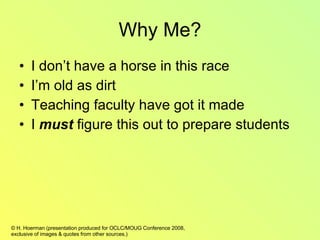
Why Me? I don’t have a horse in this race I’m old as dirt Teaching faculty have got it made I  must  figure this out to prepare students
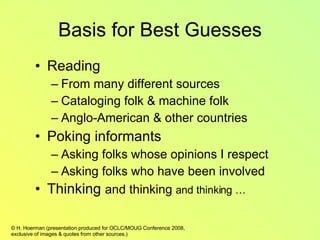
Basis for Best Guesses Reading From many different sources Cataloging folk & machine folk Anglo-American & other countries Poking informants Asking folks whose opinions I respect Asking folks who have been involved  Thinking  and thinking  and thinking …
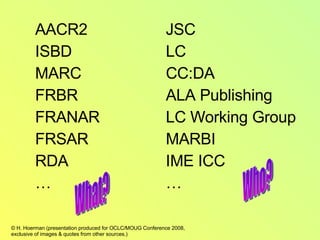
AACR2 ISBD MARC FRBR FRANAR FRSAR RDA … JSC LC  CC:DA ALA Publishing LC Working Group MARBI IME ICC … What? Who?
And what about …? MARC? Dublin Core? OAI PMH? The Consolidated ISBD? OCLC? ILS vendors? Let alone the “metadata community”
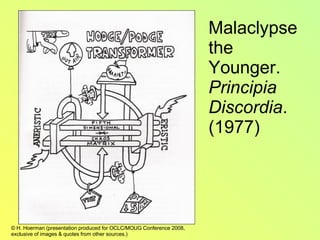
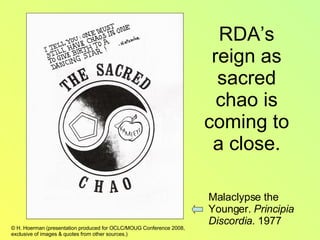
Malaclypse the Younger.  Principia Discordia . (1977)
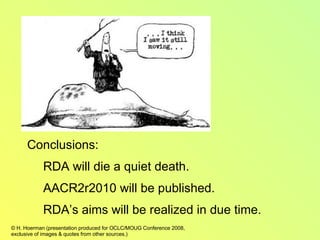
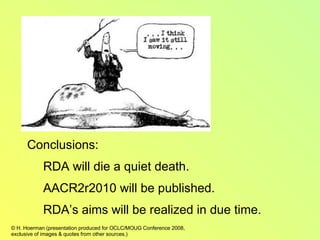
Conclusions: RDA will die a quiet death. AACR2r2010 will be published. RDA’s aims will be realized in due time.
STATEMENT OF PURPOSE FOR RDA RDA -  Resource Description and Access  will be a new standard for resource description and access, designed for the digital world. Built on foundations established by the  Anglo-American Cataloguing Rules  (AACR), RDA will provide a comprehensive set of guidelines and instructions on resource description and access covering all types of content and media. RDA will enable users of library catalogues and other systems of information organization to find, identify, select, and obtain resources appropriate to their information needs. From the JSC  Strategic Plan for RDA
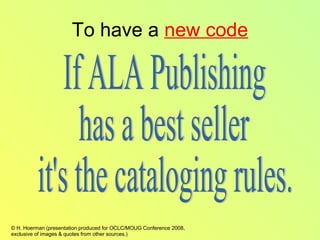
What are the aims of RDA? To get rid of  old baggage To have a  new code To be more  global To solve the  multiple versions problem To enable  data sharing  with the “metadata community”
To get rid of  old baggage Eschew “AACR3” Eschew words like “cataloging” Try to look more like the other kids Get rid of funny punctuation Get rid of strange rule numbers
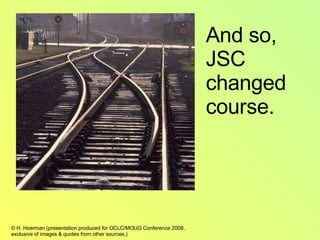
And so, JSC changed course.
To have a  new code If ALA Publishing has a best seller it's the cataloging rules.
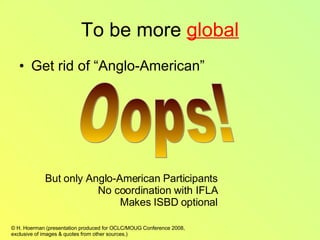
To be more  global Get rid of “Anglo-American” Oops! But only Anglo-American Participants No coordination with IFLA Makes ISBD optional
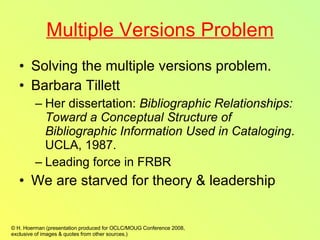
Multiple Versions Problem Solving the multiple versions problem. Barbara Tillett Her dissertation:  Bibliographic Relationships: Toward a Conceptual Structure of Bibliographic Information Used in Cataloging . UCLA, 1987. Leading force in FRBR We are starved for theory & leadership
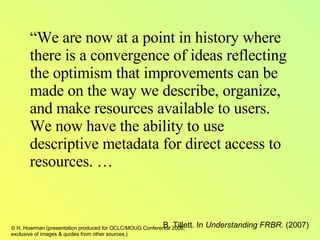
“ We are now at a point in history where there is a convergence of ideas reflecting the optimism that improvements can be made on the way we describe, organize, and make resources available to users.  We now have the ability to use descriptive metadata for direct access to resources. … B. Tillett. In  Understanding FRBR.  (2007)
“…  When the resource is available digitally online, that descriptive metadata can be the direct connection to serving the user with the desired resource, while also enabling libraries to inform the user of versions of that resource in multiple languages or editions and providing pathways to related resources—all the works by the same creator(s), all the resources on the same subject, etc.”   B. Tillett. In  Understanding FRBR.  (2007)
There were no hearings There was no research on efficacy There was no testing of sample systems There was no assessment of the bibliographic knowledge base available to those who create bibliographic records Did the Cataloging Community Agree to Operationalize FRBR?
“ As bibliographers, we cannot indeed but wish, that the catalogue of every library were a bibliographical dictionary of its books.  Practically, however, we must restrict our efforts, with the limits of probable accomplishment.” C.C. Jewett.  Smithsonian Report on the Construction of Catalogues of Libraries.  (1853)
The Vision Thing meets Practicality FRBR is glorious as vision Realizing a vision takes planning, coodination, cooperation, pooled effort, compromise, investment … JSC jumped the gun
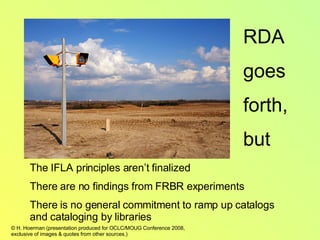
The IFLA principles aren’t finalized There are no findings from FRBR experiments There is no general commitment to ramp up catalogs and cataloging by libraries RDA goes  forth, but
Data Interoperability Marc produces serial (linear) data suited for communication of individual bibliographic records Marc was developed in 1967 Marc is a labeling system Is the problem with the cataloging or with the coding? Is the problem with MARC or with the content of bibliographic records
Are We Coordinating with the  Wider Metadata Community? RDA ignored Dublin Core until last year Only last year MARC/RDA group formed
Are We Coordinating with the  Wider Metadata Community? The meaning of “Resource Description” as in “Resource Description Framework” is well established RD refers to data structure not to specifics of data content RDA eschews discussion of data structure RDA is all about content
RDA changes the cataloging not the coding
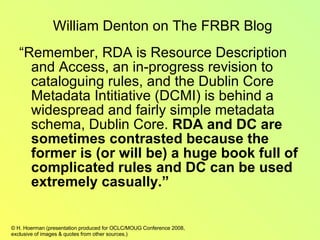
“ Remember, RDA is Resource Description and Access, an in-progress revision to cataloguing rules, and the Dublin Core Metadata Intitiative (DCMI) is behind a widespread and fairly simple metadata schema, Dublin Core.  RDA and DC are sometimes contrasted because the former is (or will be) a huge book full of complicated rules and DC can be used extremely casually.” William Denton on The FRBR Blog
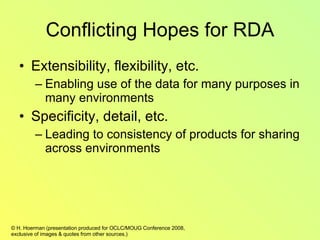
Conflicting Hopes for RDA Extensibility, flexibility, etc. Enabling use of the data for many purposes in many environments Specificity, detail, etc. Leading to consistency of products for sharing across environments
RDA reminds me of … TGI Friday’s Szechwan Shrimp Fettucine Alfredo
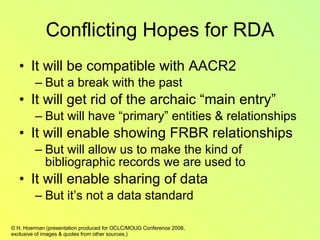
Conflicting Hopes for RDA It will be compatible with AACR2 But a break with the past It will get rid of the archaic “main entry” But will have “primary” entities & relationships It will enable showing FRBR relationships But will allow us to make the kind of bibliographic records we are used to It will enable sharing of data But it’s not a data standard
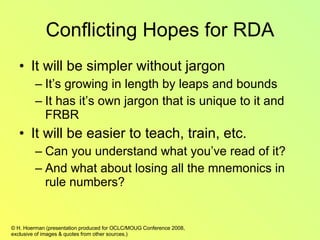
Conflicting Hopes for RDA It will be simpler without jargon It’s growing in length by leaps and bounds It has it’s own jargon that is unique to it and FRBR It will be easier to teach, train, etc. Can you understand what you’ve read of it? And what about losing all the mnemonics in rule numbers?
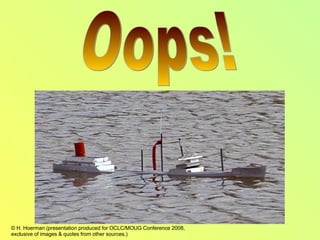
Oops!
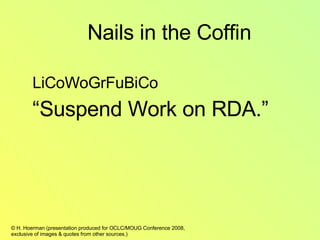
LiCoWoGrFuBiCo “ Suspend Work on RDA.” Nails in the Coffin
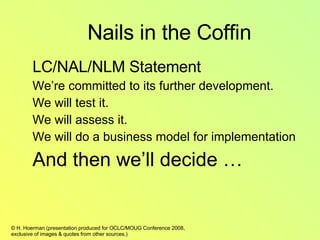
LC/NAL/NLM Statement We’re committed to its further development. We will test it. We will assess it. We will do a business model for implementation And then we’ll decide … Nails in the Coffin
And then the economy took a dive Nails in the Coffin
Recent AUTOCAT & Blog discussions  Recent confirmation of the unreasonable calendar Nails in the Coffin
Conclusions: RDA will die a quiet death. AACR2r2010 will be published. RDA’s aims will be realized in due time.
Where does this leave us With a code of rules not updated since 2005 Good & well meaning people frustrated Back at square one If we are still going to use AACR2 through this decade we need to maintain it.
Malaclypse the Younger.  Principia Discordia.  1977 RDA’s reign as sacred chao is coming to a close.
"You need chaos in your soul  to give birth  to a dancing star."  Friedrich Nietzsche .

Oclcmougpresentation

  • 1.
    This presentation wasprepared for and delivered to the OCLC/MOUG Conference, Cleveland OH, Sept. 25-28, 2008. Missing from the slides is the extensive narrative that emphasized The gratitude & respect due the Joint Steering Committee for all their work; The intellectual debt owed Barbara Tillett for her vision and leadership; And the emphasis that this is just Heidi Hoerman making an educated guess and in no way represents the opinion or sanction of anyone else.
  • 2.
    How ShouldI Prepare for RDA? Should I Prepare for RDA?
  • 3.
    What the Heck’sGoing on with RDA!?!
  • 4.
    Why Me? Idon’t have a horse in this race I’m old as dirt Teaching faculty have got it made I must figure this out to prepare students
  • 5.
    Basis for BestGuesses Reading From many different sources Cataloging folk & machine folk Anglo-American & other countries Poking informants Asking folks whose opinions I respect Asking folks who have been involved Thinking and thinking and thinking …
  • 6.
    AACR2 ISBD MARCFRBR FRANAR FRSAR RDA … JSC LC CC:DA ALA Publishing LC Working Group MARBI IME ICC … What? Who?
  • 7.
    And what about…? MARC? Dublin Core? OAI PMH? The Consolidated ISBD? OCLC? ILS vendors? Let alone the “metadata community”
  • 8.
    Malaclypse the Younger. Principia Discordia . (1977)
  • 9.
    Conclusions: RDA willdie a quiet death. AACR2r2010 will be published. RDA’s aims will be realized in due time.
  • 10.
    STATEMENT OF PURPOSEFOR RDA RDA - Resource Description and Access will be a new standard for resource description and access, designed for the digital world. Built on foundations established by the Anglo-American Cataloguing Rules (AACR), RDA will provide a comprehensive set of guidelines and instructions on resource description and access covering all types of content and media. RDA will enable users of library catalogues and other systems of information organization to find, identify, select, and obtain resources appropriate to their information needs. From the JSC Strategic Plan for RDA
  • 11.
    What are theaims of RDA? To get rid of old baggage To have a new code To be more global To solve the multiple versions problem To enable data sharing with the “metadata community”
  • 12.
    To get ridof old baggage Eschew “AACR3” Eschew words like “cataloging” Try to look more like the other kids Get rid of funny punctuation Get rid of strange rule numbers
  • 13.
    And so, JSCchanged course.
  • 14.
    To have a new code If ALA Publishing has a best seller it's the cataloging rules.
  • 15.
    To be more global Get rid of “Anglo-American” Oops! But only Anglo-American Participants No coordination with IFLA Makes ISBD optional
  • 16.
    Multiple Versions ProblemSolving the multiple versions problem. Barbara Tillett Her dissertation: Bibliographic Relationships: Toward a Conceptual Structure of Bibliographic Information Used in Cataloging . UCLA, 1987. Leading force in FRBR We are starved for theory & leadership
  • 17.
    “ We arenow at a point in history where there is a convergence of ideas reflecting the optimism that improvements can be made on the way we describe, organize, and make resources available to users. We now have the ability to use descriptive metadata for direct access to resources. … B. Tillett. In Understanding FRBR. (2007)
  • 18.
    “… Whenthe resource is available digitally online, that descriptive metadata can be the direct connection to serving the user with the desired resource, while also enabling libraries to inform the user of versions of that resource in multiple languages or editions and providing pathways to related resources—all the works by the same creator(s), all the resources on the same subject, etc.” B. Tillett. In Understanding FRBR. (2007)
  • 19.
    There were nohearings There was no research on efficacy There was no testing of sample systems There was no assessment of the bibliographic knowledge base available to those who create bibliographic records Did the Cataloging Community Agree to Operationalize FRBR?
  • 20.
    “ As bibliographers,we cannot indeed but wish, that the catalogue of every library were a bibliographical dictionary of its books. Practically, however, we must restrict our efforts, with the limits of probable accomplishment.” C.C. Jewett. Smithsonian Report on the Construction of Catalogues of Libraries. (1853)
  • 21.
    The Vision Thingmeets Practicality FRBR is glorious as vision Realizing a vision takes planning, coodination, cooperation, pooled effort, compromise, investment … JSC jumped the gun
  • 22.
    The IFLA principlesaren’t finalized There are no findings from FRBR experiments There is no general commitment to ramp up catalogs and cataloging by libraries RDA goes forth, but
  • 23.
    Data Interoperability Marcproduces serial (linear) data suited for communication of individual bibliographic records Marc was developed in 1967 Marc is a labeling system Is the problem with the cataloging or with the coding? Is the problem with MARC or with the content of bibliographic records
  • 24.
    Are We Coordinatingwith the Wider Metadata Community? RDA ignored Dublin Core until last year Only last year MARC/RDA group formed
  • 25.
    Are We Coordinatingwith the Wider Metadata Community? The meaning of “Resource Description” as in “Resource Description Framework” is well established RD refers to data structure not to specifics of data content RDA eschews discussion of data structure RDA is all about content
  • 26.
    RDA changes thecataloging not the coding
  • 27.
    “ Remember, RDAis Resource Description and Access, an in-progress revision to cataloguing rules, and the Dublin Core Metadata Intitiative (DCMI) is behind a widespread and fairly simple metadata schema, Dublin Core. RDA and DC are sometimes contrasted because the former is (or will be) a huge book full of complicated rules and DC can be used extremely casually.” William Denton on The FRBR Blog
  • 28.
    Conflicting Hopes forRDA Extensibility, flexibility, etc. Enabling use of the data for many purposes in many environments Specificity, detail, etc. Leading to consistency of products for sharing across environments
  • 29.
    RDA reminds meof … TGI Friday’s Szechwan Shrimp Fettucine Alfredo
  • 30.
    Conflicting Hopes forRDA It will be compatible with AACR2 But a break with the past It will get rid of the archaic “main entry” But will have “primary” entities & relationships It will enable showing FRBR relationships But will allow us to make the kind of bibliographic records we are used to It will enable sharing of data But it’s not a data standard
  • 31.
    Conflicting Hopes forRDA It will be simpler without jargon It’s growing in length by leaps and bounds It has it’s own jargon that is unique to it and FRBR It will be easier to teach, train, etc. Can you understand what you’ve read of it? And what about losing all the mnemonics in rule numbers?
  • 32.
  • 33.
    LiCoWoGrFuBiCo “ SuspendWork on RDA.” Nails in the Coffin
  • 34.
    LC/NAL/NLM Statement We’recommitted to its further development. We will test it. We will assess it. We will do a business model for implementation And then we’ll decide … Nails in the Coffin
  • 35.
    And then theeconomy took a dive Nails in the Coffin
  • 36.
    Recent AUTOCAT &Blog discussions Recent confirmation of the unreasonable calendar Nails in the Coffin
  • 37.
    Conclusions: RDA willdie a quiet death. AACR2r2010 will be published. RDA’s aims will be realized in due time.
  • 38.
    Where does thisleave us With a code of rules not updated since 2005 Good & well meaning people frustrated Back at square one If we are still going to use AACR2 through this decade we need to maintain it.
  • 39.
    Malaclypse the Younger. Principia Discordia. 1977 RDA’s reign as sacred chao is coming to a close.
  • 40.
    "You need chaosin your soul to give birth to a dancing star." Friedrich Nietzsche .