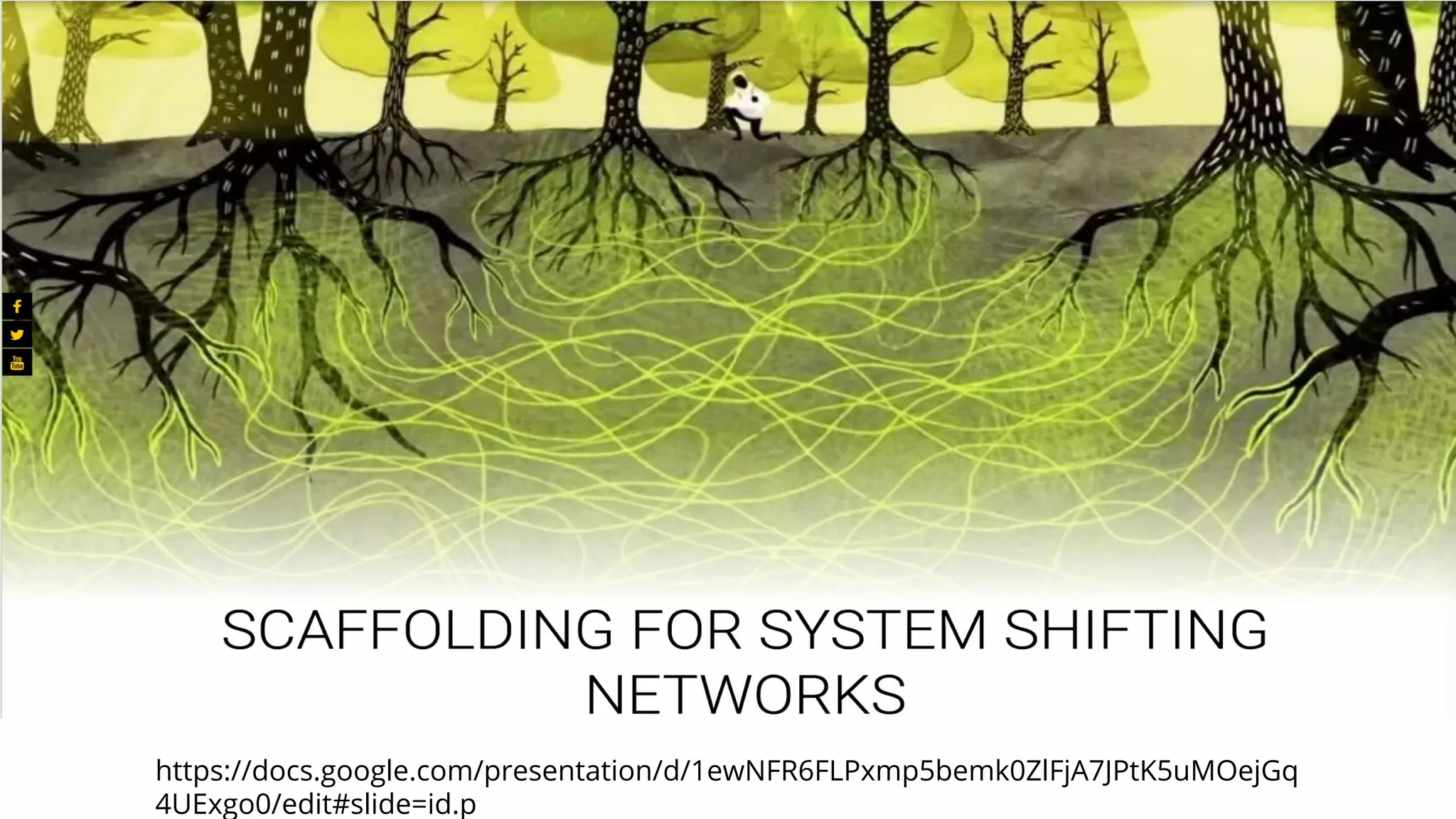
System Shifting Networks
September 2019
https://docs.google.com/presentation/d/1ewNFR6FLPxmp5bemk0ZlFjA7JPtK5uMOejGq
4UExgo0/edit#slide=id.p
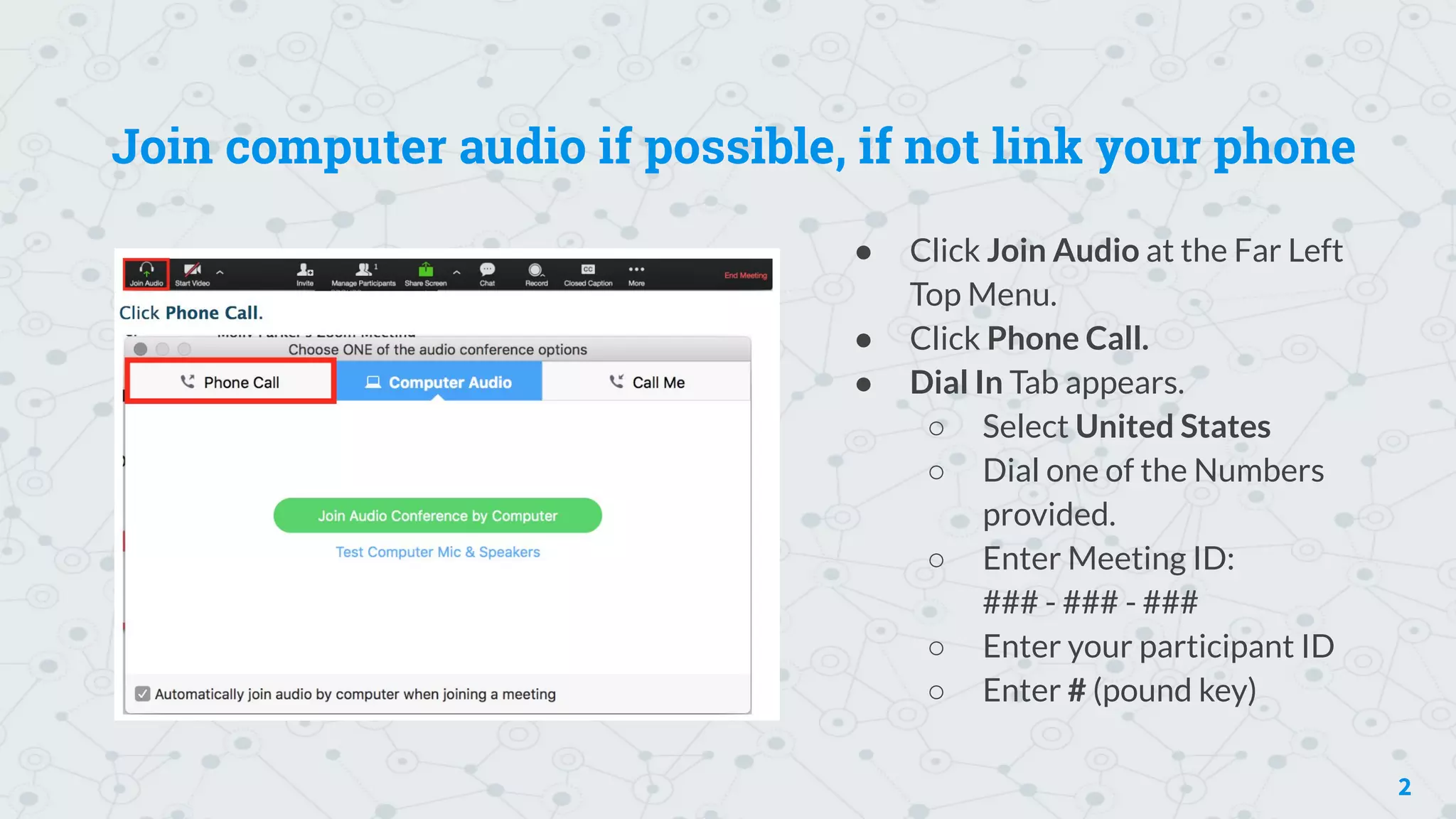
Join computer audio if possible, if not link your phone
● Click Join Audio at the Far Left
Top Menu.
● Click Phone Call.
● Dial In Tab appears.
○ Select United States
○ Dial one of the Numbers
provided.
○ Enter Meeting ID:
### - ### - ###
○ Enter your participant ID
○ Enter # (pound key)
2
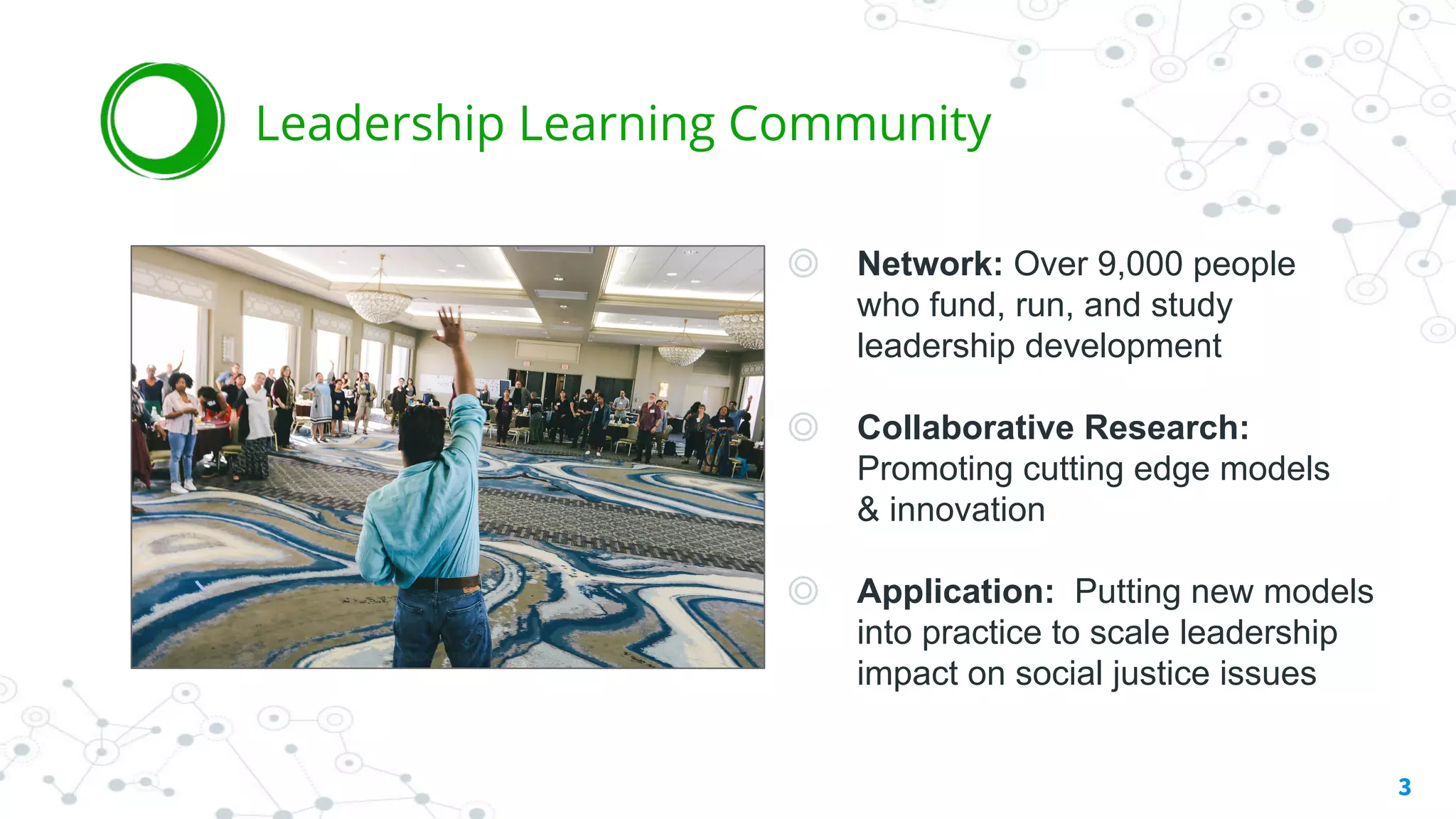
◎ Network: Over 9,000 people
who fund, run, and study
leadership development
◎ Collaborative Research:
Promoting cutting edge models
& innovation
◎ Application: Putting new models
into practice to scale leadership
impact on social justice issues
3
Leadership Learning Community
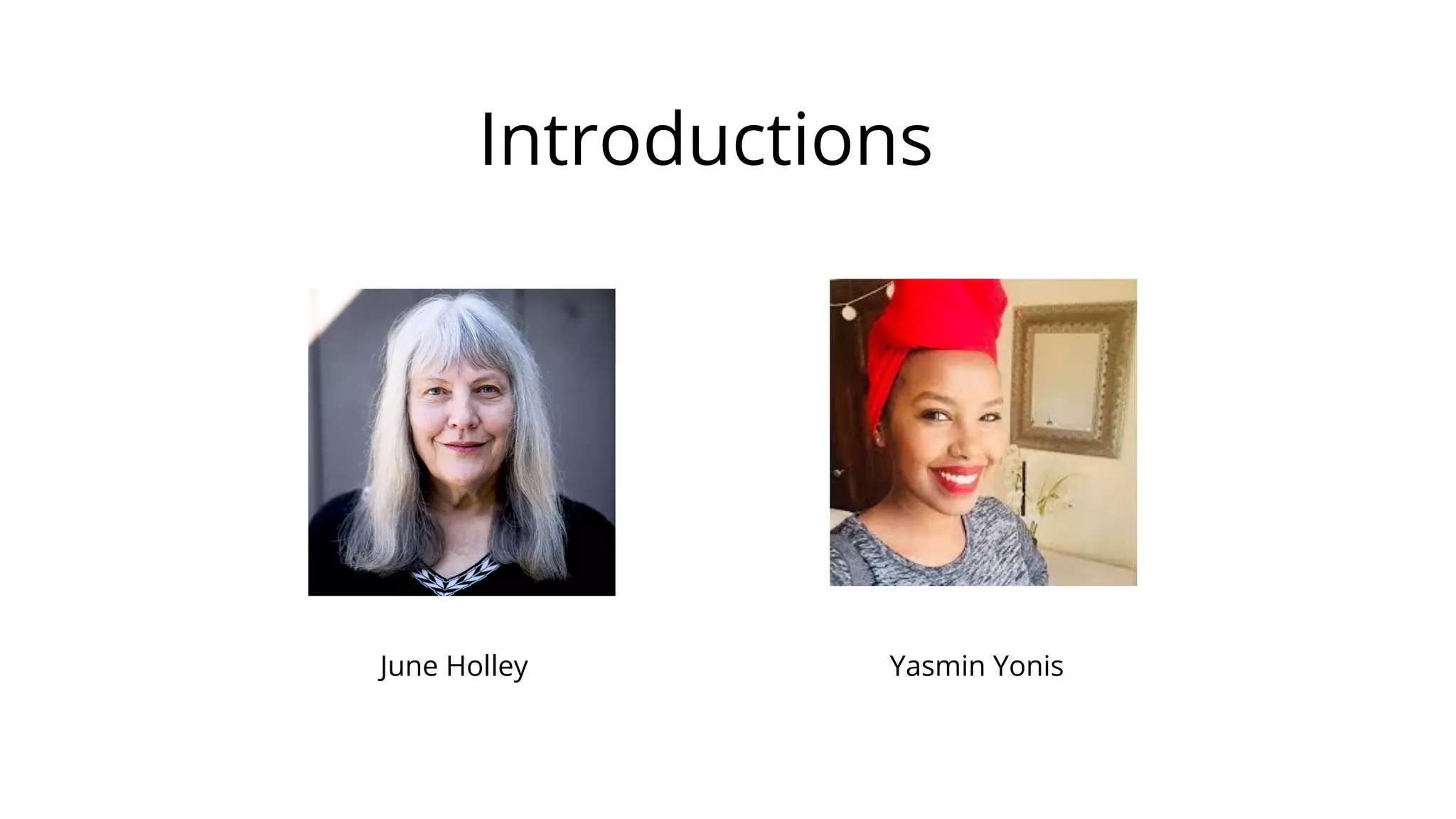
Introductions
June Holley Yasmin Yonis
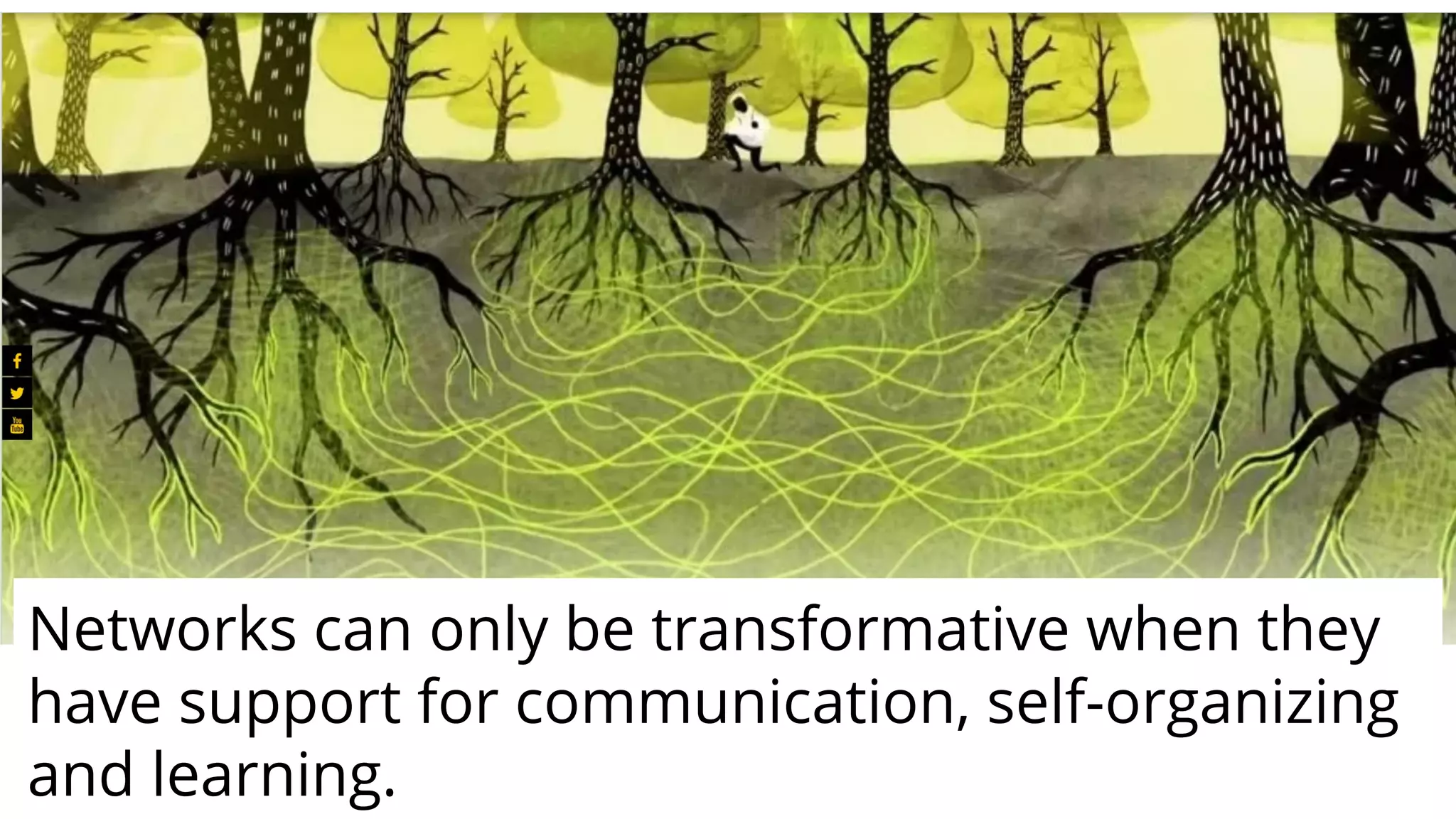
Networks can only be transformative when they
have support for communication, self-organizing
and learning.
Today’s Session
1. Relationships: Give you a chance to meet others on the call
2. New ideas: Hear from June, Yasmin and others on the call about the
concept of scaffolding
3. Processing: Have a chance to ask questions and think about
applications in your work for creating network scaffolding.
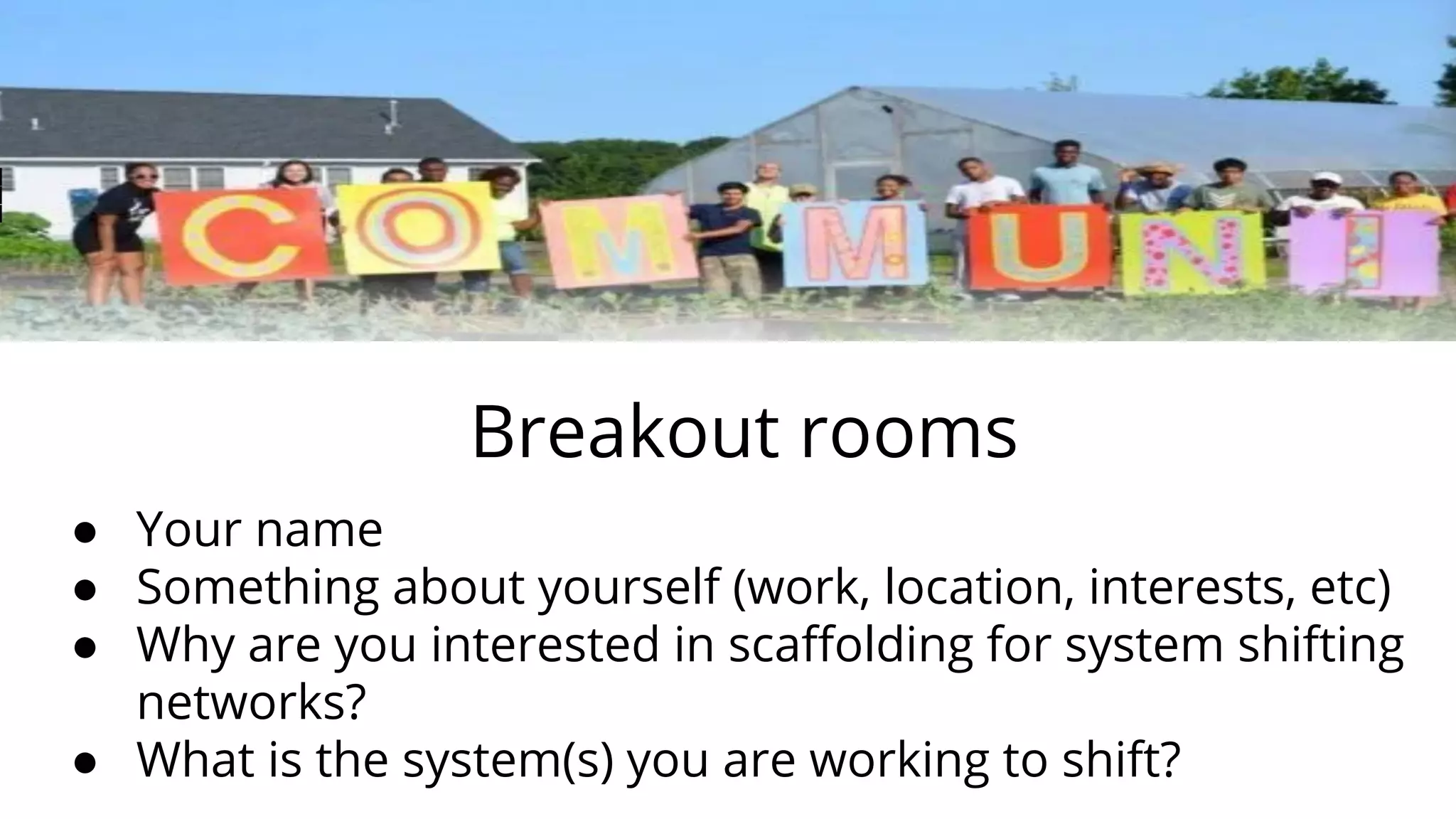
Breakout rooms
● Your name
● Something about yourself (work, location, interests, etc)
● Why are you interested in scaffolding for system shifting
networks?
● What is the system(s) you are working to shift?
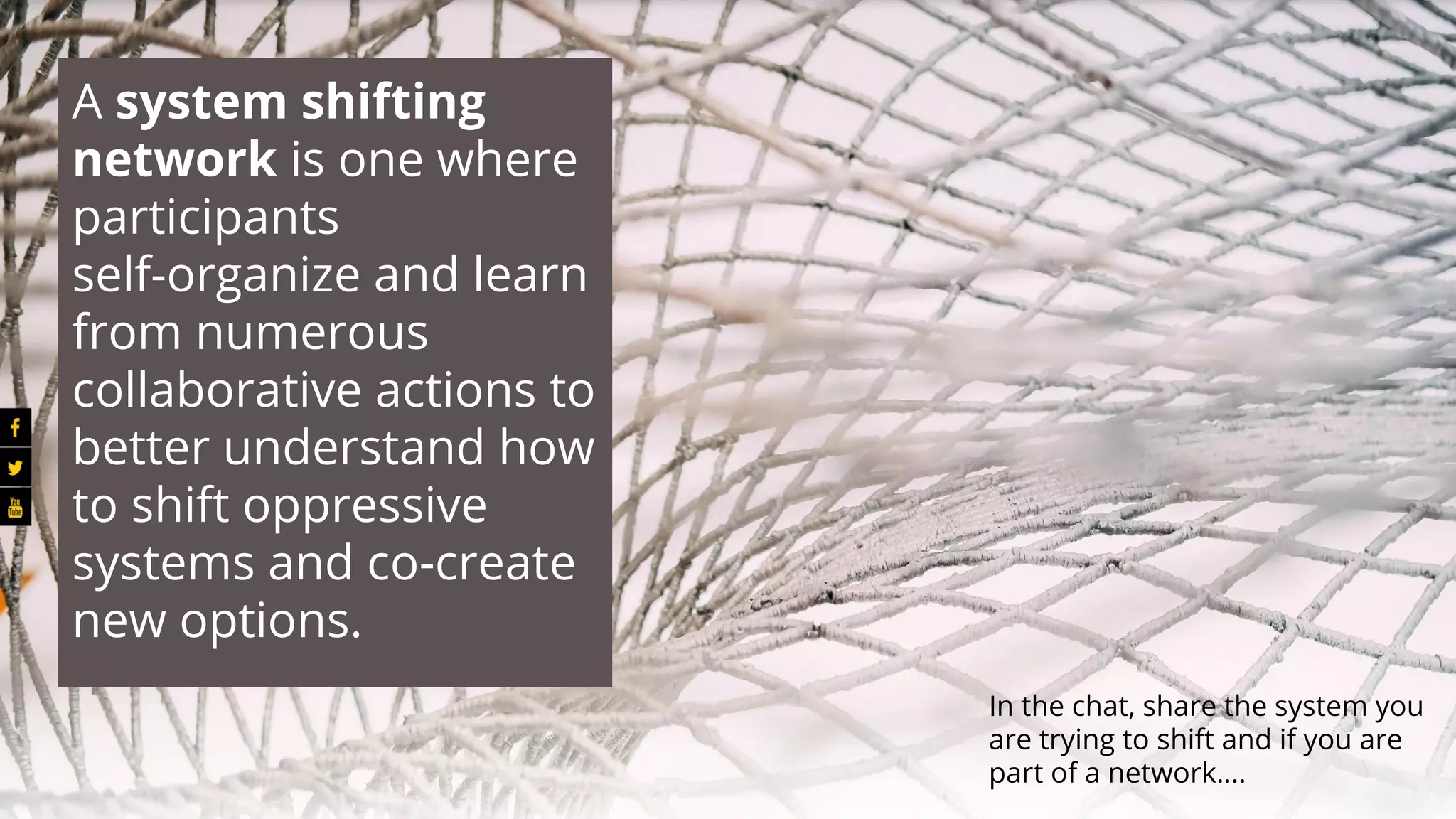
A system shifting
network is one where
participants
self-organize and learn
from numerous
collaborative actions to
better understand how
to shift oppressive
systems and co-create
new options.
In the chat, share the system you
are trying to shift and if you are
part of a network….
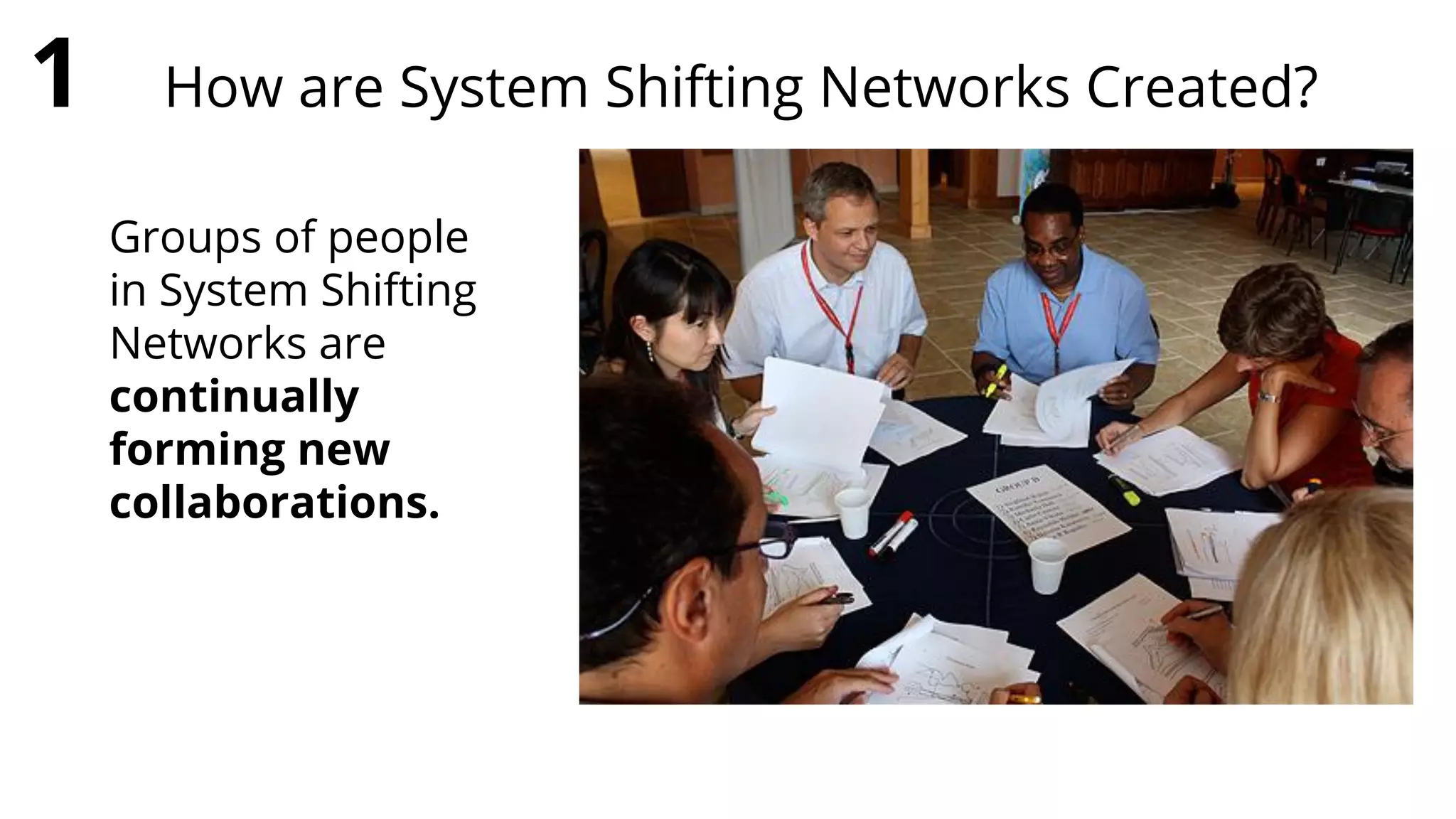
Groups of people
in System Shifting
Networks are
continually
forming new
collaborations.
1 How are System Shifting Networks Created?
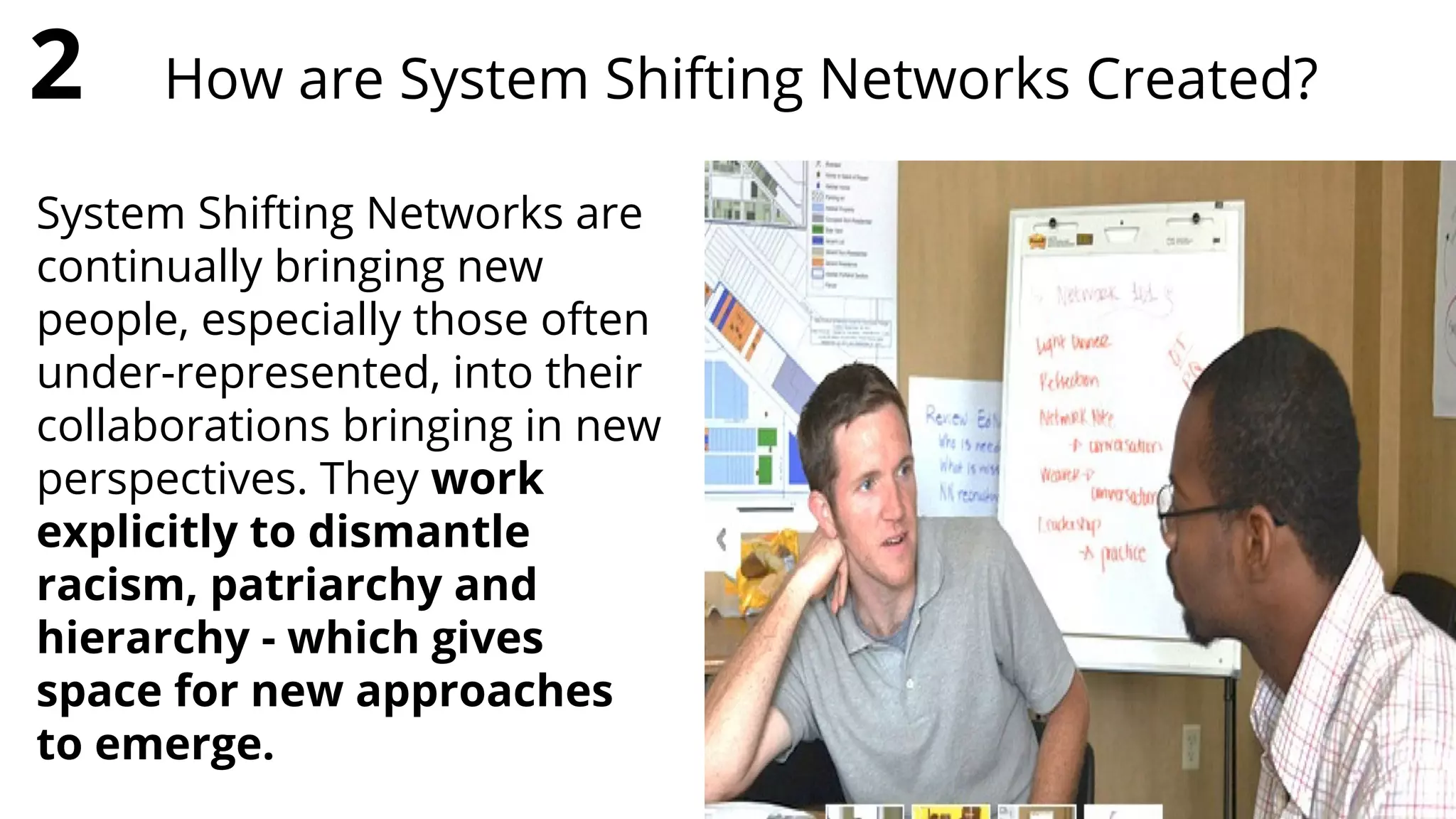
System Shifting Networks are
continually bringing new
people, especially those often
under-represented, into their
collaborations bringing in new
perspectives. They work
explicitly to dismantle
racism, patriarchy and
hierarchy - which gives
space for new approaches
to emerge.
2 How are System Shifting Networks Created?
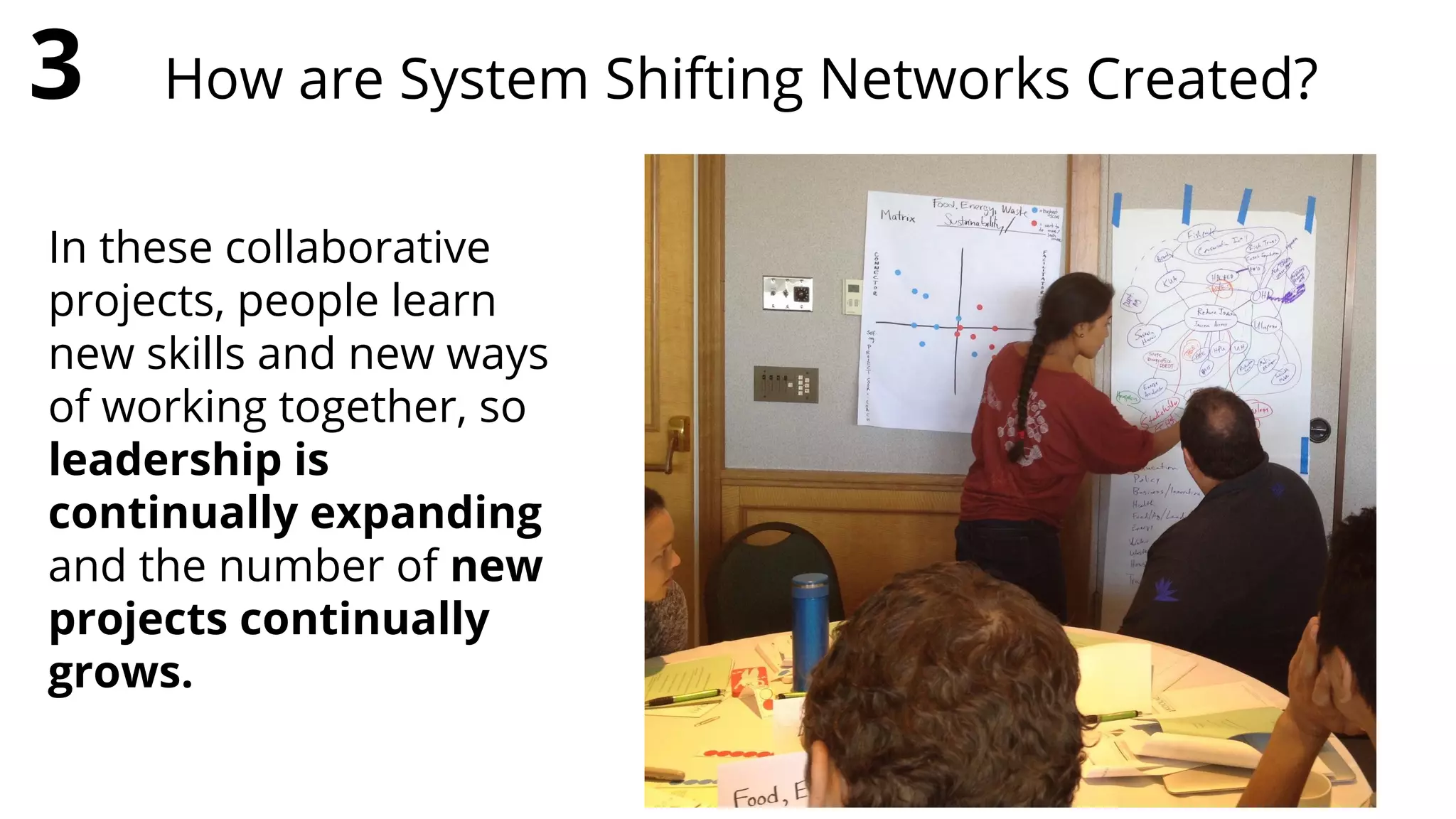
In these collaborative
projects, people learn
new skills and new ways
of working together, so
leadership is
continually expanding
and the number of new
projects continually
grows.
3 How are System Shifting Networks Created?
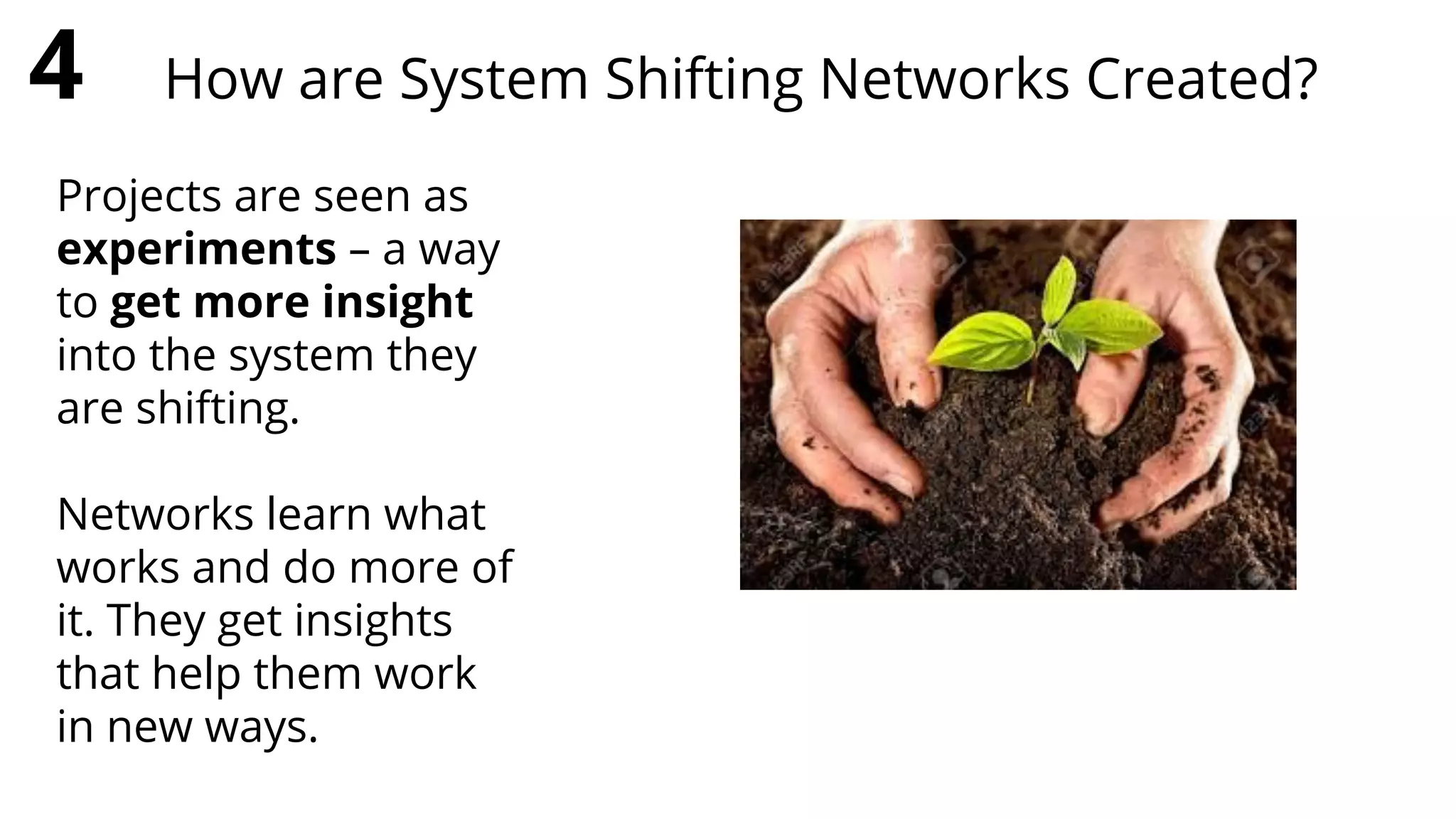
Projects are seen as
experiments – a way
to get more insight
into the system they
are shifting.
Networks learn what
works and do more of
it. They get insights
that help them work
in new ways.
4 How are System Shifting Networks Created?
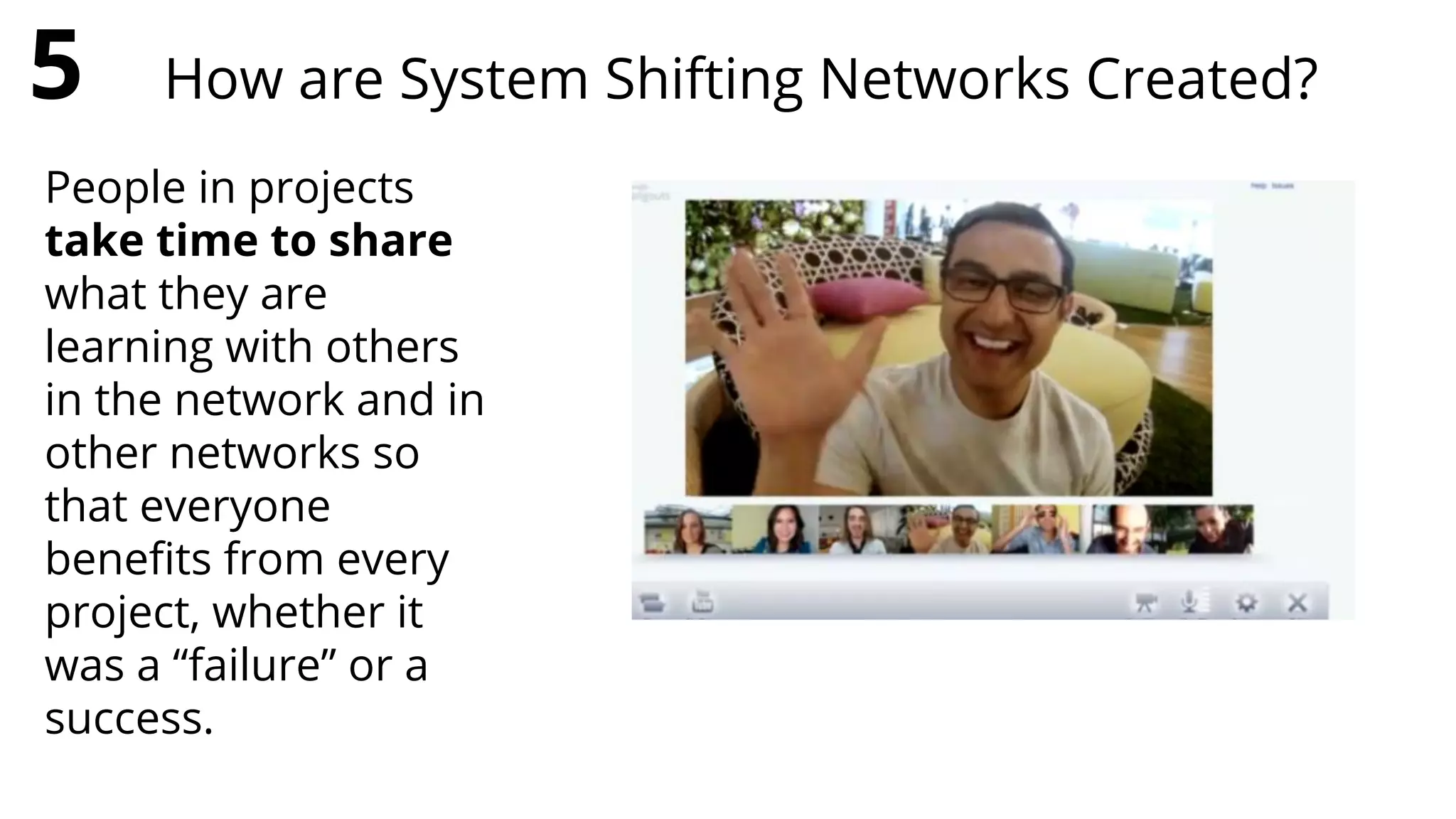
People in projects
take time to share
what they are
learning with others
in the network and in
other networks so
that everyone
benefits from every
project, whether it
was a “failure” or a
success.
5 How are System Shifting Networks Created?
Learning,
breakthroughs and new
insights ripple through
networks and networks
of networks so action
becomes highly
effective in shifting
systems.
6 How are System Shifting Networks Created?
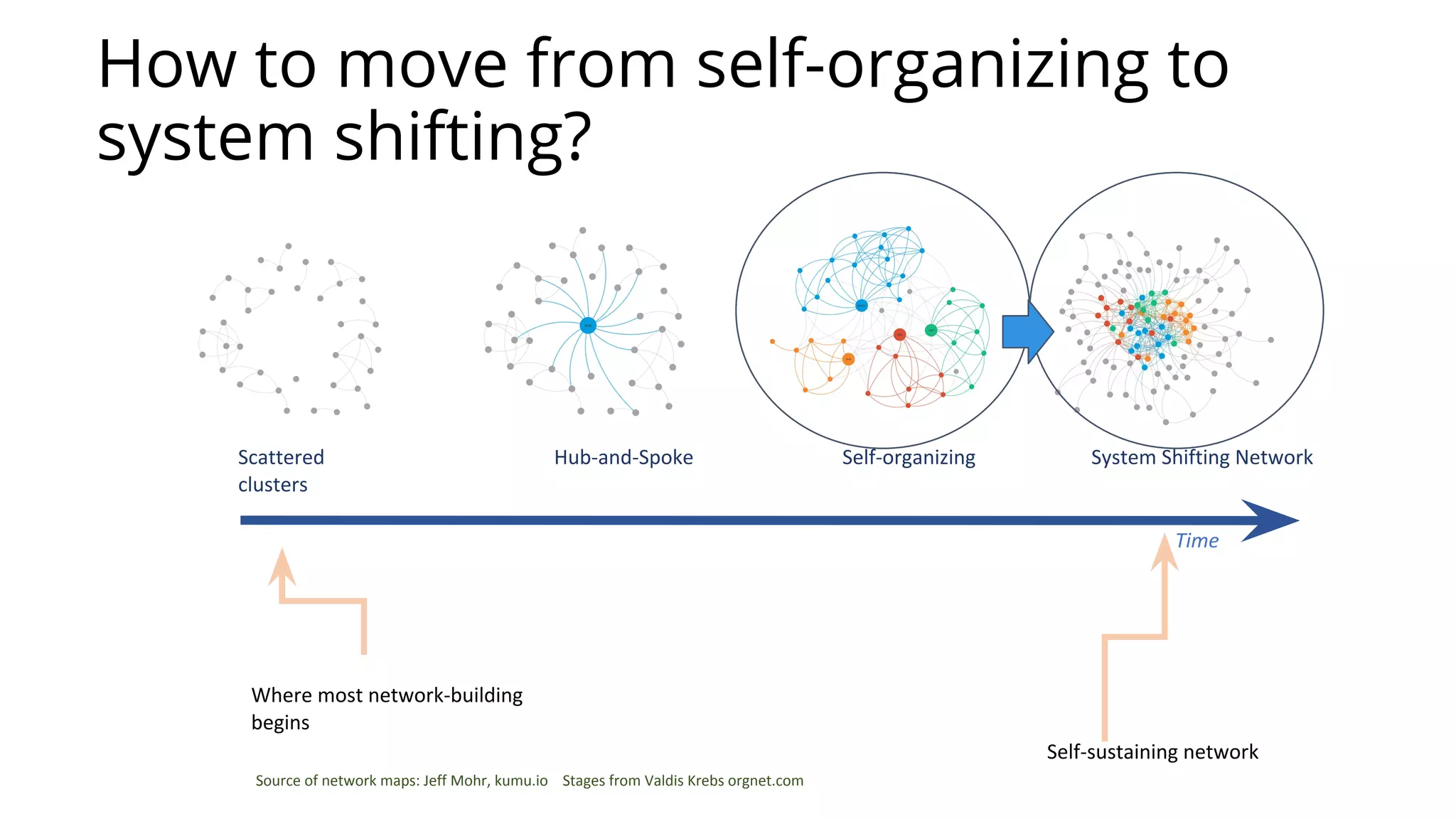
Source of network maps: Jeff Mohr, kumu.io Stages from Valdis Krebs orgnet.com
Scattered
clusters
Hub-and-Spoke Self-organizing System Shifting Network
Time
Where most network-building
begins
Self-sustaining network
How to move from self-organizing to
system shifting?
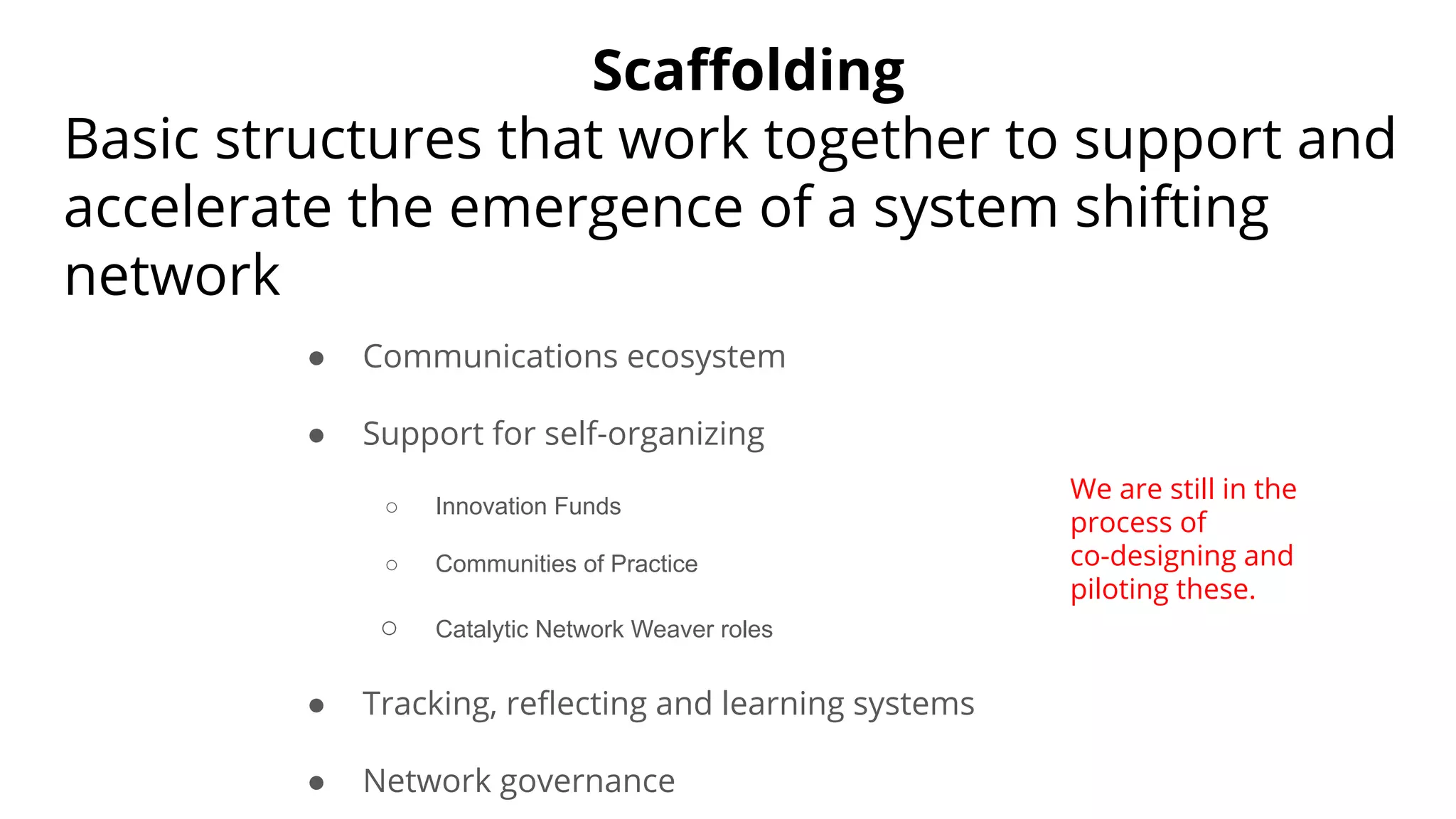
Scaffolding
Basic structures that work together to support and
accelerate the emergence of a system shifting
network
● Communications ecosystem
● Support for self-organizing
○ Innovation Funds
○ Communities of Practice
○ Catalytic Network Weaver roles
● Tracking, reflecting and learning systems
● Network governance
We are still in the
process of
co-designing and
piloting these.
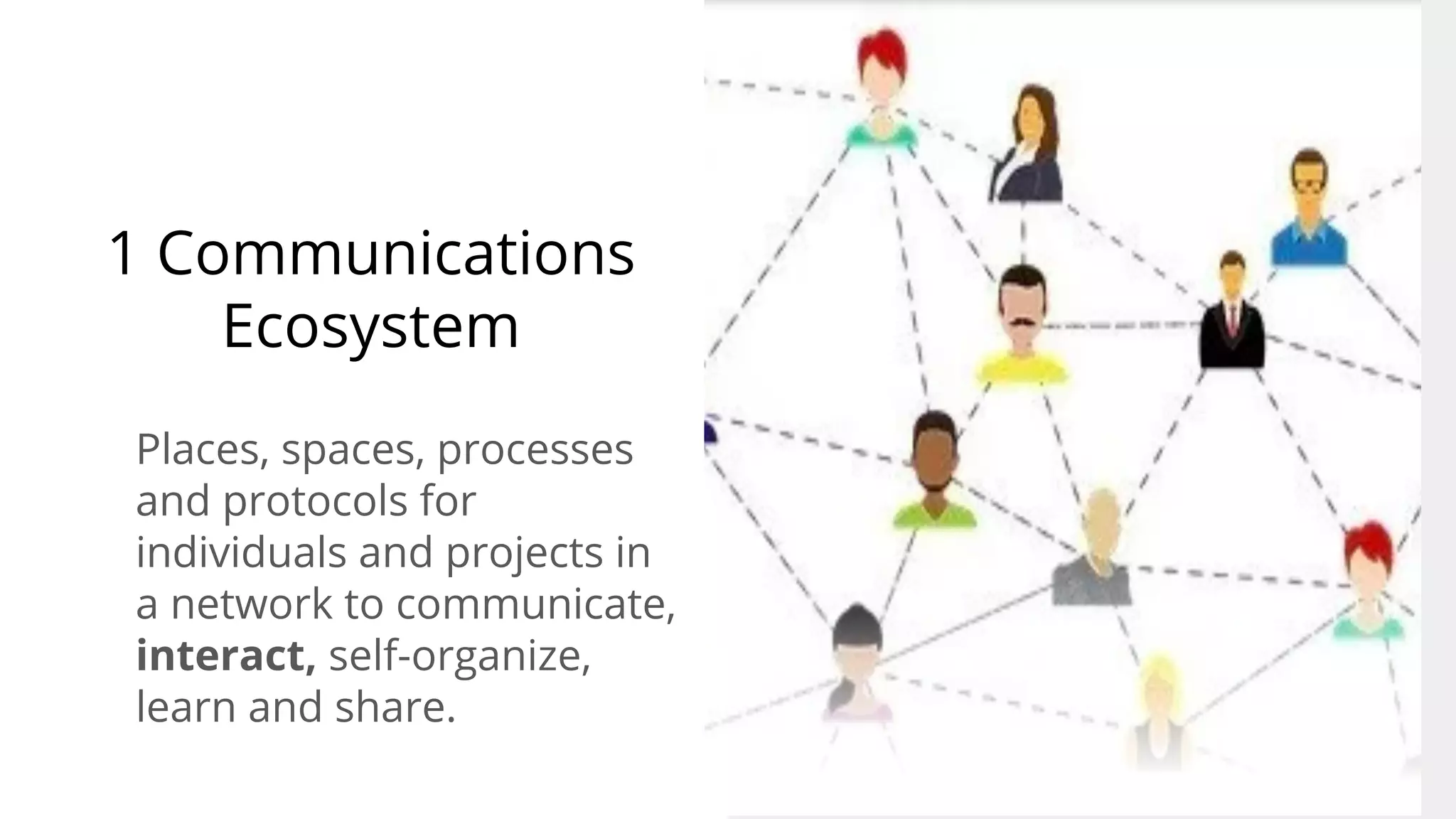
1 Communications
Ecosystem
Places, spaces, processes
and protocols for
individuals and projects in
a network to communicate,
interact, self-organize,
learn and share.
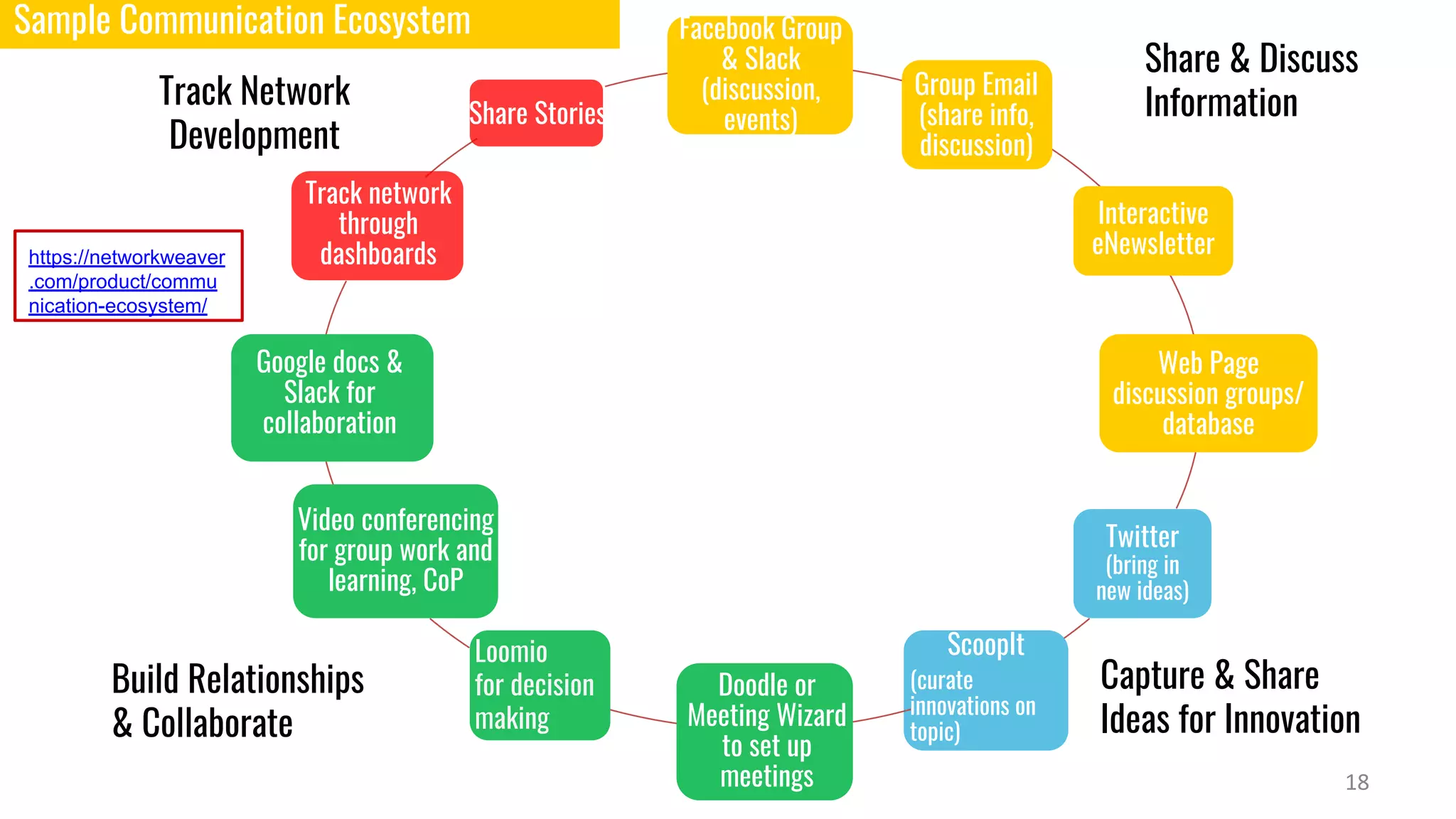
Sample Communication Ecosystem Facebook Group
& Slack
(discussion,
events)
Group Email
(share info,
discussion)
Interactive
eNewsletter
Twitter
(bring in
new ideas)
(curate
innovations on
topic)
Doodle or
Meeting Wizard
to set up
meetings
Video conferencing
for group work and
learning, CoP
Google docs &
Slack for
collaboration
Track network
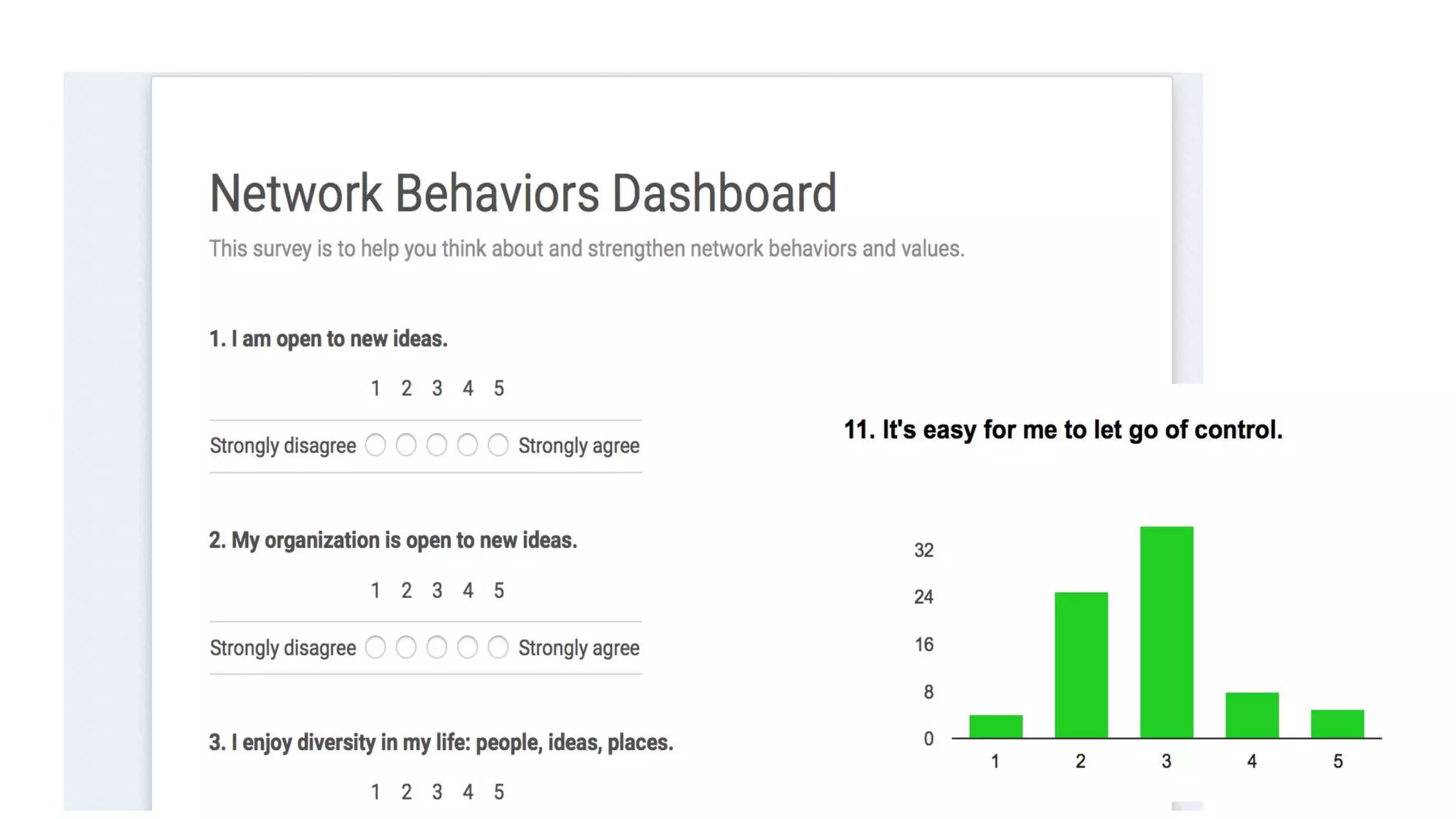
through
dashboards
Share Stories
Share & Discuss
Information
Build Relationships
& Collaborate
Capture & Share
Ideas for Innovation
Track Network
Development
Web Page
discussion groups/
database
ScoopItLoomio
for decision
making
18
https://networkweaver
.com/product/commu
nication-ecosystem/
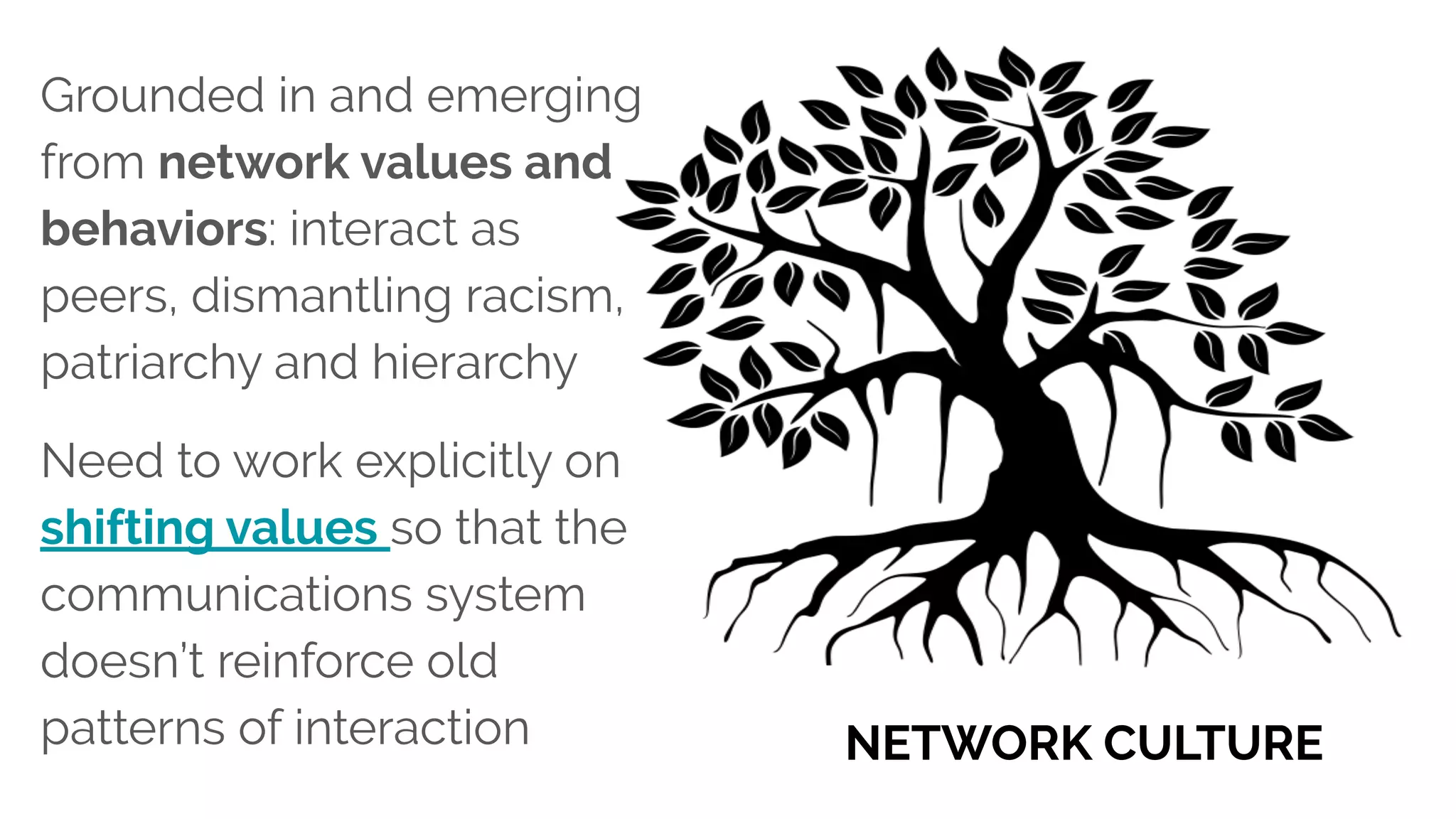
Grounded in and emerging
from network values and
behaviors: interact as
peers, dismantling racism,
patriarchy and hierarchy
Need to work explicitly on
shifting values so that the
communications system
doesn’t reinforce old
patterns of interaction NETWORK CULTURE
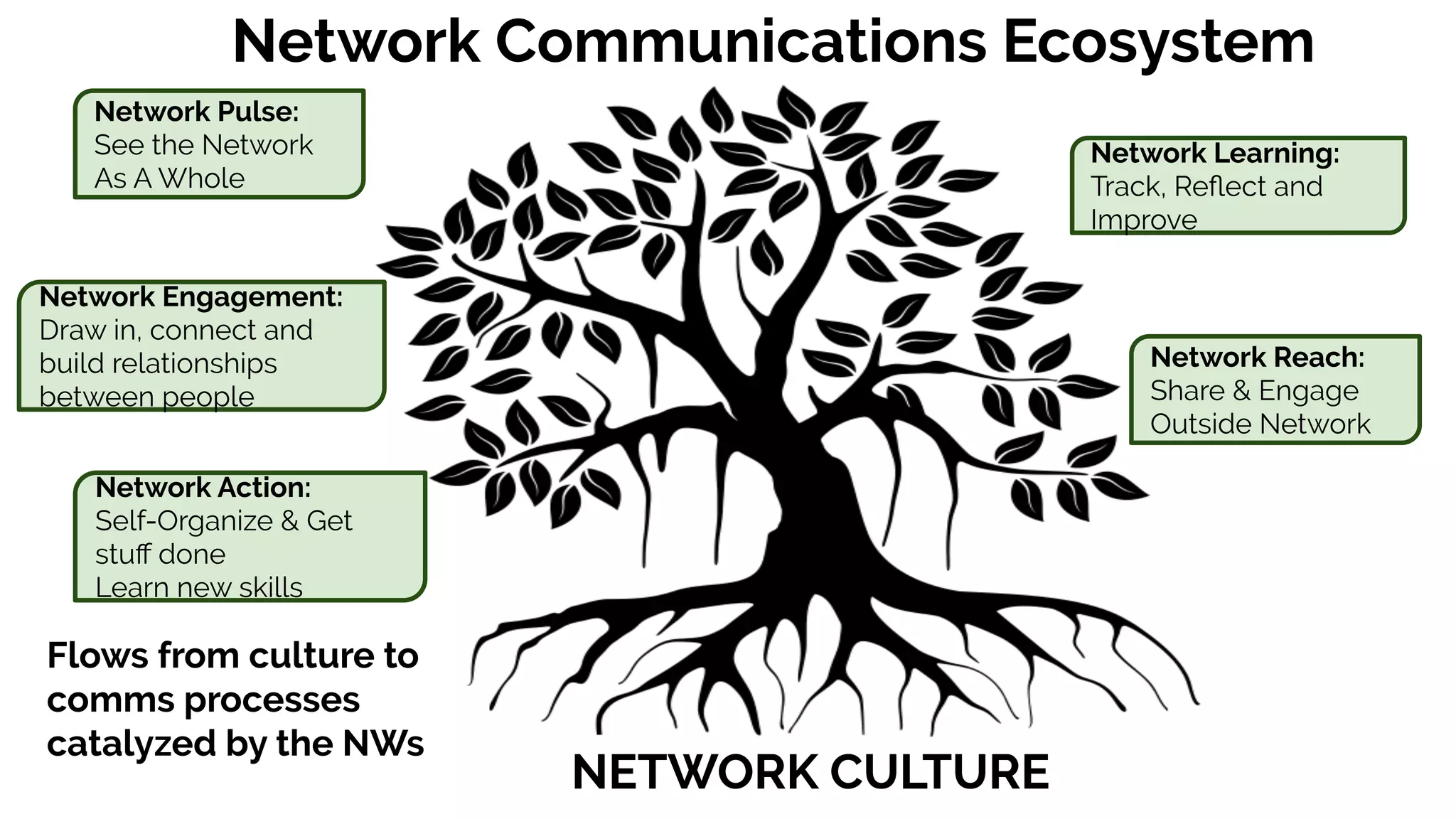
Network Communications Ecosystem
NETWORK CULTURE
Network Pulse:
See the Network
As A Whole
Network Reach:
Share & Engage
Outside Network
Network Engagement:
Draw in, connect and
build relationships
between people
Network Action:
Self-Organize & Get
stuff done
Learn new skills
Network Learning:
Track, Reflect and
Improve
Flows from culture to
comms processes
catalyzed by the NWs
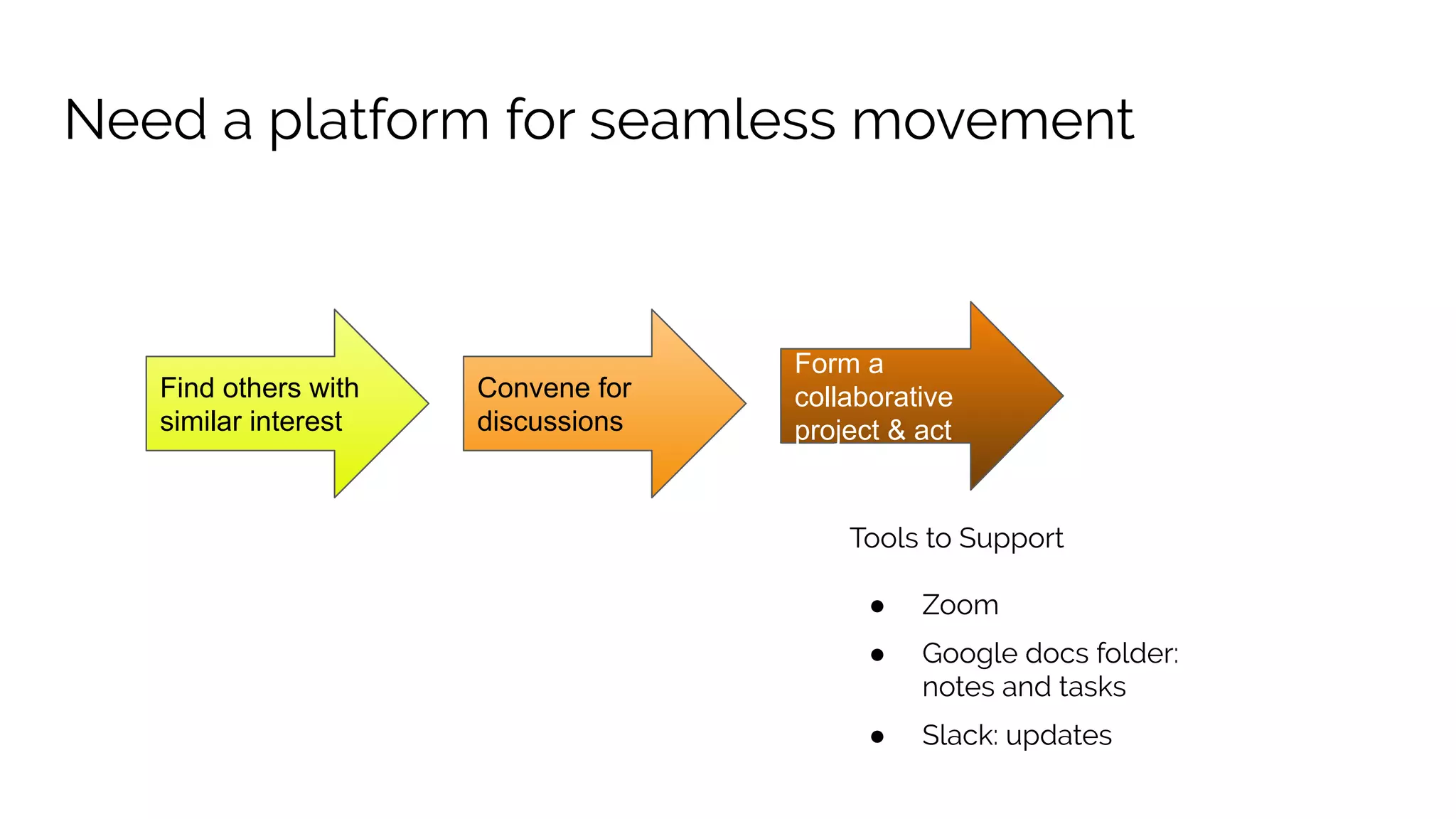
Find others with
similar interest
Convene for
discussions
Form a
collaborative
project & act
Tools to Support
● Zoom
● Google docs folder:
notes and tasks
● Slack: updates
Need a platform for seamless movement
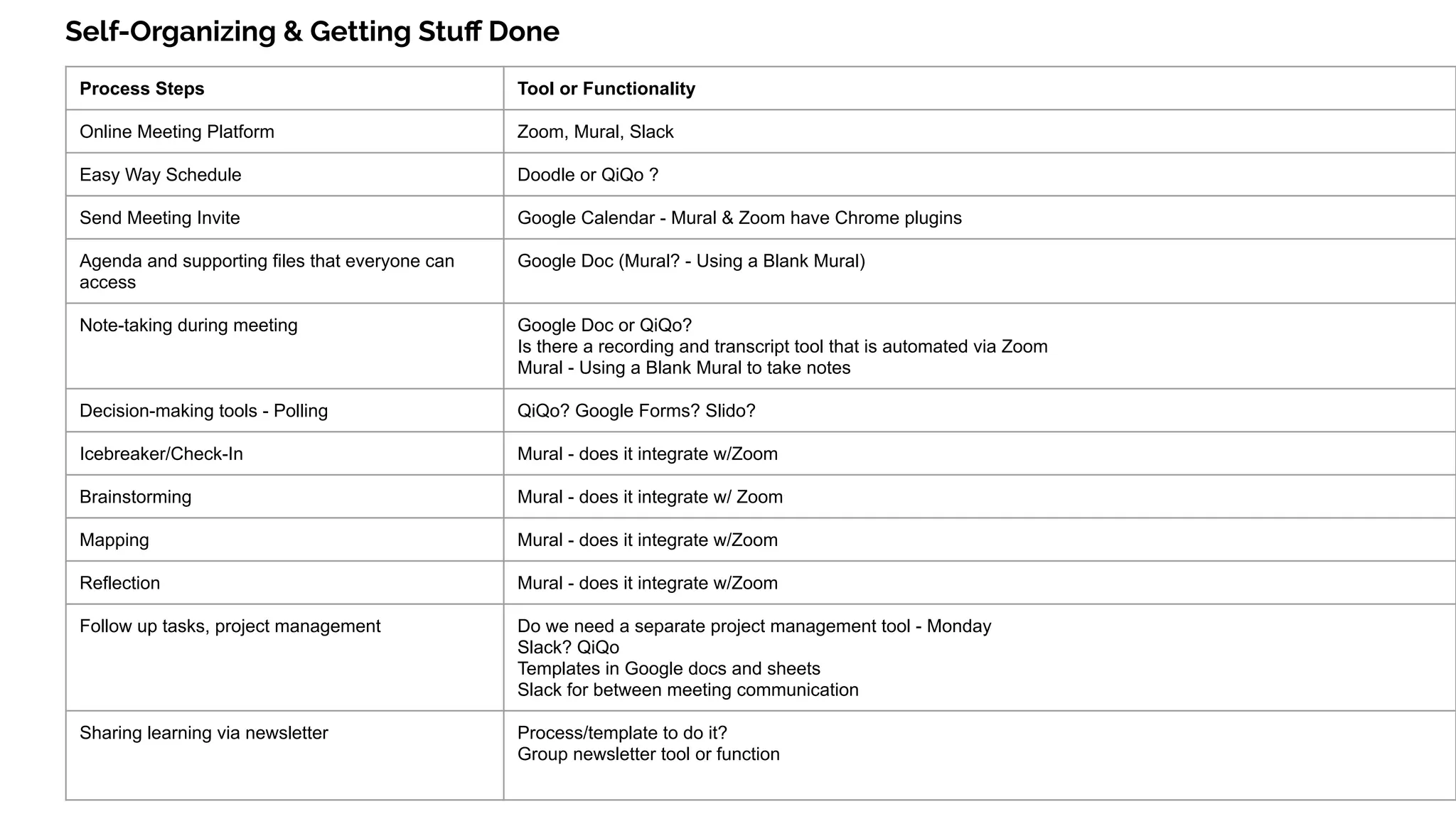
Self-Organizing & Getting Stuff Done
Process Steps Tool or Functionality
Online Meeting Platform Zoom, Mural, Slack
Easy Way Schedule Doodle or QiQo ?
Send Meeting Invite Google Calendar - Mural & Zoom have Chrome plugins
Agenda and supporting files that everyone can
access
Google Doc (Mural? - Using a Blank Mural)
Note-taking during meeting Google Doc or QiQo?
Is there a recording and transcript tool that is automated via Zoom
Mural - Using a Blank Mural to take notes
Decision-making tools - Polling QiQo? Google Forms? Slido?
Icebreaker/Check-In Mural - does it integrate w/Zoom
Brainstorming Mural - does it integrate w/ Zoom
Mapping Mural - does it integrate w/Zoom
Reflection Mural - does it integrate w/Zoom
Follow up tasks, project management Do we need a separate project management tool - Monday
Slack? QiQo
Templates in Google docs and sheets
Slack for between meeting communication
Sharing learning via newsletter Process/template to do it?
Group newsletter tool or function
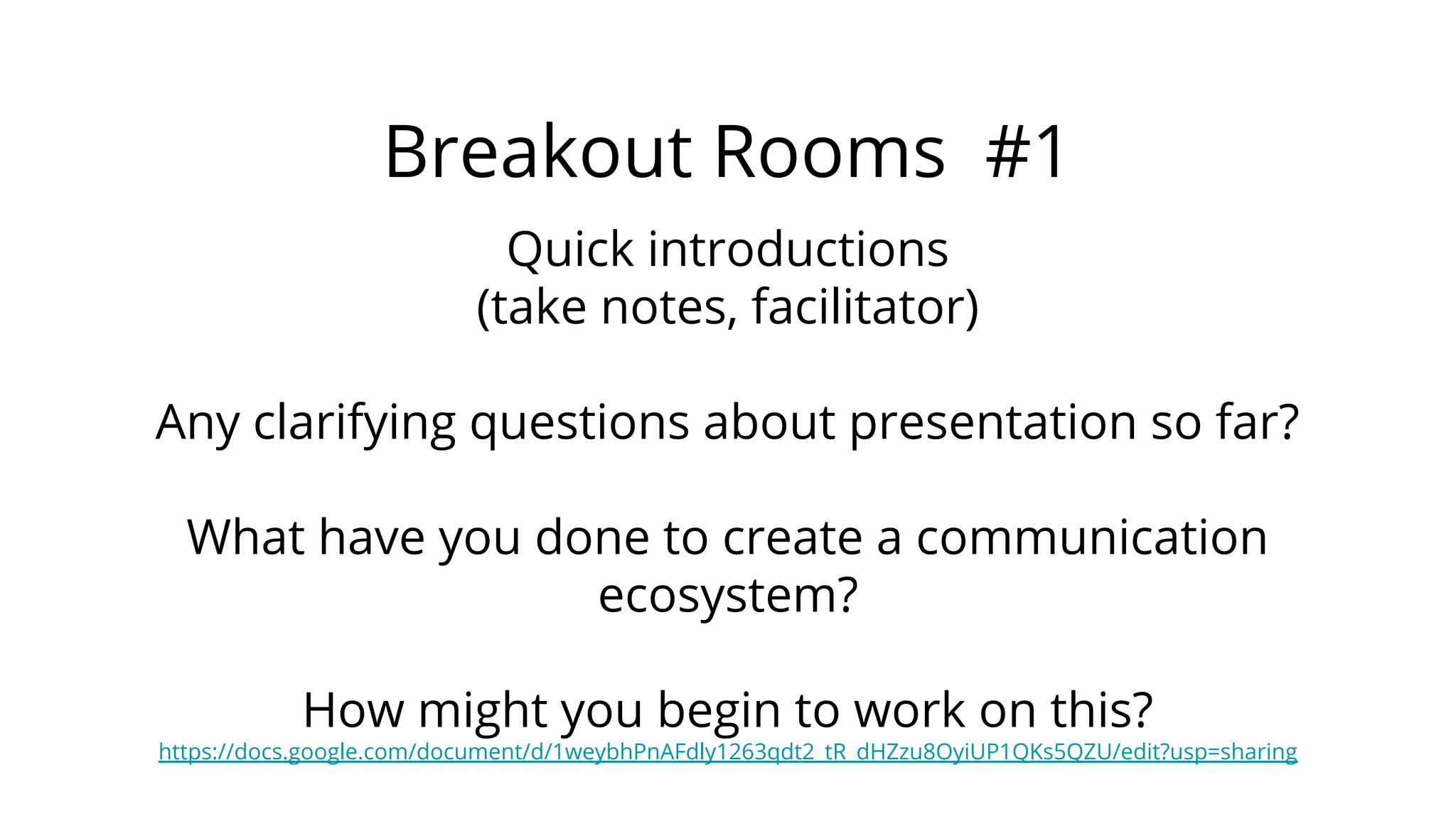
Breakout Rooms #1
Quick introductions
(take notes, facilitator)
Any clarifying questions about presentation so far?
What have you done to create a communication
ecosystem?
How might you begin to work on this?
https://docs.google.com/document/d/1weybhPnAFdly1263qdt2_tR_dHZzu8OyiUP1QKs5QZU/edit?usp=sharing
Report back:
Questions?
Any examples?
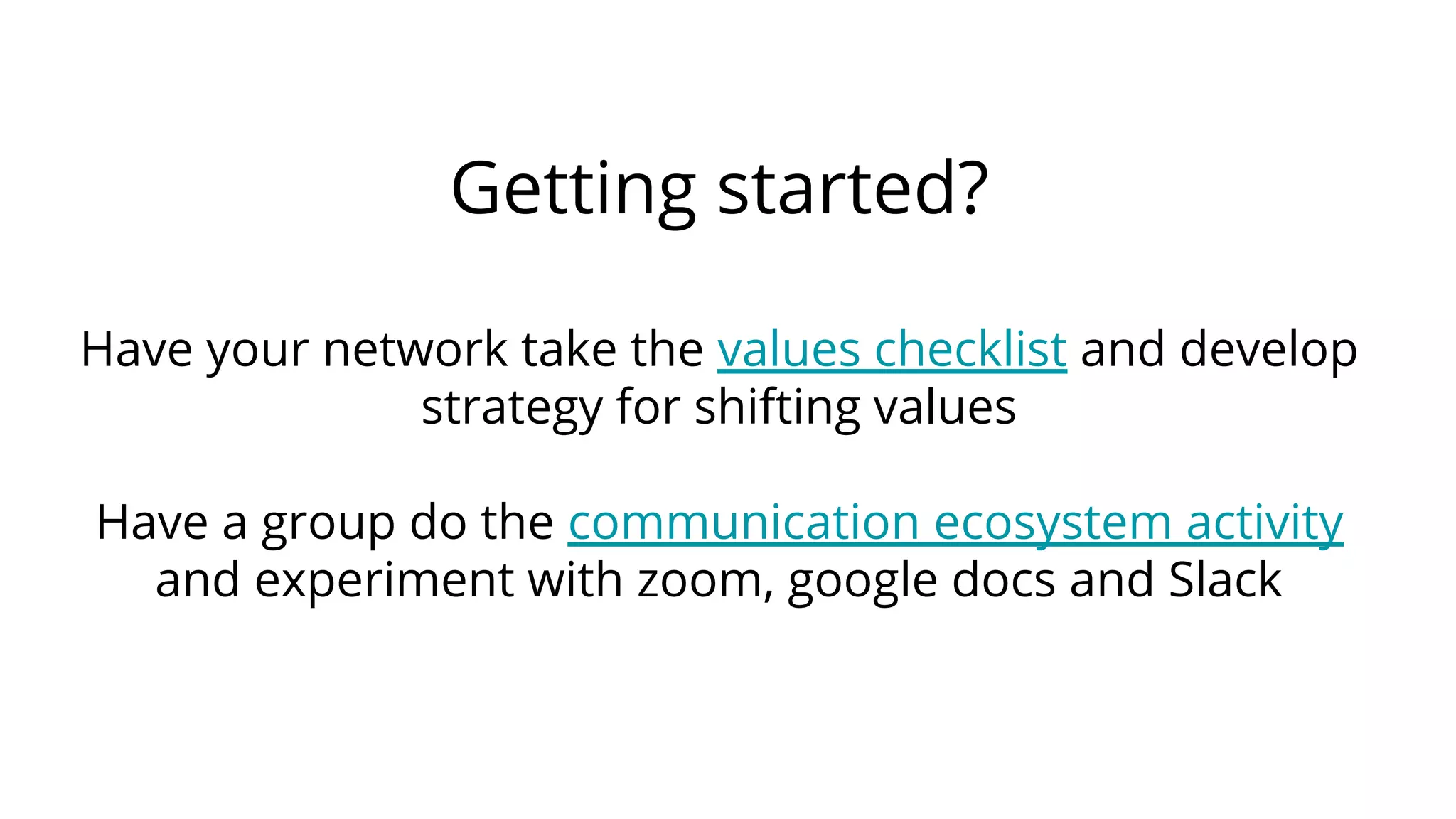
Getting started?
Have your network take the values checklist and develop
strategy for shifting values
Have a group do the communication ecosystem activity
and experiment with zoom, google docs and Slack
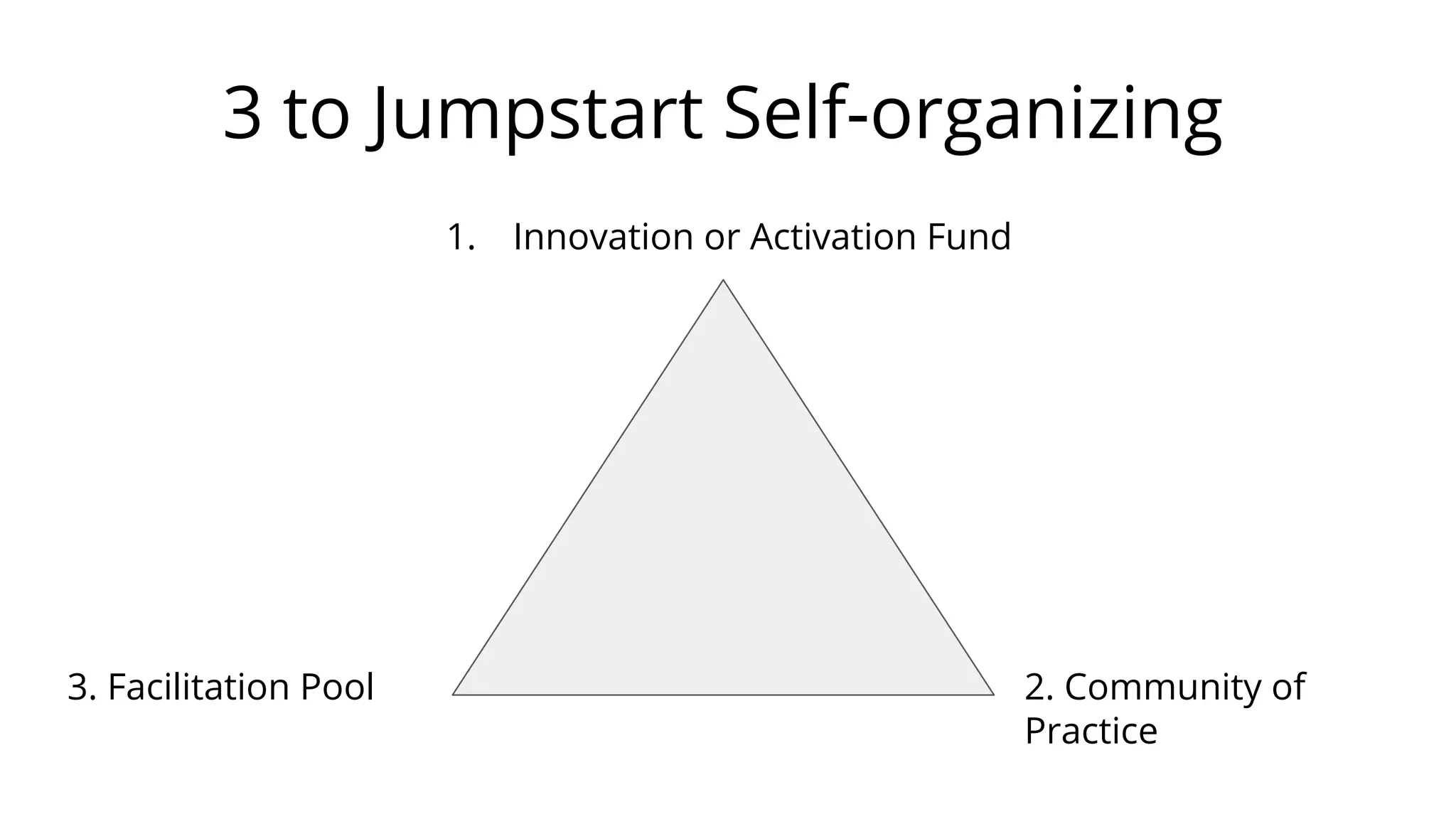
3 to Jumpstart Self-organizing
1. Innovation or Activation Fund
2. Community of
Practice
3. Facilitation Pool
1. Innovation or Activation Funds
Small grants to collaborative projects to get people to shift
to collaboration.
https://networkweaver.com/how-to-set-up-an-innovation-funds/
https://networkweaver.com/encouraging-innovation-collaboration-at-the-gras
sroots-gophil-seed-grants-in-nepal/
2. Communities of Practice for
Innovation Fund Recipients
https://networkweaver.com/communities-of-practice-for-network-weavers/
https://networkweaver.com/best-practices-for-communities-of-practice-learni
ng-networks/
1. Share what each project is learning (spreads innovation)
2. Expand and strengthen the network through relationship
building during session
3. Learn how to support each other with challenges (peer assist)
3. Catalyst Roles
Facilitation Pool
Experienced facilitators, trained in network
facilitation, available to collaborative
projects to help them learn new skills and
practices (using technology, reflection, etc)
The facilitator also models new ways of
working together.
Can lead CoPs, coach individual projects,
coordinate projects.
Catalyst Roles
Learning Weaver
● Captures learning from sessions and
shares with the larger network
● Models and trains in learning and
reflection processes
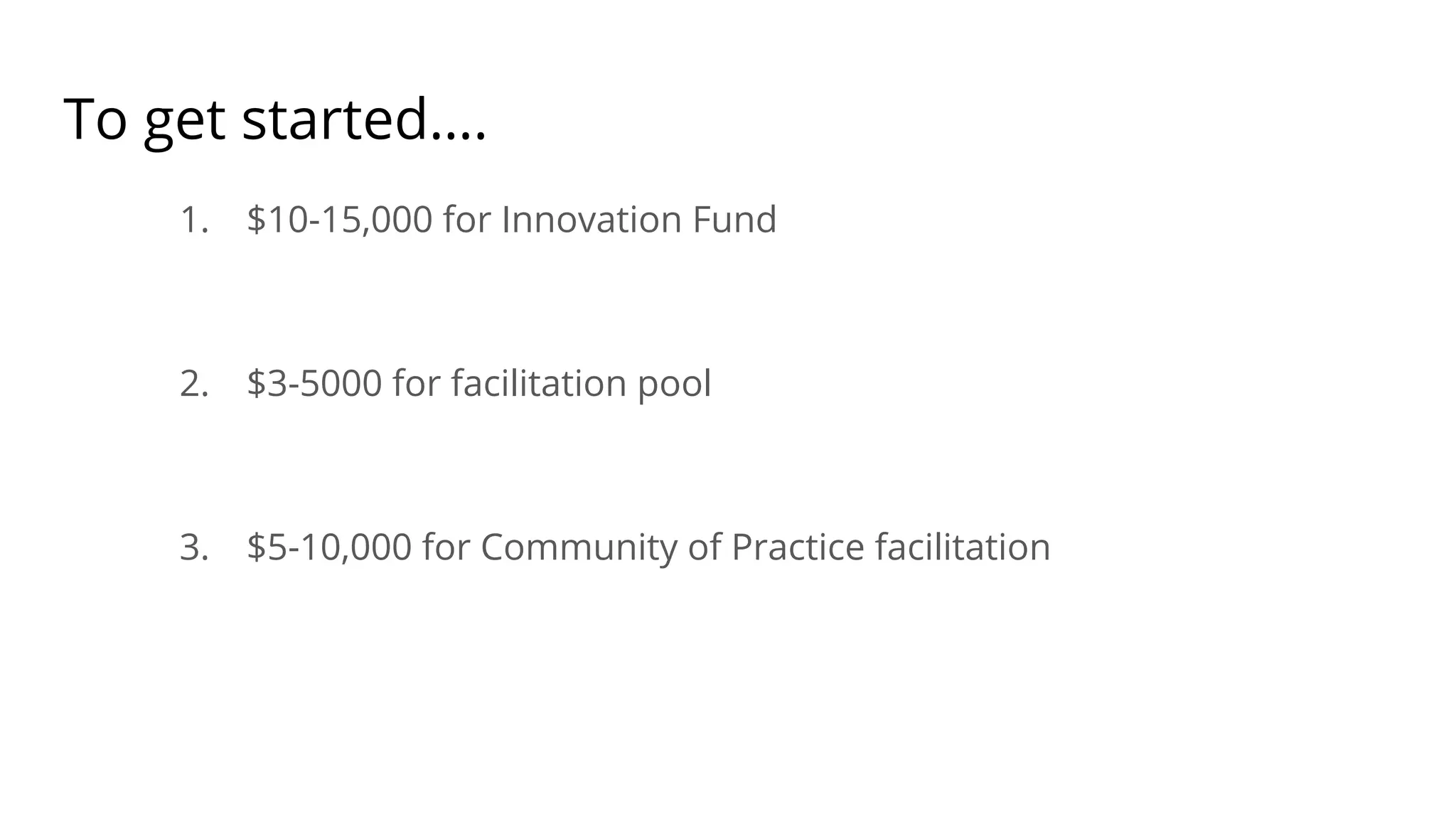
To get started….
1. $10-15,000 for Innovation Fund
2. $3-5000 for facilitation pool
3. $5-10,000 for Community of Practice facilitation
What are your thoughts and questions about
Innovation Funds, Communities of Practice, and
Facilitation Pools ?
Let us know in the chat…..
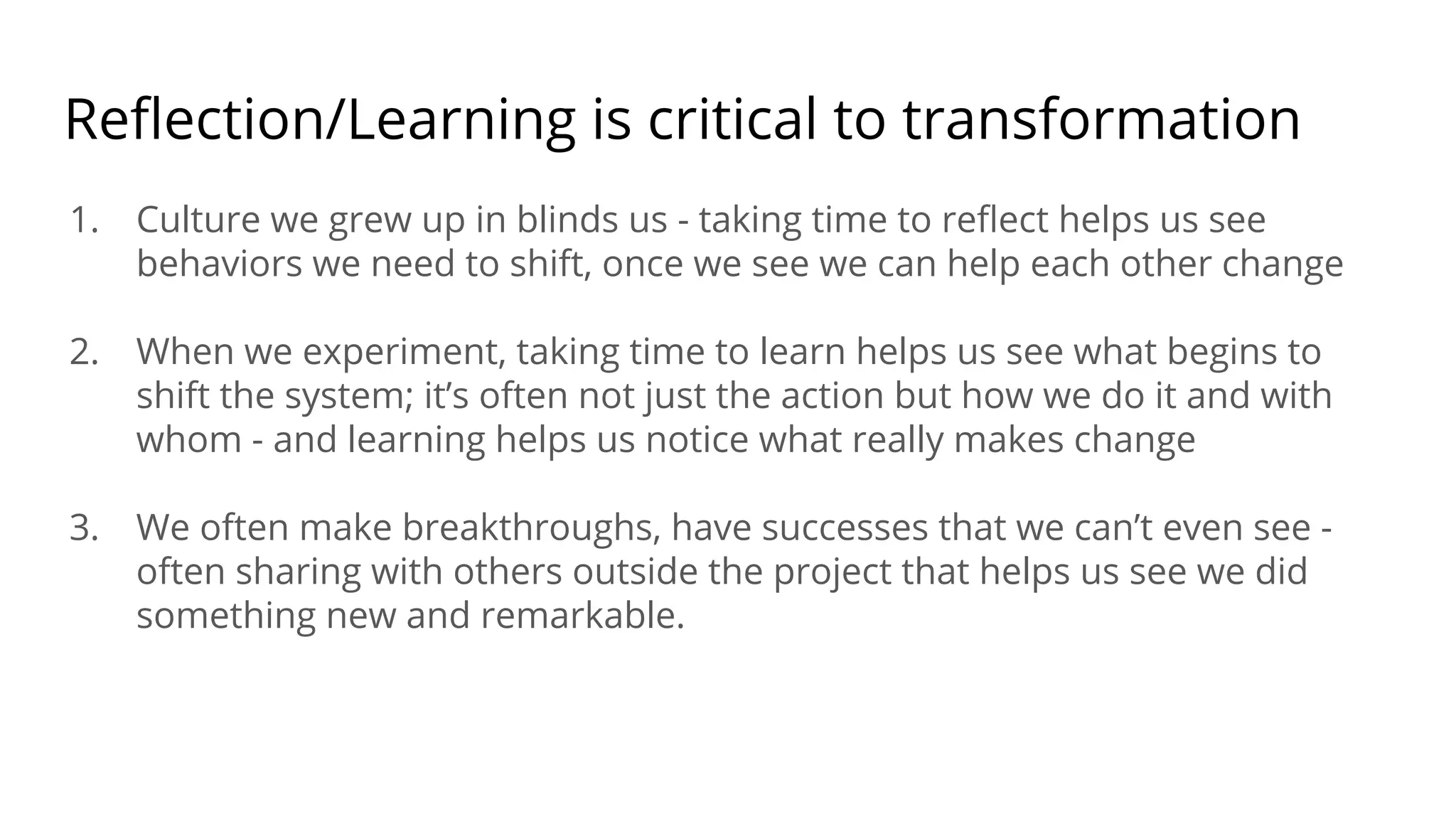
Reflection/Learning is critical to transformation
1. Culture we grew up in blinds us - taking time to reflect helps us see
behaviors we need to shift, once we see we can help each other change
2. When we experiment, taking time to learn helps us see what begins to
shift the system; it’s often not just the action but how we do it and with
whom - and learning helps us notice what really makes change
3. We often make breakthroughs, have successes that we can’t even see -
often sharing with others outside the project that helps us see we did
something new and remarkable.
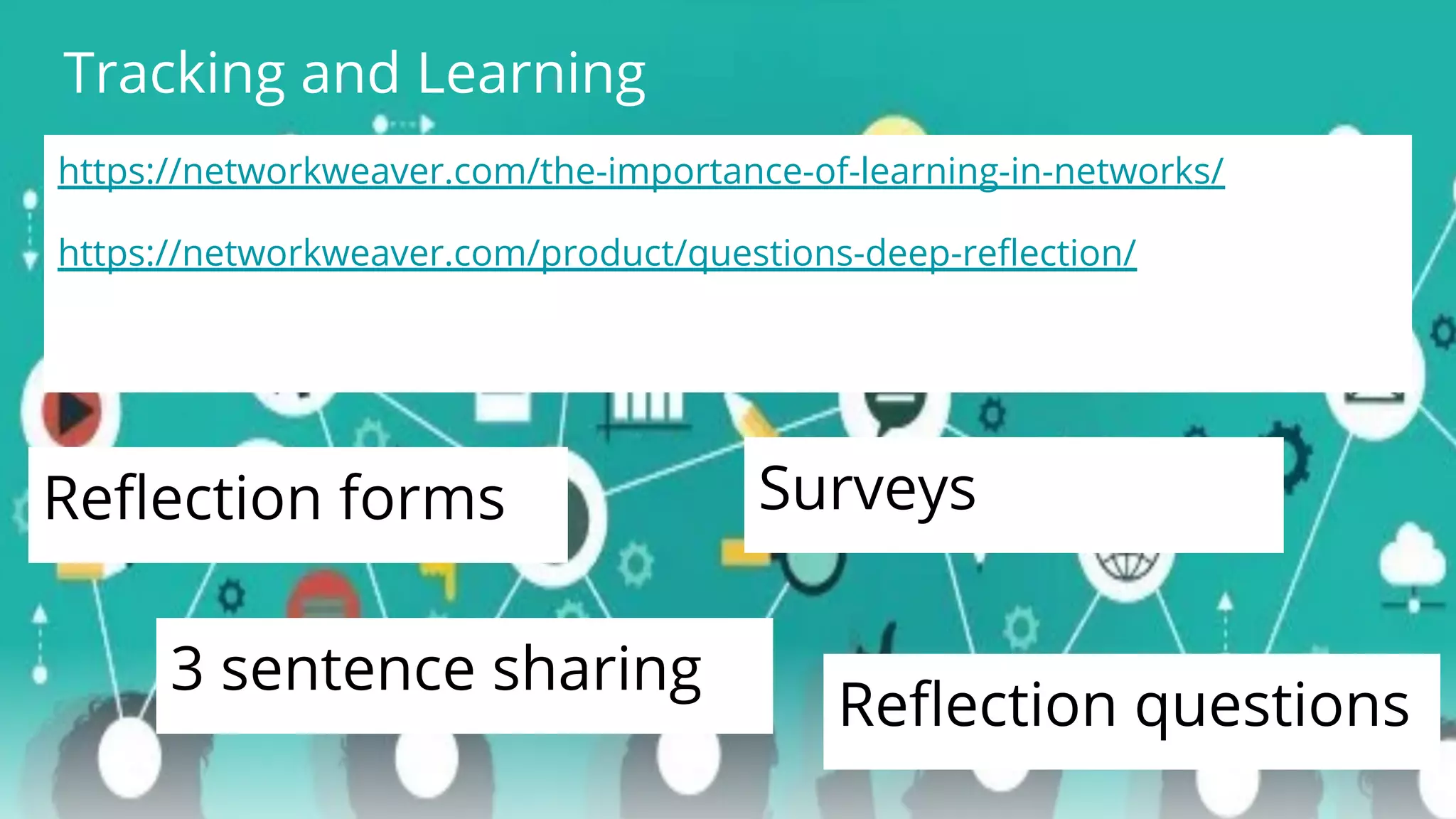
Tracking and Learning
https://networkweaver.com/the-importance-of-learning-in-networks/
https://networkweaver.com/product/questions-deep-reflection/
Reflection forms Surveys
3 sentence sharing
Reflection questions
What we haven’t figured out: How to
share what learned, innovations, insights
with full network and network of
networks?
Network governance
https://networkweaver.com/network-governance/
https://networkweaver.com/consent-based-governance-is-a-great-choice-for-c
ollaborative-networks-heres-why/
https://networkweaver.com/collaborative-governance-accelerator/
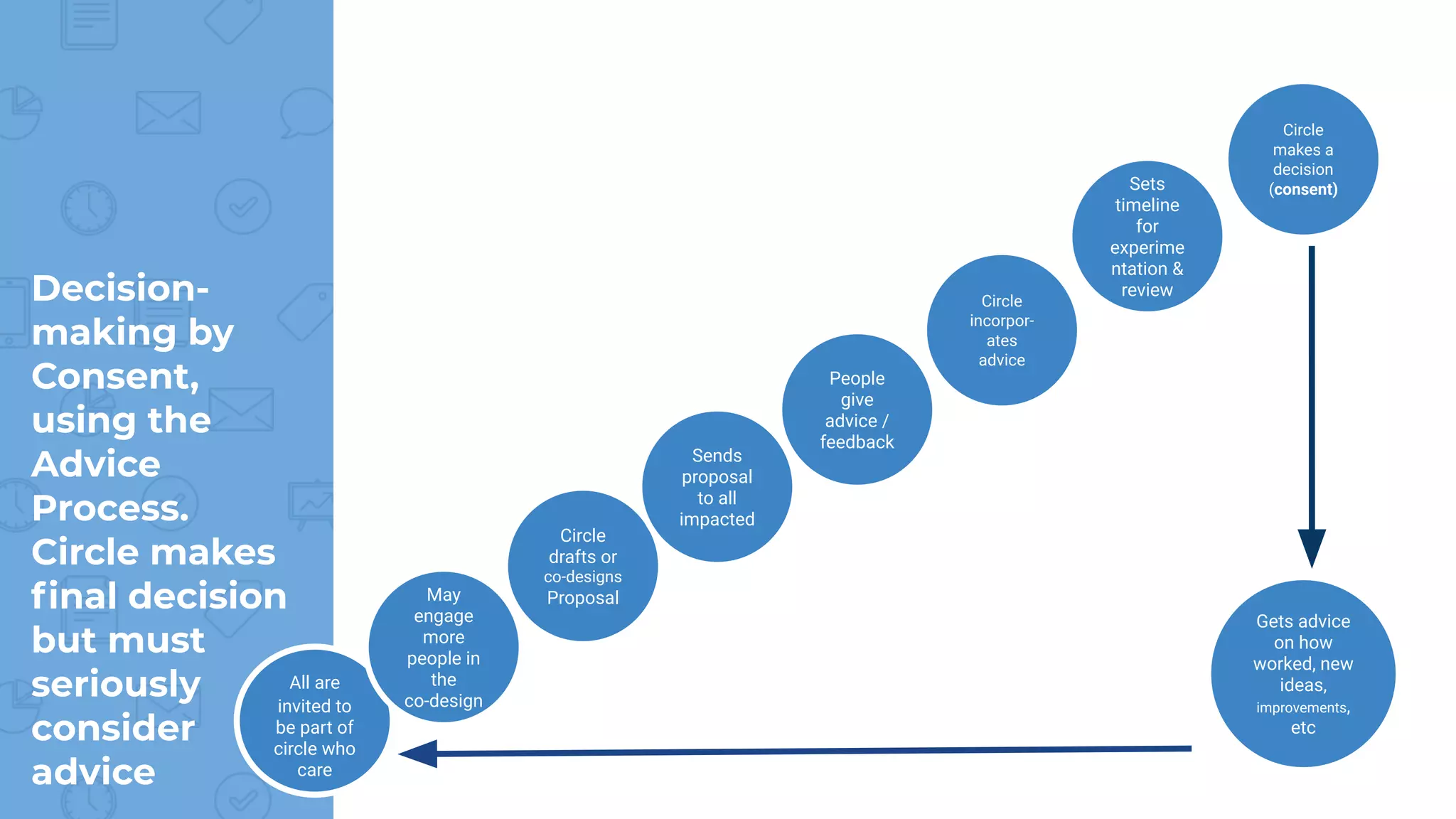
Decision-
making by
Consent,
using the
Advice
Process.
Circle makes
final decision
but must
seriously
consider
advice
Supporting
Catalyzing
Noticing
Engaging
Circle
drafts or
co-designs
Proposal
Sends
proposal
to all
impacted
People
give
advice /
feedback
Circle
incorpor-
ates
advice
Sets
timeline
for
experime
ntation &
review
Gets advice
on how
worked, new
ideas,
improvements,
etc
All are
invited to
be part of
circle who
care
Circle
makes a
decision
(consent)
May
engage
more
people in
the
co-design
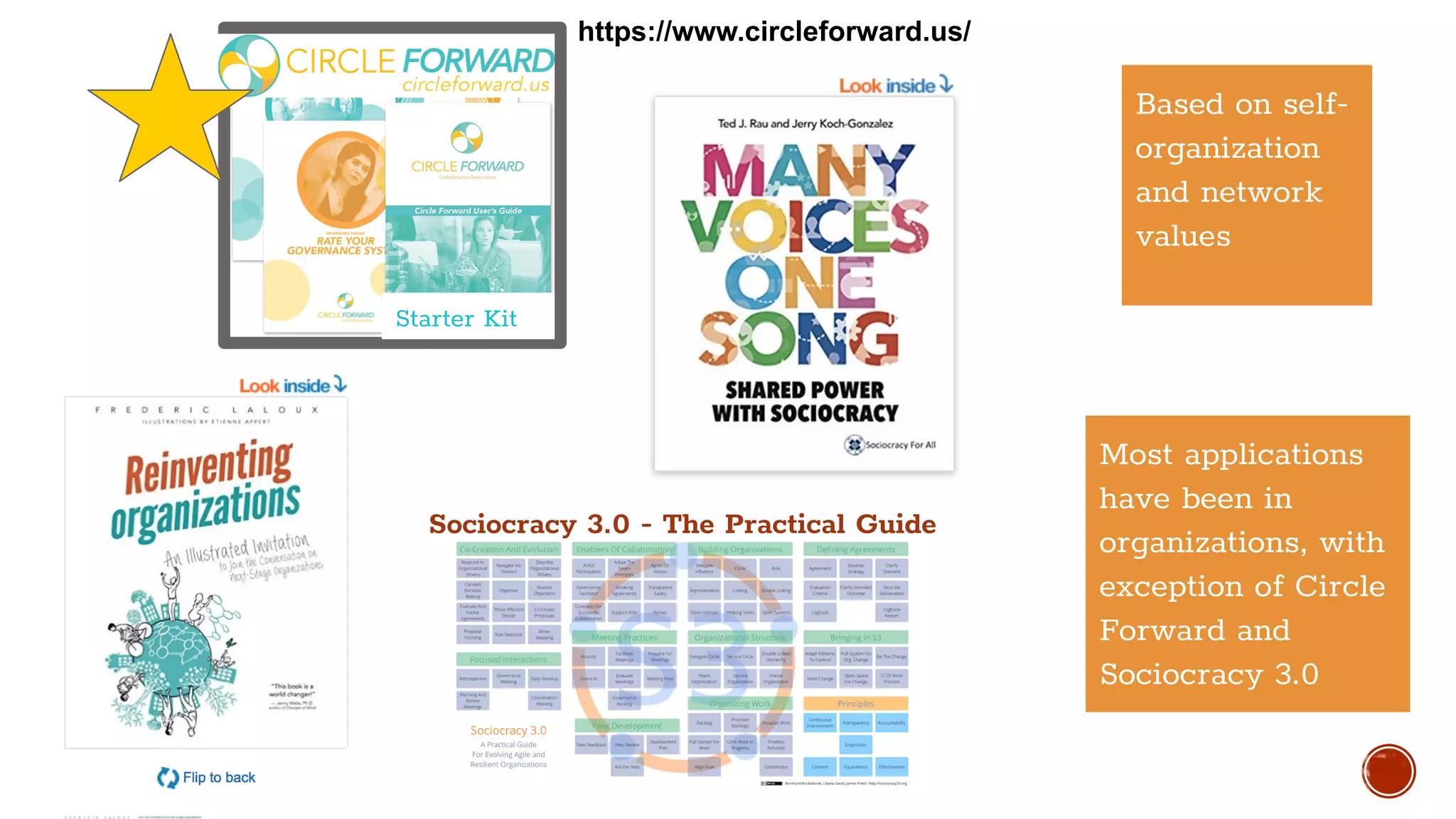
Based on self-
organization
and network
values
Most applications
have been in
organizations, with
exception of Circle
Forward and
Sociocracy 3.0
Sociocracy 3.0 - The Practical Guide
Starter Kit
https://www.circleforward.us/
Breakout Rooms #2
Any clarifying questions about presentation so far?
What have you done to create resources for projects, set
up Communities of Practice and/or facilitation support,
and make time for learning?
How might you begin to work on this?
https://docs.google.com/document/d/1weybhPnAFdly1263qdt2_tR_dHZzu8OyiUP1QKs5QZU/edit?usp=sharing
Report back
● Questions?
● What have you done already?
● Ideas for starting to work on catalysts, innovation funds, CoPs, learning or
governance
Reflection
• What is one insight you got from this day that will
change the way you work?
• What is one thing you are going to try to do?
• What are you interested in hearing more
about?
Support the LLC Webinar Series
The suggested donation for this webinar is $30
http://bit.ly/llc_donate
LLC Thank You!

LLC Webinar Series | Scaffolding for System Shifting Networks

  • 1.
    System Shifting Networks September2019 https://docs.google.com/presentation/d/1ewNFR6FLPxmp5bemk0ZlFjA7JPtK5uMOejGq 4UExgo0/edit#slide=id.p
  • 2.
    Join computer audioif possible, if not link your phone ● Click Join Audio at the Far Left Top Menu. ● Click Phone Call. ● Dial In Tab appears. ○ Select United States ○ Dial one of the Numbers provided. ○ Enter Meeting ID: ### - ### - ### ○ Enter your participant ID ○ Enter # (pound key) 2
  • 3.
    ◎ Network: Over9,000 people who fund, run, and study leadership development ◎ Collaborative Research: Promoting cutting edge models & innovation ◎ Application: Putting new models into practice to scale leadership impact on social justice issues 3 Leadership Learning Community
  • 4.
  • 5.
    Networks can onlybe transformative when they have support for communication, self-organizing and learning.
  • 6.
    Today’s Session 1. Relationships:Give you a chance to meet others on the call 2. New ideas: Hear from June, Yasmin and others on the call about the concept of scaffolding 3. Processing: Have a chance to ask questions and think about applications in your work for creating network scaffolding.
  • 7.
    Breakout rooms ● Yourname ● Something about yourself (work, location, interests, etc) ● Why are you interested in scaffolding for system shifting networks? ● What is the system(s) you are working to shift?
  • 8.
    A system shifting networkis one where participants self-organize and learn from numerous collaborative actions to better understand how to shift oppressive systems and co-create new options. In the chat, share the system you are trying to shift and if you are part of a network….
  • 9.
    Groups of people inSystem Shifting Networks are continually forming new collaborations. 1 How are System Shifting Networks Created?
  • 10.
    System Shifting Networksare continually bringing new people, especially those often under-represented, into their collaborations bringing in new perspectives. They work explicitly to dismantle racism, patriarchy and hierarchy - which gives space for new approaches to emerge. 2 How are System Shifting Networks Created?
  • 11.
    In these collaborative projects,people learn new skills and new ways of working together, so leadership is continually expanding and the number of new projects continually grows. 3 How are System Shifting Networks Created?
  • 12.
    Projects are seenas experiments – a way to get more insight into the system they are shifting. Networks learn what works and do more of it. They get insights that help them work in new ways. 4 How are System Shifting Networks Created?
  • 13.
    People in projects taketime to share what they are learning with others in the network and in other networks so that everyone benefits from every project, whether it was a “failure” or a success. 5 How are System Shifting Networks Created?
  • 14.
    Learning, breakthroughs and new insightsripple through networks and networks of networks so action becomes highly effective in shifting systems. 6 How are System Shifting Networks Created?
  • 15.
    Source of networkmaps: Jeff Mohr, kumu.io Stages from Valdis Krebs orgnet.com Scattered clusters Hub-and-Spoke Self-organizing System Shifting Network Time Where most network-building begins Self-sustaining network How to move from self-organizing to system shifting?
  • 16.
    Scaffolding Basic structures thatwork together to support and accelerate the emergence of a system shifting network ● Communications ecosystem ● Support for self-organizing ○ Innovation Funds ○ Communities of Practice ○ Catalytic Network Weaver roles ● Tracking, reflecting and learning systems ● Network governance We are still in the process of co-designing and piloting these.
  • 17.
    1 Communications Ecosystem Places, spaces,processes and protocols for individuals and projects in a network to communicate, interact, self-organize, learn and share.
  • 18.
    Sample Communication EcosystemFacebook Group & Slack (discussion, events) Group Email (share info, discussion) Interactive eNewsletter Twitter (bring in new ideas) (curate innovations on topic) Doodle or Meeting Wizard to set up meetings Video conferencing for group work and learning, CoP Google docs & Slack for collaboration Track network through dashboards Share Stories Share & Discuss Information Build Relationships & Collaborate Capture & Share Ideas for Innovation Track Network Development Web Page discussion groups/ database ScoopItLoomio for decision making 18 https://networkweaver .com/product/commu nication-ecosystem/
  • 19.
    Grounded in andemerging from network values and behaviors: interact as peers, dismantling racism, patriarchy and hierarchy Need to work explicitly on shifting values so that the communications system doesn’t reinforce old patterns of interaction NETWORK CULTURE
  • 20.
    Network Communications Ecosystem NETWORKCULTURE Network Pulse: See the Network As A Whole Network Reach: Share & Engage Outside Network Network Engagement: Draw in, connect and build relationships between people Network Action: Self-Organize & Get stuff done Learn new skills Network Learning: Track, Reflect and Improve Flows from culture to comms processes catalyzed by the NWs
  • 21.
    Find others with similarinterest Convene for discussions Form a collaborative project & act Tools to Support ● Zoom ● Google docs folder: notes and tasks ● Slack: updates Need a platform for seamless movement
  • 22.
    Self-Organizing & GettingStuff Done Process Steps Tool or Functionality Online Meeting Platform Zoom, Mural, Slack Easy Way Schedule Doodle or QiQo ? Send Meeting Invite Google Calendar - Mural & Zoom have Chrome plugins Agenda and supporting files that everyone can access Google Doc (Mural? - Using a Blank Mural) Note-taking during meeting Google Doc or QiQo? Is there a recording and transcript tool that is automated via Zoom Mural - Using a Blank Mural to take notes Decision-making tools - Polling QiQo? Google Forms? Slido? Icebreaker/Check-In Mural - does it integrate w/Zoom Brainstorming Mural - does it integrate w/ Zoom Mapping Mural - does it integrate w/Zoom Reflection Mural - does it integrate w/Zoom Follow up tasks, project management Do we need a separate project management tool - Monday Slack? QiQo Templates in Google docs and sheets Slack for between meeting communication Sharing learning via newsletter Process/template to do it? Group newsletter tool or function
  • 23.
    Breakout Rooms #1 Quickintroductions (take notes, facilitator) Any clarifying questions about presentation so far? What have you done to create a communication ecosystem? How might you begin to work on this? https://docs.google.com/document/d/1weybhPnAFdly1263qdt2_tR_dHZzu8OyiUP1QKs5QZU/edit?usp=sharing
  • 24.
  • 25.
    Getting started? Have yournetwork take the values checklist and develop strategy for shifting values Have a group do the communication ecosystem activity and experiment with zoom, google docs and Slack
  • 26.
    3 to JumpstartSelf-organizing 1. Innovation or Activation Fund 2. Community of Practice 3. Facilitation Pool
  • 27.
    1. Innovation orActivation Funds Small grants to collaborative projects to get people to shift to collaboration. https://networkweaver.com/how-to-set-up-an-innovation-funds/ https://networkweaver.com/encouraging-innovation-collaboration-at-the-gras sroots-gophil-seed-grants-in-nepal/
  • 28.
    2. Communities ofPractice for Innovation Fund Recipients https://networkweaver.com/communities-of-practice-for-network-weavers/ https://networkweaver.com/best-practices-for-communities-of-practice-learni ng-networks/ 1. Share what each project is learning (spreads innovation) 2. Expand and strengthen the network through relationship building during session 3. Learn how to support each other with challenges (peer assist)
  • 29.
    3. Catalyst Roles FacilitationPool Experienced facilitators, trained in network facilitation, available to collaborative projects to help them learn new skills and practices (using technology, reflection, etc) The facilitator also models new ways of working together. Can lead CoPs, coach individual projects, coordinate projects.
  • 30.
    Catalyst Roles Learning Weaver ●Captures learning from sessions and shares with the larger network ● Models and trains in learning and reflection processes
  • 31.
    To get started…. 1.$10-15,000 for Innovation Fund 2. $3-5000 for facilitation pool 3. $5-10,000 for Community of Practice facilitation
  • 32.
    What are yourthoughts and questions about Innovation Funds, Communities of Practice, and Facilitation Pools ? Let us know in the chat…..
  • 33.
    Reflection/Learning is criticalto transformation 1. Culture we grew up in blinds us - taking time to reflect helps us see behaviors we need to shift, once we see we can help each other change 2. When we experiment, taking time to learn helps us see what begins to shift the system; it’s often not just the action but how we do it and with whom - and learning helps us notice what really makes change 3. We often make breakthroughs, have successes that we can’t even see - often sharing with others outside the project that helps us see we did something new and remarkable.
  • 34.
  • 36.
    What we haven’tfigured out: How to share what learned, innovations, insights with full network and network of networks?
  • 37.
  • 38.
    Decision- making by Consent, using the Advice Process. Circlemakes final decision but must seriously consider advice Supporting Catalyzing Noticing Engaging Circle drafts or co-designs Proposal Sends proposal to all impacted People give advice / feedback Circle incorpor- ates advice Sets timeline for experime ntation & review Gets advice on how worked, new ideas, improvements, etc All are invited to be part of circle who care Circle makes a decision (consent) May engage more people in the co-design
  • 39.
    Based on self- organization andnetwork values Most applications have been in organizations, with exception of Circle Forward and Sociocracy 3.0 Sociocracy 3.0 - The Practical Guide Starter Kit https://www.circleforward.us/
  • 40.
    Breakout Rooms #2 Anyclarifying questions about presentation so far? What have you done to create resources for projects, set up Communities of Practice and/or facilitation support, and make time for learning? How might you begin to work on this? https://docs.google.com/document/d/1weybhPnAFdly1263qdt2_tR_dHZzu8OyiUP1QKs5QZU/edit?usp=sharing
  • 41.
    Report back ● Questions? ●What have you done already? ● Ideas for starting to work on catalysts, innovation funds, CoPs, learning or governance
  • 42.
    Reflection • What isone insight you got from this day that will change the way you work? • What is one thing you are going to try to do? • What are you interested in hearing more about?
  • 43.
    Support the LLCWebinar Series The suggested donation for this webinar is $30 http://bit.ly/llc_donate LLC Thank You!