Basic Network Training
Virtual Training
May 2018
1
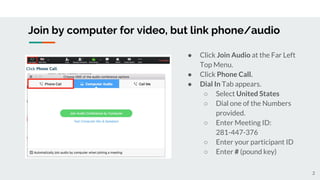
Join by computer for video, but link phone/audio
● Click Join Audio at the Far Left
Top Menu.
● Click Phone Call.
● Dial In Tab appears.
○ Select United States
○ Dial one of the Numbers
provided.
○ Enter Meeting ID:
281-447-376
○ Enter your participant ID
○ Enter # (pound key)
2
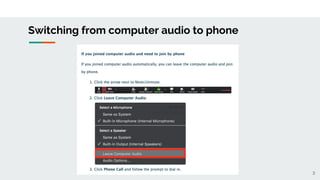
Switching from computer audio to phone
3
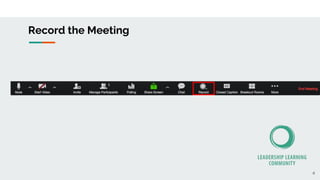
Record the Meeting
4
About the Network Building
Project: Training & Strategy
Virtual Training
May 2018
5
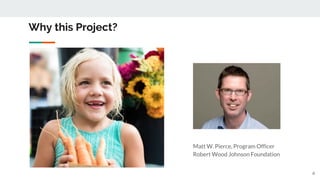
Why this Project?
Matt W. Pierce, Program Officer
Robert Wood Johnson Foundation
6
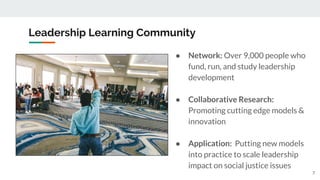
Leadership Learning Community
● Network: Over 9,000 people who
fund, run, and study leadership
development
● Collaborative Research:
Promoting cutting edge models &
innovation
● Application: Putting new models
into practice to scale leadership
impact on social justice issues
7
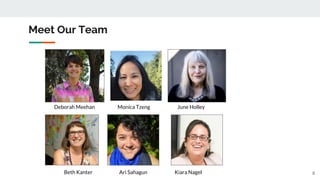
Meet Our Team
Deborah Meehan Monica Tzeng June Holley
Beth Kanter Ari Sahagun Kiara Nagel 8
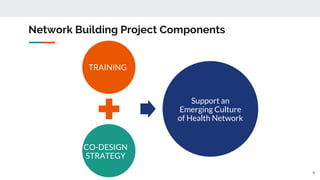
Network Building Project Components
TRAINING
CO-DESIGN
STRATEGY
Support an
Emerging Culture
of Health Network
9
Learning Goals
❏ An understanding of what we mean by networks and
the benefits of a network approach
❏ Group and individual reflections on how networks or
network strategies might advance your work
❏ Early thinking about the kinds of behaviors needed to
lead in networks and behaviors you could try out in
your work
10
Agenda
❏ Network Building Project Overview
❏ Networks: What networks are accomplishing?
❏ Exercise: The benefits of a network approach for a Culture of Health
❏ Network principles, values, and behaviors
❏ Exercise: Building network culture
❏ Reflection and Closing
11
12
Networks: Basics
Promoting a Culture of Health
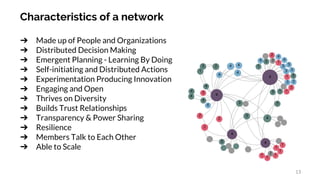
Characteristics of a network
➔ Made up of People and Organizations
➔ Distributed Decision Making
➔ Emergent Planning - Learning By Doing
➔ Self-initiating and Distributed Actions
➔ Experimentation Producing Innovation
➔ Engaging and Open
➔ Thrives on Diversity
➔ Builds Trust Relationships
➔ Transparency & Power Sharing
➔ Resilience
➔ Members Talk to Each Other
➔ Able to Scale
13
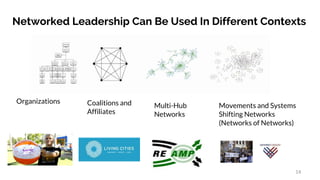
Organizations Coalitions and
Affiliates
Multi-Hub
Networks
Movements and Systems
Shifting Networks
(Networks of Networks)
Networked Leadership Can Be Used In Different Contexts
14
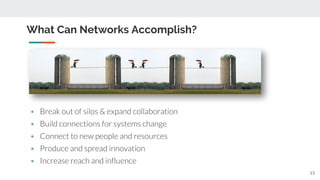
What Can Networks Accomplish?
• Break out of silos & expand collaboration
• Build connections for systems change
• Connect to new people and resources
• Produce and spread innovation
• Increase reach and influence
15
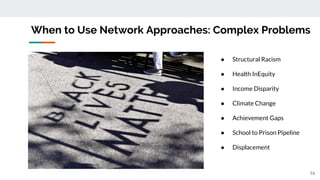
When to Use Network Approaches: Complex Problems
● Structural Racism
● Health InEquity
● Income Disparity
● Climate Change
● Achievement Gaps
● School to Prison Pipeline
● Displacement
16
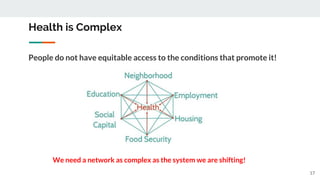
Health is Complex
People do not have equitable access to the conditions that promote it!
We need a network as complex as the system we are shifting!
17
18
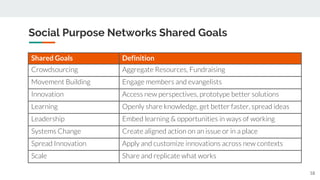
Social Purpose Networks Shared Goals
Shared Goals Definition
Crowdsourcing Aggregate Resources, Fundraising
Movement Building Engage members and evangelists
Innovation Access new perspectives, prototype better solutions
Learning Openly share knowledge, get better faster, spread ideas
Leadership Embed learning & opportunities in ways of working
Systems Change Create aligned action on an issue or in a place
Spread Innovation Apply and customize innovations across new contexts
Scale Share and replicate what works
19
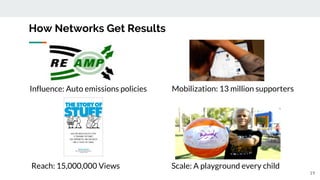
How Networks Get Results
Scale: A playground every child
can walk to
Reach: 15,000,000 Views
Influence: Auto emissions policies Mobilization: 13 million supporters
and $750, 000,000
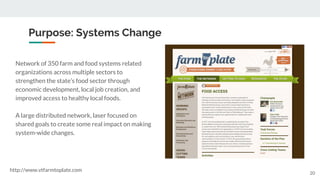
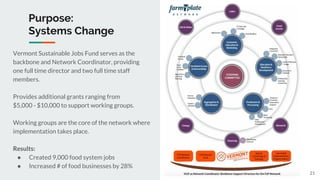
Purpose: Systems Change
Network of 350 farm and food systems related
organizations across multiple sectors to
strengthen the state’s food sector through
economic development, local job creation, and
improved access to healthy local foods.
A large distributed network, laser focused on
shared goals to create some real impact on making
system-wide changes.
20
http://www.vtfarmtoplate.com
Purpose:
Systems Change
21
Vermont Sustainable Jobs Fund serves as the
backbone and Network Coordinator, providing
one full time director and two full time staff
members.
Provides additional grants ranging from
$5,000 - $10,000 to support working groups.
Working groups are the core of the network where
implementation takes place.
Results:
● Created 9,000 food system jobs
● Increased # of food businesses by 28%
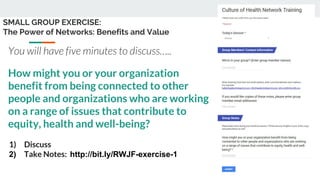
SMALL GROUP EXERCISE:
The Power of Networks: Benefits and Value
22
You will have five minutes to discuss…..
How might you or your organization
benefit from being connected to other
people and organizations who are working
on a range of issues that contribute to
equity, health and well-being?
1) Discuss
2) Take Notes: http://bit.ly/RWJF-exercise-1
Exercise: The Power of Networks: Benefits and Value
23
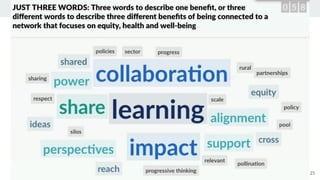
Slido.Com (You
can use your
mobile phone)
Event Code:
#RWJF-1
Slido.Com (You can use your
mobile phone)
Event Code: #RWJF-1
24
25
26
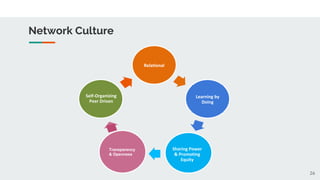
Network Culture
Relational
Learning by
Doing
Sharing Power
& Promoting
Equity
Transparency
& Openness
Self-Organizing
Peer Driven
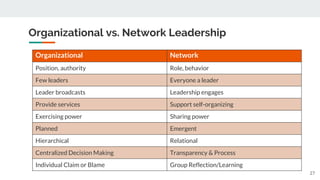
Organizational vs. Network Leadership
Organizational Network
Position, authority Role, behavior
Few leaders Everyone a leader
Leader broadcasts Leadership engages
Provide services Support self-organizing
Exercising power Sharing power
Planned Emergent
Hierarchical Relational
Centralized Decision Making Transparency & Process
Individual Claim or Blame Group Reflection/Learning
27
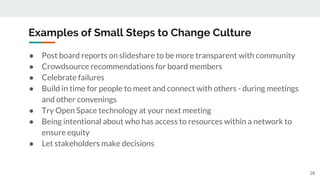
Examples of Small Steps to Change Culture
● Post board reports on slideshare to be more transparent with community
● Crowdsource recommendations for board members
● Celebrate failures
● Build in time for people to meet and connect with others - during meetings
and other convenings
● Try Open Space technology at your next meeting
● Being intentional about who has access to resources within a network to
ensure equity
● Let stakeholders make decisions
28
29
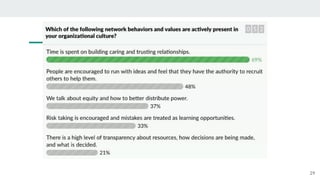
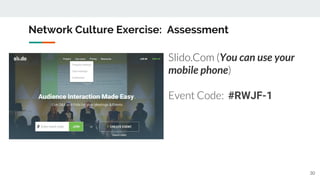
Network Culture Exercise: Assessment
Slido.Com (You can use your
mobile phone)
Event Code: #RWJF-1
30
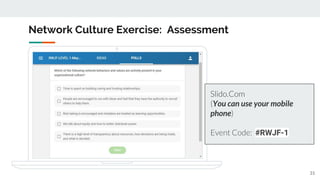
Network Culture Exercise: Assessment
Slido.Com
(You can use your mobile
phone)
Event Code: #RWJF-1
31
Network Culture Exercise: Small Group Discussion
You will have five minutes to discuss…..
What are some network behaviors you could try to
strengthen network values in the areas where you need
the most improvement?
Small Groups In Zoom Rooms
32
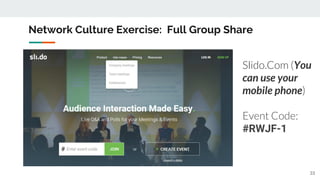
Network Culture Exercise: Full Group Share
Slido.Com (You
can use your
mobile phone)
Event Code:
#RWJF-1
33
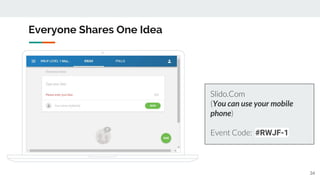
Slido.Com
(You can use your mobile
phone)
Event Code: #RWJF-1
Everyone Shares One Idea
34
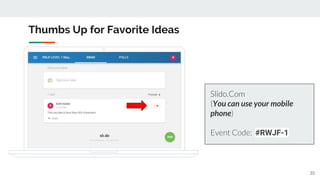
Slido.Com
(You can use your mobile
phone)
Event Code: #RWJF-1
Thumbs Up for Favorite Ideas
35
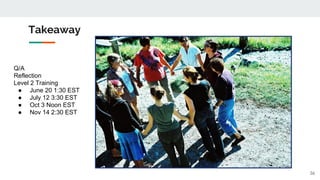
Takeaway
Q/A
Reflection
Level 2 Training
● June 20 1:30 EST
● July 12 3:30 EST
● Oct 3 Noon EST
● Nov 14 2:30 EST
36

RWJF Basic Network Training

  • 1.
    Basic Network Training VirtualTraining May 2018 1
  • 2.
    Join by computerfor video, but link phone/audio ● Click Join Audio at the Far Left Top Menu. ● Click Phone Call. ● Dial In Tab appears. ○ Select United States ○ Dial one of the Numbers provided. ○ Enter Meeting ID: 281-447-376 ○ Enter your participant ID ○ Enter # (pound key) 2
  • 3.
    Switching from computeraudio to phone 3
  • 4.
  • 5.
    About the NetworkBuilding Project: Training & Strategy Virtual Training May 2018 5
  • 6.
    Why this Project? MattW. Pierce, Program Officer Robert Wood Johnson Foundation 6
  • 7.
    Leadership Learning Community ●Network: Over 9,000 people who fund, run, and study leadership development ● Collaborative Research: Promoting cutting edge models & innovation ● Application: Putting new models into practice to scale leadership impact on social justice issues 7
  • 8.
    Meet Our Team DeborahMeehan Monica Tzeng June Holley Beth Kanter Ari Sahagun Kiara Nagel 8
  • 9.
    Network Building ProjectComponents TRAINING CO-DESIGN STRATEGY Support an Emerging Culture of Health Network 9
  • 10.
    Learning Goals ❏ Anunderstanding of what we mean by networks and the benefits of a network approach ❏ Group and individual reflections on how networks or network strategies might advance your work ❏ Early thinking about the kinds of behaviors needed to lead in networks and behaviors you could try out in your work 10
  • 11.
    Agenda ❏ Network BuildingProject Overview ❏ Networks: What networks are accomplishing? ❏ Exercise: The benefits of a network approach for a Culture of Health ❏ Network principles, values, and behaviors ❏ Exercise: Building network culture ❏ Reflection and Closing 11
  • 12.
  • 13.
    Characteristics of anetwork ➔ Made up of People and Organizations ➔ Distributed Decision Making ➔ Emergent Planning - Learning By Doing ➔ Self-initiating and Distributed Actions ➔ Experimentation Producing Innovation ➔ Engaging and Open ➔ Thrives on Diversity ➔ Builds Trust Relationships ➔ Transparency & Power Sharing ➔ Resilience ➔ Members Talk to Each Other ➔ Able to Scale 13
  • 14.
    Organizations Coalitions and Affiliates Multi-Hub Networks Movementsand Systems Shifting Networks (Networks of Networks) Networked Leadership Can Be Used In Different Contexts 14
  • 15.
    What Can NetworksAccomplish? • Break out of silos & expand collaboration • Build connections for systems change • Connect to new people and resources • Produce and spread innovation • Increase reach and influence 15
  • 16.
    When to UseNetwork Approaches: Complex Problems ● Structural Racism ● Health InEquity ● Income Disparity ● Climate Change ● Achievement Gaps ● School to Prison Pipeline ● Displacement 16
  • 17.
    Health is Complex Peopledo not have equitable access to the conditions that promote it! We need a network as complex as the system we are shifting! 17
  • 18.
    18 Social Purpose NetworksShared Goals Shared Goals Definition Crowdsourcing Aggregate Resources, Fundraising Movement Building Engage members and evangelists Innovation Access new perspectives, prototype better solutions Learning Openly share knowledge, get better faster, spread ideas Leadership Embed learning & opportunities in ways of working Systems Change Create aligned action on an issue or in a place Spread Innovation Apply and customize innovations across new contexts Scale Share and replicate what works
  • 19.
    19 How Networks GetResults Scale: A playground every child can walk to Reach: 15,000,000 Views Influence: Auto emissions policies Mobilization: 13 million supporters and $750, 000,000
  • 20.
    Purpose: Systems Change Networkof 350 farm and food systems related organizations across multiple sectors to strengthen the state’s food sector through economic development, local job creation, and improved access to healthy local foods. A large distributed network, laser focused on shared goals to create some real impact on making system-wide changes. 20 http://www.vtfarmtoplate.com
  • 21.
    Purpose: Systems Change 21 Vermont SustainableJobs Fund serves as the backbone and Network Coordinator, providing one full time director and two full time staff members. Provides additional grants ranging from $5,000 - $10,000 to support working groups. Working groups are the core of the network where implementation takes place. Results: ● Created 9,000 food system jobs ● Increased # of food businesses by 28%
  • 22.
    SMALL GROUP EXERCISE: ThePower of Networks: Benefits and Value 22 You will have five minutes to discuss….. How might you or your organization benefit from being connected to other people and organizations who are working on a range of issues that contribute to equity, health and well-being? 1) Discuss 2) Take Notes: http://bit.ly/RWJF-exercise-1
  • 23.
    Exercise: The Powerof Networks: Benefits and Value 23 Slido.Com (You can use your mobile phone) Event Code: #RWJF-1
  • 24.
    Slido.Com (You canuse your mobile phone) Event Code: #RWJF-1 24
  • 25.
  • 26.
    26 Network Culture Relational Learning by Doing SharingPower & Promoting Equity Transparency & Openness Self-Organizing Peer Driven
  • 27.
    Organizational vs. NetworkLeadership Organizational Network Position, authority Role, behavior Few leaders Everyone a leader Leader broadcasts Leadership engages Provide services Support self-organizing Exercising power Sharing power Planned Emergent Hierarchical Relational Centralized Decision Making Transparency & Process Individual Claim or Blame Group Reflection/Learning 27
  • 28.
    Examples of SmallSteps to Change Culture ● Post board reports on slideshare to be more transparent with community ● Crowdsource recommendations for board members ● Celebrate failures ● Build in time for people to meet and connect with others - during meetings and other convenings ● Try Open Space technology at your next meeting ● Being intentional about who has access to resources within a network to ensure equity ● Let stakeholders make decisions 28
  • 29.
  • 30.
    Network Culture Exercise:Assessment Slido.Com (You can use your mobile phone) Event Code: #RWJF-1 30
  • 31.
    Network Culture Exercise:Assessment Slido.Com (You can use your mobile phone) Event Code: #RWJF-1 31
  • 32.
    Network Culture Exercise:Small Group Discussion You will have five minutes to discuss….. What are some network behaviors you could try to strengthen network values in the areas where you need the most improvement? Small Groups In Zoom Rooms 32
  • 33.
    Network Culture Exercise:Full Group Share Slido.Com (You can use your mobile phone) Event Code: #RWJF-1 33
  • 34.
    Slido.Com (You can useyour mobile phone) Event Code: #RWJF-1 Everyone Shares One Idea 34
  • 35.
    Slido.Com (You can useyour mobile phone) Event Code: #RWJF-1 Thumbs Up for Favorite Ideas 35
  • 36.
    Takeaway Q/A Reflection Level 2 Training ●June 20 1:30 EST ● July 12 3:30 EST ● Oct 3 Noon EST ● Nov 14 2:30 EST 36