Network Effectiveness:  An Interactive Working Session September 2009 Ed Mazzarella Chad Nelsen (Adapted from the Monitor Institute*) *Network Effectiveness: An Interactive Working Session for Packard Foundation Grantees,Monitor Group.  May 27, 2009.  Heather Grant & Diana Scearce. On SlideShare: http://bit.ly/GvLJy
Goals Understand network thinking Understand your/our network Understanding network effectiveness
Session Agenda Network Basics – 30 minutes Mapping Exercise – 45 minutes Network Effectiveness – 30 minutes Surfrider Global Network – 15 minutes
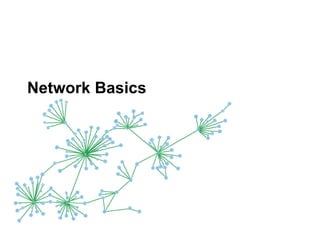
Network Basics
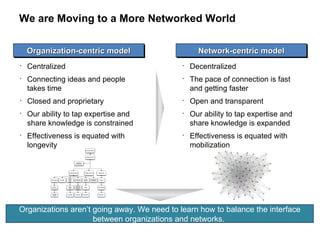
Centralized Connecting ideas and people takes time Closed and proprietary Our ability to tap expertise and share knowledge is constrained Effectiveness is equated with longevity Decentralized The pace of connection is fast and getting faster Open and transparent Our ability to tap expertise and share knowledge is expanded Effectiveness is equated with mobilization Organization-centric model Network-centric model We are Moving to a More Networked World Organizations aren’t going away. We need to learn how to balance the interface between organizations and networks.
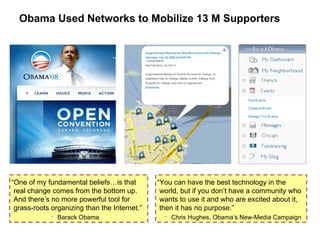
“ You can have the best technology in the world, but if you don’t have a community who wants to use it and who are excited about it, then it has no purpose.” Chris Hughes, Obama’s New-Media Campaign “ One of my fundamental beliefs…is that real change comes from the bottom up.  And there’s no more powerful tool for grass-roots organizing than the Internet.” Barack Obama Obama Used Networks to Mobilize 13 M Supporters
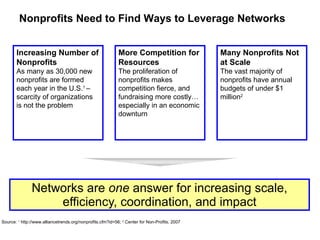
Networks are  one  answer for increasing scale, efficiency, coordination, and impact Many Nonprofits Not at Scale The vast majority of nonprofits have annual budgets of under $1 million 2 Increasing Number of Nonprofits As many as 30,000 new nonprofits are formed each year in the U.S. 1  – scarcity of organizations is not the problem More Competition for Resources The proliferation of nonprofits makes competition fierce, and fundraising more costly…especially in an economic downturn Source:  1  http://www.alliancetrends.org/nonprofits.cfm?id=56;  2  Center for Non-Profits, 2007 Nonprofits Need to Find Ways to Leverage Networks
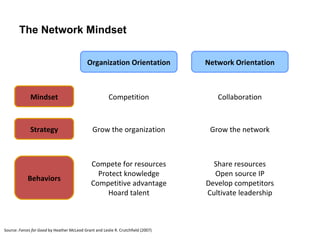
The Network Mindset Organization Orientation Network Orientation Mindset Strategy Behaviors Competition Grow the organization Compete for resources Protect knowledge Competitive advantage Hoard talent Collaboration Grow the network Share resources Open source IP Develop competitors Cultivate leadership Source:  Forces for Good  by Heather McLeod Grant and Leslie R. Crutchfield (2007)
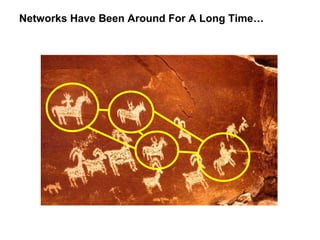
Networks Have Been Around For A Long Time…
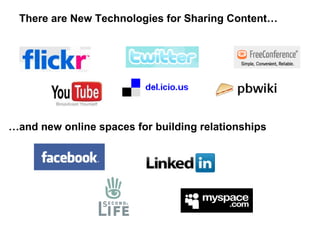
… and new online spaces for building relationships There are New Technologies for Sharing Content…
“ We are living in the  Golden Age of network theory , where sociology, math, computer science and software engineering are all combining to allow the average user to visualize, understand, and most importantly, rely on the social and business networks that are part of their lives.” - Clay Shirky Source: “Work on Networks” by Clay Shirky (2003) Our Understanding of Networks is Getting Better
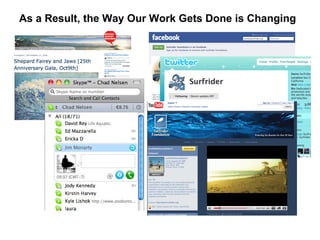
As a Result, the Way Our Work Gets Done is Changing
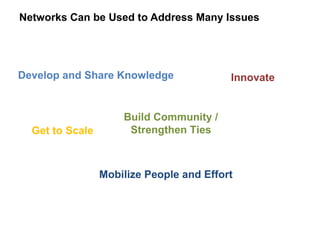
Networks Can be Used to Address Many Issues Get to Scale Mobilize People and Effort Innovate Build Community / Strengthen Ties Develop and Share Knowledge
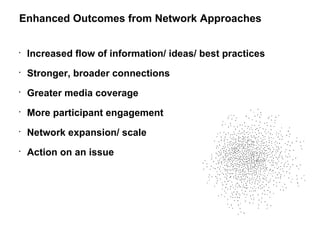
Increased flow of information/ ideas/ best practices Stronger, broader connections Greater media coverage More participant engagement Network expansion/ scale Action on an issue Enhanced Outcomes from Network Approaches
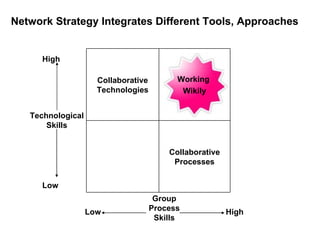
Network Strategy Integrates Different Tools, Approaches Collaborative Technologies Working  Wikily Collaborative Processes Low High Group Process Skills Low High Technological Skills
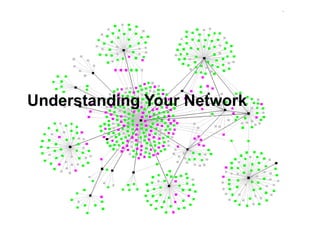
Understanding Your Network
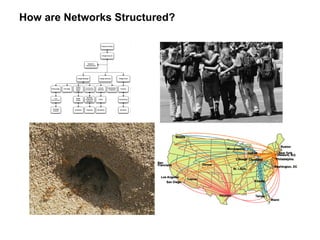
How are Networks Structured?
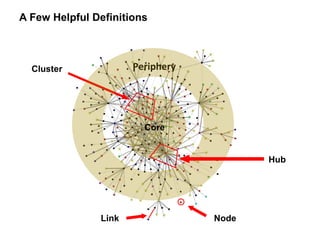
A Few Helpful Definitions Core Hub Link Node Cluster Periphery
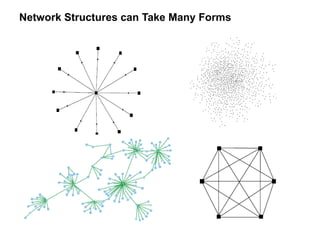
Network Structures can Take Many Forms
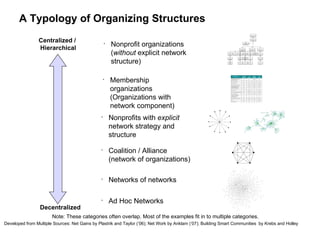
Centralized /  Hierarchical Decentralized Note: These categories often overlap. Most of the examples fit in to multiple categories. Nonprofit organizations ( without  explicit network structure) Membership organizations (Organizations with network component) Nonprofits with  explicit  network strategy and structure Coalition / Alliance (network of organizations) Networks of networks Ad Hoc Networks Developed from Multiple Sources: Net Gains by Plastrik and Taylor (‘06); Net Work by Anklam (‘07); Building Smart Communities  by Krebs and Holley A Typology of Organizing Structures
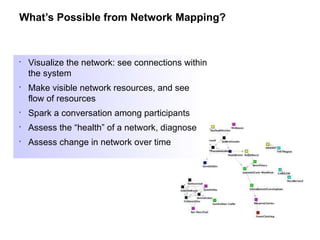
What’s Possible from Network Mapping? What’s Possible from Network Mapping? Visualize the network: see connections within the system Make visible network resources, and see flow of resources Spark a conversation among participants Assess the “health” of a network, diagnose Assess change in network over time
EXCERCIZE 1: MAP YOUR NETWORK
PART II: Network Effectiveness
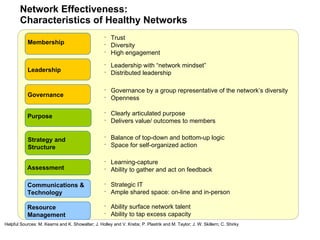
Network Effectiveness:  Characteristics of Healthy Networks Purpose Membership Strategy and Structure Leadership Communications & Technology Resource Management  Assessment Clearly articulated purpose Delivers value/ outcomes to members Trust Diversity High engagement Balance of top-down and bottom-up logic Space for self-organized action Leadership with “network mindset” Distributed leadership Strategic IT Ample shared space: on-line and in-person Ability surface network talent Ability to tap excess capacity  Learning-capture Ability to gather and act on feedback Governance Governance by a group representative of the network’s diversity Openness Helpful Sources: M. Kearns and K. Showalter; J. Holley and V. Krebs; P. Plastrik and M. Taylor; J. W. Skillern; C. Shirky
Exercise 2: How healthy is your network?
You’ve diagnosed your network’s areas of strength and weakness. Now, what do you do? Answer: It depends…
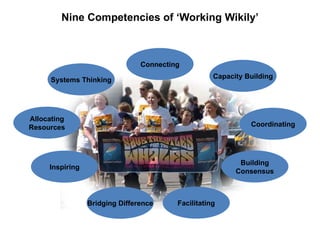
Nine Competencies of ‘Working Wikily’ Systems Thinking Allocating Resources Inspiring Bridging Difference Connecting Coordinating Capacity Building Building Consensus Facilitating
Determining the boundaries, size of the network Communicating the value of networks Internal organizational resistance Building trust among participants Scaling and meeting resource demands Tracking and evaluating impact Letting go of control; not worrying about “credit” Common Challenges Faced by Network Leaders
Eight Lessons We’re Learning About “Working Wikily” Design your experiments around a problem to solve, not the tools Experiment a lot, invest in understanding what works, and make only new mistakes Set appropriate expectations for time and effort required Prioritize human elements like trust and fun Understand your position within networks and act on this knowledge Push power to the edges Balance bottom-up and top-down strategies for  organizing people and effort Be open and transparent; share what you are  doing and learning as a matter of course Source:  Working Wikily,  by Gabriel Kasper and Diana Scearce (2008), Monitor Institute
Network Resources http://www.workingwikily.com/ http://beth.typepad.com/beths_blog/ http://nonprofitorgs.wordpress.com/ http://oceanswavesbeaches.blogspot.com/

Network effectiveness Surfrider

  • 1.
    Network Effectiveness: An Interactive Working Session September 2009 Ed Mazzarella Chad Nelsen (Adapted from the Monitor Institute*) *Network Effectiveness: An Interactive Working Session for Packard Foundation Grantees,Monitor Group. May 27, 2009. Heather Grant & Diana Scearce. On SlideShare: http://bit.ly/GvLJy
  • 2.
    Goals Understand networkthinking Understand your/our network Understanding network effectiveness
  • 3.
    Session Agenda NetworkBasics – 30 minutes Mapping Exercise – 45 minutes Network Effectiveness – 30 minutes Surfrider Global Network – 15 minutes
  • 4.
  • 5.
    Centralized Connecting ideasand people takes time Closed and proprietary Our ability to tap expertise and share knowledge is constrained Effectiveness is equated with longevity Decentralized The pace of connection is fast and getting faster Open and transparent Our ability to tap expertise and share knowledge is expanded Effectiveness is equated with mobilization Organization-centric model Network-centric model We are Moving to a More Networked World Organizations aren’t going away. We need to learn how to balance the interface between organizations and networks.
  • 6.
    “ You canhave the best technology in the world, but if you don’t have a community who wants to use it and who are excited about it, then it has no purpose.” Chris Hughes, Obama’s New-Media Campaign “ One of my fundamental beliefs…is that real change comes from the bottom up. And there’s no more powerful tool for grass-roots organizing than the Internet.” Barack Obama Obama Used Networks to Mobilize 13 M Supporters
  • 7.
    Networks are one answer for increasing scale, efficiency, coordination, and impact Many Nonprofits Not at Scale The vast majority of nonprofits have annual budgets of under $1 million 2 Increasing Number of Nonprofits As many as 30,000 new nonprofits are formed each year in the U.S. 1 – scarcity of organizations is not the problem More Competition for Resources The proliferation of nonprofits makes competition fierce, and fundraising more costly…especially in an economic downturn Source: 1 http://www.alliancetrends.org/nonprofits.cfm?id=56; 2 Center for Non-Profits, 2007 Nonprofits Need to Find Ways to Leverage Networks
  • 8.
    The Network MindsetOrganization Orientation Network Orientation Mindset Strategy Behaviors Competition Grow the organization Compete for resources Protect knowledge Competitive advantage Hoard talent Collaboration Grow the network Share resources Open source IP Develop competitors Cultivate leadership Source: Forces for Good by Heather McLeod Grant and Leslie R. Crutchfield (2007)
  • 9.
    Networks Have BeenAround For A Long Time…
  • 10.
    … and newonline spaces for building relationships There are New Technologies for Sharing Content…
  • 11.
    “ We areliving in the Golden Age of network theory , where sociology, math, computer science and software engineering are all combining to allow the average user to visualize, understand, and most importantly, rely on the social and business networks that are part of their lives.” - Clay Shirky Source: “Work on Networks” by Clay Shirky (2003) Our Understanding of Networks is Getting Better
  • 12.
    As a Result,the Way Our Work Gets Done is Changing
  • 13.
    Networks Can beUsed to Address Many Issues Get to Scale Mobilize People and Effort Innovate Build Community / Strengthen Ties Develop and Share Knowledge
  • 14.
    Increased flow ofinformation/ ideas/ best practices Stronger, broader connections Greater media coverage More participant engagement Network expansion/ scale Action on an issue Enhanced Outcomes from Network Approaches
  • 15.
    Network Strategy IntegratesDifferent Tools, Approaches Collaborative Technologies Working Wikily Collaborative Processes Low High Group Process Skills Low High Technological Skills
  • 16.
  • 17.
    How are NetworksStructured?
  • 18.
    A Few HelpfulDefinitions Core Hub Link Node Cluster Periphery
  • 19.
    Network Structures canTake Many Forms
  • 20.
    Centralized / Hierarchical Decentralized Note: These categories often overlap. Most of the examples fit in to multiple categories. Nonprofit organizations ( without explicit network structure) Membership organizations (Organizations with network component) Nonprofits with explicit network strategy and structure Coalition / Alliance (network of organizations) Networks of networks Ad Hoc Networks Developed from Multiple Sources: Net Gains by Plastrik and Taylor (‘06); Net Work by Anklam (‘07); Building Smart Communities by Krebs and Holley A Typology of Organizing Structures
  • 21.
    What’s Possible fromNetwork Mapping? What’s Possible from Network Mapping? Visualize the network: see connections within the system Make visible network resources, and see flow of resources Spark a conversation among participants Assess the “health” of a network, diagnose Assess change in network over time
  • 22.
    EXCERCIZE 1: MAPYOUR NETWORK
  • 23.
    PART II: NetworkEffectiveness
  • 24.
    Network Effectiveness: Characteristics of Healthy Networks Purpose Membership Strategy and Structure Leadership Communications & Technology Resource Management Assessment Clearly articulated purpose Delivers value/ outcomes to members Trust Diversity High engagement Balance of top-down and bottom-up logic Space for self-organized action Leadership with “network mindset” Distributed leadership Strategic IT Ample shared space: on-line and in-person Ability surface network talent Ability to tap excess capacity Learning-capture Ability to gather and act on feedback Governance Governance by a group representative of the network’s diversity Openness Helpful Sources: M. Kearns and K. Showalter; J. Holley and V. Krebs; P. Plastrik and M. Taylor; J. W. Skillern; C. Shirky
  • 25.
    Exercise 2: Howhealthy is your network?
  • 26.
    You’ve diagnosed yournetwork’s areas of strength and weakness. Now, what do you do? Answer: It depends…
  • 27.
    Nine Competencies of‘Working Wikily’ Systems Thinking Allocating Resources Inspiring Bridging Difference Connecting Coordinating Capacity Building Building Consensus Facilitating
  • 28.
    Determining the boundaries,size of the network Communicating the value of networks Internal organizational resistance Building trust among participants Scaling and meeting resource demands Tracking and evaluating impact Letting go of control; not worrying about “credit” Common Challenges Faced by Network Leaders
  • 29.
    Eight Lessons We’reLearning About “Working Wikily” Design your experiments around a problem to solve, not the tools Experiment a lot, invest in understanding what works, and make only new mistakes Set appropriate expectations for time and effort required Prioritize human elements like trust and fun Understand your position within networks and act on this knowledge Push power to the edges Balance bottom-up and top-down strategies for organizing people and effort Be open and transparent; share what you are doing and learning as a matter of course Source: Working Wikily, by Gabriel Kasper and Diana Scearce (2008), Monitor Institute
  • 30.
    Network Resources http://www.workingwikily.com/http://beth.typepad.com/beths_blog/ http://nonprofitorgs.wordpress.com/ http://oceanswavesbeaches.blogspot.com/