In the chat now, please respond:
1. Your name and the network(s) you are a part of
2. We are forming breakout groups on the following topics: please list in chat
what group you want to be in (if you didn’t take survey)
1. Coordination, Facilitation, and Communication: how do network members link and work with each other? What
are effective practices for sharing information and finding potential collaborators?
2. Decision-making: Who decides what the network will do, and how do they decide? For example, network
participants don’t feel they have a say in network decisions, takes too long to make decisions, a few people or
organizations dominate the decision-making processes, etc.
3. Measurement: how do networks monitor their condition or performance and learn together?
4. Operations: Problems getting action going, hard to get network participants to volunteer for committees or
activities, people not doing what they say they will do
5. Purpose: What is the network’s reason for being? When lack of shared focus or clear goals seems to be an
issue?
6. Structure: Not sure the network has the right governance structure, want to talk and hear about different kinds
of governance structures
7. Multi-sector policy-making network governance
3. If you haven’t taken the survey please do now https://goo.gl/forms/FgHxv6QeH6f5GTKo2
Leadership Webinar Series
December 6, 2017
LLC anticipates the future and is a dynamic catalyst capable
of creating a link from today’s issues in leadership
development to tomorrow’s solutions.
(Donna Stark, The Annie E. Casey Foundation)
Network Research Application
Leadership Learning Community
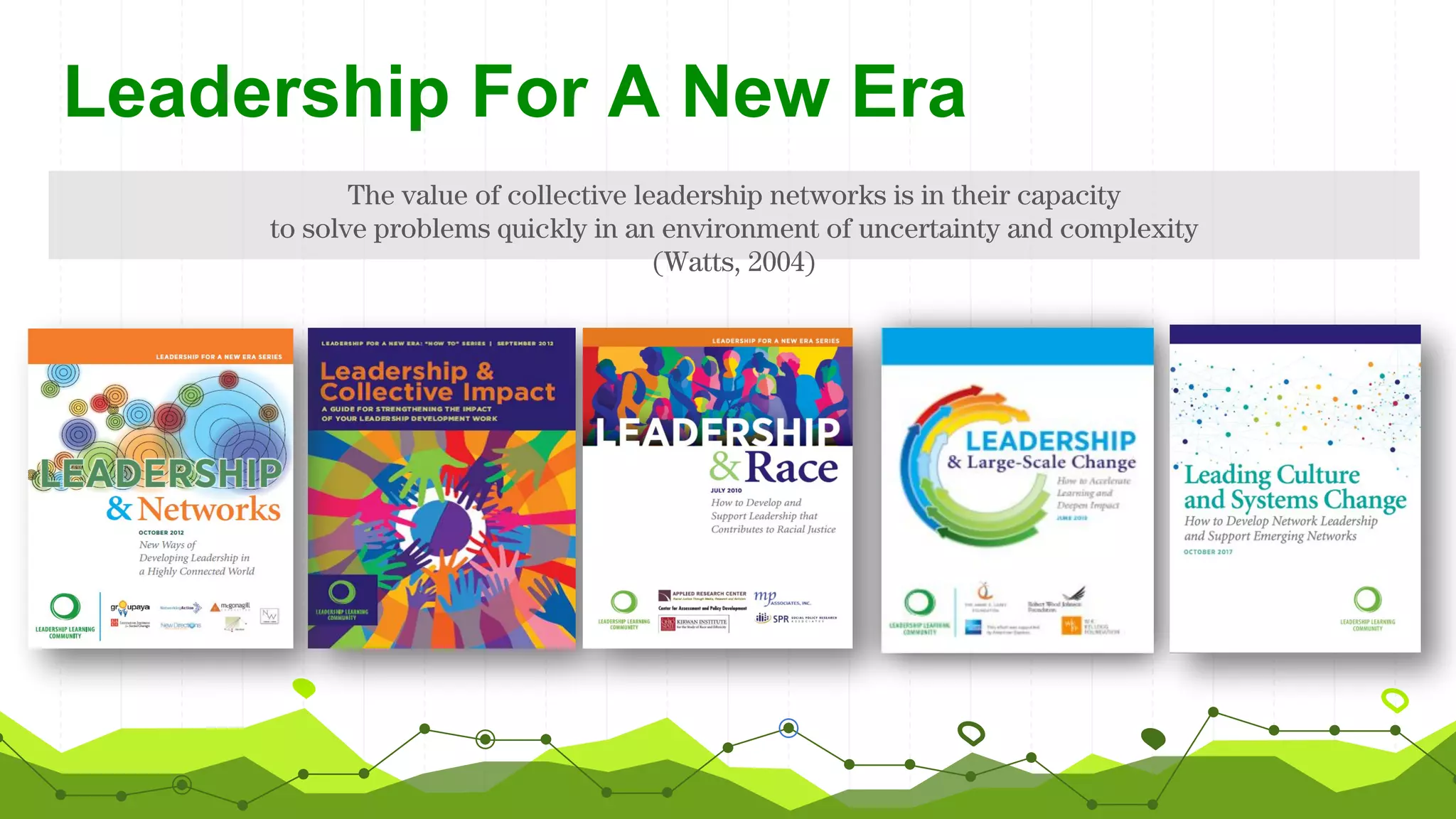
Leadership For A New Era
The value of collective leadership networks is in their capacity
to solve problems quickly in an environment of uncertainty and complexity
(Watts, 2004)
On Technology
◉ Over 120 people registered for today’s webinar
◉ We expect over 50 participants live today
◉ Please remain muted until you talk
◉ If you have access to camera, please use especially for
breakout rooms
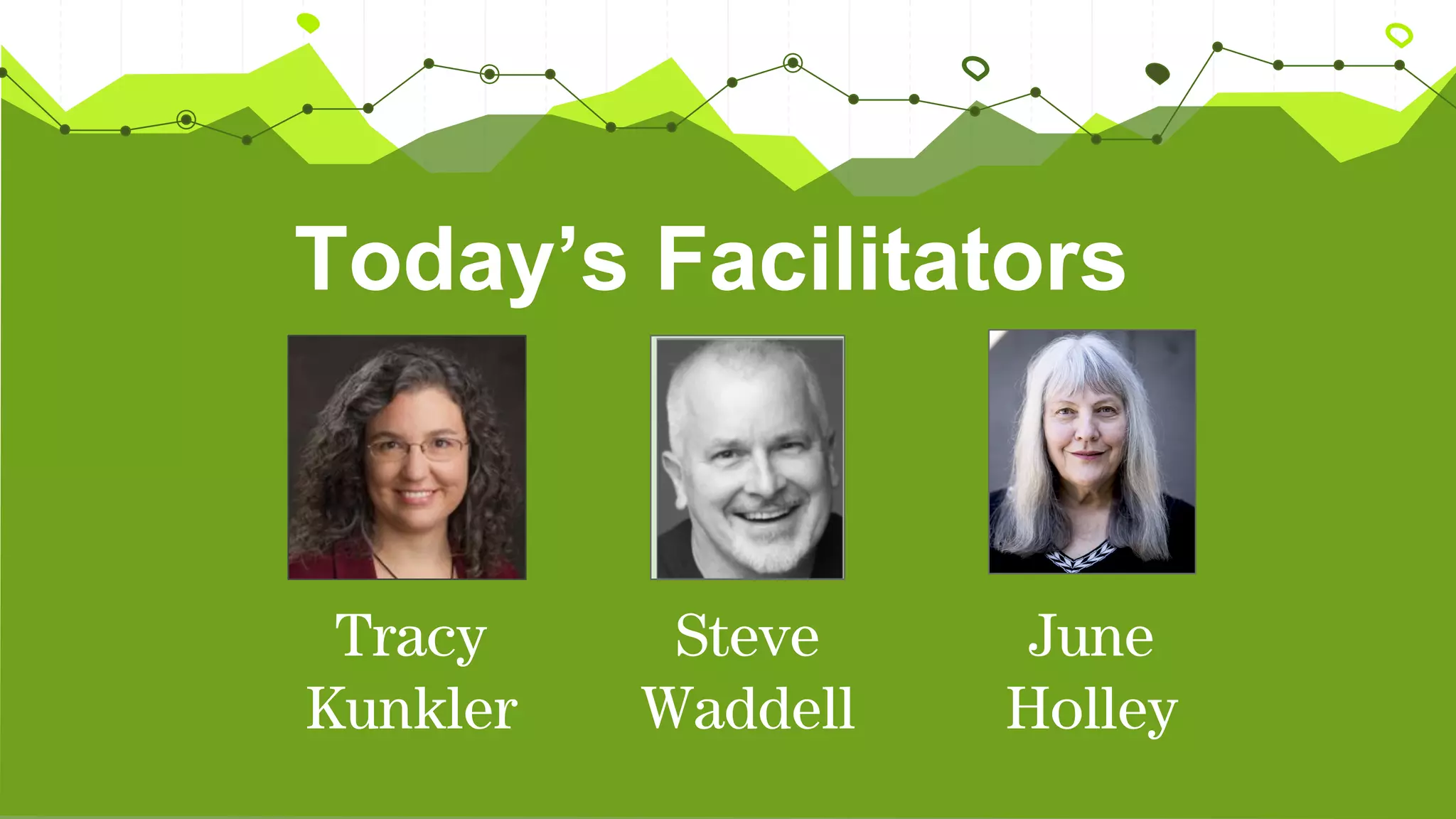
June
Holley
Today’s Facilitators
Steve
Waddell
Tracy
Kunkler
Review
Slides from last session
https://docs.google.com/presentation/d/1uDq77ofDKYaeCFK
KFgKVEg09qGuKb7J29WNrZ1WUw3k/edit?usp=sharing
Video:
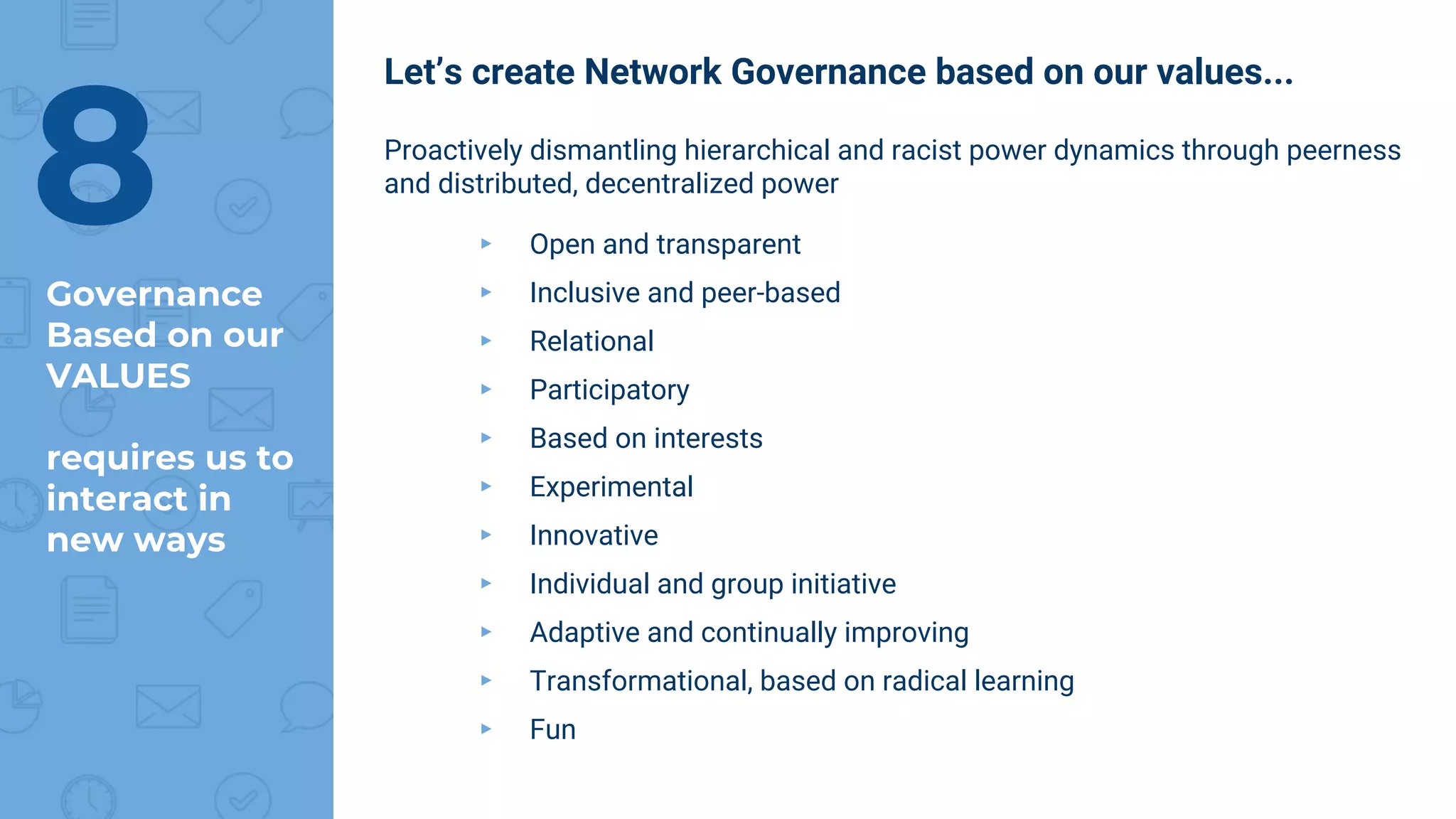
Let’s create Network Governance based on our values...
Proactively dismantling hierarchical and racist power dynamics through peerness
and distributed, decentralized power
▸ Open and transparent
▸ Inclusive and peer-based
▸ Relational
▸ Participatory
▸ Based on interests
▸ Experimental
▸ Innovative
▸ Individual and group initiative
▸ Adaptive and continually improving
▸ Transformational, based on radical learning
▸ Fun
8Governance
Based on our
VALUES
requires us to
interact in
new ways
Three exciting shifts:
1. Technology (zoom, google docs,
loomio)
2. Enough different network
models of governance that we
can learn from
3. New participatory processes for
operations and decision-making
9
Circles
As a network operations or structure need
emerges, a self-organizing group forms to
address that need getting advice or consent
from all impacted
10
Long-term goal: in next six
months, develop some sessions
and materials around all the
different aspects of governance,
structure and decision-making
Today: start building a network
of people interested in learning,
supporting others, co-inventing
11
Go over survey results
12
How do we share and
learn together?
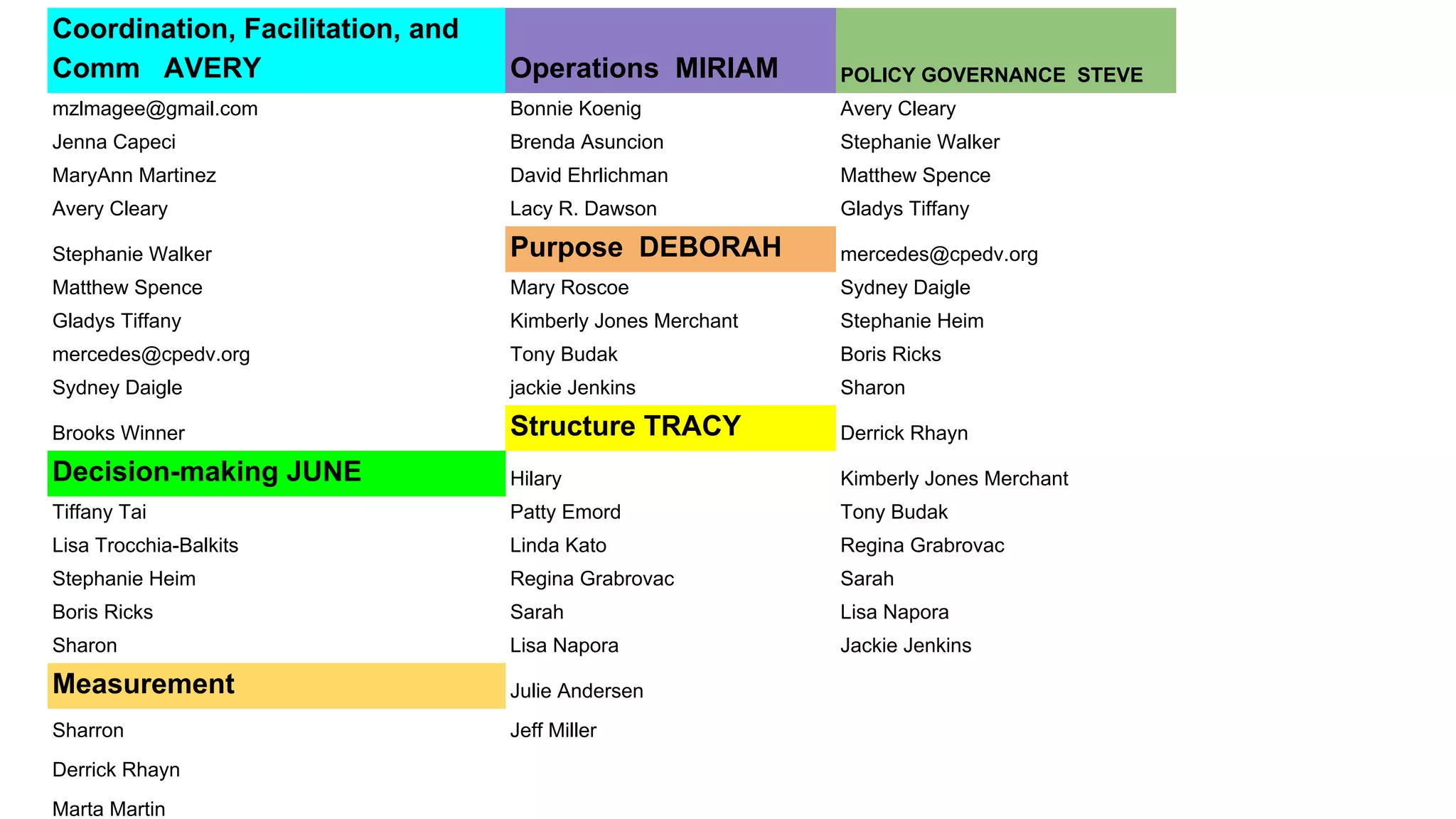
Coordination, Facilitation, and
Comm AVERY Operations MIRIAM POLICY GOVERNANCE STEVE
mzlmagee@gmail.com Bonnie Koenig Avery Cleary
Jenna Capeci Brenda Asuncion Stephanie Walker
MaryAnn Martinez David Ehrlichman Matthew Spence
Avery Cleary Lacy R. Dawson Gladys Tiffany
Stephanie Walker Purpose DEBORAH mercedes@cpedv.org
Matthew Spence Mary Roscoe Sydney Daigle
Gladys Tiffany Kimberly Jones Merchant Stephanie Heim
mercedes@cpedv.org Tony Budak Boris Ricks
Sydney Daigle jackie Jenkins Sharon
Brooks Winner Structure TRACY Derrick Rhayn
Decision-making JUNE Hilary Kimberly Jones Merchant
Tiffany Tai Patty Emord Tony Budak
Lisa Trocchia-Balkits Linda Kato Regina Grabrovac
Stephanie Heim Regina Grabrovac Sarah
Boris Ricks Sarah Lisa Napora
Sharon Lisa Napora Jackie Jenkins
Measurement Julie Andersen
Sharron Jeff Miller
Derrick Rhayn
Marta Martin
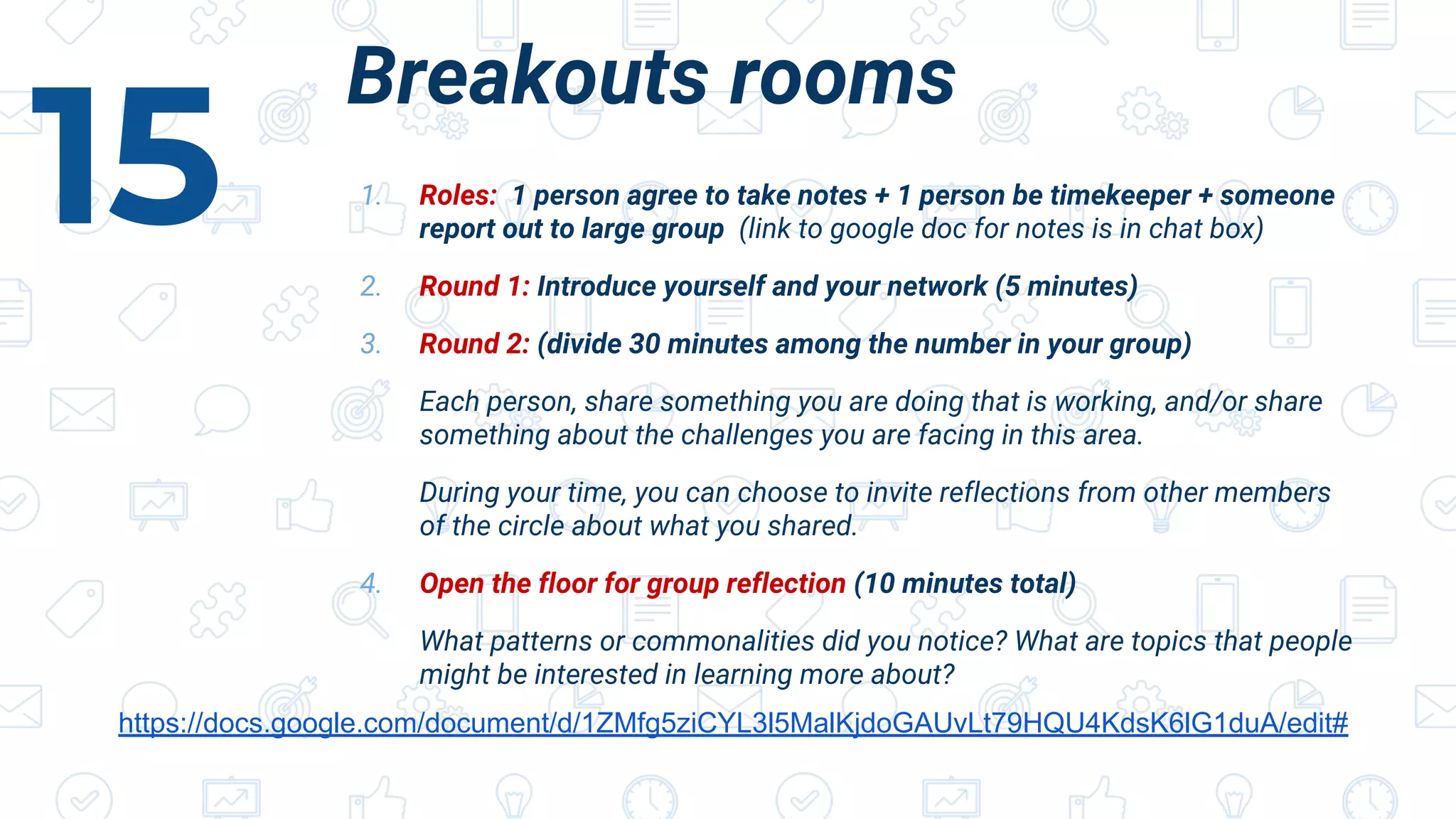
Breakouts rooms
1. Roles: 1 person agree to take notes + 1 person be timekeeper + someone
report out to large group (link to google doc for notes is in chat box)
2. Round 1: Introduce yourself and your network (5 minutes)
3. Round 2: (divide 30 minutes among the number in your group)
Each person, share something you are doing that is working, and/or share
something about the challenges you are facing in this area.
During your time, you can choose to invite reflections from other members
of the circle about what you shared.
4. Open the floor for group reflection (10 minutes total)
What patterns or commonalities did you notice? What are topics that people
might be interested in learning more about?
15
https://docs.google.com/document/d/1ZMfg5ziCYL3l5MalKjdoGAUvLt79HQU4KdsK6lG1duA/edit#
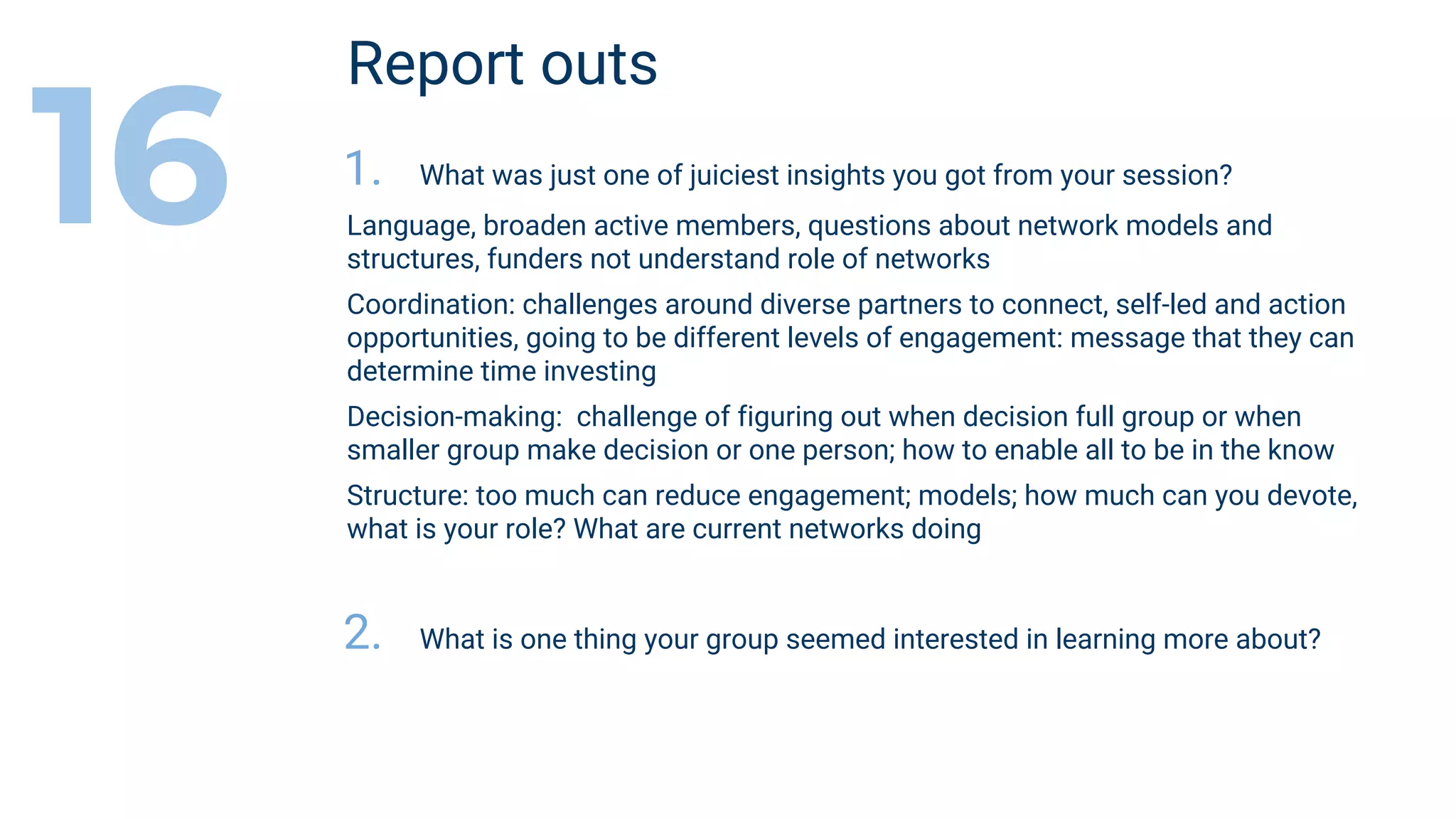
Report outs
1. What was just one of juiciest insights you got from your session?
Language, broaden active members, questions about network models and
structures, funders not understand role of networks
Coordination: challenges around diverse partners to connect, self-led and action
opportunities, going to be different levels of engagement: message that they can
determine time investing
Decision-making: challenge of figuring out when decision full group or when
smaller group make decision or one person; how to enable all to be in the know
Structure: too much can reduce engagement; models; how much can you devote,
what is your role? What are current networks doing
2. What is one thing your group seemed interested in learning more about?
16
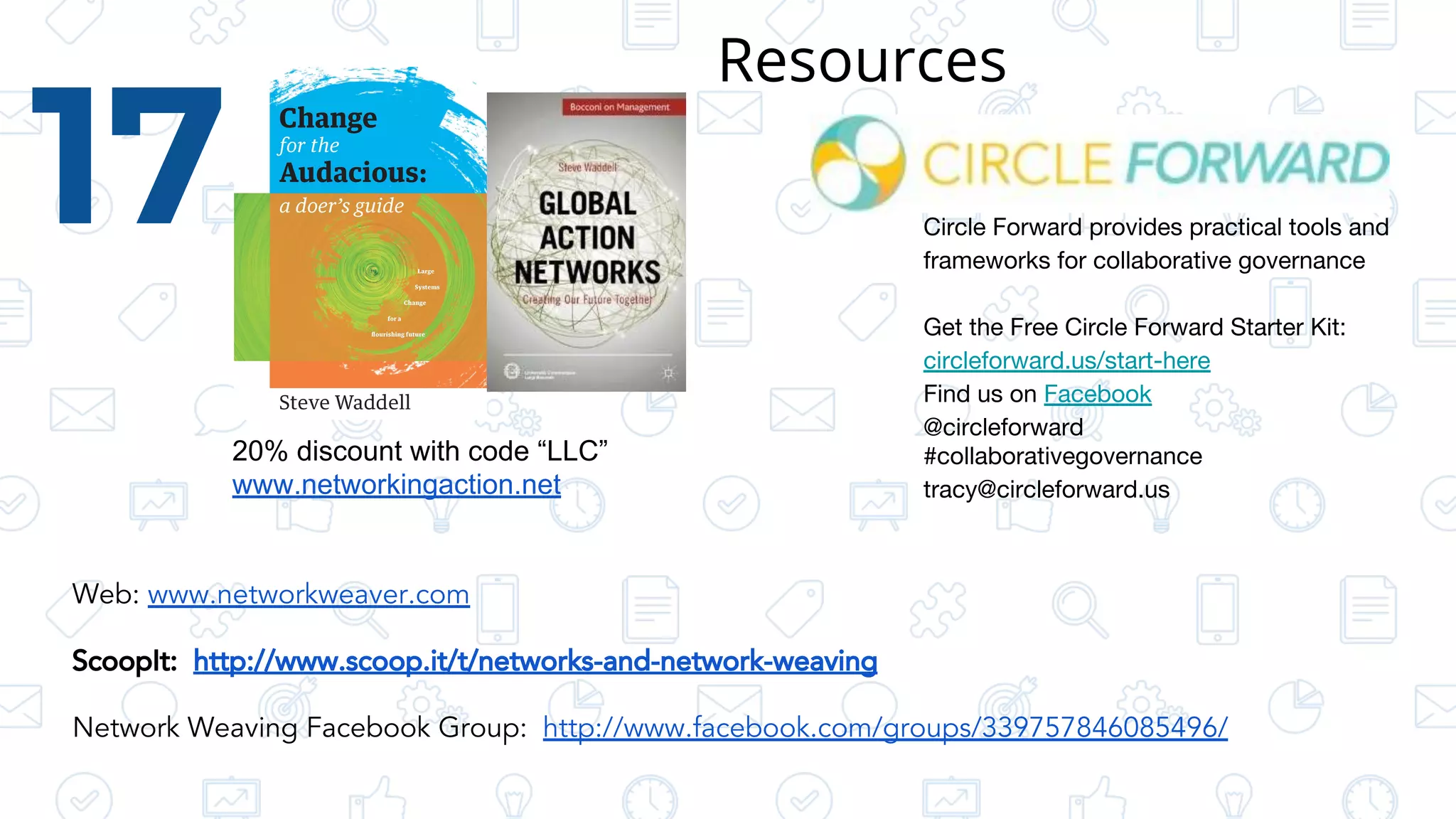
17
Web: www.networkweaver.com
ScoopIt: http://www.scoop.it/t/networks-and-network-weaving
Network Weaving Facebook Group: http://www.facebook.com/groups/339757846085496/
20% discount with code “LLC”
www.networkingaction.net
Circle Forward provides practical tools and
frameworks for collaborative governance
Get the Free Circle Forward Starter Kit:
circleforward.us/start-here
Find us on Facebook
@circleforward
#collaborativegovernance
tracy@circleforward.us
Resources
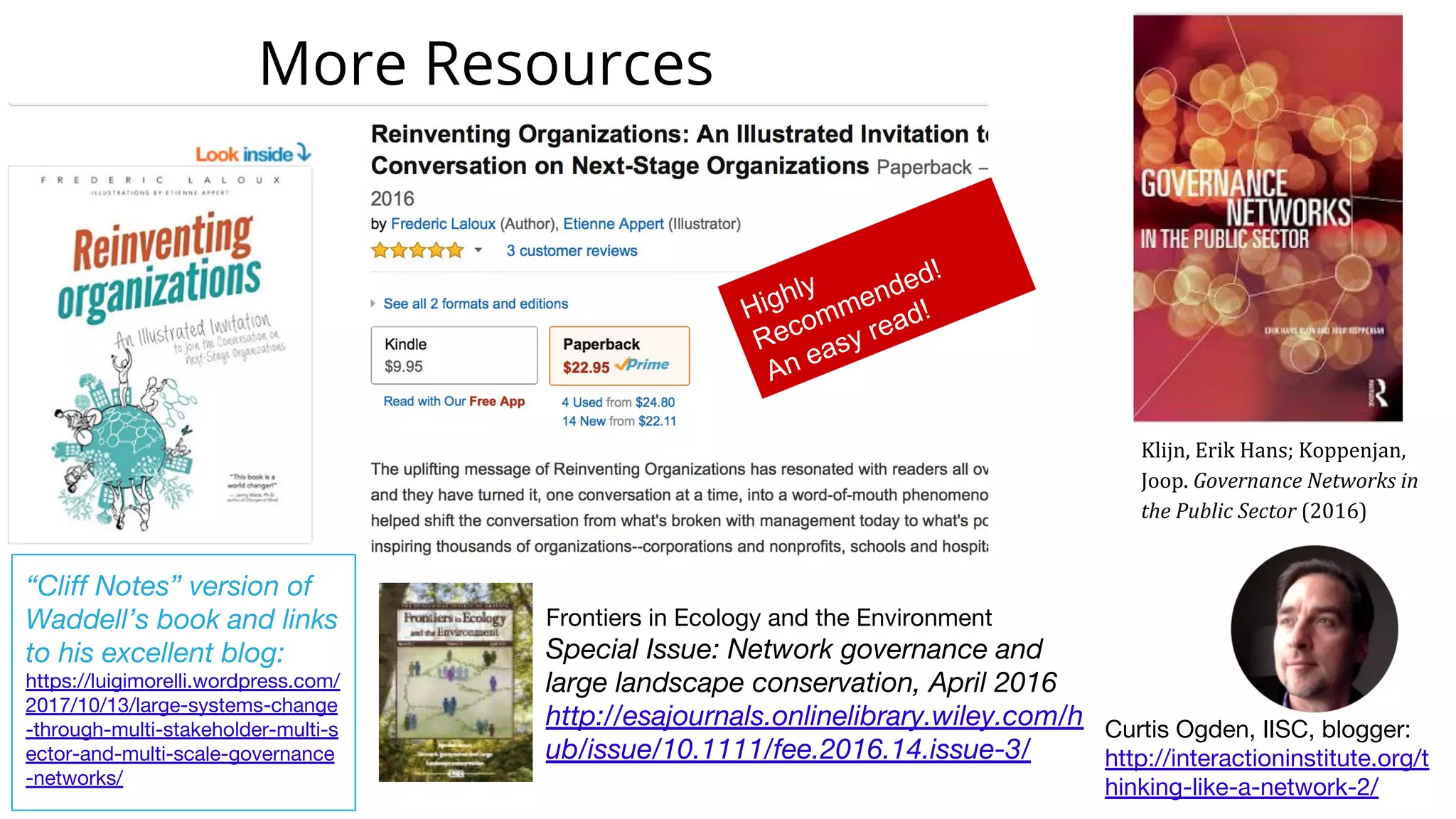
Highly
Recommended!
An easy read!
Klijn, Erik Hans; Koppenjan,
Joop. Governance Networks in
the Public Sector (2016)
Curtis Ogden, IISC, blogger:
http://interactioninstitute.org/t
hinking-like-a-network-2/
Frontiers in Ecology and the Environment
Special Issue: Network governance and
large landscape conservation, April 2016
http://esajournals.onlinelibrary.wiley.com/h
ub/issue/10.1111/fee.2016.14.issue-3/
More Resources
“Cliff Notes” version of
Waddell’s book and links
to his excellent blog:
https://luigimorelli.wordpress.com/
2017/10/13/large-systems-change
-through-multi-stakeholder-multi-s
ector-and-multi-scale-governance
-networks/
Individual coaching sessions are
available for a modest fee. If you are
interested contact:
June Holley juneholley@gmail.com
Tracy Kunkler tracy@circleforward.us
Steve Waddell swaddell@networkingaction.net
19
Please take this survey
https://goo.gl/forms/uWtNa
PvZrhrKh6523
20
Get Involved
Register for the LLC
Newsletter, then contribute
your writing to our blog!
Blog info@LeadershipLearning.orgblog
Register LeadershipLearning.org
Support The Webinar Series
The suggested donation for this webinar is $30.
http://bit.ly/llcdonatenow
Donate Today!
LLC THANKS YOU!

2017.12.06 LLC Webinar Series | Practicing Network Governance and Structures

  • 1.
    In the chatnow, please respond: 1. Your name and the network(s) you are a part of 2. We are forming breakout groups on the following topics: please list in chat what group you want to be in (if you didn’t take survey) 1. Coordination, Facilitation, and Communication: how do network members link and work with each other? What are effective practices for sharing information and finding potential collaborators? 2. Decision-making: Who decides what the network will do, and how do they decide? For example, network participants don’t feel they have a say in network decisions, takes too long to make decisions, a few people or organizations dominate the decision-making processes, etc. 3. Measurement: how do networks monitor their condition or performance and learn together? 4. Operations: Problems getting action going, hard to get network participants to volunteer for committees or activities, people not doing what they say they will do 5. Purpose: What is the network’s reason for being? When lack of shared focus or clear goals seems to be an issue? 6. Structure: Not sure the network has the right governance structure, want to talk and hear about different kinds of governance structures 7. Multi-sector policy-making network governance 3. If you haven’t taken the survey please do now https://goo.gl/forms/FgHxv6QeH6f5GTKo2
  • 2.
  • 3.
    LLC anticipates thefuture and is a dynamic catalyst capable of creating a link from today’s issues in leadership development to tomorrow’s solutions. (Donna Stark, The Annie E. Casey Foundation) Network Research Application Leadership Learning Community
  • 4.
    Leadership For ANew Era The value of collective leadership networks is in their capacity to solve problems quickly in an environment of uncertainty and complexity (Watts, 2004)
  • 5.
    On Technology ◉ Over120 people registered for today’s webinar ◉ We expect over 50 participants live today ◉ Please remain muted until you talk ◉ If you have access to camera, please use especially for breakout rooms
  • 6.
  • 7.
    Review Slides from lastsession https://docs.google.com/presentation/d/1uDq77ofDKYaeCFK KFgKVEg09qGuKb7J29WNrZ1WUw3k/edit?usp=sharing Video:
  • 8.
    Let’s create NetworkGovernance based on our values... Proactively dismantling hierarchical and racist power dynamics through peerness and distributed, decentralized power ▸ Open and transparent ▸ Inclusive and peer-based ▸ Relational ▸ Participatory ▸ Based on interests ▸ Experimental ▸ Innovative ▸ Individual and group initiative ▸ Adaptive and continually improving ▸ Transformational, based on radical learning ▸ Fun 8Governance Based on our VALUES requires us to interact in new ways
  • 9.
    Three exciting shifts: 1.Technology (zoom, google docs, loomio) 2. Enough different network models of governance that we can learn from 3. New participatory processes for operations and decision-making 9
  • 10.
    Circles As a networkoperations or structure need emerges, a self-organizing group forms to address that need getting advice or consent from all impacted 10
  • 11.
    Long-term goal: innext six months, develop some sessions and materials around all the different aspects of governance, structure and decision-making Today: start building a network of people interested in learning, supporting others, co-inventing 11
  • 12.
    Go over surveyresults 12
  • 13.
    How do weshare and learn together?
  • 14.
    Coordination, Facilitation, and CommAVERY Operations MIRIAM POLICY GOVERNANCE STEVE mzlmagee@gmail.com Bonnie Koenig Avery Cleary Jenna Capeci Brenda Asuncion Stephanie Walker MaryAnn Martinez David Ehrlichman Matthew Spence Avery Cleary Lacy R. Dawson Gladys Tiffany Stephanie Walker Purpose DEBORAH mercedes@cpedv.org Matthew Spence Mary Roscoe Sydney Daigle Gladys Tiffany Kimberly Jones Merchant Stephanie Heim mercedes@cpedv.org Tony Budak Boris Ricks Sydney Daigle jackie Jenkins Sharon Brooks Winner Structure TRACY Derrick Rhayn Decision-making JUNE Hilary Kimberly Jones Merchant Tiffany Tai Patty Emord Tony Budak Lisa Trocchia-Balkits Linda Kato Regina Grabrovac Stephanie Heim Regina Grabrovac Sarah Boris Ricks Sarah Lisa Napora Sharon Lisa Napora Jackie Jenkins Measurement Julie Andersen Sharron Jeff Miller Derrick Rhayn Marta Martin
  • 15.
    Breakouts rooms 1. Roles:1 person agree to take notes + 1 person be timekeeper + someone report out to large group (link to google doc for notes is in chat box) 2. Round 1: Introduce yourself and your network (5 minutes) 3. Round 2: (divide 30 minutes among the number in your group) Each person, share something you are doing that is working, and/or share something about the challenges you are facing in this area. During your time, you can choose to invite reflections from other members of the circle about what you shared. 4. Open the floor for group reflection (10 minutes total) What patterns or commonalities did you notice? What are topics that people might be interested in learning more about? 15 https://docs.google.com/document/d/1ZMfg5ziCYL3l5MalKjdoGAUvLt79HQU4KdsK6lG1duA/edit#
  • 16.
    Report outs 1. Whatwas just one of juiciest insights you got from your session? Language, broaden active members, questions about network models and structures, funders not understand role of networks Coordination: challenges around diverse partners to connect, self-led and action opportunities, going to be different levels of engagement: message that they can determine time investing Decision-making: challenge of figuring out when decision full group or when smaller group make decision or one person; how to enable all to be in the know Structure: too much can reduce engagement; models; how much can you devote, what is your role? What are current networks doing 2. What is one thing your group seemed interested in learning more about? 16
  • 17.
    17 Web: www.networkweaver.com ScoopIt: http://www.scoop.it/t/networks-and-network-weaving NetworkWeaving Facebook Group: http://www.facebook.com/groups/339757846085496/ 20% discount with code “LLC” www.networkingaction.net Circle Forward provides practical tools and frameworks for collaborative governance Get the Free Circle Forward Starter Kit: circleforward.us/start-here Find us on Facebook @circleforward #collaborativegovernance tracy@circleforward.us Resources
  • 18.
    Highly Recommended! An easy read! Klijn,Erik Hans; Koppenjan, Joop. Governance Networks in the Public Sector (2016) Curtis Ogden, IISC, blogger: http://interactioninstitute.org/t hinking-like-a-network-2/ Frontiers in Ecology and the Environment Special Issue: Network governance and large landscape conservation, April 2016 http://esajournals.onlinelibrary.wiley.com/h ub/issue/10.1111/fee.2016.14.issue-3/ More Resources “Cliff Notes” version of Waddell’s book and links to his excellent blog: https://luigimorelli.wordpress.com/ 2017/10/13/large-systems-change -through-multi-stakeholder-multi-s ector-and-multi-scale-governance -networks/
  • 19.
    Individual coaching sessionsare available for a modest fee. If you are interested contact: June Holley juneholley@gmail.com Tracy Kunkler tracy@circleforward.us Steve Waddell swaddell@networkingaction.net 19
  • 20.
    Please take thissurvey https://goo.gl/forms/uWtNa PvZrhrKh6523 20
  • 21.
    Get Involved Register forthe LLC Newsletter, then contribute your writing to our blog! Blog info@LeadershipLearning.orgblog Register LeadershipLearning.org
  • 22.
    Support The WebinarSeries The suggested donation for this webinar is $30. http://bit.ly/llcdonatenow Donate Today! LLC THANKS YOU!