Writing 101


Changing Simple into Compound
          Sentences
Learning Objectives

    This lesson further develops the basic elements
    of SVO by creating a variety of sentence
    structures.

    Enhance the overall readability of your story.
Introduction

    If you recall, simple sentences are:
S (Subject) + V (Verb) + O (Object)
Without any conjunctions or connectors.

    They are fine as they are grammatically correct
    until you string them to form a short paragraph
    in your story...
Changing Simple into Compound

    The following are simple sentences:
1) The boy checked his watch.
2) He looked around for suspicious characters.
3) He began walking towards the corner.

    Combining them to form a short paragraph:

    “The boy checked his watch. He looked around
    for suspicious characters. He began walking
    towards the corner.”

    Q: What's the effect of such writing in your
    story?
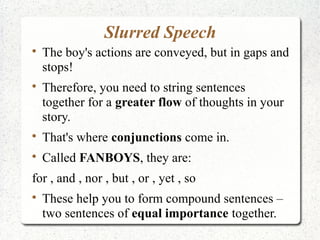
Slurred Speech

    The boy's actions are conveyed, but in gaps and
    stops!

    Therefore, you need to string sentences
    together for a greater flow of thoughts in your
    story.

    That's where conjunctions come in.

    Called FANBOYS, they are:
for , and , nor , but , or , yet , so

    These help you to form compound sentences –
    two sentences of equal importance together.
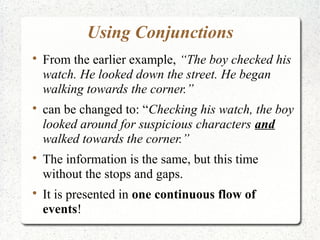
Using Conjunctions

    From the earlier example, “The boy checked his
    watch. He looked down the street. He began
    walking towards the corner.”

    can be changed to: “Checking his watch, the boy
    looked around for suspicious characters and
    walked towards the corner.”

    The information is the same, but this time
    without the stops and gaps.

    It is presented in one continuous flow of
    events!
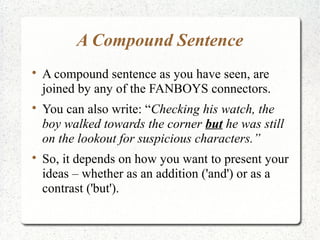
A Compound Sentence

    A compound sentence as you have seen, are
    joined by any of the FANBOYS connectors.

    You can also write: “Checking his watch, the
    boy walked towards the corner but he was still
    on the lookout for suspicious characters.”

    So, it depends on how you want to present your
    ideas – whether as an addition ('and') or as a
    contrast ('but').
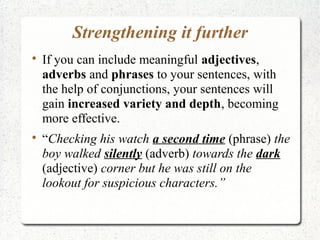
Strengthening it further

    If you can include meaningful adjectives,
    adverbs and phrases to your sentences, with
    the help of conjunctions, your sentences will
    gain increased variety and depth, becoming
    more effective.

    “Checking his watch a second time (phrase) the
    boy walked silently (adverb) towards the dark
    (adjective) corner but he was still on the
    lookout for suspicious characters.”
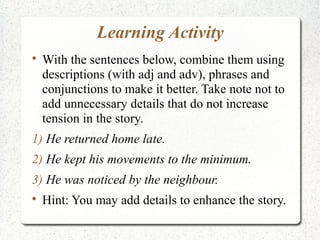
Learning Activity

    With the sentences below, combine them using
    descriptions (with adj and adv), phrases and
    conjunctions to make it better. Take note not to
    add unnecessary details that do not increase
    tension in the story.
1) He returned home late.
2) He kept his movements to the minimum.
3) He was noticed by the neighbour.

    Hint: You may add details to enhance the story.
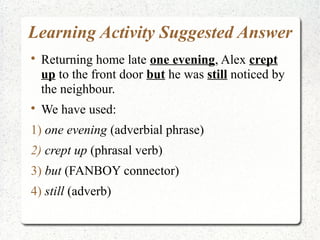
Learning Activity Suggested Answer

    Returning home late one evening, Alex crept
    up to the front door but he was still noticed by
    the neighbour.

    We have used:
1) one evening (adverbial phrase)
2) crept up (phrasal verb)
3) but (FANBOY connector)
4) still (adverb)
Discussion

    What do we use to change our simple sentences
    to compound sentences?

    What's the effect of such a change?

    What can we do to enhance this effect?
In Summary

    We use conjunctions in the form of FANBOYS
    to help us combine simple sentences.

    It will increase the variety of sentences we have
    in our writing for a better read.

    In addition, we can also use descriptions – with
    adjectives and adverbs – and phrases as tools to
    enhance our sentences' effectiveness.

LL Lower Pri D - Changing simple into compound sentences ()

  • 1.
    Writing 101 Changing Simpleinto Compound Sentences
  • 2.
    Learning Objectives  This lesson further develops the basic elements of SVO by creating a variety of sentence structures.  Enhance the overall readability of your story.
  • 3.
    Introduction  If you recall, simple sentences are: S (Subject) + V (Verb) + O (Object) Without any conjunctions or connectors.  They are fine as they are grammatically correct until you string them to form a short paragraph in your story...
  • 4.
    Changing Simple intoCompound  The following are simple sentences: 1) The boy checked his watch. 2) He looked around for suspicious characters. 3) He began walking towards the corner.  Combining them to form a short paragraph:  “The boy checked his watch. He looked around for suspicious characters. He began walking towards the corner.”  Q: What's the effect of such writing in your story?
  • 5.
    Slurred Speech  The boy's actions are conveyed, but in gaps and stops!  Therefore, you need to string sentences together for a greater flow of thoughts in your story.  That's where conjunctions come in.  Called FANBOYS, they are: for , and , nor , but , or , yet , so  These help you to form compound sentences – two sentences of equal importance together.
  • 6.
    Using Conjunctions  From the earlier example, “The boy checked his watch. He looked down the street. He began walking towards the corner.”  can be changed to: “Checking his watch, the boy looked around for suspicious characters and walked towards the corner.”  The information is the same, but this time without the stops and gaps.  It is presented in one continuous flow of events!
  • 7.
    A Compound Sentence  A compound sentence as you have seen, are joined by any of the FANBOYS connectors.  You can also write: “Checking his watch, the boy walked towards the corner but he was still on the lookout for suspicious characters.”  So, it depends on how you want to present your ideas – whether as an addition ('and') or as a contrast ('but').
  • 8.
    Strengthening it further  If you can include meaningful adjectives, adverbs and phrases to your sentences, with the help of conjunctions, your sentences will gain increased variety and depth, becoming more effective.  “Checking his watch a second time (phrase) the boy walked silently (adverb) towards the dark (adjective) corner but he was still on the lookout for suspicious characters.”
  • 9.
    Learning Activity  With the sentences below, combine them using descriptions (with adj and adv), phrases and conjunctions to make it better. Take note not to add unnecessary details that do not increase tension in the story. 1) He returned home late. 2) He kept his movements to the minimum. 3) He was noticed by the neighbour.  Hint: You may add details to enhance the story.
  • 10.
    Learning Activity SuggestedAnswer  Returning home late one evening, Alex crept up to the front door but he was still noticed by the neighbour.  We have used: 1) one evening (adverbial phrase) 2) crept up (phrasal verb) 3) but (FANBOY connector) 4) still (adverb)
  • 11.
    Discussion  What do we use to change our simple sentences to compound sentences?  What's the effect of such a change?  What can we do to enhance this effect?
  • 12.
    In Summary  We use conjunctions in the form of FANBOYS to help us combine simple sentences.  It will increase the variety of sentences we have in our writing for a better read.  In addition, we can also use descriptions – with adjectives and adverbs – and phrases as tools to enhance our sentences' effectiveness.