Ever feel like you’re not getting anywhere with your
writing???
The Sentence
As much as any sane person
needs to know…
Terms we’ll need
• Subject
• Verb
• Clause (group of words with a subject
and a verb)
Independent-strong, stands alone
Dependent-subordinate-weak, needs support
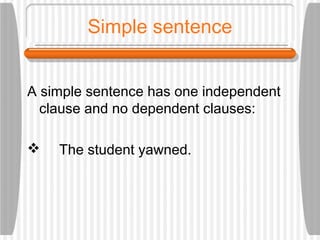
Simple sentence
A simple sentence has one independent
clause and no dependent clauses:
 The student yawned.
Although a simple sentence cannot
have a dependent clause, it can have
modifiers:
•The tall student sitting in the back in
my algebra class yawned loudly.
The basic sentence is ‘The student
yawned’. The other words are
modifiers - they are descriptive words.
• A simple sentence contains only one
independent clause, but it can have
more than one subject or verb:
• TWO SUBJECTS: The student and
his friend yawned.
• TWO VERBS : The student yawned
and fell asleep.
• TWO SUBJECTS: The student and
his friend yawned.
• TWO VERBS : The student yawned
and fell asleep.
A sentence with all these elements will be long, but it is still
simple because it contains only one independent clause:
The tall student sitting in the back in my
physics class and his friend yawned
loudly and fell asleep.
Can you identify the ‘real’ sentence and
the modifiers?
The tall student sitting in the back in
my physics class and his friend
yawned loudly and fell asleep.
Compound sentence
A compound sentence has two or more
independent clauses that are usually joined
by a coordinating conjunction:
• Henry got a new job, so he has to move.
• I have a lot of homework, but I am not going
to have time to study tonight.
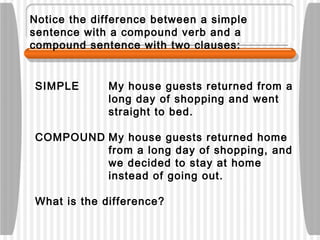
Notice the difference between a simple
sentence with a compound verb and a
compound sentence with two clauses:
SIMPLE My house guests returned from a
long day of shopping and went
straight to bed.
COMPOUND My house guests returned home
from a long day of shopping, and
we decided to stay at home
instead of going out.
What is the difference?
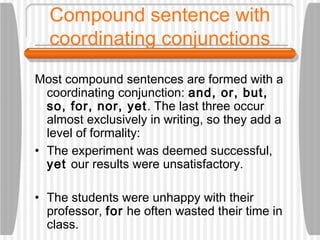
Compound sentence with
coordinating conjunctions
Most compound sentences are formed with a
coordinating conjunction: and, or, but,
so, for, nor, yet. The last three occur
almost exclusively in writing, so they add a
level of formality:
• The experiment was deemed successful,
yet our results were unsatisfactory.
• The students were unhappy with their
professor, for he often wasted their time in
class.
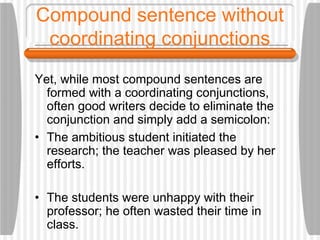
Compound sentence without
coordinating conjunctions
Yet, while most compound sentences are
formed with a coordinating conjunctions,
often good writers decide to eliminate the
conjunction and simply add a semicolon:
• The ambitious student initiated the
research; the teacher was pleased by her
efforts.
• The students were unhappy with their
professor; he often wasted their time in
class.
Compound sentence without
coordinating conjunctions
When a transition leads a clause, it is usually
followed by a comma. If the transition lands in
the middle of a compound sentence, use the
semicolon, and then follow the transition with
a comma:
• The experiment was deemed successful;
unfortunately, our results were unsatisfactory.
• The students were unhappy with their
professor; undeniably, he often wasted their
time in class.
Complex sentence
A complex sentence has an independent
clause with one or more dependent
clauses (independent clauses are in
italics). Note that introductory dependent
clauses must be followed by commas:
• Since we got to the concert late, we had to
make our way to our seats in the dark.
• We left class early so that we could attend
a special lecture.
Complex sentences should be
punctuated in one of two ways:
 INDEPENDENT CLAUSE dependent clause (no
comma)
We left class early so that we could attend a
special lecture.
Dependent clause, INDEPENDENT CLAUSE
(comma)
So that we could attend a special lecture, we
left class early.
Comparing compound and
complex sentences
• interest, variety, and coherence
• compound sentences differ from
complex sentences in one important
way: In a compound sentence, both
clauses have equal importance; in a
complex sentence, the independent
clause is more important.
Compare these sentences
• COMPOUND John was tired, but he
finished his homework.
• COMPLEX Although John was tired, he
finished his homework.
• In the first sentence, the writer is
communicating that both clauses are
equally important. In the second sentence,
the writer is saying that the subordinate
clause ("John was tired") is less important
than the independent clause ("he finished
his homework").
Long, rambling sentences
Writing that has too many strings of
independent clauses joined by
coordinating conjunctions can be
tiresome and frustrating for the reader.
These long rambling sentences leave
the reader out of breath and wondering
which information is important.
Long rambling sentences are also perceived
as informal because they duplicate
spoken language
Look at this paragraph with many independent
clauses joined with coordinating conjunctions:
I went home, but my roommate wasn't there,
so I started to cook dinner, but my roommate
came in and saw me trying to cook his favorite
recipe, but I didn't really know how to make it
well, and he got really angry, so I stopped
cooking, and he made dinner for us, and then
everything was all right.
The independent clauses are underlined, and
the coordinating conjunctions are in bold:
1 went home, but my roommate wasn't there,
so I started to cook dinner, but my roommate
came in and saw me trying to cook his favorite
recipe, but I didn't really know how to make it
well, and he got really angry, so I stopped
cooking, and he made dinner for us, and then
everything was all right.
This is better! Notice how it makes use of a
variety of sentence structures.
When I went home, my roommate wasn't
there, so I started to cook dinner. Then, my
roommate came in and saw me trying to cook
his favorite recipe even though I didn't know
how to make it well. I stopped cooking
because he got really angry. In the end, he
made dinner for us, and everything was all
right.
Sometimes you can improve things by
just adding a few interesting phrases!
“I thought of this poem while I was
watching my dog play.”
Not a TERRIBLE sentence, really, but
not a very interesting one, either.
Sometimes you can improve things by
just adding a few interesting phrases!
“I thought of this poem while I was watching my
dog play.”
By creating an introductory participial phrase,
we improve things dramatically:
“Watching my dog play, I thought of a great
idea for a poem.”
Sometimes you can improve things by
just adding a few interesting phrases!
“I wrote this poem after I finished a challenging
basketball game.”
By creating an introductory participial phrase,
we improve things dramatically:
“Finishing a challenging basketball game, I
paused to write this poem.”
Sometimes you can improve things by
just adding a few interesting phrases!
“My mom wrote this poem for me. It’s about
childhood.”
What would you do to improve this?
Sometimes you can improve things by
just adding a few interesting phrases!
“My friend, Sabrina, wrote this poem for me.
She told me that her cat inspired her to write
it.”
What would you do to improve this?
Any Questions?
If you’re viewing this from
home, email Mrs. Hand at
sheri.hand@leesummit.k12.mo.us

Sentence Types

  • 1.
    Ever feel likeyou’re not getting anywhere with your writing???
  • 2.
    The Sentence As muchas any sane person needs to know…
  • 3.
    Terms we’ll need •Subject • Verb • Clause (group of words with a subject and a verb) Independent-strong, stands alone Dependent-subordinate-weak, needs support
  • 4.
    Simple sentence A simplesentence has one independent clause and no dependent clauses:  The student yawned.
  • 5.
    Although a simplesentence cannot have a dependent clause, it can have modifiers: •The tall student sitting in the back in my algebra class yawned loudly. The basic sentence is ‘The student yawned’. The other words are modifiers - they are descriptive words.
  • 6.
    • A simplesentence contains only one independent clause, but it can have more than one subject or verb: • TWO SUBJECTS: The student and his friend yawned. • TWO VERBS : The student yawned and fell asleep.
  • 7.
    • TWO SUBJECTS:The student and his friend yawned. • TWO VERBS : The student yawned and fell asleep.
  • 8.
    A sentence withall these elements will be long, but it is still simple because it contains only one independent clause: The tall student sitting in the back in my physics class and his friend yawned loudly and fell asleep. Can you identify the ‘real’ sentence and the modifiers?
  • 9.
    The tall studentsitting in the back in my physics class and his friend yawned loudly and fell asleep.
  • 10.
    Compound sentence A compoundsentence has two or more independent clauses that are usually joined by a coordinating conjunction: • Henry got a new job, so he has to move. • I have a lot of homework, but I am not going to have time to study tonight.
  • 11.
    Notice the differencebetween a simple sentence with a compound verb and a compound sentence with two clauses: SIMPLE My house guests returned from a long day of shopping and went straight to bed. COMPOUND My house guests returned home from a long day of shopping, and we decided to stay at home instead of going out. What is the difference?
  • 12.
    Compound sentence with coordinatingconjunctions Most compound sentences are formed with a coordinating conjunction: and, or, but, so, for, nor, yet. The last three occur almost exclusively in writing, so they add a level of formality: • The experiment was deemed successful, yet our results were unsatisfactory. • The students were unhappy with their professor, for he often wasted their time in class.
  • 13.
    Compound sentence without coordinatingconjunctions Yet, while most compound sentences are formed with a coordinating conjunctions, often good writers decide to eliminate the conjunction and simply add a semicolon: • The ambitious student initiated the research; the teacher was pleased by her efforts. • The students were unhappy with their professor; he often wasted their time in class.
  • 14.
    Compound sentence without coordinatingconjunctions When a transition leads a clause, it is usually followed by a comma. If the transition lands in the middle of a compound sentence, use the semicolon, and then follow the transition with a comma: • The experiment was deemed successful; unfortunately, our results were unsatisfactory. • The students were unhappy with their professor; undeniably, he often wasted their time in class.
  • 15.
    Complex sentence A complexsentence has an independent clause with one or more dependent clauses (independent clauses are in italics). Note that introductory dependent clauses must be followed by commas: • Since we got to the concert late, we had to make our way to our seats in the dark. • We left class early so that we could attend a special lecture.
  • 16.
    Complex sentences shouldbe punctuated in one of two ways:  INDEPENDENT CLAUSE dependent clause (no comma) We left class early so that we could attend a special lecture. Dependent clause, INDEPENDENT CLAUSE (comma) So that we could attend a special lecture, we left class early.
  • 17.
    Comparing compound and complexsentences • interest, variety, and coherence • compound sentences differ from complex sentences in one important way: In a compound sentence, both clauses have equal importance; in a complex sentence, the independent clause is more important.
  • 18.
    Compare these sentences •COMPOUND John was tired, but he finished his homework. • COMPLEX Although John was tired, he finished his homework. • In the first sentence, the writer is communicating that both clauses are equally important. In the second sentence, the writer is saying that the subordinate clause ("John was tired") is less important than the independent clause ("he finished his homework").
  • 19.
    Long, rambling sentences Writingthat has too many strings of independent clauses joined by coordinating conjunctions can be tiresome and frustrating for the reader. These long rambling sentences leave the reader out of breath and wondering which information is important. Long rambling sentences are also perceived as informal because they duplicate spoken language
  • 20.
    Look at thisparagraph with many independent clauses joined with coordinating conjunctions: I went home, but my roommate wasn't there, so I started to cook dinner, but my roommate came in and saw me trying to cook his favorite recipe, but I didn't really know how to make it well, and he got really angry, so I stopped cooking, and he made dinner for us, and then everything was all right.
  • 21.
    The independent clausesare underlined, and the coordinating conjunctions are in bold: 1 went home, but my roommate wasn't there, so I started to cook dinner, but my roommate came in and saw me trying to cook his favorite recipe, but I didn't really know how to make it well, and he got really angry, so I stopped cooking, and he made dinner for us, and then everything was all right.
  • 22.
    This is better!Notice how it makes use of a variety of sentence structures. When I went home, my roommate wasn't there, so I started to cook dinner. Then, my roommate came in and saw me trying to cook his favorite recipe even though I didn't know how to make it well. I stopped cooking because he got really angry. In the end, he made dinner for us, and everything was all right.
  • 23.
    Sometimes you canimprove things by just adding a few interesting phrases! “I thought of this poem while I was watching my dog play.” Not a TERRIBLE sentence, really, but not a very interesting one, either.
  • 24.
    Sometimes you canimprove things by just adding a few interesting phrases! “I thought of this poem while I was watching my dog play.” By creating an introductory participial phrase, we improve things dramatically: “Watching my dog play, I thought of a great idea for a poem.”
  • 25.
    Sometimes you canimprove things by just adding a few interesting phrases! “I wrote this poem after I finished a challenging basketball game.” By creating an introductory participial phrase, we improve things dramatically: “Finishing a challenging basketball game, I paused to write this poem.”
  • 26.
    Sometimes you canimprove things by just adding a few interesting phrases! “My mom wrote this poem for me. It’s about childhood.” What would you do to improve this?
  • 27.
    Sometimes you canimprove things by just adding a few interesting phrases! “My friend, Sabrina, wrote this poem for me. She told me that her cat inspired her to write it.” What would you do to improve this?
  • 28.
    Any Questions? If you’reviewing this from home, email Mrs. Hand at sheri.hand@leesummit.k12.mo.us