Clauses… Sentences…Punctuation
Prepared by Bonnie Startt
January 28, 2013
Tidewater Community College
Virginia Beach


                              By PresenterMedia.com
The beginning of writing:
The first thing we learn in grammar is all about nouns (names
a person, place, or thing) and verbs (an action or state of
being), We start learning to talk with those nouns--
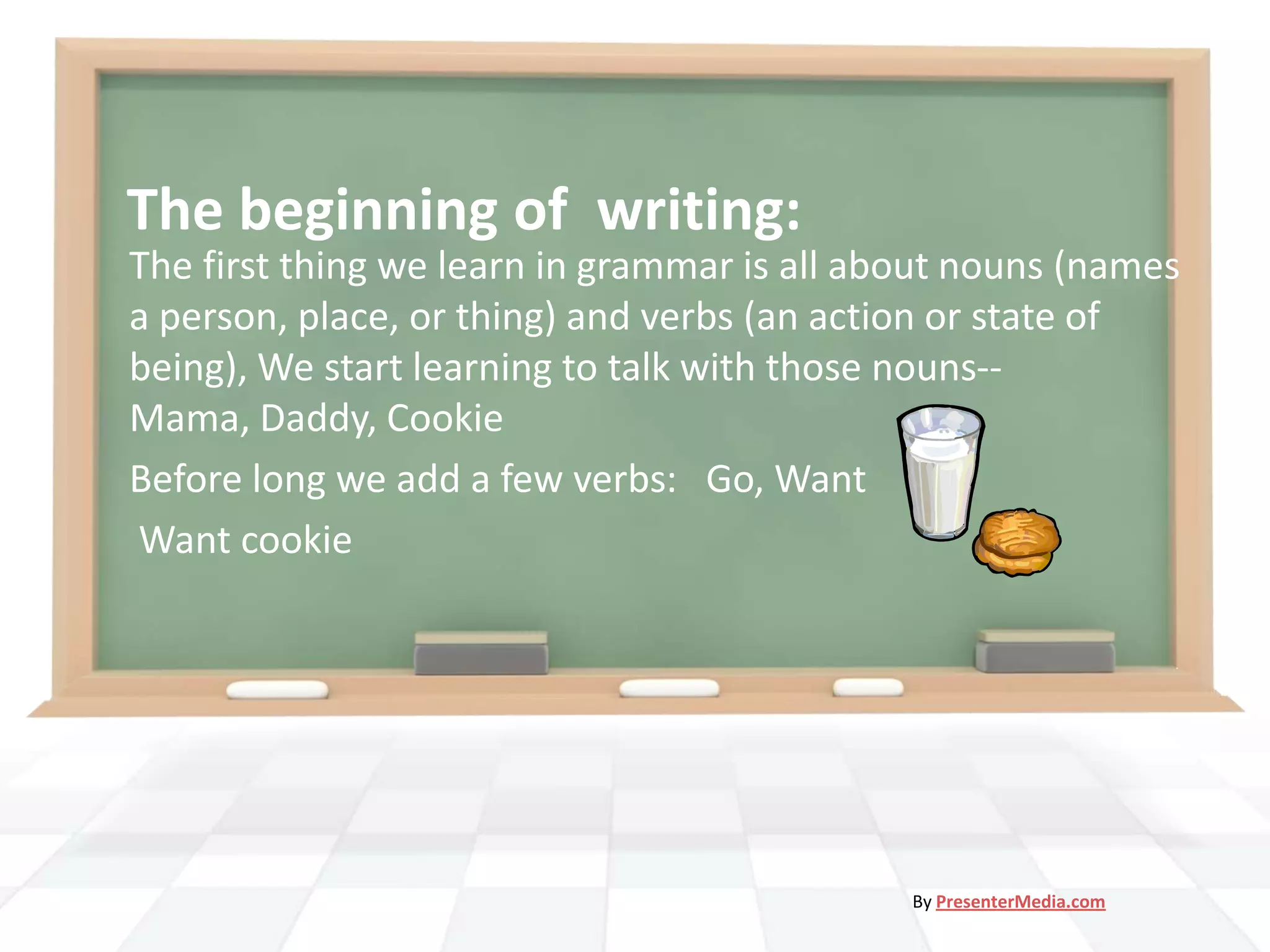
Mama, Daddy, Cookie
Before long we add a few verbs: Go, Want
Want cookie


                                             By PresenterMedia.com
•The noun and verb combine to create a
clause
 There are two kinds of clauses.
    •   The first type of clause is the
        INDEPENDENT clause. I read.
    •   The second type of clause is
        the DEPENDENT clause. Since
        I read.

    •   Did your head just tilt? There is
        a noun and a verb, but it is an
        incomplete thought. I would
        mark this as a FRAGMENT.


                                            Bonnie Startt
•How do we use the clauses?
    An independent clause is a simple sentence.

•   This does not mean if it is just
    a few words, it is a simple
    sentence.
•   A simple sentence can have
    lots of things added to it.
•   We add details…..
•   Here is a 239 word simple
    sentence:
•   http://grammar.ccc.commnet
    .edu/grammar/run-on.htm


                                                  Bonnie Startt
Start at the beginning:
 Simple Sentence
• I read

• I read books

• I read funny books .

• Adjectives

• I read funny books to my
  students.
  (Preposition/Prepositional
  Phrase)


                               Bonnie Startt
Next move
 Compound Sentences
• In spite of the fact that
  simple sentences don't
  always need punctuation, we
  need to move forward in our
  writing. The next sentence
  type we are going to look at
  is the compound sentence.
• Simple + Simple= compound

• Independent Clause +
  Independent Clause =
  Compound Sentence


                                 Bonnie Startt
Beware…..
 Compound Sentences
• However, if we just put two
  simple sentences/
  independent clauses
  together, we can get a run on
  or fused sentence.
• I read a book it was dull. RO


•   Give your reader a chance to
    take a breath. There are 3
    ways to do this.


                                   Bonnie Startt
Method ONE …..
 Compound Sentences
• The first method only
  needs one (1)
  thing/element to make it
  work correctly. We can put
  two simple sentences
  together using a semicolon
  (;).
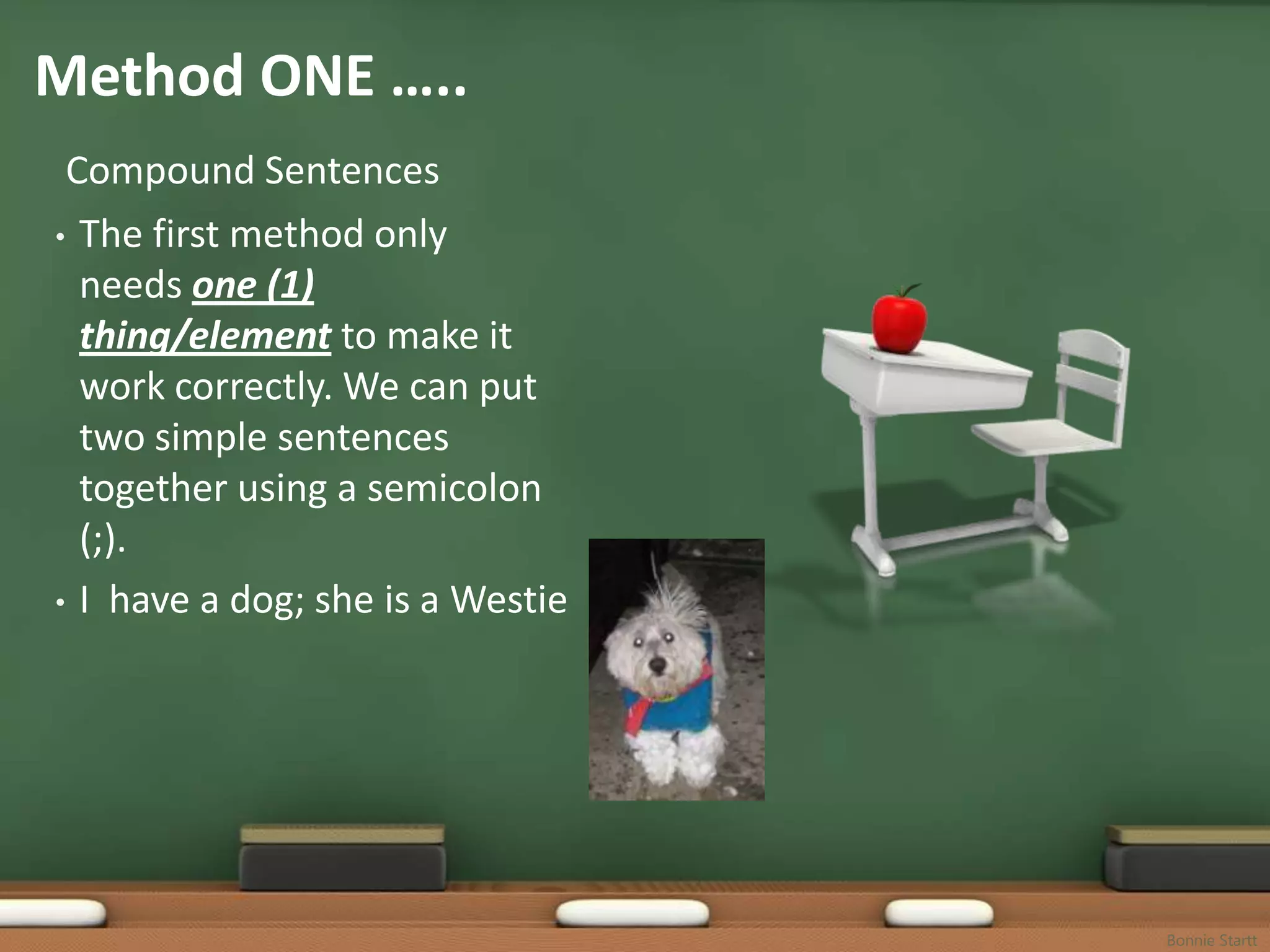
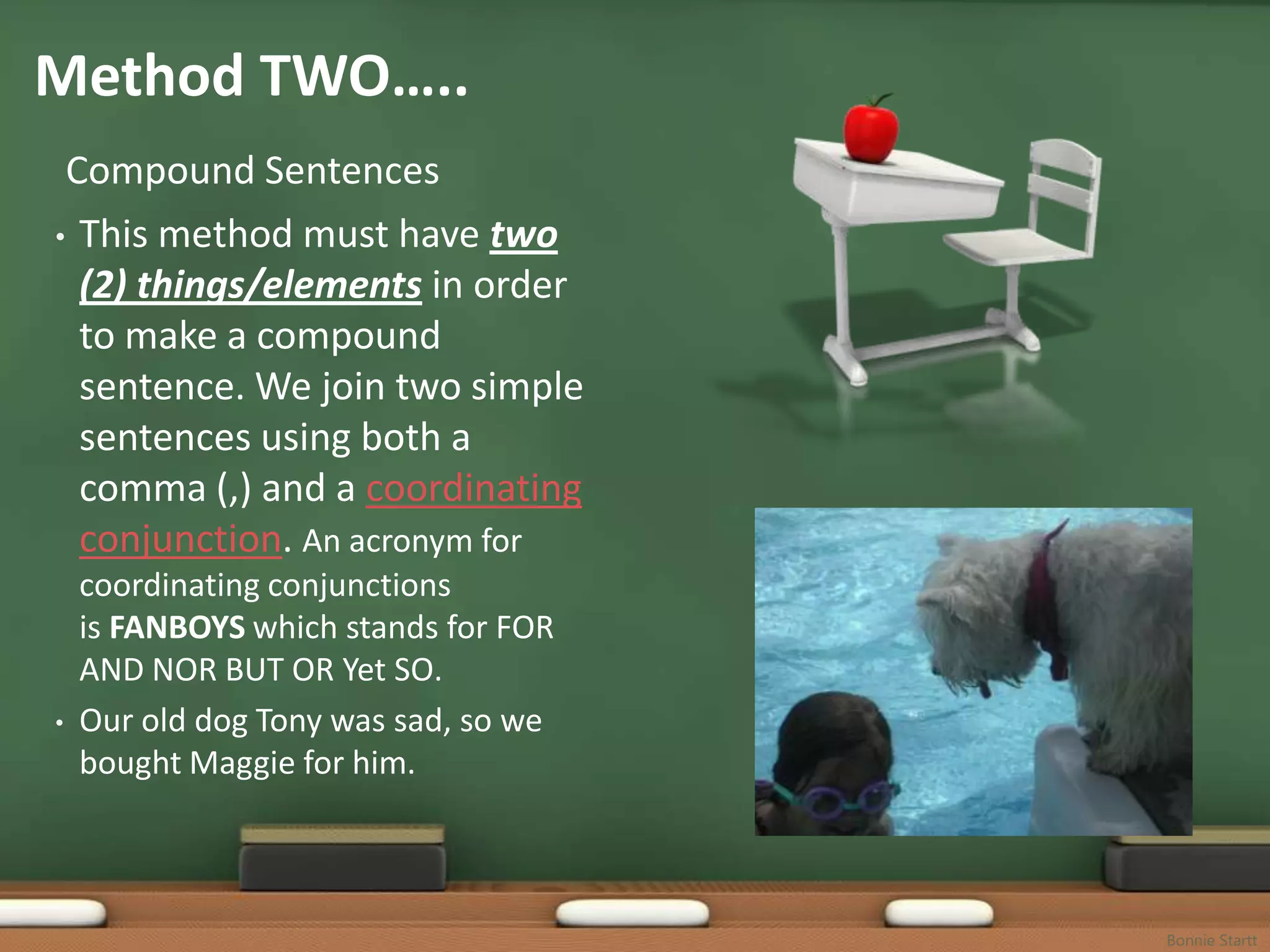
• I have a dog; she is a Westie


                                  Bonnie Startt
Method TWO…..
 Compound Sentences
• This method must have two
  (2) things/elements in order
  to make a compound
  sentence. We join two simple
  sentences using both a
  comma (,) and a coordinating
  conjunction. An acronym for
    coordinating conjunctions
    is FANBOYS which stands for FOR
    AND NOR BUT OR Yet SO.
•   Our old dog Tony was sad, so we
    bought Maggie for him.


                                      Bonnie Startt
Method THREE…..
    Compound Sentences
•   This method must have three (3)
    things/elements in order to make a
    compound sentence. We join two
•   simple sentences first using a
    semicolon (;) then a conjunctive adverb
    (fancy words =)
•   (Conjunctive adverbs)and finally a comma
    (,). How about an easy to remember
    acronym: HOT MAMAS: However, on
    the...other hand/contrary, therefore,
    moreover, although, meanwhile, and yet
    (note- 2 of our coordinating conjunctions
    together), subsequently.
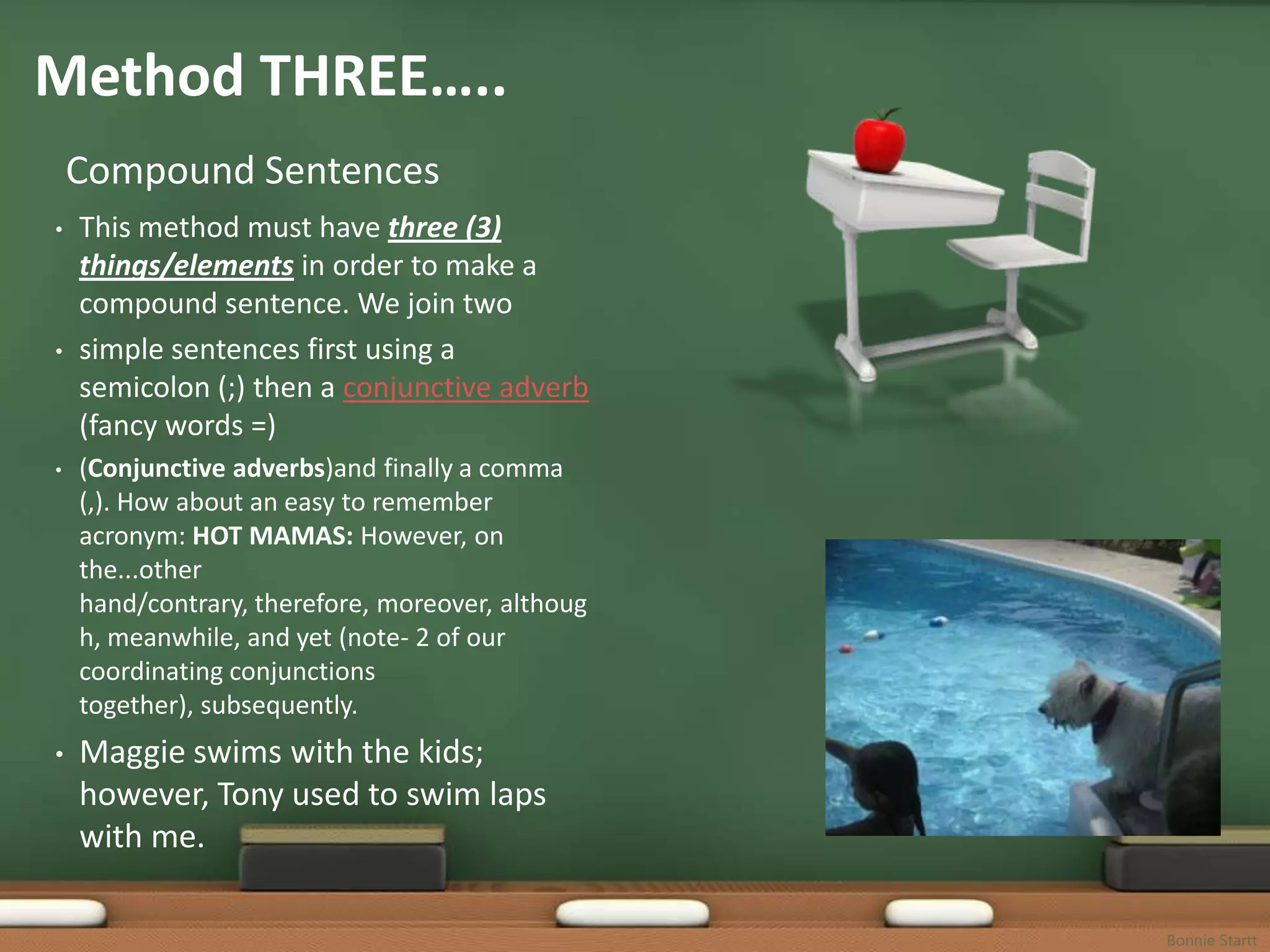
•   Maggie swims with the kids;
    however, Tony used to swim laps
    with me.


                                                Bonnie Startt
The Complex Sentence…..
    The dependent clause
•   We know all about using our
    independent clauses, but how do we
    create a dependent clause? We take a
    plain old independent clause and add
    a Subordinating Conjunction. I like to
    call the subordinating conjunctions
    spoilers because they take a clause
    which can stand alone and turn it to
    one which needs help---cannot stand
    alone. Think about Bugs Bunny as you
    consider this acronym: WABITS---
    Whenever, after, although, because.
    if, that (than though)since (so that).


                                             Bonnie Startt
The Complex Sentence…..
    The dependent clause
•   Since I read.---this is a fragment.

•   We have two options to fix the
    fragment; we can remove the
    subordinating conjunction, OR we can
    add it to an independent clause.

•   When we combine a dependent clause
    with an independent clause, we get a
    complex sentence.

•   Since I read a lot, I got a Kindle for
    Christmas.


                                             Bonnie Startt
The Complex Sentence…..
    Funny punctuation rules
•   There are 2 ways to join the two
    clauses.
•   IC and DC ; DC and IC
•   The difference between the two
    methods is a simple comma. If you
    have the first type:
•   I got a Kindle for Christmas since I read.
    You will see there is no comma
    between the clauses.
•   If we go with the second method:
•   Since I like to read, I got a Kindle for
    Christmas. It takes the comma.
•   IC DC.       OR DC, IC.


                                                 Bonnie Startt
The Compound Complex Sentence…..
    This needs 3 clauses—2 IC ; 1 DC
•   When we are writing, we want to have
    some variety in writing sentences. We use
    a few simple sentences and some
    complex sentences in our writing, but
    sometimes we need to be a bit
    fancier....... to show off a little. The best
    way to do this is to write a compound
    complex sentence..
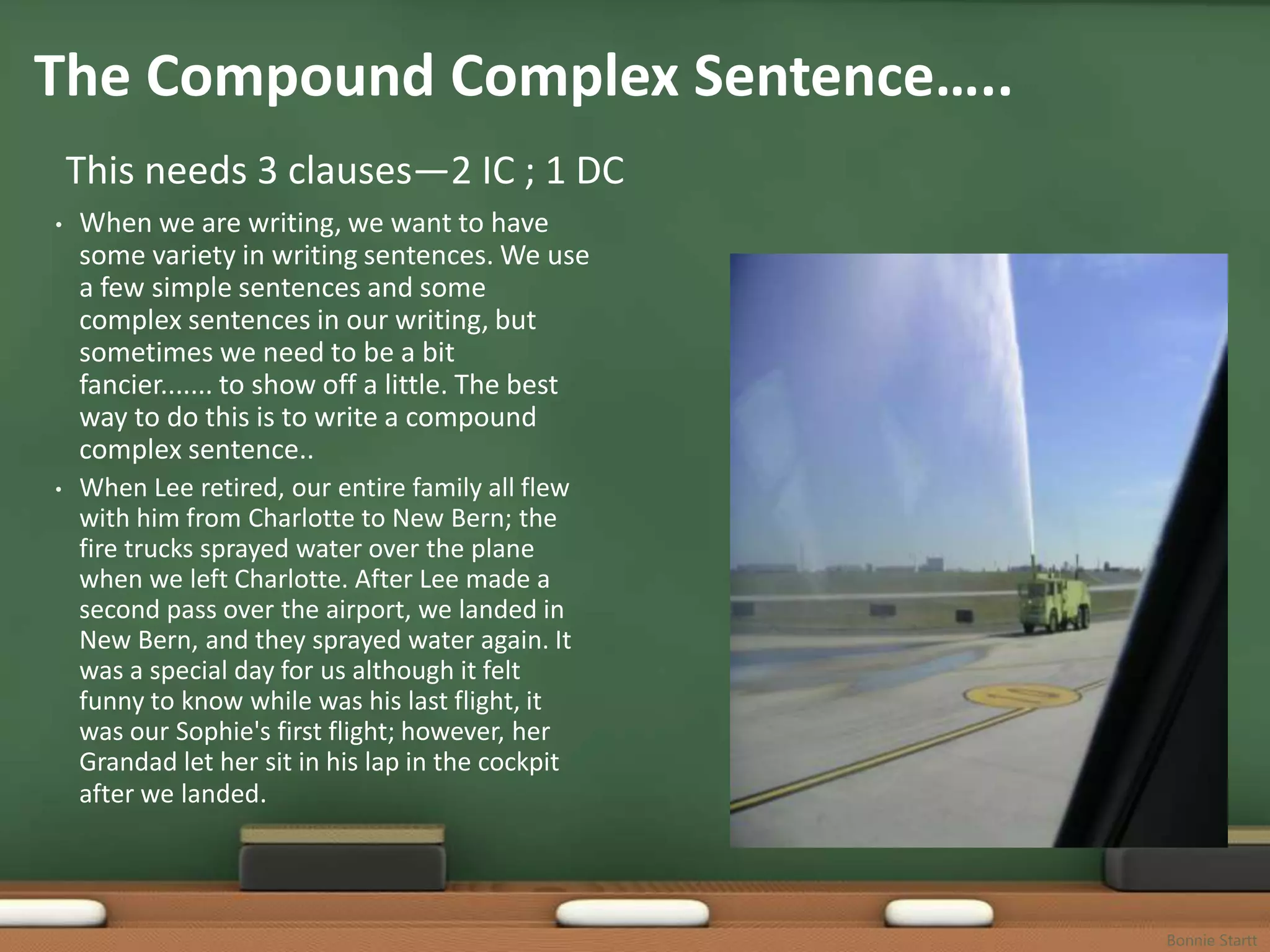
•   When Lee retired, our entire family all flew
    with him from Charlotte to New Bern; the
    fire trucks sprayed water over the plane
    when we left Charlotte. After Lee made a
    second pass over the airport, we landed in
    New Bern, and they sprayed water again. It
    was a special day for us although it felt
    funny to know while was his last flight, it
    was our Sophie's first flight; however, her
    Grandad let her sit in his lap in the cockpit
    after we landed.


                                                    Bonnie Startt
You need to make sure you know these
rules----
If you know these rules, you
know most the most common
punctuation rules.


                                       Bonnie Startt

Clauses

  • 1.
    Clauses… Sentences…Punctuation Prepared byBonnie Startt January 28, 2013 Tidewater Community College Virginia Beach By PresenterMedia.com
  • 2.
    The beginning ofwriting: The first thing we learn in grammar is all about nouns (names a person, place, or thing) and verbs (an action or state of being), We start learning to talk with those nouns-- Mama, Daddy, Cookie Before long we add a few verbs: Go, Want Want cookie By PresenterMedia.com
  • 3.
    •The noun andverb combine to create a clause There are two kinds of clauses. • The first type of clause is the INDEPENDENT clause. I read. • The second type of clause is the DEPENDENT clause. Since I read. • Did your head just tilt? There is a noun and a verb, but it is an incomplete thought. I would mark this as a FRAGMENT. Bonnie Startt
  • 4.
    •How do weuse the clauses? An independent clause is a simple sentence. • This does not mean if it is just a few words, it is a simple sentence. • A simple sentence can have lots of things added to it. • We add details….. • Here is a 239 word simple sentence: • http://grammar.ccc.commnet .edu/grammar/run-on.htm Bonnie Startt
  • 5.
    Start at thebeginning: Simple Sentence • I read • I read books • I read funny books . • Adjectives • I read funny books to my students. (Preposition/Prepositional Phrase) Bonnie Startt
  • 6.
    Next move CompoundSentences • In spite of the fact that simple sentences don't always need punctuation, we need to move forward in our writing. The next sentence type we are going to look at is the compound sentence. • Simple + Simple= compound • Independent Clause + Independent Clause = Compound Sentence Bonnie Startt
  • 7.
    Beware….. Compound Sentences •However, if we just put two simple sentences/ independent clauses together, we can get a run on or fused sentence. • I read a book it was dull. RO • Give your reader a chance to take a breath. There are 3 ways to do this. Bonnie Startt
  • 8.
    Method ONE ….. Compound Sentences • The first method only needs one (1) thing/element to make it work correctly. We can put two simple sentences together using a semicolon (;). • I have a dog; she is a Westie Bonnie Startt
  • 9.
    Method TWO….. CompoundSentences • This method must have two (2) things/elements in order to make a compound sentence. We join two simple sentences using both a comma (,) and a coordinating conjunction. An acronym for coordinating conjunctions is FANBOYS which stands for FOR AND NOR BUT OR Yet SO. • Our old dog Tony was sad, so we bought Maggie for him. Bonnie Startt
  • 10.
    Method THREE….. Compound Sentences • This method must have three (3) things/elements in order to make a compound sentence. We join two • simple sentences first using a semicolon (;) then a conjunctive adverb (fancy words =) • (Conjunctive adverbs)and finally a comma (,). How about an easy to remember acronym: HOT MAMAS: However, on the...other hand/contrary, therefore, moreover, although, meanwhile, and yet (note- 2 of our coordinating conjunctions together), subsequently. • Maggie swims with the kids; however, Tony used to swim laps with me. Bonnie Startt
  • 11.
    The Complex Sentence….. The dependent clause • We know all about using our independent clauses, but how do we create a dependent clause? We take a plain old independent clause and add a Subordinating Conjunction. I like to call the subordinating conjunctions spoilers because they take a clause which can stand alone and turn it to one which needs help---cannot stand alone. Think about Bugs Bunny as you consider this acronym: WABITS--- Whenever, after, although, because. if, that (than though)since (so that). Bonnie Startt
  • 12.
    The Complex Sentence….. The dependent clause • Since I read.---this is a fragment. • We have two options to fix the fragment; we can remove the subordinating conjunction, OR we can add it to an independent clause. • When we combine a dependent clause with an independent clause, we get a complex sentence. • Since I read a lot, I got a Kindle for Christmas. Bonnie Startt
  • 13.
    The Complex Sentence….. Funny punctuation rules • There are 2 ways to join the two clauses. • IC and DC ; DC and IC • The difference between the two methods is a simple comma. If you have the first type: • I got a Kindle for Christmas since I read. You will see there is no comma between the clauses. • If we go with the second method: • Since I like to read, I got a Kindle for Christmas. It takes the comma. • IC DC. OR DC, IC. Bonnie Startt
  • 14.
    The Compound ComplexSentence….. This needs 3 clauses—2 IC ; 1 DC • When we are writing, we want to have some variety in writing sentences. We use a few simple sentences and some complex sentences in our writing, but sometimes we need to be a bit fancier....... to show off a little. The best way to do this is to write a compound complex sentence.. • When Lee retired, our entire family all flew with him from Charlotte to New Bern; the fire trucks sprayed water over the plane when we left Charlotte. After Lee made a second pass over the airport, we landed in New Bern, and they sprayed water again. It was a special day for us although it felt funny to know while was his last flight, it was our Sophie's first flight; however, her Grandad let her sit in his lap in the cockpit after we landed. Bonnie Startt
  • 15.
    You need tomake sure you know these rules---- If you know these rules, you know most the most common punctuation rules. Bonnie Startt