LITHOSPHERE
1
Rocks & Minerals
ppt. by Robin D. Seamon
HOOK VIDEO: Making of North America (55 min)
COMPOSITION
VOCABULARY:
lithosphere
crust
mantle
asthenosphere
pedosphere
inner core
outer core
plasticity
convection
radioactive decay
6 steps of rock cycle
uplift
Lithosphere:
solid layer
comprised of
crust &
Asthenosphere
(upper mantle)
Lithosphere:
solid layer
comprised of
crust &
asthenosphere
(upper mantle)
Lithosphere:
solid layer
comprised of
crust &
asthenosphere
(upper mantle)
Pedosphere: soil
layer
• The Lithosphere is dynamic (changing)
• Heat from the center
• Energy from the Sun
OUTSIDE:
• Sun’s Energy on the atmosphere and water
make:
• Wind
• Currents
• Evaporation- Water Cycle
• This causes weather &
larger patterns of climate
• It influences Water Cycle
which controls
weathering, erosion, &
deposition
INSIDE:
• Decay of radioactive isotopes
• The release of this heat causes:
• churning of the molten rock inside
• Release of heat through cracks/vents in the
crust
• Convection causes plates of crust to move about
99% of rock inside the
Earth is greater than
2,000˚F (radioactive
decay generates the
heat)
CRUST
Crust: (0.2 – 1.1 %
crust or 4-43 miles
deep) 700˚F- 1,500˚F
• Solid
• Outermost layer
affected by solar
radiation,
weathering, &
erosion
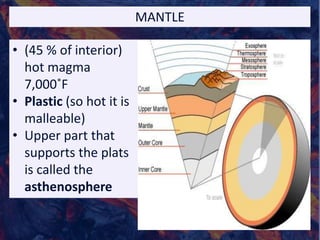
MANTLE
• (45 % of interior)
hot magma
7,000˚F
• Plastic (so hot it is
malleable)
• Upper part that
supports the plats
is called the
asthenosphere
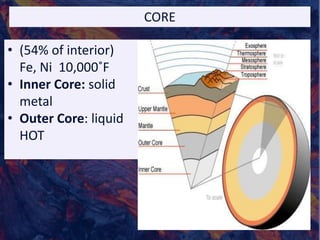
• (54% of interior)
Fe, Ni 10,000˚F
• Inner Core: solid
metal
• Outer Core: liquid
HOT
CORE
Geothermal:
relating to heat
inside the earth
DEEPEST man-made
hole:
Kola Superdeep
borehole- NW Russia
• 40,000 ft & then
too hot to dig
more
Crust 21 miles deep in
Baltic Region
At 7.4 miles,
300˚F
Average oil
well is ~ 1
mile
Scientists try to harness this geothermal Energy
for renewable Energy source
Rock Cycle
VOCABULARY:
subduction
uplift
crystallization
heat & pressure
weathering/erosion/deposition
Compaction/cementation
Melting
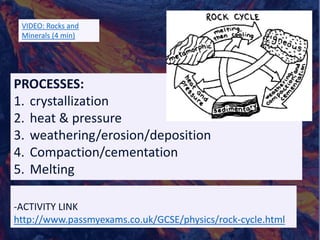
ROCK CYCLE
Rock Cycle: process by which new crust is
continually being recycled
The crust has forces acting upon it through the Rock
Cycle that changes its shape like you would clay:
• Pulled apart
• Compressed together
• Subducted
• Melted
• Weathered
VIDEO: Bill Nye Rock Cycle 3 min
What powers the Rock Cycle?
1. Gravity: creates pressure
2. Convection: caused by heat; makes pressure
PROCESSES:
1. crystallization
2. heat & pressure
3. weathering/erosion/deposition
4. Compaction/cementation
5. Melting
-ACTIVITY LINK
http://www.passmyexams.co.uk/GCSE/physics/rock-cycle.html
VIDEO: Rocks and
Minerals (4 min)
Each type of rock can turn into the other
kind of rocks!
LAB
ROCKS & MINERALS
VOCABULARY:
rock regional metamorphism
mineral contact metamorphism
Mineral classifications MOHS Hardness scale
strata
clastic
igneous
metamorphic
sedimentary
intrusive/plutonic
extrusive/volcanic
crystalline/chemical
organic sedimentary
foliated
non-foliated
VIDEO: What is a mineral (3 min)
1.Color
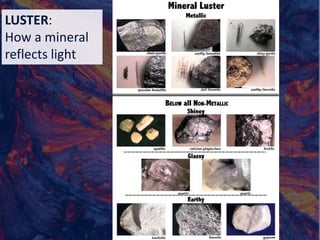
2.Luster: the way a surface reflects light
3.Streak: the color of a mineral in powdered form
(how it rubs against a streak plate)
4.Cleavage- the tendency of some minerals to break
along smooth, flat surfaces /Fracture- tendency of
a mineral to break unevenly
5.Hardness: how easy/hard it is to scratch; on Mohs
scale 1=soft to 10=hard
6.Density: how much matter in a given space (cm3)
IDENTIFYING MINERALS
VIDEO: Mineral Characteristics Tests (2 min)
COLOR-
Easy to
recognize but
not as reliable
Quartz Variations
Colorless Minerals
http://academic.brooklyn.cuny.edu/geology/grocha/mineral/images/cleavage.jpg
Quartz
Fracture
CLEAVAGE:
tendency of a
mineral to split
on smooth, flat
surfaces
LUSTER:
How a mineral
reflects light
geology.csupomona.edu/alert/mineral/streak.htm
:www.championjewelery.us/
STREAK: the color of a mineral when rubbed against
a course surface (streak plate)
Mohs Hardness
scale
BACK
HARDNESS:
OTHER PROPERTIES:
Magnetism: magnetite & pyrrhotite attract iron
Fluorescence: calcite & fluorite glow under UV light
Taste: halite is salty-tasting
http://commons.wikimedia.org/wi
ki/File:Fluorescent_minerals_hg.
jpg
http://www.msnucleus.org/m
embership/html/k-
6/rc/minerals/2/rcm2_5a.html
http://www.mchenry.edu/d
epts/EAS/courses/eas170/
minerals/pages/Magnetite.
htm
http://euromin.w3sites.n
et/mineraux/images/15
864.jpg
Chemical reaction: calcite will
become bubbly (fizz) when a
drop of weak acid is on it
(basalt, limestone, marble
sandstone)
Optical properties: a thin, clear
piece of calcite placed over an
image will make a double image
Radioactivity: minerals containing
radium or uranium
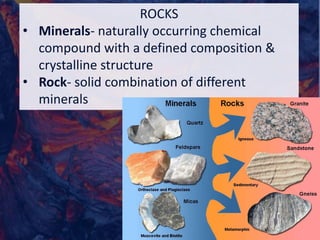
ROCKS
• Minerals- naturally occurring chemical
compound with a defined composition &
crystalline structure
• Rock- solid combination of different
minerals
3 Main Kinds of Rocks:
• Igneous-
• intrusive
• extrusive
• Metamorphic-
• foliated
• Non-foliated
• Sedimentary-
• clastic
• organic
• chemical
VIDEO: The Rock Cycle: Igneous Sedimentary Metamorphic (4 min)
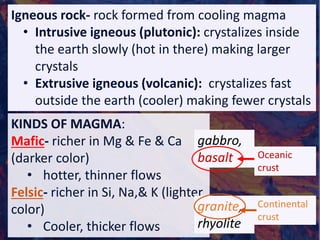
Igneous rock- rock formed from cooling magma
• Intrusive igneous (plutonic): crystalizes inside
the earth slowly (hot in there) making larger
crystals
• Extrusive igneous (volcanic): crystalizes fast
outside the earth (cooler) making fewer crystals
KINDS OF MAGMA:
Mafic- richer in Mg & Fe & Ca
(darker color)
• hotter, thinner flows
Felsic- richer in Si, Na,& K (lighter
color)
• Cooler, thicker flows
granite,
rhyolite
Continental
crust
gabbro,
basalt Oceanic
crust
IGNEOUS ROCKS- Key Features:
IGNEOUS
INTRUSIVE
granite gabbro
From
mafic
magma
From
felsic
magma
From
felsic
magma
From
mafic
magma
basalt
obsidian
rhyolite
IGNEOUS
EXTRUSIVE
VIDEO TUTORIAL: Introduction
to Igneous Rocks (5:30)
IGNEOUS ROCK FORMATION
Intrusion: place where magma fills a crack under
the surface & crystalizes.
Sedimentary rock: made from weathered
remains of parent rock or plant/animal remains
STEPS:
1. Weathering & Erosion of parent rock
2. Deposition: dropping off sediment
3. Bedding: layering; creates pressure
4. Pressure: turns sediment into new rock
• Hold fossils that describe Earth’s
early life forms
• The strata (layers) help determine
relative age of rock
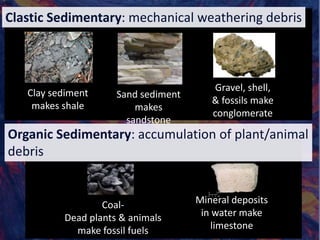
SEDIMENTARY ROCKS- Key Features:
Clay sediment
makes shale
Sand sediment
makes
sandstone
Mineral deposits
in water make
limestone
Coal-
Dead plants & animals
make fossil fuels
Gravel, shell,
& fossils make
conglomerate
Clastic Sedimentary: mechanical weathering debris
Organic Sedimentary: accumulation of plant/animal
debris
Crystalline (Chemical) Sedimentary: dissolved
materials precipitate from a solution
Flint/ Chert
(These Silicon
dioxide crystals
grow within soft
sediments that will
become
limestone/chalk)
Iron Ore
(iron ore deposits began
forming when 1st
photosynthetic organisms
began releasing O2- rusting
the dissolved Fe in the
water) 1.8 bya
VIDEO Tutorial: Introduction to Sedimentary Rocks (8 min)
http://bc.outcrop.org/GEOL_B10/lecture11.html
SEDIMENTARY ROCK FORMATION
Metamorphic rock: rock is under heat &
pressure for a long time so that it chemically
&/or physically changes into another type of rock
1. Regional metamorphism: Pressure
• Make Foliated rocks- banded pattern due to
direct heat/pressure, flattening out the
minerals into a sheet pattern
2. Contact metamorphism: Heat
• Make Non-foliated rocks- form around
igneous intrusions where temperature is high,
but pressure is relatively low
granite
gneiss
slate
schist
FOLIATED
METAMORPHIC
sandstone
quartzite
limestone
marble
NON-FOLIATED
METAMORPHIC
VIDEO TUTORIAL:
Metamorphic Rocks (4 min)
METAMORPHIC ROCKS- Key Features:
RockCycleShowerLab
Metamorphi
c Rock
MagmaSedimentary
Rock
Sediment Igneous
Rock
Cooling
Melting
Weathering/
deposition
Weathering/
deposition
METAMORPHIC
ROCK
IGNEOUS ROCK
1.
OCEAN
RAIN
MAGMA
SEDIMENTARY
ROCK
2.
3.
4.
5.
6.
7.
EH1 UNIT CHECK 3
A-
crystallization
B- melting
C- erosion
D- deposition
E- heat &
pressure
F- uplift
G- burial and
compaction
C
D
G
E
F
B
A
Mineral Reference Table LINK
Rock ID Reference Table LINK
RESOURCE Link:
https://www.radford.edu/jtso/GeologyofVirginia/Minerals/GeologyOfV
AMinerals1-3a.html

Lithosphere 1 notes