Rocks
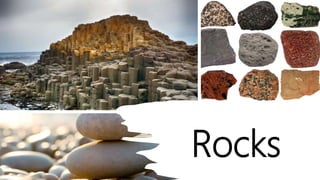
Rocks
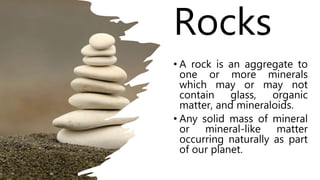
• A rock is an aggregate to
one or more minerals
which may or may not
contain glass, organic
matter, and mineraloids.
• Any solid mass of mineral
or mineral-like matter
occurring naturally as part
of our planet.
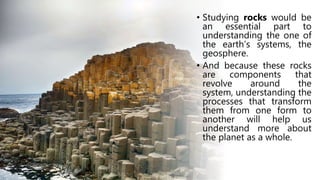
• Studying rocks would be
an essential part to
understanding the one of
the earth’s systems, the
geosphere.
• And because these rocks
are components that
revolve around the
system, understanding the
processes that transform
them from one form to
another will help us
understand more about
the planet as a whole.
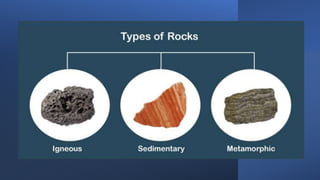
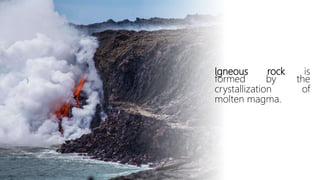
Igneous rock is
formed by the
crystallization of
molten magma.
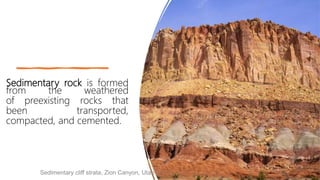
Sedimentary rock is formed
from the weathered
of preexisting rocks that
been transported,
compacted, and cemented.
Sedimentary cliff strata, Zion Canyon, Utah
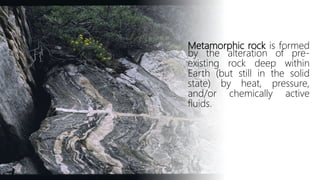
Metamorphic rock is formed
by the alteration of pre-
existing rock deep within
Earth (but still in the solid
state) by heat, pressure,
and/or chemically active
fluids.
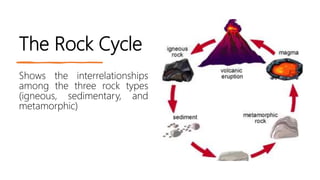
The Rock Cycle
Shows the interrelationships
among the three rock types
(igneous, sedimentary, and
metamorphic)
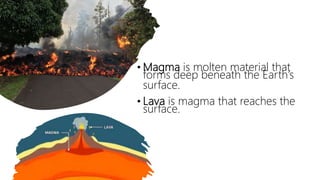
• Magma is molten material that
forms deep beneath the Earth’s
surface.
• Lava is magma that reaches the
surface.
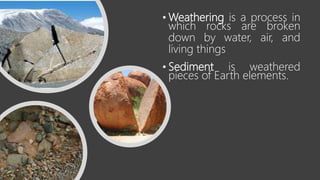
• Weathering is a process in
which rocks are broken
down by water, air, and
living things
• Sediment is weathered
pieces of Earth elements.
Energy
That
Drives
the Rock
Cycle
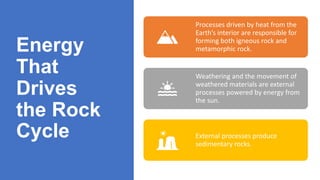
Processes driven by heat from the
Earth’s interior are responsible for
forming both igneous rock and
metamorphic rock.
Weathering and the movement of
weathered materials are external
processes powered by energy from
the sun.
External processes produce
sedimentary rocks.
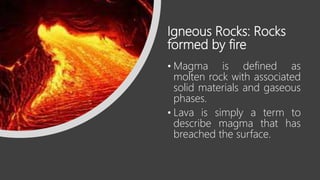
Igneous Rocks: Rocks
formed by fire
• Magma is defined as
molten rock with associated
solid materials and gaseous
phases.
• Lava is simply a term to
describe magma that has
breached the surface.
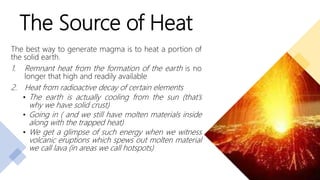
The Source of Heat
The best way to generate magma is to heat a portion of
the solid earth.
1. Remnant heat from the formation of the earth is no
longer that high and readily available
2. Heat from radioactive decay of certain elements
• The earth is actually cooling from the sun (that’s
why we have solid crust)
• Going in ( and we still have molten materials inside
along with the trapped heat)
• We get a glimpse of such energy when we witness
volcanic eruptions which spews out molten material
we call lava (in areas we call hotspots)
Other Ways to Melt Rocks
• Decompression is the removal or decrease of a certain
pressure applied on a body.
• Given a rock that is undergoing pressure at certain
temperature, a decrease in pressure will allow a change in
phase once the ambient temperature is enough to do so at
the new prevalent pressure.
• Read the example on page 31.
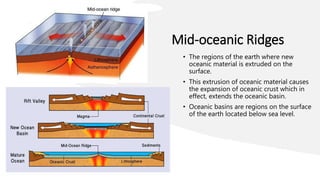
Mid-oceanic Ridges
• The regions of the earth where new
oceanic material is extruded on the
surface.
• This extrusion of oceanic material causes
the expansion of oceanic crust which in
effect, extends the oceanic basin.
• Oceanic basins are regions on the surface
of the earth located below sea level.
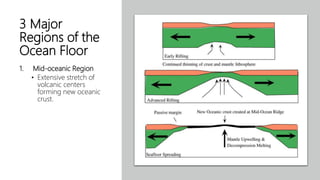
3 Major
Regions of the
Ocean Floor
1. Mid-oceanic Region
• Extensive stretch of
volcanic centers
forming new oceanic
crust.
3 Major
Regions of the
Ocean Floor
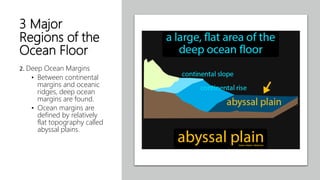
2. Deep Ocean Margins
• Between continental
margins and oceanic
ridges, deep ocean
margins are found.
• Ocean margins are
defined by relatively
flat topography called
abyssal plains.
3 Major
Regions of the
Ocean Floor
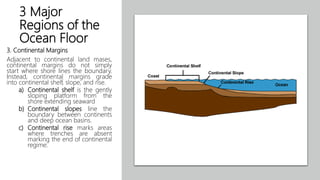
3. Continental Margins
Adjacent to continental land mases,
continental margins do not simply
start where shore lines the boundary.
Instead, continental margins grade
into continental shelf, slope, and rise.
a) Continental shelf is the gently
sloping platform from the
shore extending seaward
b) Continental slopes line the
boundary between continents
and deep ocean basins.
c) Continental rise marks areas
where trenches are absent
marking the end of continental
regime.
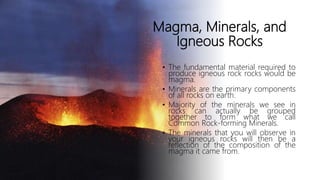
Magma, Minerals, and
Igneous Rocks
• The fundamental material required to
produce igneous rock rocks would be
magma.
• Minerals are the primary components
of all rocks on earth.
• Majority of the minerals we see in
rocks can actually be grouped
together to form what we call
Common Rock-forming Minerals.
• The minerals that you will observe in
your igneous rocks will then be a
reflection of the composition of the
magma it came from.
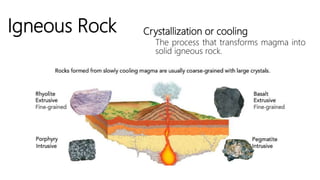
Igneous Rock Crystallization or cooling
The process that transforms magma into
solid igneous rock.
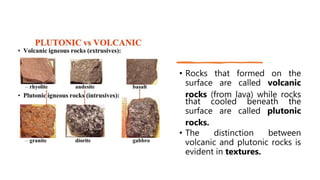
• Rocks that formed on the
surface are called volcanic
rocks (from lava) while rocks
that cooled beneath the
surface are called plutonic
rocks.
• The distinction between
volcanic and plutonic rocks is
evident in textures.
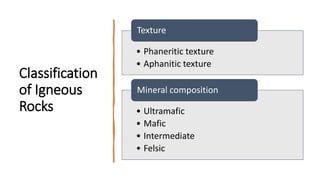
Classification
of Igneous
Rocks
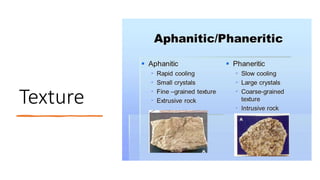
• Phaneritic texture
• Aphanitic texture
Texture
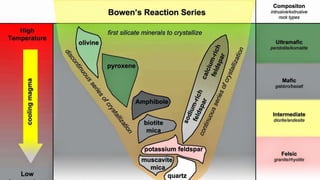
• Ultramafic
• Mafic
• Intermediate
• Felsic
Mineral composition
Texture
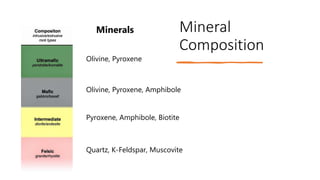
Mineral
Composition
Olivine, Pyroxene
Olivine, Pyroxene, Amphibole
Pyroxene, Amphibole, Biotite
Quartz, K-Feldspar, Muscovite
Minerals
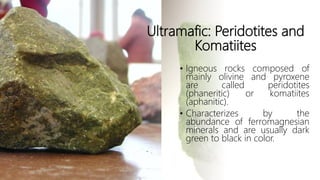
Ultramafic: Peridotites and
Komatiites
• Igneous rocks composed of
mainly olivine and pyroxene
are called peridotites
(phaneritic) or komatiites
(aphanitic).
• Characterizes by the
abundance of ferromagnesian
minerals and are usually dark
green to black in color.
Mafic: Gabbro
& Basalt
• Majority of igneous rocks produced by
mid-oceanic ridges are within the
compositional group of gabbro and
basalts.
• Lower iron and magnesium content
compared with ultramafic
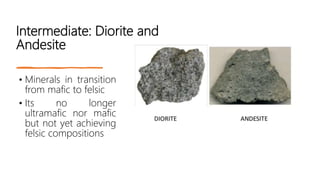
Intermediate: Diorite and
Andesite
• Minerals in transition
from mafic to felsic
• Its no longer
ultramafic nor mafic
but not yet achieving
felsic compositions
Felsic: Granite
and rhyolite
• Interaction
between magma
and the
surrounding rocks
The Study of Igneous
Rocks
• The study of Igneous rocks is an
imperative window that permits
understanding of the processes
occurring deep within the earth
• Igneous rocks pioneer the other
two rocks types
• Ultimately, any rock will trace
back its lineage to an igneous
one.

Igneous Rock.pptx

  • 1.
  • 2.
    Rocks • A rockis an aggregate to one or more minerals which may or may not contain glass, organic matter, and mineraloids. • Any solid mass of mineral or mineral-like matter occurring naturally as part of our planet.
  • 3.
    • Studying rockswould be an essential part to understanding the one of the earth’s systems, the geosphere. • And because these rocks are components that revolve around the system, understanding the processes that transform them from one form to another will help us understand more about the planet as a whole.
  • 5.
    Igneous rock is formedby the crystallization of molten magma.
  • 6.
    Sedimentary rock isformed from the weathered of preexisting rocks that been transported, compacted, and cemented. Sedimentary cliff strata, Zion Canyon, Utah
  • 7.
    Metamorphic rock isformed by the alteration of pre- existing rock deep within Earth (but still in the solid state) by heat, pressure, and/or chemically active fluids.
  • 8.
    The Rock Cycle Showsthe interrelationships among the three rock types (igneous, sedimentary, and metamorphic)
  • 9.
    • Magma ismolten material that forms deep beneath the Earth’s surface. • Lava is magma that reaches the surface.
  • 10.
    • Weathering isa process in which rocks are broken down by water, air, and living things • Sediment is weathered pieces of Earth elements.
  • 11.
    Energy That Drives the Rock Cycle Processes drivenby heat from the Earth’s interior are responsible for forming both igneous rock and metamorphic rock. Weathering and the movement of weathered materials are external processes powered by energy from the sun. External processes produce sedimentary rocks.
  • 12.
    Igneous Rocks: Rocks formedby fire • Magma is defined as molten rock with associated solid materials and gaseous phases. • Lava is simply a term to describe magma that has breached the surface.
  • 13.
    The Source ofHeat The best way to generate magma is to heat a portion of the solid earth. 1. Remnant heat from the formation of the earth is no longer that high and readily available 2. Heat from radioactive decay of certain elements • The earth is actually cooling from the sun (that’s why we have solid crust) • Going in ( and we still have molten materials inside along with the trapped heat) • We get a glimpse of such energy when we witness volcanic eruptions which spews out molten material we call lava (in areas we call hotspots)
  • 14.
    Other Ways toMelt Rocks • Decompression is the removal or decrease of a certain pressure applied on a body. • Given a rock that is undergoing pressure at certain temperature, a decrease in pressure will allow a change in phase once the ambient temperature is enough to do so at the new prevalent pressure. • Read the example on page 31.
  • 15.
    Mid-oceanic Ridges • Theregions of the earth where new oceanic material is extruded on the surface. • This extrusion of oceanic material causes the expansion of oceanic crust which in effect, extends the oceanic basin. • Oceanic basins are regions on the surface of the earth located below sea level.
  • 16.
    3 Major Regions ofthe Ocean Floor 1. Mid-oceanic Region • Extensive stretch of volcanic centers forming new oceanic crust.
  • 17.
    3 Major Regions ofthe Ocean Floor 2. Deep Ocean Margins • Between continental margins and oceanic ridges, deep ocean margins are found. • Ocean margins are defined by relatively flat topography called abyssal plains.
  • 18.
    3 Major Regions ofthe Ocean Floor 3. Continental Margins Adjacent to continental land mases, continental margins do not simply start where shore lines the boundary. Instead, continental margins grade into continental shelf, slope, and rise. a) Continental shelf is the gently sloping platform from the shore extending seaward b) Continental slopes line the boundary between continents and deep ocean basins. c) Continental rise marks areas where trenches are absent marking the end of continental regime.
  • 20.
    Magma, Minerals, and IgneousRocks • The fundamental material required to produce igneous rock rocks would be magma. • Minerals are the primary components of all rocks on earth. • Majority of the minerals we see in rocks can actually be grouped together to form what we call Common Rock-forming Minerals. • The minerals that you will observe in your igneous rocks will then be a reflection of the composition of the magma it came from.
  • 21.
    Igneous Rock Crystallizationor cooling The process that transforms magma into solid igneous rock.
  • 22.
    • Rocks thatformed on the surface are called volcanic rocks (from lava) while rocks that cooled beneath the surface are called plutonic rocks. • The distinction between volcanic and plutonic rocks is evident in textures.
  • 23.
    Classification of Igneous Rocks • Phaneritictexture • Aphanitic texture Texture • Ultramafic • Mafic • Intermediate • Felsic Mineral composition
  • 24.
  • 25.
    Mineral Composition Olivine, Pyroxene Olivine, Pyroxene,Amphibole Pyroxene, Amphibole, Biotite Quartz, K-Feldspar, Muscovite Minerals
  • 26.
    Ultramafic: Peridotites and Komatiites •Igneous rocks composed of mainly olivine and pyroxene are called peridotites (phaneritic) or komatiites (aphanitic). • Characterizes by the abundance of ferromagnesian minerals and are usually dark green to black in color.
  • 27.
    Mafic: Gabbro & Basalt •Majority of igneous rocks produced by mid-oceanic ridges are within the compositional group of gabbro and basalts. • Lower iron and magnesium content compared with ultramafic
  • 28.
    Intermediate: Diorite and Andesite •Minerals in transition from mafic to felsic • Its no longer ultramafic nor mafic but not yet achieving felsic compositions
  • 29.
    Felsic: Granite and rhyolite •Interaction between magma and the surrounding rocks
  • 30.
    The Study ofIgneous Rocks • The study of Igneous rocks is an imperative window that permits understanding of the processes occurring deep within the earth • Igneous rocks pioneer the other two rocks types • Ultimately, any rock will trace back its lineage to an igneous one.