


Investing in
the Future of
Sustainable
Energy
Revolutionizing Auto-Rickshaw Efficiency in Bangladesh
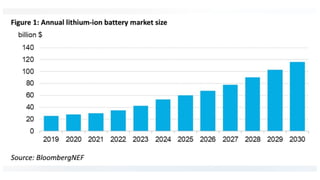
• Overview: The size of the lead-acid battery industry in Bangladesh is more than BDT 10,000 crore,
according to a report published by The Business Standard. The lithium-ion battery market in
Bangladesh is projected to grow significantly, with a compound annual growth rate (CAGR) of
approximately 4.8% from 2024 to 2030. This growth is fueled by:
• Increasing demand for renewable energy solutions.
• The rise in electric vehicle (EV) adoption.
• Expanding consumer electronics market.
• Vision: Leading the lithium battery market across multiple sectors in Bangladesh.
• Initial Product Focus: Launching with auto-rickshaw batteries.
• Expansion: Assembling warehouse setup and broader lithium battery applications in the next 4-6
months.
The Problem
Current Challenges Faced by Auto-Rickshaw
Drivers:
• High costs and frequent replacements with SLABs.
• Inefficient power usage and lengthy charging times.
• Environmental impact of SLAB disposal.
The Solution
Enchant Volt Lithium Batteries Offering:
• Longer lifespan: 3-5 years.
• Faster charging: 3-4 hours vs. 8-10 hours for SLABs.
• Increase operational hours and higher income potential.
• Environment friendly and safe.
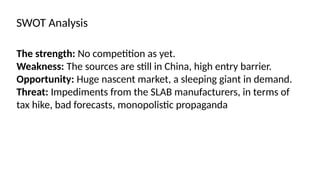
The strength: No competition as yet.
Weakness: The sources are still in China, high entry barrier.
Opportunity: Huge nascent market, a sleeping giant in demand.
Threat: Impediments from the SLAB manufacturers, in terms of
tax hike, bad forecasts, monopolistic propaganda
SWOT Analysis
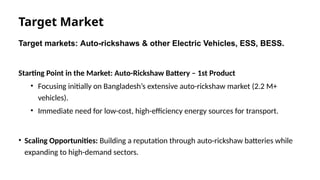
Target Market
Target markets: Auto-rickshaws & other Electric Vehicles, ESS, BESS.
Starting Point in the Market: Auto-Rickshaw Battery – 1st Product
• Focusing initially on Bangladesh’s extensive auto-rickshaw market (2.2 M+
vehicles).
• Immediate need for low-cost, high-efficiency energy sources for transport.
• Scaling Opportunities: Building a reputation through auto-rickshaw batteries while
expanding to high-demand sectors.
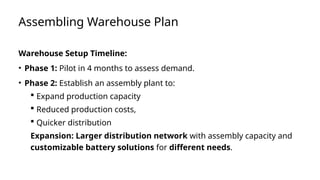
Assembling Warehouse Plan
Warehouse Setup Timeline:
• Phase 1: Pilot in 4 months to assess demand.
• Phase 2: Establish an assembly plant to:
ď‚§ Expand production capacity
ď‚§ Reduced production costs,
ď‚§ Quicker distribution
Expansion: Larger distribution network with assembly capacity and
customizable battery solutions for different needs.
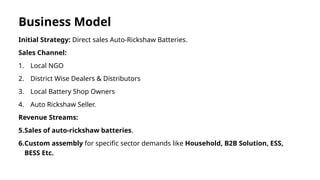
Business Model
Initial Strategy: Direct sales Auto-Rickshaw Batteries.
Sales Channel:
1. Local NGO
2. District Wise Dealers & Distributors
3. Local Battery Shop Owners
4. Auto Rickshaw Seller.
Revenue Streams:
5.Sales of auto-rickshaw batteries.
6.Custom assembly for specific sector demands like Household, B2B Solution, ESS,
BESS Etc.
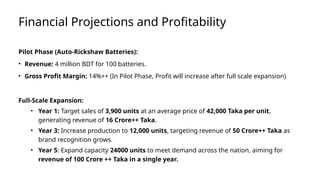
Financial Projections and Profitability
Pilot Phase (Auto-Rickshaw Batteries):
• Revenue: 4 million BDT for 100 batteries.
• Gross Profit Margin: 14%++ (In Pilot Phase, Profit will increase after full scale expansion)
Full-Scale Expansion:
• Year 1: Target sales of 3,900 units at an average price of 42,000 Taka per unit,
generating revenue of 16 Crore++ Taka.
• Year 3: Increase production to 12,000 units, targeting revenue of 50 Crore++ Taka as
brand recognition grows.
• Year 5: Expand capacity 24000 units to meet demand across the nation, aiming for
revenue of 100 Crore ++ Taka in a single year.
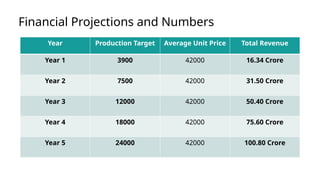
Financial Projections and Numbers
Year Production Target Average Unit Price Total Revenue
Year 1 3900 42000 16.34 Crore
Year 2 7500 42000 31.50 Crore
Year 3 12000 42000 50.40 Crore
Year 4 18000 42000 75.60 Crore
Year 5 24000 42000 100.80 Crore
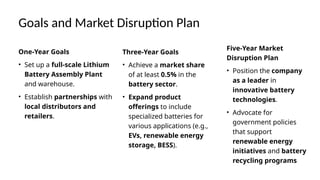
Goals and Market Disruption Plan
One-Year Goals
• Set up a full-scale Lithium
Battery Assembly Plant
and warehouse.
• Establish partnerships with
local distributors and
retailers.
Three-Year Goals
• Achieve a market share
of at least 0.5% in the
battery sector.
• Expand product
offerings to include
specialized batteries for
various applications (e.g.,
EVs, renewable energy
storage, BESS).
Five-Year Market
Disruption Plan
• Position the company
as a leader in
innovative battery
technologies.
• Advocate for
government policies
that support
renewable energy
initiatives and battery
recycling programs
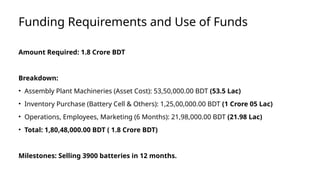
Funding Requirements and Use of Funds
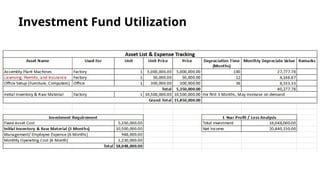
Amount Required: 1.8 Crore BDT
Breakdown:
• Assembly Plant Machineries (Asset Cost): 53,50,000.00 BDT (53.5 Lac)
• Inventory Purchase (Battery Cell & Others): 1,25,00,000.00 BDT (1 Crore 05 Lac)
• Operations, Employees, Marketing (6 Months): 21,98,000.00 BDT (21.98 Lac)
• Total: 1,80,48,000.00 BDT ( 1.8 Crore BDT)
Milestones: Selling 3900 batteries in 12 months.
Investment Fund Utilization
Unique Value Proposition
• Affordable and accessible financing for auto-rickshaw drivers
through NGO.
• Superior battery quality and longevity compared to other
competitors.
• Dedicated after-sales service network for sustained customer
satisfaction.
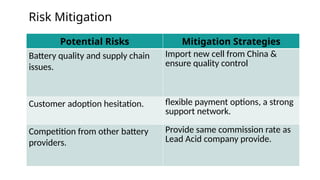
Risk Mitigation
Potential Risks Mitigation Strategies
Battery quality and supply chain
issues.
Import new cell from China &
ensure quality control
Customer adoption hesitation. flexible payment options, a strong
support network.
Competition from other battery
providers.
Provide same commission rate as
Lead Acid company provide.
Social and Environmental Impact
Sustainability Impact: Reduction in hazardous lead-acid
battery waste, longer-lasting lithium solutions.
Social Empowerment: Job creation, partnerships with local
businesses, and affordable financing for transport and rural
people.
Team and Partnerships
Strategic Partnerships: Outline alliances with NGOs, suppliers and local dealers.
Moktadirul Islam
8 years of experience in business
management & process
development, strategy building,
and building Agrobusiness.
Education: CS Diploma Graduate,
EEE graduate.
Mahboob Sohel
20 years of experience in
business development and
business building, strategy
building, and Business
Consultancy, Ex-Military Officer.
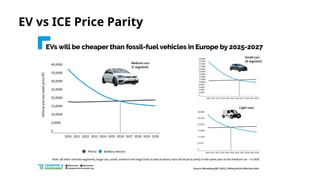
EV vs ICE Price Parity
Wright’s Law
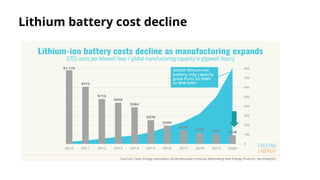
Wright’s Law, often mentioned in the context of technological
advancement and cost dynamics, posits that for every cumulative
doubling of units produced, costs fall by a consistent percentage.
According to Wright’s Law, also known as the learning curve effect,
lithium-ion (Li-ion) battery cell costs fall by 28% for every
cumulative doubling of units produced. Wright’s Law has accurately
predicted the decline in battery costs and so far, reported battery
prices have been in line with modeled forecasts.
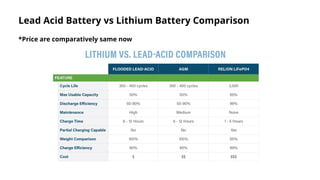
Lead Acid Battery vs Lithium Battery Comparison
*Price are comparatively same now
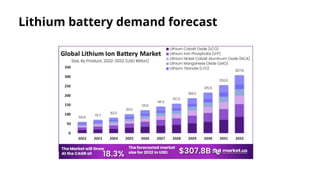
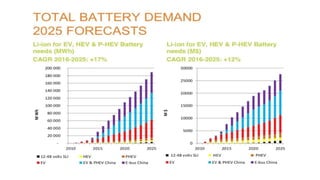
Lithium battery demand forecast
Lithium battery cost decline
Is EV better than ICE?
• The ICE or the internal combustion engines only use,
17% of the energy produced by burning gasoline,
whereas the EV is reaching for 95% efficiency. What it
means, is, while my old ICE, using one liter at 130 taka
can take me 12 kilometers, meaning 10 taka per
kilometer, the lowest cost EV, in Portugal, at 3 Euros for
a 100 kilometer costs, 300/100=3 taka, a 33% less cost
to drive an EV, as we speak. It is going to be far lower
in Bangladesh
Tony Seba’s disruption model
• Tony Seba Speaker | Why Conventional Energy & Transport will be Obsolete by 2030 |
Contact Agent
• Tony Seba
Speaker | Why Conventional Energy & Transport will be Obsolete by 2030 | Contact A
gent
Next Steps
Investment Ask: 1.8 Crore
To Achieve these goals:
• Set up a full-scale Lithium Battery Assembly Plant and warehouse.
• Selling 3900 Unit Battery (4.8 KW) & Generate 16 Crore+ Revenue.
• Establish partnerships with rural NGO, Distributors and Retailers.
Contact Information:
Name: Mahboob Sohel
Email: runinan@gmail.com
phone number: +8801711862550
Questions and comments
Thank you and salam

Lithium Battery Pitch Deck final (1).pptx

  • 1.
    Investing in the Futureof Sustainable Energy
  • 2.
    Revolutionizing Auto-Rickshaw Efficiencyin Bangladesh • Overview: The size of the lead-acid battery industry in Bangladesh is more than BDT 10,000 crore, according to a report published by The Business Standard. The lithium-ion battery market in Bangladesh is projected to grow significantly, with a compound annual growth rate (CAGR) of approximately 4.8% from 2024 to 2030. This growth is fueled by: • Increasing demand for renewable energy solutions. • The rise in electric vehicle (EV) adoption. • Expanding consumer electronics market. • Vision: Leading the lithium battery market across multiple sectors in Bangladesh. • Initial Product Focus: Launching with auto-rickshaw batteries. • Expansion: Assembling warehouse setup and broader lithium battery applications in the next 4-6 months.
  • 3.
    The Problem Current ChallengesFaced by Auto-Rickshaw Drivers: • High costs and frequent replacements with SLABs. • Inefficient power usage and lengthy charging times. • Environmental impact of SLAB disposal.
  • 4.
    The Solution Enchant VoltLithium Batteries Offering: • Longer lifespan: 3-5 years. • Faster charging: 3-4 hours vs. 8-10 hours for SLABs. • Increase operational hours and higher income potential. • Environment friendly and safe.
  • 5.
    The strength: Nocompetition as yet. Weakness: The sources are still in China, high entry barrier. Opportunity: Huge nascent market, a sleeping giant in demand. Threat: Impediments from the SLAB manufacturers, in terms of tax hike, bad forecasts, monopolistic propaganda SWOT Analysis
  • 6.
    Target Market Target markets:Auto-rickshaws & other Electric Vehicles, ESS, BESS. Starting Point in the Market: Auto-Rickshaw Battery – 1st Product • Focusing initially on Bangladesh’s extensive auto-rickshaw market (2.2 M+ vehicles). • Immediate need for low-cost, high-efficiency energy sources for transport. • Scaling Opportunities: Building a reputation through auto-rickshaw batteries while expanding to high-demand sectors.
  • 7.
    Assembling Warehouse Plan WarehouseSetup Timeline: • Phase 1: Pilot in 4 months to assess demand. • Phase 2: Establish an assembly plant to:  Expand production capacity  Reduced production costs,  Quicker distribution Expansion: Larger distribution network with assembly capacity and customizable battery solutions for different needs.
  • 8.
    Business Model Initial Strategy:Direct sales Auto-Rickshaw Batteries. Sales Channel: 1. Local NGO 2. District Wise Dealers & Distributors 3. Local Battery Shop Owners 4. Auto Rickshaw Seller. Revenue Streams: 5.Sales of auto-rickshaw batteries. 6.Custom assembly for specific sector demands like Household, B2B Solution, ESS, BESS Etc.
  • 9.
    Financial Projections andProfitability Pilot Phase (Auto-Rickshaw Batteries): • Revenue: 4 million BDT for 100 batteries. • Gross Profit Margin: 14%++ (In Pilot Phase, Profit will increase after full scale expansion) Full-Scale Expansion: • Year 1: Target sales of 3,900 units at an average price of 42,000 Taka per unit, generating revenue of 16 Crore++ Taka. • Year 3: Increase production to 12,000 units, targeting revenue of 50 Crore++ Taka as brand recognition grows. • Year 5: Expand capacity 24000 units to meet demand across the nation, aiming for revenue of 100 Crore ++ Taka in a single year.
  • 10.
    Financial Projections andNumbers Year Production Target Average Unit Price Total Revenue Year 1 3900 42000 16.34 Crore Year 2 7500 42000 31.50 Crore Year 3 12000 42000 50.40 Crore Year 4 18000 42000 75.60 Crore Year 5 24000 42000 100.80 Crore
  • 11.
    Goals and MarketDisruption Plan One-Year Goals • Set up a full-scale Lithium Battery Assembly Plant and warehouse. • Establish partnerships with local distributors and retailers. Three-Year Goals • Achieve a market share of at least 0.5% in the battery sector. • Expand product offerings to include specialized batteries for various applications (e.g., EVs, renewable energy storage, BESS). Five-Year Market Disruption Plan • Position the company as a leader in innovative battery technologies. • Advocate for government policies that support renewable energy initiatives and battery recycling programs
  • 12.
    Funding Requirements andUse of Funds Amount Required: 1.8 Crore BDT Breakdown: • Assembly Plant Machineries (Asset Cost): 53,50,000.00 BDT (53.5 Lac) • Inventory Purchase (Battery Cell & Others): 1,25,00,000.00 BDT (1 Crore 05 Lac) • Operations, Employees, Marketing (6 Months): 21,98,000.00 BDT (21.98 Lac) • Total: 1,80,48,000.00 BDT ( 1.8 Crore BDT) Milestones: Selling 3900 batteries in 12 months.
  • 14.
  • 15.
    Unique Value Proposition •Affordable and accessible financing for auto-rickshaw drivers through NGO. • Superior battery quality and longevity compared to other competitors. • Dedicated after-sales service network for sustained customer satisfaction.
  • 16.
    Risk Mitigation Potential RisksMitigation Strategies Battery quality and supply chain issues. Import new cell from China & ensure quality control Customer adoption hesitation. flexible payment options, a strong support network. Competition from other battery providers. Provide same commission rate as Lead Acid company provide.
  • 17.
    Social and EnvironmentalImpact Sustainability Impact: Reduction in hazardous lead-acid battery waste, longer-lasting lithium solutions. Social Empowerment: Job creation, partnerships with local businesses, and affordable financing for transport and rural people.
  • 18.
    Team and Partnerships StrategicPartnerships: Outline alliances with NGOs, suppliers and local dealers. Moktadirul Islam 8 years of experience in business management & process development, strategy building, and building Agrobusiness. Education: CS Diploma Graduate, EEE graduate. Mahboob Sohel 20 years of experience in business development and business building, strategy building, and Business Consultancy, Ex-Military Officer.
  • 19.
    EV vs ICEPrice Parity
  • 20.
    Wright’s Law Wright’s Law,often mentioned in the context of technological advancement and cost dynamics, posits that for every cumulative doubling of units produced, costs fall by a consistent percentage. According to Wright’s Law, also known as the learning curve effect, lithium-ion (Li-ion) battery cell costs fall by 28% for every cumulative doubling of units produced. Wright’s Law has accurately predicted the decline in battery costs and so far, reported battery prices have been in line with modeled forecasts.
  • 21.
    Lead Acid Batteryvs Lithium Battery Comparison *Price are comparatively same now
  • 24.
  • 25.
  • 27.
    Is EV betterthan ICE? • The ICE or the internal combustion engines only use, 17% of the energy produced by burning gasoline, whereas the EV is reaching for 95% efficiency. What it means, is, while my old ICE, using one liter at 130 taka can take me 12 kilometers, meaning 10 taka per kilometer, the lowest cost EV, in Portugal, at 3 Euros for a 100 kilometer costs, 300/100=3 taka, a 33% less cost to drive an EV, as we speak. It is going to be far lower in Bangladesh
  • 28.
    Tony Seba’s disruptionmodel • Tony Seba Speaker | Why Conventional Energy & Transport will be Obsolete by 2030 | Contact Agent • Tony Seba Speaker | Why Conventional Energy & Transport will be Obsolete by 2030 | Contact A gent
  • 29.
    Next Steps Investment Ask:1.8 Crore To Achieve these goals: • Set up a full-scale Lithium Battery Assembly Plant and warehouse. • Selling 3900 Unit Battery (4.8 KW) & Generate 16 Crore+ Revenue. • Establish partnerships with rural NGO, Distributors and Retailers. Contact Information: Name: Mahboob Sohel Email: runinan@gmail.com phone number: +8801711862550
  • 30.
  • 31.