BATTERIES INDUSTRY
Group members :
Rami Abdullah Ba Hamid KBA 14035
Khaled Bark Shantof KBA 14034
Ateera bt Ahmad Dahalan KBA 16011
Nur Nadiah Salihah Binti Mat Razali KBA 15040
Nor Hazlina Binti Abdullah KBA 14032
BATTERY
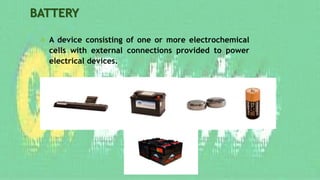
 A device consisting of one or more electrochemical
cells with external connections provided to power
electrical devices.
CONT…
BATTERY TYPES
Types in terms of chemical composition
 Household Batteries
• Rechargeable
Lead acid Lithium-ion Nickel-Cadmium Nickel Metal Hydride
• Non–Rechargeable
Alkaline & Zinc Carbon Lithium Mercury Silver Oxide Zinc Air
 Industrial batteries
Absolute Large Flooded Cell Nickel Iron Wet
. Nickel-Cadmium Steel Case UPS
 Vehicle Batteries
Hybrid Automotive Lead Acid VRLA
Battery industry
 The global battery market is about US $86 billion.
 50 billion is allocated to rechargeable batteries
 The growth is estimated at 7.7% annually.
 China, India, Brazil and South Korea will record some of the
strongest market gains.
Product Insights
 lithium-ion batteries are capture a significant portion of the lead acid battery
on account of low energy density and high lead content.
 These batteries are used in critical applications on account of high reliability
and low cost.
 Lead acid battery accounts for a significant share on account of rising
application in automotive, UPS, telecommunication, electric bikes and
transport vehicles.
 Lithium-ion are expected to penetrate lead acid, gaining a majority market
share by 2024.
Application Insights
 Automotive the largest application on rising demand from electric
vehicles, hybrid vehicles, and plug-in hybrid vehicles.
 Industrial applications, telecom, UPS, energy storage, emergency
lighting, security, road signs, control & switchgear and medical.
 High demand for portable electronics including smart phones, LCD
displays, tablets and wearable.
Regional insights
 Asia Pacific is a major consumer of batteries on account of rising
automobile production
 China and India are key manufacturing
(skilled labor - low production -setup costs)
 North America and Europe are expected to witness significant growth on
account of rising electric vehicle production.
 Latin America is expected to witness significant gains at a CAGR on account
of growing product demand in telecom and automotive sector.
Key players
growth Factors
 significant growth on account of product innovation, enhanced
efficiency, and cost-effectiveness.
 Rising popularity of consumer electronics on a global level
 rapid industrialization
 increasing governments infrastructure
 increasing of FDI
COMPANY PROFILE
 In 1964 the company was founded in Hong Kong.
 In 1990 the company was incorporated in Singapore as are holding company.
 GP is principally engaged in the development, manufacture and marketing of
batteries.
 Since its establishment, GP Batteries has rapidly expanded.
 GP Batteries' production facilities are located in Singapore, supported by
marketing and trading offices.
 GP has direct distribution in over 15 countries employing 5,800 people, 440
million US dollars as turnover.
REVIEW BY PRODUCTS
 GP offers many kinds of batteries:
 primary batteries such as lithium, alkaline, and carbon zinc batteries.
 Rechargeable batteries comprising electronic device and car alarm
batteries, portable power banks, battery chargers, and flashlights.
 GP also provides solar products and lighting products logistics support
services as well.
THEIR PHOLOCIHPY
 Group managed to overcome the keen competition and maintained the margin.
 Group will continue to strengthen their brands and focus on distribution.
MARKET SEGMENTATION
 Consumer Market: GP has developed new distribution channels in selected
markets to grow the business.
 Industrial Market: GP industrial market segment grew over last year, mainly in
rechargeable battery businesses.
COMPETITIVES ABILITYES
Battery Experts
 4 billion plus primary and rechargeable batteries a year.
 Major consumer battery brand of primary and rechargeable batteries.
 Largest consumer battery manufacturer in Asia (excluding Japan).
Championing Greener Rechargeable
 World’s largest manufacturer of nickel metal hydride (NiMH) rechargeable
batteries
 New generation USB charger for rechargeable batteries
 Save money save planet: sustainable product
CONT…
Building Their Brand and Global Reach
 Invest on brand building, product design and innovation.
 Expand global presence with focus on emerging markets.
 Produce green products.
Five
Porter’s
Model
Competitive
Rivalry
Bargaining
power of
Customers
Bargaining
Power of
Suppliers
Threat of
New
Entrants
Threat of
Substitute
Competitive Rivalry
 Competitive forces – Johnson Controls, Exide Technology, C&D
Technologies
 Products do not differ much in terms of specifications and
quality
 Price competition not very high
Bargaining Power of Customers
 No particular influence on price, more on product characteristics
 GP Batteries – high energy density, simple storage and transportation,
environmental friendly, profitable for recycling
Bargaining Power of Suppliers
 Very low level of influence over the industry
 Substitute of some resources are available through different suppliers
 Same raw materials are obtained from different suppliers from different
countries
Threat of New Entrants
 Change major determinants of the market environment
 Required high initial investments and fixed costs,brand loyalty of
customers, protected intellectual property like patents, licenses etc
 BYD Battery Co. Ltd. In China
Threat of Substitute
 Alternative products with better performance parameters for the same
purpose
 Reduces the potential sales of the existing company
 Innovation made by The Lithium Battery Co.
INTERNAL STRENGTHS AND WEAKNESSES
Strengths
• Existing Distribution
and Sales Networks
• Complements Variety
of Technologies/ Uses
• Championing Greener
Rechargeable
• New Revolution
Battery Technology–
GP ReCyko
Weaknesses
• Regulation
• Overlapping/Complicated
Range of Revenue
Sources
EXTERNAL OPPORTUNITIES AND THREATS
Opportunities
• Next 5-10 years
• Capacity Market,
Growth Rates and
Profitability
• Growing Demand
• Global Market
Threat
• Consumers Searching for
Lower Price Technology
• Risk & New Entrance
• Currency Changers
Between Country
COMPETITIVE COMPILE MATRIX (CPM)
CRITICAL SUCCESS
FACTORS
GP Batteries International
Limited
Eveready
Industries India
Ltd
Duracell
International
Uniross Batteries Panasonic
Corporation
Weigh Rating Score Rating Score Rating Score Rating Score Rating Score
Product diversity 0.10 3 0.30 3 0.30 3 0.30 3 0.30 2 0.20
Financial Position 0.10 3 0.30 3 0.30 4 0.40 3 0.30 3 0.30
Market Share 0.05 3 0.15 3 0.15 3 0.15 3 0.15 3 0.15
Brand name 0.15 3 0.45 3 0.45 3 0.45 3 0.45 3 0.45
Global Expansion 0.10 3 0.30 3 0.30 3 0.30 3 0.30 2 0.20
Price policy 0.05 2 0.10 3 0.15 3 0.15 4 0.20 3 0.15
Green production
technique
0.15 3 0.45 1 0.15 2 0.30 1 0.15 2 0.30
Marketing strategy 0.10 3 0.30 3 0.30 3 0.30 3 0.30 3 0.30
Technology 0.10 4 0.40 2 0.20 3 0.30 3 0.30 2 0.20
Long Lasting Battery 0.10 3 0.30 2 0.20 2 0.20 1 0.10 2 0.20
TOTAL 1.00 3.05 2.50 2.85 2.55 2.45
EXTERNAL FACTOR EVALUATION MATRIX - EFE
KEY EXTERNAL FACTORS Weight Rating Score
OPPORTUNITIES
Next 5-10 years 0.05 3 0.15
Enhanced Frequency Response 0.10 2 0.20
Capacity Market, Growth Rates and Profitability 0.15 3
0.45
Growing Demand 0.15 2 0.30
Global Market 0.10 2 0.30
THREATS
Consumers Searching for Lower Price 0.15 2 0.30
Technology Risk & New Entrance 0.20 3 0.60
Currency Changers Between Country 0.10 3 0.30
TOTAL 1.00 2.50
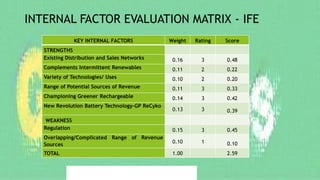
INTERNAL FACTOR EVALUATION MATRIX - IFE
KEY INTERNAL FACTORS Weight Rating Score
STRENGTHS
Existing Distribution and Sales Networks 0.16 3 0.48
Complements Intermittent Renewables 0.11 2 0.22
Variety of Technologies/ Uses 0.10 2 0.20
Range of Potential Sources of Revenue 0.11 3 0.33
Championing Greener Rechargeable 0.14 3 0.42
New Revolution Battery Technology–GP ReCyko
0.13 3 0.39
WEAKNESS
Regulation 0.15 3 0.45
Overlapping/Complicated Range of Revenue
Sources
0.10 1 0.10
TOTAL 1.00 2.59
SWOT MATRIX
 SO strategy
 GP Batteries having well-known brand and strong
online advantage so they can extend to new
markets (market Development strategy)
 Using the latest technologies (online sales) to
increase their market shares and expand their
market target.
 ST strategy
 GP Batteries can use the good reputation in market
and their brand recognition, to reveal with their
competitors
CONT…
 WO strategy
 As a form of generation, a battery storage facility will need to
be licensed and therefore comply with the various Grid Codes
 If GP Batteries able to change this regulation in the involve
country, they can take advantage from market potential
(Market penetration)
CONT…
 WT strategy:
If GP Batteries able to overcome risk by making new
innovation or make sure their technology is always
advance, they can easily compete with their competitors
If they introduce new innovation product in the market
they may able to avoid the threat of competitors
(Product development)
Strategic planning
 Partnership or joint venture
 Use high end Research and Development team as produce new things.
Make partnership with global company, in charge in electrical appliances
and electronics.
 Diversify products
 use the specialty of product batteries. Use the components of battery to
make innovations. Produce spare parts like wire harness related on
material batteries. Use innovative ways to vary producing products like
motherboard computer.
Continue…..
 Wider range customer
 Backward integration
 Based on swot . Acquire supplier . Supply own product and to others.
 Market penetrate
 The main is innovation technology. Vehicle electric using titanium dioxide
gel power saving energy.
Conclusion
 Battery industry remain face Intense competition with many technology
driven and powerful competitors.
 Balance and effective Research and Development may improve
performance and effectiveness company in this industry.
 The demand of people changes every time. Innovation battery needed.
GP Batteries success to follow the trend and make innovation products.
35
THAT’S ALL…
THANK YOU FOR YOUR ATTENTION

GP Batteries

  • 1.
    BATTERIES INDUSTRY Group members: Rami Abdullah Ba Hamid KBA 14035 Khaled Bark Shantof KBA 14034 Ateera bt Ahmad Dahalan KBA 16011 Nur Nadiah Salihah Binti Mat Razali KBA 15040 Nor Hazlina Binti Abdullah KBA 14032
  • 2.
    BATTERY  A deviceconsisting of one or more electrochemical cells with external connections provided to power electrical devices.
  • 3.
  • 4.
    BATTERY TYPES Types interms of chemical composition  Household Batteries • Rechargeable Lead acid Lithium-ion Nickel-Cadmium Nickel Metal Hydride • Non–Rechargeable Alkaline & Zinc Carbon Lithium Mercury Silver Oxide Zinc Air  Industrial batteries Absolute Large Flooded Cell Nickel Iron Wet . Nickel-Cadmium Steel Case UPS  Vehicle Batteries Hybrid Automotive Lead Acid VRLA
  • 5.
    Battery industry  Theglobal battery market is about US $86 billion.  50 billion is allocated to rechargeable batteries  The growth is estimated at 7.7% annually.  China, India, Brazil and South Korea will record some of the strongest market gains.
  • 6.
    Product Insights  lithium-ionbatteries are capture a significant portion of the lead acid battery on account of low energy density and high lead content.  These batteries are used in critical applications on account of high reliability and low cost.  Lead acid battery accounts for a significant share on account of rising application in automotive, UPS, telecommunication, electric bikes and transport vehicles.  Lithium-ion are expected to penetrate lead acid, gaining a majority market share by 2024.
  • 7.
    Application Insights  Automotivethe largest application on rising demand from electric vehicles, hybrid vehicles, and plug-in hybrid vehicles.  Industrial applications, telecom, UPS, energy storage, emergency lighting, security, road signs, control & switchgear and medical.  High demand for portable electronics including smart phones, LCD displays, tablets and wearable.
  • 8.
    Regional insights  AsiaPacific is a major consumer of batteries on account of rising automobile production  China and India are key manufacturing (skilled labor - low production -setup costs)  North America and Europe are expected to witness significant growth on account of rising electric vehicle production.  Latin America is expected to witness significant gains at a CAGR on account of growing product demand in telecom and automotive sector.
  • 9.
  • 10.
    growth Factors  significantgrowth on account of product innovation, enhanced efficiency, and cost-effectiveness.  Rising popularity of consumer electronics on a global level  rapid industrialization  increasing governments infrastructure  increasing of FDI
  • 12.
    COMPANY PROFILE  In1964 the company was founded in Hong Kong.  In 1990 the company was incorporated in Singapore as are holding company.  GP is principally engaged in the development, manufacture and marketing of batteries.  Since its establishment, GP Batteries has rapidly expanded.  GP Batteries' production facilities are located in Singapore, supported by marketing and trading offices.  GP has direct distribution in over 15 countries employing 5,800 people, 440 million US dollars as turnover.
  • 13.
    REVIEW BY PRODUCTS GP offers many kinds of batteries:  primary batteries such as lithium, alkaline, and carbon zinc batteries.  Rechargeable batteries comprising electronic device and car alarm batteries, portable power banks, battery chargers, and flashlights.  GP also provides solar products and lighting products logistics support services as well.
  • 14.
    THEIR PHOLOCIHPY  Groupmanaged to overcome the keen competition and maintained the margin.  Group will continue to strengthen their brands and focus on distribution. MARKET SEGMENTATION  Consumer Market: GP has developed new distribution channels in selected markets to grow the business.  Industrial Market: GP industrial market segment grew over last year, mainly in rechargeable battery businesses.
  • 15.
    COMPETITIVES ABILITYES Battery Experts 4 billion plus primary and rechargeable batteries a year.  Major consumer battery brand of primary and rechargeable batteries.  Largest consumer battery manufacturer in Asia (excluding Japan). Championing Greener Rechargeable  World’s largest manufacturer of nickel metal hydride (NiMH) rechargeable batteries  New generation USB charger for rechargeable batteries  Save money save planet: sustainable product
  • 16.
    CONT… Building Their Brandand Global Reach  Invest on brand building, product design and innovation.  Expand global presence with focus on emerging markets.  Produce green products.
  • 17.
  • 18.
    Competitive Rivalry  Competitiveforces – Johnson Controls, Exide Technology, C&D Technologies  Products do not differ much in terms of specifications and quality  Price competition not very high
  • 19.
    Bargaining Power ofCustomers  No particular influence on price, more on product characteristics  GP Batteries – high energy density, simple storage and transportation, environmental friendly, profitable for recycling
  • 20.
    Bargaining Power ofSuppliers  Very low level of influence over the industry  Substitute of some resources are available through different suppliers  Same raw materials are obtained from different suppliers from different countries
  • 21.
    Threat of NewEntrants  Change major determinants of the market environment  Required high initial investments and fixed costs,brand loyalty of customers, protected intellectual property like patents, licenses etc  BYD Battery Co. Ltd. In China
  • 22.
    Threat of Substitute Alternative products with better performance parameters for the same purpose  Reduces the potential sales of the existing company  Innovation made by The Lithium Battery Co.
  • 23.
    INTERNAL STRENGTHS ANDWEAKNESSES Strengths • Existing Distribution and Sales Networks • Complements Variety of Technologies/ Uses • Championing Greener Rechargeable • New Revolution Battery Technology– GP ReCyko Weaknesses • Regulation • Overlapping/Complicated Range of Revenue Sources
  • 24.
    EXTERNAL OPPORTUNITIES ANDTHREATS Opportunities • Next 5-10 years • Capacity Market, Growth Rates and Profitability • Growing Demand • Global Market Threat • Consumers Searching for Lower Price Technology • Risk & New Entrance • Currency Changers Between Country
  • 25.
    COMPETITIVE COMPILE MATRIX(CPM) CRITICAL SUCCESS FACTORS GP Batteries International Limited Eveready Industries India Ltd Duracell International Uniross Batteries Panasonic Corporation Weigh Rating Score Rating Score Rating Score Rating Score Rating Score Product diversity 0.10 3 0.30 3 0.30 3 0.30 3 0.30 2 0.20 Financial Position 0.10 3 0.30 3 0.30 4 0.40 3 0.30 3 0.30 Market Share 0.05 3 0.15 3 0.15 3 0.15 3 0.15 3 0.15 Brand name 0.15 3 0.45 3 0.45 3 0.45 3 0.45 3 0.45 Global Expansion 0.10 3 0.30 3 0.30 3 0.30 3 0.30 2 0.20 Price policy 0.05 2 0.10 3 0.15 3 0.15 4 0.20 3 0.15 Green production technique 0.15 3 0.45 1 0.15 2 0.30 1 0.15 2 0.30 Marketing strategy 0.10 3 0.30 3 0.30 3 0.30 3 0.30 3 0.30 Technology 0.10 4 0.40 2 0.20 3 0.30 3 0.30 2 0.20 Long Lasting Battery 0.10 3 0.30 2 0.20 2 0.20 1 0.10 2 0.20 TOTAL 1.00 3.05 2.50 2.85 2.55 2.45
  • 26.
    EXTERNAL FACTOR EVALUATIONMATRIX - EFE KEY EXTERNAL FACTORS Weight Rating Score OPPORTUNITIES Next 5-10 years 0.05 3 0.15 Enhanced Frequency Response 0.10 2 0.20 Capacity Market, Growth Rates and Profitability 0.15 3 0.45 Growing Demand 0.15 2 0.30 Global Market 0.10 2 0.30 THREATS Consumers Searching for Lower Price 0.15 2 0.30 Technology Risk & New Entrance 0.20 3 0.60 Currency Changers Between Country 0.10 3 0.30 TOTAL 1.00 2.50
  • 27.
    INTERNAL FACTOR EVALUATIONMATRIX - IFE KEY INTERNAL FACTORS Weight Rating Score STRENGTHS Existing Distribution and Sales Networks 0.16 3 0.48 Complements Intermittent Renewables 0.11 2 0.22 Variety of Technologies/ Uses 0.10 2 0.20 Range of Potential Sources of Revenue 0.11 3 0.33 Championing Greener Rechargeable 0.14 3 0.42 New Revolution Battery Technology–GP ReCyko 0.13 3 0.39 WEAKNESS Regulation 0.15 3 0.45 Overlapping/Complicated Range of Revenue Sources 0.10 1 0.10 TOTAL 1.00 2.59
  • 28.
    SWOT MATRIX  SOstrategy  GP Batteries having well-known brand and strong online advantage so they can extend to new markets (market Development strategy)  Using the latest technologies (online sales) to increase their market shares and expand their market target.  ST strategy  GP Batteries can use the good reputation in market and their brand recognition, to reveal with their competitors
  • 29.
    CONT…  WO strategy As a form of generation, a battery storage facility will need to be licensed and therefore comply with the various Grid Codes  If GP Batteries able to change this regulation in the involve country, they can take advantage from market potential (Market penetration)
  • 30.
    CONT…  WT strategy: IfGP Batteries able to overcome risk by making new innovation or make sure their technology is always advance, they can easily compete with their competitors If they introduce new innovation product in the market they may able to avoid the threat of competitors (Product development)
  • 31.
    Strategic planning  Partnershipor joint venture  Use high end Research and Development team as produce new things. Make partnership with global company, in charge in electrical appliances and electronics.  Diversify products  use the specialty of product batteries. Use the components of battery to make innovations. Produce spare parts like wire harness related on material batteries. Use innovative ways to vary producing products like motherboard computer.
  • 32.
    Continue…..  Wider rangecustomer  Backward integration  Based on swot . Acquire supplier . Supply own product and to others.  Market penetrate  The main is innovation technology. Vehicle electric using titanium dioxide gel power saving energy.
  • 33.
    Conclusion  Battery industryremain face Intense competition with many technology driven and powerful competitors.  Balance and effective Research and Development may improve performance and effectiveness company in this industry.  The demand of people changes every time. Innovation battery needed. GP Batteries success to follow the trend and make innovation products.
  • 34.
    35 THAT’S ALL… THANK YOUFOR YOUR ATTENTION