
Business Communication
Listening Skills
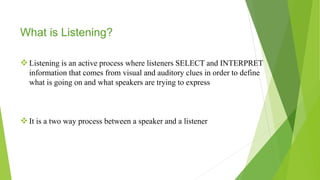
What is Listening?
Listening is an active process where listeners SELECT and INTERPRET
information that comes from visual and auditory clues in order to define
what is going on and what speakers are trying to express
It is a two way process between a speaker and a listener
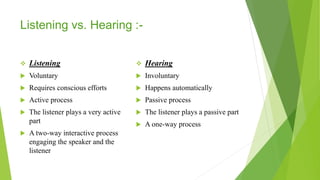
Listening vs. Hearing :-
 Listening
 Voluntary
 Requires conscious efforts
 Active process
 The listener plays a very active
part
 A two-way interactive process
engaging the speaker and the
listener
 Hearing
 Involuntary
 Happens automatically
 Passive process
 The listener plays a passive part
 A one-way process
Types of Listening :-
Informative Listening
 Concentration
 Memory
Relationship Listening
 Attending
 Supporting
 Understanding
Appreciative Listening
 Presentation
 Previous experience
Types of Listening (Cont.) :-
Critical Listening
 Ethos
 Logos
 Pathos
Discriminative Listening
 Hearing Ability
 Awareness of Sound Structure
 Integration of non-verbal cues
Barriers to Listening :-
•Speed of delivery
•Clarity of voice and utterance
•Pronunciation and language
•No pause and rewind
•Lack of context or meaningless to the learner: topic unfamiliar
•Poor quality audio materials
•Hearing problems
•Poor concentration
Effective listening strategies :-
 Stop Talking: Speaking and listening should not be done at the same time.
 Stop Thinking: One cannot listen effectively while thinking.
 Remove Distractions: The listener should not create any distractions.
 Do not Pre-judgment : Do not pre-judge before the speaker completes his
speech.
 Be Patient :The speaker should not be interrupted until he/she takes a pause
 Do not be angry : The listener may not like what the speaker is telling
 Take notes : Listeners should take note if they want to keep a record what is said.
Active Listening :-
 Effective listening is active participation in a conversation.
 The listener must actually hear and not assume what is said.
 Active listeners sit or stand alertly, maintain eye contact with the
speaker, concentrate on the speaker’s words, make verbal
responses, and summarize parts of what has been said when
clarity is needed.
Listening skill

Listening skill

  • 1.
  • 2.
    What is Listening? Listeningis an active process where listeners SELECT and INTERPRET information that comes from visual and auditory clues in order to define what is going on and what speakers are trying to express It is a two way process between a speaker and a listener
  • 3.
    Listening vs. Hearing:-  Listening  Voluntary  Requires conscious efforts  Active process  The listener plays a very active part  A two-way interactive process engaging the speaker and the listener  Hearing  Involuntary  Happens automatically  Passive process  The listener plays a passive part  A one-way process
  • 4.
    Types of Listening:- Informative Listening  Concentration  Memory Relationship Listening  Attending  Supporting  Understanding Appreciative Listening  Presentation  Previous experience
  • 5.
    Types of Listening(Cont.) :- Critical Listening  Ethos  Logos  Pathos Discriminative Listening  Hearing Ability  Awareness of Sound Structure  Integration of non-verbal cues
  • 6.
    Barriers to Listening:- •Speed of delivery •Clarity of voice and utterance •Pronunciation and language •No pause and rewind •Lack of context or meaningless to the learner: topic unfamiliar •Poor quality audio materials •Hearing problems •Poor concentration
  • 7.
    Effective listening strategies:-  Stop Talking: Speaking and listening should not be done at the same time.  Stop Thinking: One cannot listen effectively while thinking.  Remove Distractions: The listener should not create any distractions.  Do not Pre-judgment : Do not pre-judge before the speaker completes his speech.  Be Patient :The speaker should not be interrupted until he/she takes a pause  Do not be angry : The listener may not like what the speaker is telling  Take notes : Listeners should take note if they want to keep a record what is said.
  • 8.
    Active Listening :- Effective listening is active participation in a conversation.  The listener must actually hear and not assume what is said.  Active listeners sit or stand alertly, maintain eye contact with the speaker, concentrate on the speaker’s words, make verbal responses, and summarize parts of what has been said when clarity is needed.