We have 2 ears and 1 mouth, so we
can hear twice as much as we speak.
2
How are listening and
reading the
same?
different?
3
Receptive skills
Which is easier for you
listening or
reading?
4
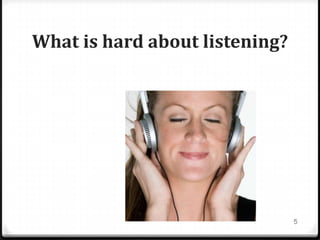
What is hard about listening?
5
What are some listening
strategies that you use to help
you when you are listening?
6
Teaching Listening video
Background knowledge:
A teacher training video on how to teach
listening
Setting a listening purpose:
What are the before, during and after
listening activities she describes, if any?
Setting predictions:
What do you think the answer to the question
above might be? Tell the person next to you.
7
Teacher training video
Listening
8
Teaching Listening video
Background knowledge:
A teacher training video on how to teach
listening– Was this helpful information?
Setting predictions: What do you think the
answer to the question above might be? Was this
helpful?
Setting a listening purpose:
What were the before, during and after listening
activities she described, if any?
9
Teaching Listening video
Setting a listening purpose:
1. What did she use for a listening?
2. What is the topic of the story? Did
you catch the gist?
Listen again for the order of the events.
(Detail).
10
Teacher training video
Listening
11
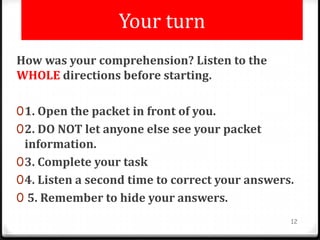
Your turn
How was your comprehension? Listen to the
WHOLE directions before starting.
01. Open the packet in front of you.
02. DO NOT let anyone else see your packet
information.
03. Complete your task
04. Listen a second time to correct your answers.
0 5. Remember to hide your answers.
12
Correct your answers
Listen again
13
Teacher training video
Listening
14
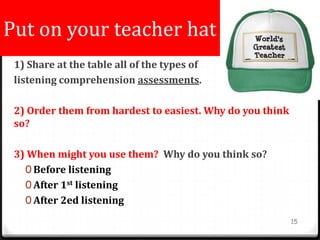
Put on your teacher hat
1) Share at the table all of the types of
listening comprehension assessments.
2) Order them from hardest to easiest. Why do you think
so?
3) When might you use them? Why do you think so?
0 Before listening
0 After 1st listening
0 After 2ed listening
15
Teacher training video
Listening
16
“Other ideas” from the video
Listen to the end of the video.
What are additional ideas that one could
use with this type of listening?
17
“Other ideas” from the video
0Open ended questions using the Wh questions.
0M/C worksheets
0Either or statements or questions
0Retell or summarize the story (or role play)
0Determine what information is in the text:
0Complete a graph or story flow chart or timeline
0Place in order pictures, sentences, or directions
0Correct a dialogue or a statement
0T/F questions
0Draw the story
0Cloze or gap fills
18
Use of transcripts to teach listening
1. Use only after students have attempted to
understand, using all cues and strategies.
2. Transcripts help students identify words or
phrases they were still not able to decipher in
earlier attempts to understand.
3. The same holds true for captions and subtitles
19
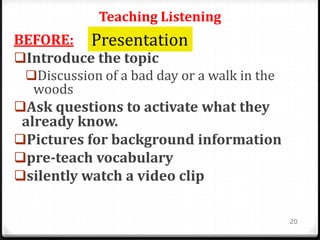
Teaching Listening
BEFORE:
Introduce the topic
Discussion of a bad day or a walk in the
woods
Ask questions to activate what they
already know.
Pictures for background information
pre-teach vocabulary
silently watch a video clip
20
Presentation
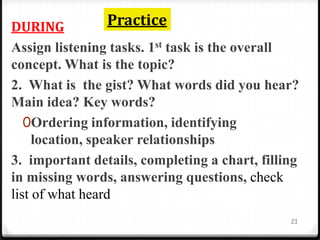
DURING
Assign listening tasks. 1st task is the overall
concept. What is the topic?
2. What is the gist? What words did you hear?
Main idea? Key words?
0Ordering information, identifying
location, speaker relationships
3. important details, completing a chart, filling
in missing words, answering questions, check
list of what heard
21
Practice
AFTER
discussion questions
role play
reading the text
Pronunciation
Vocabulary
Retelling the story
Mark , categorize and count punctuation
Around the room punctuation
grammar
22
Production
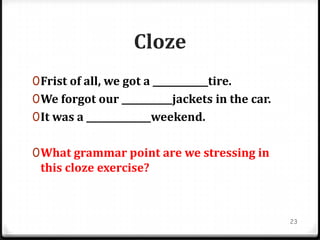
Cloze
0Frist of all, we got a ____________tire.
0We forgot our ___________jackets in the car.
0It was a ______________weekend.
0What grammar point are we stressing in
this cloze exercise?
23
Writing--Punctuation
0 Team 1- count the number of
0 Quotation marks
0 Commas
0 Question marks
0 Periods
0 Team 2
0 Put all of the punctuation into your reading.
24
Using Transcripts
In groups, decide how you would
use the transcript according to
your instructions.
25
Thanks for listening!
Rae Roberts
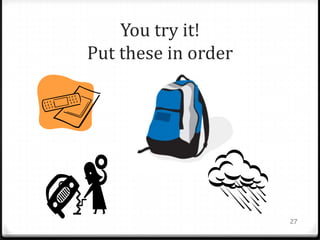
You try it!
Put these in order
27

Listening: I'm all Ears

  • 2.
    We have 2ears and 1 mouth, so we can hear twice as much as we speak. 2
  • 3.
    How are listeningand reading the same? different? 3
  • 4.
    Receptive skills Which iseasier for you listening or reading? 4
  • 5.
    What is hardabout listening? 5
  • 6.
    What are somelistening strategies that you use to help you when you are listening? 6
  • 7.
    Teaching Listening video Backgroundknowledge: A teacher training video on how to teach listening Setting a listening purpose: What are the before, during and after listening activities she describes, if any? Setting predictions: What do you think the answer to the question above might be? Tell the person next to you. 7
  • 8.
  • 9.
    Teaching Listening video Backgroundknowledge: A teacher training video on how to teach listening– Was this helpful information? Setting predictions: What do you think the answer to the question above might be? Was this helpful? Setting a listening purpose: What were the before, during and after listening activities she described, if any? 9
  • 10.
    Teaching Listening video Settinga listening purpose: 1. What did she use for a listening? 2. What is the topic of the story? Did you catch the gist? Listen again for the order of the events. (Detail). 10
  • 11.
  • 12.
    Your turn How wasyour comprehension? Listen to the WHOLE directions before starting. 01. Open the packet in front of you. 02. DO NOT let anyone else see your packet information. 03. Complete your task 04. Listen a second time to correct your answers. 0 5. Remember to hide your answers. 12
  • 13.
  • 14.
  • 15.
    Put on yourteacher hat 1) Share at the table all of the types of listening comprehension assessments. 2) Order them from hardest to easiest. Why do you think so? 3) When might you use them? Why do you think so? 0 Before listening 0 After 1st listening 0 After 2ed listening 15
  • 16.
  • 17.
    “Other ideas” fromthe video Listen to the end of the video. What are additional ideas that one could use with this type of listening? 17
  • 18.
    “Other ideas” fromthe video 0Open ended questions using the Wh questions. 0M/C worksheets 0Either or statements or questions 0Retell or summarize the story (or role play) 0Determine what information is in the text: 0Complete a graph or story flow chart or timeline 0Place in order pictures, sentences, or directions 0Correct a dialogue or a statement 0T/F questions 0Draw the story 0Cloze or gap fills 18
  • 19.
    Use of transcriptsto teach listening 1. Use only after students have attempted to understand, using all cues and strategies. 2. Transcripts help students identify words or phrases they were still not able to decipher in earlier attempts to understand. 3. The same holds true for captions and subtitles 19
  • 20.
    Teaching Listening BEFORE: Introduce thetopic Discussion of a bad day or a walk in the woods Ask questions to activate what they already know. Pictures for background information pre-teach vocabulary silently watch a video clip 20 Presentation
  • 21.
    DURING Assign listening tasks.1st task is the overall concept. What is the topic? 2. What is the gist? What words did you hear? Main idea? Key words? 0Ordering information, identifying location, speaker relationships 3. important details, completing a chart, filling in missing words, answering questions, check list of what heard 21 Practice
  • 22.
    AFTER discussion questions role play readingthe text Pronunciation Vocabulary Retelling the story Mark , categorize and count punctuation Around the room punctuation grammar 22 Production
  • 23.
    Cloze 0Frist of all,we got a ____________tire. 0We forgot our ___________jackets in the car. 0It was a ______________weekend. 0What grammar point are we stressing in this cloze exercise? 23
  • 24.
    Writing--Punctuation 0 Team 1-count the number of 0 Quotation marks 0 Commas 0 Question marks 0 Periods 0 Team 2 0 Put all of the punctuation into your reading. 24
  • 25.
    Using Transcripts In groups,decide how you would use the transcript according to your instructions. 25
  • 26.
  • 27.
    You try it! Putthese in order 27

Editor's Notes

  • #3 22
  • #6 Slides 1-6– 15 min.
  • #7 Slides 1-6 15 min.
  • #8 Their predictions– 5 min
  • #9 Play up to “ if they struggle”– 1 minute
  • #10 Their predictions—after listening
  • #11 Slide 10-11,12– 10 min
  • #12 Play the full tape this time– 7 min.
  • #13 Slide 15-16----7 min.
  • #14 Slide 13-14– 5 min
  • #16 10 min.
  • #20 18-20– 10 min.
  • #23 Slide 21-22--10 min.
  • #25 10 min
  • #26 Handout transcripts—groups complete tasks—15 min.