
ENGLISH
FOR
YOUNG
LEARNERS
UNTIRTA
VI/B
3
T
h
G
R
O
U
p Tri S
Aditta P.M
Selvy IRoki
Rizki A. SEvi M. F
Teaching Reading for Young
Learners
Reading is an
interactive
process that
goes on
between the
reader and the
text, resulting in
comprehension
Teaching reading is very
necessary in English
learning and teaching as
foreign language. It is in
the line with Burhan (2012:
9), reading is a physic and
mental activity to reveal
the meaning of the
written text.
Learning to read is
an important
educational goal.
For both children
and adults, the
ability to read
opens up new
worlds and
opportunities.
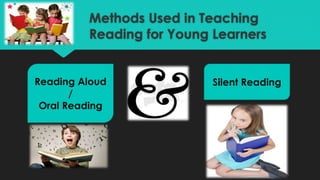
Methods Used in Teaching
Reading for Young Learners
Reading Aloud
/
Oral Reading
Silent Reading
Reading Aloud/ Oral Reading
A read aloud is a planned oral reading of a book or
print materials that may be fiction or non-fiction or
in which children have a high interest such as a
letter from a relative, child's famous comic strip
might be good options.
Why the read aloud in the
class?
 To engage the students while developing background
knowledge, increasing comprehension skills, and
fostering critical thinking.
 To helps build listening and comprehension skills.
 Can easily internalize vocabulary by hearing words in
context.
 Gain information
 Fosters curiosity, imagination and creativity.
 Increases their attention spans and ability to focus on
what is being said.
 Gives students a desire to read more
 Presents endless opportunities for related activities
Reading Aloud/ Oral Reading
How the read aloud
in the class?
 Give concrete explanations
 Invite conversation and generate questions for discussion
and investigations
 Provide content to support hands-on investigations
 Examine the colorful illustrations and photographs; they
can tell a story beyond the words on the page
 Have your child read the material aloud then at the end
of the paragraph, go back and review difficult words
and have him/her read it again.
 Raise your child for his/her efforts
Reading Aloud/ Oral Reading
How can one get the
most out of this
technique?
 Engage students' interests
 Make sure the books are at the right difficulty level
 Spend an appropriate amount of time on reading
aloud
 Offer a range of materials to read aloud
 Work in small groups
 Model fluent reading
 Do repeated readings in class
 Promote phrased reading in class
Reading Aloud/ Oral Reading
Silent Reading
Silent reading allows readers interact with the text;
thus, the teachers should not interrupt while the
students are reading. Silent reading allows students to
read at their own rate and to identify more than one
word at a time.
Benefit of Silent
Reading
 Improves student’s understanding
 develop the skills of reading for a purpose
 people read in sense groups, which means,
roughly, that we read a number of words together
so that they make sense to us
Silent Reading
Silent Reading
Unit outcomes
 Outcomes help students develop silent
reading skills to read more efficiently,
teach students how to guess the
meanings of unfamiliar words from the
context, help students understand the
relation between reading speed and
reading efficiency, and help students
improve their reading efficiency through
understanding how to interpret
information given in graphical form.
 Teacher support information
After the activities, teacher should begin to
see gradual improvement in their
comprehension. This is because silent
reading helps students to focus their
attention on the text; their increased
concentration on the text is sustained until
the entire text is read. This also helps students
absorb ideas into their subconscious and
then use them in their daily lives.
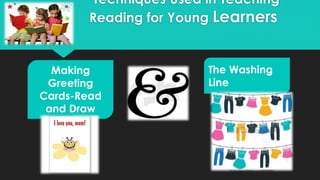
Techniques Used in Teaching
Reading for Young Learners
Making
Greeting
Cards-Read
and Draw
The Washing
Line
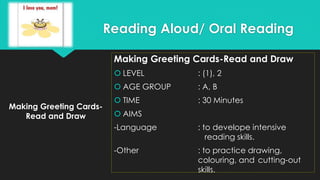
Making Greeting Cards-
Read and Draw
Making Greeting Cards-Read and Draw
 LEVEL : (1), 2
 AGE GROUP : A, B
 TIME : 30 Minutes
 AIMS
-Language : to develope intensive
reading skills.
-Other : to practice drawing,
colouring, and cutting-out
skills.
Reading Aloud/ Oral Reading
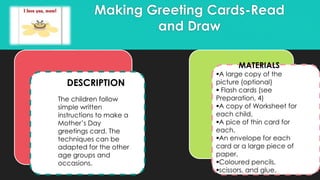
Making Greeting Cards-Read
and Draw
MATERIALS
A large copy of the
picture (optional)
 Flash cards (see
Preparation, 4)
A copy of Worksheet for
each child,
A pice of thin card for
each,
An envelope for each
card or a large piece of
paper,
Coloured pencils,
scissors, and glue.
DESCRIPTION
The children follow
simple written
instructions to make a
Mother’s Day
greetings card. The
techniques can be
adapted for the other
age groups and
occasions.
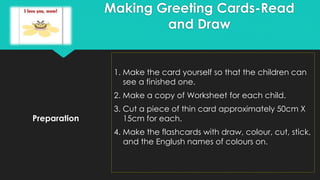
Preparation
1. Make the card yourself so that the children can
see a finished one.
2. Make a copy of Worksheet for each child.
3. Cut a piece of thin card approximately 50cm X
15cm for each.
4. Make the flashcards with draw, colour, cut, stick,
and the Englush names of colours on.
Making Greeting Cards-Read
and Draw
1. If necessary, teach the children and verbs
and colours from the worksheet and put
flashcards on the wall for reference while
they are working. This can be done in the
previous class.
2. Talk a little with the children in their native
language about mothers (and about
cares in general as some children are not
cared for by their mothers, but by fathers,
grandmothers, foster parents, or
childminders), what they do for the
children and for the family, and go on to
talk to them about Mother’s Day. Do they
have Mother’s Day in their country? If so,
what do they do for their mothers/carers
on that day.
3. Tell them that in Britain children give cards to
their mothers/carers on Mother’s Day. Show
them the card that you have made and tell
them they are going to make one for the
person that looks after them.
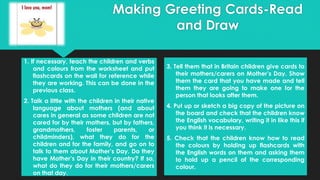
4. Put up or sketch a big copy of the picture on
the board and check that the children know
the English vocabulary, writing it in like this if
you think it is necessary.
5. Check that the children know how to read
the colours by holding up flashcards with
the English words on them and asking them
to hold up a pencil of the corresponding
colour.
Making Greeting Cards-Read
and Draw
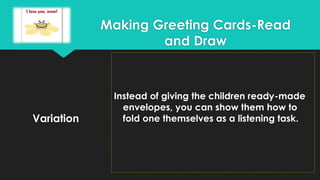
6. Give each child a piece of card and
show them how to fold it in half.
7. Give each child a worksheet. Read
through the instruction together,
checking at each step that the
children understand what they are
going to do.
8. Let the children start. Go around the
class helping out where necessary.
The language problems will mostly
be vocabulary ones so you will be
able torefer them to the board and
flashcards.
9. When they finish let them look at each
other’s cards. Show them how to write
‘To.....’ and ‘With love from.....’ on the
inside, telling them to write the name of
their carer after ‘To’ and their own
name after ‘from’.
10. Finally, give out the envelopes and
show the children how to write and
address.
Making Greeting Cards-Read
and Draw
Variation
Instead of giving the children ready-made
envelopes, you can show them how to
fold one themselves as a listening task.
Making Greeting Cards-Read
and Draw
The Washing Line
 LEVEL : 2, (3)
 AGE GROUP : B,C
 TIME : 20-30 minutes
 AIMS
-Language : to practise intensive reading.
-Other : to develop the skill of making
logical deductions.
Silent Reading
The Washing Line
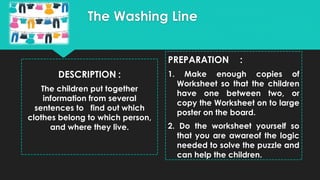
DESCRIPTION :
The children put together
information from several
sentences to find out which
clothes belong to which person,
and where they live.
PREPARATION :
1. Make enough copies of
Worksheet so that the children
have one between two, or
copy the Worksheet on to large
poster on the board.
2. Do the worksheet yourself so
that you are awareof the logic
needed to solve the puzzle and
can help the children.
IN CLASS
1. Pre-teach or revise the names of the clothes.
2. Draw a block of flats on the board and check
that the children know the names of the floors---
ground floor, first floor, and soon. (if you are
teaching American English you will have to
adapt the worksheeet to read first floor, second
floor, and so on).
3. Write the names of the people on the board:
Dawn, Peter, Bob, Jane and Mary, Anna. Tell the
children that they all live in the flats on different
floors.
The Washing Line
IN CLASS
4. Explain that they all share a washing line in the
garden. as very windy and all the clothes on the
washing line blew off and landed in a heap on the
ground. The children are going to work out who each
piece of clothing belongs to and where the owners
live. How? By reading the information and thinking
hard!
5. Put the children into pairs. Give out the worksheet
and give them a little time to read all the sentences.
6. Then ask them (in English if possible) who the football
shirt belongs to, and what floor that person lives on.
Ask those who get the answer right to tell the others
(in their native language if necessary) how they
worked it out.
The Washing Line
IN CLASS
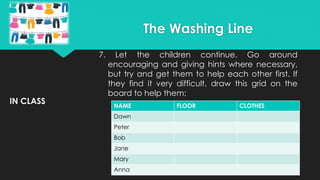
7. Let the children continue. Go around
encouraging and giving hints where necessary,
but try and get them to help each other first. If
they find it very difficult, draw this grid on the
board to help them:
The Washing Line
NAME FLOOR CLOTHES
Dawn
Peter
Bob
Jane
Mary
Anna
IN CLASS
8. When they finish, get them to compare
their answers before checking the whole
class’s answers.
The Washing Line
Reading is one of English skills. It should be
mastered by all learners, includes young
learners. The main point in teaching reading for
young learner is to keep thing playful as well.
Many methods and techniques can be used in
teaching reading for young learners. One of the
methods is read aloud and silent reading.
Conclusion
Teaching reading eyl 1st group

Teaching reading eyl 1st group

  • 1.
  • 2.
    VI/B 3 T h G R O U p Tri S AdittaP.M Selvy IRoki Rizki A. SEvi M. F
  • 3.
    Teaching Reading forYoung Learners Reading is an interactive process that goes on between the reader and the text, resulting in comprehension Teaching reading is very necessary in English learning and teaching as foreign language. It is in the line with Burhan (2012: 9), reading is a physic and mental activity to reveal the meaning of the written text. Learning to read is an important educational goal. For both children and adults, the ability to read opens up new worlds and opportunities.
  • 4.
    Methods Used inTeaching Reading for Young Learners Reading Aloud / Oral Reading Silent Reading
  • 5.
    Reading Aloud/ OralReading A read aloud is a planned oral reading of a book or print materials that may be fiction or non-fiction or in which children have a high interest such as a letter from a relative, child's famous comic strip might be good options.
  • 6.
    Why the readaloud in the class?  To engage the students while developing background knowledge, increasing comprehension skills, and fostering critical thinking.  To helps build listening and comprehension skills.  Can easily internalize vocabulary by hearing words in context.  Gain information  Fosters curiosity, imagination and creativity.  Increases their attention spans and ability to focus on what is being said.  Gives students a desire to read more  Presents endless opportunities for related activities Reading Aloud/ Oral Reading
  • 7.
    How the readaloud in the class?  Give concrete explanations  Invite conversation and generate questions for discussion and investigations  Provide content to support hands-on investigations  Examine the colorful illustrations and photographs; they can tell a story beyond the words on the page  Have your child read the material aloud then at the end of the paragraph, go back and review difficult words and have him/her read it again.  Raise your child for his/her efforts Reading Aloud/ Oral Reading
  • 8.
    How can oneget the most out of this technique?  Engage students' interests  Make sure the books are at the right difficulty level  Spend an appropriate amount of time on reading aloud  Offer a range of materials to read aloud  Work in small groups  Model fluent reading  Do repeated readings in class  Promote phrased reading in class Reading Aloud/ Oral Reading
  • 9.
    Silent Reading Silent readingallows readers interact with the text; thus, the teachers should not interrupt while the students are reading. Silent reading allows students to read at their own rate and to identify more than one word at a time.
  • 10.
    Benefit of Silent Reading Improves student’s understanding  develop the skills of reading for a purpose  people read in sense groups, which means, roughly, that we read a number of words together so that they make sense to us Silent Reading
  • 11.
    Silent Reading Unit outcomes Outcomes help students develop silent reading skills to read more efficiently, teach students how to guess the meanings of unfamiliar words from the context, help students understand the relation between reading speed and reading efficiency, and help students improve their reading efficiency through understanding how to interpret information given in graphical form.  Teacher support information After the activities, teacher should begin to see gradual improvement in their comprehension. This is because silent reading helps students to focus their attention on the text; their increased concentration on the text is sustained until the entire text is read. This also helps students absorb ideas into their subconscious and then use them in their daily lives.
  • 12.
    Techniques Used inTeaching Reading for Young Learners Making Greeting Cards-Read and Draw The Washing Line
  • 13.
    Making Greeting Cards- Readand Draw Making Greeting Cards-Read and Draw  LEVEL : (1), 2  AGE GROUP : A, B  TIME : 30 Minutes  AIMS -Language : to develope intensive reading skills. -Other : to practice drawing, colouring, and cutting-out skills. Reading Aloud/ Oral Reading
  • 14.
    Making Greeting Cards-Read andDraw MATERIALS A large copy of the picture (optional)  Flash cards (see Preparation, 4) A copy of Worksheet for each child, A pice of thin card for each, An envelope for each card or a large piece of paper, Coloured pencils, scissors, and glue. DESCRIPTION The children follow simple written instructions to make a Mother’s Day greetings card. The techniques can be adapted for the other age groups and occasions.
  • 15.
    Preparation 1. Make thecard yourself so that the children can see a finished one. 2. Make a copy of Worksheet for each child. 3. Cut a piece of thin card approximately 50cm X 15cm for each. 4. Make the flashcards with draw, colour, cut, stick, and the Englush names of colours on. Making Greeting Cards-Read and Draw
  • 16.
    1. If necessary,teach the children and verbs and colours from the worksheet and put flashcards on the wall for reference while they are working. This can be done in the previous class. 2. Talk a little with the children in their native language about mothers (and about cares in general as some children are not cared for by their mothers, but by fathers, grandmothers, foster parents, or childminders), what they do for the children and for the family, and go on to talk to them about Mother’s Day. Do they have Mother’s Day in their country? If so, what do they do for their mothers/carers on that day. 3. Tell them that in Britain children give cards to their mothers/carers on Mother’s Day. Show them the card that you have made and tell them they are going to make one for the person that looks after them. 4. Put up or sketch a big copy of the picture on the board and check that the children know the English vocabulary, writing it in like this if you think it is necessary. 5. Check that the children know how to read the colours by holding up flashcards with the English words on them and asking them to hold up a pencil of the corresponding colour. Making Greeting Cards-Read and Draw
  • 17.
    6. Give eachchild a piece of card and show them how to fold it in half. 7. Give each child a worksheet. Read through the instruction together, checking at each step that the children understand what they are going to do. 8. Let the children start. Go around the class helping out where necessary. The language problems will mostly be vocabulary ones so you will be able torefer them to the board and flashcards. 9. When they finish let them look at each other’s cards. Show them how to write ‘To.....’ and ‘With love from.....’ on the inside, telling them to write the name of their carer after ‘To’ and their own name after ‘from’. 10. Finally, give out the envelopes and show the children how to write and address. Making Greeting Cards-Read and Draw
  • 18.
    Variation Instead of givingthe children ready-made envelopes, you can show them how to fold one themselves as a listening task. Making Greeting Cards-Read and Draw
  • 19.
    The Washing Line LEVEL : 2, (3)  AGE GROUP : B,C  TIME : 20-30 minutes  AIMS -Language : to practise intensive reading. -Other : to develop the skill of making logical deductions. Silent Reading
  • 20.
    The Washing Line DESCRIPTION: The children put together information from several sentences to find out which clothes belong to which person, and where they live. PREPARATION : 1. Make enough copies of Worksheet so that the children have one between two, or copy the Worksheet on to large poster on the board. 2. Do the worksheet yourself so that you are awareof the logic needed to solve the puzzle and can help the children.
  • 21.
    IN CLASS 1. Pre-teachor revise the names of the clothes. 2. Draw a block of flats on the board and check that the children know the names of the floors--- ground floor, first floor, and soon. (if you are teaching American English you will have to adapt the worksheeet to read first floor, second floor, and so on). 3. Write the names of the people on the board: Dawn, Peter, Bob, Jane and Mary, Anna. Tell the children that they all live in the flats on different floors. The Washing Line
  • 22.
    IN CLASS 4. Explainthat they all share a washing line in the garden. as very windy and all the clothes on the washing line blew off and landed in a heap on the ground. The children are going to work out who each piece of clothing belongs to and where the owners live. How? By reading the information and thinking hard! 5. Put the children into pairs. Give out the worksheet and give them a little time to read all the sentences. 6. Then ask them (in English if possible) who the football shirt belongs to, and what floor that person lives on. Ask those who get the answer right to tell the others (in their native language if necessary) how they worked it out. The Washing Line
  • 23.
    IN CLASS 7. Letthe children continue. Go around encouraging and giving hints where necessary, but try and get them to help each other first. If they find it very difficult, draw this grid on the board to help them: The Washing Line NAME FLOOR CLOTHES Dawn Peter Bob Jane Mary Anna
  • 24.
    IN CLASS 8. Whenthey finish, get them to compare their answers before checking the whole class’s answers. The Washing Line
  • 25.
    Reading is oneof English skills. It should be mastered by all learners, includes young learners. The main point in teaching reading for young learner is to keep thing playful as well. Many methods and techniques can be used in teaching reading for young learners. One of the methods is read aloud and silent reading. Conclusion