
Talk Your Head Off: Strategies for
designing an Effective and
Engaging ESL Conversation Class
Presenter:
Ryan Brux, English Language Fellow
BNC – El Cultural – Tarapoto, Peru
Goals and Objectives:
To describe the importance of teaching speaking in the
communicative classroom
To discuss the importance of planning for a conversation
class
To discuss ways to integrate vocabulary in authentic
speaking situations
To learn how to develop extension activities that are
project-based, communicative, and support language
acquisition goals.
To use this information to create a lesson plan for
conversation purposes
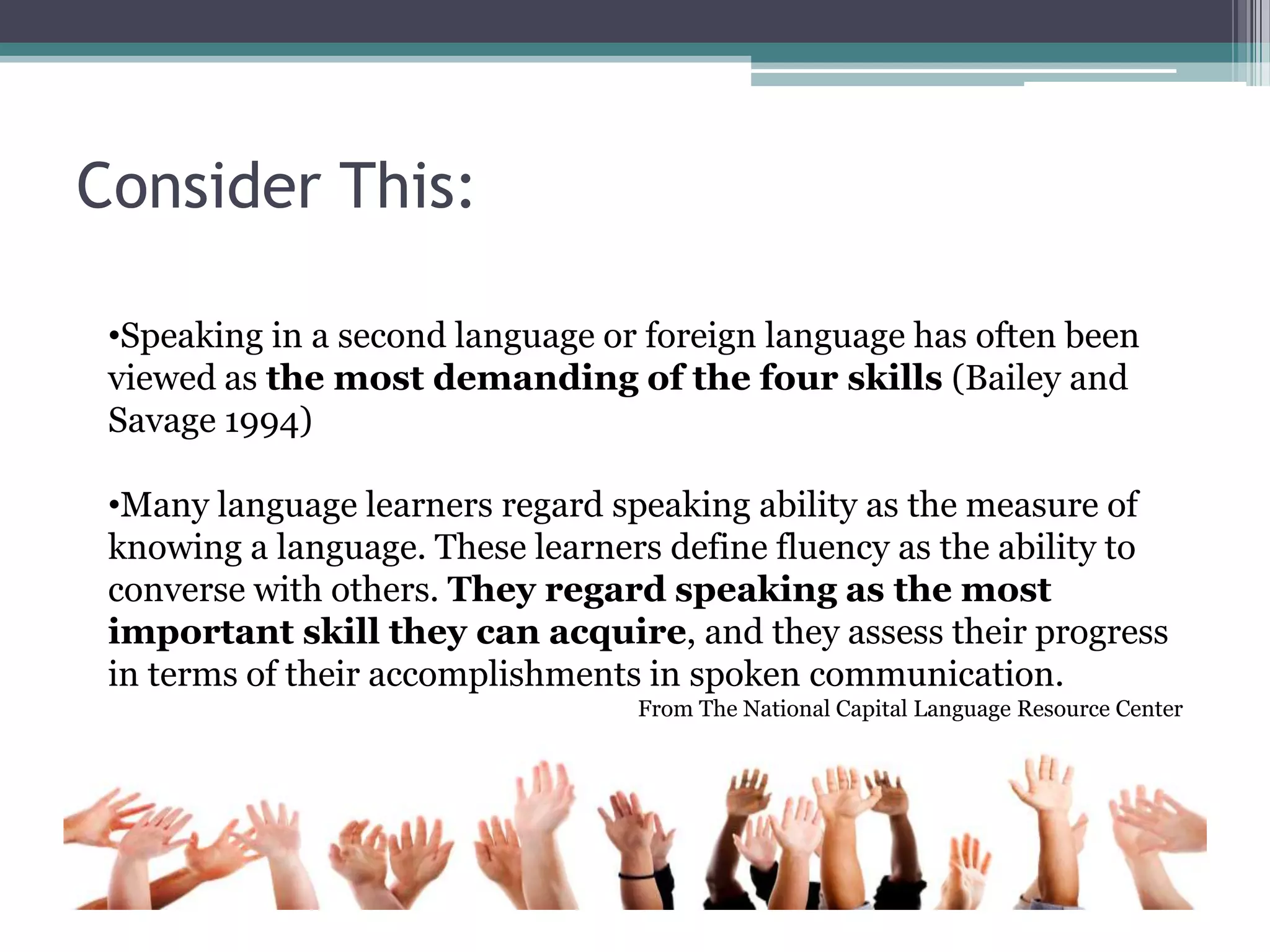
Consider This:
•Speaking in a second language or foreign language has often been
viewed as the most demanding of the four skills (Bailey and
Savage 1994)
•Many language learners regard speaking ability as the measure of
knowing a language. These learners define fluency as the ability to
converse with others. They regard speaking as the most
important skill they can acquire, and they assess their progress
in terms of their accomplishments in spoken communication.
From The National Capital Language Resource Center
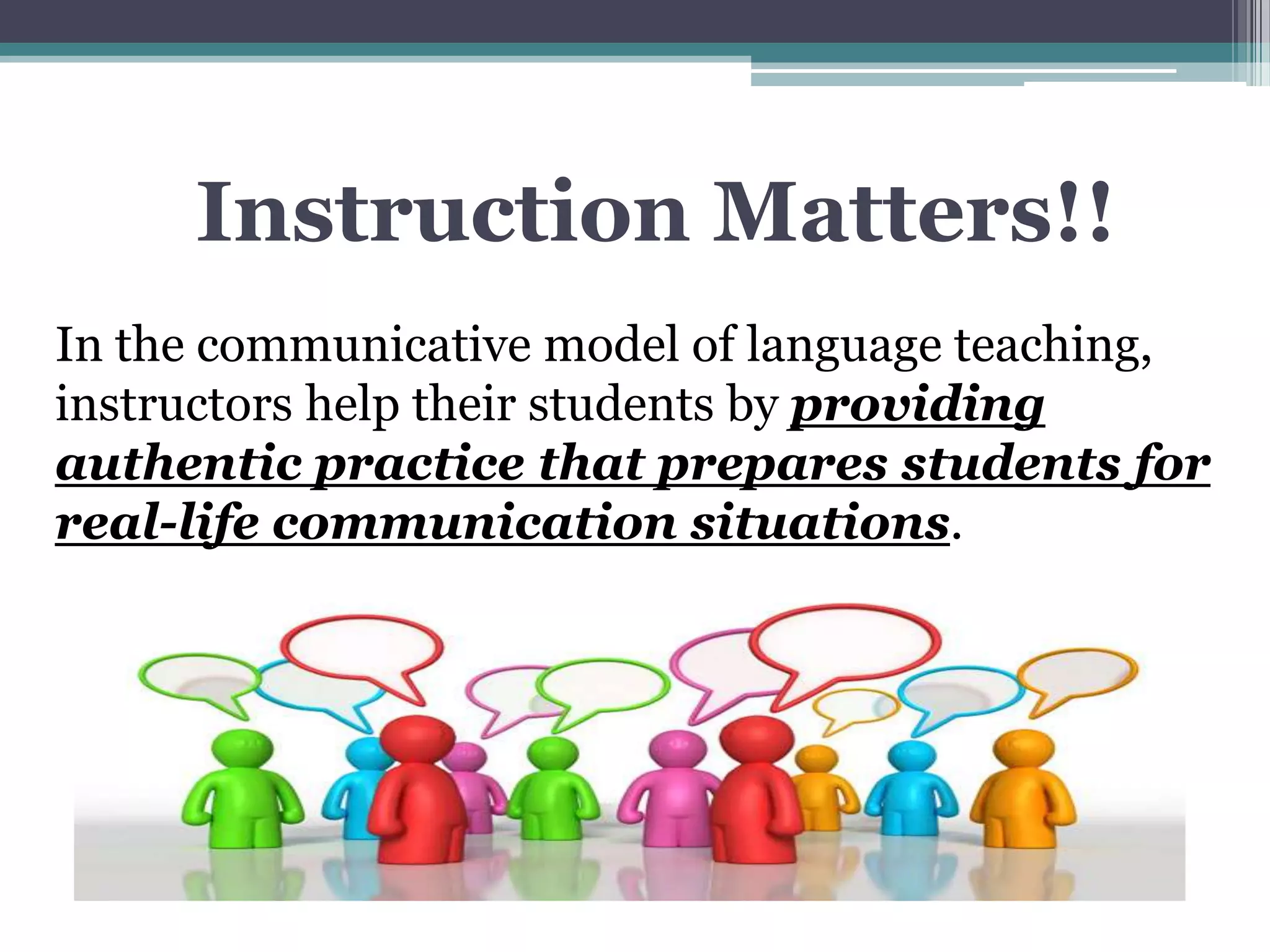
Instruction Matters!!
In the communicative model of language teaching,
instructors help their students by providing
authentic practice that prepares students for
real-life communication situations.
“By failing to prepare, you are __________.”
-Benjamin Franklin
“By failing to prepare, you are preparing to fail.”
-Benjamin Franklin
It’s all about planning your lesson!
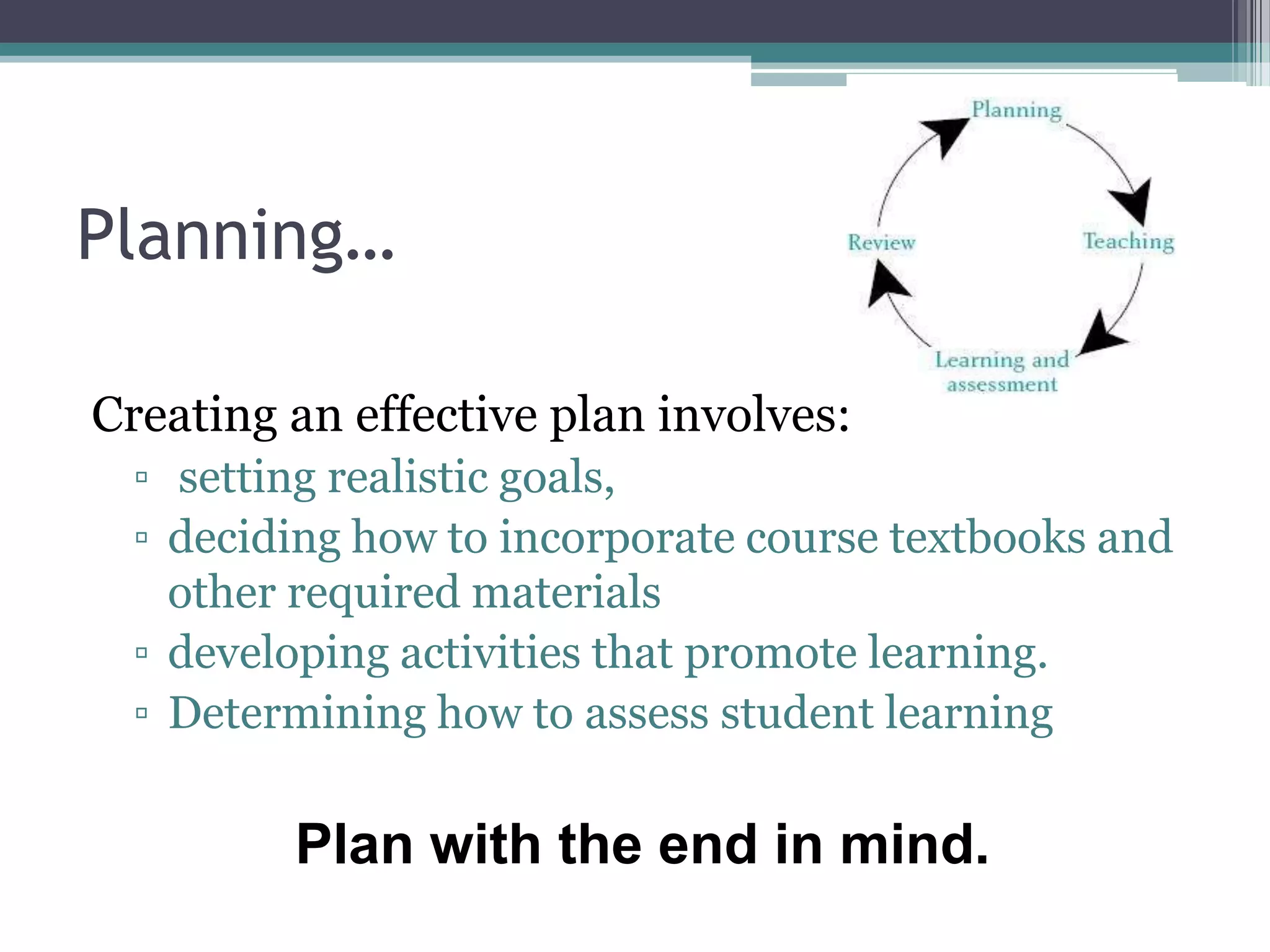
Planning…
Creating an effective plan involves:
▫ setting realistic goals,
▫ deciding how to incorporate course textbooks and
other required materials
▫ developing activities that promote learning.
▫ Determining how to assess student learning
Plan with the end in mind.
Before You Begin
▫ What topic(s) will you talk about?
▫ What kinds of questions will you ask?
▫ What special vocabulary will students need?
▫ What kinds of activities will be used to further
support instruction?
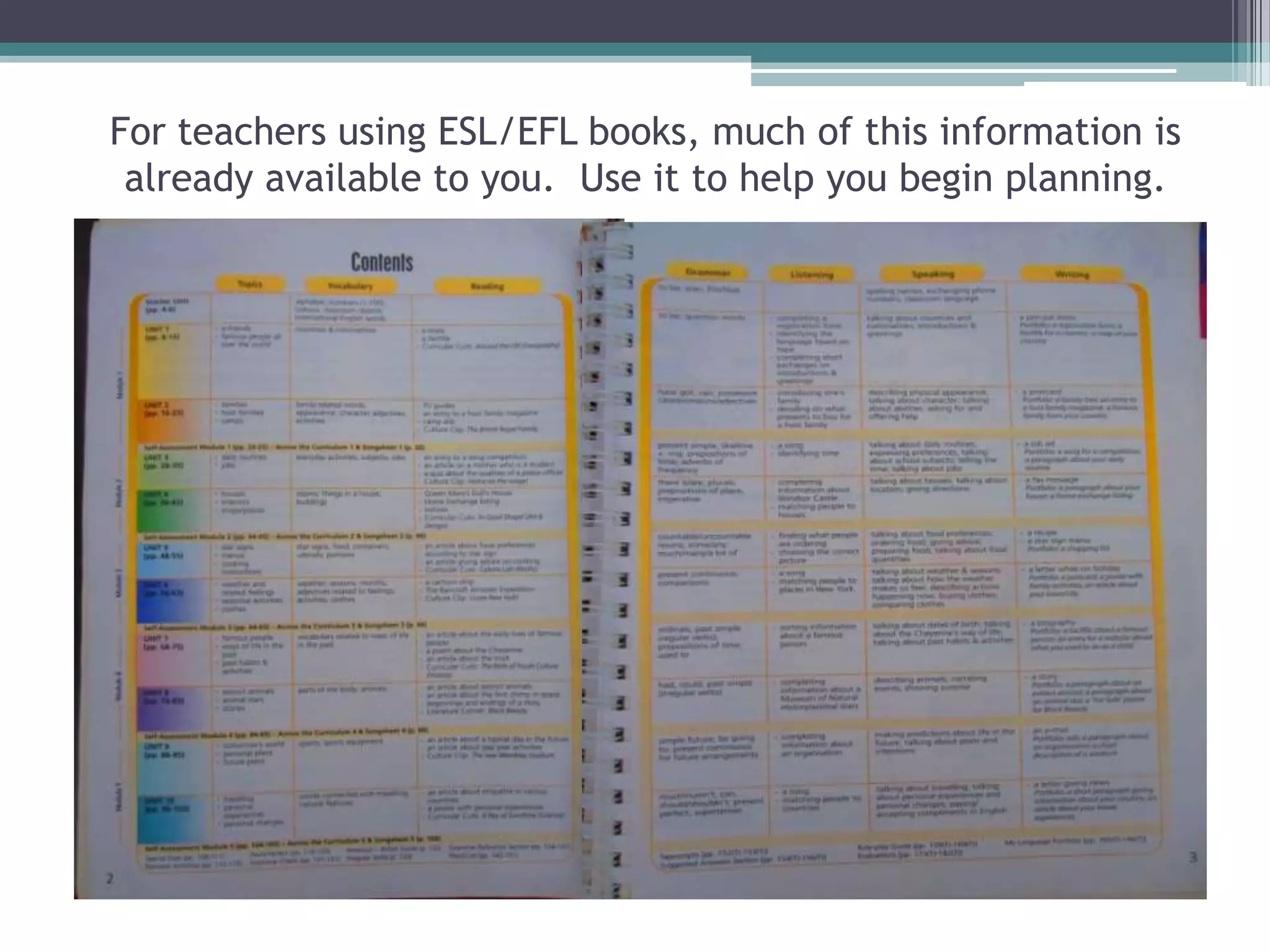
For teachers using ESL/EFL books, much of this information is
already available to you. Use it to help you begin planning.
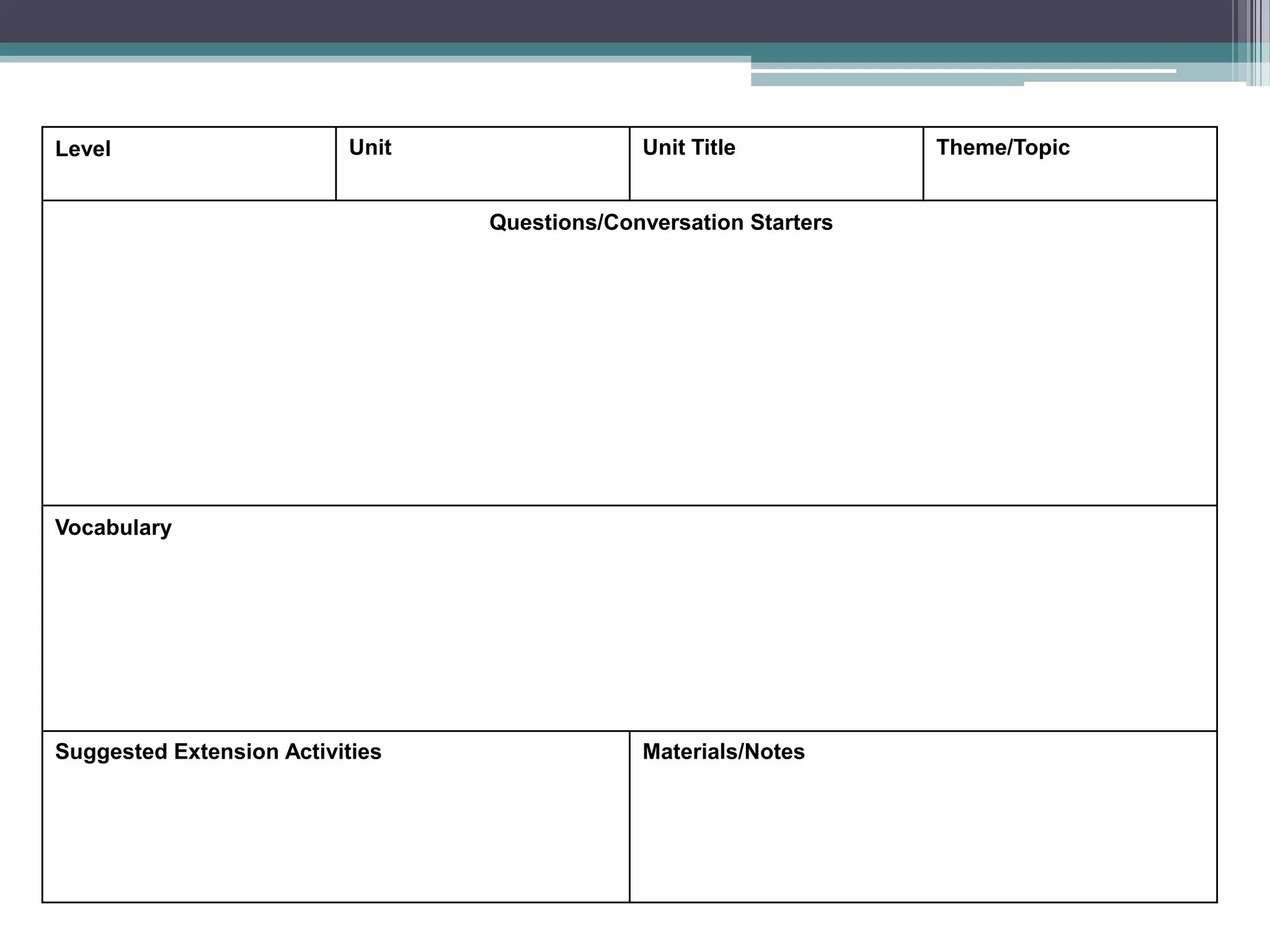
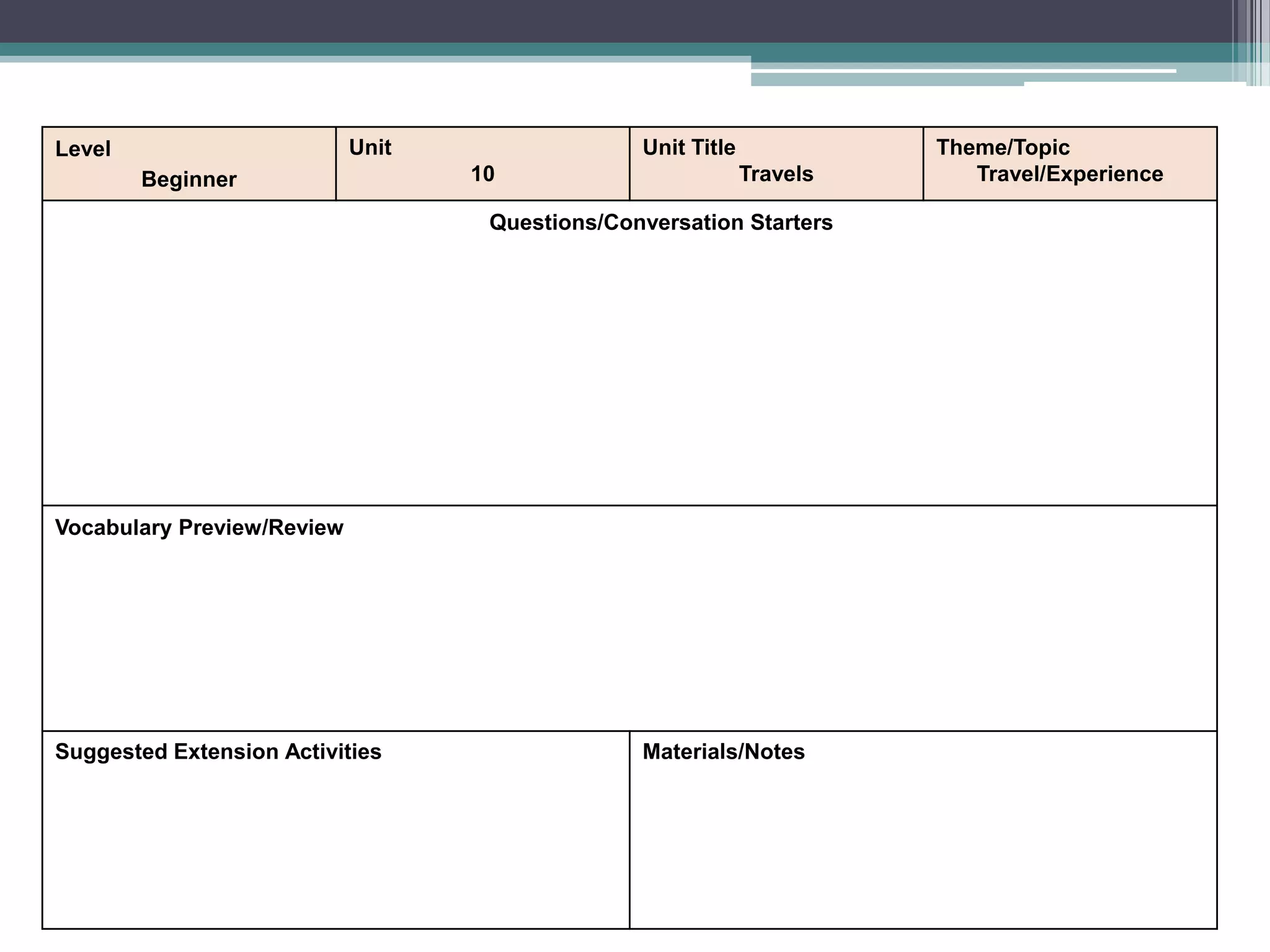
Level Unit Unit Title Theme/Topic
Questions/Conversation Starters
Vocabulary
Suggested Extension Activities Materials/Notes
Step One…Identify Your Focus
• Identify the
▫ Level (Beginner)
▫ Unit # (10)
▫ Unit Title (Travel)
▫ Theme/Topic (Travelling/Experiences)
**Focusing on the topic of study and will help you
determine level-appropriate questions/situations
to present to students.
Level
Beginner
Unit
10
Unit Title
Travels
Theme/Topic
Travel/Experience
Questions/Conversation Starters
Vocabulary Preview/Review
Suggested Extension Activities Materials/Notes
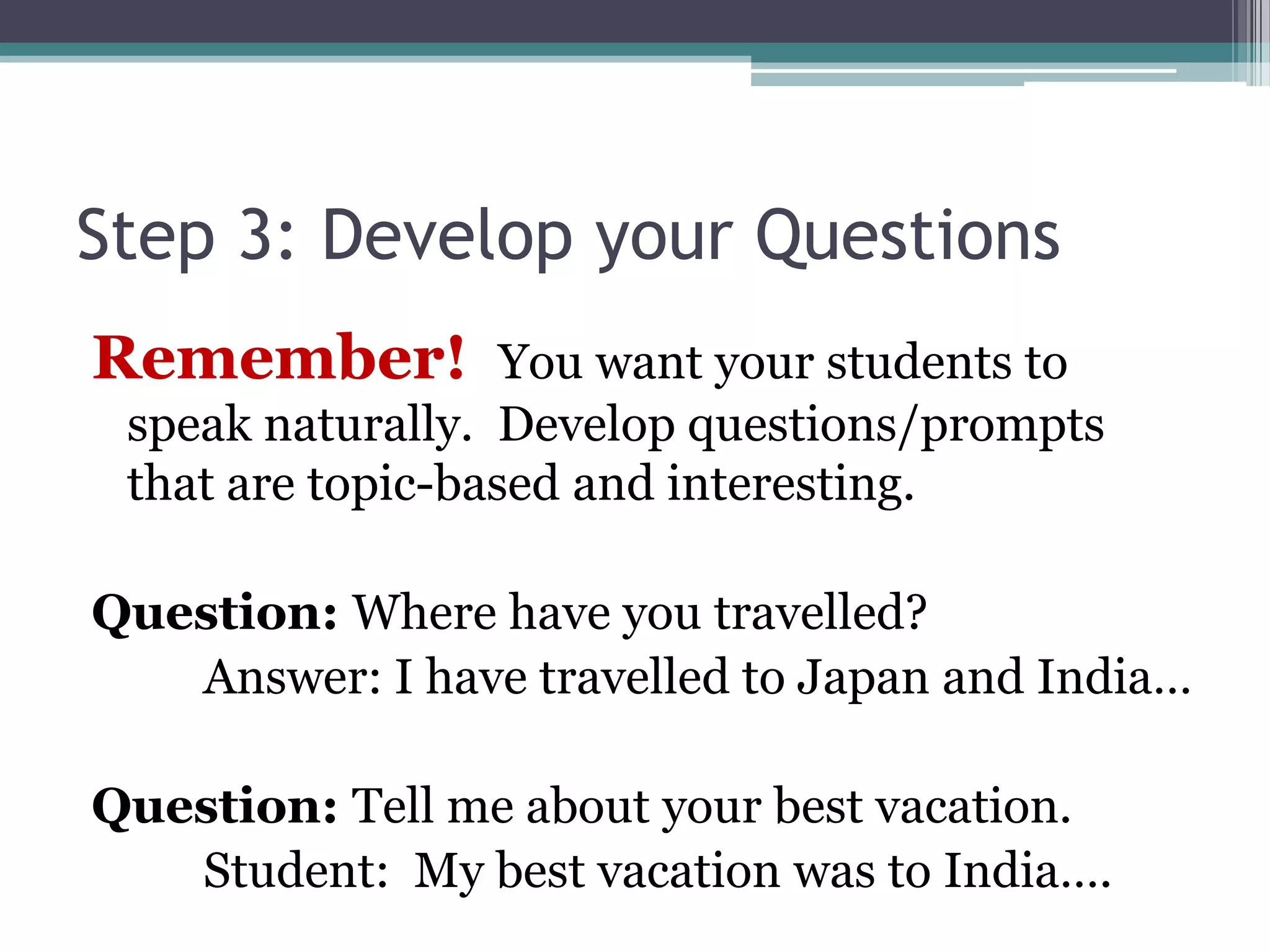
Step 3: Develop your Questions
Remember! You want your students to
speak naturally. Develop questions/prompts
that are topic-based and interesting.
Question: Where have you travelled?
Answer: I have travelled to Japan and India…
Question: Tell me about your best vacation.
Student: My best vacation was to India….
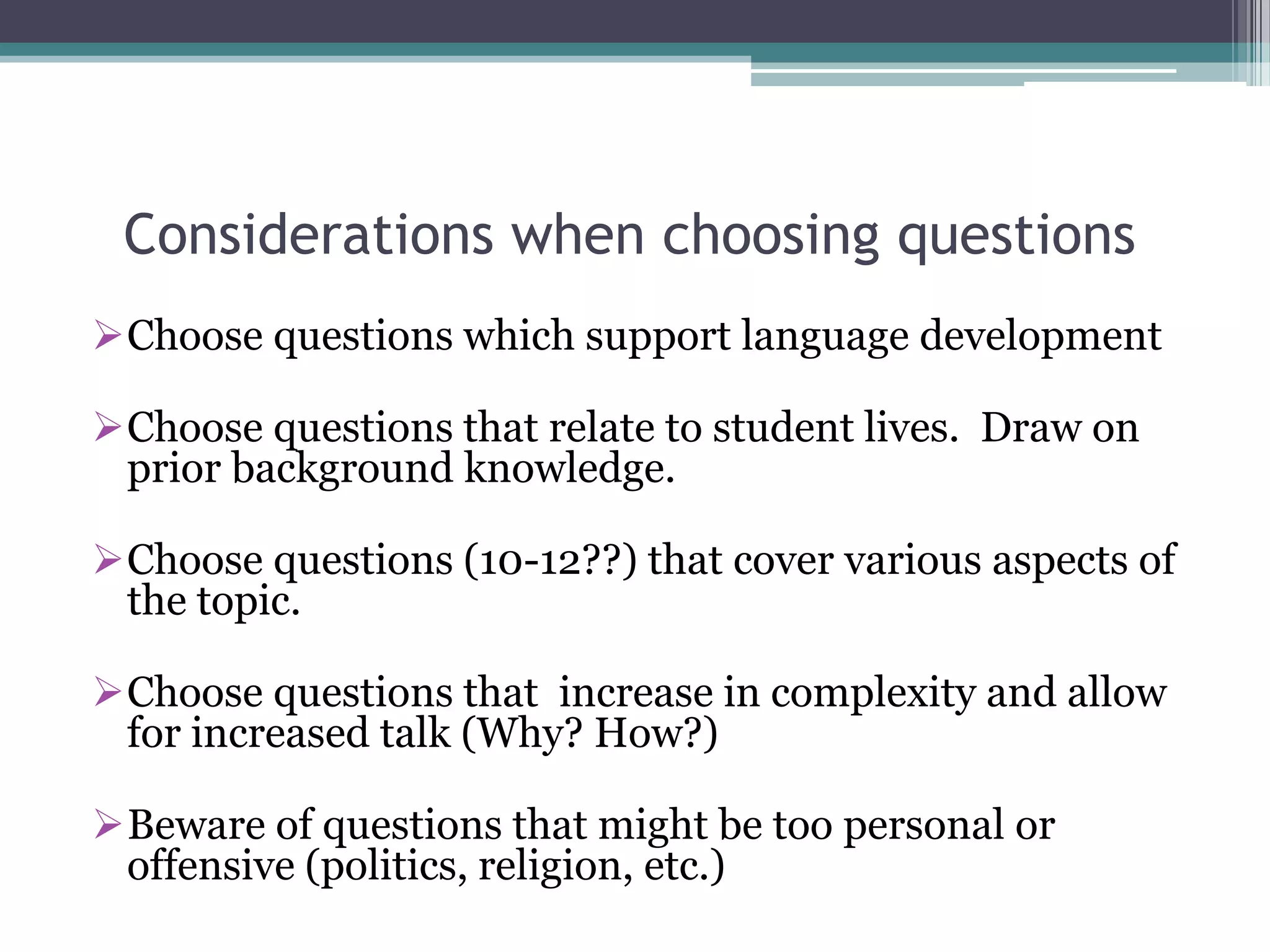
Considerations when choosing questions
Choose questions which support language development
Choose questions that relate to student lives. Draw on
prior background knowledge.
Choose questions (10-12??) that cover various aspects of
the topic.
Choose questions that increase in complexity and allow
for increased talk (Why? How?)
Beware of questions that might be too personal or
offensive (politics, religion, etc.)
Help!!! I Can’t Think of Any
Questions to Ask My Students!!!
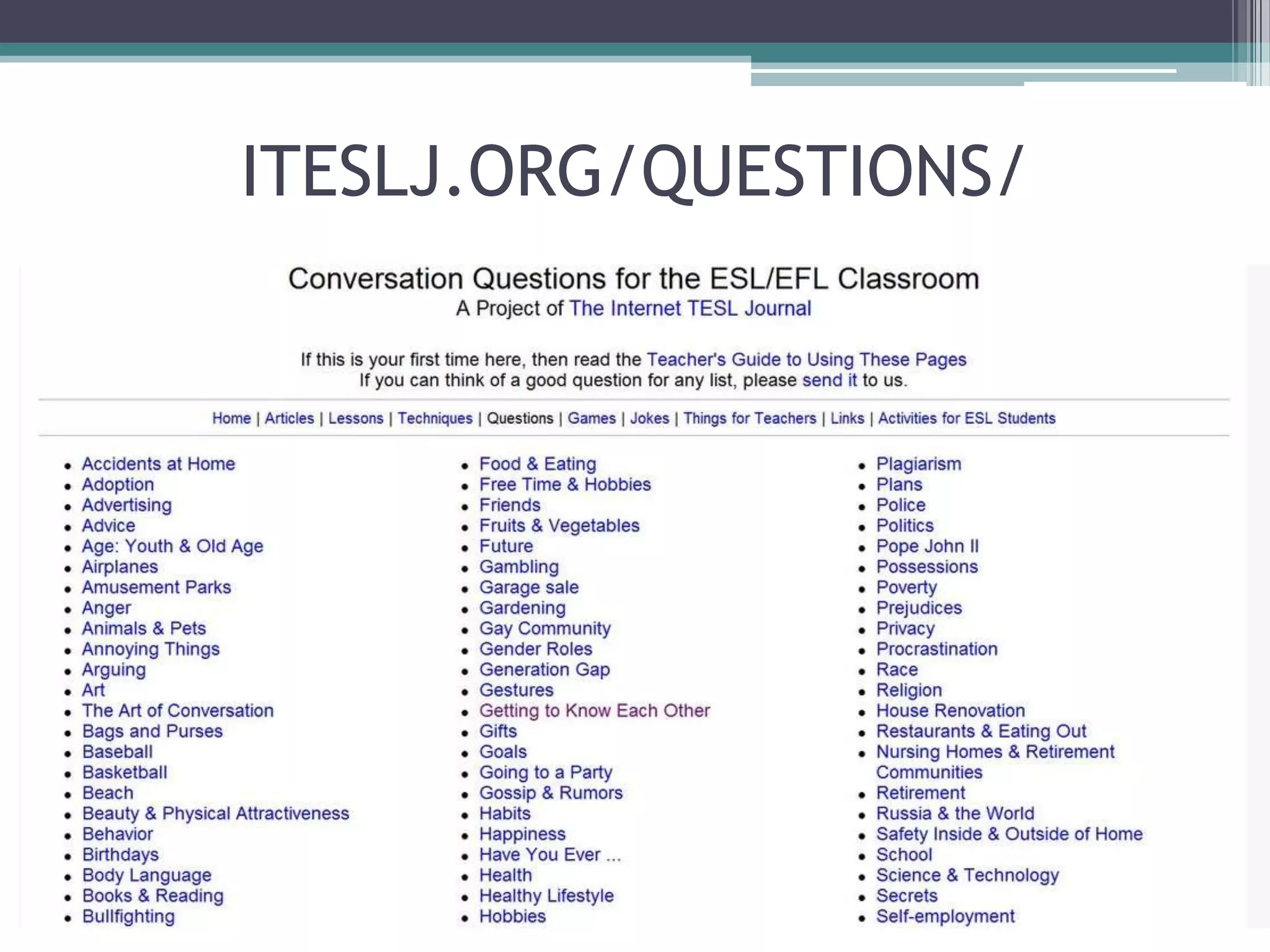
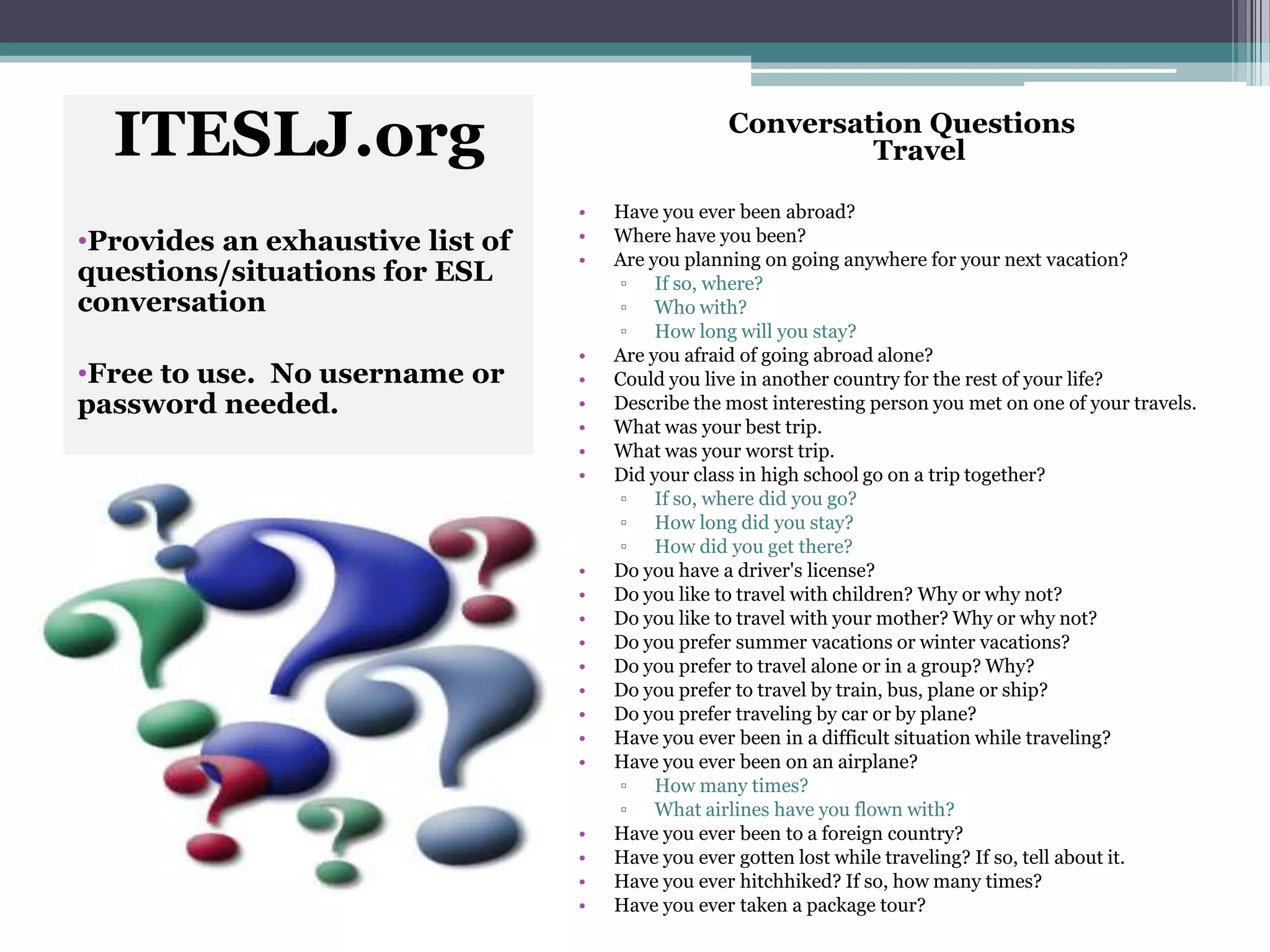
ITESLJ.ORG/QUESTIONS/
ITESLJ.org
•Provides an exhaustive list of
questions/situations for ESL
conversation
•Free to use. No username or
password needed.
Conversation Questions
Travel
• Have you ever been abroad?
• Where have you been?
• Are you planning on going anywhere for your next vacation?
▫ If so, where?
▫ Who with?
▫ How long will you stay?
• Are you afraid of going abroad alone?
• Could you live in another country for the rest of your life?
• Describe the most interesting person you met on one of your travels.
• What was your best trip.
• What was your worst trip.
• Did your class in high school go on a trip together?
▫ If so, where did you go?
▫ How long did you stay?
▫ How did you get there?
• Do you have a driver's license?
• Do you like to travel with children? Why or why not?
• Do you like to travel with your mother? Why or why not?
• Do you prefer summer vacations or winter vacations?
• Do you prefer to travel alone or in a group? Why?
• Do you prefer to travel by train, bus, plane or ship?
• Do you prefer traveling by car or by plane?
• Have you ever been in a difficult situation while traveling?
• Have you ever been on an airplane?
▫ How many times?
▫ What airlines have you flown with?
• Have you ever been to a foreign country?
• Have you ever gotten lost while traveling? If so, tell about it.
• Have you ever hitchhiked? If so, how many times?
• Have you ever taken a package tour?
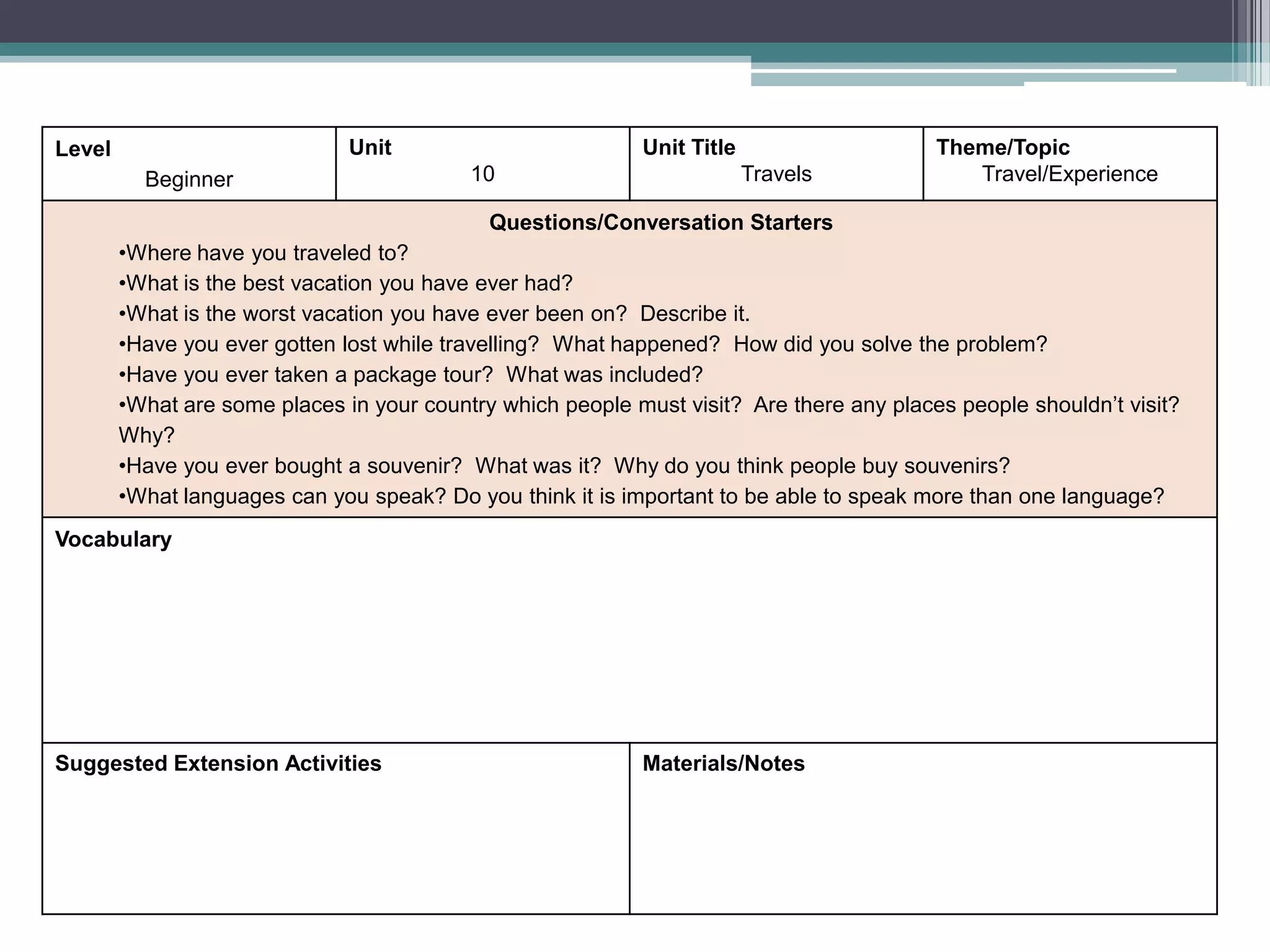
Level
Beginner
Unit
10
Unit Title
Travels
Theme/Topic
Travel/Experience
Questions/Conversation Starters
•Where have you traveled to?
•What is the best vacation you have ever had?
•What is the worst vacation you have ever been on? Describe it.
•Have you ever gotten lost while travelling? What happened? How did you solve the problem?
•Have you ever taken a package tour? What was included?
•What are some places in your country which people must visit? Are there any places people shouldn’t visit?
Why?
•Have you ever bought a souvenir? What was it? Why do you think people buy souvenirs?
•What languages can you speak? Do you think it is important to be able to speak more than one language?
Vocabulary
Suggested Extension Activities Materials/Notes
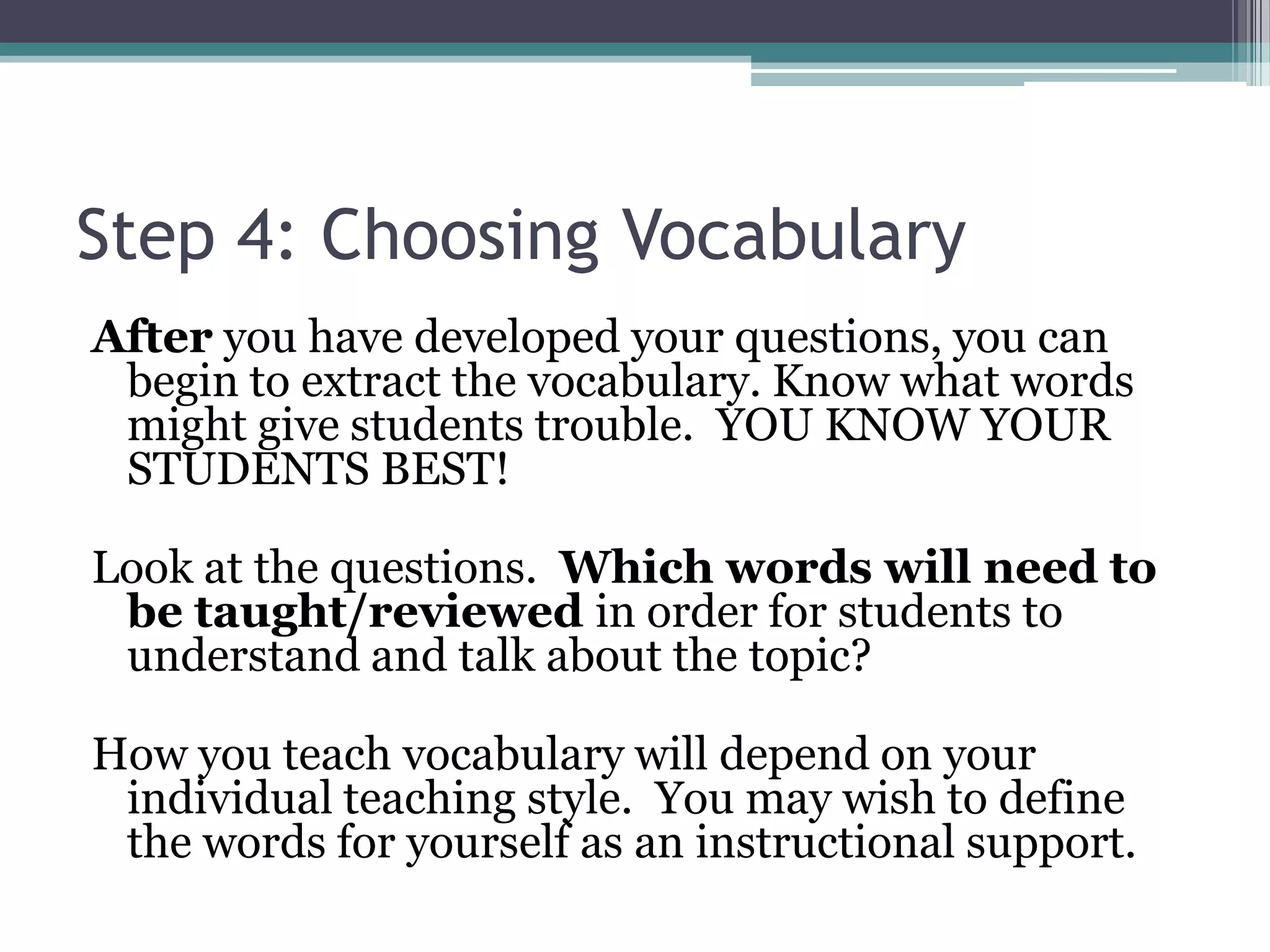
Step 4: Choosing Vocabulary
After you have developed your questions, you can
begin to extract the vocabulary. Know what words
might give students trouble. YOU KNOW YOUR
STUDENTS BEST!
Look at the questions. Which words will need to
be taught/reviewed in order for students to
understand and talk about the topic?
How you teach vocabulary will depend on your
individual teaching style. You may wish to define
the words for yourself as an instructional support.
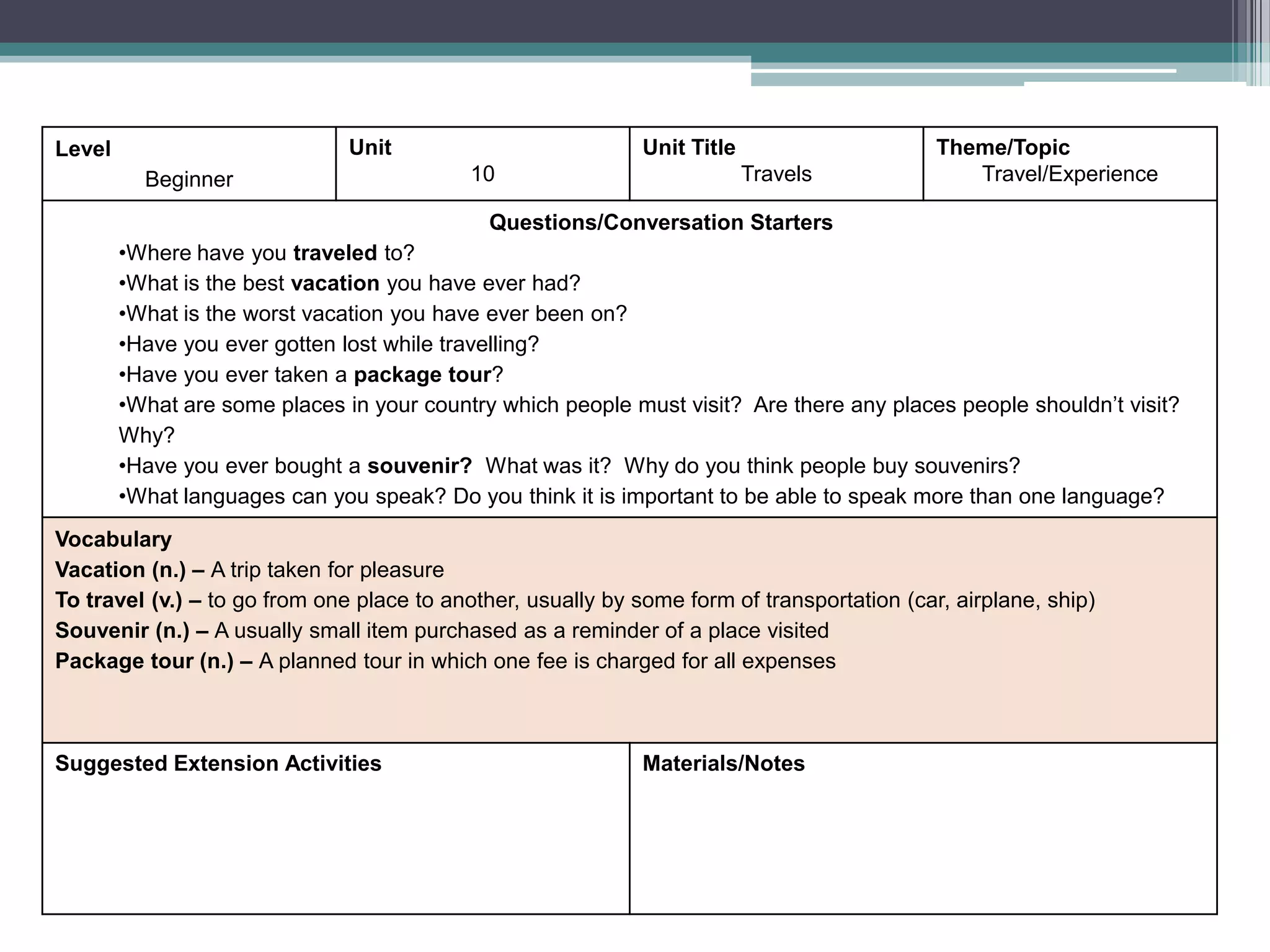
Level
Beginner
Unit
10
Unit Title
Travels
Theme/Topic
Travel/Experience
Questions/Conversation Starters
•Where have you traveled to?
•What is the best vacation you have ever had?
•What is the worst vacation you have ever been on?
•Have you ever gotten lost while travelling?
•Have you ever taken a package tour?
•What are some places in your country which people must visit? Are there any places people shouldn’t visit?
Why?
•Have you ever bought a souvenir? What was it? Why do you think people buy souvenirs?
•What languages can you speak? Do you think it is important to be able to speak more than one language?
Vocabulary
Vacation (n.) – A trip taken for pleasure
To travel (v.) – to go from one place to another, usually by some form of transportation (car, airplane, ship)
Souvenir (n.) – A usually small item purchased as a reminder of a place visited
Package tour (n.) – A planned tour in which one fee is charged for all expenses
Suggested Extension Activities Materials/Notes
Vocabulary Considerations
Do not focus all energy on vocabulary instruction –
the purpose of a speaking class is to speak!
Introduce 5-8 words that might give students
difficulties.
Use speaking as a way to review previously learned
vocabulary as well as a way to introduce new words.
Use new words frequently throughout the conversation
lesson. Students need multiple exposures to a word to
learn it well (Lawrence, 2009; Nagy, Herman, &
Anderson, 1985)
Step 5: Consider a Project-Based
Learning (Extension) Activity
Project-based learning is an
instructional approach to
engage students in sustained,
cooperative investigation
(Bransford & Stein, 1993)
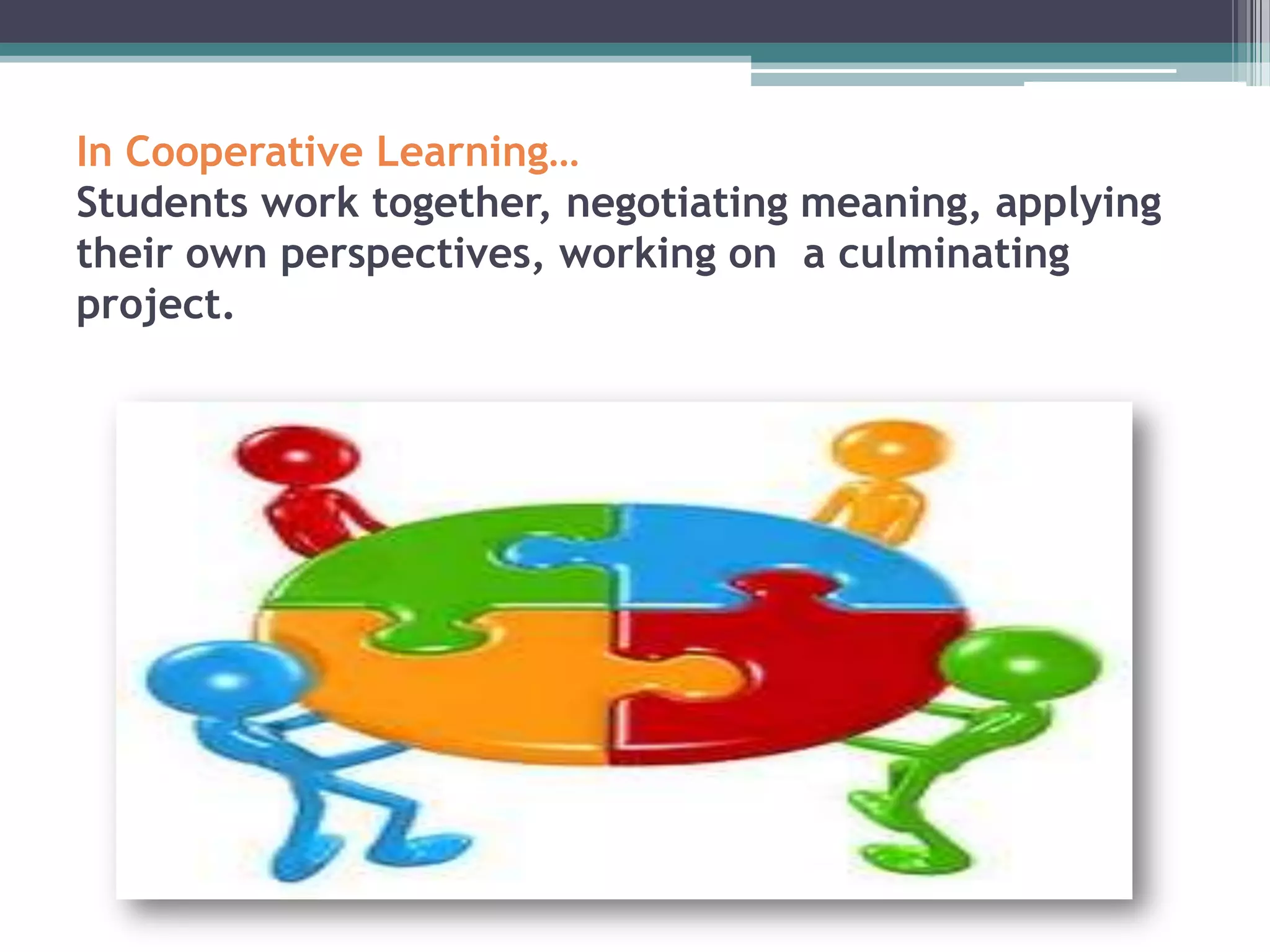
In Cooperative Learning…
Students work together, negotiating meaning, applying
their own perspectives, working on a culminating
project.
Project Based Activities for Speaking:
The Possibilities are Endless
• Poster Presentations
• Brochures
• Commercials
• Role Play
• Story-Building w/ Language
Experience Approach (LEA)
• Panel discussions/talk show
• Debates
• Short Reading/Discussion
• Create a YouTube Video
• Surveys
• Short Video Clip/Discussion
• Retelling Stories
• Talk-show
• Telling Stories
• Radio/T.V. Interviews
• Short persuasive speeches
• Audio-taped Oral Dialogue Journals
• Skits/Plays
• Structured interviews
• Problem-solving simulations
• Describing a picture
• Sentence expansion activities
• Jokes/Riddles
• Analysis of charts, graphs, tables
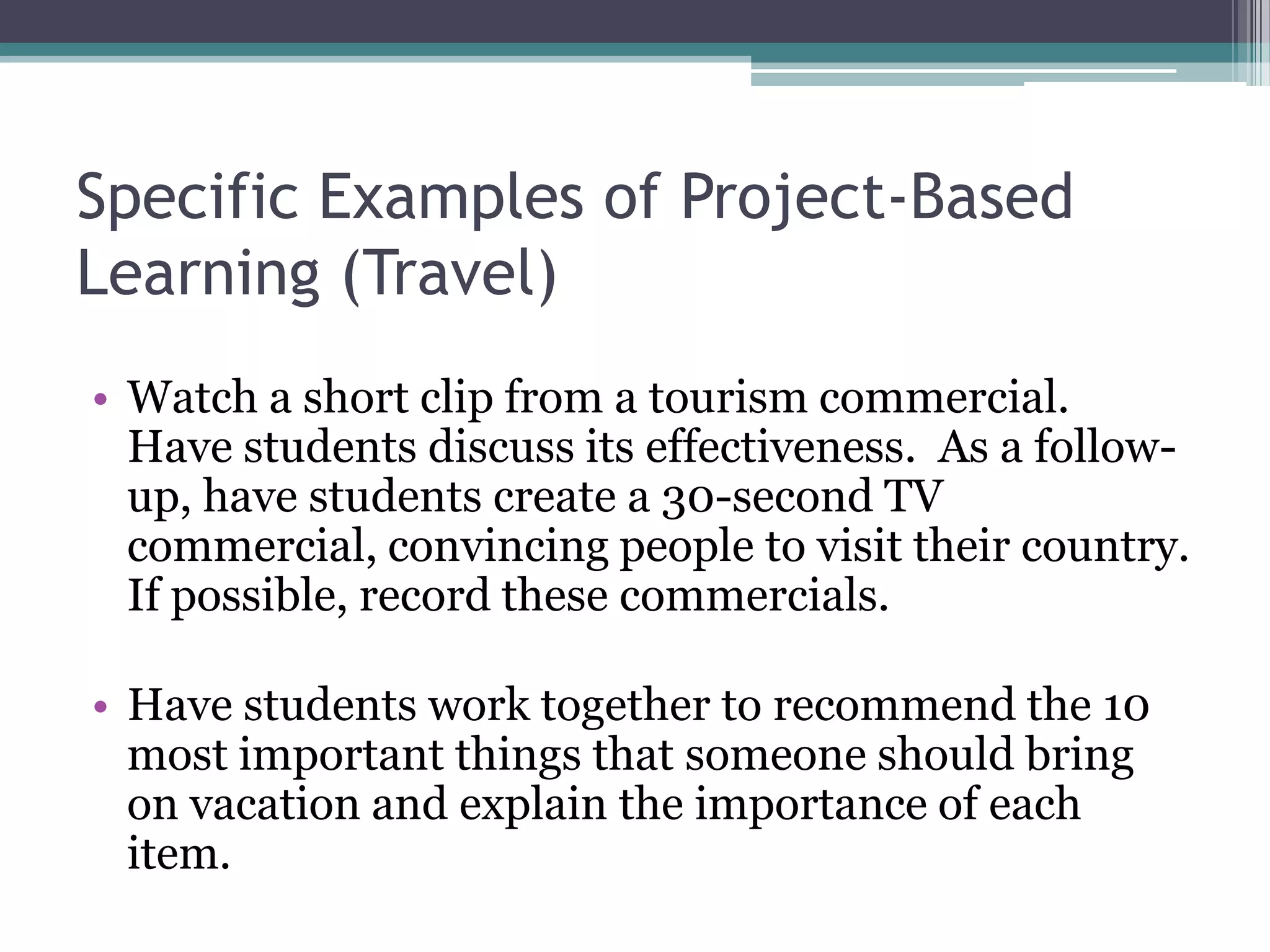
Specific Examples of Project-Based
Learning (Travel)
• Watch a short clip from a tourism commercial.
Have students discuss its effectiveness. As a follow-
up, have students create a 30-second TV
commercial, convincing people to visit their country.
If possible, record these commercials.
• Have students work together to recommend the 10
most important things that someone should bring
on vacation and explain the importance of each
item.
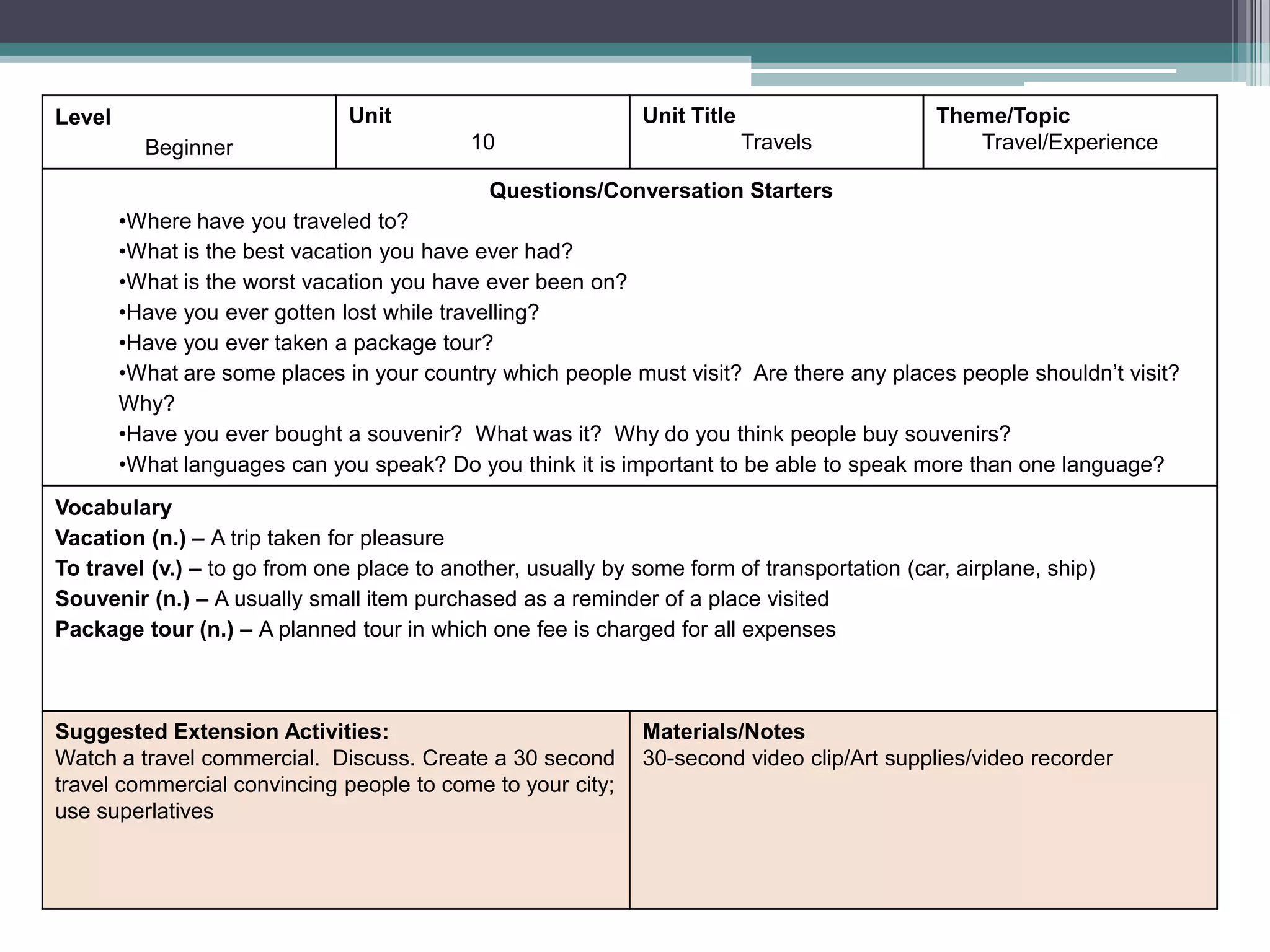
Level
Beginner
Unit
10
Unit Title
Travels
Theme/Topic
Travel/Experience
Questions/Conversation Starters
•Where have you traveled to?
•What is the best vacation you have ever had?
•What is the worst vacation you have ever been on?
•Have you ever gotten lost while travelling?
•Have you ever taken a package tour?
•What are some places in your country which people must visit? Are there any places people shouldn’t visit?
Why?
•Have you ever bought a souvenir? What was it? Why do you think people buy souvenirs?
•What languages can you speak? Do you think it is important to be able to speak more than one language?
Vocabulary
Vacation (n.) – A trip taken for pleasure
To travel (v.) – to go from one place to another, usually by some form of transportation (car, airplane, ship)
Souvenir (n.) – A usually small item purchased as a reminder of a place visited
Package tour (n.) – A planned tour in which one fee is charged for all expenses
Suggested Extension Activities:
Watch a travel commercial. Discuss. Create a 30 second
travel commercial convincing people to come to your city;
use superlatives
Materials/Notes
30-second video clip/Art supplies/video recorder
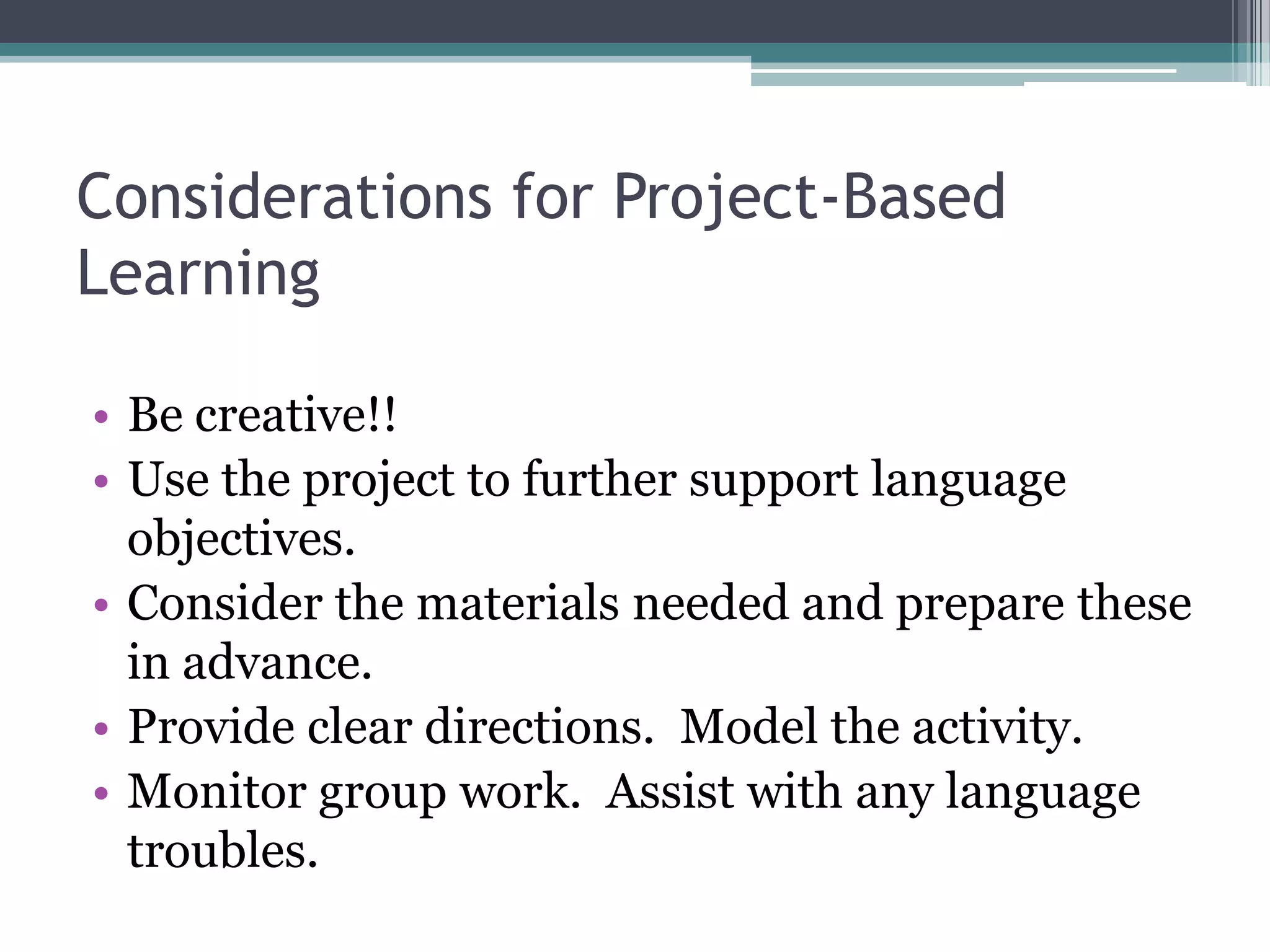
Considerations for Project-Based
Learning
• Be creative!!
• Use the project to further support language
objectives.
• Consider the materials needed and prepare these
in advance.
• Provide clear directions. Model the activity.
• Monitor group work. Assist with any language
troubles.
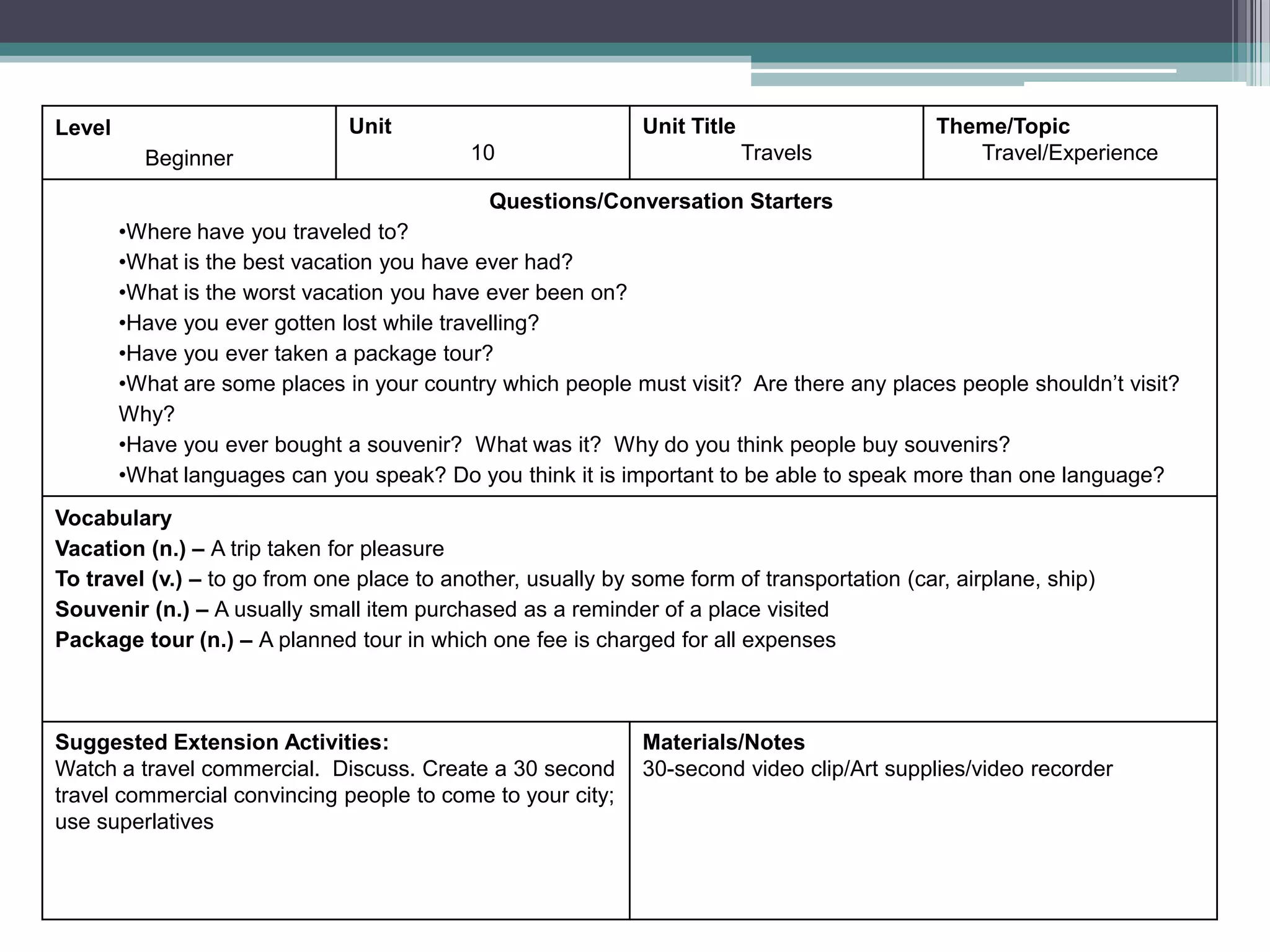
Level
Beginner
Unit
10
Unit Title
Travels
Theme/Topic
Travel/Experience
Questions/Conversation Starters
•Where have you traveled to?
•What is the best vacation you have ever had?
•What is the worst vacation you have ever been on?
•Have you ever gotten lost while travelling?
•Have you ever taken a package tour?
•What are some places in your country which people must visit? Are there any places people shouldn’t visit?
Why?
•Have you ever bought a souvenir? What was it? Why do you think people buy souvenirs?
•What languages can you speak? Do you think it is important to be able to speak more than one language?
Vocabulary
Vacation (n.) – A trip taken for pleasure
To travel (v.) – to go from one place to another, usually by some form of transportation (car, airplane, ship)
Souvenir (n.) – A usually small item purchased as a reminder of a place visited
Package tour (n.) – A planned tour in which one fee is charged for all expenses
Suggested Extension Activities:
Watch a travel commercial. Discuss. Create a 30 second
travel commercial convincing people to come to your city;
use superlatives
Materials/Notes
30-second video clip/Art supplies/video recorder
Considerations during Speaking
Eliminate the “ping-pong game”.
Let the questions serve as a starting guide. As the
teacher, you will want to clarify student answers and
ask for more information.
Students should avoid using one-word responses.
Ensure that students are using the language
previously taught by providing sentence prompts.
DON’T LET THE CONVERSATION DIE!!
In Summary
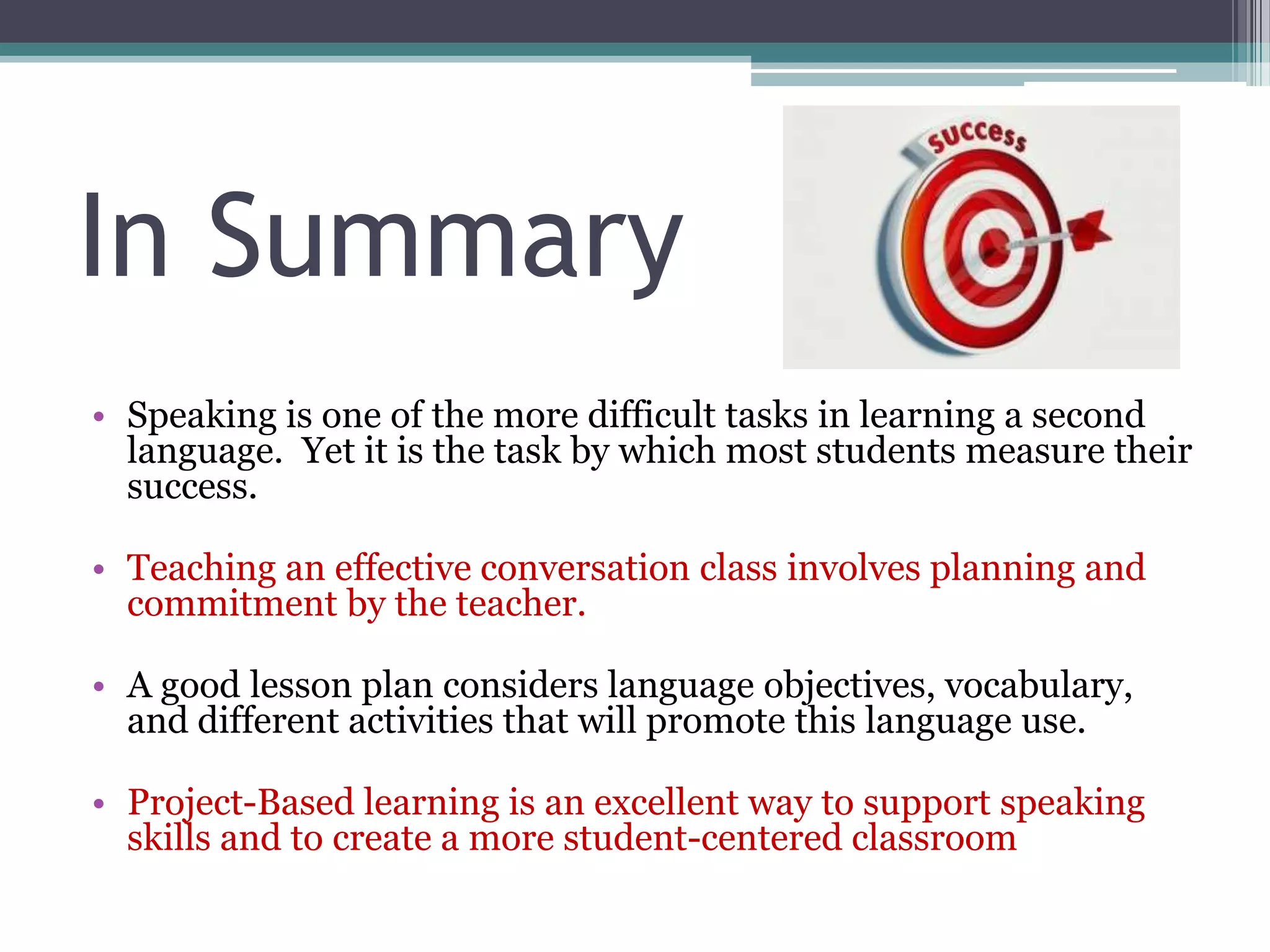
• Speaking is one of the more difficult tasks in learning a second
language. Yet it is the task by which most students measure their
success.
• Teaching an effective conversation class involves planning and
commitment by the teacher.
• A good lesson plan considers language objectives, vocabulary,
and different activities that will promote this language use.
• Project-Based learning is an excellent way to support speaking
skills and to create a more student-centered classroom
View and print this lesson plan template at
https://docs.google.com/file/d/0BzCjtd-ukPh1TlloR2pFcm5EenM/edit
Additional Resources
• www.iteslj.org/questions/
▫ A excellent resource for ESL/EFL conversation-based
questions on a variety of issues.
• www.pbl-online.org
▫ One-stop resource for project-based learning. Provides a
step-by-step guide for developing and implementing
projects in the classroom
Further Questions?
Ryan Brux
English Language Fellow
BNC – El Cultural (Tarapoto)
ryanbrux@gmail.com

Conversation ppt2nogrammar

  • 1.
    Talk Your HeadOff: Strategies for designing an Effective and Engaging ESL Conversation Class Presenter: Ryan Brux, English Language Fellow BNC – El Cultural – Tarapoto, Peru
  • 3.
    Goals and Objectives: Todescribe the importance of teaching speaking in the communicative classroom To discuss the importance of planning for a conversation class To discuss ways to integrate vocabulary in authentic speaking situations To learn how to develop extension activities that are project-based, communicative, and support language acquisition goals. To use this information to create a lesson plan for conversation purposes
  • 4.
    Consider This: •Speaking ina second language or foreign language has often been viewed as the most demanding of the four skills (Bailey and Savage 1994) •Many language learners regard speaking ability as the measure of knowing a language. These learners define fluency as the ability to converse with others. They regard speaking as the most important skill they can acquire, and they assess their progress in terms of their accomplishments in spoken communication. From The National Capital Language Resource Center
  • 5.
    Instruction Matters!! In thecommunicative model of language teaching, instructors help their students by providing authentic practice that prepares students for real-life communication situations.
  • 6.
    “By failing toprepare, you are __________.” -Benjamin Franklin
  • 7.
    “By failing toprepare, you are preparing to fail.” -Benjamin Franklin It’s all about planning your lesson!
  • 8.
    Planning… Creating an effectiveplan involves: ▫ setting realistic goals, ▫ deciding how to incorporate course textbooks and other required materials ▫ developing activities that promote learning. ▫ Determining how to assess student learning Plan with the end in mind.
  • 9.
    Before You Begin ▫What topic(s) will you talk about? ▫ What kinds of questions will you ask? ▫ What special vocabulary will students need? ▫ What kinds of activities will be used to further support instruction?
  • 10.
    For teachers usingESL/EFL books, much of this information is already available to you. Use it to help you begin planning.
  • 11.
    Level Unit UnitTitle Theme/Topic Questions/Conversation Starters Vocabulary Suggested Extension Activities Materials/Notes
  • 12.
    Step One…Identify YourFocus • Identify the ▫ Level (Beginner) ▫ Unit # (10) ▫ Unit Title (Travel) ▫ Theme/Topic (Travelling/Experiences) **Focusing on the topic of study and will help you determine level-appropriate questions/situations to present to students.
  • 13.
  • 14.
    Step 3: Developyour Questions Remember! You want your students to speak naturally. Develop questions/prompts that are topic-based and interesting. Question: Where have you travelled? Answer: I have travelled to Japan and India… Question: Tell me about your best vacation. Student: My best vacation was to India….
  • 15.
    Considerations when choosingquestions Choose questions which support language development Choose questions that relate to student lives. Draw on prior background knowledge. Choose questions (10-12??) that cover various aspects of the topic. Choose questions that increase in complexity and allow for increased talk (Why? How?) Beware of questions that might be too personal or offensive (politics, religion, etc.)
  • 16.
    Help!!! I Can’tThink of Any Questions to Ask My Students!!!
  • 17.
  • 18.
    ITESLJ.org •Provides an exhaustivelist of questions/situations for ESL conversation •Free to use. No username or password needed. Conversation Questions Travel • Have you ever been abroad? • Where have you been? • Are you planning on going anywhere for your next vacation? ▫ If so, where? ▫ Who with? ▫ How long will you stay? • Are you afraid of going abroad alone? • Could you live in another country for the rest of your life? • Describe the most interesting person you met on one of your travels. • What was your best trip. • What was your worst trip. • Did your class in high school go on a trip together? ▫ If so, where did you go? ▫ How long did you stay? ▫ How did you get there? • Do you have a driver's license? • Do you like to travel with children? Why or why not? • Do you like to travel with your mother? Why or why not? • Do you prefer summer vacations or winter vacations? • Do you prefer to travel alone or in a group? Why? • Do you prefer to travel by train, bus, plane or ship? • Do you prefer traveling by car or by plane? • Have you ever been in a difficult situation while traveling? • Have you ever been on an airplane? ▫ How many times? ▫ What airlines have you flown with? • Have you ever been to a foreign country? • Have you ever gotten lost while traveling? If so, tell about it. • Have you ever hitchhiked? If so, how many times? • Have you ever taken a package tour?
  • 19.
    Level Beginner Unit 10 Unit Title Travels Theme/Topic Travel/Experience Questions/Conversation Starters •Wherehave you traveled to? •What is the best vacation you have ever had? •What is the worst vacation you have ever been on? Describe it. •Have you ever gotten lost while travelling? What happened? How did you solve the problem? •Have you ever taken a package tour? What was included? •What are some places in your country which people must visit? Are there any places people shouldn’t visit? Why? •Have you ever bought a souvenir? What was it? Why do you think people buy souvenirs? •What languages can you speak? Do you think it is important to be able to speak more than one language? Vocabulary Suggested Extension Activities Materials/Notes
  • 20.
    Step 4: ChoosingVocabulary After you have developed your questions, you can begin to extract the vocabulary. Know what words might give students trouble. YOU KNOW YOUR STUDENTS BEST! Look at the questions. Which words will need to be taught/reviewed in order for students to understand and talk about the topic? How you teach vocabulary will depend on your individual teaching style. You may wish to define the words for yourself as an instructional support.
  • 21.
    Level Beginner Unit 10 Unit Title Travels Theme/Topic Travel/Experience Questions/Conversation Starters •Wherehave you traveled to? •What is the best vacation you have ever had? •What is the worst vacation you have ever been on? •Have you ever gotten lost while travelling? •Have you ever taken a package tour? •What are some places in your country which people must visit? Are there any places people shouldn’t visit? Why? •Have you ever bought a souvenir? What was it? Why do you think people buy souvenirs? •What languages can you speak? Do you think it is important to be able to speak more than one language? Vocabulary Vacation (n.) – A trip taken for pleasure To travel (v.) – to go from one place to another, usually by some form of transportation (car, airplane, ship) Souvenir (n.) – A usually small item purchased as a reminder of a place visited Package tour (n.) – A planned tour in which one fee is charged for all expenses Suggested Extension Activities Materials/Notes
  • 22.
    Vocabulary Considerations Do notfocus all energy on vocabulary instruction – the purpose of a speaking class is to speak! Introduce 5-8 words that might give students difficulties. Use speaking as a way to review previously learned vocabulary as well as a way to introduce new words. Use new words frequently throughout the conversation lesson. Students need multiple exposures to a word to learn it well (Lawrence, 2009; Nagy, Herman, & Anderson, 1985)
  • 23.
    Step 5: Considera Project-Based Learning (Extension) Activity Project-based learning is an instructional approach to engage students in sustained, cooperative investigation (Bransford & Stein, 1993)
  • 24.
    In Cooperative Learning… Studentswork together, negotiating meaning, applying their own perspectives, working on a culminating project.
  • 25.
    Project Based Activitiesfor Speaking: The Possibilities are Endless • Poster Presentations • Brochures • Commercials • Role Play • Story-Building w/ Language Experience Approach (LEA) • Panel discussions/talk show • Debates • Short Reading/Discussion • Create a YouTube Video • Surveys • Short Video Clip/Discussion • Retelling Stories • Talk-show • Telling Stories • Radio/T.V. Interviews • Short persuasive speeches • Audio-taped Oral Dialogue Journals • Skits/Plays • Structured interviews • Problem-solving simulations • Describing a picture • Sentence expansion activities • Jokes/Riddles • Analysis of charts, graphs, tables
  • 26.
    Specific Examples ofProject-Based Learning (Travel) • Watch a short clip from a tourism commercial. Have students discuss its effectiveness. As a follow- up, have students create a 30-second TV commercial, convincing people to visit their country. If possible, record these commercials. • Have students work together to recommend the 10 most important things that someone should bring on vacation and explain the importance of each item.
  • 27.
    Level Beginner Unit 10 Unit Title Travels Theme/Topic Travel/Experience Questions/Conversation Starters •Wherehave you traveled to? •What is the best vacation you have ever had? •What is the worst vacation you have ever been on? •Have you ever gotten lost while travelling? •Have you ever taken a package tour? •What are some places in your country which people must visit? Are there any places people shouldn’t visit? Why? •Have you ever bought a souvenir? What was it? Why do you think people buy souvenirs? •What languages can you speak? Do you think it is important to be able to speak more than one language? Vocabulary Vacation (n.) – A trip taken for pleasure To travel (v.) – to go from one place to another, usually by some form of transportation (car, airplane, ship) Souvenir (n.) – A usually small item purchased as a reminder of a place visited Package tour (n.) – A planned tour in which one fee is charged for all expenses Suggested Extension Activities: Watch a travel commercial. Discuss. Create a 30 second travel commercial convincing people to come to your city; use superlatives Materials/Notes 30-second video clip/Art supplies/video recorder
  • 28.
    Considerations for Project-Based Learning •Be creative!! • Use the project to further support language objectives. • Consider the materials needed and prepare these in advance. • Provide clear directions. Model the activity. • Monitor group work. Assist with any language troubles.
  • 29.
    Level Beginner Unit 10 Unit Title Travels Theme/Topic Travel/Experience Questions/Conversation Starters •Wherehave you traveled to? •What is the best vacation you have ever had? •What is the worst vacation you have ever been on? •Have you ever gotten lost while travelling? •Have you ever taken a package tour? •What are some places in your country which people must visit? Are there any places people shouldn’t visit? Why? •Have you ever bought a souvenir? What was it? Why do you think people buy souvenirs? •What languages can you speak? Do you think it is important to be able to speak more than one language? Vocabulary Vacation (n.) – A trip taken for pleasure To travel (v.) – to go from one place to another, usually by some form of transportation (car, airplane, ship) Souvenir (n.) – A usually small item purchased as a reminder of a place visited Package tour (n.) – A planned tour in which one fee is charged for all expenses Suggested Extension Activities: Watch a travel commercial. Discuss. Create a 30 second travel commercial convincing people to come to your city; use superlatives Materials/Notes 30-second video clip/Art supplies/video recorder
  • 30.
    Considerations during Speaking Eliminatethe “ping-pong game”. Let the questions serve as a starting guide. As the teacher, you will want to clarify student answers and ask for more information. Students should avoid using one-word responses. Ensure that students are using the language previously taught by providing sentence prompts. DON’T LET THE CONVERSATION DIE!!
  • 31.
    In Summary • Speakingis one of the more difficult tasks in learning a second language. Yet it is the task by which most students measure their success. • Teaching an effective conversation class involves planning and commitment by the teacher. • A good lesson plan considers language objectives, vocabulary, and different activities that will promote this language use. • Project-Based learning is an excellent way to support speaking skills and to create a more student-centered classroom
  • 32.
    View and printthis lesson plan template at https://docs.google.com/file/d/0BzCjtd-ukPh1TlloR2pFcm5EenM/edit Additional Resources • www.iteslj.org/questions/ ▫ A excellent resource for ESL/EFL conversation-based questions on a variety of issues. • www.pbl-online.org ▫ One-stop resource for project-based learning. Provides a step-by-step guide for developing and implementing projects in the classroom
  • 33.
    Further Questions? Ryan Brux EnglishLanguage Fellow BNC – El Cultural (Tarapoto) ryanbrux@gmail.com