OUTLINE
• What islistening ?
• Why listening is important?
• Steps in the listening process
• types of listening
• Listening skills
• Intensive vs extensive listening
• What kind of listeners are you?
• Factors that may affect listening process
• frame work for task- based teaching
•Planning to teach listening
3.
We have twoears and one mouth so that
we can listen twice as much as we speak.
~ Epictetus
4.
What is listening?
• It is a physical and psychological process that involves choosing to listen,
understanding, and responding to symbolic messages from others
• Listening is considered to be the one of the most important part of the oral
communication.
5.
Why is listeningimportant?
Listening will help you in…
•School
•Relationships
•Social groups &
organizations
•Making decisions
•job
6.
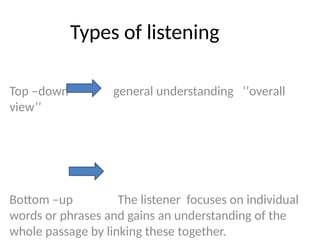
Types of listening
Top–down general understanding ‘’overall
view’’
Bottom –up The listener focuses on individual
words or phrases and gains an understanding of the
whole passage by linking these together.
7.
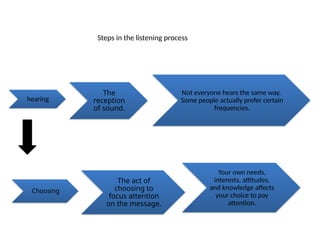
Steps in thelistening process
hearing
The
reception
of sound.
Not everyone hears the same way.
Some people actually prefer certain
frequencies.
Choosing
The act of
choosing to
focus attention
on the message.
Your own needs,
interests, attitudes,
and knowledge affects
your choice to pay
attention.
8.
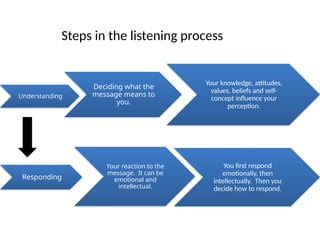
Steps in thelistening process
Understanding
Deciding what the
message means to
you.
Your knowledge, attitudes,
values, beliefs and self-
concept influence your
perception.
Responding
Your reaction to the
message. It can be
emotional and
intellectual.
You first respond
emotionally, then
intellectually. Then you
decide how to respond.
9.
Listening skills
•Identifying thetopic
•Predicting and guessing
•Listening for general understanding
•Listening for specific or detailed information
•Interpreting a text/making inferences
10.
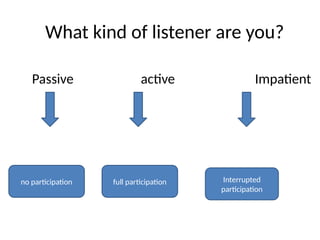
What kind oflistener are you?
Passive active Impatient
no participation full participation Interrupted
participation
11.
Intensive vs extensivelistening
Extensive listening for pleasure (listening on your own;
because you want to)
Intensive listening for a purpose (often done with the
teacher’s help; because you have to)
12.
Factors that mayaffect listening process
• Noise – Internal and external distractions
– Examples: outside sounds, distracting thoughts
• Barriers – Blocks listening/understanding.
– Unfamiliar language, anger, attitudes, biases, needs, beliefs, fear,
hearing problems, stress, ignorance, prejudices, tiredness.
• Memory – 3 types
– Immediate – Recalling information for a brief period of time.
– Short term – Recalling information for carrying out a routine or daily
task.
– Long term – Recalling information from past experience.
13.
framework for task-basedteaching
• It is a comprehensive framework suggested by, jane willis (1996),
it consists of three main stages.
1) Pre-task stage which involes :
• Introducing the topic.
• Introducing the tasks.
• Modling by presenting a picture or a video demonstrating the
task .
• Triggering and re-organizing the existing strutures.
14.
framework for task-basedteaching
2) During the task phase :
• Students complete tasks depending on the nature f the activity
• This stage involves a lot of practice
3) Post –task phase:
• Teacher reviews what has been done in the during task phase
• Teacher selects language areas to practice based on the needs of
the students
• Activities that provide more exposure to language are presented
15.
Planning to teachlistening
Pre-listening
1) What students need to know before listening:
• When the teacher says “Listen to this,” and starts playing the
recording, students may have no idea what to expect.
• Without a clear context connected speech often becomes
inaccessible.
• Contextual information-who is speaking? Where is the
conversation taking place?
16.
Planning to teachlistening
• Information concerning the topic is another
important factor.
• It allows listeners to predict what a speaker will say
and how they will say it.
17.
Planning to teachlistening
• 2) Activating schemata/predicting
• Brainstorming
-From one to many
-Poster display
-Board writing
• Visuals
-Pictures
-Picture story
18.
Planning to teachlistening
• 3) Establishing reasons for listening :
• Teachers need to give students a purpose for listening.
• Make the purpose realistic
• Make the goal achievable
• Get the students involved. If they have invested time, effort
and thought in the material, they are more likely to listen
successfully.
19.
Planning to teachlistening
• 4) Pre-Teaching Vocabulary:
• If the teacher thinks that there are a number
of words that will be unknown to the
students, and that these words are essential
to the meaning of the passage, probably
better to pre-teach.
• Pre-teach vocabulary may give students some
20.
Planning to teachlistening
• 5) Things to avoid during the pre-listening stage
• Don’t let the pre-listening stage drag on. Make
it short and fact paced.
• Don’t give away too much information to the
students.
• Pre-listening activities must be entirely
relevant to what the students will hear.
21.
Planning to teachlistening
While –listening
• 1) Listening for gist
• Gist = main idea
• Before any discussion is developed, the students have to
grasp the overall communicative intention of the speaker
• Examples of gist questions:
– What problems are they discussing?
– What does the speaker think of the topic?
– Look at the pictures. Who are the speakers talking about?
22.
Planning to teachlistening
• 2) Listening for details
Try to play the recording once for overall
comprehension and then for specific details.
Take notes ( dates, places, people)
• Repeat the recording especially in the difficult
parts
• Times, dates, numbers
23.
Planning to teachlistening
Post-listening
• Compare their notes in small groups.
• Encourage debates and answer questions.
• Write a summary of the main points and then
compare.
• Make a list of any new vocabulary.