Special Considerations in Listening and Speaking#. GROUP 3So, YunJoungLee, Ju HyunRyu, YeonJooLee, JiYeonYou, KyoungCourse Number  TitleEESL542D Listening and Speaking in TESOL
Table of Contents1. A variety of teaching resources in Listening2. Various environment for listening. 2[SPECIAL CONSIDERATIONS IN LISTENING]p. 5 ~ 9••••••••••••••••••••p. 10 ~ 14••••••••••••••••••••••••••••••••••3. Offering various testing methodsp. 15 ~ 19••••••••••••••••••••••••••••••••••[SPECIAL CONSIDERATIONS IN SPEAKING]1. Offering comfortable learning environmentp. 21 ~ 22•••••••••••••••••••2. Reinforcing student-centered instructionp. 23 ~ 25••••••••••••••••••••••••3. Focusing on communicative competencyp. 26 ~ 27••••••••••••••••••••••••4. Having confidence in teachingp. 28 ~ 31•••••••••••••••••••••••••••••••••••••
Let us start off by introducing ourselves 3▶ GROUP #3LEADER Hello, everyone We are group #3.Please listen carefully!  Are you ready? LISTENINGSPEAKINGJi-yeon LeeKyoung YouYeon-jooRyuJu-hyun LeeYun-joung So
SPECIAL CONSIDERATIONSIN LISTENING1. A variety of teaching resources in Listening- By. Ji-yeon Lee2. Various environment for listening. - By. Kyoung You3. Offering various testing methods- By. Yeon-jooRyu
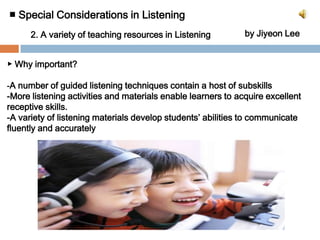
■ Special Considerations in Listening by Jiyeon Lee2. A variety of teaching resources in Listening		▶ Why important? -A number of guided listening techniques contain a host of subskills-More listening activities and materials enable learners to acquire excellent receptive skills.-A variety of listening materials develop students’ abilities to communicate fluently and accurately
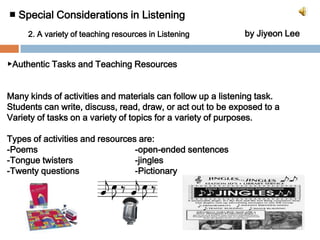
■ Special Considerations in Listening by Jiyeon Lee2. A variety of teaching resources in Listening▶Authentic Tasks and Teaching ResourcesMany kinds of activities and materials can follow up a listening task.Students can write, discuss, read, draw, or act out to be exposed to a Variety of tasks on a variety of topics for a variety of purposes.Types of activities and resources are:-Poems				-open-ended sentences-Tongue twisters		-jingles-Twenty questions 		-Pictionary
■ Special Considerations in Listening 2. A variety of teaching resources in Listeningby Jiyeon Lee▶ProblemsBoth teachers and students are not familiar with techniques and guidelines for supporting and developing student listening and speaking skills.
To speak and listen fluently and accurately in a second language, language learners need to be able to comprehend and produce in a native-like fashion-stress, intonation, rhythm, pacing, gestures, and body language. ■ Special Considerations in Listening 2. A variety of teaching resources in Listening		by Jiyeon Lee▶Solution 1-Computers can make reluctant English language learners speak English by providing them with increased opportunities, less teacher fronting, and the authentic and challenging situations.-Learners can speak around the computer, or learners can speak through the computer. Some software programs and Web sites provide learners with opportunities to speak with the computer. When designing technology-supported language learning tasks, teachers can use one or more of these structures as appropriate for learners.
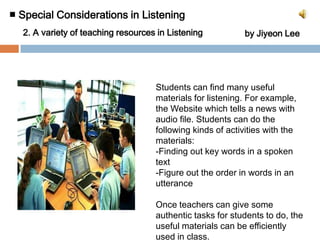
■ Special Considerations in Listening 2. A variety of teaching resources in Listening		by Jiyeon LeeStudents can find many useful materials for listening. For example, the Website which tells a news with audio file. Students can do the following kinds of activities with the materials:Finding out key words in a spoken text
Figure out the order in words in an utteranceOnce teachers can give some authentic tasks for students to do, the useful materials can be efficiently used in class.
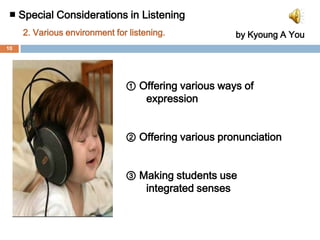
■ Special Considerations in Listening 2.Various environment for listening. by Kyoung A You① Offering various ways of               expression② Offering various pronunciation③ Making students use        integrated senses10
■ Special Considerations in Listening 2. Various environment for listening. by Kyoung A You① Offering various ways of expression▶ Why important?Language can be expressed in diverse ways of the speakers depending       on situations or how the speakers are feeling.▶ Solution - Expressions which are same phrases can be used with a different    meaning and in different situations. (sarcasm) - Variety of contents relating to situations using more realistic materials    such as audio book, drama, and news casting should be provided to   show diverse situations.11
■ Special Considerations in Listening 2. Various environment for listening. by Kyoung A You② Offering variant pronunciation▶ Why important?   Listeners can understand the speaker according to the speakers’   intonation, speed, and accent. We can call this English variation.▶ Solution - Need to expose many kinds of pronunciations such as telephoning   with foreign English speakers so that chances to experience different    kinds of accents are given.   ( ex. video telephone with foreigners) - Furnish contents which are related to pronunciation from Europe, Asia           etc and inform regional variations in pronunciation.    ( e.g: Either aɪðə(r) ; |i:ðə(r) )12
■ Special Considerations in Listening 2. Various environment for listening. by Kyoung A You③ Making students use integrated senses▶ Why important?   Listening comprehension can’t be achieved when learners are keeping               focused on listening separately. Listening is not just about hearing words,           it is about recognizing the feeling of the speakers.    Listening comprehension can be improved with various senses.▶ Solution - Provide integrated practice using various senses. Listeners can understand    exactness when they look at speaker’s facial expressions or the shape of     the mouth. - Instruct useful gestures. Most people use many gestures when they    speak. Listeners may guess what he/she says through the speaker’s    gestures.  13
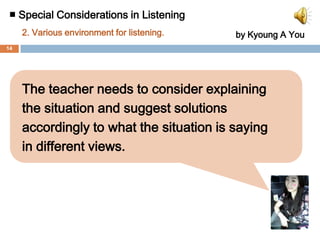
The teacher needs to consider explainingthe situation and suggest solutions accordingly to what the situation is saying in different views.14■ Special Considerations in Listening 2. Various environment for listening. by Kyoung A You
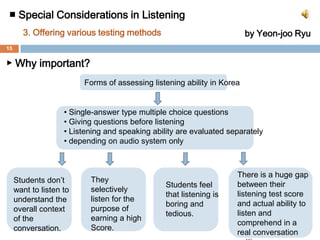
■ Special Considerations in Listening 3. Offering various testing methodsby Yeon-jooRyu▶ Why important?  Forms of assessing listening ability in Korea• Single-answer type multiple choice questions• Giving questions before listening• Listening and speaking ability are evaluated separately• depending on audio system onlyThere is a huge gap between their listening test score and actual ability to listen and comprehend in a real conversation setting.They selectively listen for the purpose of earning a high Score.Students don’t want to listen to understand the overall context of the conversation.Students feel that listening is boring and tedious.15
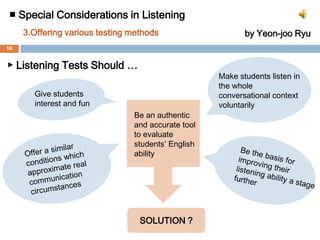
■ Special Considerations in Listening 3.Offering various testing methodsby Yeon-jooRyu▶ Listening Tests Should …Make students listen in the whole  conversational context voluntarilyGive students interest and fun Be an authentic  and accurate tool to evaluate students’ English ability Offer a similar  conditions which approximate real communication circumstances Be the basis for improving their listening ability a stage further SOLUTION ? 16
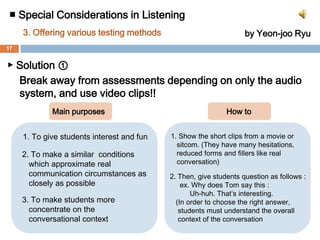
■ Special Considerations in Listening 3. Offering various testing methodsby Yeon-jooRyu▶ Solution ①Break away from assessments depending on only the audio system, and use video clips!!  Main purposesHow to1. To give students interest and fun1. Show the short clips from a movie or        sitcom. (They havemany hesitations,        reduced forms and fillers like real    conversation)2. To make a similar  conditions   which approximate real   communication circumstances as         closely as possible2. Then, give students question as follows :ex.Why does Tom say this :           Uh-huh. That’s interesting.    (In order to choose the right answer,    students must understand the overall           context of the conversation3. To make students more   concentrate on the    conversational context17
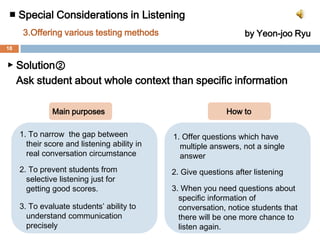
■ Special Considerations in Listening 3.Offering various testing methodsby Yeon-jooRyu▶ Solution②Ask student about whole context than specific information Main purposesHow to1. To narrow  the gap between    their score and listening ability in    real conversation circumstance 1. Offer questions which have   multiple answers, not a single   answer2. To prevent students from    selective listening just for    getting good scores.2. Give questions after listening3. When you need questions about    specific information of     conversation, notice students that    there will be one more chance to    listen again. 3. To evaluate students’ ability to     understand communication    precisely 18
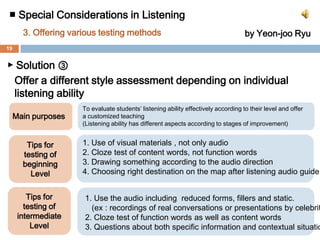
■ Special Considerations in Listening 3. Offering various testing methodsby Yeon-jooRyu▶ Solution ③Offer a different style assessment depending on individual listening ability To evaluate students’listening ability effectively according to their level and offer a customized teaching (Listening ability has different aspects according to stages of improvement)Main purposesTips for testing ofbeginning Level1. Use of visual materials , not only audio  2. Cloze test of content words, not function words3. Drawing something according to the audio direction4. Choosing right destination on the map after listening audio guideTips for testing ofintermediateLevel1. Use the audio including  reduced forms, fillers and static.    (ex : recordings of real conversations or presentations by celebrities) 2. Cloze test of function words as well as content words3. Questions about both specific information and contextual situation19
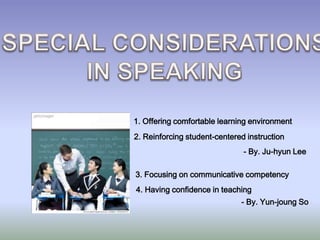
SPECIAL CONSIDERATIONSIN SPEAKING1.Offering comfortable learning environment2.Reinforcing student-centered instruction- By. Ju-hyun Lee3. Focusing on communicative competency  4. Having confidence in teaching - By. Yun-joung So
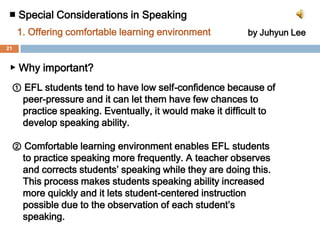
■ Special Considerations in Speaking 1.Offering comfortable learning environmentby Juhyun Lee▶ Why important?  ① EFL students tend to have low self-confidence because of    peer-pressure and it can let them have few chances to    practice speaking. Eventually, it would make it difficult to    develop speaking ability.② Comfortable learning environment enables EFLstudents    to practice speaking more frequently. A teacher observes    and corrects students’ speaking while they are doing this.    This process makes students speaking ability increased    more quickly and it lets student-centered instruction    possible due to the observation of each student’s    speaking.21
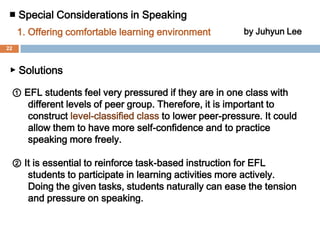
■ Special Considerations in Speaking 1.Offering comfortable learning environmentby Juhyun Lee▶ Solutions  ① EFL students feel very pressured if they are in one class with different levels of peer group. Therefore, it is important to construct level-classified class to lower peer-pressure. It could allow them to have more self-confidence and to practice speaking more freely.② It is essential to reinforce task-based instruction for EFL students to participate in learning activities more actively. Doing the given tasks, students naturally can ease the tension and pressure on speaking.22
■ Special Considerations in Speaking by Juhyun Lee2. Reinforcing student-centered instruction▶ Why important?  ① Each EFL student has different learning speed in language acquisition.② Every EFL student has different learning style.③ EFL students have difficulty increasing their communicative    competence in teacher-centered instruction. ④ Student-centered instruction lets students have more    interest and self-confidence in language acquisition and it    enables them to autonomy in speaking learning.23
■ Special Considerations in Speaking 2.Reinforcing student-centered instructionby Juhyun Lee▶ Solutions  ① Diversification of learning materials     : For example, a multimedia would be a very effective learning materials to learn a language since it includes text, graphics, audio, video, and more. Seeing, hearing, and speaking English through use of multimedia, EFL students are able to recognize the difference between “live” and written English. By listening to pop songs with lyrics and watching American TV series or movies with subtitles, they can actually acquire English expressions and pronunciation, and they can get used to American culture naturally.24
■ Special Considerations in Speaking by Juhyun Lee2.Reinforcing student-centered instruction▶ Solutions  ② Teacher’s continuous observation and error-correction on     students’ speaking    : While students are practicing speaking, teacher should observe the spoken language and give a correction on students’ speaking errors. It’s because feedback is a crucial element in student-centered instruction.③ Reinforcement of task-based instruction    : Taking part in learning activities, EFL students focus on the given tasks and ease off the pressure on speaking. Naturally, they can develop their speaking ability.25
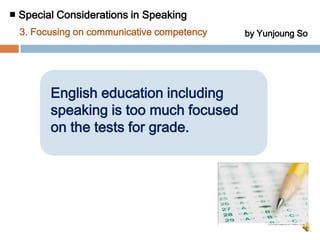
■ Special Considerations in Speaking 3. Focusing on communicative competencyby Yunjoung SoEnglish education including speaking is too much focused on the tests for grade.
■ Special Considerations in Speaking 3. Focusing on communicative competencyby Yunjoung So▶SolutionsFocusing on communicative competency① Teachers make students regard English speaking as an oral     interaction and communicative competence not as a test subject.② Teachers offer friendly English-speaking environment  to students.③ Teachers encourage students to speak out for real communication        despite limited proficiency of  students.
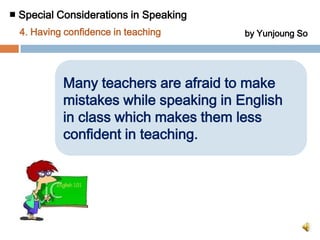
■ Special Considerations in Speaking 4. Having confidence in teaching by Yunjoung SoMany teachers are afraid to make mistakes while speaking in English in class which makes them less confident in teaching.
■ Special Considerations in Speaking 4. Having confidence in teaching by Yunjoung So▶Solutions ① Teachers try to feel free to speak in English in front of their     students without burden on making mistakes.② Teachers teach students that nobody is perfect and nobody    knows everything in speaking second language.③ Teachers tell students non-native usage as well as native     usage both can serve as models for speaking.
■ Special Considerations in Speaking 4. Having confidence in teaching by Yunjoung SoEnjoy Speaking! Speaking has always been a major focus in language teaching. However, both the natureof speaking skills and approaches have undergone many changes. Teachers can help students improve speaking ability, providing them solutions for difficulties.

Special considerations in listening and speaking (GROUP3)

  • 1.
    Special Considerations inListening and Speaking#. GROUP 3So, YunJoungLee, Ju HyunRyu, YeonJooLee, JiYeonYou, KyoungCourse Number TitleEESL542D Listening and Speaking in TESOL
  • 2.
    Table of Contents1.A variety of teaching resources in Listening2. Various environment for listening. 2[SPECIAL CONSIDERATIONS IN LISTENING]p. 5 ~ 9••••••••••••••••••••p. 10 ~ 14••••••••••••••••••••••••••••••••••3. Offering various testing methodsp. 15 ~ 19••••••••••••••••••••••••••••••••••[SPECIAL CONSIDERATIONS IN SPEAKING]1. Offering comfortable learning environmentp. 21 ~ 22•••••••••••••••••••2. Reinforcing student-centered instructionp. 23 ~ 25••••••••••••••••••••••••3. Focusing on communicative competencyp. 26 ~ 27••••••••••••••••••••••••4. Having confidence in teachingp. 28 ~ 31•••••••••••••••••••••••••••••••••••••
  • 3.
    Let us startoff by introducing ourselves 3▶ GROUP #3LEADER Hello, everyone We are group #3.Please listen carefully! Are you ready? LISTENINGSPEAKINGJi-yeon LeeKyoung YouYeon-jooRyuJu-hyun LeeYun-joung So
  • 4.
    SPECIAL CONSIDERATIONSIN LISTENING1.A variety of teaching resources in Listening- By. Ji-yeon Lee2. Various environment for listening. - By. Kyoung You3. Offering various testing methods- By. Yeon-jooRyu
  • 5.
    ■ Special Considerationsin Listening by Jiyeon Lee2. A variety of teaching resources in Listening ▶ Why important? -A number of guided listening techniques contain a host of subskills-More listening activities and materials enable learners to acquire excellent receptive skills.-A variety of listening materials develop students’ abilities to communicate fluently and accurately
  • 6.
    ■ Special Considerationsin Listening by Jiyeon Lee2. A variety of teaching resources in Listening▶Authentic Tasks and Teaching ResourcesMany kinds of activities and materials can follow up a listening task.Students can write, discuss, read, draw, or act out to be exposed to a Variety of tasks on a variety of topics for a variety of purposes.Types of activities and resources are:-Poems -open-ended sentences-Tongue twisters -jingles-Twenty questions -Pictionary
  • 7.
    ■ Special Considerationsin Listening 2. A variety of teaching resources in Listeningby Jiyeon Lee▶ProblemsBoth teachers and students are not familiar with techniques and guidelines for supporting and developing student listening and speaking skills.
  • 8.
    To speak andlisten fluently and accurately in a second language, language learners need to be able to comprehend and produce in a native-like fashion-stress, intonation, rhythm, pacing, gestures, and body language. ■ Special Considerations in Listening 2. A variety of teaching resources in Listening by Jiyeon Lee▶Solution 1-Computers can make reluctant English language learners speak English by providing them with increased opportunities, less teacher fronting, and the authentic and challenging situations.-Learners can speak around the computer, or learners can speak through the computer. Some software programs and Web sites provide learners with opportunities to speak with the computer. When designing technology-supported language learning tasks, teachers can use one or more of these structures as appropriate for learners.
  • 9.
    ■ Special Considerationsin Listening 2. A variety of teaching resources in Listening by Jiyeon LeeStudents can find many useful materials for listening. For example, the Website which tells a news with audio file. Students can do the following kinds of activities with the materials:Finding out key words in a spoken text
  • 10.
    Figure out theorder in words in an utteranceOnce teachers can give some authentic tasks for students to do, the useful materials can be efficiently used in class.
  • 11.
    ■ Special Considerationsin Listening 2.Various environment for listening. by Kyoung A You① Offering various ways of expression② Offering various pronunciation③ Making students use integrated senses10
  • 12.
    ■ Special Considerationsin Listening 2. Various environment for listening. by Kyoung A You① Offering various ways of expression▶ Why important?Language can be expressed in diverse ways of the speakers depending on situations or how the speakers are feeling.▶ Solution - Expressions which are same phrases can be used with a different meaning and in different situations. (sarcasm) - Variety of contents relating to situations using more realistic materials such as audio book, drama, and news casting should be provided to show diverse situations.11
  • 13.
    ■ Special Considerationsin Listening 2. Various environment for listening. by Kyoung A You② Offering variant pronunciation▶ Why important? Listeners can understand the speaker according to the speakers’ intonation, speed, and accent. We can call this English variation.▶ Solution - Need to expose many kinds of pronunciations such as telephoning with foreign English speakers so that chances to experience different kinds of accents are given. ( ex. video telephone with foreigners) - Furnish contents which are related to pronunciation from Europe, Asia etc and inform regional variations in pronunciation. ( e.g: Either aɪðə(r) ; |i:ðə(r) )12
  • 14.
    ■ Special Considerationsin Listening 2. Various environment for listening. by Kyoung A You③ Making students use integrated senses▶ Why important? Listening comprehension can’t be achieved when learners are keeping focused on listening separately. Listening is not just about hearing words, it is about recognizing the feeling of the speakers. Listening comprehension can be improved with various senses.▶ Solution - Provide integrated practice using various senses. Listeners can understand exactness when they look at speaker’s facial expressions or the shape of the mouth. - Instruct useful gestures. Most people use many gestures when they speak. Listeners may guess what he/she says through the speaker’s gestures. 13
  • 15.
    The teacher needsto consider explainingthe situation and suggest solutions accordingly to what the situation is saying in different views.14■ Special Considerations in Listening 2. Various environment for listening. by Kyoung A You
  • 16.
    ■ Special Considerationsin Listening 3. Offering various testing methodsby Yeon-jooRyu▶ Why important? Forms of assessing listening ability in Korea• Single-answer type multiple choice questions• Giving questions before listening• Listening and speaking ability are evaluated separately• depending on audio system onlyThere is a huge gap between their listening test score and actual ability to listen and comprehend in a real conversation setting.They selectively listen for the purpose of earning a high Score.Students don’t want to listen to understand the overall context of the conversation.Students feel that listening is boring and tedious.15
  • 17.
    ■ Special Considerationsin Listening 3.Offering various testing methodsby Yeon-jooRyu▶ Listening Tests Should …Make students listen in the whole conversational context voluntarilyGive students interest and fun Be an authentic and accurate tool to evaluate students’ English ability Offer a similar conditions which approximate real communication circumstances Be the basis for improving their listening ability a stage further SOLUTION ? 16
  • 18.
    ■ Special Considerationsin Listening 3. Offering various testing methodsby Yeon-jooRyu▶ Solution ①Break away from assessments depending on only the audio system, and use video clips!! Main purposesHow to1. To give students interest and fun1. Show the short clips from a movie or sitcom. (They havemany hesitations, reduced forms and fillers like real conversation)2. To make a similar conditions which approximate real communication circumstances as closely as possible2. Then, give students question as follows :ex.Why does Tom say this : Uh-huh. That’s interesting. (In order to choose the right answer, students must understand the overall context of the conversation3. To make students more concentrate on the conversational context17
  • 19.
    ■ Special Considerationsin Listening 3.Offering various testing methodsby Yeon-jooRyu▶ Solution②Ask student about whole context than specific information Main purposesHow to1. To narrow the gap between their score and listening ability in real conversation circumstance 1. Offer questions which have multiple answers, not a single answer2. To prevent students from selective listening just for getting good scores.2. Give questions after listening3. When you need questions about specific information of conversation, notice students that there will be one more chance to listen again. 3. To evaluate students’ ability to understand communication precisely 18
  • 20.
    ■ Special Considerationsin Listening 3. Offering various testing methodsby Yeon-jooRyu▶ Solution ③Offer a different style assessment depending on individual listening ability To evaluate students’listening ability effectively according to their level and offer a customized teaching (Listening ability has different aspects according to stages of improvement)Main purposesTips for testing ofbeginning Level1. Use of visual materials , not only audio 2. Cloze test of content words, not function words3. Drawing something according to the audio direction4. Choosing right destination on the map after listening audio guideTips for testing ofintermediateLevel1. Use the audio including reduced forms, fillers and static. (ex : recordings of real conversations or presentations by celebrities) 2. Cloze test of function words as well as content words3. Questions about both specific information and contextual situation19
  • 21.
    SPECIAL CONSIDERATIONSIN SPEAKING1.Offeringcomfortable learning environment2.Reinforcing student-centered instruction- By. Ju-hyun Lee3. Focusing on communicative competency 4. Having confidence in teaching - By. Yun-joung So
  • 22.
    ■ Special Considerationsin Speaking 1.Offering comfortable learning environmentby Juhyun Lee▶ Why important? ① EFL students tend to have low self-confidence because of peer-pressure and it can let them have few chances to practice speaking. Eventually, it would make it difficult to develop speaking ability.② Comfortable learning environment enables EFLstudents to practice speaking more frequently. A teacher observes and corrects students’ speaking while they are doing this. This process makes students speaking ability increased more quickly and it lets student-centered instruction possible due to the observation of each student’s speaking.21
  • 23.
    ■ Special Considerationsin Speaking 1.Offering comfortable learning environmentby Juhyun Lee▶ Solutions ① EFL students feel very pressured if they are in one class with different levels of peer group. Therefore, it is important to construct level-classified class to lower peer-pressure. It could allow them to have more self-confidence and to practice speaking more freely.② It is essential to reinforce task-based instruction for EFL students to participate in learning activities more actively. Doing the given tasks, students naturally can ease the tension and pressure on speaking.22
  • 24.
    ■ Special Considerationsin Speaking by Juhyun Lee2. Reinforcing student-centered instruction▶ Why important? ① Each EFL student has different learning speed in language acquisition.② Every EFL student has different learning style.③ EFL students have difficulty increasing their communicative competence in teacher-centered instruction. ④ Student-centered instruction lets students have more interest and self-confidence in language acquisition and it enables them to autonomy in speaking learning.23
  • 25.
    ■ Special Considerationsin Speaking 2.Reinforcing student-centered instructionby Juhyun Lee▶ Solutions ① Diversification of learning materials : For example, a multimedia would be a very effective learning materials to learn a language since it includes text, graphics, audio, video, and more. Seeing, hearing, and speaking English through use of multimedia, EFL students are able to recognize the difference between “live” and written English. By listening to pop songs with lyrics and watching American TV series or movies with subtitles, they can actually acquire English expressions and pronunciation, and they can get used to American culture naturally.24
  • 26.
    ■ Special Considerationsin Speaking by Juhyun Lee2.Reinforcing student-centered instruction▶ Solutions ② Teacher’s continuous observation and error-correction on students’ speaking : While students are practicing speaking, teacher should observe the spoken language and give a correction on students’ speaking errors. It’s because feedback is a crucial element in student-centered instruction.③ Reinforcement of task-based instruction : Taking part in learning activities, EFL students focus on the given tasks and ease off the pressure on speaking. Naturally, they can develop their speaking ability.25
  • 27.
    ■ Special Considerationsin Speaking 3. Focusing on communicative competencyby Yunjoung SoEnglish education including speaking is too much focused on the tests for grade.
  • 28.
    ■ Special Considerationsin Speaking 3. Focusing on communicative competencyby Yunjoung So▶SolutionsFocusing on communicative competency① Teachers make students regard English speaking as an oral interaction and communicative competence not as a test subject.② Teachers offer friendly English-speaking environment to students.③ Teachers encourage students to speak out for real communication despite limited proficiency of students.
  • 29.
    ■ Special Considerationsin Speaking 4. Having confidence in teaching by Yunjoung SoMany teachers are afraid to make mistakes while speaking in English in class which makes them less confident in teaching.
  • 30.
    ■ Special Considerationsin Speaking 4. Having confidence in teaching by Yunjoung So▶Solutions ① Teachers try to feel free to speak in English in front of their students without burden on making mistakes.② Teachers teach students that nobody is perfect and nobody knows everything in speaking second language.③ Teachers tell students non-native usage as well as native usage both can serve as models for speaking.
  • 31.
    ■ Special Considerationsin Speaking 4. Having confidence in teaching by Yunjoung SoEnjoy Speaking! Speaking has always been a major focus in language teaching. However, both the natureof speaking skills and approaches have undergone many changes. Teachers can help students improve speaking ability, providing them solutions for difficulties.