

With
Khaled M. Al-Abbadi
   Welcome to “ESCP (Semester 2) : Listening
    Comprehension”

    ◦ This is a 25 hour Practical Course
    ◦ It starts from Today until May 3rd
    ◦ We will meet every Wednesday from 4pm-6pm and
      every Thursday from 8am-10am.

    ◦ I really, really hope that you will enjoy this class
    ◦ I really, really hope that you will learn something…
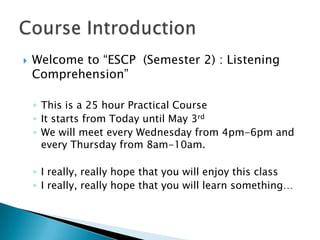
   My name is
                               Khaled Al-Abbadi

                              I’m your teacher.
                              I’m responsible for
                               grading your work.
                              You can call me…
                               ◦   Khaled
                               ◦   Mr. Khaled
                               ◦   Sidi Khaled
                               ◦   King Khaled…etc…


This is me in Saudi Arabia, about to eat some Kabsa.
This is me getting a really bad haircut in Yemen
This is my lovely daughter Huda…
She’s almost 3 years old…
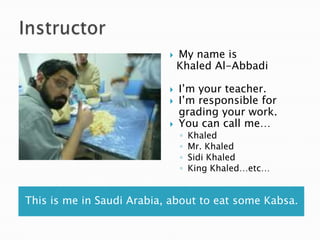
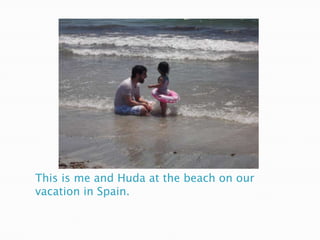
This is me and Huda at the beach on our
vacation in Spain.
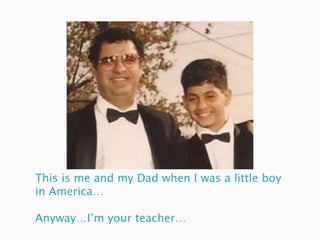
This is me and my Dad when I was a little boy
in America…

Anyway…I’m your teacher…
   Course Description and Objectives:
    ◦ Our Objectives are Real Simple:
      1. Develop Listening Skills
      2. Learn Good Listening Strategies
      3. Understand the different contexts of Listening

    ◦ We will do this by:
      1. Discussing Listening contexts and strategies.
      2. Practicing Listening in the classroom.
      3. Doing Listening assignments outside the classroom.
   Topics Discussed:
    ◦ This course is a practical approach to listening.
    ◦ We will discuss 4 main listening contexts and strategies.
    ◦ These 4 contexts are:

       1. Listening to Narratives
         (For example: Listening to a boring story from your teacher)

       2. Listening for Specific Information and Data
         (For example: Listening to a boring story from your teacher with a lot of facts)

       3. Listening in Conversational Contexts
         (For example: Listening to a boring story from your teacher and having to respond to
            your teacher)

       4. Listening to Extended Discourse
         (For example: Listening to a boring story from your teacher, with a lot of facts, for a
            really long time…)
   Regarding Materials:
    ◦ I will provide all class material, which means there
      is no textbook, copies, or anything like that…

    ◦ However, you are responsible for;
      Having a pen
      Having a notebook
        To take notes and for class activities
      Having access to internet
        To download mp3s for homework assignments
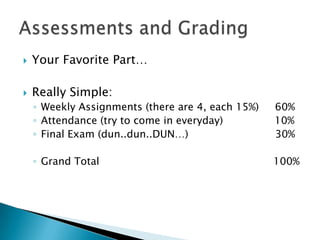
   Your Favorite Part…

   Really Simple:
    ◦ Weekly Assignments (there are 4, each 15%)   60%
    ◦ Attendance (try to come in everyday)         10%
    ◦ Final Exam (dun..dun..DUN…)                  30%

    ◦ Grand Total                                  100%
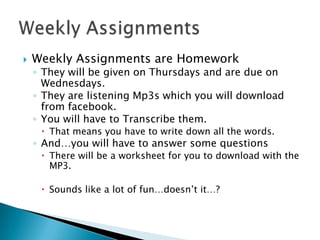
   Weekly Assignments are Homework
    ◦ They will be given on Thursdays and are due on
      Wednesdays.
    ◦ They are listening Mp3s which you will download
      from facebook.
    ◦ You will have to Transcribe them.
      That means you have to write down all the words.
    ◦ And…you will have to answer some questions
      There will be a worksheet for you to download with the
       MP3.

      Sounds like a lot of fun…doesn’t it…?
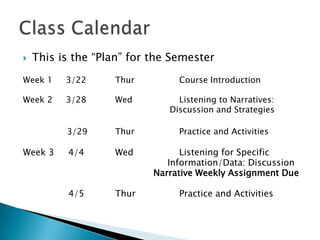
   This is the “Plan” for the Semester
Week 1    3/22     Thur         Course Introduction

Week 2    3/28     Wed          Listening to Narratives:
                              Discussion and Strategies

          3/29     Thur         Practice and Activities

Week 3    4/4      Wed           Listening for Specific
                              Information/Data: Discussion
                           Narrative Weekly Assignment Due

          4/5      Thur         Practice and Activities
Week 4   4/11     Wed         Spring Break Vacation
         4/12     Thur        Spring Break Vacation

Week 5   4/18     Wed          Listening in Conversation:
                               Discussion and Strategies
                   Spec. Info/Data Weekly Assignment Due

         4/19     Thur        Practice and Activities

         4/XX   Some Day    Makeup Session: More Practice
                                  and Activities

Week 6   4/25       Wed           Listening to Extended
                                  Discourse: Discussion
                           Conversations Weekly Assignment Due

         4/26       Thur          Practice and Activities

         4/XX       Some Day      Makeup Session: More
                                  Practice and Activities

Week 7   5/2 Wed                Course Review of Listening
                                 Contexts and Strategies
                      Extended Discourse Weekly Assignment Due

         5/3 Thur                Final Exam
   All of this should be in your Syllabus
   I will try to have this available on Facebook
    for you to download…

   Anyone have any:
    ◦   Questions,
    ◦   Comments,
    ◦   Insults,
    ◦   Something you want to throw at me…
    ◦   Anything…?
What is Listening?
   How would you define…Listening?

   What is the difference
    between…Listening…and…Hearing?

   Is all…Listening…the same or is there a
    difference?

   How can you improve your…Listening?
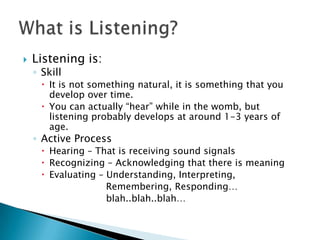
   Listening is:
    ◦ Skill
       It is not something natural, it is something that you
        develop over time.
       You can actually “hear” while in the womb, but
        listening probably develops at around 1-3 years of
        age.
    ◦ Active Process
       Hearing – That is receiving sound signals
       Recognizing – Acknowledging that there is meaning
       Evaluating – Understanding, Interpreting,
                     Remembering, Responding…
                     blah..blah..blah…
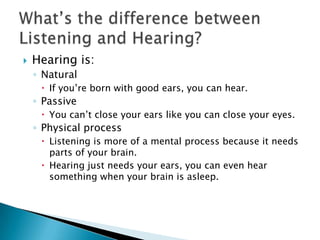
   Hearing is:
    ◦ Natural
      If you’re born with good ears, you can hear.
    ◦ Passive
      You can’t close your ears like you can close your eyes.
    ◦ Physical process
      Listening is more of a mental process because it needs
       parts of your brain.
      Hearing just needs your ears, you can even hear
       something when your brain is asleep.
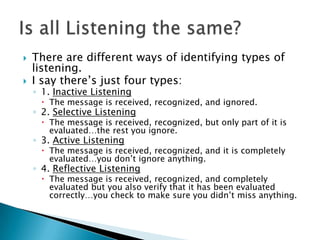
   There are different ways of identifying types of
    listening.
   I say there’s just four types:
    ◦ 1. Inactive Listening
      The message is received, recognized, and ignored.
    ◦ 2. Selective Listening
      The message is received, recognized, but only part of it is
       evaluated…the rest you ignore.
    ◦ 3. Active Listening
      The message is received, recognized, and it is completely
       evaluated…you don’t ignore anything.
    ◦ 4. Reflective Listening
      The message is received, recognized, and completely
       evaluated but you also verify that it has been evaluated
       correctly…you check to make sure you didn’t miss anything.
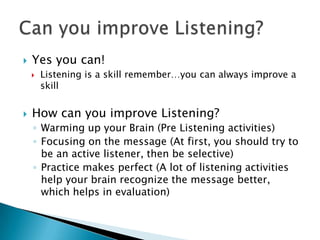
   Yes you can!
       Listening is a skill remember…you can always improve a
        skill


   How can you improve Listening?
    ◦ Warming up your Brain (Pre Listening activities)
    ◦ Focusing on the message (At first, you should try to
      be an active listener, then be selective)
    ◦ Practice makes perfect (A lot of listening activities
      help your brain recognize the message better,
      which helps in evaluation)
   Using Strategies when Listening helps a lot
    ◦ In this Class:
      We will learn strategies to better Recognize and
       Evaluate messages.
      We will learn different strategies for different listening
       contexts.
      Not all messages are the same.


    ◦ So what are the different contexts of messages?
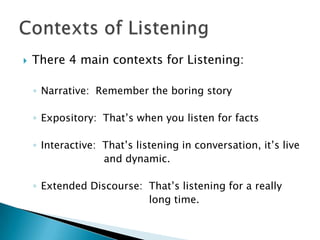
   There 4 main contexts for Listening:

    ◦ Narrative: Remember the boring story

    ◦ Expository: That’s when you listen for facts

    ◦ Interactive: That’s listening in conversation, it’s live
                   and dynamic.

    ◦ Extended Discourse: That’s listening for a really
                          long time.
   Next Week:
    ◦ We will Discuss some strategies for listening to
      Narratives.
    ◦ Then we will do some activities in class to practice
      those strategies.
    ◦ Then you will practice some more.
    ◦ Then you will show me what you can do at home
      with the assignment.

Escp s2 listening comprehension 2- week 1 ppt

  • 1.
  • 2.
    Welcome to “ESCP (Semester 2) : Listening Comprehension” ◦ This is a 25 hour Practical Course ◦ It starts from Today until May 3rd ◦ We will meet every Wednesday from 4pm-6pm and every Thursday from 8am-10am. ◦ I really, really hope that you will enjoy this class ◦ I really, really hope that you will learn something…
  • 3.
    My name is Khaled Al-Abbadi  I’m your teacher.  I’m responsible for grading your work.  You can call me… ◦ Khaled ◦ Mr. Khaled ◦ Sidi Khaled ◦ King Khaled…etc… This is me in Saudi Arabia, about to eat some Kabsa.
  • 4.
    This is megetting a really bad haircut in Yemen
  • 5.
    This is mylovely daughter Huda… She’s almost 3 years old…
  • 6.
    This is meand Huda at the beach on our vacation in Spain.
  • 7.
    This is meand my Dad when I was a little boy in America… Anyway…I’m your teacher…
  • 8.
    Course Description and Objectives: ◦ Our Objectives are Real Simple:  1. Develop Listening Skills  2. Learn Good Listening Strategies  3. Understand the different contexts of Listening ◦ We will do this by:  1. Discussing Listening contexts and strategies.  2. Practicing Listening in the classroom.  3. Doing Listening assignments outside the classroom.
  • 9.
    Topics Discussed: ◦ This course is a practical approach to listening. ◦ We will discuss 4 main listening contexts and strategies. ◦ These 4 contexts are:  1. Listening to Narratives (For example: Listening to a boring story from your teacher)  2. Listening for Specific Information and Data (For example: Listening to a boring story from your teacher with a lot of facts)  3. Listening in Conversational Contexts (For example: Listening to a boring story from your teacher and having to respond to your teacher)  4. Listening to Extended Discourse (For example: Listening to a boring story from your teacher, with a lot of facts, for a really long time…)
  • 10.
    Regarding Materials: ◦ I will provide all class material, which means there is no textbook, copies, or anything like that… ◦ However, you are responsible for;  Having a pen  Having a notebook  To take notes and for class activities  Having access to internet  To download mp3s for homework assignments
  • 11.
    Your Favorite Part…  Really Simple: ◦ Weekly Assignments (there are 4, each 15%) 60% ◦ Attendance (try to come in everyday) 10% ◦ Final Exam (dun..dun..DUN…) 30% ◦ Grand Total 100%
  • 12.
    Weekly Assignments are Homework ◦ They will be given on Thursdays and are due on Wednesdays. ◦ They are listening Mp3s which you will download from facebook. ◦ You will have to Transcribe them.  That means you have to write down all the words. ◦ And…you will have to answer some questions  There will be a worksheet for you to download with the MP3.  Sounds like a lot of fun…doesn’t it…?
  • 13.
    This is the “Plan” for the Semester Week 1 3/22 Thur Course Introduction Week 2 3/28 Wed Listening to Narratives: Discussion and Strategies 3/29 Thur Practice and Activities Week 3 4/4 Wed Listening for Specific Information/Data: Discussion Narrative Weekly Assignment Due 4/5 Thur Practice and Activities
  • 14.
    Week 4 4/11 Wed Spring Break Vacation 4/12 Thur Spring Break Vacation Week 5 4/18 Wed Listening in Conversation: Discussion and Strategies Spec. Info/Data Weekly Assignment Due 4/19 Thur Practice and Activities 4/XX Some Day Makeup Session: More Practice and Activities 
  • 15.
    Week 6 4/25 Wed Listening to Extended Discourse: Discussion Conversations Weekly Assignment Due 4/26 Thur Practice and Activities 4/XX Some Day Makeup Session: More Practice and Activities Week 7 5/2 Wed Course Review of Listening Contexts and Strategies Extended Discourse Weekly Assignment Due 5/3 Thur Final Exam
  • 16.
    All of this should be in your Syllabus  I will try to have this available on Facebook for you to download…  Anyone have any: ◦ Questions, ◦ Comments, ◦ Insults, ◦ Something you want to throw at me… ◦ Anything…?
  • 17.
  • 18.
    How would you define…Listening?  What is the difference between…Listening…and…Hearing?  Is all…Listening…the same or is there a difference?  How can you improve your…Listening?
  • 19.
    Listening is: ◦ Skill  It is not something natural, it is something that you develop over time.  You can actually “hear” while in the womb, but listening probably develops at around 1-3 years of age. ◦ Active Process  Hearing – That is receiving sound signals  Recognizing – Acknowledging that there is meaning  Evaluating – Understanding, Interpreting, Remembering, Responding… blah..blah..blah…
  • 20.
    Hearing is: ◦ Natural  If you’re born with good ears, you can hear. ◦ Passive  You can’t close your ears like you can close your eyes. ◦ Physical process  Listening is more of a mental process because it needs parts of your brain.  Hearing just needs your ears, you can even hear something when your brain is asleep.
  • 21.
    There are different ways of identifying types of listening.  I say there’s just four types: ◦ 1. Inactive Listening  The message is received, recognized, and ignored. ◦ 2. Selective Listening  The message is received, recognized, but only part of it is evaluated…the rest you ignore. ◦ 3. Active Listening  The message is received, recognized, and it is completely evaluated…you don’t ignore anything. ◦ 4. Reflective Listening  The message is received, recognized, and completely evaluated but you also verify that it has been evaluated correctly…you check to make sure you didn’t miss anything.
  • 22.
    Yes you can!  Listening is a skill remember…you can always improve a skill  How can you improve Listening? ◦ Warming up your Brain (Pre Listening activities) ◦ Focusing on the message (At first, you should try to be an active listener, then be selective) ◦ Practice makes perfect (A lot of listening activities help your brain recognize the message better, which helps in evaluation)
  • 23.
    Using Strategies when Listening helps a lot ◦ In this Class:  We will learn strategies to better Recognize and Evaluate messages.  We will learn different strategies for different listening contexts.  Not all messages are the same. ◦ So what are the different contexts of messages?
  • 24.
    There 4 main contexts for Listening: ◦ Narrative: Remember the boring story ◦ Expository: That’s when you listen for facts ◦ Interactive: That’s listening in conversation, it’s live and dynamic. ◦ Extended Discourse: That’s listening for a really long time.
  • 25.
    Next Week: ◦ We will Discuss some strategies for listening to Narratives. ◦ Then we will do some activities in class to practice those strategies. ◦ Then you will practice some more. ◦ Then you will show me what you can do at home with the assignment.