Communication Skills
Mid Term Presentation
9 Ways to Enhance English Language Skills
Hamza Yasin 315-23595
BSCS Sec A (16)
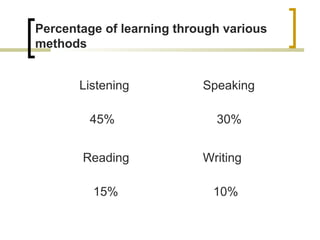
Listening
45%
Speaking
30%
Reading
15%
Writing
10%
Percentage of learning through various
methods
9 Ways to Learn English
1. Don’t be afraid
Sometimes we are afraid to speak a foreign language
because we think we are going to make terrible mistakes and
people will laugh at us. Well, the best learners of foreign
languages try not to be afraid. They make game of learning.
They are not anxious about making mistakes. And they
sometimes share their fears with friends. You can do that too,
and you will then feel better about yourself.
2. Dive in!
Try to speak out! Try to say things in English! The best way to
learn English is to speak it yourself. Don’t worry about perfect
pronunciation or grammar; other people usually will not
criticize you.
3. Believe in yourself
You have lots of strengths. You have already learned some
English. You must believe that you can do it! Compliment your
fellow learners on their efforts. Then maybe they will return the
favor.
4. Develop motivation
Why are you learning English? Make a list of your reasons for
studying English. Those reasons can be your individual goals
for this course. If you have your own reason for learning
English, you will have better success.
5. Cooperate with your colleagues
You are learning language in order to communicate with other
people. So, practice with other people and you will be
more successful. Create your own conversation group. Try out
new ways to communicate in that group. And, in class,
remember your colleagues are your “team” members, not your
opponents.
6. Get the “big” picture!
Sometimes learners look too closely at all the details of
language (words, pronunciation, grammar, usage). It’s OK to
pay attention to those details, but it is also important to
understand general meanings (the “big” picture). Maybe you
don’t know the right words or grammar, but you can say things
anyway. See movies in English. Read books and magazines
for pleasure.
7. Don’t worry if you are confused
Learning English is a big task! Sometimes you will feel
confused about all the things you have to learn in a foreign
language. Try not to worry about everything all at once. Don’t
try to learn all the rules right now. Ask your mentor questions
about English. And try to learn a little every day.
8. Make your mistakes work FOR you
A mistake is not always “bad”. We all make mistakes learning
anything new. Successful learners don’t worry about
mistakes, they learn from them. They take note of their errors
and try to correct them the next time. Some things you can
do:
 Make a list of your mistakes
 Select grammar points to watch for
 Tape-record yourself and listen for errors
9. Set your own goals
Other people have usually so far set goals (assignments,
homework, class work) for you. But you need to set your own
goals, too. You can do that by doing the following:
 Set aside a certain number of hours a week for extra study
 Learn a certain number of words a day/week
 Read a certain number of extra pages a day/week
Take charge of your own learning!
Important Message
 If you’re not willing to appreciate
others. So remember you’re not
allowed to criticize them.
Thank you 
Thank you 

Language skills by Hamza Yasin

  • 1.
    Communication Skills Mid TermPresentation 9 Ways to Enhance English Language Skills Hamza Yasin 315-23595 BSCS Sec A (16)
  • 2.
  • 3.
    9 Ways toLearn English 1. Don’t be afraid Sometimes we are afraid to speak a foreign language because we think we are going to make terrible mistakes and people will laugh at us. Well, the best learners of foreign languages try not to be afraid. They make game of learning. They are not anxious about making mistakes. And they sometimes share their fears with friends. You can do that too, and you will then feel better about yourself. 2. Dive in! Try to speak out! Try to say things in English! The best way to learn English is to speak it yourself. Don’t worry about perfect pronunciation or grammar; other people usually will not criticize you.
  • 4.
    3. Believe inyourself You have lots of strengths. You have already learned some English. You must believe that you can do it! Compliment your fellow learners on their efforts. Then maybe they will return the favor. 4. Develop motivation Why are you learning English? Make a list of your reasons for studying English. Those reasons can be your individual goals for this course. If you have your own reason for learning English, you will have better success.
  • 5.
    5. Cooperate withyour colleagues You are learning language in order to communicate with other people. So, practice with other people and you will be more successful. Create your own conversation group. Try out new ways to communicate in that group. And, in class, remember your colleagues are your “team” members, not your opponents. 6. Get the “big” picture! Sometimes learners look too closely at all the details of language (words, pronunciation, grammar, usage). It’s OK to pay attention to those details, but it is also important to understand general meanings (the “big” picture). Maybe you don’t know the right words or grammar, but you can say things anyway. See movies in English. Read books and magazines for pleasure.
  • 6.
    7. Don’t worryif you are confused Learning English is a big task! Sometimes you will feel confused about all the things you have to learn in a foreign language. Try not to worry about everything all at once. Don’t try to learn all the rules right now. Ask your mentor questions about English. And try to learn a little every day. 8. Make your mistakes work FOR you A mistake is not always “bad”. We all make mistakes learning anything new. Successful learners don’t worry about mistakes, they learn from them. They take note of their errors and try to correct them the next time. Some things you can do:  Make a list of your mistakes  Select grammar points to watch for  Tape-record yourself and listen for errors
  • 7.
    9. Set yourown goals Other people have usually so far set goals (assignments, homework, class work) for you. But you need to set your own goals, too. You can do that by doing the following:  Set aside a certain number of hours a week for extra study  Learn a certain number of words a day/week  Read a certain number of extra pages a day/week Take charge of your own learning!
  • 8.
    Important Message  Ifyou’re not willing to appreciate others. So remember you’re not allowed to criticize them.
  • 9.
  • 10.