Linux Interrupts: The Basic Concepts
Mika J. Järvenpää
University of Helsinki
Department of Computer Science
mjjarven@cs.helsinki.fi
ABSTRACT
The idea of this document is to shed some light to the con-
cepts and main ideas of implementation of interrupts in
Linux kernel. Main focus is in Linux kernel version 2.4.18-
10.
1. LINUX INTERRUPTS
At any time one CPU in a Linux system can be:
- serving a hardware interrupt in kernel mode
- serving a softirq, tasklet or bottom half in kernel mode
- running a process in user mode.
There is a strict order between these. Other than the last
category (user mode) can only be preempted by those above.
For example, while a softirq is running on a CPU, no other
softirqs will preempt it, but a hardware interrupt can.
In the next chapters different interrupt and exception types,
initialization, hardware handling and software handling of
interrupts, interrupt data structures and terms like IDT,
bottom half, softirq and tasklet are explained in more detail.
2. INTERRUPTS AND EXCEPTIONS
An interrupt is an asynchronous event that is typically
generated by an I/O device not synchronized to processor
instruction execution.
An exception is a synchronous event that is generated when
the processor detects one or more predefined conditions
while executing an instruction.
Interrupts can be divided to maskable interrupts and
non-maskable interrupts.
Also exceptions can be divided to processor-detected
exceptions ie. faults, traps, aborts and programmed
exceptions. Example of fault is Page fault. Traps are used
mainly for debugging purposes. Aborts inform about hard-
ware failures and invalid system tables and and abort han-
dler has no choice but to force affected process to terminate.
[1], [3], p. 4-9, 4-10.
Table 1: Signals sent by the exception handlers
# Exception Handler Signal
0 Divide error divide error() SIGFPE
1 Debug debug() SIGTRAP
2 NMI nmi() None
3 Breakpoint int3() SIGTRAP
4 Overflow overflow() SIGSEGV
5 Bounds check bounds() SIGSEGV
6 Invalid opcode invalid op() SIGILL
7 Device not avail. device not avail.() SIGSEGV
8 Double fault double fault() SIGSEGV
9 Coproc.seg.ovr. coproc. seg. ovr.() SIGFPE
10 Invalid TSS invalid tss() SIGSEGV
11 Seg. not present seg. not present() SIGBUS
12 Stack seg. fault stack segment() SIGBUS
13 General protect. general prot.() SIGSEGV
14 Page fault page fault() SIGSEGV
15 Intel reserved None None
16 FP error coprocessor error() SIGFPE
17 Alignment check alignment check() SIGSEGV
18 Machine check machine check() None
19 SIMD coproc.err simd coproc. error Depends
2.1 Exception and Interrupt Vectors
Intel architecture identifies different interrupts and excep-
tions by a number ranging from 0 to 255 ([5], p. 4-11).
This number is called a vector. Linux uses vectors 0 to
31, which are for exceptions and non-maskable interrupts,
vectors 32 to 47, which are for maskable interrupts ie. in-
terrupts caused by interrupt requests (IRQs) and only one
vector (128) from the remaining vectors ranging from 48 to
255, which are meant for software interrupts.
Linux uses this vector 128 to implement a system call ie.
when an int 0x80 opcode ([6]) is executed by a process
running in user mode the CPU switches into kernel mode
and starts executing kernel function system call().
2.2 Hardware Interrupts
Hardware devices capable of issuing IRQs are connected to
Interrupt Controller. The Intel 8259A Programmable Inter-
rupt Controller (PIC) handles up to eight vectored prior-
ity interrupts for the CPU and PICs can be cascaded ([2]).
Typical configuration for 15 IRQs is cascade of two PICs.
PIC can remember one IRQ while IRQ is masked. Vector
of masked IRQ is sent to CPU after unmasking. Processing
of previous interrupt is finished by writing End Of Interrupt
(EOI) to PIC or both PICs in cascade, if source was the
slave PIC. Since the number of available IRQ lines is lim-
ited the same IRQ line can be shared between several I/O
devices. This is possible, if interrupt handlers poll every
I/O device connected to same IRQ line to determine which
I/O device should be serviced. Intel processors having local
APIC (more about APICs in section: APIC System) could
receive external interrupts through pins on the processor or
through the local APIC serial bus. All maskable hardware
interrupts ie. interrupts delivered to CPU by means of INTR
signal (0-255) or through local APIC (16-255) can be masked
as a group by using IF flag in the EFLAGS register.
2.3 Software Generated Interrupts
The INT n instruction permits interrupts to be generated
by software. Interrupts generated in software with INT n
cannot be masked by the IF flag in the EFLAGS register.
2.4 Exceptions
Intel 80x86 processors generate roughly 20 different excep-
tions. Some types of exceptions may provide error code,
which report additional information about the error. In
Linux each exception has specific handler, which usually
sends a UNIX signal to the process that caused the excep-
tion (see Table 1)1
.
Faults are type of exceptions, in which eip contains the ad-
dress of instruction that caused the exception, so the handler
can re-execute the instruction for example after loading the
needed page to memory. In case of trap the saved value of
eip is the address of the next instruction since traps are
used mainly for debugging purposes to implement for ex-
ample breakpoints. Aborts are caused by serious errors and
there might not possible to get any address in eip. Pro-
grammed exceptions are triggered by int, int3 and condi-
tionally by into (check for overflow) and bound (check on
address bound).
Proper list containing conditions which generate exceptions
and interrupts on Intel architecture can be found from Intel
Architecture Software Developer’s Manual, Volume 3: Sys-
tem Programming, Chapter 5.12. Exception and Interrupt
Reference([7]).
2.5 Interrupt Descriptor Table
Interrupt Descriptor Table (IDT) associates each exception
or interrupt vector with a gate descriptor for the handler
used to service the associated exception or interrupt ([7]
p. 5-11). IDT need not contain more than 256 descriptors
since there are only that amount of interrupt or exception
vectors. The IDT must be properly initialized before the
kernel enables interrupts. The idtr register allows the IDT
to be located anywhere in the memory. Figure 1 shows the
format of the three different gate descriptors. Linux uses
interrupt gates to handle interrupts and trap gates to handle
exceptions. Linux does not use task gates.
2.6 Hardware Handling of Interrupts and Ex-
ceptions
After executing an instruction, the cs and eip contain the
logical address of the next instruction to be executed. Be-
fore executing that instruction the control unit checks, if an
1
Exception handler names truncated by typographical
reasons
TSS SEGMENT SELECTOR
RESERVED
RESERVED
P 0 0 1 0 1DPL RESERVED
Task Gate Descriptor
63 62 61 60 59 58 57 56 55 54 53 52 51 50 49 48 47 46 45 44 43 42 41 40 39 38 37 36 35 34 33 32
31 30 29 28 27 26 25 24 23 22 21 20 19 18 17 16 15 14 13 12 11 10 9 8 7 6 5 4 3 2 1 0
SEGMENT SELECTOR
OFFSET (16-31)
OFFSET (0-15)
P 0 1 1 1 0DPL RESERVED
Interrupt Gate Descriptor
63 62 61 60 59 58 57 56 55 54 53 52 51 50 49 48 47 46 45 44 43 42 41 40 39 38 37 36 35 34 33 32
31 30 29 28 27 26 25 24 23 22 21 20 19 18 17 16 15 14 13 12 11 10 9 8 7 6 5 4 3 2 1 0
SEGMENT SELECTOR
OFFSET (16-31)
OFFSET (0-15)
P 0 1 1 1 1DPL RESERVED
Trap Gate Descriptor
63 62 61 60 59 58 57 56 55 54 53 52 51 50 49 48 47 46 45 44 43 42 41 40 39 38 37 36 35 34 33 32
31 30 29 28 27 26 25 24 23 22 21 20 19 18 17 16 15 14 13 12 11 10 9 8 7 6 5 4 3 2 1 0
0 0 0
0 0 0
Figure 1: Gate descriptor’s format
interrupt or an exception has occurred while executing the
previous instruction. If one occurred, the control unit:
1. Determines the vector i associated with the interrupt
or exception.
2. Reads the ith gate descriptor of the IDT referred by
the idtr register (an interrupt or a trap gate assumed)
3. Gets the base address of the GDT from the gdtr regis-
ter and checks GDT to find the Segment Descriptor for
the selector of IDT entry in order to find base address
of the segment having interrupt or exception handler.
4. Compares Current Privilege Level (CPL) with the De-
scriptor Privilege Level (DPL) and issues General Pro-
tection (GP) exception, if the DPL is lower than CPL.
Interrupt handler cannot have lower privilege than pro-
gram that caused the interrupt.
5. Check if the CPL is different from the selected Seg-
ment Descrictor’s DPL. If so, the control unit must
start using stack that is associated with the new pri-
lege level.
(a) Read tr to access the TSS of the current process.
(b) Load new ss and esp found from TSS.
(c) Save ss and esp to new stack.
6. If a fault occurred load cs and eip with the logical
address caused the exception so that it can be executed
again.
7. Save eflags, cs and eip to the stack.
8. If the exception generated a hardware error code save
it to the stack.
9. Load cs and eip with values got from ith entry of
the IDT ie. the address of the first instruction of the
interrupt or exception handler.
Next step caused by control unit is the execution of the first
instruction of the handler. After the interrupt or exception
has been processed the handler must issue the iret instruc-
tion which causes the control unit to:
1. Load cs, eip and eflags from the stack. If hardware
error code was pushed to the stack on top of eip, it
must be popped before executing iret.
2. Check if the CPL of the handler is equal as value of
two least significant bits of cs. If so iret finishes
execution, otherwise next step is entered.
3. Load the ss and esp from the stack.
4. Check ds, es, fs and gs. If any of them contains a
selector that refers to Segment Descriptor whose DPL
value is lower than CPL, clear the corresponding seg-
ment register in order to forbid the user mode program
that run with a CPL 3 from making use of segment
registers previously used by the kernel routines.
2.7 Kernel Control Paths
A kernel control path consists of the sequence of instructions
executed in kernel mode to handle an interrupt or exception.
At most two kernel control paths can be stacked in case of
exceptions since page fault exception never gives rise to fur-
ther exceptions. Linux does not allow scheduling while the
CPU is executing a kernel control path associated with an
interrupt. But an interrupt handler may be interrupted by
another interrupt handler and so on. An interrupt handler
may defer an exception handler, but an exception handler
never defers an interrupt handler. The only exception pos-
sible in kernel mode is the page fault. Interrupt handlers
never perform operations that could cause page fault and
thus potentially scheduling.
The Linux interleaves kernel control paths for two major
reasons: to implement an interrupt model without prior-
ity levels and to improve the throughput of PICs by making
possible to acknowledgement of IRQ while servicing another
IRQ.
3. INITIALIZATION
Interrupt Descriptor Table should be initialized so that il-
legal interrupts and exceptions simulated by user space ap-
plications will be blocked. This is achieved by clearing the
DPL field of the Interrupt and Trap Gate Descriptors. If the
process attempts to issue one of such interrupt or exception
signals, the control unit will check the CPL value against the
DPL field and issue a GP exception. In those cases where
user space process must be able to issue a programmed ex-
ception the DPL field of the corresponding interrupt or trap
gate descriptor is set to 3.
Also the base addresses of the IDT should be aligned on an
8-byte boundary to maximize performance of cache line fills.
Linux uses three descriptor formats in its IDT:
Interrupt gate An Intel interrupt gate that cannot be ac-
cessed by user mode process (gate’s DPL field cleared).
All Linux interrupt handlers are activated by using in-
terrupt gates.
System gate An intel trap gate that can be accessed by
user mode process (gate’s DPL equal to 3). The four
Linux exception handlers 3, 4, 5, 128 are activated by
using system gates The int3, into, bound and int
0x80 can be accessed by user mode process.
Trap gates An Intel trap gate that cannot be accessed by
a user mode process (gate’s DPL field cleared). All
Linux exception handlers except those four are acti-
vated using of trap gates.
4. EXCEPTION HANDLING
Linux uses exceptions to handle demand paging and to sig-
nal process an anomalous condition. Exception handlers
have a structure consisting of three parts:
1. Save registers to kernel mode stack.
2. Handle exception using C function.
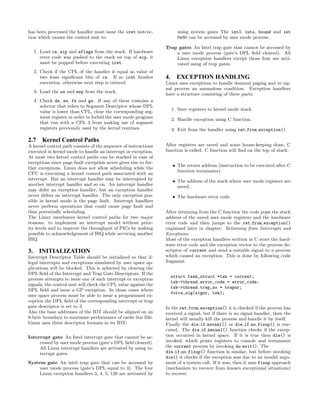
3. Exit from the handler using ret from exception().
After registers are saved and some house-keeping done, C
function is called. C function will find on the top of stack:
• The return address (instruction to be executed after C
function terminates).
• The address of the stack where user mode registers are
saved.
• The hardware error code.
After returning from the C function the code pops the stack
address of the saved user mode registers and the hardware
error code and then jumps to the ret from exception()
explained later in chapter: Returning from Interrupts and
Exceptions.
Most of the exception handlers written in C store the hard-
ware error code and the exception vector to the process de-
scriptor of current and send a suitable signal to a process
which caused an exception. This is done by following code
fragment:
struct task_struct *tsk = current;
tsk->thread.error_code = error_code;
tsk->thread.trap_no = trapnr;
force_sig(signr, tsk);
In the ret from exception() it is checked if the process has
received a signal, but if there is no signal handler, then the
kernel will usually kill the process and handle it by itself.
Finally the die if kernel() or die if no fixup() is exe-
cuted. The die if kernel() function checks if the excep-
tion occurred in kernel space. If it is true then die() is
invoked, which prints registers to console and terminates
the current process by invoking do exit(). The
die if no fixup() function is similar, but before invoking
die() it checks if the exception was due to an invalid argu-
ment of a system call. If it was, then it uses fixup approach
(mechanism to recover from known exceptional situations)
to recover.
NR_IRQSi0
hw_irq_controller / hw_interrupt_type
irq_desc_t
irqactionirqaction
irq_desc[ ]
Figure 2: IRQ descriptors
5. INTERRUPT HANDLING
All interrupt handlers preform the same five basic actions:
1. Save IRQ value and the registers to the kernel mode
stack.
2. Send ack to the PIC thus allowing it to issue next
interrupt.
3. Execute ISRs associated with all the devices that share
same IRQ.
4. Execute active softirqs
5. Terminate by jumping to the ret from intr().
5.1 Data Structures
An irq desc array includes NR IRQS irq desc t type de-
scriptors.
typedef struct {
unsigned int status; /* IRQ status */
hw_irq_controller *handler;
struct irqaction *action; /* IRQ action list */
unsigned int depth; /* nested irq disables */
spinlock_t lock;
} ____cacheline_aligned irq_desc_t;
The status field may contain following values:
IRQ INPROGRESS IRQ handler active - do not enter
IRQ DISABLED IRQ disabled - do not enter
IRQ PENDING IRQ pending - replay on enable
IRQ REPLAY IRQ has been replayed but not acked yet
IRQ AUTODETECT IRQ is being autodetected
IRQ WAITING IRQ not yet seen - for autodetection
IRQ LEVEL IRQ level triggered
IRQ MASKED IRQ masked - shouldn’t be seen again
IRQ PER CPU IRQ is per CPU
The hw interrupt type descriptor includes group of point-
ers to the low-level I/O routines that interact with a specific
interrupt controller.
struct hw_interrupt_type {
const char * typename;
unsigned int (*startup)(unsigned int irq);
void (*shutdown)(unsigned int irq);
void (*enable)(unsigned int irq);
void (*disable)(unsigned int irq);
void (*ack)(unsigned int irq);
void (*end)(unsigned int irq);
void (*set_affinity)(unsigned int irq,
unsigned long mask);
};
typedef struct
hw_interrupt_type hw_irq_controller;
Sample structure initialized for 8259A PIC:
static struct hw_interrupt_type i8259A_irq_type = {
"XT-PIC",
startup_8259A_irq,
shutdown_8259A_irq,
enable_8259A_irq,
disable_8259A_irq,
mask_and_ack_8259A,
end_8259A_irq,
NULL
};
The irqaction descriptors can be chained in case of shared
IRQs used as shown in figure 2.
struct irqaction {
void (*handler)(int, void *, struct pt_regs *);
unsigned long flags;
unsigned long mask;
const char *name;
void *dev_id;
struct irqaction *next;
};
The flags field can contain following values:
SA SHIRQ Interrupt is shared.
SA INTERRUPT Disable local interrupts while process-
ing.
SA SAMPLE RANDOM The interrupt can be used for
source of random number.
5.2 Saving Registers
In include/asm-i386/hw irq.h is implemented BUILD IRQ
macro which is used to implement interrupt handler entry
points (not IPI or SMP):
IRQn_interrupt:
pushl $n-256
jmp common_interrupt
There is also BUILD COMMON IRQ macro which builds common
interrupt handler:
common_interrupt:
SAVE_ALL
call do_IRQ
jmp ret_from_intr
The SAVE ALL macro expands to:
cld
pushl %es
pushl %ds
pushl %eax
pushl %ebp
pushl %edi
pushl %esi
pushl %edx
pushl %ecx
pushl %ebx
movl $" STR(__KERNEL_DS) ",%edx
movl %edx,%ds
movl %edx,%es
5.3 The do IRQ() Function
The do IRQ() function handles all normal device IRQs (IPIs
have their own specific handlers). It first gets lock to the
specific IRQ descriptor, so that the first CPU getting the
lock takes care of that specific IRQ. Next thing is to ac-
knowledge the IRQ to PIC as fast as possible:
desc->handler->ack(irq);
After that the status of the IRQ descriptor is updated (”we
want to handle this specific IRQ”) and after that IRQ de-
scriptor is unlocked. Next thing is to call the IRQ handler:
handle_IRQ_event(irq, &regs, action);
following IRQ descriptor locking, IRQ descriptor status up-
dating, IRQ descriptor unlocking and calling:
desc->handler->end(irq);
to deal with interrupts which got disabled while the handler
was running and finally check and execute possible softirqs:
if (softirq_pending(cpu))
do_softirq();
return 1;
5.4 ISRs
Interrupt service routines (ISRs) implementing device-
specific function are all called with same parameters, which
are: irq, dev id and regs. The first parameter allows ser-
vice of multiple IRQs inside one ISR, the second parameter
allows service of several devices of same type and the last
parameter allows the access to the execution context of the
interrupted kernel control path. In practice these parame-
ters are seldom used inside ISRs.
ret_from_intr:
ret_from_exception:
ret_from_sys_call:
Nested kernel
control paths?
GET_CURRENT
save_v86_state()
do_signal()
schedule()
Restore hardware context
(RESTORE_ALL)
Virtual
v86 mode?
Need
reschedule?
Pending
signals?
YESYES
YES
YES
reschedule:
NO
signal_return: v86_signal_return:
NO
NO
NO
Figure 3: Returning from interrupts and exceptions
5.5 Bottom Halves/Softirqs/Tasklets
Bottom halves (BHs) is the oldest concept in the era of BHs,
softirqs and tasklets. The idea of BH is to divide the han-
dling of interrupt into two pieces and make the first piece
ie. interrupt handler (top half) to serve hardware as fast as
possible and suspend the rest of interrupt handling (bottom
half) to the later point of the time. BHs didn’t take an ad-
vantage of multiple CPUs. Existence of 32 available BHs is
defined by a pointer table.
Softirqs are versions of BHs which can run on as many CPUs
at once as required (they also need to deal mutual exclusion
of shared data using their own locks). Activity of 32 avail-
able softirqs is defined by a bit mask.
After developing softirqs BHs were built on top of softirqs.
Tasklets are like softirqs, except they are registered dynam-
ically (count of tasklets is unlimited), and they also guaran-
tee that any tasklet will run on only one CPU at any time
(no need for re-entrant code), although different tasklets can
run simultaneously on different CPUs (unlike different BHs
can’t).
BHs are built on top of tasklets and tasklets are built on top
of softirqs.
Task queues are dynamic extension of old BHs. Task queue
is basically linked list containing function pointers.
5.6 Dynamic Handling of IRQ Lines
There is a way to share the IRQ even if the I/O device do not
allow the IRQ sharing. The concept is to serialize the activa-
tion of the devices so that one at a time owns the IRQ line.
This is implemented by three functions: request irq(),
setup x86 irq() and free irq(). The setup x86 irq()
function called inside the request irq() function returns
the error code, if the IRQ line is already in use. In this case
device driver aborts the operation and could try again later.
6. RETURNING FROM INTERRUPTS AND
EXCEPTIONS
There are three entry points ret from intr(),
ret from sys call() and ret from exception() which are
used when returning from interrupts, exceptions and system
calls. Those are covered by following code fragments and a
flow diagram in figure 3.
#define GET_CURRENT(reg) 
movl $-8192, reg; 
andl %esp, reg
ENTRY(ret_from_intr)
GET_CURRENT(%ebx)
ret_from_exception:
movl EFLAGS(%esp),%eax
movb CS(%esp),%al
testl $(VM_MASK | 3),%eax
jne ret_from_sys_call
jmp restore_all
The address of the current process descriptor is stored to
ebx. The values of the eflags and cs (pushed to the stack
when the interrupt occurred) are used to determine if the
interrupted program was running in kernel mode. If the in-
terrupted program was running in user mode or if the VM flag
of eflags was set a jump is made to the ret from sys call
entry point:
ENTRY(ret_from_sys_call)
cli
cmpl $0,need_resched(%ebx)
jne reschedule
cmpl $0,sigpending(%ebx)
jne signal_return
restore_all:
RESTORE_ALL
The need resched and sigpending are offsets into the pro-
cess descriptor. If the need resched field is 1 the schedule()
function is called:
reschedule:
call SYMBOL_NAME(schedule) # test
jmp ret_from_sys_call
If the sigpending field is not null the signal return branch
is taken to handle pending signals of current:
signal_return:
sti
testl $(VM_MASK),EFLAGS(%esp)
movl %esp,%eax
jne v86_signal_return
xorl %edx,%edx
call SYMBOL_NAME(do_signal)
jmp restore_all
v86_signal_return:
call SYMBOL_NAME(save_v86_state)
movl %eax,%esp
xorl %edx,%edx
call SYMBOL_NAME(do_signal)
jmp restore_all
After this the process current can resume execution in user
mode. The RESTORE ALL macro (loads the values saved by
SAVE ALL macro) expands to:
Interrupt Controller Communication (ICC) bus
I/O
APIC
Local
APIC
CPU 0
External
IRQs
Local
IRQs
Local
APIC
CPU 1
Local
IRQs
Figure 4: APIC system
popl %ebx;
popl %ecx;
popl %edx;
popl %esi;
popl %edi;
popl %ebp;
popl %eax;
popl %ds;
popl %es;
addl $4,%esp;
iret;
As shown in figure 3 and the code fragments above the ex-
ceptions and system calls terminate same way as interrupts.
7. SMP SYSTEM
Symmetrical multiprocessing (SMP) system sets slightly dif-
ferent requirements to interrupt handling by hardware and
software than ordinary uniprocessing (UP) system. Tak-
ing advantage of parallelism requires distributed handling
of hardware interrupts, which then requires synchronization
ie. only one CPU should handle certain hardware interrupt.
Secondly some kind of efficient mechanism is needed to pass
messages between CPUs. Latter is needed for scheduling
tasks between CPUs and for different synchronization pur-
poses.
7.1 APIC
To be able to fully distribute interrupt handling among
CPUs in SMP system Intel has developed I/O APIC (Ad-
vanced Programmable Interrupt Controller) which replaces
the old 8259A Programmable Interrupt Controller ([4]).
The sample SMP system with local APICs and I/O APIC
is shown in figure 4. Local APIC has 32-bit registers, an
internal clock, a timer device and two additional IRQ lines
reserved for local interrupts. Local interrupts are typically
used to reset the system.
The I/O APIC consists of a set of IRQ lines, a 24-entry
Interrupt Redirection Table, programmable registers and a
message unit for sending and receiving APIC messages over
the ICC bus. Each entry in the Redirection Table can be in-
dividually programmed to indicate the interrupt vector and
priority, the destination CPU, and how the CPU is selected.
Table is used to translate any external IRQ to signal into a
message to one or more local APIC units via the ICC bus.
Interrupt requests can be distributed to CPUs in two differ-
ent ways: Fixed mode and Lowest-priority mode. [8]
Inportant feature of the APIC is that it allows CPUs to gen-
erate interprocessor interrupts. CPU can store the interrupt
vector and the identifier of the target’s local APIC in the
Interrupt Command Register (ICR) of its own local APIC.
A message is then sent via the ICC bus to the target’s lo-
cal APIC, which then issues a corresponding interrupt to its
own CPU.
There is support for multiple external I/O APICs in kernel
2.4.18-10.
7.2 IPIs
Interprocessor interrupts (IPIs) are used to exchange mes-
sages between CPUs in SMP system. SMP kernel pro-
vides following functions to handle them: send IPI all(),
send IPI allbutself(), send IPI self() and
send IPI single()([9]). SMP kernel recognizes four differ-
ent type of messages identified by interrupt vectors:
RESCHEDULE VECTOR(0x30) Used at least when
the best cpu for the woken up task is not this cpu.
Handler: smp reschedule interrupt().
INVALIDATE TLB VECTOR(0x31) Used when the
TLBs of the other CPU need to be invalidated.
Handler: smp invalidate interrupt().
LOCAL TIMER VECTOR(0x41) Used for finer
grained (better than traditional 100 Hz timer) kernel
profiling and process statistics and rescheduling.
Handler: smp apic timer interrupt(), which handles
pending softirqs also.
CALL FUNCTION VECTOR(0x50) Used to call
functions with a given argument on other CPUs like
flush tlb all ipi() and stop this cpu().
Handler: smp call function interrupt().
8. CONCLUSIONS
Linux provide efficient mechanisms for interrupt and excep-
tion handling such as possibility to defer part of interrupt
handling, optimized control paths and CPU cache utiliza-
tion (alignments) and SMP support using local APICs and
I/O APIC(s). It is also possible to share IRQs (capable to
handle more I/O devices than there are IRQ lines) in Linux.
9. REFERENCES
[1] D. P. Bovet and M. Cesati. Understanding the Linux
Kernel: From I/O ports to process management.
O’Reilly and Associates, Sebastopol, 2001.
[2] Intel. 8259A Programmable Interrupt Controller. Intel
Corporation, Dec 1988.
[3] Intel. Pentium Pro Family Developers Manual, Volume
2: Programmer’s Reference Manual. Intel Corporation,
1995.
[4] Intel. 82093AA I/O Advanced Programmable Interrupt
Controller (IOAPIC). Intel Corporation, May 1996.
[5] Intel. Intel Architecture Software Developer’s Manual,
Volume 1: Basic Architecture. Intel Corporation, 1997.
[6] Intel. Intel Architecture Software Developer’s Manual,
Volume 2: Instruction Set Reference. Intel Corporation,
1997.
[7] Intel. Intel Architecture Software Developer’s Manual,
Volume 3: System Programming. Intel Corporation,
1997.
[8] Intel. Multiprocessor Specification, Version 1.4. Intel
Corporation, May 1997.
[9] S. A. Maxwell. Linux Core Kernel Commentary:
In-Depth Code Annotation. Coriolis, Arizona, 2001.

Linux interrupts

  • 1.
    Linux Interrupts: TheBasic Concepts Mika J. Järvenpää University of Helsinki Department of Computer Science mjjarven@cs.helsinki.fi ABSTRACT The idea of this document is to shed some light to the con- cepts and main ideas of implementation of interrupts in Linux kernel. Main focus is in Linux kernel version 2.4.18- 10. 1. LINUX INTERRUPTS At any time one CPU in a Linux system can be: - serving a hardware interrupt in kernel mode - serving a softirq, tasklet or bottom half in kernel mode - running a process in user mode. There is a strict order between these. Other than the last category (user mode) can only be preempted by those above. For example, while a softirq is running on a CPU, no other softirqs will preempt it, but a hardware interrupt can. In the next chapters different interrupt and exception types, initialization, hardware handling and software handling of interrupts, interrupt data structures and terms like IDT, bottom half, softirq and tasklet are explained in more detail. 2. INTERRUPTS AND EXCEPTIONS An interrupt is an asynchronous event that is typically generated by an I/O device not synchronized to processor instruction execution. An exception is a synchronous event that is generated when the processor detects one or more predefined conditions while executing an instruction. Interrupts can be divided to maskable interrupts and non-maskable interrupts. Also exceptions can be divided to processor-detected exceptions ie. faults, traps, aborts and programmed exceptions. Example of fault is Page fault. Traps are used mainly for debugging purposes. Aborts inform about hard- ware failures and invalid system tables and and abort han- dler has no choice but to force affected process to terminate. [1], [3], p. 4-9, 4-10. Table 1: Signals sent by the exception handlers # Exception Handler Signal 0 Divide error divide error() SIGFPE 1 Debug debug() SIGTRAP 2 NMI nmi() None 3 Breakpoint int3() SIGTRAP 4 Overflow overflow() SIGSEGV 5 Bounds check bounds() SIGSEGV 6 Invalid opcode invalid op() SIGILL 7 Device not avail. device not avail.() SIGSEGV 8 Double fault double fault() SIGSEGV 9 Coproc.seg.ovr. coproc. seg. ovr.() SIGFPE 10 Invalid TSS invalid tss() SIGSEGV 11 Seg. not present seg. not present() SIGBUS 12 Stack seg. fault stack segment() SIGBUS 13 General protect. general prot.() SIGSEGV 14 Page fault page fault() SIGSEGV 15 Intel reserved None None 16 FP error coprocessor error() SIGFPE 17 Alignment check alignment check() SIGSEGV 18 Machine check machine check() None 19 SIMD coproc.err simd coproc. error Depends 2.1 Exception and Interrupt Vectors Intel architecture identifies different interrupts and excep- tions by a number ranging from 0 to 255 ([5], p. 4-11). This number is called a vector. Linux uses vectors 0 to 31, which are for exceptions and non-maskable interrupts, vectors 32 to 47, which are for maskable interrupts ie. in- terrupts caused by interrupt requests (IRQs) and only one vector (128) from the remaining vectors ranging from 48 to 255, which are meant for software interrupts. Linux uses this vector 128 to implement a system call ie. when an int 0x80 opcode ([6]) is executed by a process running in user mode the CPU switches into kernel mode and starts executing kernel function system call(). 2.2 Hardware Interrupts Hardware devices capable of issuing IRQs are connected to Interrupt Controller. The Intel 8259A Programmable Inter- rupt Controller (PIC) handles up to eight vectored prior- ity interrupts for the CPU and PICs can be cascaded ([2]). Typical configuration for 15 IRQs is cascade of two PICs. PIC can remember one IRQ while IRQ is masked. Vector of masked IRQ is sent to CPU after unmasking. Processing of previous interrupt is finished by writing End Of Interrupt
  • 2.
    (EOI) to PICor both PICs in cascade, if source was the slave PIC. Since the number of available IRQ lines is lim- ited the same IRQ line can be shared between several I/O devices. This is possible, if interrupt handlers poll every I/O device connected to same IRQ line to determine which I/O device should be serviced. Intel processors having local APIC (more about APICs in section: APIC System) could receive external interrupts through pins on the processor or through the local APIC serial bus. All maskable hardware interrupts ie. interrupts delivered to CPU by means of INTR signal (0-255) or through local APIC (16-255) can be masked as a group by using IF flag in the EFLAGS register. 2.3 Software Generated Interrupts The INT n instruction permits interrupts to be generated by software. Interrupts generated in software with INT n cannot be masked by the IF flag in the EFLAGS register. 2.4 Exceptions Intel 80x86 processors generate roughly 20 different excep- tions. Some types of exceptions may provide error code, which report additional information about the error. In Linux each exception has specific handler, which usually sends a UNIX signal to the process that caused the excep- tion (see Table 1)1 . Faults are type of exceptions, in which eip contains the ad- dress of instruction that caused the exception, so the handler can re-execute the instruction for example after loading the needed page to memory. In case of trap the saved value of eip is the address of the next instruction since traps are used mainly for debugging purposes to implement for ex- ample breakpoints. Aborts are caused by serious errors and there might not possible to get any address in eip. Pro- grammed exceptions are triggered by int, int3 and condi- tionally by into (check for overflow) and bound (check on address bound). Proper list containing conditions which generate exceptions and interrupts on Intel architecture can be found from Intel Architecture Software Developer’s Manual, Volume 3: Sys- tem Programming, Chapter 5.12. Exception and Interrupt Reference([7]). 2.5 Interrupt Descriptor Table Interrupt Descriptor Table (IDT) associates each exception or interrupt vector with a gate descriptor for the handler used to service the associated exception or interrupt ([7] p. 5-11). IDT need not contain more than 256 descriptors since there are only that amount of interrupt or exception vectors. The IDT must be properly initialized before the kernel enables interrupts. The idtr register allows the IDT to be located anywhere in the memory. Figure 1 shows the format of the three different gate descriptors. Linux uses interrupt gates to handle interrupts and trap gates to handle exceptions. Linux does not use task gates. 2.6 Hardware Handling of Interrupts and Ex- ceptions After executing an instruction, the cs and eip contain the logical address of the next instruction to be executed. Be- fore executing that instruction the control unit checks, if an 1 Exception handler names truncated by typographical reasons TSS SEGMENT SELECTOR RESERVED RESERVED P 0 0 1 0 1DPL RESERVED Task Gate Descriptor 63 62 61 60 59 58 57 56 55 54 53 52 51 50 49 48 47 46 45 44 43 42 41 40 39 38 37 36 35 34 33 32 31 30 29 28 27 26 25 24 23 22 21 20 19 18 17 16 15 14 13 12 11 10 9 8 7 6 5 4 3 2 1 0 SEGMENT SELECTOR OFFSET (16-31) OFFSET (0-15) P 0 1 1 1 0DPL RESERVED Interrupt Gate Descriptor 63 62 61 60 59 58 57 56 55 54 53 52 51 50 49 48 47 46 45 44 43 42 41 40 39 38 37 36 35 34 33 32 31 30 29 28 27 26 25 24 23 22 21 20 19 18 17 16 15 14 13 12 11 10 9 8 7 6 5 4 3 2 1 0 SEGMENT SELECTOR OFFSET (16-31) OFFSET (0-15) P 0 1 1 1 1DPL RESERVED Trap Gate Descriptor 63 62 61 60 59 58 57 56 55 54 53 52 51 50 49 48 47 46 45 44 43 42 41 40 39 38 37 36 35 34 33 32 31 30 29 28 27 26 25 24 23 22 21 20 19 18 17 16 15 14 13 12 11 10 9 8 7 6 5 4 3 2 1 0 0 0 0 0 0 0 Figure 1: Gate descriptor’s format interrupt or an exception has occurred while executing the previous instruction. If one occurred, the control unit: 1. Determines the vector i associated with the interrupt or exception. 2. Reads the ith gate descriptor of the IDT referred by the idtr register (an interrupt or a trap gate assumed) 3. Gets the base address of the GDT from the gdtr regis- ter and checks GDT to find the Segment Descriptor for the selector of IDT entry in order to find base address of the segment having interrupt or exception handler. 4. Compares Current Privilege Level (CPL) with the De- scriptor Privilege Level (DPL) and issues General Pro- tection (GP) exception, if the DPL is lower than CPL. Interrupt handler cannot have lower privilege than pro- gram that caused the interrupt. 5. Check if the CPL is different from the selected Seg- ment Descrictor’s DPL. If so, the control unit must start using stack that is associated with the new pri- lege level. (a) Read tr to access the TSS of the current process. (b) Load new ss and esp found from TSS. (c) Save ss and esp to new stack. 6. If a fault occurred load cs and eip with the logical address caused the exception so that it can be executed again. 7. Save eflags, cs and eip to the stack. 8. If the exception generated a hardware error code save it to the stack. 9. Load cs and eip with values got from ith entry of the IDT ie. the address of the first instruction of the interrupt or exception handler. Next step caused by control unit is the execution of the first instruction of the handler. After the interrupt or exception
  • 3.
    has been processedthe handler must issue the iret instruc- tion which causes the control unit to: 1. Load cs, eip and eflags from the stack. If hardware error code was pushed to the stack on top of eip, it must be popped before executing iret. 2. Check if the CPL of the handler is equal as value of two least significant bits of cs. If so iret finishes execution, otherwise next step is entered. 3. Load the ss and esp from the stack. 4. Check ds, es, fs and gs. If any of them contains a selector that refers to Segment Descriptor whose DPL value is lower than CPL, clear the corresponding seg- ment register in order to forbid the user mode program that run with a CPL 3 from making use of segment registers previously used by the kernel routines. 2.7 Kernel Control Paths A kernel control path consists of the sequence of instructions executed in kernel mode to handle an interrupt or exception. At most two kernel control paths can be stacked in case of exceptions since page fault exception never gives rise to fur- ther exceptions. Linux does not allow scheduling while the CPU is executing a kernel control path associated with an interrupt. But an interrupt handler may be interrupted by another interrupt handler and so on. An interrupt handler may defer an exception handler, but an exception handler never defers an interrupt handler. The only exception pos- sible in kernel mode is the page fault. Interrupt handlers never perform operations that could cause page fault and thus potentially scheduling. The Linux interleaves kernel control paths for two major reasons: to implement an interrupt model without prior- ity levels and to improve the throughput of PICs by making possible to acknowledgement of IRQ while servicing another IRQ. 3. INITIALIZATION Interrupt Descriptor Table should be initialized so that il- legal interrupts and exceptions simulated by user space ap- plications will be blocked. This is achieved by clearing the DPL field of the Interrupt and Trap Gate Descriptors. If the process attempts to issue one of such interrupt or exception signals, the control unit will check the CPL value against the DPL field and issue a GP exception. In those cases where user space process must be able to issue a programmed ex- ception the DPL field of the corresponding interrupt or trap gate descriptor is set to 3. Also the base addresses of the IDT should be aligned on an 8-byte boundary to maximize performance of cache line fills. Linux uses three descriptor formats in its IDT: Interrupt gate An Intel interrupt gate that cannot be ac- cessed by user mode process (gate’s DPL field cleared). All Linux interrupt handlers are activated by using in- terrupt gates. System gate An intel trap gate that can be accessed by user mode process (gate’s DPL equal to 3). The four Linux exception handlers 3, 4, 5, 128 are activated by using system gates The int3, into, bound and int 0x80 can be accessed by user mode process. Trap gates An Intel trap gate that cannot be accessed by a user mode process (gate’s DPL field cleared). All Linux exception handlers except those four are acti- vated using of trap gates. 4. EXCEPTION HANDLING Linux uses exceptions to handle demand paging and to sig- nal process an anomalous condition. Exception handlers have a structure consisting of three parts: 1. Save registers to kernel mode stack. 2. Handle exception using C function. 3. Exit from the handler using ret from exception(). After registers are saved and some house-keeping done, C function is called. C function will find on the top of stack: • The return address (instruction to be executed after C function terminates). • The address of the stack where user mode registers are saved. • The hardware error code. After returning from the C function the code pops the stack address of the saved user mode registers and the hardware error code and then jumps to the ret from exception() explained later in chapter: Returning from Interrupts and Exceptions. Most of the exception handlers written in C store the hard- ware error code and the exception vector to the process de- scriptor of current and send a suitable signal to a process which caused an exception. This is done by following code fragment: struct task_struct *tsk = current; tsk->thread.error_code = error_code; tsk->thread.trap_no = trapnr; force_sig(signr, tsk); In the ret from exception() it is checked if the process has received a signal, but if there is no signal handler, then the kernel will usually kill the process and handle it by itself. Finally the die if kernel() or die if no fixup() is exe- cuted. The die if kernel() function checks if the excep- tion occurred in kernel space. If it is true then die() is invoked, which prints registers to console and terminates the current process by invoking do exit(). The die if no fixup() function is similar, but before invoking die() it checks if the exception was due to an invalid argu- ment of a system call. If it was, then it uses fixup approach (mechanism to recover from known exceptional situations) to recover.
  • 4.
    NR_IRQSi0 hw_irq_controller / hw_interrupt_type irq_desc_t irqactionirqaction irq_desc[] Figure 2: IRQ descriptors 5. INTERRUPT HANDLING All interrupt handlers preform the same five basic actions: 1. Save IRQ value and the registers to the kernel mode stack. 2. Send ack to the PIC thus allowing it to issue next interrupt. 3. Execute ISRs associated with all the devices that share same IRQ. 4. Execute active softirqs 5. Terminate by jumping to the ret from intr(). 5.1 Data Structures An irq desc array includes NR IRQS irq desc t type de- scriptors. typedef struct { unsigned int status; /* IRQ status */ hw_irq_controller *handler; struct irqaction *action; /* IRQ action list */ unsigned int depth; /* nested irq disables */ spinlock_t lock; } ____cacheline_aligned irq_desc_t; The status field may contain following values: IRQ INPROGRESS IRQ handler active - do not enter IRQ DISABLED IRQ disabled - do not enter IRQ PENDING IRQ pending - replay on enable IRQ REPLAY IRQ has been replayed but not acked yet IRQ AUTODETECT IRQ is being autodetected IRQ WAITING IRQ not yet seen - for autodetection IRQ LEVEL IRQ level triggered IRQ MASKED IRQ masked - shouldn’t be seen again IRQ PER CPU IRQ is per CPU The hw interrupt type descriptor includes group of point- ers to the low-level I/O routines that interact with a specific interrupt controller. struct hw_interrupt_type { const char * typename; unsigned int (*startup)(unsigned int irq); void (*shutdown)(unsigned int irq); void (*enable)(unsigned int irq); void (*disable)(unsigned int irq); void (*ack)(unsigned int irq); void (*end)(unsigned int irq); void (*set_affinity)(unsigned int irq, unsigned long mask); }; typedef struct hw_interrupt_type hw_irq_controller; Sample structure initialized for 8259A PIC: static struct hw_interrupt_type i8259A_irq_type = { "XT-PIC", startup_8259A_irq, shutdown_8259A_irq, enable_8259A_irq, disable_8259A_irq, mask_and_ack_8259A, end_8259A_irq, NULL }; The irqaction descriptors can be chained in case of shared IRQs used as shown in figure 2. struct irqaction { void (*handler)(int, void *, struct pt_regs *); unsigned long flags; unsigned long mask; const char *name; void *dev_id; struct irqaction *next; }; The flags field can contain following values: SA SHIRQ Interrupt is shared. SA INTERRUPT Disable local interrupts while process- ing. SA SAMPLE RANDOM The interrupt can be used for source of random number. 5.2 Saving Registers In include/asm-i386/hw irq.h is implemented BUILD IRQ macro which is used to implement interrupt handler entry points (not IPI or SMP): IRQn_interrupt: pushl $n-256 jmp common_interrupt There is also BUILD COMMON IRQ macro which builds common interrupt handler:
  • 5.
    common_interrupt: SAVE_ALL call do_IRQ jmp ret_from_intr TheSAVE ALL macro expands to: cld pushl %es pushl %ds pushl %eax pushl %ebp pushl %edi pushl %esi pushl %edx pushl %ecx pushl %ebx movl $" STR(__KERNEL_DS) ",%edx movl %edx,%ds movl %edx,%es 5.3 The do IRQ() Function The do IRQ() function handles all normal device IRQs (IPIs have their own specific handlers). It first gets lock to the specific IRQ descriptor, so that the first CPU getting the lock takes care of that specific IRQ. Next thing is to ac- knowledge the IRQ to PIC as fast as possible: desc->handler->ack(irq); After that the status of the IRQ descriptor is updated (”we want to handle this specific IRQ”) and after that IRQ de- scriptor is unlocked. Next thing is to call the IRQ handler: handle_IRQ_event(irq, &regs, action); following IRQ descriptor locking, IRQ descriptor status up- dating, IRQ descriptor unlocking and calling: desc->handler->end(irq); to deal with interrupts which got disabled while the handler was running and finally check and execute possible softirqs: if (softirq_pending(cpu)) do_softirq(); return 1; 5.4 ISRs Interrupt service routines (ISRs) implementing device- specific function are all called with same parameters, which are: irq, dev id and regs. The first parameter allows ser- vice of multiple IRQs inside one ISR, the second parameter allows service of several devices of same type and the last parameter allows the access to the execution context of the interrupted kernel control path. In practice these parame- ters are seldom used inside ISRs. ret_from_intr: ret_from_exception: ret_from_sys_call: Nested kernel control paths? GET_CURRENT save_v86_state() do_signal() schedule() Restore hardware context (RESTORE_ALL) Virtual v86 mode? Need reschedule? Pending signals? YESYES YES YES reschedule: NO signal_return: v86_signal_return: NO NO NO Figure 3: Returning from interrupts and exceptions 5.5 Bottom Halves/Softirqs/Tasklets Bottom halves (BHs) is the oldest concept in the era of BHs, softirqs and tasklets. The idea of BH is to divide the han- dling of interrupt into two pieces and make the first piece ie. interrupt handler (top half) to serve hardware as fast as possible and suspend the rest of interrupt handling (bottom half) to the later point of the time. BHs didn’t take an ad- vantage of multiple CPUs. Existence of 32 available BHs is defined by a pointer table. Softirqs are versions of BHs which can run on as many CPUs at once as required (they also need to deal mutual exclusion of shared data using their own locks). Activity of 32 avail- able softirqs is defined by a bit mask. After developing softirqs BHs were built on top of softirqs. Tasklets are like softirqs, except they are registered dynam- ically (count of tasklets is unlimited), and they also guaran- tee that any tasklet will run on only one CPU at any time (no need for re-entrant code), although different tasklets can run simultaneously on different CPUs (unlike different BHs can’t). BHs are built on top of tasklets and tasklets are built on top of softirqs. Task queues are dynamic extension of old BHs. Task queue is basically linked list containing function pointers. 5.6 Dynamic Handling of IRQ Lines There is a way to share the IRQ even if the I/O device do not allow the IRQ sharing. The concept is to serialize the activa- tion of the devices so that one at a time owns the IRQ line. This is implemented by three functions: request irq(), setup x86 irq() and free irq(). The setup x86 irq() function called inside the request irq() function returns the error code, if the IRQ line is already in use. In this case device driver aborts the operation and could try again later. 6. RETURNING FROM INTERRUPTS AND EXCEPTIONS There are three entry points ret from intr(), ret from sys call() and ret from exception() which are used when returning from interrupts, exceptions and system calls. Those are covered by following code fragments and a flow diagram in figure 3.
  • 6.
    #define GET_CURRENT(reg) movl$-8192, reg; andl %esp, reg ENTRY(ret_from_intr) GET_CURRENT(%ebx) ret_from_exception: movl EFLAGS(%esp),%eax movb CS(%esp),%al testl $(VM_MASK | 3),%eax jne ret_from_sys_call jmp restore_all The address of the current process descriptor is stored to ebx. The values of the eflags and cs (pushed to the stack when the interrupt occurred) are used to determine if the interrupted program was running in kernel mode. If the in- terrupted program was running in user mode or if the VM flag of eflags was set a jump is made to the ret from sys call entry point: ENTRY(ret_from_sys_call) cli cmpl $0,need_resched(%ebx) jne reschedule cmpl $0,sigpending(%ebx) jne signal_return restore_all: RESTORE_ALL The need resched and sigpending are offsets into the pro- cess descriptor. If the need resched field is 1 the schedule() function is called: reschedule: call SYMBOL_NAME(schedule) # test jmp ret_from_sys_call If the sigpending field is not null the signal return branch is taken to handle pending signals of current: signal_return: sti testl $(VM_MASK),EFLAGS(%esp) movl %esp,%eax jne v86_signal_return xorl %edx,%edx call SYMBOL_NAME(do_signal) jmp restore_all v86_signal_return: call SYMBOL_NAME(save_v86_state) movl %eax,%esp xorl %edx,%edx call SYMBOL_NAME(do_signal) jmp restore_all After this the process current can resume execution in user mode. The RESTORE ALL macro (loads the values saved by SAVE ALL macro) expands to: Interrupt Controller Communication (ICC) bus I/O APIC Local APIC CPU 0 External IRQs Local IRQs Local APIC CPU 1 Local IRQs Figure 4: APIC system popl %ebx; popl %ecx; popl %edx; popl %esi; popl %edi; popl %ebp; popl %eax; popl %ds; popl %es; addl $4,%esp; iret; As shown in figure 3 and the code fragments above the ex- ceptions and system calls terminate same way as interrupts. 7. SMP SYSTEM Symmetrical multiprocessing (SMP) system sets slightly dif- ferent requirements to interrupt handling by hardware and software than ordinary uniprocessing (UP) system. Tak- ing advantage of parallelism requires distributed handling of hardware interrupts, which then requires synchronization ie. only one CPU should handle certain hardware interrupt. Secondly some kind of efficient mechanism is needed to pass messages between CPUs. Latter is needed for scheduling tasks between CPUs and for different synchronization pur- poses. 7.1 APIC To be able to fully distribute interrupt handling among CPUs in SMP system Intel has developed I/O APIC (Ad- vanced Programmable Interrupt Controller) which replaces the old 8259A Programmable Interrupt Controller ([4]). The sample SMP system with local APICs and I/O APIC is shown in figure 4. Local APIC has 32-bit registers, an internal clock, a timer device and two additional IRQ lines reserved for local interrupts. Local interrupts are typically used to reset the system. The I/O APIC consists of a set of IRQ lines, a 24-entry Interrupt Redirection Table, programmable registers and a message unit for sending and receiving APIC messages over the ICC bus. Each entry in the Redirection Table can be in- dividually programmed to indicate the interrupt vector and priority, the destination CPU, and how the CPU is selected. Table is used to translate any external IRQ to signal into a
  • 7.
    message to oneor more local APIC units via the ICC bus. Interrupt requests can be distributed to CPUs in two differ- ent ways: Fixed mode and Lowest-priority mode. [8] Inportant feature of the APIC is that it allows CPUs to gen- erate interprocessor interrupts. CPU can store the interrupt vector and the identifier of the target’s local APIC in the Interrupt Command Register (ICR) of its own local APIC. A message is then sent via the ICC bus to the target’s lo- cal APIC, which then issues a corresponding interrupt to its own CPU. There is support for multiple external I/O APICs in kernel 2.4.18-10. 7.2 IPIs Interprocessor interrupts (IPIs) are used to exchange mes- sages between CPUs in SMP system. SMP kernel pro- vides following functions to handle them: send IPI all(), send IPI allbutself(), send IPI self() and send IPI single()([9]). SMP kernel recognizes four differ- ent type of messages identified by interrupt vectors: RESCHEDULE VECTOR(0x30) Used at least when the best cpu for the woken up task is not this cpu. Handler: smp reschedule interrupt(). INVALIDATE TLB VECTOR(0x31) Used when the TLBs of the other CPU need to be invalidated. Handler: smp invalidate interrupt(). LOCAL TIMER VECTOR(0x41) Used for finer grained (better than traditional 100 Hz timer) kernel profiling and process statistics and rescheduling. Handler: smp apic timer interrupt(), which handles pending softirqs also. CALL FUNCTION VECTOR(0x50) Used to call functions with a given argument on other CPUs like flush tlb all ipi() and stop this cpu(). Handler: smp call function interrupt(). 8. CONCLUSIONS Linux provide efficient mechanisms for interrupt and excep- tion handling such as possibility to defer part of interrupt handling, optimized control paths and CPU cache utiliza- tion (alignments) and SMP support using local APICs and I/O APIC(s). It is also possible to share IRQs (capable to handle more I/O devices than there are IRQ lines) in Linux. 9. REFERENCES [1] D. P. Bovet and M. Cesati. Understanding the Linux Kernel: From I/O ports to process management. O’Reilly and Associates, Sebastopol, 2001. [2] Intel. 8259A Programmable Interrupt Controller. Intel Corporation, Dec 1988. [3] Intel. Pentium Pro Family Developers Manual, Volume 2: Programmer’s Reference Manual. Intel Corporation, 1995. [4] Intel. 82093AA I/O Advanced Programmable Interrupt Controller (IOAPIC). Intel Corporation, May 1996. [5] Intel. Intel Architecture Software Developer’s Manual, Volume 1: Basic Architecture. Intel Corporation, 1997. [6] Intel. Intel Architecture Software Developer’s Manual, Volume 2: Instruction Set Reference. Intel Corporation, 1997. [7] Intel. Intel Architecture Software Developer’s Manual, Volume 3: System Programming. Intel Corporation, 1997. [8] Intel. Multiprocessor Specification, Version 1.4. Intel Corporation, May 1997. [9] S. A. Maxwell. Linux Core Kernel Commentary: In-Depth Code Annotation. Coriolis, Arizona, 2001.