
Beneath the Linux Interrupt
Presenter Name: Bhoomil C.
Date: 26th September 2016
Agenda
• Introduction
• Interrupt handling in MCU
• Interrupt handling in Linux kernelspace.
• Event handling in Linux userspace.
• Q/A
2
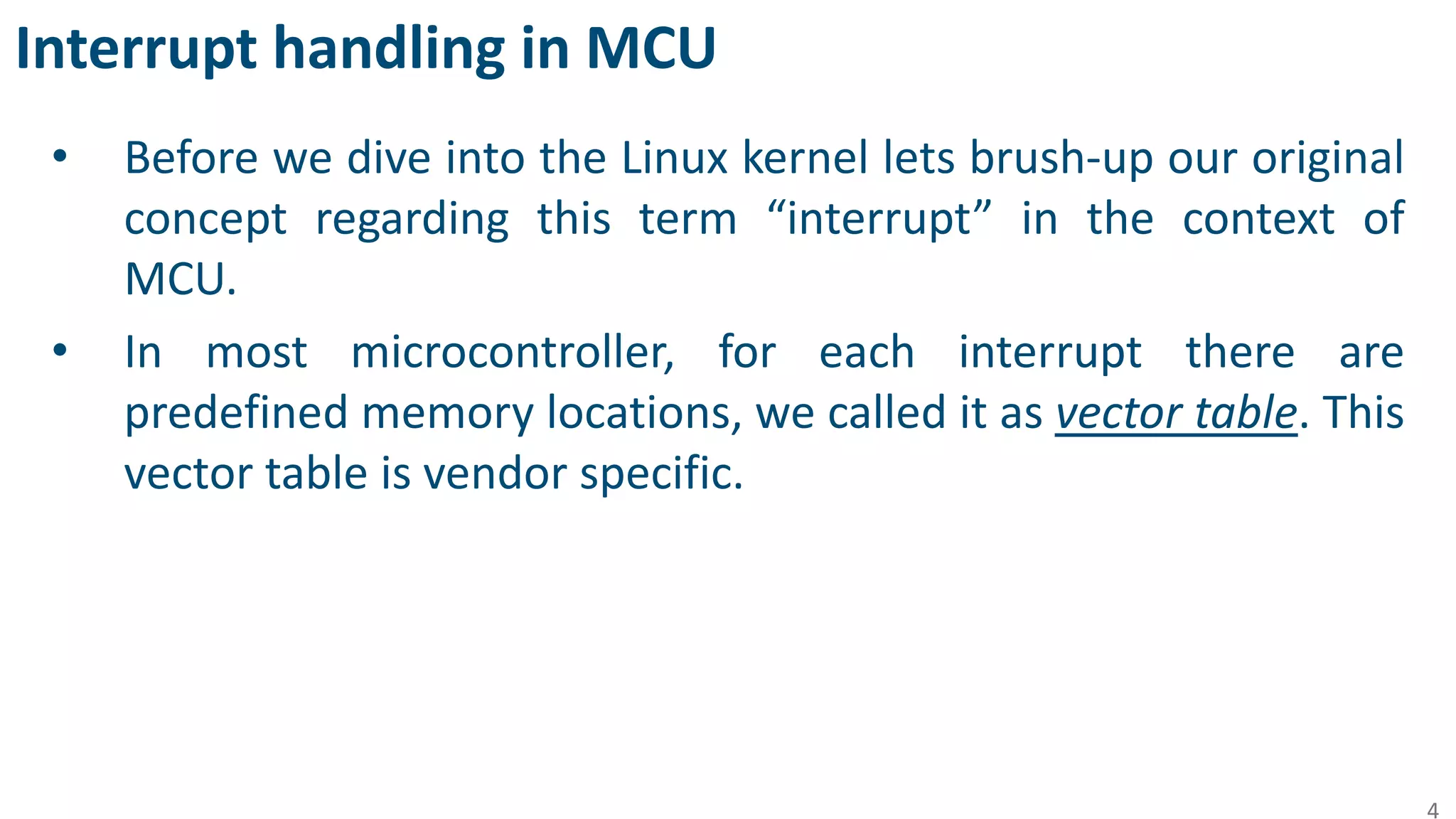
Introduction
• What is interrupt or Event in computing system?
The simplest answer is,
CPU Attention to any physical or virtual objects whenever those
objects are in action. Or Forcibly change the current execution.
• Busy POLLING alternative and much more efficient.
• In this presentation we will understand the interrupt
management mechanism in Linux kernelspace by taking an
example of GPIO LKM as well as how we can control GPIO
LKM from userspace.
3
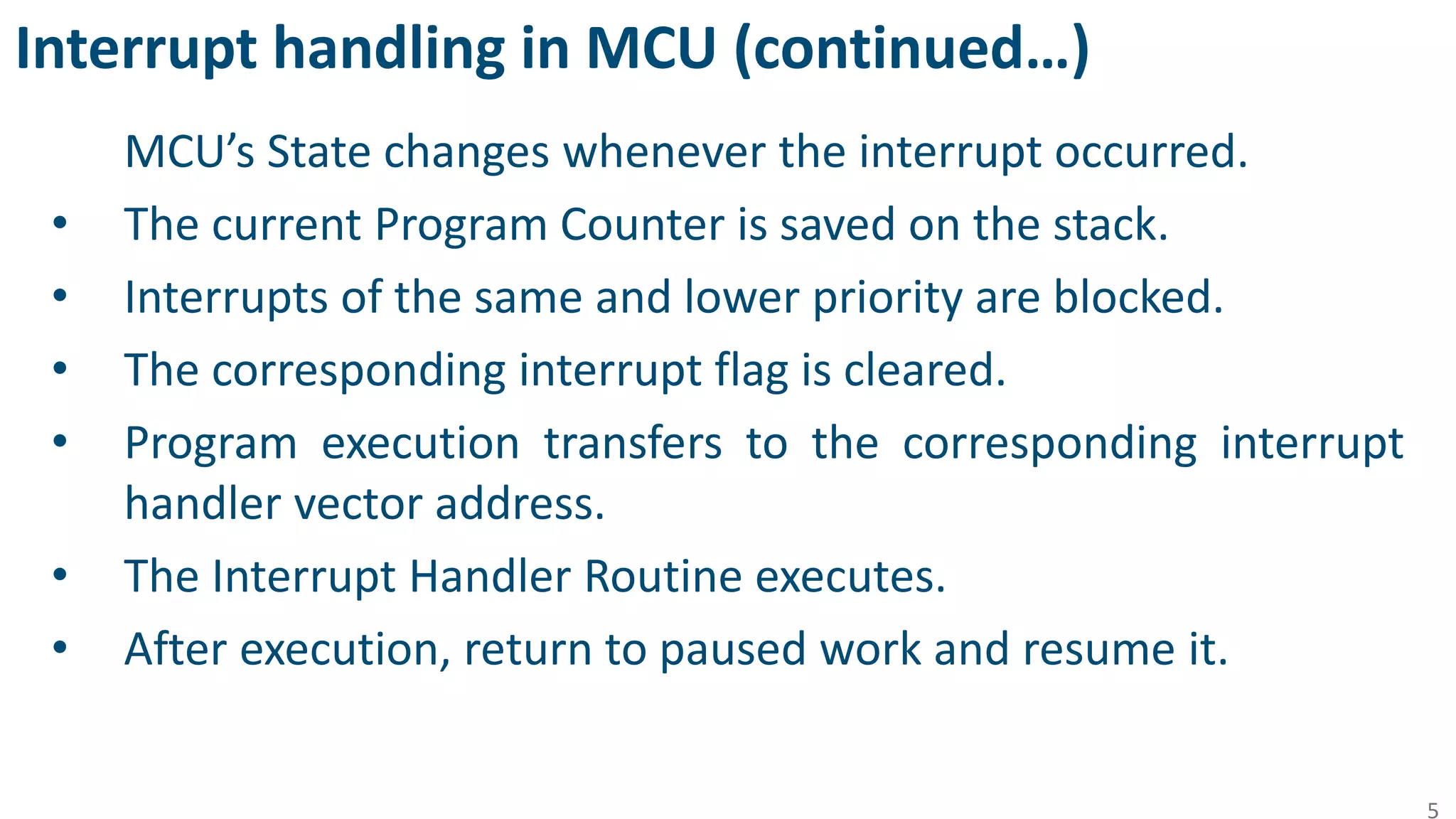
Interrupt handling in MCU
• Before we dive into the Linux kernel lets brush-up our original
concept regarding this term “interrupt” in the context of
MCU.
• In most microcontroller, for each interrupt there are
predefined memory locations, we called it as vector table. This
vector table is vendor specific.
4
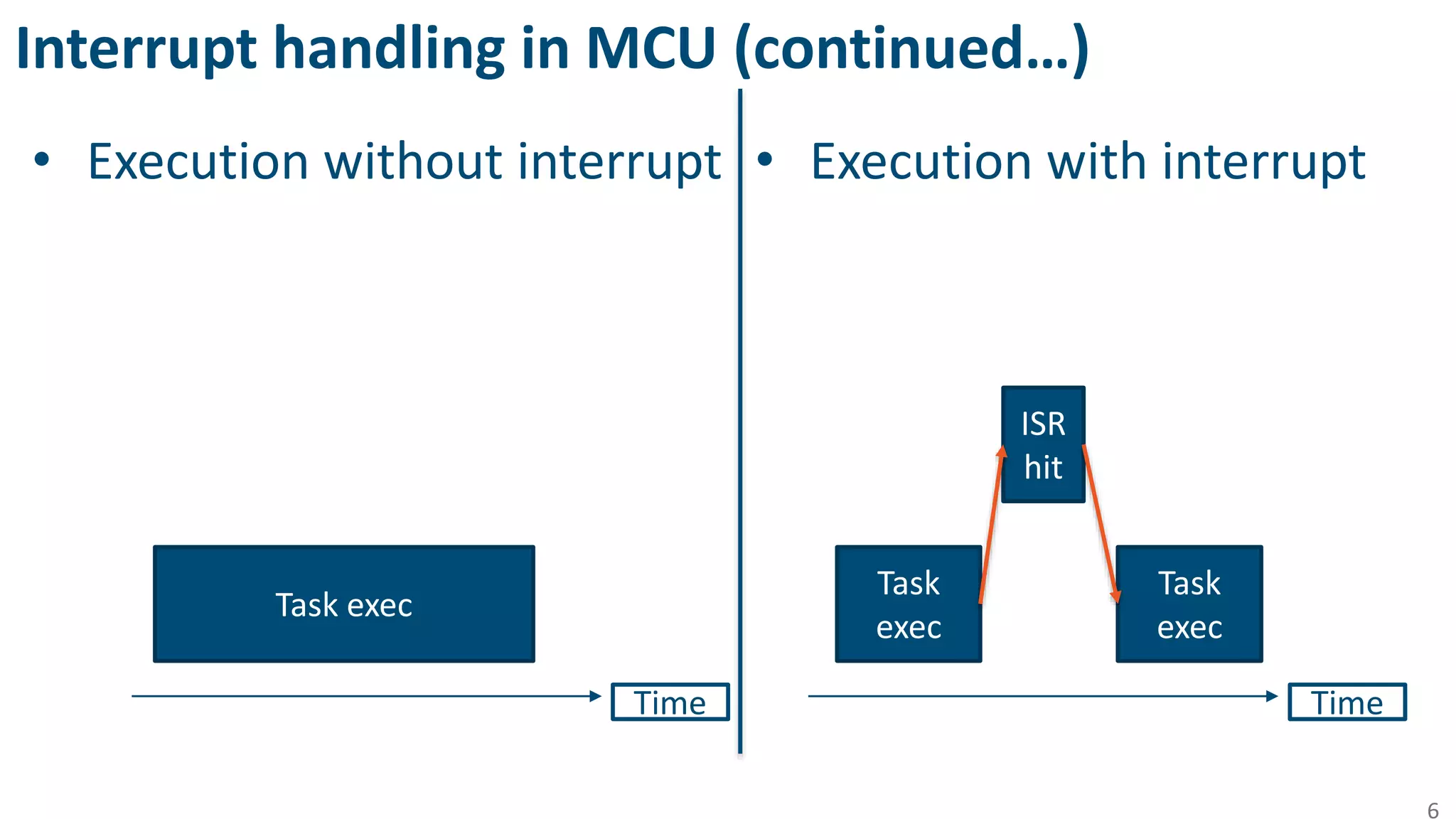
Interrupt handling in MCU (continued…)
MCU’s State changes whenever the interrupt occurred.
• The current Program Counter is saved on the stack.
• Interrupts of the same and lower priority are blocked.
• The corresponding interrupt flag is cleared.
• Program execution transfers to the corresponding interrupt
handler vector address.
• The Interrupt Handler Routine executes.
• After execution, return to paused work and resume it.
5
Interrupt handling in MCU (continued…)
• Execution without interrupt • Execution with interrupt
6
Task
exec
Task
exec
ISR
hit
Task exec
Time Time
Interrupt handling in Linux kernelspace
• Lets talk about SoC + Linux combination.
• It might be possible that we have more then one hardware
connection with SoC.
• For equal response to each hardware, kernel must have to
communicate with each individual hardware.
• Due to low-speed nature of I/O device as compared to CPU,
the I/O devices sent attention signal to CPU asynchronously.
7
Interrupt handling in Linux kernelspace(continued…)
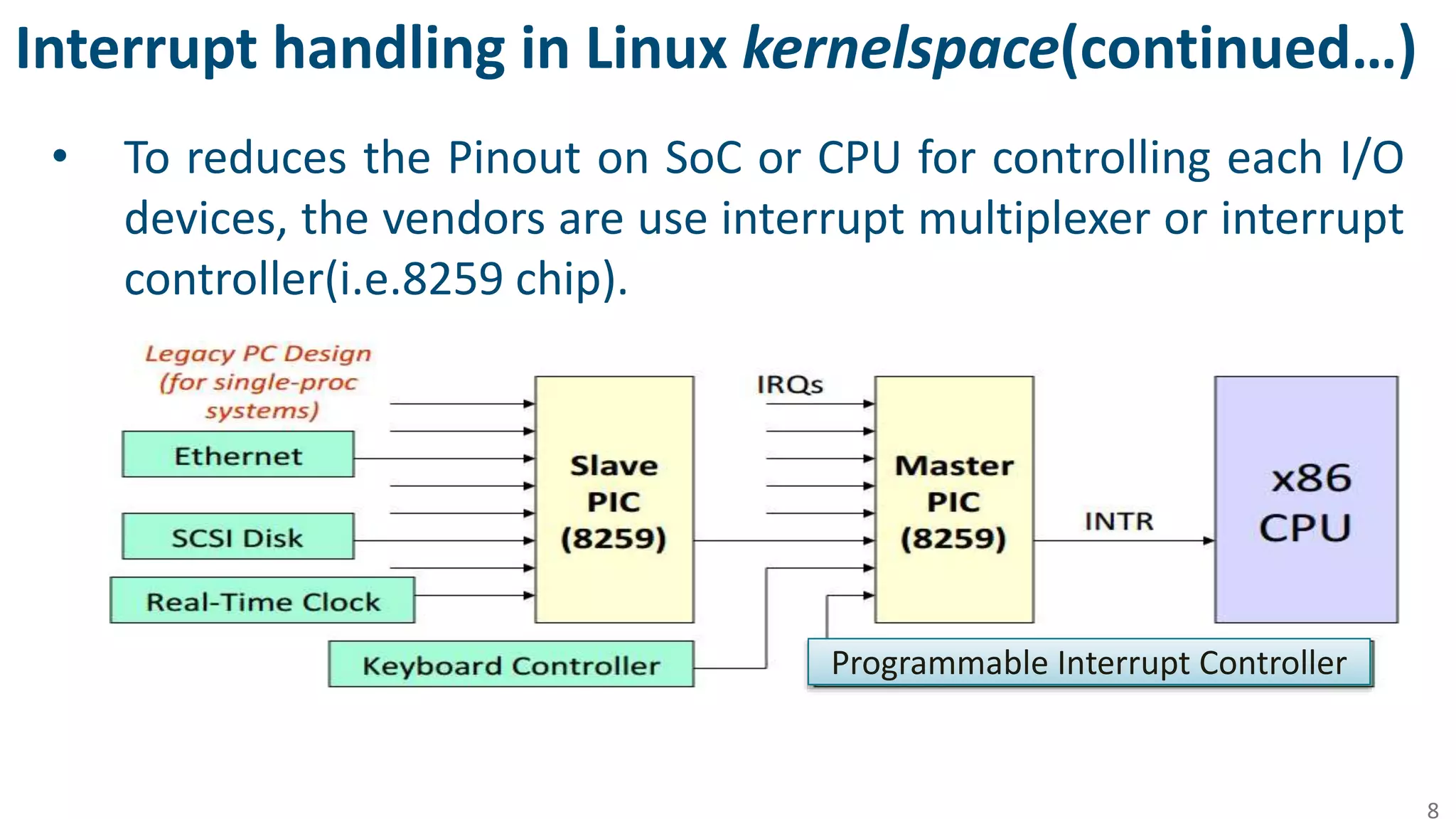
• To reduces the Pinout on SoC or CPU for controlling each I/O
devices, the vendors are use interrupt multiplexer or interrupt
controller(i.e.8259 chip).
8
Programmable Interrupt Controller
Interrupt handling in Linux kernelspace(continued…)
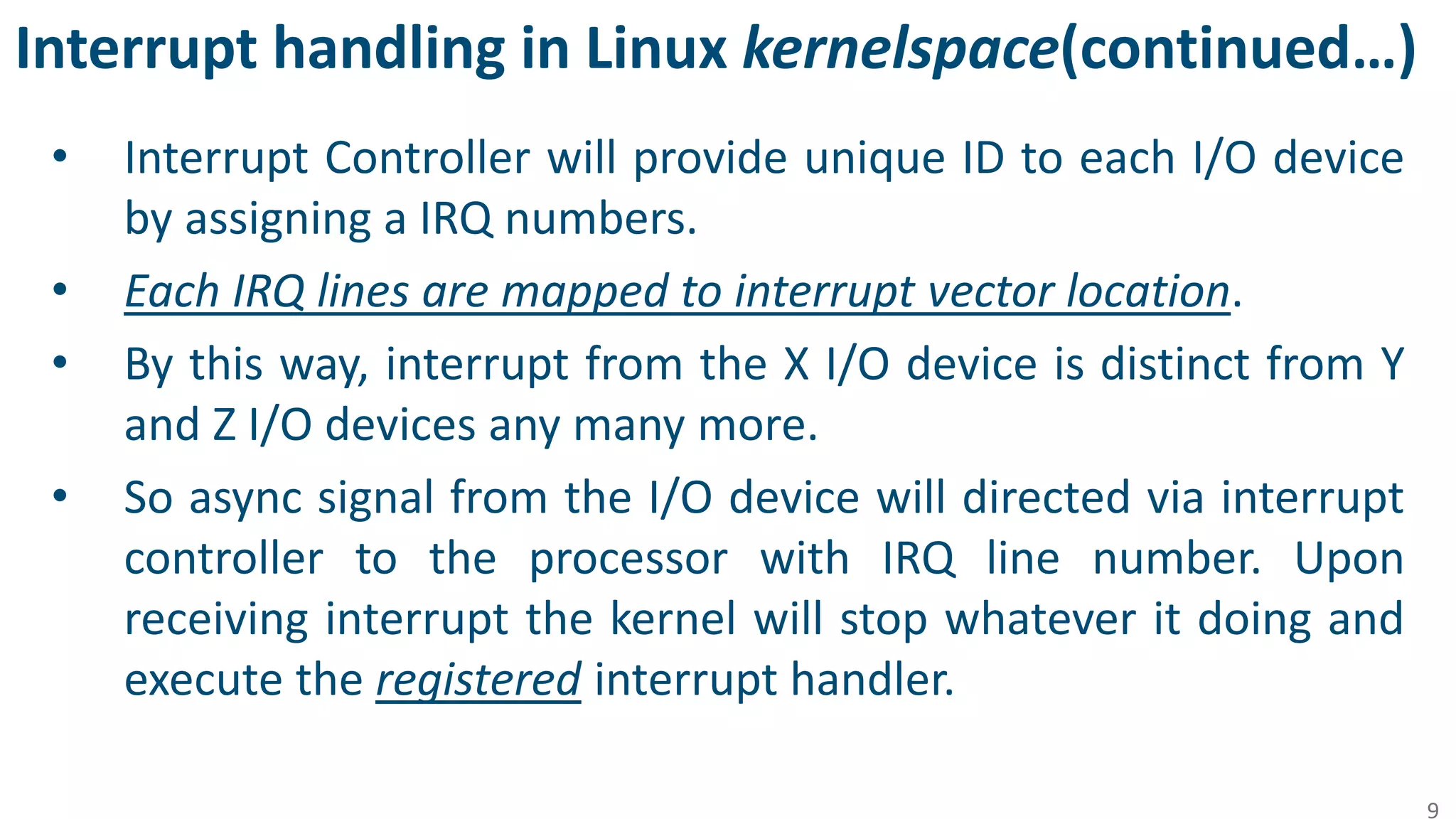
• Interrupt Controller will provide unique ID to each I/O device
by assigning a IRQ numbers.
• Each IRQ lines are mapped to interrupt vector location.
• By this way, interrupt from the X I/O device is distinct from Y
and Z I/O devices any many more.
• So async signal from the I/O device will directed via interrupt
controller to the processor with IRQ line number. Upon
receiving interrupt the kernel will stop whatever it doing and
execute the registered interrupt handler.
9
Interrupt handling in Linux kernelspace(continued…)
• How to implement I/O devices’ interrupt handler?
• Lets make our custom GPIO LKM and see how the
implementation is look like.
• In this example code for userspace entry point, we will focus
on /sys directory rather then /dev, because it is easy to
understand.
•
10
Interrupt handling in Linux kernelspace(continued…)
• What actually request_irq() kernel function (which may sleep)
do internally?
• For the answer of this question we have to understand two
following terms.
 Interrupt Setup
 Interrupt Handling
• For this two terms all the further code flow is as per the Linux
3.10 release and i8259A PIC as example.
11
Interrupt handling in Linux kernelspace(continued…)
• Now return to request_irq() kernel function.
-> request_irq
- -> request_threaded_irq
- - - > action->handler = handler;
12
Our interrupt handler
assignment to irqaction
data structure
Interrupt handling in Linux kernelspace(continued…)
 Interrupt Setup
• As we know that each and every data structure of kernel will
be initialize after we apply power supply.
• The same in case of interrupt, the related data structure and
code flow will also initialize during the boot time.
• Everything are inside the start_kernel() kernel function, which
is “main” function of kernel itself.
13
Interrupt handling in Linux kernelspace(continued…)
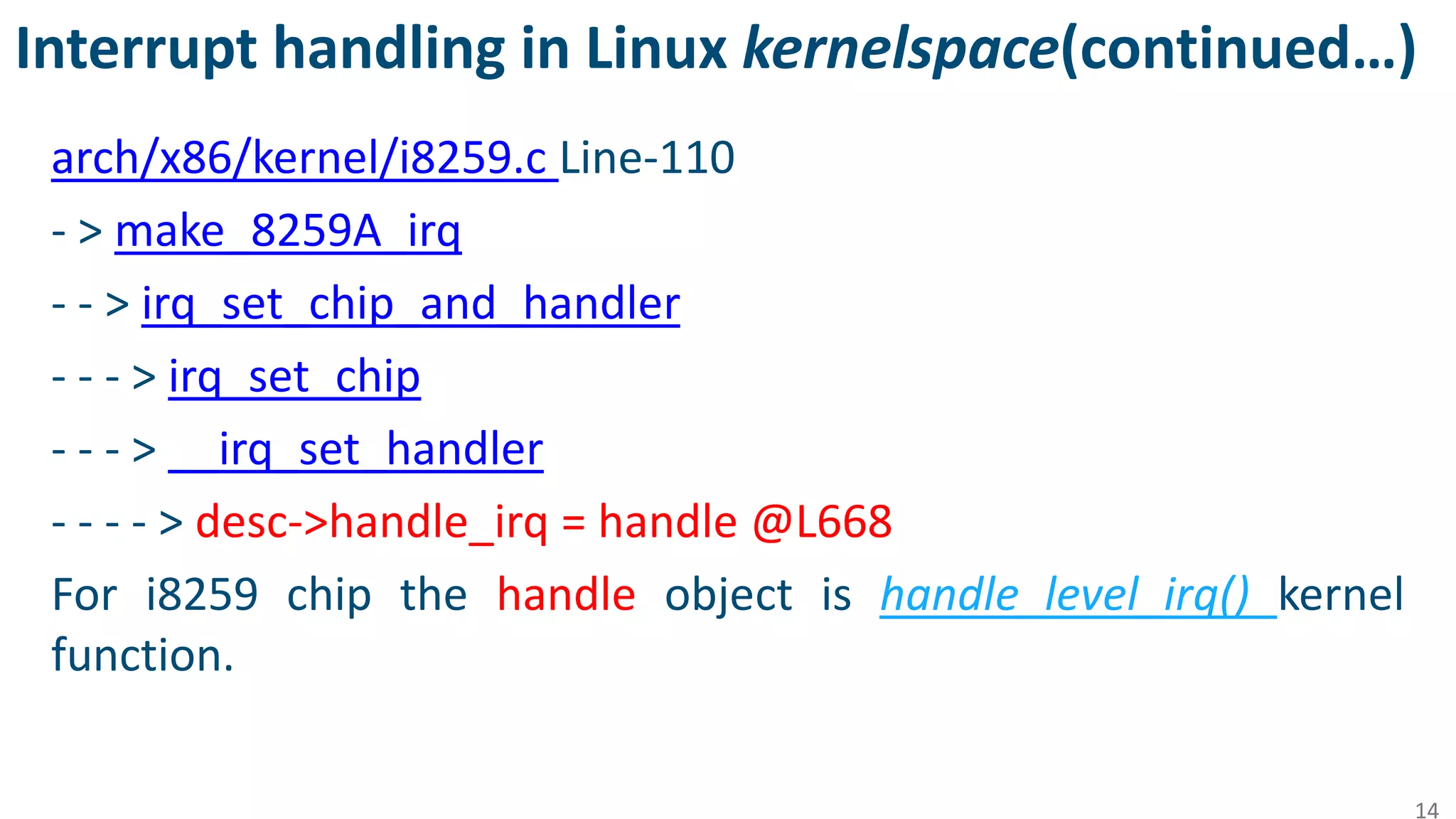
arch/x86/kernel/i8259.c Line-110
- > make_8259A_irq
- - > irq_set_chip_and_handler
- - - > irq_set_chip
- - - > __irq_set_handler
- - - - > desc->handle_irq = handle @L668
For i8259 chip the handle object is handle_level_irq() kernel
function.
14
Interrupt handling in Linux kernelspace(continued…)
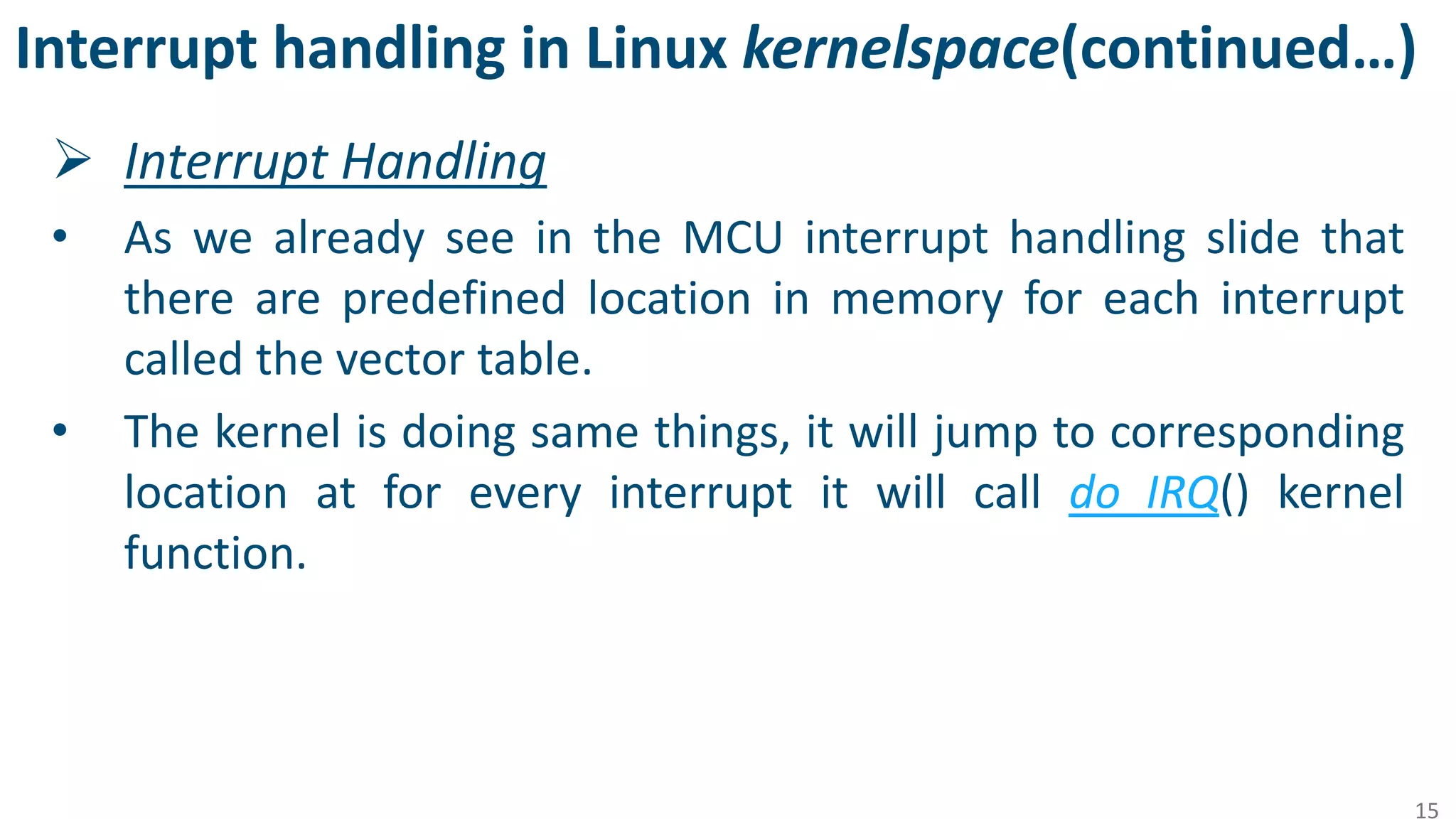
 Interrupt Handling
• As we already see in the MCU interrupt handling slide that
there are predefined location in memory for each interrupt
called the vector table.
• The kernel is doing same things, it will jump to corresponding
location at for every interrupt it will call do_IRQ() kernel
function.
15
Interrupt handling in Linux kernelspace(continued…)
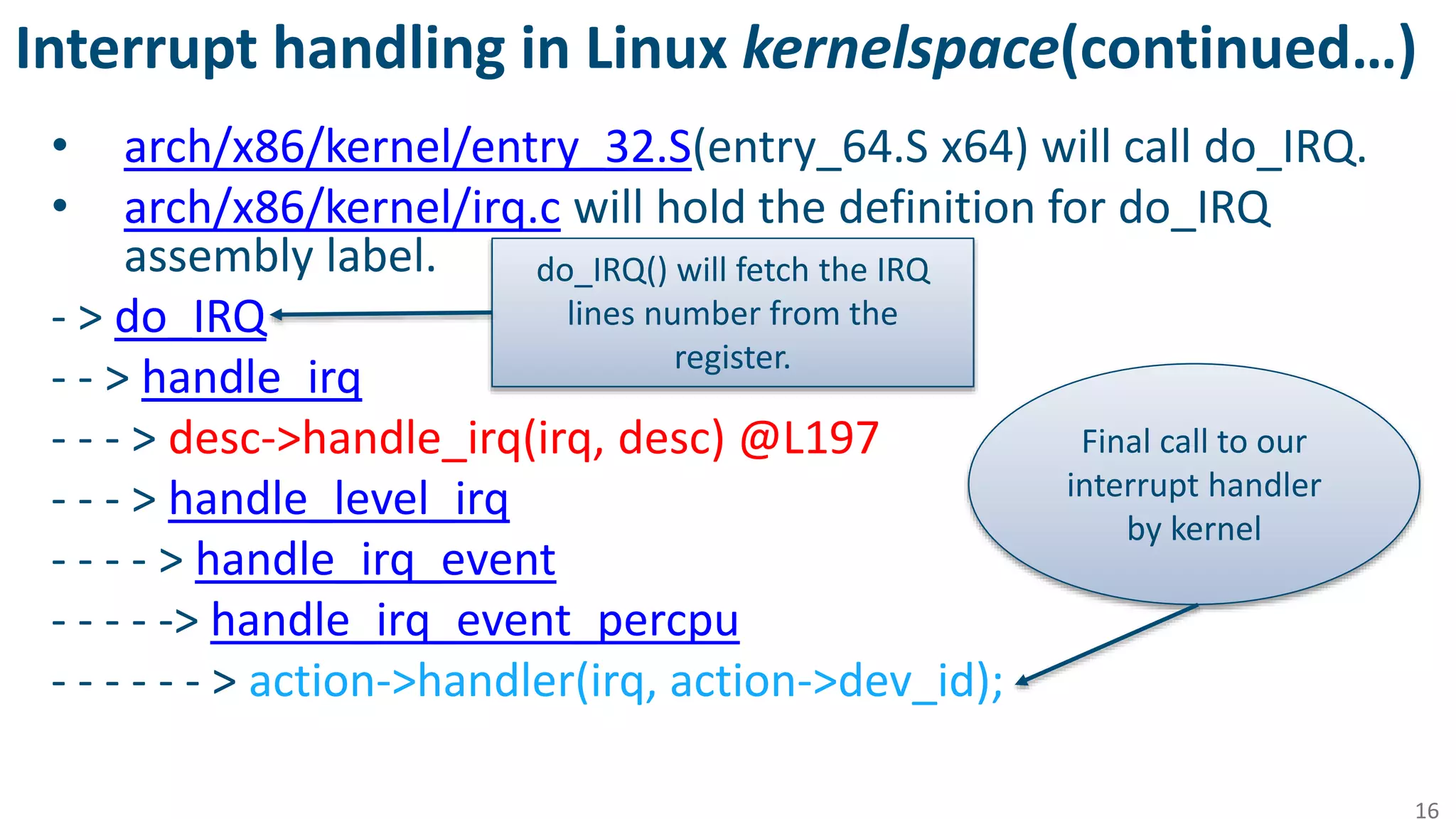
• arch/x86/kernel/entry_32.S(entry_64.S x64) will call do_IRQ.
• arch/x86/kernel/irq.c will hold the definition for do_IRQ
assembly label.
- > do_IRQ
- - > handle_irq
- - - > desc->handle_irq(irq, desc) @L197
- - - > handle_level_irq
- - - - > handle_irq_event
- - - - -> handle_irq_event_percpu
- - - - - - > action->handler(irq, action->dev_id);
16
Final call to our
interrupt handler
by kernel
do_IRQ() will fetch the IRQ
lines number from the
register.
Event handling in userspace
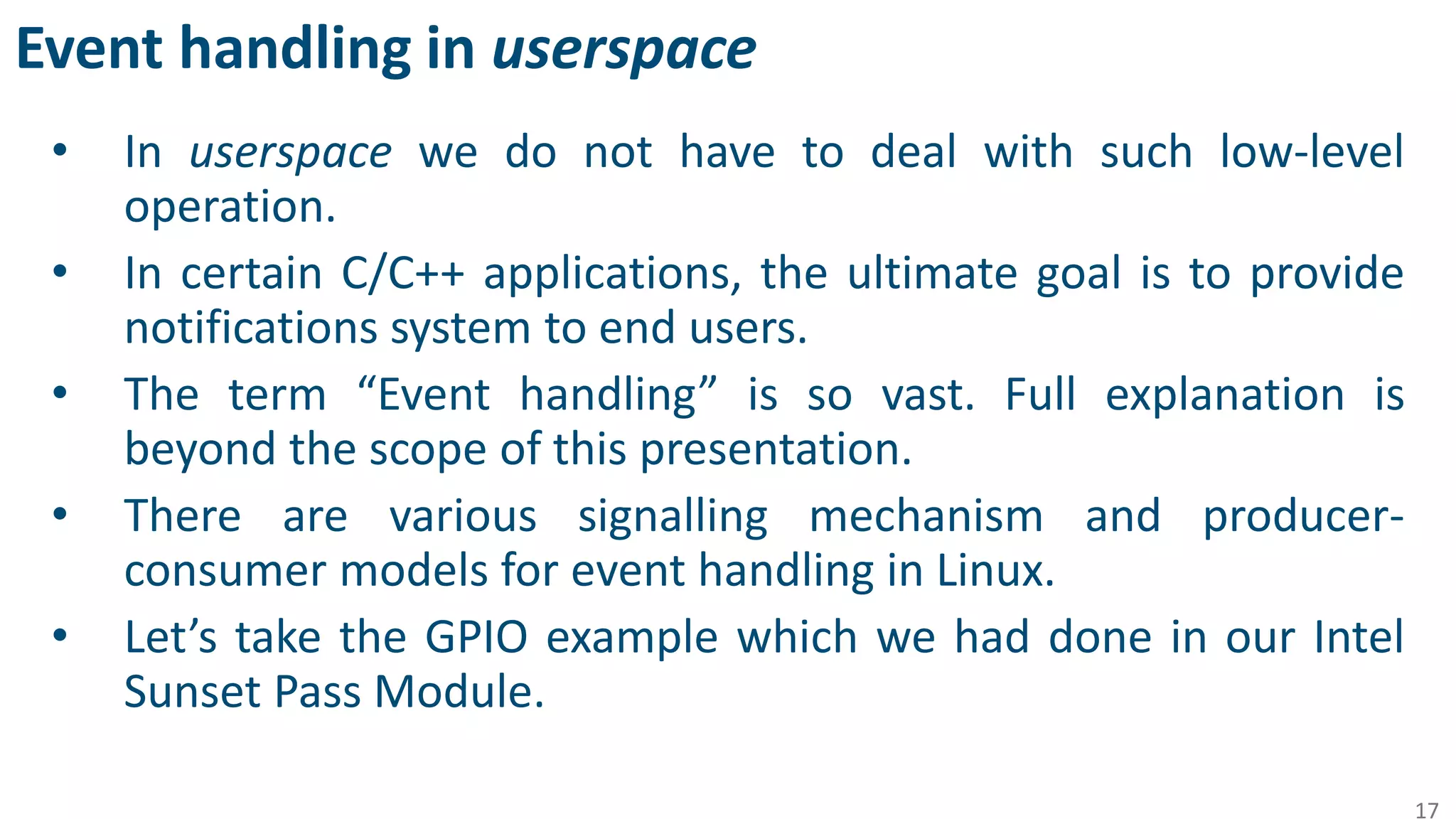
• In userspace we do not have to deal with such low-level
operation.
• In certain C/C++ applications, the ultimate goal is to provide
notifications system to end users.
• The term “Event handling” is so vast. Full explanation is
beyond the scope of this presentation.
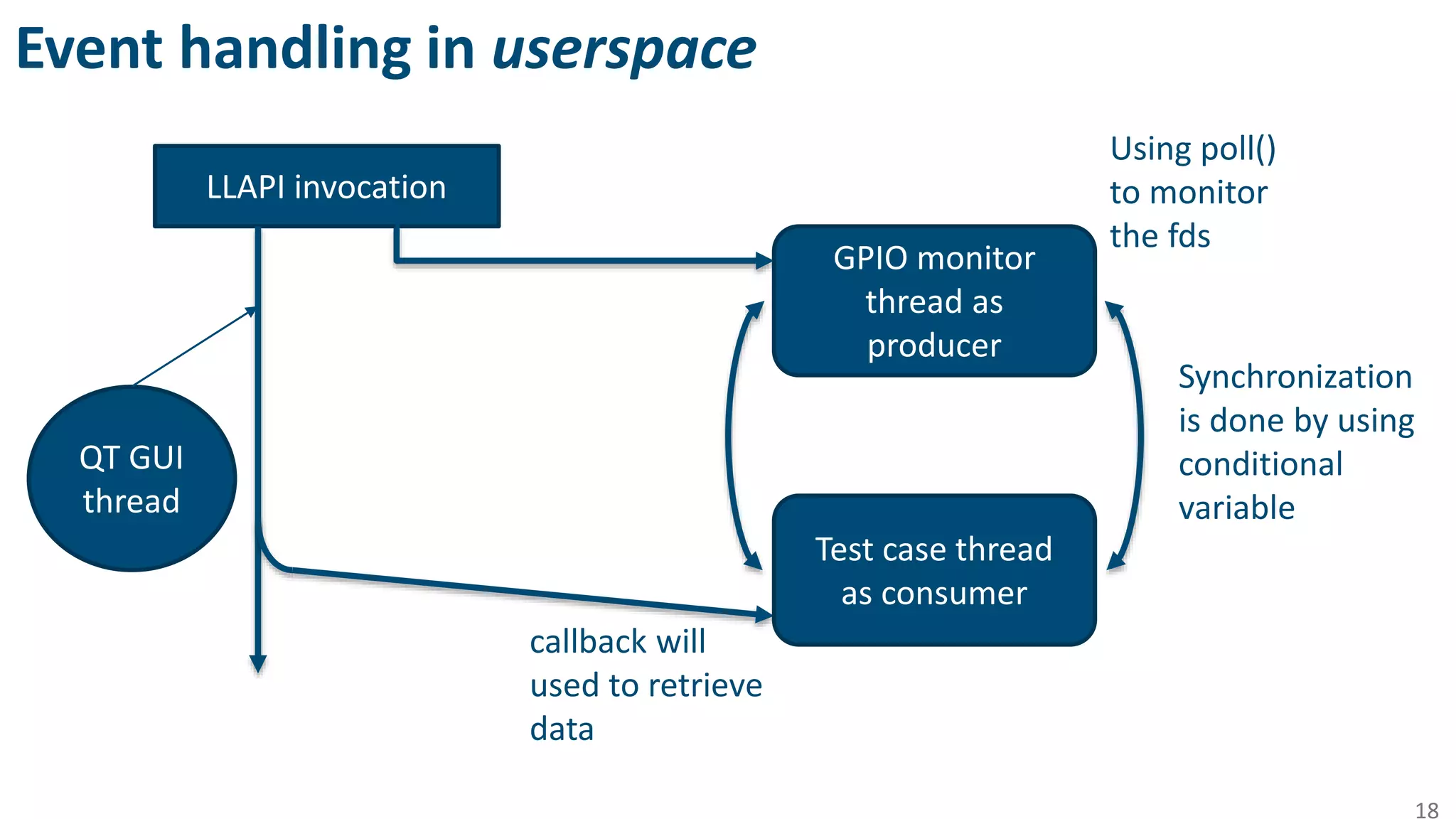
• There are various signalling mechanism and producer-
consumer models for event handling in Linux.
• Let’s take the GPIO example which we had done in our Intel
Sunset Pass Module.
17
Event handling in userspace
18
LLAPI invocation
QT GUI
thread
Test case thread
as consumer
GPIO monitor
thread as
producer
Using poll()
to monitor
the fds
Synchronization
is done by using
conditional
variable
callback will
used to retrieve
data
Q & A
19
20
Name : Bhoomil C.
Email ID : bhoomil.chavda@einfochips.com
Phone Number : +91 9825511802

Beneath the Linux Interrupt handling

  • 1.
    Beneath the LinuxInterrupt Presenter Name: Bhoomil C. Date: 26th September 2016
  • 2.
    Agenda • Introduction • Interrupthandling in MCU • Interrupt handling in Linux kernelspace. • Event handling in Linux userspace. • Q/A 2
  • 3.
    Introduction • What isinterrupt or Event in computing system? The simplest answer is, CPU Attention to any physical or virtual objects whenever those objects are in action. Or Forcibly change the current execution. • Busy POLLING alternative and much more efficient. • In this presentation we will understand the interrupt management mechanism in Linux kernelspace by taking an example of GPIO LKM as well as how we can control GPIO LKM from userspace. 3
  • 4.
    Interrupt handling inMCU • Before we dive into the Linux kernel lets brush-up our original concept regarding this term “interrupt” in the context of MCU. • In most microcontroller, for each interrupt there are predefined memory locations, we called it as vector table. This vector table is vendor specific. 4
  • 5.
    Interrupt handling inMCU (continued…) MCU’s State changes whenever the interrupt occurred. • The current Program Counter is saved on the stack. • Interrupts of the same and lower priority are blocked. • The corresponding interrupt flag is cleared. • Program execution transfers to the corresponding interrupt handler vector address. • The Interrupt Handler Routine executes. • After execution, return to paused work and resume it. 5
  • 6.
    Interrupt handling inMCU (continued…) • Execution without interrupt • Execution with interrupt 6 Task exec Task exec ISR hit Task exec Time Time
  • 7.
    Interrupt handling inLinux kernelspace • Lets talk about SoC + Linux combination. • It might be possible that we have more then one hardware connection with SoC. • For equal response to each hardware, kernel must have to communicate with each individual hardware. • Due to low-speed nature of I/O device as compared to CPU, the I/O devices sent attention signal to CPU asynchronously. 7
  • 8.
    Interrupt handling inLinux kernelspace(continued…) • To reduces the Pinout on SoC or CPU for controlling each I/O devices, the vendors are use interrupt multiplexer or interrupt controller(i.e.8259 chip). 8 Programmable Interrupt Controller
  • 9.
    Interrupt handling inLinux kernelspace(continued…) • Interrupt Controller will provide unique ID to each I/O device by assigning a IRQ numbers. • Each IRQ lines are mapped to interrupt vector location. • By this way, interrupt from the X I/O device is distinct from Y and Z I/O devices any many more. • So async signal from the I/O device will directed via interrupt controller to the processor with IRQ line number. Upon receiving interrupt the kernel will stop whatever it doing and execute the registered interrupt handler. 9
  • 10.
    Interrupt handling inLinux kernelspace(continued…) • How to implement I/O devices’ interrupt handler? • Lets make our custom GPIO LKM and see how the implementation is look like. • In this example code for userspace entry point, we will focus on /sys directory rather then /dev, because it is easy to understand. • 10
  • 11.
    Interrupt handling inLinux kernelspace(continued…) • What actually request_irq() kernel function (which may sleep) do internally? • For the answer of this question we have to understand two following terms.  Interrupt Setup  Interrupt Handling • For this two terms all the further code flow is as per the Linux 3.10 release and i8259A PIC as example. 11
  • 12.
    Interrupt handling inLinux kernelspace(continued…) • Now return to request_irq() kernel function. -> request_irq - -> request_threaded_irq - - - > action->handler = handler; 12 Our interrupt handler assignment to irqaction data structure
  • 13.
    Interrupt handling inLinux kernelspace(continued…)  Interrupt Setup • As we know that each and every data structure of kernel will be initialize after we apply power supply. • The same in case of interrupt, the related data structure and code flow will also initialize during the boot time. • Everything are inside the start_kernel() kernel function, which is “main” function of kernel itself. 13
  • 14.
    Interrupt handling inLinux kernelspace(continued…) arch/x86/kernel/i8259.c Line-110 - > make_8259A_irq - - > irq_set_chip_and_handler - - - > irq_set_chip - - - > __irq_set_handler - - - - > desc->handle_irq = handle @L668 For i8259 chip the handle object is handle_level_irq() kernel function. 14
  • 15.
    Interrupt handling inLinux kernelspace(continued…)  Interrupt Handling • As we already see in the MCU interrupt handling slide that there are predefined location in memory for each interrupt called the vector table. • The kernel is doing same things, it will jump to corresponding location at for every interrupt it will call do_IRQ() kernel function. 15
  • 16.
    Interrupt handling inLinux kernelspace(continued…) • arch/x86/kernel/entry_32.S(entry_64.S x64) will call do_IRQ. • arch/x86/kernel/irq.c will hold the definition for do_IRQ assembly label. - > do_IRQ - - > handle_irq - - - > desc->handle_irq(irq, desc) @L197 - - - > handle_level_irq - - - - > handle_irq_event - - - - -> handle_irq_event_percpu - - - - - - > action->handler(irq, action->dev_id); 16 Final call to our interrupt handler by kernel do_IRQ() will fetch the IRQ lines number from the register.
  • 17.
    Event handling inuserspace • In userspace we do not have to deal with such low-level operation. • In certain C/C++ applications, the ultimate goal is to provide notifications system to end users. • The term “Event handling” is so vast. Full explanation is beyond the scope of this presentation. • There are various signalling mechanism and producer- consumer models for event handling in Linux. • Let’s take the GPIO example which we had done in our Intel Sunset Pass Module. 17
  • 18.
    Event handling inuserspace 18 LLAPI invocation QT GUI thread Test case thread as consumer GPIO monitor thread as producer Using poll() to monitor the fds Synchronization is done by using conditional variable callback will used to retrieve data
  • 19.
  • 20.
    20 Name : BhoomilC. Email ID : bhoomil.chavda@einfochips.com Phone Number : +91 9825511802

Editor's Notes