Microprocessor - 8086 Interrupts
Interrupt is the method of creating a temporary
halt during program execution and allows
peripheral devices to access the microprocessor.
The microprocessor responds to that interrupt
with an ISR (Interrupt Service Routine), which is
a short program to instruct the microprocessor
on how to handle the interrupt.
The following image shows the types of interrupts we
have in a 8086 microprocessor
Hardware Interrupts
• Hardware interrupt is caused by any peripheral
device by sending a signal through a specified pin
to the microprocessor.
• The 8086 has two hardware interrupt pins, i.e.
NMI and INTR.
• NMI is a non-maskable interrupt and INTR is a
maskable interrupt having lower priority.
• One more interrupt pin associated is INTA called
interrupt acknowledge.
NMI
• It is a single non-maskable interrupt pin (NMI) having higher
priority than the maskable interrupt request pin (INTR)and
it is of type 2 interrupt.
• When this interrupt is activated, these actions take place −
 Completes the current instruction that is in progress.
 Pushes the Flag register values on to the stack.
 Pushes the CS (code segment) value and IP (instruction
pointer) value of the return address on to the stack.
 IP is loaded from the contents of the word location 00008H.
 CS is loaded from the contents of the next word location
0000AH.
 Interrupt flag and trap flag are reset to 0.
INTR
• The INTR is a maskable interrupt because the microprocessor will be
interrupted only if interrupts are enabled using set interrupt flag
instruction.
• It should not be enabled using clear interrupt Flag instruction.
• The INTR interrupt is activated by an I/O port.
• If the interrupt is enabled and NMI is disabled, then the microprocessor
first completes the current execution and sends ‘0’ on INTA pin twice.
• The first ‘0’ means INTA informs the external device to get ready and during
the second ‘0’ the microprocessor receives the 8 bit, say X, from the
programmable interrupt controller.
• These actions are taken by the microprocessor −
 First completes the current instruction.
 Activates INTA output and receives the interrupt type, say X.
 Flag register value, CS value of the return address and IP value of the return
address are pushed on to the stack.
 IP value is loaded from the contents of word location X × 4
 CS is loaded from the contents of the next word location.
 Interrupt flag and trap flag is reset to 0
Interrupt vectors
• Interrupt vectors are addresses which inform the interrupt handler as to where
to find the ISR.
• All interrupts are assigned a number from 0 to 255.
• The interrupt vectors associated with each interrupt number are stored in the
lower 1024 bytes of PC memory.
• For example, interrupt 0 is stored from 0000:0000 to 0000:0003, interrupt 1
from 0000:0004 to 0000:0007, and so on.
• The first two bytes store the offset and the next two store the segment address.
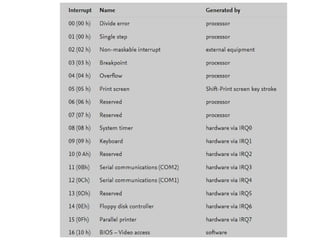
• Each interrupt number is assigned a predetermined task, as outlined
in Table 2.5.
• An interrupt can be generated either by external hardware, software, or by the
processor.
• Interrupts 0, 1, 3, 4, 6 and 7 are generated by the processor.
• Interrupts from 8 to 15 and interrupt 2 are generated by external hardware.
• These get the attention of the processor by activating a interrupt request (IRQ)
line.
• The IRQ0 line connects to the system timer, the keyboard to IRQ1, and so on.
• Most other interrupts are generated by software.
• In an interrupt vector table, the first five
interrupt vectors are identical in all
Intel microprocessor family members, from the
8086 to the Pentium.
• Other interrupt vectors exist for the 80286 that
are upward-compatible to 80386, 80486, and
Pentium to Pentium 4, but not downward-
compatible to the 8086 or 8088.
• Intel reserves the first 32 interrupt vectors for its
use in various microprocessor family members.
• The last 224 vectors are available as user
interrupt vectors.
Software Interrupts
• Some instructions are inserted at the desired
position into the program to create interrupts.
• These interrupt instructions can be used to
test the working of various interrupt handlers.
INT- Interrupt instruction with type number
• It is 2-byte instruction.
• First byte provides the op-code and the second byte provides
the interrupt type number.
• There are 256 interrupt types under this group.
• Its execution includes the following steps −
 Flag register value is pushed on to the stack.
 CS value of the return address and IP value of the return
address are pushed on to the stack.
 IP is loaded from the contents of the word location ‘type
number’ × 4
 CS is loaded from the contents of the next word location.
 Interrupt Flag and Trap Flag are reset to 0
 The starting address for type0 interrupt is 000000H, for type1
interrupt is 00004H similarly for type2 is 00008H and ……so on.
First Five Pointers
• The first five pointers are dedicated interrupt pointers.
i.e. −
 TYPE 0 interrupt represents division by zero situation.
 TYPE 1 interrupt represents single-step execution
during the debugging of a program.
 TYPE 2 interrupt represents non-maskable NMI
interrupt.
 TYPE 3 interrupt represents break-point interrupt.
 TYPE 4 interrupt represents overflow interrupt.
• The interrupts from Type 5 to Type 31 are reserved for
other advanced microprocessors, and
• interrupts from 32 to Type 255 are available for
hardware and software interrupts.
INT 3-Break Point Interrupt Instruction
• It is a 1-byte instruction having op-code is CCH.
• These instructions are inserted into the program so that
when the processor reaches there, then it stops the normal
execution of program and follows the break-point procedure.
• Its execution includes the following steps −
 Flag register value is pushed on to the stack.
 CS value of the return address and IP value of the return
address are pushed on to the stack.
 IP is loaded from the contents of the word location 3×4 =
0000CH
 CS is loaded from the contents of the next word location.
 Interrupt Flag and Trap Flag are reset to 0
INT4 - Interrupt on overflow instruction
• It is a 1-byte instruction and their mnemonic INT4.
• The op-code for this instruction is CEH.
• As the name suggests it is a conditional interrupt instruction, i.e.
it is active only when the overflow flag is set to 1 and branches to
the interrupt handler whose interrupt type number is 4.
• If the overflow flag is reset then, the execution continues to the
next instruction.
• Its execution includes the following steps −
 Flag register values are pushed on to the stack.
 CS value of the return address and IP value of the return address
are pushed on to the stack.
 IP is loaded from the contents of word location 4×4 = 00010H
 CS is loaded from the contents of the next word location.
 Interrupt flag and Trap flag are reset to 0
Interrupt Nesting
• Another feature of this family is that interrupt nesting can be enabled.
With interrupt nesting enabled interrupts can interrupt other interrupts
(but not themselves).
• Yet another feature in this family allows an interrupt level (0–7) to be
assigned to each interrupt handler.
• Instead of a hard interrupts-enabled or -disabled (GIE flag) there is
available a service level number (0–7) that indicates which interrupts are
enabled by level number.
• For example, if the service level is set to 3, only levels 3, 4, 5, 6, and 7 are
serviced, the remaining act like the interrupt is disabled.
• This is used for complex programs where, depending on the current mode
of the program, only certain groups of interrupts are enabled.
• The level also determines which interrupt is invoked first if two interrupts
happen at the same time.
• To set the level for an ISR, use: # int_ext level=3
• Finally there is a group of interrupt sources defined in this family that is
related to program errors. These are called traps but work like interrupts.
• For example, one of the traps is a divide by zero

3.12_8086 microprocessor Interrupts.pptx

  • 1.
    Microprocessor - 8086Interrupts Interrupt is the method of creating a temporary halt during program execution and allows peripheral devices to access the microprocessor. The microprocessor responds to that interrupt with an ISR (Interrupt Service Routine), which is a short program to instruct the microprocessor on how to handle the interrupt.
  • 2.
    The following imageshows the types of interrupts we have in a 8086 microprocessor
  • 3.
    Hardware Interrupts • Hardwareinterrupt is caused by any peripheral device by sending a signal through a specified pin to the microprocessor. • The 8086 has two hardware interrupt pins, i.e. NMI and INTR. • NMI is a non-maskable interrupt and INTR is a maskable interrupt having lower priority. • One more interrupt pin associated is INTA called interrupt acknowledge.
  • 4.
    NMI • It isa single non-maskable interrupt pin (NMI) having higher priority than the maskable interrupt request pin (INTR)and it is of type 2 interrupt. • When this interrupt is activated, these actions take place −  Completes the current instruction that is in progress.  Pushes the Flag register values on to the stack.  Pushes the CS (code segment) value and IP (instruction pointer) value of the return address on to the stack.  IP is loaded from the contents of the word location 00008H.  CS is loaded from the contents of the next word location 0000AH.  Interrupt flag and trap flag are reset to 0.
  • 5.
    INTR • The INTRis a maskable interrupt because the microprocessor will be interrupted only if interrupts are enabled using set interrupt flag instruction. • It should not be enabled using clear interrupt Flag instruction. • The INTR interrupt is activated by an I/O port. • If the interrupt is enabled and NMI is disabled, then the microprocessor first completes the current execution and sends ‘0’ on INTA pin twice. • The first ‘0’ means INTA informs the external device to get ready and during the second ‘0’ the microprocessor receives the 8 bit, say X, from the programmable interrupt controller. • These actions are taken by the microprocessor −  First completes the current instruction.  Activates INTA output and receives the interrupt type, say X.  Flag register value, CS value of the return address and IP value of the return address are pushed on to the stack.  IP value is loaded from the contents of word location X × 4  CS is loaded from the contents of the next word location.  Interrupt flag and trap flag is reset to 0
  • 6.
    Interrupt vectors • Interruptvectors are addresses which inform the interrupt handler as to where to find the ISR. • All interrupts are assigned a number from 0 to 255. • The interrupt vectors associated with each interrupt number are stored in the lower 1024 bytes of PC memory. • For example, interrupt 0 is stored from 0000:0000 to 0000:0003, interrupt 1 from 0000:0004 to 0000:0007, and so on. • The first two bytes store the offset and the next two store the segment address. • Each interrupt number is assigned a predetermined task, as outlined in Table 2.5. • An interrupt can be generated either by external hardware, software, or by the processor. • Interrupts 0, 1, 3, 4, 6 and 7 are generated by the processor. • Interrupts from 8 to 15 and interrupt 2 are generated by external hardware. • These get the attention of the processor by activating a interrupt request (IRQ) line. • The IRQ0 line connects to the system timer, the keyboard to IRQ1, and so on. • Most other interrupts are generated by software.
  • 11.
    • In aninterrupt vector table, the first five interrupt vectors are identical in all Intel microprocessor family members, from the 8086 to the Pentium. • Other interrupt vectors exist for the 80286 that are upward-compatible to 80386, 80486, and Pentium to Pentium 4, but not downward- compatible to the 8086 or 8088. • Intel reserves the first 32 interrupt vectors for its use in various microprocessor family members. • The last 224 vectors are available as user interrupt vectors.
  • 12.
    Software Interrupts • Someinstructions are inserted at the desired position into the program to create interrupts. • These interrupt instructions can be used to test the working of various interrupt handlers.
  • 13.
    INT- Interrupt instructionwith type number • It is 2-byte instruction. • First byte provides the op-code and the second byte provides the interrupt type number. • There are 256 interrupt types under this group. • Its execution includes the following steps −  Flag register value is pushed on to the stack.  CS value of the return address and IP value of the return address are pushed on to the stack.  IP is loaded from the contents of the word location ‘type number’ × 4  CS is loaded from the contents of the next word location.  Interrupt Flag and Trap Flag are reset to 0  The starting address for type0 interrupt is 000000H, for type1 interrupt is 00004H similarly for type2 is 00008H and ……so on.
  • 14.
    First Five Pointers •The first five pointers are dedicated interrupt pointers. i.e. −  TYPE 0 interrupt represents division by zero situation.  TYPE 1 interrupt represents single-step execution during the debugging of a program.  TYPE 2 interrupt represents non-maskable NMI interrupt.  TYPE 3 interrupt represents break-point interrupt.  TYPE 4 interrupt represents overflow interrupt. • The interrupts from Type 5 to Type 31 are reserved for other advanced microprocessors, and • interrupts from 32 to Type 255 are available for hardware and software interrupts.
  • 15.
    INT 3-Break PointInterrupt Instruction • It is a 1-byte instruction having op-code is CCH. • These instructions are inserted into the program so that when the processor reaches there, then it stops the normal execution of program and follows the break-point procedure. • Its execution includes the following steps −  Flag register value is pushed on to the stack.  CS value of the return address and IP value of the return address are pushed on to the stack.  IP is loaded from the contents of the word location 3×4 = 0000CH  CS is loaded from the contents of the next word location.  Interrupt Flag and Trap Flag are reset to 0
  • 16.
    INT4 - Interrupton overflow instruction • It is a 1-byte instruction and their mnemonic INT4. • The op-code for this instruction is CEH. • As the name suggests it is a conditional interrupt instruction, i.e. it is active only when the overflow flag is set to 1 and branches to the interrupt handler whose interrupt type number is 4. • If the overflow flag is reset then, the execution continues to the next instruction. • Its execution includes the following steps −  Flag register values are pushed on to the stack.  CS value of the return address and IP value of the return address are pushed on to the stack.  IP is loaded from the contents of word location 4×4 = 00010H  CS is loaded from the contents of the next word location.  Interrupt flag and Trap flag are reset to 0
  • 17.
    Interrupt Nesting • Anotherfeature of this family is that interrupt nesting can be enabled. With interrupt nesting enabled interrupts can interrupt other interrupts (but not themselves). • Yet another feature in this family allows an interrupt level (0–7) to be assigned to each interrupt handler. • Instead of a hard interrupts-enabled or -disabled (GIE flag) there is available a service level number (0–7) that indicates which interrupts are enabled by level number. • For example, if the service level is set to 3, only levels 3, 4, 5, 6, and 7 are serviced, the remaining act like the interrupt is disabled. • This is used for complex programs where, depending on the current mode of the program, only certain groups of interrupts are enabled. • The level also determines which interrupt is invoked first if two interrupts happen at the same time. • To set the level for an ISR, use: # int_ext level=3 • Finally there is a group of interrupt sources defined in this family that is related to program errors. These are called traps but work like interrupts. • For example, one of the traps is a divide by zero