





CPU hotplug implementation for the
multicore system running RTOS and Linux
simultaneously on separate cores
Oleksandr Shevchenko
Senior Consultant, Engineering
Agenda
1. Running RTOS and Linux simultaneously on separate
cores
2. CPU hotplug implementation
3. Questions?
3
Part 1
Running RTOS and Linux
simultaneously on separate cores
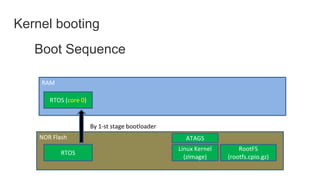
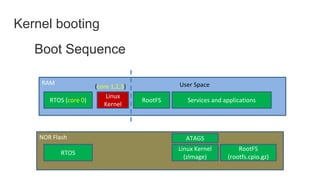
Kernel booting
Boot Sequence
NOR Flash
RTOS
Linux Kernel
(zImage)
RootFS
(rootfs.cpio.gz)
RAM
ATAGS
Kernel booting
Boot Sequence
NOR Flash
RTOS
Linux Kernel
(zImage)
RootFS
(rootfs.cpio.gz)
RAM
RTOS (core 0)
By 1-st stage bootloader
ATAGS
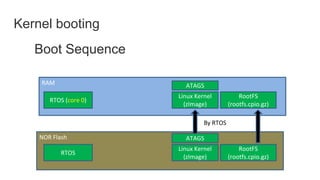
Kernel booting
Boot SequenceBoot Sequence
NOR Flash
Linux Kernel
(zImage)
RootFS
(rootfs.cpio.gz)
RAM
By RTOS
Linux Kernel
(zImage)
RootFS
(rootfs.cpio.gz)
ATAGS
ATAGS
RTOS
RTOS (core 0)
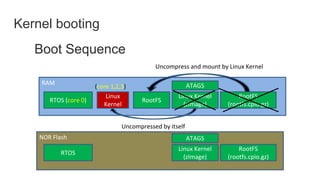
Kernel booting
Boot SequenceBoot SequenceBoot Sequence
NOR Flash
Linux Kernel
(zImage)
RootFS
(rootfs.cpio.gz)
RAM
Linux
Kernel
RootFS
(rootfs.cpio.gz)
RootFS
Uncompress and mount by Linux Kernel
ATAGS
Linux Kernel
(zImage)
Uncompressed by itself
ATAGS
RTOS
RTOS (core 0)
(core 1,2,3)
Kernel booting
Boot SequenceBoot SequenceBoot Sequence
NOR Flash
Linux Kernel
(zImage)
RootFS
(rootfs.cpio.gz)
RAM
Linux
Kernel
RootFS
ATAGS
User Space
Services and applications
RTOS
RTOS (core 0)
(core 1,2,3)
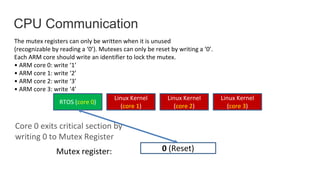
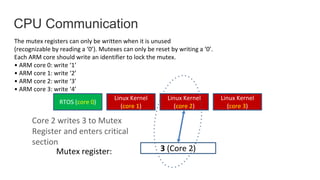
CPU Communication
The mutex registers can only be written when it is unused
(recognizable by reading a ‘0’). Mutexes can only be reset by writing a ‘0’.
Each ARM core should write an identifier to lock the mutex.
• ARM core 0: write ‘1’
• ARM core 1: write ‘2’
• ARM core 2: write ‘3’
• ARM core 3: write ‘4’
RTOS (core 0)
Linux Kernel
(core 2)
Linux Kernel
(core 3)
Linux Kernel
(core 1)
0 (Reset)Mutex register:
CPU Communication
The mutex registers can only be written when it is unused
(recognizable by reading a ‘0’). Mutexes can only be reset by writing a ‘0’.
Each ARM core should write an identifier to lock the mutex.
• ARM core 0: write ‘1’
• ARM core 1: write ‘2’
• ARM core 2: write ‘3’
• ARM core 3: write ‘4’
RTOS (core 0)
Linux Kernel
(core 2)
Linux Kernel
(core 3)
Linux Kernel
(core 1)
1 (Core 0)Mutex register:
Core 0 writes 1 to Mutex
Register and enters critical
section
CPU Communication
The mutex registers can only be written when it is unused
(recognizable by reading a ‘0’). Mutexes can only be reset by writing a ‘0’.
Each ARM core should write an identifier to lock the mutex.
• ARM core 0: write ‘1’
• ARM core 1: write ‘2’
• ARM core 2: write ‘3’
• ARM core 3: write ‘4’
RTOS (core 0)
Linux Kernel
(core 2)
Linux Kernel
(core 3)
Linux Kernel
(core 1)
0 (Reset)Mutex register:
Core 0 exits critical section by
writing 0 to Mutex Register
CPU Communication
The mutex registers can only be written when it is unused
(recognizable by reading a ‘0’). Mutexes can only be reset by writing a ‘0’.
Each ARM core should write an identifier to lock the mutex.
• ARM core 0: write ‘1’
• ARM core 1: write ‘2’
• ARM core 2: write ‘3’
• ARM core 3: write ‘4’
RTOS (core 0)
Linux Kernel
(core 2)
Linux Kernel
(core 3)
Linux Kernel
(core 1)
3 (Core 2)Mutex register:
Core 2 writes 3 to Mutex
Register and enters critical
section
CPU Communication
The mutex registers can only be written when it is unused
(recognizable by reading a ‘0’). Mutexes can only be reset by writing a ‘0’.
Each ARM core should write an identifier to lock the mutex.
• ARM core 0: write ‘1’
• ARM core 1: write ‘2’
• ARM core 2: write ‘3’
• ARM core 3: write ‘4’
RTOS (core 0)
Linux Kernel
(core 2)
Linux Kernel
(core 3)
Linux Kernel
(core 1)
0 (Reset)Mutex register:
Core 2 exits critical section by
writing 0 to Mutex Register
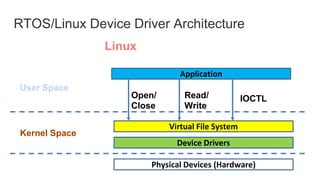
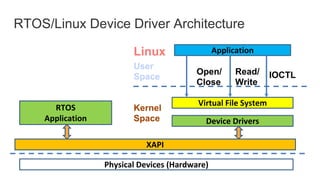
RTOS/Linux Device Driver Architecture
Physical Devices (Hardware)
Device Drivers
Virtual File System
Kernel Space
User Space
Application
Open/
Close
Read/
Write
IOCTL
Linux
RTOS/Linux Device Driver Architecture
Physical Devices (Hardware)
Device Drivers
Virtual File System
Kernel
Space
User
Space
Application
Open/
Close
Read/
Write
IOCTL
Linux
XAPI
RTOS
Application
RTOS/Linux Device Driver Architecture
Linux Driver file opsApplication
fd=open(“/dev/module_xyz”, …); modXyzOpen()
Private
data
handle
last_error
alloc
XAPI Core API
XAPI_XYZ_Open()
XAPI_XYZ_SetX()
XAPI_XYZ_GetY()
close(fd) modXyzClose()
free
XAPI_XYZ_Close()
XAPI_XYZ_Read()
XAPI_XYZ_Write()
modXyzIoctl()ioctl(fd, cmd, …)
User Space Kernel Space
modXyzRead()
modXyzWrite()
read(fd, …)
write(fd, …)
17
Part 1 Summary
1. Introduce correct boot sequence.
18
Part 1 Summary
1. Introduce correct boot sequence.
2. Provide inter-CPU synchronization mechanism.
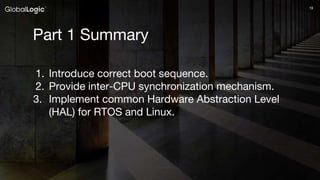
19
Part 1 Summary
1. Introduce correct boot sequence.
2. Provide inter-CPU synchronization mechanism.
3. Implement common Hardware Abstraction Level
(HAL) for RTOS and Linux.
20
PART 2
CPU hotplug implementation
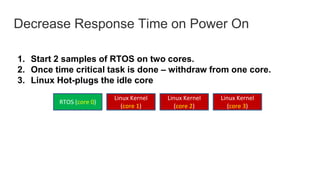
Decrease Response Time on Power On
RTOS (core 0)
Linux Kernel
(core 2)
Linux Kernel
(core 3)
RTOS (core 1)
1. Start 2 samples of RTOS on two cores.
RTOS (core 0)
Linux Kernel
(core 2)
Linux Kernel
(core 3)
1. Start 2 samples of RTOS on two cores.
2. Once time critical task is done – withdraw from one core.
RTOS (core 1)
Decrease Response Time on Power On
RTOS (core 0)
Linux Kernel
(core 2)
Linux Kernel
(core 3)
Idle (core 1)
1. Start 2 samples of RTOS on two cores.
2. Once time critical task is done – withdraw from one core.
Decrease Response Time on Power On
RTOS (core 0)
Linux Kernel
(core 2)
Linux Kernel
(core 3)
Idle (core 1)
1. Start 2 samples of RTOS on two cores.
2. Once time critical task is done – withdraw from one core.
3. Linux Hot-plugs the idle core
Decrease Response Time on Power On
RTOS (core 0)
Linux Kernel
(core 2)
Linux Kernel
(core 3)
1. Start 2 samples of RTOS on two cores.
2. Once time critical task is done – withdraw from one core.
3. Linux Hot-plugs the idle core
Linux Kernel
(core 1)
Decrease Response Time on Power On
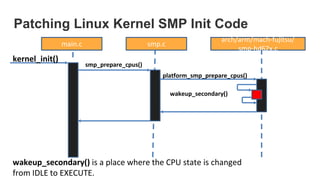
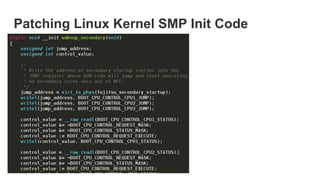
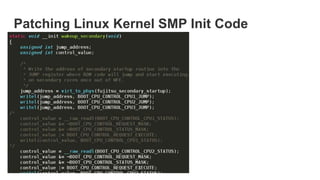
Patching Linux Kernel SMP Init Code
main.c
kernel_init()
wakeup_secondary() is a place where the CPU state is changed
from IDLE to EXECUTE.
smp.c
smp_prepare_cpus()
arch/arm/mach-fujitsu/
smp-hd62x.c
platform_smp_prepare_cpus()
wakeup_secondary()
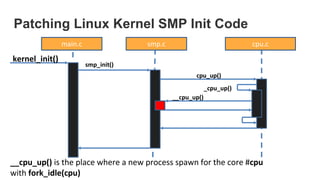
Patching Linux Kernel SMP Init Code
main.c
kernel_init()
__cpu_up() is the place where a new process spawn for the core #cpu
with fork_idle(cpu)
smp.c
smp_init()
cpu.c
cpu_up()
_cpu_up()
__cpu_up()
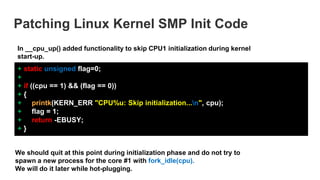
Patching Linux Kernel SMP Init Code
In __cpu_up() added functionality to skip CPU1 initialization during kernel
start-up.
+ static unsigned flag=0;
+
+ if ((cpu == 1) && (flag == 0))
+ {
+ printk(KERN_ERR "CPU%u: Skip initialization...n", cpu);
+ flag = 1;
+ return -EBUSY;
+ }
We should quit at this point during initialization phase and do not try to
spawn a new process for the core #1 with fork_idle(cpu).
We will do it later while hot-plugging.
Patching Linux Kernel SMP Init Code
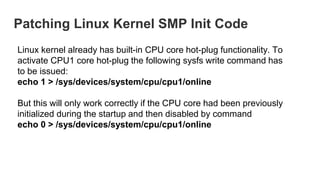
Linux kernel already has built-in CPU core hot-plug functionality. To
activate CPU1 core hot-plug the following sysfs write command has
to be issued:
echo 1 > /sys/devices/system/cpu/cpu1/online
But this will only work correctly if the CPU core had been previously
initialized during the startup and then disabled by command
echo 0 > /sys/devices/system/cpu/cpu1/online
Patching Linux Kernel SMP Init Code
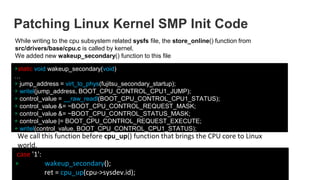
While writing to the cpu subsystem related sysfs file, the store_online() function from
src/drivers/base/cpu.c is called by kernel.
We added new wakeup_secondary() function to this file
+static void wakeup_secondary(void)
…
+ jump_address = virt_to_phys(fujitsu_secondary_startup);
+ writel(jump_address, BOOT_CPU_CONTROL_CPU1_JUMP);
+ control_value = __raw_readl(BOOT_CPU_CONTROL_CPU1_STATUS);
+ control_value &= ~BOOT_CPU_CONTROL_REQUEST_MASK;
+ control_value &= ~BOOT_CPU_CONTROL_STATUS_MASK;
+ control_value |= BOOT_CPU_CONTROL_REQUEST_EXECUTE;
+ writel(control_value, BOOT_CPU_CONTROL_CPU1_STATUS);
We call this function before cpu_up() function that brings the CPU core to Linux
world.
case '1':
+ wakeup_secondary();
ret = cpu_up(cpu->sysdev.id);
Patching Linux Kernel SMP Init Code
And of course before hot-plugging from Linux the RTOS should
withdraw from the core 1 and send it to POLLING state by writing
correct value to the CPU control register
BOOT_CPU_CONTROL_CPU1_STATUS
Check if it works
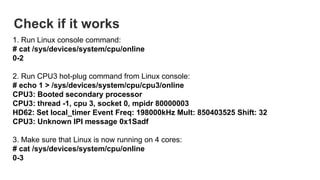
1. Run Linux console command:
# cat /sys/devices/system/cpu/online
0-2
2. Run CPU3 hot-plug command from Linux console:
# echo 1 > /sys/devices/system/cpu/cpu3/online
CPU3: Booted secondary processor
CPU3: thread -1, cpu 3, socket 0, mpidr 80000003
HD62: Set local_timer Event Freq: 198000kHz Mult: 850403525 Shift: 32
CPU3: Unknown IPI message 0x1Sadf
3. Make sure that Linux is now running on 4 cores:
# cat /sys/devices/system/cpu/online
0-3
Check if it works
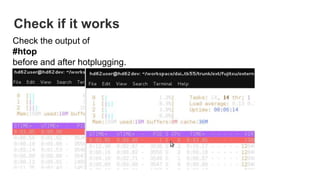
Check the output of
#htop
before and after hotplugging.
36
Part 2 Summary
1. Modify smp_prepare_cpus() to not put the target
CPU core to EXECUTE state.
37
Part 2 Summary
1. Modify smp_prepare_cpus() to not put the target
CPU core to EXECUTE state.
2. Modify __cpu_up to not spawn a new process for
the target core with fork_idle(cpu).
38
Part 2 Summary
1. Modify smp_prepare_cpus() to not put the target
CPU core to EXECUTE state.
2. Modify __cpu_up to not spawn a new process for
the target core with fork_idle(cpu).
3. Modify the RTOS code to put the target CPU core
to POLLING state on exit.
Questions?
Thank you!

“Linux Kernel CPU Hotplug in the Multicore System”

  • 1.
    CPU hotplug implementationfor the multicore system running RTOS and Linux simultaneously on separate cores Oleksandr Shevchenko Senior Consultant, Engineering
  • 2.
    Agenda 1. Running RTOSand Linux simultaneously on separate cores 2. CPU hotplug implementation 3. Questions?
  • 3.
    3 Part 1 Running RTOSand Linux simultaneously on separate cores
  • 4.
    Kernel booting Boot Sequence NORFlash RTOS Linux Kernel (zImage) RootFS (rootfs.cpio.gz) RAM ATAGS
  • 5.
    Kernel booting Boot Sequence NORFlash RTOS Linux Kernel (zImage) RootFS (rootfs.cpio.gz) RAM RTOS (core 0) By 1-st stage bootloader ATAGS
  • 6.
    Kernel booting Boot SequenceBootSequence NOR Flash Linux Kernel (zImage) RootFS (rootfs.cpio.gz) RAM By RTOS Linux Kernel (zImage) RootFS (rootfs.cpio.gz) ATAGS ATAGS RTOS RTOS (core 0)
  • 7.
    Kernel booting Boot SequenceBootSequenceBoot Sequence NOR Flash Linux Kernel (zImage) RootFS (rootfs.cpio.gz) RAM Linux Kernel RootFS (rootfs.cpio.gz) RootFS Uncompress and mount by Linux Kernel ATAGS Linux Kernel (zImage) Uncompressed by itself ATAGS RTOS RTOS (core 0) (core 1,2,3)
  • 8.
    Kernel booting Boot SequenceBootSequenceBoot Sequence NOR Flash Linux Kernel (zImage) RootFS (rootfs.cpio.gz) RAM Linux Kernel RootFS ATAGS User Space Services and applications RTOS RTOS (core 0) (core 1,2,3)
  • 9.
    CPU Communication The mutexregisters can only be written when it is unused (recognizable by reading a ‘0’). Mutexes can only be reset by writing a ‘0’. Each ARM core should write an identifier to lock the mutex. • ARM core 0: write ‘1’ • ARM core 1: write ‘2’ • ARM core 2: write ‘3’ • ARM core 3: write ‘4’ RTOS (core 0) Linux Kernel (core 2) Linux Kernel (core 3) Linux Kernel (core 1) 0 (Reset)Mutex register:
  • 10.
    CPU Communication The mutexregisters can only be written when it is unused (recognizable by reading a ‘0’). Mutexes can only be reset by writing a ‘0’. Each ARM core should write an identifier to lock the mutex. • ARM core 0: write ‘1’ • ARM core 1: write ‘2’ • ARM core 2: write ‘3’ • ARM core 3: write ‘4’ RTOS (core 0) Linux Kernel (core 2) Linux Kernel (core 3) Linux Kernel (core 1) 1 (Core 0)Mutex register: Core 0 writes 1 to Mutex Register and enters critical section
  • 11.
    CPU Communication The mutexregisters can only be written when it is unused (recognizable by reading a ‘0’). Mutexes can only be reset by writing a ‘0’. Each ARM core should write an identifier to lock the mutex. • ARM core 0: write ‘1’ • ARM core 1: write ‘2’ • ARM core 2: write ‘3’ • ARM core 3: write ‘4’ RTOS (core 0) Linux Kernel (core 2) Linux Kernel (core 3) Linux Kernel (core 1) 0 (Reset)Mutex register: Core 0 exits critical section by writing 0 to Mutex Register
  • 12.
    CPU Communication The mutexregisters can only be written when it is unused (recognizable by reading a ‘0’). Mutexes can only be reset by writing a ‘0’. Each ARM core should write an identifier to lock the mutex. • ARM core 0: write ‘1’ • ARM core 1: write ‘2’ • ARM core 2: write ‘3’ • ARM core 3: write ‘4’ RTOS (core 0) Linux Kernel (core 2) Linux Kernel (core 3) Linux Kernel (core 1) 3 (Core 2)Mutex register: Core 2 writes 3 to Mutex Register and enters critical section
  • 13.
    CPU Communication The mutexregisters can only be written when it is unused (recognizable by reading a ‘0’). Mutexes can only be reset by writing a ‘0’. Each ARM core should write an identifier to lock the mutex. • ARM core 0: write ‘1’ • ARM core 1: write ‘2’ • ARM core 2: write ‘3’ • ARM core 3: write ‘4’ RTOS (core 0) Linux Kernel (core 2) Linux Kernel (core 3) Linux Kernel (core 1) 0 (Reset)Mutex register: Core 2 exits critical section by writing 0 to Mutex Register
  • 14.
    RTOS/Linux Device DriverArchitecture Physical Devices (Hardware) Device Drivers Virtual File System Kernel Space User Space Application Open/ Close Read/ Write IOCTL Linux
  • 15.
    RTOS/Linux Device DriverArchitecture Physical Devices (Hardware) Device Drivers Virtual File System Kernel Space User Space Application Open/ Close Read/ Write IOCTL Linux XAPI RTOS Application
  • 16.
    RTOS/Linux Device DriverArchitecture Linux Driver file opsApplication fd=open(“/dev/module_xyz”, …); modXyzOpen() Private data handle last_error alloc XAPI Core API XAPI_XYZ_Open() XAPI_XYZ_SetX() XAPI_XYZ_GetY() close(fd) modXyzClose() free XAPI_XYZ_Close() XAPI_XYZ_Read() XAPI_XYZ_Write() modXyzIoctl()ioctl(fd, cmd, …) User Space Kernel Space modXyzRead() modXyzWrite() read(fd, …) write(fd, …)
  • 17.
    17 Part 1 Summary 1.Introduce correct boot sequence.
  • 18.
    18 Part 1 Summary 1.Introduce correct boot sequence. 2. Provide inter-CPU synchronization mechanism.
  • 19.
    19 Part 1 Summary 1.Introduce correct boot sequence. 2. Provide inter-CPU synchronization mechanism. 3. Implement common Hardware Abstraction Level (HAL) for RTOS and Linux.
  • 20.
    20 PART 2 CPU hotplugimplementation
  • 21.
    Decrease Response Timeon Power On RTOS (core 0) Linux Kernel (core 2) Linux Kernel (core 3) RTOS (core 1) 1. Start 2 samples of RTOS on two cores.
  • 22.
    RTOS (core 0) LinuxKernel (core 2) Linux Kernel (core 3) 1. Start 2 samples of RTOS on two cores. 2. Once time critical task is done – withdraw from one core. RTOS (core 1) Decrease Response Time on Power On
  • 23.
    RTOS (core 0) LinuxKernel (core 2) Linux Kernel (core 3) Idle (core 1) 1. Start 2 samples of RTOS on two cores. 2. Once time critical task is done – withdraw from one core. Decrease Response Time on Power On
  • 24.
    RTOS (core 0) LinuxKernel (core 2) Linux Kernel (core 3) Idle (core 1) 1. Start 2 samples of RTOS on two cores. 2. Once time critical task is done – withdraw from one core. 3. Linux Hot-plugs the idle core Decrease Response Time on Power On
  • 25.
    RTOS (core 0) LinuxKernel (core 2) Linux Kernel (core 3) 1. Start 2 samples of RTOS on two cores. 2. Once time critical task is done – withdraw from one core. 3. Linux Hot-plugs the idle core Linux Kernel (core 1) Decrease Response Time on Power On
  • 26.
    Patching Linux KernelSMP Init Code main.c kernel_init() wakeup_secondary() is a place where the CPU state is changed from IDLE to EXECUTE. smp.c smp_prepare_cpus() arch/arm/mach-fujitsu/ smp-hd62x.c platform_smp_prepare_cpus() wakeup_secondary()
  • 27.
    Patching Linux KernelSMP Init Code
  • 28.
    Patching Linux KernelSMP Init Code
  • 29.
    Patching Linux KernelSMP Init Code main.c kernel_init() __cpu_up() is the place where a new process spawn for the core #cpu with fork_idle(cpu) smp.c smp_init() cpu.c cpu_up() _cpu_up() __cpu_up()
  • 30.
    Patching Linux KernelSMP Init Code In __cpu_up() added functionality to skip CPU1 initialization during kernel start-up. + static unsigned flag=0; + + if ((cpu == 1) && (flag == 0)) + { + printk(KERN_ERR "CPU%u: Skip initialization...n", cpu); + flag = 1; + return -EBUSY; + } We should quit at this point during initialization phase and do not try to spawn a new process for the core #1 with fork_idle(cpu). We will do it later while hot-plugging.
  • 31.
    Patching Linux KernelSMP Init Code Linux kernel already has built-in CPU core hot-plug functionality. To activate CPU1 core hot-plug the following sysfs write command has to be issued: echo 1 > /sys/devices/system/cpu/cpu1/online But this will only work correctly if the CPU core had been previously initialized during the startup and then disabled by command echo 0 > /sys/devices/system/cpu/cpu1/online
  • 32.
    Patching Linux KernelSMP Init Code While writing to the cpu subsystem related sysfs file, the store_online() function from src/drivers/base/cpu.c is called by kernel. We added new wakeup_secondary() function to this file +static void wakeup_secondary(void) … + jump_address = virt_to_phys(fujitsu_secondary_startup); + writel(jump_address, BOOT_CPU_CONTROL_CPU1_JUMP); + control_value = __raw_readl(BOOT_CPU_CONTROL_CPU1_STATUS); + control_value &= ~BOOT_CPU_CONTROL_REQUEST_MASK; + control_value &= ~BOOT_CPU_CONTROL_STATUS_MASK; + control_value |= BOOT_CPU_CONTROL_REQUEST_EXECUTE; + writel(control_value, BOOT_CPU_CONTROL_CPU1_STATUS); We call this function before cpu_up() function that brings the CPU core to Linux world. case '1': + wakeup_secondary(); ret = cpu_up(cpu->sysdev.id);
  • 33.
    Patching Linux KernelSMP Init Code And of course before hot-plugging from Linux the RTOS should withdraw from the core 1 and send it to POLLING state by writing correct value to the CPU control register BOOT_CPU_CONTROL_CPU1_STATUS
  • 34.
    Check if itworks 1. Run Linux console command: # cat /sys/devices/system/cpu/online 0-2 2. Run CPU3 hot-plug command from Linux console: # echo 1 > /sys/devices/system/cpu/cpu3/online CPU3: Booted secondary processor CPU3: thread -1, cpu 3, socket 0, mpidr 80000003 HD62: Set local_timer Event Freq: 198000kHz Mult: 850403525 Shift: 32 CPU3: Unknown IPI message 0x1Sadf 3. Make sure that Linux is now running on 4 cores: # cat /sys/devices/system/cpu/online 0-3
  • 35.
    Check if itworks Check the output of #htop before and after hotplugging.
  • 36.
    36 Part 2 Summary 1.Modify smp_prepare_cpus() to not put the target CPU core to EXECUTE state.
  • 37.
    37 Part 2 Summary 1.Modify smp_prepare_cpus() to not put the target CPU core to EXECUTE state. 2. Modify __cpu_up to not spawn a new process for the target core with fork_idle(cpu).
  • 38.
    38 Part 2 Summary 1.Modify smp_prepare_cpus() to not put the target CPU core to EXECUTE state. 2. Modify __cpu_up to not spawn a new process for the target core with fork_idle(cpu). 3. Modify the RTOS code to put the target CPU core to POLLING state on exit.
  • 39.
  • 40.