Lab 5: System calls
Advanced Operating Systems

Zubair Nabi
zubair.nabi@itu.edu.pk

February 27, 2013
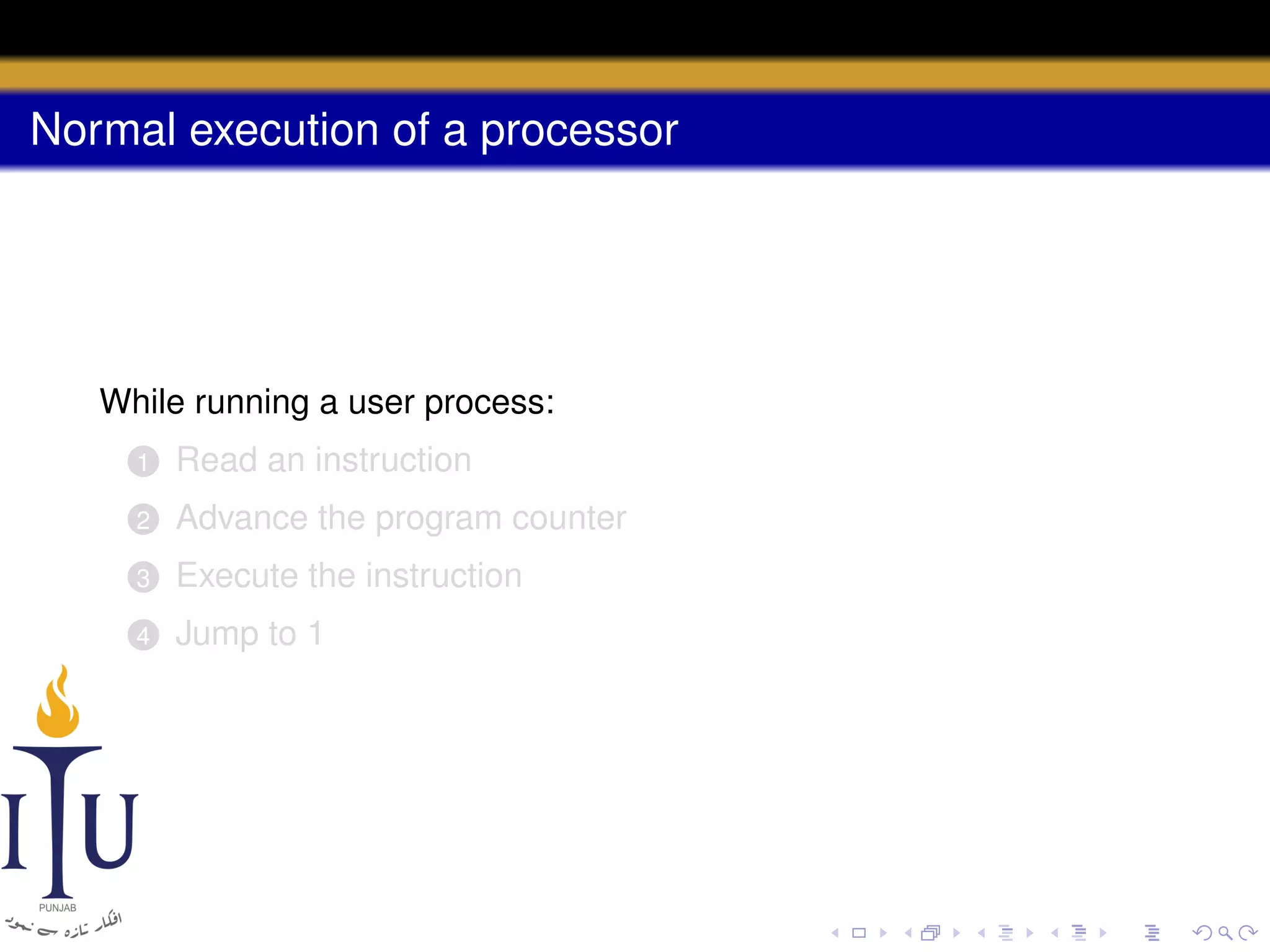
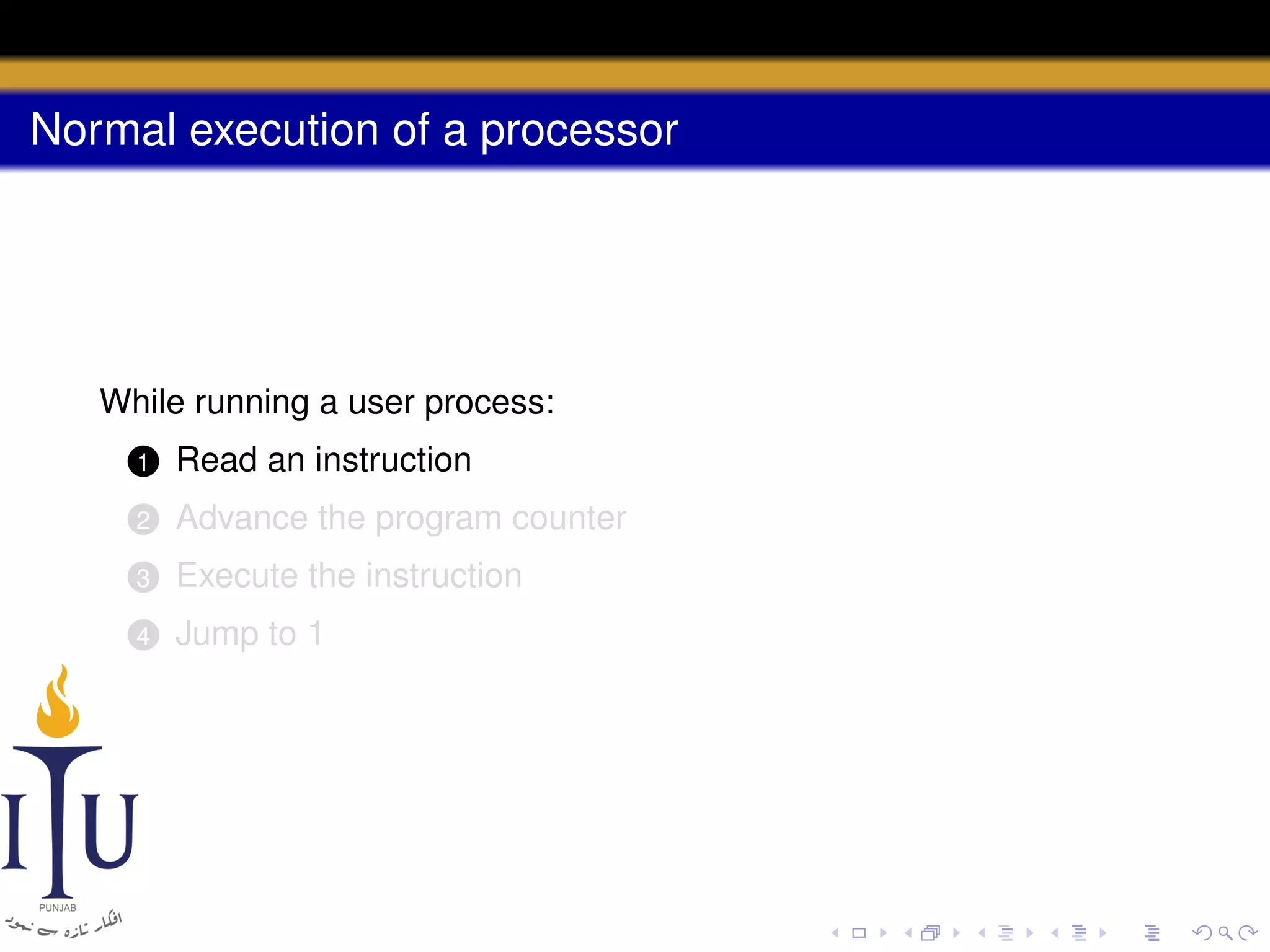
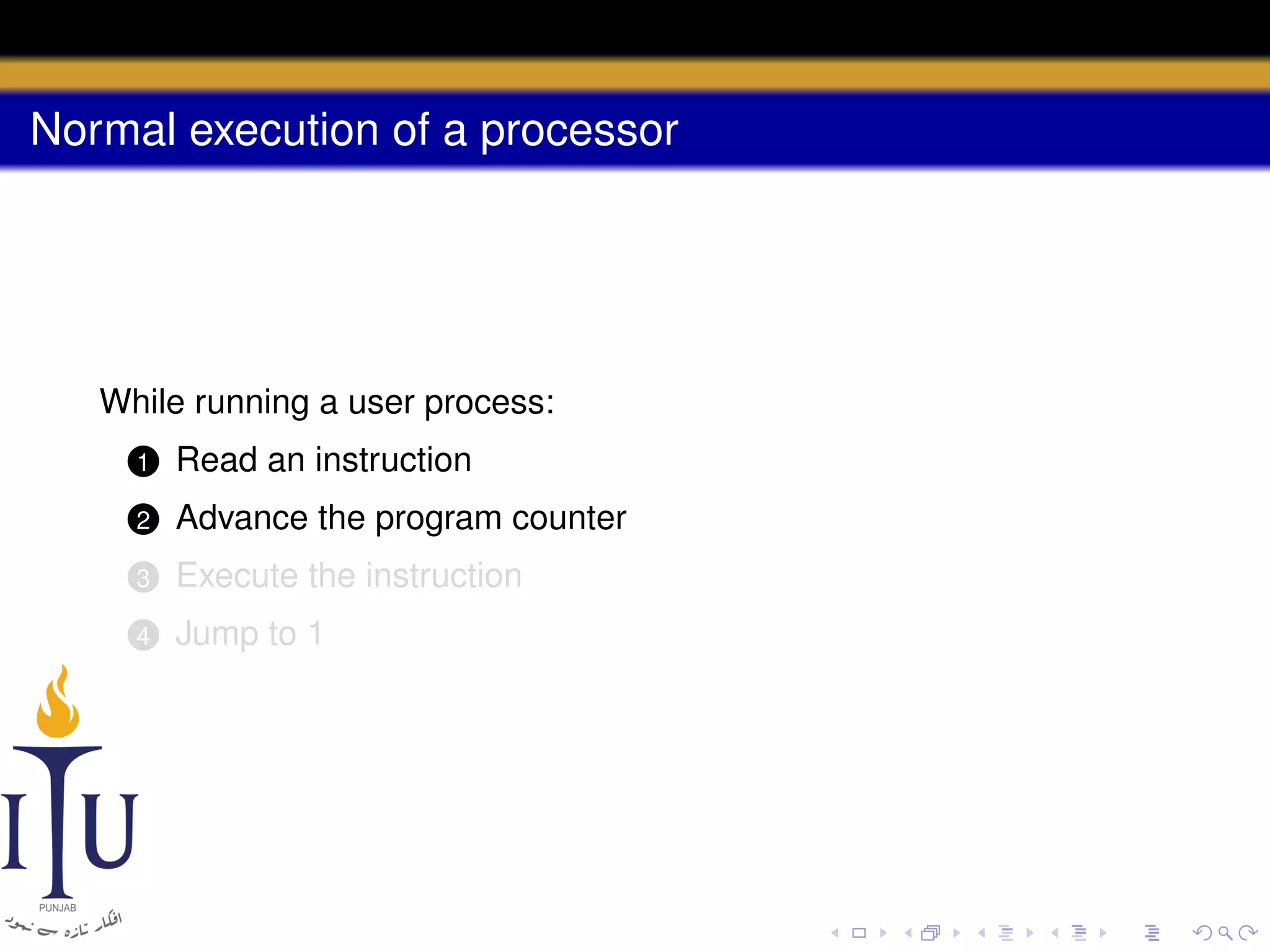
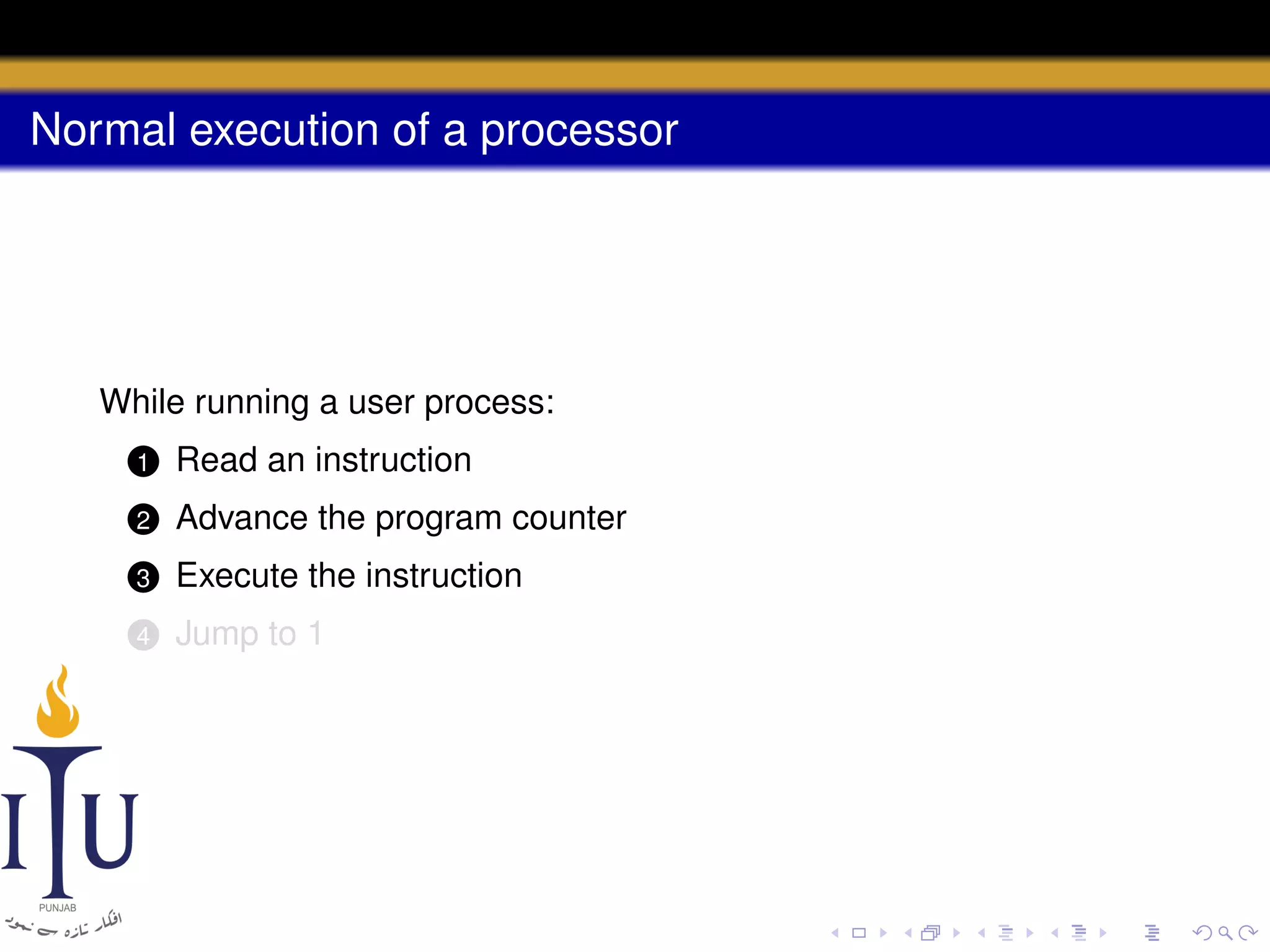
Normal execution of a processor

While running a user process:
1

Read an instruction

2

Advance the program counter

3

Execute the instruction

4

Jump to 1
Normal execution of a processor

While running a user process:
1

Read an instruction

2

Advance the program counter

3

Execute the instruction

4

Jump to 1
Normal execution of a processor

While running a user process:
1

Read an instruction

2

Advance the program counter

3

Execute the instruction

4

Jump to 1
Normal execution of a processor

While running a user process:
1

Read an instruction

2

Advance the program counter

3

Execute the instruction

4

Jump to 1
Normal execution of a processor

While running a user process:
1

Read an instruction

2

Advance the program counter

3

Execute the instruction

4

Jump to 1
Extraordinary events

Events that break normal processor flow, to return control to the
kernel:
1

A device signals that it needs attention (e.g. Timer): Interrupt

2

A user program does something illegal (e.g. divide by zero):
Exception

3

A user program asks the kernel for a service: System call
Extraordinary events

Events that break normal processor flow, to return control to the
kernel:
1

A device signals that it needs attention (e.g. Timer): Interrupt

2

A user program does something illegal (e.g. divide by zero):
Exception

3

A user program asks the kernel for a service: System call
Extraordinary events

Events that break normal processor flow, to return control to the
kernel:
1

A device signals that it needs attention (e.g. Timer): Interrupt

2

A user program does something illegal (e.g. divide by zero):
Exception

3

A user program asks the kernel for a service: System call
Extraordinary events

Events that break normal processor flow, to return control to the
kernel:
1

A device signals that it needs attention (e.g. Timer): Interrupt

2

A user program does something illegal (e.g. divide by zero):
Exception

3

A user program asks the kernel for a service: System call
Handling extraordinary events

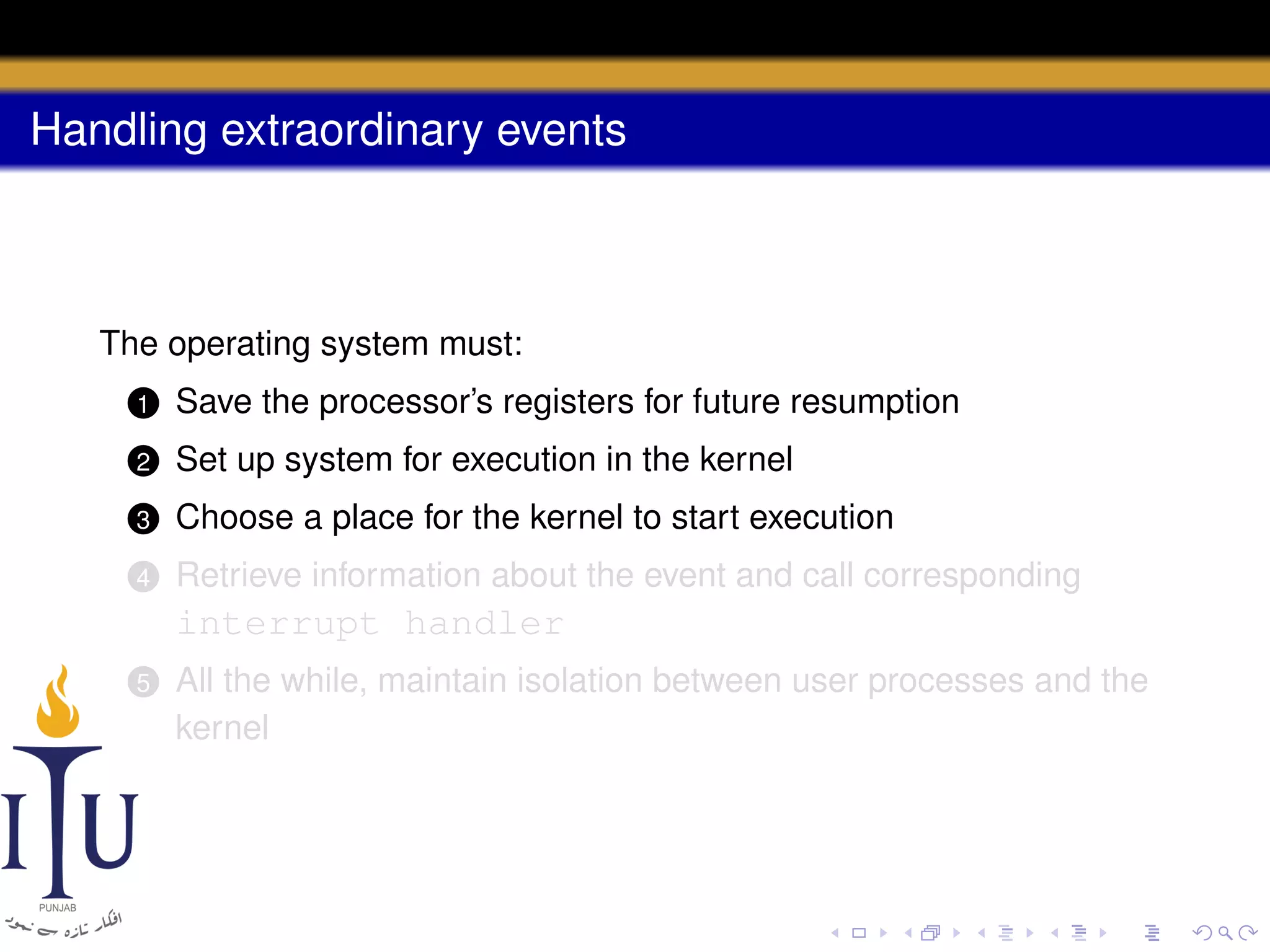
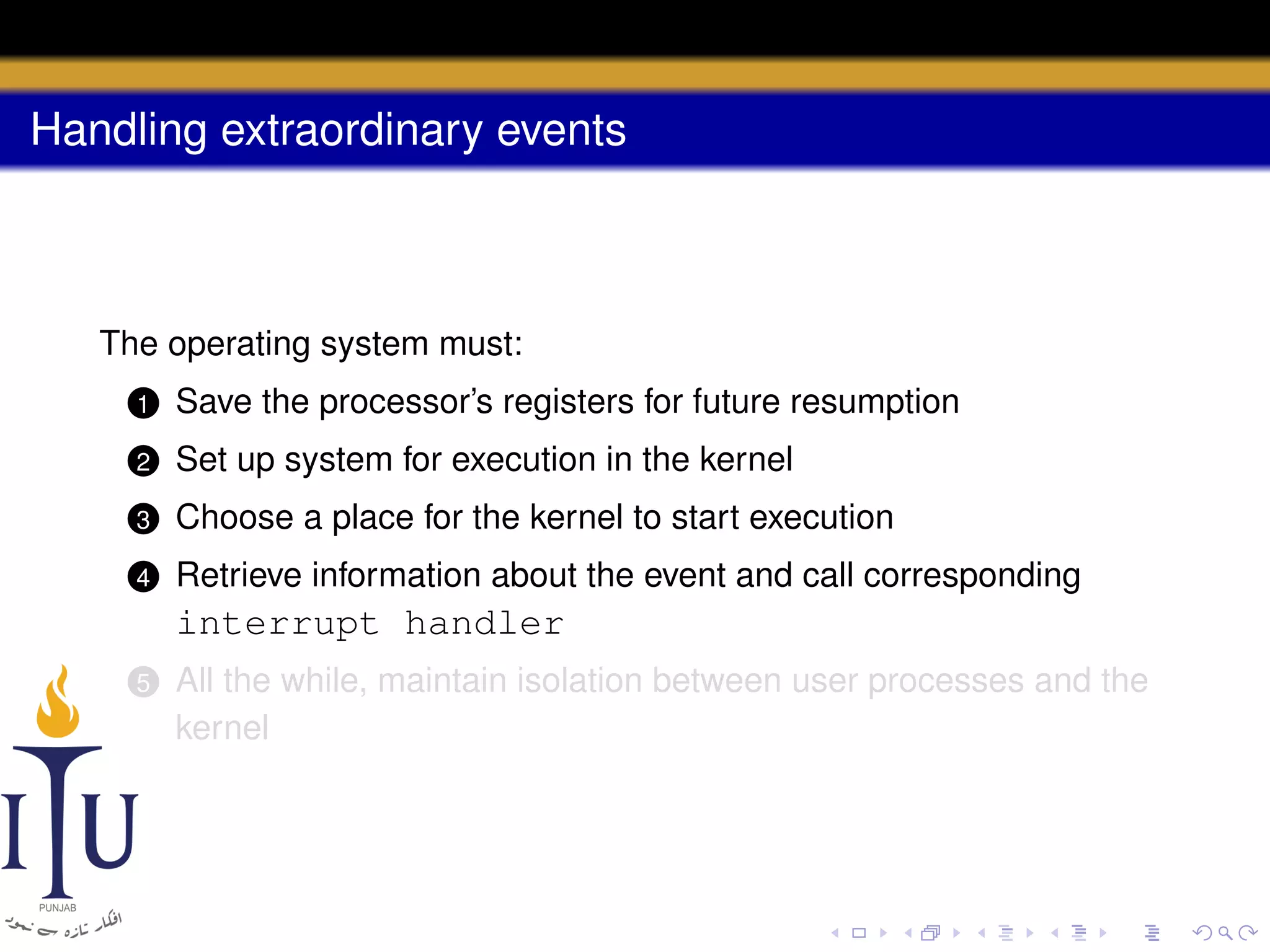
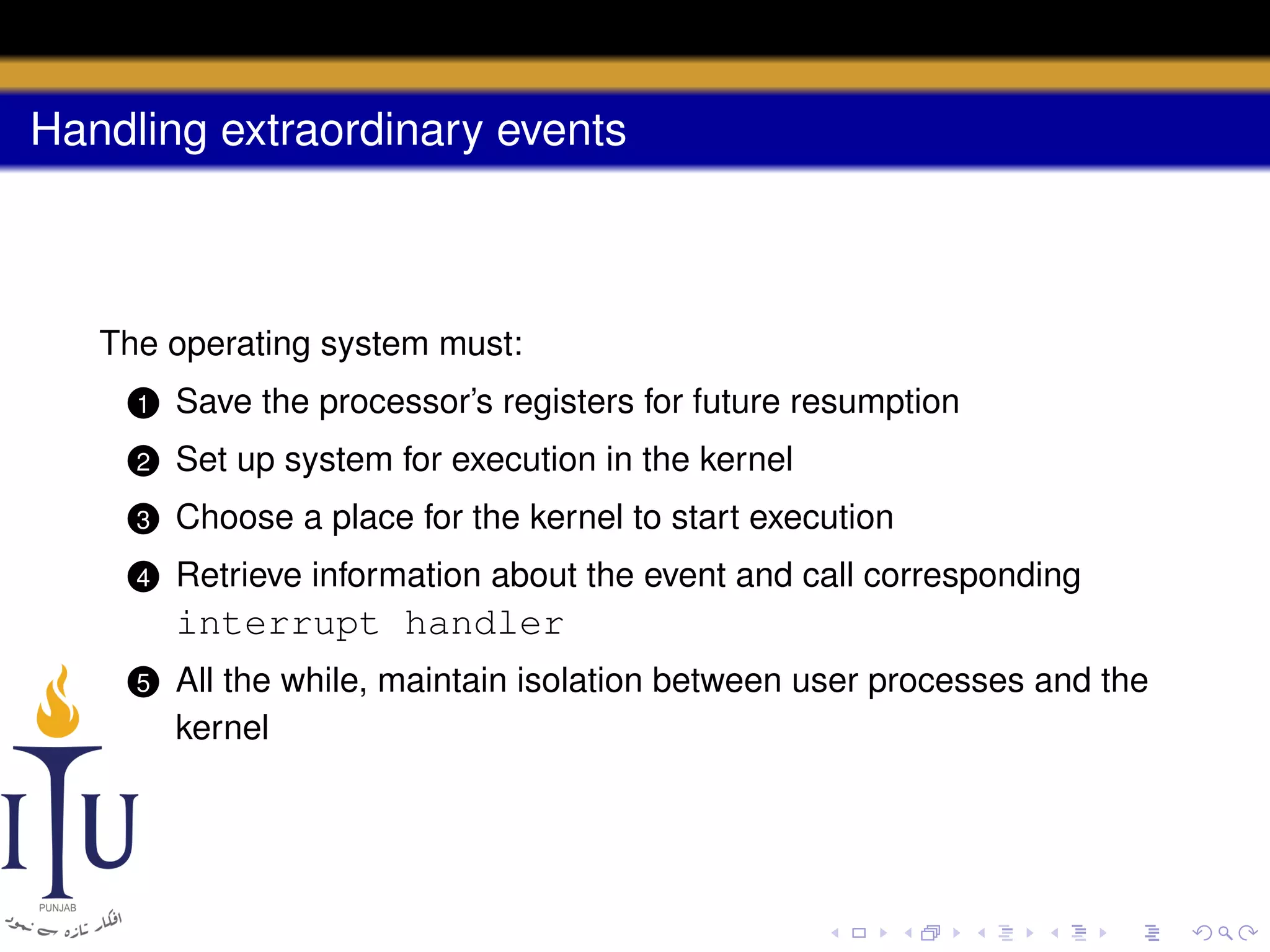
The operating system must:
1

Save the processor’s registers for future resumption

2

Set up system for execution in the kernel

3

Choose a place for the kernel to start execution

4

Retrieve information about the event and call corresponding

interrupt handler
5

All the while, maintain isolation between user processes and the
kernel
Handling extraordinary events

The operating system must:
1

Save the processor’s registers for future resumption

2

Set up system for execution in the kernel

3

Choose a place for the kernel to start execution

4

Retrieve information about the event and call corresponding

interrupt handler
5

All the while, maintain isolation between user processes and the
kernel
Handling extraordinary events

The operating system must:
1

Save the processor’s registers for future resumption

2

Set up system for execution in the kernel

3

Choose a place for the kernel to start execution

4

Retrieve information about the event and call corresponding

interrupt handler
5

All the while, maintain isolation between user processes and the
kernel
Handling extraordinary events

The operating system must:
1

Save the processor’s registers for future resumption

2

Set up system for execution in the kernel

3

Choose a place for the kernel to start execution

4

Retrieve information about the event and call corresponding

interrupt handler
5

All the while, maintain isolation between user processes and the
kernel
Handling extraordinary events

The operating system must:
1

Save the processor’s registers for future resumption

2

Set up system for execution in the kernel

3

Choose a place for the kernel to start execution

4

Retrieve information about the event and call corresponding

interrupt handler
5

All the while, maintain isolation between user processes and the
kernel
Handling extraordinary events

The operating system must:
1

Save the processor’s registers for future resumption

2

Set up system for execution in the kernel

3

Choose a place for the kernel to start execution

4

Retrieve information about the event and call corresponding

interrupt handler
5

All the while, maintain isolation between user processes and the
kernel
Handling extraordinary events (2)

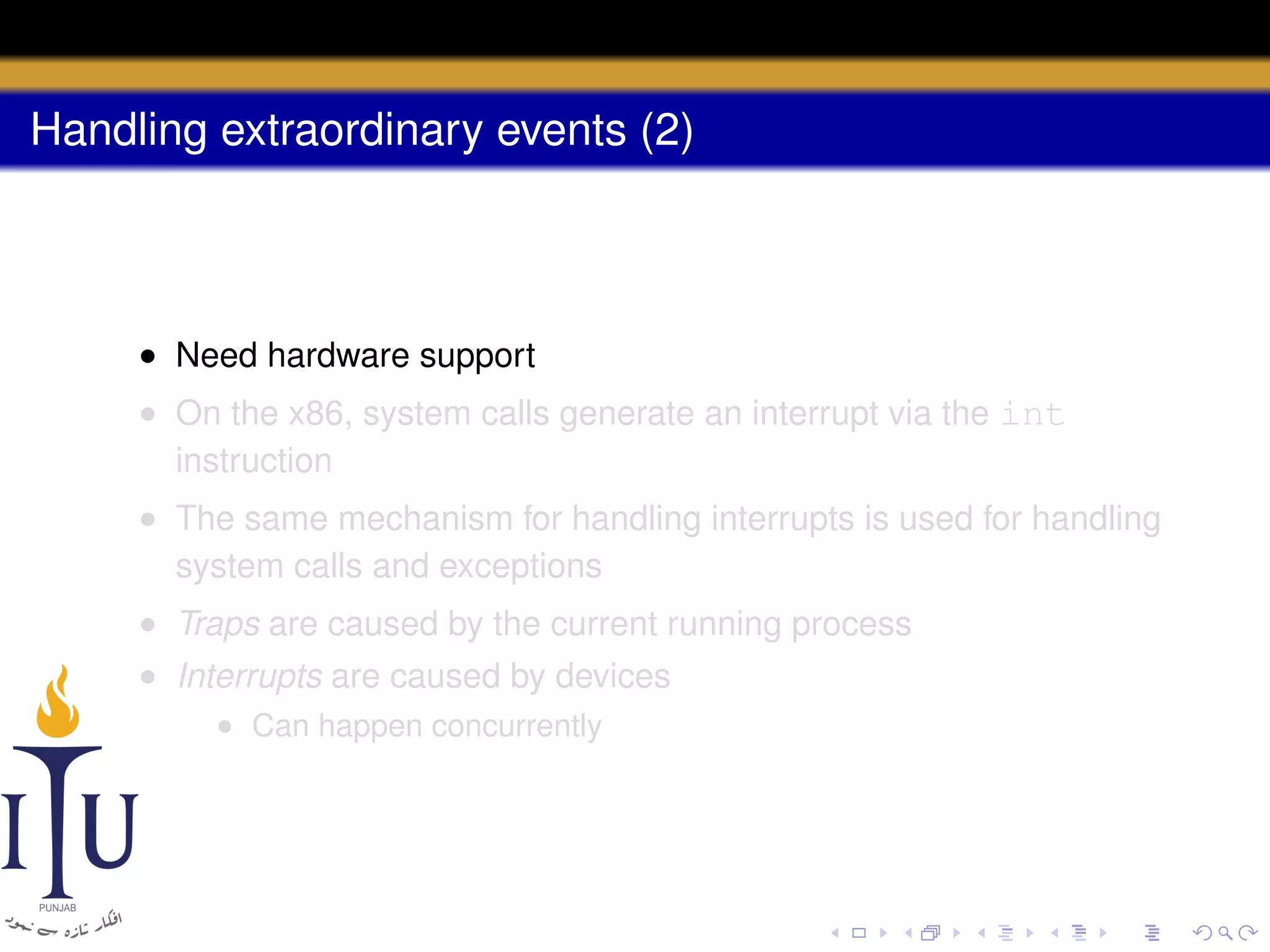
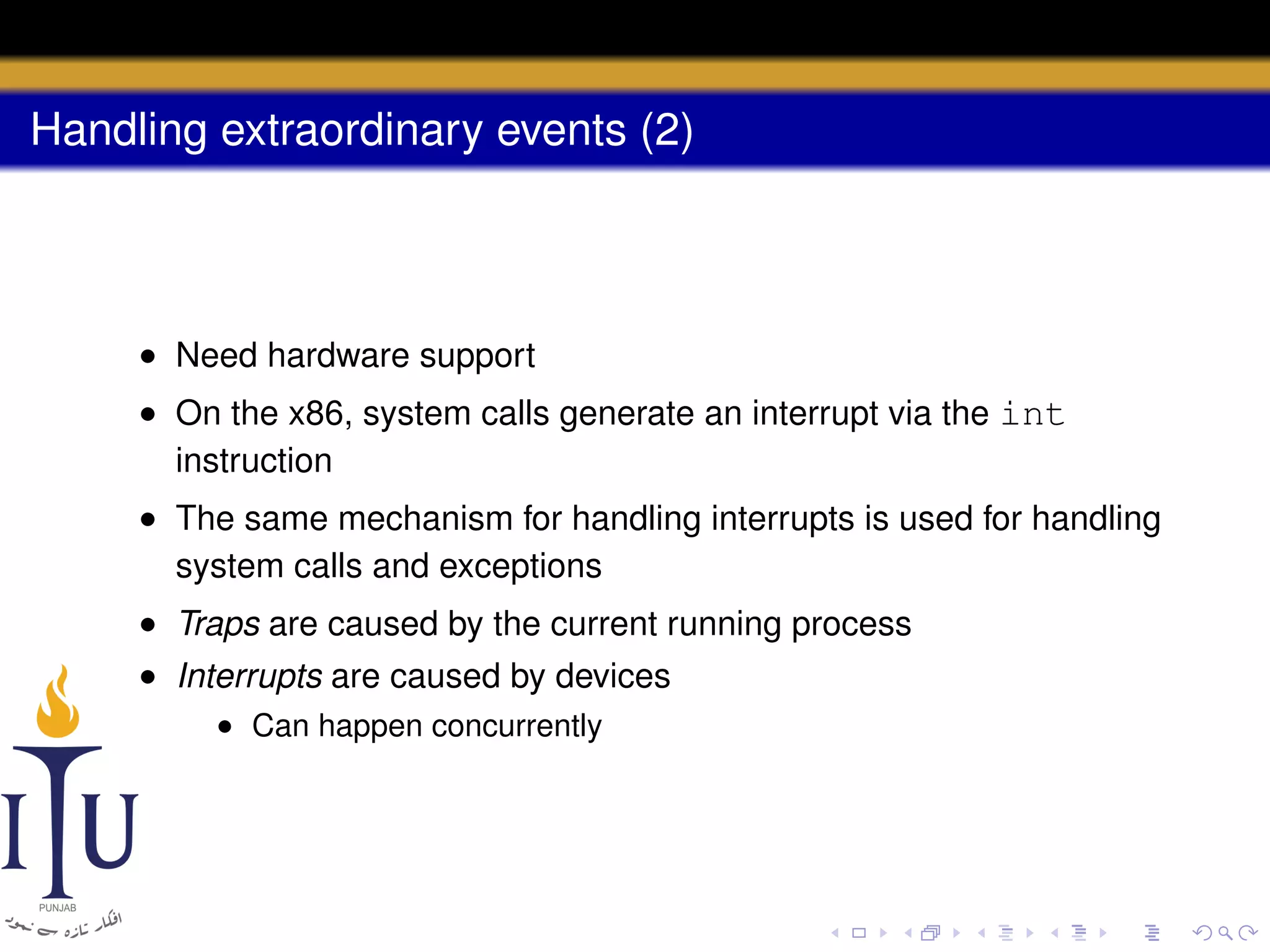
• Need hardware support
• On the x86, system calls generate an interrupt via the int
instruction
• The same mechanism for handling interrupts is used for handling
system calls and exceptions
• Traps are caused by the current running process
• Interrupts are caused by devices
• Can happen concurrently
Handling extraordinary events (2)

• Need hardware support
• On the x86, system calls generate an interrupt via the int
instruction
• The same mechanism for handling interrupts is used for handling
system calls and exceptions
• Traps are caused by the current running process
• Interrupts are caused by devices
• Can happen concurrently
Handling extraordinary events (2)

• Need hardware support
• On the x86, system calls generate an interrupt via the int
instruction
• The same mechanism for handling interrupts is used for handling
system calls and exceptions
• Traps are caused by the current running process
• Interrupts are caused by devices
• Can happen concurrently
Handling extraordinary events (2)

• Need hardware support
• On the x86, system calls generate an interrupt via the int
instruction
• The same mechanism for handling interrupts is used for handling
system calls and exceptions
• Traps are caused by the current running process
• Interrupts are caused by devices
• Can happen concurrently
Handling extraordinary events (2)

• Need hardware support
• On the x86, system calls generate an interrupt via the int
instruction
• The same mechanism for handling interrupts is used for handling
system calls and exceptions
• Traps are caused by the current running process
• Interrupts are caused by devices
• Can happen concurrently
Handling extraordinary events (2)

• Need hardware support
• On the x86, system calls generate an interrupt via the int
instruction
• The same mechanism for handling interrupts is used for handling
system calls and exceptions
• Traps are caused by the current running process
• Interrupts are caused by devices
• Can happen concurrently
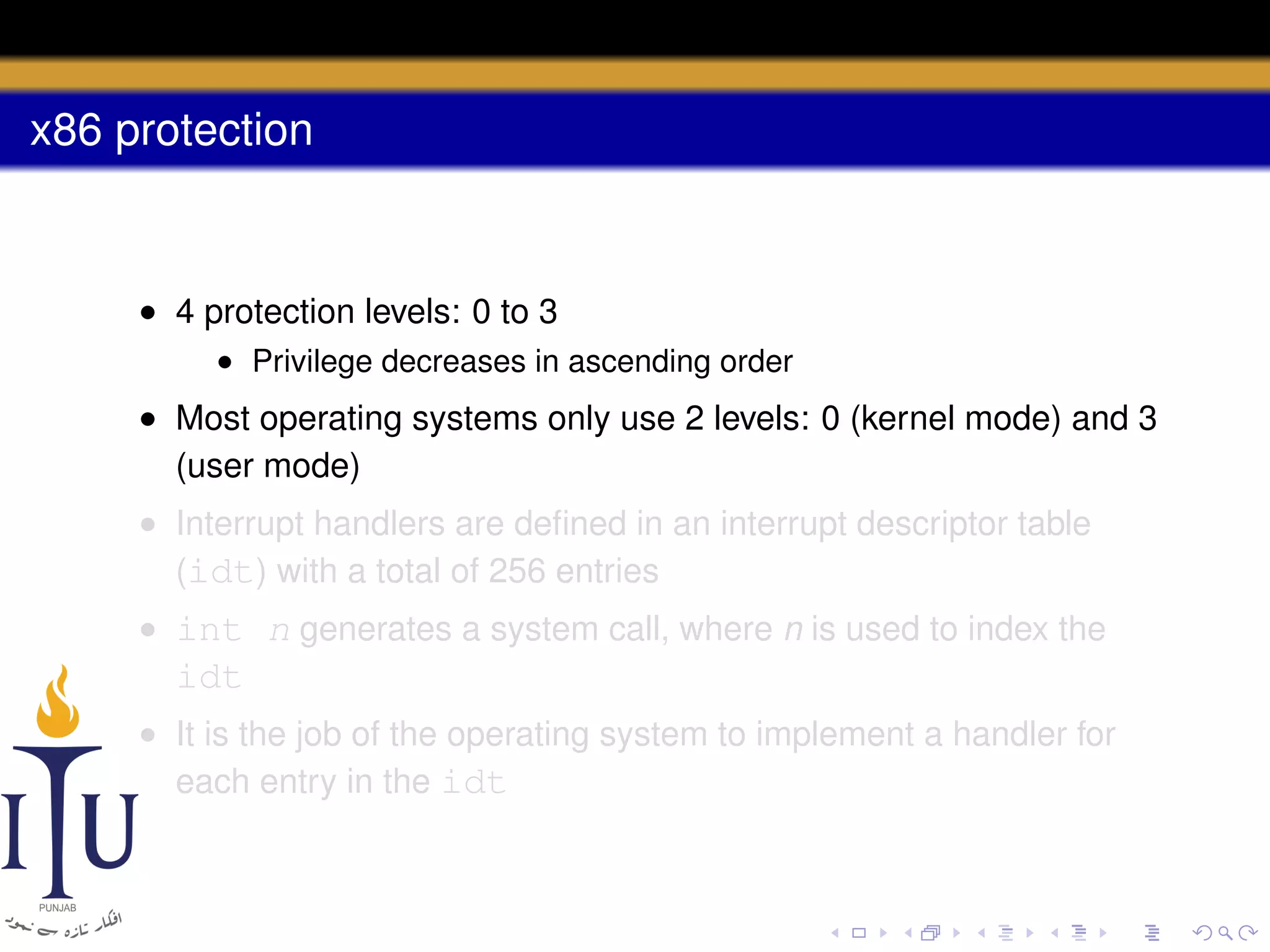
x86 protection

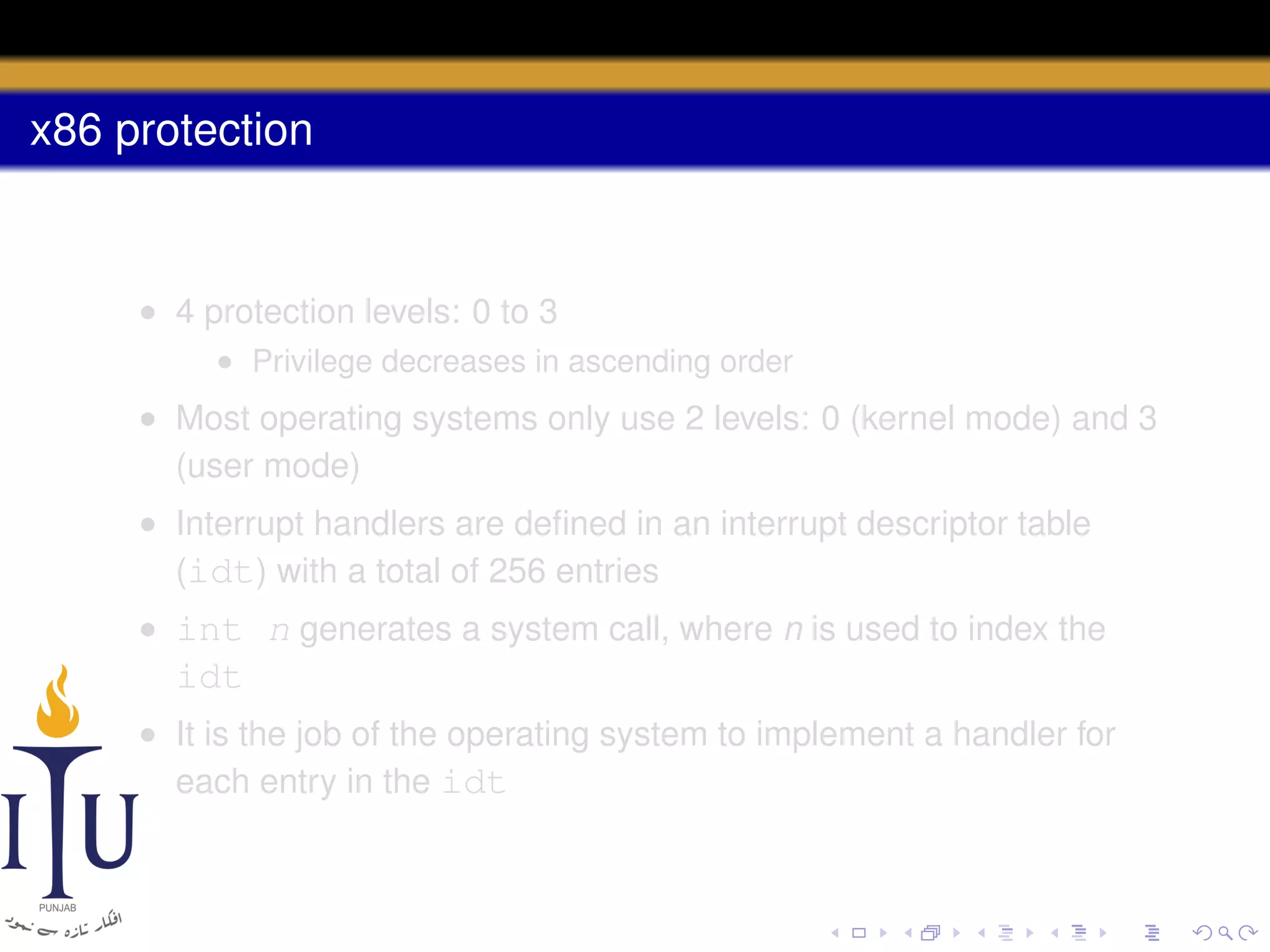
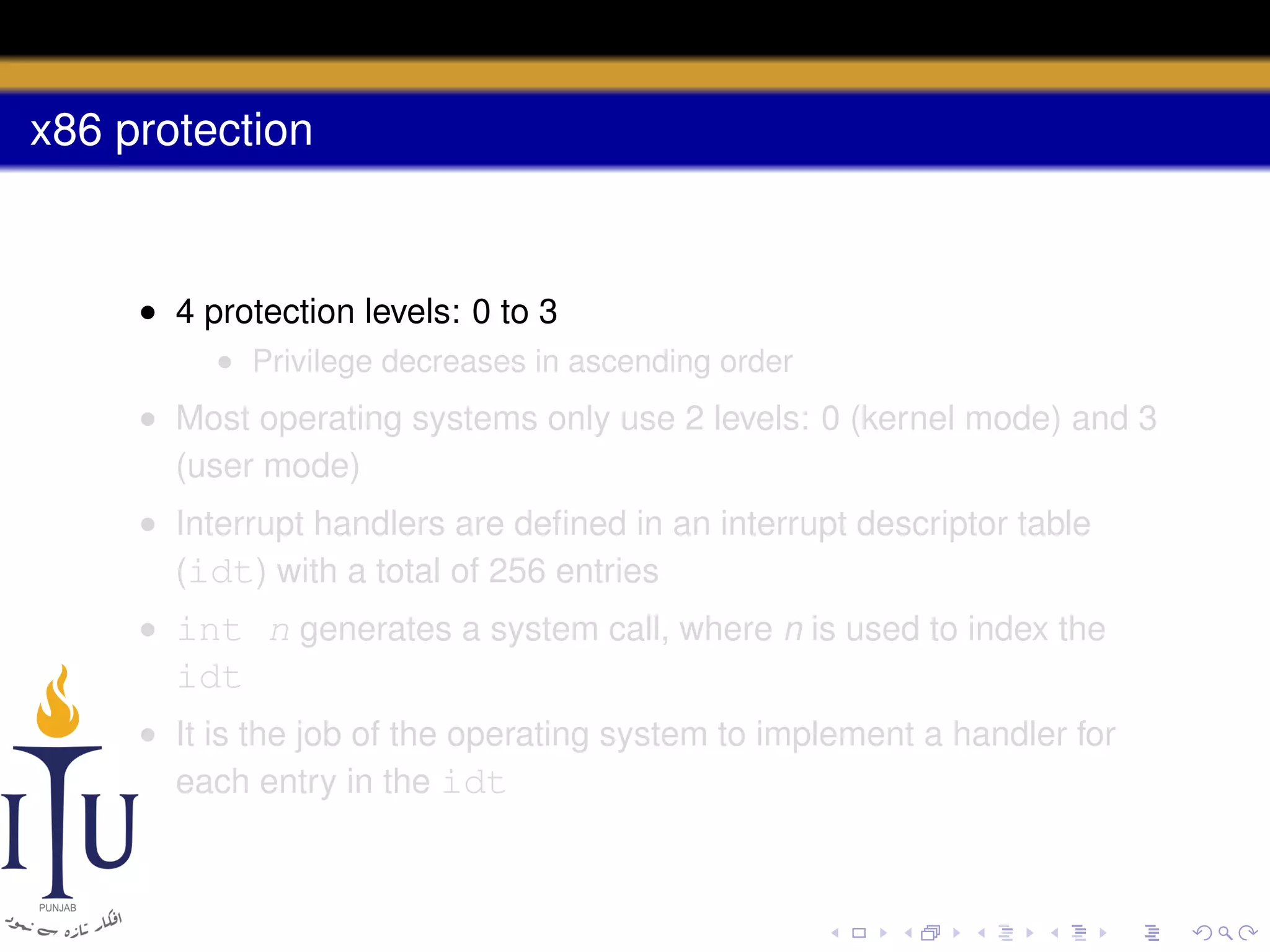
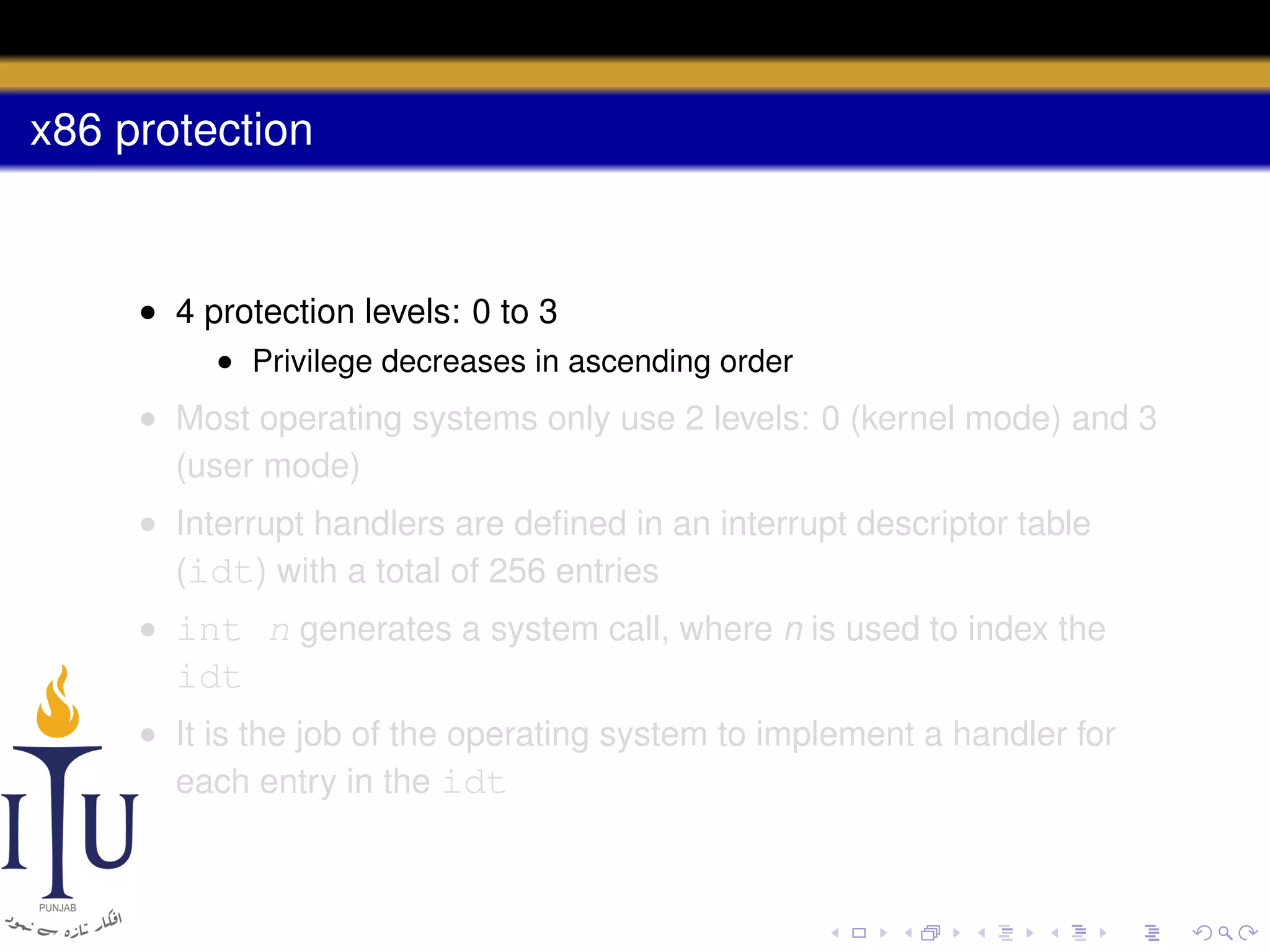
• 4 protection levels: 0 to 3
• Privilege decreases in ascending order

• Most operating systems only use 2 levels: 0 (kernel mode) and 3
(user mode)
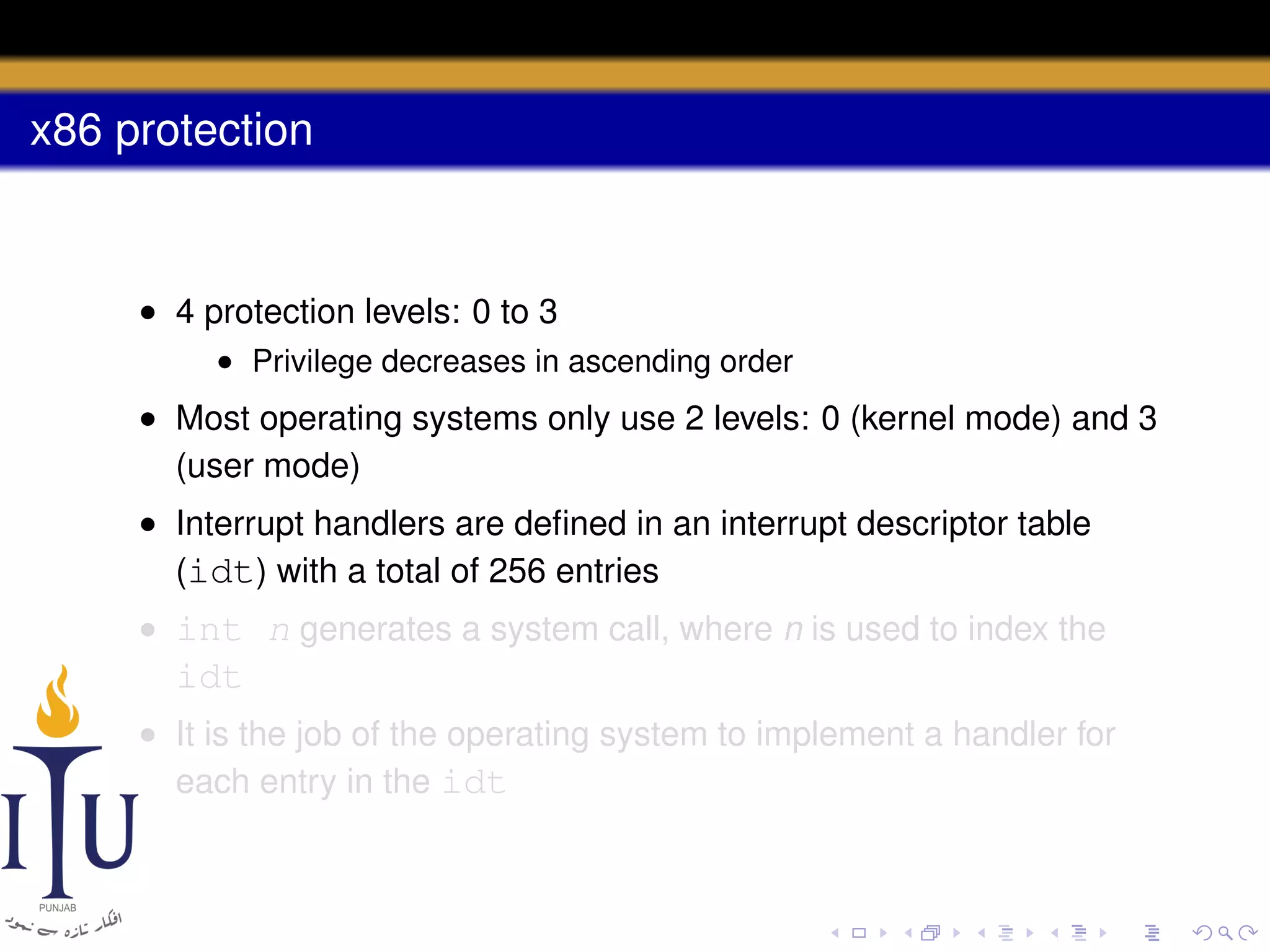
• Interrupt handlers are defined in an interrupt descriptor table
(idt) with a total of 256 entries
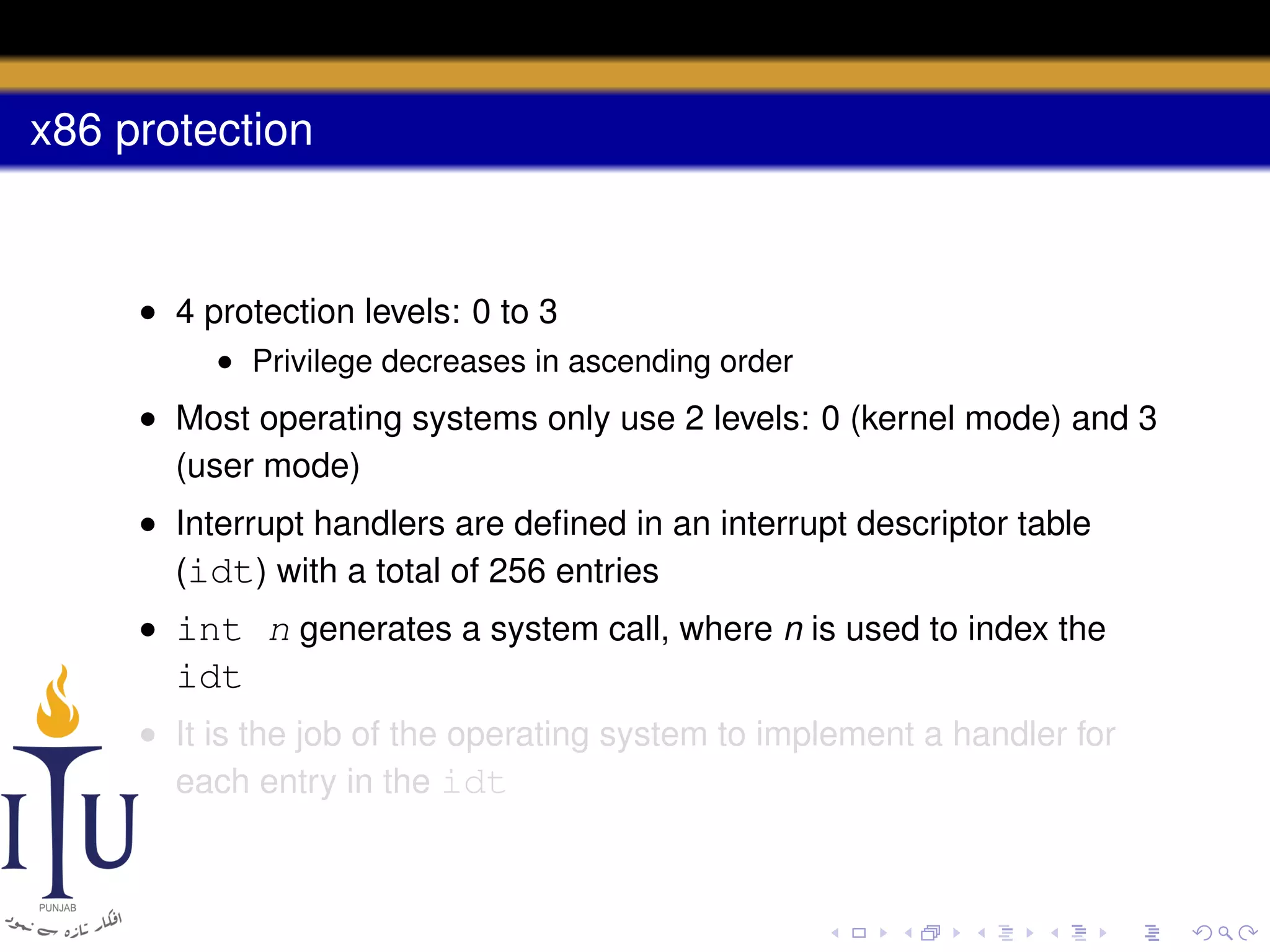
• int n generates a system call, where n is used to index the

idt
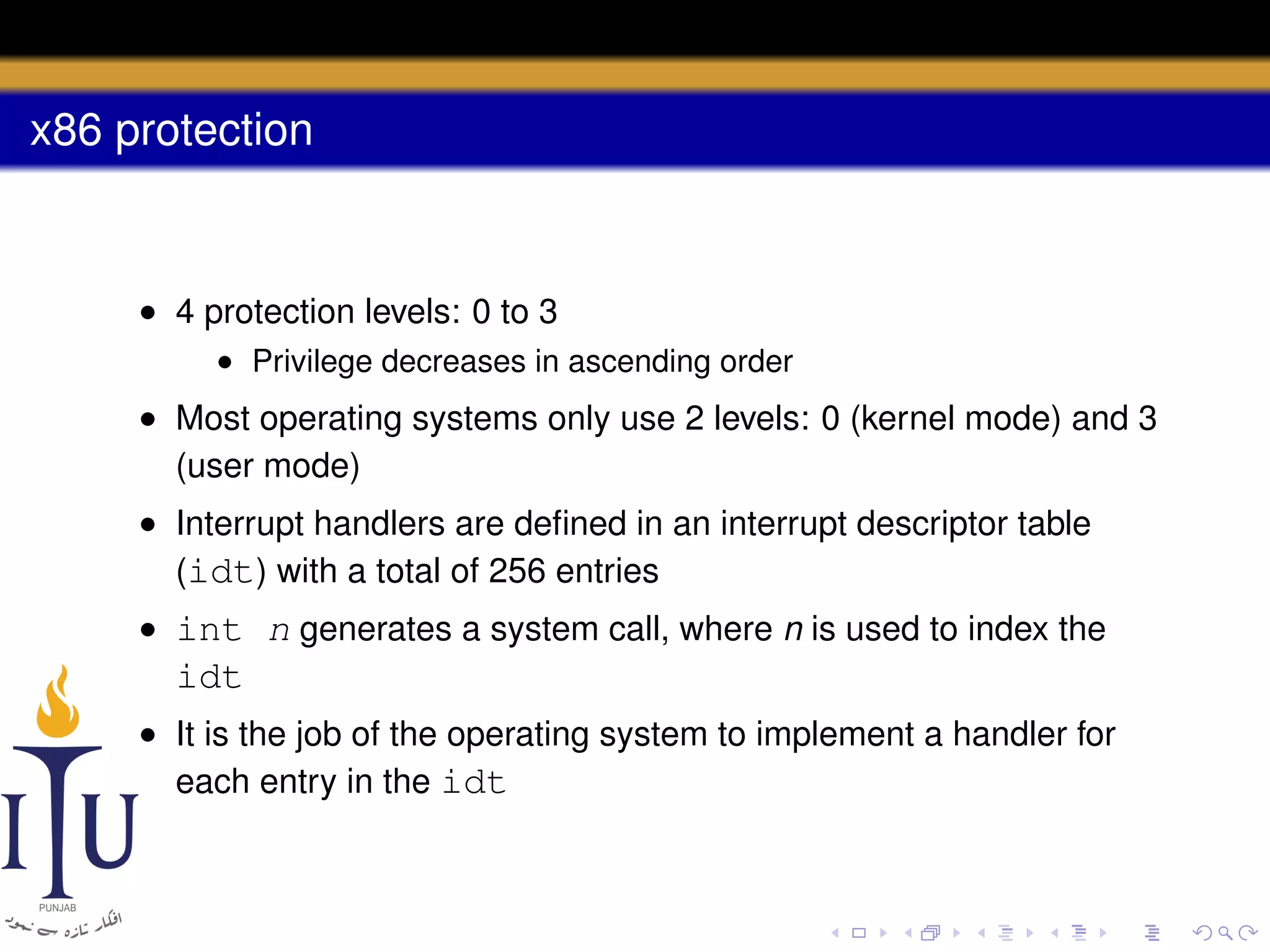
• It is the job of the operating system to implement a handler for
each entry in the idt
x86 protection

• 4 protection levels: 0 to 3
• Privilege decreases in ascending order

• Most operating systems only use 2 levels: 0 (kernel mode) and 3
(user mode)
• Interrupt handlers are defined in an interrupt descriptor table
(idt) with a total of 256 entries
• int n generates a system call, where n is used to index the

idt
• It is the job of the operating system to implement a handler for
each entry in the idt
x86 protection

• 4 protection levels: 0 to 3
• Privilege decreases in ascending order

• Most operating systems only use 2 levels: 0 (kernel mode) and 3
(user mode)
• Interrupt handlers are defined in an interrupt descriptor table
(idt) with a total of 256 entries
• int n generates a system call, where n is used to index the

idt
• It is the job of the operating system to implement a handler for
each entry in the idt
x86 protection

• 4 protection levels: 0 to 3
• Privilege decreases in ascending order

• Most operating systems only use 2 levels: 0 (kernel mode) and 3
(user mode)
• Interrupt handlers are defined in an interrupt descriptor table
(idt) with a total of 256 entries
• int n generates a system call, where n is used to index the

idt
• It is the job of the operating system to implement a handler for
each entry in the idt
x86 protection

• 4 protection levels: 0 to 3
• Privilege decreases in ascending order

• Most operating systems only use 2 levels: 0 (kernel mode) and 3
(user mode)
• Interrupt handlers are defined in an interrupt descriptor table
(idt) with a total of 256 entries
• int n generates a system call, where n is used to index the

idt
• It is the job of the operating system to implement a handler for
each entry in the idt
x86 protection

• 4 protection levels: 0 to 3
• Privilege decreases in ascending order

• Most operating systems only use 2 levels: 0 (kernel mode) and 3
(user mode)
• Interrupt handlers are defined in an interrupt descriptor table
(idt) with a total of 256 entries
• int n generates a system call, where n is used to index the

idt
• It is the job of the operating system to implement a handler for
each entry in the idt
x86 protection

• 4 protection levels: 0 to 3
• Privilege decreases in ascending order

• Most operating systems only use 2 levels: 0 (kernel mode) and 3
(user mode)
• Interrupt handlers are defined in an interrupt descriptor table
(idt) with a total of 256 entries
• int n generates a system call, where n is used to index the

idt
• It is the job of the operating system to implement a handler for
each entry in the idt
int

• Fetches the nth descriptor from idt
• Ensures that the privilege level in the descriptor is 3
• As the interrupt is due to a user process, saves the process state
(change in privilege level)
• Sets the instructor pointer to the required starting address in the
descriptor table and starts execution
• After execution, the OS calls iret to resume previous execution
state
int

• Fetches the nth descriptor from idt
• Ensures that the privilege level in the descriptor is 3
• As the interrupt is due to a user process, saves the process state
(change in privilege level)
• Sets the instructor pointer to the required starting address in the
descriptor table and starts execution
• After execution, the OS calls iret to resume previous execution
state
int

• Fetches the nth descriptor from idt
• Ensures that the privilege level in the descriptor is 3
• As the interrupt is due to a user process, saves the process state
(change in privilege level)
• Sets the instructor pointer to the required starting address in the
descriptor table and starts execution
• After execution, the OS calls iret to resume previous execution
state
int

• Fetches the nth descriptor from idt
• Ensures that the privilege level in the descriptor is 3
• As the interrupt is due to a user process, saves the process state
(change in privilege level)
• Sets the instructor pointer to the required starting address in the
descriptor table and starts execution
• After execution, the OS calls iret to resume previous execution
state
int

• Fetches the nth descriptor from idt
• Ensures that the privilege level in the descriptor is 3
• As the interrupt is due to a user process, saves the process state
(change in privilege level)
• Sets the instructor pointer to the required starting address in the
descriptor table and starts execution
• After execution, the OS calls iret to resume previous execution
state
The first system call

• Recall that initcode.S started off by invoking an exec
system call to load the init process (/init)
• Flow:
1 Push the arguments and binary for exec on the process’s stack
2 Put the system call number (SYS_exec) in %eax (obviously this
number should already be present in the system call table,
*syscalls[])
3 Execute int T_SYSCALL
The first system call

• Recall that initcode.S started off by invoking an exec
system call to load the init process (/init)
• Flow:
1 Push the arguments and binary for exec on the process’s stack
2 Put the system call number (SYS_exec) in %eax (obviously this
number should already be present in the system call table,
*syscalls[])
3 Execute int T_SYSCALL
The first system call

• Recall that initcode.S started off by invoking an exec
system call to load the init process (/init)
• Flow:
1 Push the arguments and binary for exec on the process’s stack
2 Put the system call number (SYS_exec) in %eax (obviously this
number should already be present in the system call table,
*syscalls[])
3 Execute int T_SYSCALL
The first system call

• Recall that initcode.S started off by invoking an exec
system call to load the init process (/init)
• Flow:
1 Push the arguments and binary for exec on the process’s stack
2 Put the system call number (SYS_exec) in %eax (obviously this
number should already be present in the system call table,
*syscalls[])
3 Execute int T_SYSCALL
The first system call

• Recall that initcode.S started off by invoking an exec
system call to load the init process (/init)
• Flow:
1 Push the arguments and binary for exec on the process’s stack
2 Put the system call number (SYS_exec) in %eax (obviously this
number should already be present in the system call table,
*syscalls[])
3 Execute int T_SYSCALL
x86 traps

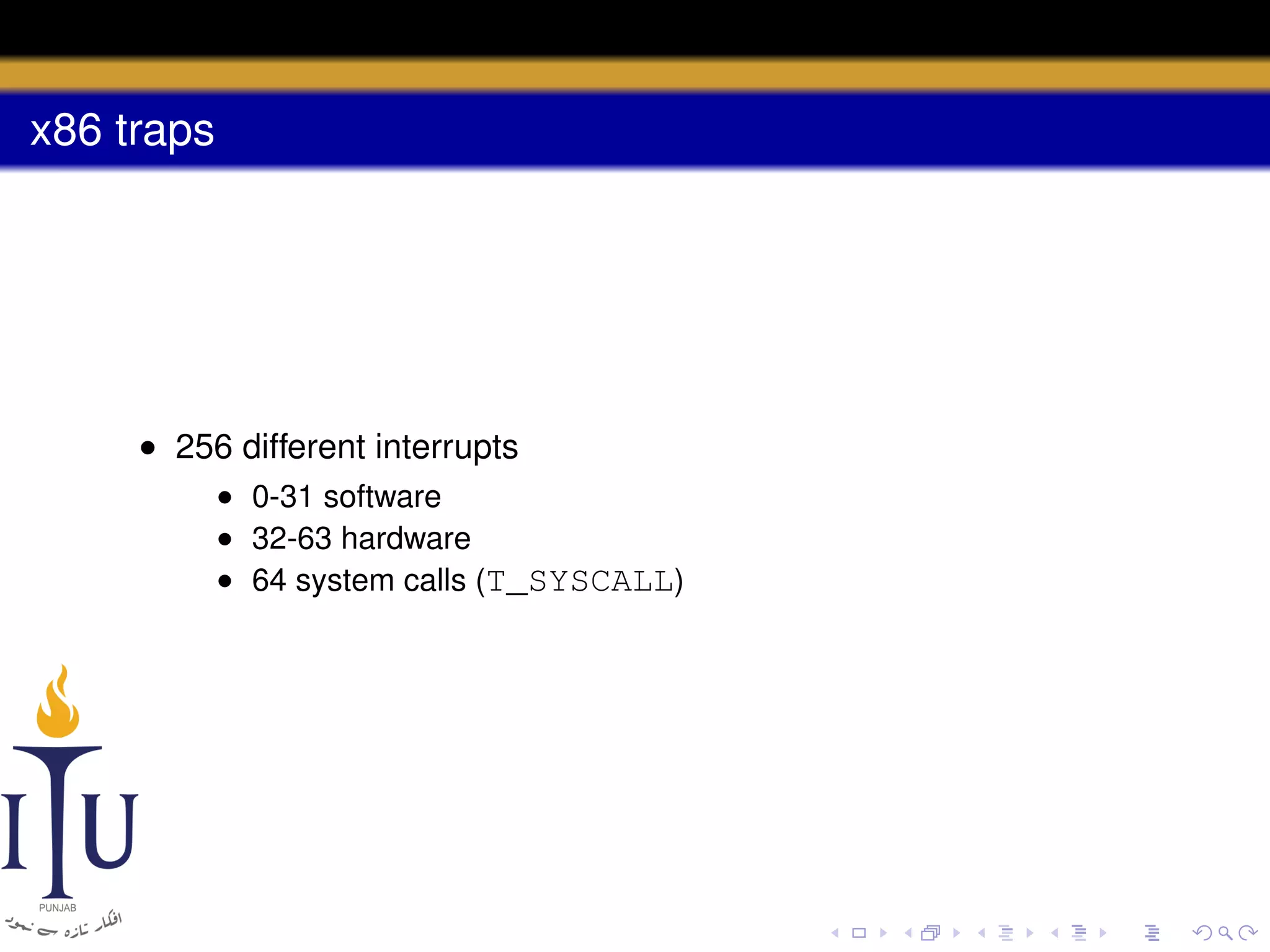
• 256 different interrupts
• 0-31 software
• 32-63 hardware
• 64 system calls (T_SYSCALL)
x86 traps

• 256 different interrupts
• 0-31 software
• 32-63 hardware
• 64 system calls (T_SYSCALL)
x86 traps

• 256 different interrupts
• 0-31 software
• 32-63 hardware
• 64 system calls (T_SYSCALL)
x86 traps

• 256 different interrupts
• 0-31 software
• 32-63 hardware
• 64 system calls (T_SYSCALL)
Setting up idt

• tvinit, called from main, sets up the entries in idt
• The address of the handler for each interrupt in idt is present in
vectors[], i.e. Interrupt i is handled by vectors[i]
• T_SYSCALL is handled specially: it is distinguished as a trap
allowing multiple system calls to execute simultaneously
Setting up idt

• tvinit, called from main, sets up the entries in idt
• The address of the handler for each interrupt in idt is present in
vectors[], i.e. Interrupt i is handled by vectors[i]
• T_SYSCALL is handled specially: it is distinguished as a trap
allowing multiple system calls to execute simultaneously
Setting up idt

• tvinit, called from main, sets up the entries in idt
• The address of the handler for each interrupt in idt is present in
vectors[], i.e. Interrupt i is handled by vectors[i]
• T_SYSCALL is handled specially: it is distinguished as a trap
allowing multiple system calls to execute simultaneously
tvinit
1
2
3
4
5
6
7
8
9
10
11
12
13
14

void tvinit (void) {
int i;
for(i = 0; i < 256; i++)
SETGATE (idt[i], 0, SEG_KCODE <<3, vectors [i], 0);
SETGATE (idt[ T_SYSCALL ], 1, SEG_KCODE <<3,
vectors [ T_SYSCALL ], DPL_USER );
/∗ SETGATE (gate , istrap , sel , off , d)

∗
∗
∗
∗
∗

gate: idt entry
istrap : 1 trap , 0 interrupt
sel: code segment
off: offset within code segment
d: privilege level

∗/

initlock (& tickslock , "time");
}
Addresses of interrupt handlers

• xv6 uses a custom Perl script vectors.pl to generate
vectors.S which holds entry points of interrupt handlers in

vectors[]
• Each entry point:
Pushes an error code
Pushes the interrupt number
3 Jumps to alltraps
1
2
Addresses of interrupt handlers

• xv6 uses a custom Perl script vectors.pl to generate
vectors.S which holds entry points of interrupt handlers in

vectors[]
• Each entry point:
Pushes an error code
Pushes the interrupt number
3 Jumps to alltraps

1

2
Addresses of interrupt handlers

• xv6 uses a custom Perl script vectors.pl to generate
vectors.S which holds entry points of interrupt handlers in

vectors[]
• Each entry point:
Pushes an error code
Pushes the interrupt number
3 Jumps to alltraps

1

2
Addresses of interrupt handlers

• xv6 uses a custom Perl script vectors.pl to generate
vectors.S which holds entry points of interrupt handlers in

vectors[]
• Each entry point:
Pushes an error code
Pushes the interrupt number
3 Jumps to alltraps

1

2
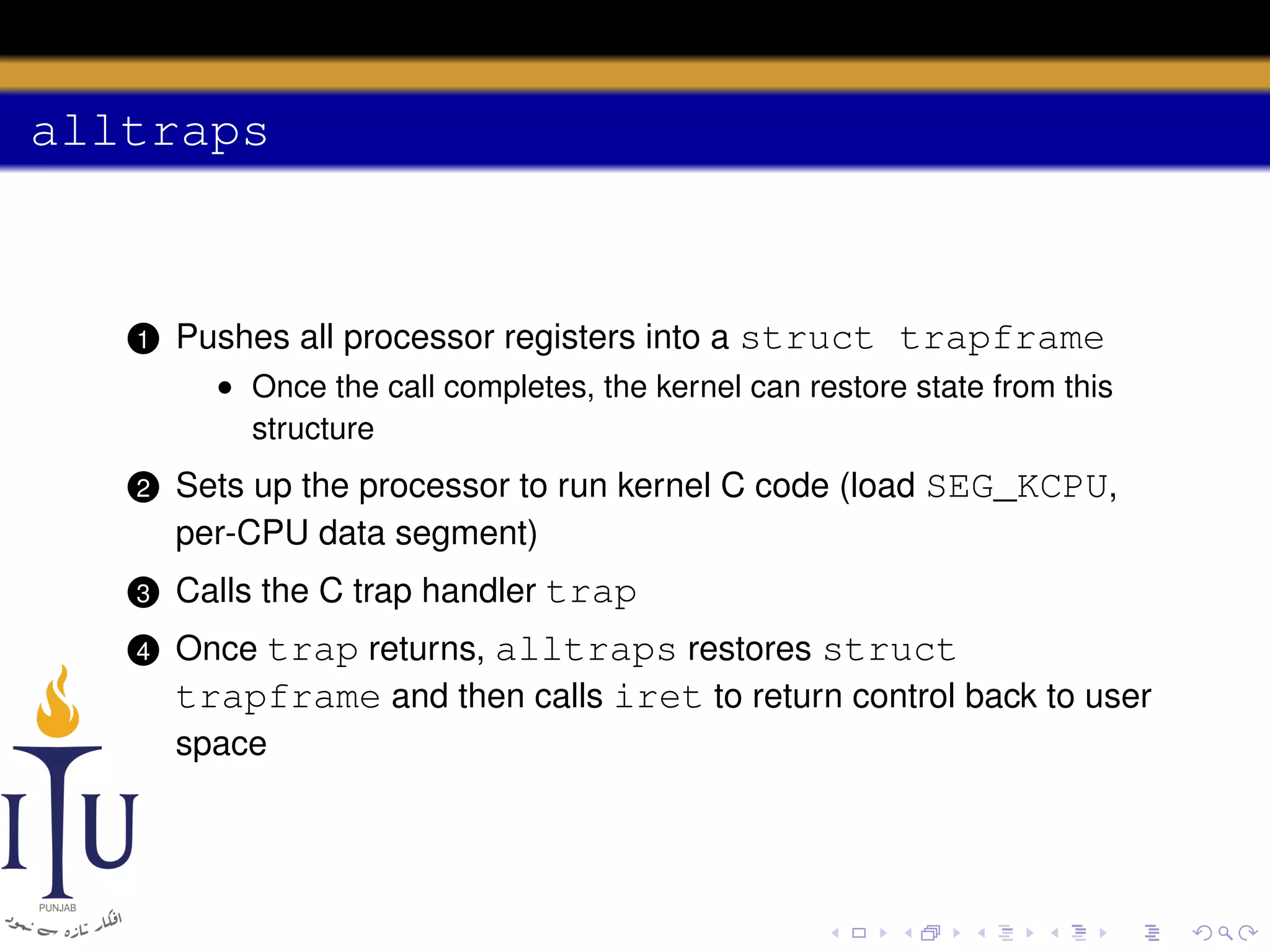
alltraps

1

Pushes all processor registers into a struct trapframe
• Once the call completes, the kernel can restore state from this
structure

2

Sets up the processor to run kernel C code (load SEG_KCPU,
per-CPU data segment)

3

Calls the C trap handler trap

4

Once trap returns, alltraps restores struct
trapframe and then calls iret to return control back to user
space
alltraps

1

Pushes all processor registers into a struct trapframe
• Once the call completes, the kernel can restore state from this
structure

2

Sets up the processor to run kernel C code (load SEG_KCPU,
per-CPU data segment)

3

Calls the C trap handler trap

4

Once trap returns, alltraps restores struct
trapframe and then calls iret to return control back to user
space
alltraps

1

Pushes all processor registers into a struct trapframe
• Once the call completes, the kernel can restore state from this
structure

2

Sets up the processor to run kernel C code (load SEG_KCPU,
per-CPU data segment)

3

Calls the C trap handler trap

4

Once trap returns, alltraps restores struct
trapframe and then calls iret to return control back to user
space
alltraps

1

Pushes all processor registers into a struct trapframe
• Once the call completes, the kernel can restore state from this
structure

2

Sets up the processor to run kernel C code (load SEG_KCPU,
per-CPU data segment)

3

Calls the C trap handler trap

4

Once trap returns, alltraps restores struct
trapframe and then calls iret to return control back to user
space
alltraps

1

Pushes all processor registers into a struct trapframe
• Once the call completes, the kernel can restore state from this
structure

2

Sets up the processor to run kernel C code (load SEG_KCPU,
per-CPU data segment)

3

Calls the C trap handler trap

4

Once trap returns, alltraps restores struct
trapframe and then calls iret to return control back to user
space
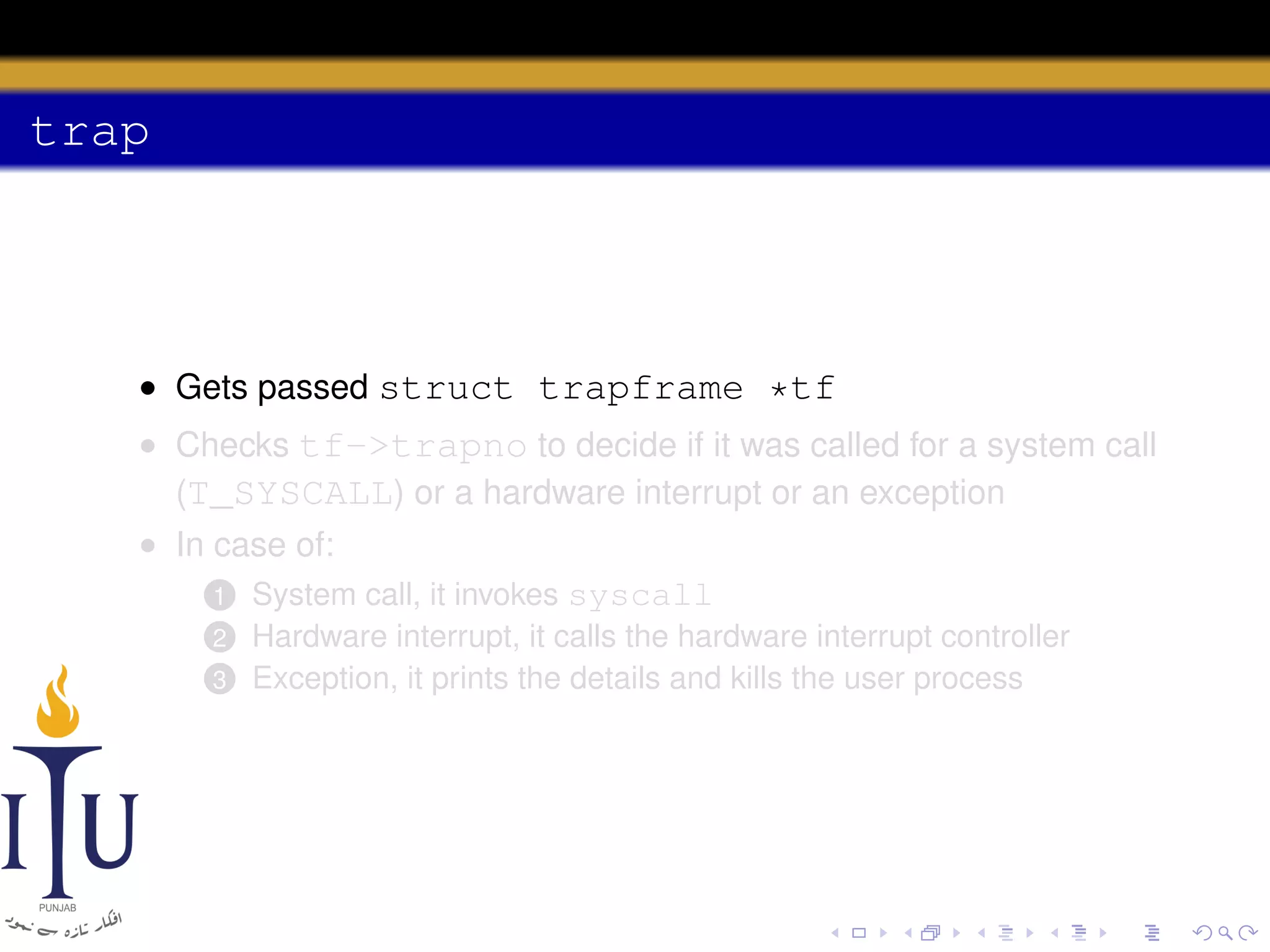
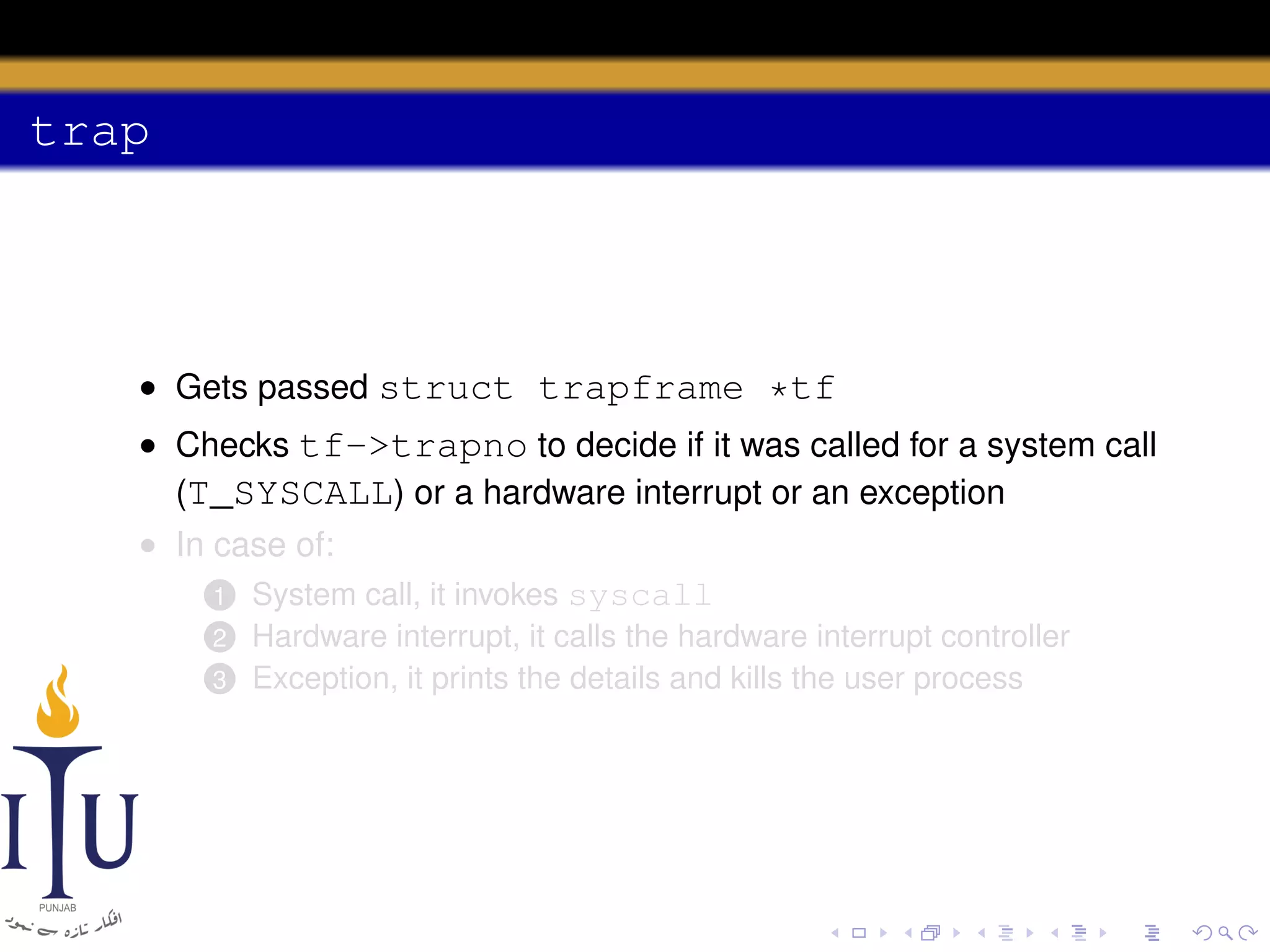
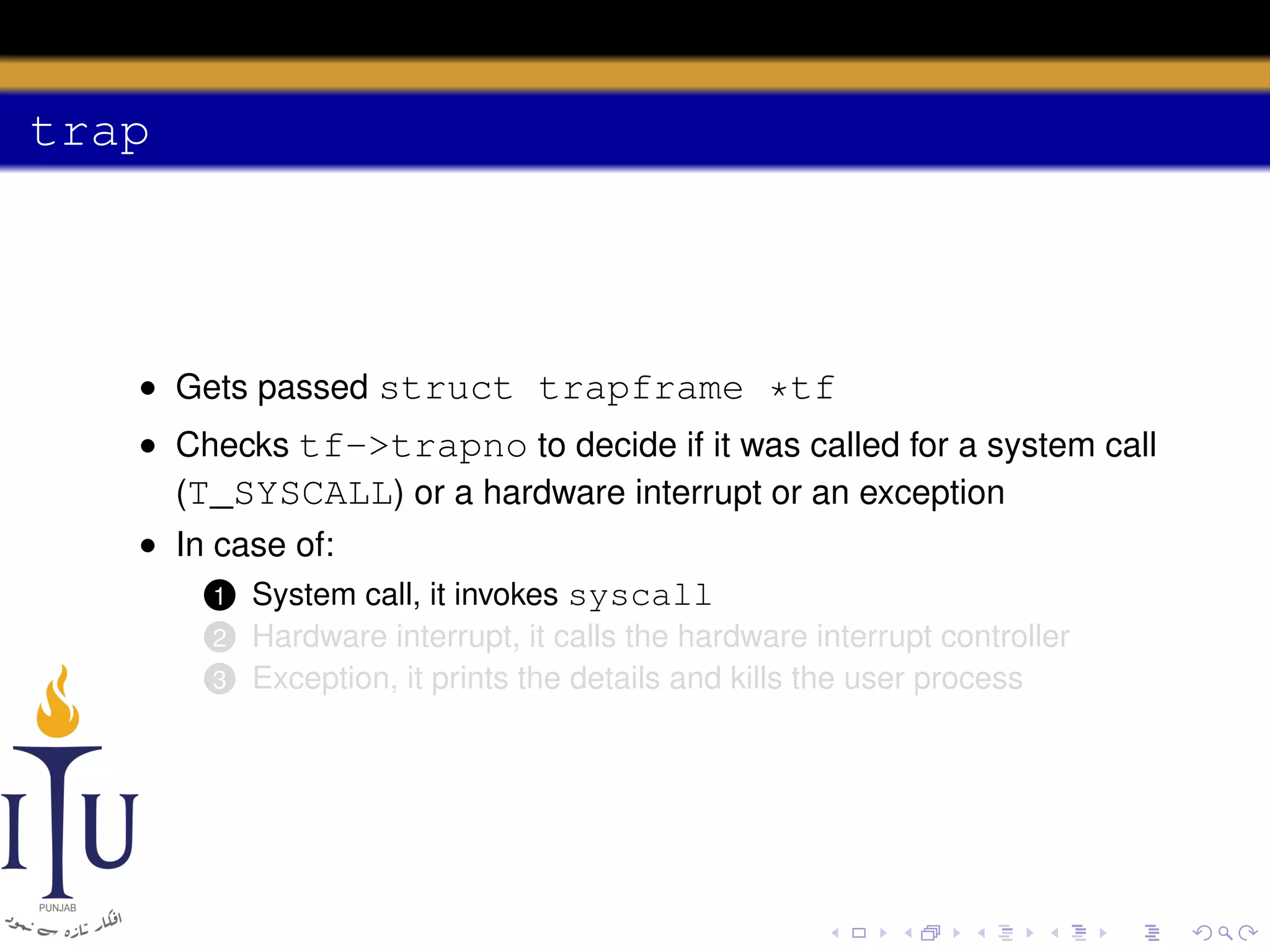
trap

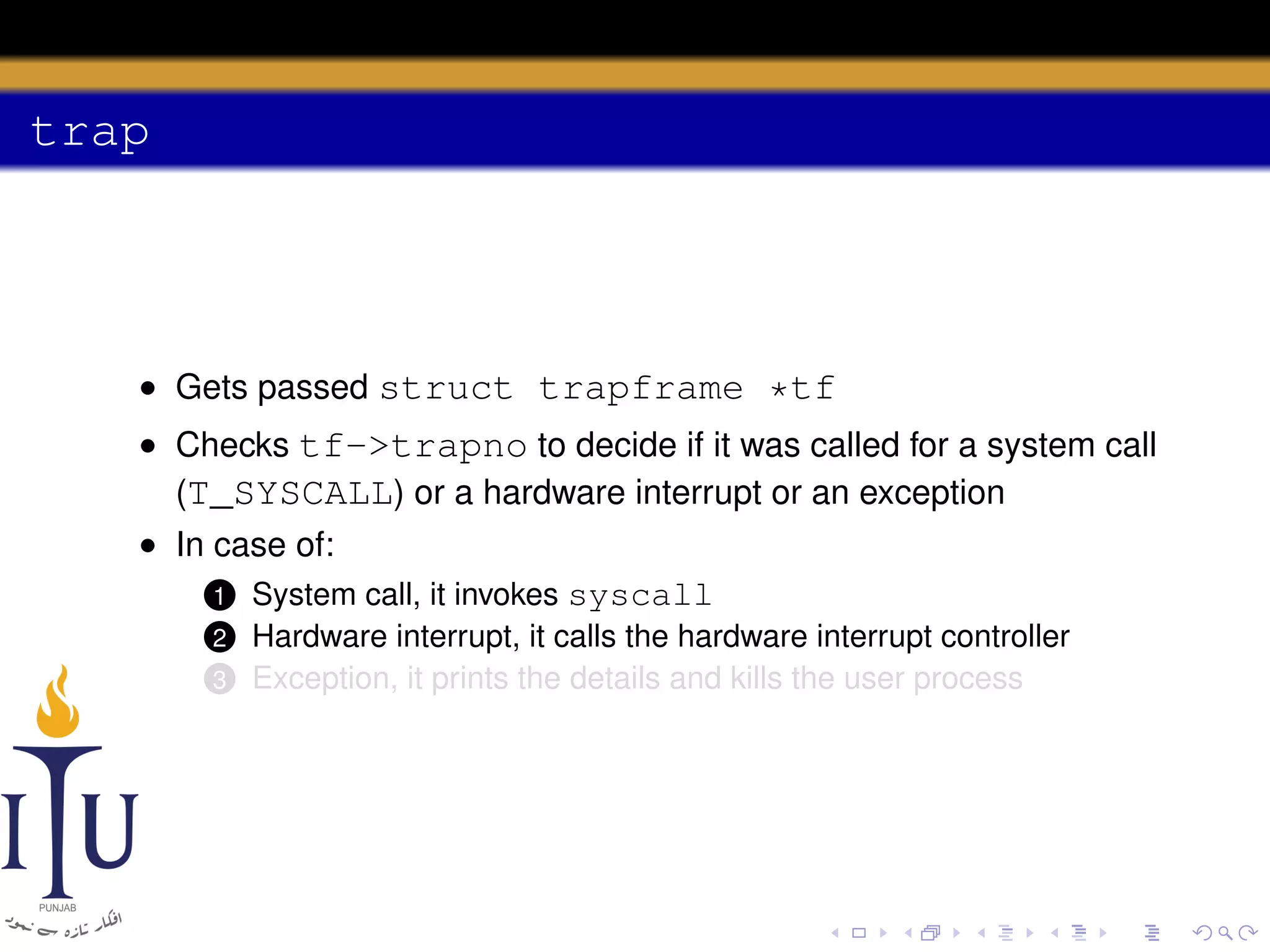
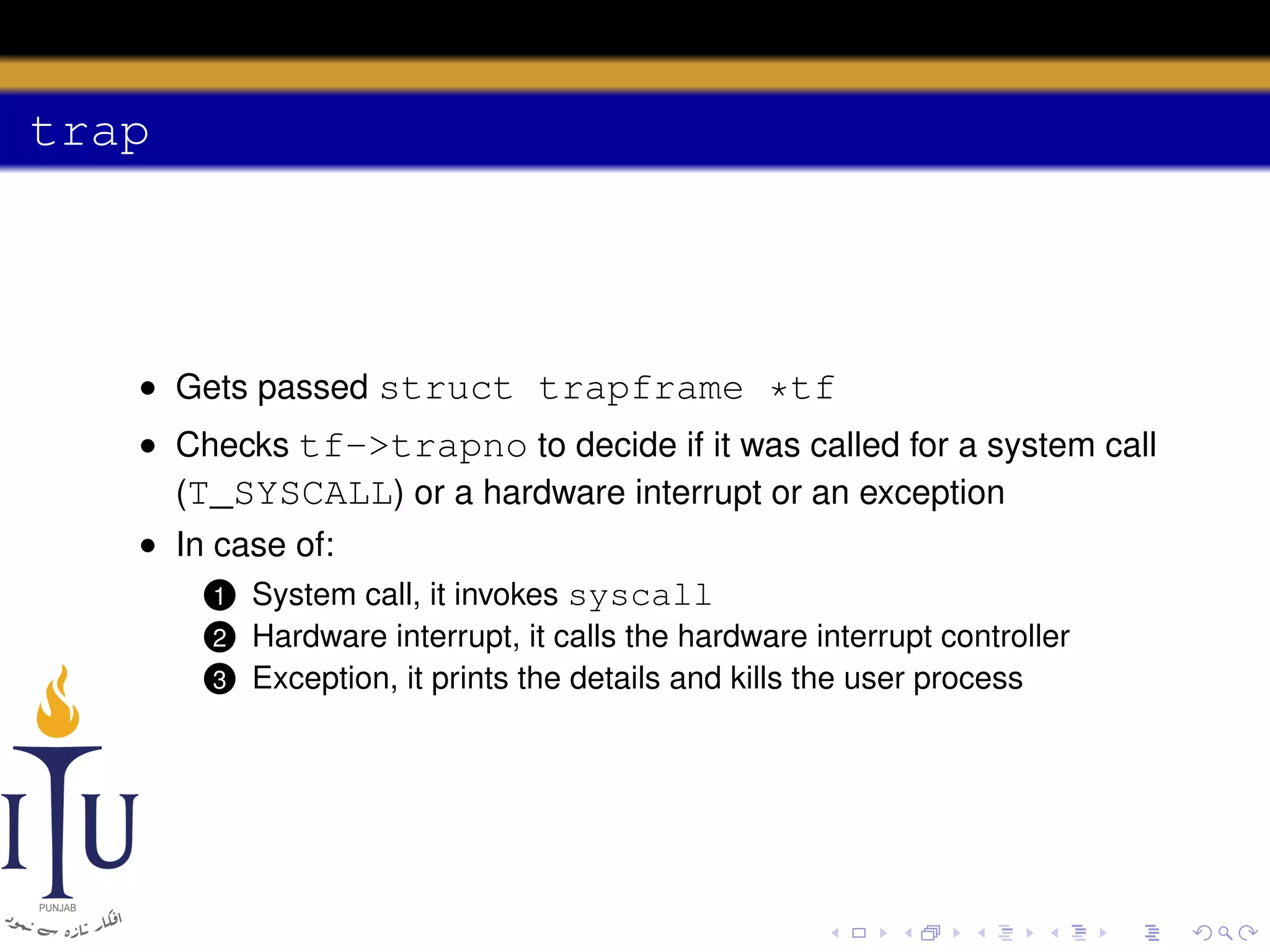
• Gets passed struct trapframe *tf
• Checks tf->trapno to decide if it was called for a system call
(T_SYSCALL) or a hardware interrupt or an exception
• In case of:
1 System call, it invokes syscall
2
3

Hardware interrupt, it calls the hardware interrupt controller
Exception, it prints the details and kills the user process
trap

• Gets passed struct trapframe *tf
• Checks tf->trapno to decide if it was called for a system call
(T_SYSCALL) or a hardware interrupt or an exception
• In case of:
1 System call, it invokes syscall
2
3

Hardware interrupt, it calls the hardware interrupt controller
Exception, it prints the details and kills the user process
trap

• Gets passed struct trapframe *tf
• Checks tf->trapno to decide if it was called for a system call
(T_SYSCALL) or a hardware interrupt or an exception
• In case of:
1 System call, it invokes syscall
2
3

Hardware interrupt, it calls the hardware interrupt controller
Exception, it prints the details and kills the user process
trap

• Gets passed struct trapframe *tf
• Checks tf->trapno to decide if it was called for a system call
(T_SYSCALL) or a hardware interrupt or an exception
• In case of:
1 System call, it invokes syscall
2
3

Hardware interrupt, it calls the hardware interrupt controller
Exception, it prints the details and kills the user process
trap

• Gets passed struct trapframe *tf
• Checks tf->trapno to decide if it was called for a system call
(T_SYSCALL) or a hardware interrupt or an exception
• In case of:
1 System call, it invokes syscall
2
3

Hardware interrupt, it calls the hardware interrupt controller
Exception, it prints the details and kills the user process
syscall

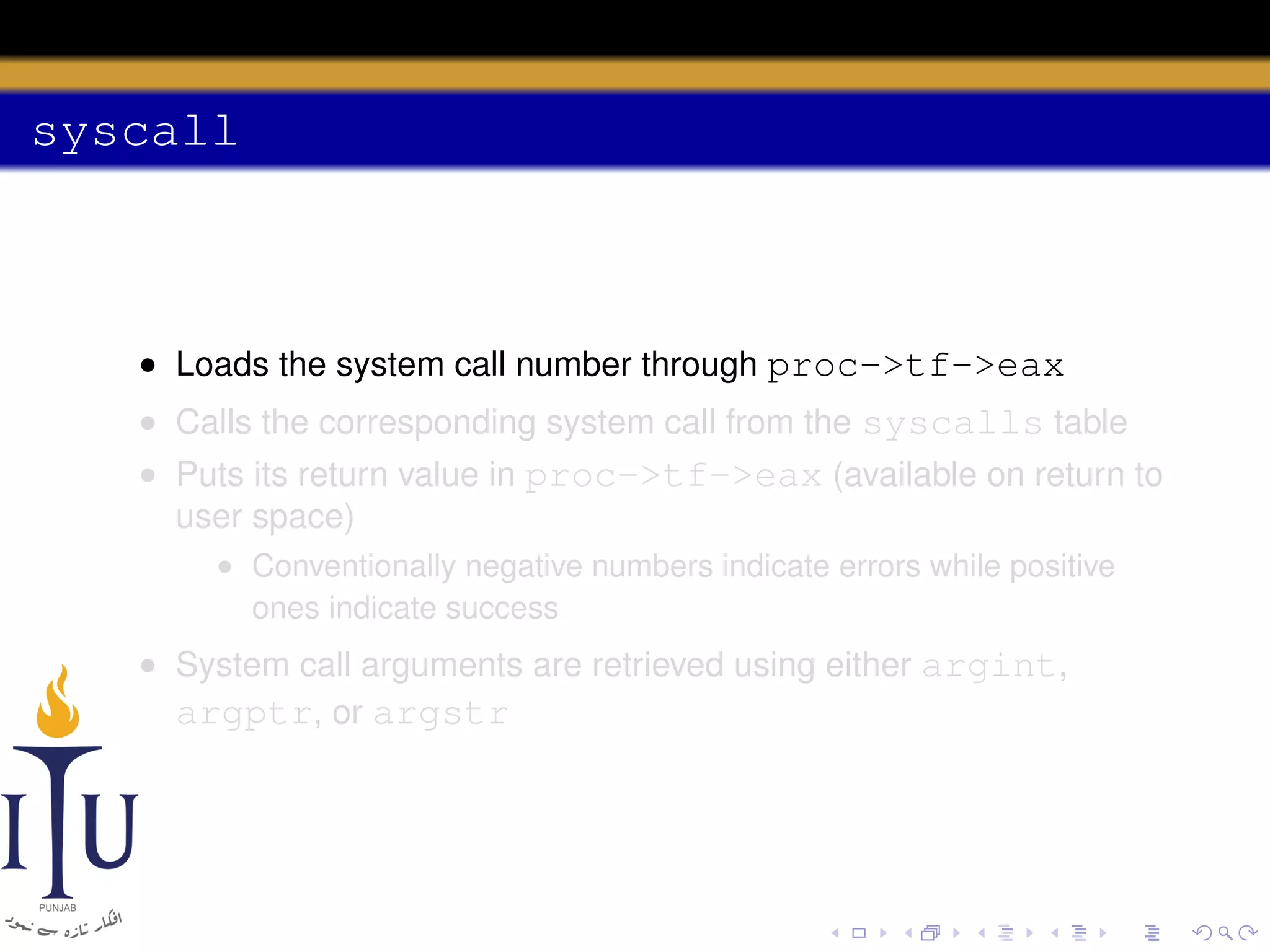
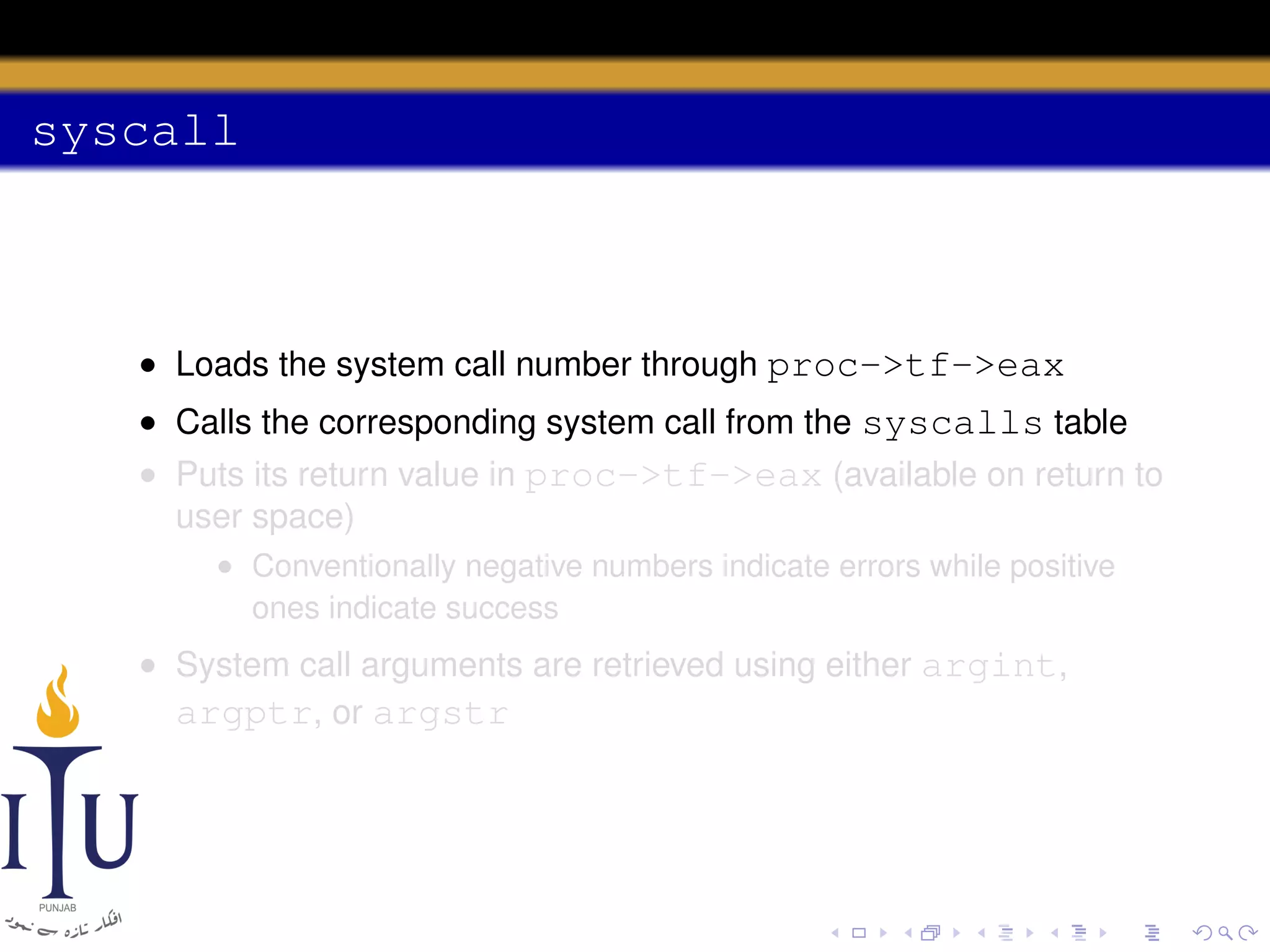
• Loads the system call number through proc->tf->eax
• Calls the corresponding system call from the syscalls table
• Puts its return value in proc->tf->eax (available on return to
user space)
• Conventionally negative numbers indicate errors while positive
ones indicate success

• System call arguments are retrieved using either argint,
argptr, or argstr
syscall

• Loads the system call number through proc->tf->eax
• Calls the corresponding system call from the syscalls table
• Puts its return value in proc->tf->eax (available on return to
user space)
• Conventionally negative numbers indicate errors while positive
ones indicate success

• System call arguments are retrieved using either argint,
argptr, or argstr
syscall

• Loads the system call number through proc->tf->eax
• Calls the corresponding system call from the syscalls table
• Puts its return value in proc->tf->eax (available on return to
user space)
• Conventionally negative numbers indicate errors while positive
ones indicate success

• System call arguments are retrieved using either argint,
argptr, or argstr
syscall

• Loads the system call number through proc->tf->eax
• Calls the corresponding system call from the syscalls table
• Puts its return value in proc->tf->eax (available on return to
user space)
• Conventionally negative numbers indicate errors while positive
ones indicate success

• System call arguments are retrieved using either argint,
argptr, or argstr
syscall

• Loads the system call number through proc->tf->eax
• Calls the corresponding system call from the syscalls table
• Puts its return value in proc->tf->eax (available on return to
user space)
• Conventionally negative numbers indicate errors while positive
ones indicate success

• System call arguments are retrieved using either argint,
argptr, or argstr
Reading(s)

• Chapter 3, “Traps, interrupts, and drivers”, till section “Code:
System calls" from “xv6: a simple, Unix-like teaching operating
system”

AOS Lab 5: System calls

  • 1.
    Lab 5: Systemcalls Advanced Operating Systems Zubair Nabi zubair.nabi@itu.edu.pk February 27, 2013
  • 2.
    Normal execution ofa processor While running a user process: 1 Read an instruction 2 Advance the program counter 3 Execute the instruction 4 Jump to 1
  • 3.
    Normal execution ofa processor While running a user process: 1 Read an instruction 2 Advance the program counter 3 Execute the instruction 4 Jump to 1
  • 4.
    Normal execution ofa processor While running a user process: 1 Read an instruction 2 Advance the program counter 3 Execute the instruction 4 Jump to 1
  • 5.
    Normal execution ofa processor While running a user process: 1 Read an instruction 2 Advance the program counter 3 Execute the instruction 4 Jump to 1
  • 6.
    Normal execution ofa processor While running a user process: 1 Read an instruction 2 Advance the program counter 3 Execute the instruction 4 Jump to 1
  • 7.
    Extraordinary events Events thatbreak normal processor flow, to return control to the kernel: 1 A device signals that it needs attention (e.g. Timer): Interrupt 2 A user program does something illegal (e.g. divide by zero): Exception 3 A user program asks the kernel for a service: System call
  • 8.
    Extraordinary events Events thatbreak normal processor flow, to return control to the kernel: 1 A device signals that it needs attention (e.g. Timer): Interrupt 2 A user program does something illegal (e.g. divide by zero): Exception 3 A user program asks the kernel for a service: System call
  • 9.
    Extraordinary events Events thatbreak normal processor flow, to return control to the kernel: 1 A device signals that it needs attention (e.g. Timer): Interrupt 2 A user program does something illegal (e.g. divide by zero): Exception 3 A user program asks the kernel for a service: System call
  • 10.
    Extraordinary events Events thatbreak normal processor flow, to return control to the kernel: 1 A device signals that it needs attention (e.g. Timer): Interrupt 2 A user program does something illegal (e.g. divide by zero): Exception 3 A user program asks the kernel for a service: System call
  • 11.
    Handling extraordinary events Theoperating system must: 1 Save the processor’s registers for future resumption 2 Set up system for execution in the kernel 3 Choose a place for the kernel to start execution 4 Retrieve information about the event and call corresponding interrupt handler 5 All the while, maintain isolation between user processes and the kernel
  • 12.
    Handling extraordinary events Theoperating system must: 1 Save the processor’s registers for future resumption 2 Set up system for execution in the kernel 3 Choose a place for the kernel to start execution 4 Retrieve information about the event and call corresponding interrupt handler 5 All the while, maintain isolation between user processes and the kernel
  • 13.
    Handling extraordinary events Theoperating system must: 1 Save the processor’s registers for future resumption 2 Set up system for execution in the kernel 3 Choose a place for the kernel to start execution 4 Retrieve information about the event and call corresponding interrupt handler 5 All the while, maintain isolation between user processes and the kernel
  • 14.
    Handling extraordinary events Theoperating system must: 1 Save the processor’s registers for future resumption 2 Set up system for execution in the kernel 3 Choose a place for the kernel to start execution 4 Retrieve information about the event and call corresponding interrupt handler 5 All the while, maintain isolation between user processes and the kernel
  • 15.
    Handling extraordinary events Theoperating system must: 1 Save the processor’s registers for future resumption 2 Set up system for execution in the kernel 3 Choose a place for the kernel to start execution 4 Retrieve information about the event and call corresponding interrupt handler 5 All the while, maintain isolation between user processes and the kernel
  • 16.
    Handling extraordinary events Theoperating system must: 1 Save the processor’s registers for future resumption 2 Set up system for execution in the kernel 3 Choose a place for the kernel to start execution 4 Retrieve information about the event and call corresponding interrupt handler 5 All the while, maintain isolation between user processes and the kernel
  • 17.
    Handling extraordinary events(2) • Need hardware support • On the x86, system calls generate an interrupt via the int instruction • The same mechanism for handling interrupts is used for handling system calls and exceptions • Traps are caused by the current running process • Interrupts are caused by devices • Can happen concurrently
  • 18.
    Handling extraordinary events(2) • Need hardware support • On the x86, system calls generate an interrupt via the int instruction • The same mechanism for handling interrupts is used for handling system calls and exceptions • Traps are caused by the current running process • Interrupts are caused by devices • Can happen concurrently
  • 19.
    Handling extraordinary events(2) • Need hardware support • On the x86, system calls generate an interrupt via the int instruction • The same mechanism for handling interrupts is used for handling system calls and exceptions • Traps are caused by the current running process • Interrupts are caused by devices • Can happen concurrently
  • 20.
    Handling extraordinary events(2) • Need hardware support • On the x86, system calls generate an interrupt via the int instruction • The same mechanism for handling interrupts is used for handling system calls and exceptions • Traps are caused by the current running process • Interrupts are caused by devices • Can happen concurrently
  • 21.
    Handling extraordinary events(2) • Need hardware support • On the x86, system calls generate an interrupt via the int instruction • The same mechanism for handling interrupts is used for handling system calls and exceptions • Traps are caused by the current running process • Interrupts are caused by devices • Can happen concurrently
  • 22.
    Handling extraordinary events(2) • Need hardware support • On the x86, system calls generate an interrupt via the int instruction • The same mechanism for handling interrupts is used for handling system calls and exceptions • Traps are caused by the current running process • Interrupts are caused by devices • Can happen concurrently
  • 23.
    x86 protection • 4protection levels: 0 to 3 • Privilege decreases in ascending order • Most operating systems only use 2 levels: 0 (kernel mode) and 3 (user mode) • Interrupt handlers are defined in an interrupt descriptor table (idt) with a total of 256 entries • int n generates a system call, where n is used to index the idt • It is the job of the operating system to implement a handler for each entry in the idt
  • 24.
    x86 protection • 4protection levels: 0 to 3 • Privilege decreases in ascending order • Most operating systems only use 2 levels: 0 (kernel mode) and 3 (user mode) • Interrupt handlers are defined in an interrupt descriptor table (idt) with a total of 256 entries • int n generates a system call, where n is used to index the idt • It is the job of the operating system to implement a handler for each entry in the idt
  • 25.
    x86 protection • 4protection levels: 0 to 3 • Privilege decreases in ascending order • Most operating systems only use 2 levels: 0 (kernel mode) and 3 (user mode) • Interrupt handlers are defined in an interrupt descriptor table (idt) with a total of 256 entries • int n generates a system call, where n is used to index the idt • It is the job of the operating system to implement a handler for each entry in the idt
  • 26.
    x86 protection • 4protection levels: 0 to 3 • Privilege decreases in ascending order • Most operating systems only use 2 levels: 0 (kernel mode) and 3 (user mode) • Interrupt handlers are defined in an interrupt descriptor table (idt) with a total of 256 entries • int n generates a system call, where n is used to index the idt • It is the job of the operating system to implement a handler for each entry in the idt
  • 27.
    x86 protection • 4protection levels: 0 to 3 • Privilege decreases in ascending order • Most operating systems only use 2 levels: 0 (kernel mode) and 3 (user mode) • Interrupt handlers are defined in an interrupt descriptor table (idt) with a total of 256 entries • int n generates a system call, where n is used to index the idt • It is the job of the operating system to implement a handler for each entry in the idt
  • 28.
    x86 protection • 4protection levels: 0 to 3 • Privilege decreases in ascending order • Most operating systems only use 2 levels: 0 (kernel mode) and 3 (user mode) • Interrupt handlers are defined in an interrupt descriptor table (idt) with a total of 256 entries • int n generates a system call, where n is used to index the idt • It is the job of the operating system to implement a handler for each entry in the idt
  • 29.
    x86 protection • 4protection levels: 0 to 3 • Privilege decreases in ascending order • Most operating systems only use 2 levels: 0 (kernel mode) and 3 (user mode) • Interrupt handlers are defined in an interrupt descriptor table (idt) with a total of 256 entries • int n generates a system call, where n is used to index the idt • It is the job of the operating system to implement a handler for each entry in the idt
  • 30.
    int • Fetches thenth descriptor from idt • Ensures that the privilege level in the descriptor is 3 • As the interrupt is due to a user process, saves the process state (change in privilege level) • Sets the instructor pointer to the required starting address in the descriptor table and starts execution • After execution, the OS calls iret to resume previous execution state
  • 31.
    int • Fetches thenth descriptor from idt • Ensures that the privilege level in the descriptor is 3 • As the interrupt is due to a user process, saves the process state (change in privilege level) • Sets the instructor pointer to the required starting address in the descriptor table and starts execution • After execution, the OS calls iret to resume previous execution state
  • 32.
    int • Fetches thenth descriptor from idt • Ensures that the privilege level in the descriptor is 3 • As the interrupt is due to a user process, saves the process state (change in privilege level) • Sets the instructor pointer to the required starting address in the descriptor table and starts execution • After execution, the OS calls iret to resume previous execution state
  • 33.
    int • Fetches thenth descriptor from idt • Ensures that the privilege level in the descriptor is 3 • As the interrupt is due to a user process, saves the process state (change in privilege level) • Sets the instructor pointer to the required starting address in the descriptor table and starts execution • After execution, the OS calls iret to resume previous execution state
  • 34.
    int • Fetches thenth descriptor from idt • Ensures that the privilege level in the descriptor is 3 • As the interrupt is due to a user process, saves the process state (change in privilege level) • Sets the instructor pointer to the required starting address in the descriptor table and starts execution • After execution, the OS calls iret to resume previous execution state
  • 35.
    The first systemcall • Recall that initcode.S started off by invoking an exec system call to load the init process (/init) • Flow: 1 Push the arguments and binary for exec on the process’s stack 2 Put the system call number (SYS_exec) in %eax (obviously this number should already be present in the system call table, *syscalls[]) 3 Execute int T_SYSCALL
  • 36.
    The first systemcall • Recall that initcode.S started off by invoking an exec system call to load the init process (/init) • Flow: 1 Push the arguments and binary for exec on the process’s stack 2 Put the system call number (SYS_exec) in %eax (obviously this number should already be present in the system call table, *syscalls[]) 3 Execute int T_SYSCALL
  • 37.
    The first systemcall • Recall that initcode.S started off by invoking an exec system call to load the init process (/init) • Flow: 1 Push the arguments and binary for exec on the process’s stack 2 Put the system call number (SYS_exec) in %eax (obviously this number should already be present in the system call table, *syscalls[]) 3 Execute int T_SYSCALL
  • 38.
    The first systemcall • Recall that initcode.S started off by invoking an exec system call to load the init process (/init) • Flow: 1 Push the arguments and binary for exec on the process’s stack 2 Put the system call number (SYS_exec) in %eax (obviously this number should already be present in the system call table, *syscalls[]) 3 Execute int T_SYSCALL
  • 39.
    The first systemcall • Recall that initcode.S started off by invoking an exec system call to load the init process (/init) • Flow: 1 Push the arguments and binary for exec on the process’s stack 2 Put the system call number (SYS_exec) in %eax (obviously this number should already be present in the system call table, *syscalls[]) 3 Execute int T_SYSCALL
  • 40.
    x86 traps • 256different interrupts • 0-31 software • 32-63 hardware • 64 system calls (T_SYSCALL)
  • 41.
    x86 traps • 256different interrupts • 0-31 software • 32-63 hardware • 64 system calls (T_SYSCALL)
  • 42.
    x86 traps • 256different interrupts • 0-31 software • 32-63 hardware • 64 system calls (T_SYSCALL)
  • 43.
    x86 traps • 256different interrupts • 0-31 software • 32-63 hardware • 64 system calls (T_SYSCALL)
  • 44.
    Setting up idt •tvinit, called from main, sets up the entries in idt • The address of the handler for each interrupt in idt is present in vectors[], i.e. Interrupt i is handled by vectors[i] • T_SYSCALL is handled specially: it is distinguished as a trap allowing multiple system calls to execute simultaneously
  • 45.
    Setting up idt •tvinit, called from main, sets up the entries in idt • The address of the handler for each interrupt in idt is present in vectors[], i.e. Interrupt i is handled by vectors[i] • T_SYSCALL is handled specially: it is distinguished as a trap allowing multiple system calls to execute simultaneously
  • 46.
    Setting up idt •tvinit, called from main, sets up the entries in idt • The address of the handler for each interrupt in idt is present in vectors[], i.e. Interrupt i is handled by vectors[i] • T_SYSCALL is handled specially: it is distinguished as a trap allowing multiple system calls to execute simultaneously
  • 47.
    tvinit 1 2 3 4 5 6 7 8 9 10 11 12 13 14 void tvinit (void){ int i; for(i = 0; i < 256; i++) SETGATE (idt[i], 0, SEG_KCODE <<3, vectors [i], 0); SETGATE (idt[ T_SYSCALL ], 1, SEG_KCODE <<3, vectors [ T_SYSCALL ], DPL_USER ); /∗ SETGATE (gate , istrap , sel , off , d) ∗ ∗ ∗ ∗ ∗ gate: idt entry istrap : 1 trap , 0 interrupt sel: code segment off: offset within code segment d: privilege level ∗/ initlock (& tickslock , "time"); }
  • 48.
    Addresses of interrupthandlers • xv6 uses a custom Perl script vectors.pl to generate vectors.S which holds entry points of interrupt handlers in vectors[] • Each entry point: Pushes an error code Pushes the interrupt number 3 Jumps to alltraps 1 2
  • 49.
    Addresses of interrupthandlers • xv6 uses a custom Perl script vectors.pl to generate vectors.S which holds entry points of interrupt handlers in vectors[] • Each entry point: Pushes an error code Pushes the interrupt number 3 Jumps to alltraps 1 2
  • 50.
    Addresses of interrupthandlers • xv6 uses a custom Perl script vectors.pl to generate vectors.S which holds entry points of interrupt handlers in vectors[] • Each entry point: Pushes an error code Pushes the interrupt number 3 Jumps to alltraps 1 2
  • 51.
    Addresses of interrupthandlers • xv6 uses a custom Perl script vectors.pl to generate vectors.S which holds entry points of interrupt handlers in vectors[] • Each entry point: Pushes an error code Pushes the interrupt number 3 Jumps to alltraps 1 2
  • 52.
    alltraps 1 Pushes all processorregisters into a struct trapframe • Once the call completes, the kernel can restore state from this structure 2 Sets up the processor to run kernel C code (load SEG_KCPU, per-CPU data segment) 3 Calls the C trap handler trap 4 Once trap returns, alltraps restores struct trapframe and then calls iret to return control back to user space
  • 53.
    alltraps 1 Pushes all processorregisters into a struct trapframe • Once the call completes, the kernel can restore state from this structure 2 Sets up the processor to run kernel C code (load SEG_KCPU, per-CPU data segment) 3 Calls the C trap handler trap 4 Once trap returns, alltraps restores struct trapframe and then calls iret to return control back to user space
  • 54.
    alltraps 1 Pushes all processorregisters into a struct trapframe • Once the call completes, the kernel can restore state from this structure 2 Sets up the processor to run kernel C code (load SEG_KCPU, per-CPU data segment) 3 Calls the C trap handler trap 4 Once trap returns, alltraps restores struct trapframe and then calls iret to return control back to user space
  • 55.
    alltraps 1 Pushes all processorregisters into a struct trapframe • Once the call completes, the kernel can restore state from this structure 2 Sets up the processor to run kernel C code (load SEG_KCPU, per-CPU data segment) 3 Calls the C trap handler trap 4 Once trap returns, alltraps restores struct trapframe and then calls iret to return control back to user space
  • 56.
    alltraps 1 Pushes all processorregisters into a struct trapframe • Once the call completes, the kernel can restore state from this structure 2 Sets up the processor to run kernel C code (load SEG_KCPU, per-CPU data segment) 3 Calls the C trap handler trap 4 Once trap returns, alltraps restores struct trapframe and then calls iret to return control back to user space
  • 57.
    trap • Gets passedstruct trapframe *tf • Checks tf->trapno to decide if it was called for a system call (T_SYSCALL) or a hardware interrupt or an exception • In case of: 1 System call, it invokes syscall 2 3 Hardware interrupt, it calls the hardware interrupt controller Exception, it prints the details and kills the user process
  • 58.
    trap • Gets passedstruct trapframe *tf • Checks tf->trapno to decide if it was called for a system call (T_SYSCALL) or a hardware interrupt or an exception • In case of: 1 System call, it invokes syscall 2 3 Hardware interrupt, it calls the hardware interrupt controller Exception, it prints the details and kills the user process
  • 59.
    trap • Gets passedstruct trapframe *tf • Checks tf->trapno to decide if it was called for a system call (T_SYSCALL) or a hardware interrupt or an exception • In case of: 1 System call, it invokes syscall 2 3 Hardware interrupt, it calls the hardware interrupt controller Exception, it prints the details and kills the user process
  • 60.
    trap • Gets passedstruct trapframe *tf • Checks tf->trapno to decide if it was called for a system call (T_SYSCALL) or a hardware interrupt or an exception • In case of: 1 System call, it invokes syscall 2 3 Hardware interrupt, it calls the hardware interrupt controller Exception, it prints the details and kills the user process
  • 61.
    trap • Gets passedstruct trapframe *tf • Checks tf->trapno to decide if it was called for a system call (T_SYSCALL) or a hardware interrupt or an exception • In case of: 1 System call, it invokes syscall 2 3 Hardware interrupt, it calls the hardware interrupt controller Exception, it prints the details and kills the user process
  • 62.
    syscall • Loads thesystem call number through proc->tf->eax • Calls the corresponding system call from the syscalls table • Puts its return value in proc->tf->eax (available on return to user space) • Conventionally negative numbers indicate errors while positive ones indicate success • System call arguments are retrieved using either argint, argptr, or argstr
  • 63.
    syscall • Loads thesystem call number through proc->tf->eax • Calls the corresponding system call from the syscalls table • Puts its return value in proc->tf->eax (available on return to user space) • Conventionally negative numbers indicate errors while positive ones indicate success • System call arguments are retrieved using either argint, argptr, or argstr
  • 64.
    syscall • Loads thesystem call number through proc->tf->eax • Calls the corresponding system call from the syscalls table • Puts its return value in proc->tf->eax (available on return to user space) • Conventionally negative numbers indicate errors while positive ones indicate success • System call arguments are retrieved using either argint, argptr, or argstr
  • 65.
    syscall • Loads thesystem call number through proc->tf->eax • Calls the corresponding system call from the syscalls table • Puts its return value in proc->tf->eax (available on return to user space) • Conventionally negative numbers indicate errors while positive ones indicate success • System call arguments are retrieved using either argint, argptr, or argstr
  • 66.
    syscall • Loads thesystem call number through proc->tf->eax • Calls the corresponding system call from the syscalls table • Puts its return value in proc->tf->eax (available on return to user space) • Conventionally negative numbers indicate errors while positive ones indicate success • System call arguments are retrieved using either argint, argptr, or argstr
  • 67.
    Reading(s) • Chapter 3,“Traps, interrupts, and drivers”, till section “Code: System calls" from “xv6: a simple, Unix-like teaching operating system”