PEDIGREE ANALYSIS
CSIR – UGC NET PROBLEMS SOLVED
Dr. Valli Syam
NET June 2019
NET June 2019
Let us take the allele for this gene as A and a
Genotype of II 4 is given aa – The chance of this woman
passing her defective gene to III-1 is 100%
NET June 2019
I-1 and I-2 are heterozygous (Aa) for this trait –
evident from II-1
NET June 2019
The chance of II-3 being heterozygous can be calculated
as follows
There are 4 possibilities when I-1 and I-2 are
heterozygous
1 AA : 1 Aa : 1 aA : 1 aa – 4
1 AA : 2 Aa : 1 aa – 4
Since this man is not affected 1 aa should be ruled out
1 AA : 2Aa – 3
So only 3 possibilities
He being carrier (Aa) for this trait is =
2
3
II-3 (Aa) x II-4 (aa)
III-1 receiving recessive allele from II-3 =
1
2
III-1 receiving recessive allele from II-4 = 1
The chance of III-1 getting this defective gene is
2
3
x
1
2
x 1=
2
6
=
1
3

NET June 2019
ANS 2
NET June 2019
ANS 2
Unaffected father – Affected Daughter
Rules out X – Linked Inheritance – Option A and B ruled
out
NET June 2019
Mothers (I-2, II-4, III-7) passing on the trait to all her children –
characteristic of Mitochondrial Inheritance – Option C is right
The answer must be 2 which has option C and D.
Variable expression can be due to heteroplasmy deals with the
presence of more than one type of organellar genome
(mitochondrial DNA or plastid DNA) within a cell or individual –
Option D also right
The answer is 2 which has Option C and D

NET December 2018
NET December 2018
4 and 5 are heterozygous – evident from 7 being
homozygous recessive (Expressing the phenotype)
NET December 2018
4 and 5 are heterozygous – evident from 7 being
homozygous recessive
Aa (4) x Aa (5)
AA Aa aA aa
1 AA 2 Aa 1 aa – 4
6 being homozygous recessive can be ruled out as he is
not having that trait
So only 3 possibilities are there
1 AA 2 Aa – 3
The probability of 6 being heterozygous (Aa) is
2
3

NET December 2017
NET December 2017
Normal parents giving rise to affected child – Family 1
RECESSIVE
So Option 2 and 4 can be ruled out
NET December 2017
Normal father giving rise to affected daughter – Family 2
and Affected mother giving rise to normal son – Family 3
X-linked recessive ruled out – ie., Option 1 can be ruled out
The answer is Option 3 – Autosomal Recessive is the right
answer

NET December 2016
The following pedigree shows the inheritance
pattern of a trait
From the following select the possible mode
of inheritance and the probability that the
daughter in generation III will show the trait
1. X-linked recessive, probability is 1/2
2. X-linked recessive, probability is 1/4
3. Autosomal recessive, probability is 1/2
4. Autosomal recessive, probability is 1/3
NET December 2016
Affected mother giving rise to unaffected son –
Not X-linked recessive – Option 1 and 2 ruled out
So Autosomal recessive
The following pedigree shows the inheritance
pattern of a trait
From the following select the possible mode
of inheritance and the probability that the
daughter in generation III will show the trait
1. X-linked recessive, probability is 1/2
2. X-linked recessive, probability is 1/4
3. Autosomal recessive, probability is 1/2
4. Autosomal recessive, probability is 1/3
NET December 2016
This woman being heterozygous is 100% - Would have
received the defective gene from affected father
The following pedigree shows the inheritance
pattern of a trait
From the following select the possible mode
of inheritance and the probability that the
daughter in generation III will show the trait
1. X-linked recessive, probability is 1/2
2. X-linked recessive, probability is 1/4
3. Autosomal recessive, probability is 1/2
4. Autosomal recessive, probability is 1/3
NET December 2016
This man is Homozygous Recessive – Since he is carrying
the trait
The following pedigree shows the inheritance
pattern of a trait
From the following select the possible mode
of inheritance and the probability that the
daughter in generation III will show the trait
1. X-linked recessive, probability is 1/2
2. X-linked recessive, probability is 1/4
3. Autosomal recessive, probability is 1/2
4. Autosomal recessive, probability is 1/3
NET December 2016
This daughter receiving the defective gene from father (aa) is
100%
This daughter receiving the defective gene from Mother (Aa) is
50% - ie. ½, Since mother is heterozygous (one normal gene
and another defective gene)
So Option 3 is the Right Answer

The following pedigree shows the inheritance
pattern of a trait
From the following select the possible mode
of inheritance and the probability that the
daughter in generation III will show the trait
1. X-linked recessive, probability is 1/2
2. X-linked recessive, probability is 1/4
3. Autosomal recessive, probability is 1/2
4. Autosomal recessive, probability is 1/3
NET December 2015
The following pedigree chart shows inheritance
of a given trait
The trait can be called
1. Autosomal dominant
2. Autosomal recessive
3. X-linked dominant
4. Sex limited
Affected parents giving rise to unaffected children
Dominant pedigree – Option 2 Ruled out
More towards Option 1 and 3
NET December 2015
The following pedigree chart shows inheritance
of a given trait
The trait can be called
1. Autosomal dominant
2. Autosomal recessive
3. X-linked dominant
4. Sex limited
Affected father giving rise to unaffected daughter and affected
son
Not X-linked – Option 3 Ruled out
NET December 2015
The following pedigree chart shows inheritance
of a given trait
The trait can be called
1. Autosomal dominant
2. Autosomal recessive
3. X-linked dominant
4. Sex limited
While all the male individuals are affected, this male is not
affected – So not sex limited – Option 4 ruled out
So the answer is Autosomal Dominant – Option 1 is the Right
Answer
NET December 2015
The following pedigree chart shows inheritance
of a given trait
The trait can be called
1. Autosomal dominant
2. Autosomal recessive
3. X-linked dominant
4. Sex limited

NET December 2014
I-1 is heterozygous for this phenotype – evident from II-2
NET December 2014
II-3 inheriting defective gene from I-2 is 100%
Probability of this woman being heterozygous is 1
NET December 2014
Details of Genotype of III-4 is not given, If his parents are
heterozygous
1 AA : 1Aa : 1aA : 1 aa - 4 possibilities
Since he is also not showing the phenotype homozygous recessive
condition is ruled out – Only 3 possibilities are there
1 AA : 2Aa – 3
II-4 being heterozygous is
2
3
(provided his parents are heterozygous
– this information is not available)
The probabilities of carriers in the population is given as
1
3
Therefore, Probability of III-4 being heterozygous is
2
3
𝑥
1
3
=
2
9
NET December 2014
1 AA : 1Aa : 1aA : 1 aa
The probability of the child from heterozygous parents getting the
phenotype is
1
4
The probability of the child born to this parent (II-3 and II-4) showing
the phenotype = Probability of parents being heterozygous x
probability of getting the disorder with heterozygous parents
= 1 𝑥
2
9
𝑥
1
4
=
1
18
So the answer is Option 2 is the Right Answer
NET December 2014

NET December 2013
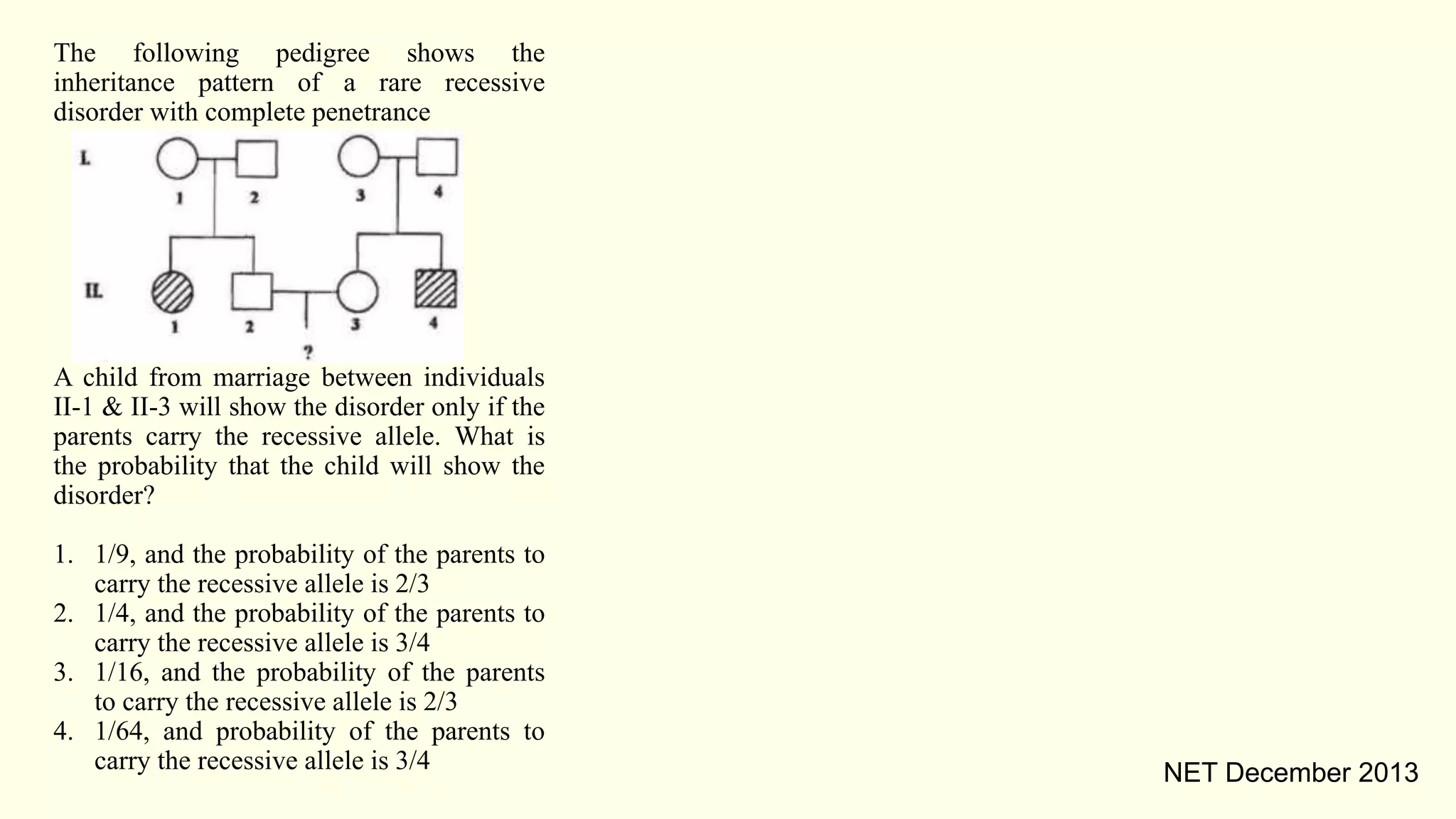
The following pedigree shows the
inheritance pattern of a rare recessive
disorder with complete penetrance
A child from marriage between individuals
II-1 & II-3 will show the disorder only if the
parents carry the recessive allele. What is
the probability that the child will show the
disorder?
1. 1/9, and the probability of the parents to
carry the recessive allele is 2/3
2. 1/4, and the probability of the parents to
carry the recessive allele is 3/4
3. 1/16, and the probability of the parents
to carry the recessive allele is 2/3
4. 1/64, and probability of the parents to
carry the recessive allele is 3/4
I-1,2 and 3,4 are heterozygous – evident from II-1 and II-4
NET December 2013
The following pedigree shows the
inheritance pattern of a rare recessive
disorder with complete penetrance
A child from marriage between individuals
II-1 & II-3 will show the disorder only if the
parents carry the recessive allele. What is
the probability that the child will show the
disorder?
1. 1/9, and the probability of the parents to
carry the recessive allele is 2/3
2. 1/4, and the probability of the parents to
carry the recessive allele is 3/4
3. 1/16, and the probability of the parents
to carry the recessive allele is 2/3
4. 1/64, and probability of the parents to
carry the recessive allele is 3/4
The chance of II-2 being heterozygous can be calculated as follows –
Same for II-3 also
1 AA : 1 Aa : 1 aA : 1 aa – 4
1 AA : 2 Aa : 1 aa – 4
Since II-2 and II-3 are not affected 1 aa should be ruled out
1 AA : 2Aa – 3
So only 3 possibilities
The chance of being carrier (Aa) for this trait is =
2
3
The chance of both II-2 and II-3 being heterozygous is
2
3
x
2
3
=
4
9
The probability of getting the disorder is
1 AA : 1Aa : 1aA : 1 aa
The probability of getting the disorder is
1
4
NET December 2013
The following pedigree shows the
inheritance pattern of a rare recessive
disorder with complete penetrance
A child from marriage between individuals
II-1 & II-3 will show the disorder only if the
parents carry the recessive allele. What is
the probability that the child will show the
disorder?
1. 1/9, and the probability of the parents to
carry the recessive allele is 2/3
2. 1/4, and the probability of the parents to
carry the recessive allele is 3/4
3. 1/16, and the probability of the parents
to carry the recessive allele is 2/3
4. 1/64, and probability of the parents to
carry the recessive allele is 3/4
The chance of both II-2 and II-3 being heterozygous is
2
3
x
2
3
=
4
9
The probability of getting the disorder with heterozygous parents is
1
4
The probability of the child born to this parent showing the disorder =
Probability of parents being heterozygous x probability of getting the
disorder with heterozygous parents
=
4
9
x
1
4
=
1
9
So the answer is Option 1 is the Right Answer
NET December 2013
The following pedigree shows the
inheritance pattern of a rare recessive
disorder with complete penetrance
A child from marriage between individuals
II-1 & II-3 will show the disorder only if the
parents carry the recessive allele. What is
the probability that the child will show the
disorder?
1. 1/9, and the probability of the parents to
carry the recessive allele is 2/3
2. 1/4, and the probability of the parents to
carry the recessive allele is 3/4
3. 1/16, and the probability of the parents
to carry the recessive allele is 2/3
4. 1/64, and probability of the parents to
carry the recessive allele is 3/4

NET December 2012
The following pedigree represents inheritance of a trait in an
extended family
What is the probable mode of inheritance and which
individuals conclusively demonstrate this mode of
inheritance
1. Autosomal recessive, III-2,3 and IV-1,2 conclusively
demonstrate the mode of inheritance
2. Autosomal recessive I-1,2 and II-2 conclusively
demonstrate the mode of inheritance
3. Autosomal dominant, III-2,3 and IV-1,2 conclusively
demonstrate the mode of inheritance
4. X-linked recessive, II-3,4 and 5 conclusively
demonstrate the mode of inheritance
Unaffected parents (III-2,3) giving rise to affected children
(IV-1,2) – Not a dominant pedigree – It is a
Recessive pedigree - Option 3 ruled out
NET December 2012
The following pedigree represents inheritance of a trait in an
extended family
What is the probable mode of inheritance and which
individuals conclusively demonstrate this mode of
inheritance
1. Autosomal recessive, III-2,3 and IV-1,2 conclusively
demonstrate the mode of inheritance
2. Autosomal recessive I-1,2 and II-2 conclusively
demonstrate the mode of inheritance
3. Autosomal dominant, III-2,3 and IV-1,2 conclusively
demonstrate the mode of inheritance
4. X-linked recessive, II-3,4 and 5 conclusively
demonstrate the mode of inheritance
I-1,2 and II-2 do not provide a conclusive evidence for
autosomal recessive condition – This can also be an
autosomal dominant pedigree or Y linked pedigree –
Option 2 ruled out
NET December 2012
The following pedigree represents inheritance of a trait in an
extended family
What is the probable mode of inheritance and which
individuals conclusively demonstrate this mode of
inheritance
1. Autosomal recessive, III-2,3 and IV-1,2 conclusively
demonstrate the mode of inheritance
2. Autosomal recessive I-1,2 and II-2 conclusively
demonstrate the mode of inheritance
3. Autosomal dominant, III-2,3 and IV-1,2 conclusively
demonstrate the mode of inheritance
4. X-linked recessive, II-3,4 and 5 conclusively
demonstrate the mode of inheritance
Affected father (I-1) giving rise to affected son (II-2)
Not X-linked – Option 4 Ruled out
So the answer is Option 1 is the Right Answer
NET December 2012

The following pedigree represents inheritance of a trait in an
extended family
What is the probable mode of inheritance and which
individuals conclusively demonstrate this mode of
inheritance
1. Autosomal recessive, III-2,3 and IV-1,2 conclusively
demonstrate the mode of inheritance
2. Autosomal recessive I-1,2 and II-2 conclusively
demonstrate the mode of inheritance
3. Autosomal dominant, III-2,3 and IV-1,2 conclusively
demonstrate the mode of inheritance
4. X-linked recessive, II-3,4 and 5 conclusively
demonstrate the mode of inheritance

Pedigree problems (NET)

  • 1.
    PEDIGREE ANALYSIS CSIR –UGC NET PROBLEMS SOLVED Dr. Valli Syam
  • 2.
  • 3.
    NET June 2019 Letus take the allele for this gene as A and a Genotype of II 4 is given aa – The chance of this woman passing her defective gene to III-1 is 100%
  • 4.
    NET June 2019 I-1and I-2 are heterozygous (Aa) for this trait – evident from II-1
  • 5.
    NET June 2019 Thechance of II-3 being heterozygous can be calculated as follows There are 4 possibilities when I-1 and I-2 are heterozygous 1 AA : 1 Aa : 1 aA : 1 aa – 4 1 AA : 2 Aa : 1 aa – 4 Since this man is not affected 1 aa should be ruled out 1 AA : 2Aa – 3 So only 3 possibilities He being carrier (Aa) for this trait is = 2 3 II-3 (Aa) x II-4 (aa) III-1 receiving recessive allele from II-3 = 1 2 III-1 receiving recessive allele from II-4 = 1 The chance of III-1 getting this defective gene is 2 3 x 1 2 x 1= 2 6 = 1 3 
  • 6.
  • 7.
    NET June 2019 ANS2 Unaffected father – Affected Daughter Rules out X – Linked Inheritance – Option A and B ruled out
  • 8.
    NET June 2019 Mothers(I-2, II-4, III-7) passing on the trait to all her children – characteristic of Mitochondrial Inheritance – Option C is right The answer must be 2 which has option C and D. Variable expression can be due to heteroplasmy deals with the presence of more than one type of organellar genome (mitochondrial DNA or plastid DNA) within a cell or individual – Option D also right The answer is 2 which has Option C and D 
  • 9.
  • 10.
    NET December 2018 4and 5 are heterozygous – evident from 7 being homozygous recessive (Expressing the phenotype)
  • 11.
    NET December 2018 4and 5 are heterozygous – evident from 7 being homozygous recessive Aa (4) x Aa (5) AA Aa aA aa 1 AA 2 Aa 1 aa – 4 6 being homozygous recessive can be ruled out as he is not having that trait So only 3 possibilities are there 1 AA 2 Aa – 3 The probability of 6 being heterozygous (Aa) is 2 3 
  • 12.
  • 13.
    NET December 2017 Normalparents giving rise to affected child – Family 1 RECESSIVE So Option 2 and 4 can be ruled out
  • 14.
    NET December 2017 Normalfather giving rise to affected daughter – Family 2 and Affected mother giving rise to normal son – Family 3 X-linked recessive ruled out – ie., Option 1 can be ruled out The answer is Option 3 – Autosomal Recessive is the right answer 
  • 15.
    NET December 2016 Thefollowing pedigree shows the inheritance pattern of a trait From the following select the possible mode of inheritance and the probability that the daughter in generation III will show the trait 1. X-linked recessive, probability is 1/2 2. X-linked recessive, probability is 1/4 3. Autosomal recessive, probability is 1/2 4. Autosomal recessive, probability is 1/3
  • 16.
    NET December 2016 Affectedmother giving rise to unaffected son – Not X-linked recessive – Option 1 and 2 ruled out So Autosomal recessive The following pedigree shows the inheritance pattern of a trait From the following select the possible mode of inheritance and the probability that the daughter in generation III will show the trait 1. X-linked recessive, probability is 1/2 2. X-linked recessive, probability is 1/4 3. Autosomal recessive, probability is 1/2 4. Autosomal recessive, probability is 1/3
  • 17.
    NET December 2016 Thiswoman being heterozygous is 100% - Would have received the defective gene from affected father The following pedigree shows the inheritance pattern of a trait From the following select the possible mode of inheritance and the probability that the daughter in generation III will show the trait 1. X-linked recessive, probability is 1/2 2. X-linked recessive, probability is 1/4 3. Autosomal recessive, probability is 1/2 4. Autosomal recessive, probability is 1/3
  • 18.
    NET December 2016 Thisman is Homozygous Recessive – Since he is carrying the trait The following pedigree shows the inheritance pattern of a trait From the following select the possible mode of inheritance and the probability that the daughter in generation III will show the trait 1. X-linked recessive, probability is 1/2 2. X-linked recessive, probability is 1/4 3. Autosomal recessive, probability is 1/2 4. Autosomal recessive, probability is 1/3
  • 19.
    NET December 2016 Thisdaughter receiving the defective gene from father (aa) is 100% This daughter receiving the defective gene from Mother (Aa) is 50% - ie. ½, Since mother is heterozygous (one normal gene and another defective gene) So Option 3 is the Right Answer  The following pedigree shows the inheritance pattern of a trait From the following select the possible mode of inheritance and the probability that the daughter in generation III will show the trait 1. X-linked recessive, probability is 1/2 2. X-linked recessive, probability is 1/4 3. Autosomal recessive, probability is 1/2 4. Autosomal recessive, probability is 1/3
  • 20.
    NET December 2015 Thefollowing pedigree chart shows inheritance of a given trait The trait can be called 1. Autosomal dominant 2. Autosomal recessive 3. X-linked dominant 4. Sex limited
  • 21.
    Affected parents givingrise to unaffected children Dominant pedigree – Option 2 Ruled out More towards Option 1 and 3 NET December 2015 The following pedigree chart shows inheritance of a given trait The trait can be called 1. Autosomal dominant 2. Autosomal recessive 3. X-linked dominant 4. Sex limited
  • 22.
    Affected father givingrise to unaffected daughter and affected son Not X-linked – Option 3 Ruled out NET December 2015 The following pedigree chart shows inheritance of a given trait The trait can be called 1. Autosomal dominant 2. Autosomal recessive 3. X-linked dominant 4. Sex limited
  • 23.
    While all themale individuals are affected, this male is not affected – So not sex limited – Option 4 ruled out So the answer is Autosomal Dominant – Option 1 is the Right Answer NET December 2015 The following pedigree chart shows inheritance of a given trait The trait can be called 1. Autosomal dominant 2. Autosomal recessive 3. X-linked dominant 4. Sex limited 
  • 24.
  • 25.
    I-1 is heterozygousfor this phenotype – evident from II-2 NET December 2014
  • 26.
    II-3 inheriting defectivegene from I-2 is 100% Probability of this woman being heterozygous is 1 NET December 2014
  • 27.
    Details of Genotypeof III-4 is not given, If his parents are heterozygous 1 AA : 1Aa : 1aA : 1 aa - 4 possibilities Since he is also not showing the phenotype homozygous recessive condition is ruled out – Only 3 possibilities are there 1 AA : 2Aa – 3 II-4 being heterozygous is 2 3 (provided his parents are heterozygous – this information is not available) The probabilities of carriers in the population is given as 1 3 Therefore, Probability of III-4 being heterozygous is 2 3 𝑥 1 3 = 2 9 NET December 2014
  • 28.
    1 AA :1Aa : 1aA : 1 aa The probability of the child from heterozygous parents getting the phenotype is 1 4 The probability of the child born to this parent (II-3 and II-4) showing the phenotype = Probability of parents being heterozygous x probability of getting the disorder with heterozygous parents = 1 𝑥 2 9 𝑥 1 4 = 1 18 So the answer is Option 2 is the Right Answer NET December 2014 
  • 29.
    NET December 2013 Thefollowing pedigree shows the inheritance pattern of a rare recessive disorder with complete penetrance A child from marriage between individuals II-1 & II-3 will show the disorder only if the parents carry the recessive allele. What is the probability that the child will show the disorder? 1. 1/9, and the probability of the parents to carry the recessive allele is 2/3 2. 1/4, and the probability of the parents to carry the recessive allele is 3/4 3. 1/16, and the probability of the parents to carry the recessive allele is 2/3 4. 1/64, and probability of the parents to carry the recessive allele is 3/4
  • 30.
    I-1,2 and 3,4are heterozygous – evident from II-1 and II-4 NET December 2013 The following pedigree shows the inheritance pattern of a rare recessive disorder with complete penetrance A child from marriage between individuals II-1 & II-3 will show the disorder only if the parents carry the recessive allele. What is the probability that the child will show the disorder? 1. 1/9, and the probability of the parents to carry the recessive allele is 2/3 2. 1/4, and the probability of the parents to carry the recessive allele is 3/4 3. 1/16, and the probability of the parents to carry the recessive allele is 2/3 4. 1/64, and probability of the parents to carry the recessive allele is 3/4
  • 31.
    The chance ofII-2 being heterozygous can be calculated as follows – Same for II-3 also 1 AA : 1 Aa : 1 aA : 1 aa – 4 1 AA : 2 Aa : 1 aa – 4 Since II-2 and II-3 are not affected 1 aa should be ruled out 1 AA : 2Aa – 3 So only 3 possibilities The chance of being carrier (Aa) for this trait is = 2 3 The chance of both II-2 and II-3 being heterozygous is 2 3 x 2 3 = 4 9 The probability of getting the disorder is 1 AA : 1Aa : 1aA : 1 aa The probability of getting the disorder is 1 4 NET December 2013 The following pedigree shows the inheritance pattern of a rare recessive disorder with complete penetrance A child from marriage between individuals II-1 & II-3 will show the disorder only if the parents carry the recessive allele. What is the probability that the child will show the disorder? 1. 1/9, and the probability of the parents to carry the recessive allele is 2/3 2. 1/4, and the probability of the parents to carry the recessive allele is 3/4 3. 1/16, and the probability of the parents to carry the recessive allele is 2/3 4. 1/64, and probability of the parents to carry the recessive allele is 3/4
  • 32.
    The chance ofboth II-2 and II-3 being heterozygous is 2 3 x 2 3 = 4 9 The probability of getting the disorder with heterozygous parents is 1 4 The probability of the child born to this parent showing the disorder = Probability of parents being heterozygous x probability of getting the disorder with heterozygous parents = 4 9 x 1 4 = 1 9 So the answer is Option 1 is the Right Answer NET December 2013 The following pedigree shows the inheritance pattern of a rare recessive disorder with complete penetrance A child from marriage between individuals II-1 & II-3 will show the disorder only if the parents carry the recessive allele. What is the probability that the child will show the disorder? 1. 1/9, and the probability of the parents to carry the recessive allele is 2/3 2. 1/4, and the probability of the parents to carry the recessive allele is 3/4 3. 1/16, and the probability of the parents to carry the recessive allele is 2/3 4. 1/64, and probability of the parents to carry the recessive allele is 3/4 
  • 33.
    NET December 2012 Thefollowing pedigree represents inheritance of a trait in an extended family What is the probable mode of inheritance and which individuals conclusively demonstrate this mode of inheritance 1. Autosomal recessive, III-2,3 and IV-1,2 conclusively demonstrate the mode of inheritance 2. Autosomal recessive I-1,2 and II-2 conclusively demonstrate the mode of inheritance 3. Autosomal dominant, III-2,3 and IV-1,2 conclusively demonstrate the mode of inheritance 4. X-linked recessive, II-3,4 and 5 conclusively demonstrate the mode of inheritance
  • 34.
    Unaffected parents (III-2,3)giving rise to affected children (IV-1,2) – Not a dominant pedigree – It is a Recessive pedigree - Option 3 ruled out NET December 2012 The following pedigree represents inheritance of a trait in an extended family What is the probable mode of inheritance and which individuals conclusively demonstrate this mode of inheritance 1. Autosomal recessive, III-2,3 and IV-1,2 conclusively demonstrate the mode of inheritance 2. Autosomal recessive I-1,2 and II-2 conclusively demonstrate the mode of inheritance 3. Autosomal dominant, III-2,3 and IV-1,2 conclusively demonstrate the mode of inheritance 4. X-linked recessive, II-3,4 and 5 conclusively demonstrate the mode of inheritance
  • 35.
    I-1,2 and II-2do not provide a conclusive evidence for autosomal recessive condition – This can also be an autosomal dominant pedigree or Y linked pedigree – Option 2 ruled out NET December 2012 The following pedigree represents inheritance of a trait in an extended family What is the probable mode of inheritance and which individuals conclusively demonstrate this mode of inheritance 1. Autosomal recessive, III-2,3 and IV-1,2 conclusively demonstrate the mode of inheritance 2. Autosomal recessive I-1,2 and II-2 conclusively demonstrate the mode of inheritance 3. Autosomal dominant, III-2,3 and IV-1,2 conclusively demonstrate the mode of inheritance 4. X-linked recessive, II-3,4 and 5 conclusively demonstrate the mode of inheritance
  • 36.
    Affected father (I-1)giving rise to affected son (II-2) Not X-linked – Option 4 Ruled out So the answer is Option 1 is the Right Answer NET December 2012  The following pedigree represents inheritance of a trait in an extended family What is the probable mode of inheritance and which individuals conclusively demonstrate this mode of inheritance 1. Autosomal recessive, III-2,3 and IV-1,2 conclusively demonstrate the mode of inheritance 2. Autosomal recessive I-1,2 and II-2 conclusively demonstrate the mode of inheritance 3. Autosomal dominant, III-2,3 and IV-1,2 conclusively demonstrate the mode of inheritance 4. X-linked recessive, II-3,4 and 5 conclusively demonstrate the mode of inheritance