Why Study Linguistics?Why Study Linguistics?
Produced by the Subject Centre for
Languages, Linguistics and Area Studies
Can you answerCan you answer
these questions?these questions?
1. What is the difference between a ‘knight’ and
‘knave’?
2. What do you eat with your ghoti?
3. How many words are there in the sentence
‘The cats talked and the dogs walked’ 7, 6 or 2?
4. Do sentences grow on trees?
5. Can ‘Colourless green ideas sleep furiously’ ?
6. Who taught you to speak?
Linguistics can help us to find the answers…
Can you answerCan you answer
this question?this question?
Q. What is the difference between a
knight and a knave?
A. Time
Why?
‘Knave’ and ‘knight’ both meant ‘boy’ once. They
now mean opposing things. Meanings of words
and pronunciation change over time.
Historical LinguisticsHistorical Linguistics
Etymology is the study of the historical
development of words, which is part of Historical
Linguistics.
Can you answerCan you answer
this question?this question?
Q. What do you eat with ghoti?
A. Chips
Why?
If we take the [gh] from ‘laugh’, the [o] from "women"
and the [ti] from ‘nation’ the word ghoti can be
pronounced fish. We spell some words in English in
ways which bear no resemblance to the way they are
pronounced.
Ghoti was invented by the playwright George
Bernard Shaw to show the illogicality of English
spelling.
Phonetics and PhonologyPhonetics and Phonology
These are the areas of Linguistics that deal with
the study of the sound system of a language
(Phonology) and the scientific study of speech
processes (Phonetics).
Can you answerCan you answer
this question?this question?
Q. How many words are there in the
sentence ‘The cats talked and the dogs
walked’ 7 or 6?
A. Both
Why 7?
It all depends what you mean by word
because the word ‘word’ is ambiguous.
If the question means ‘How many word
forms’ then the answer is 7
(sometimes this is referred to as
7 word tokens).
Can you answerCan you answer
this question?this question?
Q. How many words are there in the
sentence ‘The cats talked and the dogs
walked’ 7 or 6?
A. Both
Why 6?
If we mean ‘how many different word
forms’, then the answer is 6 since
there are two ‘the’s (sometimes
referred to as word types).
Can you answerCan you answer
this question?this question?
Q. How many of the words in the sentence
would you expect to find in the
dictionary?
A. 6 or 2
Why 6?
The dictionary is not a list of actual
word forms but of ‘dictionary words’.
We will find ‘cat’ and ‘dog’ but not
‘cats’ and ‘dogs’; we will find ‘walk’
and ‘talk’ but not ‘walked’ and
‘talked’. ‘-s’ and ‘-ed’ are not in the
dictionary at all, thus 6: CAT, DOG
WALK, TALK, the, and
Can you answerCan you answer
this question?this question?
Q. How many of the words in the sentence
would you expect to find in the
dictionary?
A. 6 or 2
Why 2?
But if we mean how many actual
word forms the answer will be 2
(the, and). Look it up and see!
Can you answerCan you answer
this question?this question?
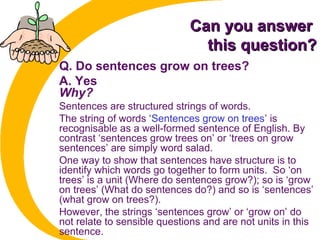
Q. Do sentences grow on trees?
A. Yes
Why?
Sentences are structured strings of words.
The string of words ‘Sentences grow on trees’ is
recognisable as a well-formed sentence of English. By
contrast ‘sentences grow trees on’ or ‘trees on grow
sentences’ are simply word salad.
One way to show that sentences have structure is to
identify which words go together to form units. So ‘on
trees’ is a unit (Where do sentences grow?); so is ‘grow
on trees’ (What do sentences do?) and so is ‘sentences’
(what grow on trees?).
However, the strings ‘sentences grow’ or ‘grow on’ do
not relate to sensible questions and are not units in this
sentence.
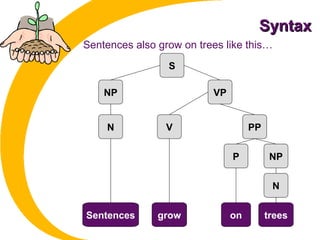
SyntaxSyntax
Sentences grow on trees
S
NP VP
N V PP
NPP
N
Sentences also grow on trees like this…
SyntaxSyntax
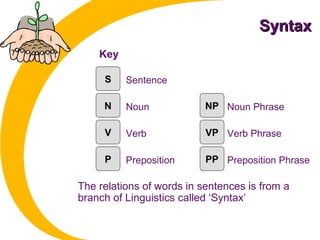
The relations of words in sentences is from a
branch of Linguistics called ‘Syntax’
S
NPN
V VP
PPP
Sentence
Noun PhraseNoun
Verb
Preposition Preposition Phrase
Verb Phrase
Key
Can you answerCan you answer
this question?this question?
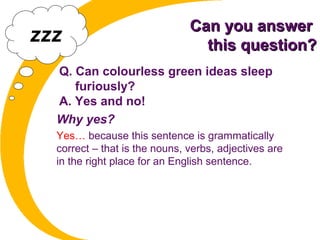
Q. Can colourless green ideas sleep
furiously?
A. Yes and no!
Why yes?
Yes… because this sentence is grammatically
correct – that is the nouns, verbs, adjectives are
in the right place for an English sentence.
zzz
Can you answerCan you answer
this question?this question?
Q. Can colourless green ideas sleep
furiously?
A. Yes and no!
Why no?
No…because you can’t make sense of it in the ‘real
world’. This demonstrates that it is not grammar alone
that makes a sentence sensible, but the context in
which it is created. In the ‘real world’ a colour can’t be
colourless and an idea can’t be green.
The world of the imagination is another matter,
however!
zzz
SemanticsSemantics
The branch of linguistics dealing with meaning is
called Semantics.
zzz
Can you answerCan you answer
this question?this question?
Q. Who taught you to speak?
A. You did
Why?
You might think that it is your parents who taught
you how to speak, but you have really taught
yourself. Certainly your parents offer you the ‘model’
of the language or languages you are going to learn
but you came into the world equipped with a kind of
ready-made language processor that helped you to
sort out how the language you were hearing actually
worked.
Working out the rulesWorking out the rules
Have you ever heard a child say ‘I dided it’ or ‘I
bringed it’? What do you think is going on here?
They won’t have heard their parents saying these
words, so where did they come from?
Language AcquisitionLanguage Acquisition
This is the branch of Linguistics that studies the
ways in which children learn language. When
Linguistics looks at how we learn a second or
foreign language this is called Second Language
Acquisition.
Want to find out more?Want to find out more?
These examples are based on the "The collected
works of the phantom linguist" which can be visited
at: http://www.yourdictionary.com/library/index.html - linguist
So what precisely isSo what precisely is
Linguistics?Linguistics?
"Linguistics is the science of language. It is the
subject whose practitioners devote their energy to
understanding why human language is the way it is.
They study the history, acquisition, structure, and
use of as many languages as possible - It would be
nice to study them all, but life's too short."
(Crystal: http://www.bangor.ac.uk/ling/whatis.htm)
So what precisely isSo what precisely is
Linguistics?Linguistics?
Since language enters into almost every area of
human activity, the application of linguistic analysis
can be extremely broad, encompassing almost any
area where language is a practical concern.
For example:
language learning and teaching • language in
new technologies • writing systems • dictionaries
• translation • language issues • multilingual
societies • linguistic difficulties • communication
between different social, cultural, ethnic groups •
endangered languages • linguistic input to
computer systems • …and many more!
Sounds interesting butSounds interesting but
what career will it lead to?what career will it lead to?
• information technology
• translation and interpreting
• education
• speech and language therapy
• publishing
• research
• dictionary writing
Careers that would relate directly to Linguistics
include the following:
Sorry not interestedSorry not interested
in those!in those!
• numeracy
• logical thinking
• data analysis
• communication and presentation
• critical thinking
• working with others
• use of IT
Don’t worry Linguistics will provide you with
many skills desirable in a variety of jobs and
careers:
Give me some examplesGive me some examples
• advertising
• journalism
• TV presenting
• voice coach
• speech therapist
• accountancy
• forensics
• counselling/social work
Here are some of the jobs that Linguistics
graduates have gone onto:
But will LinguisticsBut will Linguistics
make me ‘special’?make me ‘special’?
• respect for accuracy
• confidence in learning new systems
• attention to form
• understanding of human behaviour
• good grasp of the language needed to describe
language
There are some particular skills that are
associated with Linguistics that makes it ‘special’:
But will LinguisticsBut will Linguistics
make me ‘special’?make me ‘special’?
• recognition and use of evidence
• speculation
• critical and logical thinking
• building complex systems
Linguistics also requires a certain amount of hard
thinking which might involve:
But will LinguisticsBut will Linguistics
make me ‘special’?make me ‘special’?
• How do I understand language?
• How does language operate in my and other
societies?
• How might the language I use shape me as a
person?
Finally Linguistics might help you to become a
more self-aware person by posing a number of
questions such as:
What might aWhat might a
Linguistics Course look like?Linguistics Course look like?
• Morphology and Syntax (Structure)
• Phonetics and Phonology (Sound)
• Semantics and Pragmatics (Meaning)
• Language Acquisition
• Sociolinguistics (Language and society)
• Psycholinguistics (Language and the mind)
• Historical Linguistics
• Discourse (Language in use)
A typical BA in Linguistics might include:
What might aWhat might a
Linguistics Course look like?Linguistics Course look like?
• Modern Languages and Linguistics
• English Literature and Linguistics
• Computing and Linguistics
• Linguistics and Education
• Linguistics and Philosophy
However, Linguistics is typically combined with a
wide variety of other subjects.
Some examples are:
For more examples see UCAS www.ucas.ac.uk
What might aWhat might a
Linguistics Course look like?Linguistics Course look like?
• Acoustics and Audiology
• Anatomy, Biology and Physiology
• Vocal tract disorders
• Managing people with communication difficulties
• Health Psychology
• Practical Phonetics
• Child language development
• Research methods and statistics
A typical BSc in Speech Science might include:
So what to studentsSo what to students
think of Linguistics?think of Linguistics?
I learnt a great amount ranging from the way we
learn and develop our speech to the phonetic
alphabet
Some examples from first year students:
The course was completely new, therefore
everything was new and interesting
Thanks to syntax I understand how
a sentence is made
Fascinating – helps understanding
of different languages
So what to studentsSo what to students
think of Linguistics?think of Linguistics?
greater analytical skills
Some other things students say they have gained:
greatly aided my understanding of
English, Spanish and French, also
helped my library research skills
I learnt the phonetic
alphabet which is quite
useful in pronunciation
I thought it was really
interesting and helped
loads with grammar
Any famous Linguists?Any famous Linguists?
J.R.R. Tolkein - professor of Philology
Historical Linguistics & author of...?
Lord of the Rings
Noam Chomsky - revolutionised Linguistics but is also noted for
his radical ...?
Politics
Jacob Grimm - philologist and co-author of ... ?
Grimm's Fairy Tales
Alexander Graham Bell - Linguist and inventor of …?
the telephone
Yes, there are a few. Have you heard of them?:
Tell me more,more, more…!Tell me more,more, more…!
More ‘Why Study Linguistics’ links:
http://www.lang.ltsn.ac.uk/whylinguistics.aspx
‘The collected works of the phantom linguist’:
http://www.yourdictionary.com/library/index.html#linguist
Linguistics courses:
http://www.ucas.ac.uk
Produced by the Subject Centre for
Languages, Linguistics and Area Studies

Whystudylinguistics 1225478191520703 8

  • 1.
    Why Study Linguistics?WhyStudy Linguistics? Produced by the Subject Centre for Languages, Linguistics and Area Studies
  • 2.
    Can you answerCanyou answer these questions?these questions? 1. What is the difference between a ‘knight’ and ‘knave’? 2. What do you eat with your ghoti? 3. How many words are there in the sentence ‘The cats talked and the dogs walked’ 7, 6 or 2? 4. Do sentences grow on trees? 5. Can ‘Colourless green ideas sleep furiously’ ? 6. Who taught you to speak? Linguistics can help us to find the answers…
  • 3.
    Can you answerCanyou answer this question?this question? Q. What is the difference between a knight and a knave? A. Time Why? ‘Knave’ and ‘knight’ both meant ‘boy’ once. They now mean opposing things. Meanings of words and pronunciation change over time.
  • 4.
    Historical LinguisticsHistorical Linguistics Etymologyis the study of the historical development of words, which is part of Historical Linguistics.
  • 5.
    Can you answerCanyou answer this question?this question? Q. What do you eat with ghoti? A. Chips Why? If we take the [gh] from ‘laugh’, the [o] from "women" and the [ti] from ‘nation’ the word ghoti can be pronounced fish. We spell some words in English in ways which bear no resemblance to the way they are pronounced. Ghoti was invented by the playwright George Bernard Shaw to show the illogicality of English spelling.
  • 6.
    Phonetics and PhonologyPhoneticsand Phonology These are the areas of Linguistics that deal with the study of the sound system of a language (Phonology) and the scientific study of speech processes (Phonetics).
  • 7.
    Can you answerCanyou answer this question?this question? Q. How many words are there in the sentence ‘The cats talked and the dogs walked’ 7 or 6? A. Both Why 7? It all depends what you mean by word because the word ‘word’ is ambiguous. If the question means ‘How many word forms’ then the answer is 7 (sometimes this is referred to as 7 word tokens).
  • 8.
    Can you answerCanyou answer this question?this question? Q. How many words are there in the sentence ‘The cats talked and the dogs walked’ 7 or 6? A. Both Why 6? If we mean ‘how many different word forms’, then the answer is 6 since there are two ‘the’s (sometimes referred to as word types).
  • 9.
    Can you answerCanyou answer this question?this question? Q. How many of the words in the sentence would you expect to find in the dictionary? A. 6 or 2 Why 6? The dictionary is not a list of actual word forms but of ‘dictionary words’. We will find ‘cat’ and ‘dog’ but not ‘cats’ and ‘dogs’; we will find ‘walk’ and ‘talk’ but not ‘walked’ and ‘talked’. ‘-s’ and ‘-ed’ are not in the dictionary at all, thus 6: CAT, DOG WALK, TALK, the, and
  • 10.
    Can you answerCanyou answer this question?this question? Q. How many of the words in the sentence would you expect to find in the dictionary? A. 6 or 2 Why 2? But if we mean how many actual word forms the answer will be 2 (the, and). Look it up and see!
  • 11.
    Can you answerCanyou answer this question?this question? Q. Do sentences grow on trees? A. Yes Why? Sentences are structured strings of words. The string of words ‘Sentences grow on trees’ is recognisable as a well-formed sentence of English. By contrast ‘sentences grow trees on’ or ‘trees on grow sentences’ are simply word salad. One way to show that sentences have structure is to identify which words go together to form units. So ‘on trees’ is a unit (Where do sentences grow?); so is ‘grow on trees’ (What do sentences do?) and so is ‘sentences’ (what grow on trees?). However, the strings ‘sentences grow’ or ‘grow on’ do not relate to sensible questions and are not units in this sentence.
  • 12.
    SyntaxSyntax Sentences grow ontrees S NP VP N V PP NPP N Sentences also grow on trees like this…
  • 13.
    SyntaxSyntax The relations ofwords in sentences is from a branch of Linguistics called ‘Syntax’ S NPN V VP PPP Sentence Noun PhraseNoun Verb Preposition Preposition Phrase Verb Phrase Key
  • 14.
    Can you answerCanyou answer this question?this question? Q. Can colourless green ideas sleep furiously? A. Yes and no! Why yes? Yes… because this sentence is grammatically correct – that is the nouns, verbs, adjectives are in the right place for an English sentence. zzz
  • 15.
    Can you answerCanyou answer this question?this question? Q. Can colourless green ideas sleep furiously? A. Yes and no! Why no? No…because you can’t make sense of it in the ‘real world’. This demonstrates that it is not grammar alone that makes a sentence sensible, but the context in which it is created. In the ‘real world’ a colour can’t be colourless and an idea can’t be green. The world of the imagination is another matter, however! zzz
  • 16.
    SemanticsSemantics The branch oflinguistics dealing with meaning is called Semantics. zzz
  • 17.
    Can you answerCanyou answer this question?this question? Q. Who taught you to speak? A. You did Why? You might think that it is your parents who taught you how to speak, but you have really taught yourself. Certainly your parents offer you the ‘model’ of the language or languages you are going to learn but you came into the world equipped with a kind of ready-made language processor that helped you to sort out how the language you were hearing actually worked.
  • 18.
    Working out therulesWorking out the rules Have you ever heard a child say ‘I dided it’ or ‘I bringed it’? What do you think is going on here? They won’t have heard their parents saying these words, so where did they come from?
  • 19.
    Language AcquisitionLanguage Acquisition Thisis the branch of Linguistics that studies the ways in which children learn language. When Linguistics looks at how we learn a second or foreign language this is called Second Language Acquisition.
  • 20.
    Want to findout more?Want to find out more? These examples are based on the "The collected works of the phantom linguist" which can be visited at: http://www.yourdictionary.com/library/index.html - linguist
  • 21.
    So what preciselyisSo what precisely is Linguistics?Linguistics? "Linguistics is the science of language. It is the subject whose practitioners devote their energy to understanding why human language is the way it is. They study the history, acquisition, structure, and use of as many languages as possible - It would be nice to study them all, but life's too short." (Crystal: http://www.bangor.ac.uk/ling/whatis.htm)
  • 22.
    So what preciselyisSo what precisely is Linguistics?Linguistics? Since language enters into almost every area of human activity, the application of linguistic analysis can be extremely broad, encompassing almost any area where language is a practical concern. For example: language learning and teaching • language in new technologies • writing systems • dictionaries • translation • language issues • multilingual societies • linguistic difficulties • communication between different social, cultural, ethnic groups • endangered languages • linguistic input to computer systems • …and many more!
  • 23.
    Sounds interesting butSoundsinteresting but what career will it lead to?what career will it lead to? • information technology • translation and interpreting • education • speech and language therapy • publishing • research • dictionary writing Careers that would relate directly to Linguistics include the following:
  • 24.
    Sorry not interestedSorrynot interested in those!in those! • numeracy • logical thinking • data analysis • communication and presentation • critical thinking • working with others • use of IT Don’t worry Linguistics will provide you with many skills desirable in a variety of jobs and careers:
  • 25.
    Give me someexamplesGive me some examples • advertising • journalism • TV presenting • voice coach • speech therapist • accountancy • forensics • counselling/social work Here are some of the jobs that Linguistics graduates have gone onto:
  • 26.
    But will LinguisticsButwill Linguistics make me ‘special’?make me ‘special’? • respect for accuracy • confidence in learning new systems • attention to form • understanding of human behaviour • good grasp of the language needed to describe language There are some particular skills that are associated with Linguistics that makes it ‘special’:
  • 27.
    But will LinguisticsButwill Linguistics make me ‘special’?make me ‘special’? • recognition and use of evidence • speculation • critical and logical thinking • building complex systems Linguistics also requires a certain amount of hard thinking which might involve:
  • 28.
    But will LinguisticsButwill Linguistics make me ‘special’?make me ‘special’? • How do I understand language? • How does language operate in my and other societies? • How might the language I use shape me as a person? Finally Linguistics might help you to become a more self-aware person by posing a number of questions such as:
  • 29.
    What might aWhatmight a Linguistics Course look like?Linguistics Course look like? • Morphology and Syntax (Structure) • Phonetics and Phonology (Sound) • Semantics and Pragmatics (Meaning) • Language Acquisition • Sociolinguistics (Language and society) • Psycholinguistics (Language and the mind) • Historical Linguistics • Discourse (Language in use) A typical BA in Linguistics might include:
  • 30.
    What might aWhatmight a Linguistics Course look like?Linguistics Course look like? • Modern Languages and Linguistics • English Literature and Linguistics • Computing and Linguistics • Linguistics and Education • Linguistics and Philosophy However, Linguistics is typically combined with a wide variety of other subjects. Some examples are: For more examples see UCAS www.ucas.ac.uk
  • 31.
    What might aWhatmight a Linguistics Course look like?Linguistics Course look like? • Acoustics and Audiology • Anatomy, Biology and Physiology • Vocal tract disorders • Managing people with communication difficulties • Health Psychology • Practical Phonetics • Child language development • Research methods and statistics A typical BSc in Speech Science might include:
  • 32.
    So what tostudentsSo what to students think of Linguistics?think of Linguistics? I learnt a great amount ranging from the way we learn and develop our speech to the phonetic alphabet Some examples from first year students: The course was completely new, therefore everything was new and interesting Thanks to syntax I understand how a sentence is made Fascinating – helps understanding of different languages
  • 33.
    So what tostudentsSo what to students think of Linguistics?think of Linguistics? greater analytical skills Some other things students say they have gained: greatly aided my understanding of English, Spanish and French, also helped my library research skills I learnt the phonetic alphabet which is quite useful in pronunciation I thought it was really interesting and helped loads with grammar
  • 34.
    Any famous Linguists?Anyfamous Linguists? J.R.R. Tolkein - professor of Philology Historical Linguistics & author of...? Lord of the Rings Noam Chomsky - revolutionised Linguistics but is also noted for his radical ...? Politics Jacob Grimm - philologist and co-author of ... ? Grimm's Fairy Tales Alexander Graham Bell - Linguist and inventor of …? the telephone Yes, there are a few. Have you heard of them?:
  • 35.
    Tell me more,more,more…!Tell me more,more, more…! More ‘Why Study Linguistics’ links: http://www.lang.ltsn.ac.uk/whylinguistics.aspx ‘The collected works of the phantom linguist’: http://www.yourdictionary.com/library/index.html#linguist Linguistics courses: http://www.ucas.ac.uk Produced by the Subject Centre for Languages, Linguistics and Area Studies