







Introduction
to Linguistics
BATANGAS STATE UNIVERSITY
Main Campus I
College of Teacher Education
Eng 203 – Intro to Linguistics
Prepared by: Mam Rej
Points of Discussion
– Definition of linguistics
– Linguistics versus traditional grammar
– Use of studying linguistics
– Scope of linguistics
Difficult points
1. Linguistics versus traditional grammar
2. Scope of linguistics
Definition of linguistics
– Linguistics can be defined as the scientific or
systematic study of language. It is a science in the
sense that it scientifically studies the rules,
systems and principles of human languages.
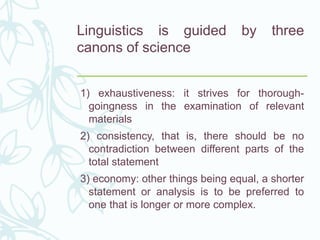
Linguistics is guided by three
canons of science
1) exhaustiveness: it strives for thorough-
goingness in the examination of relevant
materials
2) consistency, that is, there should be no
contradiction between different parts of the
total statement
3) economy: other things being equal, a shorter
statement or analysis is to be preferred to
one that is longer or more complex.
Linguistics has two main purposes
– One is that it studies the nature of language and tries
to establish a theory of language and describes
languages in the light of the theory established.
– The other is that it examines all the forms of language
in general and seeks a scientific understanding of the
ways in which it is organized to fulfill the needs it
serves and the functions it performs in human life.
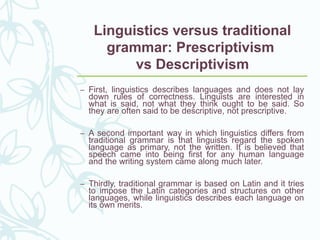
Linguistics versus traditional
grammar: Prescriptivism
vs Descriptivism
– First, linguistics describes languages and does not lay
down rules of correctness. Linguists are interested in
what is said, not what they think ought to be said. So
they are often said to be descriptive, not prescriptive.
– A second important way in which linguistics differs from
traditional grammar is that linguists regard the spoken
language as primary, not the written. It is believed that
speech came into being first for any human language
and the writing system came along much later.
– Thirdly, traditional grammar is based on Latin and it tries
to impose the Latin categories and structures on other
languages, while linguistics describes each language on
its own merits.
Use of studying
linguistics
–For a student of language
–For a teacher of foreign languages
–For a researcher
For a student of language
– To know the general properties of language can help
the student to have an overview of human language
which in turn will stop him from asking unnecessary
questions.
For a teacher of foreign
languages
– He will definitely benefit a great deal from the
knowledge of linguistics.
– He will learn about not only how language is
pronounced or structured, but also how it should
be presented to learners.
– He will know not only how each level of the
language system is related to other levels, but
also how langrage is closely related to many
things outside itself, such as the mind, the brain,
and society, among other things.
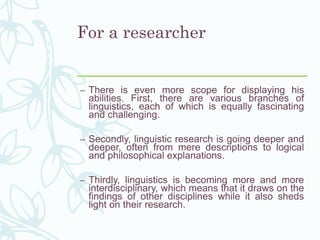
For a researcher
– There is even more scope for displaying his
abilities. First, there are various branches of
linguistics, each of which is equally fascinating
and challenging.
– Secondly, linguistic research is going deeper and
deeper, often from mere descriptions to logical
and philosophical explanations.
– Thirdly, linguistics is becoming more and more
interdisciplinary, which means that it draws on the
findings of other disciplines while it also sheds
light on their research.
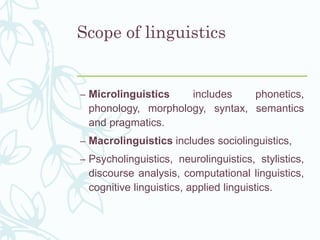
Scope of linguistics
– Microlinguistics includes phonetics,
phonology, morphology, syntax, semantics
and pragmatics.
– Macrolinguistics includes sociolinguistics,
– Psycholinguistics, neurolinguistics, stylistics,
discourse analysis, computational linguistics,
cognitive linguistics, applied linguistics.
Microlinguistics
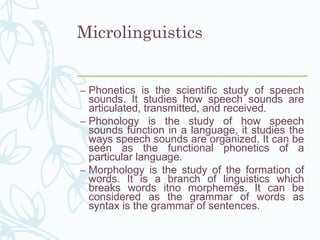
– Phonetics is the scientific study of speech
sounds. It studies how speech sounds are
articulated, transmitted, and received.
– Phonology is the study of how speech
sounds function in a language, it studies the
ways speech sounds are organized. It can be
seen as the functional phonetics of a
particular language.
– Morphology is the study of the formation of
words. It is a branch of linguistics which
breaks words itno morphemes. It can be
considered as the grammar of words as
syntax is the grammar of sentences.
Microlinguistics
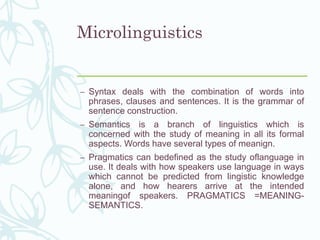
– Syntax deals with the combination of words into
phrases, clauses and sentences. It is the grammar of
sentence construction.
– Semantics is a branch of linguistics which is
concerned with the study of meaning in all its formal
aspects. Words have several types of meanign.
– Pragmatics can bedefined as the study oflanguage in
use. It deals with how speakers use language in ways
which cannot be predicted from lingistic knowledge
alone, and how hearers arrive at the intended
meaningof speakers. PRAGMATICS =MEANING-
SEMANTICS.
Macrolinguistics
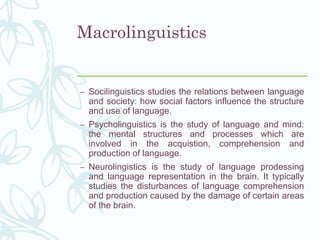
– Socilinguistics studies the relations between language
and society: how social factors influence the structure
and use of language.
– Psycholinguistics is the study of language and mind:
the mental structures and processes which are
involved in the acquistion, comprehension and
production of language.
– Neurolingistics is the study of language prodessing
and language representation in the brain. It typically
studies the disturbances of language comprehension
and production caused by the damage of certain areas
of the brain.
Macrolinguistics
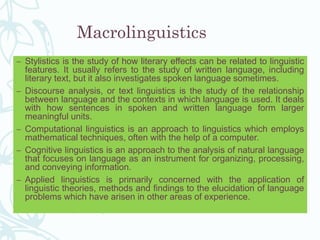
– Stylistics is the study of how literary effects can be related to linguistic
features. It usually refers to the study of written language, including
literary text, but it also investigates spoken language sometimes.
– Discourse analysis, or text linguistics is the study of the relationship
between language and the contexts in which language is used. It deals
with how sentences in spoken and written language form larger
meaningful units.
– Computational linguistics is an approach to linguistics which employs
mathematical techniques, often with the help of a computer.
– Cognitive linguistics is an approach to the analysis of natural language
that focuses on language as an instrument for organizing, processing,
and conveying information.
– Applied linguistics is primarily concerned with the application of
linguistic theories, methods and findings to the elucidation of language
problems which have arisen in other areas of experience.

Introduction to linguistics

  • 1.
    Introduction to Linguistics BATANGAS STATEUNIVERSITY Main Campus I College of Teacher Education Eng 203 – Intro to Linguistics Prepared by: Mam Rej
  • 2.
    Points of Discussion –Definition of linguistics – Linguistics versus traditional grammar – Use of studying linguistics – Scope of linguistics
  • 3.
    Difficult points 1. Linguisticsversus traditional grammar 2. Scope of linguistics
  • 4.
    Definition of linguistics –Linguistics can be defined as the scientific or systematic study of language. It is a science in the sense that it scientifically studies the rules, systems and principles of human languages.
  • 5.
    Linguistics is guidedby three canons of science 1) exhaustiveness: it strives for thorough- goingness in the examination of relevant materials 2) consistency, that is, there should be no contradiction between different parts of the total statement 3) economy: other things being equal, a shorter statement or analysis is to be preferred to one that is longer or more complex.
  • 6.
    Linguistics has twomain purposes – One is that it studies the nature of language and tries to establish a theory of language and describes languages in the light of the theory established. – The other is that it examines all the forms of language in general and seeks a scientific understanding of the ways in which it is organized to fulfill the needs it serves and the functions it performs in human life.
  • 7.
    Linguistics versus traditional grammar:Prescriptivism vs Descriptivism – First, linguistics describes languages and does not lay down rules of correctness. Linguists are interested in what is said, not what they think ought to be said. So they are often said to be descriptive, not prescriptive. – A second important way in which linguistics differs from traditional grammar is that linguists regard the spoken language as primary, not the written. It is believed that speech came into being first for any human language and the writing system came along much later. – Thirdly, traditional grammar is based on Latin and it tries to impose the Latin categories and structures on other languages, while linguistics describes each language on its own merits.
  • 8.
    Use of studying linguistics –Fora student of language –For a teacher of foreign languages –For a researcher
  • 9.
    For a studentof language – To know the general properties of language can help the student to have an overview of human language which in turn will stop him from asking unnecessary questions.
  • 10.
    For a teacherof foreign languages – He will definitely benefit a great deal from the knowledge of linguistics. – He will learn about not only how language is pronounced or structured, but also how it should be presented to learners. – He will know not only how each level of the language system is related to other levels, but also how langrage is closely related to many things outside itself, such as the mind, the brain, and society, among other things.
  • 11.
    For a researcher –There is even more scope for displaying his abilities. First, there are various branches of linguistics, each of which is equally fascinating and challenging. – Secondly, linguistic research is going deeper and deeper, often from mere descriptions to logical and philosophical explanations. – Thirdly, linguistics is becoming more and more interdisciplinary, which means that it draws on the findings of other disciplines while it also sheds light on their research.
  • 12.
    Scope of linguistics –Microlinguistics includes phonetics, phonology, morphology, syntax, semantics and pragmatics. – Macrolinguistics includes sociolinguistics, – Psycholinguistics, neurolinguistics, stylistics, discourse analysis, computational linguistics, cognitive linguistics, applied linguistics.
  • 13.
    Microlinguistics – Phonetics isthe scientific study of speech sounds. It studies how speech sounds are articulated, transmitted, and received. – Phonology is the study of how speech sounds function in a language, it studies the ways speech sounds are organized. It can be seen as the functional phonetics of a particular language. – Morphology is the study of the formation of words. It is a branch of linguistics which breaks words itno morphemes. It can be considered as the grammar of words as syntax is the grammar of sentences.
  • 14.
    Microlinguistics – Syntax dealswith the combination of words into phrases, clauses and sentences. It is the grammar of sentence construction. – Semantics is a branch of linguistics which is concerned with the study of meaning in all its formal aspects. Words have several types of meanign. – Pragmatics can bedefined as the study oflanguage in use. It deals with how speakers use language in ways which cannot be predicted from lingistic knowledge alone, and how hearers arrive at the intended meaningof speakers. PRAGMATICS =MEANING- SEMANTICS.
  • 15.
    Macrolinguistics – Socilinguistics studiesthe relations between language and society: how social factors influence the structure and use of language. – Psycholinguistics is the study of language and mind: the mental structures and processes which are involved in the acquistion, comprehension and production of language. – Neurolingistics is the study of language prodessing and language representation in the brain. It typically studies the disturbances of language comprehension and production caused by the damage of certain areas of the brain.
  • 16.
    Macrolinguistics – Stylistics isthe study of how literary effects can be related to linguistic features. It usually refers to the study of written language, including literary text, but it also investigates spoken language sometimes. – Discourse analysis, or text linguistics is the study of the relationship between language and the contexts in which language is used. It deals with how sentences in spoken and written language form larger meaningful units. – Computational linguistics is an approach to linguistics which employs mathematical techniques, often with the help of a computer. – Cognitive linguistics is an approach to the analysis of natural language that focuses on language as an instrument for organizing, processing, and conveying information. – Applied linguistics is primarily concerned with the application of linguistic theories, methods and findings to the elucidation of language problems which have arisen in other areas of experience.

Editor's Notes

  • #2 What is said, Ought to be said Spoken, not written Not too much concerned with Latin