Linear regression Machine Learning; Mon Apr 21, 2008
Motivation
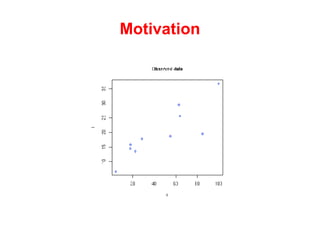
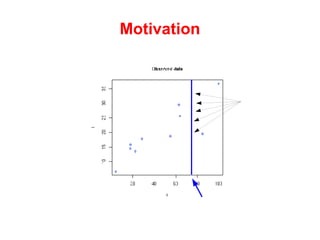
Motivation Prediction for target? New observed predictor value
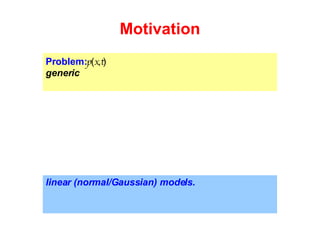
Motivation Problem:  We want a general way of obtaining a distribution  p ( x , t )  fitted to observed data. If we don't try to interpret the distribution, then any distribution with non-zero value at the data points will do. We will use theory from last week to construct  generic  approaches to learning distributions from data.
Motivation Problem:  We want a general way of obtaining a distribution  p ( x , t )  fitted to observed data. If we don't try to interpret the distribution, then any distribution with non-zero value at the data points will do. We will use theory from last week to construct  generic  approaches to learning distributions from data. In this lecture:  linear (normal/Gaussian) models.
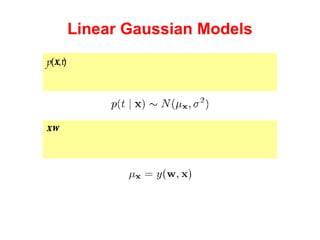
Linear Gaussian Models In a linear Guassian model, we model  p ( x , t )  as a conditional Guassian distribution where the  x  dependent mean depends linearly on a set of weights  w .
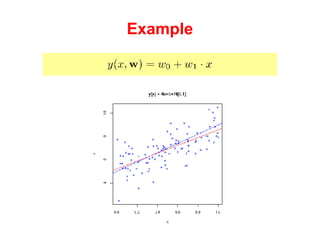
Example
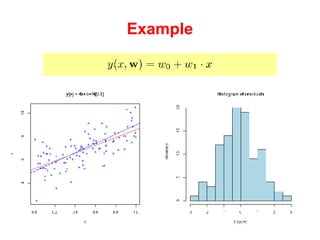
Example
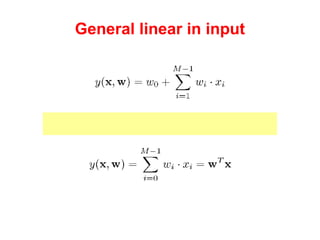
General linear in input ...or adding a pseudo input x 0 =1
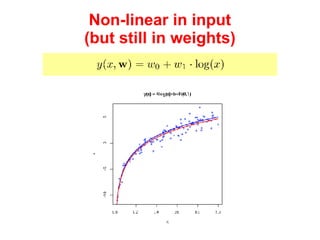
Non-linear in input (but still in weights)
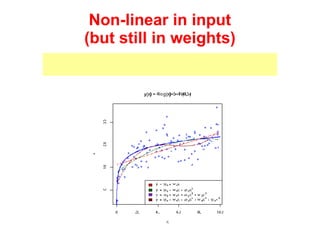
Non-linear in input (but still in weights) But remember that we do not know the “true” underlying function...
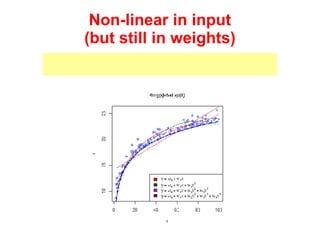
Non-linear in input (but still in weights) ...nor the noise around the function...
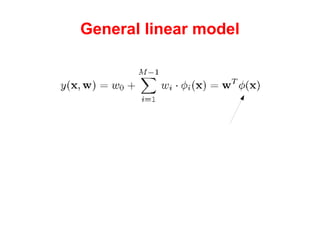
General linear model Basis functions. Sometimes called “features”.
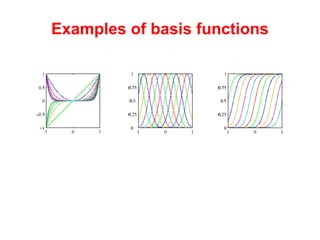
Examples of basis functions Polynomials Gaussians Sigmoids
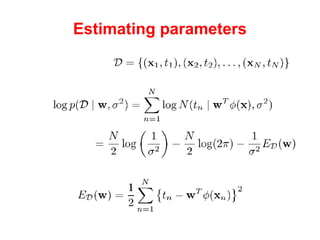
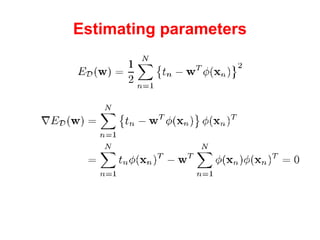
Estimating parameters Log likelihood: Observed data:
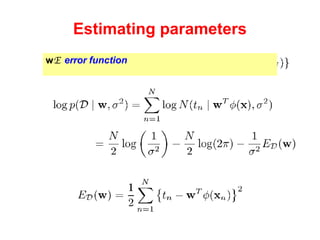
Estimating parameters Log likelihood: Maximizing wrt  w  means minimizing  E   – the   error function . Observed data:
Estimating parameters
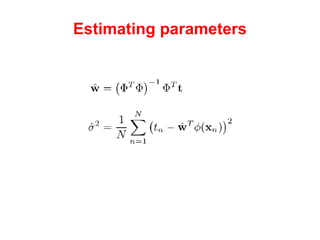
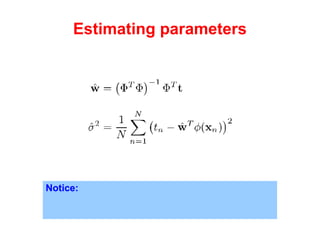
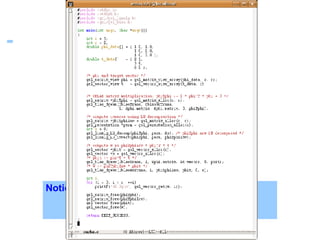
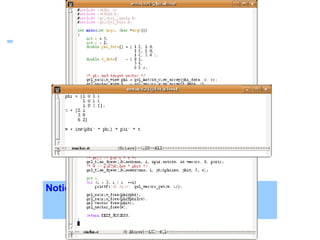
Estimating parameters Notice:  This is not just pure mathematics but an actual algorithm for estimating (learning) the parameters!
Estimating parameters Notice:  This is not just pure mathematics but an actual algorithm for estimating (learning) the parameters! C with GSL and CBLAS
Estimating parameters Notice:  This is not just pure mathematics but an actual algorithm for estimating (learning) the parameters! Octave/ Matlab
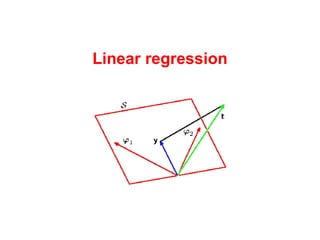
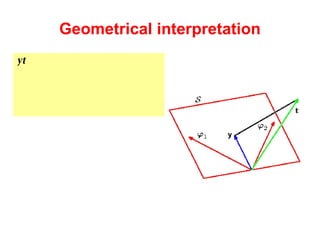
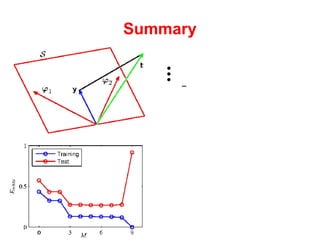
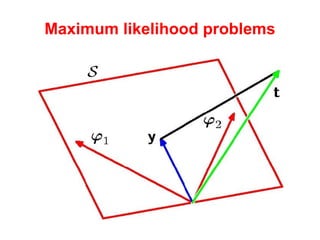
Geometrical interpretation Geometrically  y  is the projection of  t  onto the space spanned by the features:
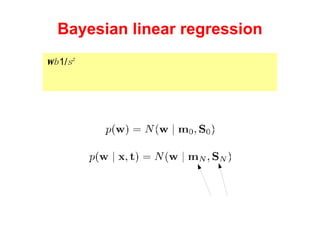
Bayesian linear regression For the Bayesian approach we need a prior over the parameters  w  and  b  =  1/ s 2 Conjugate for Gaussian is Gaussian: Functions of observed values
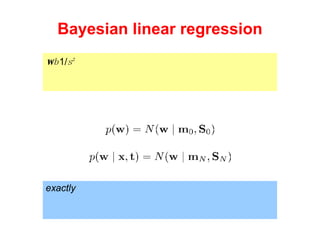
Bayesian linear regression For the Bayesian approach we need a prior over the parameters  w  and  b  =  1/ s 2 Conjugate for Gaussian is Gaussian: Proof not  exactly  like before, but similar, and uses linearity results from Gaussians' from 2.3.3.
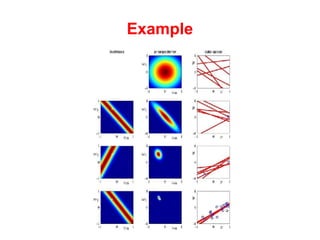
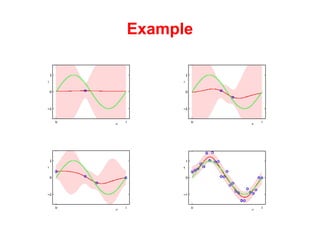
Example
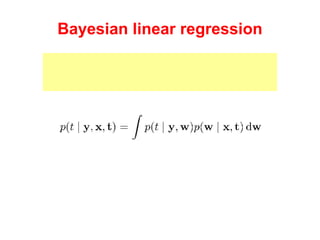
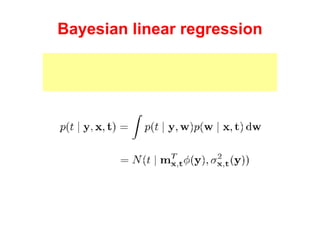
Bayesian linear regression Predictor for future observations is also Guassian (again result from 2.3.3):
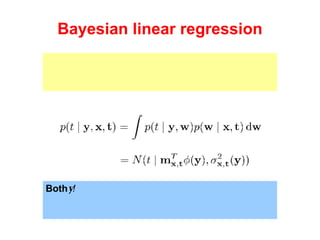
Bayesian linear regression Predictor for future observations is also Guassian (again result from 2.3.3): Both  mean and variance of this distribution depends on  y !
Example
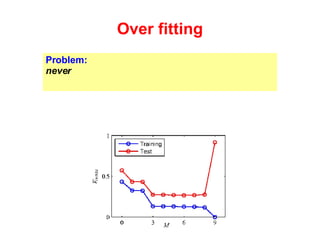
Over fitting Problem:  Over-fitting is always a problem when we fit data to generic models. With nested models, the ML parameters will  never  prefer a simple model over a more complex model...
Maximum likelihood problems
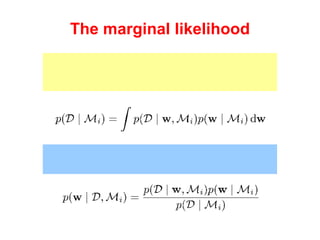
Bayesian model selection We can take a more Bayesian approach and select model based on posterior model probabilities:
Bayesian model selection We can take a more Bayesian approach and select model based on posterior model probabilities: The normalizing factor is the same for all models:
Bayesian model selection We can take a more Bayesian approach and select model based on posterior model probabilities: The prior captures our preferences in the models.
Bayesian model selection We can take a more Bayesian approach and select model based on posterior model probabilities: The likelihood captures the data's preferences in models.
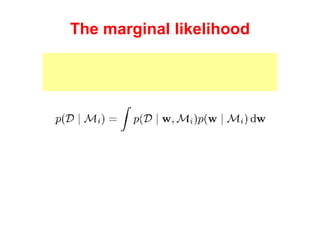
The marginal likelihood The likelihood of the model is the integral over all the models parameters:
The marginal likelihood The likelihood of the model is the integral over all the models parameters: which is also the normalizing factor for the posterior:
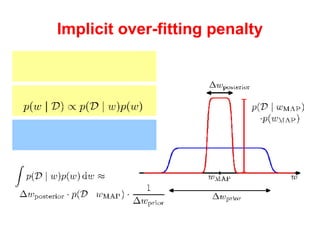
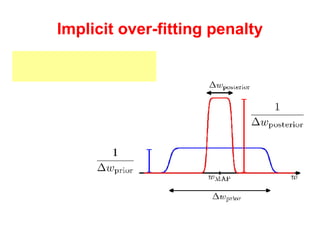
Implicit over-fitting penalty Assume this is the shape of prior and posterior prior posterior
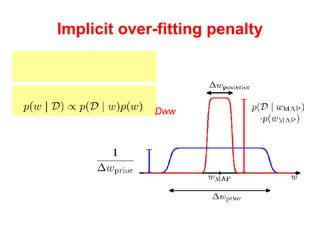
Implicit over-fitting penalty Assume this is the shape of prior and posterior By proportionality prior p( D | w )p( w )
Implicit over-fitting penalty Assume this is the shape of prior and posterior By proportionality Integral approximately “width” times “height”
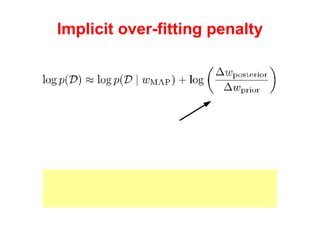
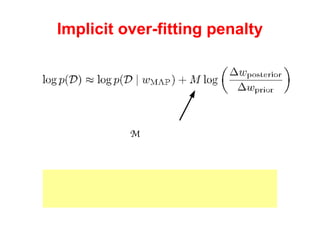
Implicit over-fitting penalty Increasingly negative as posterior becomes “pointy” compared to prior Close fitting to data is implicitly penalized, and the marginal likelihood is a trade-off between maximizing the posterior and minimizing this penalty.
Implicit over-fitting penalty Penalty increases with number of parameters  M   Close fitting to data is implicitly penalized, and the marginal likelihood is a trade-off between maximizing the posterior and minimizing this penalty.
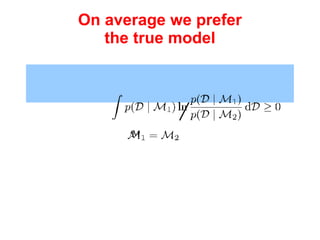
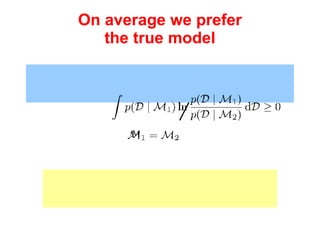
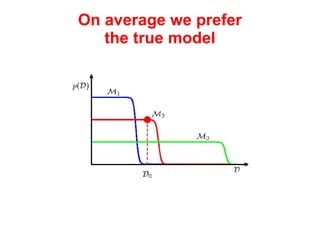
On average we prefer the true model Penalty increases with number of parameters  M   This doesn't mean we always prefer the simplest model! One can show  with zero only when i.e. on average the right model is the  preferred  model.
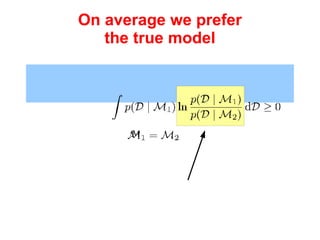
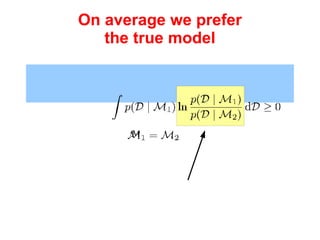
On average we prefer the true model Penalty increases with number of parameters  M   This doesn't mean we always prefer the simplest model! One can show  with zero only when i.e. on average the right model is the  preferred  model. Negative when we prefer the second model positive when we prefer the first
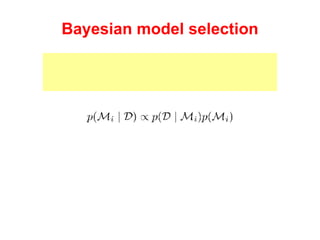
On average we prefer the true model Penalty increases with number of parameters  M   This doesn't mean we always prefer the simplest model! One can show  with zero only when i.e. on average the right model is the  preferred  model. On average, we will not prefer the second model when the first is true...
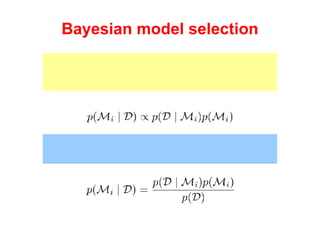
On average we prefer the true model Penalty increases with number of parameters  M   Close fitting to data is implicitly penalized, and the marginal likelihood is a trade-off between maximizing the posterior and minimizing this penalty. This doesn't mean we always prefer the simplest model! One can show  with zero only when i.e. on average the right model is the  preferred  model.
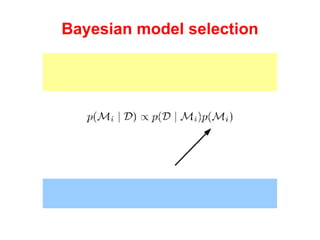
On average we prefer the true model
Summary Linear Gaussians as generic densities ML or Bayesian estimation for training Over-fitting is an inherent problem in ML estimation Bayesian methods avoid the maximization caused over-fitting problem (but is still  vulnerable  to model mis-specification)

Linear Regression

  • 1.
    Linear regression MachineLearning; Mon Apr 21, 2008
  • 2.
  • 3.
    Motivation Prediction fortarget? New observed predictor value
  • 4.
    Motivation Problem: We want a general way of obtaining a distribution p ( x , t ) fitted to observed data. If we don't try to interpret the distribution, then any distribution with non-zero value at the data points will do. We will use theory from last week to construct generic approaches to learning distributions from data.
  • 5.
    Motivation Problem: We want a general way of obtaining a distribution p ( x , t ) fitted to observed data. If we don't try to interpret the distribution, then any distribution with non-zero value at the data points will do. We will use theory from last week to construct generic approaches to learning distributions from data. In this lecture: linear (normal/Gaussian) models.
  • 6.
    Linear Gaussian ModelsIn a linear Guassian model, we model p ( x , t ) as a conditional Guassian distribution where the x dependent mean depends linearly on a set of weights w .
  • 7.
  • 8.
  • 9.
    General linear ininput ...or adding a pseudo input x 0 =1
  • 10.
    Non-linear in input(but still in weights)
  • 11.
    Non-linear in input(but still in weights) But remember that we do not know the “true” underlying function...
  • 12.
    Non-linear in input(but still in weights) ...nor the noise around the function...
  • 13.
    General linear modelBasis functions. Sometimes called “features”.
  • 14.
    Examples of basisfunctions Polynomials Gaussians Sigmoids
  • 15.
    Estimating parameters Loglikelihood: Observed data:
  • 16.
    Estimating parameters Loglikelihood: Maximizing wrt w means minimizing E – the error function . Observed data:
  • 17.
  • 18.
  • 19.
    Estimating parameters Notice: This is not just pure mathematics but an actual algorithm for estimating (learning) the parameters!
  • 20.
    Estimating parameters Notice: This is not just pure mathematics but an actual algorithm for estimating (learning) the parameters! C with GSL and CBLAS
  • 21.
    Estimating parameters Notice: This is not just pure mathematics but an actual algorithm for estimating (learning) the parameters! Octave/ Matlab
  • 22.
    Geometrical interpretation Geometrically y is the projection of t onto the space spanned by the features:
  • 23.
    Bayesian linear regressionFor the Bayesian approach we need a prior over the parameters w and b = 1/ s 2 Conjugate for Gaussian is Gaussian: Functions of observed values
  • 24.
    Bayesian linear regressionFor the Bayesian approach we need a prior over the parameters w and b = 1/ s 2 Conjugate for Gaussian is Gaussian: Proof not exactly like before, but similar, and uses linearity results from Gaussians' from 2.3.3.
  • 25.
  • 26.
    Bayesian linear regressionPredictor for future observations is also Guassian (again result from 2.3.3):
  • 27.
    Bayesian linear regressionPredictor for future observations is also Guassian (again result from 2.3.3):
  • 28.
    Bayesian linear regressionPredictor for future observations is also Guassian (again result from 2.3.3): Both mean and variance of this distribution depends on y !
  • 29.
  • 30.
    Over fitting Problem: Over-fitting is always a problem when we fit data to generic models. With nested models, the ML parameters will never prefer a simple model over a more complex model...
  • 31.
  • 32.
    Bayesian model selectionWe can take a more Bayesian approach and select model based on posterior model probabilities:
  • 33.
    Bayesian model selectionWe can take a more Bayesian approach and select model based on posterior model probabilities: The normalizing factor is the same for all models:
  • 34.
    Bayesian model selectionWe can take a more Bayesian approach and select model based on posterior model probabilities: The prior captures our preferences in the models.
  • 35.
    Bayesian model selectionWe can take a more Bayesian approach and select model based on posterior model probabilities: The likelihood captures the data's preferences in models.
  • 36.
    The marginal likelihoodThe likelihood of the model is the integral over all the models parameters:
  • 37.
    The marginal likelihoodThe likelihood of the model is the integral over all the models parameters: which is also the normalizing factor for the posterior:
  • 38.
    Implicit over-fitting penaltyAssume this is the shape of prior and posterior prior posterior
  • 39.
    Implicit over-fitting penaltyAssume this is the shape of prior and posterior By proportionality prior p( D | w )p( w )
  • 40.
    Implicit over-fitting penaltyAssume this is the shape of prior and posterior By proportionality Integral approximately “width” times “height”
  • 41.
    Implicit over-fitting penaltyIncreasingly negative as posterior becomes “pointy” compared to prior Close fitting to data is implicitly penalized, and the marginal likelihood is a trade-off between maximizing the posterior and minimizing this penalty.
  • 42.
    Implicit over-fitting penaltyPenalty increases with number of parameters M Close fitting to data is implicitly penalized, and the marginal likelihood is a trade-off between maximizing the posterior and minimizing this penalty.
  • 43.
    On average weprefer the true model Penalty increases with number of parameters M This doesn't mean we always prefer the simplest model! One can show with zero only when i.e. on average the right model is the preferred model.
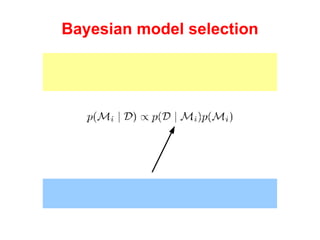
  • 44.
    On average weprefer the true model Penalty increases with number of parameters M This doesn't mean we always prefer the simplest model! One can show with zero only when i.e. on average the right model is the preferred model. Negative when we prefer the second model positive when we prefer the first
  • 45.
    On average weprefer the true model Penalty increases with number of parameters M This doesn't mean we always prefer the simplest model! One can show with zero only when i.e. on average the right model is the preferred model. On average, we will not prefer the second model when the first is true...
  • 46.
    On average weprefer the true model Penalty increases with number of parameters M Close fitting to data is implicitly penalized, and the marginal likelihood is a trade-off between maximizing the posterior and minimizing this penalty. This doesn't mean we always prefer the simplest model! One can show with zero only when i.e. on average the right model is the preferred model.
  • 47.
    On average weprefer the true model
  • 48.
    Summary Linear Gaussiansas generic densities ML or Bayesian estimation for training Over-fitting is an inherent problem in ML estimation Bayesian methods avoid the maximization caused over-fitting problem (but is still vulnerable to model mis-specification)