Lecture 2: Linear regression
Machine Learning Course
MIPT, 2019
1. Overview of linear models.
2. Linear regression.
3. Analytical solution.
4. Regularization.
5. Gauss-Markov theorem.
6. Probabilistic interpretation and intuition.
Outline
2
3
4
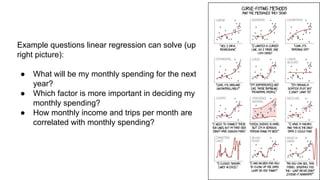
Example questions linear regression can solve (up
right picture):
● What will be my monthly spending for the next
year?
● Which factor is more important in deciding my
monthly spending?
● How monthly income and trips per month are
correlated with monthly spending?
5
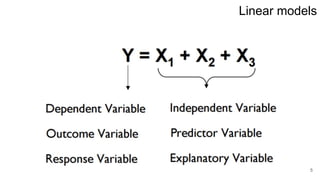
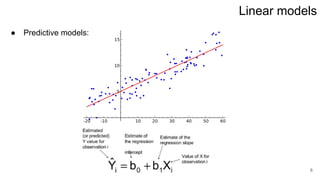
Linear models
6
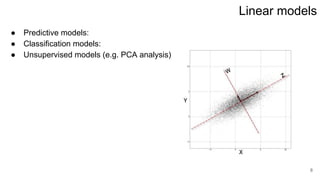
● Predictive models:
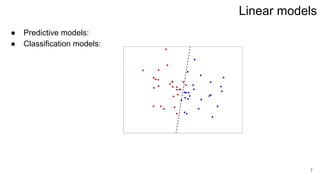
Linear models
7
● Predictive models:
● Classification models:
Linear models
8
● Predictive models:
● Classification models:
● Unsupervised models (e.g. PCA analysis)
Linear models
9
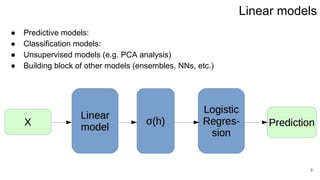
● Predictive models:
● Classification models:
● Unsupervised models (e.g. PCA analysis)
● Building block of other models (ensembles, NNs, etc.)
Linear models
10
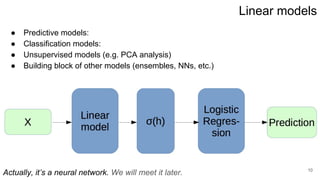
● Predictive models:
● Classification models:
● Unsupervised models (e.g. PCA analysis)
● Building block of other models (ensembles, NNs, etc.)
Linear models
Actually, it’s a neural network. We will meet it later.
11
Linear regression
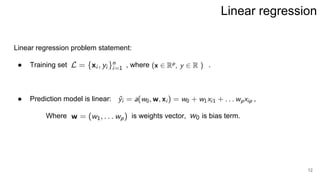
Linear regression problem statement:
● Training set , where .
12
Linear regression
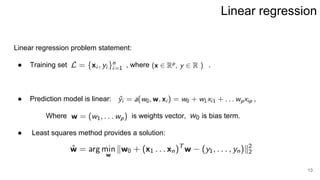
Linear regression problem statement:
● Training set , where .
● Prediction model is linear: ,
Where is weights vector, is bias term.
13
Linear regression
Linear regression problem statement:
● Training set , where .
● Prediction model is linear: ,
Where is weights vector, is bias term.
● Least squares method provides a solution:
14
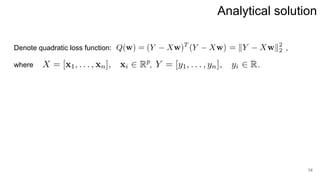
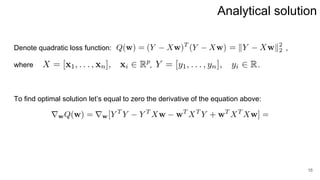
Analytical solution
Denote quadratic loss function: ,
where , .
15
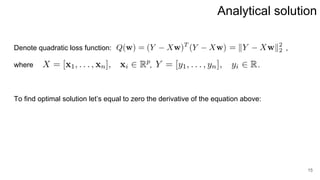
Analytical solution
Denote quadratic loss function: ,
where , .
To find optimal solution let’s equal to zero the derivative of the equation above:
16
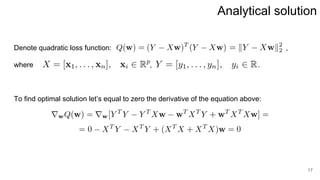
Analytical solution
Denote quadratic loss function: ,
where , .
To find optimal solution let’s equal to zero the derivative of the equation above:
17
Analytical solution
Denote quadratic loss function: ,
where , .
To find optimal solution let’s equal to zero the derivative of the equation above:
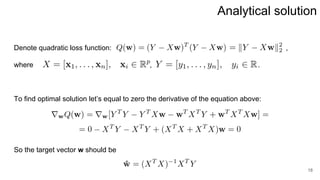
18
Analytical solution
Denote quadratic loss function: ,
where , .
To find optimal solution let’s equal to zero the derivative of the equation above:
So the target vector w should be
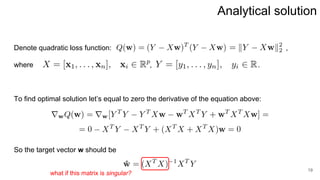
19
Analytical solution
Denote quadratic loss function: ,
where , .
To find optimal solution let’s equal to zero the derivative of the equation above:
So the target vector w should be
what if this matrix is singular?
20
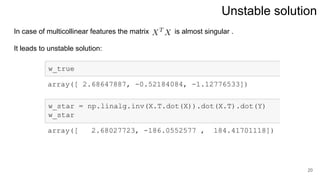
Unstable solution
In case of multicollinear features the matrix is almost singular .
It leads to unstable solution:
21
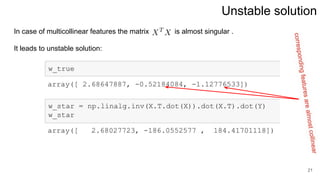
Unstable solution
In case of multicollinear features the matrix is almost singular .
It leads to unstable solution:
22
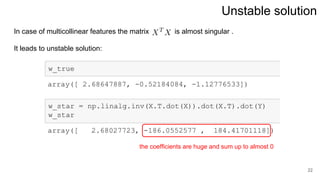
Unstable solution
In case of multicollinear features the matrix is almost singular .
It leads to unstable solution:
the coefficients are huge and sum up to almost 0
23
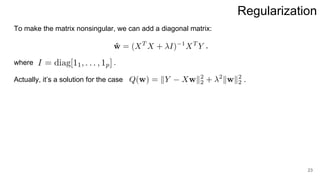
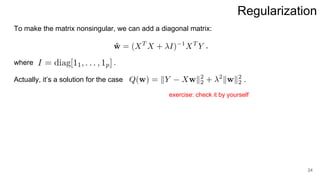
Regularization
To make the matrix nonsingular, we can add a diagonal matrix:
,
where .
Actually, it’s a solution for the case .
24
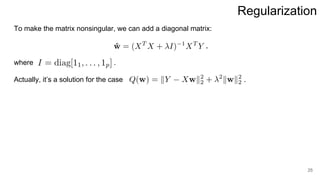
Regularization
To make the matrix nonsingular, we can add a diagonal matrix:
,
where .
Actually, it’s a solution for the case .
exercise: check it by yourself
25
Regularization
To make the matrix nonsingular, we can add a diagonal matrix:
,
where .
Actually, it’s a solution for the case .
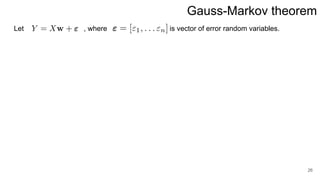
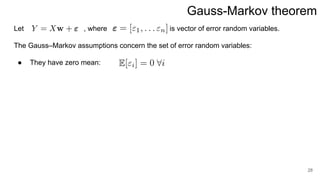
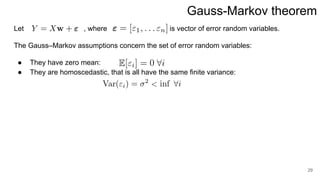
Let , where is vector of error random variables.
26
Gauss-Markov theorem
Let , where is vector of error random variables.
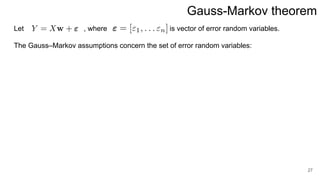
The Gauss–Markov assumptions concern the set of error random variables:
27
Gauss-Markov theorem
28
Gauss-Markov theorem
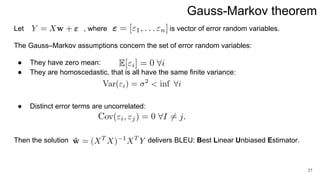
Let , where is vector of error random variables.
The Gauss–Markov assumptions concern the set of error random variables:
● They have zero mean:
29
Gauss-Markov theorem
Let , where is vector of error random variables.
The Gauss–Markov assumptions concern the set of error random variables:
● They have zero mean:
● They are homoscedastic, that is all have the same finite variance:
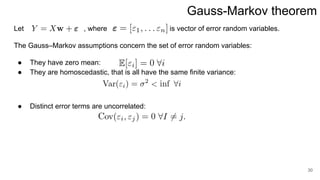
30
Gauss-Markov theorem
Let , where is vector of error random variables.
The Gauss–Markov assumptions concern the set of error random variables:
● They have zero mean:
● They are homoscedastic, that is all have the same finite variance:
● Distinct error terms are uncorrelated:
31
Gauss-Markov theorem
Let , where is vector of error random variables.
The Gauss–Markov assumptions concern the set of error random variables:
● They have zero mean:
● They are homoscedastic, that is all have the same finite variance:
● Distinct error terms are uncorrelated:
Then the solution delivers BLEU: Best Linear Unbiased Estimator.
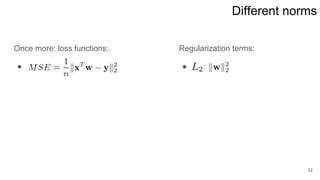
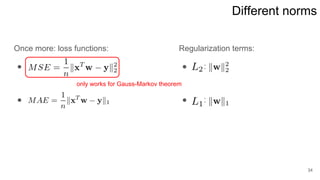
Once more: loss functions:
●
32
Regularization terms:
● :
Different norms
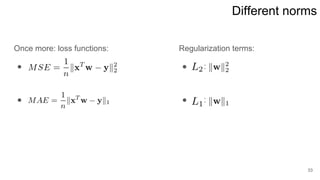
Once more: loss functions:
●
●
33
Regularization terms:
● :
● :
Different norms
Once more: loss functions:
●
●
34
Regularization terms:
● :
● :
Different norms
only works for Gauss-Markov theorem
35
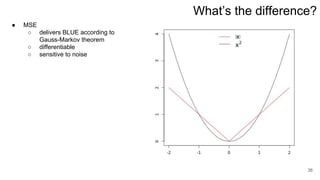
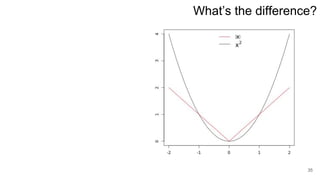
What’s the difference?
36
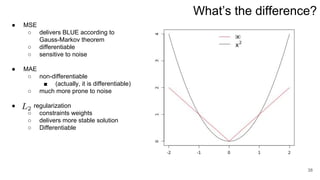
What’s the difference?
● MSE
○ delivers BLUE according to
Gauss-Markov theorem
○ differentiable
○ sensitive to noise
37
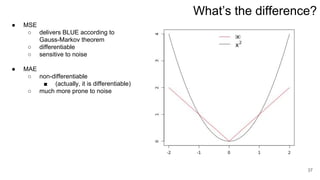
What’s the difference?
● MSE
○ delivers BLUE according to
Gauss-Markov theorem
○ differentiable
○ sensitive to noise
● MAE
○ non-differentiable
■ (actually, it is differentiable)
○ much more prone to noise
38
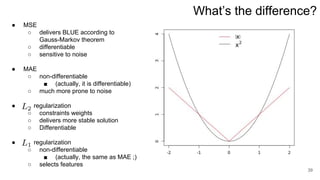
What’s the difference?
● MSE
○ delivers BLUE according to
Gauss-Markov theorem
○ differentiable
○ sensitive to noise
● MAE
○ non-differentiable
■ (actually, it is differentiable)
○ much more prone to noise
● regularization
○ constraints weights
○ delivers more stable solution
○ Differentiable
39
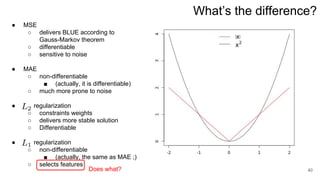
What’s the difference?
● MSE
○ delivers BLUE according to
Gauss-Markov theorem
○ differentiable
○ sensitive to noise
● MAE
○ non-differentiable
■ (actually, it is differentiable)
○ much more prone to noise
● regularization
○ constraints weights
○ delivers more stable solution
○ Differentiable
● regularization
○ non-differentiable
■ (actually, the same as MAE ;)
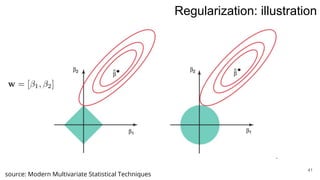
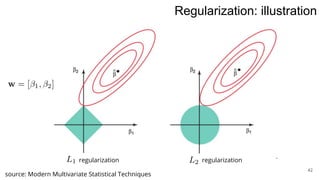
○ selects features
40
What’s the difference?
● MSE
○ delivers BLUE according to
Gauss-Markov theorem
○ differentiable
○ sensitive to noise
● MAE
○ non-differentiable
■ (actually, it is differentiable)
○ much more prone to noise
● regularization
○ constraints weights
○ delivers more stable solution
○ Differentiable
● regularization
○ non-differentiable
■ (actually, the same as MAE ;)
○ selects features
Does what?
41
source: Modern Multivariate Statistical Techniques
Regularization: illustration
42
source: Modern Multivariate Statistical Techniques
regularization regularization
Regularization: illustration
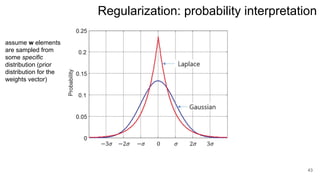
43
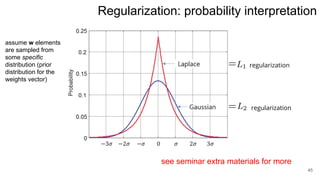
Regularization: probability interpretation
assume w elements
are sampled from
some specific
distribution (prior
distribution for the
weights vector)
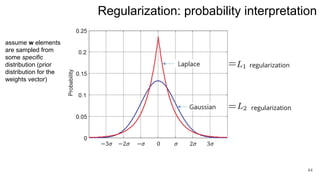
44
regularization
Regularization: probability interpretation
regularization
assume w elements
are sampled from
some specific
distribution (prior
distribution for the
weights vector)
45
regularization
Regularization: probability interpretation
regularization
see seminar extra materials for more
assume w elements
are sampled from
some specific
distribution (prior
distribution for the
weights vector)
Welcome to the church of Bayes
46
church of Bayes
Дмитрий Ветров - заведующий Международной лабораторией глубинного обучения и байесовских методов
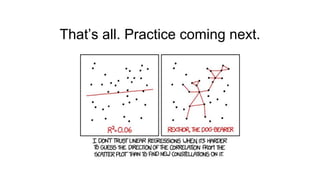
That’s all. Practice coming next.

lecture02_LinearRegression.pdf

  • 1.
    Lecture 2: Linearregression Machine Learning Course MIPT, 2019
  • 2.
    1. Overview oflinear models. 2. Linear regression. 3. Analytical solution. 4. Regularization. 5. Gauss-Markov theorem. 6. Probabilistic interpretation and intuition. Outline 2
  • 3.
  • 4.
    4 Example questions linearregression can solve (up right picture): ● What will be my monthly spending for the next year? ● Which factor is more important in deciding my monthly spending? ● How monthly income and trips per month are correlated with monthly spending?
  • 5.
  • 6.
  • 7.
    7 ● Predictive models: ●Classification models: Linear models
  • 8.
    8 ● Predictive models: ●Classification models: ● Unsupervised models (e.g. PCA analysis) Linear models
  • 9.
    9 ● Predictive models: ●Classification models: ● Unsupervised models (e.g. PCA analysis) ● Building block of other models (ensembles, NNs, etc.) Linear models
  • 10.
    10 ● Predictive models: ●Classification models: ● Unsupervised models (e.g. PCA analysis) ● Building block of other models (ensembles, NNs, etc.) Linear models Actually, it’s a neural network. We will meet it later.
  • 11.
    11 Linear regression Linear regressionproblem statement: ● Training set , where .
  • 12.
    12 Linear regression Linear regressionproblem statement: ● Training set , where . ● Prediction model is linear: , Where is weights vector, is bias term.
  • 13.
    13 Linear regression Linear regressionproblem statement: ● Training set , where . ● Prediction model is linear: , Where is weights vector, is bias term. ● Least squares method provides a solution:
  • 14.
    14 Analytical solution Denote quadraticloss function: , where , .
  • 15.
    15 Analytical solution Denote quadraticloss function: , where , . To find optimal solution let’s equal to zero the derivative of the equation above:
  • 16.
    16 Analytical solution Denote quadraticloss function: , where , . To find optimal solution let’s equal to zero the derivative of the equation above:
  • 17.
    17 Analytical solution Denote quadraticloss function: , where , . To find optimal solution let’s equal to zero the derivative of the equation above:
  • 18.
    18 Analytical solution Denote quadraticloss function: , where , . To find optimal solution let’s equal to zero the derivative of the equation above: So the target vector w should be
  • 19.
    19 Analytical solution Denote quadraticloss function: , where , . To find optimal solution let’s equal to zero the derivative of the equation above: So the target vector w should be what if this matrix is singular?
  • 20.
    20 Unstable solution In caseof multicollinear features the matrix is almost singular . It leads to unstable solution:
  • 21.
    21 Unstable solution In caseof multicollinear features the matrix is almost singular . It leads to unstable solution:
  • 22.
    22 Unstable solution In caseof multicollinear features the matrix is almost singular . It leads to unstable solution: the coefficients are huge and sum up to almost 0
  • 23.
    23 Regularization To make thematrix nonsingular, we can add a diagonal matrix: , where . Actually, it’s a solution for the case .
  • 24.
    24 Regularization To make thematrix nonsingular, we can add a diagonal matrix: , where . Actually, it’s a solution for the case . exercise: check it by yourself
  • 25.
    25 Regularization To make thematrix nonsingular, we can add a diagonal matrix: , where . Actually, it’s a solution for the case .
  • 26.
    Let , whereis vector of error random variables. 26 Gauss-Markov theorem
  • 27.
    Let , whereis vector of error random variables. The Gauss–Markov assumptions concern the set of error random variables: 27 Gauss-Markov theorem
  • 28.
    28 Gauss-Markov theorem Let ,where is vector of error random variables. The Gauss–Markov assumptions concern the set of error random variables: ● They have zero mean:
  • 29.
    29 Gauss-Markov theorem Let ,where is vector of error random variables. The Gauss–Markov assumptions concern the set of error random variables: ● They have zero mean: ● They are homoscedastic, that is all have the same finite variance:
  • 30.
    30 Gauss-Markov theorem Let ,where is vector of error random variables. The Gauss–Markov assumptions concern the set of error random variables: ● They have zero mean: ● They are homoscedastic, that is all have the same finite variance: ● Distinct error terms are uncorrelated:
  • 31.
    31 Gauss-Markov theorem Let ,where is vector of error random variables. The Gauss–Markov assumptions concern the set of error random variables: ● They have zero mean: ● They are homoscedastic, that is all have the same finite variance: ● Distinct error terms are uncorrelated: Then the solution delivers BLEU: Best Linear Unbiased Estimator.
  • 32.
    Once more: lossfunctions: ● 32 Regularization terms: ● : Different norms
  • 33.
    Once more: lossfunctions: ● ● 33 Regularization terms: ● : ● : Different norms
  • 34.
    Once more: lossfunctions: ● ● 34 Regularization terms: ● : ● : Different norms only works for Gauss-Markov theorem
  • 35.
  • 36.
    36 What’s the difference? ●MSE ○ delivers BLUE according to Gauss-Markov theorem ○ differentiable ○ sensitive to noise
  • 37.
    37 What’s the difference? ●MSE ○ delivers BLUE according to Gauss-Markov theorem ○ differentiable ○ sensitive to noise ● MAE ○ non-differentiable ■ (actually, it is differentiable) ○ much more prone to noise
  • 38.
    38 What’s the difference? ●MSE ○ delivers BLUE according to Gauss-Markov theorem ○ differentiable ○ sensitive to noise ● MAE ○ non-differentiable ■ (actually, it is differentiable) ○ much more prone to noise ● regularization ○ constraints weights ○ delivers more stable solution ○ Differentiable
  • 39.
    39 What’s the difference? ●MSE ○ delivers BLUE according to Gauss-Markov theorem ○ differentiable ○ sensitive to noise ● MAE ○ non-differentiable ■ (actually, it is differentiable) ○ much more prone to noise ● regularization ○ constraints weights ○ delivers more stable solution ○ Differentiable ● regularization ○ non-differentiable ■ (actually, the same as MAE ;) ○ selects features
  • 40.
    40 What’s the difference? ●MSE ○ delivers BLUE according to Gauss-Markov theorem ○ differentiable ○ sensitive to noise ● MAE ○ non-differentiable ■ (actually, it is differentiable) ○ much more prone to noise ● regularization ○ constraints weights ○ delivers more stable solution ○ Differentiable ● regularization ○ non-differentiable ■ (actually, the same as MAE ;) ○ selects features Does what?
  • 41.
    41 source: Modern MultivariateStatistical Techniques Regularization: illustration
  • 42.
    42 source: Modern MultivariateStatistical Techniques regularization regularization Regularization: illustration
  • 43.
    43 Regularization: probability interpretation assumew elements are sampled from some specific distribution (prior distribution for the weights vector)
  • 44.
    44 regularization Regularization: probability interpretation regularization assumew elements are sampled from some specific distribution (prior distribution for the weights vector)
  • 45.
    45 regularization Regularization: probability interpretation regularization seeseminar extra materials for more assume w elements are sampled from some specific distribution (prior distribution for the weights vector)
  • 46.
    Welcome to thechurch of Bayes 46 church of Bayes Дмитрий Ветров - заведующий Международной лабораторией глубинного обучения и байесовских методов
  • 47.