
Submitted by, 
C.PRIYANKA KARANCY, 
M.TECH, CCE.
 Quality relates to the degree to which a system, 
system component, or process meets specified 
requirements. 
 Quality relates to the degree to which a system, 
system component, or process, meets customer, or 
user, needs or expectations 
 The software quality assurance (SQA) group is a 
team of people with the necessary training and skills 
to ensure that all necessary actions are taken during 
the development process so that the resulting 
software conforms to established technical 
requirements.
 The costs of quality can be decomposed into three 
major areas: 
 Prevention- identify the causes of defects 
 Appraisal- determine the level of quality 
 Failure- cost for repair and regression testing
 Quality control consists of the procedures and 
practices employed to ensure that a work product 
or deliverable conforms to standards or 
requirements. 
 Quality control is the set of activities designed to 
evaluate the quality of developed or manufactured 
products.
 policies and standards; 
 review and audit procedures; 
 a training program; 
 dedicated, trained, and motivated staff. 
 a measurement program; 
 a planning process (for test and quality assurance); 
 effective testing techniques, statistical techniques, 
and tools; 
 process monitoring and controlling systems; 
 a test process assessment system (TMM-AM); 
 a configuration management system.
 An operational profile is a quantitative character 
of how a software system will be used in its 
intended environment . 
 An operational profile is a specification of classes 
of inputs and the probability of their occurrence.
 Statistical testing has several major benefits which 
include: 
(i) concentrating testing resources on the parts of 
the system mostly likely to be used; this should result 
in a more reliable system from the users viewpoint; 
(ii) supporting estimations or predications of 
reliability which should be accurate from the user’s 
viewpoint; 
(iii) providing quantitative criteria for decisions 
on the completeness of testing and system release.
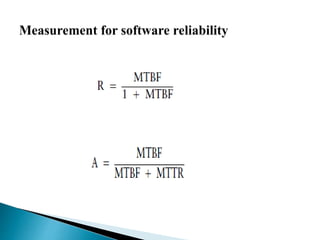
 Software reliability is the ability of a system or 
component to perform its required functions 
under stated conditions for a specified period of 
time . 
 Software reliability is the probability that a 
software system will operate without failure 
under given conditions for a given time interval.
 Usability is a quality factor that is related to the 
effort needed to learn, operate, prepare input, and 
interpret the output of a computer program
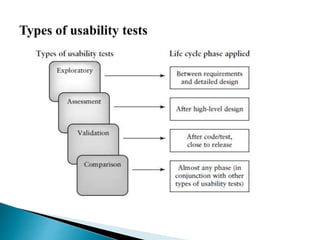
 Exploratory tests are carried out early in the life 
cycle between requirements and detailed design. 
 A user profile and usage model should be 
developed in parallel with this activity. 
 The objective of exploratory usability testing is to 
examine a high-level representation of the user 
interface to see if it characterizes the user’s 
mental model of the software.
 Assessment tests are usually conducted after a 
high-level design for the software has been 
developed.
 To evaluate how the product compares to some 
predetermined usability standard or benchmark.
 Comparison test is very useful for comparing 
various user interface design approaches to 
determine which will work best for the user 
population. 
 Comparison test can be used to evaluate 
how the organization’s software product compares 
to that of a competing system on the market.
 A usability testing laboratory 
 Trained personnel 
 Usability test planning
 Usability testers also collect quantitative 
measures. For example: 
(i) time to complete each task; 
(ii) time to access information in the user manual; 
(iii) time to access information from on-line help; 
(iv) number and percentage of tasks completed 
correctly; 
(v) number or percentage of tasks completed 
incorrectly; 
(vi) time spent in communicating with help desk.
Suppose you were a test manager and you were 
organizing a team to develop an operational 
profile/usage model for an automated airline 
reservation system that was being developed by 
your company. From which organizational, and 
non-organizational groups would you select 
members for the team? Give your reasons in 
terms of the qualifications needed. What 
approach could you use to verify the 
profile/model?
 The team should contains the following 
candidates for developing the automated 
airline reservation system: 
 Technical Experts 
 Software Developer 
 Business analyst 
 Programmer 
 Debugger 
 End user

EVALUATING SOFTWARE QUALITY : A QUANTITATIVE APPROACH

  • 1.
    Submitted by, C.PRIYANKAKARANCY, M.TECH, CCE.
  • 2.
     Quality relatesto the degree to which a system, system component, or process meets specified requirements.  Quality relates to the degree to which a system, system component, or process, meets customer, or user, needs or expectations  The software quality assurance (SQA) group is a team of people with the necessary training and skills to ensure that all necessary actions are taken during the development process so that the resulting software conforms to established technical requirements.
  • 3.
     The costsof quality can be decomposed into three major areas:  Prevention- identify the causes of defects  Appraisal- determine the level of quality  Failure- cost for repair and regression testing
  • 4.
     Quality controlconsists of the procedures and practices employed to ensure that a work product or deliverable conforms to standards or requirements.  Quality control is the set of activities designed to evaluate the quality of developed or manufactured products.
  • 5.
     policies andstandards;  review and audit procedures;  a training program;  dedicated, trained, and motivated staff.  a measurement program;  a planning process (for test and quality assurance);  effective testing techniques, statistical techniques, and tools;  process monitoring and controlling systems;  a test process assessment system (TMM-AM);  a configuration management system.
  • 6.
     An operationalprofile is a quantitative character of how a software system will be used in its intended environment .  An operational profile is a specification of classes of inputs and the probability of their occurrence.
  • 8.
     Statistical testinghas several major benefits which include: (i) concentrating testing resources on the parts of the system mostly likely to be used; this should result in a more reliable system from the users viewpoint; (ii) supporting estimations or predications of reliability which should be accurate from the user’s viewpoint; (iii) providing quantitative criteria for decisions on the completeness of testing and system release.
  • 9.
     Software reliabilityis the ability of a system or component to perform its required functions under stated conditions for a specified period of time .  Software reliability is the probability that a software system will operate without failure under given conditions for a given time interval.
  • 11.
     Usability isa quality factor that is related to the effort needed to learn, operate, prepare input, and interpret the output of a computer program
  • 13.
     Exploratory testsare carried out early in the life cycle between requirements and detailed design.  A user profile and usage model should be developed in parallel with this activity.  The objective of exploratory usability testing is to examine a high-level representation of the user interface to see if it characterizes the user’s mental model of the software.
  • 14.
     Assessment testsare usually conducted after a high-level design for the software has been developed.
  • 15.
     To evaluatehow the product compares to some predetermined usability standard or benchmark.
  • 16.
     Comparison testis very useful for comparing various user interface design approaches to determine which will work best for the user population.  Comparison test can be used to evaluate how the organization’s software product compares to that of a competing system on the market.
  • 17.
     A usabilitytesting laboratory  Trained personnel  Usability test planning
  • 18.
     Usability testersalso collect quantitative measures. For example: (i) time to complete each task; (ii) time to access information in the user manual; (iii) time to access information from on-line help; (iv) number and percentage of tasks completed correctly; (v) number or percentage of tasks completed incorrectly; (vi) time spent in communicating with help desk.
  • 19.
    Suppose you werea test manager and you were organizing a team to develop an operational profile/usage model for an automated airline reservation system that was being developed by your company. From which organizational, and non-organizational groups would you select members for the team? Give your reasons in terms of the qualifications needed. What approach could you use to verify the profile/model?
  • 20.
     The teamshould contains the following candidates for developing the automated airline reservation system:  Technical Experts  Software Developer  Business analyst  Programmer  Debugger  End user

Editor's Notes

  • #11 Mean time between failure, mean time to failure.