ALL ABOUT
SHADOWS
What exactly is a shadow?
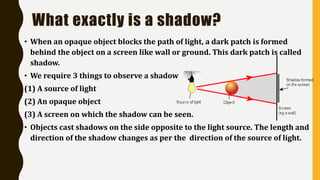
• When an opaque object blocks the path of light, a dark patch is formed
behind the object on a screen like wall or ground. This dark patch is called
shadow.
• We require 3 things to observe a shadow
(1) A source of light
(2) An opaque object
(3) A screen on which the shadow can be seen.
• Objects cast shadows on the side opposite to the light source. The length and
direction of the shadow changes as per the direction of the source of light.
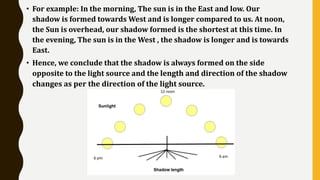
• For example: In the morning, The sun is in the East and low. Our
shadow is formed towards West and is longer compared to us. At noon,
the Sun is overhead, our shadow formed is the shortest at this time. In
the evening, The sun is in the West , the shadow is longer and is towards
East.
• Hence, we conclude that the shadow is always formed on the side
opposite to the light source and the length and direction of the shadow
changes as per the direction of the light source.
• Transparent objects permit light rays to pass through entirely, resulting
in the absence of shadows.
• Translucent objects enable light rays to partially pass through, leading
to the formation of faint or less defined shadows.
• Opaque objects prohibit light rays from passing through, resulting in
the formation of well-defined and sharp shadows.
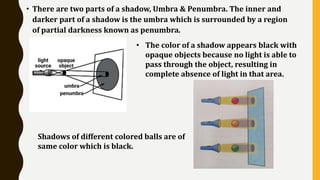
• There are two parts of a shadow, Umbra & Penumbra. The inner and
darker part of a shadow is the umbra which is surrounded by a region
of partial darkness known as penumbra.
Shadows of different colored balls are of
same color which is black.
• The color of a shadow appears black with
opaque objects because no light is able to
pass through the object, resulting in
complete absence of light in that area.
• When an object is positioned far from the light source, the shadow
will be smaller.
• Similarly, if the object is positioned close to the light source, the
shadow will be larger in size.
• When a bird is on the ground, we can see its shadow which is formed
by sunlight. The bird blocks the sunlight to form shadow on the
nearby ground.
• When the same bird is flying high up in the air, even then the bird
blocks the sunlight falling on it but its shadow is not seen on the
ground. Why?
• This is because the region of complete darkness which is the umbra is
not able to reach the ground and the region of partial darkness that is
the penumbra reaching the Earth is too faint to be visible to us.
• Eclipses are celestial events that occur when one celestial body passes
through the shadow of another. There are two types of eclipses:
A solar eclipse occurs when the moon passes between the Earth and
the Sun, totally or partially blocking the Sun's light from reaching the
Earth.
A lunar eclipse occurs when the Earth passes between the Sun and the
Moon, causing the Earth's shadow totally or partially to be cast on the
Moon.
Let’s revise the characteristics of a
shadow
• A screen is must for a shadow to be visible.
• A shadow is always formed on the side opposite to the source of light
with respect to an opaque object.
• The size of a shadow changes with change in position of the object,
screen or light source.
• The position of the shadow shifts as the position of the light source
shifts.
• The color of the shadow is always black irrespective of the color of
the opaque object.
• The formation of a shadow depends on the size of the light source
and an opaque object.
Quiz time!
• When an opaque object comes in the path of light _________ is formed.
Shadow
• If an object is placed closer to the light source the shadow formed
is___________.
Larger
• ____________ and ____________ are essential for the formation of shadow on
a screen.
Light source and opaque object
• Which type of object forms the sharpest shadow?
Opaque object
• Name the eclipse which occurs when the Earth passes between the
Sun and the Moon.
Lunar eclipse
Fact Bite
If you could travel at the
speed of light, you would go
around the earth seven
times in just one second!
Animals sometimes become
confused and behave
strangely during a total
eclipse of the Sun.
During a total solar eclipse,
a bright ring, called the
diamond ring appears in
the sky for a very short
period. It was observed in
India during the total solar
eclipse of 24 October 1995.
The first person to calculate
the size of Earth used
measurements of shadows.
The head librarian of the
Great Library of Alexandria,
performed this feat over
around 250 BCE.
A project by Gursheen Kaur Chawla

All about shadows.pptx

  • 1.
  • 2.
    What exactly isa shadow? • When an opaque object blocks the path of light, a dark patch is formed behind the object on a screen like wall or ground. This dark patch is called shadow. • We require 3 things to observe a shadow (1) A source of light (2) An opaque object (3) A screen on which the shadow can be seen. • Objects cast shadows on the side opposite to the light source. The length and direction of the shadow changes as per the direction of the source of light.
  • 3.
    • For example:In the morning, The sun is in the East and low. Our shadow is formed towards West and is longer compared to us. At noon, the Sun is overhead, our shadow formed is the shortest at this time. In the evening, The sun is in the West , the shadow is longer and is towards East. • Hence, we conclude that the shadow is always formed on the side opposite to the light source and the length and direction of the shadow changes as per the direction of the light source.
  • 4.
    • Transparent objectspermit light rays to pass through entirely, resulting in the absence of shadows. • Translucent objects enable light rays to partially pass through, leading to the formation of faint or less defined shadows. • Opaque objects prohibit light rays from passing through, resulting in the formation of well-defined and sharp shadows.
  • 5.
    • There aretwo parts of a shadow, Umbra & Penumbra. The inner and darker part of a shadow is the umbra which is surrounded by a region of partial darkness known as penumbra. Shadows of different colored balls are of same color which is black. • The color of a shadow appears black with opaque objects because no light is able to pass through the object, resulting in complete absence of light in that area.
  • 6.
    • When anobject is positioned far from the light source, the shadow will be smaller. • Similarly, if the object is positioned close to the light source, the shadow will be larger in size.
  • 7.
    • When abird is on the ground, we can see its shadow which is formed by sunlight. The bird blocks the sunlight to form shadow on the nearby ground. • When the same bird is flying high up in the air, even then the bird blocks the sunlight falling on it but its shadow is not seen on the ground. Why? • This is because the region of complete darkness which is the umbra is not able to reach the ground and the region of partial darkness that is the penumbra reaching the Earth is too faint to be visible to us.
  • 8.
    • Eclipses arecelestial events that occur when one celestial body passes through the shadow of another. There are two types of eclipses: A solar eclipse occurs when the moon passes between the Earth and the Sun, totally or partially blocking the Sun's light from reaching the Earth. A lunar eclipse occurs when the Earth passes between the Sun and the Moon, causing the Earth's shadow totally or partially to be cast on the Moon.
  • 9.
    Let’s revise thecharacteristics of a shadow • A screen is must for a shadow to be visible. • A shadow is always formed on the side opposite to the source of light with respect to an opaque object. • The size of a shadow changes with change in position of the object, screen or light source. • The position of the shadow shifts as the position of the light source shifts. • The color of the shadow is always black irrespective of the color of the opaque object. • The formation of a shadow depends on the size of the light source and an opaque object.
  • 10.
    Quiz time! • Whenan opaque object comes in the path of light _________ is formed. Shadow • If an object is placed closer to the light source the shadow formed is___________. Larger • ____________ and ____________ are essential for the formation of shadow on a screen. Light source and opaque object • Which type of object forms the sharpest shadow? Opaque object • Name the eclipse which occurs when the Earth passes between the Sun and the Moon. Lunar eclipse
  • 11.
    Fact Bite If youcould travel at the speed of light, you would go around the earth seven times in just one second! Animals sometimes become confused and behave strangely during a total eclipse of the Sun. During a total solar eclipse, a bright ring, called the diamond ring appears in the sky for a very short period. It was observed in India during the total solar eclipse of 24 October 1995. The first person to calculate the size of Earth used measurements of shadows. The head librarian of the Great Library of Alexandria, performed this feat over around 250 BCE.
  • 12.
    A project byGursheen Kaur Chawla