Kathleen Stassen Berger


                           Epilogue
                  Death and Dying

Death and Hope

Dying and Acceptance

Bereavement


                   Prepared by Madeleine Lacefield   1
                            Tattoon, M.A.
Death and Dying
• ―Death mirrors the complexity of life
  as death highlights cultural
  differences and ethical dilemmas.‖
  – thanatology is the study of death and
    dying, especially social and emotional
    aspect.


                                             2
Death and Hope
• What is death?
  – a end or a beginning
  – a private and personal event
  – a part of the larger culture
  – something to deny or avoid
  – something to welcome


                                   3
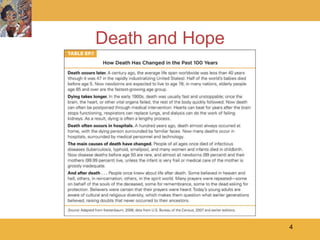
Death and Hope


                 4
Death Through the Life Span
―In order to understand what death
  means to people, we begin with
  developmental differences. The
  meaning assigned to death—either
  the person’s own death or the death
  of another person—depends partly
  on cognitive maturation and personal
  experience.‖

                                         5
Death in Childhood
• children as young as 2 have some
  understanding of death, but their
  perspective differs from that of older
  family members
• children have some comprehension
  of death—adults cannot assume that
  children share their perceptions

                                           6
Death in Adulthood

• a major shift in attitude about death
  occurs when adults become
  responsible for work and family
• death is not romanticized, but
  dreaded as something to be avoided
  or at least postponed

                                          7
Death in Late Adulthood

• in late adulthood, anxiety about death
  decreases
• a sign of mental health in older adults is
  acceptance of their mortality
• older people write their wills, designate
  health proxies---performing these actions
  does not mean that they have given up on
  life

                                               8
Many Religions, Many Cultures
• Views of Death in Major Religions
  – Buddhism
  – Hinduism
  – Native American Traditions
  – Judaism
  – Christianity
  – Islam

                                      9
Many Religions, Many Cultures
• Respect for Ancestors
• Spiritual and Cultural Affirmation
  – near-death experience
    • an episode in which a person comes
      close to dying but survives and reports
      having left his or her body and having
      moved towards a bright, white light while
      feeling peacefulness and joy


                                              10
Dying and Acceptance
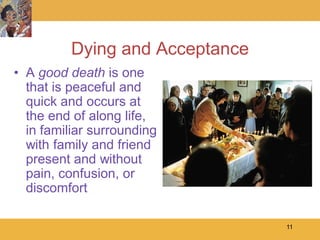
• A good death is one
  that is peaceful and
  quick and occurs at
  the end of along life,
  in familiar surrounding
  with family and friend
  present and without
  pain, confusion, or
  discomfort

                                 11
Dying and Acceptance
• Attending to the Needs of the Dying
  – Honest Conversation
  – The Hospice
     • an institution in which terminally ill patients
       receive palliative care
  – Comfort Care
     • palliative care
       – care designed not to treat an illness but to relieve the
         pain and suffering of the patient and his or her family
     • double effect
       – an ethical situation in which a person performs an
         action that is good or morally neutral but has ill effects
         that are foreseen, though not desired

                                                                    12
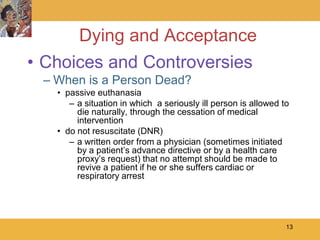
Dying and Acceptance
• Choices and Controversies
 – When is a Person Dead?
   • passive euthanasia
      – a situation in which a seriously ill person is allowed to
        die naturally, through the cessation of medical
        intervention
   • do not resuscitate (DNR)
      – a written order from a physician (sometimes initiated
        by a patient’s advance directive or by a health care
        proxy’s request) that no attempt should be made to
        revive a patient if he or she suffers cardiac or
        respiratory arrest


                                                                13
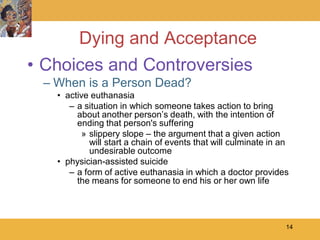
Dying and Acceptance
• Choices and Controversies
 – When is a Person Dead?
   • active euthanasia
      – a situation in which someone takes action to bring
        about another person’s death, with the intention of
        ending that person's suffering
         » slippery slope – the argument that a given action
           will start a chain of events that will culminate in an
           undesirable outcome
   • physician-assisted suicide
      – a form of active euthanasia in which a doctor provides
        the means for someone to end his or her own life


                                                                14
Dying and Acceptance
– The Netherlands
– Oregon


                           15
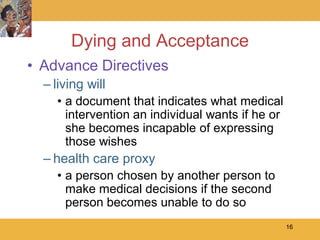
Dying and Acceptance
• Advance Directives
  – living will
    • a document that indicates what medical
      intervention an individual wants if he or
      she becomes incapable of expressing
      those wishes
  – health care proxy
    • a person chosen by another person to
      make medical decisions if the second
      person becomes unable to do so
                                                  16
Bereavement
• Normal Grief
  – Grief and Mourning
    • bereavement
      – the sense of loss following a death
    • grief
      – an individual's emotional response to the death of
        another
    • mourning
      – the ceremonies and behavior that a religion or culture
        prescribes for bereaved people


                                                             17
Bereavement
– Seeking Blame and Meaning
  • a common impulse after death is for the
    survivor to asses blame
  • the normal grief reaction is intense and
    irrational at first but gradually eases
  • time, social support, and traditions help


                                                18
Bereavement
– Complicated Grief
  • absent grief
    – a situation in which overly private people cut
      themselves off from the community and customs of
      expected grief—can lead to social isolation
  • disenfranchised grief
    – a situation in which certain people, although they are
      bereaved, are not allowed to mourn publicly
  • incomplete grief
    – a situation in which circumstances, such as a police
      investigation or an autopsy, interfere with the process
      of grieving

                                                               19
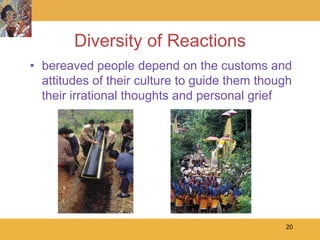
Diversity of Reactions
• bereaved people depend on the customs and
  attitudes of their culture to guide them though
  their irrational thoughts and personal grief


                                               20

Epilogue (Psych 41)Pdf

  • 1.
    Kathleen Stassen Berger Epilogue Death and Dying Death and Hope Dying and Acceptance Bereavement Prepared by Madeleine Lacefield 1 Tattoon, M.A.
  • 2.
    Death and Dying •―Death mirrors the complexity of life as death highlights cultural differences and ethical dilemmas.‖ – thanatology is the study of death and dying, especially social and emotional aspect. 2
  • 3.
    Death and Hope •What is death? – a end or a beginning – a private and personal event – a part of the larger culture – something to deny or avoid – something to welcome 3
  • 4.
  • 5.
    Death Through theLife Span ―In order to understand what death means to people, we begin with developmental differences. The meaning assigned to death—either the person’s own death or the death of another person—depends partly on cognitive maturation and personal experience.‖ 5
  • 6.
    Death in Childhood •children as young as 2 have some understanding of death, but their perspective differs from that of older family members • children have some comprehension of death—adults cannot assume that children share their perceptions 6
  • 7.
    Death in Adulthood •a major shift in attitude about death occurs when adults become responsible for work and family • death is not romanticized, but dreaded as something to be avoided or at least postponed 7
  • 8.
    Death in LateAdulthood • in late adulthood, anxiety about death decreases • a sign of mental health in older adults is acceptance of their mortality • older people write their wills, designate health proxies---performing these actions does not mean that they have given up on life 8
  • 9.
    Many Religions, ManyCultures • Views of Death in Major Religions – Buddhism – Hinduism – Native American Traditions – Judaism – Christianity – Islam 9
  • 10.
    Many Religions, ManyCultures • Respect for Ancestors • Spiritual and Cultural Affirmation – near-death experience • an episode in which a person comes close to dying but survives and reports having left his or her body and having moved towards a bright, white light while feeling peacefulness and joy 10
  • 11.
    Dying and Acceptance •A good death is one that is peaceful and quick and occurs at the end of along life, in familiar surrounding with family and friend present and without pain, confusion, or discomfort 11
  • 12.
    Dying and Acceptance •Attending to the Needs of the Dying – Honest Conversation – The Hospice • an institution in which terminally ill patients receive palliative care – Comfort Care • palliative care – care designed not to treat an illness but to relieve the pain and suffering of the patient and his or her family • double effect – an ethical situation in which a person performs an action that is good or morally neutral but has ill effects that are foreseen, though not desired 12
  • 13.
    Dying and Acceptance •Choices and Controversies – When is a Person Dead? • passive euthanasia – a situation in which a seriously ill person is allowed to die naturally, through the cessation of medical intervention • do not resuscitate (DNR) – a written order from a physician (sometimes initiated by a patient’s advance directive or by a health care proxy’s request) that no attempt should be made to revive a patient if he or she suffers cardiac or respiratory arrest 13
  • 14.
    Dying and Acceptance •Choices and Controversies – When is a Person Dead? • active euthanasia – a situation in which someone takes action to bring about another person’s death, with the intention of ending that person's suffering » slippery slope – the argument that a given action will start a chain of events that will culminate in an undesirable outcome • physician-assisted suicide – a form of active euthanasia in which a doctor provides the means for someone to end his or her own life 14
  • 15.
    Dying and Acceptance –The Netherlands – Oregon 15
  • 16.
    Dying and Acceptance •Advance Directives – living will • a document that indicates what medical intervention an individual wants if he or she becomes incapable of expressing those wishes – health care proxy • a person chosen by another person to make medical decisions if the second person becomes unable to do so 16
  • 17.
    Bereavement • Normal Grief – Grief and Mourning • bereavement – the sense of loss following a death • grief – an individual's emotional response to the death of another • mourning – the ceremonies and behavior that a religion or culture prescribes for bereaved people 17
  • 18.
    Bereavement – Seeking Blameand Meaning • a common impulse after death is for the survivor to asses blame • the normal grief reaction is intense and irrational at first but gradually eases • time, social support, and traditions help 18
  • 19.
    Bereavement – Complicated Grief • absent grief – a situation in which overly private people cut themselves off from the community and customs of expected grief—can lead to social isolation • disenfranchised grief – a situation in which certain people, although they are bereaved, are not allowed to mourn publicly • incomplete grief – a situation in which circumstances, such as a police investigation or an autopsy, interfere with the process of grieving 19
  • 20.
    Diversity of Reactions •bereaved people depend on the customs and attitudes of their culture to guide them though their irrational thoughts and personal grief 20