CASH: Library Skills
        Falmer Library
Journal articles: What and Why?
•   Academic publications published regularly containing articles
    by academics and practitioners.

•   Journals can be academic or practitioner focused.

•   Why use them?-

•    They provide current perspective

•   Contain information that might not be available elsewhere

•   Academically credible. Many undergo Peer Review process.
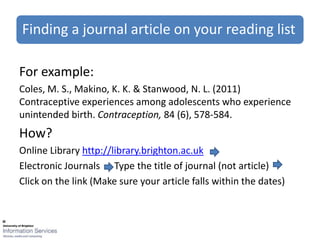
Finding a journal article on your reading list

For example:
Coles, M. S., Makino, K. K. & Stanwood, N. L. (2011)
Contraceptive experiences among adolescents who experience
unintended birth. Contraception, 84 (6), 578-584.
How?
Online Library http://library.brighton.ac.uk
Electronic Journals Type the title of journal (not article)
Click on the link (Make sure your article falls within the dates)
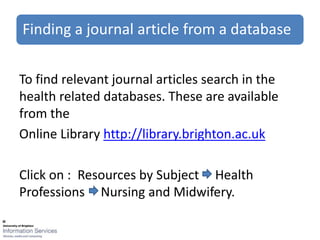
Finding a journal article from a database


To find relevant journal articles search in the
health related databases. These are available
from the
Online Library http://library.brighton.ac.uk

Click on : Resources by Subject Health
Professions Nursing and Midwifery.
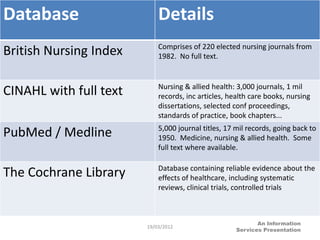
Database                    Details
                  Databases...(2)
                            Comprises of 220 elected nursing journals from
British Nursing Index       1982. No full text.


                            Nursing & allied health: 3,000 journals, 1 mil
CINAHL with full text       records, inc articles, health care books, nursing
                            dissertations, selected conf proceedings,
                            standards of practice, book chapters...
                            5,000 journal titles, 17 mil records, going back to
PubMed / Medline            1950. Medicine, nursing & allied health. Some
                            full text where available.

                            Database containing reliable evidence about the
The Cochrane Library        effects of healthcare, including systematic
                            reviews, clinical trials, controlled trials


                                                            An Information
                        19/03/2012
                                                     Services Presentation
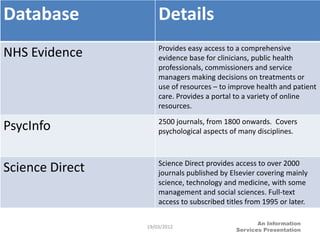
Database                  Details
                 Databases...(2)
                          Provides easy access to a comprehensive
NHS Evidence              evidence base for clinicians, public health
                          professionals, commissioners and service
                          managers making decisions on treatments or
                          use of resources – to improve health and patient
                          care. Provides a portal to a variety of online
                          resources.
                          2500 journals, from 1800 onwards. Covers
PsycInfo                  psychological aspects of many disciplines.


                          Science Direct provides access to over 2000
Science Direct            journals published by Elsevier covering mainly
                          science, technology and medicine, with some
                          management and social sciences. Full-text
                          access to subscribed titles from 1995 or later.

                                                         An Information
                      19/03/2012
                                                  Services Presentation
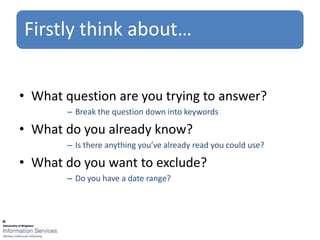
Firstly think about…


• What question are you trying to answer?
       – Break the question down into keywords

• What do you already know?
       – Is there anything you’ve already read you could use?

• What do you want to exclude?
       – Do you have a date range?
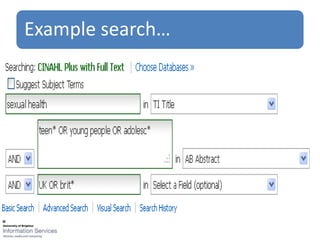
Example search…
Constructing a search strategy…

• Think about your keywords
        – Are there any other words you could use to describe them?

• Are you searching for an exact expression?
        – Putting an expression in (brackets) or “speech marks” will help
          find these

• Use AND, OR, NOT
        – children AND teenagers – articles must have both these words
        – children OR teenagers – articles can have either word
        – children NOT teenagers – will only find the first word
Constructing a search strategy…

• Use truncation
        – By using * you can extend your results e.g. child* will find
          child, children, childhood

• Use field searching
        – Databases let you search within the author, title, abstract,
          journal name etc. This may help narrow your results

• Be flexible
        – If at first you don’t succeed re-examine your keywords!
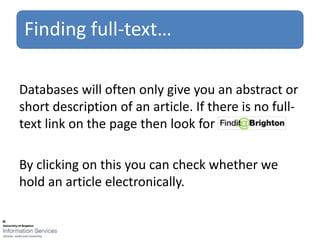
Finding full-text…

Databases will often only give you an abstract or
short description of an article. If there is no full-
text link on the page then look for

By clicking on this you can check whether we
hold an article electronically.
Other things to think about…
• Currency
        – databases let you limit your search by date, some lecturers
          will only want you to include current materials
• Peer-reviewed
        – some databases let you search for peer-reviewed articles,
          these have been reviewed by experts on that subject
• Types of articles
        – you may want to find case studies, qualitative or quantitative
          research, literature reviews etc. you can add these as
          keywords to your search
        – primary or secondary sources – databases find both, so be
          aware of this when searching
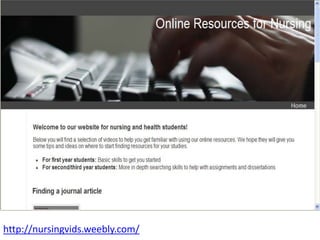
http://nursingvids.weebly.com/

Cash library skills

  • 1.
    CASH: Library Skills Falmer Library
  • 3.
    Journal articles: Whatand Why? • Academic publications published regularly containing articles by academics and practitioners. • Journals can be academic or practitioner focused. • Why use them?- • They provide current perspective • Contain information that might not be available elsewhere • Academically credible. Many undergo Peer Review process.
  • 4.
    Finding a journalarticle on your reading list For example: Coles, M. S., Makino, K. K. & Stanwood, N. L. (2011) Contraceptive experiences among adolescents who experience unintended birth. Contraception, 84 (6), 578-584. How? Online Library http://library.brighton.ac.uk Electronic Journals Type the title of journal (not article) Click on the link (Make sure your article falls within the dates)
  • 5.
    Finding a journalarticle from a database To find relevant journal articles search in the health related databases. These are available from the Online Library http://library.brighton.ac.uk Click on : Resources by Subject Health Professions Nursing and Midwifery.
  • 6.
    Database Details Databases...(2) Comprises of 220 elected nursing journals from British Nursing Index 1982. No full text. Nursing & allied health: 3,000 journals, 1 mil CINAHL with full text records, inc articles, health care books, nursing dissertations, selected conf proceedings, standards of practice, book chapters... 5,000 journal titles, 17 mil records, going back to PubMed / Medline 1950. Medicine, nursing & allied health. Some full text where available. Database containing reliable evidence about the The Cochrane Library effects of healthcare, including systematic reviews, clinical trials, controlled trials An Information 19/03/2012 Services Presentation
  • 7.
    Database Details Databases...(2) Provides easy access to a comprehensive NHS Evidence evidence base for clinicians, public health professionals, commissioners and service managers making decisions on treatments or use of resources – to improve health and patient care. Provides a portal to a variety of online resources. 2500 journals, from 1800 onwards. Covers PsycInfo psychological aspects of many disciplines. Science Direct provides access to over 2000 Science Direct journals published by Elsevier covering mainly science, technology and medicine, with some management and social sciences. Full-text access to subscribed titles from 1995 or later. An Information 19/03/2012 Services Presentation
  • 8.
    Firstly think about… •What question are you trying to answer? – Break the question down into keywords • What do you already know? – Is there anything you’ve already read you could use? • What do you want to exclude? – Do you have a date range?
  • 9.
  • 10.
    Constructing a searchstrategy… • Think about your keywords – Are there any other words you could use to describe them? • Are you searching for an exact expression? – Putting an expression in (brackets) or “speech marks” will help find these • Use AND, OR, NOT – children AND teenagers – articles must have both these words – children OR teenagers – articles can have either word – children NOT teenagers – will only find the first word
  • 11.
    Constructing a searchstrategy… • Use truncation – By using * you can extend your results e.g. child* will find child, children, childhood • Use field searching – Databases let you search within the author, title, abstract, journal name etc. This may help narrow your results • Be flexible – If at first you don’t succeed re-examine your keywords!
  • 12.
    Finding full-text… Databases willoften only give you an abstract or short description of an article. If there is no full- text link on the page then look for By clicking on this you can check whether we hold an article electronically.
  • 13.
    Other things tothink about… • Currency – databases let you limit your search by date, some lecturers will only want you to include current materials • Peer-reviewed – some databases let you search for peer-reviewed articles, these have been reviewed by experts on that subject • Types of articles – you may want to find case studies, qualitative or quantitative research, literature reviews etc. you can add these as keywords to your search – primary or secondary sources – databases find both, so be aware of this when searching
  • 14.

Editor's Notes

  • #3 Course infoPersonal info – can renew passwordOnline libraryCommunityAskLibrary accountUnimail