ENGL 1231
              Pitts


   Traci Welch Moritz
 Public Services Librarian
   Assistant Professor
Heterick Memorial Library
Introduction
                   
Welcome
Professor Moritz, t-moritz@onu.edu
Feel free to visit or email
Librarians on duty 8-4:30, 6-9 Mon –
 Thurs, 8-4:30 Friday and 10-3:30 on
 Sundays
IM and Chat Reference available certain
 times
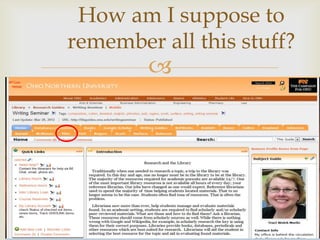
How am I suppose to
remember all this stuff?
        
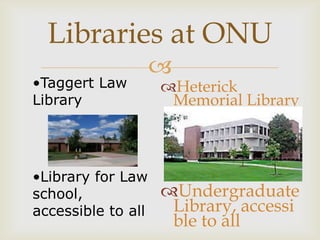
Libraries at ONU
                    
•Taggert Law        Heterick
Library              Memorial Library


•Library for Law
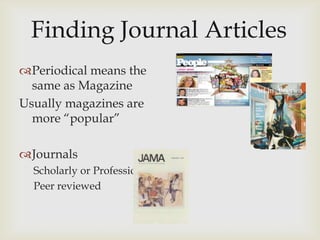
school,             Undergraduate
accessible to all    Library, accessi
                     ble to all
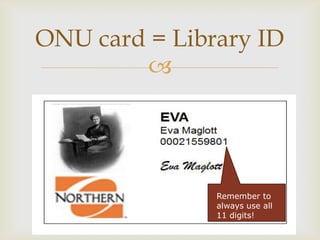
ONU card = Library ID
        


               Remember to
               always use all
               11 digits!
What we’ll do today
             
How to do research
How to use library
 resources to do research
What resources to use
 when doing research
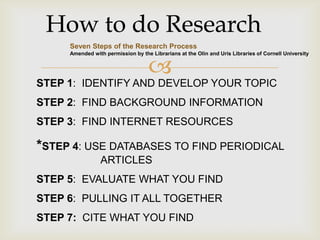
How to do Research
     Seven Steps of the Research Process
     Amended with permission by the Librarians at the Olin and Uris Libraries of Cornell University


                                   
STEP 1: IDENTIFY AND DEVELOP YOUR TOPIC
STEP 2: FIND BACKGROUND INFORMATION
STEP 3: FIND INTERNET RESOURCES

*STEP 4: USE DATABASES TO FIND PERIODICAL
                 ARTICLES
STEP 5: EVALUATE WHAT YOU FIND
STEP 6: PULLING IT ALL TOGETHER
STEP 7: CITE WHAT YOU FIND
Start at the beginning
   IDENTIFY AND DEVELOP YOUR TOPIC
                        
       •State your topic as a question
       •Identify main concepts or keywords

       •Test the topic --         Look for keywords and
       synonyms and related terms for the information sought
             Subject headings in catalogs
             Built-in thesauri in many databases
             Reference sources
             Textbooks, lecture notes, readings
STEP         Internet
             Librarians, Instructors
 1
Researching
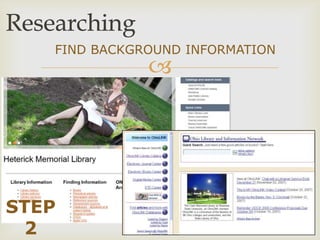
    FIND BACKGROUND INFORMATION
               


STEP
 2

•Highly structured information environment
   Way individual records are arranged
   Subject headings
   Catalog software optimized for above
   Deal with material in many formats

•Implies heavy human involvement
•Emphasis on precision
•Preparation relatively labor-intensive
•Implies a learning curve to use successfully
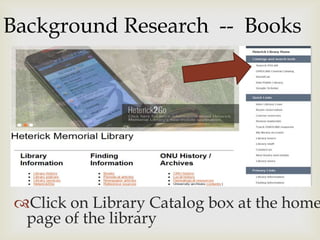
Background Research -- Books


 Click on Library Catalog box at the home
  page of the library
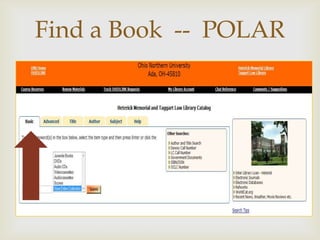
Find a Book -- POLAR
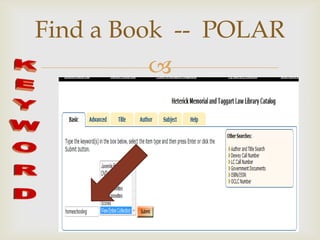
  •Looks in several locations
  (usually subject, article title,
  abstracts or contents)
  •Does not require an exact
  match
  •Generates comparatively large
  number of hits (not precise)
  •Good if you are not familiar with
  terminology
Find a Book -- POLAR
         
Find a Book -- OhioLINK
                       
 Materials owned by all Ohio
  colleges, universities, several public libraries
 Ca. 10 million items
 Link from POLAR permits you to submit
  requests. Available from Heterick home
  page
 Most requests arrive in 2-3 working days
 No charge
 Limited to 100 items at a time
 MAY RENEW UP TO 4 TIMES
Find a Book -- OhioLINK
                       
Materials owned by all Ohio
 colleges, universities, several public libraries
Ca. 10 million items
Link from POLAR permits you to submit
 requests. Available from Heterick home page
Most requests arrive in 3-5 working days
No charge
Limited to 100 items at a time
May keep up to 84 days
What about Google?
            
    Does the information located
     satisfy the research need?
    Is the information factual and
     unbiased?
    See handout “Critically Analyzing
     Information Sources” the Writing
STEP Seminar Research Guide
  3
What about Google?
                    


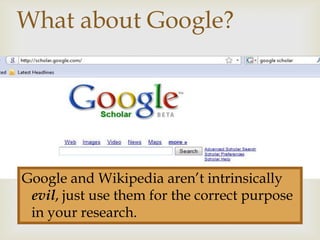
Google and Wikipedia aren’t intrinsically
 evil, just use them for the correct purpose
 in your research.
Google Scholar
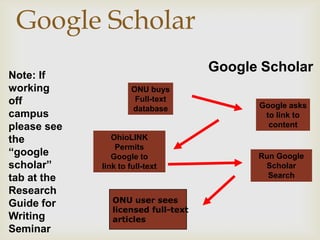
                                     Google Scholar
Note: If
working               ONU buys
off                    Full-text
                      database             Google asks
campus                                      to link to
please see                                   content
the             OhioLINK
                 Permits
“google         Google to                  Run Google
scholar”     link to full-text              Scholar
tab at the                                   Search
Research
Guide for       ONU user sees
                licensed full-text
Writing         articles
Seminar
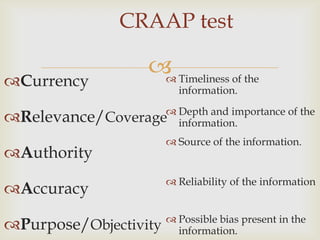
CRAAP test

                       Timeliness of the
Currency              
                           information.
                    Depth and importance of the
Relevance/Coverage information.
                          Source of the information.
Authority
                          Reliability of the information
Accuracy
                          Possible bias present in the
Purpose/Objectivity       information.
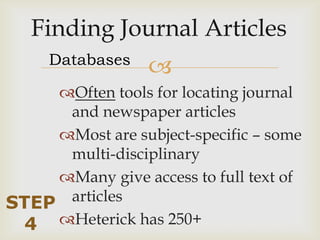
Databases
                  
     Often tools for locating journal
      and newspaper articles
     Most are subject-specific – some
      multi-disciplinary
     Many give access to full text of
STEP  articles
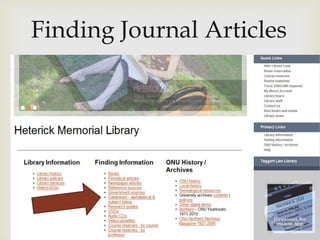
 4 Heterick has 250+

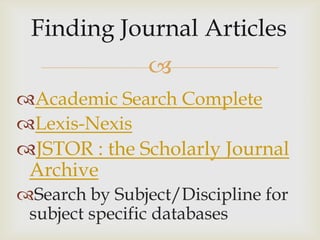
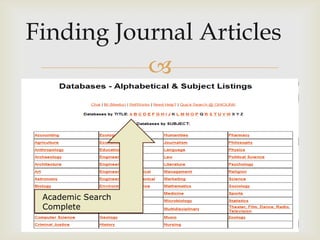
Academic Search Complete
Lexis-Nexis
JSTOR : the Scholarly Journal
 Archive
Search by Subject/Discipline for
 subject specific databases
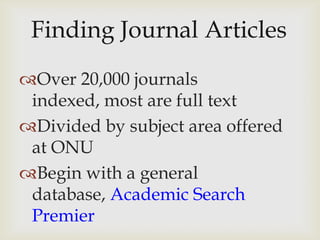
Over 20,000 journals
 indexed, most are full text
Divided by subject area offered
 at ONU
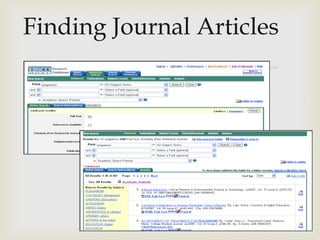
Begin with a general
 database, Academic Search
 Premier
Periodical means the
  same as Magazine
Usually magazines are
  more “popular”

Journals
  Scholarly or Professional
  Peer reviewed



Academic Search
Complete




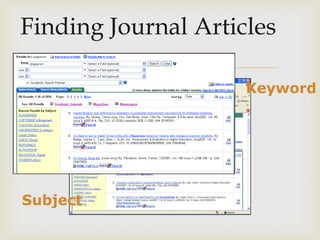
              Keyword


Subject

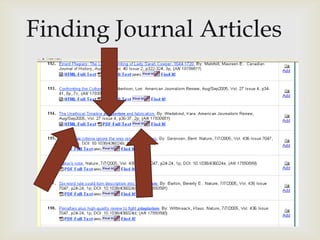
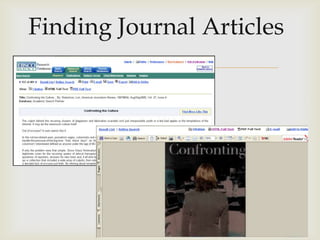
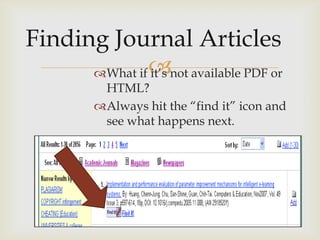
What if it’s not available PDF or
 HTML?
Always hit the “find it” icon and
 see what happens next.
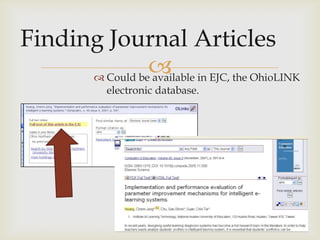
 in EJC, the OhioLINK
 Could be available
 electronic database.

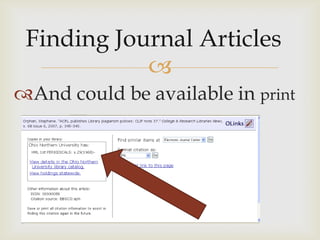
And could be available in print

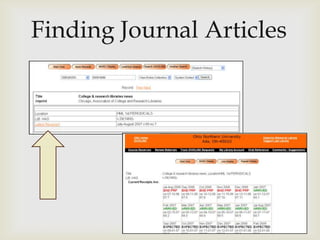
Reserve means the periodical/journal is held at
 the front desk.
Current means the issue is new and is available
 on the open shelves beside the computer lab.
All others are upstairs and arranged
 alphabetically by title.
Bound means it’s out of the building
Arrived means it’s on the open shelves
Expected means it’s not here yet
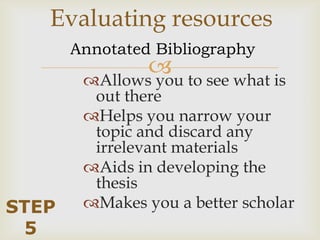
Evaluating resources
       Annotated Bibliography
                to see what is
        Allows you
         out there
        Helps you narrow your
         topic and discard any
         irrelevant materials
        Aids in developing the
         thesis
STEP    Makes you a better scholar
 5
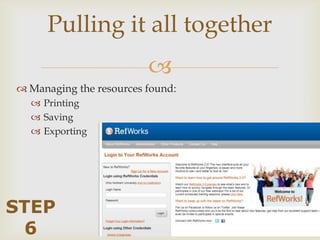
Pulling it all together
                         
 Managing the resources found:
   Printing
   Saving
   Exporting


STEP
 6
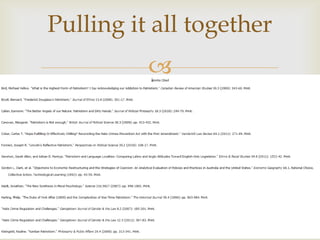
Pulling it all together
             


STEP
 6
Pulling it all together
                      
       Accuracy. If your page lists the author
       and institution that published the page and
       provides a way of contacting him/her and…
       Authority. If your page lists the author
       credentials and its domain is preferred
       (.edu, .gov, .org, or .net), and, …
       Objectivity. If your page provides
       accurate information with limited
       advertising and it is objective in presenting
STEP   the information, and…
 6
Pulling it all together
                    page is current and
       Currency. If your
       updated regularly (as stated on the page)
       and the links (if any) are also up-to-date,
       and…
       Coverage. If you can view the
       information properly--not limited to fees,
       browser technology, or software
       requirement, then…
       You may have a Web page that
       could be of value to your
STEP   research!
 6
Cite what you find using
        standard formats
                    
 There are 3 citation styles that are in
 frequent used at ONU. They are:
     •MLA (Modern Language Association)
     •APA (American Psychological
       Association)
       •CMS (Chicago Manual of Style)


STEP
 7
Research Ethics
        

ACADEMIC
INTEGRITY
Research Ethics
                  
Copyright - intended to promote
 the arts and the sciences. It does this
 by providing authors of original
 literary, dramatic, musical, artistic, a
 nd certain other intellectual works
 the ability to control how their work
 is used by others.
Research Ethics
                  
Plagiarism - “...the wrongful
 appropriation or purloining, and
 publication as one’s own, the ideas or
 the expression of the ideas
 (literary, artistic, musical, mechanical,
 etc.) of an other.” – see Heterick Help
 Page and Student Code of
Research Ethics
                                 
In other words, to plagiarize is to
 copy someone else’s work without
 giving him/her credit.
Plagiarism is not always intentional. You can do
    1
 it by accident, but it is still against the law. If
 you ever have a question about whether
 something is plagiarized, please ask!

 1. How not to plagiarize your report -- Shannon Hosier Mersand
Research Ethics
                                                                2
           How may I avoid plagiarizing?
                                   
 Identify any information that would not be considered
  common knowledge
 Unless in direct quotes, make sure you paraphrase what the
  original author said
 Use a quote if you can’t think of a way to paraphrase the
  information
 always, Always, ALWAYS cite the source of any
  information in your paper which is not considered common
  knowledge. If you are unsure if something is common
  knowledge, cite it!
             2   How not to plagiarize your report -- Shannon Hosier Mersand
HELP
                     
                   Traci Welch Moritz, MLS
                   Public Services Librarian
                   Assistant Professor
                   Heterick Memorial Library
Reference
                   t-moritz@onu.edu
Librarians on      419-772-2473
duty               419-772-2185
8a-4:30p Mon-Fri
6p-9p Mon-Thur
10a-3:30p
Sundays

Writing Seminar Pitts Spring 2012

  • 1.
    ENGL 1231 Pitts Traci Welch Moritz Public Services Librarian Assistant Professor Heterick Memorial Library
  • 2.
    Introduction  Welcome Professor Moritz, t-moritz@onu.edu Feel free to visit or email Librarians on duty 8-4:30, 6-9 Mon – Thurs, 8-4:30 Friday and 10-3:30 on Sundays IM and Chat Reference available certain times
  • 3.
    How am Isuppose to remember all this stuff? 
  • 4.
    Libraries at ONU  •Taggert Law Heterick Library Memorial Library •Library for Law school, Undergraduate accessible to all Library, accessi ble to all
  • 5.
    ONU card =Library ID  Remember to always use all 11 digits!
  • 6.
    What we’ll dotoday  How to do research How to use library resources to do research What resources to use when doing research
  • 7.
    How to doResearch Seven Steps of the Research Process Amended with permission by the Librarians at the Olin and Uris Libraries of Cornell University  STEP 1: IDENTIFY AND DEVELOP YOUR TOPIC STEP 2: FIND BACKGROUND INFORMATION STEP 3: FIND INTERNET RESOURCES *STEP 4: USE DATABASES TO FIND PERIODICAL ARTICLES STEP 5: EVALUATE WHAT YOU FIND STEP 6: PULLING IT ALL TOGETHER STEP 7: CITE WHAT YOU FIND
  • 8.
    Start at thebeginning IDENTIFY AND DEVELOP YOUR TOPIC  •State your topic as a question •Identify main concepts or keywords •Test the topic -- Look for keywords and synonyms and related terms for the information sought Subject headings in catalogs Built-in thesauri in many databases Reference sources Textbooks, lecture notes, readings STEP Internet Librarians, Instructors 1
  • 9.
    Researching FIND BACKGROUND INFORMATION  STEP 2
  • 10.
     •Highly structured informationenvironment Way individual records are arranged Subject headings Catalog software optimized for above Deal with material in many formats •Implies heavy human involvement •Emphasis on precision •Preparation relatively labor-intensive •Implies a learning curve to use successfully
  • 11.
    Background Research --Books Click on Library Catalog box at the home page of the library
  • 12.
    Find a Book-- POLAR
  • 13.
    Find a Book-- POLAR •Looks in several locations (usually subject, article title, abstracts or contents) •Does not require an exact match •Generates comparatively large number of hits (not precise) •Good if you are not familiar with terminology
  • 14.
    Find a Book-- POLAR 
  • 15.
    Find a Book-- OhioLINK  Materials owned by all Ohio colleges, universities, several public libraries Ca. 10 million items Link from POLAR permits you to submit requests. Available from Heterick home page Most requests arrive in 2-3 working days No charge Limited to 100 items at a time MAY RENEW UP TO 4 TIMES
  • 16.
    Find a Book-- OhioLINK  Materials owned by all Ohio colleges, universities, several public libraries Ca. 10 million items Link from POLAR permits you to submit requests. Available from Heterick home page Most requests arrive in 3-5 working days No charge Limited to 100 items at a time May keep up to 84 days
  • 17.
    What about Google?  Does the information located satisfy the research need? Is the information factual and unbiased? See handout “Critically Analyzing Information Sources” the Writing STEP Seminar Research Guide 3
  • 18.
    What about Google?  Google and Wikipedia aren’t intrinsically evil, just use them for the correct purpose in your research.
  • 19.
    Google Scholar Google Scholar Note: If working ONU buys off Full-text database Google asks campus to link to please see content the OhioLINK Permits “google Google to Run Google scholar” link to full-text Scholar tab at the Search Research Guide for ONU user sees licensed full-text Writing articles Seminar
  • 20.
    CRAAP test  Timeliness of the Currency  information.  Depth and importance of the Relevance/Coverage information.  Source of the information. Authority  Reliability of the information Accuracy  Possible bias present in the Purpose/Objectivity information.
  • 21.
    Databases  Often tools for locating journal and newspaper articles Most are subject-specific – some multi-disciplinary Many give access to full text of STEP articles 4 Heterick has 250+
  • 22.
     Academic Search Complete Lexis-Nexis JSTOR: the Scholarly Journal Archive Search by Subject/Discipline for subject specific databases
  • 23.
    Over 20,000 journals indexed, most are full text Divided by subject area offered at ONU Begin with a general database, Academic Search Premier
  • 24.
    Periodical means the same as Magazine Usually magazines are more “popular” Journals Scholarly or Professional Peer reviewed
  • 26.
  • 27.
  • 28.
  • 29.
  • 30.
    Keyword Subject
  • 31.
     What if it’snot available PDF or HTML? Always hit the “find it” icon and see what happens next.
  • 32.
     in EJC,the OhioLINK  Could be available electronic database.
  • 33.
     And could beavailable in print
  • 35.
     Reserve means theperiodical/journal is held at the front desk. Current means the issue is new and is available on the open shelves beside the computer lab. All others are upstairs and arranged alphabetically by title. Bound means it’s out of the building Arrived means it’s on the open shelves Expected means it’s not here yet
  • 36.
    Evaluating resources Annotated Bibliography  to see what is Allows you out there Helps you narrow your topic and discard any irrelevant materials Aids in developing the thesis STEP Makes you a better scholar 5
  • 37.
    Pulling it alltogether   Managing the resources found:  Printing  Saving  Exporting STEP 6
  • 38.
    Pulling it alltogether  STEP 6
  • 39.
    Pulling it alltogether  Accuracy. If your page lists the author and institution that published the page and provides a way of contacting him/her and… Authority. If your page lists the author credentials and its domain is preferred (.edu, .gov, .org, or .net), and, … Objectivity. If your page provides accurate information with limited advertising and it is objective in presenting STEP the information, and… 6
  • 40.
    Pulling it alltogether  page is current and Currency. If your updated regularly (as stated on the page) and the links (if any) are also up-to-date, and… Coverage. If you can view the information properly--not limited to fees, browser technology, or software requirement, then… You may have a Web page that could be of value to your STEP research! 6
  • 41.
    Cite what youfind using standard formats  There are 3 citation styles that are in frequent used at ONU. They are: •MLA (Modern Language Association) •APA (American Psychological Association) •CMS (Chicago Manual of Style) STEP 7
  • 42.
    Research Ethics  ACADEMIC INTEGRITY
  • 43.
    Research Ethics  Copyright - intended to promote the arts and the sciences. It does this by providing authors of original literary, dramatic, musical, artistic, a nd certain other intellectual works the ability to control how their work is used by others.
  • 44.
    Research Ethics  Plagiarism - “...the wrongful appropriation or purloining, and publication as one’s own, the ideas or the expression of the ideas (literary, artistic, musical, mechanical, etc.) of an other.” – see Heterick Help Page and Student Code of
  • 45.
    Research Ethics  In other words, to plagiarize is to copy someone else’s work without giving him/her credit. Plagiarism is not always intentional. You can do 1 it by accident, but it is still against the law. If you ever have a question about whether something is plagiarized, please ask! 1. How not to plagiarize your report -- Shannon Hosier Mersand
  • 46.
    Research Ethics 2 How may I avoid plagiarizing?   Identify any information that would not be considered common knowledge  Unless in direct quotes, make sure you paraphrase what the original author said  Use a quote if you can’t think of a way to paraphrase the information  always, Always, ALWAYS cite the source of any information in your paper which is not considered common knowledge. If you are unsure if something is common knowledge, cite it! 2 How not to plagiarize your report -- Shannon Hosier Mersand
  • 47.
    HELP  Traci Welch Moritz, MLS Public Services Librarian Assistant Professor Heterick Memorial Library Reference t-moritz@onu.edu Librarians on 419-772-2473 duty 419-772-2185 8a-4:30p Mon-Fri 6p-9p Mon-Thur 10a-3:30p Sundays