DR.Ammar Al-bourhi
FINDING KNOWLEDGE IN
DIGITAL LIBRARY HAYSTACK
Outlines
Introduction
Defining the Digital Library
Digital Libraries Shorten the Chain
Types of Digital Collections
Digital Library Basics
Personal Reference Managers
Library Guides and Tutorials
Bibliographic Databases Pertinent to Nursing
Embarking on the Quest for Knowledge
Challenges to the Adoption of Evidence-Based
Nursing
References
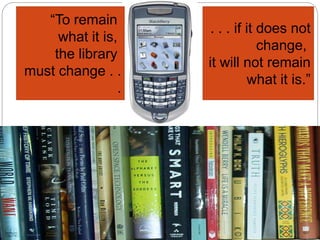
“To remain
what it is,
the library
must change . .
.
. . . if it does not
change,
it will not remain
what it is.”
Objective
 Compare nursing knowledge found
in online library databases with that
found using the Internet.
 Discuss library bibliographic
databases useful to nurses.
 Demonstrate effective literature
search strategies to support
evidence-based practice.
 Describe the use of personal
reference management
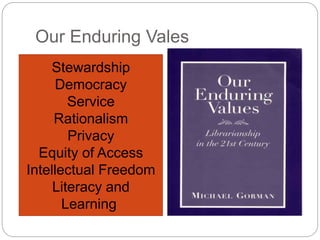
Our Enduring Vales
Stewardship
Democracy
Service
Rationalism
Privacy
Equity of Access
Intellectual Freedom
Literacy and
Learning
Introduction
 Given the vast amount of published
information,.
 Library online resources provide a
pivotal gateway to knowledge
discovery.
 Must proactively develop and
practice information search
competencies to improve patient
care and promote the scholarship of
nursing
Introduction-const.
 Without effective information
search competencies,
knowledge remains
embedded in the digital
haystack.
 To assist with information
searches, librarians created
digital index guides to the
Defining the Digital Library
Service is an assemblage of digital
computing, storage, and
communications machinery together
with the software needed to
reproduce, emulate, and extend the
services provided by conventional
libraries based on paper and other
material means of collecting, storing,
cataloguing, finding, and
What is important?
 Site Neutrality
 Access-Anytime (24*7)
 Anywhere (Office, Residence, Travel)
 By Anyone
 Open Access and Sharing of information
 Greater variety and granularity of
information
 Up-to- date
 New forms of rendering ( New Genre)
What is important?
 Integration of digital media into traditional
collections
 Digital libraries are different in that they
are designed to support the creation,
maintenance, management, access to, and
preservation of digital content
Five Elements in Various
Definitions of DL.
 The digital library is not a single entity;
 The digital library requires technology to link
the resources of many;
 The linkages between the many digital
libraries and information services are
transparent to the end users;
 Universal access to digital libraries and
information services is a goal;
Digital library collections are not limited to
document surrogates: they extend to digital
artefacts that cannot be represented or
distributed in printed formats.
Ingredients for DLs
 Hardware
The minimum machinery to do the
job.
 Software
The programs for handling data.
 Digital Objects
Articles, Conference Papers,
Thesis,……
 Basic Skills
Things one has to learn
Types of Digital Collections
Digitization :- Converting paper and
other media in existing collections to
digital form
 Acquisition of original digital works
:- Created by publishers and
scholars like electronic books,
journals, and dataset
 Access to external materials :- Like
Web sites, other library collections,
or publishers' servers
Creating DLs …
Six steps
Selecting
 Acquiring
Digitization
Organizing
Archiving
Providing Access
Digital Library Basics
 Knowledge-based databases index
published literature.
 Factual databases replace reference books
with searchable and updatable online
information, for example, drug and
laboratory manuals.
 Knowledge-based databases focus on
areas such as health sciences, business,
history, government, law, and ethics.
 Furthermore, each database is specialized
by the number and type of resources (e.g.,
journal or book names)
Personal Reference Managers
 A personal reference manager refers to
database software that allows the user to
create a personal collection of citations.
 Most library database interfaces include
an export feature that allows the user to
download citation information into a
personal reference manager.
 There are a number of commercial
products available, for example,
EndNote®, ProCite®, Reference
Manager®, and RefWorks
Zotero
 Zotero (http://www.zotero.org/) is a
very powerful open-source personal
reference manager.
- Zotero allows the user to save
citation
information from most library
bibliographic databases and certain
websites, such as Amazon.com and
the New York Times.
CiteULike at
http://www.CiteULike.org/ is a free
online personal reference manager
service that allows users to store,
organize, and share citation
information (CiteUlike, 2010).
Users must register for an account
with a login and password.
Library Guides and Tutorials
 Even the most experienced library
patrons can benefit from library guides
and tutorials because the technology
development for library resources
continues to change rapidly.
 Lifelong learning for professional
nursing must begin with demonstrated
 competencies in the use of digital
library searches to discover new
nursing knowledge.
Library Guides and Tutorials-
const.
 Nursing knowledge, including (EBP) findings,
should be quickly integrated into clinical practice
to improve patient outcomes.
 The most efficient way to develop/improve library
competencies is with the assistance of a
librarian.
 Qualified librarians have a master’s or doctoral
degree with a specialization in an area of library
science.
Zotero guides and tutorials address
how to use the specific library facility .
how to search using medical subject
headings (MeSH).
how to use a vendor search interface.
how to use a specific database.
how to find books and journals, and links
to help resources such as guides and
tutorials.
 Subject headings
refer to standardized terms used to index or
catalog reference materials.
 Each library chooses a standard subject
authority or thesaurus for all of its cataloging.
 Libraries using the National Library of Medicine
(NLM) classification use the “medical subject
headings” or MeSH
(http://www.nlm.nih.gov/mesh/).
Searching Using Mesh Terms
MeSH
refers to the controlled
vocabulary of terms used to
index materials in PubMed and
MEDLINE databases
Bibliographic Databases Pertinent
to Nursing
There are numerous
databases with information
pertinent to nursing.
 Essential ones with a focus
on nursing and health-
related topics are CINAHL,
MEDLINE/ PubMed,
Cochrane Library, and
PsycINFO
CINAHL
 CINAHL When researching a
nursing topic, the CINAHL
database is an excellent place to
start.
 This database includes citations
and abstracts for more than 500
nursing journals and 400 allied
health journals dating back to
1982 (CINAHL, 2010).
Medline
 MEDLINE When researching a
biomedical research topic that
crosses healthcare disciplines, use
MEDLINE in addition to CINAHL.
 The NLM is the largest medical
library in the world.
PubMed Central allows access to free full
text articles(PubMed Central, 2010).
PubMed provides a variety of free
services.
Cochrane Library
Cochrane Library is considered a gold standard for
meta-analysis of medical research
Nursing students and practicing nurses may not have
the confidence and experience to analyze research
without assistance of faculty or nurse researchers.
The Cochrane Library provides access to systematic
reviews of the best research evidence.
A systematic review is designed to reduce three types
of bias inherent in individual research studies:
selection, indexing, and publication
(Sackett, Rosenberg, Gray, Haynes, & Richardson, 1996).
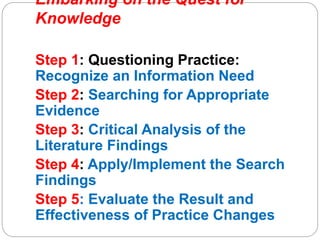
Embarking on the Quest for
Knowledge
Step 1: Questioning Practice:
Recognize an Information Need
Step 2: Searching for Appropriate
Evidence
Step 3: Critical Analysis of the
Literature Findings
Step 4: Apply/Implement the Search
Findings
Step 5: Evaluate the Result and
Effectiveness of Practice Changes
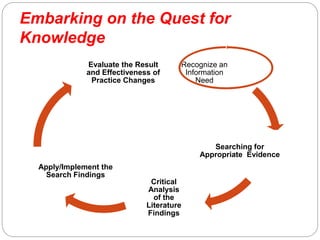
Embarking on the Quest for
Knowledge
Recognize an
Information
Need
Searching for
Appropriate Evidence
Critical
Analysis
of the
Literature
Findings
Apply/Implement the
Search Findings
Evaluate the Result
and Effectiveness of
Practice Changes
Analyze the literature using the seven-
level rating system for hierarchy of
research evidence (Melnyk & Fineout-Overholt, 2011)
 Level I: Evidence from a systematic
review or meta-analysis of all
relevant randomized controlled
trials (RCTs) or evidence-based
clinical practice guideline based on
systematic review of RCTs.
 Level II: Evidence obtained from at
least one well-designed RCT.
 Level III: Evidence obtained from
well-designed controlled trials
without randomization.
Analyze the literature using the seven-
level rating system for hierarchy of
research evidence
 Level IV: Evidence from well-
designed case– control and cohort
studies.
 Level V: Evidence from systematic
reviews of descriptive and
qualitative studies.
 Level VI: Evidence from single
descriptive or qualitative study.
 Level VII: Evidence from the opinion
of authorities and/or reports of
expert committees.
Challenges to the Adoption of
Evidence-Based Nursing
 Although EBP is widely accepted today,
originally the concept was criticized.
 Those critical believed that it was impractical
to implement and served to only reduce costs
and limit clinical freedom (Sackett, Rosenberg,
Gray, Haynes, & Richardson, 1996).
The problem is complex, ranging from access
to knowledge resources, attitudes toward
research, and information literacy knowledge
and skills
Personal barriers to the adoption
of EBP:
 The most significant was the
 Lack of value in clinical settings for research
 other barriers related to access of research
resources
 Lack of research skills.
 Lack of information literacy skills.
 Lack of information technology competencies.
 lack of time and sufficient staff
 Difficulties in interpreting statistics and research
writings

Finding knowledge from digital library

  • 1.
    DR.Ammar Al-bourhi FINDING KNOWLEDGEIN DIGITAL LIBRARY HAYSTACK
  • 2.
    Outlines Introduction Defining the DigitalLibrary Digital Libraries Shorten the Chain Types of Digital Collections Digital Library Basics Personal Reference Managers Library Guides and Tutorials Bibliographic Databases Pertinent to Nursing Embarking on the Quest for Knowledge Challenges to the Adoption of Evidence-Based Nursing References
  • 3.
    “To remain what itis, the library must change . . . . . . if it does not change, it will not remain what it is.”
  • 4.
    Objective  Compare nursingknowledge found in online library databases with that found using the Internet.  Discuss library bibliographic databases useful to nurses.  Demonstrate effective literature search strategies to support evidence-based practice.  Describe the use of personal reference management
  • 5.
    Our Enduring Vales Stewardship Democracy Service Rationalism Privacy Equityof Access Intellectual Freedom Literacy and Learning
  • 6.
    Introduction  Given thevast amount of published information,.  Library online resources provide a pivotal gateway to knowledge discovery.  Must proactively develop and practice information search competencies to improve patient care and promote the scholarship of nursing
  • 7.
    Introduction-const.  Without effectiveinformation search competencies, knowledge remains embedded in the digital haystack.  To assist with information searches, librarians created digital index guides to the
  • 8.
    Defining the DigitalLibrary Service is an assemblage of digital computing, storage, and communications machinery together with the software needed to reproduce, emulate, and extend the services provided by conventional libraries based on paper and other material means of collecting, storing, cataloguing, finding, and
  • 9.
    What is important? Site Neutrality  Access-Anytime (24*7)  Anywhere (Office, Residence, Travel)  By Anyone  Open Access and Sharing of information  Greater variety and granularity of information  Up-to- date  New forms of rendering ( New Genre)
  • 10.
    What is important? Integration of digital media into traditional collections  Digital libraries are different in that they are designed to support the creation, maintenance, management, access to, and preservation of digital content
  • 11.
    Five Elements inVarious Definitions of DL.  The digital library is not a single entity;  The digital library requires technology to link the resources of many;  The linkages between the many digital libraries and information services are transparent to the end users;  Universal access to digital libraries and information services is a goal; Digital library collections are not limited to document surrogates: they extend to digital artefacts that cannot be represented or distributed in printed formats.
  • 12.
    Ingredients for DLs Hardware The minimum machinery to do the job.  Software The programs for handling data.  Digital Objects Articles, Conference Papers, Thesis,……  Basic Skills Things one has to learn
  • 13.
    Types of DigitalCollections Digitization :- Converting paper and other media in existing collections to digital form  Acquisition of original digital works :- Created by publishers and scholars like electronic books, journals, and dataset  Access to external materials :- Like Web sites, other library collections, or publishers' servers
  • 14.
    Creating DLs … Sixsteps Selecting  Acquiring Digitization Organizing Archiving Providing Access
  • 15.
    Digital Library Basics Knowledge-based databases index published literature.  Factual databases replace reference books with searchable and updatable online information, for example, drug and laboratory manuals.  Knowledge-based databases focus on areas such as health sciences, business, history, government, law, and ethics.  Furthermore, each database is specialized by the number and type of resources (e.g., journal or book names)
  • 16.
    Personal Reference Managers A personal reference manager refers to database software that allows the user to create a personal collection of citations.  Most library database interfaces include an export feature that allows the user to download citation information into a personal reference manager.  There are a number of commercial products available, for example, EndNote®, ProCite®, Reference Manager®, and RefWorks
  • 17.
    Zotero  Zotero (http://www.zotero.org/)is a very powerful open-source personal reference manager. - Zotero allows the user to save citation information from most library bibliographic databases and certain websites, such as Amazon.com and the New York Times.
  • 18.
    CiteULike at http://www.CiteULike.org/ isa free online personal reference manager service that allows users to store, organize, and share citation information (CiteUlike, 2010). Users must register for an account with a login and password.
  • 19.
    Library Guides andTutorials  Even the most experienced library patrons can benefit from library guides and tutorials because the technology development for library resources continues to change rapidly.  Lifelong learning for professional nursing must begin with demonstrated  competencies in the use of digital library searches to discover new nursing knowledge.
  • 20.
    Library Guides andTutorials- const.  Nursing knowledge, including (EBP) findings, should be quickly integrated into clinical practice to improve patient outcomes.  The most efficient way to develop/improve library competencies is with the assistance of a librarian.  Qualified librarians have a master’s or doctoral degree with a specialization in an area of library science.
  • 21.
    Zotero guides andtutorials address how to use the specific library facility . how to search using medical subject headings (MeSH). how to use a vendor search interface. how to use a specific database. how to find books and journals, and links to help resources such as guides and tutorials.
  • 22.
     Subject headings referto standardized terms used to index or catalog reference materials.  Each library chooses a standard subject authority or thesaurus for all of its cataloging.  Libraries using the National Library of Medicine (NLM) classification use the “medical subject headings” or MeSH (http://www.nlm.nih.gov/mesh/).
  • 23.
    Searching Using MeshTerms MeSH refers to the controlled vocabulary of terms used to index materials in PubMed and MEDLINE databases
  • 24.
    Bibliographic Databases Pertinent toNursing There are numerous databases with information pertinent to nursing.  Essential ones with a focus on nursing and health- related topics are CINAHL, MEDLINE/ PubMed, Cochrane Library, and PsycINFO
  • 25.
    CINAHL  CINAHL Whenresearching a nursing topic, the CINAHL database is an excellent place to start.  This database includes citations and abstracts for more than 500 nursing journals and 400 allied health journals dating back to 1982 (CINAHL, 2010).
  • 26.
    Medline  MEDLINE Whenresearching a biomedical research topic that crosses healthcare disciplines, use MEDLINE in addition to CINAHL.  The NLM is the largest medical library in the world. PubMed Central allows access to free full text articles(PubMed Central, 2010). PubMed provides a variety of free services.
  • 27.
    Cochrane Library Cochrane Libraryis considered a gold standard for meta-analysis of medical research Nursing students and practicing nurses may not have the confidence and experience to analyze research without assistance of faculty or nurse researchers. The Cochrane Library provides access to systematic reviews of the best research evidence. A systematic review is designed to reduce three types of bias inherent in individual research studies: selection, indexing, and publication (Sackett, Rosenberg, Gray, Haynes, & Richardson, 1996).
  • 28.
    Embarking on theQuest for Knowledge Step 1: Questioning Practice: Recognize an Information Need Step 2: Searching for Appropriate Evidence Step 3: Critical Analysis of the Literature Findings Step 4: Apply/Implement the Search Findings Step 5: Evaluate the Result and Effectiveness of Practice Changes
  • 29.
    Embarking on theQuest for Knowledge Recognize an Information Need Searching for Appropriate Evidence Critical Analysis of the Literature Findings Apply/Implement the Search Findings Evaluate the Result and Effectiveness of Practice Changes
  • 30.
    Analyze the literatureusing the seven- level rating system for hierarchy of research evidence (Melnyk & Fineout-Overholt, 2011)  Level I: Evidence from a systematic review or meta-analysis of all relevant randomized controlled trials (RCTs) or evidence-based clinical practice guideline based on systematic review of RCTs.  Level II: Evidence obtained from at least one well-designed RCT.  Level III: Evidence obtained from well-designed controlled trials without randomization.
  • 31.
    Analyze the literatureusing the seven- level rating system for hierarchy of research evidence  Level IV: Evidence from well- designed case– control and cohort studies.  Level V: Evidence from systematic reviews of descriptive and qualitative studies.  Level VI: Evidence from single descriptive or qualitative study.  Level VII: Evidence from the opinion of authorities and/or reports of expert committees.
  • 32.
    Challenges to theAdoption of Evidence-Based Nursing  Although EBP is widely accepted today, originally the concept was criticized.  Those critical believed that it was impractical to implement and served to only reduce costs and limit clinical freedom (Sackett, Rosenberg, Gray, Haynes, & Richardson, 1996). The problem is complex, ranging from access to knowledge resources, attitudes toward research, and information literacy knowledge and skills
  • 33.
    Personal barriers tothe adoption of EBP:  The most significant was the  Lack of value in clinical settings for research  other barriers related to access of research resources  Lack of research skills.  Lack of information literacy skills.  Lack of information technology competencies.  lack of time and sufficient staff  Difficulties in interpreting statistics and research writings

Editor's Notes

  • #7 All nurses and healthcare providers و it is impossible to know everything applicable to nursing practice,