Searching Online  for Health Research Information Y.S. Sivan PSG Institute of Medical Sciences & Research, Coimbatore Research Methodology Workshop-cum-Training August 31-September 1, 2007 PSG College of Nursing, Coimbatore
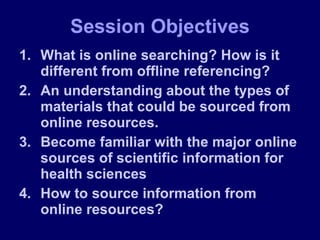
What is online searching? How is it different from offline referencing? An understanding about the types of materials that could be sourced from online resources. Become familiar with the major online sources of scientific information for health sciences How to source information from online resources? Session Objectives
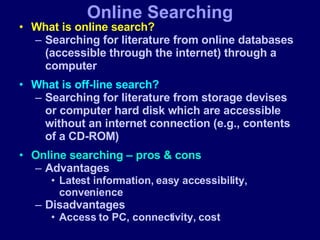
What is online search? Searching for literature from online databases (accessible through the internet) through a computer What is off-line search? Searching for literature from storage devises or computer hard disk which are accessible without an internet connection (e.g., contents of a CD-ROM) Online searching – pros & cons Advantages Latest information, easy accessibility, convenience  Disadvantages Access to PC, connectivity, cost Online Searching
Searching the net Internet browsers: Internet Explorer Netscape Navigator Mozilla Firefox
Types of online databases Bibliographic  Full-Text Numeric  Image, Audio, Video Dictionaries, glossaries and encyclopedia
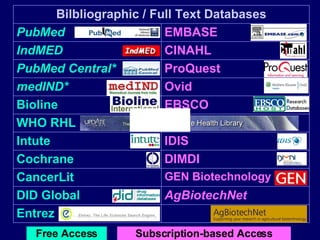
Free Access Subscription-based Access Entrez AgBiotechNet DID Global GEN Biotechnology CancerLit DIMDI Cochrane IDIS Intute WHO RHL EBSCO Bioline Ovid medIND* ProQuest PubMed Central* CINAHL IndMED EMBASE PubMed Bilbliographic / Full Text Databases
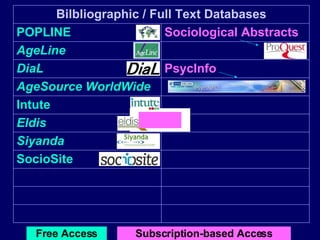
Free Access Subscription-based Access SocioSite Siyanda Eldis Intute AgeSource WorldWide PsycInfo DiaL AgeLine Sociological Abstracts POPLINE Bilbliographic / Full Text Databases
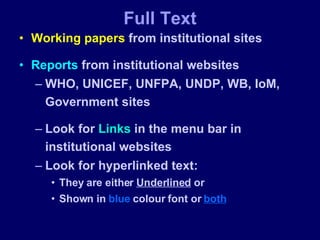
Full Text Working papers  from institutional sites Reports  from institutional websites WHO, UNICEF, UNFPA, UNDP, WB, IoM, Government sites  Look for  Links  in the menu bar in institutional websites Look for hyperlinked text: They are either  Underlined  or  Shown in  blue  colour font or  both
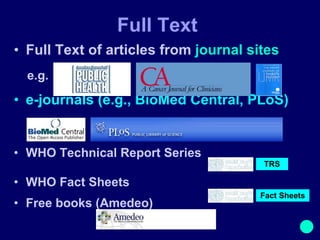
Full Text Full Text of articles from  journal sites e-journals (e.g., BioMed Central, PLoS) WHO Technical Report Series WHO Fact Sheets Free books (Amedeo) TRS Fact Sheets e.g.
Databases: Numeric WHO Statistics Information System (WHOSIS) NFHS III CBHI Census of India 2001 National Statistics, UK
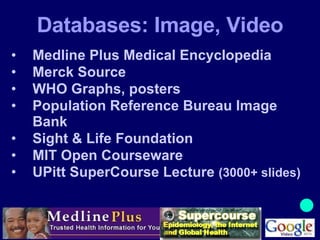
Databases: Image, Video Medline Plus Medical Encyclopedia Merck Source WHO Graphs, posters Population Reference Bureau Image Bank Sight & Life Foundation MIT Open Courseware UPitt SuperCourse Lecture  (3000+ slides)
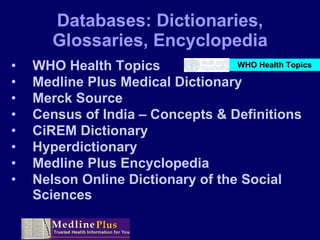
Databases: Dictionaries, Glossaries, Encyclopedia WHO Health Topics Medline Plus Medical Dictionary Merck Source Census of India – Concepts & Definitions CiREM Dictionary Hyperdictionary Medline Plus Encyclopedia Nelson Online Dictionary of the Social Sciences WHO Health Topics
Other types of Databases Clinical Trials Reporting Guidelines Longitudinal studies Patents
Search Basic Advanced Search term  Boolean Operators Limits Thesaurus Success depends on  Search strategy How to source information from databases?
Research Topic: “Prevalence of malnutrition in Tamil Nadu” Search strategy: “ Previous literatures on malnutrition in India”  Revised search strategy “ Malnutrition in India”  Limits: Abstract, Human Limits: 0-6 years  The above search strategy for Tamil Nadu Example
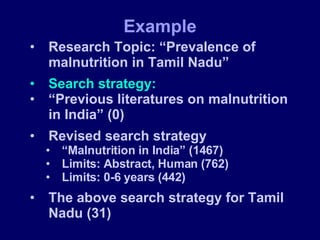
Research Topic: “Prevalence of malnutrition in Tamil Nadu” Search strategy: “ Previous literatures on malnutrition in India” (0) Revised search strategy “ Malnutrition in India” (1467) Limits: Abstract, Human (762) Limits: 0-6 years (442) The above search strategy for Tamil Nadu (31) Example
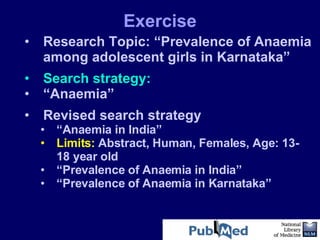
Research Topic: “Prevalence of Anaemia among adolescent girls in Karnataka” Search strategy: “ Anaemia”  Revised search strategy “ Anaemia in India”  Limits:  Abstract, Human, Females, Age: 13-18 year old  “ Prevalence of Anaemia in India”  “ Prevalence of Anaemia in Karnataka”  Exercise
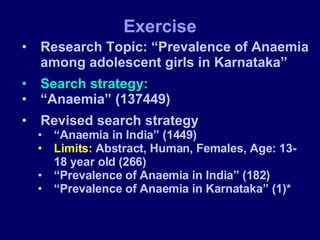
Research Topic: “Prevalence of Anaemia among adolescent girls in Karnataka” Search strategy: “ Anaemia” (137449) Revised search strategy “ Anaemia in India” (1449) Limits:  Abstract, Human, Females, Age: 13-18 year old (266) “ Prevalence of Anaemia in India” (182) “ Prevalence of Anaemia in Karnataka” (1)* Exercise
Boolean searching is a way to improve search results.    Boolean terms are called "operators."   Boolean operators are AND, OR, NOT, and NEAR  They can be combined in the same search.  AND  Narrows – more precise, fewer items [use this when 1 out of 10 of retrieved items are irrelevant] e.g., Vitamin A Deficiency (VAD) & Iron Deficiency Anaemia (IDA) OR  Broadens – more inclusive, more items NOT / NO  Eliminates – eliminate items NEAR / WITH / ADJASCENT / FOLLOWED BY   Specifies how close terms should appear to each other.   Parentheses  ( Nesting )  Clarifies relationships between search terms  e.g. (diet or nutrition) and women Some databases use Boolean under ‘Limit’ / ‘Combine’ function Venn Diagrams Near Wild Cat George Boole John Venn VAD IDA VAD IDA VAD NOT IDA The art of database searching: Boolean operators
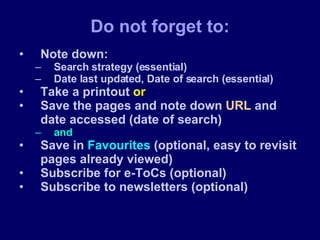
Note down: Search strategy (essential) Date last updated, Date of search (essential) Take a printout  or Save the pages and note down  URL  and date accessed (date of search)  and Save in  Favourites  (optional, easy to revisit pages already viewed) Subscribe for e-ToCs (optional) Subscribe to newsletters (optional) Do not forget to:
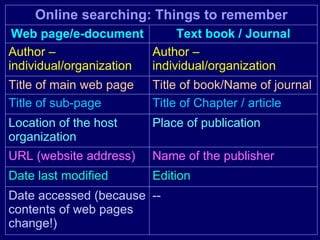
Online searching: Things to remember -- Date accessed (because contents of web pages change!) Edition Date last modified Name of the publisher URL (website address) Place of publication Location of the host organization Title of Chapter / article Title of sub-page Title of book/Name of journal Title of main web page Author – individual/organization Author – individual/organization Text book / Journal Web page/e-document
The ICMJE-URM and the Vancouver Style of Referencing How to quote online sources?
Health Research: Quality & Reliability  of Online Sources of Information Scientific Authentic (e.g., peer reviewed) Accredited HON CODE Grey literature: unpublished,  not available through commercial  publication channels http://www.hon.ch/
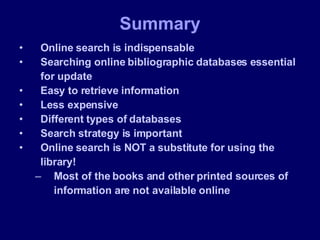
Online search is indispensable Searching online bibliographic databases essential for update Easy to retrieve information Less expensive  Different types of databases Search strategy is important Online search is NOT a substitute for using the library!  Most of the books and other printed sources of information are not available online Summary
References Eyers JE. Searching Bibliographic databases effectively (1998). Health Policy and Planning. 3:339-342. Health On the Net Foundation (2007). Quality and Trustworthiness of the Medical and Health Web. [(last modified 10 Feb, 2007) (cited 26 Aug, 2007)]. Available from:  http://www.hon.ch/visitor.html National Centre for Biotechnology Information (2007). Home page of NCBI. [(last modified 3 July, 2007) (cited 26 Aug, 2007)]. Available from:  http://www.ncbi.nlm.nih.gov/ 4. National Library of Medicine (2007). List of Journals Indexed for MEDLINE. [(last modified 26 June, 2007) (cited 26 Aug, 2007)]. Available from:  http:// www.nlm.nih.gov/tsd/serials/lji.html
Thank You! PSG
Annexure Glossary of Terms HINARI CINAHL  Plus  with Full Text EMBASE and PubMed Contact Information
Glossary of Terms Internet:  An electronic network of computers that work using a common communication protocol Browse:  Explore an online site in the World Wide Web (WWW) URL:   U niform  R esource  L ocator (The address of a resource in the Internet or World Wide Web)
Glossary of Terms Online database searching: A online database is a collection of information stored in a computer in a systematic way, so that a computer program can identify and access specific information being searched for. Online searching is done mostly using computer with the help of an internet connection. The software (programme) used to manage and source information from a database is called a database management system (DBMS). Types of databases  include bibliographic, textual, numeric, image, audio and video.
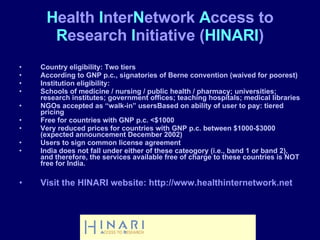
Country eligibility: Two tiers According to GNP p.c., signatories of Berne convention (waived for poorest) Institution eligibility: Schools of medicine / nursing / public health / pharmacy; universities; research institutes; government offices; teaching hospitals; medical libraries  NGOs accepted as “walk-in” usersBased on ability of user to pay: tiered pricing Free for countries with GNP p.c. <$1000  Very reduced prices for countries with GNP p.c. between $1000-$3000 (expected announcement December 2002) Users to sign common license agreement India does not fall under either of these cateogory (i.e., band 1 or band 2), and therefore, the services available free of charge to these countries is NOT free for India. Visit the HINARI website: http://www.healthinternetwork.net H ealth  I nter N etwork  A ccess to  R esearch  I nitiative ( HINARI )
CINAHL Plus with Full Text , referred to as the “robust version” of  CINAHLdirect  online service ( Cumulative Index to Nursing and Allied Health Literature ), includes indexing for 3,001 journals with coverage as far back as 1937 and full text for 336 of them. Previously, we subscribed to  CINAHLdirect  which provided indexing for 1,792 journals with full text access to 33 journals.  Legal cases, clinical innovations, critical paths, drug records, research instruments, clinical trials, access to publications from the National League for Nursing and the American Nurses’ Association, health care books, book chapters, nursing dissertations, selected conference proceedings, Evidence-Based Care Sheets and more are indexed.  CINAHL Plus with Full Text  provides a multidisciplinary approach to health care. The database is specifically designed for nursing and allied health disciplines such as physical therapy, speech pathology, audiology and general health care information. CINAHL  Plus  with Full Text
Stronger in Asian / Eastern Europe Journals Indexing is better for pharmaceutical concepts (generic pharmaceutical names, brand names, etc) Many journals in WHO library are indexed in EMBASE but not in PubMed. When to ask for EMBASE? Systematic review Major review paper or article When PubMed is not sufficient Pharmaceutical related questions Ongoing updates / alerts required Usually a discussion with the Librarians will determine if using EMBASE is necessary. What is in  EMBASE  but not in  PubMed ?
Contact information Dr. Y.S. Sivan Senior Lecturer Department of Community Medicine PSG Institute of Medical Sciences & Research Avinashi Road, Peelamedu Coimbatore 641 004 e-mail: yssivan@rediffmail.com

Ys Sivan Psgimsr Online Searching

  • 1.
    Searching Online for Health Research Information Y.S. Sivan PSG Institute of Medical Sciences & Research, Coimbatore Research Methodology Workshop-cum-Training August 31-September 1, 2007 PSG College of Nursing, Coimbatore
  • 2.
    What is onlinesearching? How is it different from offline referencing? An understanding about the types of materials that could be sourced from online resources. Become familiar with the major online sources of scientific information for health sciences How to source information from online resources? Session Objectives
  • 3.
    What is onlinesearch? Searching for literature from online databases (accessible through the internet) through a computer What is off-line search? Searching for literature from storage devises or computer hard disk which are accessible without an internet connection (e.g., contents of a CD-ROM) Online searching – pros & cons Advantages Latest information, easy accessibility, convenience Disadvantages Access to PC, connectivity, cost Online Searching
  • 4.
    Searching the netInternet browsers: Internet Explorer Netscape Navigator Mozilla Firefox
  • 5.
    Types of onlinedatabases Bibliographic Full-Text Numeric Image, Audio, Video Dictionaries, glossaries and encyclopedia
  • 6.
    Free Access Subscription-basedAccess Entrez AgBiotechNet DID Global GEN Biotechnology CancerLit DIMDI Cochrane IDIS Intute WHO RHL EBSCO Bioline Ovid medIND* ProQuest PubMed Central* CINAHL IndMED EMBASE PubMed Bilbliographic / Full Text Databases
  • 7.
    Free Access Subscription-basedAccess SocioSite Siyanda Eldis Intute AgeSource WorldWide PsycInfo DiaL AgeLine Sociological Abstracts POPLINE Bilbliographic / Full Text Databases
  • 8.
    Full Text Workingpapers from institutional sites Reports from institutional websites WHO, UNICEF, UNFPA, UNDP, WB, IoM, Government sites Look for Links in the menu bar in institutional websites Look for hyperlinked text: They are either Underlined or Shown in blue colour font or both
  • 9.
    Full Text FullText of articles from journal sites e-journals (e.g., BioMed Central, PLoS) WHO Technical Report Series WHO Fact Sheets Free books (Amedeo) TRS Fact Sheets e.g.
  • 10.
    Databases: Numeric WHOStatistics Information System (WHOSIS) NFHS III CBHI Census of India 2001 National Statistics, UK
  • 11.
    Databases: Image, VideoMedline Plus Medical Encyclopedia Merck Source WHO Graphs, posters Population Reference Bureau Image Bank Sight & Life Foundation MIT Open Courseware UPitt SuperCourse Lecture (3000+ slides)
  • 12.
    Databases: Dictionaries, Glossaries,Encyclopedia WHO Health Topics Medline Plus Medical Dictionary Merck Source Census of India – Concepts & Definitions CiREM Dictionary Hyperdictionary Medline Plus Encyclopedia Nelson Online Dictionary of the Social Sciences WHO Health Topics
  • 13.
    Other types ofDatabases Clinical Trials Reporting Guidelines Longitudinal studies Patents
  • 14.
    Search Basic AdvancedSearch term Boolean Operators Limits Thesaurus Success depends on Search strategy How to source information from databases?
  • 15.
    Research Topic: “Prevalenceof malnutrition in Tamil Nadu” Search strategy: “ Previous literatures on malnutrition in India” Revised search strategy “ Malnutrition in India” Limits: Abstract, Human Limits: 0-6 years The above search strategy for Tamil Nadu Example
  • 16.
    Research Topic: “Prevalenceof malnutrition in Tamil Nadu” Search strategy: “ Previous literatures on malnutrition in India” (0) Revised search strategy “ Malnutrition in India” (1467) Limits: Abstract, Human (762) Limits: 0-6 years (442) The above search strategy for Tamil Nadu (31) Example
  • 17.
    Research Topic: “Prevalenceof Anaemia among adolescent girls in Karnataka” Search strategy: “ Anaemia” Revised search strategy “ Anaemia in India” Limits: Abstract, Human, Females, Age: 13-18 year old “ Prevalence of Anaemia in India” “ Prevalence of Anaemia in Karnataka” Exercise
  • 18.
    Research Topic: “Prevalenceof Anaemia among adolescent girls in Karnataka” Search strategy: “ Anaemia” (137449) Revised search strategy “ Anaemia in India” (1449) Limits: Abstract, Human, Females, Age: 13-18 year old (266) “ Prevalence of Anaemia in India” (182) “ Prevalence of Anaemia in Karnataka” (1)* Exercise
  • 19.
    Boolean searching isa way to improve search results.   Boolean terms are called &quot;operators.&quot;  Boolean operators are AND, OR, NOT, and NEAR They can be combined in the same search. AND Narrows – more precise, fewer items [use this when 1 out of 10 of retrieved items are irrelevant] e.g., Vitamin A Deficiency (VAD) & Iron Deficiency Anaemia (IDA) OR Broadens – more inclusive, more items NOT / NO Eliminates – eliminate items NEAR / WITH / ADJASCENT / FOLLOWED BY Specifies how close terms should appear to each other. Parentheses ( Nesting ) Clarifies relationships between search terms e.g. (diet or nutrition) and women Some databases use Boolean under ‘Limit’ / ‘Combine’ function Venn Diagrams Near Wild Cat George Boole John Venn VAD IDA VAD IDA VAD NOT IDA The art of database searching: Boolean operators
  • 20.
    Note down: Searchstrategy (essential) Date last updated, Date of search (essential) Take a printout or Save the pages and note down URL and date accessed (date of search) and Save in Favourites (optional, easy to revisit pages already viewed) Subscribe for e-ToCs (optional) Subscribe to newsletters (optional) Do not forget to:
  • 21.
    Online searching: Thingsto remember -- Date accessed (because contents of web pages change!) Edition Date last modified Name of the publisher URL (website address) Place of publication Location of the host organization Title of Chapter / article Title of sub-page Title of book/Name of journal Title of main web page Author – individual/organization Author – individual/organization Text book / Journal Web page/e-document
  • 22.
    The ICMJE-URM andthe Vancouver Style of Referencing How to quote online sources?
  • 23.
    Health Research: Quality& Reliability of Online Sources of Information Scientific Authentic (e.g., peer reviewed) Accredited HON CODE Grey literature: unpublished, not available through commercial publication channels http://www.hon.ch/
  • 24.
    Online search isindispensable Searching online bibliographic databases essential for update Easy to retrieve information Less expensive Different types of databases Search strategy is important Online search is NOT a substitute for using the library! Most of the books and other printed sources of information are not available online Summary
  • 25.
    References Eyers JE.Searching Bibliographic databases effectively (1998). Health Policy and Planning. 3:339-342. Health On the Net Foundation (2007). Quality and Trustworthiness of the Medical and Health Web. [(last modified 10 Feb, 2007) (cited 26 Aug, 2007)]. Available from: http://www.hon.ch/visitor.html National Centre for Biotechnology Information (2007). Home page of NCBI. [(last modified 3 July, 2007) (cited 26 Aug, 2007)]. Available from: http://www.ncbi.nlm.nih.gov/ 4. National Library of Medicine (2007). List of Journals Indexed for MEDLINE. [(last modified 26 June, 2007) (cited 26 Aug, 2007)]. Available from: http:// www.nlm.nih.gov/tsd/serials/lji.html
  • 26.
  • 27.
    Annexure Glossary ofTerms HINARI CINAHL Plus with Full Text EMBASE and PubMed Contact Information
  • 28.
    Glossary of TermsInternet: An electronic network of computers that work using a common communication protocol Browse: Explore an online site in the World Wide Web (WWW) URL: U niform R esource L ocator (The address of a resource in the Internet or World Wide Web)
  • 29.
    Glossary of TermsOnline database searching: A online database is a collection of information stored in a computer in a systematic way, so that a computer program can identify and access specific information being searched for. Online searching is done mostly using computer with the help of an internet connection. The software (programme) used to manage and source information from a database is called a database management system (DBMS). Types of databases include bibliographic, textual, numeric, image, audio and video.
  • 30.
    Country eligibility: Twotiers According to GNP p.c., signatories of Berne convention (waived for poorest) Institution eligibility: Schools of medicine / nursing / public health / pharmacy; universities; research institutes; government offices; teaching hospitals; medical libraries NGOs accepted as “walk-in” usersBased on ability of user to pay: tiered pricing Free for countries with GNP p.c. <$1000 Very reduced prices for countries with GNP p.c. between $1000-$3000 (expected announcement December 2002) Users to sign common license agreement India does not fall under either of these cateogory (i.e., band 1 or band 2), and therefore, the services available free of charge to these countries is NOT free for India. Visit the HINARI website: http://www.healthinternetwork.net H ealth I nter N etwork A ccess to R esearch I nitiative ( HINARI )
  • 31.
    CINAHL Plus withFull Text , referred to as the “robust version” of CINAHLdirect online service ( Cumulative Index to Nursing and Allied Health Literature ), includes indexing for 3,001 journals with coverage as far back as 1937 and full text for 336 of them. Previously, we subscribed to CINAHLdirect which provided indexing for 1,792 journals with full text access to 33 journals. Legal cases, clinical innovations, critical paths, drug records, research instruments, clinical trials, access to publications from the National League for Nursing and the American Nurses’ Association, health care books, book chapters, nursing dissertations, selected conference proceedings, Evidence-Based Care Sheets and more are indexed. CINAHL Plus with Full Text provides a multidisciplinary approach to health care. The database is specifically designed for nursing and allied health disciplines such as physical therapy, speech pathology, audiology and general health care information. CINAHL Plus with Full Text
  • 32.
    Stronger in Asian/ Eastern Europe Journals Indexing is better for pharmaceutical concepts (generic pharmaceutical names, brand names, etc) Many journals in WHO library are indexed in EMBASE but not in PubMed. When to ask for EMBASE? Systematic review Major review paper or article When PubMed is not sufficient Pharmaceutical related questions Ongoing updates / alerts required Usually a discussion with the Librarians will determine if using EMBASE is necessary. What is in EMBASE but not in PubMed ?
  • 33.
    Contact information Dr.Y.S. Sivan Senior Lecturer Department of Community Medicine PSG Institute of Medical Sciences & Research Avinashi Road, Peelamedu Coimbatore 641 004 e-mail: yssivan@rediffmail.com