Library Collection Managers in Higher
Grounds: Weighing the Odds
Marianita D. Dablio
Lecturer, Library and Information Science
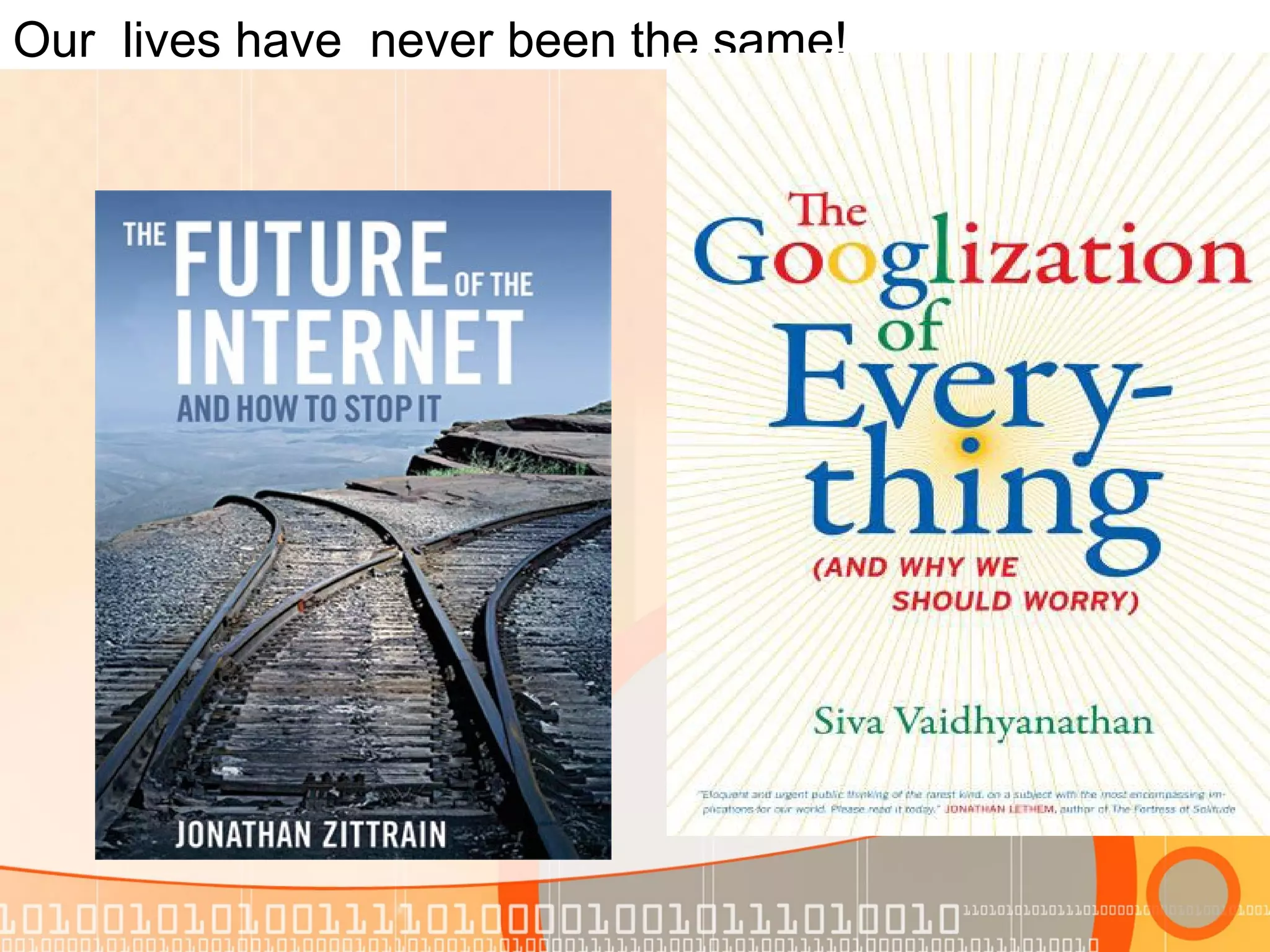
Our lives have never been the same!
Facts that figure:
• It took two centuries for the Library of Congress to acquire
today's analog collection—32 million printed volumes, 12.5
million photographs, 59.5 million manuscripts and other
materials – a total of more than 134 million physical items.
By contrast, with the explosion of digital information, it
now takes only about 15 minutes for the world to produce
an equivalent amount of information. Researchers at Cal-
Berkeley produced estimates of the amount of information
produced and circulated on the Internet in 2003 – it was
equivalent to 37,000 times the content of one Library of
Congress. Most of this information exists only in digital
form: so-called born-digital items, many of which are
already irretrievably lost.” Statement of Dr. James H. Billington The
Librarian of Congress before the House Subcommittee on Legislative Branch
U.S.House of Representatives
March 20, 2007
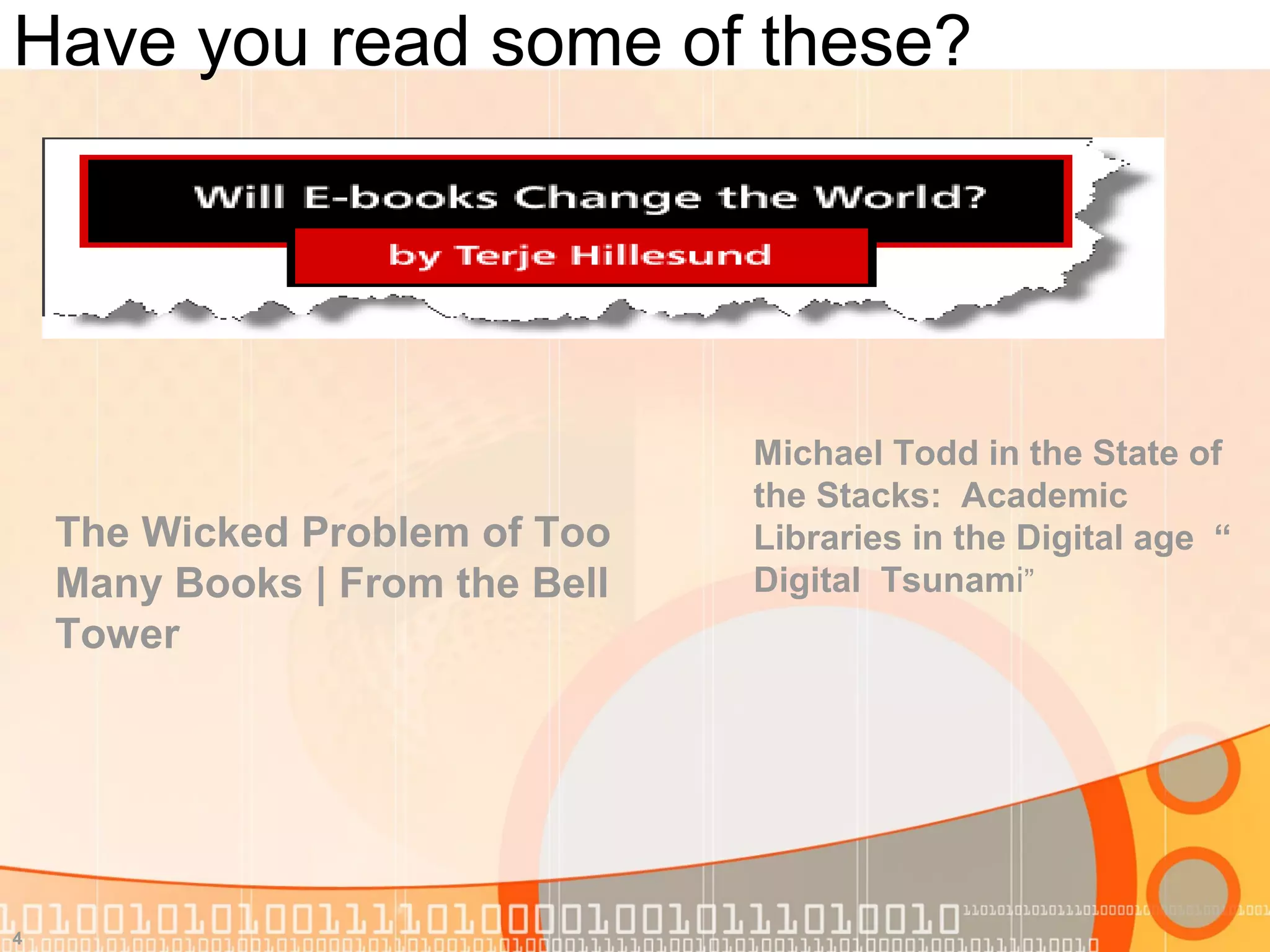
Have you read some of these?
4
The Wicked Problem of Too
Many Books | From the Bell
Tower
Michael Todd in the State of
the Stacks: Academic
Libraries in the Digital age “
Digital Tsunami”
Fr. Ambeth R. Ocampo
• “My greatest fear to my digital library is this:
Technology moves to fast that my present
PDF files may not be computer-readable in the
future”
Ocampo , Ambeth. Old fashioned
books in Looking Back. Philippine
Daily Inquirer March 4, 2015
I suggest that we find answers to the following:
• In what ways have collection and collecting
evolved in the changing digital landscape?
• What key issues confront collection
development/acquisition librarians in digital
environment?
• What strategies can library collection managers
consider?
• What roles /competencies are necessary in
managing digital resources?
IN WHAT WAYS HAVE
COLLECTION AND COLLECTING
EVOLVED IN THE CHANGING
DIGITAL LANDSCAPE?
Some things “old”, yet constant:
• Simply put, collection management is the systemic,
efficient and economic stewardship of library
resources.1
• The goal of any collection development organization
must be to provide the library with a collection that
meets the appropriate needs of its client population
within the limits of its fiscal and personnel resources.
To reach this goal, each segment of the collection
must be developed with an application of resources
consistent with its relative importance to the mission of
the library and the needs of its patrons.2
• Source: cited in Johnson
Traditional activities associated with
collection management
• Selection & acquisition of materials;
• Collection development policy;
• Assessment of patron needs;
• Collection analysis;
• Budget management;
• Space management including storage
• Community outreach & liaison
• Resource-sharing arrangements
• De-selection/cancellation & preservation
• Source: Horava
Do these concepts of collection still hold
true today?
• Ownership
• Control
• Tangibility (mostly on-site materials)
• Permanence
• Predictability (eg formats)
• Comprehensiveness
• Implicit pride and prestige for the institution
• Implicit value judgements -privileging/selecting
sources
Something “new”
• New and non-traditional forms of knowledge,
eg oral history, streaming audio and video,
research datasets, blogs, tweets, etc..
• Collections have sense making function
:translating information resources into
knowledge to solve problems
content in the 21st
century
• “The University of California Library Collection
comprises all print and digital resources,
archival collections, and shared purchases of
the UC Libraries. It is an integrated, shareable
user-centric collection that supports and
enhances the mission of the University of
California and whose strength is derived from
the diverse nature of the individual campus
library collections.”
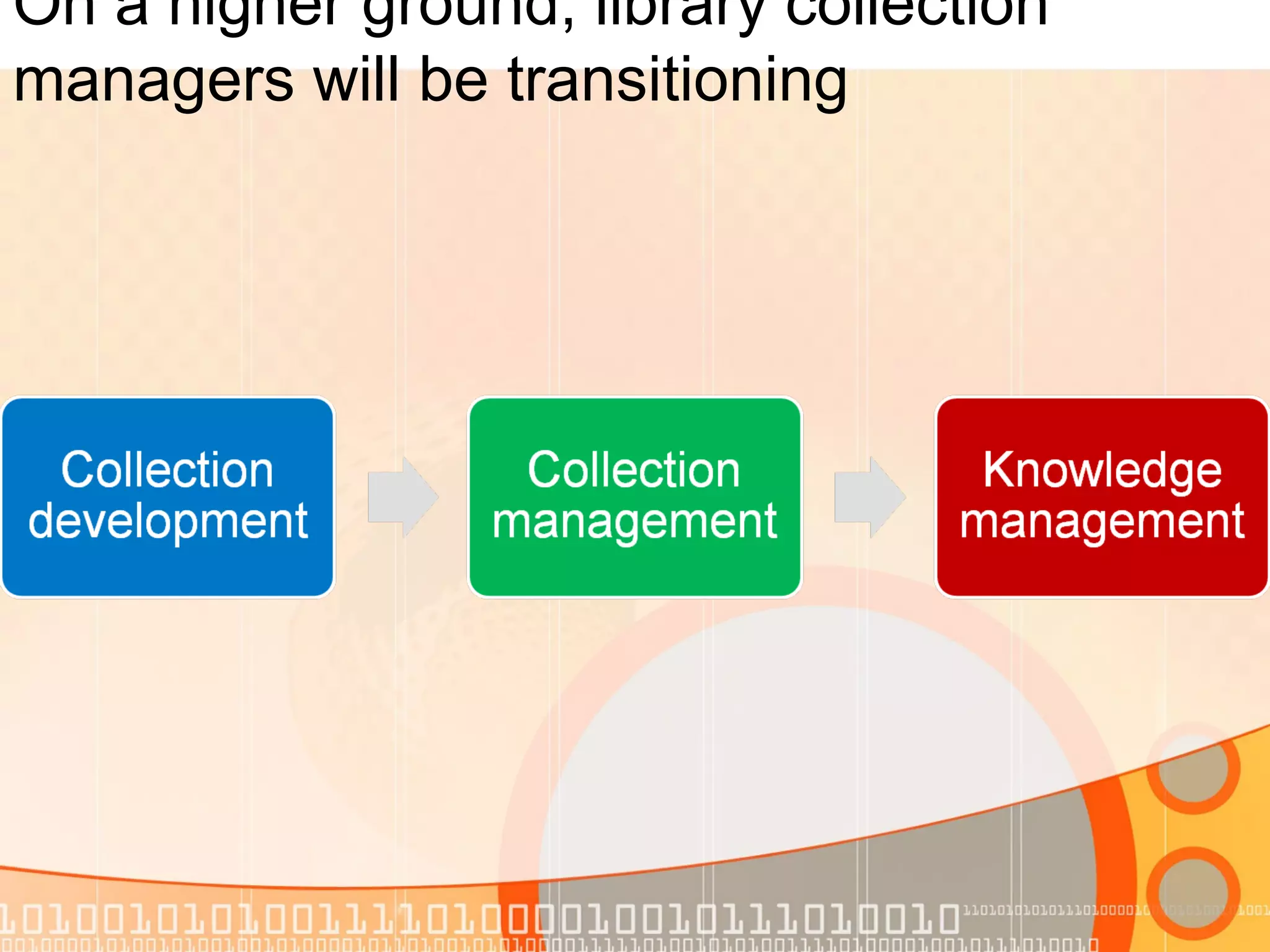
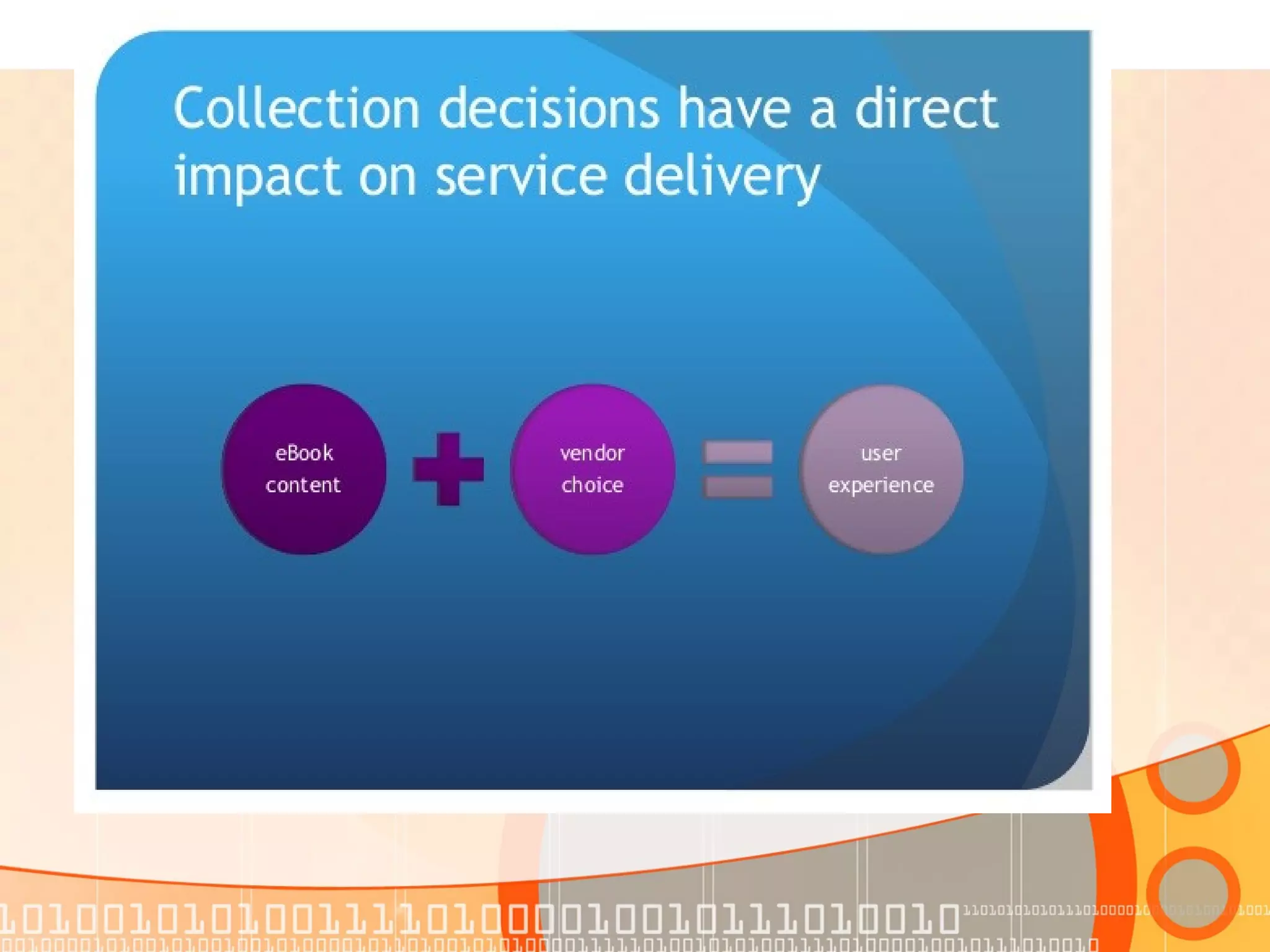
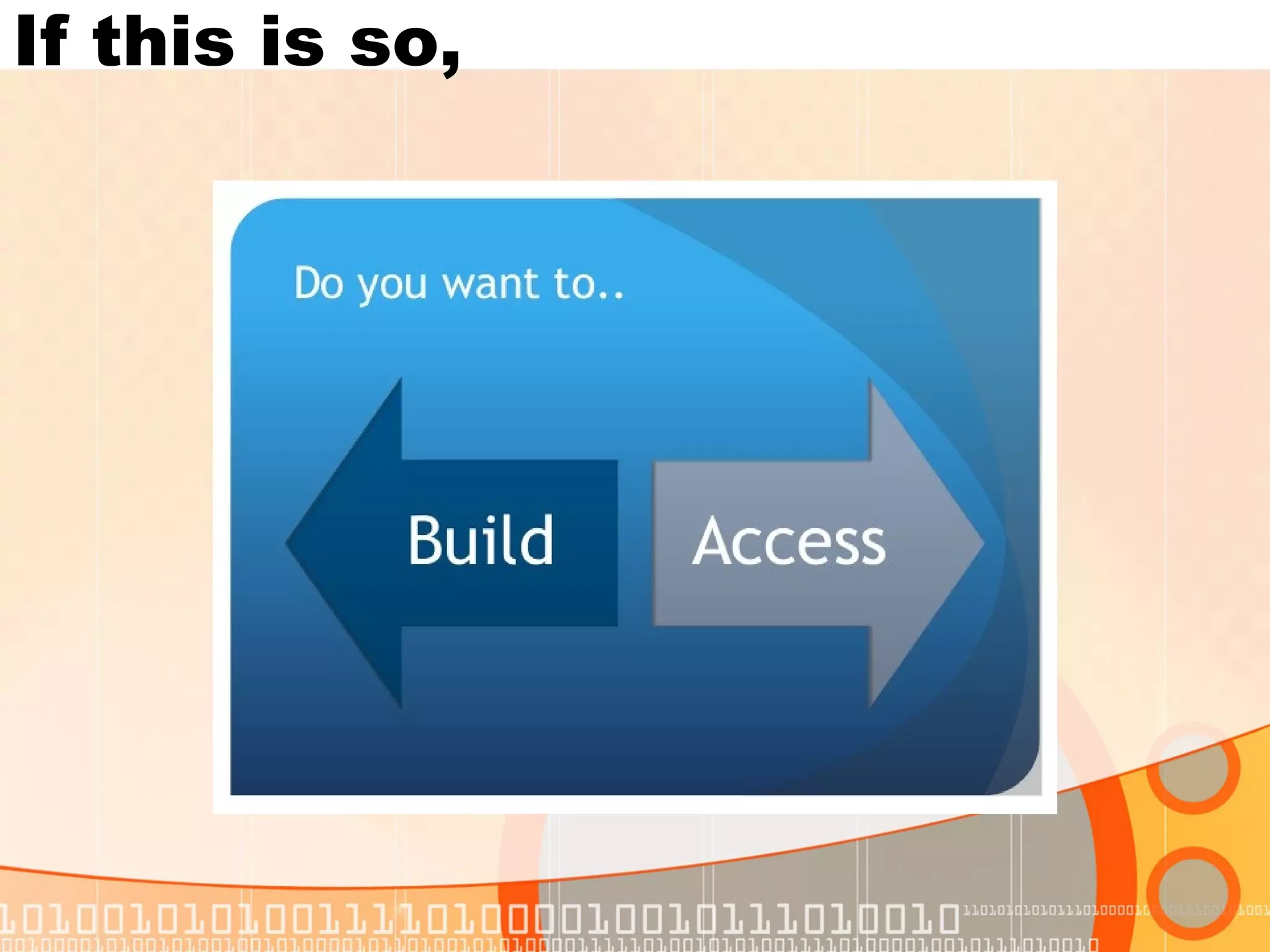
On a higher ground, library collection
managers will be transitioning
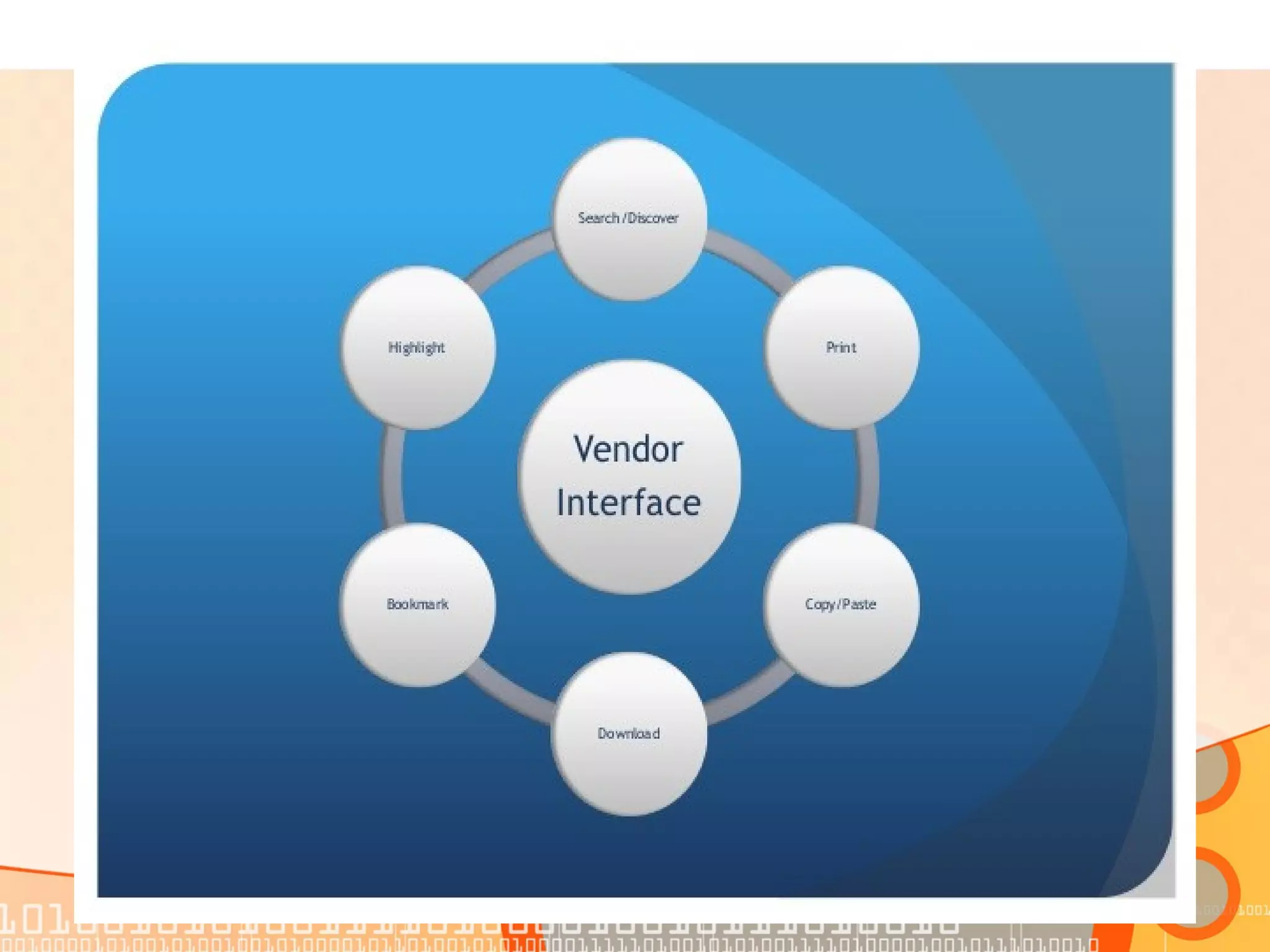
1. COLLECTION AS
CONTENTS AND CONTAINER
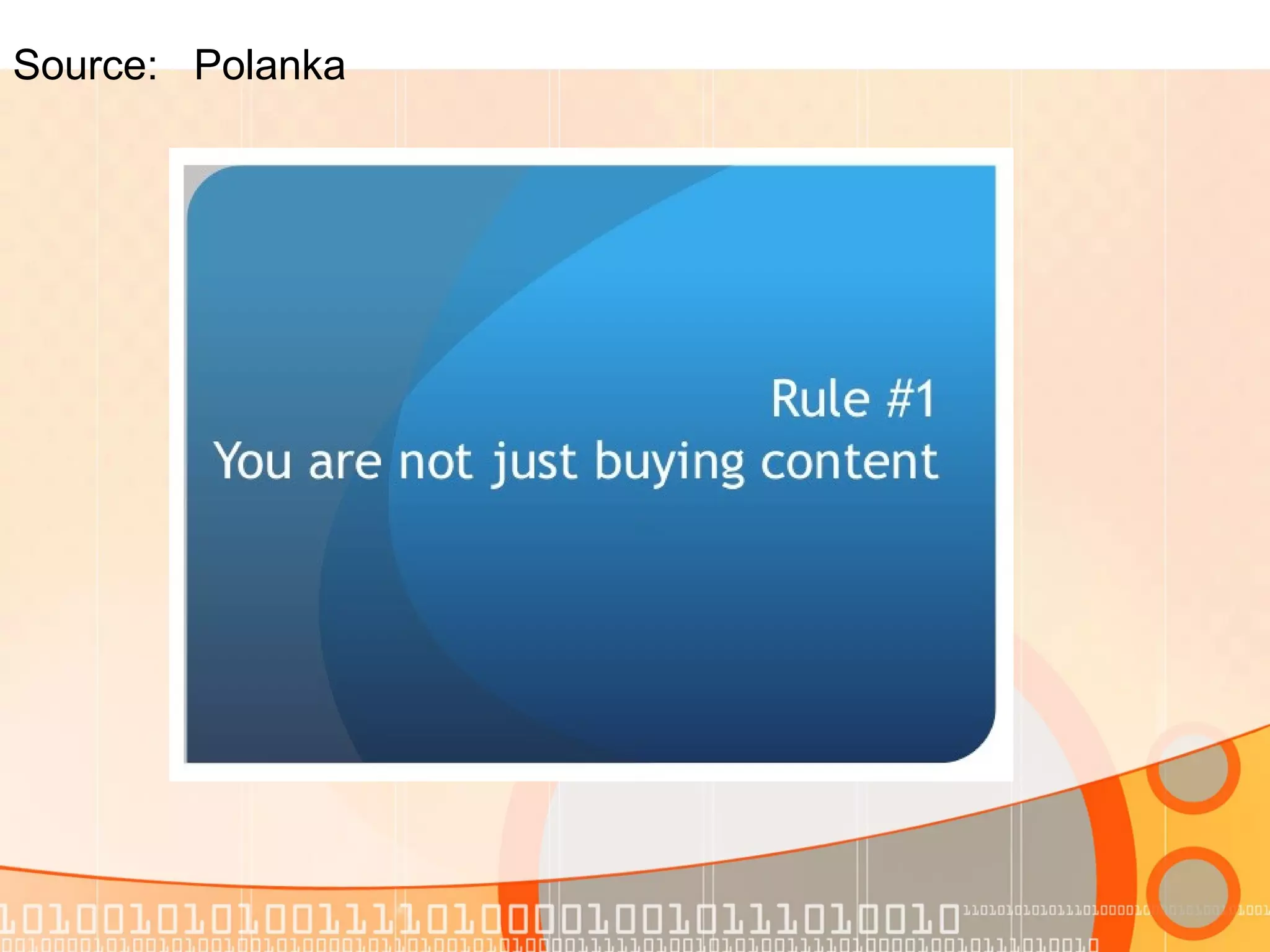
Source: Polanka
If this is so,
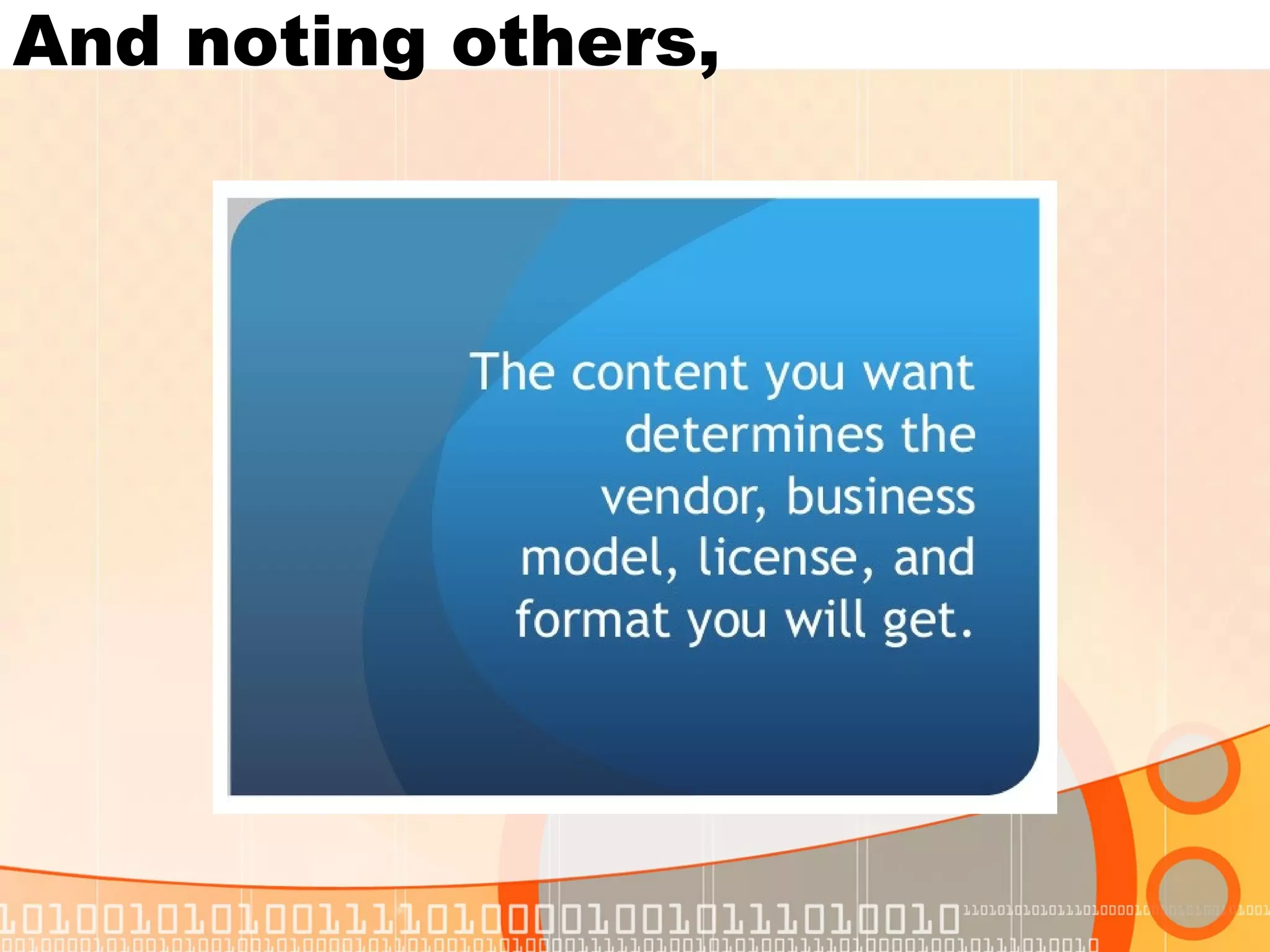
And noting others,
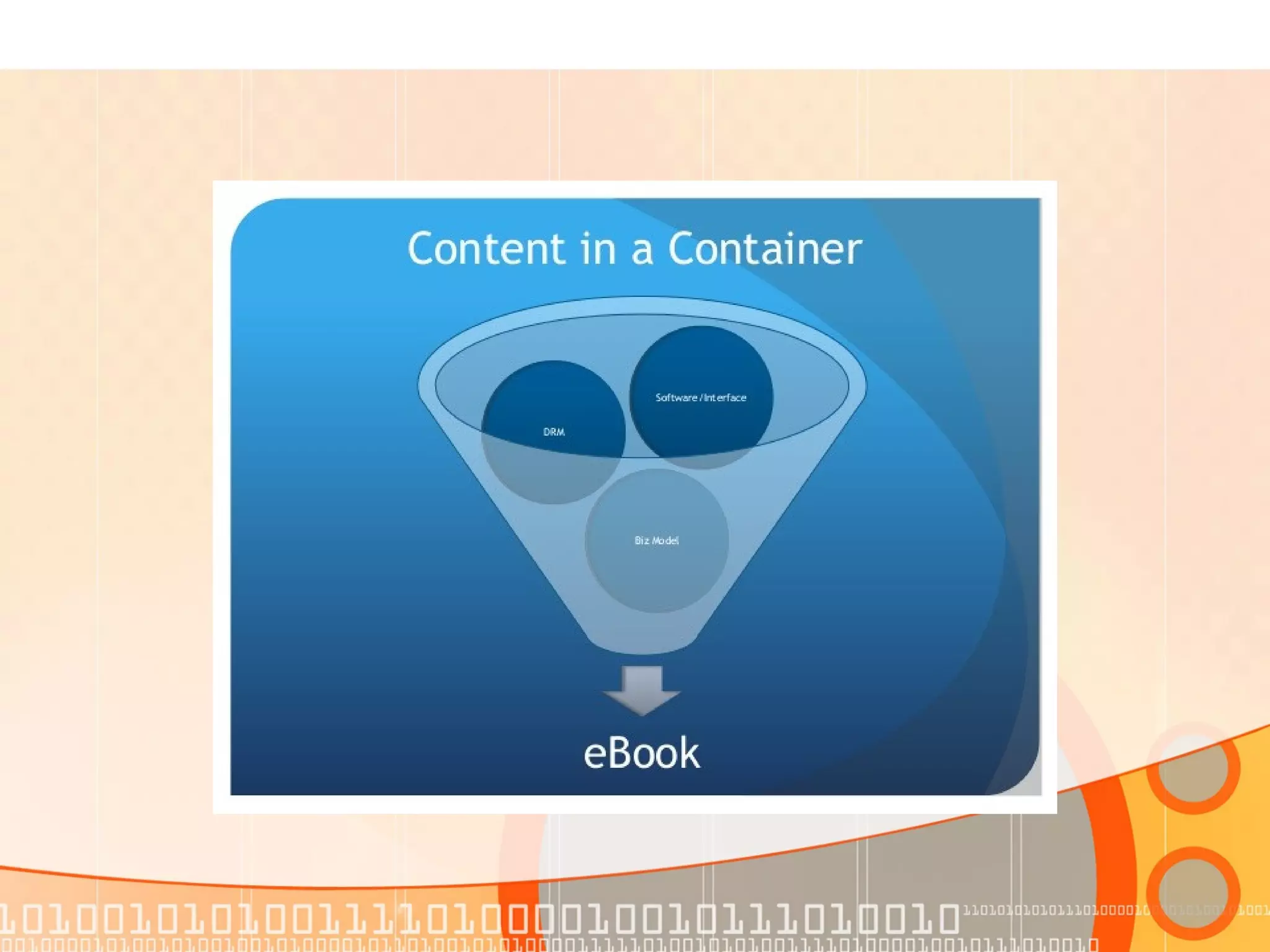
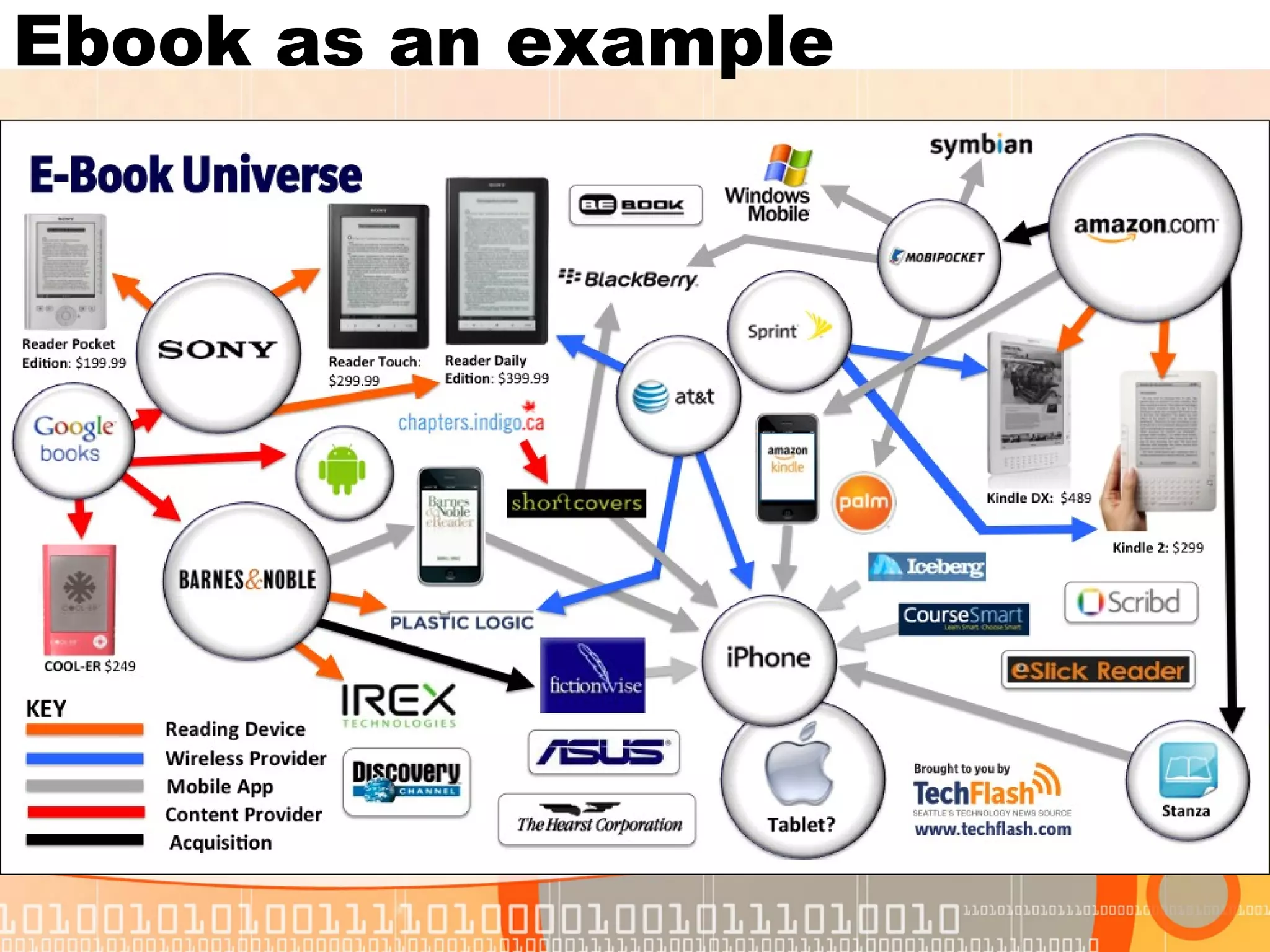
Ebook as an example
2.The evolving
scholarly record
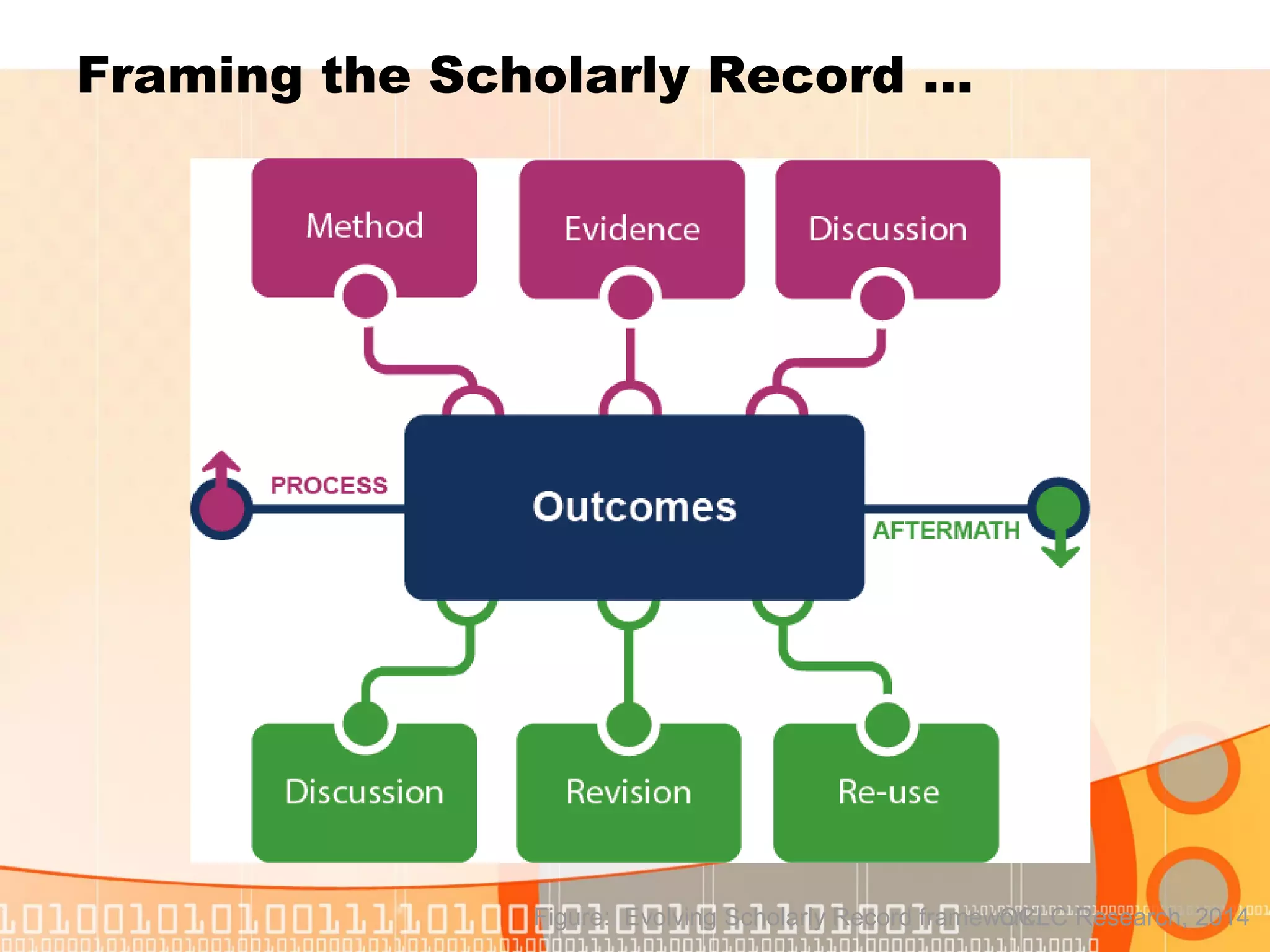
• Shift from print centric record to digital format
• The boundaries are shifting and blurring
• The shift from static nature to dynamic features
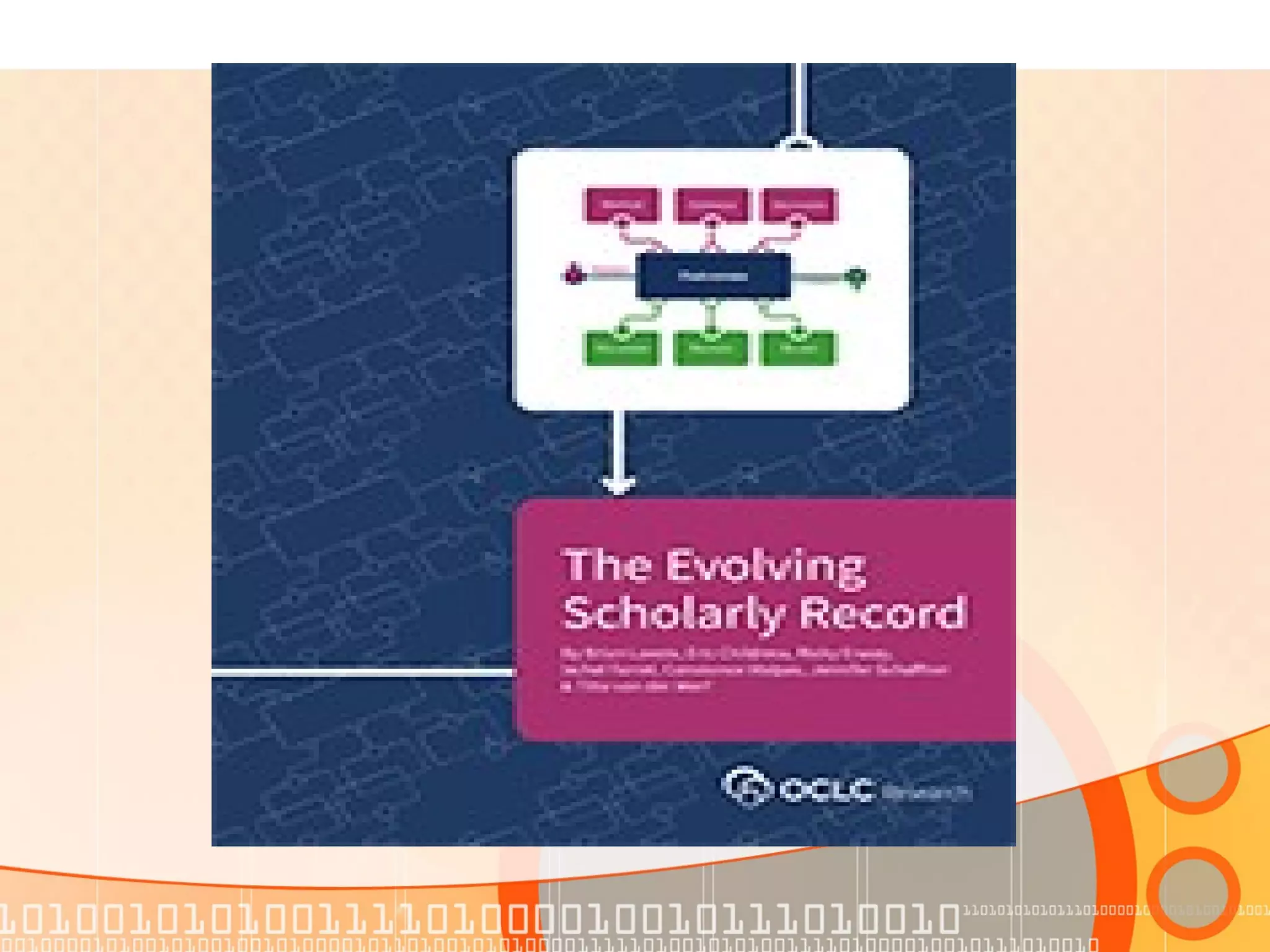
Framing the Scholarly Record …
OCLC Research, 2014Figure: Evolving Scholarly Record framework.
2. Collection Grid
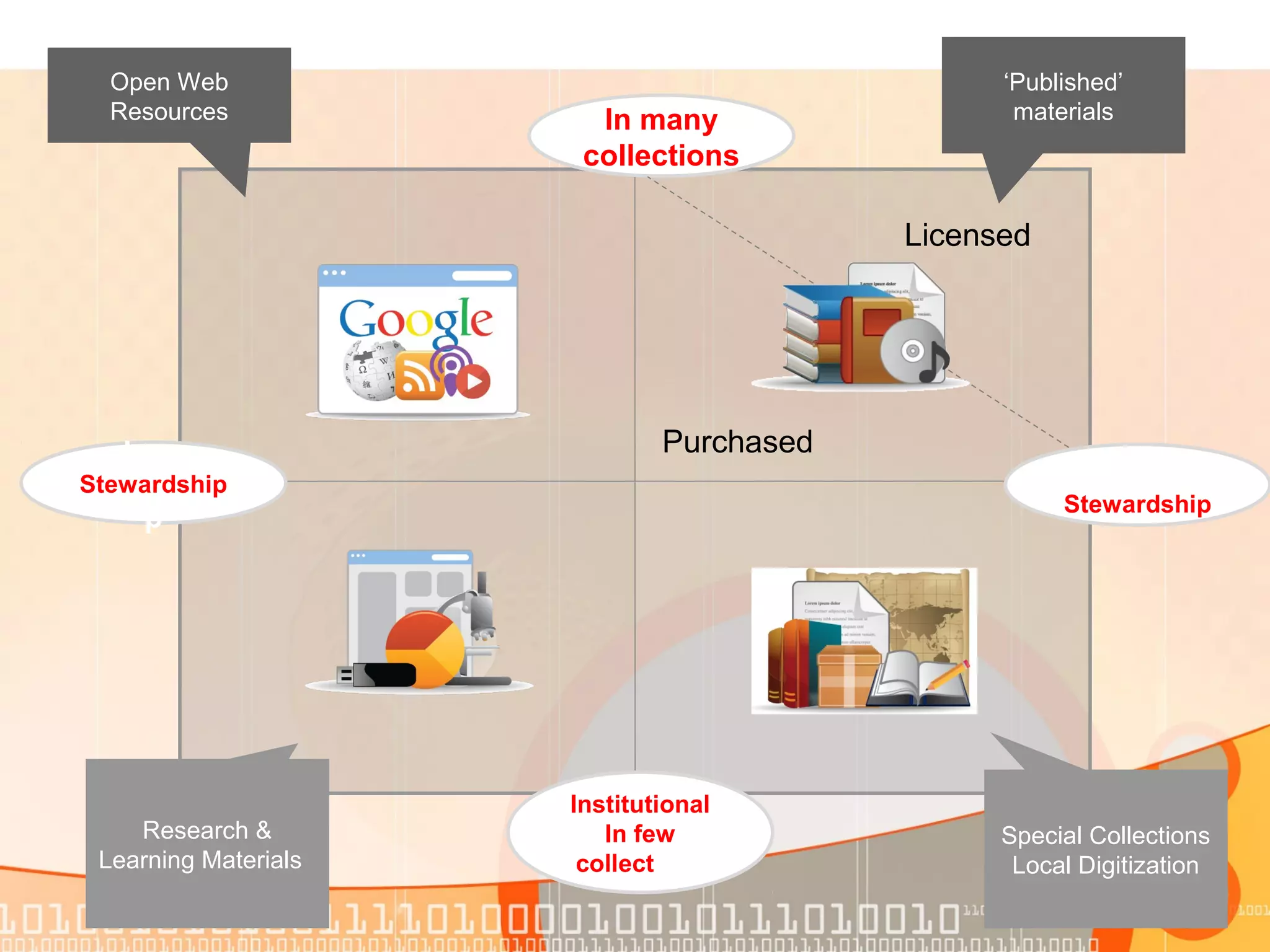
Low
Stewardship
p
Institutional
In few
collections
In many
collections
Research &
Learning Materials
Open Web
Resources
‘Published’
materials
Special Collections
Local Digitization
Licensed
Purchased
High
Stewardship
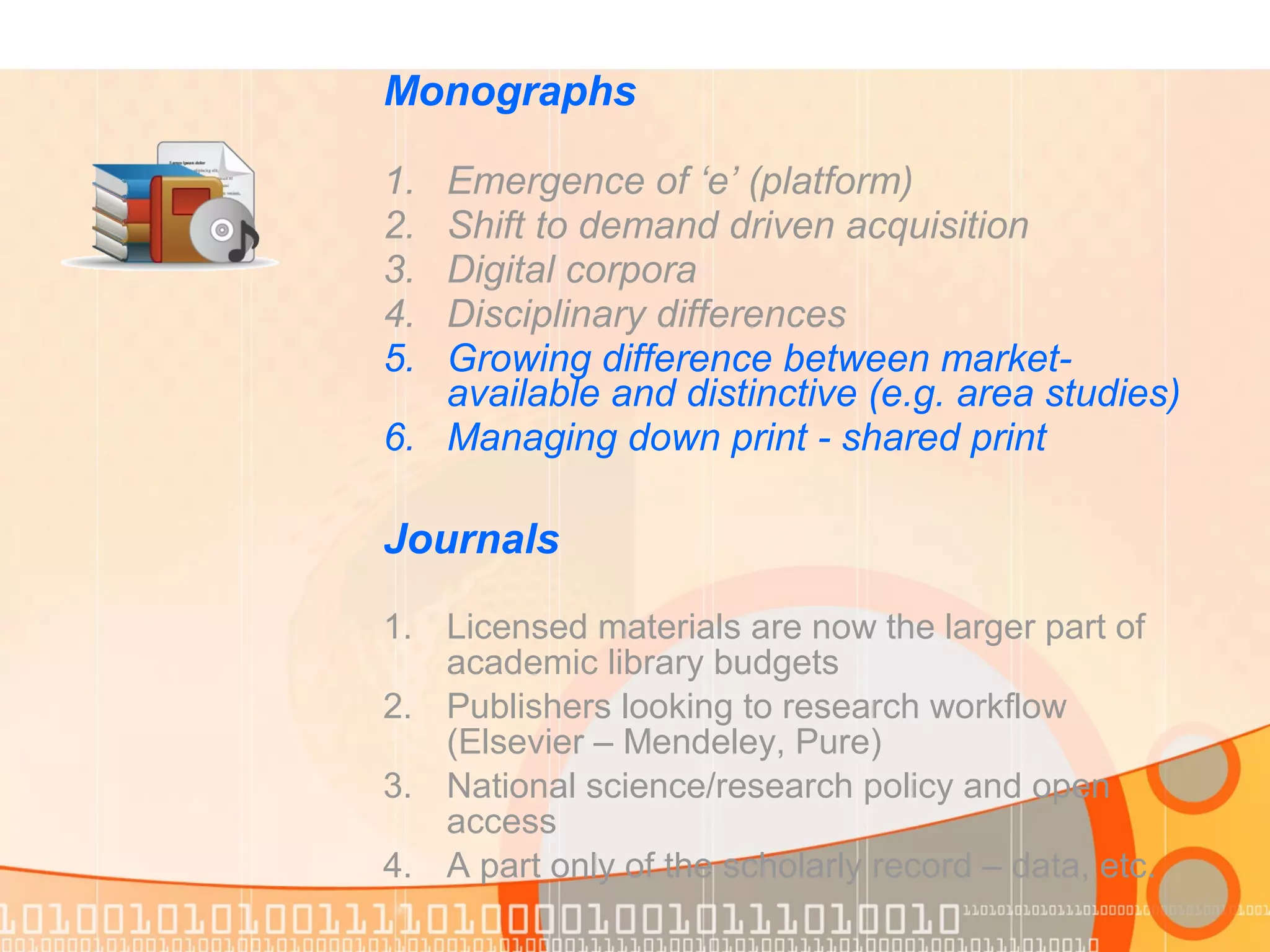
Journals
1. Licensed materials are now the larger part of
academic library budgets
2. Publishers looking to research workflow
(Elsevier – Mendeley, Pure)
3. National science/research policy and open
access
4. A part only of the scholarly record – data, etc.
Monographs
1. Emergence of ‘e’ (platform)
2. Shift to demand driven acquisition
3. Digital corpora
4. Disciplinary differences
5. Growing difference between market-
available and distinctive (e.g. area studies)
6. Managing down print - shared print
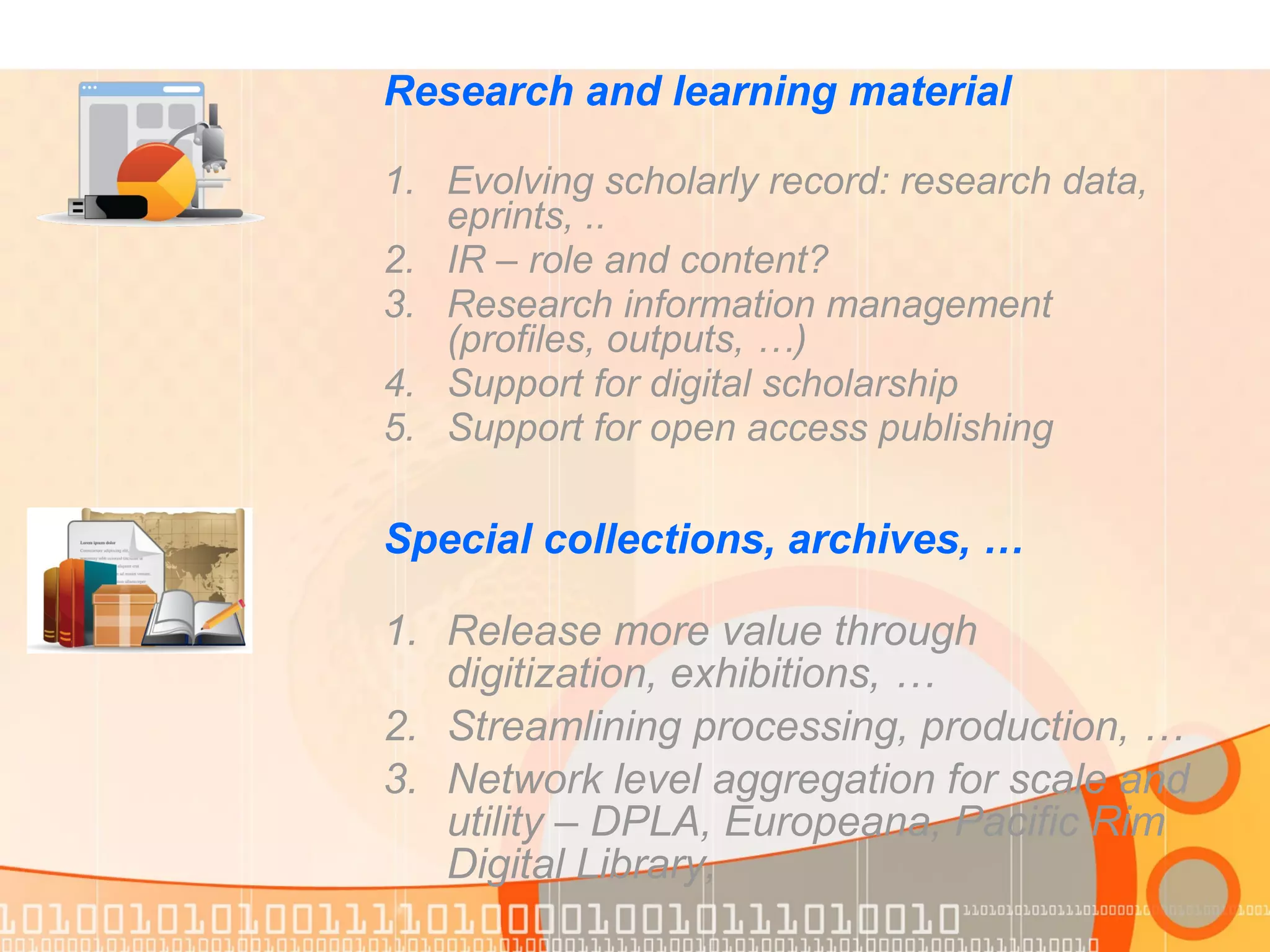
Special collections, archives, …
1. Release more value through
digitization, exhibitions, …
2. Streamlining processing, production, …
3. Network level aggregation for scale and
utility – DPLA, Europeana, Pacific Rim
Digital Library,
Research and learning material
1. Evolving scholarly record: research data,
eprints, ..
2. IR – role and content?
3. Research information management
(profiles, outputs, …)
4. Support for digital scholarship
5. Support for open access publishing
3.Collections as a
service
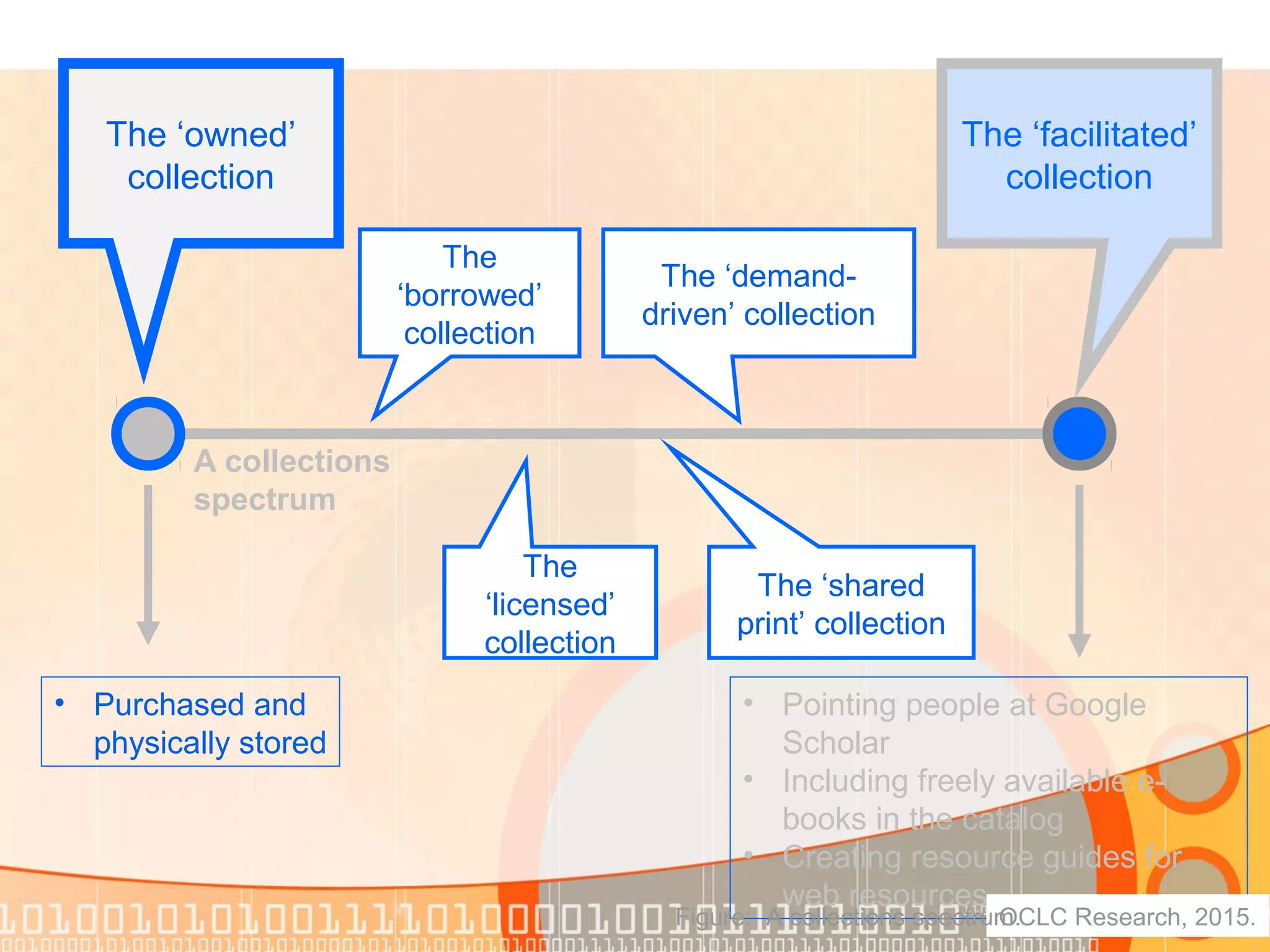
The ‘owned’
collection
The ‘facilitated’
collection
The
‘licensed’
collection
The
‘borrowed’
collection
• Pointing people at Google
Scholar
• Including freely available e-
books in the catalog
• Creating resource guides for
web resources
• Purchased and
physically stored
A collections
spectrum
The ‘demand-
driven’ collection
The ‘shared
print’ collection
OCLC Research, 2015.Figure: A collections spectrum.
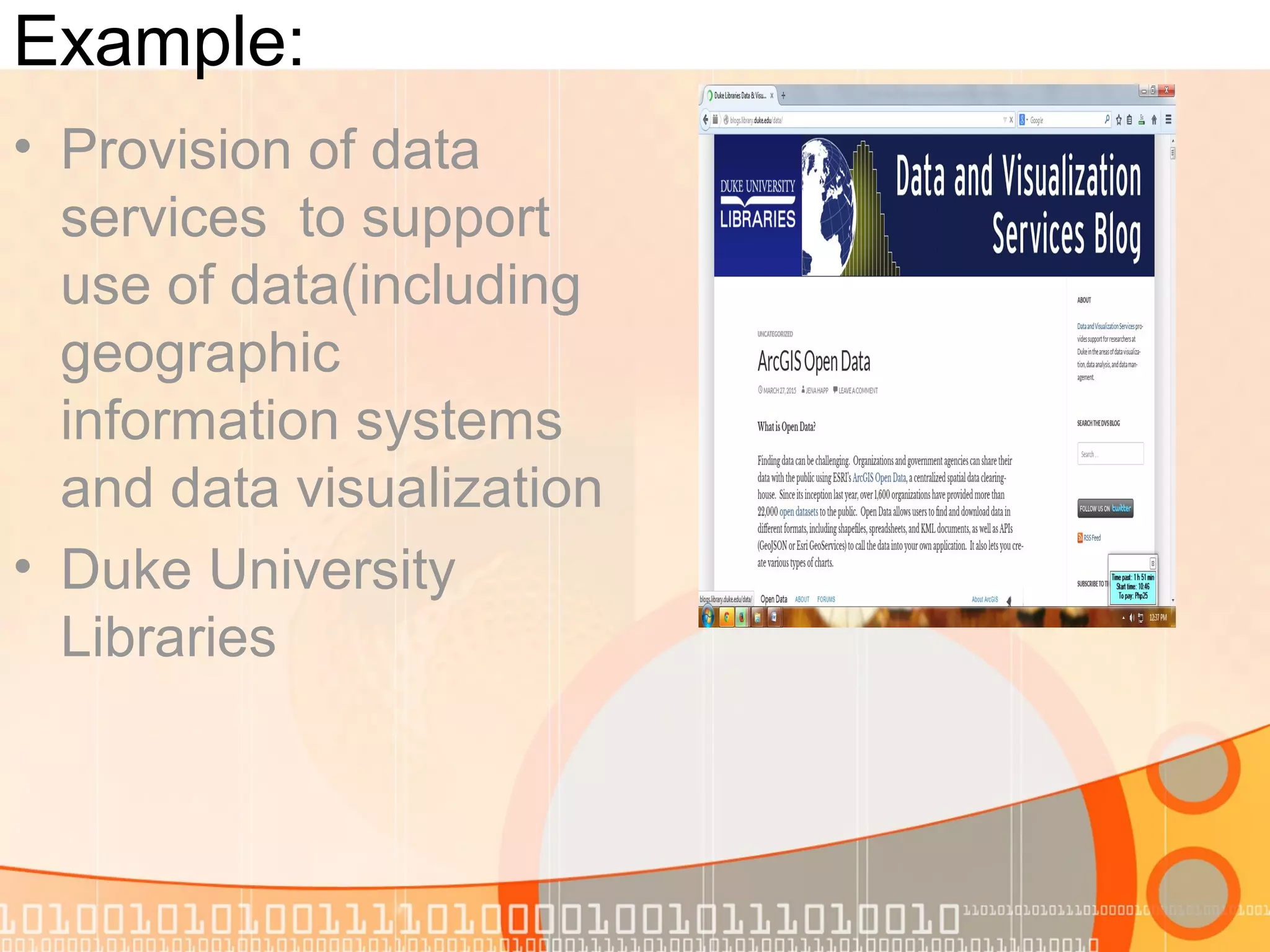
Example:
• Provision of data
services to support
use of data(including
geographic
information systems
and data visualization
• Duke University
Libraries
4. Workflow is the
new content
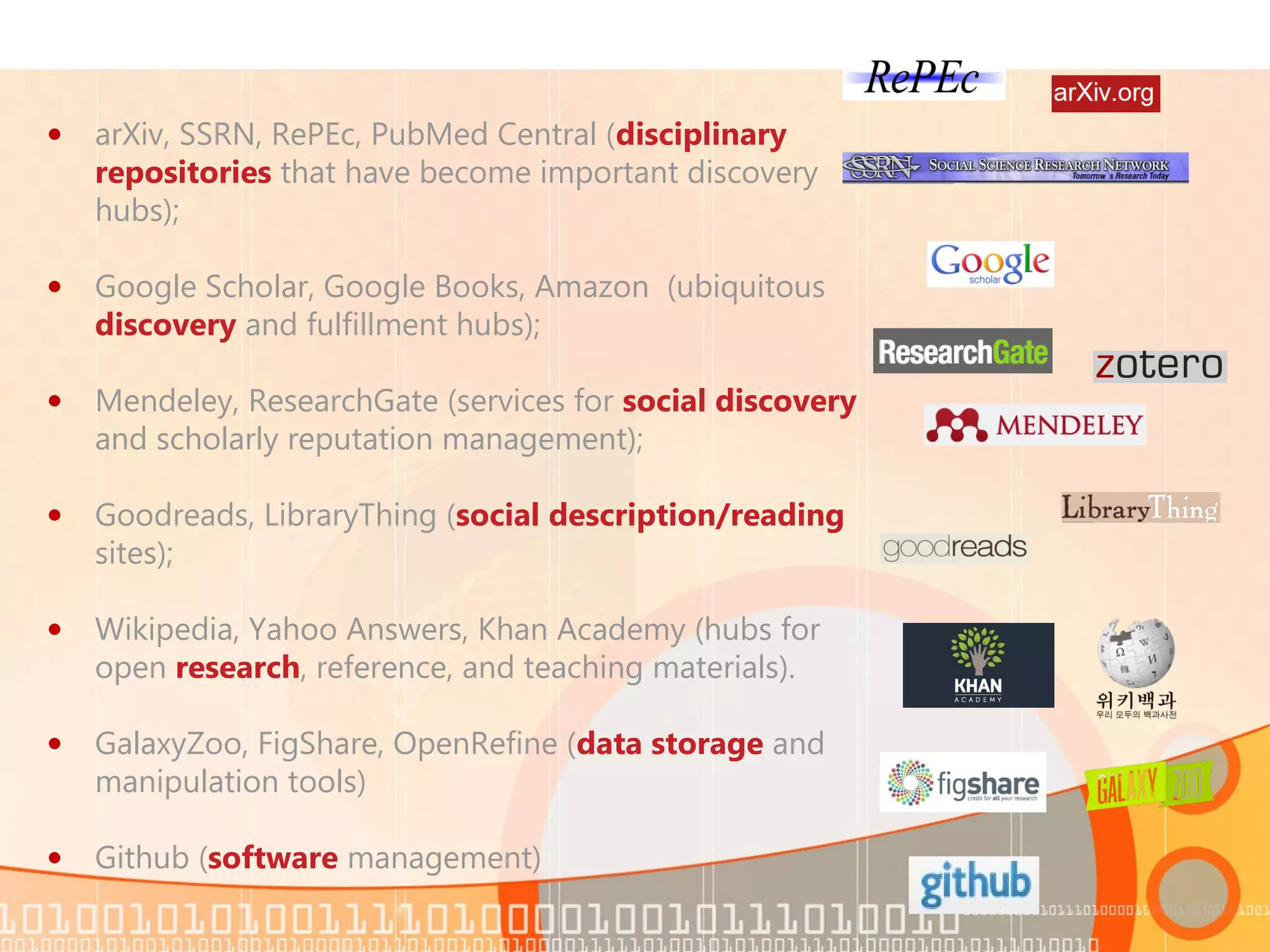
• arXiv, SSRN, RePEc, PubMed Central (disciplinary
repositories that have become important discovery
hubs);
• Google Scholar, Google Books, Amazon  (ubiquitous
discovery and fulfillment hubs);
• Mendeley, ResearchGate (services for social discovery
and scholarly reputation management);
• Goodreads, LibraryThing (social description/reading
sites);
• Wikipedia, Yahoo Answers, Khan Academy (hubs for
open research, reference, and teaching materials).
• GalaxyZoo, FigShare, OpenRefine (data storage and
manipulation tools)
• Github (software management)
Workflow is the new content
• In a print world,
researchers and learners
organized their workflow
around the library.
• The library had limited
interaction with the full
process.
• In a digital world, the
library needs to organize
itself around the
workflows of research
and learners.
• Workflows generate and
consume information
resources.
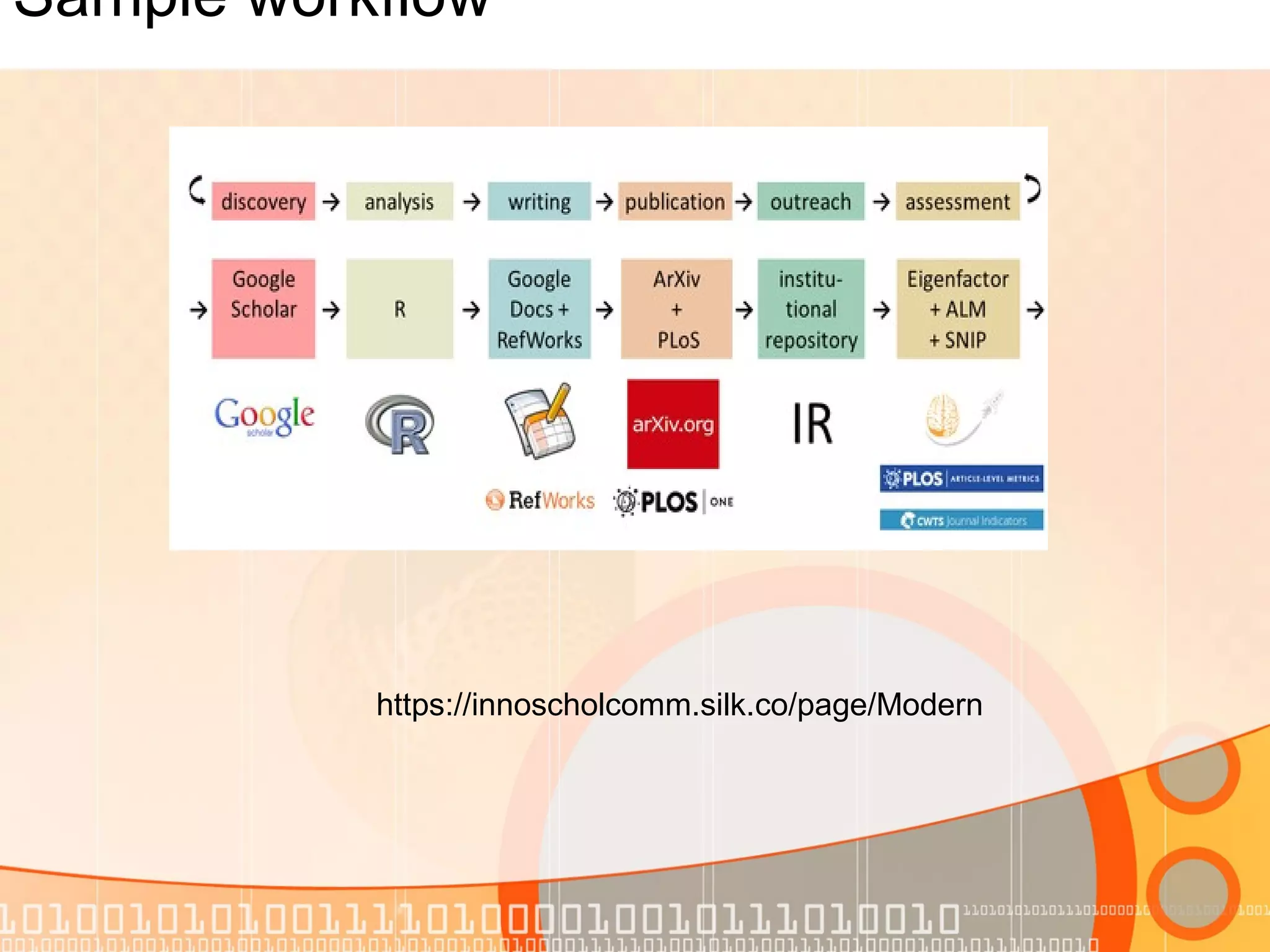
Sample workflow
 
https://innoscholcomm.silk.co/page/Modern
The inside out
collection
In the paradigm shift
• The dominant model is
outside in where the
dominant model is
buying and licensing
material and make them
accessible to the users
• In the inside out model, the
university and the library
support resources that may
be unique to the institution
and the audience is both
local and external
• These unique collection may
include archives and special
collections and new
generated learning materials
• E.g. e prints,
The outcome
In the outside-in model , the librarian serves as
broker, his goal is to maximize efficiency and
its intended outcome is discovery
• In the in-outside model, the librarian serves as
provider, his goal is to maximize discoverability/
6. From curation to
creation
Libraries as publisher
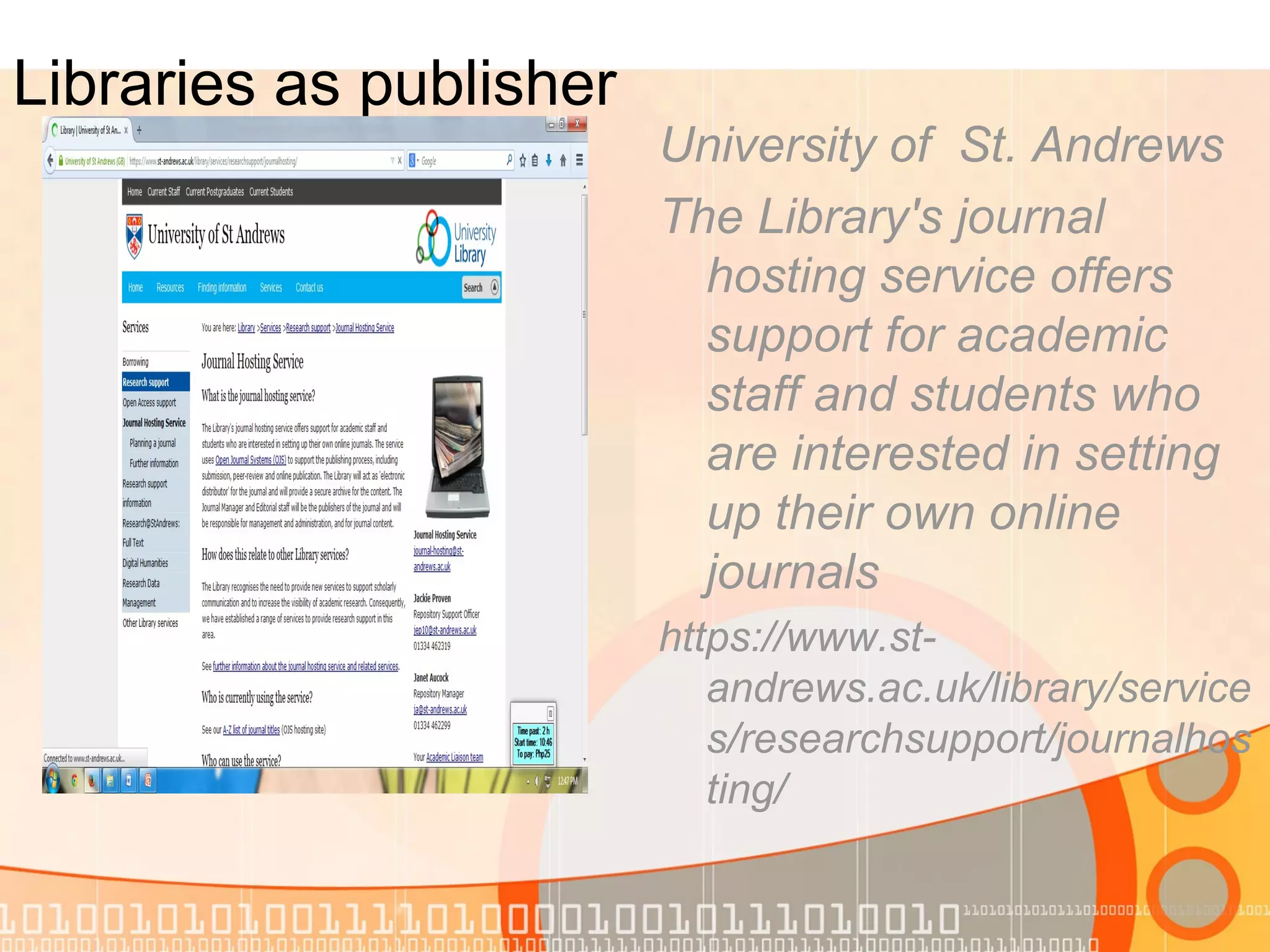
University of St. Andrews
The Library's journal
hosting service offers
support for academic
staff and students who
are interested in setting
up their own online
journals
https://www.st-
andrews.ac.uk/library/service
s/researchsupport/journalhos
ting/
Other activities
• Publishing conference proceedings
• Supporting student publications
• Assisting researchers for funding grants
Beyond Information Literacy
• Visual literacy
• Quantitative literacy
• Archival literacy
• New ways to explore
dimension of information
• Opportunities for
collaboration and
curricular synergy
7. Towards the
collective (print)
collection
• The bubble of
growth in
twentieth-century printed
collections has left …
librarians with a tricky
problem.
• Barbara Fister
New Roles for the Road
Ahead:Essays
commissioned for ACRL’s
75th
Birthday
• The need to add print
collections
• Space to use library
collections in new ways
that will support new
pedagogies
• Consider the non-
collection oriented uses
of such collection
The future of academic libraries
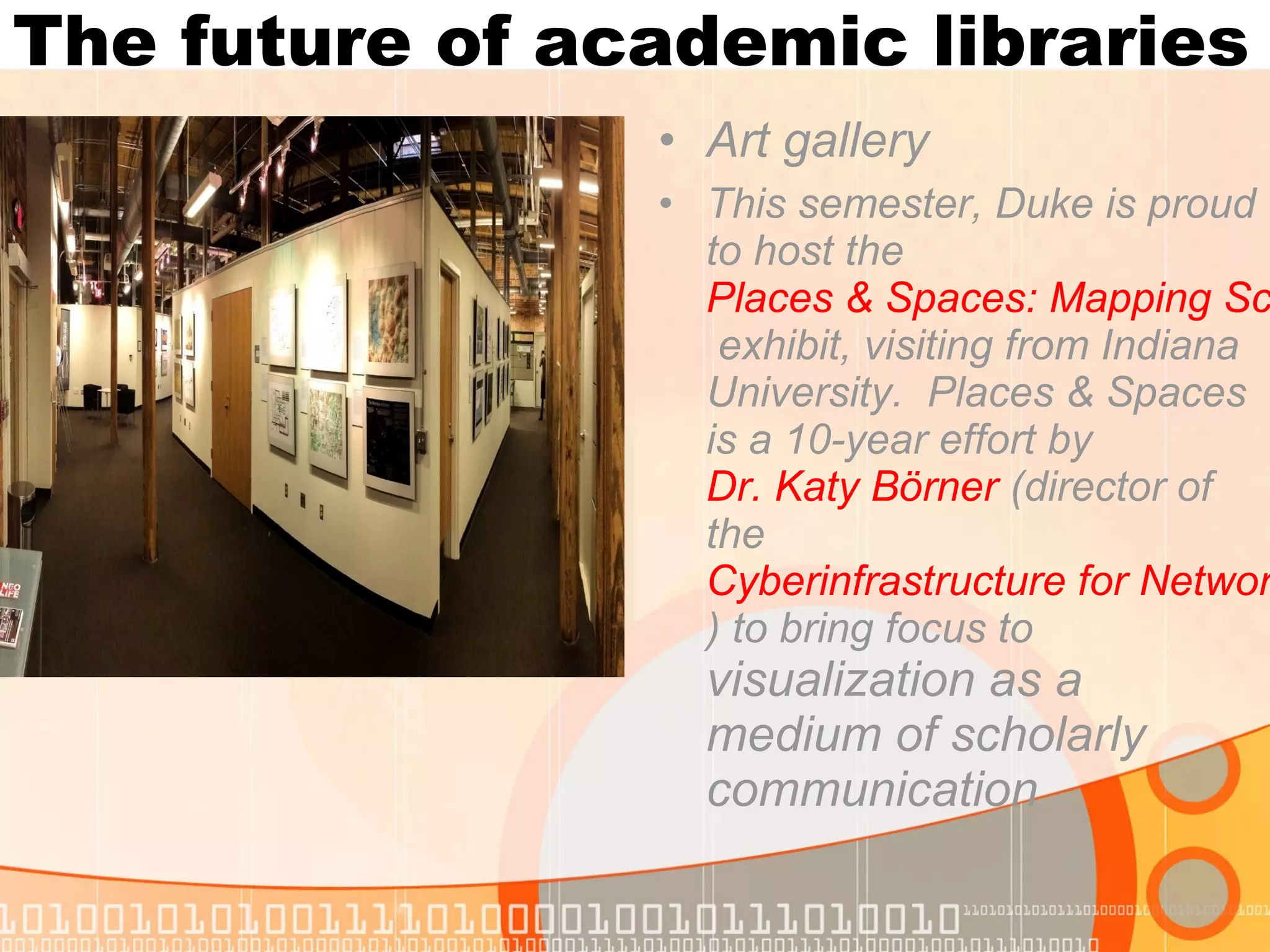
• Art gallery
• This semester, Duke is proud
to host the
Places & Spaces: Mapping Sc
exhibit, visiting from Indiana
University. Places & Spaces
is a 10-year effort by
Dr. Katy Börner (director of
the
Cyberinfrastructure for Networ
) to bring focus to
visualization as a
medium of scholarly
communication
Space for traveling exhibit
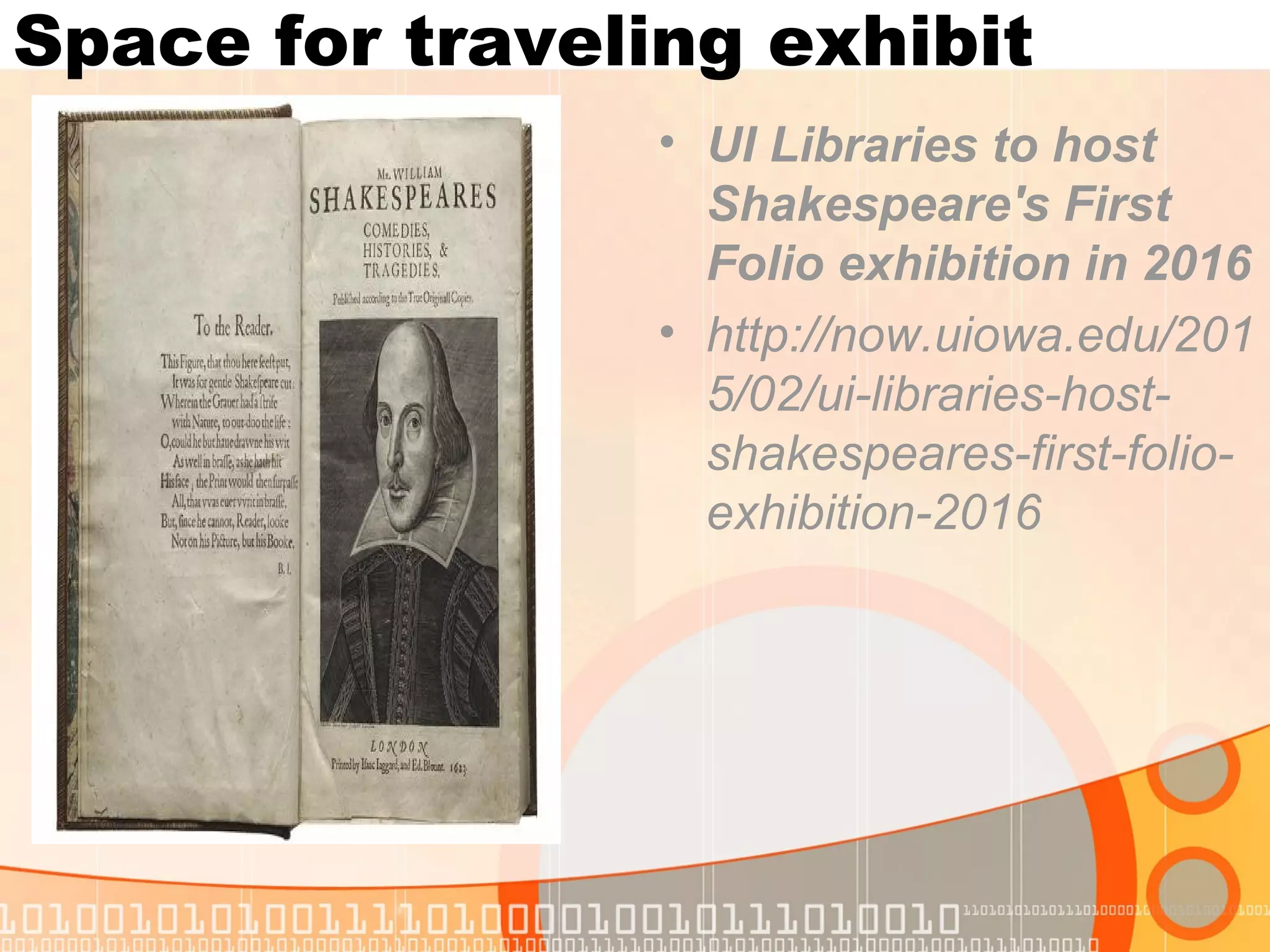
• UI Libraries to host
Shakespeare's First
Folio exhibition in 2016
• http://now.uiowa.edu/201
5/02/ui-libraries-host-
shakespeares-first-folio-
exhibition-2016
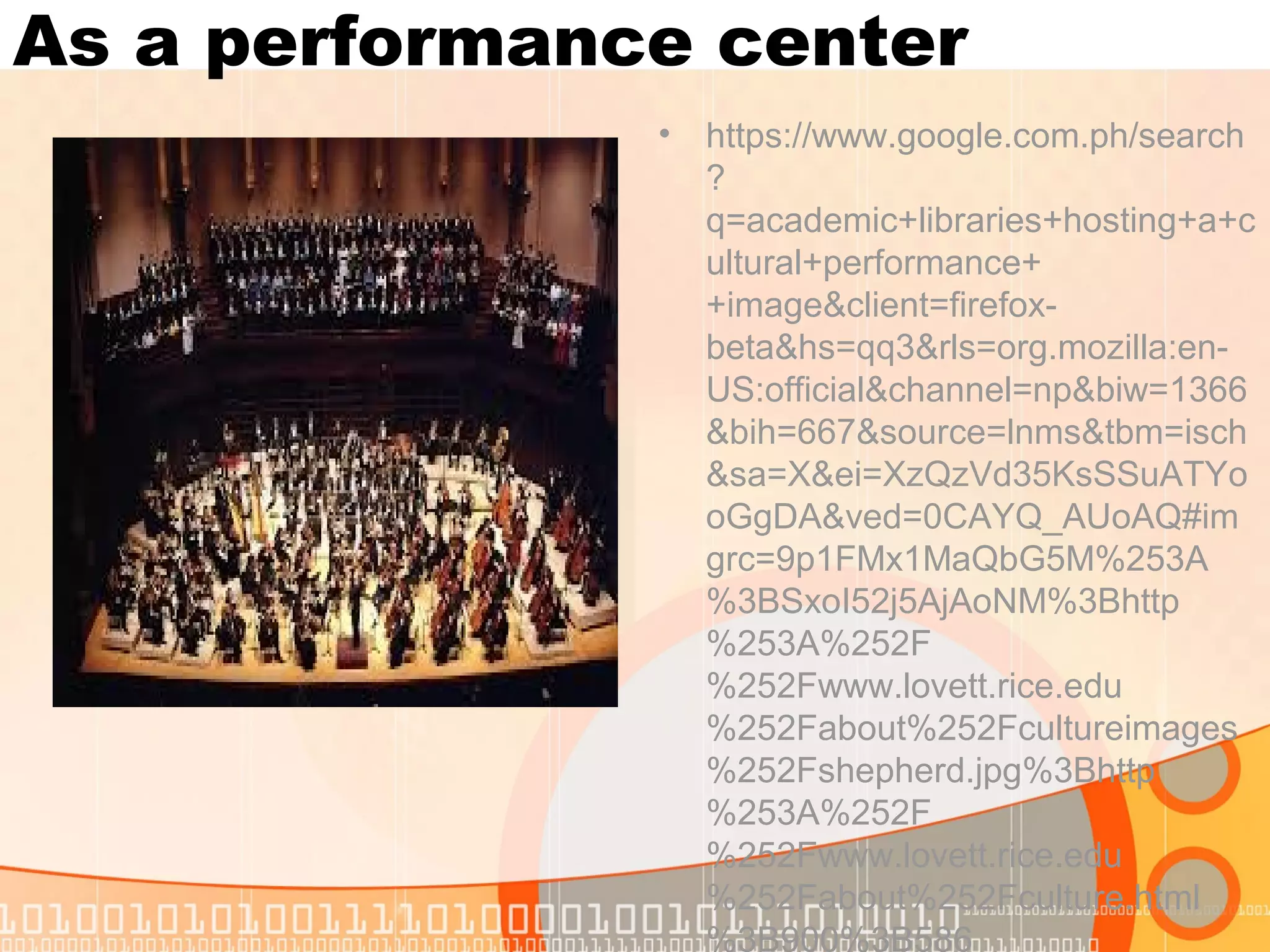
As a performance center
• https://www.google.com.ph/search
?
q=academic+libraries+hosting+a+c
ultural+performance+
+image&client=firefox-
beta&hs=qq3&rls=org.mozilla:en-
US:official&channel=np&biw=1366
&bih=667&source=lnms&tbm=isch
&sa=X&ei=XzQzVd35KsSSuATYo
oGgDA&ved=0CAYQ_AUoAQ#im
grc=9p1FMx1MaQbG5M%253A
%3BSxoI52j5AjAoNM%3Bhttp
%253A%252F
%252Fwww.lovett.rice.edu
%252Fabout%252Fcultureimages
%252Fshepherd.jpg%3Bhttp
%253A%252F
%252Fwww.lovett.rice.edu
%252Fabout%252Fculture.html
%3B900%3B586
50
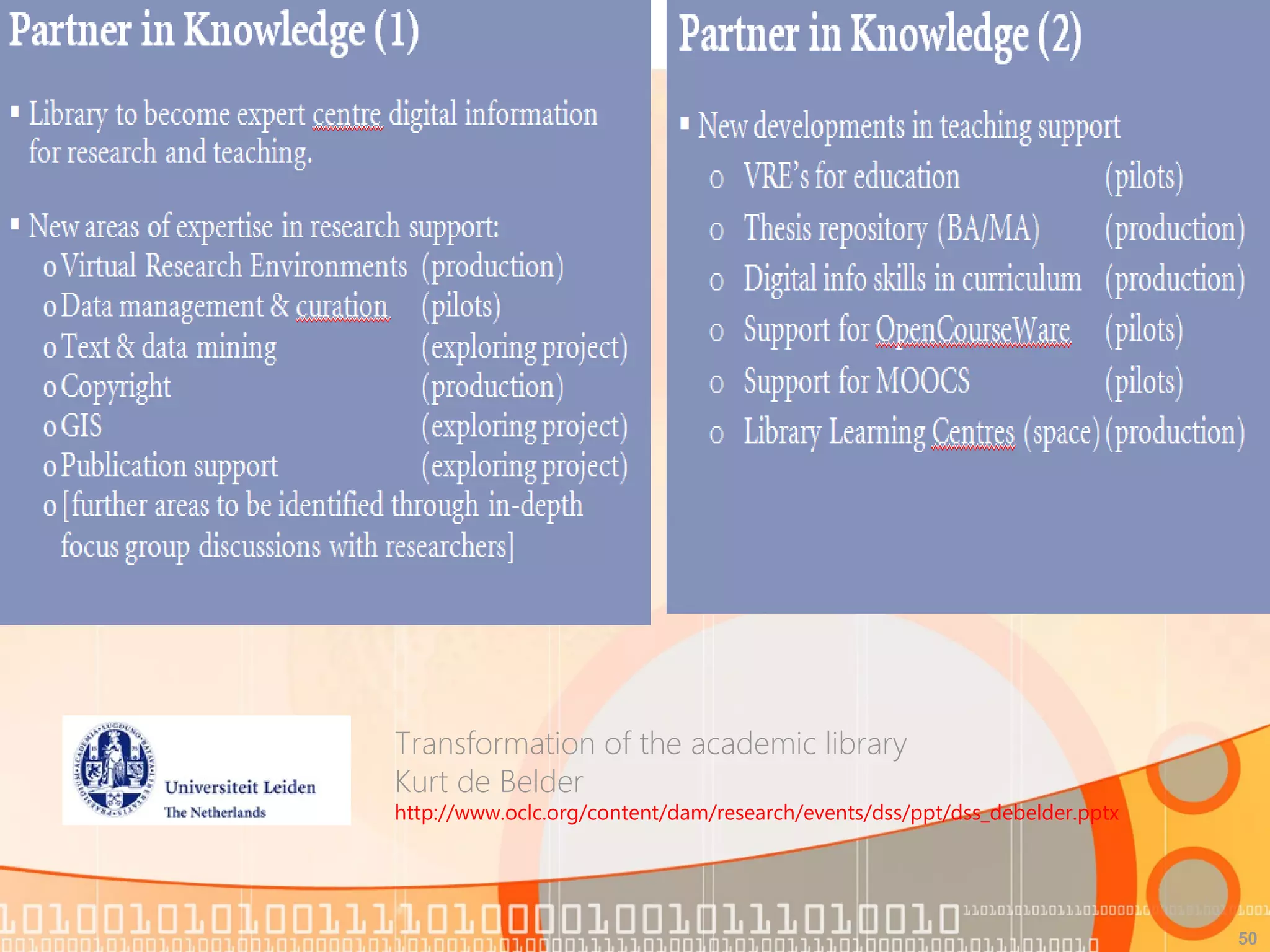
Transformation of the academic library
Kurt de Belder
http://www.oclc.org/content/dam/research/events/dss/ppt/dss_debelder.pptx
WHAT KEY ISSUES CONFRONT
DIGITAL/ACQUISITION LIBRARIANS IN
THE DIGITAL AGE?
Issue 1: Budget
• How do we allocate budget to meet the
changing curriculum and research needs of
our institution?
• What budget strategies are appropriate to the
multiplicity of challenges?
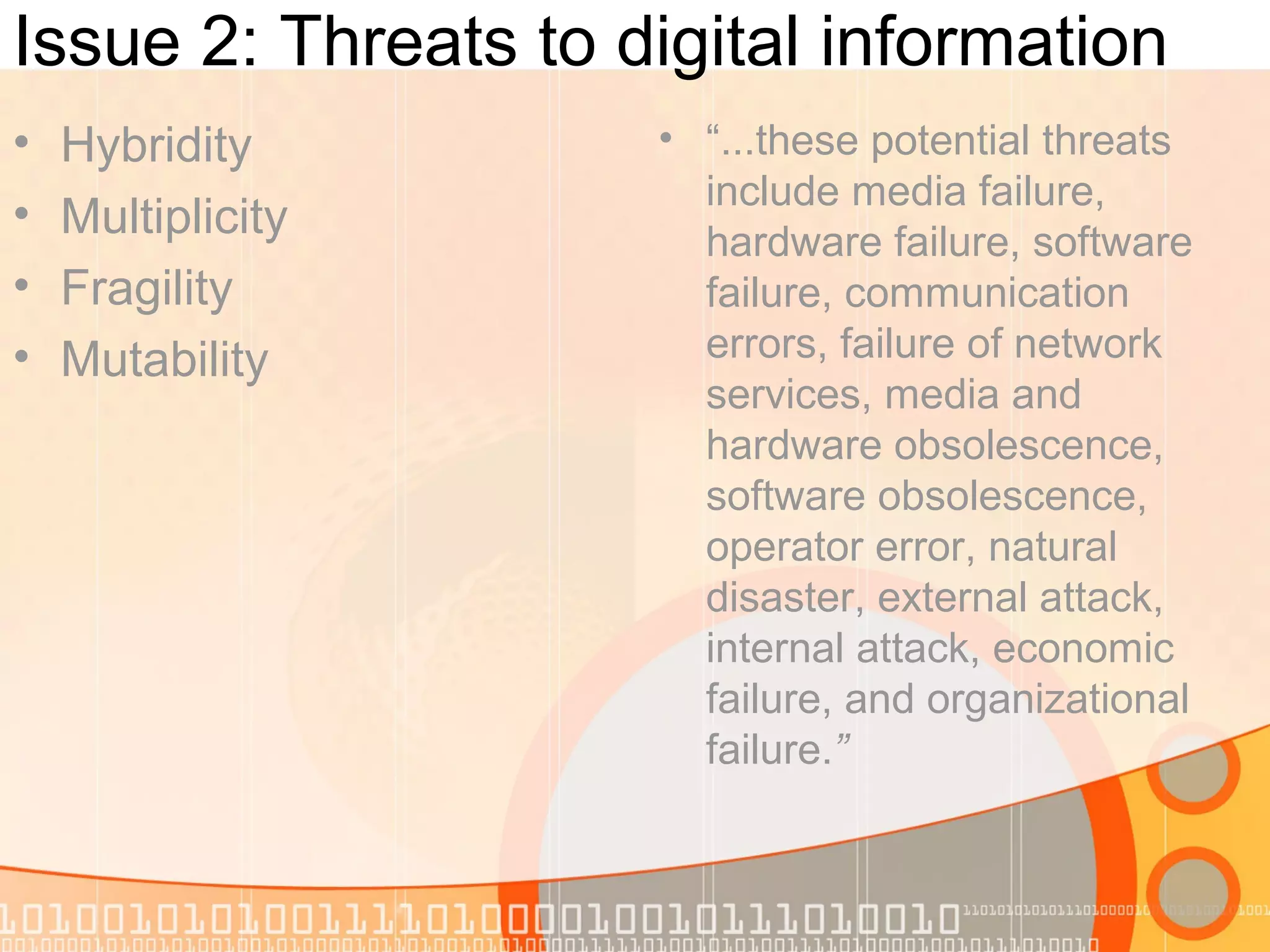
Issue 2: Threats to digital information
• Hybridity
• Multiplicity
• Fragility
• Mutability
• “...these potential threats
include media failure,
hardware failure, software
failure, communication
errors, failure of network
services, media and
hardware obsolescence,
software obsolescence,
operator error, natural
disaster, external attack,
internal attack, economic
failure, and organizational
failure.”
Issue 3: Digital rights management
• Author’s rights
• Open access
• Institutional repositories
Issue 4: New collection metrics
• Standards
• Performance measurements
• Outcome-based
• Evidence-based
Issue 5: Core values
• Access
• Confidentiality/Privacy
• Democracy
• Diversity
• Education and training
• Intellectual freedom
• Professionalism
• Public Good
• Service
• Social Responsibility
• Can collection
managers maintain the
core values as
collection management
practices and scholarly
communication practices
are undergoing radical
change?
WHAT THE STRATEGIES CAN
COLLECTION MANAGERS
CONSIDER?
Some suggestions
1. Focus on what is sustainable. Prioritize
2.Strategize on what format to support
3.Plan innovative ways of repurposing your
physical collection and library space
4.Seek wider opportunities for collaboration:
vendors, publishing industry, the learning
ecosystem, research infrastructure
WHAT ROLES /COMPETENCIES
ARE NECESSARY IN MANAGING
DIGITAL RESOURCES?
Sample titles
• Selectors
• Bibliographers
• Collections librarians
• Subject specialists
• Subject liaisons
• Collection managers
• Collection developers
• Copyright and licensing
librarian
• Electronic resource and
acquisition librarian
• Collection strategists
Electronic resource librarians
• Nasig Core Competencies for Electronic
Resources Librarians. North American Serials
Interest Group. 2013.
Rising expectations:
• Collection librarians need to expand their
traditional skills and expertise
• Developing a keen understanding of the
scholarly communications, publishing and
technological landscapes
• A passion for exploring new forms of
knowledge and new approaches to learning
• Imagination, leadership and creativity in how
we acquire and deliver information resources
Source : Horava
Evolving roles as collection managers
• curators
• collaborators
• teachers
• publishers
• knowledge managers
• information policy guide
As a concluding note:
• Crisis?
• Crossroads?
• Is the road ahead going to a evolving state:
NEW NORMAL?
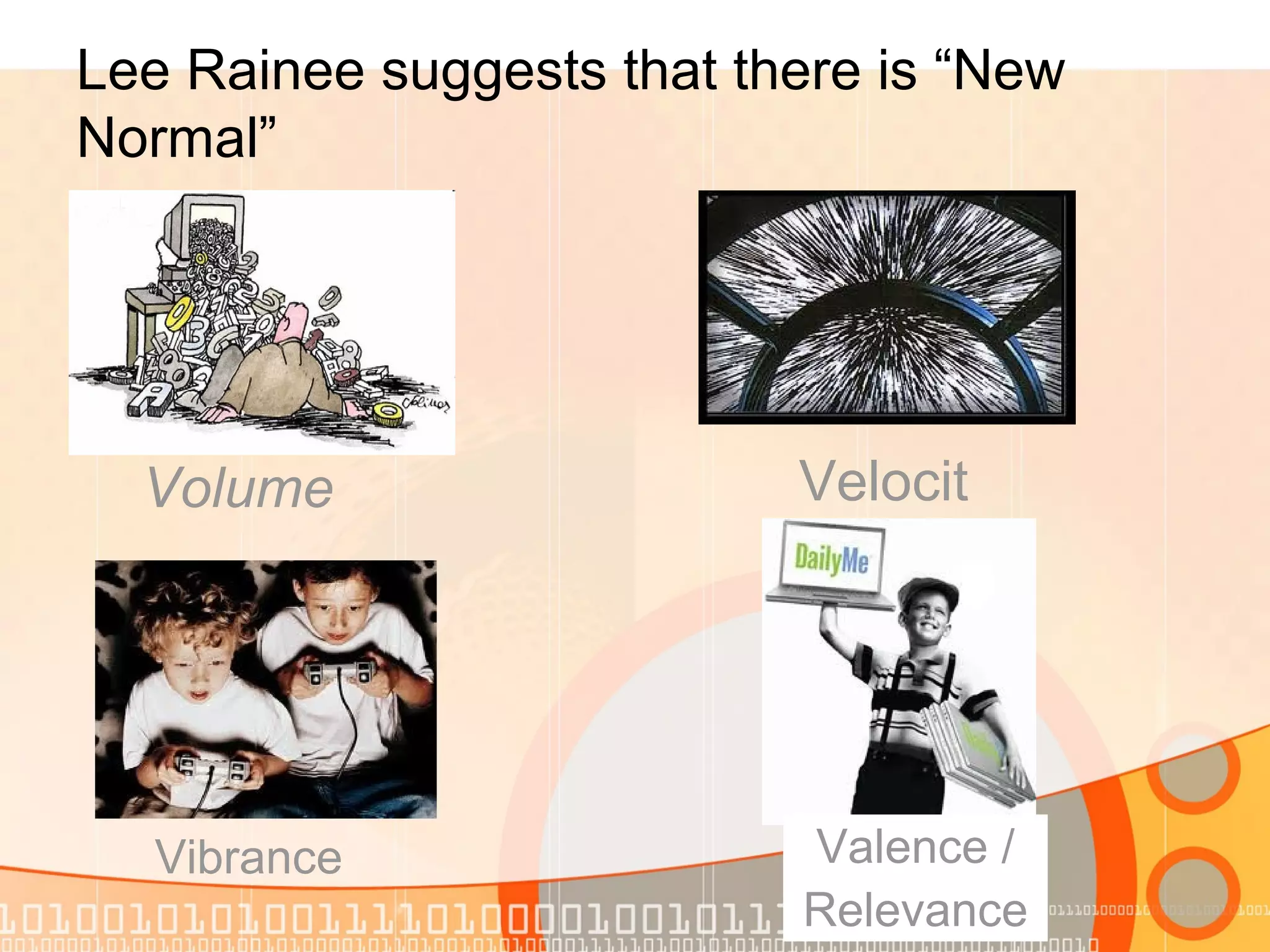
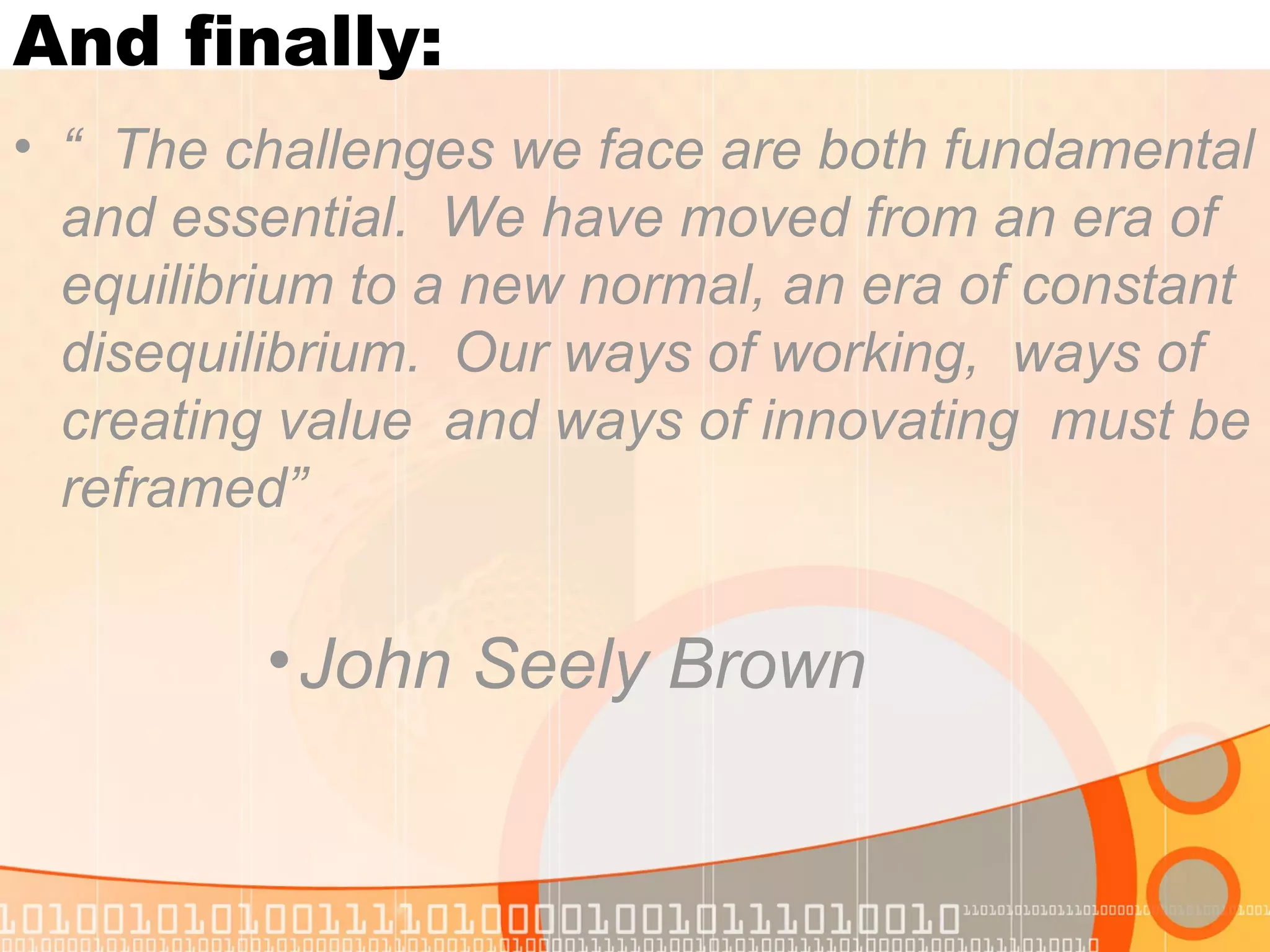
Volume Velocit
y
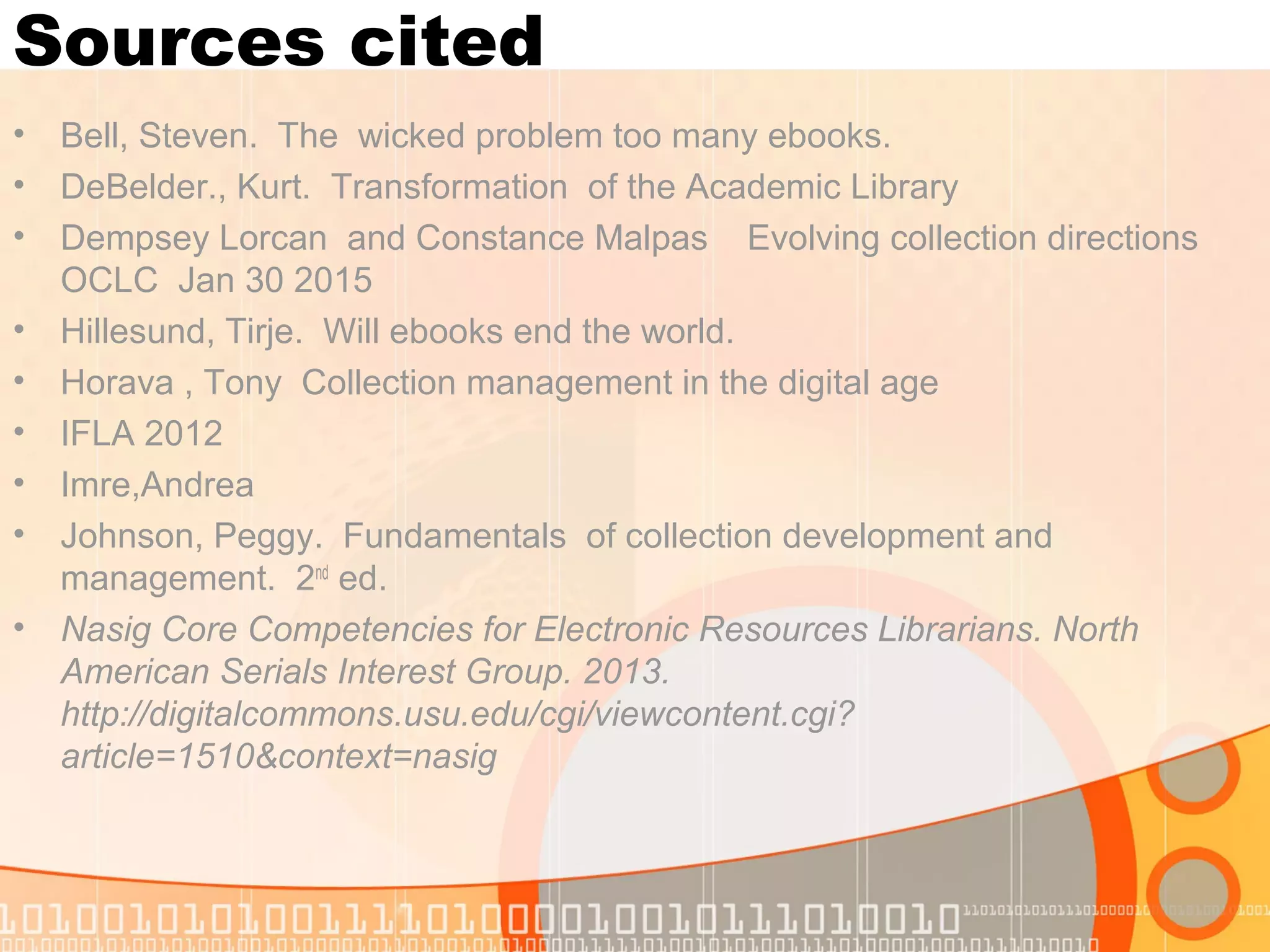
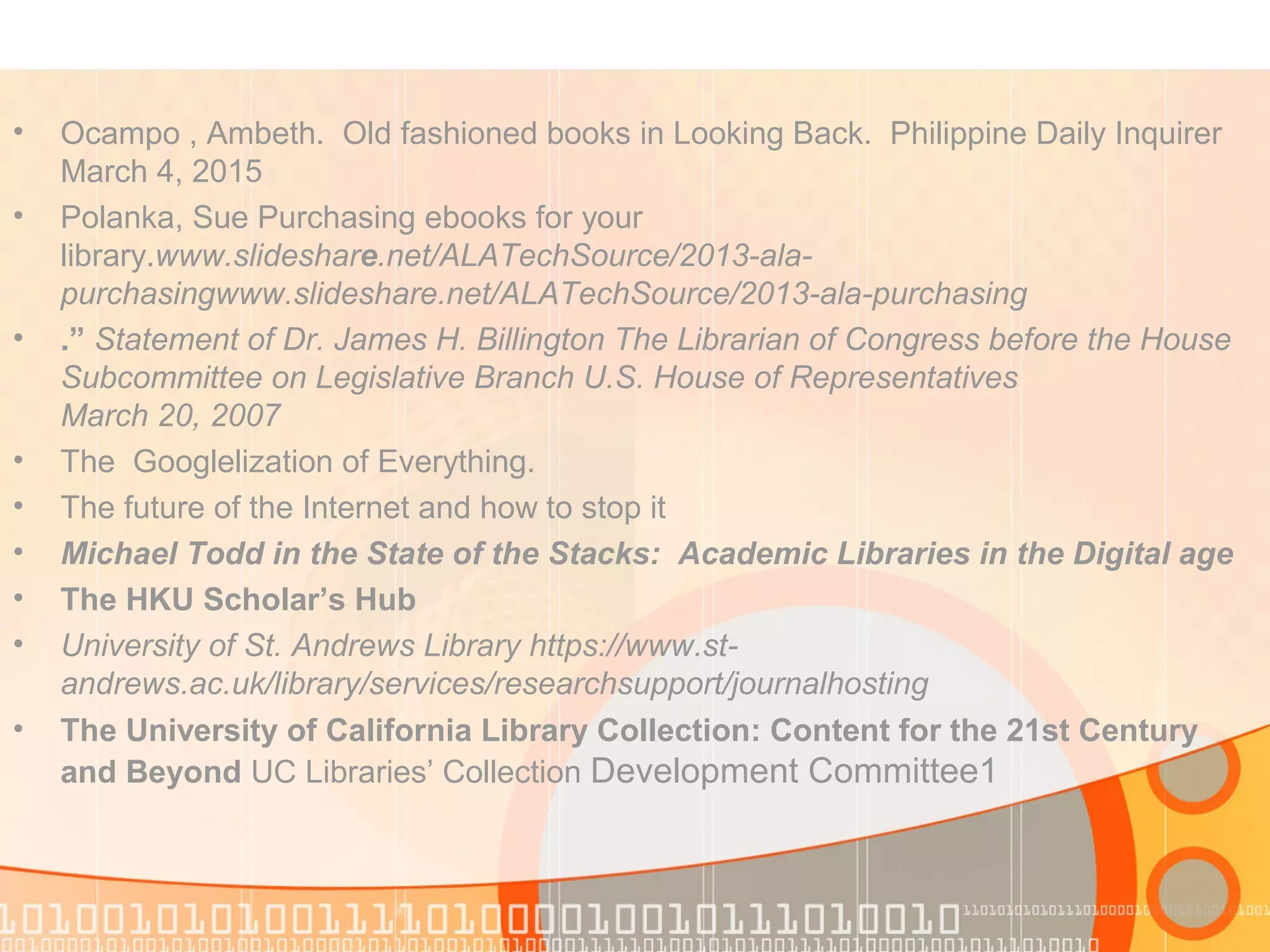
Vibrance Valence /
Relevance
Lee Rainee suggests that there is “New
Normal”
And finally:
• “ The challenges we face are both fundamental
and essential. We have moved from an era of
equilibrium to a new normal, an era of constant
disequilibrium. Our ways of working, ways of
creating value and ways of innovating must be
reframed”
•John Seely Brown
Sources cited
• Bell, Steven. The wicked problem too many ebooks.
• DeBelder., Kurt. Transformation of the Academic Library
• Dempsey Lorcan and Constance Malpas Evolving collection directions
OCLC Jan 30 2015
• Hillesund, Tirje. Will ebooks end the world.
• Horava , Tony Collection management in the digital age
• IFLA 2012
• Imre,Andrea
• Johnson, Peggy. Fundamentals of collection development and
management. 2nd
ed.
• Nasig Core Competencies for Electronic Resources Librarians. North
American Serials Interest Group. 2013.
http://digitalcommons.usu.edu/cgi/viewcontent.cgi?
article=1510&context=nasig
• Ocampo , Ambeth. Old fashioned books in Looking Back. Philippine Daily Inquirer
March 4, 2015
• Polanka, Sue Purchasing ebooks for your
library.www.slideshare.net/ALATechSource/2013-ala-
purchasingwww.slideshare.net/ALATechSource/2013-ala-purchasing
• .” Statement of Dr. James H. Billington The Librarian of Congress before the House
Subcommittee on Legislative Branch U.S. House of Representatives
March 20, 2007
• The Googlelization of Everything.
• The future of the Internet and how to stop it
• Michael Todd in the State of the Stacks: Academic Libraries in the Digital age
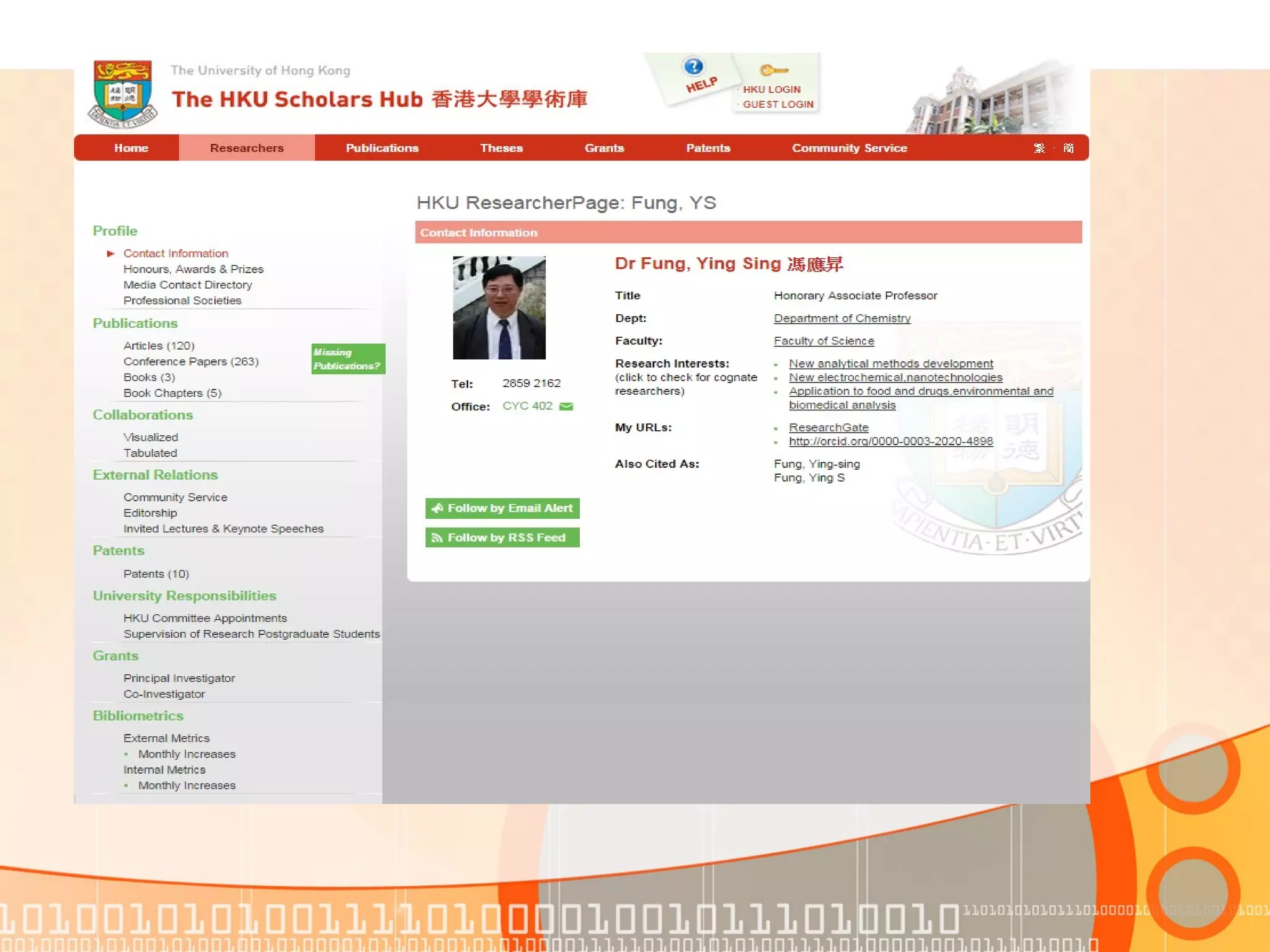
• The HKU Scholar’s Hub
• University of St. Andrews Library https://www.st-
andrews.ac.uk/library/services/researchsupport/journalhosting
• The University of California Library Collection: Content for the 21st Century
and Beyond UC Libraries’ Collection Development Committee1
• Presented during the
PAARL National
Summer Conference
2015, Cagayan de Oro
City April 22-24, 2015

LIBRARY COLLECTION MANAGERS IN HIGHER GROUNDS: WEIGHING THE ODDS

  • 1.
    Library Collection Managersin Higher Grounds: Weighing the Odds Marianita D. Dablio Lecturer, Library and Information Science
  • 2.
    Our lives havenever been the same!
  • 3.
    Facts that figure: •It took two centuries for the Library of Congress to acquire today's analog collection—32 million printed volumes, 12.5 million photographs, 59.5 million manuscripts and other materials – a total of more than 134 million physical items. By contrast, with the explosion of digital information, it now takes only about 15 minutes for the world to produce an equivalent amount of information. Researchers at Cal- Berkeley produced estimates of the amount of information produced and circulated on the Internet in 2003 – it was equivalent to 37,000 times the content of one Library of Congress. Most of this information exists only in digital form: so-called born-digital items, many of which are already irretrievably lost.” Statement of Dr. James H. Billington The Librarian of Congress before the House Subcommittee on Legislative Branch U.S.House of Representatives March 20, 2007
  • 4.
    Have you readsome of these? 4 The Wicked Problem of Too Many Books | From the Bell Tower Michael Todd in the State of the Stacks: Academic Libraries in the Digital age “ Digital Tsunami”
  • 5.
    Fr. Ambeth R.Ocampo • “My greatest fear to my digital library is this: Technology moves to fast that my present PDF files may not be computer-readable in the future” Ocampo , Ambeth. Old fashioned books in Looking Back. Philippine Daily Inquirer March 4, 2015
  • 6.
    I suggest thatwe find answers to the following: • In what ways have collection and collecting evolved in the changing digital landscape? • What key issues confront collection development/acquisition librarians in digital environment? • What strategies can library collection managers consider? • What roles /competencies are necessary in managing digital resources?
  • 7.
    IN WHAT WAYSHAVE COLLECTION AND COLLECTING EVOLVED IN THE CHANGING DIGITAL LANDSCAPE?
  • 8.
    Some things “old”,yet constant: • Simply put, collection management is the systemic, efficient and economic stewardship of library resources.1 • The goal of any collection development organization must be to provide the library with a collection that meets the appropriate needs of its client population within the limits of its fiscal and personnel resources. To reach this goal, each segment of the collection must be developed with an application of resources consistent with its relative importance to the mission of the library and the needs of its patrons.2 • Source: cited in Johnson
  • 9.
    Traditional activities associatedwith collection management • Selection & acquisition of materials; • Collection development policy; • Assessment of patron needs; • Collection analysis; • Budget management; • Space management including storage • Community outreach & liaison • Resource-sharing arrangements • De-selection/cancellation & preservation • Source: Horava
  • 10.
    Do these conceptsof collection still hold true today? • Ownership • Control • Tangibility (mostly on-site materials) • Permanence • Predictability (eg formats) • Comprehensiveness • Implicit pride and prestige for the institution • Implicit value judgements -privileging/selecting sources
  • 11.
    Something “new” • Newand non-traditional forms of knowledge, eg oral history, streaming audio and video, research datasets, blogs, tweets, etc.. • Collections have sense making function :translating information resources into knowledge to solve problems
  • 12.
    content in the21st century • “The University of California Library Collection comprises all print and digital resources, archival collections, and shared purchases of the UC Libraries. It is an integrated, shareable user-centric collection that supports and enhances the mission of the University of California and whose strength is derived from the diverse nature of the individual campus library collections.”
  • 13.
    On a higherground, library collection managers will be transitioning
  • 14.
  • 15.
  • 19.
  • 20.
  • 21.
    Ebook as anexample
  • 22.
  • 24.
    • Shift fromprint centric record to digital format • The boundaries are shifting and blurring • The shift from static nature to dynamic features
  • 26.
    Framing the ScholarlyRecord … OCLC Research, 2014Figure: Evolving Scholarly Record framework.
  • 27.
  • 28.
    Low Stewardship p Institutional In few collections In many collections Research& Learning Materials Open Web Resources ‘Published’ materials Special Collections Local Digitization Licensed Purchased High Stewardship
  • 29.
    Journals 1. Licensed materialsare now the larger part of academic library budgets 2. Publishers looking to research workflow (Elsevier – Mendeley, Pure) 3. National science/research policy and open access 4. A part only of the scholarly record – data, etc. Monographs 1. Emergence of ‘e’ (platform) 2. Shift to demand driven acquisition 3. Digital corpora 4. Disciplinary differences 5. Growing difference between market- available and distinctive (e.g. area studies) 6. Managing down print - shared print
  • 30.
    Special collections, archives,… 1. Release more value through digitization, exhibitions, … 2. Streamlining processing, production, … 3. Network level aggregation for scale and utility – DPLA, Europeana, Pacific Rim Digital Library, Research and learning material 1. Evolving scholarly record: research data, eprints, .. 2. IR – role and content? 3. Research information management (profiles, outputs, …) 4. Support for digital scholarship 5. Support for open access publishing
  • 31.
  • 32.
    The ‘owned’ collection The ‘facilitated’ collection The ‘licensed’ collection The ‘borrowed’ collection •Pointing people at Google Scholar • Including freely available e- books in the catalog • Creating resource guides for web resources • Purchased and physically stored A collections spectrum The ‘demand- driven’ collection The ‘shared print’ collection OCLC Research, 2015.Figure: A collections spectrum.
  • 33.
    Example: • Provision ofdata services to support use of data(including geographic information systems and data visualization • Duke University Libraries
  • 34.
    4. Workflow isthe new content
  • 35.
    • arXiv, SSRN,RePEc, PubMed Central (disciplinary repositories that have become important discovery hubs); • Google Scholar, Google Books, Amazon  (ubiquitous discovery and fulfillment hubs); • Mendeley, ResearchGate (services for social discovery and scholarly reputation management); • Goodreads, LibraryThing (social description/reading sites); • Wikipedia, Yahoo Answers, Khan Academy (hubs for open research, reference, and teaching materials). • GalaxyZoo, FigShare, OpenRefine (data storage and manipulation tools) • Github (software management)
  • 36.
    Workflow is thenew content • In a print world, researchers and learners organized their workflow around the library. • The library had limited interaction with the full process. • In a digital world, the library needs to organize itself around the workflows of research and learners. • Workflows generate and consume information resources.
  • 37.
  • 38.
  • 39.
    In the paradigmshift • The dominant model is outside in where the dominant model is buying and licensing material and make them accessible to the users • In the inside out model, the university and the library support resources that may be unique to the institution and the audience is both local and external • These unique collection may include archives and special collections and new generated learning materials • E.g. e prints,
  • 40.
    The outcome In theoutside-in model , the librarian serves as broker, his goal is to maximize efficiency and its intended outcome is discovery • In the in-outside model, the librarian serves as provider, his goal is to maximize discoverability/
  • 41.
    6. From curationto creation
  • 42.
    Libraries as publisher Universityof St. Andrews The Library's journal hosting service offers support for academic staff and students who are interested in setting up their own online journals https://www.st- andrews.ac.uk/library/service s/researchsupport/journalhos ting/
  • 43.
    Other activities • Publishingconference proceedings • Supporting student publications • Assisting researchers for funding grants
  • 44.
    Beyond Information Literacy •Visual literacy • Quantitative literacy • Archival literacy • New ways to explore dimension of information • Opportunities for collaboration and curricular synergy
  • 45.
    7. Towards the collective(print) collection
  • 46.
    • The bubbleof growth in twentieth-century printed collections has left … librarians with a tricky problem. • Barbara Fister New Roles for the Road Ahead:Essays commissioned for ACRL’s 75th Birthday • The need to add print collections • Space to use library collections in new ways that will support new pedagogies • Consider the non- collection oriented uses of such collection
  • 47.
    The future ofacademic libraries • Art gallery • This semester, Duke is proud to host the Places & Spaces: Mapping Sc exhibit, visiting from Indiana University. Places & Spaces is a 10-year effort by Dr. Katy Börner (director of the Cyberinfrastructure for Networ ) to bring focus to visualization as a medium of scholarly communication
  • 48.
    Space for travelingexhibit • UI Libraries to host Shakespeare's First Folio exhibition in 2016 • http://now.uiowa.edu/201 5/02/ui-libraries-host- shakespeares-first-folio- exhibition-2016
  • 49.
    As a performancecenter • https://www.google.com.ph/search ? q=academic+libraries+hosting+a+c ultural+performance+ +image&client=firefox- beta&hs=qq3&rls=org.mozilla:en- US:official&channel=np&biw=1366 &bih=667&source=lnms&tbm=isch &sa=X&ei=XzQzVd35KsSSuATYo oGgDA&ved=0CAYQ_AUoAQ#im grc=9p1FMx1MaQbG5M%253A %3BSxoI52j5AjAoNM%3Bhttp %253A%252F %252Fwww.lovett.rice.edu %252Fabout%252Fcultureimages %252Fshepherd.jpg%3Bhttp %253A%252F %252Fwww.lovett.rice.edu %252Fabout%252Fculture.html %3B900%3B586
  • 50.
    50 Transformation of theacademic library Kurt de Belder http://www.oclc.org/content/dam/research/events/dss/ppt/dss_debelder.pptx
  • 51.
    WHAT KEY ISSUESCONFRONT DIGITAL/ACQUISITION LIBRARIANS IN THE DIGITAL AGE?
  • 52.
    Issue 1: Budget •How do we allocate budget to meet the changing curriculum and research needs of our institution? • What budget strategies are appropriate to the multiplicity of challenges?
  • 53.
    Issue 2: Threatsto digital information • Hybridity • Multiplicity • Fragility • Mutability • “...these potential threats include media failure, hardware failure, software failure, communication errors, failure of network services, media and hardware obsolescence, software obsolescence, operator error, natural disaster, external attack, internal attack, economic failure, and organizational failure.”
  • 54.
    Issue 3: Digitalrights management • Author’s rights • Open access • Institutional repositories
  • 55.
    Issue 4: Newcollection metrics • Standards • Performance measurements • Outcome-based • Evidence-based
  • 56.
    Issue 5: Corevalues • Access • Confidentiality/Privacy • Democracy • Diversity • Education and training • Intellectual freedom • Professionalism • Public Good • Service • Social Responsibility • Can collection managers maintain the core values as collection management practices and scholarly communication practices are undergoing radical change?
  • 57.
    WHAT THE STRATEGIESCAN COLLECTION MANAGERS CONSIDER?
  • 58.
    Some suggestions 1. Focuson what is sustainable. Prioritize 2.Strategize on what format to support 3.Plan innovative ways of repurposing your physical collection and library space 4.Seek wider opportunities for collaboration: vendors, publishing industry, the learning ecosystem, research infrastructure
  • 59.
    WHAT ROLES /COMPETENCIES ARENECESSARY IN MANAGING DIGITAL RESOURCES?
  • 60.
    Sample titles • Selectors •Bibliographers • Collections librarians • Subject specialists • Subject liaisons • Collection managers • Collection developers • Copyright and licensing librarian • Electronic resource and acquisition librarian • Collection strategists
  • 61.
    Electronic resource librarians •Nasig Core Competencies for Electronic Resources Librarians. North American Serials Interest Group. 2013.
  • 62.
    Rising expectations: • Collectionlibrarians need to expand their traditional skills and expertise • Developing a keen understanding of the scholarly communications, publishing and technological landscapes • A passion for exploring new forms of knowledge and new approaches to learning • Imagination, leadership and creativity in how we acquire and deliver information resources Source : Horava
  • 63.
    Evolving roles ascollection managers • curators • collaborators • teachers • publishers • knowledge managers • information policy guide
  • 64.
    As a concludingnote: • Crisis? • Crossroads? • Is the road ahead going to a evolving state: NEW NORMAL?
  • 65.
    Volume Velocit y Vibrance Valence/ Relevance Lee Rainee suggests that there is “New Normal”
  • 66.
    And finally: • “The challenges we face are both fundamental and essential. We have moved from an era of equilibrium to a new normal, an era of constant disequilibrium. Our ways of working, ways of creating value and ways of innovating must be reframed” •John Seely Brown
  • 67.
    Sources cited • Bell,Steven. The wicked problem too many ebooks. • DeBelder., Kurt. Transformation of the Academic Library • Dempsey Lorcan and Constance Malpas Evolving collection directions OCLC Jan 30 2015 • Hillesund, Tirje. Will ebooks end the world. • Horava , Tony Collection management in the digital age • IFLA 2012 • Imre,Andrea • Johnson, Peggy. Fundamentals of collection development and management. 2nd ed. • Nasig Core Competencies for Electronic Resources Librarians. North American Serials Interest Group. 2013. http://digitalcommons.usu.edu/cgi/viewcontent.cgi? article=1510&context=nasig
  • 68.
    • Ocampo ,Ambeth. Old fashioned books in Looking Back. Philippine Daily Inquirer March 4, 2015 • Polanka, Sue Purchasing ebooks for your library.www.slideshare.net/ALATechSource/2013-ala- purchasingwww.slideshare.net/ALATechSource/2013-ala-purchasing • .” Statement of Dr. James H. Billington The Librarian of Congress before the House Subcommittee on Legislative Branch U.S. House of Representatives March 20, 2007 • The Googlelization of Everything. • The future of the Internet and how to stop it • Michael Todd in the State of the Stacks: Academic Libraries in the Digital age • The HKU Scholar’s Hub • University of St. Andrews Library https://www.st- andrews.ac.uk/library/services/researchsupport/journalhosting • The University of California Library Collection: Content for the 21st Century and Beyond UC Libraries’ Collection Development Committee1
  • 69.
    • Presented duringthe PAARL National Summer Conference 2015, Cagayan de Oro City April 22-24, 2015

Editor's Notes

  • #66 The info ecology changes thanks to rise of internet/broadband. Volume of information rises 20-30% per year. Never had anything close to this in human history. Velocity of information increases, especially in groups. Personally relevant news speeds up as people customize personal feeds, alerts, listservs, group communications. Vibrance of information/media increases as bandwidth increases and computing power grows so media experiences become more immersive and compelling Valence/relevance of information grows in the era of the “Daily Me” and “Daily Us” and custom feeds. 2 mins