From Archive to Gateway: The
Evolution of the Research Library


                University of Utah
     Friends of the Marriott Library Banquet
                   April 9, 2013
              Michael Levine-Clark
          University of Denver Libraries
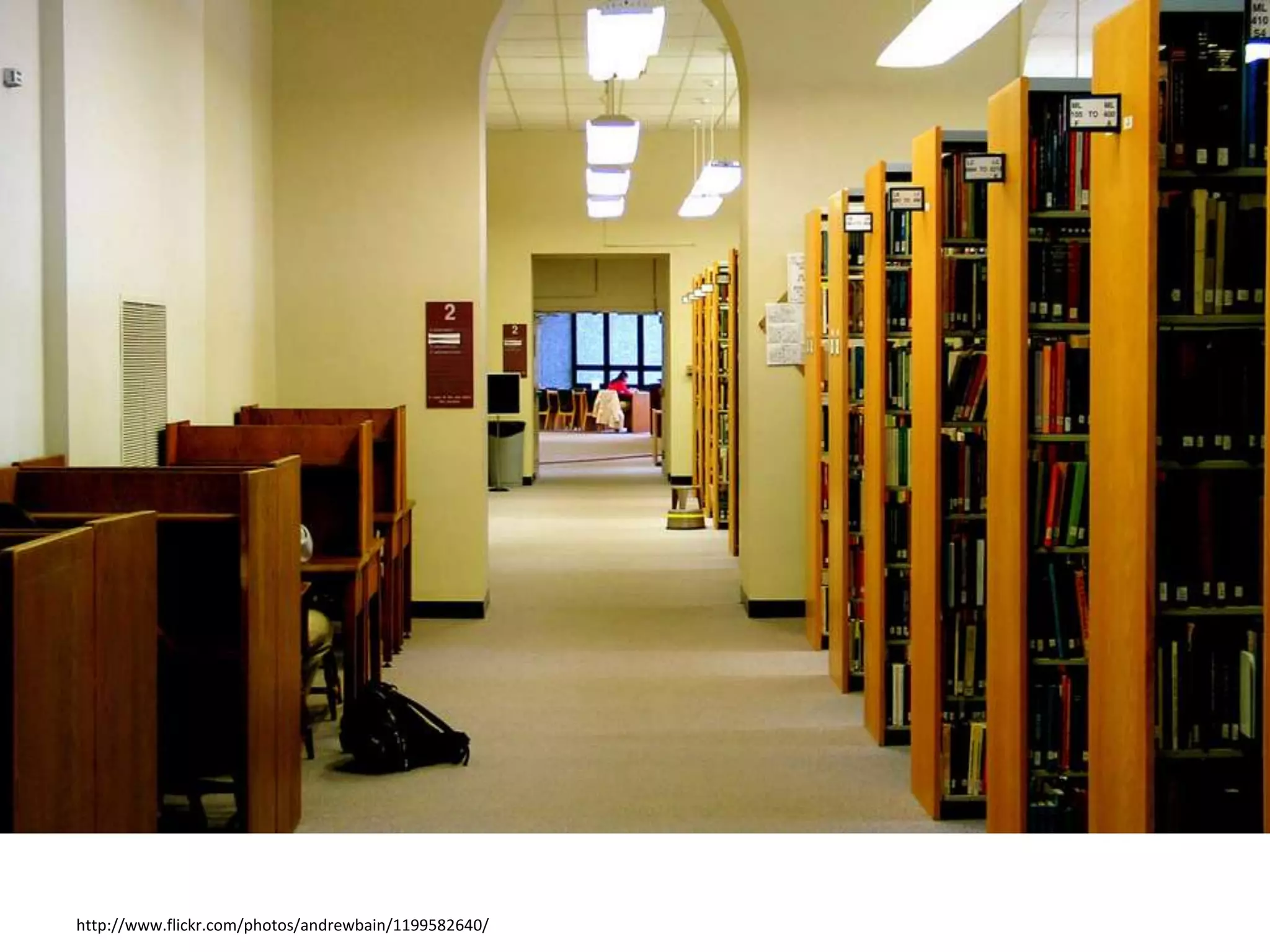
http://www.flickr.com/photos/andrewbain/1199582640/
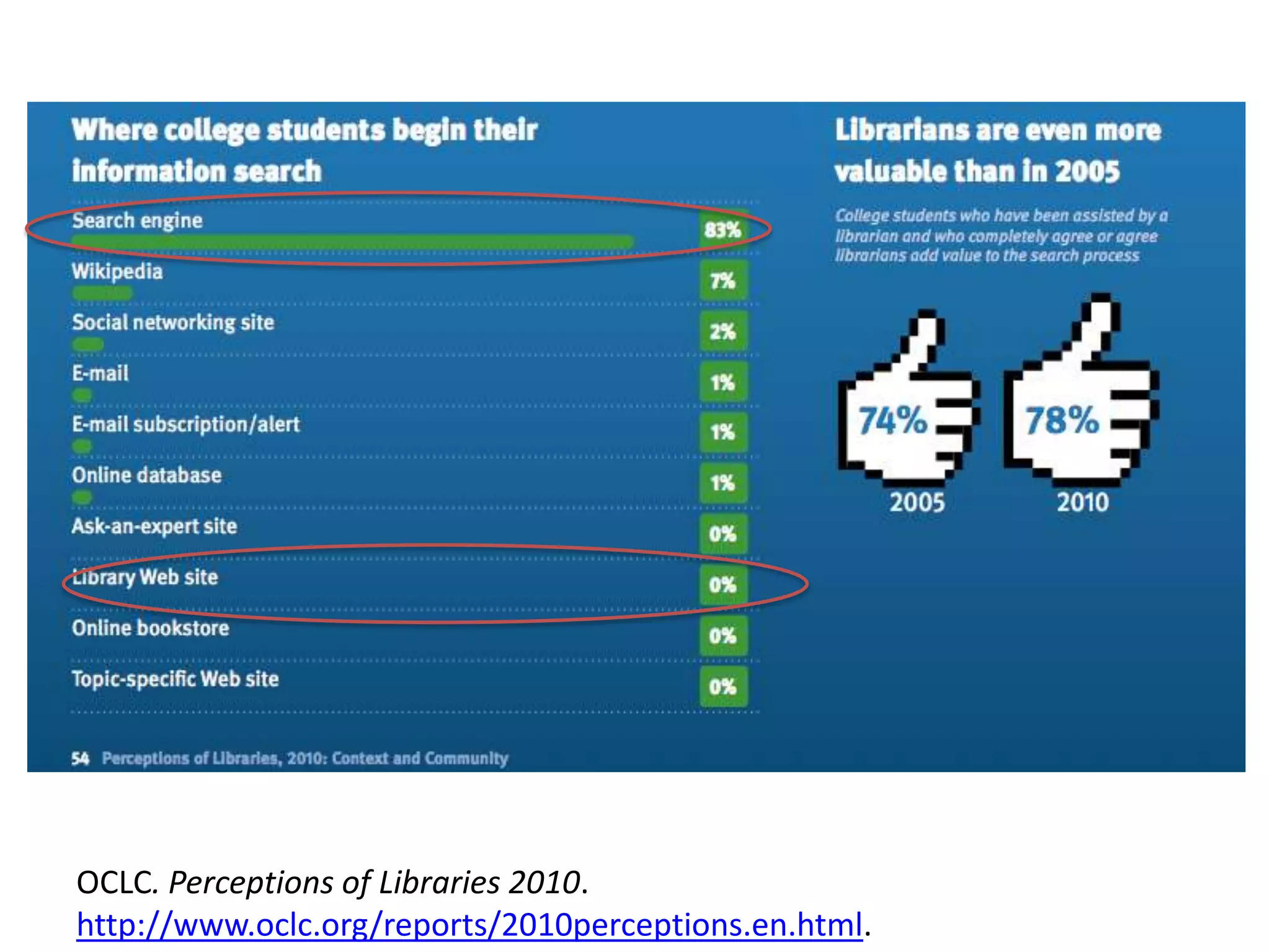
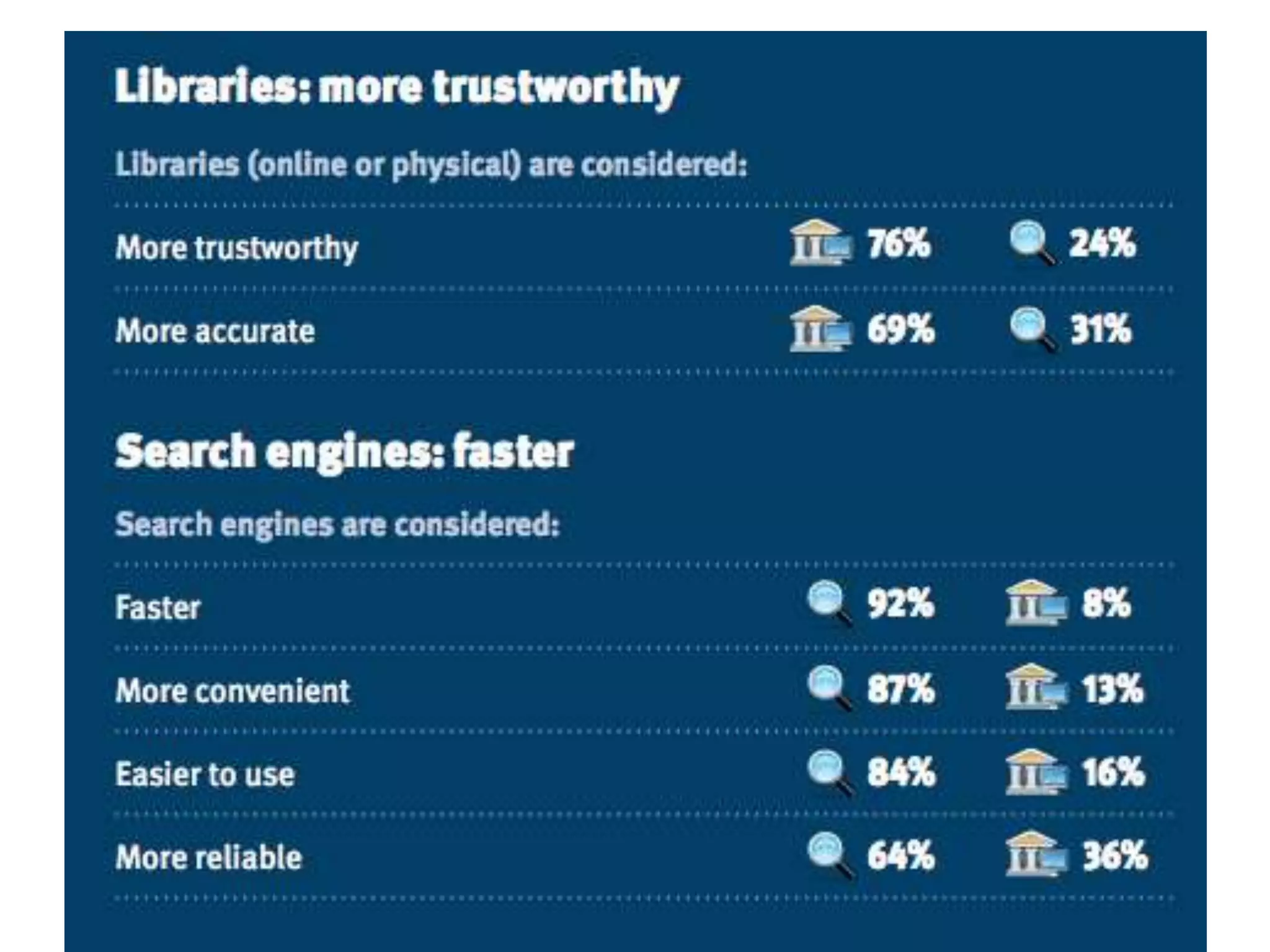
OCLC. Perceptions of Libraries 2010.
http://www.oclc.org/reports/2010perceptions.en.html.
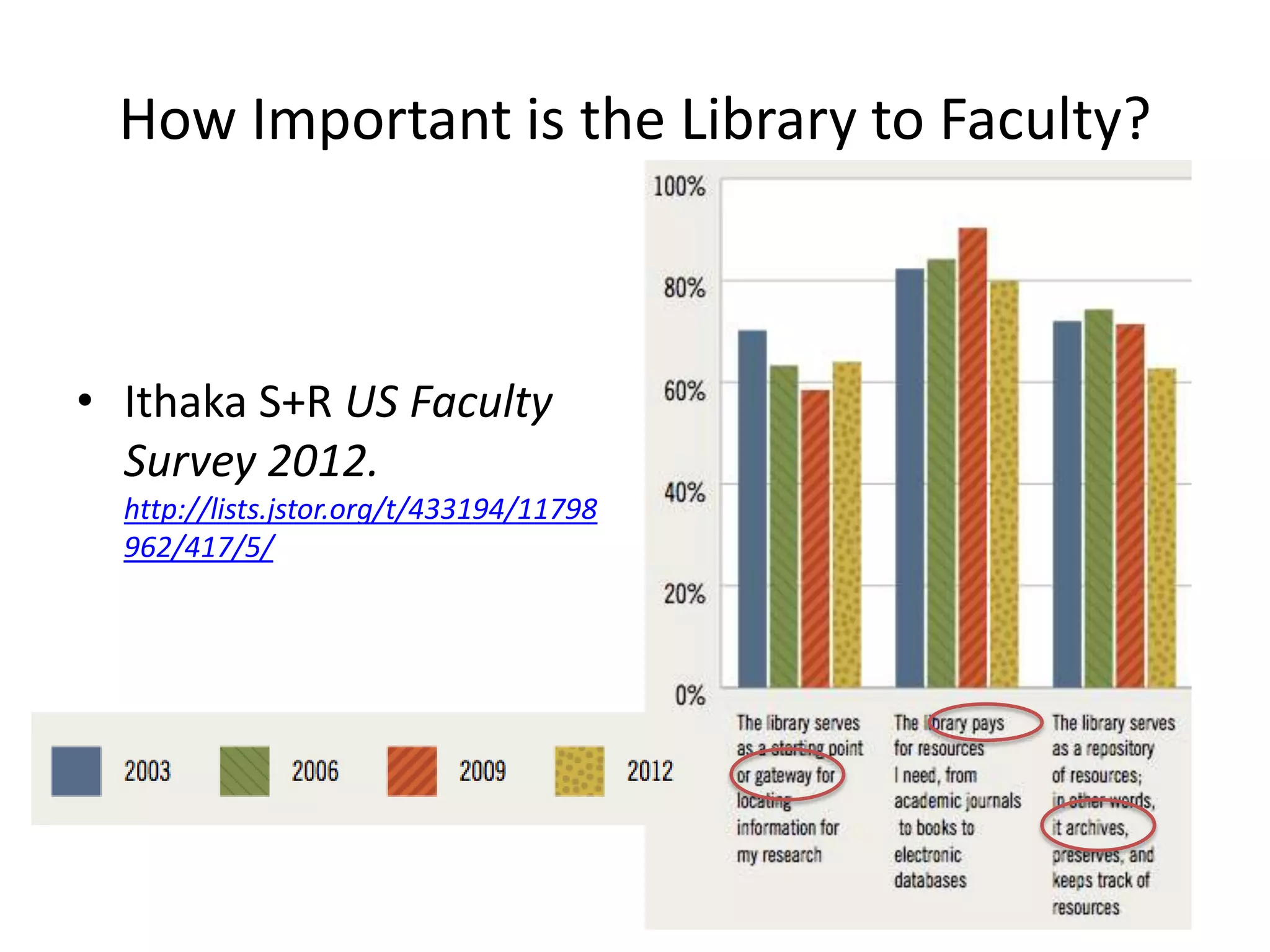
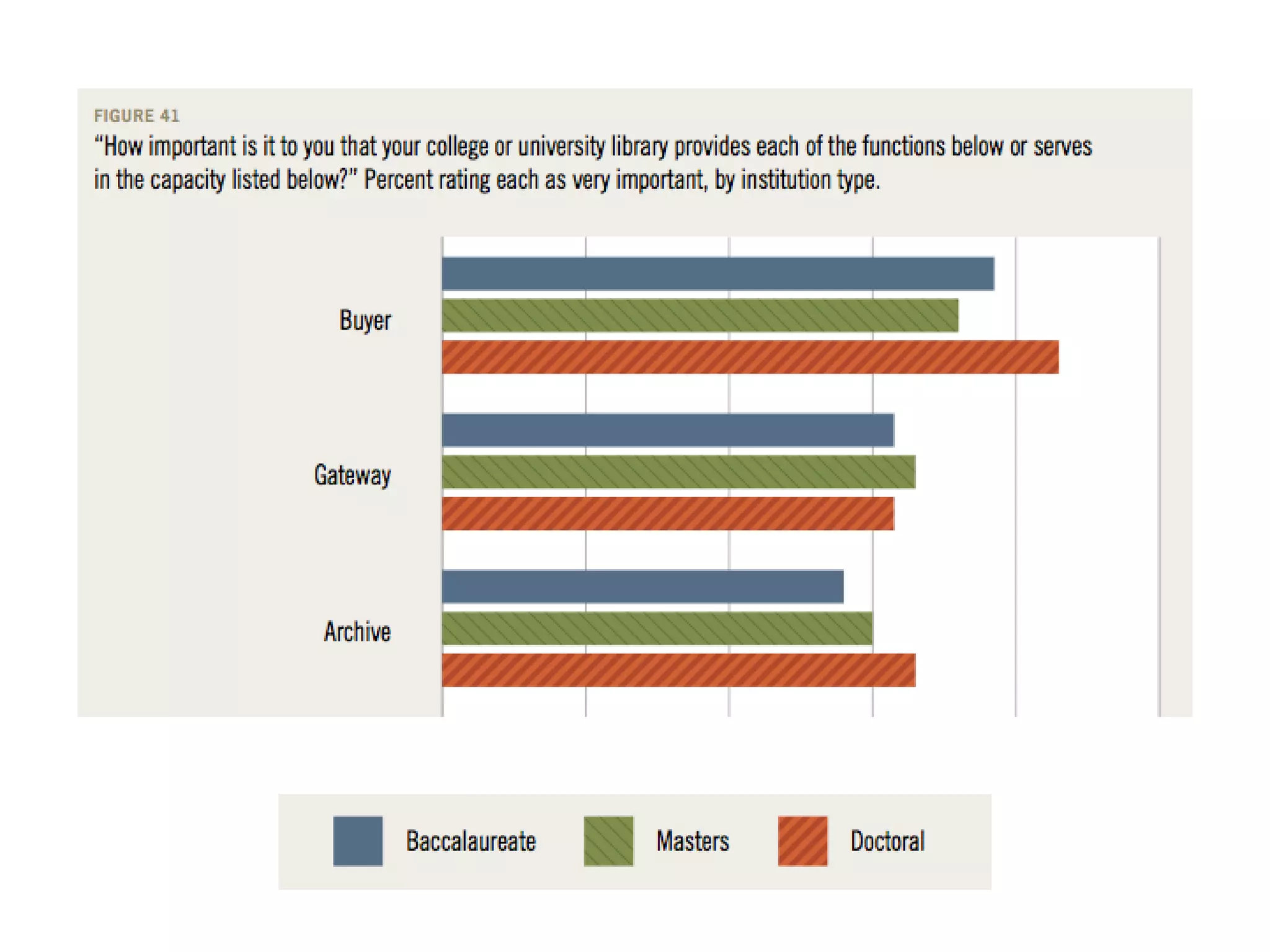
How Important is the Library to Faculty?


• Ithaka S+R US Faculty
  Survey 2012.
  http://lists.jstor.org/t/433194/11798
  962/417/5/
“Academic libraries can no longer assume that
their importance and value to a university is
universally understood.”

                  Susan Gibbons, University Librarian
                  Yale University Library Annual Report, 2011-12
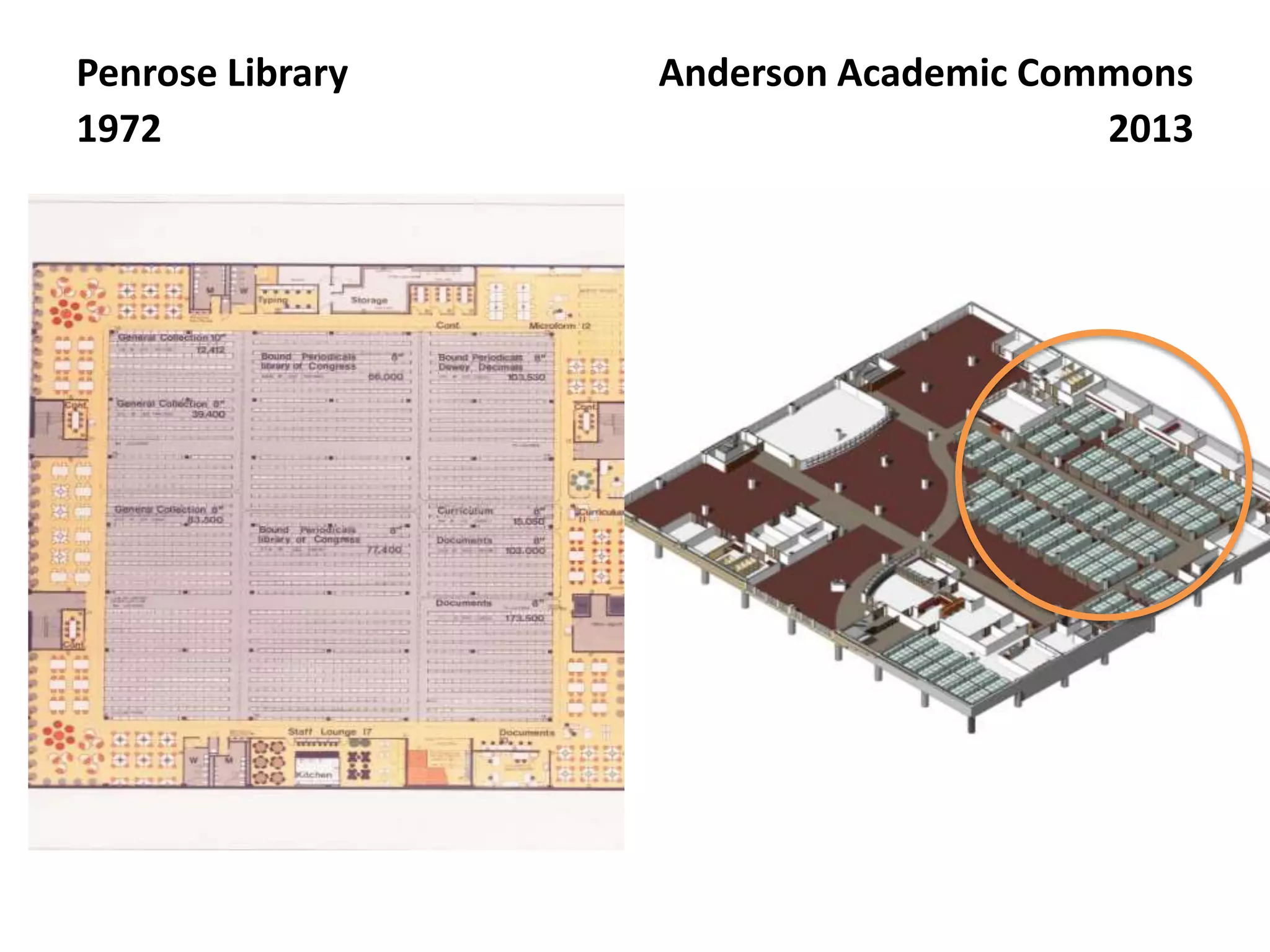
Penrose Library   Anderson Academic Commons
1972                                   2013
This is NOT a Library!!!
definitions
li·brar·y
1. A building or room containing collections
    of books…
2. A collection of books…
3. The organization that manages that
    building and collection…
What Do The Experts Say?
• "The future library will be located in a spaceship. The
  spaceship will have blue tables and purple chairs. The walls of
  the future library will be green and magenta. Also, the future
  library will have many skylights."
• "Libraries will have flying desks and iPads for each person.”
• "The future library will be open twenty four hours.”
• "The library will have ninety thousand computers. The library
  will also have a café."
• "Libraries will be floating in the sky. People will have their own
  planes to get there.”
• "As much as I love the library, I’m 100% sure future libraries
  would be even more awesome. Just think how amazing the
  library will be in the future, with robots and electronics."
• "I also believe that there will be robot librarians. But then
  again a lot of people know that someday robots will take over
  the world. Also people think that there will be a war of good
  robots vs bad robots but here is the good part about all this is
  that the good robots will be teamed up with all of humanity.
  But earth is a very strong place and can fight with or without
  human help.”
• "They [robots] will be very cost effective because we will not
  have to pay them."
• The librarians are so friendly, even the shyest person in the
  world won't be shy anymore.”
• "If you have a book that is out of date, it will warp back to the
  library. It also allows you to warp to other libraries."


Essays from children on the future of libraries. April 2011.
http://www.screwydecimal.com/2011/04/library-of-future.html
The Past
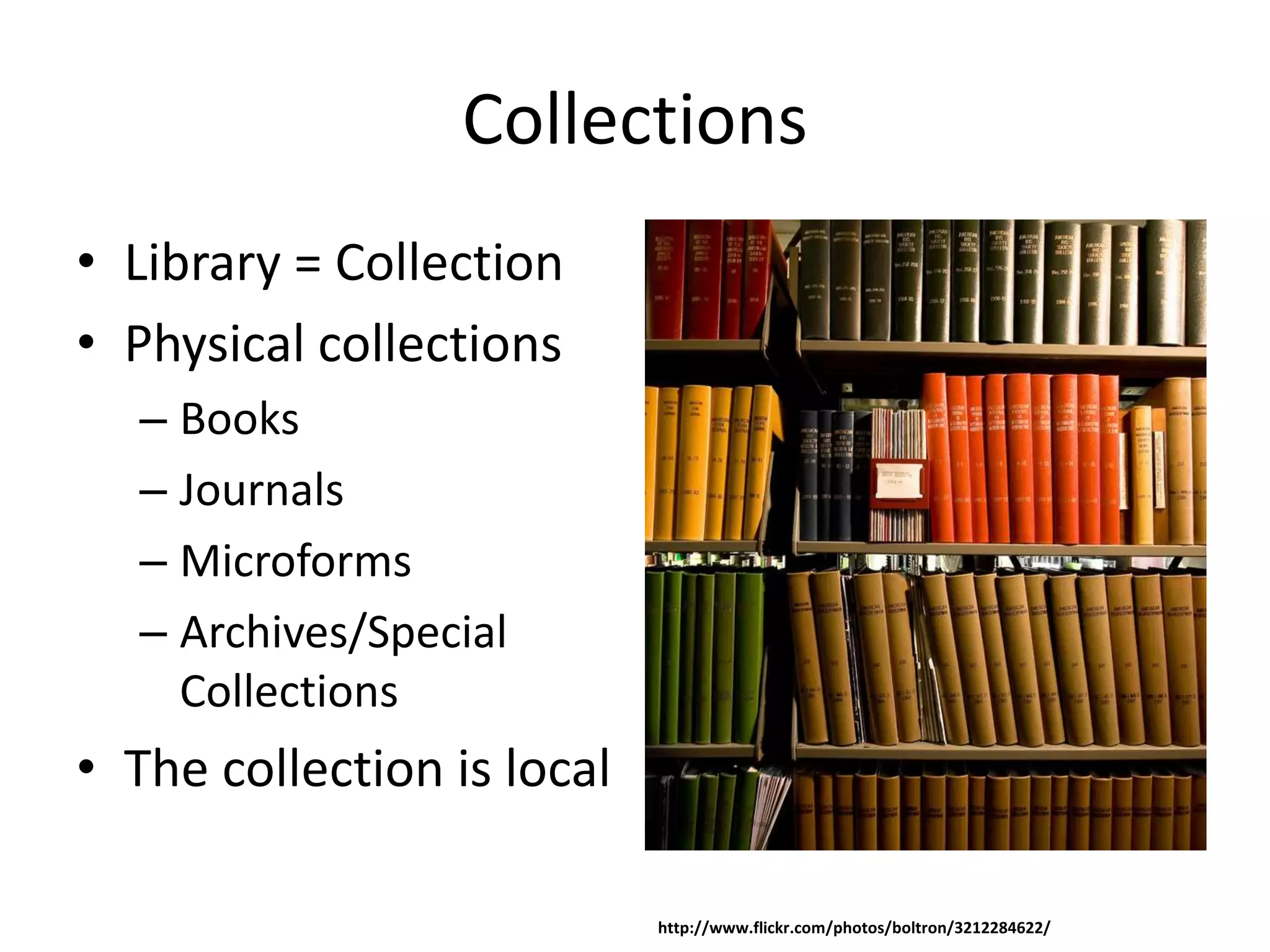
Collections
• Library = Collection
• Physical collections
  – Books
  – Journals
  – Microforms
  – Archives/Special
    Collections
• The collection is local

                            http://www.flickr.com/photos/boltron/3212284622/
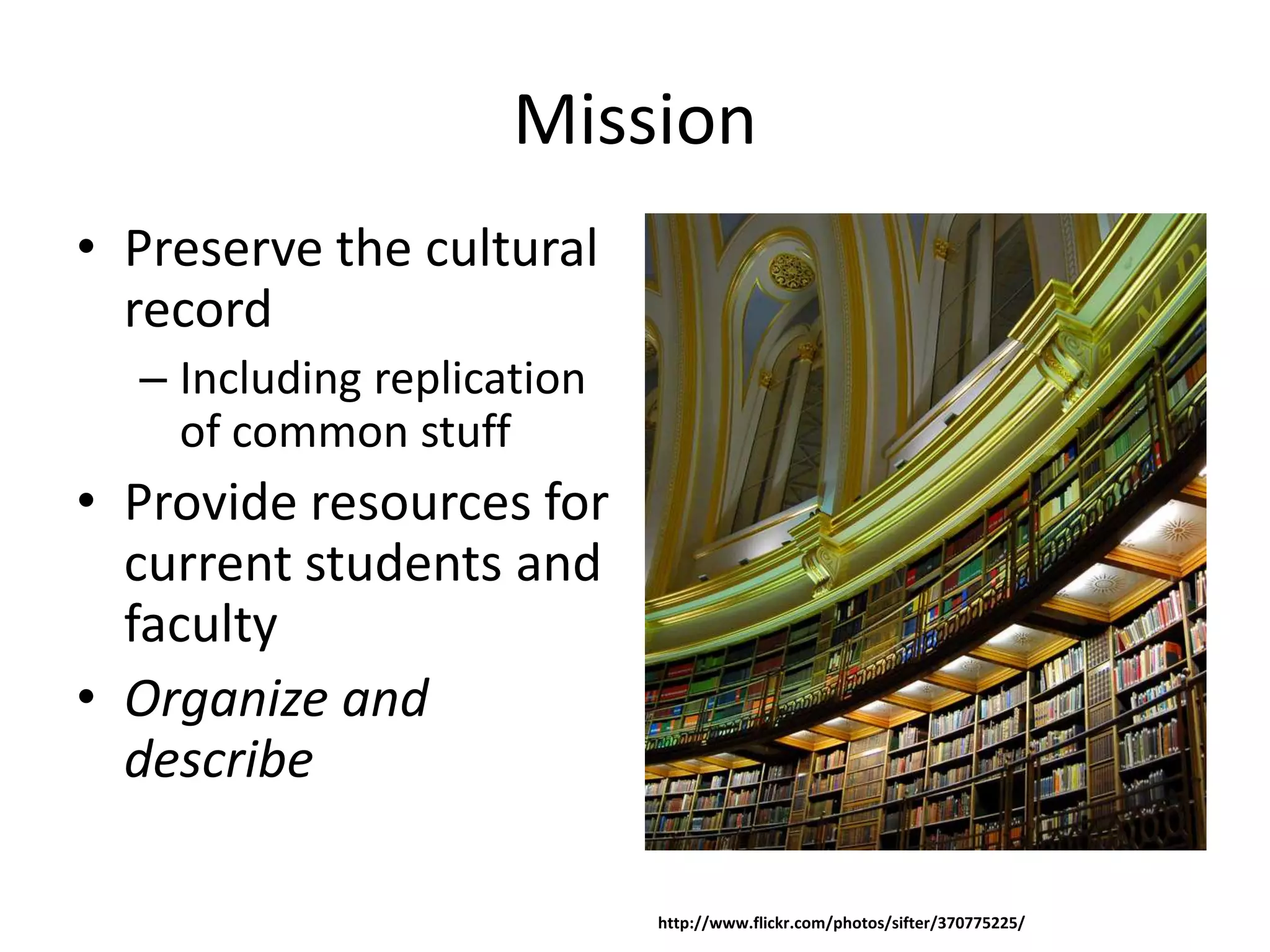
Mission
• Preserve the cultural
  record
  – Including replication
    of common stuff
• Provide resources for
  current students and
  faculty
• Organize and
  describe

                            http://www.flickr.com/photos/sifter/370775225/
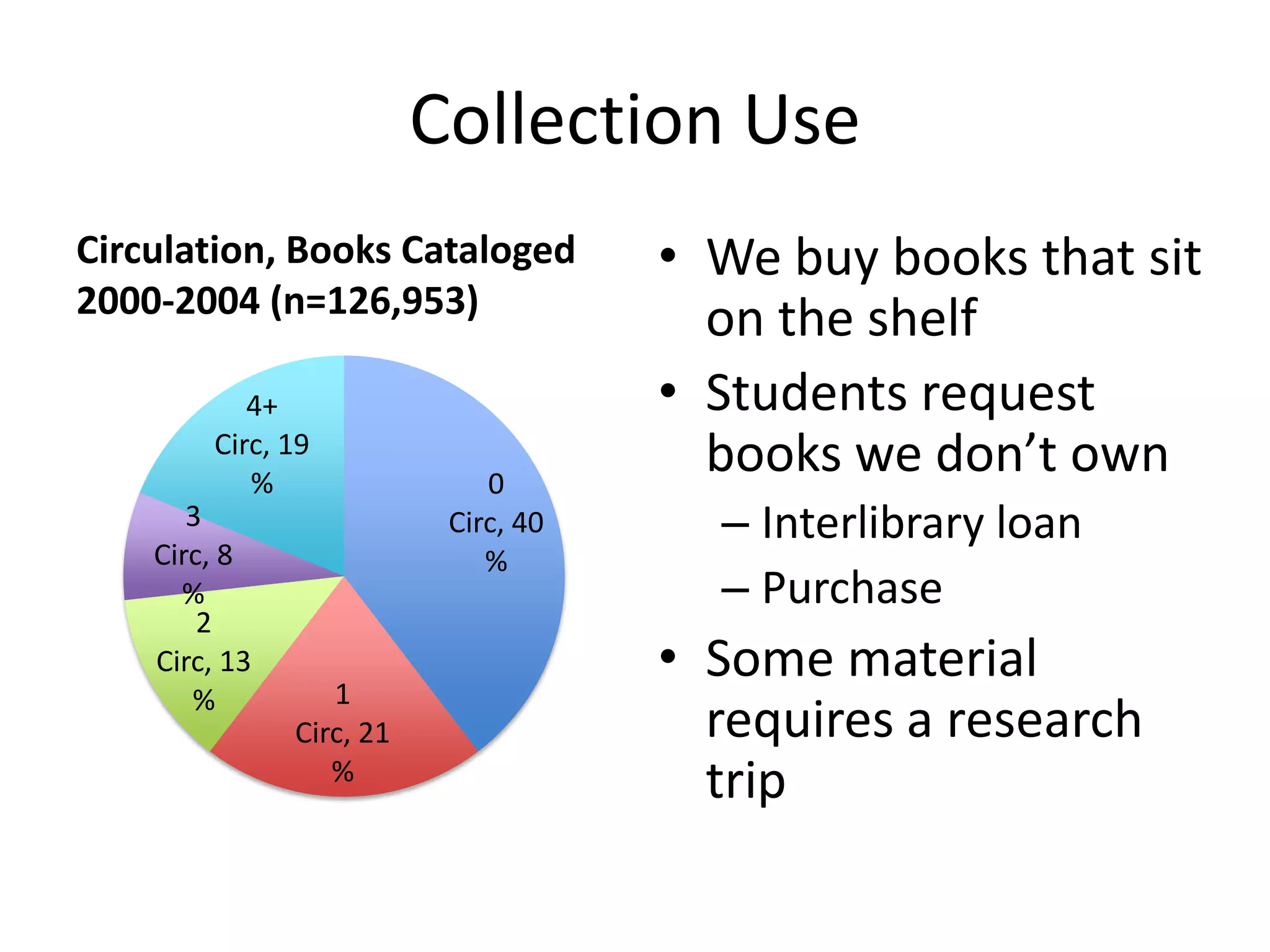
Collection Use
Circulation, Books Cataloged          • We buy books that sit
2000-2004 (n=126,953)
                                        on the shelf
           4+                         • Students request
        Circ, 19
           %                  0
                                        books we don’t own
       3                   Circ, 40     – Interlibrary loan
    Circ, 8                   %
      %                                 – Purchase
        2
    Circ, 13
                  1
                                      • Some material
       %
               Circ, 21                 requires a research
                  %
                                        trip
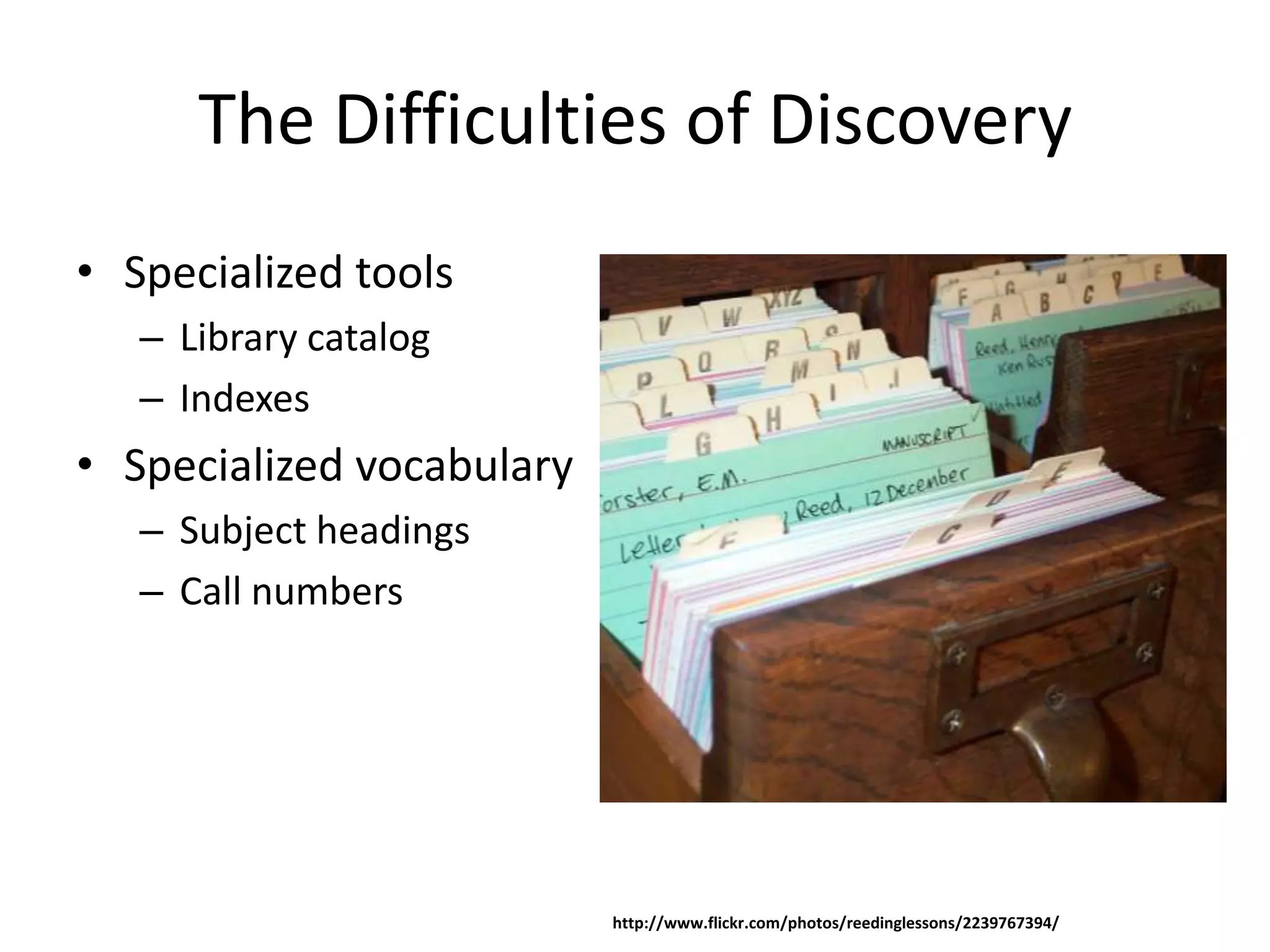
The Difficulties of Discovery
• Specialized tools
   – Library catalog
   – Indexes
• Specialized vocabulary
   – Subject headings
   – Call numbers


                           http://www.flickr.com/photos/reedinglessons/2239767394/
As Physical Collections Expanded…
• Quantity came to equal quality
• There was less room for students
• There was little ability to integrate technology
  into the building
• There was less money for special collections
The Present
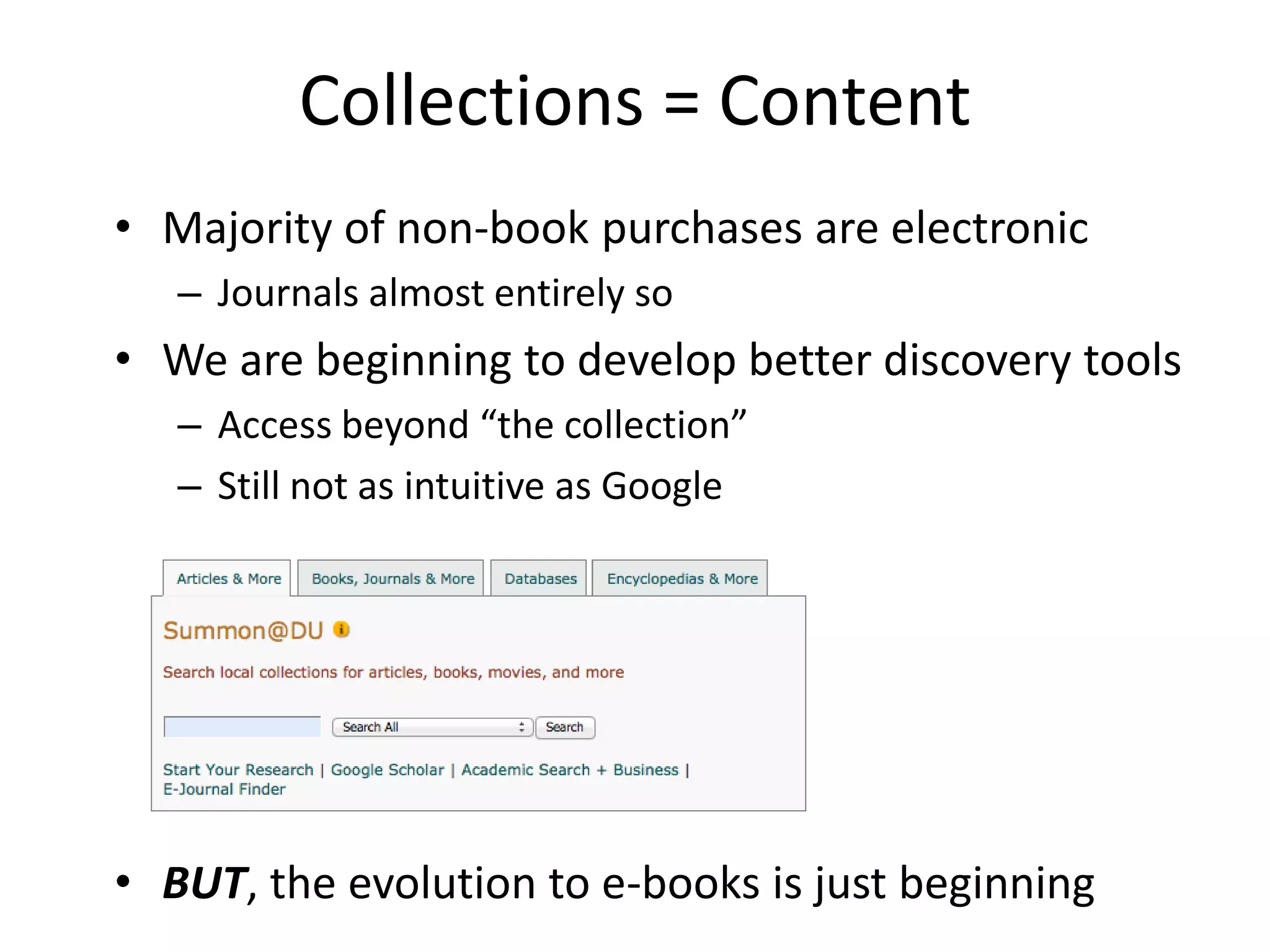
Collections = Content
• Majority of non-book purchases are electronic
   – Journals almost entirely so
• We are beginning to develop better discovery tools
   – Access beyond “the collection”
   – Still not as intuitive as Google


• BUT, the evolution to e-books is just beginning
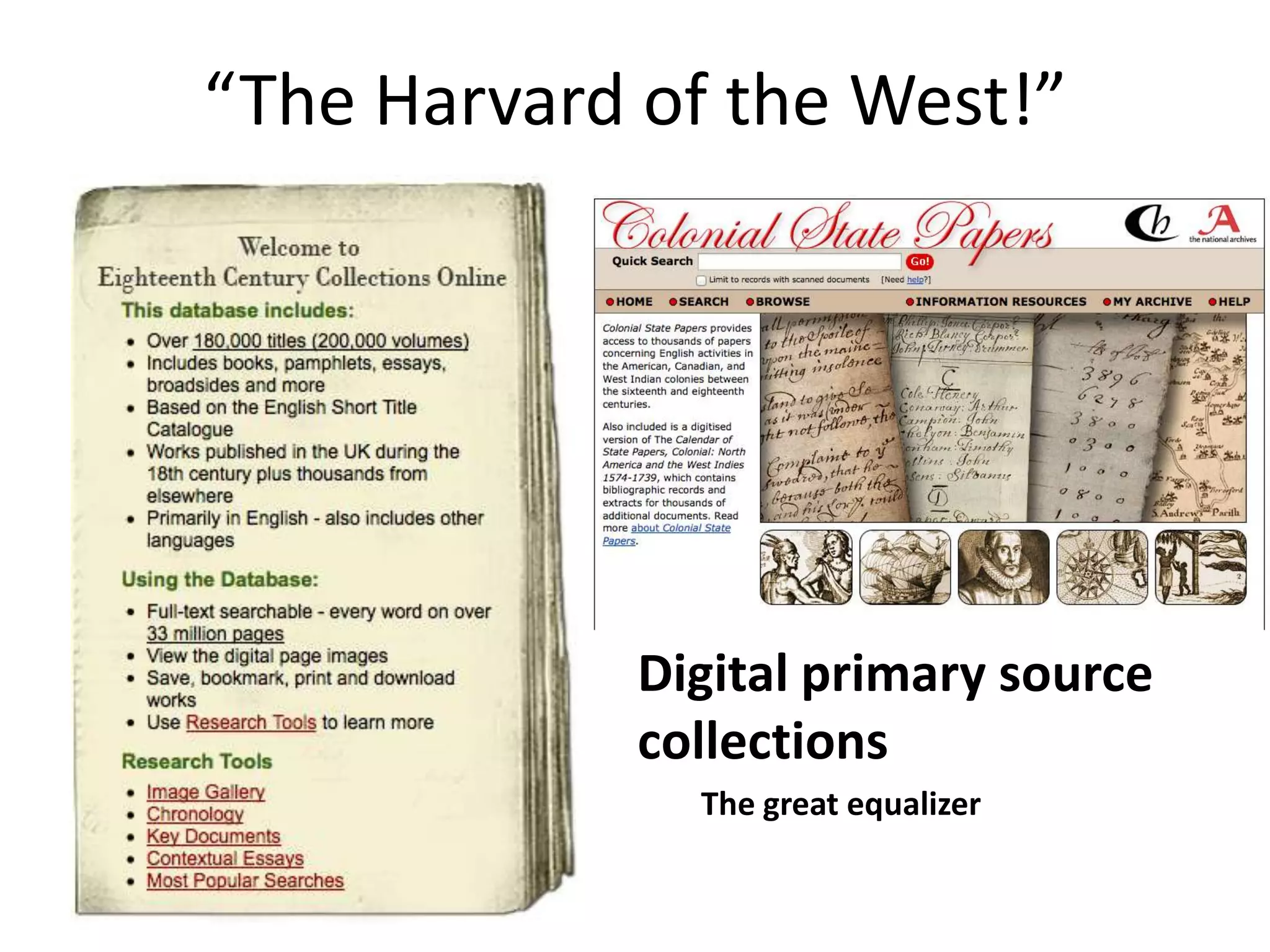
“The Harvard of the West!”


             Digital primary source
             collections
               The great equalizer
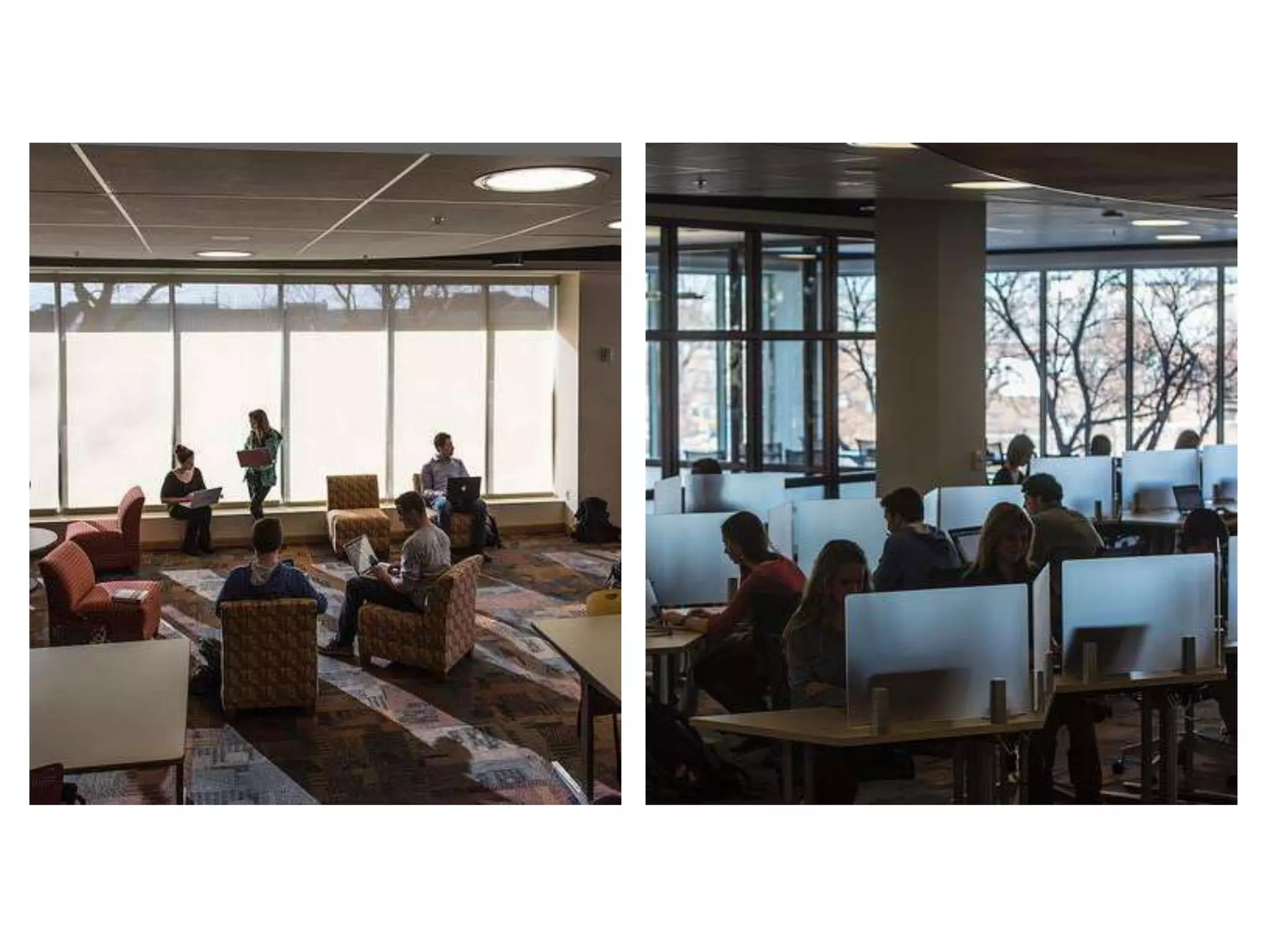
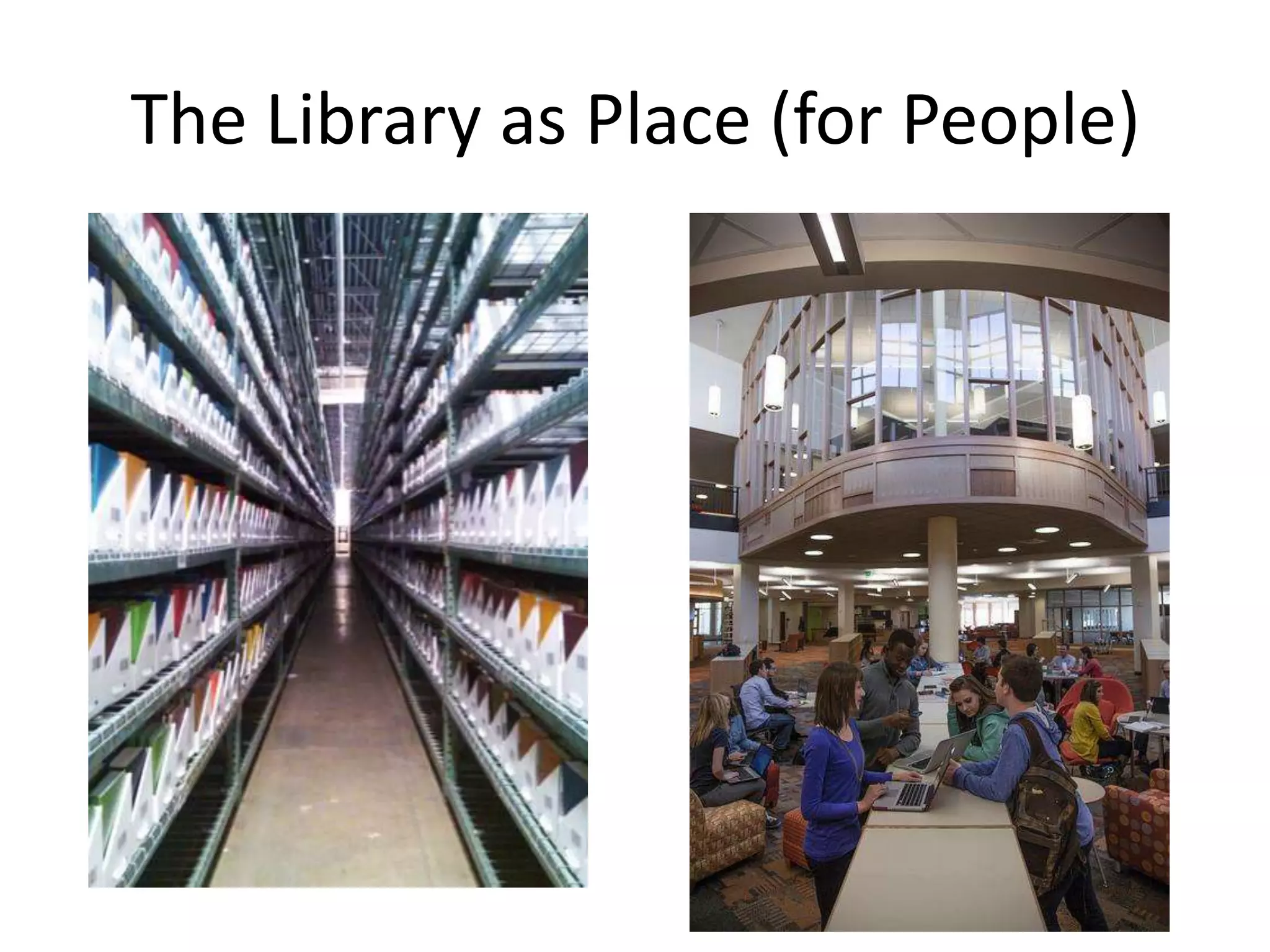
The Library as Place (for People)
Evolving Mission
• Provide access to content for current students
  and faculty
  – Service orientation
  – Discovery tools
     • Owned and unowned content
• Preserve the cultural record
  – Institutional Repositories
  – Redundant print
  – Portico
The Future
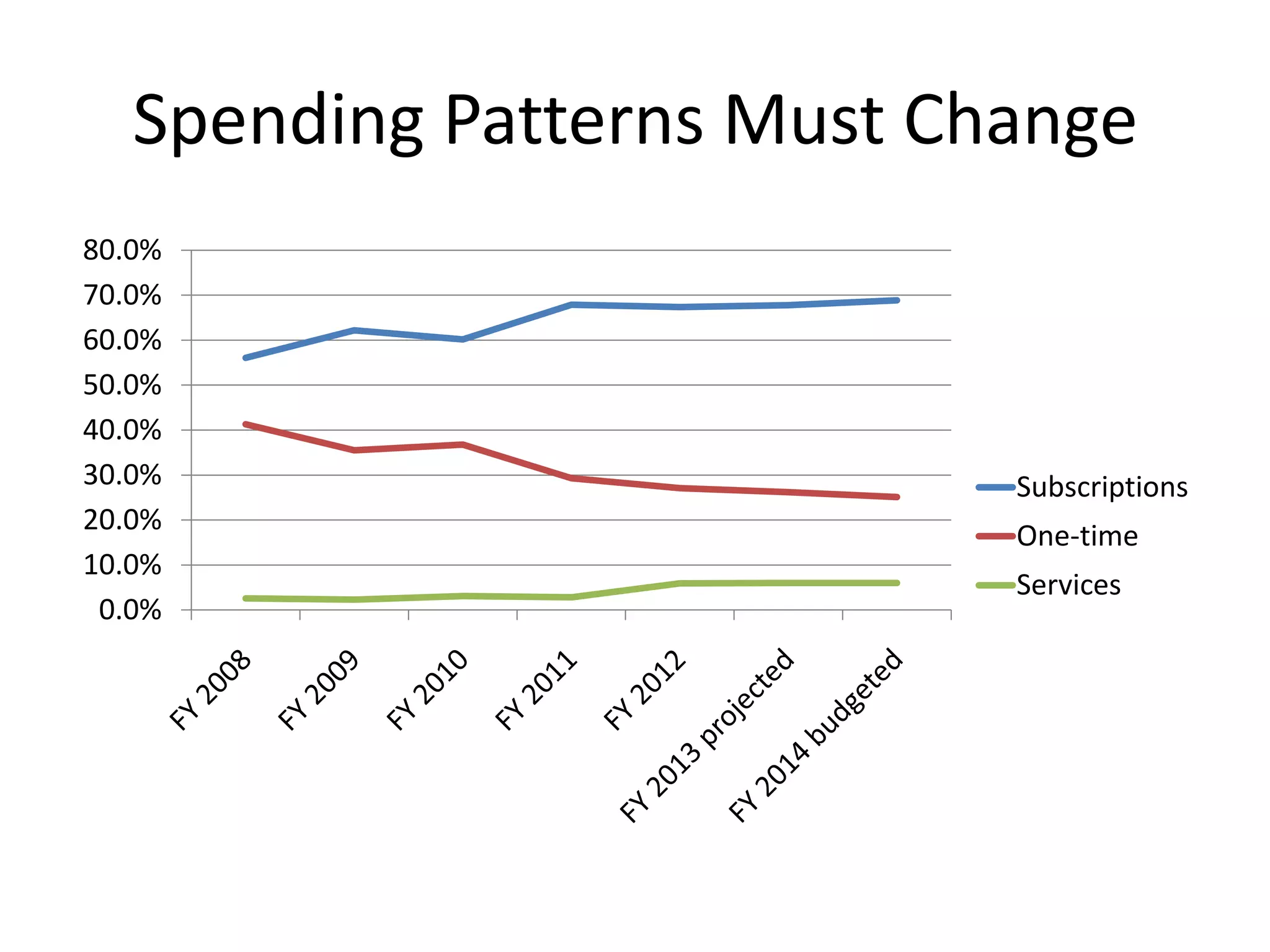
Spending Patterns Must Change
80.0%
70.0%
60.0%
50.0%
40.0%
30.0%                       Subscriptions
20.0%
                            One-time
10.0%
                            Services
 0.0%
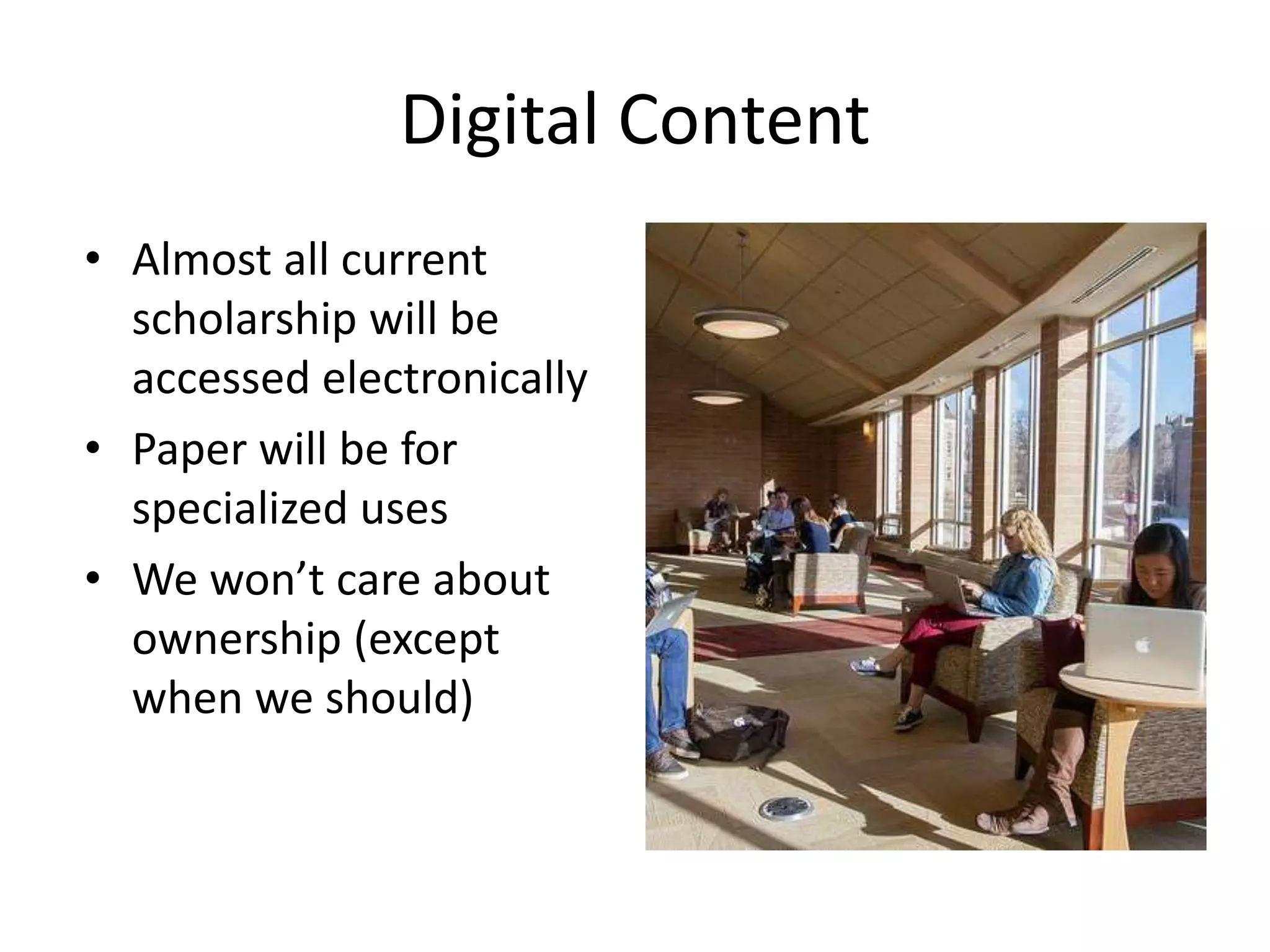
Digital Content
• Almost all current
  scholarship will be
  accessed electronically
• Paper will be for
  specialized uses
• We won’t care about
  ownership (except
  when we should)
Rethinking the Collection
• Access on demand
  – Pay only for use
  – Pay only for level of use
  – E-books
  – Articles (not journals)
  – Print on Demand
     • Espresso Book Machine
• Access instead of assets
• A broader, richer content pool
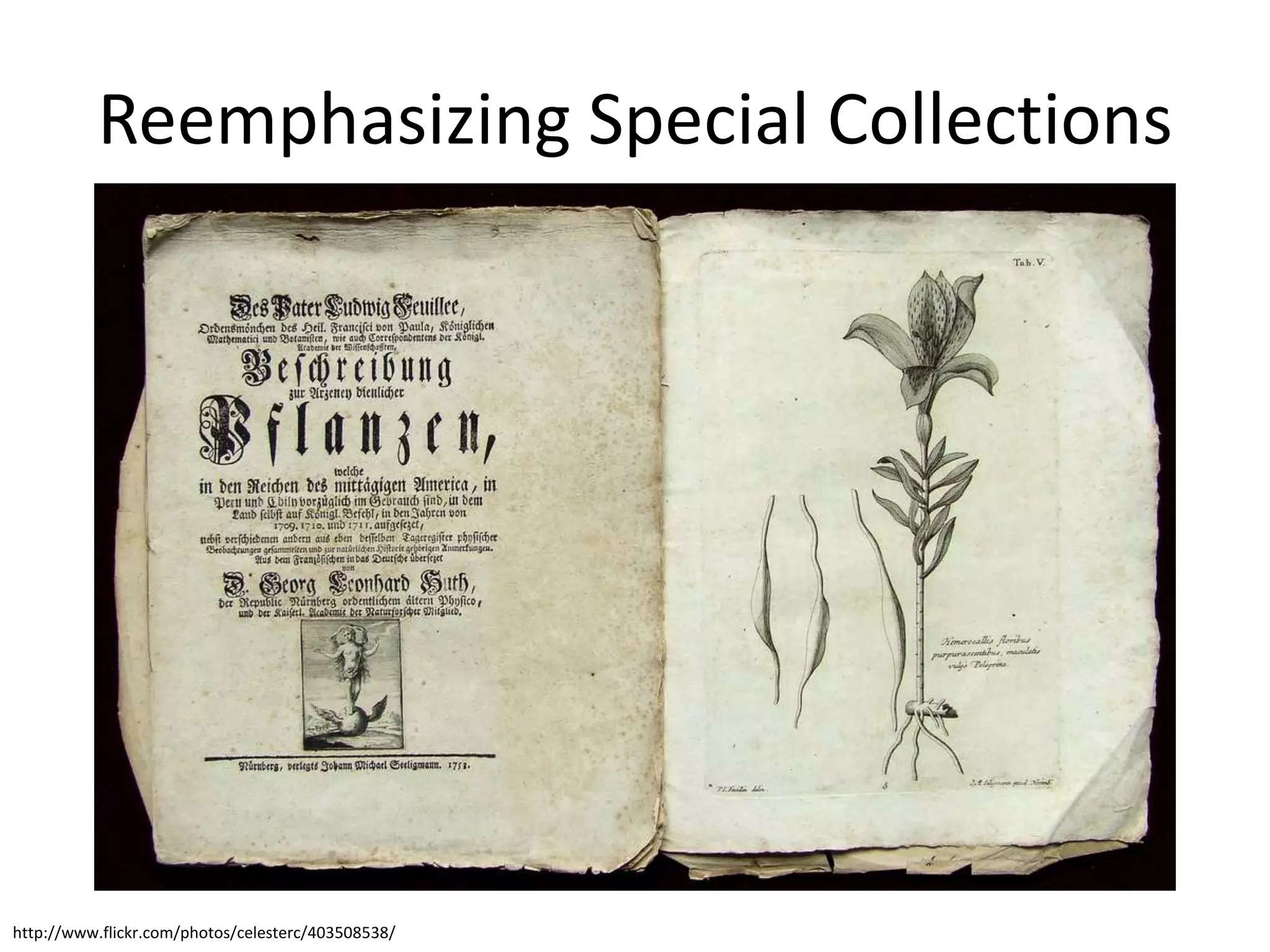
Reemphasizing Special Collections


http://www.flickr.com/photos/celesterc/403508538/
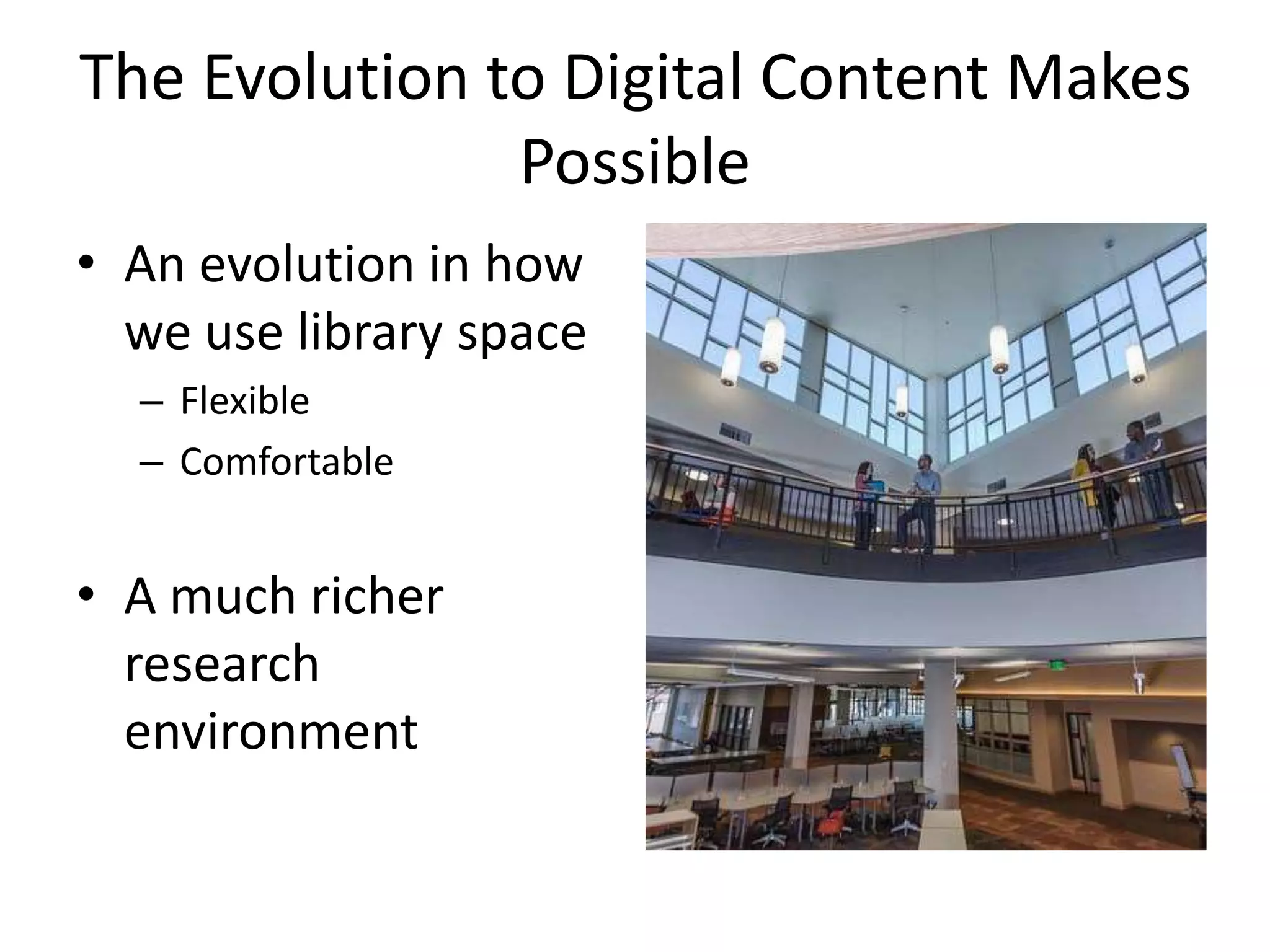
The Evolution to Digital Content Makes
               Possible
• An evolution in how
  we use library space
  – Flexible
  – Comfortable


• A much richer
  research
  environment
Our Mission Should Be…
• Locally, to provide our users with the widest range of
  quality resources possible (and to make these things
  easier to find)
   – Digital content, owned and unowned
   – Primary source collections, digital and physical
• Collectively, to serve as stewards of the cultural
  record
   – Maintain the physical collections that matter locally
      • Collaborate on the rest
   – Pay third-party specialists to preserve licensed digital
     content
Research libraries are both the same as
they’ve always been, and very different
• Same mission
  – Providing information resources and services to
    support the curriculum
  – Stewardship
• Very different emphases
  – Access vs. assets
  – Locally unique materials
  – Service / ease of use
  – Space
  – Comfort
Thank You

From Archive to Gateway: The Evolution of the Research Library

  • 1.
    From Archive toGateway: The Evolution of the Research Library University of Utah Friends of the Marriott Library Banquet April 9, 2013 Michael Levine-Clark University of Denver Libraries
  • 2.
  • 5.
    OCLC. Perceptions ofLibraries 2010. http://www.oclc.org/reports/2010perceptions.en.html.
  • 7.
    How Important isthe Library to Faculty? • Ithaka S+R US Faculty Survey 2012. http://lists.jstor.org/t/433194/11798 962/417/5/
  • 9.
    “Academic libraries canno longer assume that their importance and value to a university is universally understood.” Susan Gibbons, University Librarian Yale University Library Annual Report, 2011-12
  • 10.
    Penrose Library Anderson Academic Commons 1972 2013
  • 12.
    This is NOTa Library!!!
  • 13.
    definitions li·brar·y 1. A buildingor room containing collections of books… 2. A collection of books… 3. The organization that manages that building and collection…
  • 14.
    What Do TheExperts Say? • "The future library will be located in a spaceship. The spaceship will have blue tables and purple chairs. The walls of the future library will be green and magenta. Also, the future library will have many skylights." • "Libraries will have flying desks and iPads for each person.” • "The future library will be open twenty four hours.” • "The library will have ninety thousand computers. The library will also have a café." • "Libraries will be floating in the sky. People will have their own planes to get there.” • "As much as I love the library, I’m 100% sure future libraries would be even more awesome. Just think how amazing the library will be in the future, with robots and electronics."
  • 15.
    • "I alsobelieve that there will be robot librarians. But then again a lot of people know that someday robots will take over the world. Also people think that there will be a war of good robots vs bad robots but here is the good part about all this is that the good robots will be teamed up with all of humanity. But earth is a very strong place and can fight with or without human help.” • "They [robots] will be very cost effective because we will not have to pay them." • The librarians are so friendly, even the shyest person in the world won't be shy anymore.” • "If you have a book that is out of date, it will warp back to the library. It also allows you to warp to other libraries." Essays from children on the future of libraries. April 2011. http://www.screwydecimal.com/2011/04/library-of-future.html
  • 16.
  • 17.
    Collections • Library =Collection • Physical collections – Books – Journals – Microforms – Archives/Special Collections • The collection is local http://www.flickr.com/photos/boltron/3212284622/
  • 18.
    Mission • Preserve thecultural record – Including replication of common stuff • Provide resources for current students and faculty • Organize and describe http://www.flickr.com/photos/sifter/370775225/
  • 19.
    Collection Use Circulation, BooksCataloged • We buy books that sit 2000-2004 (n=126,953) on the shelf 4+ • Students request Circ, 19 % 0 books we don’t own 3 Circ, 40 – Interlibrary loan Circ, 8 % % – Purchase 2 Circ, 13 1 • Some material % Circ, 21 requires a research % trip
  • 20.
    The Difficulties ofDiscovery • Specialized tools – Library catalog – Indexes • Specialized vocabulary – Subject headings – Call numbers http://www.flickr.com/photos/reedinglessons/2239767394/
  • 21.
    As Physical CollectionsExpanded… • Quantity came to equal quality • There was less room for students • There was little ability to integrate technology into the building • There was less money for special collections
  • 22.
  • 23.
    Collections = Content •Majority of non-book purchases are electronic – Journals almost entirely so • We are beginning to develop better discovery tools – Access beyond “the collection” – Still not as intuitive as Google • BUT, the evolution to e-books is just beginning
  • 24.
    “The Harvard ofthe West!” Digital primary source collections The great equalizer
  • 25.
    The Library asPlace (for People)
  • 26.
    Evolving Mission • Provideaccess to content for current students and faculty – Service orientation – Discovery tools • Owned and unowned content • Preserve the cultural record – Institutional Repositories – Redundant print – Portico
  • 27.
  • 28.
    Spending Patterns MustChange 80.0% 70.0% 60.0% 50.0% 40.0% 30.0% Subscriptions 20.0% One-time 10.0% Services 0.0%
  • 29.
    Digital Content • Almostall current scholarship will be accessed electronically • Paper will be for specialized uses • We won’t care about ownership (except when we should)
  • 30.
    Rethinking the Collection •Access on demand – Pay only for use – Pay only for level of use – E-books – Articles (not journals) – Print on Demand • Espresso Book Machine • Access instead of assets • A broader, richer content pool
  • 31.
  • 32.
    The Evolution toDigital Content Makes Possible • An evolution in how we use library space – Flexible – Comfortable • A much richer research environment
  • 33.
    Our Mission ShouldBe… • Locally, to provide our users with the widest range of quality resources possible (and to make these things easier to find) – Digital content, owned and unowned – Primary source collections, digital and physical • Collectively, to serve as stewards of the cultural record – Maintain the physical collections that matter locally • Collaborate on the rest – Pay third-party specialists to preserve licensed digital content
  • 34.
    Research libraries areboth the same as they’ve always been, and very different • Same mission – Providing information resources and services to support the curriculum – Stewardship • Very different emphases – Access vs. assets – Locally unique materials – Service / ease of use – Space – Comfort
  • 35.