Can	
  We	
  Have	
  It	
  All?	
  Do	
  We	
  Want	
  It	
  
All?	
  The	
  Evolu4on	
  of	
  Academic	
  
Library	
  Collec4on	
  Development	
  
INFORUM	
  Conference	
  
Prague	
  
May	
  26,	
  2015	


Michael	
  Levine-­‐Clark	
  
Associate	
  Dean	
  for	
  Scholarly	
  Communica4on	
  and	
  Collec4ons	
  Services	
  
University	
  of	
  Denver	
  
	
  hQps://flic.kr/p/aDHfHc	


The	
  academic	
  library	
  exists	
  to	
  preserve	
  
knowledge	
  for	
  future	
  genera4ons.	
  
hQps://flic.kr/p/s2hSPr	


The	
  academic	
  library	
  exists	
  to	
  serve	
  
the	
  curricular	
  and	
  research	
  needs	
  of	
  
current	
  students	
  and	
  faculty.	
  
hQps://flic.kr/p/8pWq9v	
  
Coexis4ng	
  Missions	
  
Tradi4onally,	
  access	
  to	
  
resources	
  for	
  our	
  
students	
  necessitated	
  
long-­‐term	
  preserva4on	
  
hQps://flic.kr/p/a1ByLR	
  
Conflic4ng	
  Missions	


Temporary	
  Access	
  
•  More	
  resources	
  
available	
  to	
  current	
  
students	
  and	
  faculty	
  
•  Weakens	
  stewardship	
  
mission	


Permanent	
  Access	
  
•  More	
  costly	
  
•  Fewer	
  resources	
  for	
  
current	
  students	
  and	
  
faculty	
  
The	
  library	
  used	
  to	
  be	
  the	
  primary	
  place	
  to	
  
find	
  informa4on	
  .	
  .	
  .	
  but	
  not	
  anymore	
  
Student	
  Expecta4ons	
  
•  Immediate	
  access	
  to	
  
almost	
  everything	
  
•  If	
  you	
  can’t	
  get	
  it	
  right	
  
away,	
  move	
  on	
  to	
  the	
  
next	
  thing	
  
Tradi4onal	
  Collec4on	
  Development	
  
•  Purchase	
  books	
  
–  At	
  point	
  of	
  publica4on	
  
–  At	
  close	
  to	
  list	
  price	
  
–  Made	
  easier	
  by	
  approval	
  
plans	
  
–  Ra4onal	
  
–  Predictable	
  
•  Subscribe	
  to	
  journals	
  
–  As	
  they	
  are	
  issued	
  
–  At	
  list	
  price,	
  then	
  at	
  a	
  
discount	
  as	
  part	
  of	
  the	
  
Big	
  Deal	


Buy	
  un&l	
  the	
  budget	
  is	
  spent	
  
Drawbacks	
  of	
  the	
  tradi4onal	
  model	
  
•  Hard	
  to	
  acquire	
  books	
  retroac4vely	
  
•  Difficult	
  to	
  access	
  journal	
  ar4cles	
  without	
  
ini4al	
  subscrip4on	
  
•  Lots	
  of	
  low	
  or	
  no-­‐use	
  material	
  
•  A	
  somewhat	
  sta4c	
  collec4on,	
  augmented	
  by	
  
interlibrary	
  loan	
  
•  Heavy	
  duplica4on	
  of	
  common	
  materials	
  across	
  
libraries	
  
Beginnings	
  of	
  a	
  new	
  model	
  
Started	
  with	
  journals	
  
•  Shi`	
  to	
  access	
  through	
  journal	
  packages	
  
– But	
  with	
  perpetual	
  access	
  rights	
  to	
  some	
  4tles	
  
•  Reliance	
  on	
  aggregator	
  packages	
  
– With	
  no	
  perpetual	
  access	
  rights	
  
We	
  now	
  accept	
  as	
  a	
  given	
  that	
  most	
  of	
  the	
  
journals	
  in	
  our	
  collec&ons	
  have	
  only	
  
temporary	
  access	
  rights.	
  
New	
  approaches	
  for	
  books	
  
•  Demand-­‐driven	
  acquisi4on	
  of	
  monographs	
  
– Mostly	
  ebooks	
  
•  Subscrip4on	
  packages	
  of	
  ebooks	
  
•  Possible	
  because	
  of	
  print-­‐on-­‐demand,	
  
decreased	
  chance	
  of	
  books	
  going	
  out	
  of	
  print,	
  
beQer	
  used	
  book	
  market	
  
Libraries	
  treat	
  these	
  as	
  supplementary	
  
models	
  to	
  tradi&onal	
  book	
  buying	


What	
  if	
  we	
  became	
  more	
  aggressive?	
  
A	
  (mostly)	
  demand-­‐driven	
  collec4on?	
  
•  Load	
  records	
  into	
  catalog	
  
–  Any	
  book	
  with	
  poten4al	
  relevance	
  to	
  curricular	
  and	
  
research	
  focus	
  of	
  university	
  
•  Subscribe	
  to	
  some	
  4tles	
  
•  Purchase	
  the	
  right	
  format	
  for	
  the	
  moment	
  
–  POD	
  	
  
–  eBook	
  
At	
  the	
  moment,	
  Most	
  books	
  not	
  available	
  for	
  
local	
  POD	
  or	
  as	
  ebook	
  on	
  DDA	
  
What	
  would	
  be	
  necessary	
  to	
  expand	
  
DDA?	
  
•  All	
  books	
  available	
  as	
  POD,	
  ebook	
  
•  No	
  book	
  ever	
  goes	
  out	
  of	
  print	
  
•  Guaranteed	
  access	
  to	
  not-­‐yet-­‐purchased	
  1tles	
  
Ensuring	
  Future	
  Access	
  
•  Por4co,	
  LOCKSS/CLOCKSS	
  	
  protect	
  what	
  we’ve	
  
already	
  licensed	
  
•  We	
  need	
  a	
  solu4on	
  to	
  protect	
  what	
  we	
  have	
  
not	
  yet	
  licensed	
  
Just	
  imagine	
  .	
  .	
  .	
  
•  ALL	
  relevant	
  4tles	
  
available	
  to	
  our	
  students	
  
•  Purchase	
  based	
  on	
  use	
  
hQps://flic.kr/p/yNpLa	
  
A	
  demand-­‐driven	
  collec4on	
  
•  Confidence	
  that	
  a	
  4tle	
  will	
  always	
  be	
  available	
  
for	
  poten&al	
  purchase	
  
•  Demand-­‐drive	
  collec4on	
  size	
  bounded	
  	
  
– At	
  the	
  lower	
  end	
  by	
  limita4ons	
  in	
  academic	
  
quality,	
  curricular	
  match	
  
– At	
  the	
  upper	
  end	
  by	
  budget	
  
 
What	
  about	
  journals?	
  
hQps://flic.kr/p/4pShZo	


A	
  beQer	
  ques4on:	
  
What	
  about	
  ar&cles?	
  
 
To	
  what	
  extent	
  can	
  ar4cle-­‐level	
  rental	
  
replace	
  subscrip4ons	
  and	
  the	
  big	
  deal?	
  
The	
  Big	
  Deal 	
  	
  
•  O`en	
  a	
  very	
  good	
  deal	
  
•  O`en	
  unaffordable	
  
.	
  .	
  .	
  a	
  medium	
  or	
  small	
  deal	
  supplemented	
  by	
  
ar&cle	
  rental?	


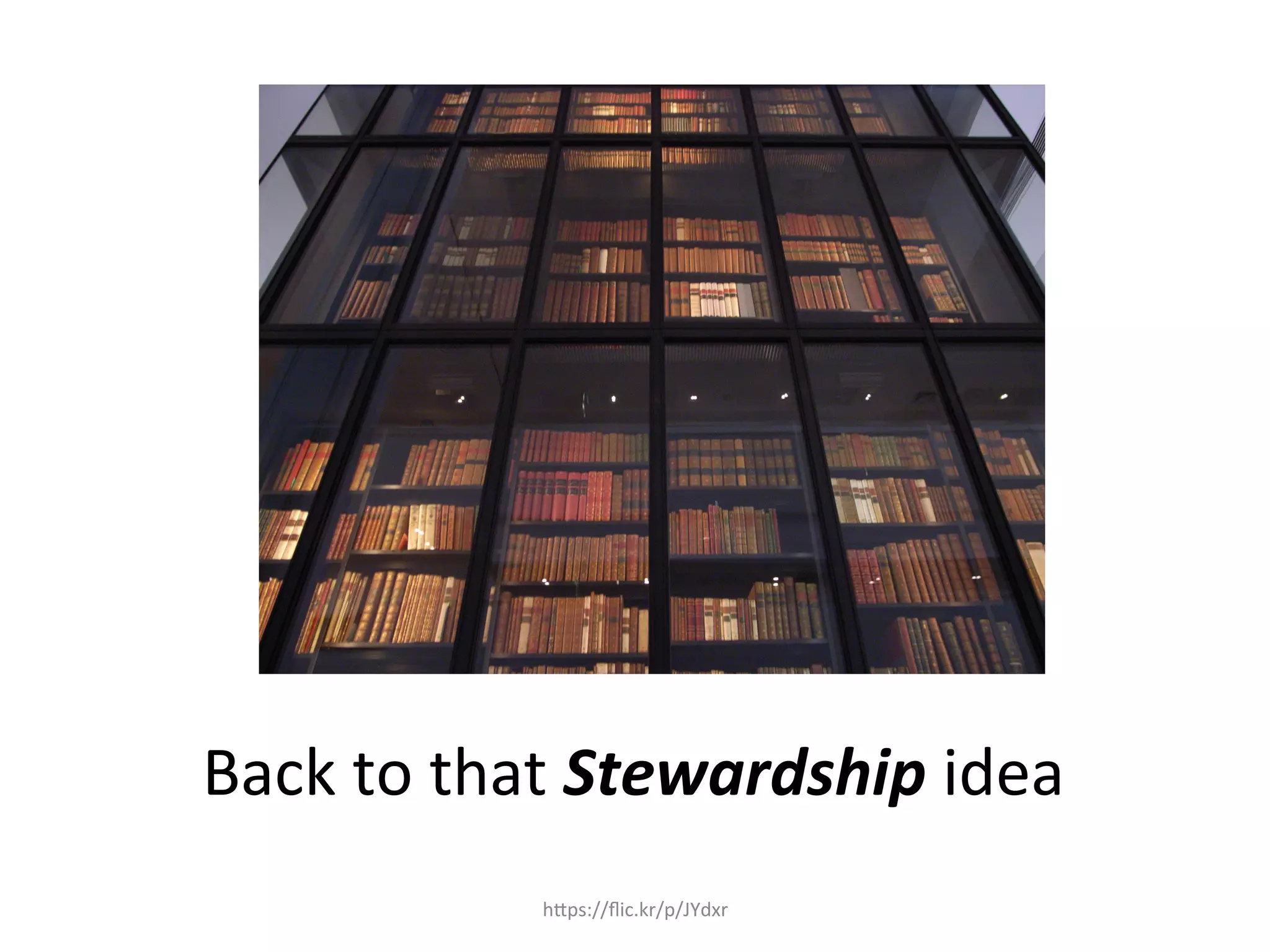
Back	
  to	
  that	
  Stewardship	
  idea	
  
hQps://flic.kr/p/JYdxr	
  
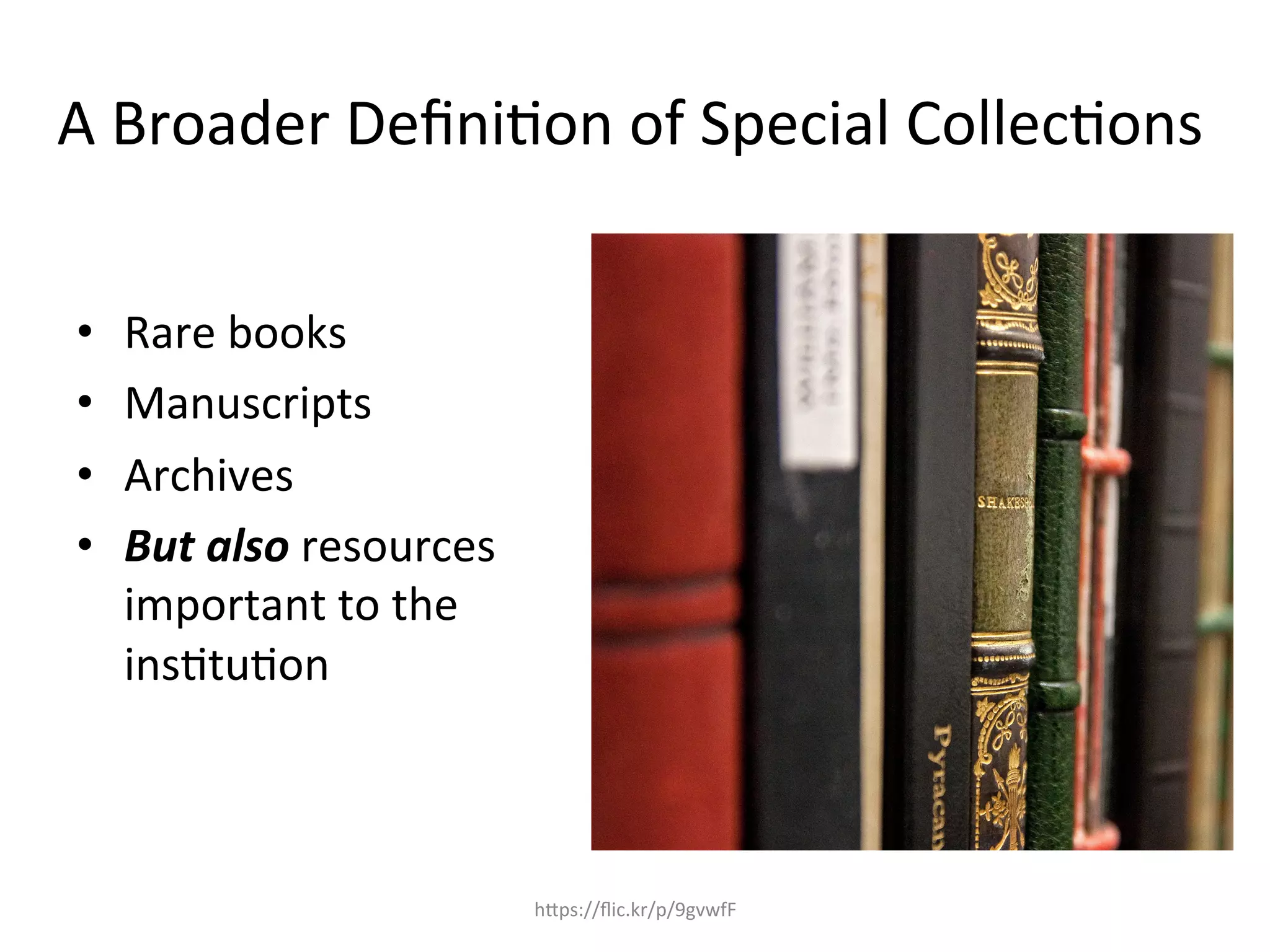
A	
  Broader	
  Defini4on	
  of	
  Special	
  Collec4ons	


•  Rare	
  books	
  
•  Manuscripts	
  
•  Archives	
  
•  But	
  also	
  resources	
  
important	
  to	
  the	
  
ins4tu4on	


hQps://flic.kr/p/9gvwfF	
  
Other	
  Collec4ons	
  
To	
  the	
  extent	
  possible,	
  all	
  material	
  not	
  included	
  in	
  
this	
  more	
  expansive	
  defini4on	
  of	
  Special	
  
Collec4ons	
  will	
  be	
  provided	
  temporarily	


•  On	
  demand	
  
•  Via	
  subscrip4on	
  with	
  no	
  post-­‐cancella4on	
  rights	
  
Shared	
  Print	
  Archiving	
  
•  Libraries	
  will	
  more	
  aggressively	
  decrease	
  
legacy	
  print	
  holdings	
  
•  Regional,	
  na4onal	
  last	
  copy	
  policies	
  and	
  
procedures	
  
•  Collabora4ve	
  prospec4ve	
  collec4on	
  building	
  
This	
  is	
  one	
  way	
  that	
  libraries	
  will	
  fulfill	
  
the	
  stewardship	
  mission	
  
Expanding	
  the	
  scope	
  of	
  collec4ons	
  
•  Research	
  support	
  and	
  analysis	
  
•  Cita4on	
  management	
  
•  Primary	
  sources	
  
Expanding	
  Even	
  Further	
  
We	
  concentrate	
  our	
  efforts	
  
on	
  a	
  very	
  small	
  por4on	
  of	
  a	
  
huge	
  poten4al	
  collec4on	
  
Tradi&onal	
  	
  
Collec&on	
  
Scholarly	
  	
  
Resources	
  
The	
  Universe	
  	
  
of	
  Informa&on	
  
hQp://www.oclc.org/content/dam/research/publica4ons/library/2014/oclcresearch-­‐collec4on-­‐direc4ons-­‐preprint-­‐2014.pdf	
  
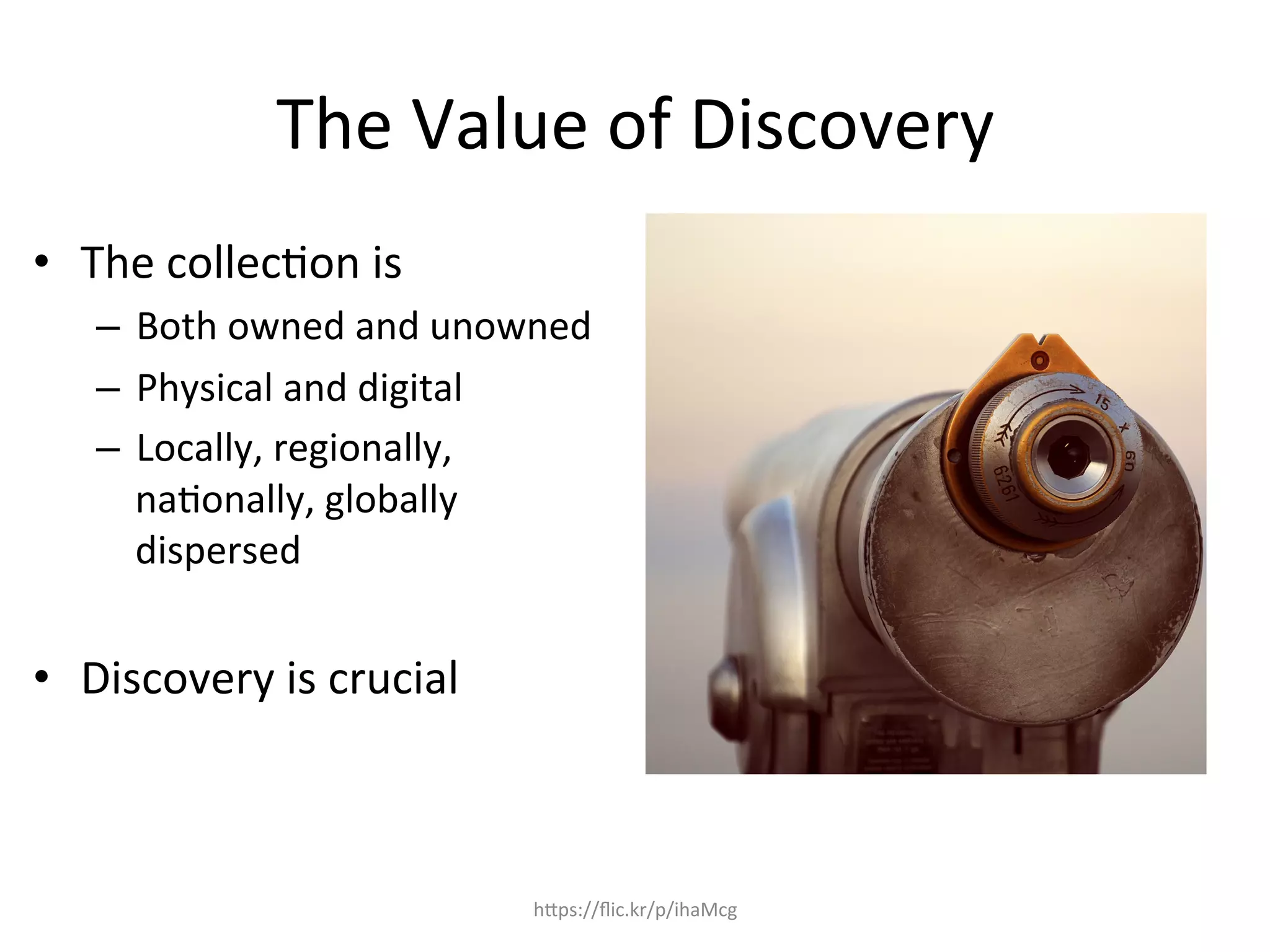
The	
  Value	
  of	
  Discovery	
  
•  The	
  collec4on	
  is	
  	
  
–  Both	
  owned	
  and	
  unowned	
  
–  Physical	
  and	
  digital	
  
–  Locally,	
  regionally,	
  
na4onally,	
  globally	
  
dispersed	
  
•  Discovery	
  is	
  crucial	


hQps://flic.kr/p/ihaMcg	
  
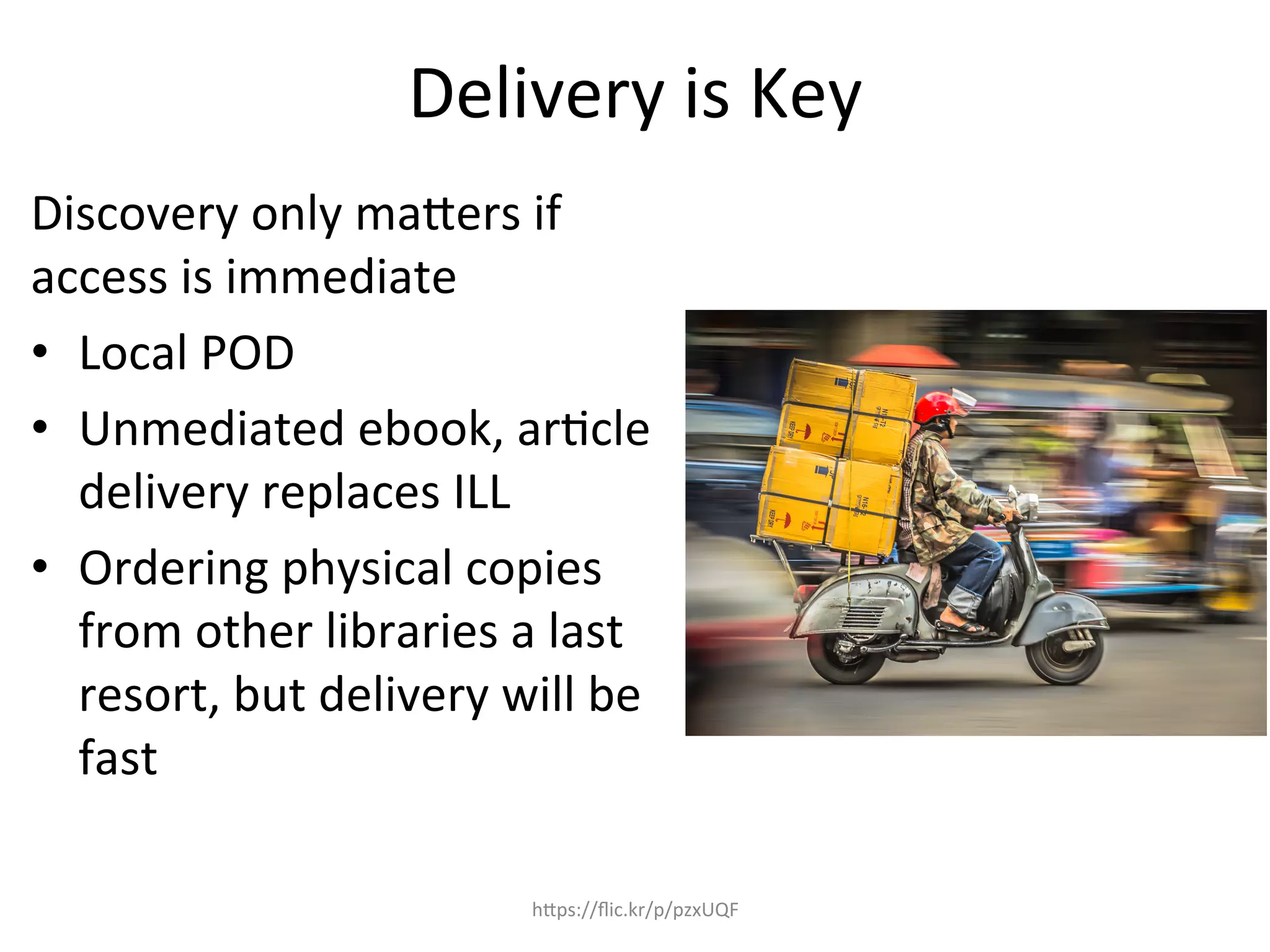
Delivery	
  is	
  Key	
  
Discovery	
  only	
  maQers	
  if	
  
access	
  is	
  immediate	
  
•  Local	
  POD	
  
•  Unmediated	
  ebook,	
  ar4cle	
  
delivery	
  replaces	
  ILL	
  
•  Ordering	
  physical	
  copies	
  
from	
  other	
  libraries	
  a	
  last	
  
resort,	
  but	
  delivery	
  will	
  be	
  
fast	
  
hQps://flic.kr/p/pzxUQF	
  
For	
  more	
  on	
  this	
  topic	
  
Levine-­‐Clark,	
  Michael,	
  “Access	
  to	
  Everything:	
  Building	
  the	
  
Future	
  Academic	
  Library	
  Collec4on,”	
  portal:	
  Libraries	
  and	
  
the	
  Academy	
  14,	
  no.	
  3	
  (2014):	
  425-­‐437.	
  
hQp://www.press.jhu.edu/journals/portal_libraries_and_the_academy/
portal_pre_print/ar4cles/14.3clark.pdf	


Dempsey,	
  Lorcan,	
  Constance	
  Malpas,	
  and	
  Brian	
  Lavoie,	
  
“Collec4on	
  Direc4ons:	
  The	
  Evolu4on	
  of	
  Library	
  Collec4ons	
  
and	
  Collec4ng,”	
  portal:	
  Libraries	
  and	
  the	
  Academy	
  14,	
  no.	
  3	
  
(2014):	
  393-­‐423.	
  
hQp://www.oclc.org/content/dam/research/publica4ons/library/2014/
oclcresearch-­‐collec4on-­‐direc4ons-­‐preprint-­‐2014.pdf	
  	
  
Michael	
  Levine-­‐Clark	
  
michael.levine-­‐clark@du.edu	


hQp://www.slideshare.net/MichaelLevineClark/	
  	
  
hQps://flic.kr/p/8vT9yB	
  

Can we have it all inforum 2015 levine clark

  • 1.
    Can  We  Have  It  All?  Do  We  Want  It   All?  The  Evolu4on  of  Academic   Library  Collec4on  Development   INFORUM  Conference   Prague   May  26,  2015     Michael  Levine-­‐Clark   Associate  Dean  for  Scholarly  Communica4on  and  Collec4ons  Services   University  of  Denver    hQps://flic.kr/p/aDHfHc  
  • 2.
        The  academic  library  exists  to  preserve   knowledge  for  future  genera4ons.   hQps://flic.kr/p/s2hSPr  
  • 3.
        The  academic  library  exists  to  serve   the  curricular  and  research  needs  of   current  students  and  faculty.   hQps://flic.kr/p/8pWq9v  
  • 4.
    Coexis4ng  Missions   Tradi4onally,  access  to   resources  for  our   students  necessitated   long-­‐term  preserva4on   hQps://flic.kr/p/a1ByLR  
  • 5.
    Conflic4ng  Missions     Temporary  Access   •  More  resources   available  to  current   students  and  faculty   •  Weakens  stewardship   mission     Permanent  Access   •  More  costly   •  Fewer  resources  for   current  students  and   faculty  
  • 6.
    The  library  used  to  be  the  primary  place  to   find  informa4on  .  .  .  but  not  anymore  
  • 7.
    Student  Expecta4ons   • Immediate  access  to   almost  everything   •  If  you  can’t  get  it  right   away,  move  on  to  the   next  thing  
  • 8.
    Tradi4onal  Collec4on  Development   •  Purchase  books   –  At  point  of  publica4on   –  At  close  to  list  price   –  Made  easier  by  approval   plans   –  Ra4onal   –  Predictable   •  Subscribe  to  journals   –  As  they  are  issued   –  At  list  price,  then  at  a   discount  as  part  of  the   Big  Deal     Buy  un&l  the  budget  is  spent  
  • 9.
    Drawbacks  of  the  tradi4onal  model   •  Hard  to  acquire  books  retroac4vely   •  Difficult  to  access  journal  ar4cles  without   ini4al  subscrip4on   •  Lots  of  low  or  no-­‐use  material   •  A  somewhat  sta4c  collec4on,  augmented  by   interlibrary  loan   •  Heavy  duplica4on  of  common  materials  across   libraries  
  • 10.
    Beginnings  of  a  new  model   Started  with  journals   •  Shi`  to  access  through  journal  packages   – But  with  perpetual  access  rights  to  some  4tles   •  Reliance  on  aggregator  packages   – With  no  perpetual  access  rights   We  now  accept  as  a  given  that  most  of  the   journals  in  our  collec&ons  have  only   temporary  access  rights.  
  • 11.
    New  approaches  for  books   •  Demand-­‐driven  acquisi4on  of  monographs   – Mostly  ebooks   •  Subscrip4on  packages  of  ebooks   •  Possible  because  of  print-­‐on-­‐demand,   decreased  chance  of  books  going  out  of  print,   beQer  used  book  market   Libraries  treat  these  as  supplementary   models  to  tradi&onal  book  buying  
  • 12.
        What  if  we  became  more  aggressive?  
  • 13.
    A  (mostly)  demand-­‐driven  collec4on?   •  Load  records  into  catalog   –  Any  book  with  poten4al  relevance  to  curricular  and   research  focus  of  university   •  Subscribe  to  some  4tles   •  Purchase  the  right  format  for  the  moment   –  POD     –  eBook   At  the  moment,  Most  books  not  available  for   local  POD  or  as  ebook  on  DDA  
  • 14.
    What  would  be  necessary  to  expand   DDA?   •  All  books  available  as  POD,  ebook   •  No  book  ever  goes  out  of  print   •  Guaranteed  access  to  not-­‐yet-­‐purchased  1tles  
  • 15.
    Ensuring  Future  Access   •  Por4co,  LOCKSS/CLOCKSS    protect  what  we’ve   already  licensed   •  We  need  a  solu4on  to  protect  what  we  have   not  yet  licensed  
  • 16.
    Just  imagine  .  .  .   •  ALL  relevant  4tles   available  to  our  students   •  Purchase  based  on  use   hQps://flic.kr/p/yNpLa  
  • 17.
    A  demand-­‐driven  collec4on   •  Confidence  that  a  4tle  will  always  be  available   for  poten&al  purchase   •  Demand-­‐drive  collec4on  size  bounded     – At  the  lower  end  by  limita4ons  in  academic   quality,  curricular  match   – At  the  upper  end  by  budget  
  • 18.
      What  about  journals?   hQps://flic.kr/p/4pShZo  
  • 19.
        A  beQer  ques4on:   What  about  ar&cles?  
  • 21.
      To  what  extent  can  ar4cle-­‐level  rental   replace  subscrip4ons  and  the  big  deal?  
  • 22.
    The  Big  Deal     •  O`en  a  very  good  deal   •  O`en  unaffordable   .  .  .  a  medium  or  small  deal  supplemented  by   ar&cle  rental?  
  • 23.
          Back  to  that  Stewardship  idea   hQps://flic.kr/p/JYdxr  
  • 24.
    A  Broader  Defini4on  of  Special  Collec4ons     •  Rare  books   •  Manuscripts   •  Archives   •  But  also  resources   important  to  the   ins4tu4on     hQps://flic.kr/p/9gvwfF  
  • 25.
    Other  Collec4ons   To  the  extent  possible,  all  material  not  included  in   this  more  expansive  defini4on  of  Special   Collec4ons  will  be  provided  temporarily     •  On  demand   •  Via  subscrip4on  with  no  post-­‐cancella4on  rights  
  • 26.
    Shared  Print  Archiving   •  Libraries  will  more  aggressively  decrease   legacy  print  holdings   •  Regional,  na4onal  last  copy  policies  and   procedures   •  Collabora4ve  prospec4ve  collec4on  building   This  is  one  way  that  libraries  will  fulfill   the  stewardship  mission  
  • 27.
    Expanding  the  scope  of  collec4ons   •  Research  support  and  analysis   •  Cita4on  management   •  Primary  sources  
  • 28.
    Expanding  Even  Further   We  concentrate  our  efforts   on  a  very  small  por4on  of  a   huge  poten4al  collec4on   Tradi&onal     Collec&on   Scholarly     Resources   The  Universe     of  Informa&on  
  • 29.
  • 30.
    The  Value  of  Discovery   •  The  collec4on  is     –  Both  owned  and  unowned   –  Physical  and  digital   –  Locally,  regionally,   na4onally,  globally   dispersed   •  Discovery  is  crucial     hQps://flic.kr/p/ihaMcg  
  • 31.
    Delivery  is  Key   Discovery  only  maQers  if   access  is  immediate   •  Local  POD   •  Unmediated  ebook,  ar4cle   delivery  replaces  ILL   •  Ordering  physical  copies   from  other  libraries  a  last   resort,  but  delivery  will  be   fast   hQps://flic.kr/p/pzxUQF  
  • 32.
    For  more  on  this  topic   Levine-­‐Clark,  Michael,  “Access  to  Everything:  Building  the   Future  Academic  Library  Collec4on,”  portal:  Libraries  and   the  Academy  14,  no.  3  (2014):  425-­‐437.   hQp://www.press.jhu.edu/journals/portal_libraries_and_the_academy/ portal_pre_print/ar4cles/14.3clark.pdf       Dempsey,  Lorcan,  Constance  Malpas,  and  Brian  Lavoie,   “Collec4on  Direc4ons:  The  Evolu4on  of  Library  Collec4ons   and  Collec4ng,”  portal:  Libraries  and  the  Academy  14,  no.  3   (2014):  393-­‐423.   hQp://www.oclc.org/content/dam/research/publica4ons/library/2014/ oclcresearch-­‐collec4on-­‐direc4ons-­‐preprint-­‐2014.pdf    
  • 33.
    Michael  Levine-­‐Clark   michael.levine-­‐clark@du.edu       hQp://www.slideshare.net/MichaelLevineClark/     hQps://flic.kr/p/8vT9yB