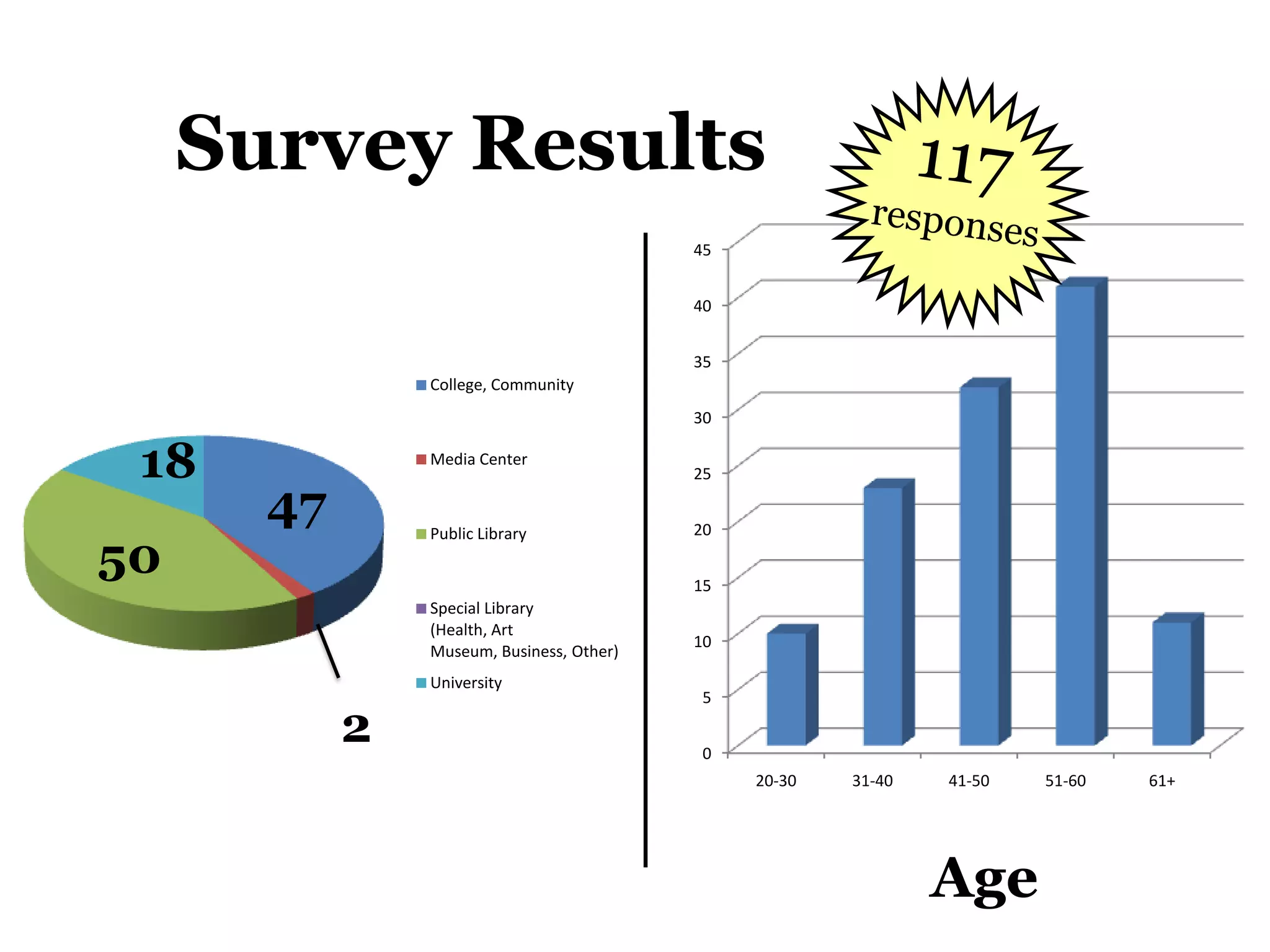
Survey Results117responses1847502Age
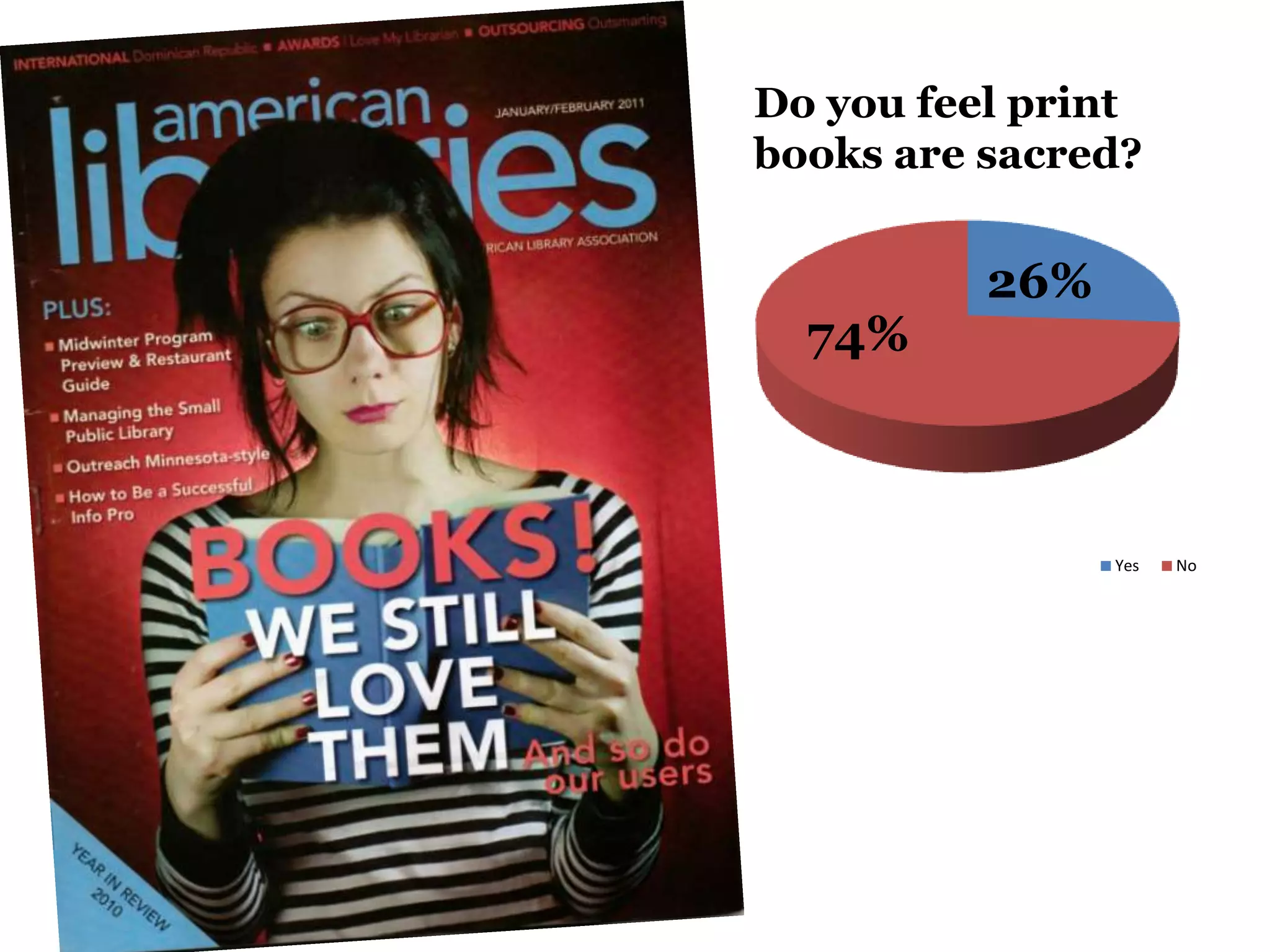
Do you feel print books are sacred?
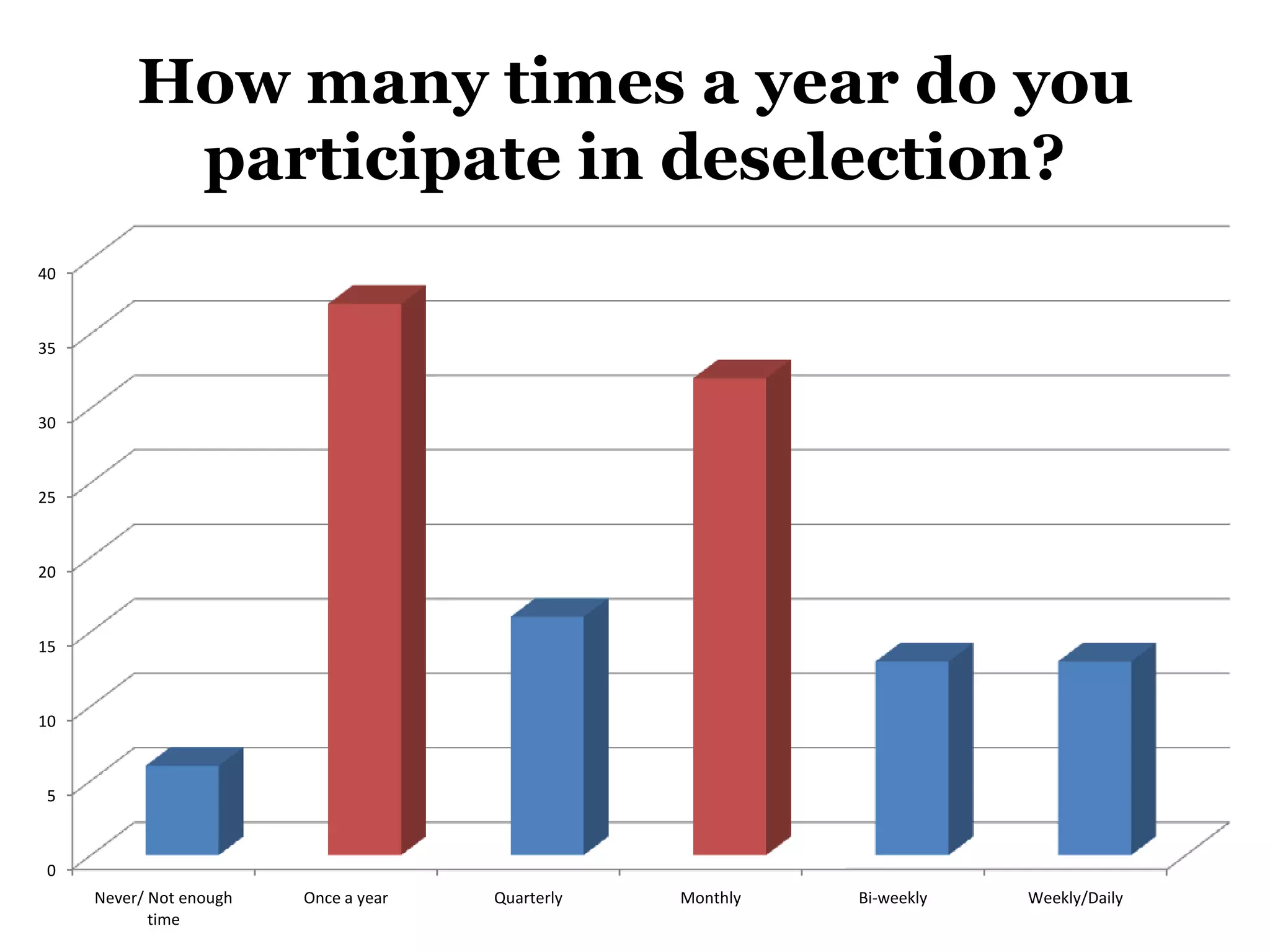
How many times a year do you participate in deselection?
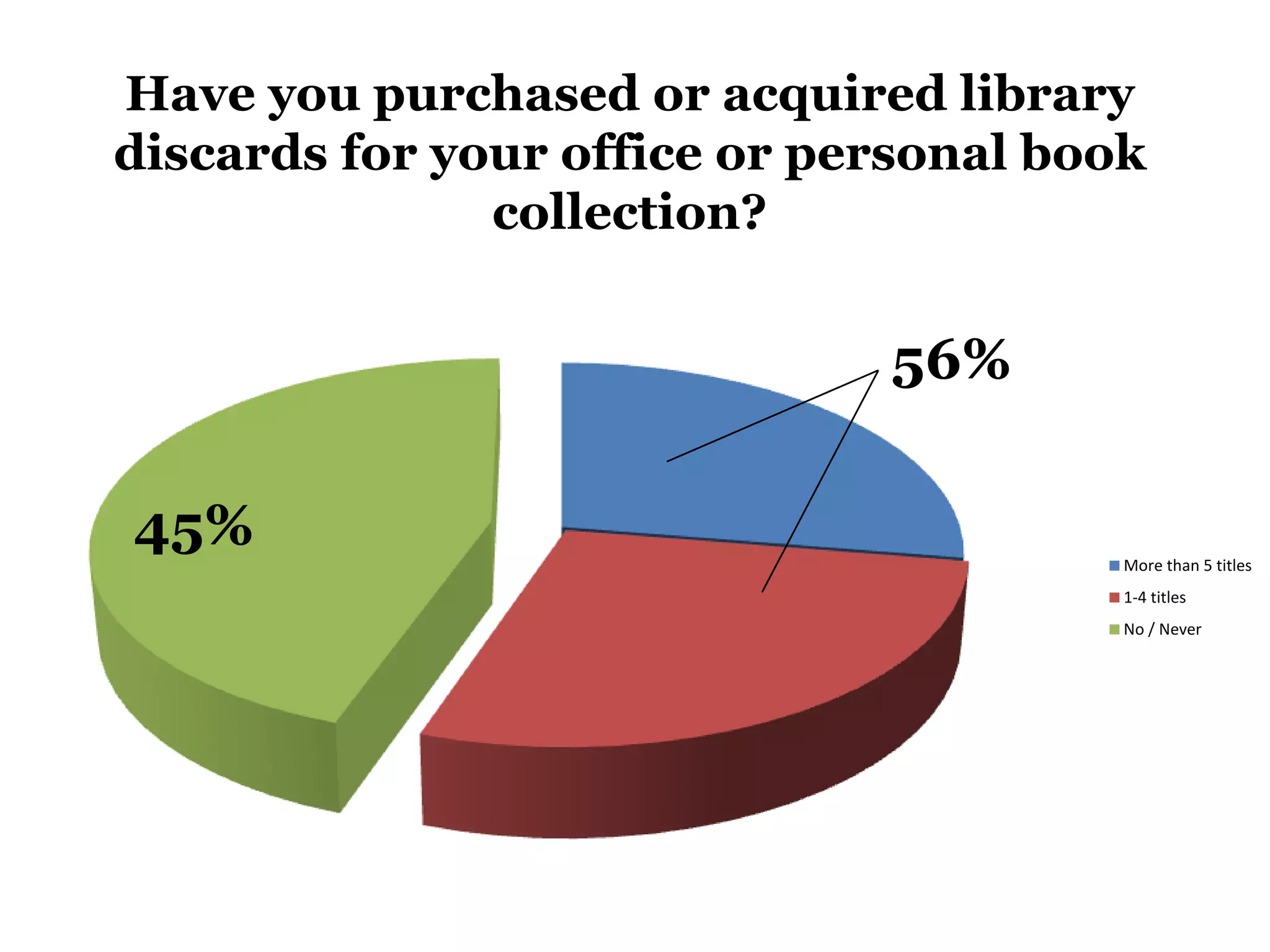
Have you purchased or acquired library discards for your office or personal book collection?56%
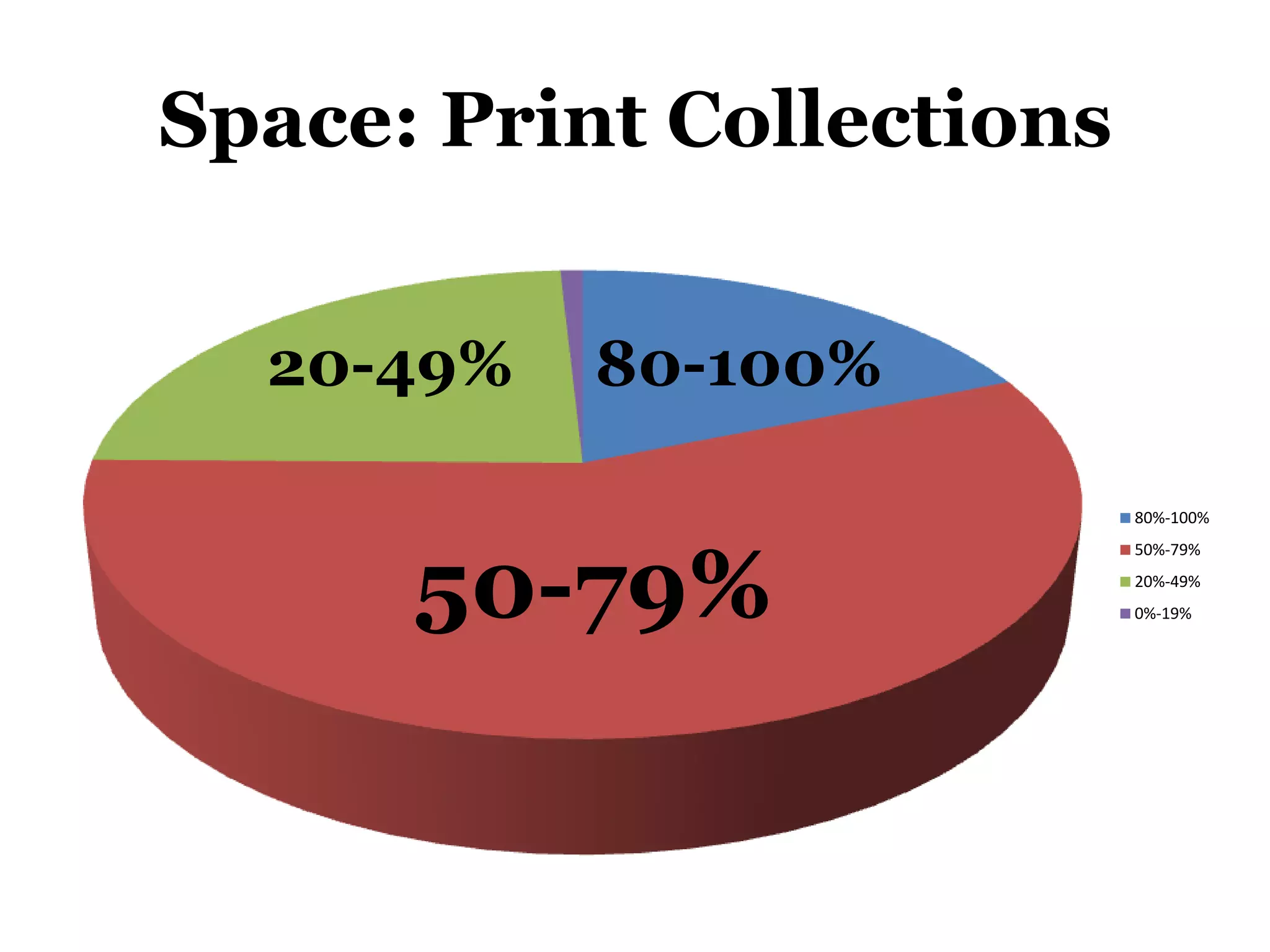
Space: Print Collections20-49%50-79%
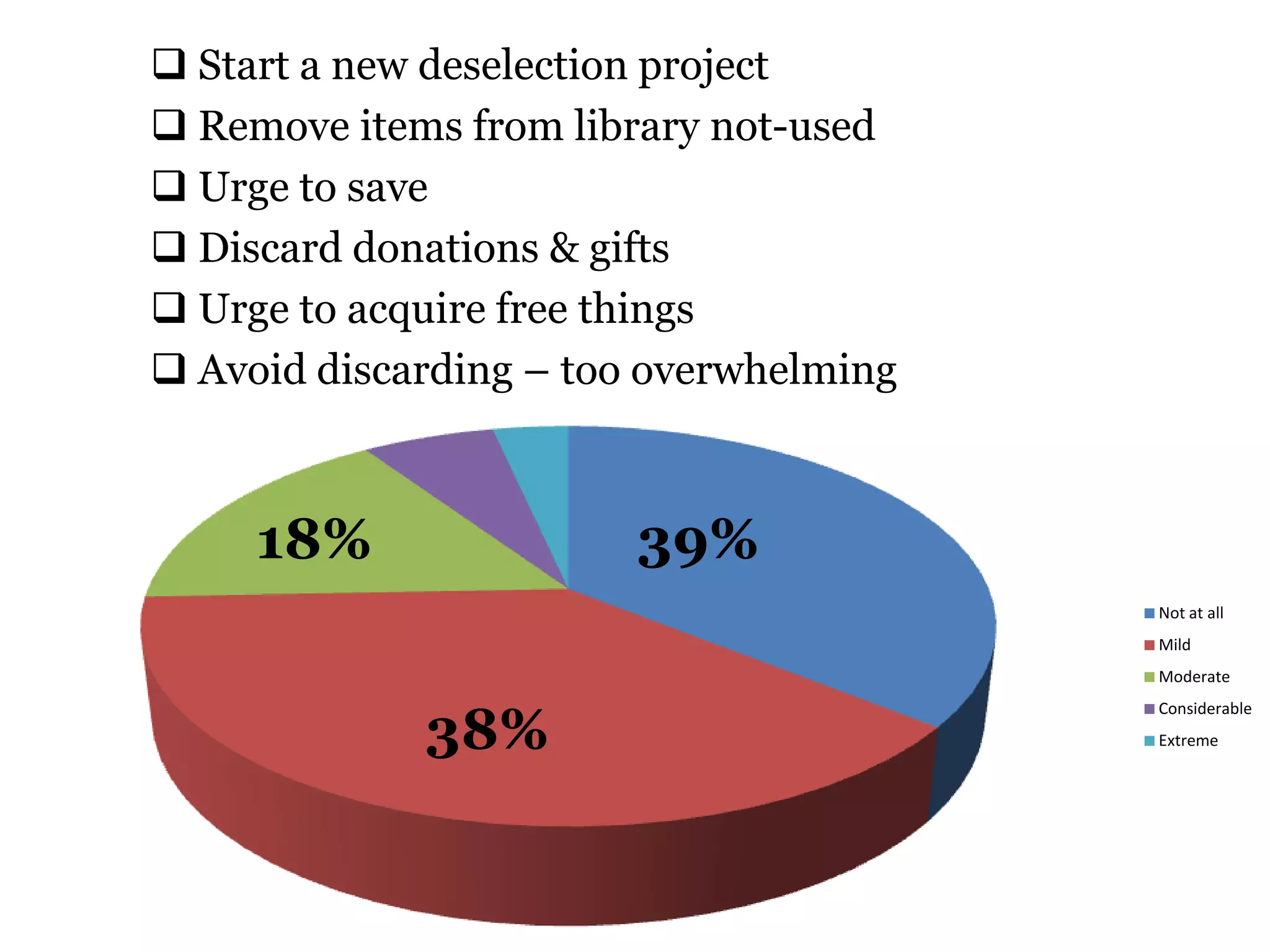
Start a new deselection project
Remove items from library not-used
Urge to save
Discard donations & gifts
Urge to acquire free things
Avoid discarding – too overwhelming39%18%38%
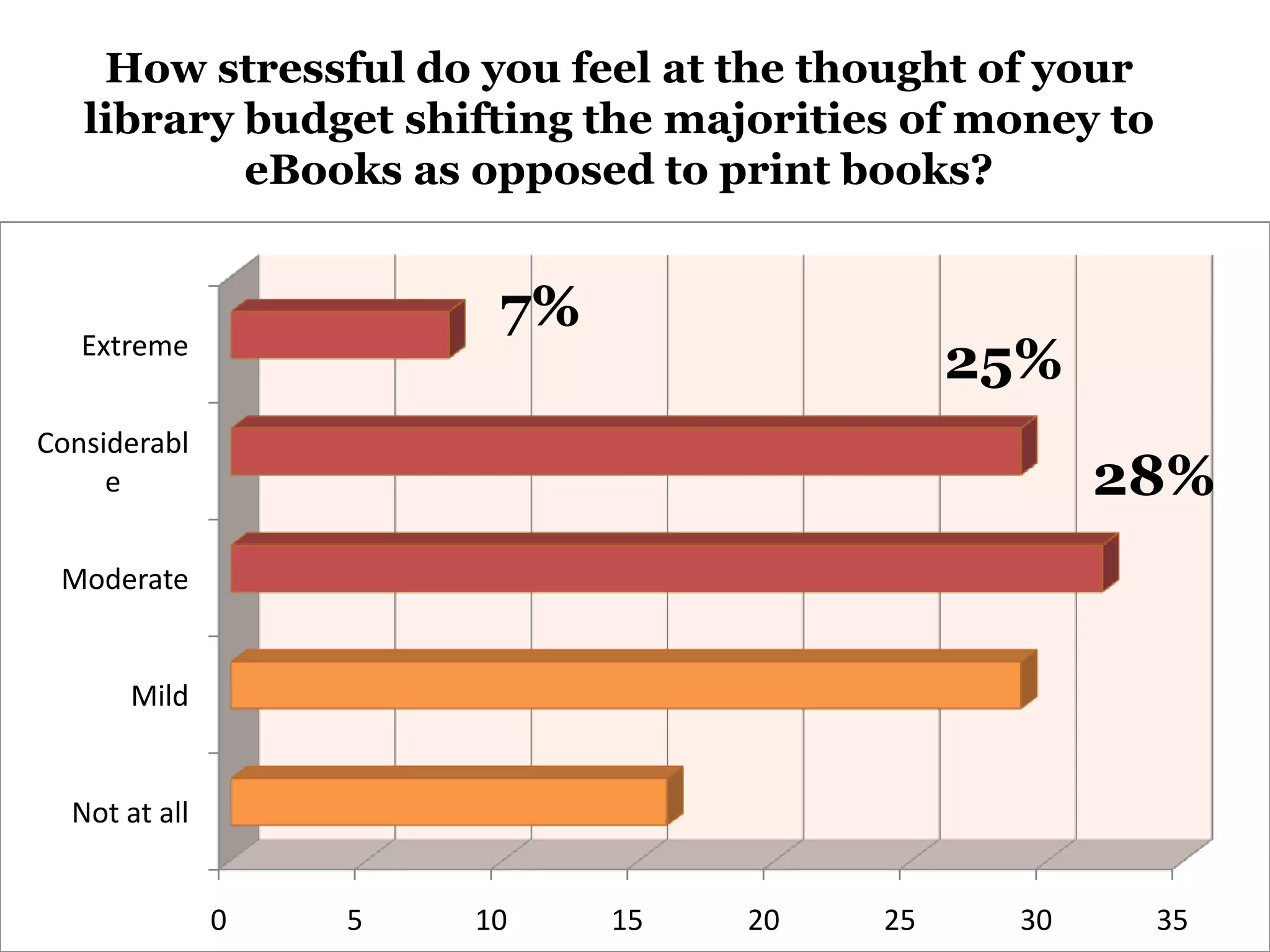
How stressful do you feel at the thought of your library budget shifting the majorities of money to eBooks as opposed to print books? 7%25%28%
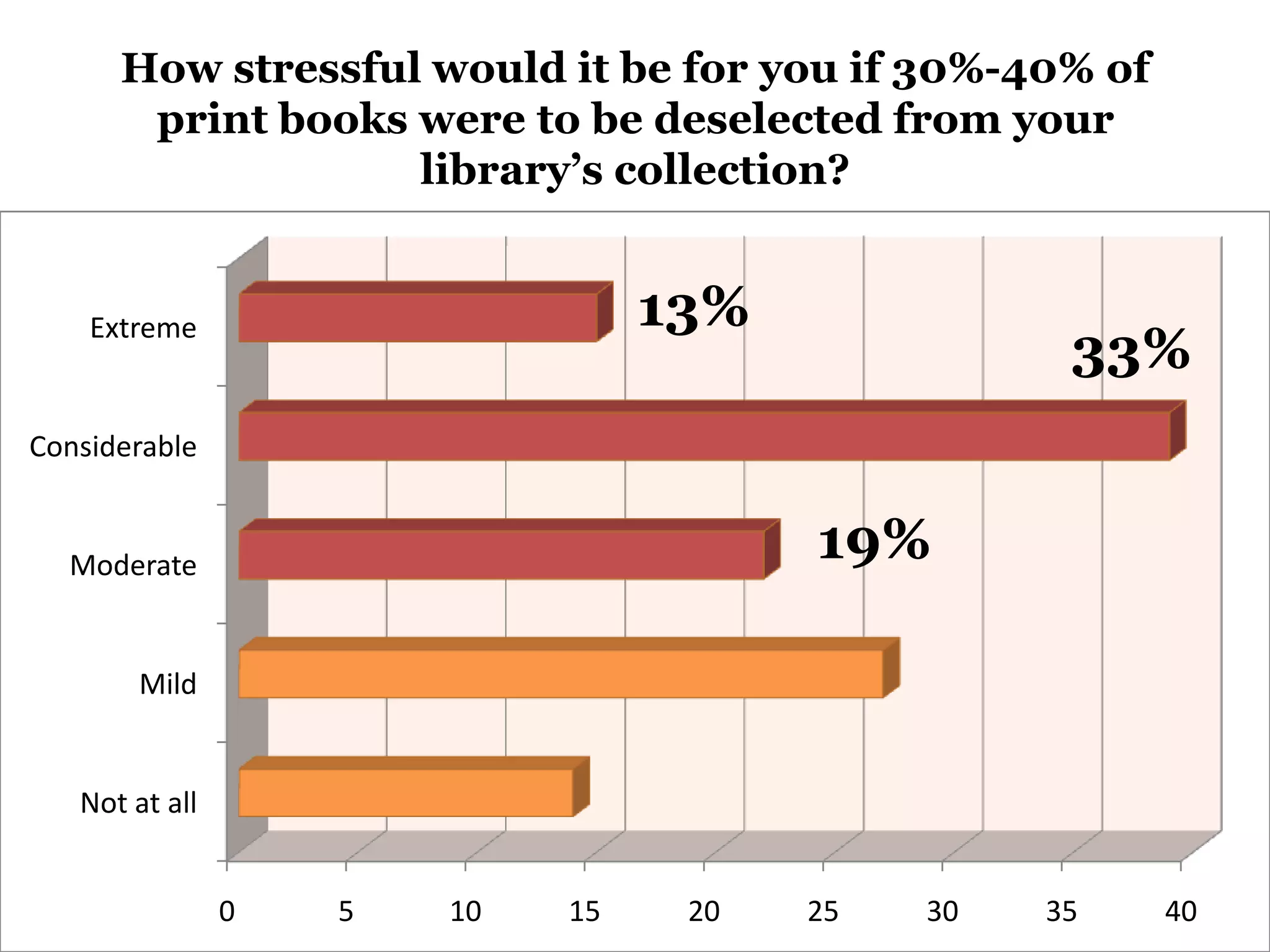
How stressful would it be for you if 30%-40% of print books were to be deselected from your library’s collection?13%33%19%
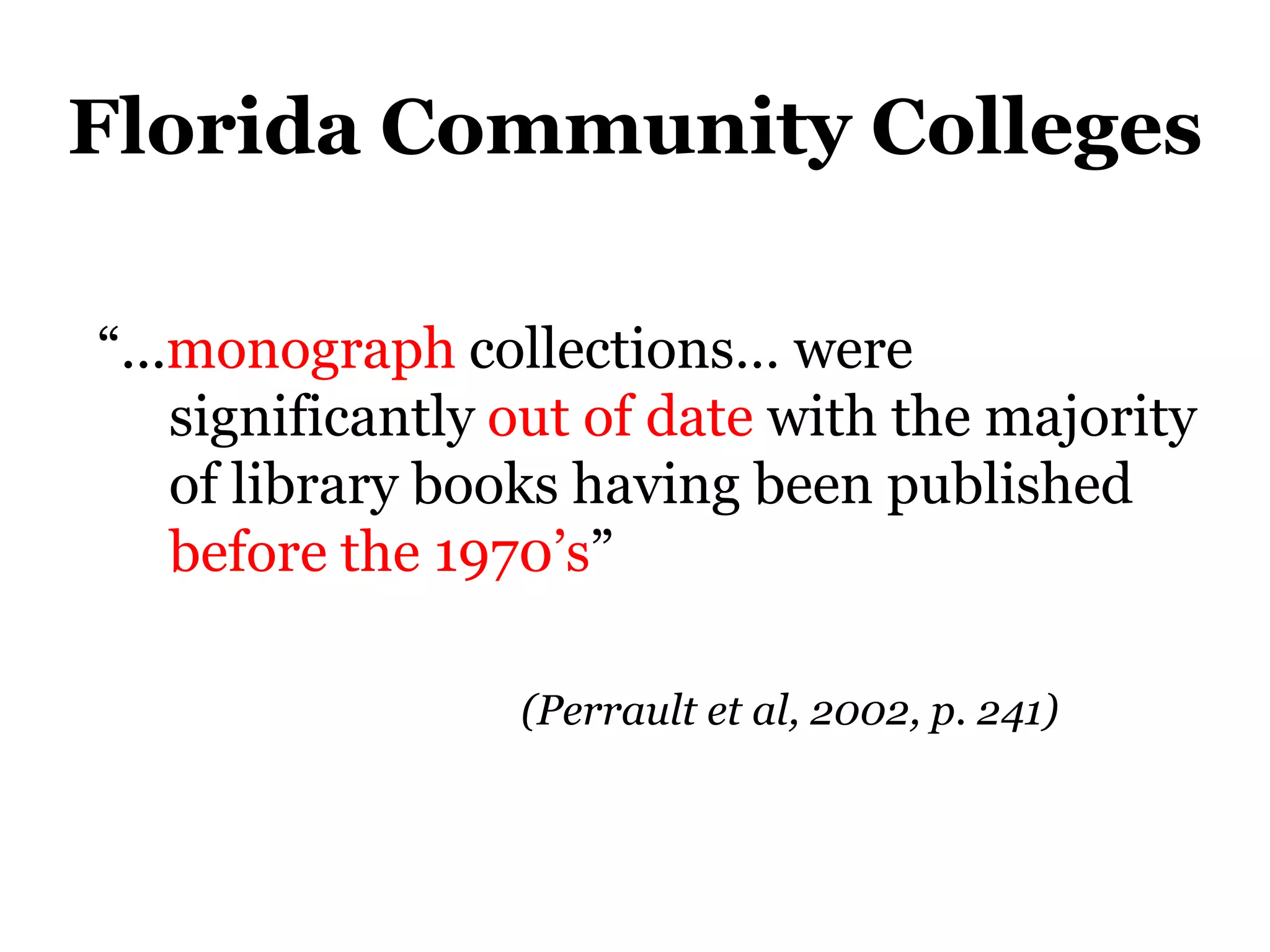
Florida Community Colleges“...monograph collections… were significantly out of date with the majority of library books having been published before the 1970’s”(Perrault et al, 2002, p. 241)
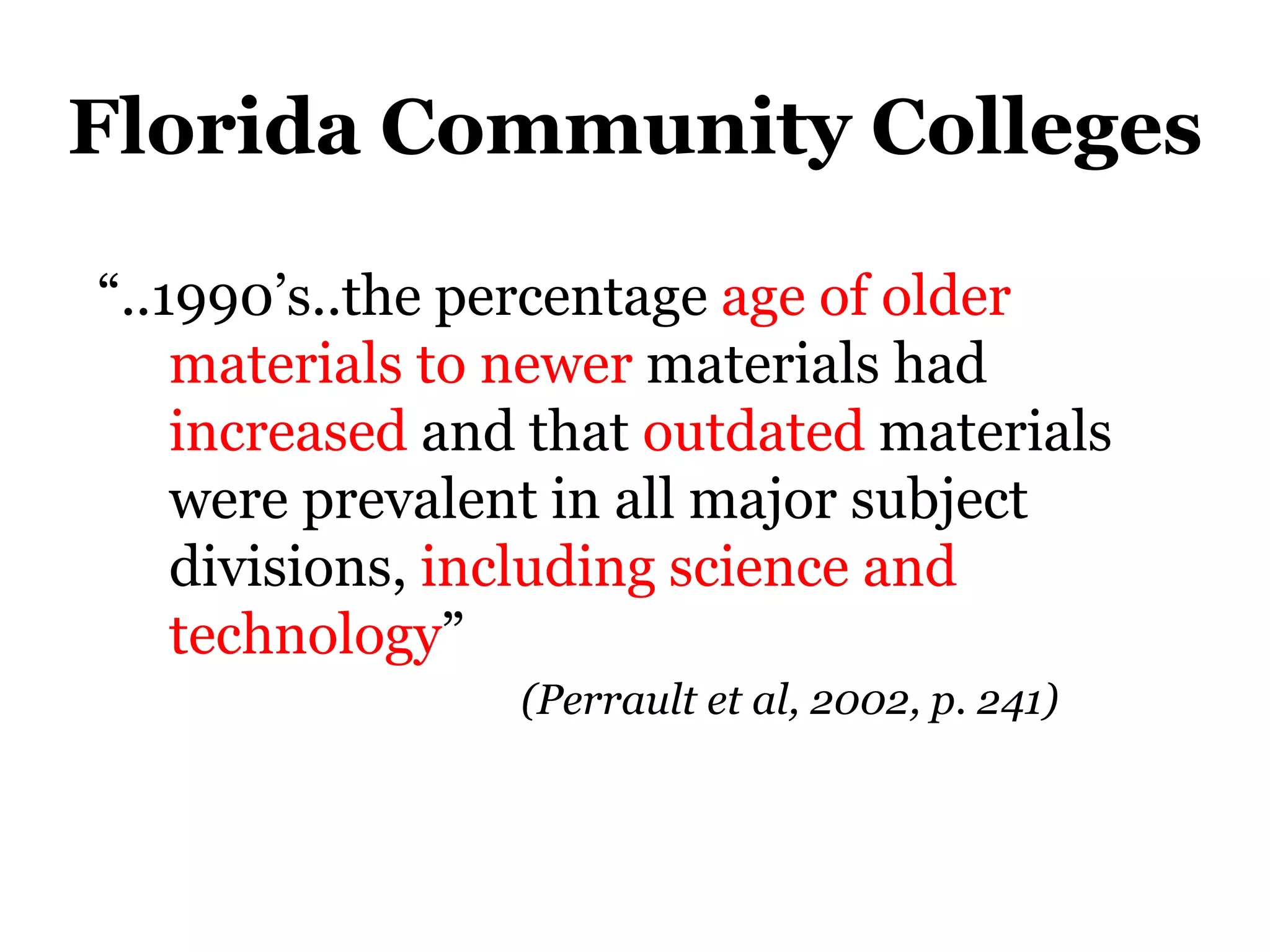
Florida Community Colleges“..1990’s..the percentage age of older materials to newer materials had increased and that outdated materials were prevalent in all major subject divisions, including science and technology”(Perrault et al, 2002, p. 241)
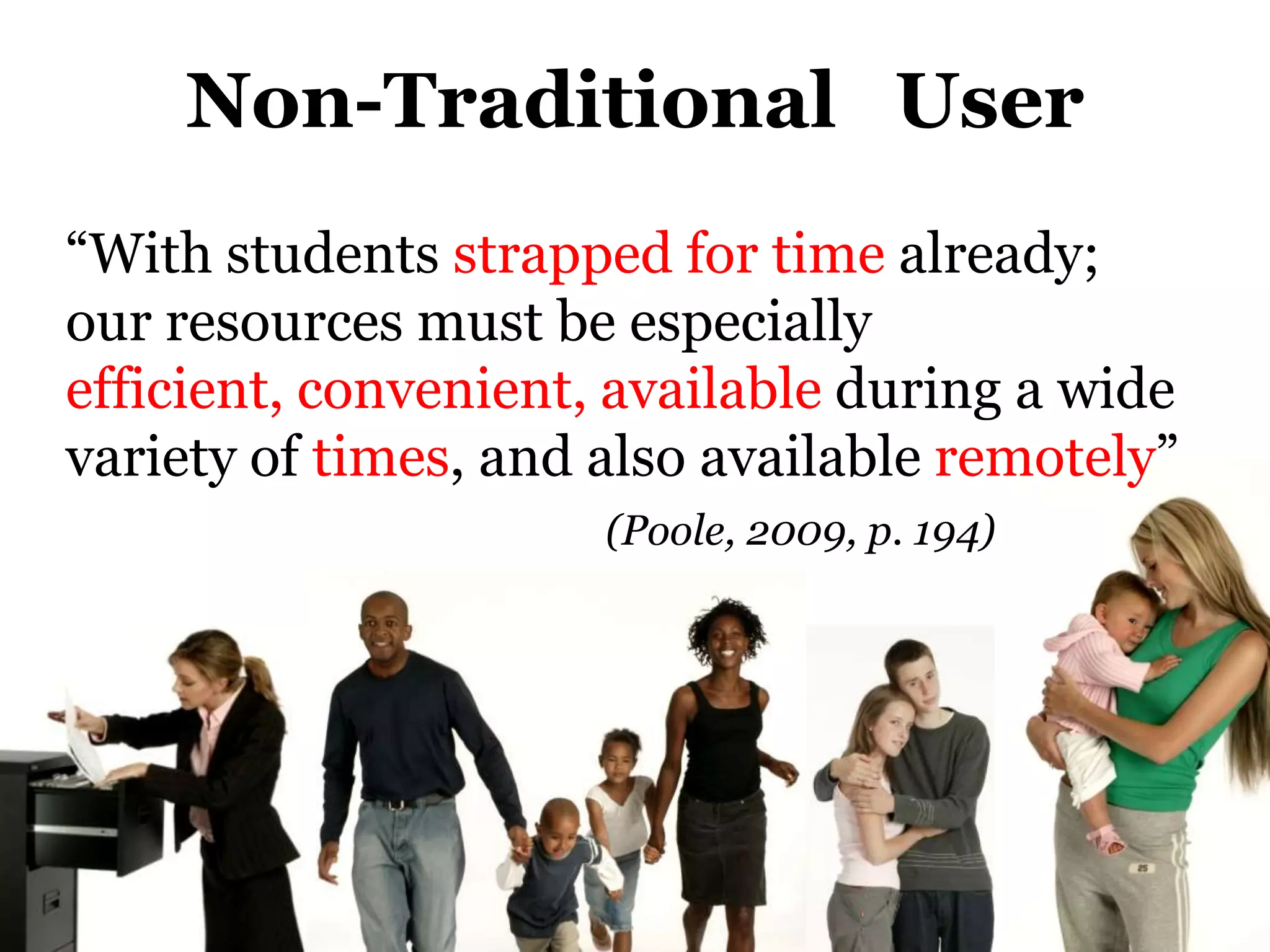
Non-Traditional   User“With students strapped for time already; our resources must be especially efficient, convenient, available during a wide variety of times, and also available remotely”(Poole, 2009, p. 194)
“Reading a book, however, requires concentration, endurance, the ability to disconnect from other connections.  You have to be there rather than not there.  Hyperwired young people may be making it to age 17 without acquiring that ability, let alone losing it.”(Romano, 2010, para. 19)
“….the focus is no longer in creating a comprehensive print collection but supplementing it with a vast and comprehensive collection of electronic information sources, resources, and links”(Fernandes, 2008, p. 206)
…[Steven J. Bell, Temple University]   urged librarians to think past libraries traditional roles of gateway, archive, and buyer of scholarly material.…“We could really carve out a much more significant role as instructional partners”(Howard, 2008, para. 10)
“Ranganathan deplored that many librarians seemed to be more concerned with preservation than with use, thus perpetuating the image of the librarian as a custodian rather than as some skilled in the exploitation of bibliographic resources”(Lancaster, 1988, para. 1)
Meaning of Books“The non-library world interprets weeding destroying of valuable materials, the treasured vessels and conveyers of our culture and society.”(Intner, 2006)
“Libraries were invented so that individuals wouldn’t have to own everything they might sometime want to read.  Our trust in libraries makes it possible for us to throw things away.”Nicholson BakerWriter / Advocate for library preservation
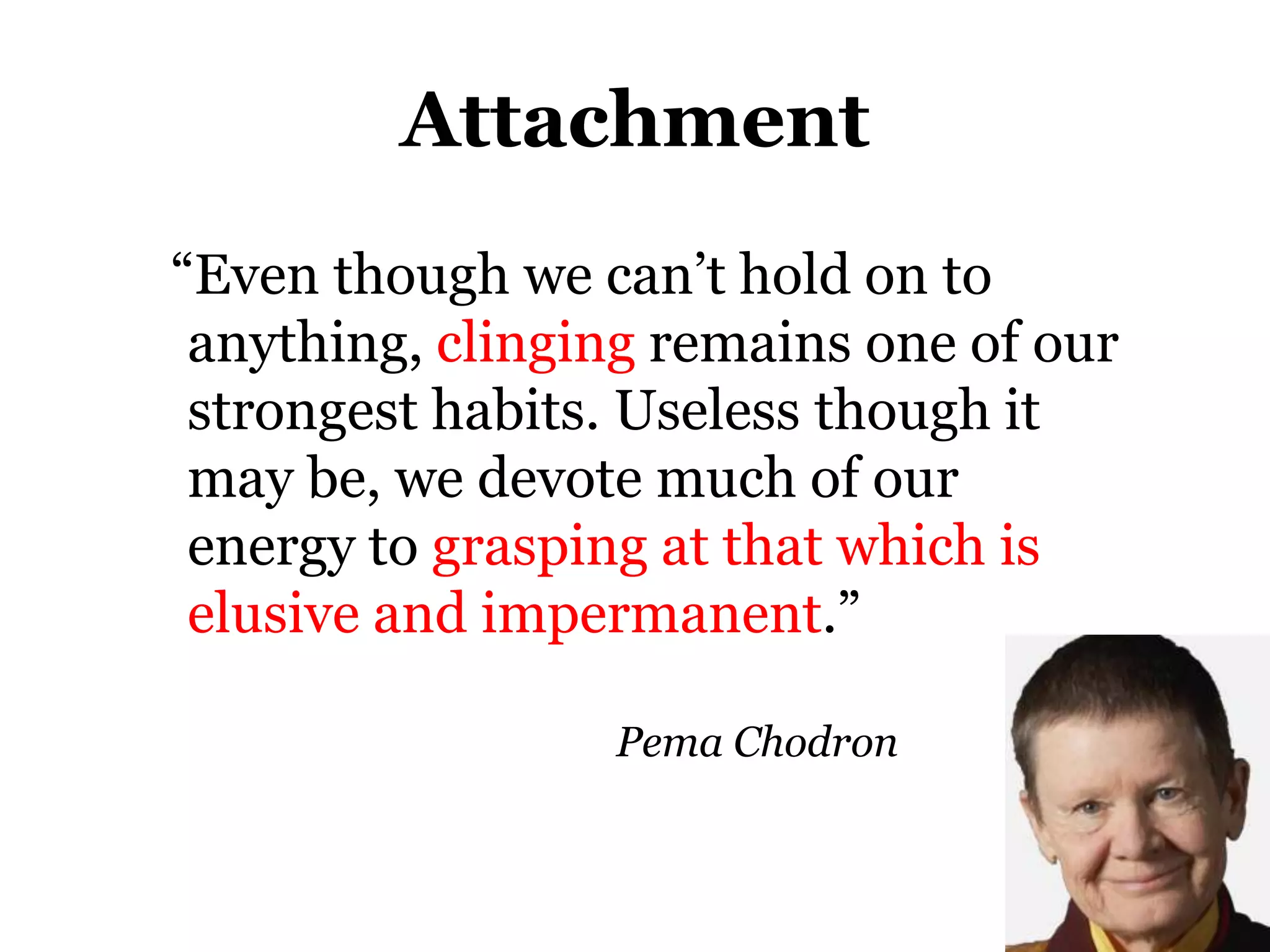
Attachment“Even though we can’t hold on to anything, clinging remains one of our strongest habits. Useless though it may be, we devote much of our energy to grasping at that which is elusive and impermanent.”Pema Chodron
“Many librarians have an emotional attachment to their collections.  They think of books as a literal part of the library, as part of their family.”Michael SawyerDirector of Calcasieu Parish Public LibraryLouisiana
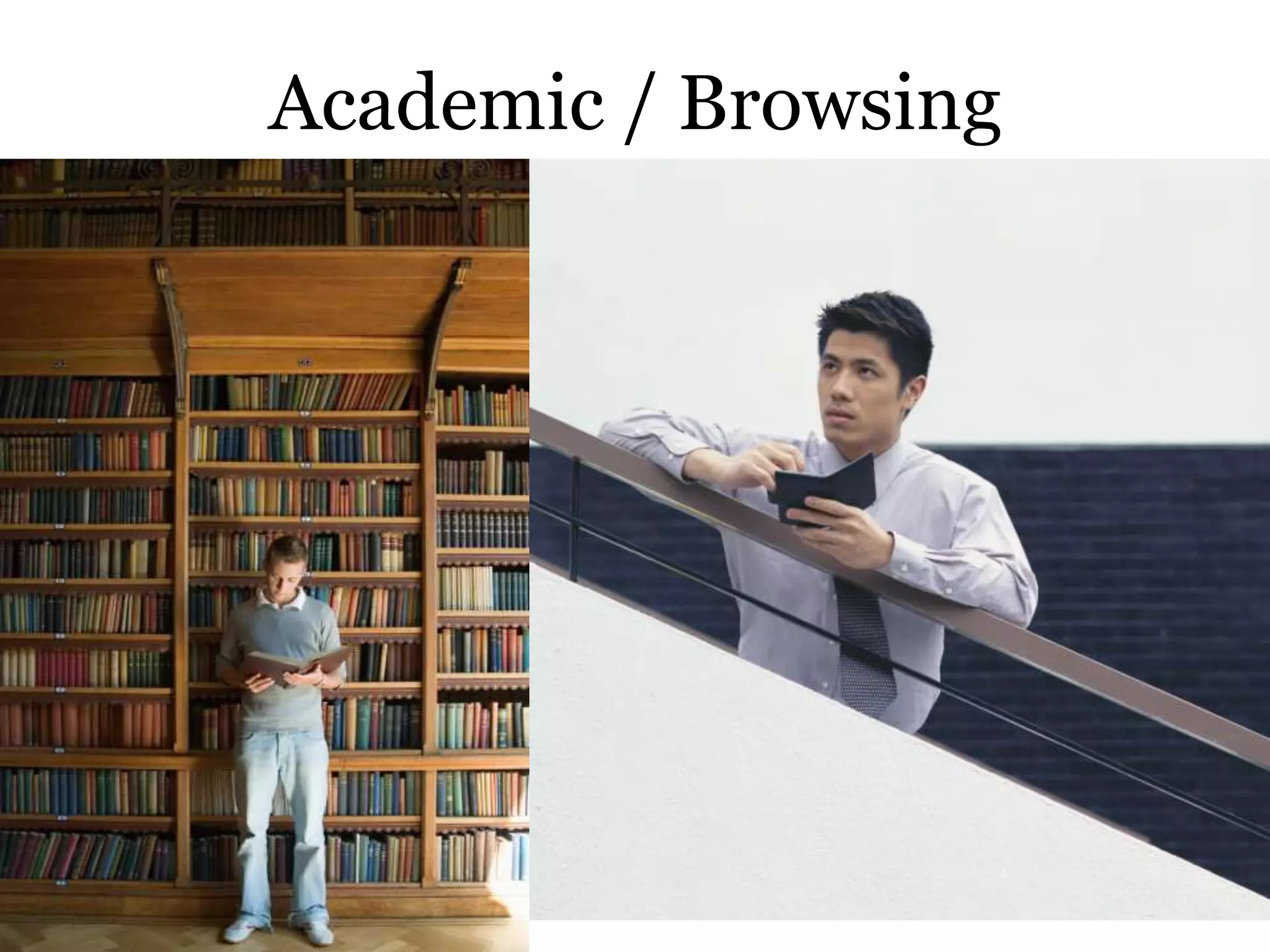
Browsing“When items on the first shelf or two they examine aren’t what they want and aren’t very attractive looking, browsers get the vague feeling that the rest of the stock, which, on the surface, looks the same as what they’ve just seen, isn’t going to be any better.”(Intner, 2006, p. 16)
Academic / Browsing
Clutter Personality TypesEasily distractedProcrastinatorSentimental CluttererBargain shoppersPerfectionistsGeralin ThomasProfessional OrganizerCary, North Carolina
Decision-making“To weed is to make multiple decisions simultaneously, decisions based on both objective and subjective criteria”(Handy, 1994, para. 5)
“People with compulsive hoarding often feel afraid to throw things away, worry excessively, and repeatedly check to make sure they’re not throwing away anything important.”(Tolin, Frost & Steketee, 2007, p. 20)
Cost ConcernsWill not throw out an item until we have spent the valueShelvingSavings in staff timeMaterial usefuture acquisition decisions
Stakeholders    “The benefit of involving the faculty seems to be more to prevent negative feelings rather than to improve the weeding process.” x(Slote, 1997, p. 10)
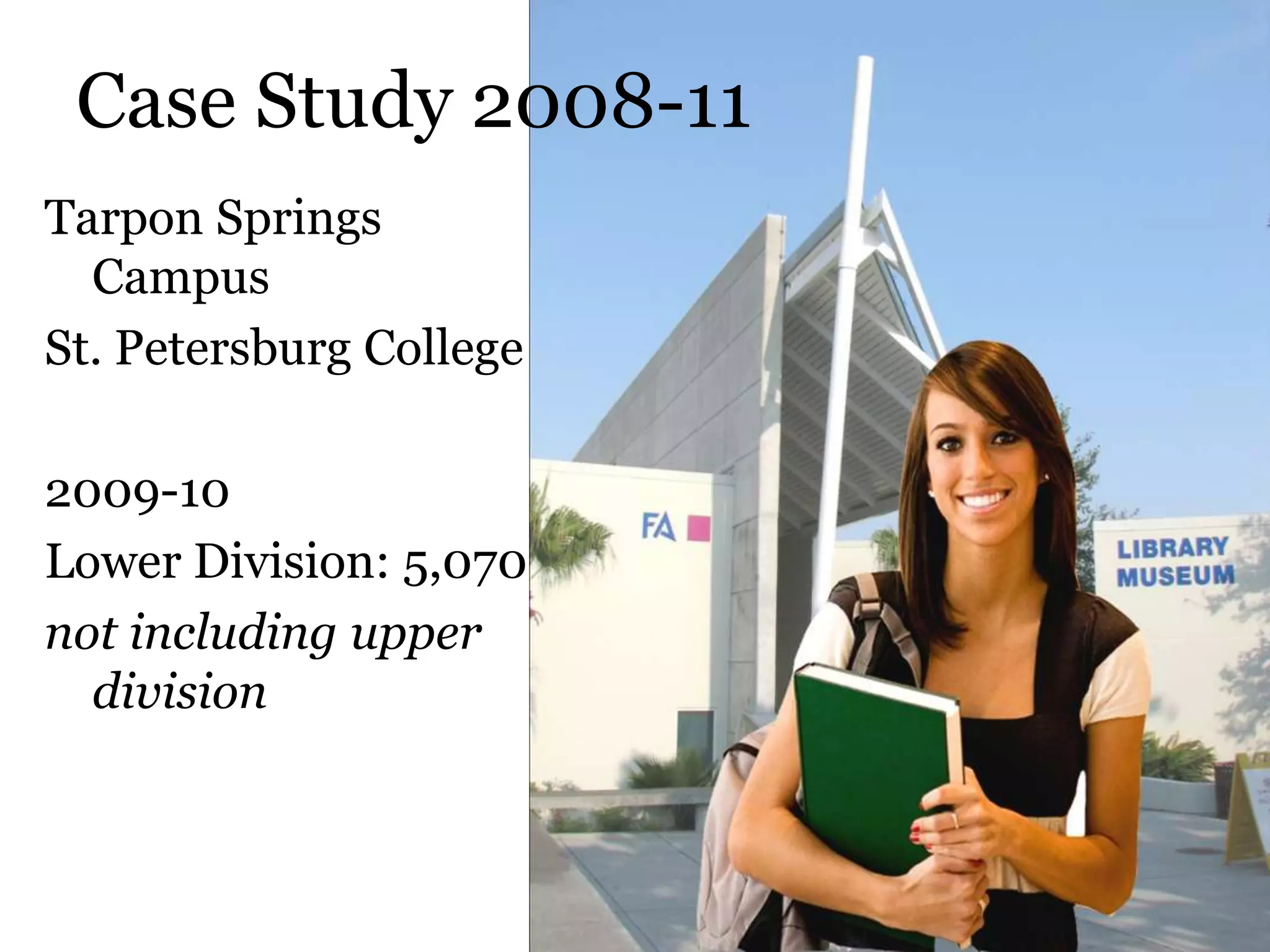
Case Study 2008-11Tarpon Springs CampusSt. Petersburg College2009-10Lower Division: 5,070not including upper division
Library Staff2 paraprofessionals2 librarians (liaison areas)3 student assistants1 OPS –staff member 20-32 hrs.
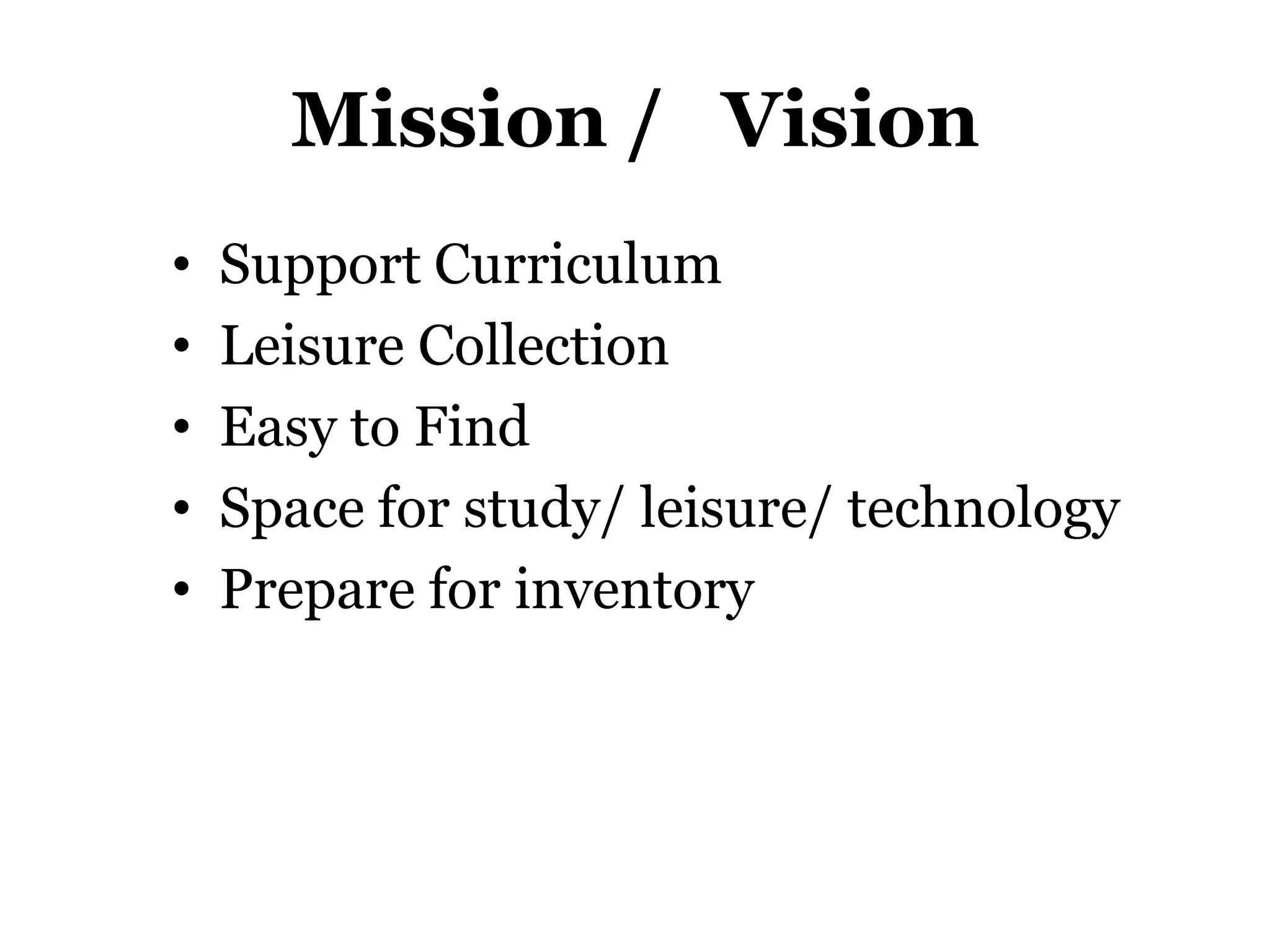
Mission /   VisionSupport CurriculumLeisure CollectionEasy to FindSpace for study/ leisure/ technologyPrepare for inventory
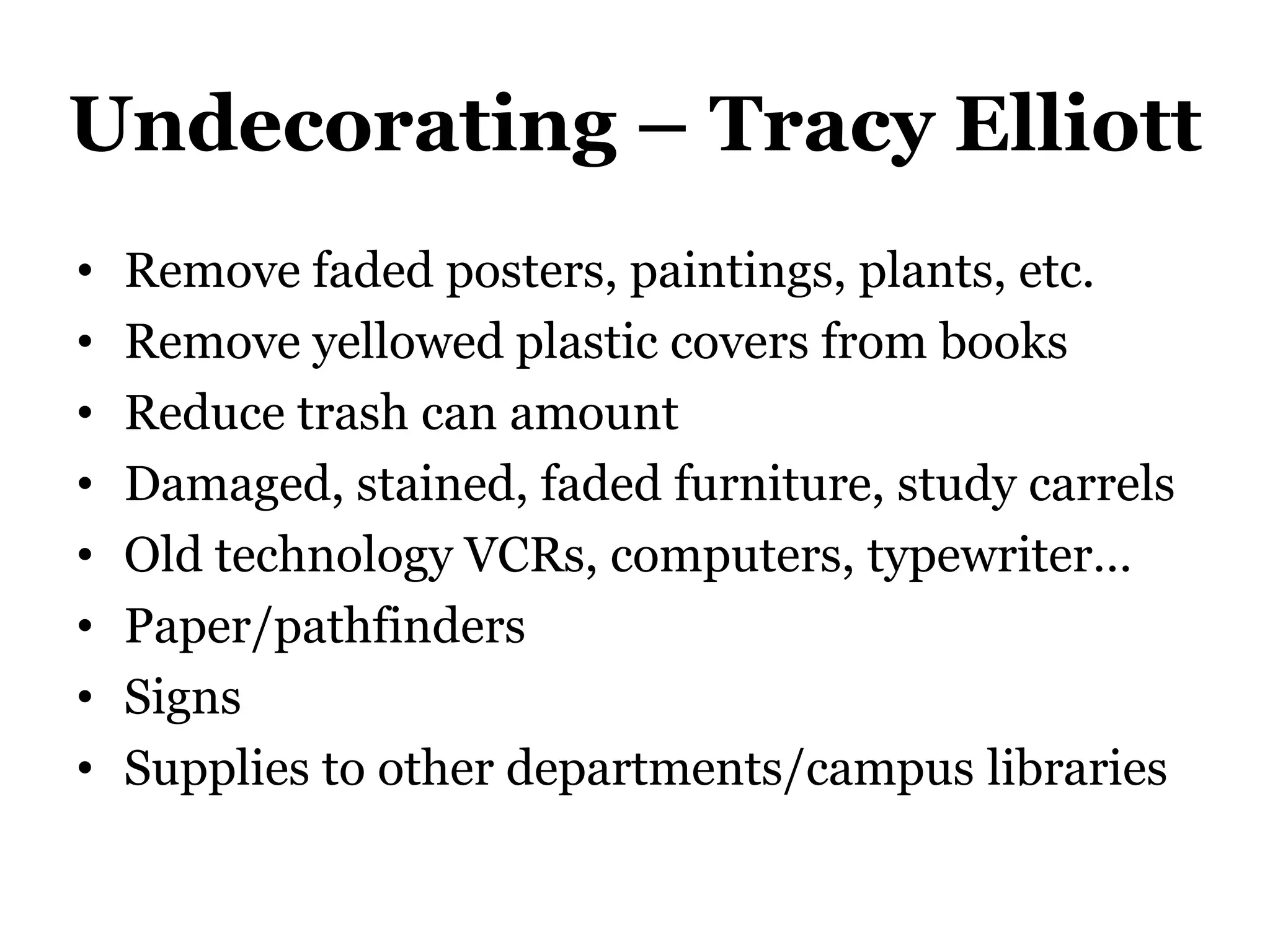
Undecorating – Tracy ElliottRemove faded posters, paintings, plants, etc.Remove yellowed plastic covers from booksReduce trash can amountDamaged, stained, faded furniture, study carrelsOld technology VCRs, computers, typewriter… Paper/pathfindersSignsSupplies to other departments/campus libraries
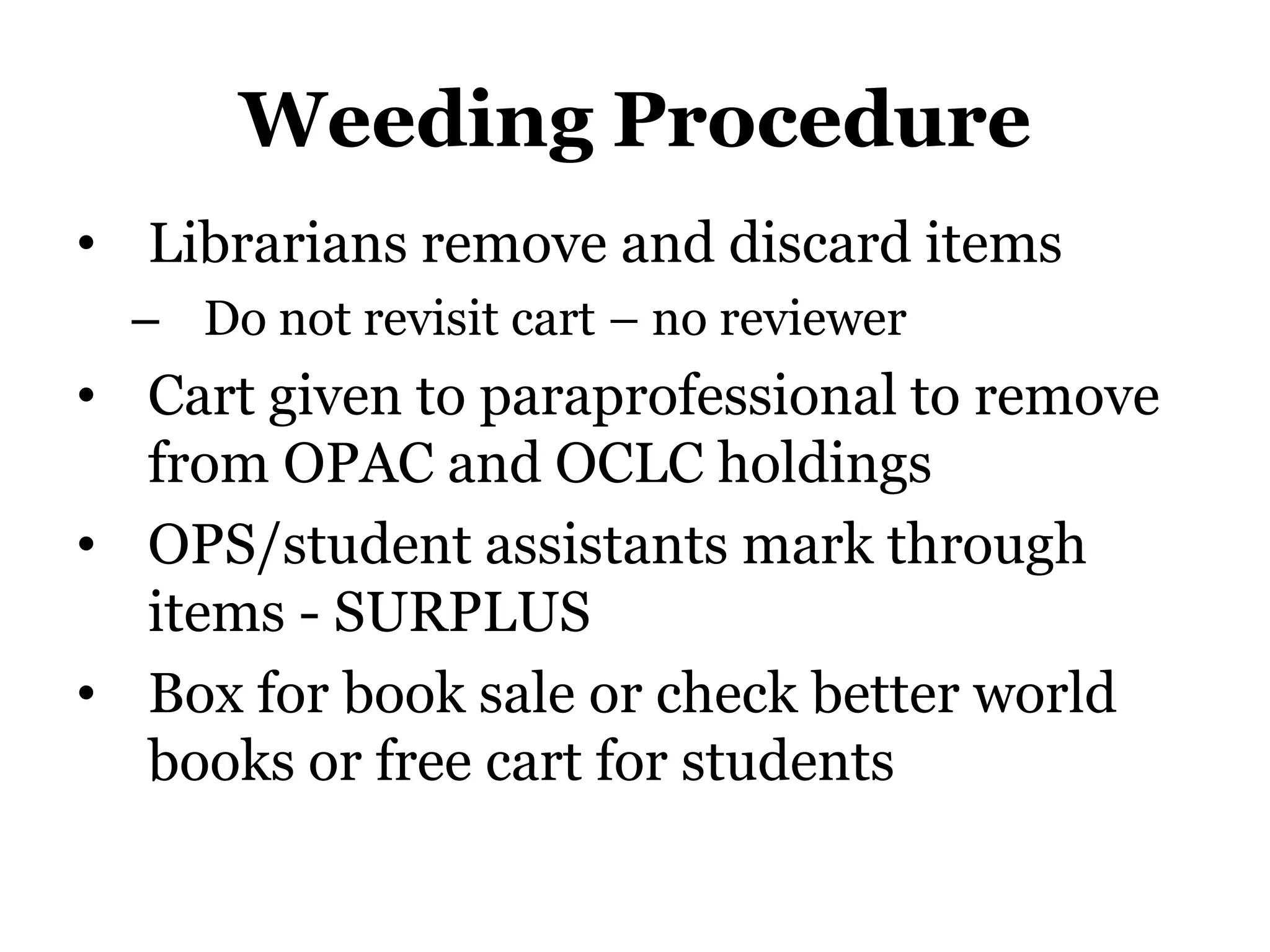
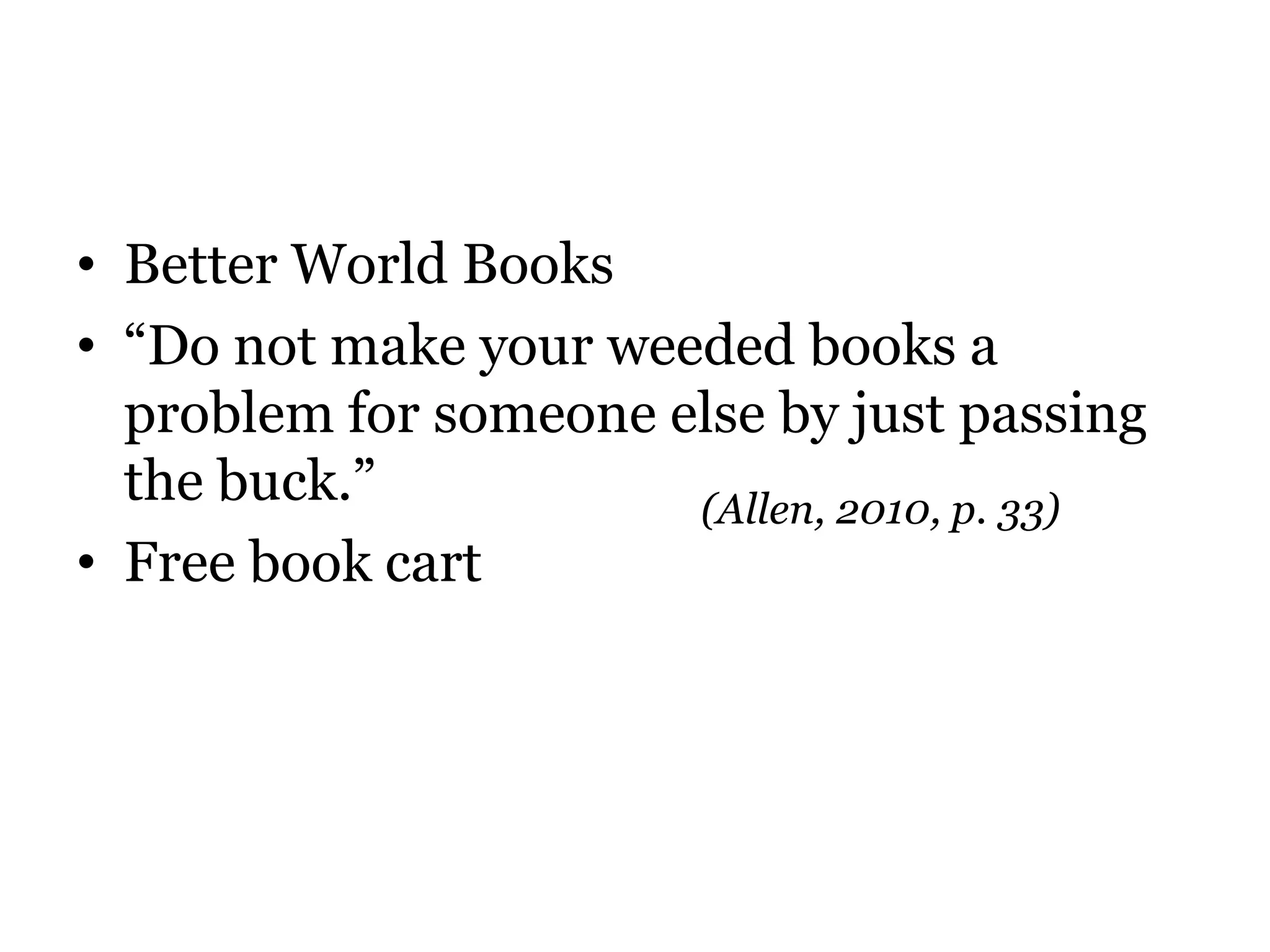
Weeding ProcedureLibrarians remove and discard itemsDo not revisit cart – no reviewerCart given to paraprofessional to remove from OPAC and OCLC holdingsOPS/student assistants mark through items - SURPLUSBox for book sale or check better world books or free cart for students
Initial DeselectionJust Weed before involving faculty or other stakeholderRepeat copies – if not usedDamaged materialOlder reference copy in circ. CollectionMedical/Law/Technology 5 yearsDuplication in electronic format- some removalToo many in one subject – gift for other campus library
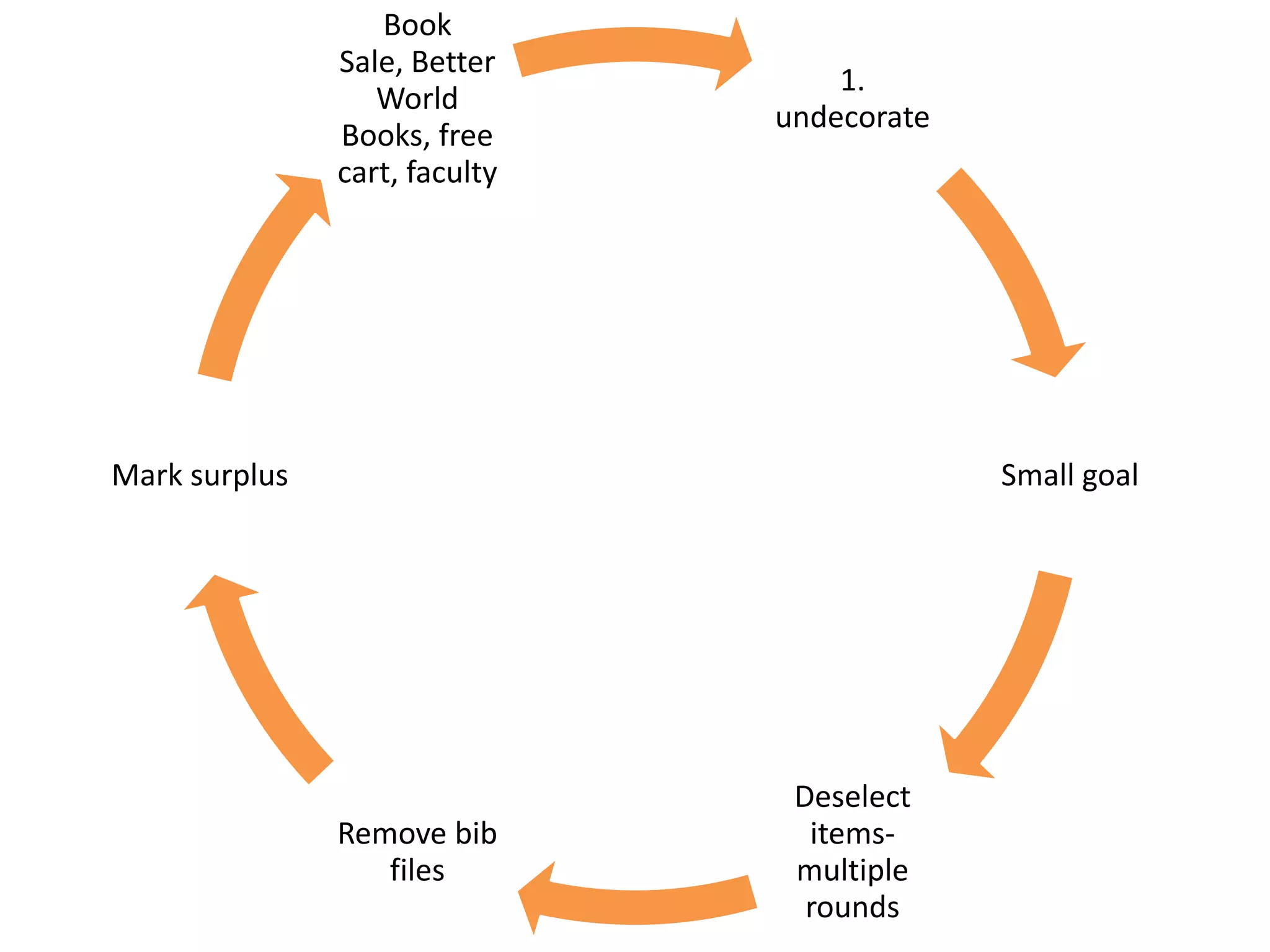
Multiple Rounds- Small GoalsCheck areas multiple times throughout a period of timeFirst time: everything older than 1990 and does not have historical valueSecond: remove a section not being usedEtc.
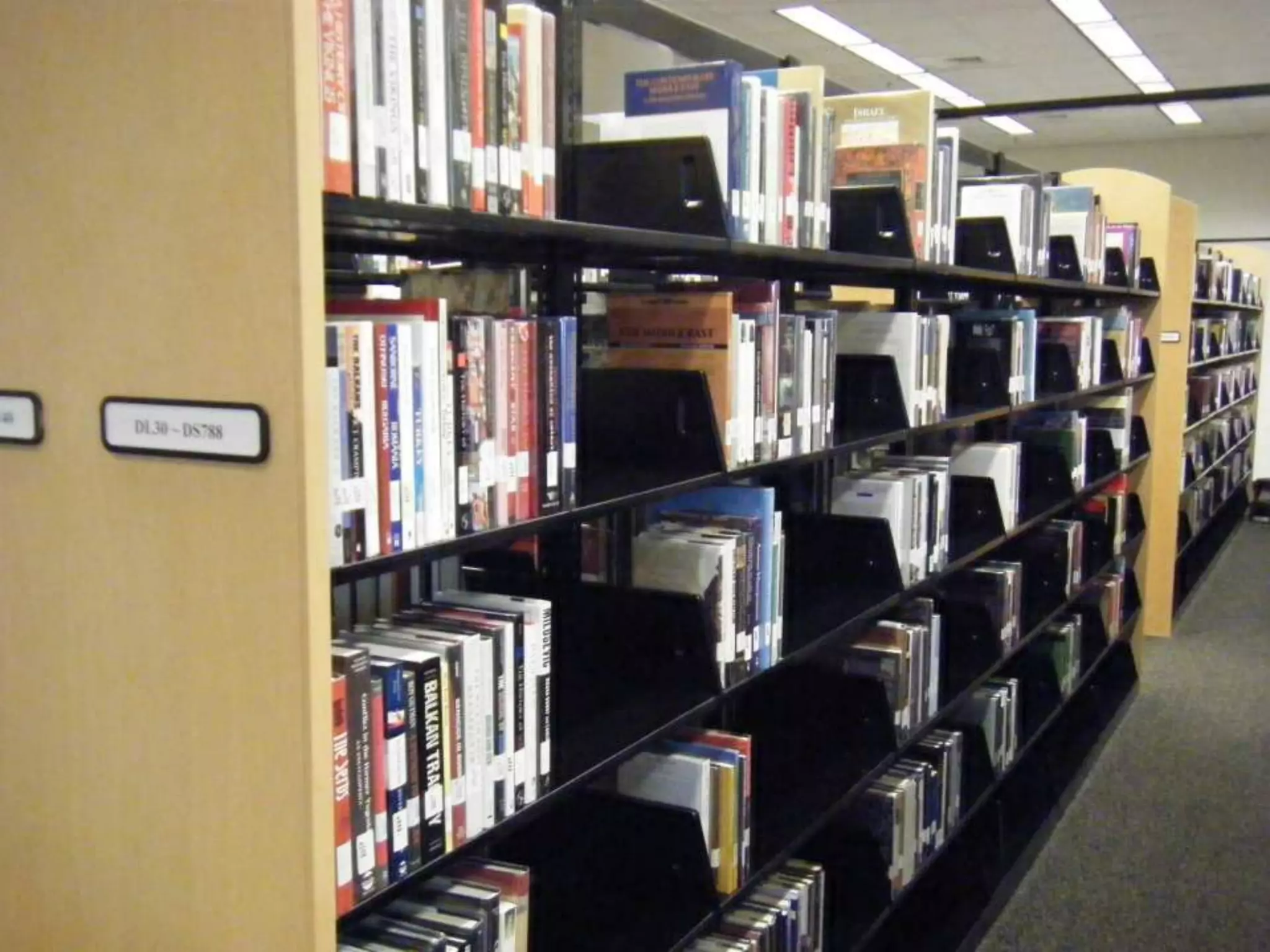
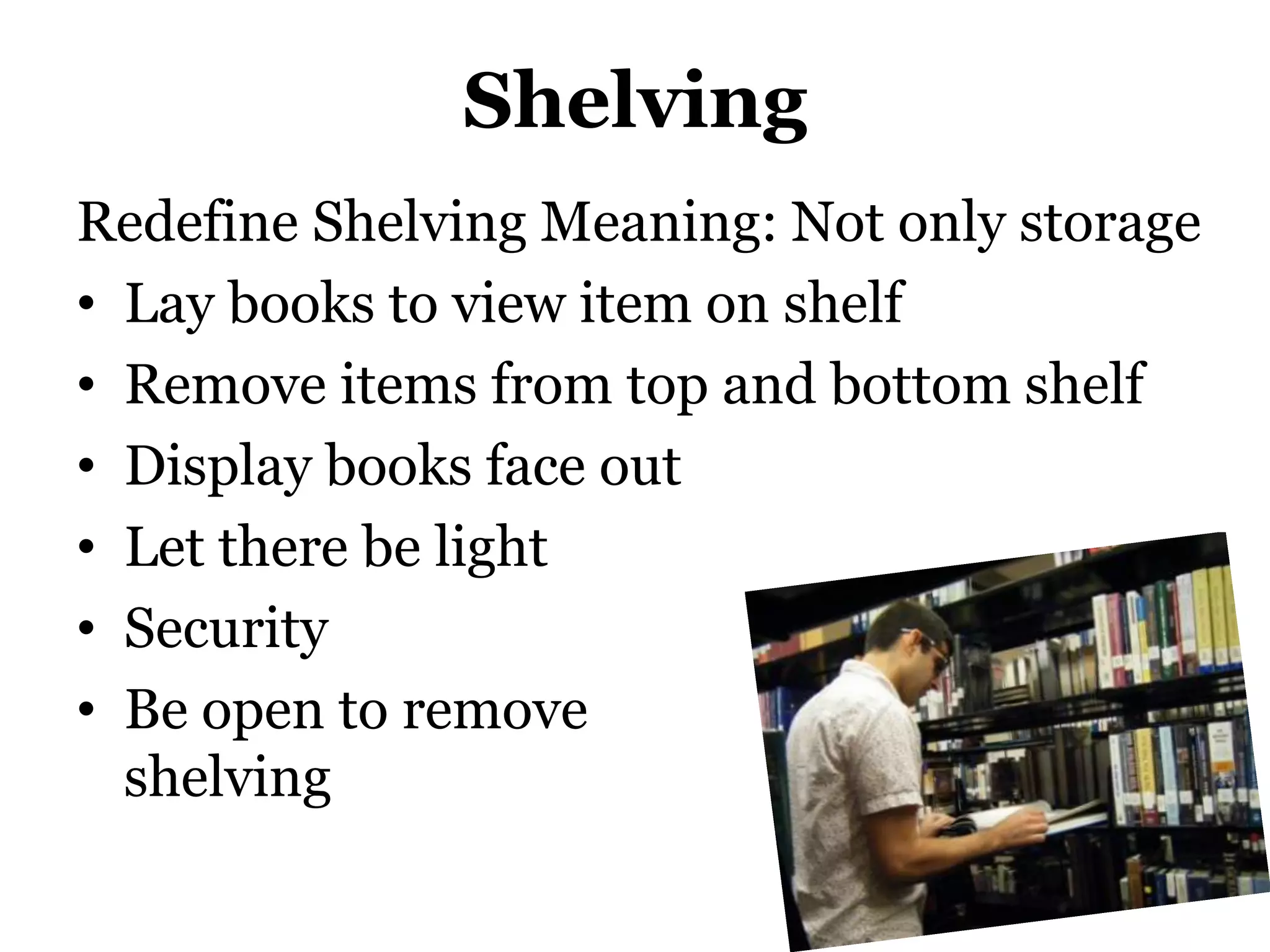
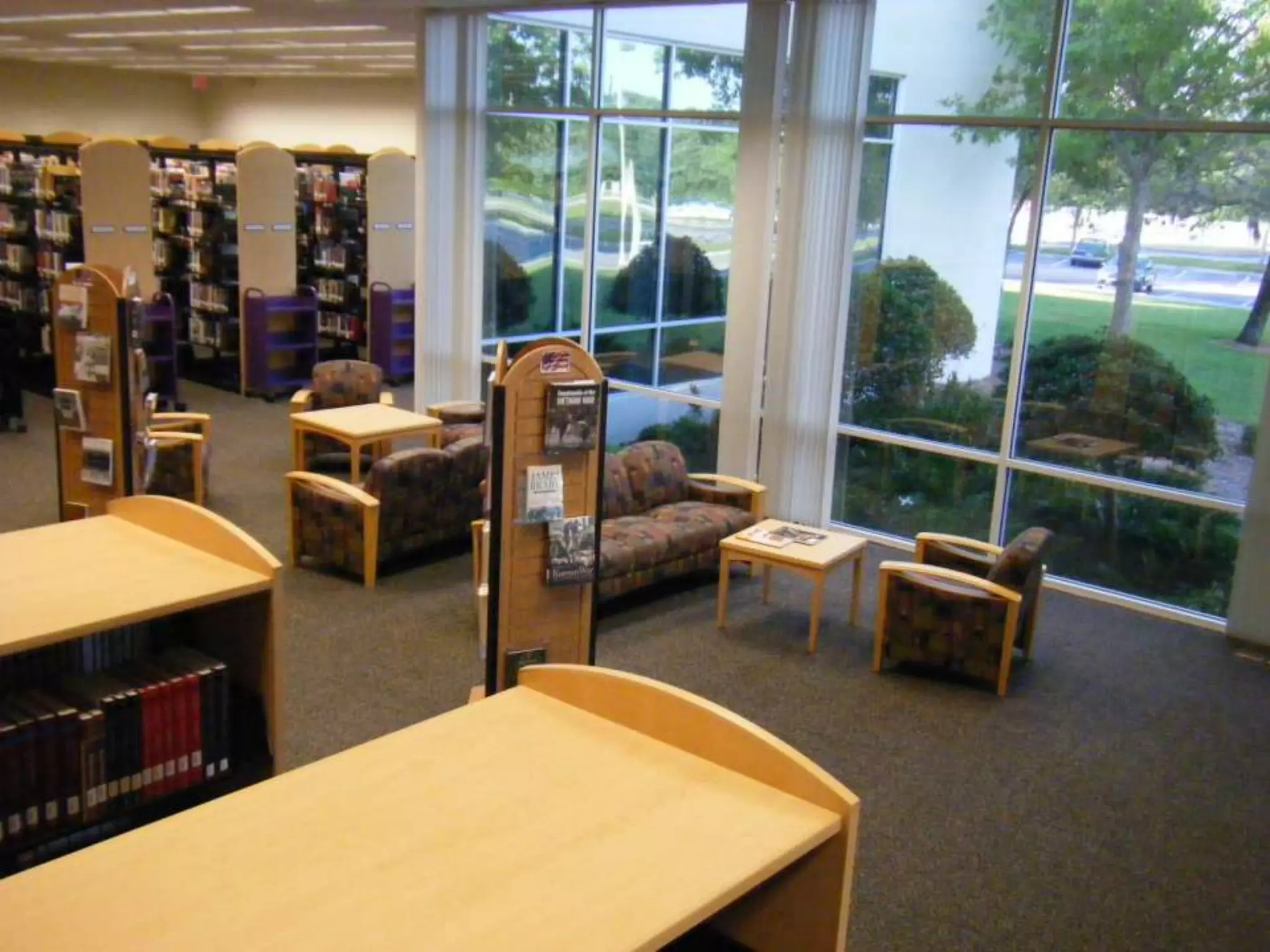
ShelvingRedefine Shelving Meaning: Not only storageLay books to view item on shelfRemove items from top and bottom shelfDisplay books face outLet there be lightSecurityBe open to remove shelving
Reference Collection“For most reference collections, more is not necessarily better”(Matthews & Tychson, 1981)
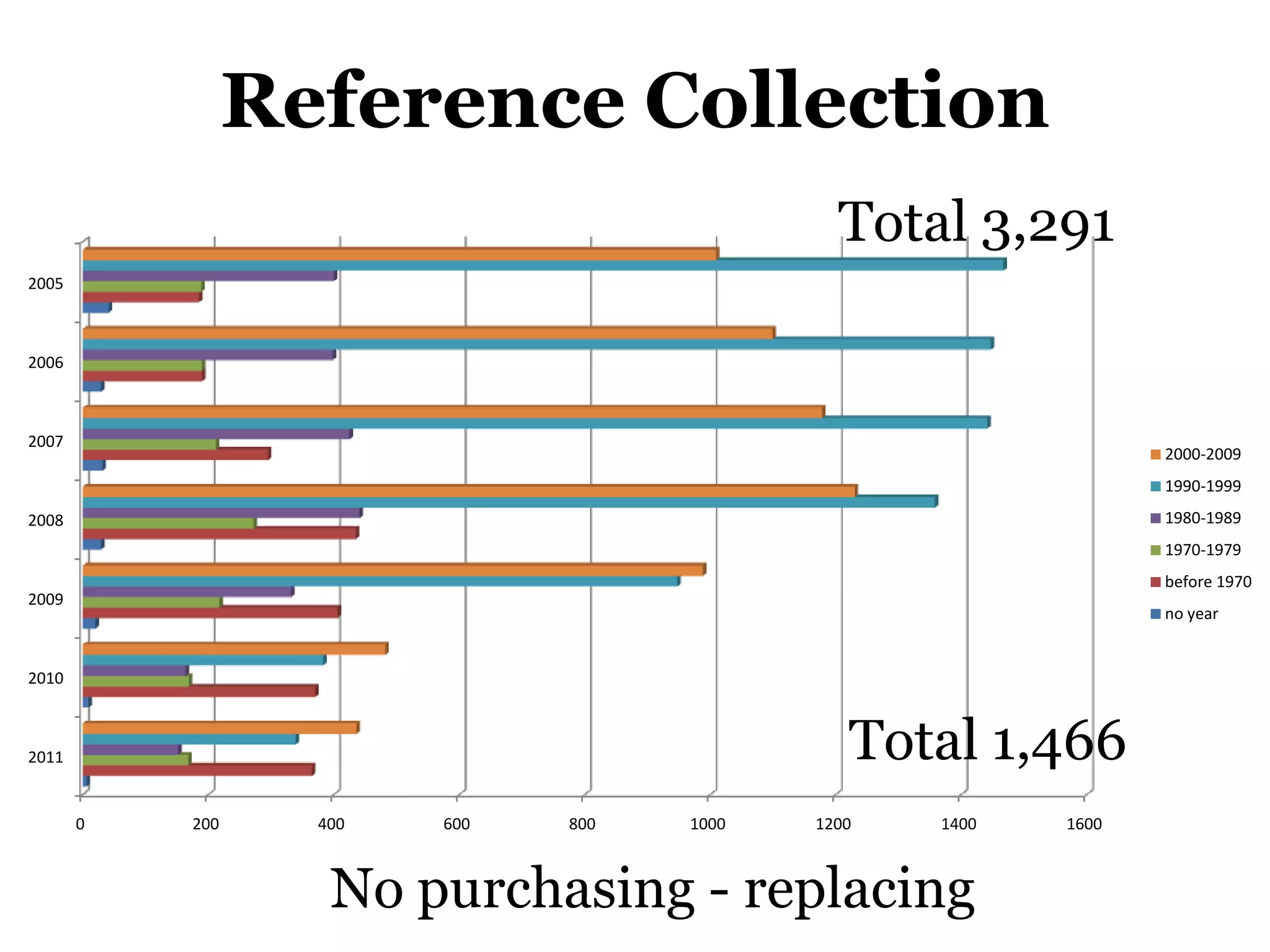
Reference CollectionTotal 3,291Total 1,466No purchasing - replacing
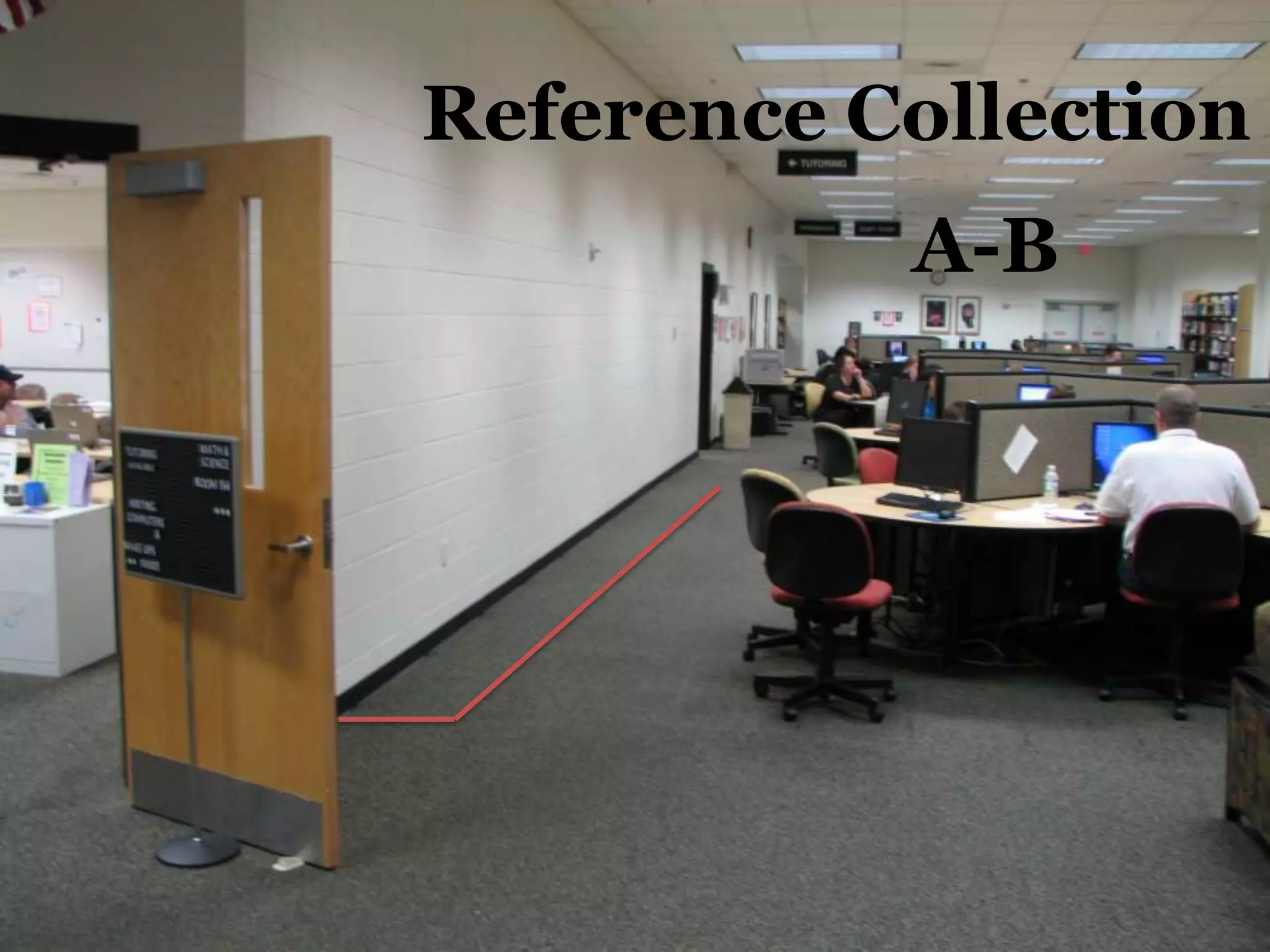
Reference CollectionReference CollectionA-B
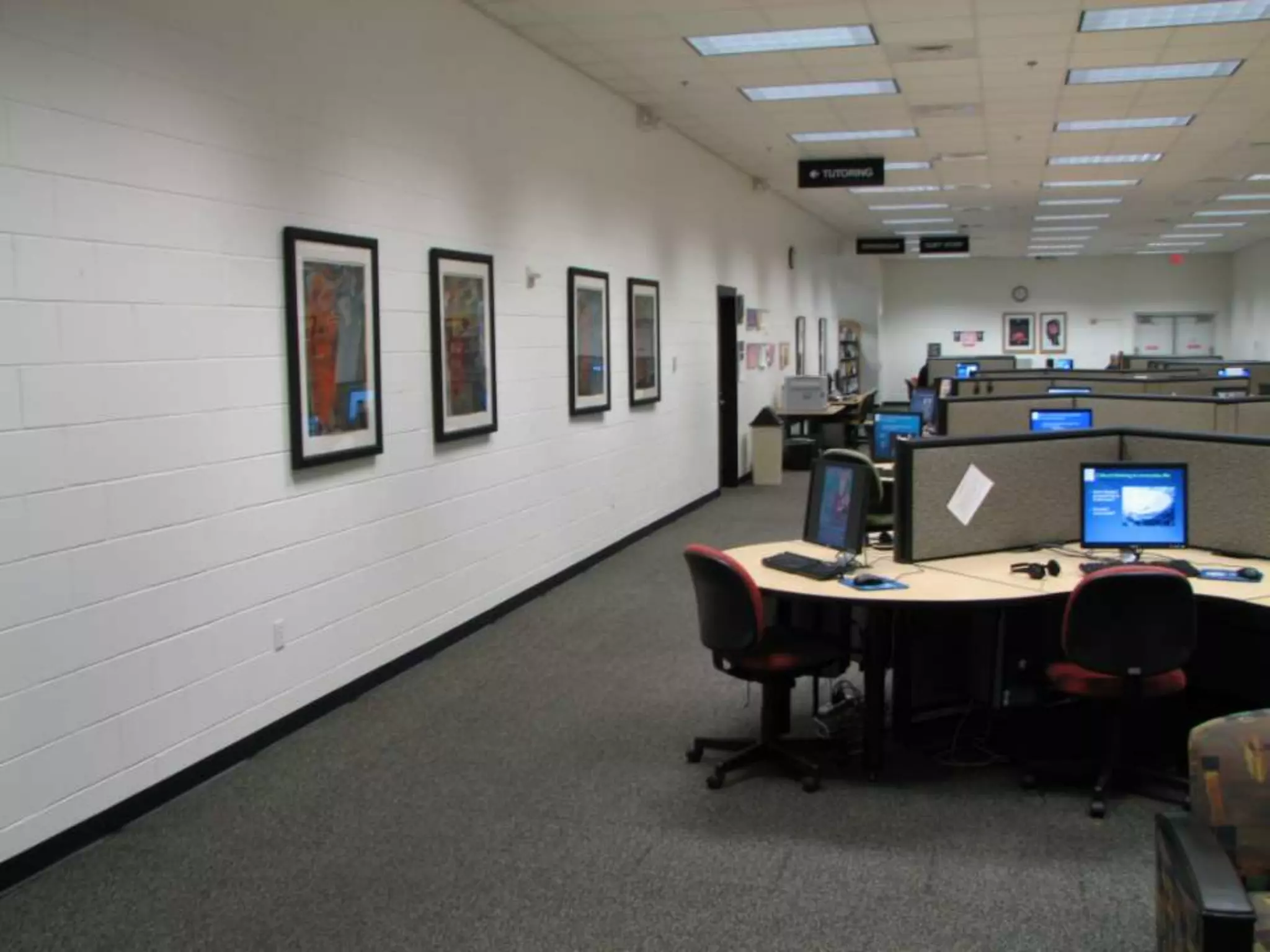
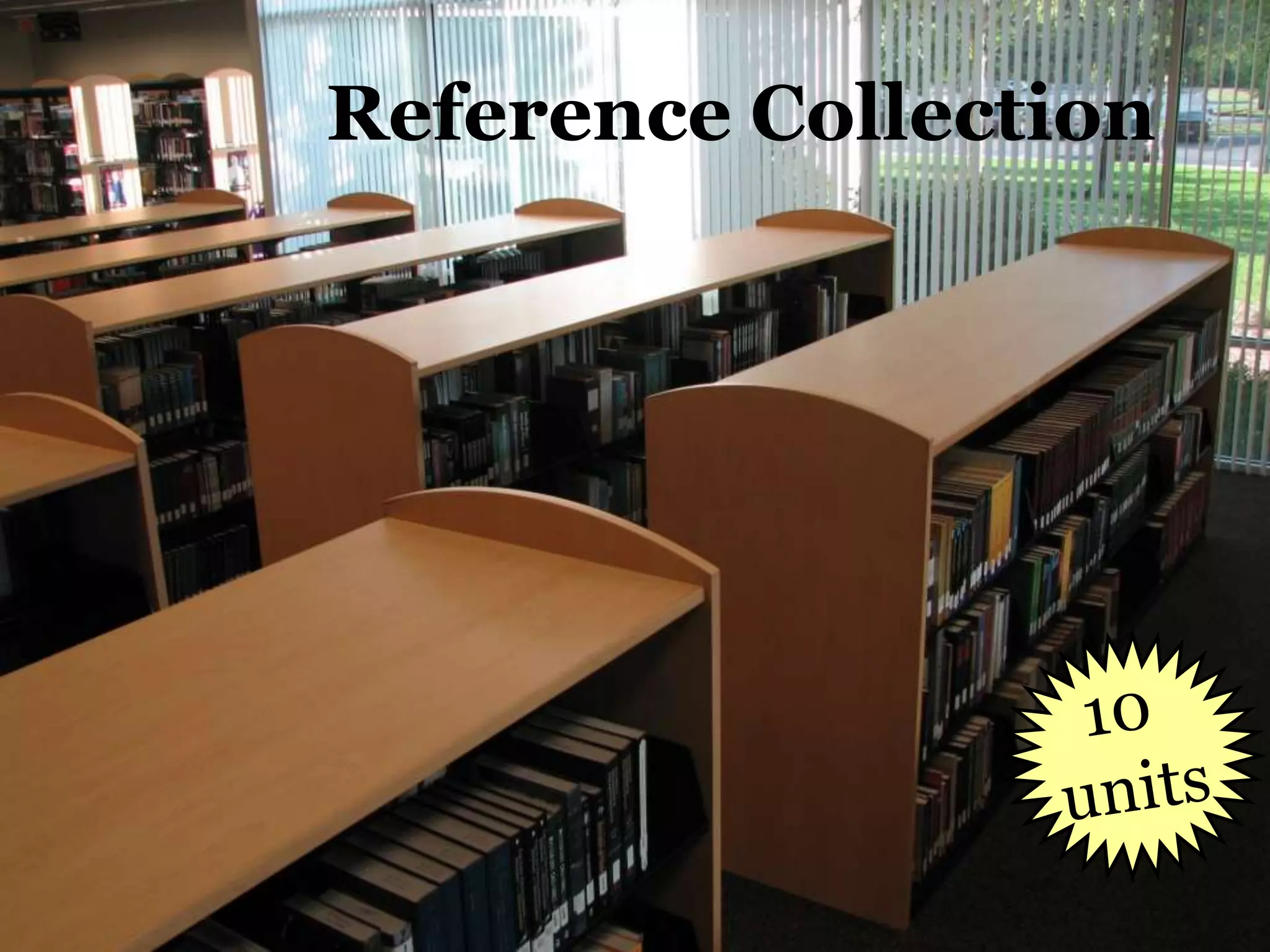
Reference Collection10 units
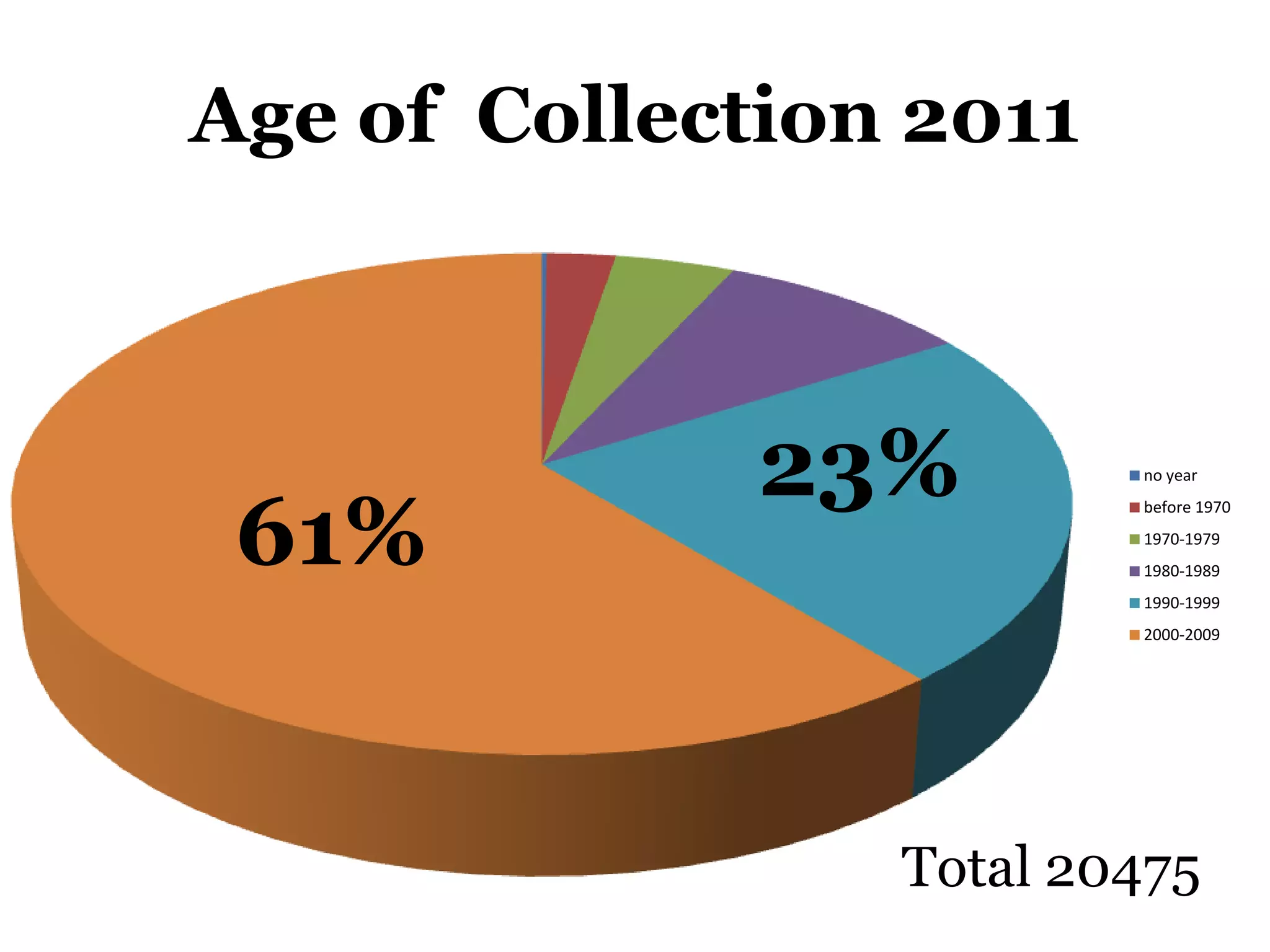
General Collectiontotal 25,627total 30,229total 20,475
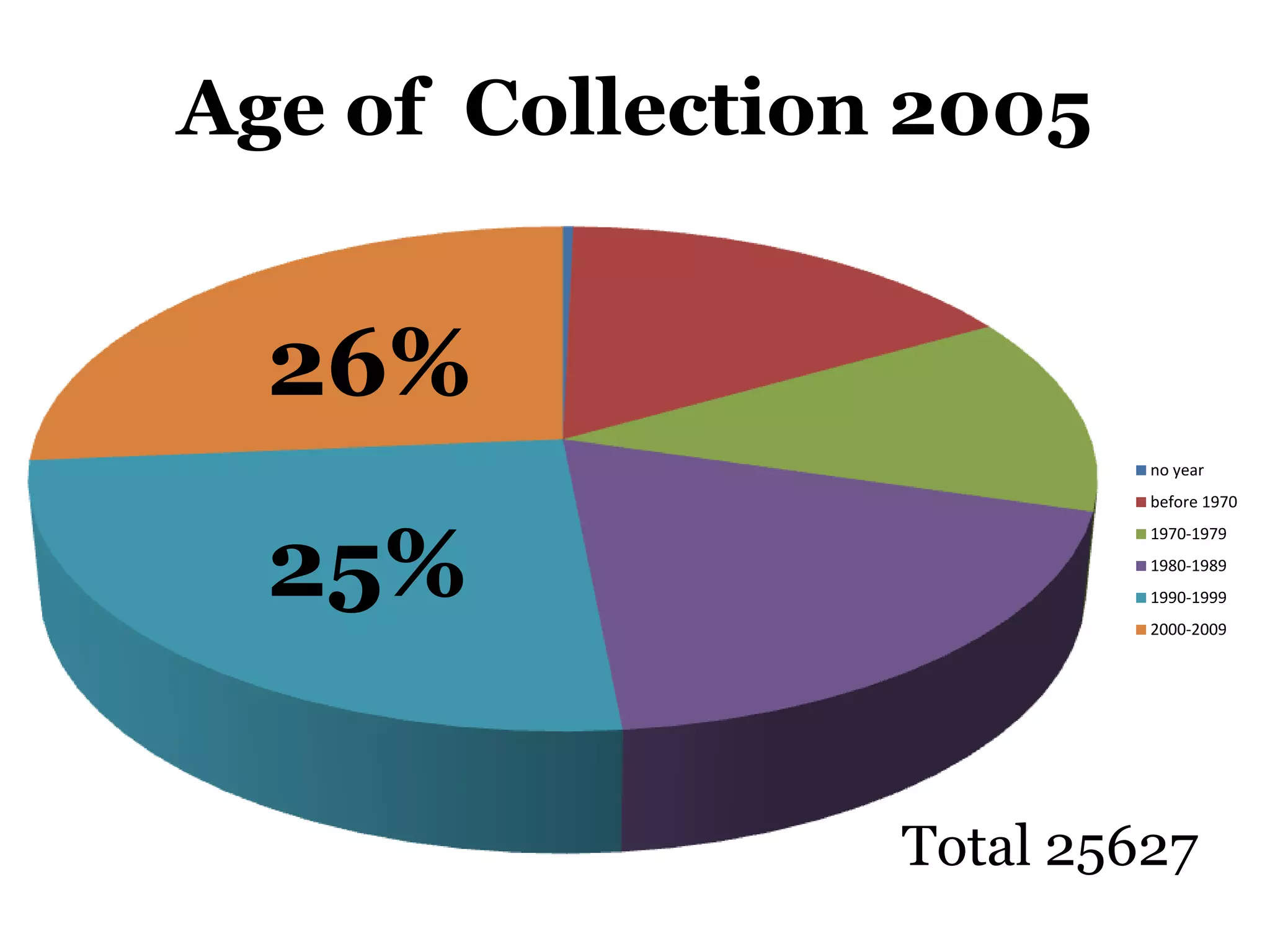
Age of  Collection 200526%25%Total 25627
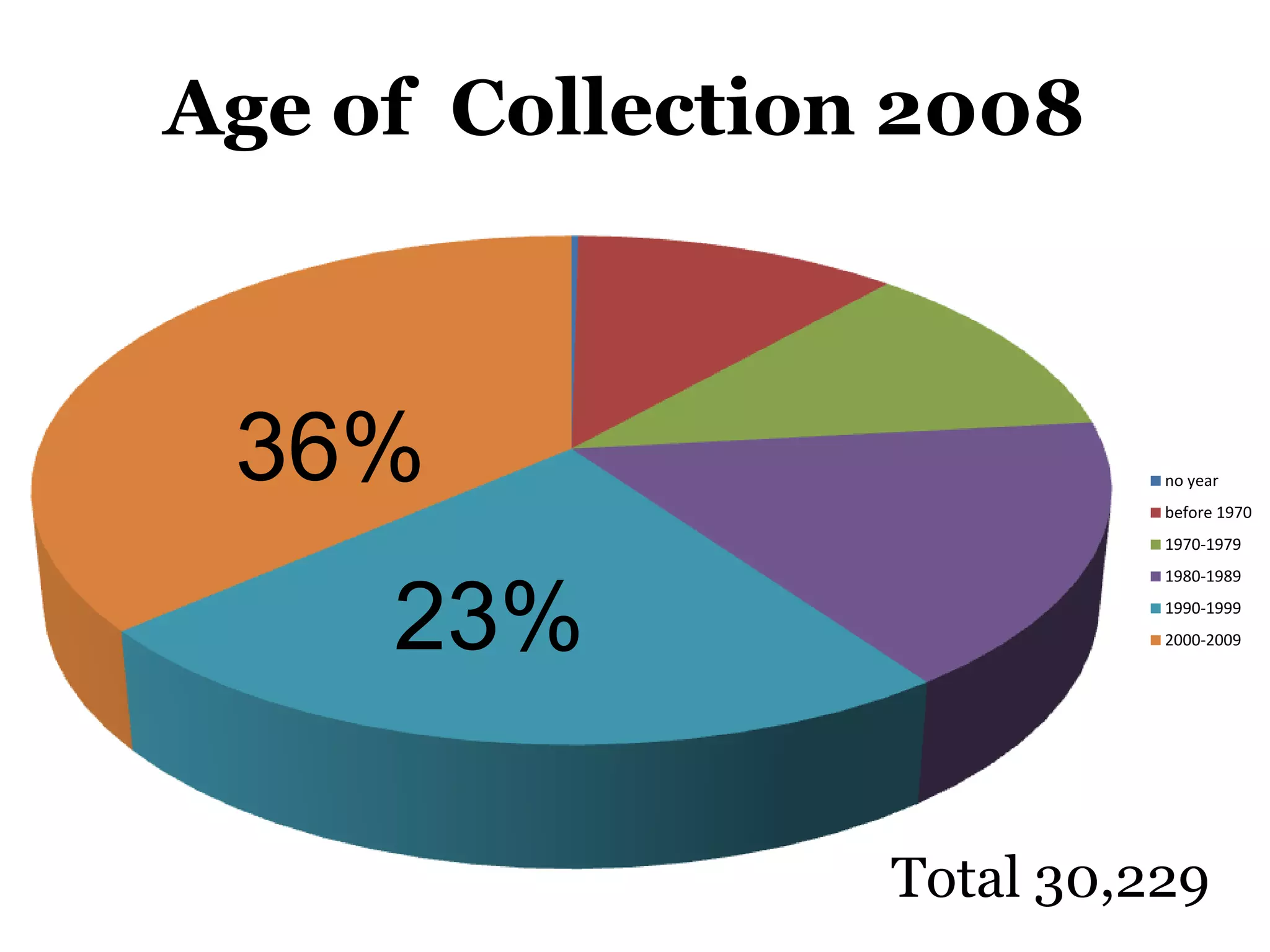
Age of  Collection 200836%23%Total 30,229
Age of  Collection 201161%Total 20475
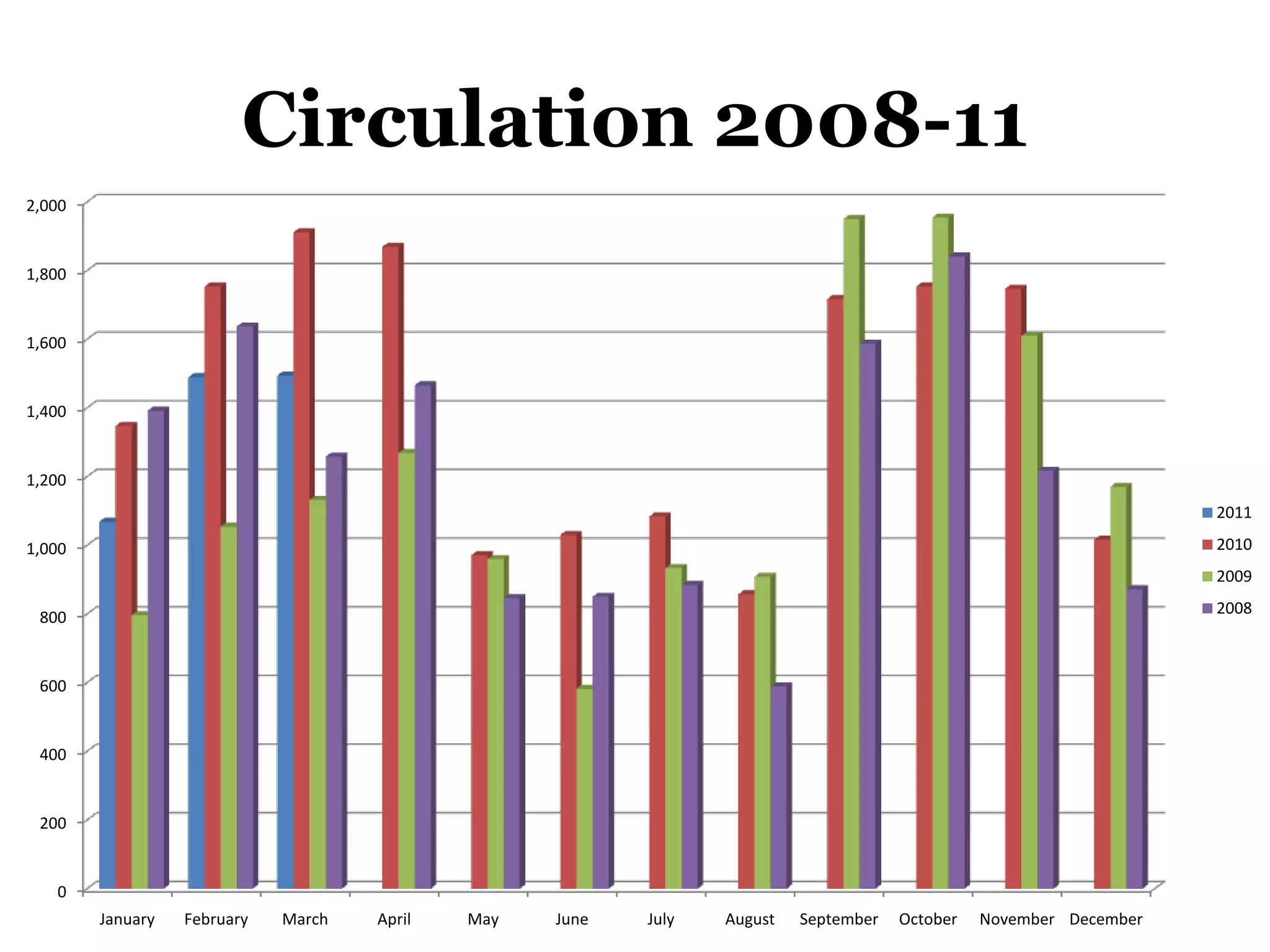
Circulation 2008-11
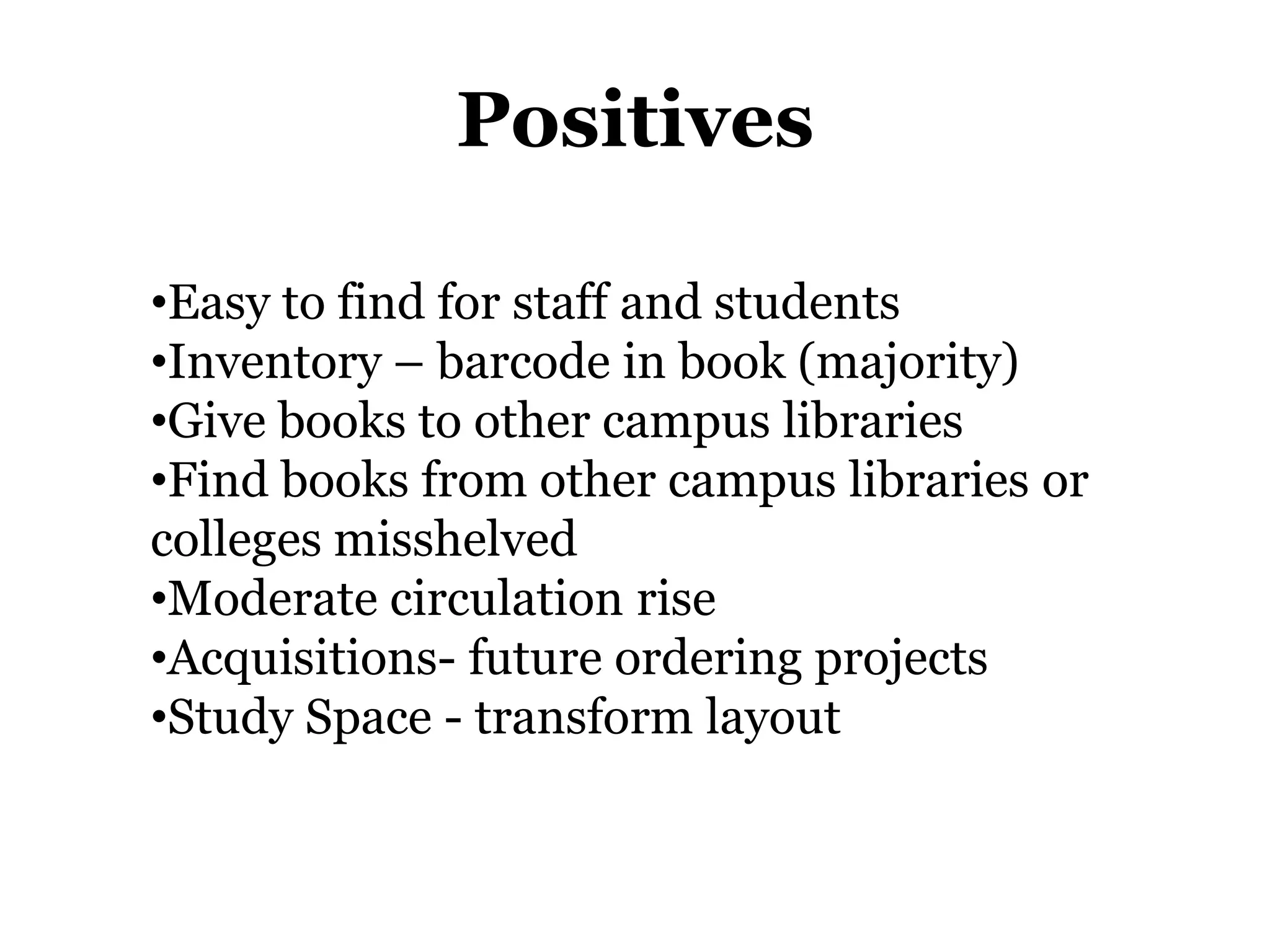
PositivesEasy to find for staff and students
Inventory – barcode in book (majority)
Give books to other campus libraries

We are what we own: Deselection strategies for our profession's viability

  • 2.
  • 3.
    Do you feelprint books are sacred?
  • 4.
    How many timesa year do you participate in deselection?
  • 5.
    Have you purchasedor acquired library discards for your office or personal book collection?56%
  • 6.
  • 7.
    Start a newdeselection project
  • 8.
    Remove items fromlibrary not-used
  • 9.
  • 10.
  • 11.
    Urge to acquirefree things
  • 12.
    Avoid discarding –too overwhelming39%18%38%
  • 13.
    How stressful doyou feel at the thought of your library budget shifting the majorities of money to eBooks as opposed to print books? 7%25%28%
  • 14.
    How stressful wouldit be for you if 30%-40% of print books were to be deselected from your library’s collection?13%33%19%
  • 16.
    Florida Community Colleges“...monographcollections… were significantly out of date with the majority of library books having been published before the 1970’s”(Perrault et al, 2002, p. 241)
  • 17.
    Florida Community Colleges“..1990’s..thepercentage age of older materials to newer materials had increased and that outdated materials were prevalent in all major subject divisions, including science and technology”(Perrault et al, 2002, p. 241)
  • 18.
    Non-Traditional User“With students strapped for time already; our resources must be especially efficient, convenient, available during a wide variety of times, and also available remotely”(Poole, 2009, p. 194)
  • 19.
    “Reading a book,however, requires concentration, endurance, the ability to disconnect from other connections. You have to be there rather than not there. Hyperwired young people may be making it to age 17 without acquiring that ability, let alone losing it.”(Romano, 2010, para. 19)
  • 20.
    “….the focus isno longer in creating a comprehensive print collection but supplementing it with a vast and comprehensive collection of electronic information sources, resources, and links”(Fernandes, 2008, p. 206)
  • 21.
    …[Steven J. Bell,Temple University] urged librarians to think past libraries traditional roles of gateway, archive, and buyer of scholarly material.…“We could really carve out a much more significant role as instructional partners”(Howard, 2008, para. 10)
  • 22.
    “Ranganathan deplored thatmany librarians seemed to be more concerned with preservation than with use, thus perpetuating the image of the librarian as a custodian rather than as some skilled in the exploitation of bibliographic resources”(Lancaster, 1988, para. 1)
  • 23.
    Meaning of Books“Thenon-library world interprets weeding destroying of valuable materials, the treasured vessels and conveyers of our culture and society.”(Intner, 2006)
  • 24.
    “Libraries were inventedso that individuals wouldn’t have to own everything they might sometime want to read. Our trust in libraries makes it possible for us to throw things away.”Nicholson BakerWriter / Advocate for library preservation
  • 25.
    Attachment“Even though wecan’t hold on to anything, clinging remains one of our strongest habits. Useless though it may be, we devote much of our energy to grasping at that which is elusive and impermanent.”Pema Chodron
  • 26.
    “Many librarians havean emotional attachment to their collections. They think of books as a literal part of the library, as part of their family.”Michael SawyerDirector of Calcasieu Parish Public LibraryLouisiana
  • 27.
    Browsing“When items onthe first shelf or two they examine aren’t what they want and aren’t very attractive looking, browsers get the vague feeling that the rest of the stock, which, on the surface, looks the same as what they’ve just seen, isn’t going to be any better.”(Intner, 2006, p. 16)
  • 28.
  • 29.
    Clutter Personality TypesEasilydistractedProcrastinatorSentimental CluttererBargain shoppersPerfectionistsGeralin ThomasProfessional OrganizerCary, North Carolina
  • 30.
    Decision-making“To weed isto make multiple decisions simultaneously, decisions based on both objective and subjective criteria”(Handy, 1994, para. 5)
  • 31.
    “People with compulsivehoarding often feel afraid to throw things away, worry excessively, and repeatedly check to make sure they’re not throwing away anything important.”(Tolin, Frost & Steketee, 2007, p. 20)
  • 32.
    Cost ConcernsWill notthrow out an item until we have spent the valueShelvingSavings in staff timeMaterial usefuture acquisition decisions
  • 33.
    Stakeholders “The benefit of involving the faculty seems to be more to prevent negative feelings rather than to improve the weeding process.” x(Slote, 1997, p. 10)
  • 34.
    Case Study 2008-11TarponSprings CampusSt. Petersburg College2009-10Lower Division: 5,070not including upper division
  • 35.
    Library Staff2 paraprofessionals2librarians (liaison areas)3 student assistants1 OPS –staff member 20-32 hrs.
  • 36.
    Mission / VisionSupport CurriculumLeisure CollectionEasy to FindSpace for study/ leisure/ technologyPrepare for inventory
  • 37.
    Undecorating – TracyElliottRemove faded posters, paintings, plants, etc.Remove yellowed plastic covers from booksReduce trash can amountDamaged, stained, faded furniture, study carrelsOld technology VCRs, computers, typewriter… Paper/pathfindersSignsSupplies to other departments/campus libraries
  • 38.
    Weeding ProcedureLibrarians removeand discard itemsDo not revisit cart – no reviewerCart given to paraprofessional to remove from OPAC and OCLC holdingsOPS/student assistants mark through items - SURPLUSBox for book sale or check better world books or free cart for students
  • 40.
    Initial DeselectionJust Weedbefore involving faculty or other stakeholderRepeat copies – if not usedDamaged materialOlder reference copy in circ. CollectionMedical/Law/Technology 5 yearsDuplication in electronic format- some removalToo many in one subject – gift for other campus library
  • 41.
    Multiple Rounds- SmallGoalsCheck areas multiple times throughout a period of timeFirst time: everything older than 1990 and does not have historical valueSecond: remove a section not being usedEtc.
  • 43.
    ShelvingRedefine Shelving Meaning:Not only storageLay books to view item on shelfRemove items from top and bottom shelfDisplay books face outLet there be lightSecurityBe open to remove shelving
  • 44.
    Reference Collection“For mostreference collections, more is not necessarily better”(Matthews & Tychson, 1981)
  • 45.
    Reference CollectionTotal 3,291Total1,466No purchasing - replacing
  • 46.
  • 48.
  • 50.
  • 51.
    Age of Collection 200526%25%Total 25627
  • 52.
    Age of Collection 200836%23%Total 30,229
  • 53.
    Age of Collection 201161%Total 20475
  • 54.
  • 55.
    PositivesEasy to findfor staff and students
  • 56.
    Inventory – barcodein book (majority)
  • 57.
    Give books toother campus libraries
  • 58.
    Find books fromother campus libraries or colleges misshelved
  • 59.
  • 60.
  • 61.
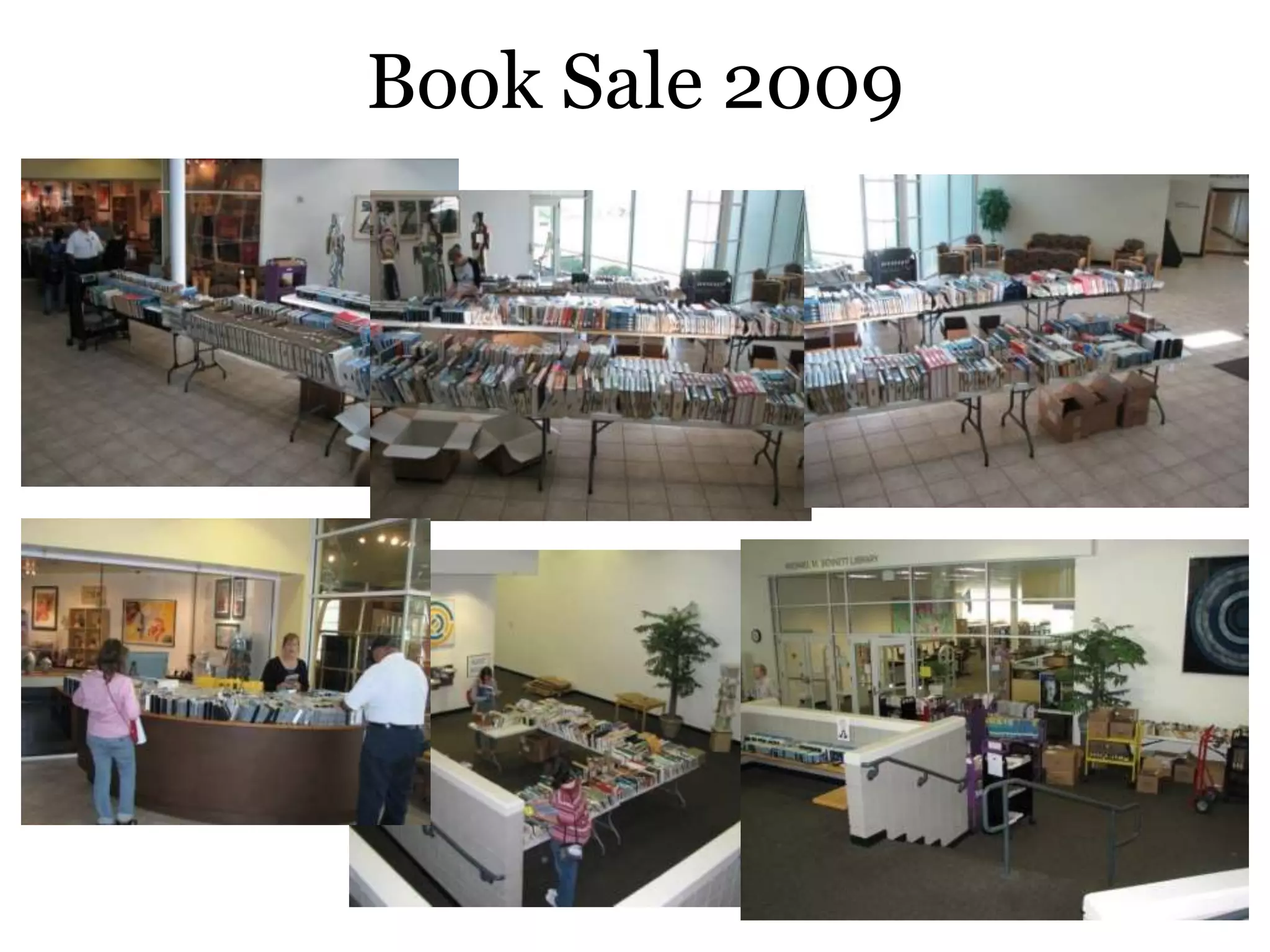
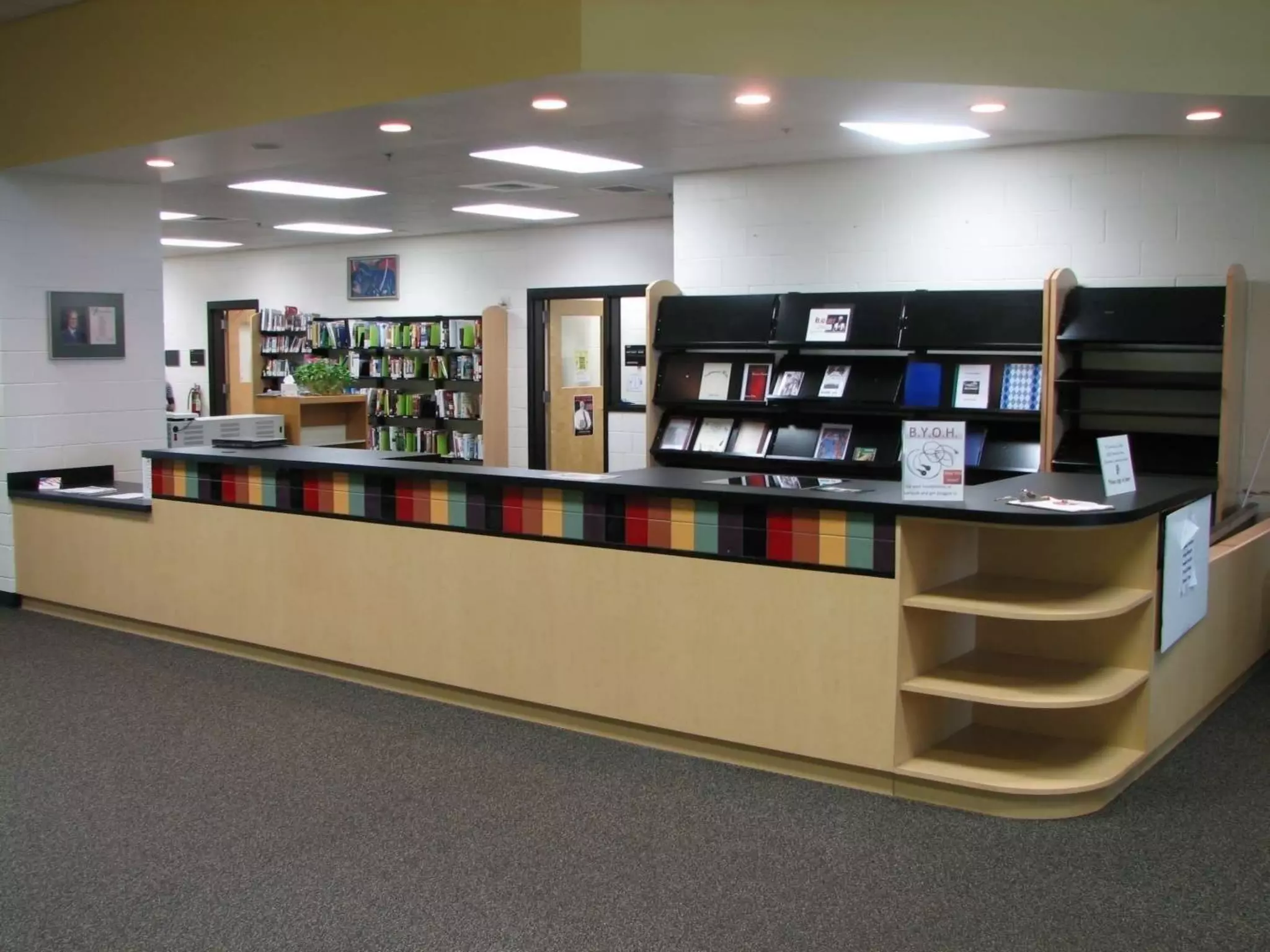
    Study Space -transform layoutBook Sale 2009
  • 62.
    Better World Books“Donot make your weeded books a problem for someone else by just passing the buck.”Free book cart(Allen, 2010, p. 33)
  • 63.
    Policies and ProceduresMoreinformation- directionWeeding procedures (guide for staff)Donation/gift policyacquisition
  • 64.
    Policies and Procedures“Agood collection development policy should be clear, concise, and easily followed since many staff members have collection development responsibilities and everyone should work toward mutual goals when making decisions”(Poole, 2009, p. 199)
  • 66.
  • 67.
    “(Deselection) is aprocess of catharsis that frees you to focus on the future”(Handy, 1994, para. 25)

Editor's Notes

  • #11 Continual Update Collection Management Model: 5% percent withdrawn and 5% addition (continue to be current and a viable collection)Crew Method: Continuous, Review, Evaluation, Weeding– small to medium public libraryMustie: Misleading, Ugly, Superseded, Trivial, Irrelevant, Elsewhere (ILL) – media centersWORST: Worn out, out of date, rarely Used, System (can another supply?), TrivialWeed of the Month – media centersSlote Method – Academic Library
  • #12 The Association of College and Research Libraries (ACRL) Guidelines for Undergraduate Libraries states: “Collection policies should include withdrawal practices. Collections should be dynamic and responsive to the needs of a changing curriculum and clientele.” (1997)
  • #14 Brian Matthews Georgia Institute of Technology 32…”shift toward user-centered approach, where we are really trying to understand not just how we fit in the 24-hour cycle of the students. If as student comes in during the day, they are going to have certain needs, and if they come it at night, they are going to have different needs, and at the beginning of the semester it’s different than at the end of the semester, Really looking at it with an anthropological approach.” (Carlson, 2007)More prone to use online sources- digital shift in altering relationshipWith view the library? What is the impression does the collection/ space give?
  • #15 Romano/ Chronicle of Higher Education: “the death of the book as object of study, the disappearance of “whole” books as assigned reading. (Romano, 2010, para. 9)Linda Nilson, director of the Office of Teaching Effectiveness at Clemson University, posts a piece titled “Getting Students to Do the Reading” on the Website of the National Education Association, advising: “Look for readings with graphics and pictures that reinforce the text, and pare down the required paes to the essentials. The less reading assigned, the more likely students will do it. (Romano, 2010, para. 14)My personal story
  • #16 With students strapped for time already, our resources must be especially efficient, convenient, available during a wide variety of times, and also available remotely. (Poole,2009, p. 194)
  • #17 Instruction is our key. Helping patron become information literate, finding information digital or print, and participating is the goal. We do not have everything. We will never have everything. Amazon, Barnes and Nobles….“It seems to me that a modern university library should be more than a study hall and a computer lab” Bruce L. Emerton, Librarian, Polytechnic University, CA
  • #18 Five Laws of Library Science: Book are for Use
  • #19 Destruction of books brings up images of censorship and book burningMeasured by its use, not solely by its size (Crosetto, Kinner & Duhon, 2008, p.45)
  • #20 “Perhaps our professional problem is that we measure collection development success by how large the collections grow, rather than by how much service they provide in proportion to their size.” Sheila Intner, professor, Mount Holyoke College, MA
  • #21 In this present moment, there is nothing left of the past but memories. Our nostalgia for the good times, our fear of the bad times: that’s all that’s really left. Instead of getting hooked further by nostalgia and fear, we can simply acknowledge these tendencies and question the intelligence of continuing to harm ourselves for the sake of such transient concerns.
  • #22 From Mathews. Weeding grows the garden:Yard Sign Project: rewarded kids who read 10 books sign read “ A Library Champion lives here”White Paper: outlined the economic benefits of the library for the community to small business (paying for library)Taxes Marketing Project: A home owner with a 100,000 house would pay tax equal to two candy bars a monthA business owner with a business valued at 600,000 would pay a rate equal to a monthly home internet connection.
  • #24 Some value the serendipitous discovery, and the increasingly arcane art of wandering, aimlessly, in the stacks. For these readers relevance is overrated. (New York Times, October 26, 2002)Assumption: A huge amount of browsable books is a necessary component of research (Barclay, 2010, p.53)Assumption: the voluminous prescence is all that prevents an academic library from deteriorating into Starbucks (Barclay, 2010, p.53)Assumption: presence of large numbers of printed books creates something – a vibe, an ambiance, a holiness – that engenders scholarly behavior among the student bodyProblem: Browsing only shows the user what happens to be on the self (checkout, stolen, lost, misshelved, etc.) (Barclay, 2010, p.53)Needs of today: Classroom and study space: current needsPrint on Demand / Online (Barclay, 2010, p.54)
  • #26 “Some librarians lack the assurance needed to make these complex decisions and feel their judgment may be challenged by patrons or colleagues” (Handis, 2007, 85).
  • #27 From Mathews. Weeding grows the garden:Yard Sign Project: rewarded kids who read 10 books sign read “ A Library Champion lives here”White Paper: outlined the economic benefits of the library for the community to small business (paying for library)Taxes Marketing Project: A home owner with a 100,000 house would pay tax equal to two candy bars a monthA business owner with a business valued at 600,000 would pay a rate equal to a monthly home internet connection.
  • #32 Mercer University Regional Academic Libraries, Georgia: collection development project improve collection development policy, and the collection itself, improve relations with stakeholders, ensure that the library’s mission is being fulfilled, and to complete Southern Association of Colleges and Schools (SACS) accreditation requirements
  • #58 Read Objects of Our Desire by Salman Akhtar