
Serum calcium
DR.GHULAM MURTAZA
RESIDENT CHEMICAL PATHOLOGY
DIMC
1
Serum calcium
 CALCIUM is 5th most common element in the body &
most prevalent cation
 Average human body (70kg ) contain about 1KG or 25
mol, of calcium
 the skeleton contain 99% of body calcium ( extracellular
crystals ) while 1 % is present in soft tissues ,& extra
cellular fluid .
2
Biochemistry & physiology
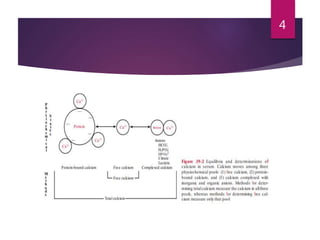
 In blood all calcium is found in plasma with mean
concentration of 9.5mg/dl
 Exits in three physiochemical states in plasma
 50 % is free ( ionized ),
 40 % is bound to plasma protein &
 10 % is complexed with small diffusible inorganic including
bicarbonate ,phosphate, lactate ,& citrate
3
4
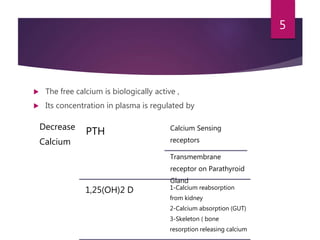
 The free calcium is biologically active ,
 Its concentration in plasma is regulated by
Decrease
Calcium
PTH Calcium Sensing
receptors
Transmembrane
receptor on Parathyroid
Gland
1,25(OH)2 D 1-Calcium reabsorption
from kidney
2-Calcium absorption (GUT)
3-Skeleton ( bone
resorption releasing calcium
5
Clinical significance
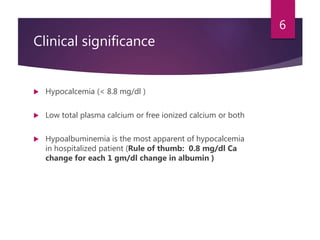
 Hypocalcemia (< 8.8 mg/dl )
 Low total plasma calcium or free ionized calcium or both
 Hypoalbuminemia is the most apparent of hypocalcemia
in hospitalized patient (Rule of thumb: 0.8 mg/dl Ca
change for each 1 gm/dl change in albumin )
6
7
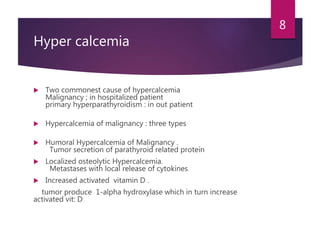
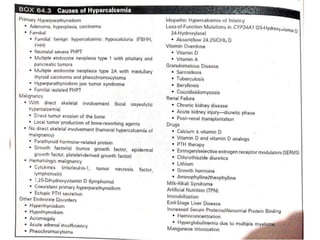
Hyper calcemia
 Two commonest cause of hypercalcemia
Malignancy ; in hospitalized patient
primary hyperparathyroidism : in out patient
 Hypercalcemia of malignancy : three types
 Humoral Hypercalcemia of Malignancy .
Tumor secretion of parathyroid related protein
 Localized osteolytic Hypercalcemia.
Metastases with local release of cytokines
 Increased activated vitamin D .
tumor produce 1-alpha hydroxylase which in turn increase
activated vit: D
8
9
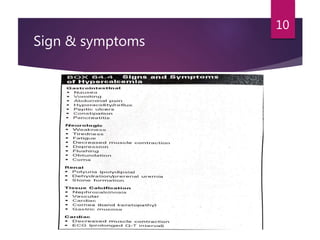
Sign & symptoms
10
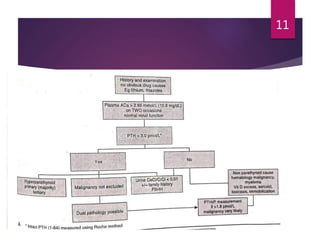
11
Calcium measurement
 Measurement of Total Calcium :
 At present two methods are in use
1- Photometric 2- Ion Selective Electrode
 ISE method has been introduced recently than photometric
 The specimen is acidified to convert protein bound & complexed
calcium to free calcium before calcium is measured by ISE
12
o-Cresolpthalein Complexone methods
 In alkaline solution ,the Metal complex dye CPC
forms a red chromophore complex with Calcium
 The color is usually measured at a wave length
between 570-580nm
 The sample is diluted with acid to release complex &
protein bound calcium
13
o-Cresolpthalein Complexone methods
 Interference by Magnesium is reduced by adding
8-hydroxyquinolone
 Calcium forms both 1;1 & 2;1 complexes with CPC
with former predominately with lower concentration
 Reaction is temperature sensitive .
14
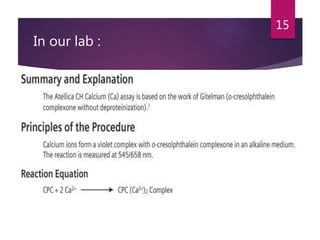
In our lab :
15
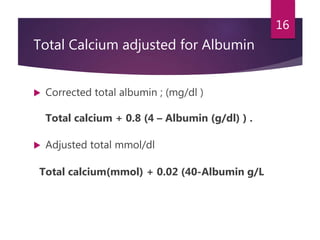
Total Calcium adjusted for Albumin
 Corrected total albumin ; (mg/dl )
Total calcium + 0.8 (4 – Albumin (g/dl) ) .
 Adjusted total mmol/dl
Total calcium(mmol) + 0.02 (40-Albumin g/L
16
Free Calcium
• Ionized Ca has been shown to be a more sensitive test for the
diagnosis of various calcium disorders4 .
• The results are instant as test is done on ISE based systems e.g.
electrolyte or ABG analyzers.
• Composite ABG analyzers should be preferred to give
simultaneous estimation of Ca++ and pH.
• Reference method for Total Ca is Atomic Absorption photometry
but for Ca++ an ISE based method been developed and approved
by IFCC2 .
17
Free Calcium
• Precautions for Ca++ are same as for ABG analysis
• It must be emphasized that factors like tourniquet and
patient posture only minimally effect free calcium
estimation.
• Lyophilized Lithium Heparin Syringes or tubes should be
used in anaerobic conditions and estimation should be
done within 30 min (maximum 1 h).
• If delayed should be stored at 40 C but then K+ estimation
is effected.
• Lyophilized Lithium Heparin Syringes are available in
Pakistan and may be used for ABGs and electrolytes
18
Effect of pH
 There is inverse relation between free calcium & pH
 Free calcium changes by about 5% for each 0.1 unit in
change pH
 Albumin has 30 binding site for calcium binding & account
for 80% of the protein bound calcium .
 Increase in pH increase negative charge on albumin &
other proteins leading to increase in protein bound calcium
& decrease free calcium
19
20
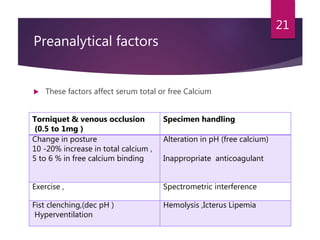
Preanalytical factors
 These factors affect serum total or free Calcium
21
Torniquet & venous occlusion
(0.5 to 1mg )
Specimen handling
Change in posture
10 -20% increase in total calcium ,
5 to 6 % in free calcium binding
Alteration in pH (free calcium)
Inappropriate anticoagulant
Exercise , Spectrometric interference
Fist clenching,(dec pH )
Hyperventilation
Hemolysis ,Icterus Lipemia
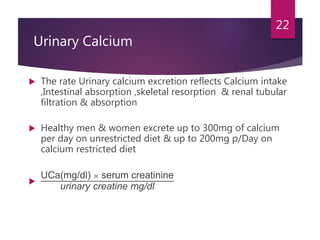
Urinary Calcium
 The rate Urinary calcium excretion reflects Calcium intake
,Intestinal absorption ,skeletal resorption & renal tubular
filtration & absorption
 Healthy men & women excrete up to 300mg of calcium
per day on unrestricted diet & up to 200mg p/Day on
calcium restricted diet

UCa(mg/dl) × serum creatinine
urinary creatine mg/dl
22
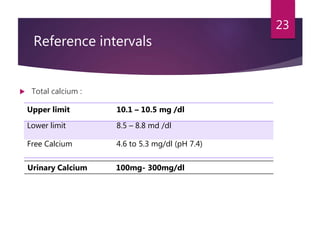
Reference intervals
23
 Total calcium :
Upper limit 10.1 – 10.5 mg /dl
Lower limit 8.5 – 8.8 md /dl
Free Calcium 4.6 to 5.3 mg/dl (pH 7.4)
Urinary Calcium 100mg- 300mg/dl
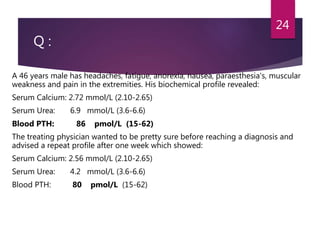
Q :
A 46 years male has headaches, fatigue, anorexia, nausea, paraesthesia's, muscular
weakness and pain in the extremities. His biochemical profile revealed:
Serum Calcium: 2.72 mmol/L (2.10-2.65)
Serum Urea: 6.9 mmol/L (3.6-6.6)
Blood PTH: 86 pmol/L (15-62)
The treating physician wanted to be pretty sure before reaching a diagnosis and
advised a repeat profile after one week which showed:
Serum Calcium: 2.56 mmol/L (2.10-2.65)
Serum Urea: 4.2 mmol/L (3.6-6.6)
Blood PTH: 80 pmol/L (15-62)
24
Q :
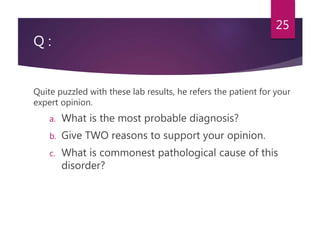
Quite puzzled with these lab results, he refers the patient for your
expert opinion.
a. What is the most probable diagnosis?
b. Give TWO reasons to support your opinion.
c. What is commonest pathological cause of this
disorder?
25
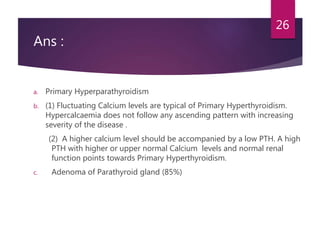
Ans :
a. Primary Hyperparathyroidism
b. (1) Fluctuating Calcium levels are typical of Primary Hyperthyroidism.
Hypercalcaemia does not follow any ascending pattern with increasing
severity of the disease .
(2) A higher calcium level should be accompanied by a low PTH. A high
PTH with higher or upper normal Calcium levels and normal renal
function points towards Primary Hyperthyroidism.
c. Adenoma of Parathyroid gland (85%)
26
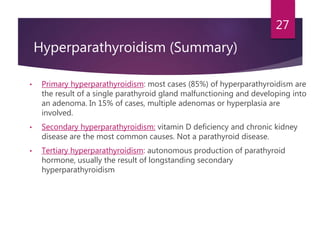
Hyperparathyroidism (Summary)
• Primary hyperparathyroidism: most cases (85%) of hyperparathyroidism are
the result of a single parathyroid gland malfunctioning and developing into
an adenoma. In 15% of cases, multiple adenomas or hyperplasia are
involved.
• Secondary hyperparathyroidism: vitamin D deficiency and chronic kidney
disease are the most common causes. Not a parathyroid disease.
• Tertiary hyperparathyroidism: autonomous production of parathyroid
hormone, usually the result of longstanding secondary
hyperparathyroidism
27
Thank you
28
References
 Tietz text book of clinical chemistry &
molecular diagnosis 6th edition vol; 03
 Chemical Pathology for beginners
Dr.Aamir Ijaz
29

Serum calcium

  • 1.
  • 2.
    Serum calcium  CALCIUMis 5th most common element in the body & most prevalent cation  Average human body (70kg ) contain about 1KG or 25 mol, of calcium  the skeleton contain 99% of body calcium ( extracellular crystals ) while 1 % is present in soft tissues ,& extra cellular fluid . 2
  • 3.
    Biochemistry & physiology In blood all calcium is found in plasma with mean concentration of 9.5mg/dl  Exits in three physiochemical states in plasma  50 % is free ( ionized ),  40 % is bound to plasma protein &  10 % is complexed with small diffusible inorganic including bicarbonate ,phosphate, lactate ,& citrate 3
  • 4.
  • 5.
     The freecalcium is biologically active ,  Its concentration in plasma is regulated by Decrease Calcium PTH Calcium Sensing receptors Transmembrane receptor on Parathyroid Gland 1,25(OH)2 D 1-Calcium reabsorption from kidney 2-Calcium absorption (GUT) 3-Skeleton ( bone resorption releasing calcium 5
  • 6.
    Clinical significance  Hypocalcemia(< 8.8 mg/dl )  Low total plasma calcium or free ionized calcium or both  Hypoalbuminemia is the most apparent of hypocalcemia in hospitalized patient (Rule of thumb: 0.8 mg/dl Ca change for each 1 gm/dl change in albumin ) 6
  • 7.
  • 8.
    Hyper calcemia  Twocommonest cause of hypercalcemia Malignancy ; in hospitalized patient primary hyperparathyroidism : in out patient  Hypercalcemia of malignancy : three types  Humoral Hypercalcemia of Malignancy . Tumor secretion of parathyroid related protein  Localized osteolytic Hypercalcemia. Metastases with local release of cytokines  Increased activated vitamin D . tumor produce 1-alpha hydroxylase which in turn increase activated vit: D 8
  • 9.
  • 10.
  • 11.
  • 12.
    Calcium measurement  Measurementof Total Calcium :  At present two methods are in use 1- Photometric 2- Ion Selective Electrode  ISE method has been introduced recently than photometric  The specimen is acidified to convert protein bound & complexed calcium to free calcium before calcium is measured by ISE 12
  • 13.
    o-Cresolpthalein Complexone methods In alkaline solution ,the Metal complex dye CPC forms a red chromophore complex with Calcium  The color is usually measured at a wave length between 570-580nm  The sample is diluted with acid to release complex & protein bound calcium 13
  • 14.
    o-Cresolpthalein Complexone methods Interference by Magnesium is reduced by adding 8-hydroxyquinolone  Calcium forms both 1;1 & 2;1 complexes with CPC with former predominately with lower concentration  Reaction is temperature sensitive . 14
  • 15.
  • 16.
    Total Calcium adjustedfor Albumin  Corrected total albumin ; (mg/dl ) Total calcium + 0.8 (4 – Albumin (g/dl) ) .  Adjusted total mmol/dl Total calcium(mmol) + 0.02 (40-Albumin g/L 16
  • 17.
    Free Calcium • IonizedCa has been shown to be a more sensitive test for the diagnosis of various calcium disorders4 . • The results are instant as test is done on ISE based systems e.g. electrolyte or ABG analyzers. • Composite ABG analyzers should be preferred to give simultaneous estimation of Ca++ and pH. • Reference method for Total Ca is Atomic Absorption photometry but for Ca++ an ISE based method been developed and approved by IFCC2 . 17
  • 18.
    Free Calcium • Precautionsfor Ca++ are same as for ABG analysis • It must be emphasized that factors like tourniquet and patient posture only minimally effect free calcium estimation. • Lyophilized Lithium Heparin Syringes or tubes should be used in anaerobic conditions and estimation should be done within 30 min (maximum 1 h). • If delayed should be stored at 40 C but then K+ estimation is effected. • Lyophilized Lithium Heparin Syringes are available in Pakistan and may be used for ABGs and electrolytes 18
  • 19.
    Effect of pH There is inverse relation between free calcium & pH  Free calcium changes by about 5% for each 0.1 unit in change pH  Albumin has 30 binding site for calcium binding & account for 80% of the protein bound calcium .  Increase in pH increase negative charge on albumin & other proteins leading to increase in protein bound calcium & decrease free calcium 19
  • 20.
  • 21.
    Preanalytical factors  Thesefactors affect serum total or free Calcium 21 Torniquet & venous occlusion (0.5 to 1mg ) Specimen handling Change in posture 10 -20% increase in total calcium , 5 to 6 % in free calcium binding Alteration in pH (free calcium) Inappropriate anticoagulant Exercise , Spectrometric interference Fist clenching,(dec pH ) Hyperventilation Hemolysis ,Icterus Lipemia
  • 22.
    Urinary Calcium  Therate Urinary calcium excretion reflects Calcium intake ,Intestinal absorption ,skeletal resorption & renal tubular filtration & absorption  Healthy men & women excrete up to 300mg of calcium per day on unrestricted diet & up to 200mg p/Day on calcium restricted diet  UCa(mg/dl) × serum creatinine urinary creatine mg/dl 22
  • 23.
    Reference intervals 23  Totalcalcium : Upper limit 10.1 – 10.5 mg /dl Lower limit 8.5 – 8.8 md /dl Free Calcium 4.6 to 5.3 mg/dl (pH 7.4) Urinary Calcium 100mg- 300mg/dl
  • 24.
    Q : A 46years male has headaches, fatigue, anorexia, nausea, paraesthesia's, muscular weakness and pain in the extremities. His biochemical profile revealed: Serum Calcium: 2.72 mmol/L (2.10-2.65) Serum Urea: 6.9 mmol/L (3.6-6.6) Blood PTH: 86 pmol/L (15-62) The treating physician wanted to be pretty sure before reaching a diagnosis and advised a repeat profile after one week which showed: Serum Calcium: 2.56 mmol/L (2.10-2.65) Serum Urea: 4.2 mmol/L (3.6-6.6) Blood PTH: 80 pmol/L (15-62) 24
  • 25.
    Q : Quite puzzledwith these lab results, he refers the patient for your expert opinion. a. What is the most probable diagnosis? b. Give TWO reasons to support your opinion. c. What is commonest pathological cause of this disorder? 25
  • 26.
    Ans : a. PrimaryHyperparathyroidism b. (1) Fluctuating Calcium levels are typical of Primary Hyperthyroidism. Hypercalcaemia does not follow any ascending pattern with increasing severity of the disease . (2) A higher calcium level should be accompanied by a low PTH. A high PTH with higher or upper normal Calcium levels and normal renal function points towards Primary Hyperthyroidism. c. Adenoma of Parathyroid gland (85%) 26
  • 27.
    Hyperparathyroidism (Summary) • Primaryhyperparathyroidism: most cases (85%) of hyperparathyroidism are the result of a single parathyroid gland malfunctioning and developing into an adenoma. In 15% of cases, multiple adenomas or hyperplasia are involved. • Secondary hyperparathyroidism: vitamin D deficiency and chronic kidney disease are the most common causes. Not a parathyroid disease. • Tertiary hyperparathyroidism: autonomous production of parathyroid hormone, usually the result of longstanding secondary hyperparathyroidism 27
  • 28.
  • 29.
    References  Tietz textbook of clinical chemistry & molecular diagnosis 6th edition vol; 03  Chemical Pathology for beginners Dr.Aamir Ijaz 29