antihistamines
Outline
• What is an antihistamine?
• What causes allergies and what are
they, what is histamine?
• History of antihistamines
• Classes of antihistamines
• Future of antihistamines and allergy
treatment in general
What is an antihistamine?
• A drug that reduces or eliminates the effects
mediated by the chemical histamine
• Histamine is released by your body during an allergic
reaction and acts on a specific histamine receptor
• True antihistamines are only the agents that produce
a therapeutic effect that is mediated by negative
modulation of histamine receptors (other agents may
have antihistaminergic action but are not true
antihistamines)
• The term antihistamine only refers to H1 receptor
antagonists (actually inverse agonists)
• Antihistamines compete with histamine for binding
sites at the receptors. Antihistamine cannot remove
the histamine if it is already bound
What are allergies?
• Allergies are caused by a hypersensitivity reaction of
the antibody class IgE (which are located on mast
cells in the tissues and basophils in the blood)
• When an allergen is encountered, it binds to IgE,
which excessively activates the mast cells or
basophils, leading them to release massive amounts
of histamines.
• These histamines lead to inflammatory responses
ranging from runny nose to anaphylactic shock
• If both parents have allergies, you have a 70% of
having them, if only one parent does, you have a
48% chance (American Academy of Asthma,
Allergies and Immunology, Spring 2003).
Allergies
Structure of Histamine
Mast Cells
•When it is released, histamine
causes inflammation by increasing
vasodilation, capillary permeability,
causing smooth muscle
contraction, mucus secretion, and
parasympathetic nerve stimulation
•Histamine is distributed in Mast
Cells in all peripheral tissues of the
body and basophils, which
circulate in the blood
Synthesis of Histamine
• Formed from the amino acid Histadine in a
decarboxylation reaction with the enzyme
histadine decarboxylase
• Occurs primarily in mast cells and basophils
The different Histamine receptors
Location Type of
receptor
Effect Treatment
H1 Throughout the body, specifically
in smooth muscles, on vascular
endothelial cells, in the heart and
the CNS
G-protein coupled,
linked to
intercellular Gq,
which activates
phospholipase C
Mediate an increase
in vascular
permeability at sites
of inflammation
induced by histamine
Allergies, nausea,
sleep disorders
H2 In more specific locations in the
body mainly in gastric parietal
cells, a low level can be found in
vascular smooth muscle,
neutrophils, CNS, heart, uterus
G-protein coupled,
linked to
intercellular Gs
Increases the release
of gastric acid
Stomach ulcers
H3 Found mostly in the CNS, with a
high level in the thalamus,
caudate nucleus and cortex, also
a low level detected in small
intestine, testis and prostate.
G-protein coupled,
possibly linked to
intercellular Gi
Neural presynaptic
receptor, may
function to release
histamine
Unknown
H4 They were recently discovered in
2000. They are widely expressed
in components of the immune
system such as the spleen,
thymus and leukocytes.
Unknown, most
likely also G-
protein coupled
Unknown In addition to
benefiting allergic
conditions, research in
the h4 receptor may
lead to the treatment of
autoimmune diseases.
(rheumatoid arthritis
and IBS)
Clinical Uses of Antihistamines
• Allergic rhinitis (common cold)
• Allergic conjunctivitis (pink eye)
• Allergic dermatological conditions
• Urticaria (hives)
• Angioedema (swelling of the skin)
• Pruritus (atopic dermatitis, insect bites)
• Anaphylactic reactions (severe allergies)
• Nausea and vomiting (first generation H1-
antihistamines)
• Sedation (first generation H1-antihistamines)
Adverse side effects
• Associated with the first generation H1-antihistamines and due
to their lack of selectivity for the H1 receptor and anti-cholinergic
activity. Side effects are due to CNS depression:
• Sedation
• Dizziness
• Tinnitus (ringing in the ear)
• Blurred vision
• Euphoria
• Uncoordination
• Anxiety
• Insomnia
• Tremor
• Nausea/vomitting
• Dry mouth/dry cough
• Newer second generation H1-antihistamines are more selective
for the peripheral histamine receptors and have far less side
effects (drowsiness, fatigue, headache, nausea and dry mouth)
First antihistamine
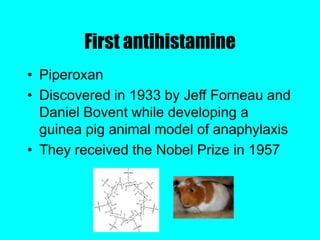
• Piperoxan
• Discovered in 1933 by Jeff Forneau and
Daniel Bovent while developing a
guinea pig animal model of anaphylaxis
• They received the Nobel Prize in 1957
Classes of first generation H1
receptor antagonist antihistamines
• Ethylenediamines
• Ethanolamines
• Alkylamines
• Piperazines
• Tricyclics
Common Structural Features of classical
first generation antihistamines
• 2 aromatic rings, connected
to a central carbon, nitrogen,
or oxygen
• Spacer between central atom
and the amine, usually 2-3
carbons in length. (Can be
linear, ring, branched,
saturated or unsaturated)
• The amine is substituted with
small alkyl groups
• Chirality at X and having the
rings in different planes
increases potency of the drug
Ethylenediamines
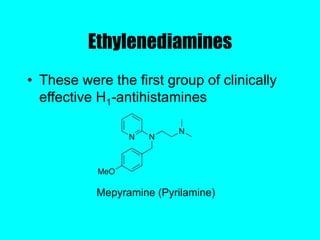
• These were the first group of clinically
effective H1-antihistamines
Mepyramine (Pyrilamine)
Ethanolamines
• This class has significant anticholinergic side effects and
sedation, however reduced the gastroinestnal side effects
Diphenhydramine (Benedryl)
• Oldest and most effective antihistamine on the
market
• Available over the counter
• Because it induces sedation, it’s used in
nonprescription sleep aids such as Tylenol PM
• Also inhibits the reuptake of serotonin, which
led to the search for viable antidepressants with
similar structures (prozac)
Ethanolamines
Carbinoxamine(Clistine) Doxylamine succinate
•2nd in effectiveness of anti-allergy
activity only to Benadryl
•Active ingredient in NyQuil
•Potent anti-cholinergic effects
•Is used to treat Hay fever and
is especially popular to children
due its its mild taste
•After 21 reported deaths in
children under 2, its now only
marketed to children above 3
(FDA, June 2006)
Ethanolamines
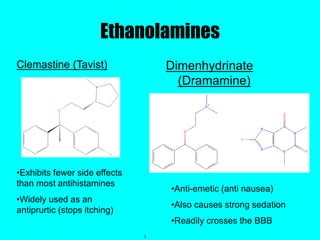
Clemastine (Tavist) Dimenhydrinate
(Dramamine)
•Exhibits fewer side effects
than most antihistamines
•Widely used as an
antiprurtic (stops itching)
•Anti-emetic (anti nausea)
•Also causes strong sedation
•Readily crosses the BBB
t
Alkylamines
• Isomerism is an important factor in this class of
drugs, which is due to the positioning and fit of the
molecules in the H1-receptor binding site
• These drugs have fewer sedative and GI adverse
effects, but a greater incidence of CNS stimulation
• These drugs lack the “spacer molecule” (which is
usually a nitrogen or oxygen) between the two
aromatic rings and at least one of the rings has
nitrogen included in the aromatic system
Akylamines
Chlorpheniramine Brompheniramine
(Dimetapp)
•Originally used to prevent
allergic conditions
•Shown to have antidepressant
properties and inhibit the
reuptake of serotonin
•The first SSRI was made as a
derivative of chlorphenamine
•Available over the counter
•Used to treat the common cold
by relieving runny nose, itchy,
watery eyes and sneezing
Akylamines
Triprolidine hydrochloride Pheniramine (Avil)
•Used to alleviate the symptoms
associated with allergies
•Can be combined with other cold
medicine to relieve “flu-like”
symptoms
•Used most often to treat hay fever or
urticaria (hives)
•Antihistamine component of Visine-A
Piperazines
• Structurally related to the ethylenediamines and the ethanolamines
and thus produce significant anti-cholinergic effects
• Used most often to treat motion sickness, vertigo, nausea and
vomiting
•Used to treat the symptoms associated
with motion sickness, vertigo and post-op
following administration of general
anaesthesia and opiods
•Mechanism of inhibiting motion sickness
is not well understood, but it may act on
the labyrinthine apparatus and the
chemoreceptor trigger zone (area of the
brain which receives input and induces
vomiting)
Cyclizine
Piperazines
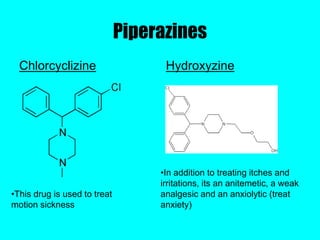
Chlorcyclizine Hydroxyzine
•In addition to treating itches and
irritations, its an anitemetic, a weak
analgesic and an anxiolytic (treat
anxiety)
•This drug is used to treat
motion sickness
Piperazines
Meclizine Cetirizine (Zyrtec)
•It is most commonly
used to inhibit nausea
and vomiting as well as
vertigo, however it does
cause drowsiness
•This drug treats indoor and
outdoor allergies and is safe to
use in children as young as 2
Tricyclics
• These drugs are structurally related to tricyclic
antidepressants, which explains why they have
cholinergic side effects
Promethazine (Phenegran)
•This drug has extremely strong
anticholinergic and sedative effects
•It was originally used as an antipsychotic,
however now it is most commonly used as a
sedative or antinausea drug (also severe
morning sickness) and requires a prescription
Tricyclics
Cyproheptadine Ketotifen (Zaditor)
•This drug both an antihistamine and an
antiserotonergic agent
•It is a 5-HT2 receptor antagonist and also
blocks calcium channels
•Used to treat hay fever and also to
stimulate appetite in people with anorexia
•It is also rarely used to treat SSRI induced
sexual dysfunction and also Cushing’s
Syndrome (high level of cortisol in the
blood) and migraine headaches
•This drug is available in two forms: an
ophthalmic form used to treat allergic
conjunctivitis or itchy red eyes and an oral
form used to prevent asthma attacks
•It has several adverse side effects including
drowsiness, weight gain, dry mouth,
irritability and increased nosebleeds
Tricyclics
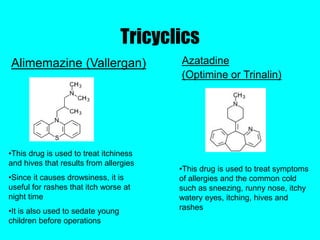
Alimemazine (Vallergan) Azatadine
(Optimine or Trinalin)
•This drug is used to treat itchiness
and hives that results from allergies
•Since it causes drowsiness, it is
useful for rashes that itch worse at
night time
•It is also used to sedate young
children before operations
•This drug is used to treat symptoms
of allergies and the common cold
such as sneezing, runny nose, itchy
watery eyes, itching, hives and
rashes
Second generation H1-receptor
antagonists
• These are the newer drugs and they are much more
selective for the peripheral H1-receptors involved in
allergies as opposed to the H1-receptors in the CNS
• Therefore, these drugs provide the same relief with many
fewer adverse side effects
• The structure of these drugs varies and there are no
common structural features associated with them
• They are however bulkier and less lipophilic than the first
generation drugs, therefore they do not cross the BBB as
readily
• Recent studies have also showed that these drugs also
have anti-inflammatory activity and therefore, would be
helpful in the management of inflammation in allergic
airways disease (Devalia and Davies).
Second generation H1-receptor
antagonists
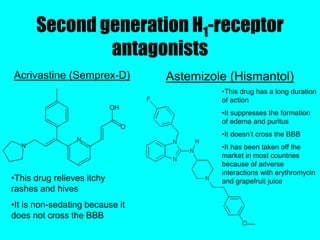
Acrivastine (Semprex-D) Astemizole (Hismantol)
•This drug has a long duration
of action
•It suppresses the formation
of edema and puritus
•It doesn’t cross the BBB
•It has been taken off the
market in most countries
because of adverse
interactions with erythromycin
and grapefruit juice
•This drug relieves itchy
rashes and hives
•It is non-sedating because it
does not cross the BBB
Second generation H1-receptor
antagonists
Loratadine (Claritin) Terfenadine (Seldane)
•It is the only drug of its class
available over the counter
•It has long lasting effects and does
not cause drowsiness because it
does not cross the BBB
•It was formerly used to treat
allergic conditions
•In the 1990’s it was removed from
the market due to the increased
risk of cardiac arrythmias
Second generation H1-receptor
antagonists
Azelastine
(Astelin or Optivar)
Levocabastine
(Livostin)
•It is a mast cell stablilizer
•Available as a nasal spray
(Astelin) or eye drops for pink
eye (Optivar)
•Both of these drugs are used as eye
drops to treat allergic conjunctivitis
Olopatadine
(Patanol)
Third generation H1-receptor
antagonists
• These drugs are derived from second generation antihistamines
• They are either the active enantiomer or metabolite of the
second generation drug designed to have increased efficacy
and fewer side effects
Levocetirizine (Zyzal)
•This drug is the active enantiomer of cetirizine and is
believed to be more effective and have fewer adverse
side effects.
•Also it is not metabolized and is likely to be safer than
other drugs due to a lack of possible drug interactions
(Tillement).
•It does not cross the BBB and does not cause
significant drowsiness
•It has been shown to reduce asthma attacks by 70%
in children
Third generation H1-receptor
antagonists
Deslortadine (Clarinex) Fexofenadine (Allegra)
•It is the active metabolite of
Lortadine
•Even though it is thought to be
more effective, there is no
concrete evidence to prove this
•It was developed as an
alternative to Terfenadine
•Fexofenadine was proven to be
more effective and safe
The future of antihistamines
• The anti-inflammatory activity of second generation
antihistamines, about which little is known, will
continue to be researched and possibly lead to an
effective alternative to corticosteriods in the treatment
of allergic airways conditions.
• The action of the H4 receptor will also continue to be
researched and will possibly lead to effective
treatment of autoimmune dieseases.
• Creating antihistamines with higher selectivity and
less adverse side effects will continue to be the goal

antihistamine presentation-khall.ppt

  • 1.
  • 2.
    Outline • What isan antihistamine? • What causes allergies and what are they, what is histamine? • History of antihistamines • Classes of antihistamines • Future of antihistamines and allergy treatment in general
  • 3.
    What is anantihistamine? • A drug that reduces or eliminates the effects mediated by the chemical histamine • Histamine is released by your body during an allergic reaction and acts on a specific histamine receptor • True antihistamines are only the agents that produce a therapeutic effect that is mediated by negative modulation of histamine receptors (other agents may have antihistaminergic action but are not true antihistamines) • The term antihistamine only refers to H1 receptor antagonists (actually inverse agonists) • Antihistamines compete with histamine for binding sites at the receptors. Antihistamine cannot remove the histamine if it is already bound
  • 4.
    What are allergies? •Allergies are caused by a hypersensitivity reaction of the antibody class IgE (which are located on mast cells in the tissues and basophils in the blood) • When an allergen is encountered, it binds to IgE, which excessively activates the mast cells or basophils, leading them to release massive amounts of histamines. • These histamines lead to inflammatory responses ranging from runny nose to anaphylactic shock • If both parents have allergies, you have a 70% of having them, if only one parent does, you have a 48% chance (American Academy of Asthma, Allergies and Immunology, Spring 2003).
  • 5.
    Allergies Structure of Histamine MastCells •When it is released, histamine causes inflammation by increasing vasodilation, capillary permeability, causing smooth muscle contraction, mucus secretion, and parasympathetic nerve stimulation •Histamine is distributed in Mast Cells in all peripheral tissues of the body and basophils, which circulate in the blood
  • 6.
    Synthesis of Histamine •Formed from the amino acid Histadine in a decarboxylation reaction with the enzyme histadine decarboxylase • Occurs primarily in mast cells and basophils
  • 7.
    The different Histaminereceptors Location Type of receptor Effect Treatment H1 Throughout the body, specifically in smooth muscles, on vascular endothelial cells, in the heart and the CNS G-protein coupled, linked to intercellular Gq, which activates phospholipase C Mediate an increase in vascular permeability at sites of inflammation induced by histamine Allergies, nausea, sleep disorders H2 In more specific locations in the body mainly in gastric parietal cells, a low level can be found in vascular smooth muscle, neutrophils, CNS, heart, uterus G-protein coupled, linked to intercellular Gs Increases the release of gastric acid Stomach ulcers H3 Found mostly in the CNS, with a high level in the thalamus, caudate nucleus and cortex, also a low level detected in small intestine, testis and prostate. G-protein coupled, possibly linked to intercellular Gi Neural presynaptic receptor, may function to release histamine Unknown H4 They were recently discovered in 2000. They are widely expressed in components of the immune system such as the spleen, thymus and leukocytes. Unknown, most likely also G- protein coupled Unknown In addition to benefiting allergic conditions, research in the h4 receptor may lead to the treatment of autoimmune diseases. (rheumatoid arthritis and IBS)
  • 8.
    Clinical Uses ofAntihistamines • Allergic rhinitis (common cold) • Allergic conjunctivitis (pink eye) • Allergic dermatological conditions • Urticaria (hives) • Angioedema (swelling of the skin) • Pruritus (atopic dermatitis, insect bites) • Anaphylactic reactions (severe allergies) • Nausea and vomiting (first generation H1- antihistamines) • Sedation (first generation H1-antihistamines)
  • 9.
    Adverse side effects •Associated with the first generation H1-antihistamines and due to their lack of selectivity for the H1 receptor and anti-cholinergic activity. Side effects are due to CNS depression: • Sedation • Dizziness • Tinnitus (ringing in the ear) • Blurred vision • Euphoria • Uncoordination • Anxiety • Insomnia • Tremor • Nausea/vomitting • Dry mouth/dry cough • Newer second generation H1-antihistamines are more selective for the peripheral histamine receptors and have far less side effects (drowsiness, fatigue, headache, nausea and dry mouth)
  • 10.
    First antihistamine • Piperoxan •Discovered in 1933 by Jeff Forneau and Daniel Bovent while developing a guinea pig animal model of anaphylaxis • They received the Nobel Prize in 1957
  • 11.
    Classes of firstgeneration H1 receptor antagonist antihistamines • Ethylenediamines • Ethanolamines • Alkylamines • Piperazines • Tricyclics
  • 12.
    Common Structural Featuresof classical first generation antihistamines • 2 aromatic rings, connected to a central carbon, nitrogen, or oxygen • Spacer between central atom and the amine, usually 2-3 carbons in length. (Can be linear, ring, branched, saturated or unsaturated) • The amine is substituted with small alkyl groups • Chirality at X and having the rings in different planes increases potency of the drug
  • 13.
    Ethylenediamines • These werethe first group of clinically effective H1-antihistamines Mepyramine (Pyrilamine)
  • 14.
    Ethanolamines • This classhas significant anticholinergic side effects and sedation, however reduced the gastroinestnal side effects Diphenhydramine (Benedryl) • Oldest and most effective antihistamine on the market • Available over the counter • Because it induces sedation, it’s used in nonprescription sleep aids such as Tylenol PM • Also inhibits the reuptake of serotonin, which led to the search for viable antidepressants with similar structures (prozac)
  • 15.
    Ethanolamines Carbinoxamine(Clistine) Doxylamine succinate •2ndin effectiveness of anti-allergy activity only to Benadryl •Active ingredient in NyQuil •Potent anti-cholinergic effects •Is used to treat Hay fever and is especially popular to children due its its mild taste •After 21 reported deaths in children under 2, its now only marketed to children above 3 (FDA, June 2006)
  • 16.
    Ethanolamines Clemastine (Tavist) Dimenhydrinate (Dramamine) •Exhibitsfewer side effects than most antihistamines •Widely used as an antiprurtic (stops itching) •Anti-emetic (anti nausea) •Also causes strong sedation •Readily crosses the BBB t
  • 17.
    Alkylamines • Isomerism isan important factor in this class of drugs, which is due to the positioning and fit of the molecules in the H1-receptor binding site • These drugs have fewer sedative and GI adverse effects, but a greater incidence of CNS stimulation • These drugs lack the “spacer molecule” (which is usually a nitrogen or oxygen) between the two aromatic rings and at least one of the rings has nitrogen included in the aromatic system
  • 18.
    Akylamines Chlorpheniramine Brompheniramine (Dimetapp) •Originally usedto prevent allergic conditions •Shown to have antidepressant properties and inhibit the reuptake of serotonin •The first SSRI was made as a derivative of chlorphenamine •Available over the counter •Used to treat the common cold by relieving runny nose, itchy, watery eyes and sneezing
  • 19.
    Akylamines Triprolidine hydrochloride Pheniramine(Avil) •Used to alleviate the symptoms associated with allergies •Can be combined with other cold medicine to relieve “flu-like” symptoms •Used most often to treat hay fever or urticaria (hives) •Antihistamine component of Visine-A
  • 20.
    Piperazines • Structurally relatedto the ethylenediamines and the ethanolamines and thus produce significant anti-cholinergic effects • Used most often to treat motion sickness, vertigo, nausea and vomiting •Used to treat the symptoms associated with motion sickness, vertigo and post-op following administration of general anaesthesia and opiods •Mechanism of inhibiting motion sickness is not well understood, but it may act on the labyrinthine apparatus and the chemoreceptor trigger zone (area of the brain which receives input and induces vomiting) Cyclizine
  • 21.
    Piperazines Chlorcyclizine Hydroxyzine •In additionto treating itches and irritations, its an anitemetic, a weak analgesic and an anxiolytic (treat anxiety) •This drug is used to treat motion sickness
  • 22.
    Piperazines Meclizine Cetirizine (Zyrtec) •Itis most commonly used to inhibit nausea and vomiting as well as vertigo, however it does cause drowsiness •This drug treats indoor and outdoor allergies and is safe to use in children as young as 2
  • 23.
    Tricyclics • These drugsare structurally related to tricyclic antidepressants, which explains why they have cholinergic side effects Promethazine (Phenegran) •This drug has extremely strong anticholinergic and sedative effects •It was originally used as an antipsychotic, however now it is most commonly used as a sedative or antinausea drug (also severe morning sickness) and requires a prescription
  • 24.
    Tricyclics Cyproheptadine Ketotifen (Zaditor) •Thisdrug both an antihistamine and an antiserotonergic agent •It is a 5-HT2 receptor antagonist and also blocks calcium channels •Used to treat hay fever and also to stimulate appetite in people with anorexia •It is also rarely used to treat SSRI induced sexual dysfunction and also Cushing’s Syndrome (high level of cortisol in the blood) and migraine headaches •This drug is available in two forms: an ophthalmic form used to treat allergic conjunctivitis or itchy red eyes and an oral form used to prevent asthma attacks •It has several adverse side effects including drowsiness, weight gain, dry mouth, irritability and increased nosebleeds
  • 25.
    Tricyclics Alimemazine (Vallergan) Azatadine (Optimineor Trinalin) •This drug is used to treat itchiness and hives that results from allergies •Since it causes drowsiness, it is useful for rashes that itch worse at night time •It is also used to sedate young children before operations •This drug is used to treat symptoms of allergies and the common cold such as sneezing, runny nose, itchy watery eyes, itching, hives and rashes
  • 26.
    Second generation H1-receptor antagonists •These are the newer drugs and they are much more selective for the peripheral H1-receptors involved in allergies as opposed to the H1-receptors in the CNS • Therefore, these drugs provide the same relief with many fewer adverse side effects • The structure of these drugs varies and there are no common structural features associated with them • They are however bulkier and less lipophilic than the first generation drugs, therefore they do not cross the BBB as readily • Recent studies have also showed that these drugs also have anti-inflammatory activity and therefore, would be helpful in the management of inflammation in allergic airways disease (Devalia and Davies).
  • 27.
    Second generation H1-receptor antagonists Acrivastine(Semprex-D) Astemizole (Hismantol) •This drug has a long duration of action •It suppresses the formation of edema and puritus •It doesn’t cross the BBB •It has been taken off the market in most countries because of adverse interactions with erythromycin and grapefruit juice •This drug relieves itchy rashes and hives •It is non-sedating because it does not cross the BBB
  • 28.
    Second generation H1-receptor antagonists Loratadine(Claritin) Terfenadine (Seldane) •It is the only drug of its class available over the counter •It has long lasting effects and does not cause drowsiness because it does not cross the BBB •It was formerly used to treat allergic conditions •In the 1990’s it was removed from the market due to the increased risk of cardiac arrythmias
  • 29.
    Second generation H1-receptor antagonists Azelastine (Astelinor Optivar) Levocabastine (Livostin) •It is a mast cell stablilizer •Available as a nasal spray (Astelin) or eye drops for pink eye (Optivar) •Both of these drugs are used as eye drops to treat allergic conjunctivitis Olopatadine (Patanol)
  • 30.
    Third generation H1-receptor antagonists •These drugs are derived from second generation antihistamines • They are either the active enantiomer or metabolite of the second generation drug designed to have increased efficacy and fewer side effects Levocetirizine (Zyzal) •This drug is the active enantiomer of cetirizine and is believed to be more effective and have fewer adverse side effects. •Also it is not metabolized and is likely to be safer than other drugs due to a lack of possible drug interactions (Tillement). •It does not cross the BBB and does not cause significant drowsiness •It has been shown to reduce asthma attacks by 70% in children
  • 31.
    Third generation H1-receptor antagonists Deslortadine(Clarinex) Fexofenadine (Allegra) •It is the active metabolite of Lortadine •Even though it is thought to be more effective, there is no concrete evidence to prove this •It was developed as an alternative to Terfenadine •Fexofenadine was proven to be more effective and safe
  • 32.
    The future ofantihistamines • The anti-inflammatory activity of second generation antihistamines, about which little is known, will continue to be researched and possibly lead to an effective alternative to corticosteriods in the treatment of allergic airways conditions. • The action of the H4 receptor will also continue to be researched and will possibly lead to effective treatment of autoimmune dieseases. • Creating antihistamines with higher selectivity and less adverse side effects will continue to be the goal