Taking a Paediatric History
TSOFWA JULIUS
CO PEDIATRICIAN
Differences
 Birth history and impact
of children’s growth and
development
 Often distracted by
presence of the child
 Need to be flexible
 Maintain a sense of
humour
Chief Problem/Presenting
Complaint
Who is Giving the History?
Listen to the mother,
What are her worries?
What does she think is the problem?
Ask her to define her terms
Quote verbatim what she says.
 Understand her idioms.
Presenting Complaint & History of
Presenting Complaint
 Presenting Complaint
use patient’s/parents own words
 History of Presenting Complaint
Sequence of events - what happened next? when was
he last well? - what was the first thing you noticed
wrong?
Follow-up enquiry ,
eg pain - site, nature, frequency, radiation, aggravating &
relieving factors, associated features
eg seizure – onset, characteristics, duration, post episode
Taking a Paediatric History
 Previous History - Medical & Surgical
 Neonatal History
 Nutrition History
 Developmental History
 Vaccination History
 Family History
 Social History
 Medications & Allergies
Natal / Neonatal History
 Neonatal History
- pregnancy/antenatal
complications
- gestation, mode of delivery –
Why?
-birth weight, (AGA, SGA, LGA)
 Apgar scores
 Neonatal problems,
-jaundice, transfusions, sepsis
 Feeding
 Respiratory problems,
-ventilated – why & how long
for?
 Congenital defects
 Did the baby go home with you?
Nutritional History
 Nutrition/Feeding History
- breast /bottle,
-weaning (when?, amount
& type of feeds)
 Major food groups
- likes, dislikes
-idiosyncrasies
 Special diets - why?
Adherence/compliance, e.g
diabetes- diabetic
exchanges,PKU, Coeliac
disease
Development & Growth
 Developmental History
- major milestones achieved i.e age smiled,
sat, crawled, walked, first words
- vision, hearing speech, motor skills, social
skills
- comparison with sibs
- school performance
 Growth
- does mother think child is growing
- ask about puberty if appropriate to child’s
age
Vaccinations
 Vaccination History
- BCG,
- 5 in 1( dip, pertussis, tetanus, Hib, ipv)
and Meningococcus C ( 2, 4 and 6 months)
- MMR ( 12 – 15 months)
- Boosters
-special cases e.g pneumococcal vaccine,
varicella vaccine, Hepatitis A & B
* if no vaccinations always ask why
Taking a Paediatric History
 Family History
Asthma, eczema, diabetes, cystic fibrosis
specific enquiries from pc
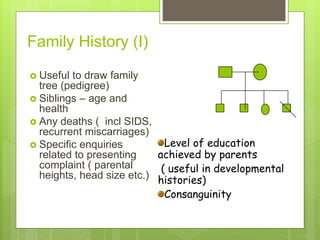
Family History (I)
 Useful to draw family
tree (pedigree)
 Siblings – age and
health
 Any deaths ( incl SIDS,
recurrent miscarriages)
 Specific enquiries
related to presenting
complaint ( parental
heights, head size etc.)
Level of education
achieved by parents
( useful in developmental
histories)
Consanguinity
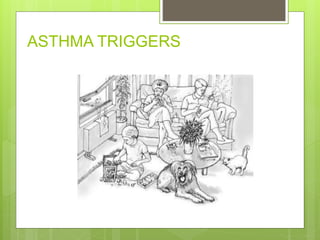
ASTHMA TRIGGERS
Taking a Paediatric History
 Social History
marital status, supports, occupation
siblings age & health
any pets, smoking
carers - who cares for the child by day
Taking a Paediatric History - Social
History contd.
School
Type of school, class, progress
interaction with peers, bullying
amount of school missed (chronic disease)
chronic disease - disease impact on family & sibs.
Cares, who, when, how, duration
Travel - when & where
Disease contact
Medications
 Medications
- Dose, frequency, mode of administration
-Compliance or adherence – How often would
you forget?
- Who administers or supervises?
 Allergies
Taking a Paediatric History
 Systems Review
not exhaustive, always include general questions on
energy, appetite, growth, bladder and bowel habit,
behaviour
Should be age-appropriate.
Should be tailored to the visit.
Introduction to the Clinical Examination of
Children
Introduction to the Clinical
Examination of Children
 The care and safety of the children in our
Hospitals is the prime concern for their
parents and for those working with children
 People need to know who you are - please
wear your name badge & display it
prominently at all times, introduce yourself &
explain the purpose of your visit
Introduction to the Clinical
Examination of Children
 Prior to examining any child -
Seek permission of the senior nursing staff, the parents and
when the child is old enough her/himself
Remember people have the right to refuse - Be Nice
 The well-being of the child takes precedence over any
personal learning objective
Introduction to the Clinical
Examination of Children
 The well being of the child is the responsibility of the examining
medical student - leave the child in comfort with the cot sides
up
 Respect the privacy and dignity of the child at all times -
Intimate examinations, such as, palpation of the breasts or
genital examination in a pubertal child should not be
performed. Examination for UDT in a male infant is an
important part of the clinical exam and this should be explained
to parents.
Introduction to the Clinical
Examination of Children
 Measurement of blood pressure or
examination of the fundi is not required in
your clinical exam - but you must refer to
them as necessary
Introduction to the Clinical
Examination of Children
 Examine in groups of 2
 Use the written guidelines for examination as
an aid to help each other
 See children ASAP after admission as
children go home quickly
Physical Examination
 Must be able to examine the ‘four ages of
childhood’
- newborn
- infant
-toddler
- older child/ adolescent
INTRODUCTION
 Specific techniques similar to adult
 inspection
 palpation
 percussion
 Auscultation
 Approach and order different
TIPS FOR A SUCCESSFUL (AND TEARLESS)
PAEDIATRIC PHYSICAL EXAM
 Be friendly
 Have equipment ready but
not prominent
 Size up the child’s likely
reaction - Mum helpful
 Use games, let child handle
instruments
 Keep up a conversation -
distracts child
 WARM HANDS
 BE GENTLE
Sometimes helpful to show what you plan
to do e.g finger-nose testing
Key to success is patience
Tell the child what you are going to do -
offer choices
Be observant and make the best of
unexpected opportunities
Position
Birth-6m: On familiar blanket on
exam table or cot
6m-2y: Mother’s lap when
possible
3y and up: Sitting or lying on bed
THE PHYSICAL EXAMINATION
“Don’t touch the patient – state first what
you see; cultivate your powers of
observation”
Sir William Osler
SEQUENCE OF THE EXAM
(6 months - upwards)
 Observation/general impression
 “ 3 metre’’ examination
 Skin
 HEENT
 Neck
 Cardiac
 Lungs
 Abdomen
 Musculoskeletal
 Neurological
•PULSE
Varies with age;.Affected by
temperature, fear, illness.
•RESPIRATORY RATE
Varies with age; Affected by
temperature, fear, illness, state
(sleeping, quiet awake, excited)
VITAL SIGNS
PHYSICAL EXAMINATION
The four cardinal principles of physical
examination are:
1. Inspection
2. Palpation
3. Percussion
4. Auscultation
INSPECTION
General appearance
State of nutrition
Body habitus
Colour
Symmetry
Posture and gait
Speech
For each system specific aspects
considered
GROWTH PARAMETERS
 WEIGHT - kilograms
 HEIGHT - centimeters
 HEAD CIRCUMFERENCE - centimeters
 Measure and plot on growth chart
 Measure < 2 yrs
 Plot > 2 years
SKIN
 RASHES - Individual lesions, colour,
arrangement, distribution
 COLOUR - mottling, cyanosis, jaundice
 BIRTH MARKS - haemangiomata, pigmented
lesions, skin tags
 TURGOR/HYDRATION
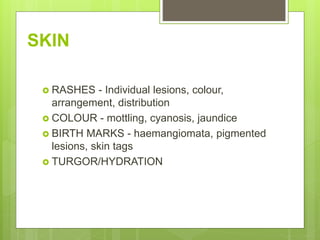
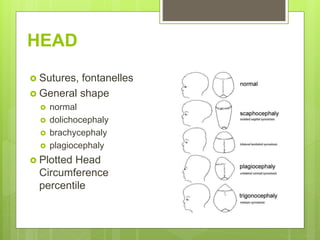
HEAD
 Sutures, fontanelles
 General shape
 normal
 dolichocephaly
 brachycephaly
 plagiocephaly
 Plotted Head
Circumference
percentile
EYES
Symmetry
Swelling, lesions, discolouration
Lids
Epicanthic folds
Sclera
Pupils
Visual acuity
Direct and consensual reflexes
Visual fields and diplopia
EARS
 Position of pinna
 EAC exam (otitis externa)
 TM exam (Clin Skills Lab)
 Landmarks ( malleus handle)
 Light reflex
 Colour (grey, opalescent, red, dull)
 Contour
 Middle ear contents (pus, clear fluid)
OROPHARYNX
 Dentition - alignment, caries, eruption
 Mucous membranes and enanthems
 Tongue - frenulum
 Palate/Uvula - clefts, high arched
 Tonsils - size, exudate
 Posterior pharynx
NECK
 Short in infancy
 Rashes/candidiasis
 Lymph nodes
 Nuchal rigidity in
meningitis
 ROM - torticollis
 Clavicles - fracture
 Trachea
 Thyroid
 Masses
 Lymphadenopathy
 Carotid pulsations
 Carotid bruits
LYMPH NODES
 Enlargement > 2cm
 Tenderness
 Erythematous
 Fluctuant
 Cervical, pre/post-auricular, axillary, inguinal,
femoral
LUNGS
Inspiration and Expiration
Chest size and symmetry
Bell or diaphragm (warm first)
Breath sounds harsher in infants and young
children
- tracheal, bronchial and adventitial
Distinguish lower from transmitted upper
airway sounds
Abnormalities - decreased BS, crackles,
wheeze, stridor,  rate, retractions
(distinguish IC from SC)
CARDIOVASCULAR
 Pulses
 Apical pulse - varies with age
 Rate and rhythm
 Sinus arrhythmia common
 S3 common
 Premature ventricular contractions common
 Functional murmur in 1/2 to 2/3
FUNCTIONAL MURMURS
 No cardiac symptoms
 Low intensity
 Usually midsystolic
 Change with position
 Still’s murmur louder supine
 Venous hum diappears supine
 Do not radiate
 Systolic - never diastolic
ABDOMEN
Warm hands, palpate gently
Look at Face not hands
Kneel down
Spleen tip and liver edge commonly palpable in
infancy
If abdomen tense, try flexing legs at hip
Look For:
Masses, lesions, discolorations
Distention, fluid
Liver, spleen, kidneys
Abdominal aorta
Large bowel
Bladder
SPINE
Lumbar lordosis in toddler
Screen at all ages for scoliosis,
especially just before onset puberty at
which time may dramatically increase
Look for shoulder/scapular height,
spine, arm/torso triangle, pelvis tilt,
height of posterior ribs (spine flexed)
MUSCULOSKELETAL
Gait
Symmetry
Bulk and tone
Strength
Range of motion
Dyskinetic movements
Joint mechanics
Joint swellings and noise
NEUROLOGIC
 Similar to adult
 Extent of neurologic
exam dictated by
history and index of
suspicion
 Much of the usual
neurologic
examination is done
by observation wrt
age
 Level of
consciousness
 Mental status –
cognitive appropriate
 Cranial nerve
examination
 Sensory examination
 Motor examination
 Deep tendon
reflexes
DEVELOPMENTAL
 Majority done by observation
 4 domains (Gross motor, vision & fine motor,
hearing/speech, social)
 maternal history
 Use of a tool (e.g. Denver ) allows better quantitation but
not really necessary at student stage
 Express in developmental age
Summarise History and
Examination
 Summarise after presentation the findings of clinical
examination
 Include relevant positive and negative findings of history
and examination
 Formulate a problem list
 Include a diagnosis ( if reached)
 OR a differential diagnosis
 Outline proposed investigation and a management Plan
 Example: An eight month old boy, previously well and fully immunised,
admitted with a two day history of fever unresponsive to erythromycin and
paracetamol and progressive drowsiness. Examination reveals irritability, neck
stiffness, a full fontanelle and a purpuric rash.
Meningitis, probably meningococcus is the likely diagnosis
Examination
 Practice
 Ask questions
 Go to the wards

PEDIATRIC HISTORY.ppt

  • 1.
    Taking a PaediatricHistory TSOFWA JULIUS CO PEDIATRICIAN
  • 2.
    Differences  Birth historyand impact of children’s growth and development  Often distracted by presence of the child  Need to be flexible  Maintain a sense of humour
  • 3.
    Chief Problem/Presenting Complaint Who isGiving the History? Listen to the mother, What are her worries? What does she think is the problem? Ask her to define her terms Quote verbatim what she says.  Understand her idioms.
  • 4.
    Presenting Complaint &History of Presenting Complaint  Presenting Complaint use patient’s/parents own words  History of Presenting Complaint Sequence of events - what happened next? when was he last well? - what was the first thing you noticed wrong? Follow-up enquiry , eg pain - site, nature, frequency, radiation, aggravating & relieving factors, associated features eg seizure – onset, characteristics, duration, post episode
  • 5.
    Taking a PaediatricHistory  Previous History - Medical & Surgical  Neonatal History  Nutrition History  Developmental History  Vaccination History  Family History  Social History  Medications & Allergies
  • 6.
    Natal / NeonatalHistory  Neonatal History - pregnancy/antenatal complications - gestation, mode of delivery – Why? -birth weight, (AGA, SGA, LGA)  Apgar scores  Neonatal problems, -jaundice, transfusions, sepsis  Feeding  Respiratory problems, -ventilated – why & how long for?  Congenital defects  Did the baby go home with you?
  • 7.
    Nutritional History  Nutrition/FeedingHistory - breast /bottle, -weaning (when?, amount & type of feeds)  Major food groups - likes, dislikes -idiosyncrasies  Special diets - why? Adherence/compliance, e.g diabetes- diabetic exchanges,PKU, Coeliac disease
  • 8.
    Development & Growth Developmental History - major milestones achieved i.e age smiled, sat, crawled, walked, first words - vision, hearing speech, motor skills, social skills - comparison with sibs - school performance  Growth - does mother think child is growing - ask about puberty if appropriate to child’s age
  • 9.
    Vaccinations  Vaccination History -BCG, - 5 in 1( dip, pertussis, tetanus, Hib, ipv) and Meningococcus C ( 2, 4 and 6 months) - MMR ( 12 – 15 months) - Boosters -special cases e.g pneumococcal vaccine, varicella vaccine, Hepatitis A & B * if no vaccinations always ask why
  • 10.
    Taking a PaediatricHistory  Family History Asthma, eczema, diabetes, cystic fibrosis specific enquiries from pc
  • 11.
    Family History (I) Useful to draw family tree (pedigree)  Siblings – age and health  Any deaths ( incl SIDS, recurrent miscarriages)  Specific enquiries related to presenting complaint ( parental heights, head size etc.) Level of education achieved by parents ( useful in developmental histories) Consanguinity
  • 12.
  • 13.
    Taking a PaediatricHistory  Social History marital status, supports, occupation siblings age & health any pets, smoking carers - who cares for the child by day
  • 14.
    Taking a PaediatricHistory - Social History contd. School Type of school, class, progress interaction with peers, bullying amount of school missed (chronic disease) chronic disease - disease impact on family & sibs. Cares, who, when, how, duration Travel - when & where Disease contact
  • 15.
    Medications  Medications - Dose,frequency, mode of administration -Compliance or adherence – How often would you forget? - Who administers or supervises?  Allergies
  • 16.
    Taking a PaediatricHistory  Systems Review not exhaustive, always include general questions on energy, appetite, growth, bladder and bowel habit, behaviour Should be age-appropriate. Should be tailored to the visit.
  • 17.
    Introduction to theClinical Examination of Children
  • 19.
    Introduction to theClinical Examination of Children  The care and safety of the children in our Hospitals is the prime concern for their parents and for those working with children  People need to know who you are - please wear your name badge & display it prominently at all times, introduce yourself & explain the purpose of your visit
  • 20.
    Introduction to theClinical Examination of Children  Prior to examining any child - Seek permission of the senior nursing staff, the parents and when the child is old enough her/himself Remember people have the right to refuse - Be Nice  The well-being of the child takes precedence over any personal learning objective
  • 21.
    Introduction to theClinical Examination of Children  The well being of the child is the responsibility of the examining medical student - leave the child in comfort with the cot sides up  Respect the privacy and dignity of the child at all times - Intimate examinations, such as, palpation of the breasts or genital examination in a pubertal child should not be performed. Examination for UDT in a male infant is an important part of the clinical exam and this should be explained to parents.
  • 22.
    Introduction to theClinical Examination of Children  Measurement of blood pressure or examination of the fundi is not required in your clinical exam - but you must refer to them as necessary
  • 23.
    Introduction to theClinical Examination of Children  Examine in groups of 2  Use the written guidelines for examination as an aid to help each other  See children ASAP after admission as children go home quickly
  • 24.
    Physical Examination  Mustbe able to examine the ‘four ages of childhood’ - newborn - infant -toddler - older child/ adolescent
  • 25.
    INTRODUCTION  Specific techniquessimilar to adult  inspection  palpation  percussion  Auscultation  Approach and order different
  • 26.
    TIPS FOR ASUCCESSFUL (AND TEARLESS) PAEDIATRIC PHYSICAL EXAM  Be friendly  Have equipment ready but not prominent  Size up the child’s likely reaction - Mum helpful  Use games, let child handle instruments  Keep up a conversation - distracts child  WARM HANDS  BE GENTLE Sometimes helpful to show what you plan to do e.g finger-nose testing Key to success is patience Tell the child what you are going to do - offer choices
  • 27.
    Be observant andmake the best of unexpected opportunities Position Birth-6m: On familiar blanket on exam table or cot 6m-2y: Mother’s lap when possible 3y and up: Sitting or lying on bed
  • 28.
    THE PHYSICAL EXAMINATION “Don’ttouch the patient – state first what you see; cultivate your powers of observation” Sir William Osler
  • 29.
    SEQUENCE OF THEEXAM (6 months - upwards)  Observation/general impression  “ 3 metre’’ examination  Skin  HEENT  Neck  Cardiac  Lungs  Abdomen  Musculoskeletal  Neurological
  • 30.
    •PULSE Varies with age;.Affectedby temperature, fear, illness. •RESPIRATORY RATE Varies with age; Affected by temperature, fear, illness, state (sleeping, quiet awake, excited) VITAL SIGNS
  • 31.
    PHYSICAL EXAMINATION The fourcardinal principles of physical examination are: 1. Inspection 2. Palpation 3. Percussion 4. Auscultation
  • 32.
    INSPECTION General appearance State ofnutrition Body habitus Colour Symmetry Posture and gait Speech For each system specific aspects considered
  • 34.
    GROWTH PARAMETERS  WEIGHT- kilograms  HEIGHT - centimeters  HEAD CIRCUMFERENCE - centimeters  Measure and plot on growth chart  Measure < 2 yrs  Plot > 2 years
  • 35.
    SKIN  RASHES -Individual lesions, colour, arrangement, distribution  COLOUR - mottling, cyanosis, jaundice  BIRTH MARKS - haemangiomata, pigmented lesions, skin tags  TURGOR/HYDRATION
  • 36.
    HEAD  Sutures, fontanelles General shape  normal  dolichocephaly  brachycephaly  plagiocephaly  Plotted Head Circumference percentile
  • 37.
    EYES Symmetry Swelling, lesions, discolouration Lids Epicanthicfolds Sclera Pupils Visual acuity Direct and consensual reflexes Visual fields and diplopia
  • 38.
    EARS  Position ofpinna  EAC exam (otitis externa)  TM exam (Clin Skills Lab)  Landmarks ( malleus handle)  Light reflex  Colour (grey, opalescent, red, dull)  Contour  Middle ear contents (pus, clear fluid)
  • 39.
    OROPHARYNX  Dentition -alignment, caries, eruption  Mucous membranes and enanthems  Tongue - frenulum  Palate/Uvula - clefts, high arched  Tonsils - size, exudate  Posterior pharynx
  • 40.
    NECK  Short ininfancy  Rashes/candidiasis  Lymph nodes  Nuchal rigidity in meningitis  ROM - torticollis  Clavicles - fracture  Trachea  Thyroid  Masses  Lymphadenopathy  Carotid pulsations  Carotid bruits
  • 41.
    LYMPH NODES  Enlargement> 2cm  Tenderness  Erythematous  Fluctuant  Cervical, pre/post-auricular, axillary, inguinal, femoral
  • 42.
    LUNGS Inspiration and Expiration Chestsize and symmetry Bell or diaphragm (warm first) Breath sounds harsher in infants and young children - tracheal, bronchial and adventitial Distinguish lower from transmitted upper airway sounds Abnormalities - decreased BS, crackles, wheeze, stridor,  rate, retractions (distinguish IC from SC)
  • 43.
    CARDIOVASCULAR  Pulses  Apicalpulse - varies with age  Rate and rhythm  Sinus arrhythmia common  S3 common  Premature ventricular contractions common  Functional murmur in 1/2 to 2/3
  • 44.
    FUNCTIONAL MURMURS  Nocardiac symptoms  Low intensity  Usually midsystolic  Change with position  Still’s murmur louder supine  Venous hum diappears supine  Do not radiate  Systolic - never diastolic
  • 45.
    ABDOMEN Warm hands, palpategently Look at Face not hands Kneel down Spleen tip and liver edge commonly palpable in infancy If abdomen tense, try flexing legs at hip Look For: Masses, lesions, discolorations Distention, fluid Liver, spleen, kidneys Abdominal aorta Large bowel Bladder
  • 46.
    SPINE Lumbar lordosis intoddler Screen at all ages for scoliosis, especially just before onset puberty at which time may dramatically increase Look for shoulder/scapular height, spine, arm/torso triangle, pelvis tilt, height of posterior ribs (spine flexed)
  • 47.
    MUSCULOSKELETAL Gait Symmetry Bulk and tone Strength Rangeof motion Dyskinetic movements Joint mechanics Joint swellings and noise
  • 48.
    NEUROLOGIC  Similar toadult  Extent of neurologic exam dictated by history and index of suspicion  Much of the usual neurologic examination is done by observation wrt age  Level of consciousness  Mental status – cognitive appropriate  Cranial nerve examination  Sensory examination  Motor examination  Deep tendon reflexes
  • 49.
    DEVELOPMENTAL  Majority doneby observation  4 domains (Gross motor, vision & fine motor, hearing/speech, social)  maternal history  Use of a tool (e.g. Denver ) allows better quantitation but not really necessary at student stage  Express in developmental age
  • 51.
    Summarise History and Examination Summarise after presentation the findings of clinical examination  Include relevant positive and negative findings of history and examination  Formulate a problem list  Include a diagnosis ( if reached)  OR a differential diagnosis  Outline proposed investigation and a management Plan  Example: An eight month old boy, previously well and fully immunised, admitted with a two day history of fever unresponsive to erythromycin and paracetamol and progressive drowsiness. Examination reveals irritability, neck stiffness, a full fontanelle and a purpuric rash. Meningitis, probably meningococcus is the likely diagnosis
  • 52.
    Examination  Practice  Askquestions  Go to the wards