Fractures (Broken Bones)
BY
NYAMARI Y. M.
DIFINITION
• A fracture is a broken bone. A bone may
be completely fractured or partially
fractured in any number of ways
(crosswise, lengthwise, in multiple
pieces).
Types of Fractures
Common types of fractures include:
• Stable fracture. The broken ends of the bone
line up and are barely out of place.
• Open, compound fracture. The skin may be
pierced by the bone or by a blow that breaks
the skin at the time of the fracture. The bone
may or may not be visible in the wound.
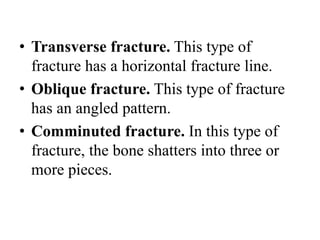
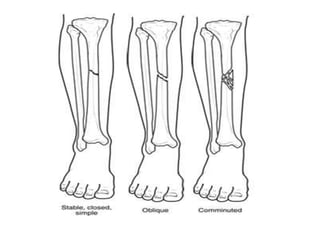
• Transverse fracture. This type of
fracture has a horizontal fracture line.
• Oblique fracture. This type of fracture
has an angled pattern.
• Comminuted fracture. In this type of
fracture, the bone shatters into three or
more pieces.
FRACTURE HEALING
• A broken bone is called a fracture. In order for
a fracture to heal, the bones must be held in
the correct position and protected.
• Soon after a fracture occurs, the body acts to
protect the injured area, and forms a
protective blood clot and callus around the
fracture.
• New "threads" of bone cells start to grow
on both sides of the fracture line. These
threads grow toward each other.
• The fracture closes and the callus is
absorbed. Depending upon the type of
fracture, this healing process may take up
to a year.
• Fracture healing is a natural process that
occurs following any fracture. It is a normal
pathobiological process, that can be
supported by various treatment options.
• Healing of a fracture is defined as the
restoration of mechanical stability, continuity
and normal load carrying capacity of a broken
bone. The healing process must be monitored
by x-ray controls at regular intervals to detect
any abnormalities.
NORMAL FRACTURE HEALING
For normal fracture healing to occur a number
of requirements must be met:
• Viabilty of fragments (intact blood supply)
• Mechanical rest (this can be achieved by not
moving, external immobilisation (e.g. cast) or
internal fixation)
• Absence of infection
The process of healing is different
depending on the configuration of the
fracture fragments and can be divided
into three main categories:
• Spontaneous (indirect / secondary)
healing
• Contact (angiogenic, primary) healing
• Gap healing.
1 SPONTANEOUS (INDIRECT,
SECONDARY) HEALING
• This is the most common 'natural' healing
process, whereby the fracture ends are
close to each other, with intervening
haematoma and variable displacement /
angulation.
• Though the healing process of a fracture
can be divided into various phases, it
should rather be understood as a
biological continuum. The periosteum,
endosteum, and Haversian canals are the
sources of pluripotent mesenchymal cells,
that initiate the formation of the healing
tissues (three blastema theory). The
bridging callus seen on radiographs
mainly arises from the periosteum.
THE PROCESS OF FRACTURE HEALING
• The fracture haematoma initiates the healing
response. Within 48 hours, chemotaxic
signaling mechanisms attract the
inflammation cells necessary to promote the
healing process.
• Within 7-14 days, granulation tissue is formed
between the fragments, leading to
vascularisation of the haematoma. On
radiographs, there may be increased
translucency of the fracture during this stage,
due to bone reabsorption.
• Eventually, remodeling of the bone takes
place, restoring its normal cortical
structure depending on load distribution.
This is an ongoing process that may last
for several years. In children, remodeling
occurs faster than in older people and
may compensate malunion to some
degree.
Average healing times of common
fractures
• fingers : 3 weeks
• metacarpals : 4 - 6 weeks
• distal radius : 4 - 6 weeks
• lower arm : 8 - 10 weeks
• humerus : 6 - 8 weeks
• femoral neck : 12 weeks
• femoral shaft : 12 weeks
• tibia : 10 weeks
2 CONTACT (ANGIOGENIC, PRIMARY)
HEALING
• Contact healing occurs between adapted
fragments when there is less than 0.1 mm
distance and neutralisation of
interfragmentary strain. This is the aim of
stable internal fixation. The process is
initiated by osteoclasts forming cutting
cones, that traverse the fracture line at 50-
100 µm/d.
• They are accompanied by capillaries and
osteoblasts, that form lamellar bone
primarily oriented in the right direction
(Haversian remodeling). In a stable
osteosynthesis, there should be no
formation of periosteal callus. Else, this
must be regarded as a sign of instability
(irritation callus).
3. GAP HEALING
• If internal fixation leaves a gap between
fragments of even less then 1 mm,
lamellar bone is at first deposited
perpendicular to the long axis. Haversian
remodeling doesn't start until the gap has
been filled by this process.
DISTURBED FRACTURE HEALING
Normal fracture healing can be disrupted in
numerous ways:
• delayed union
– fracture healing takes about twice as long as
expected for a specific location
• non-union (pseudarthrosis)
– fracture healing does not occur within 6-9 months
– predilection sites: scaphoid bone, femoral neck,
tibial shaft.
• malunion
– healing in the wrong position
– can be compensated to a certain degree by
remodeling of the bone (except for rotational
malunion).
• refracturing
– as a rule of the thumb, fixation material should be
removed within about 18 months after
consolidation of the fracture
– leaving it in place may lead to cortical atrophy and
a higher risk of refracturing

5.Fractures (Broken Bones).ppt

  • 1.
  • 2.
    DIFINITION • A fractureis a broken bone. A bone may be completely fractured or partially fractured in any number of ways (crosswise, lengthwise, in multiple pieces).
  • 3.
    Types of Fractures Commontypes of fractures include: • Stable fracture. The broken ends of the bone line up and are barely out of place. • Open, compound fracture. The skin may be pierced by the bone or by a blow that breaks the skin at the time of the fracture. The bone may or may not be visible in the wound.
  • 4.
    • Transverse fracture.This type of fracture has a horizontal fracture line. • Oblique fracture. This type of fracture has an angled pattern. • Comminuted fracture. In this type of fracture, the bone shatters into three or more pieces.
  • 6.
    FRACTURE HEALING • Abroken bone is called a fracture. In order for a fracture to heal, the bones must be held in the correct position and protected. • Soon after a fracture occurs, the body acts to protect the injured area, and forms a protective blood clot and callus around the fracture.
  • 7.
    • New "threads"of bone cells start to grow on both sides of the fracture line. These threads grow toward each other. • The fracture closes and the callus is absorbed. Depending upon the type of fracture, this healing process may take up to a year.
  • 8.
    • Fracture healingis a natural process that occurs following any fracture. It is a normal pathobiological process, that can be supported by various treatment options. • Healing of a fracture is defined as the restoration of mechanical stability, continuity and normal load carrying capacity of a broken bone. The healing process must be monitored by x-ray controls at regular intervals to detect any abnormalities.
  • 9.
    NORMAL FRACTURE HEALING Fornormal fracture healing to occur a number of requirements must be met: • Viabilty of fragments (intact blood supply) • Mechanical rest (this can be achieved by not moving, external immobilisation (e.g. cast) or internal fixation) • Absence of infection
  • 10.
    The process ofhealing is different depending on the configuration of the fracture fragments and can be divided into three main categories: • Spontaneous (indirect / secondary) healing • Contact (angiogenic, primary) healing • Gap healing.
  • 11.
    1 SPONTANEOUS (INDIRECT, SECONDARY)HEALING • This is the most common 'natural' healing process, whereby the fracture ends are close to each other, with intervening haematoma and variable displacement / angulation.
  • 12.
    • Though thehealing process of a fracture can be divided into various phases, it should rather be understood as a biological continuum. The periosteum, endosteum, and Haversian canals are the sources of pluripotent mesenchymal cells, that initiate the formation of the healing tissues (three blastema theory). The bridging callus seen on radiographs mainly arises from the periosteum.
  • 13.
    THE PROCESS OFFRACTURE HEALING • The fracture haematoma initiates the healing response. Within 48 hours, chemotaxic signaling mechanisms attract the inflammation cells necessary to promote the healing process. • Within 7-14 days, granulation tissue is formed between the fragments, leading to vascularisation of the haematoma. On radiographs, there may be increased translucency of the fracture during this stage, due to bone reabsorption.
  • 14.
    • Eventually, remodelingof the bone takes place, restoring its normal cortical structure depending on load distribution. This is an ongoing process that may last for several years. In children, remodeling occurs faster than in older people and may compensate malunion to some degree.
  • 15.
    Average healing timesof common fractures • fingers : 3 weeks • metacarpals : 4 - 6 weeks • distal radius : 4 - 6 weeks • lower arm : 8 - 10 weeks • humerus : 6 - 8 weeks • femoral neck : 12 weeks • femoral shaft : 12 weeks • tibia : 10 weeks
  • 16.
    2 CONTACT (ANGIOGENIC,PRIMARY) HEALING • Contact healing occurs between adapted fragments when there is less than 0.1 mm distance and neutralisation of interfragmentary strain. This is the aim of stable internal fixation. The process is initiated by osteoclasts forming cutting cones, that traverse the fracture line at 50- 100 µm/d.
  • 17.
    • They areaccompanied by capillaries and osteoblasts, that form lamellar bone primarily oriented in the right direction (Haversian remodeling). In a stable osteosynthesis, there should be no formation of periosteal callus. Else, this must be regarded as a sign of instability (irritation callus).
  • 18.
    3. GAP HEALING •If internal fixation leaves a gap between fragments of even less then 1 mm, lamellar bone is at first deposited perpendicular to the long axis. Haversian remodeling doesn't start until the gap has been filled by this process.
  • 19.
    DISTURBED FRACTURE HEALING Normalfracture healing can be disrupted in numerous ways: • delayed union – fracture healing takes about twice as long as expected for a specific location • non-union (pseudarthrosis) – fracture healing does not occur within 6-9 months – predilection sites: scaphoid bone, femoral neck, tibial shaft.
  • 20.
    • malunion – healingin the wrong position – can be compensated to a certain degree by remodeling of the bone (except for rotational malunion). • refracturing – as a rule of the thumb, fixation material should be removed within about 18 months after consolidation of the fracture – leaving it in place may lead to cortical atrophy and a higher risk of refracturing