LEXIS Chapter 2:  Describing the English Language.  Harmer (2007) Power Point prepared by  Prof. Estela and Liliana Monserrat, UNLPam. Facultad de Cs. Humanas Departamento de Lenguas Extranjeras
LEXIS:  Vocabulary of a language Word meaning Metaphors and idioms Collocations Lexical phrases
Word Meaning Problem of  polysemy ,  the same word can have many different meanings. It can be resolved by seeing the word in  context.
A word in relation to others ANTONYMS:  empty/full SYNONYMS:  dear/expensive/costly, slight changs of meaning: Semantic fields:  see, watch, glance peer, stare. HYPONYMY:  Superordinate (fruit), hyponyms (orange, pear, peach, strawberry) CONNOTATION:  Dont’ be  cheecky!
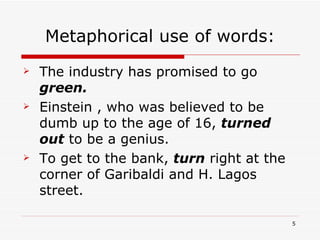
Metaphorical use of words: The industry has promised to go  green. Einstein , who was believed to be dumb up to the age of 16,   turned out   to be a genius. To get to the bank,  turn  right at the corner of Garibaldi and H. Lagos street.
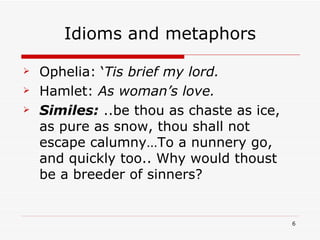
Idioms and metaphors Ophelia: ‘ Tis brief my lord. Hamlet:  As woman’s love. Similes:   ..be thou as chaste as ice, as pure as snow, thou shall not escape calumny…To a nunnery go, and quickly too.. Why would thoust be a breeder of sinners?
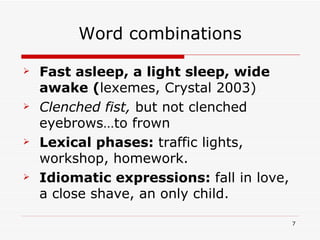
Word combinations Fast asleep, a light sleep, wide awake ( lexemes, Crystal 2003) Clenched fist,  but not clenched eyebrows…to frown  Lexical phases:  traffic lights, workshop, homework. Idiomatic expressions:  fall in love, a close shave, an only child.
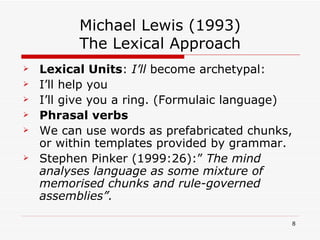
Michael Lewis (1993) The Lexical Approach Lexical Units :  I’ll  become archetypal: I’ll help you I’ll give you a ring. (Formulaic language) Phrasal verbs We can use words as prefabricated chunks, or within templates provided by grammar. Stephen Pinker (1999:26):”  The mind analyses language as some mixture of memorised chunks and rule-governed assemblies”.
Bibliography Harmer J. (2007)  The Practice of the English Language , Pearson Longman

Lexis

  • 1.
    LEXIS Chapter 2: Describing the English Language. Harmer (2007) Power Point prepared by Prof. Estela and Liliana Monserrat, UNLPam. Facultad de Cs. Humanas Departamento de Lenguas Extranjeras
  • 2.
    LEXIS: Vocabularyof a language Word meaning Metaphors and idioms Collocations Lexical phrases
  • 3.
    Word Meaning Problemof polysemy , the same word can have many different meanings. It can be resolved by seeing the word in context.
  • 4.
    A word inrelation to others ANTONYMS: empty/full SYNONYMS: dear/expensive/costly, slight changs of meaning: Semantic fields: see, watch, glance peer, stare. HYPONYMY: Superordinate (fruit), hyponyms (orange, pear, peach, strawberry) CONNOTATION: Dont’ be cheecky!
  • 5.
    Metaphorical use ofwords: The industry has promised to go green. Einstein , who was believed to be dumb up to the age of 16, turned out to be a genius. To get to the bank, turn right at the corner of Garibaldi and H. Lagos street.
  • 6.
    Idioms and metaphorsOphelia: ‘ Tis brief my lord. Hamlet: As woman’s love. Similes: ..be thou as chaste as ice, as pure as snow, thou shall not escape calumny…To a nunnery go, and quickly too.. Why would thoust be a breeder of sinners?
  • 7.
    Word combinations Fastasleep, a light sleep, wide awake ( lexemes, Crystal 2003) Clenched fist, but not clenched eyebrows…to frown Lexical phases: traffic lights, workshop, homework. Idiomatic expressions: fall in love, a close shave, an only child.
  • 8.
    Michael Lewis (1993)The Lexical Approach Lexical Units : I’ll become archetypal: I’ll help you I’ll give you a ring. (Formulaic language) Phrasal verbs We can use words as prefabricated chunks, or within templates provided by grammar. Stephen Pinker (1999:26):” The mind analyses language as some mixture of memorised chunks and rule-governed assemblies”.
  • 9.
    Bibliography Harmer J.(2007) The Practice of the English Language , Pearson Longman